It’s dangerous! Films reviewed: Daniela Forever, Apocalypse in the Tropics, We Were Dangerous
Hi, this is Daniel Garber at the Movies for culturalmining.com and CIUT 89.5 FM.
Guillermo del Toro, the celebrated director who splits his time between Mexico and Canada, has curated a series of classic Canadian horror movies called From Rabid to Skinamarink: Canadian Movie Madness, playing at the TIFF Lightbox this weekend. I happen to have seen everyone of them myself, and I totally agree with del Toro’s selection. You can catch Canadian gems like the feminist werewolf drama Ginger Snaps, Vincenzo Natali’s cult-hit Cube, Kyle Edward Ball’s experimental Skinamarink, and many more.
But this week, I’m looking at three new movies from abroad: a surreal fantasy from Spain, a politically documentary from Brazil, and a period drama from New Zealand.
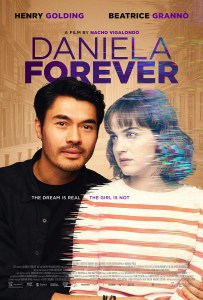 Daniela Forever
Wri/Dir: Nacho Vigalondo
It’s present-day Madrid. Nicolas (Henry Golding: Crazy Rich Asians) is a popular DJ at the city’s hottest nightclubs. But he is thrown into a deep depression when his girlfriend, an artist named Daniela (Beatrice Grannò: The White Lotus) is killed by a negligent driver just outside his home. But things take a turn for the better when a good friend of his, Victoria (Nathalie Poza), tells him of a new, experimental drug that might be just what he needs. But it’s top secret, filled with non-disclosure clauses, and requires regular visits to the pharmaceutical labs. The scientists there tell him each pill, if taken just before bed, will produce lucid dreams, real visions where he can control the content and won’t forget about them when he wakes up. This means he can bring Daniela back to life, at least while he sleeps. But he soon discovers its limitations: he can’t dream about something he’s never seen. If he turns down an ally he’s never visited, it will be covered in unformed, writhing grey matter. Kinda creepy.
Daniela seems artificial at first, but as time progresses, she starts turning real. She even produces creative ideas and thoughts that he doesn’t remember ever experiencing in the awake world. And far from seeming etherial, his lucid dreams are now wide- screen images in living colour, while awake 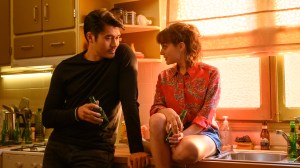 time is small and drab. He can take Daniela to new places just by thinking about them and opening a door, and change the city of Madrid into something out of one of her paintings. But he soon realizes, not everything is going the way he planned. And when things from his dream world start appearing in awake time, he has to wonder what is real? Can he be in love with someone who doesn’t exist? And can she ever really love him if she’s just a figure of his imagination?
Forever Daniela is a highly- creative science fiction romance about love, death and reality. While it sounds like a Black Mirror jump-scare thriller, it actually avoids most “bad” things except for the sadness of mourning. It also has a very surprising twist at the end (no spoilers). The film is Spanish, but most of the dialogue is in English. Henry Golding (Crazy Rich Asians) is appealing as the leading man, but runs into a bit of acting trouble when he tries to do a full-fledged meltdown. The special effects are excellent, fooling around with unusual concepts like daytime light and shadows in a nighttime environment. I quite like the writer/director Nacho Vigalondo
for the way he incorporates horror movie elements within an otherwise realistic context (like his film Colossal a few years ago.) So if you’re looking for something that’s surreal and supernatural but told in a positive, though bittersweet, way, I think you’ll like Daniela Forever.
 Apocalypse in the Tropics
Wri/Dir: Petra Costa
Brasilia — a capital city designed, planned and built from the ground up — was meant to be modern, secular and democratic. But after a coup-d’etat in 1964, Brazil became something other than democratic: a military dictatorship which ruled for the next two decades. So when a new, populist right-wing leader with military ties emerged in the 2010s, many Brazilians were wary of democracy falling again. But Jair Bolsonaro was different, a politician who changed his power base when he forged ties with evangelical Christians.
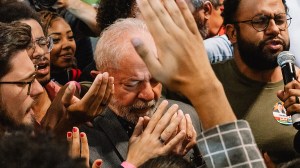
Apocalypse in the Tropics traces Brazilian politics over the past decade and the rise in religion within government policies. It also gives background, from the building of the capital, through the military coup, American evangelist Billy Graham, the return to democracy, and more recent developments. It uses beautiful period footage, lush music and symbolic paintings — like Hieronymus Bosch’s Garden of Earthly Delights — as a metaphoric portrayal of millenarian changes in Brazilian politics. It is narrated by the filmmaker and includes her one-on-one interviews with Bolsonaro, current President Luiz Inácio Lula da Silva, and the wildly popular televangelist, Silas Malafaia, who served as 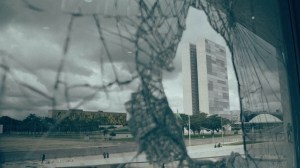 Bolsonaro’s right-hand man. We witness Malafaia’s sermons before huge crowds — shouting his opposition to same-sex marriage, abortion rights, and feminism — as well as intimate conversations aboard his private plane. The doc also shows new footage of the beloved capital Brazilia occupied and trashed by massive demonstrators, who called for a coup after Bolsonaro’s defeat.
Apocalypse in the Tropics is a follow-up to Petra Costa’s 2019 film The Edge of Democracy with similar footage, style, and topic but concentrating this time on religion’s role in government policies. I’m not sure if this is a sequel, a reshoot or a continuation, but either way, it’s as aesthetically beautiful as it is disturbing.
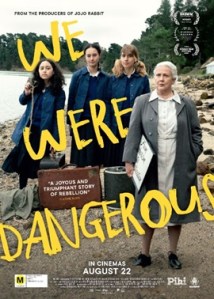 We Were Dangerous
Wri/Dir Josephine Stewart-Te Whiu
It’s the 1950s on a small island somewhere off the coast of New Zealand, where three girls share a cabin: Daisy, Nelly and Lou (Manaia Hall, Erana James, and Nathalie Morris). They were sent there by the authorities or their parents. Te Motu is a school for “incorrigible” girls or, as the administrators call them, “whores, queers, delinquents and sexual deviants.” Many are orphans or runaways caught stealing food, like Daisy or Nelly. Lou is the exception. She comes from a rich family but was caught making out with her (female) tutor. The school operates under the strict rule of Matron (Rima Te Wiata), who has a cruel streak a mile long. Raised by nuns, she feels the only way to cure these girls’ bad attitudes is through the bible and the lash. Naturally the girls all want to get the hell out of there, but it’s hard to escape from an isolated island in the south pacific. The purpose of the school is to turn bad girls into happy homemakers. They are given lessons in diction and manners but not reading or math.  Matron is frustrated by their outcome: She says they are “too stupid for school, to uncivilized to be maids and too barbaric to work”. Every so often, Matron is visited by men in suits from the mainland, one of whom suggests a horrifying treatment. But when Nelly find out, the three girls decide they have to do something to stop it.
We Were Dangerous is a moving, coming-of-age story about girls surviving in 1950s New Zealand. It’s bright and exuberant, full of playfulness and dancing, Haka and history, and though fictional, it tackles the very real issue of the mistreatment of indigenous girls. The acting is excellent all around, full of subtle clues and delightful details. For a first film, Stewart-Te Whiu avoids many potential stumbles and instead gives us a solid film that’s fun to watch. It played at ImagineNative this year, and is definitely worth seeing.
Apocalypse in the Tropics is playing this weekend at HotDocs and will be streaming on Netflix this coming week; Daniela Forever opens this weekend in Toronto; check your local listings; and We Were Dangerous is available now on VOD.
This is Daniel Garber at the Movies, each Saturday morning, on CIUT 89.5 FM and on my website culturalmining.com.
Daniel Garber talks with Toshiaki Aoyagi about Cinema Kabuki
 Hi, this is Daniel Garber at the Movies for culturalmining.com and CIUT 89.5 FM.
When you hear the word “kabuki”, you’re probably familiar with what it looks like, perhaps the costumes and makeup, or its movement. You might think it’s complex, performative or inscrutable. But it’s actually a living and breathing performance art form, a medium still practiced and popular. But, unless you’ve been to Japan, you’ve probably never seen a performance of a kabuki play. Well, now’s your chance.
Cinema Kabuki is a series of three kabuki plays filmed for the big screen, starring some of its biggest stars. They are full of love, romance, tragedy and glory. The first is the salacious-sounding Love Letters from the Pleasure Quarters; the second show is Princess  Sakurahime, Part I, full of death, tragedy, lust and a fair bit of supernatural LGBT content; and the third performance is Lion Dance, Kagami-jishi, a one-man, or one-animal performance.
The series is co-presented by the Japan Foundation and the Consulate General of Japan in Toronto and programmed
by their program officer Toshi Aoyagi, known for his love of the arts, from origami to performing art. This is a rare opportunity to see kabuki in a Toronto theatre.
I spoke with Toshiaki Aoyagi in person at CIUT 89.5 FM.
The films are playing at the TIFF Lightbox in Toronto on Sunday, February 23rd, from 1 pm until the evening.
Daniel Garber talks with Gillian McKercher about her film Lucky Star premiering at ReelAsian
 Hi, this is Daniel Garber at the Movies for culturalmining.com and CIUT 89.5 FM.
It’s a snowy December in Calgary, Alberta, and the Lee family is preparing for Christmas. Both parents run small businesses; Lucky, the dad, has a small electronic repair shop while Noel, the mom, tailors made-to-measure mens’ suits. Their older daughter Grace is on the verge of becoming the family’s first professional, while their youngest is still a pre-teen. But when Lucky gets a call from Revenue Canada demanding his back taxes, he springs into action, digging up all his savings with a quickie loan to pay the difference. When he  discovers all his money went to a con artist, he is mortified by his own mistake. But this is not his first brush with financial ruin; Lucky has a dark history as a compulsive poker player. Should he come clean to his family? Or will a deck of cards be Lucky’s Lucky Star?
Lucky Star is also the name of a new Canadian drama set within Calgary’s close-knit Chinese community. It’s a complex, multi-layered story full of secrets and lies, suspense and suspicion. The film is writer/director Gillian McKercher’s second feature, and she’s a rising star herself, after a residency at the Canadian Film Centre and on Playback’s Top 10 To Watch for 2024.
I spoke with Gillian McKercher in Calgary, Alberta, via ZOOM from Toronto. Gillian talked about her film, the prairies, winter, history, second-generation diaspora, playing poker… and more!
Lucky Star had its Toronto premiere at the TIFF Lightbox as part of the ReelAsian Film Festival.
Daniel Garber talks with Neil Diamond and Catherine Bainbridge about Red Fever
 Hi, this is Daniel Garber at the Movies for culturalmining.com and CIUT 89.5 FM.
Photos by Jeff Harris.
What do a feathered headdress on the cover of Vogue, a 70s pop video by Cher, and the gesture used by fans of the Kansas City chiefs have in common? They’re all about the world’s obsession with North American indigenous culture and how it’s been appropriated by the mainstream for fun and profit. And it’s used and misused everywhere, in Europe, North America — even in Asian culture — but with little or no attributions or compensation ever given to the people who originated them. What’s wrong with this, how  can it be corrected, and what is the cause of Red Fever?
Red Fever is a punchy new documentary that takes a look at cultural appropriation of indigenous art, religion, customs, and their bodies and faces within the mainstream of art, fashion, sports, entertainment, and even democracy. Using fast-moving historical footage, photos and music, it brings us back to the largely unrecognized origins of many aspects of our daily lives. It’s seen through the eyes of  Cree filmmaker Neil Diamond who guides us across oceans and continents, as he confronts, in a humorous way. Neil Diamond is known for Reel Injun, The Last Explorer and One More River. It’s co-directed by Catherine Bainbridge, a Canadian writer, producer and director who co-founded the award-winning indigenous production company Rezolution Pictures, and is best known for co-directing the award doc Rumble: The Indians Who Rocked the World.
I spoke with Neil and Catherine in person, in Toronto during Hot Docs.
Red Fever opens in Toronto on June 14th, 2024 at the TIFF Lightbox.
Road movies. Io Capitano, Ordinary Angels, Drive Away Dolls
Hi, this is Daniel Garber at the Movies for culturalmining.com and CIUT 89.5 FM.
The road from the festival circuit to your local cinema is a slow and tortuous one. I reviewed Meredith Hana-Brown’s Seagrass — a moving drama about a young couple and their daughters at an island retreat in BC — five months ago, but it’s finally hitting theatres this weekend — check it out! (Review here).
So, in recognition of that long and twisted path, this week I’m looking at three new road movies. There’s two lesbians in their twenties driving south from Philly, two teenaged boys travelling across the Sahara desert from Dakar, and a middle-aged hairdresser trying to get a little girl to a far-off hospital in time for a transplant.
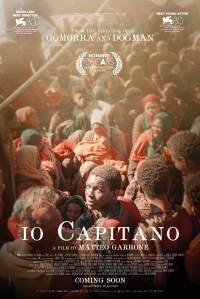 Io Capitano
Co-Wri/Dir: Matteo Garrone
It’s present-day in Dakar, Senegal. Seydou (Seydou Sarr) is a 16-year-old student who works part time as a builder. With his best friend Moussa (Moustapha Fall) they’re saving money for a major purchase. Their goal? To travel to Europe to make it big as singer-songwriters. But though Seydou’s mother and others object — People die at sea! Europe is not like what they show on TV — the two boys sneak out one night, and head off on their journey. They buy their tickets for a long trip across the Sahara, via Mali and Niger to Tripoli, Libya, and from their on to Europe. They are promised modern new trucks to whiz them there. But they soon discover, the world is full of thieves, swindlers, and worse. They are forced to pay bribes to cross borders. Anyone who falls out of the rusty flatbed trucks is left behind to die. They are set upon by cruel bandits, separating the boys, with Seydou sent to a prison run by the Libyan Mafia. Inmates are subject to extortion and torture. And those who survive are sold into de facto slavery. But, somehow, Seydou makes it to Tripoli. Now he has to find Moussa, and get a boat to take them to Italy. But what will the future bring?
Io Capitano is a powerful, heartfelt drama about two young 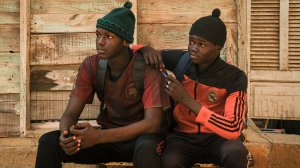 migrants trying to reach Europe. Seydou is a heroic figure who gradually matures from boy to man to leader. (The title means I am the Captain.) Garrone, as in most of his films (Reviews: Dogman, Reality, Gomorrah), again casts first-time actors in the main roles, giving the movie a hyper-realistic feel. Seydou, for one, is amazing, totally believable. And lest you think this is a gruelling journey, it is also filled with music, dance and magical fantasies that appear in Seydou’s mind.
Io Capitano is an uplifting and heroic story.
 Ordinary Angels
Co-Wri/Dir: Jon Gunn (Writer/Producer: I Still Believe, American Underdog, Jesus Revolution)
It’s the 1990s in Louisville, Kentucky. Sharon (Hilary Swank) is a hair stylist who owns a beauty parlour. She’s known for her sparkling skirts, fringed leather jackets, and her long, curly hair with frosted tips. She likes getting drunk at roadhouses and dancing on the bar. But her best friend and coworker Rose (Tamala Jones), sees trouble ahead if she doesn’t stop drinking. Clearly, Sharon needs something — a lover, a religion, or a cause — to devote herself to. But her first marriage was a bomb (her adult son won’t even talk with her), and going to church isn’t her thing. But when she spots a local newspaper headline — Man’s wife dies, his 5-year-old daughter is suffering from a rare illness — she decides to do something about it. She starts raising funds at the hair salon, and spreading awareness of this family’s plight. Ed Schmitt (Alan Ritchson) is a simple roofer in debt half a million bucks, and his daughter Michelle (Emily Mitchell) needs expensive treatment. Sharon starts giving him envelopes of cash she raises, but he doesn’t feel comfortable. Why is this strange alcoholic woman giving him money?
But the kids and Ed’s mom take to Sharon like bees to honey.  She helps him balance his books, and raises money from the bigwigs in Louisville. Soon everyone knows about Michelle’s plight. But when the big day comes for a liver transplant, the city is closed down by a freak snowstorm. And the hospital is halfway across the country. Are Sharon — and the community’s — wits and determination be enough to save a dying girl?
Ordinary Angels is an uplifting, non-preachy faith-based drama about an ordinary woman trying to change the world. It feels a bit manipulative at times, with gushing music, and twinkling stars overhead . Ed barely talks — he’s the strong, silent type, just yes ma’am, no ma’am — and little dying Michelle is way too cute. Luckily, Hilary Swank is just great as the indefatigable Sharon, a woman who won’t take “no” for an answer. Yeah, the movie is a little bit forced and a little too long, but it also tugs your heart-strings in just the right places. And it’s great seeing a large group of people working together in an attempt to save a life. (It’s based on a true story.)
So if you like tear-jerkers, this one is a two-hankie classic, one that’ll leave you crying, for sure.
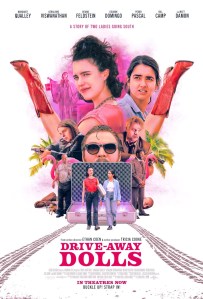 Drive Away Dolls
Co-Wri/Dir: Ethan Coen
It’s 1999 in Philadelphia.
Jamie and Marion are best friends, but couldn’t be more different. Jamie (Margaret Qualley) has a southern drawl and a wild-at-heart attitude. She’s always up for a roll in the hay with any chick she meets in a lesbian bar. Marian (Geraldine Vishvanathan) is reserved and uptight, stuck in a futureless, cubicle office job. But when Jamie’s long-time girlfriend Sukie (Beanie Feldstein) catches her cheating in their own apartment, she goes ballistic. Sukie is a hot-headed cop and Jamie knows when it’s time to skedaddle. So she decides to go for a drive home to Tallahassee with Marian as her co-pilot. Luckily, Jamie knows about a great deal at Drive Away autos — they deliver the car to Tallahassee and they get the ride for free. What they don’t know, is they’re driving the wrong car, carrying unexpected cargo in the trunk: a metal suitcase… and a human head!
You see, that metal suitcase contains something of crucial importance to someone with a lot of power, and a gang of ruthless men want it back. And they’re racing down the highway trying to catch up with  Jamie and Marion and take back the suitcase. But the clueless pair are taking their own sweet time, with Jamie smoking pot and meeting up with nubile soccer players in honky-tonk bars and sleazy motel rooms on the way, while Marion has to deal with over-zealous redneck sheriffs. But the criminals are steadily getting closer, and who knows what will happen if they meet. What’s in the metal suitcase? Can Jamie and Marion stay friends? And is there something deeper going on between them?
Drive Away Dolls is an unapologetic B-movie, a non-stop comedy-thriller about lesbians on the road. It’s full of wanton sex and gratuitous violence, though nothing overly explicit. It also features cameos by A-listers like Matt Damon, Pedro Pascal and Colman Domingo. And it’s all strangely interspersed with vintage, psychedelic soft-core hippy-porn, (its meaning only revealed at the end). This is like a Coen Brothers movie, but no Joel. Instead Ethan is paired with longtime film-editor (and wife) Tricia Cooke who also co-directed and cowrote it, apparently based on her own salad days. It’s great raunchy fun. The only thing that puzzles me is, in a movie that’s all about lesbians, why does the trailers completely hide that fact? (Not to mention changing the title from Drive Away Dykes to Drive Away Dolls.) But I guess you have to sell a movie to a broader audience or you won’t get the crowds.
Either way, I really enjoyed this one.
Io Capitano is now playing at the TIFF Lightbox; with Drive Away Dolls and Ordinary Angels both opening theatrically this weekend in Toronto; check your local listings.
This is Daniel Garber at the Movies, each Saturday morning, on CIUT 89.5 FM and on my website culturalmining.com.
 culturalmining.com
leave a comment