When to stop. Films reviewed: Friendship, Hurry up Tomorrow, The Old Woman with the Knife
Hi, this is Daniel Garber at the Movies for culturalmining.com and CIUT 89.5 FM.
This week, I’m looking at three new movies — an action thriller, a dark comedy, and a fictional music biopic — all about people who don’t know when to stop. There’s a middle-aged dad looking for a friend, a super-fan looking for the object of her obsession; and an elderly hitman in her declining years who refuses to retire.
Friendship
Wri/Dir: Andrew DeYoung
Craig (Tim Robinson) is an ordinary guy in the suburbs who works at a tech communications firm. He’s geeky and boorish with marginal social skills. He spends time with his wife Katie (Kate Mara) who is in remission and their teenaged son Steven (Jack Dylan Grazer). He likes watching TV or for a real treat ordering the dinner specials at his favourite chain restaurant. But everything changes one day when a package is delivered to his house by mistake. He carries it over, rings the bell, and meets his neighbour for the first time. Austin (Paul Rudd) is everything Craig is not. He’s suave, handsome and self-confident. He’s even a minor celebrity as the weatherman on the local TV station.
And he smiles at Craig. Wow… Craig is ensorcelled. And when Austin takes him under his wing for an adventure in the woods, he is absolutely thrilled. A real friend! But the bromance is short-lived, when he makes a number of unforgivable faux pas at a get together with Austin’s entourage. He’s cancelled and so is their friendship. But Craig refuses to accept it, and vows to do anything to get Austin back. And as his obsession grows so does his hazardous behaviour. Is Craig a stalker or just an unrequited friend. And how far is too far?
Friendship is a very dark and very funny comedy about adult male friendships. Tim Robinson — best known for his show I
Think You Should Leave — is famous for his uncomfortable style of humour. This is comedy that makes you squirm, cringe or look away. You can see the results of his terrible mistakes coming a mile away but there’s you can do to stop it and it’s still painfully funny. Paul Rudd is good as his “straight man” but this is all about Tim Robinson.
I haven’t laughed this hard or this often at a comedy movie in at least six months.
Hurry up Tomorrow
Co-Wri/Dir: Trey Edward Shults
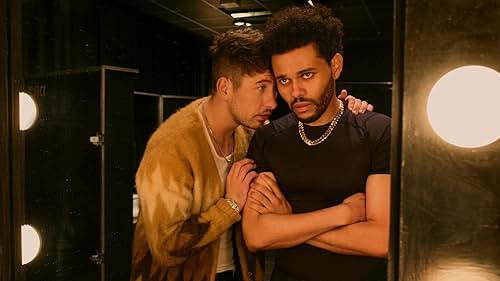
It’s the green room of a huge concert hall. The Weeknd (Toronto musician Abel Tesfaye) is a superstar in the midst of an exhausting world tour. He depends on his mellifluous voice to perform the songs his fans come to see. But he’s tense tonight and his throat is contracting. He’s upset with a voicemail from a woman he knows who recents his selfish and cold behaviour. Now plagued with self-doubt, he doesn’t feel up to performing. But his ever-present manager (Barry Keoghan) convinces him — through a combination of confidence-building words plus copious drugs and alcohol — that he owes it to his fans. But once on stage his voice fails him in the middle of a song and he runs off in disgrace.
There he collides with a super-fan who somehow got past bouncers and security. Anima (Jenna Ortega) offers words of love and comfort. They spend an enchanted day together far from his source of stress. But the next morning brings unanticipated and perilous consequences. Can The Weeknd return to his tour as of that day never happened?
Hurry Up Tomorrow is a complex but deeply flawed look at one day in the life of a singer on his world tour. The story is told at least four times through elliptical points of view. Anima sees herself as The Weeknd’s soulmate who only she can understand. But she is portrayed by the neutral camera as a deranged sadistic arsonist determined to erase her past problems by burning them down — literally. Ortega is allowed to run wild here. Keoghan as his manager sees himself as his best bud, almost his brother, the only one who can save The Weeknd from self-destruction (there are countless shots of him gazing longingly into his eyes.) Neutral camera? A sleazy, mercenary drug dealer. Then there’s the star himself. His mind drifts into hallucinatory depictions from deep in his psyche conveying, paranoia, claustrophobia and childlike helplessness. Neutral camera? A self-obsessed narcissist. So watching it with all these different points of view floating around, it’s hard to tell what’s real and what is a fantasy. Are the frequent tear-filled eyes actual or in one of their
imaginations? I’ve seen director Trey Edward Shults’s features It Comes at Night and Waves, both excellent movies — he’s highly skilled, but this one seems more muddy with less of an identifiable narrative. And it starts with a shockingly inappropriate music video… why? Why? On the other hand, the references to Stephen King movies like The Shining and Misery are much more interesting.
I’m glad I watched Hurry Up Tomorrow, but I wish it were a bit better.
The Old Woman with the Knife
Co-Wri/Dir: Min Kyu-dong
It’s winter in Seoul in the 1970s. A starving young woman, barefoot and dressed in rags is desperately searching for food in the drifting snow like The Little Match Girl. A kindly couple save her life by inviting her into their tiny diner for a meal, and later take her on as a dishwasher in exchange for room and board. But her relatively stable new life is shattered one night when she is cornered by an American GI in the cafe’s kitchen. She manages to fight off his sexual advances until he turns violent and starts to choke her to death with his barehands. In desperation, she grabs a nearby knife and stabs him. He dies. This is witnessed by a man named Ryu (Kim Mu-yeol) who invites her to join a secret organization that specializes in pest control. That’s their euphemism for the murderers, rapists and torturers, the scum of the earth, whom they are hired to kill.
Fifty years later and she’s still at it. Now known as Hornclaw (Lee Hye-yeong), she’s the hitman with the best reputation in the business. No one suspects an unassuming old woman — she can get away from any murder scene without anyone noticing. But she’s showing compassion — a complete taboo in the business — for a stray dog she finds. Her doctor is telling her to slow down, and her boss wants her to retire. Hornclaw, retire? Nevah!
But things really start to change when a brash newcomer
walks in. Bullfight (Kim Sung-cheol) doesn’t know the codes or rules, he just plays it by ear. He’s violent fearless and will stop at nothing to get her out of his way. Can he usurp her seat on the throne? And what grudge does he hold against his rival?
The Old Woman with the Knife is an action thriller with an elderly woman as the protagonist. And if you think this is a Murder She Wrote with little handguns and stilettos you couldn’t be more wrong.
She’s tough as Helen Mirren, and can take down and slice up a room full of thugs singlehandedly. And since it’s a Korean action movie, you can bet there’s a melodramatic subplot and at least one character whose motivation is revenge. (No spoilers.)
I liked this movie a lot.
Friendship, Lady with the Knife and Hurry up Tomorrow all open in Toronto this weekend; check your local listings. This is Daniel Garber at the Movies, each Saturday morning, on CIUT 89.5 FM and on my website culturalmining.com.
Dangerous, exotic. Films reviewed: Sinners, Yadang: the Snitch, The Legend of the Ochi
Hi, this is Daniel Garber at the Movies for culturalmining.com and CIUT 89.5 FM.
Hotdocs International Documentary Film festival is on now in Toronto, with free daytime admission for students and seniors. So get out there and watch some docs!
But this week I’m looking at three new movies about unexpected dangers in exotic locales. There are vampires in the Mississippi Delta, snitches in the drug wars of South Korea, and elusive, sharp-toothed creatures on an island in Carpathia.
Sinners
Wri/Dir: Ryan Coogler
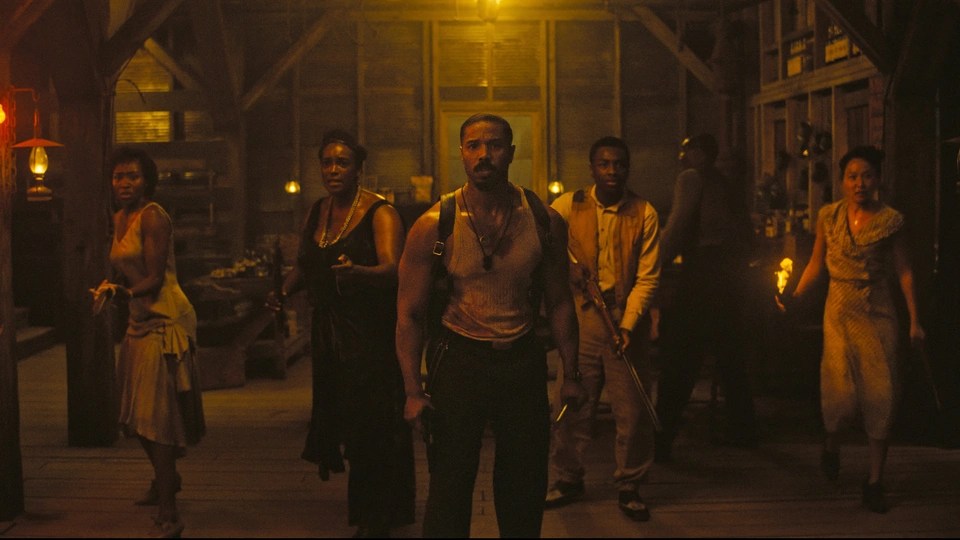
It’s 1932 in a small town in the Mississippi Delta. The Smokestack brothers aka Smoke and Stack (Michael B Jordan: The Fantastic Four, Chronicle) are identical twin who spent years making money working for the mob in Chicago. Now they’re back in town with a truck full of bootleg alcohol, a wad of cash and big ideas on how to make it rich. Namely, they’re opening a juke joint in an abandoned woodmill they bought from a local good ol’ boy. They’re rounding up the necessary musicians, like their cousin Sammie (Miles Caton), the preacher’s son, on blues guitar and Delta Slim (Delroy Lindo) on the piano and mouth organ. Bo and Grace Chow furnish the provisions and Cornbread minds the door. Even Smoke’s and Stack’s ex-partners show up: Mary (Hailee Steinfeld) a glamorous married woman who can pass for white, and Annie (Wunmi Mosaku) an experienced practitioner of Hoodoo. By sunset the place is hopping, the
customers are drinking and gambling, everything is going great, until… a mysterious, smiling stranger who loves Irish music (Jack O’Connell; Seberg, Unbroken, ’71, Starred Up ) appears at the door asking to be let in. They don’t know who he is but he just looks shifty. Turns out he’s a vampire who wants all their blood — not to wipe them out, just to turn everyone over to the dark side. But can the people on the inside keep the demons on the outside until the sun comes up in the morning?
The Sinners is a black history drama about life in the Jim Crow south in the 1930s combined with the action and horror of a conventional genre movie, that succeeds on both fronts. It’s rich in meticulous historical detail in the background: sharecroppers picking cotton in the same fields as their grandparents had as slaves, paid in company scrip not dollars; chain gangs on the highway; and the omnipresent KKK.
All this is counterposed with raunchy dialogue and the sexualized dancing and singing of the juke joint. Every character has a backstory, devoid of cookie-cutter cliches. The costumes, scenery and especially the music — from delta blues to Irish folk songs — evoke that period in a way only a movie can. The acting is superb, though I do wish Michael B Jordan made Smoke and Stack a little less identical. The vampires are more conventional. They still hate garlic, sunlight and stakes through the heart but interestingly these demons lose also racial prejudice once they become vampires. Put this all together and you end up with this amazing movie that’s multifaceted, educational and really fun to watch.
Yadang: The Snitch
Dir: Hwang Byeong-gug
It’s present-day Korea. Lee Kang-su (Kang Ha-neul) is a self-confident young man with a perpetual grin. Why does he swagger and show off his gold lighter? It’s because he’s always two steps ahead of anyone else. He’s a yadang, an informant, and plays a crucial role in the government’s war on drugs. But things weren’t always this way. He was incarcerated after being falsely accused of drug dealing, where he was beaten up and bullied on a daily basis. Until Ku Gwan-hee (Yoo Hai-jin) an ambitious prosecutor pulled him out of that world to be his personal Yadang. Now the two of them are pledged as eternal brothers, functioning like a well-oiled machine, pulling off repeated sting operations and arrests of drug kingpins and thugs across the country. Much to the chagrin of a police detective trying to arrest those same criminals. So Det. Oh Sang-jae (Park Hae-joon) a.k.a. the Jade Emperor of Narcotics Division, finds a Yadang of his own, a rising young actress (Chae Won-been) who is caught using illegal amphetamines as diet pills. Now the lines are drawn and the two sides — the prosecutors and the police — are in direct competition. But the Prosecutor, in his rapid rise to the top, has to make some uncomfortable political alliances, including a rich junkie named Cho Hoon, whose dad just happens to be running for President. Will Cho-hoon’s influence on the Prosecutors rise in power threaten the Yadang’s status and the delicate balance of that world?
Yadang: the Snitch is a Korean action-thriller about
crime, corruption, and the complex relationships among politicians, police and informants in the world of organized drug-crime. Fast moving and compelling, it maintains a frenetic pace throughout the film, with some flashbacks that last only a few seconds. It’s dizzying. It’s also quite violent, sometimes disturbingly so. Luckily, it has interesting characters and a clever plot with enough double- and triple-crosses to keep you guessing until the very end.
Yadang: The Snitch is an entertaining action flic.
The Legend of Ochi
Wri/Dir: Isaiah Saxon
Yuri (Helena Zengel) is a teenaged girl who lives with her dad and adopted brother, Petro. She likes reading library books and listening to loud music. Her farm is on a mountainous island in the Black Sea, off the coast of Romania, and though it’s decades since the fall of Ceausescu, people there still drive Ladas and keep to the old ways. Above all, they fear the Ochi, mythical beasts unique to their island who live in trees, attack sheep and kidnap children. Her Dad (Willem Dafoe) lives in constant fear of the Ochi. He leads a ragtag army of children to capture and kill the monsters… though they have never been successful. Her step-brother Petro (Finn Wolfhard) is a member too, though her rarely speaks. Yuri, on the other hand, is angry at her father and wonders why her mother (Emily Watson) abandoned her. (It’s the Ochi! says her dad.)
One day, when her father sends her out to do her rounds, she finds a small ochi with its paw caught in an animal trap. She frees him and takes him home in her knapsack. He looks like a blue-faced koala until he bares his teeth revealing long pointed fangs. But Yuri is not afraid, she nurses him back to health and eventually the two form an unexpected bond. But can she get him back to his homeland without her father finding out?
The Legend of Ochi is a highly-original adventure story about a young girl and the creature she befriends. It’s warm and delightful. While on the surface it’s a kids’ movie, the
sumptuous, painted scenery and retro feel makes it an instant cult classic. (Think ET, and Charlie and the Chocolate Factory.) It’s full of panpipes and medieval crusaders overladen with Soviet kitsch. Even the odd faces of the kids in the army are straight out of Dr Seuss. I’ve never heard of director Isaiah Saxon before, but I get the impression he’s been doodling pictures of Ochis since he was a little kid. And they are amazing: not cheap-ass CGI, but a combination of puppetry and animatronics that make them seem totally real in their own fantastical way.
I love this movie.
The Legend of the Ochi, Yadang: The Snitch and The Sinners all open this weekend in Toronto; check your local listings. This is Daniel Garber at the Movies, each Saturday morning, on CIUT 89.5 FM and on my website culturalmining.com.
Dangerous jobs? Movies reviewed: Love Hurts, Dark Nuns, Bring Them Down
Hi, this is Daniel Garber at the Movies for culturalmining.com and CIUT 89.5 FM.
Look at Me, a movie from Nova Scotia about an insecure, bisexual actor with an eating disorder, is finally opening in Toronto! In a review about year ago, I called it a “scathing — and humorous — self-examination that exposes Taylor Olsen’s innermost thoughts and fears.” Check it out.
But this week, I’m looking at three new movies (two by first-time directors) from around the world. They’re all about people who work at peaceful and innocuous jobs who encounter danger and even death. There’s a Catholic nun in South Korea, a real estate agent in Milwaukee, Wisconsin, and a sheep farmer in rural Ireland.
Dark Nuns
Dir: Hyeok-jae Kwon
Somewhere in Korea, a teenaged boy named Hae-Jun (Moon Woo-jin) is suffering from a serious illness. The doctors are baffled by his condition; nothing they try is working. But Sister Giunia (Song Hye-kyo) a Catholic nun, identifies the problem immediately: the boy is possessed. You see, Sister Giunia is a Dark Nun, a woman born with indigenous shamanistic powers. She can hear what demons say. And this boy needs a full-blown exorcism. But she can’t do it alone.
She turns to Sister Michela (Jeon Yeo-been), a much younger nun, for help. A Dark Nun like herself, Michela is adept at reading tarot cards,
and can use her powers to see vision, and manifestations of evil. But she is a nun now, and a nurse. She said goodbye to all that mumbo-jumbo years ago, and, besides it’s expressly forbidden by the Church — especially Father Paolo (Lee Jin-wook). He may be a scholar of exorcism, but he doesn’t believe in it. But Giunia is convinced the boy will die unless they intervene. Can she get sister Michela to come aboard? Will the church ever let them do it? And can two nuns and a stammering shaman defeat Satan himself?
Dark Nuns is a pretty typical exorcism/horror movie but with a twist: It incorporates Buddhism and Shamanism within a Catholic ritual. There are a lot of quirks in this movie. Like why do all the Korean priests and nuns have Italian names, like Paolo, and Michela? Are they Ninja Turtles? And the exorcism seemed way off: heavy on the holy water — she pours gallon after gallon of it on the kid! — but awfully light on bibles, crosses or rosary beads. Then there’s the biggest problem of all: it’s a horror movie, but it just isn’t scary. What’s good about this movie? I like the way it compares Korean patriarchal neo-Confucianism with a Catholic Church keeping women out of positions of power. I’m intrigued by the culture-clash of Christianity meets Shamanism. But if you’re looking for a Korean horror movie about shamans and possession, you should watch last year’s Exhuma, instead.
Love Hurts
Dir: Jonathan Eusebio
It’s Valentine’s Day in the suburbs of Milwaukee, and Marvin Gable (Ke Huy Quan) is busy baking heart-shaped cookies. No, he’s not in love or in a relationship; all his efforts are focussed on his career as a real estate agent. And he considers all his clients as his friends. But everything changes when a valentine’s day letter appears on his desk. Rose (Ariana DeBose) is back in town. You see, before he went straight, he used to be a killer employed by his older brother Knuckles (Daniel Wu) who is a powerful local gangster. And killing Rose was his last job. The thing is, he didn’t kill her and now everyone wants to have a word to Marvin Gable. There’s the poet-assassin Raven (Mustafa Shakir) along with a slew of other killers, with weird names like King, Otis Merlo and Kippy. Can he dodge the bullets and kill the killers, without harming all the clients trying to buy his houses? Or will he be dragged back into a dark world he thought he had left far behind?
Love Hurts is an action movie about people trying to kill each other. Despite the extreme violence it’s told a light and somewhat humorous manner. Unfortunately, it’s also tedious and predictable. The dialogue is dumb, the plot is basically non-existent. (There is also a rom-com sub-plot, with various characters falling in love with their respective crushes, but that seems like an afterthought more than part of the story.) So what’s good about it? Two things. Jonathan Eusebio is
obviously a first-time director, but what he is not new at is fight scenes. He’s a highly experienced fight choreographer, and luckily most of the movie consists of creative takes on people throwing knives and kicks as they destroy the interiors of houses and video stores. This I like. First time I’ve ever witnessed a killing using a bubble tea straw. And the cast is appealing too. It’s nice to see Ke Huy Quan back again after his big comeback in Everything, Everywhere, All at Once. He’s funny! So are Ariana DeBose, Lio Tipton, Sean Astin and Drew Scott… the whole crew.
Is this a good movie? Not really, but it’s very light, easy to watch, and the fight scenes are well-done.
Bring Them Down
Wri/Dir: Chris Andrews
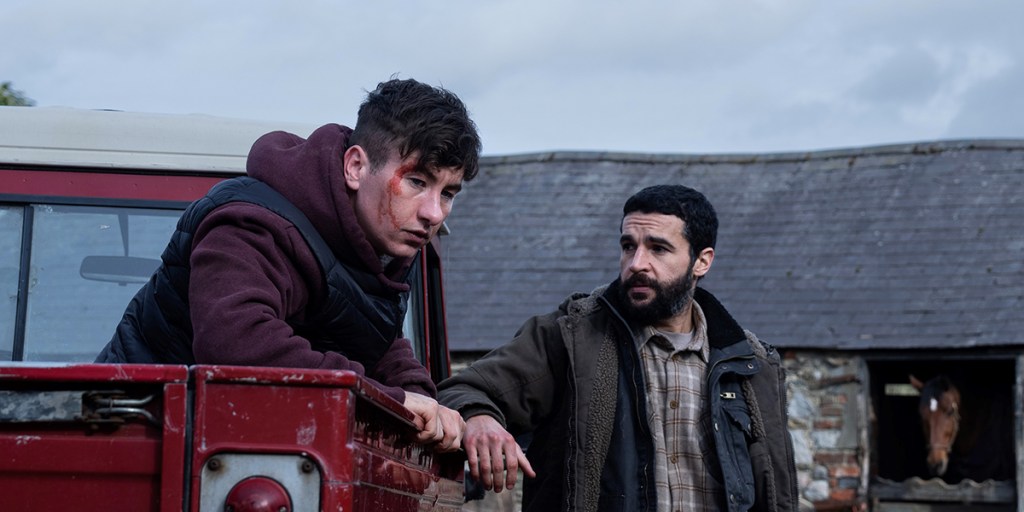
It’s rural Ireland in the present day. Michael (Christopher Abbott) runs a one-man sheep farm, where prize-winning rams graze on rocky hillsides. His abusive dad Ray (Colm Meaney) sits in the kitchen all day shouting angry epithets in Irish at Michael about all the things he’s doing wrong. In the next sheep farm over, young Jack Keeley (Barry Keoghan) does much the same as Michael but not very well. His dad Gary (Paul Ready) — who is Michael’s age — tries to keep things going but the farm is bleeding money. Gary is married to Caroline (Nora-Jane Noone), Michael’s ex, and Jack can see his parents are not getting along. Michael hasn’t seen her for 20 years, ever since a car accident killed his mother and sent Caroline to hospital with serious injuries (The accident was Michael’s fault).
But their relatively bucolic lives are interrupted when two rams disappear from Michael’s flock. And there’s only one place they can go — to the Keeley farm just over the hill. But Jack claims they both suddenly died and he threw their bodies into a pit…a very unlikely story. This signals the start of a feud between the two families, involving simmering grudges, sheep poachers, and organized crime. Can their conflicts ever be resolved? Or are both farms headed for
ruin, violence and possibly even death?
Bring Them Down is a violent, suspenseful drama about escalating grudges between two houses. It’s done in that chop-up style popular among some European arthouse directors where the narrative is not told chronologically. Your perception of “who is to blame for what” gradually shifts as new scenes fill in the blanks. I liked the acting and the dialogue — half of which is in Irish — and it has a compelling plot. The settings are just beautiful, with wide panoramic views of hillsides at dusk and dawn, and images like Michael carrying a lame sheep draped over his shoulders. There are also some strikingly original tableaux like the sheep at an auction house. This is a good first film — it reminds me of Frozen River and Winter’s Bone, all serious looks at crime in rural settings. But why are all these movies about brooding Irish men so depressing? What miserable lives these people seem to lead! If there were a bit of humour or love, Bring them Down would have been a lot easier to take.
But it’s still a good movie, anyway.
Dark Nuns, Love Hurts, and Bring them Down are all opening this weekend in Toronto; check your local listings. This is Daniel Garber at the Movies, each Saturday morning, on CIUT 89.5 FM and on my website culturalmining.com.
The thrill of uncertainty. Films reviewed: Harbin, Babygirl, The Brutalist
Hi, this is Daniel Garber at the Movies for culturalmining.com and CIUT 89.5 FM.
First let me wish you all a Happy New Year! With a new year comes renewal, hope… and potential dread. So this week, I’m looking at three new movies where people face potentially dreadful situations, partly of their own making. There’s an abused architect, a compromised CEO, and a sympathetic assassin.
Harbin
Co-Wri/Dir: Min-ho Woo
It’s 1909 in Korea. After defeating a European empire in the Russo-Japanese war, Japan is flush with imperial ambition. They want more colonies on the mainland and are looking hungrily at Korea, Manchuria, Mongolia, and China. But some independence-minded Koreans are regrouping to fight Japan. Their leader, Ahn Jung-geun (Hyun Bin), managed to defeat a Japanese battalion in a bloody battle. But when, following international laws, Anh released the disarmed POWs, their leader Mori (Park Hoon) shot a cannon at their base killing everyone except Anh. Now the survivors are meeting in Vladivostok to decide what to do next. This includes Kim (Jo Woo-jin) his closest ally, and Woo, (Park Jeong-min) his biggest rival. And some of them think Anh is a Japanese mole. To atone for his mistakes and to do something big, he vows to assassinate Ito
Hirobumi (Lilly Franky: Shoplifters, Like Father, Like Son) one of the top statesmen of Imperial Japan who is calling for the annexation of Korea.
To do this killing Anh must make his way to Harbin, a rail hub city right on the border of Russia and northeast China where Ito plans to give a public speech. But If he travels by train he will be caught. He must turn to a former comrade turned bandit, Ms Gong (Jeon Yeo-been) to try to secure explosives. But there is a traitor in their midsts, telling the Japanese all their plans. Can they make it to Harbin undetected, find the rat, fool their enemies, and carry out the assassination? Or are they fated to be erased from their country’s history?
Harbin is a vivid and gripping retelling of a famous historical event. It’s a classic cloak & dagger, full of action, thrills, drama, and deception. It’s done in the traditional style, with the name of each character appearing on the screen to help
you keep track of which moustachioed fighter is which. But easier said than done, when everyone pulls down the brims of their fedoras to cover their faces. The locations are amazing: Anh crawling across the frozen waters of the Tumen River, horse caravans on the sands of Mongolia, ancient Russian train stations… very impressive! The sets and costumes are great too, with a drunken warlord festooned in animal furs or the ceiling lamps aboard a Russian train, swinging from side to side. If you have any interest in action-thrillers, spy stories or even NE Asian history, Harbin is the film for you.
Babygirl
Co-Wri/Dir: Halina Reijn
Romy (Nicole Kidman) is the CEO of a large, successful corporation that makes automated parcel-sorting equipment — similar to what Amazon has in their warehouses. She lives with her husband Jason a play director (Antonio Banderas) and their two teenage daughters, Isabel and Nora. Her life is almost perfect, but is missing a certain…. je ne said quoi. She is not sexually satisfied. One day she is startled by a vicious dog running rampant outside her office tower. She witnesses a random young man calm the dog down and return it to its owner. Later, inside her office, she is introduced to her latest intern; it’s the same guy she saw outside. Samuel (Harris Dickinson) has an unusually forthright manner, almost rude and overbearing for someone so young. He makes her feel unhinged and yet… intrigued. Who is this twerp, and why is he like that? She finds him overconfident and almost ridiculous. And yet… eventually, to her great surprise, they kiss and sparks fly.
Soon she is secretly meeting him in seedy hotel rooms for furtive sex. But he wants more — total domination over her in an S&M relationship. Romy loves her husband and kids has never done anything like this before. Even though he takes the dominant role, in real life she holds all the cards: she’s older, richer and his boss. She has more to lose, though, and it’s that threat that excites her. And she can’t got enough of him. What will happen if word gets out? Has she bit off more than she can chew?
Babygirl is an erotic drama about an older woman’s fling with
a much younger man for the thrill of it all. It’s both highly sexualized and yet uncomfortable to watch in parts. It’s entirely told from Nicole Kidman’s (Before I go to Sleep, Genius, The Beguiled, The Killing of a Sacred Deer, Boy Erased, The Upside, Destroyer, The Goldfinch, Bombshell, The Northman) Romy’s point of view; we share her agony, her ecstasy, her cringing embarrassment (he treats her like a domesticated pet). As Samuel, Dickinson is opaque, functioning mainly as her erotic foil. He’s usually an excellent actor (Beach Rats, Triangle of Sadness, Scrapper, The Iron Claw) but in this movie he takes second all the way. Some people love this movie, others despise it. I’m somewhere in between. The plot is just a slight twist to the hoary old cliche of the powerful executive submitting to a dominatrix. I don’t need to watch a grown woman lick milk from a saucer. But other parts are quite exciting and altogether it’s worth it for Nicole Kidman’s performance.
The Brutalist
Co-Wri/Dir: Brady Corbet
It’s post-WWII. László Tóth (Adrian Brody: Splice, Predators, The French Dispatch, Asteroid City) is a holocaust survivor from Hungary who arrives in America as a displaced person. His wife Erzsébet (Felicity Jones) and niece Zsófia are nowhere to be seen. His cousin Attila (Alessandro Nivola) gives him a place to stay in his furniture store and puts him to work designing and building chairs. Things look up when the son of an oligarch offers him a job redesigning his father’s home library. Laszlo takes to it like a fish out of water, building a modernistic room with synchronized wooden panels and shelves beneath an open skylight. But when the industrialist Harrison Lee Van Buren Sr. (Guy Pearce) sees it, he goes ballistic and fires him without pay. Soon after his cousin falsely accuses him of sleeping with his wife Laszlo finds himself unemployed, homeless and addicted to drugs. He gets work doing manual labour at a ship yard with Gordon (Isaach De Bankolé) a man he
befriended earlier until the industrialist who fired him seeks him out ago. Turns out Laszlo was a Bauhaus architect before the war, and the library was featured in modern architecture. Lee immediately rehires him, this time to build a monumental memorial on a hilltop in honour of his mother. But conflicts still trouble the two men’s relationship. Will Laszlo ever complete his masterpiece? Or will Lee crush him with his oppressive and egoistical nature?
The Brutalist is a moving drama about the American Dream and the class struggle between two men. (The title refers to the Brutalist style of architecture Laszlo favours). It’s a full-fledged four hour epic, compete with an overture, intermission and various story lines within the plot. I’m only giving you a taste of it here, a three-minute review of a four hour movie. It is visually and audibly stunning, both in design and execution, from the score to the crisp camera work, even the surprising credit roll. The acting is superb — I’m referring to Brody, Pierce, Jones and the rest of the large cast. This is a mature film made by a young director and former child actor. I’ve only seen one other movie by him, Vox Luxe, which, while visually interesting, didn’t have much to it. The Brutalist takes a quantum leap beyond that, filling in all the parts left out of his previous work. The movie is exciting, full of both hope and crushing devastation. It’s so well done that I left the theatre assuming it was a biopic, only later realizing it’s entirely fictional.
The Brutalist is a stupendous movie that must be seen to be appreciated.
The Brutalist and Babygirl are now playing in Toronto, with Harbin opening this weekend; check your local listings.
This is Daniel Garber at the Movies, each Saturday morning, on CIUT 89.5 FM and on my website culturalmining.com.
Trouble at home. Films reviewed: Civil War, Sting, Housekeeping for Beginners
Hi, this is Daniel Garber at the Movies for culturalmining.com and CIUT 89.5 FM.
This week I’m looking a three interesting movies: from the US, North Macedonia, and Australia. There’s a carful of journalists heading to an apocalyptic Washington, a makeshift family in Skopje, and a carnivorous spider that fell from outer space.
Civil War
Wri/Dir: Alex Garland
It’s the near future in the United States, but these states are not united. The country is in the midst of a violent civil war, with a Texas- and California-based militia battling the federal government in an East vs West conflict. WF (Western Forces) vs the USA. The rebels are slowly advancing southward toward Washington DC.
Lee (Kirsten Dunst) a veteran war photographer is in New York, chasing a terror bombing alongside Joel a journalist (Wagner Moura). Lee has covered many wars at the frontline, but never one like this, on her home turf. Still, she and Joel want to cross the battlefront to get to DC and interview the president (Nick Offerman) ahead of the advancing rebel troops.
Sammy (Stephen McKinley Henderson), a grizzled newspaperman from way back, wants to hitch a ride as far as the Charlottesville front line. And greenhorn Jessie (Cailee Spaeny), straight out of school, says she idolizes Lee and her work. She caries a camera around her neck. Couldn’t she come too? Lee doesn’t mind mentoring young photographers, but not while she’s dodging bullets. In the end, all four of them begin their perilous in a 4WD.
It’s an apocalyptic journey, along broken highways filled with abandoned cars. Burnt out towns have snipers standing guard on roofs. Gas stations only take cash, preferably Canadian. Fear, hatred and the stench of rotting bodies floats in the air. Soldiers in camo, their hair dyed fluorescent colours casually brandish assault weapons. Accused collaborators hang from
rafters. Will their press passes be enough to save them from friendly fire? And who will enter the Whitehouse?
Civil War is a Heart of Darkness plunge into an apocalyptic America where the enemy is ourselves. It’s thrilling, chilling, and quite disturbing. The theme is politics and war (and journalism), but you never quite find out what the two sides are fighting about, what they stand for, who’s right or who’s wrong. Rather, it’s about the hellish nature of war, and how conflict can destroy a country. Alex Garland (Ex Machina, Annihilation) made 28 Days Later, where an infection that leads to fast-moving zombies destroying the world. This has a similar feel but with a very different type of monster. And it will have you on the edge of your seat all the way through.
Sting
Wri/Dir: Kiah Roache-Turner
It’s a cold winter night in a big, American city, where a record-breaking ice storm has trapped everyone in their homes. Charlotte (Alyla Browne), an intense, blonde Wednesday Addams, lives in a tenement with her mom, her cartoonist stepdad Ethan (Ryan Corr), and her infant brother. Ice storms are boring, but luckilly, Charlotte knows the building through and through. She easily crawls through vents to spy on other tenants: her sweet but demented Grandma (Noni Hazlehurst), her cruel great aunt Gunter (Robyn Nevin), the slumlord who owns the building; Maria, a sangria-guzzling alky with a yapping chihuahua, and Erik, a reclusive scientist. To keep herself occupied, Charlotte keeps a tiny spider she found in a glass jar. She names her Sting. But this is no ordinary spider. Sting can communicate with Charlotte, perfectly imitating her whistles. And Charlotte doesn’t know Sting is an intelligent alien that fell to earth inside a meteor.
As Sting voraciously consumes the bugs she feeds her, the spider rapidly grows in size and strength. Charlotte moves her into an aquarium, but even that won’t contain her. Like Charlotte, it can run through the vents, snatching, mummifying or scarfing up small animals on the spot. But when Charlotte notices people are disappearing, she realizes something is not right. She teams up with Ethan and a professional exterminator named Frank (Jermaine Fowler) to get Sting under control… but are they too late?
Sting is a ridiculously silly horror film about a man-eating alien insect who spins slimy webs and cocoons out of slimy mucous. Lots of fake blood and gore. At the same time, it always keeps a humorous tone, even in the scary and gross-out scenes. One interesting fact: Charlotte names her spider Sting after reading The Hobbit, but JRR Tolkien fans will notice Sting was actually the dagger Bilbo Baggins used to kill… a giant, man-eating spider! Another interesting fact: although it’s set in a snowy city like New York, Sting is an Australian movie, with an almost completely Aussie cast (including the delightful Noni Hazlehurst.)
Suffice it to say, Sting is an unabashedly B-movie that’s also a fun night out.
Housekeeping for Beginners
Wri/Dir: Goran Stolevski
It’s present-day Northern Macedonia. Dita is an older woman who works at a social welfare office in Skopje. She’s descended from a prominent family in Tito’s Yugoslavia and shares a big house with a middle-aged man named Toni (Vladimir Tintor). Suada (Alina Serban) — a client from work — lives there too; she fled her abusive husband. Suada brought her two kids with her: tough, teenaged Vanessa (Mia Mustafi) and 6-year-old Mia (Dzada Selim). Today, there’s a new face in the house: 19 year old Ali (Samson Selim). He’s a sweet-talker who dyes his hair blond and is fond of green fingernail polish. He also knows everyone and everything happening in his neighbourhood. This means now there are two moms, one and a half dads, and a bunch of kids. The unusual thing is Dita and Suada are lovers, and Ali is Toni’s latest hookup. But that’s not all. Dita and Toni are ethnic Macedonians, while Ali, Suada and the kids all come from Shutka, a Muslim Romani neighbourhood. Dita’s house serves as an underground Mecca for outcastes, whether LGBT, Romani or both.
But everything changes when Suada is diagnosed with a fatal illness. She wants to make sure her kids are taken care of after she dies, and to give them a chance at success. The Roma are severely discriminated against, at school, work and even in accessing social services. If Rita and Toni adopt Mia, a bright and creative little girl, perhaps she can escape this endemic racism. But can a group of misfits live like a normal heterosexual family? Or is their experiment doomed for failure?
Housekeeping for Beginners is a sweet and realistic drama about the daily life of an unusual family and the tribulations they face. It’s also a real eye-opener! I never knew there are Muslim Romani communities, nevermind gay subcultures, within Northern Macedonia. It gives a glimpse into the street life of Shutka, and the complex social structures within that
neighbourhood. The acting is great, the characters they play are bold and fascinating. Apparently Samson Selim who plays Ali is the real-life father of Dzada Selim, the girl who plays Mia. It’s directed by Macedonian-Australian filmmaker Goran Stolevski, who spins amazing stories. This is the third movie I’ve seen by him (Reviews: Of an Age, You Won’t Be Alone) and even though his genres vary widely, he has a distinct style of storytelling, a bittersweet intimacy, which I’m liking more and more with each new film.
This is a good movie.
Sting, Civil War and Housekeeping for Beginners all open this weekend in Toronto: check your local listings.
This is Daniel Garber at the Movies, each Saturday morning, on CIUT 89.5 FM and on my website culturalmining.com.
Three Women. Films reviewed: Immaculate, Exhuma, The Queen of my Dreams
Hi, this is Daniel Garber at the Movies for culturalmining.com and CIUT 89.5 FM.
This week, I’m looking at three new movies about three distinct women from three different religions. There’s a nun fighting for her life in Italy, a shaman fighting demons in Korea, and a Canadian woman fighting with her Mom in Karachi.
Immaculate
Dir: Michael Mohan
Sister Cecilia (Sydney Sweeney) is a novice at a convent in Italy. It’s an ancient edifice dating back hundreds of years, with an airy courtyard surrounded by lovely white pillars, and situated amongst Italy’s rolling hills. She has just arrived from Michigan, but is already taking her vows of chastity, poverty and obedience. She was invited to join the convent by Father Sal Tedeschi (Álvaro Morte) a former scientist who, like Cecilia, had a calling. Her job? To tend to the sick and dying, mainly older nuns who have lived their entire lives within their stone walls. There is little privacy there, especially for novices. Anyone can wander into their rooms, day or night.
But something strange is going on. When she touches a relic of the true cross, she faints. She wakes up days later with few memories of what happened. She goes to confession but her priest seems to fade away inside the booth. And one morning she throws up in the shared baths. Could that be morning sickness? Could she be pregnant? Bishops and doctors examine her closely: she is still a virgin. Which makes this an immaculate conception! It’s a miracle! It’s the second coming! Soon people are gazing at her in awe, reaching out to touch
her face. But this is not why Cecilia took her vows. She doesn’t trust the convent’s doctor — who just happens to be an obstetrician in a convent full of nuns. And then there are the frightening sisters who cover their faces in masques of red gauze to carry out enforcement. When her only friend, Sister Gwen (Benedetta Porcaroli) disappears, Cecilia realizes she has get out of this place — or this nun will be done. But how can she escape?
Immaculate is a thriller/horror about an innocent young woman trapped in an Italian house of by some religious fanatics. But for a movie about a nunnery there sure are a lot of breasts on display… draped in damp white diaphanous gowns in the baths or partly exposed late at night. That’s half of this exploitation movie: soft-core porn. The other half, though, is extreme, bloody violence and sadistic torture — what I call “gorno”: Disgusting, extended violence you’re forced to watch for its titillating effect. This leaves the movie both ridiculous and over the top, and more gross than scary, in the manner of an Italian Giallo movie from the 70s… but without any camp.
That said, I actually liked Sydney Sweeney as the innocent woman who fights back. And while this is clearly a B movie, it does end on a suitably shocking note.
Exhuma
Wri/Dir: Jang Jae-hyun
Hwarim (Kim Go-eun) is a young Korean woman on a Japanese flight to LA. She’s going there to investigate a client from a filthy-rich Korean family that suffers from strange dreams and illnesses. Not just the man himself, but his new born baby, and other relatives. She’s a shaman, travelling with her coworker Bong-Gil a heavily-tattooed, former baseball player (Lee Do-hyun) who can see visions and dreams. They determine evil forces are at work here, and call for an exhumation of a distant ancestor’s grave to rectify some unknown problem. The family agrees and pays them a hefty salary to make it work. Back in Korea, they turn to Kim a geomancer (Choi Min-sik) and his assistant. He knows about how Yin and Yang, Feng Shui and the Five Elements all must be correctly aligned to make for a peaceful grave. But the grave they find is anything but peaceful. The coffin is buried beneath an unmarked tombstone, on a distant hilltop near North Korea, reachable only through a chain-locked road where no one ever goes. It’s home to a skulk of foxes and a pit of snakes. And despite their lengthy shamanic
rituals, somehow an ancient evil spirit escapes from the grave wreaking havoc on everyone nearby. It’s not just a ghost that says “boo”; it takes on a physical form, looking for humans as his slaves, to feed him sweet melons and mincemeat. And woe be to him or her who disobeys. Human livers taste just as good. Can these four brave souls defeat a dark evil from a rich family’s hidden past?
Exhuma is a supernatural horror/thriller about a fight against the deep, dark mysteries from Korea’s history (including references to their brutal occupation under Imperial Japan). The film is done in an interesting way, incorporating actual shamanic rituals into the story. In one scene, to the sound of pounding drums, Hwarim does an extended ecstatic dance around the bodies of four hogs impaled on skewers. Not the sort of thing you usually see in a horror movie.
Exhuma was a huge hit in Korea when it was released there a month ago, and I’m not at all surprised.
I like this one.
The Queen of My Dreams
Wri/Dir: Fawzia Mirza
It’s 1999 in Toronto. Azra (Amrit Kaur) is an aspiring actress with a steady girlfriend. She has been on bad terms with her mother Mariam (Nimra Bucha: Polite Society) since she was caught playing spin the bottle with a girl at her teenage birthday party. But she still communicates with her friendly Dad (Hamza Haq: Transplant) a doctor. The one thing Azra has in common with her mother is their obsession with an old Bollywood movie starring Sharmila Tagore. But when her Dad suddenly dies on a visit to Karachi, Pakistan, Azra and her brother must fly there for the funeral. This sets off a series of revealing memories both from Azra and Mariam. Suddenly we’re
transported back to 1969, when Mariam is a totally different person and Karachi a swinging city, filled with bars, discos, VW bugs and Beatlemania.
Mariam is a rebel who rejects her parents’ arranged marriages when she falls for her future husband. Then we’re in Sydney, Nova Scotia, in 1989. Young Azra (wonderfully played by Ayana Manji) joins her mom’s work as a Tupperware lady. These scenes are a coming of age replete with a moustache on her upper lip, her first dance with a boy, and being excused from class during Christian prayers. But can the 1999 mother and daughter reconcile with their pasts in 1989 Nova Scotia and 1969 Karachi and learn to love each other again?
The Queen of my Dreams is a wonderful family drama that deftly weaves three eras and three generations across two continents. It deals with religion and sexuality, rules that are made to be broken and others that are upheld. I don’t know if this film is autobiographical or not, but it really rings true. Amrit Kaur plays both the adult Azra and a younger version of Mariam, while Hamza Haq plays the Dad both in youth and middle age. Not just that: Nimra Bucha (Mariam) and Kaur in their daydreams are both transformed into the main character in their favourite Bollywood film. Sounds really complicated, right? It’s not! It’s totally accessible and understandable with wonderful realistic characters, funny lines and deeply moving dialogue. The production design deserves a special mention. The ’60s scenes use traditional film to perfectly capture the look of Kodacolor movies from the period, through costumes, hair, locations, cars — and especially its cinematography. And on top of everything else, this is Fawzia Mirza first feature film.
I’ve seen The Queen of my Dreams twice now and I still love it.
Exhuma opens at the TIFF Lightnox; Immaculate, and The Queen of My Dreams also playing this weekend in Toronto; check your local listings.
This is Daniel Garber at the Movies, each Saturday morning, on CIUT 89.5 FM and on my website culturalmining.com.
Summer entertainment. Films reviewed: Three Thousand Years of Longing, Alienoid, The Good Boss
Hi, this is Daniel Garber at the Movies for culturalmining.com and CIUT 89.5 FM.
This week I’m talking about three entertaining summer movies from around the world. There’s a British academic who meets a djinn in Istanbul; an ambitious businessman forced to “weigh his options” in Spain; and some alien, time-travelling prison guards trying to catch mutant convicts in medieval Korea.
Three Thousand Years of Longing
Co-Wri/ Dir: George Miller (Based on the short story by A.S. Byatt)
Dr Alithia Binney (Tilda Swinton) is a British academic in Istanbul for a conference. She’s a narratologist, someone who studies the structure of stories and how they’re told. She’s been obsessed by stories since she was a kid, when she even had an imaginary friend. She’s still more comfortable reading than talking to other people. But these imaginary friends seem to be reappearing more often lately. A small man in a lambskin coat talks to her in the airport — but no one else sees him. And when giving a lecture a strange man in Mesopotamian garb appears in the audience. But she really
starts to worry when one of them doesn’t go away. This all started when a glass bottle she found in an Istanbul antique store let loose a gigantic genie (Idris Elba) — or Djinn as he calls himself. To no one’s — surprise since we all know this narrative structure — he grants her three wishes. But to the Djinn’s shock she says she doesn’t want anything. She’s content with what she has, and besides, these sort of stories always go wrong in the end. So the Djinn tells her his 3000-year-long story instead, and what will happen if she doesn’t use those wishes. And an amazing tale it is, with characters like Solomon and Sheba, and the sultans of Ottoman Arabia. There’s a sluggish prince locked in a fur-lined chamber with a dozen huge-breasted Rubenesque consorts. And a woman genius in the Renaissance who just wants to study. Like a story within a story, these talks are told by the
djinn as they both sit in her hotel room, dressed in white terrycloth robes and towel turbans. Is this all in her mind, or is it real? And if so, what will her wishes be?
Three Thousand Years of Longing is the retelling of stories within stories, in the style of The Thousand and One Nights, but told from a contemporary perspective. These are framed by Alithia’s own stories, and contemporary events. George Miller, of Mad Max fame, directed this, and spares no special effects — there is a mind-boggling plethora of CGIs in every scene: with non-stop, lush magical images. Idris Elba is fun as the Djinn with his pointy ears and the blue-green scales on his legs; and Tilda Swinton is great as always, this time bedecked in rose-coloured skirts, with a red pageboy haircut and academic glasses. Nothing deep here and it’s not terribly moving, but I always love a good story, well-told.
Wri/Dir: Choi Dong-hoon
It’s Korea six centuries ago, when a metal object tears through the sky, killing a woman with its tentacles. But, believe it or not, the tentacles are from the good guys, and the medieval Korean woman is actually an escaped mutant killer from another planet. You see, Guard (KIM Woo-bin) and Thunder are alien prison guards who lock the mutant prisoners inside human brains… and if they try to escape, earth’s atmosphere will kill them in a few minutes. But the humans with the alien prisoners locked inside them have no idea.
The woman they killed has a newborn baby girl, so they take her with them back to 2022 and raise her like she’s their own child (yes, little Ean has two daddies!) But they’re neither human nor mutants — Guard is a sophisticated robot and
Thunder is a computer program, but they both can take on human form. Now in 2022 things are going bad. Alien mutants have arrived on earth to free the prisoners and turn the earth’s air toxic for humans but breathable by them. And they’re winning the battle.
But back to 600 years ago, things aren’t as bad. Muruk (RYU Jun-yeol) is a young Dosa, or spell caster, who earns his living as a bounty hunter. Now he’s after something more valuable — a legendary crystal knife called the divine blade for its strange powers. He tracks it down to a wedding and impersonates the
groom to steal it. What he doesn’t know is his “bride” is also an imposter seeking the same prize. So are Madame Blue and Mr Black, veteran sorcerers who make their living selling magic trinkets, as well as some evil killers, one of which dresses like a man from 2022. Who are all these people? What’s going on here? Will the world be destroyed? And what’s the connection between then and now?
Alienoid is a Korean movie about science fiction time travel that spans all genres. It’s part action, superhero, fantasy, romance, drama, and comedy. It deftly incorporates the time-travelling robots from Terminator; HK style airborne fighting, and the funny, soapy characters of Korean historical TV dramas all pulled together in a way I’ve never quite seen before. It has a
huge budget — 33 billion won — but it’s not a superhero movie. That’s another great thing about Alienoid: unlike superheroes, all the main characters may have some special powers but they also have major flaws: they mess up a lot, lie, cheat, steal, and behave like grifters. One warning (not a spoiler) the movie finishes, but it doesn’t end, with the next sequel coming out next year. So if you’re looking for a highly entertaining two hours, you can’t go wrong with Alienoid.
Dir: Fernando León de Aranoa
Julio Blanco (Javier Bardem) is the owner of Blanco Scales, a factory in a small Spanish town — he inherited the company from his Dad. They make everything from bathroom scales to enormous steel balances that can weigh a whole cow. He knows he’s a successful businessman and a good boss by the way his smiling employees applaud him whenever he makes a speech. They’re like his children, he says beneficently, and when they have a problem, he has a problem — his door is always open to help them out. Then there’s his industry trophy wall, directly across from his marital bed, that recognizes him for his business accomplishments. There’s just one prize he hasn’t won yet, the official regional award, which could open huge doors in government contracts. He’s one of three nominees and he really wants to win it.. All he has to do is make everything run perfectly and all his employees content within one week — that’s when the inspectors are coming.
The problem is, not everything is as perfect as he imagines.
Production is weeks behind schedule, because Miralles — whom he’s known since childhood — is not paying attention. He’s too busy stalking his wife who he thinks is cheating on him. Won’t Blanco help him catch her in flagrante delecto? Jose, a laid-off employee, doesn’t want to leave; he’s camped out in front of the factory demanding to be rehired. And long-time mechanic Fortuna’s son has been arrested for assaulting strangers in the park — won’t Blanco behave like a role model and get the kid a job somewhere? And then there’s problems of his own creation: he’s flirting with a beautiful new intern, Liliana (Almudena Amor) who seems equally attracted to him. She even has the scales of Libra tattooed on her neck. Little does Blanco know, she’s the daughter of his wife’s best friend, the same one he coddled as an infant. Can he solve all his company’s problems in just one week? Or is he just digging deeper into a hole?
The Good Boss is a biting social satire dealing with class, race, and gender in contemporary Spain. Javier Bardem is terrific as the smarmy Blanco, a big fish in a small pond who loves his glassed-in office where he can lord over all the little people beneath him. A comedy, it’s full of every possible pun about scales — the blind justice statue, the Libra sign, tipping the scales… to name just a few. And though a light comedy, it looks at very dark issues with a jaundiced eye.
I enjoyed this one, too.
Three Thousand Years of Longing and Alienoid both open this weekend across North America; check your local listings; and you can catch The Good Boss now at the TIFF Bell Lightbox in Toronto.
This is Daniel Garber at the Movies, each Saturday morning, on CIUT 89.5 FM and on my website, culturalmining.com
The Twentieth Century. Films reviewed: Escape from Mogadishu, When Hitler Stole Pink Rabbit, 12 Mighty Orphans
Hi, this is Daniel Garber at the Movies for culturalmining.com and CIUT 89.5 FM.
Some movies have titles that tell you a lot about what you’re going to see. This week I’m looking at three such movies, all set during the 20th century. We’ve got Koreans in Mogadishu in the 1990s; child refugees from Nazi Germany in the early 30s; and Texan orphans playing football in the Great Depression.
Dir: Seung-wan Ryoo
It’s 1990 in Mogadishu Somalia, and the country is on the verge of collapse. Its authoritarian President Barre is still in power but rebel forces are gaining strength. It’s also the year when both North and South Korea are joining the United Nations, and are in heavy cold-war competition to build up more allies than their rival in vote-rich Africa. And the two ambassadors, Ambassador Han from the south (Kim Yoon-seok) and Ambassador Rim (Heo Joon-ho) from the north are in constant competition to curry favour with Barre’s government. And they each have heavy-hitters to help them. Kang (In-Sung Jo) is a recent arrival from the notorious Korean CIA. He’s arrogant and rude, but effective. Likewise, his counterpart from the north. They each run underhanded schemes against the other side, from planting fake news reports, to hiring thugs to steal embassy materials. But the Somali government is losing its grip, and there’s mayhem on the streets. And when all communications cease, both sides realize they
have to get the hell out of Mogadishu. And due to strange circumstances, the North and the South are forced to cooperate, and try to escape together.
But will it work?
Escape from Mogadishu is a Korean action/thriller set in a Somalia teetering on the brink of civil war. There are child soldiers shooting rifles at random, corrupt police, and mobs of looters running rampant. Both North and South Koreans loathe their rivals — the countries are technically still at war, with a 40-year-old ceasefire at their shared border. When they encounter each other face-to-face, the ROKs thinks the DPRKs are trained as killers since they
were kids; while they’re sure the South Koreans are either trying to poison them or force them to defect. And neither country can let it be known they’re doing anything that might help the other side.
This is a fun movie about rivals caught in an apocalypse. It includes an amazing, 30-minute chase scene as they try to escape. It’s set in Somalia (and shot in Morocco) but it’s really about Koreans — rivalry, suspicion, with the underlying hope of brotherhood and peace. The Somalis are there as decoration, mainly portrayed as corrupt, violent, crazy, untrustworthy, or else as silent, nameless victims — typical of most war movies. The Korean characters are more rounded but not always favourable either. Escape from Mogadishu has a hardboiled, cynical tone, but with a great streak of ironic humour and an underlying message of good will. This movie was just released in South Korea and it’s the years first blockbuster. So if you like action thrillers, you should check this one out.
Co-WriDir: Caroline Link
It’s 1933 in Berlin. The Kempers are an upper middle class family living in a nice neighbourhood. Dad (Oliver Masucci) is a leading theatre critic, also known for his radio broadcasts. Mom (Carla Juri) is a pianist. Their son, Max (Marinus Hohmann) is into Zorro, while little Anna (Riva Krymalowski) likes drawing pictures of animals at the zoo. And they all adore their housekeeper Heimpi. But with elections a week away, and Hitler’s Nazis likely to prevail, Dad is worried. As a committed socialist and an unsparing critic, he’s prominent on Hitler’s enemy list. If the Nazis win he will likely be jailed or killed. So the family packs up a few suitcases for a quick trip to Switzerland. They plan to come back after the election. No such luck. Hitler triumphs, and they’re stranded in
Zurich. The government seizes all his possessions and furniture, brown shirts burn his books, and newspapers stop publishing his work. Suddenly they are refugees, and Jewish intellectuals, no less, an exceedingly unpopular category.
So they settle into country life in a tiny alpen village near lake Zurich. Anna is baffled by the strange accent, their melted cheese and odd customs. Girls are separated from boys and kept at the back of the classroom, and boys throw rocks at girls they like. She soon adjusts and makes local friends. But their parents must keep a low profile. Dad is a wanted man, with a price on his head, and Nazi sympathizers are everywhere. Eventually they movie to Paris, where antisemitism is rife. As they sink deeper into poverty, they are forced to
choose between necessities (like food, pencils and lightbulbs) and luxuries (like books and meat). Will the tide ever turn in their favour?
When Hitler Stole Pink Rabbit is a realistic and poignant story about a young girl’s life as a refugee in the 1930s. It’s about the whole family but seen through Anna’s eyes. It’s also about her internal trauma — her drawings turn from cute animals to people drowning in the ocean or crushed in an avalanche. It’s based on the semi-autobiographical novel by the late British author and illustrator Judith Kerr. So, as a film, it’s not the kind that builds to big climax and denouement; rather it’s episodic storytelling, a collection of vivid memories taken from the author’s childhood. The movie is filled with the wonder and disillusionment of a girl growing up in an unkind world, but it never loses its optimism.
This is a very nice and engrossing film.
Dir: Ty Roberts
It’s the 1938 in the Texas panhandle dustbowl, where starving farmers are abandoning their land and their children. Rusty Russel (Luke Wilson) is a renowned high school football coach starting a new job. He has taken many teams statewide championships. But his newest school is an exception. The kids here are barefoot, undernourished and illiterate. And they’re all orphans. But the coach is determined to change all that. So he tries to put together a football team, the school’s first, from among the orphans. They’re regularly flogged by Frank Wynne (Wayne Knight) who runs a for-profit printing press on school grounds and who treats the kids as virtual slaves. Rusty offers an
enticement — when you’re training on the football field, you won’t be working on the fields.
Rusty pulls together a ramshackle bunch of scrawny, gap-toothed kids with low-esteem. And a newcomer, Hardy Brown (Jake Austin Walker) a 17-year-old seething with anger. With the help of the school’s medic, the kindly alcoholic Doc Hall (Martin Sheen), they manage to get the boys to resemble something like a team. Through pep-talks, motivation and intensive training, they’re ready to play ball — but against whom? The other schools want nothing to do with them. And they’re so much smaller than the average football player they don’t stand a chance even if they do play. But the Mighty
Mites persevere, and make it into the league. But can they ever win? And will they learn to call themselves orphans with pride not shame?
12 Mighty Orphans is a wonderful, heartwarming sports movie about a team of underdogs trying to make it. I have no interest whatsoever in high school football, and yet I found this movie captivating. It’s a traditional-style movie — it could have been made in the 1940s — but still feels fresh. Each kid has his own personality, with names like Snoggs (Jacob Lofland), Fairbanks, Wheatie, and Pickett — all based on actual players. With clear-cut villains, and bittersweet heroes, it’s simple and easy to follow but moving, nonetheless.
This is a good one.
When Hitler Stole Pink Rabbit is now available on VOD and other digital formats. 12 Mighty Orphans and Escape from Mogadishu both open theatrically in Toronto this weekend — check your local listings.
This is Daniel Garber at the Movies, each Saturday morning, on CIUT 89.5 FM and on my website, culturalmining.com


leave a comment