More Cabins in the Woods. Films reviewed: Anemone, Queen of Bones, Bone Lake
Hi, this is Daniel Garber at the Movies for culturalmining.com and CIUT 89.5 FM.
From Goldilocks to Hansel and Gretel, we’ve all grown up with an innate fear and fascination of cabins in the woods. They’re isolated, mysterious and possibly dangerous. And that goes for movies, too, with cabins in the woods a common recurring theme, especially in horror movies. So this week, I’m looking at three such movies all opening this weekend.
There’s a fugitive in a house made of stone, a pair of twins looking for the Queen of Bones, and a young couple renting a place beside Bone Lake.
Anemone
Co-Wri/Dir: Ronan Day-Lewis
Jem and Nessa (Sean Bean, Samantha Morton) are a comfortably couple raising their 19 year old son Brian (Samuel Bottomley). So why is Brian at home in his room? He got in a fight and nearly beat the other guy to death. He’s depressed and frustrated, and desperately needs the help that they can’t provide. So Nessa asks Jem to do something he’s sworn never to do: find a man who disappeared 20 years ago. So Jem, armed with only a cryptic piece of paper with longitudinal measurements and a sealed letter from Nessa, sets out for a journey into a forest somewhere in the UK.
His clues lead him to a stone hut, literally in the middle of nowhere. As he approaches, a grizzled old man almost blows his head off with a rifle, but, just in time, he recognizes the sound of a clicking, childhood toy. It’s Ray (Daniel Day-Lewis) a fugitive from justice, who has been hidden away all this time. He is somehow connected to a killing that occurred during The Troubles in Northern Ireland. Not only that, he’s Jem’s big brother. What happened all those years back, what is Ray’s connection to Nessa and Brian, and will he agree to come out of hiding?
Anemone is a passionate and personal story about brothers, fathers and family history. Along the way, there’s lots of whiskey spilt and dirty jokes told, along with hiking and camping, punch-outs and wrestling. Lots of guy stuff, a Man’s-Own story. And it’s filmed among spectacular scenery, a stone beach, a glowing moon, distant hills and mountains. Just
gorgeous. Daniel Day- Lewis — who retires every 5-10 years, then makes another movie — puts a lot into his role, and Sean Bean is excellent as his foil. Samuel Bottomley seems like another Barry Keoghan. And there are some cool dreamlike sequences, and I even shed a tear near the end. But the movie as a whole just doesn’t seem quite right. It’s too contrived, too set up. I got a lot out of it aesthetically, but found it hard to connect emotionally. It’s directed by Daniel’s son Ronan and they wrote it together, but it’s just OK, not great.
Maybe it’s too weak a script and too strong an actor for a first-time directors to handle.
Queen of Bones
Dir: Robert Budreau
It’s the 1930s in a small house deep in the woods outside Portland, Oregon. Fraternal twins Lily and Sam are in their early teens. They were raised together by their single dad, a devout Christian (Martin Freeman). He’s a craftsman who makes exquisite violins to order. Lily (Julia Butters) takes after her mom, a violin virtuoso, while Sam (Jacob Tremblay) is more interested in trains and cars — he wants to be a mechanic, though his family still rides a horse and buggy. Their father has always said their mother died before they were born and it’s a miracle they came out alive, but they still wonder about what happened to her. And around this time, when they both reach puberty, Lily starts seeing strange cryptic signs carved into trees in the woods. What could they mean? She has dreams about wolves, and, if she concentrates hard enough, she thinks she can control the weather.
One day, Ida-May (Taylor Schilling) a local shopkeeper, drops by their home. She flirts with their dad, as they’re both widowed. But she also leaves behind a trunk of the twins’ mother’s possessions they inherited from their late grandfather. It’s full of shawls and dresses. But hidden at the bottom is a book of spells and incantations written by her mom. Lily hopes they can explain the mysteries surrounding her mother. But they have to keep it hidden from their dad, who abhors anything related to witchcraft, and keeps the
twins separated from anyone but him. Who is the Queen of the Bones? Was their mom a witch?Did Lily inherit her powers? And is there someone out there who can answer all these questions?
The Queen of Bones is a fairytale about a pair of twins trying to find a witch while evading their over-protective father. It’s low-budget, and simple, but kinda neat. It’s told in a series of short chapters, leading inexorably toward a dramatic end. Though set in Oregon, the locations and some of the cast is Canadian, from Jacob Tremblay (he was the little boy in Room) to the great stage actor Clare Coulter. Julia Butters is excellent as Lily.
I like witches and fairytales and cabins in the woods so, while not a terrific movie, I enjoyed it anyway.
Bone Lake
Dir: Mercedes Bryce Morgan
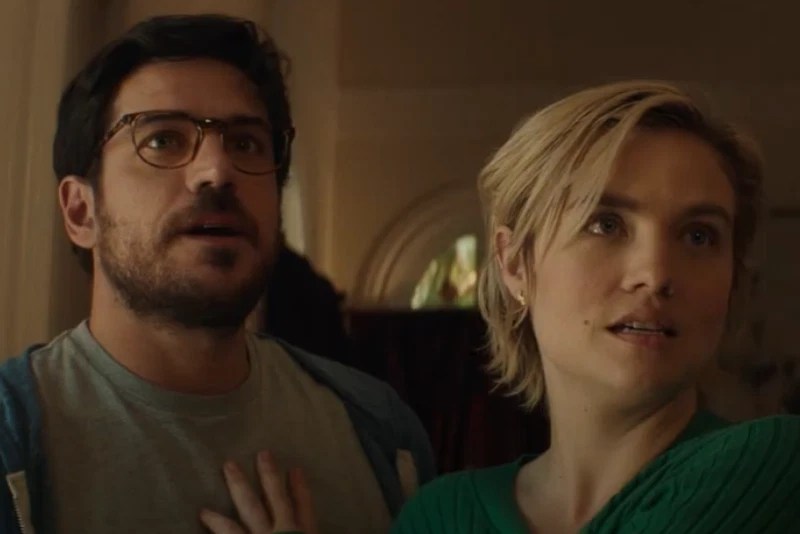
Sage and Diego are a professional couple heading for a luxury weekend in the country. Diego (Marco Pigossi) teaches creative writing at a community college but wants to write a novel. Sage (Maddie Hasson) is a freelance journalist known for her provocative features about sex toys. They are at a turning point in their relationship. Sage has agreed to take a desk job — an editing position — so Diego can pursue his dream for a year. And unbeknownst to her, he plans to propose to her, with his late grandmother’s ring. But when they get there, The BnB they rented is far from the rustic cabin they expected. It’s an enormous, elegant mansion on a huge lot overlooking a lake. It seems way too fancy for what they payed, but they decide not to look a gift horse in the mouth. They settle quite nicely in their new digs. Until another couple shows up claiming they rented the house for the weekend, too!
Sage and Diego decide to go with the flow, and let them share the place — it’s a huge mansion, remember. And the other couple happens to be younger, better-looking and scantily dressed. The appropriately-named Cin, short for Cinnamon (Andra Nechita), looks like a model, and so does her boyfriend, Will (Alex Roe). While Sage and Diego are looking for some alone time, Can and Will prefer games, both sexual
and psychological. Together they explore the locked rooms in the house, one quite sexual, another occult. Cin and Will proceed to ingratiate themselves into Sage and Diego’s lives, splitting them apart for intimate talks… and possible seductions. But as the games turn serious, no one knows who to trust. Who is behind this weird house, and what do they want?
Bone Lake is a psychological thriller about the relations between two couples in an isolated house in the woods. What starts out as a sex comedy, gradually shifts into a violent thriller/horror. There are hints from the start — the opening scene involves a naked couple pursued by unknown assailants carrying crossbows — but it’s left ambiguous whether it’s just
a scene from Diego’s novel or an actual event within the movie. While not entirely original, there’s more than enough enough sex and violence to keep you interested. The acting’s good and the tension is palpable.
All in all, Bone Lake is pretty good horror.
Anemone and Bone Lake both open this weekend in Toronto; check your local listings. And Queen of Bones is now available digitally and on demand.
This is Daniel Garber at the Movies, each Saturday morning, on CIUT 89.5 FM and on my website culturalmining.com.
Short & sweet. Films reviewed: Bride Hard, Pins and Needles, His Father’s Son
Hi, this is Daniel Garber at the Movies for culturalmining.com and CIUT 89.5 FM.
The Toronto Arab Film Festival — which is on now through June 29th — has shorts and features from 40 countries, including Egypt, Tunisia and Lebanon, that show the diversity of the Arab world.
But this week, I’m looking at three new movies that are short and sweet: all under 2 hours and two under 90 minutes! There’s family trouble at a dinner table in Toronto, robbery at a wedding party in Georgia, and murder at an isolated cabin in the woods.
Bride Hard
Dir: Simon West (review: The Mechanic, 2011)
Sam and Betsy (Rebel Wilson: Cats, The Hustle, Anna Camp) were best friends as kids but lost touch as adults. So he is overjoyed to be chosen as Betsy’s Maid of Honour at her upcoming wedding. She’s marrying into “old money”; Ryan’s family has a southern plantation where they have brewed whiskey for centuries. But the bachelorette’s destination party in Paris is ruined when Sam cuts out in the middle of a lap dance from a team of male strippers so she could take care of some work duties. You see, what Sam can’t tell them is she’s a secret agent, and the only one who can save the world from weapons of mass destruction. The other guests, including the jealous Virginia (Anna Chlumsky), and the dry Lydia (Da’Vine Joy Randolph: The Holdovers, Shadow Force) don’t buy it,
and convince Betsy to dump Sam and make Virginia her new Maid of Honour.
The wedding is opulent, on a lush green island with Irish moss dripping from willow trees owned by the groom’s family. Feeling unwanted, Sam turns to the best man for comfort, the handsome but cynical Chris (Justin Hartley). In her red dress and high heels she says she feels like a dancing girl emoji. But just as the wedding is about to begin, a gang of heavily-armed organized criminals storm the ceremony, led by their evil kingpin (Steven Dorff). They are there to grab the fortune from the family’s vault, and then kill all the guests. Can Sam take on a couple dozen trained killers… and free her best friend and her family?
Bride Hard (geddit? Like Die Hard?) is an action comedy with a slightly novel premise: a powerful female hero fighting crime at a wedding alongside her wise-cracking girlfriends. Sort of like Bridesmaids but with guns and bombs and chase scenes.I think they traded action for a less-funny script — a lot of the jokes were real duds. Luckily, the mainly female cast is very funny despite the lame lines they’re forced to say. Rebel Wilson can make you laugh with just a pose or side glance. And watching all the characters doing their thing is hilarious.
Bride Hard is silly but fun to watch.
Pins and Needles
Wri/Dir: James Villeneuve
Max (Chelsea Clark) is in a bad mood. She’s on a field trip collecting insect specimens as a grad student in biology, but a fellow student she likes has made her furious. So she’s heading back to the city, along with classmate Keith and his sketchy friend Harold, a part-time drug dealer. It’s a long haul. But after a run in with a cop, they’ve been taking the long route, in unknown territory, to avoid potential trouble. But trouble finds them. First their phones stop working. Then they pop two tires, leaving them stranded.
Keith and Harold stay with the car while Max heads toward a nearby house to ask for help. There’s no-one there… but when she looks back she sees something awful. She sees a couple who appear to be offering a hand to her friends. But as soon as Keith and Harold turn their backs, they are brutally murdered! Max is shocked… and terrified. She runs into the tall grass behind the home to avoid being caught. She figures she can run away and find help. Problem is Max suffers from Type 1 Diabetes… meaning she always keeps her insulin kit close at hand. But it’s in the car, that’s now in that couple’s garage. Though she can never fight off two deranged psycho-killers, she does have one advantage: they don’t know she’s there. Can she fight them off long enough to grab her kit and run away? Or will this fight be more complicated — and deadly — than she ever imagined?
Pins and Needles is a short, taut cat-and-mouse thriller about an ongoing battle between a desperate woman and two ruthless killers. Clark is good as Max who shifts between
wimpy escapee to teethbaring fighter. And Kate Corbett and Ryan McDonald are totally hateable as super villains who are not only sadistic killers who laugh as they murder people, but equally detestable as businesspeople. They both do that deranged killer face really well. While the movie is a rehash of the oft used “cabin in the woods” theme, this one is in a glass and wood mansion, not a creaky cottage. Perhaps Max is checking her insulin levels a few times too many, but other than that, Pins and Needles is a good horror/ thriller that keeps the tension on high till the final credits roll.
His Father’s Son
Wri/Dir: Meelad Moaphi
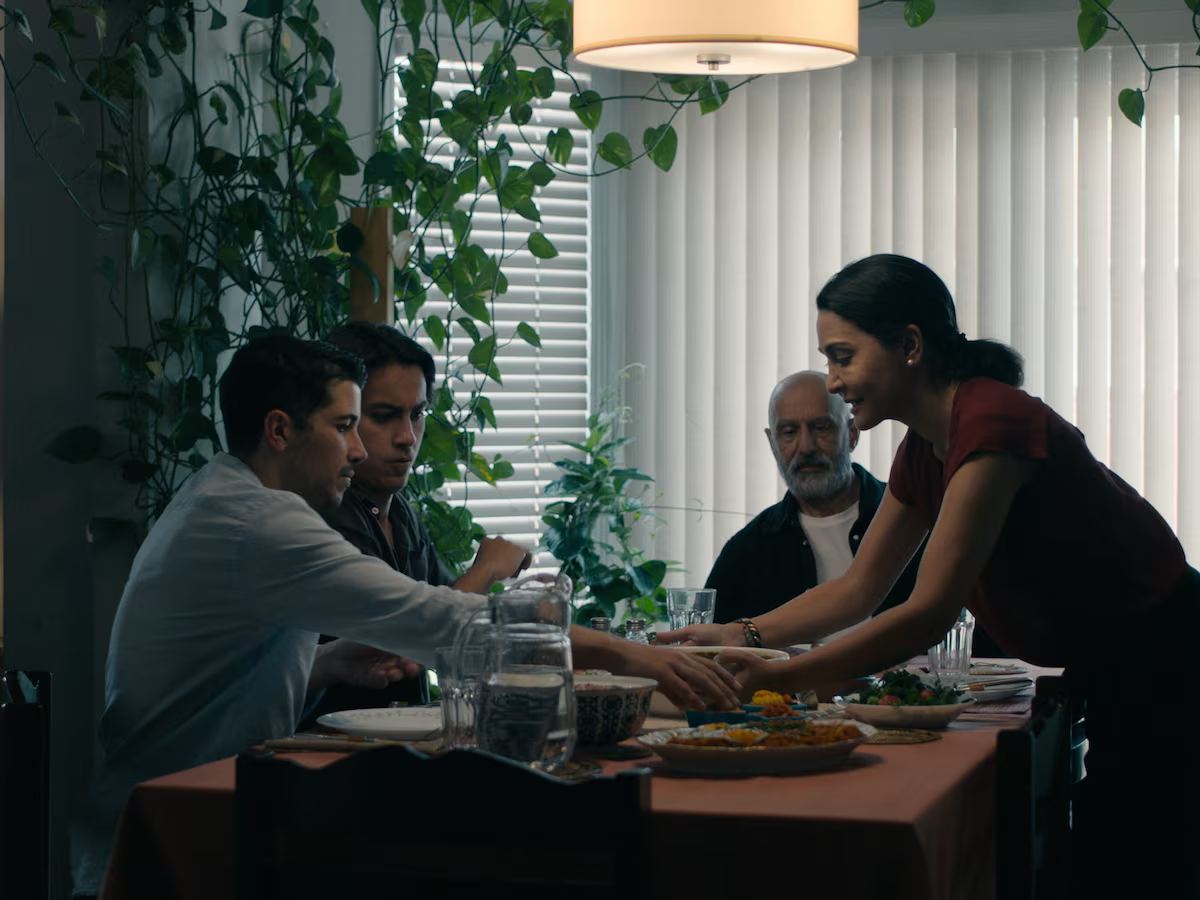
Amir (Alireza Shojaei) is a cook in an upscale French restaurant in Toronto. He has a degree in Engineering, but finds that kind of work boring. His dream? To open up his own place as the executive chef. In the meantime he works long, gruelling hours in the kitchen. His younger brother Mahyar (Parham Rownaghi) has no creative drive — his dreams centre around symbols of wealth: a beautiful woman, a Ferrari to drive or a Rolex watch on his wrist. He’s a crypto bro, who still lives in their parents’ home. Amir regularly eats family dinners with Mahyar, his Mom (Mitra Lohrasb), and his Dad (Gus Tayari) The rest of his free time he spends with his lover a married woman with whom he’s having a secret affair. But his life — and that of his family — comes in the form of an unexpected death. His and his brother’s childhood doctor — who they haven’t seen in decades — has left his entire substantial fortune to Mahyar. There is a new degree of tension in the family, between Amir and his father, and between his parents. Only Mahyar seems blissfully unaware. What is going on, and why won’t his parents talk about it? And can a trip to Niagara Falls provide the answers to Amir’s questions?
His Father’s Son is a family drama set within Toronto’s large Iranian-Canadian community. It feels at first like another look at the immigrant experience in North America, and the clash between traditional parents and their sons who want to break
free. But wait! This is not how it turns out at all. It gradually gets more complex, emotionally powerful and surprising. And these changes are not sudden or in your face, they’re subtle, unspoken, in the spaces between what you see, the elliptical passage of time.
The acting — with dialogue in Farsi and English — is terrific all around, but especially Gus Tayari, Mitra Lohrasb, and Alireza Shojaei in the lead role. This is Moaphi’s first film, and though quite short (under 90 minutes) it shows an unexpected maturity, the kind you’d see in films by Asghar Farhadi or Kore-eda Hirokazu.
His Father’s Son is a well-made drama.
Bride Hard and His Father’s Son both open this weekend in Toronto; check your local listings. Needles and Pins opens theatrically next week in the US, and on VOD in Canada.
This is Daniel Garber at the Movies, each Saturday morning, on CIUT 89.5 FM and on my website culturalmining.com.
Three generations. Films reviewed: My Dead Friend Zoe, Exhibiting Forgiveness
Hi, this is Daniel Garber at the Movies for culturalmining.com and CIUT 89.5 FM.
It may be the closing of Black History Month, but there are still good movies opening this weekend. So this week, I’m looking at two new American movies, about three-generation families. There’s an Army vet with PTSD whose grandpa has dementia; and an artist with a young son whose dad is addicted to crack.
My Dead Friend Zoe
Co-Wri/Dir: Kyle Hausmann-Stokes
Merit (Sonequa Martin-Green) is a US Army Vet who lives in Portland, Oregon. She was a lightweight vehicle mechanic in Afghanistan, but hasn’t done much since she was discharged. The fact is, like many vets she is depressed and suffers from PTSD. That’s why she goes to a military support group especially for people like her. And she always brings her best friend and fellow vet Zoe (Natalie Morales) with her. Zoe’s the only one who could understand what she’s been going through. But to the group leader, Dr Cole (Morgan Freeman) that’s not enough. He wants her to tell them all what’s the matter. You see, Zoe is dead, and Merit’s the only one who can see her. And unless she shares with the group, Dr Cole won’t sign the form keeping her out of jail.
Then she gets a long distance phone call from her mom
(Gloria Reuben). Merit’s Grandpa (Ed Harris) has lived alone in a beautiful lakeside home outside of Portland since Merit’s Grandma died. He was spotted wandering on a country road near his house. For Merit’s mom, that means he has dementia and so, for his own good, he has to be locked up in a nursing home.
But Grandpa is as stubborn as Merit. They’re both war vets — he’s the one who inspired her to sign up — and they carry similar mental scars. Will Grandpa agree to leave his home? Can Merit ever admit her terrible secret? And why is Zoe still around?
My Dead Friend Zoe is a gentle comedy-drama about the very serious effects war has on American soldiers, and the multigenerational trauma it brings to a mixed-race family. (Like most war movies, it never mentions the people they killed on the other side.) The movie is divided among flashbacks to Merit and Zoe in Afghanistan; Merit and (dead) Zoe in the present day; and the time spent with her Grandfather. Part weeper, part comedy (plus a tiny bit of romance) it has big name stars — like Ed Harris and Morgan Freeman — but not all that much happens. It’s not bad — I like Sonequa Martin-Green and Natalie Morales as Merit and Zoe, and their relationship is the most interesting part of the story — but as a whole, the film is missing its drive.
Exhibiting Forgiveness
Wri/Dir: Titus Kaphar
Tarrell (André Holland) is an artist who lives with his nuclear family in a pretty American suburb. His wife Aisha (Andra Day), also an artist, is a singer-songwriter, and they both adore their three-year-old son. Tarrell paints realistic aspects of his personal history inspired by his own memories and snapshots. They’re painted on enormous, larger-than-life canvases, mounted on the towering walls of their studio. His last show was a smashing success and his agent is pressing him for another (lucrative) show, ASAP. But the images in his paintings are not bucolic… they recall past traumas that Tarrell lived through but has yet to deal with. He frequently wakes up in bed, screaming from night terrors.
Meanwhile, in a bad part of town, La’Ron (John Earl Jelks) a homeless addict with a long, grey beard, struggles to make it through each day. He ekes out his meagre existence collecting spare change for shining hubcaps and washing cars outside a
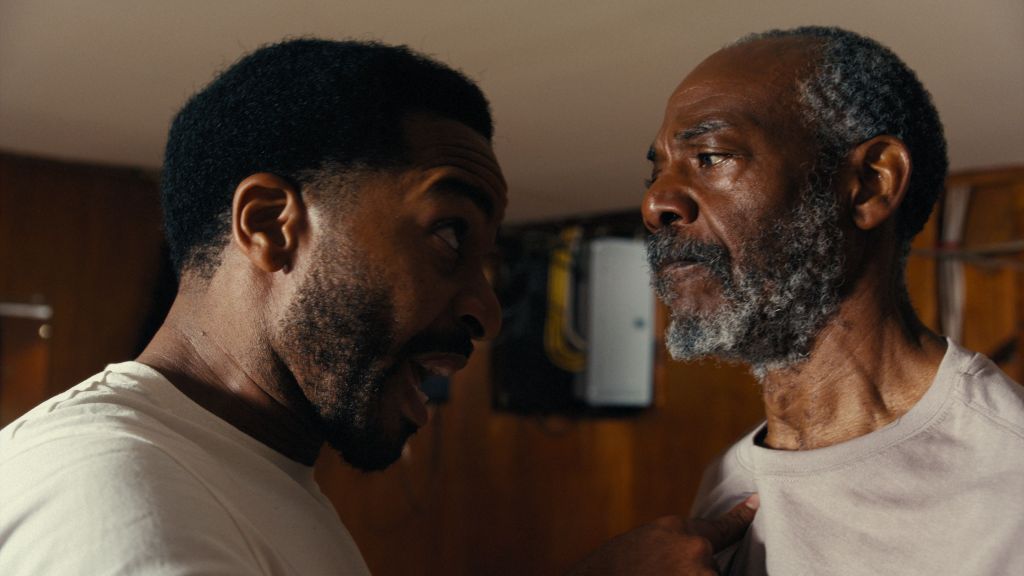
skid-row liquor store. But when he ends up in hospital, near-dead after a severe beating by a stickup crook, he decides it’s time to go clean. His brother offers him temporary shelter, and sends him to rehab. His estranged wife Joyce (Aunjanue Ellis-Taylor) forgives him once again in hopes of future familial reconciliation. But what does homeless La’Ron have to do with artist Tarrell? He’s his father, and bad blood flows between them. He taught his son that as a black man, no one will care about him, no one will help him, and unless he gets tough and works extra hard, he’ll never survive and no one will care. But to Tarrell, the abuse visited upon him by his father was mean, self-serving and
sadistic, exploiting his son’s labour to pay for his crack habit. And now La’ron shows up at his door again — what is it he wants now? Can father and son talk honestly? Has La’ron’s nature change? Can Tarrell ever forgive him? And can this extended family be saved?
Exhibiting Forgiveness is a multigenerational look at the hidden fissures and cruelty of masculinity unintentionally visited by fathers upon their sons. It’s rich and moving in its portrayals. The story is told both as a drama and as an artist’s representation of current and past events. We see Tarrell paint three youths; one of them his younger self (Ian Foreman). He later erases two of them by obliterating their images with whitewash on the canvas. In another he cuts his teenaged self out of a painting with an x-acto knife, later draping the missing image on a chair,
So I’m watching this movie with the striking canvases in the paintings — this is not just anonymous crap-art made-up for the movie, it’s the real stuff — but when Tarrell violates the art by splashes white paint or cutting it up… I was a bit disturbed, thinking, OK, the director is making a point, but he’s also destroying another artist’s work. So I looked him up afterwards: The director is an artist, the paintings are his, and cutting up and altering his own canvases is an integral part of his work. He’s primarily an artist, and this is his first film. Watching the movie, I liked the passion of the acting and the emotional (and physical) violence in the characters they portrayed. But once I connected it with Titus Kaphar’s physical art, it suddenly became something much bigger than the sum of its parts.
Exhibiting Forgiveness is an impressive first feature.
My Dead Friend Zoe opens this weekend in Toronto; check your local listings; and Exhibiting Forgiveness is now available on VOD.
This is Daniel Garber at the Movies, each Saturday morning, on CIUT 89.5 FM and on my website culturalmining.com.
Remote houses. Films reviewed: Anacoreta, Eat the Night + TBFF!
Hi, this is Daniel Garber at the Movies for culturalmining.com and CIUT 89.5 FM.
February is Black History Month, the perfect time to check out Toronto’s Black Film Festival. It features movies, docs and shorts from Canada and around the world. Like Karen Chapman’s Village Keeper a drama set in Toronto’s Laurence Heights neighbourhood, about an overprotective mom with her two teenage kids who are forced to move into their grandmother’s crowded apartment. And in the documentary feature category, Tara Moore tells the history of apartheid South Africa and how it affects that country now, in Legacy: The De-colonized History of South Africa. Toronto Black Film Festival is running now through February 17th at the Carlton Cinema.
But this week, I’m looking at two new movies, from Canada and France, about remote houses. There’s a group of friends at a haunted cabin in the woods, and a teenage girl and her brother living in a world that only exists online.
Anacoreta
Co-Wri/Dir: Jeremy Schuetze
It’s a beautiful cabin in a remote part of Vancouver Island. Jeremy (Jeremy Schuetze) is there with three friends Antonia (Antonia Thomas), Matt (Matt Visser) and Jess (Jess Stanley) for one last look at his late grandfather’s cabin before it’s sold. It’s a beautiful old building overlooking pristine blue waters and mountains rising dramatically right behind them. It’s like paradise: they grill sausages and play beer pong, pick low-hanging fruit while watching a black bear cub sun itself on the grass. But despite all the natural beauty, something is creepy here. Antonia sees a truck following them whenever they’re driving. They find a dead black cat in their freezer. And things get really spooky when Jess starts sleepwalking. Is this place haunted? The thing is, they’re also there to shoot a film. And some of those scary parts might have been planned and executed by Jeremy, their director, to get some good reactions out of the cast. He’s a bit of dick, and the rest of them are not happy about it.
But that’s not all. Jeremy’s grandfather made his fortune
writing Hardy Boys -type mysteries in this very cabin. And when they find an unpublished script things get even weirder. It mentions a place called Afterglow, a mausoleum about seven hours away. That’s where ghosts are said to live just underground. So of course they have to go there and see for themselves. Is it all a hoax? Or is it real? And who will survive this perilous journey?
Anacoreta is a horror movie about four friends in a cabin in the woods and a documentary (or mockumentary) about making a movie. All the actors and crew use their real names, Jeremy and Matt wrote the script, and Anotonia and Jess produced it. Same with the cameraman and the boom, who also appear as characters in the film. But it also takes pains to
remind us they’re shooting a movie, often repeating scenes two or three times, till Jeremy is satisfied. Which partly interrupts the scariness, but also makes the scary parts seem more real, in a found-footage / Blair Witch Project kind of way. Does it work? It kinda does. It makes you believe the movie you’re watching is a disaster project, while at the same time, reminding you it’s all just a scripted story.
Budget? Low.
Indie? Yes.
Acting? Good.
Canadian? Very.
Meta? You bet!
Scary? Not too shabby, especially near the end.
Eat the Night
Wri/Dir: Caroline Poggi, Jonathan Vinel
Apolline (Lila Gueneau) is a high school student with curly reddish hair. She lives with her big brother Pablo (Théo Cholbi). They spend most of their time online, on a role-playing game called Darknoon. It’s an apocalyptic fantasy land, where their avatars live exciting lives, killing thousands of competitors in exotic sword fights. Apo much prefers Darknoon to real life. At school she’s an ordinary girl somewhere in France. Online she’s an anime figure with enormous breasts and sharp, pink leather spikes coming out of her shoulder. Pablo’s avatar has pierced nipples and carries a sabre. Apo rides on the back of a giant blue cat she tamed. In real life, Pablo drops her off at school each day on his acid-green Kawasaki. Their mom’s gone and their dad is never around, so they take turns cooking for each other. But the tide turns when Darknoon announces
it’s shutting down, permanently, on the Winter Solstice, just a few weeks away. Apo is devastated.
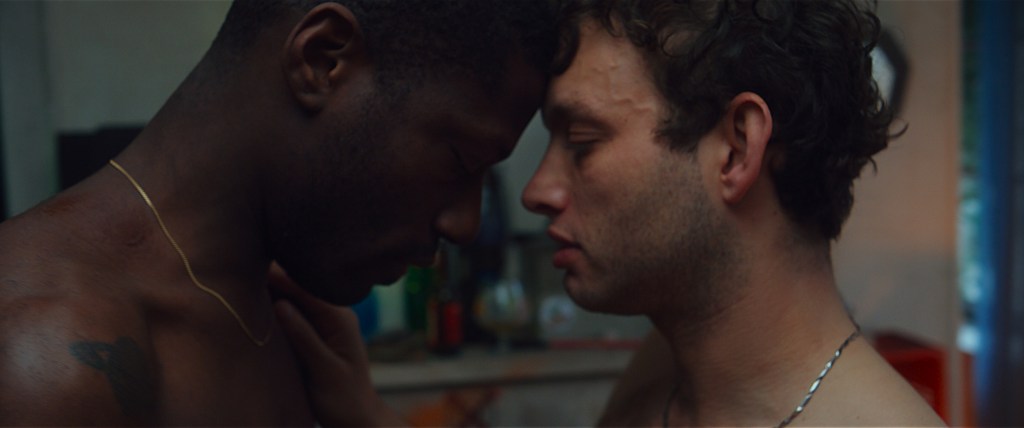
Pablo also has a side hustle selling colourful little pills at clubs and parties. It’s a one-man operation using a metal crank-press to turn out tiny batches of uppers, molly and acid, one by one. But when a big-time dealer sees him encroaching on his turf, his henchmen beat Pablo up. That’s when a stranger appeared to tend his wounds and wipe up the blood. His name is Night (Erwan Kepoa Falé). Pablo needs a bodyguard and a business partner. Night quits his job, and moves in, and soon they’re having passionate, violent sex in Pablo’s hideaway. But Darknoon’s last day is coming soon and the gangster are gathering forces to find and kill Pablo. Can Apo and Pablo leave Darknoon in a blaze of glory? And in the real world, can Pablo and Night permanently leave this crappy town and go somewhere safe and new?
Eat the Night is a glorious French thriller about online role-playing games and real-life crime. It’s passionate and tragic. About 25% takes place inside the otherworldly game, the rest in a cinematically cool, louche real world. Two very different places but visually harmonious. And as the movie progresses characters increasingly appear in the game as like their actual selves. Lila Gueneau plays Apo as a young artist who lives in an animated, comic book world complete with an elaborate pink cos-play outfit. As Pablo, Théo Cholbi is a nihilistic fighter/criminal with a pet green snake. As his lover and defender Night, Erwan Kepoa Falé is kinder and gentler but just as dangerous. Eat the Night (under the even more carnal title Devore la nuit) played in the Directors Fortnight at Cannes. a very violent and highly sexual film.
I think it’s great.
Eat the Night is playing at the Revue Cinema in Toronto on Feb 19, and opens at the Carlton and Yonge/Dundas on the 21st; check your local listings. Anacoreta will be available on demand starting the 21st.
This is Daniel Garber at the Movies, each Saturday morning, on CIUT 89.5 FM and on my website culturalmining.com.
Disappeared. Films reviewed: Dark Match, I’m Still Here
Hi, this is Daniel Garber at the Movies for culturalmining.com and CIUT 89.5 FM.
You may have heard about Sook-Yin Lee’s indie movie Paying For It, starring Dan Beirne as graphic novelist Chester Brown, and Emily Le as Sunny, modelled on Sook-yin herself as a TV VJ in the 1990s. It’s about their relationship after they broke up, when Chester decides only to sleep with paid sex workers. I interviewed Sook-yin and Dan way back in August on this show, and later ranked the movie on my Best-of-the-Year list. Well, good news: you can finally see Paying for It on the big screen starting this weekend. Check it out, it’s very cool, very indie and very local.
But this week I’m looking at two other new movies: a family drama set in Rio de Janeiro in the 1970s, during the military dictatorship; and a horror movie about pro-wrestlers in the sticks of northern Alberta in the 1980s.
Dark Match
Wri/Dir: Lowell Dean
It’s 1988, and a team of pro-wrestlers are getting ready for a big match in a small town somewhere north of Edmonton, Alberta. They’re there under the direction of a sleazy promoter named Rusty Beans (Jonathan Cherry). The wrestlers have worked together for years and know all the rules: the good guys win and the heels lose. This goes for men and women alike. And Nick — aka Miss Behave (Ayisha Issa) — doesn’t like it. She’s a damn good wrestler and wants some wins… along with a raise. But it’s always Kate the Great (Sara Canning) who gets the cheers while she gets the boos. The only ones she can complain to are the enigmatic Enigma (Mo Jabari) who never speaks or takes off his lucha libre mask… and Joe. She spends most of her off-time with Mean Joe Lean (Steven Ogg) a veteran wrestler, and a heel like her. It’s ambiguous whether they’re a couple or “friends with benefits”. Either way, they keep it on the down low. But (back to the story) everything went wrong when she lost her temper in the ring, which left her facing a pay cut and maybe losing her job altogether. Until, out of the blue, Rusty comes by with some good news for a change. They’ve all been offered a gig in a village they’ve never heard of somewhere up north. It pays really well, maybe even a cut of the door. It’s for a dark match — a special wrestling show, for their eyes only, with no cameras present. So they all pile into Rusty’s old rusty van and head into the sticks. When they get there, things seem a bit fishy. Joe think’s they’re all
rednecks or Jesus freaks, led by a mysterious leader in a cowboy hat (Chris Jericho).
But hey, a gig’s a gig. Things get stranger the night before the big event. They stumble into some kind of weird orgy involving handcuffs, a hot tub, a threesome, a suckling pig, and some glowing green plonk. They wake up the next morning with aches and pains all over. But that’s just the beginning. The match is not what they’re used to. There are armed guards with AK47s standing outside the locked door of their green room. And the wrestlers aren’t coming back after their match! What’s going on… and why? Miss Behavin’, Mean Joe Lean and Enigma realize they have to do something… but can they stand up to a crowd of bloodthirsty satanic fans?
Dark Match is a horror movie about a wrestling match gone wild at the headquarters of a bizarre religious cult on the Canadian prairies. It’s bloody and gory with a hint of the
supernatural at work. The cast is composed of both professional actors and pro-wrestlers (who, as we all know, do their own fair share of acting). It’s loaded with 80s music, big hair and grainy video footage with lurid red lighting. I was surprised how much I liked this sleazy, gritty B-movie, and I’m not even a wrestling fan. Of course you have to be comfortable with extreme violence, blood and death — it’s that kind of horror — but it’s also quite funny and goofy, too. So if you’re jonesing for some western-Canadian gore, Dark Match is it.
I’m Still Here
Dir: Walter Salles
It’s the early 1970s in Rio de Janeiro, Brazil. The Paivas are an upper middle class family who live so close to Leblon beach they can walk there barefoot. Eunice, their mom (Fernanda Torres) loves to float in the waves; she finds it relaxing. With five kids to take care of, she needs a bit of down time. Rubens Paiva (Selton Mello), the dad, is an engineer and former congressman for the Labour Party. He loves whisky, cigars and playing foosball with the kids. His firm is working on a huge project, an underground tunnel. But they still find time to get together with their close circle of friends and families: intellectuals, journalists, artists and activists, all on the left. Then there are the five kids: four girls: Veroca, Eliana, Babiu, and Ana, and one boy, Marcello. They love beach volleyball, soccer, pop music and a fluffy dog they find on the beach. Rubens names him Pimpão, after Verona’s shaggy friend.
But a dark cloud hangs over their otherwise idyllic lives. Brazil is ruled by a right-wing military dictatorship and they’re using a series of kidnappings of European diplomats to question and harass anyone vaguely on the ‘left”. Vera is sent off to London for her own safety. Then one day, five sketchy men invade
their home draw the curtains, and without a warrant drive Rubens away to an unnamed location. When Eunice tries to free him, the government denies they ever took him. It’s up to Eunice to take care of the kids as she tries to find him. Has he been disappeared?
I’m Still Here is the incredibly moving, true story of a Brazilian family, based on the bestselling memoirs of their son, Marcello. While it covers the secret arrest of Rubens Paiva by the military dictatorship it’s also about the repercussions it had on the lives of Eunice, their entire family, their friends, and the country of Brazil as a whole. And that’s where it hits you — the intimate details of a remarkable family’s everyday lives: the super-8 movies they record, the records they listen to. I though it was going to be just an historical retelling of an important event. But it’s actually about everything, good and bad, that the family goes through. Now I’m not Brazilian, I don’t live on a beach in Rio, but for some reason I totally identified with this family, I felt a real connection.
Walter Salles directs an epic movie like this every decade or so, films like The Motorcycle Diaries and Central Station.
Apparently he had personal ties to the Paiva family as a young man. Fernanda Torres gives an amazingly nuanced performance as Eunice, that had my eyes tearing up. I’m Still Here has been nominated for three oscars — best actress, best picture and best foreign film — and rightly so. I can’t say enough good things about this movie.
Dark Match and I’m Still Here are both opening this weekend in Toronto; check your local listings.
This is Daniel Garber at the Movies, each Saturday morning, on CIUT 89.5 FM and on my website culturalmining.com.
Unobtainable, unsustainable, inevitable. Films reviewed: Bookworm, Monkey on a Stick, Smile 2
Hi, this is Daniel Garber at the Movies for culturalmining.com and CIUT 89.5 FM.
Toronto Fall Film Festival season continues with Rendezvous with Madness presenting docs and dramas, features and shorts, about addiction and mental health followed by in-person discussions, starting on October 25th.
But this week, I’m looking at three new films, a kids’ movie, a doc and a horror film. There’s a precocious girl looking for the unobtainable; a group of deranged gurus trying to hold onto the unsustainable; and a pop starch wants to escape the inevitable.
Bookworm
Co-Wri/Dir: Ant Timpson
Mildred (Nell Fisher) is a young girl who lives with her mom in New Zealand. She loves reading but hates school. Her desk is surrounded by leather-bound books alongside a microscope, a telescope, a typewriter and a record player. She talks like a grownup, and is obsessed by wild animals. Her dream? To catch on film a black panther said to be roaming in the woods (along with a big fat cash prize for anyone who can take a picture of it.) But her plans all change when her mother is sent to hospital in critical condition following an exploding toaster. That’s when her biological father comes into the picture. He flies in from America to save the day.
Strawn (Elijah Wood) is a professional magician — he prefers “illusionist” — who loves magic: like making small things disappear or pulling coins from behind someone’s ears. Most people are wowed by Strawn’s prestidigitations and puppy dog eyes, but not Mildred. She scoffs at magic and is quick to reveal all his tricks. They two are opposites at heart. If you say “David Copperfield” she thinks of Dickens while he thinks of the
magician. Nonetheless, they are stuck together for now, so he agrees to take her camping. But little do they know of the exciting adventures and frightening dangers — like criminals, wild animals and crazy escapes — that lie ahead.
Bookworm is a very cute coming-of-age adventure about two strangers put together to form a makeshift family. It feels like a cross between a Roald Dahl Matilda and Taika Waititi’s Hunt for the Wilderpeople. It’s shot in the New Zealand wilderness amidst stunning mountains, cliffs and lakes. Nell Fisher is adorable as the obnoxiously mature Mildred, while Elijah Wood is equally adorable as the man-child who won’t grow up. I wanted to see this one because I loved director Ant Timpson’s bizarre debut, the violent comedy Come to Daddy. Bookworm is as different as any film could be but just as enjoyable.
I liked this one a lot.
Monkey on a Stick
Dir: Jason Lapeyre
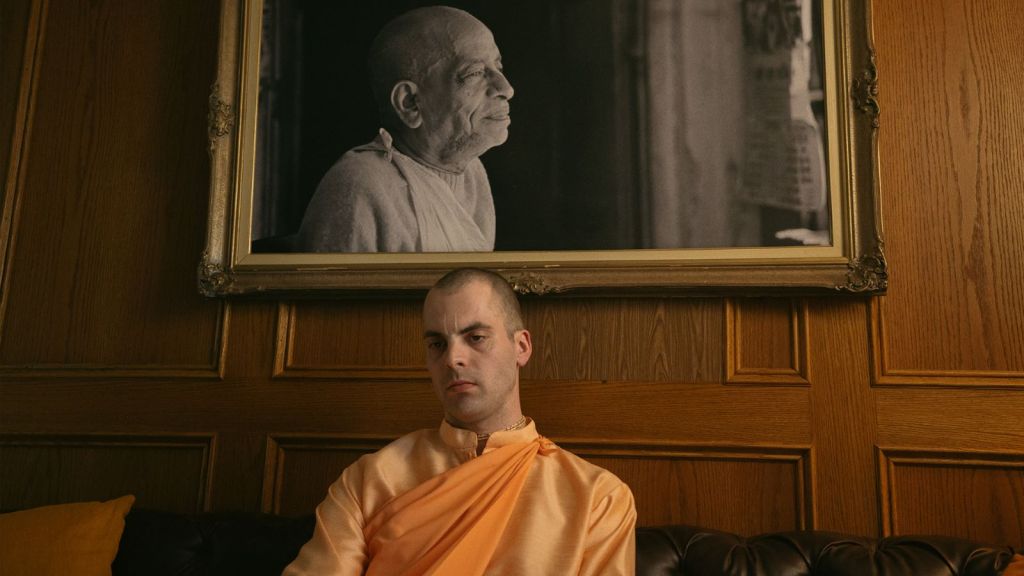
It’s 1965 and America is in high hippie mode. A. C. Bhaktivedanta Swami Prabhupada arrives in New York City from Calcutta. He’s there to sell books, including his own translation of the Baghdad Gita. But he ends up heading the Hare Krishna movement, a vast multinational phenomenon, a religion that espouses dancing, singing and chanting mantras in order to achieve a better afterlife. After picking up many devotees in New York, the movement exploded in popularity once he reaches California. Allen Ginzburg endorses it and George Harrison writes a song about it. Countless people join the religion, throwing away material possessions to dance, chant and collect alms in airports. But when the Swami dies, he leaves behind eleven gurus. That’s when things start to fall apart. This documentary — based on a bestselling book — exposes the crimes and excesses of the Hare Krishna movement in the 1970s and 80s.
One guru — in order to generate more money — sets up a drug ring of devotees instructed to smuggle hash from Pakistan to Canada. They have ties to the mob, leading to a series of violent crimes until it is finally exposed. Another guru collects automatic weapons, and goes on a shooting spree in California. A third guru — a self-declared Swami — the scariest of them all, builds himself an ornate golden castle in West Virginia, while his disciples — who have given away all their worldly
possessions — live in a shanty town beside the castle without toilet paper or plumbing. He later plans murders and is suspected of molesting children.
In fact, the movement as a whole is riddled with problems. Women are treated as inferior beings who distract male practitioners from their religious obligations. Homosexuality is strictly forbidden as is all sex outside marriage. And heavy censorship prevails — no TV, magazines, newspapers, movies, or books are allowed, except for one official newspaper. And by the second generation — the 1970s and 80s, when most of the documentary takes place — kids are sent to schools with teachers who have no training. They lock kids in dark closets or dump them in trashcans as punishment, among even worse crimes.
Monkey on a Stick is a documentary that looks at crimes of the Hare Krishna movement. It’s told using talking heads — including former devotees — period footage, and many reenactments, with actors visually demonstrating what the narrators are talking about. There’s also a series of random people sharing their views on religion, God and the afterlife. Though quite disturbing in parts, on the whole, it’s a fascinating story that exposes events I had never heard about before.
Smile 2
Wri/Dir: Parker Finn
Skye Riley (Naomi Scott) is a pop superstar, about to launch a worldwide tour. She lives in a luxury apartment on Park Avenue, and can buy anything she wants. She’s busy 24/7 at dance rehearsals, talk show appearances and autograph signings, under the constant supervision of her stage mom (Rosemarie DeWitt) and her PA (Miles Gutierrez-Riley). It’s her big comeback, after a year of rehab. This follows a bout of addiction culminating in a terrible car crash that killed her boyfriend and put her in intensive care. A year later, she still suffers from intense pain, pain so bad she is forced to buy opioids on the sly. But everything changes when she witnesses her high school friend (and drug supplier), Lewis (Lucas Gage) kill himself in front of her eyes in the most gruesome manner imaginable. And he dies with a rictus grin plastered on his face.
That’s when things start to go bad. Everywhere she looks she
sees that awful smile. It’s like she caught a disease by witnessing her friend’s death. She starts seeing people who aren’t really there, and experiencing events that never happened — even though they feel so real. She begins to doubt her sanity. It’s like some alien presence has lodged itself into her brain. Her friends, family and colleagues look at her in a strange way, even as she fears she’ll end up dead in a matter of days, with that same awful smile. Can she break this smile cycle? Or is she headed for insanity and death?
Smile 2 is a genuinely-scary psychological thriller/ horror about fame, celebrity, and a deadly condition passed on from person to person. It’s also one of those Hollywood rarities: a sequel that’s demonstrably better than the original. Naomi Scott is terrific as Skye, a punky, self-centred celebrity; Skye’s not just a horror movie screamer, she’s a real character, complete with a psyche and a believable back story. The movie itself is really well made, with beautiful art direction, cool choreography, and ingenious camerawork and editing, where a scene can flip, elliptically, from an elevator ride to an overhead view of the street. Warning: it’s quite violent, so if you don’t like seeing blood and guts, stay away. But otherwise, Smile 2 is a really good, heart-pounding genre movie.
Bookworm, Monkey on a Stick and Smile 2 all open this weekend in Toronto; check your local listings.
This is Daniel Garber at the Movies, each Saturday morning, on CIUT 89.5 FM and on my website culturalmining.com.
Current cinema. Films reviewed: Destroy All Neighbours, Freud’s Last Session, T.I.M.
Hi, this is Daniel Garber at the Movies for culturalmining.com and CIUT 89.5 FM.
It’s “award season” when prizes are handed out to the best — or most widely publicized — movies. But not every film is prestigious or a blockbuster. So this week, I’m looking at three new movies — one each from the US, Ireland and England — that might otherwise fall through the cracks. There’s a robot with human traits, a music producer turned serial killer, and a psychoanalyst talking about God.
Destroy All Neighbours
Wri/Dir: Jonah Ray Rodrigues
William (Jonah Ray Rodrigues) lives in a rundown apartment with his girlfriend Emily (Kiran Deol) a lawyer. He’s tall, skinny, and wears unfashionable clothes and nerd glasses. He works in a studio at the soundboard, helping bands record their music. But sometimes he feels like he’s just a knob- turner, going through the motions. His real passion is recording the ultimate prog-rock album, and is constantly coming up with new ideas, but never finishing it. Emily encourages him to give up and move on, but he feels he has to do it. But he’s getting more and more tired and frustrated by the people around him. At work, his boss is constantly ragging him for being late. And the latest client, Caleb Bang Jansen is insufferable. Even the panhandler where he parks his car is getting on his nerves. At home, Eleanor, the elderly pothead superintendent (Randee Heller) is constantly calling him for help with the fuses. Another neighbour, Phillip, lets his pet pig roam the halls. But worst of all is the new tenant next door. Vlad (Alex Winter) is hideously ugly, aggressive and incredibly loud, playing non-stop euro disco all night long. Vlad lifts weights using buckets of cement attached to his barbell. He’s a scary guy, William is passive aggressive and terrified of face to face confrontations.
When he finally visits Vlad to ask him to turn down the music, they get in a fight and somehow Vlad ends up impaled on a stake, and — accidentally — decapitated!
William doesn’t know what to do, but finally realizes he has to dispose of the body. But things have changed since Vlad — new bodies keep piling up — always killed unintentionally by him, by strange coincidences. He becomes a serial killer by default, or a serial manslaughterer, as he likes to say.
But when the all the people he killed come back to life, he realizes something really strange is going on. Can William keep his boss and girlfriend happy, record his prog rock album, stop killing people, and living a normal life? Is he destined for a very dark future? Or is he just losing his marbles?
Destroy all Neighbours (the title says it all) is a comedy/horror movie, with an emphasis on in-your-face, gross-out humour. So there’s lots of disgusting blood and
gore, but it’s always so exaggerated it’s funny, not scary, in the manner of Monte Python or Army of Darkness. Jonah Ray Rodrigues is the writer/ director/star and the current host of Mystery Science Theatre 3000. I admit it’s an acquired taste, and some of the gags and schtick fall flat, but I was laughing more than not. I happen to like that kind of humour (in moderation) but, admittedly, it’s not for everyone. So if you’re into bloody horror-comedy set in L.A.s skid row, or even if you’ve ever had annoying neighbours, I think you’ll love Destroy all Neighbours.
Freud’s Last Session
Co-Wri/Dir: Matt Brown
It’s September, 1939. Germany has invaded Poland and Great Britain is about to go to war. Sigmund Freud (Anthony Hopkins) and his daughter Anna (Liv Lisa Fries) left their homes and vocations in Vienna after the Anschluss — the unification of Austria and the Third Reich, and moved to London. His office is decorated with the art and bric-a-brac of home: Persian rugs, African fertility statues and Catholic saints. Anna continues to research and give lectures on psychoanalysis and child psychology, but Sigmund, due to his age (he’s 83) and poor health (he’s dying of cancer) rarely leaves his home now. But on this day he has an unusual visitor: CS Lewis (Matthew Goode). Lewis is a don at Oxford where he teaches English and has written a book about Pilgrims Progress. (He later goes on to write The Chronicles of Narnia.) And he’s still suffering from shell shock from WWI. But why are they meeting? Lewis wants to talk with Freud about God and religion. He once was an atheist but now has adopted theism and Christianity as his guiding light. Freud, on the other hand, is a committed atheist and finds all religions equally fascinating and equally false. Still, they have a spirited discussion on a wide range of issues. But certain topics are taboo. For example, Freud refuses to talk about the fact that Anna has a female lover. And Lewis considers his own sexual relationship with his late best friend’s mother as something too private to share. Meanwhile, air raid sirens are going off, Freud is struggling with the oral prosthetic he calls his “Monster” and nobody knows what the future will bring. Will this be Freud’s very last session?
Freud’s Last Session is a fictional historical drama adapted from the successful stage play. There’s no evidence that an elderly Freud and a younger Lewis ever actually met; the story functions more as an intellectual exercise than a theatrical drama. So it’s not captivating, but it did keep my attention. They try to perk it up a bit with flashbacks — Lewis in the trenches in WWI; Freud as a small child — but I found them lacklustre at
best. There are some clever touches, where Freud ends up reclining on the settee while Lewis takes on the analysts role. Of course it has nice period costumes and sets, but the main reasons to see this film is first the topics and second the acting. The topics range from sex to psychoanalysis to theology. Devotees of Freud and/or Lewis may get a kick out of it, but no major revelations here. The acting, though is delightful. Hopkins walks through his usual role — along with a few artfully-placed wunderbars and ja ja ja and das ist gut! so we don’t forget he’s Austrian. Goode is more passionate, fearful and sad. Best of all is German actress Liv Lisa Fries (from Babylon Berlin) as Anna Freud, who gets to rush around London looking for meds for her Dad.
Freud’s Last Session is not bad, but not noteworthy, either.
T.I.M.
Co-Wri/Dir: Spencer Brown
Abi and Paul Granger (Georgina Campbell, Mark Rowley) are married, professionals, double-income, no kids, moving into a beautiful, modern home in rural England. It’s at the end of a long country road, with open staircases, glass walls and a huge garden, all paid for and arranged by Abi’s employer. She’s an engineer who specializes in AI robotic prostheses. She designs the human-looking hands of robots. Paul is currently unemployed, but is in line for a corporate position in London. They’re both looking forward to their first child, and are working hard at it each night.
Now this house is completely on the grid. Everything’s smart — smart windows, locks, heating, computers, lighting — all controlled through a central console, and co-ordinated with their smart watches and phones. The central console, though, is something her company invented. It’s a Technologically Integrated Manservant, T.I.M. for short, or just Tim. Tim (Eamon Farren) is a humanoid robot with perfect male features, blond hair, and artificial intelligence; he’s constantly learning. He’s a prototype: he can cook gourmet foods, do heavy lifting, play the piano, send and answer emails. Abi’s boss is adamant that all his employees have a T.I.M., so they can get rid of the bugs in the system before the upcoming release. Abi, loves her new toy, but Paul is less enthusiastic. Why did T.I.M. barge into their bedroom while they were making love? T.I.M. says Abi’s blood pressure and temperature had risen, he just wanted to make sure she was OK. But Paul suspects T.I.M. of spying on him. He thinks TIM sends messages to Abi whenever Paul visits Rose their only neighbour (Amara Karan), feeding Abi’s suspicious jealousies. And when he catches T.I.M. perving through Abi’s clothes, he knows something is very wrong. Is T.I.M. morphing into something bad? Can a robot even have feelings? And if things go wrong, who will Abi trust: Paul, the fallible human, or T.I.M., the perfect machine?
T.I.M. is a sci-fi thriller about the potential dire consequences of AI given a human form. This isn’t the first humanoid movie — there have been at least a dozen in the past few years — and some of the plot is predictable. And it does have that “pandemic movie feel” to it, with a tiny cast (just four main characters) located in an isolated country setting, but, in this case, it really works. It’s scary, it’s creepy, it’s interesting. It feeds on your worst fears about electronic devices communicating without your knowledge, and the possibility of the singularity, when humans will no longer be essential. I’m not familiar with any of the actors but the cast is good. The storyline is compelling, and most of all, the movie feels believable. So if you ever feel like your smart phone is a bit too smart, you’ll like this scary, sci-fi thriller. It’s a good one.
Freud’s Last Session opens this weekend in Toronto; check your local listings. Destroy All Neighbours is streaming exclusively on shudder.com, starting today; and T.I.M. is now available digitally and on V.O.D.
This is Daniel Garber at the Movies, each Saturday morning, on CIUT 89.5 FM and on my website culturalmining.com.
A New World? Films reviewed: Going In, Poor Things
Hi, this is Daniel Garber at the Movies for culturalmining.com and CIUT 89.5 FM.
December is supposed to be a time for fun and relaxation, so this week, I’m looking at two new movies that you might find fun to watch. There’s a comedy/action movie set 40 years ago in Toronto, and a wild comedic fable set a century ago in Europe.
Going In
Wri/Dir: Evan Rissi
It’s the late 1980s in Toronto. Leslie Booth (Evan Rissi) is a young lecturer who waxes eloquent about Hegelian dialectics to bored college students. He doesn’t smoke, drink or cuss and stays away from drugs. He even goes to bed early if his on-again, off-again girlfriend isn’t spending the night. But everything changes when a strange man, all dressed in black, starts showing up everywhere he goes. Reuben (Ira Goldman) is a Jamaican-Canadian who wears a huge Star of David around his neck. He used to be Leslie’s best friend, going out on the town every night, but haven’t seen each other for five years. And Leslie has been on the straight and narrow ever since.
But Reuben needs his help, and is calling in a favour. His brother has disappeared, and he suspects it’s the work of a Toronto drug kingpin named Feng (Victor D.S. Man). Feng has cornered the market on a highly-addictive pill hitting the streets known as Pearl. Users love the experience, but addicts end up looking like zombies with solid white eyes. Reuben wants to penetrate this Triad and save his brother’s life, but the only way to do it is to get hold of a pair of tickets to Feng’s annual tournament. So Leslie joins with Reuben
and finds himself falling into old habits, snorting coke and frequenting sleazy bars to get more information. But the closer they get to their target the more dangerous it all looks. What is that tournament about? And can they rescue Reuben’s and get out unscathed?
Going In is a Toronto action/comedy movie set in — and in the style of — the 1980s. It’s also a buddy movie with a black guy and a white guy, like Lethal Weapon, Beverley Hills Cop or Silver Streak. But unlike those Hollywood hits, Going In is a micro- budget movie — we’re talking tens of thousands not hundreds of millions — with unknown actors and minimal special effects. Evan Rissi
wrote, directed and stars as Leslie, while Ira Goldman who plays Reuben also produced it. And Victor D.S. Man as the villain looks like he walked straight out of an old Hong Kong flick.
Surprisingly, this movie works. It’s clearly low-budget but it doesn’t seem slapdash. While it plays into a lot of film conventions and stereotypes, there are some very original scenes that I’ve never seen before — like the tournament they’re trying so hard to get into (no spoilers) It also has a good soundtrack, a b-ball match, some fight scenes and even a psychedelic out-of-body experience. And it’s not afraid to have the CN Tower constantly popping up in the background, to remind us that it’s Toronto, not NY, Detroit, Boston, Phillie or any of the other cities Toronto usually pretends to be in movies shot here. Keep in mind that this is a DIY movie, not from a big studio, and you might get a kick out of it.
Poor Things
Dir: Yorgos Lanthimos
Max McCandles (Ramy Youssef) is a medical student in Victorian England. He regularly attends surgical demonstrations by Dr Godwin Baxter (an unrecognizable Willem Dafoe) a controversial scientist with outrageous ideas. Baxter’s face is grotesque, like something that was cut into pieces and sewn back together. But the doctor takes a liking to shy Max, and hires him to live in his home and look after his daughter Bella (Emma Stone). Bella is a beautiful woman in her late 20s, but who behaves like a recently-hatched duckling just learning to walk. She has a vocabulary of just six words, and is given to stabbing, tearing or biting anything put in front of her. But with Max’s help, she quickly learns to speak and think, and is full of questions about the world. She is not allowed out of her home — it’s too dangerous, they say. You see, Bella is an adult woman with a baby’s brain implanted in her skull, one of the mad scientist’s latest experiments. As she matures, she and Max fall in love and plan their wedding — though still in a strictly patriarchal relationship (she refers to her father/creator Godwin Baxter as God for short.) But before they can marry, a scoundrel named Duncan Wedderburn (Mark Ruffalo) shows up on the scene. He sweeps Bella off her feet with the introduction of something new into her vocabulary — sexual pleasure — which she greatly enjoys. He
promises endless sexual satisfaction and rollicking new adventures if she follows him on his trip. Bella realizes Duncan is a cad and a rake but agrees to go with him anyway, postponing her marriage to Max indefinitely or at least until after she sees the world.
She sets off on this journey with Duncan aboard an ocean liner docking in various ports which she naively explores and learns from what she sees. She’s the ultimate fish out pf water, a novelty to all she meets, because she speaks so frankly and forthrightly. Bella has yet to learn basic societal rules about class, money, capitalism, sex, nudity and modesty. She explores this strange world scientifically and logically, much to Duncan’s dismay. Who is she really and where did she come from? Is sex a market commodity or something more personal? Will her naivety lead to disaster? Or will she return,
triumphant, to London with her innocence intact?
Poor Things is a brilliant social satire about sex, class, feminism, and society. It incorporates elements of 18th century novels like Fanny Hill, Tom Jones and Candide. It’s surreal, absurdist and psychedelic, but ultimately comes across as a fable or a morality play. It’s all filmed on an elaborate set (shot in Hungary), in a weird, steampunk Europe that never existed beneath a sky filled with blimps and zeppelins. (It looks like Terry Gilliam’s movie Brazil.) The costumes are outrageous — Bella has enormous shoulder pads bigger than her head. Emma Stone is amazing as Bella, though Mark Ruffalo overdoes it as Duncan — teetering between funny and ridiculous.
I’ve been following Yorgos Lanthimos’s films since Dogtooth in 2009, and this one revisits many of his earliest themes: absurdist humour; adults who speak awkwardly like small children, and who grow up isolated, never
allowed to leave their home, by a dictatorial, god-like father figure. It feels like Dogtooth Part Two: The Outside World. But now he commands a big enough budget to build ornate sets, costumes and wigs, with dozens of fascinating characters. I’m sure some of you will hate this movie, or be offended by it, but I think it’s absolutely brilliant.
Poor Things opens this weekend in Toronto; check your local listings. Going In is available digitally online across North America, from December 19th.
This is Daniel Garber at the Movies, each Saturday morning, on CIUT 89.5 FM and on my website culturalmining.
Magical kids. Films reviewed: The New Boy, Butterfly Tale, Once Within a Time
Hi, this is Daniel Garber at the Movies for culturalmining.com and CIUT 89.5 FM.
You’ve heard of Peter Pan, right? He’s most famous for not growing up and for believing in fairies. And it’s true, kids are more likely to believe in magic than grown ups. This week, I’m looking at three new movies about the innocence and magic of childhood. There’s a disabled, teenaged butterfly that wants to migrate with his flock; an indigenous boy with magical powers sent to a church-run school; and a group of kids forced to face a fairytale apocalypse.
The New Boy
Wri/Dir: Warwick Thornton (Sweet Country)
It’s the 1940s at a remote Australian Benedictine monastery. Sister Eileen (Kate Blanchett) is excited because there’s a new student arriving soon. She runs the place, ever since the head Benedictine monk died — she keeps this detail a secret from the outside world. The new boy (Aswan Reid) is indigenous, can’t speak English, and has had virtually no contact with white Australia. He has blond hair and brown skin. He sleeps on the floor, not on a bed, and finds forks and spoons a mystery. At the same time, he can conjure up glowing particles to light his way, using just his hands. And he has magical powers: he can speak to trees, and cures people bitten by poisonous snakes.
The sisters teach him out to use an outhouse (which he finds both funny and revolting), and about western ways and foods. Above all, Sister Eileen wants to convert him to Christianity — she lives him deeply, and wants to save his soul. She uses a life-sized wooden statue of Jesus writhing on the cross as the catalyst. She hopes to change him completely, and ultimately to baptize him and give him a Christian name. Will he convert? And what will happen if he does?
The New Boy is a gentle, bittersweet look at religion,
colonization, forced assimilation and residential schools (known as boarding schools in Australia), as seen through one boy’s eyes. I found it both inspiring and tragic. Kate Blanchett is wonderful as the scheming but good-hearted nun, while young actor Aswan Reid is remarkable as the unnamed new boy. (The movie opens with a violent fight between him and a soldier in the bush, just one of many surprising scenes he manages to convey without uttering a single word.) Director Warwick Thornton based it partly on his own experiences as a boy in Alice Springs, and those personal details and feelings come through.
I liked The New Boy a lot.
Butterfly Tale
Dir: Sophie Roy
Patrick (Mena Massoud) is a young monarch butterfly who recently made the transition from caterpillar. He and his best friend Marty are looking forward to joining his village on their annual migration to Mexico. He is especially excited about spending quality time with the girl he’s crushing on, Jennifer (Tatiana Maslany). But there’s a problem. Patrick emerged from his cocoon with mismatched wings, so he’s disabled and can’t fly. And Marty is still a caterpillar. They are teased and bullied by the bigger butterflies as “butter fails”.
Worse still, Patrick’s mom, a leading flier in the “flutter” (what they call their butterfly community) wants him to stay home in the winter. But Patrick and Marty are determined to get there by hook or by crook. Jennifer, a strong flier, is pulling a leaf filled with milkweed so they can all eat on the way. Patric and Marty stowaway aboard that leaf! Little did they know they’ll face tornadoes, big box stores and angry birds posing life threatening dangers on the way. Will Patrick ever learn to fly? Will Marty ever make the transition from caterpillar to butterfly? And will Jennifer get over her hangups?
Butterfly Tale is an animated, coming-of-age road movie
about anthropomorphic butterflies. They’re basically people, with human hair, faces, and bodies but with big butterfly wings coming out of their backs. They wear T-shirts and hoodies, and worry about adolescent insecurities. (They even have to stop the flight along the way to take a leak.) Little kids might really identify with the characters and like this movie; it has good role models for children with disabilities, and deals with environmental issues. The thing is, it’s not original or funny or risky or challenging anywhere, just a typical adolescent drama, where the people happen to be butterflies. I’m not saying it was uninteresting — it kept my attention the whole time — there just wasn’t much to it.
Once Within a Time
Wri/Dir: Godfrey Reggio
Once upon a time, a bunch of happy kids follow the beckoning voice of a goddess onto a stage. After riding a merry-go-round they start to notice strange happenings. An Adam-and-Eve-like young couple in wire masks take a piece of fruit from a sinister looking apple-man, unleashing terrible events. Smart phones generate robots, a chimp in a monkey suit and another in a VR helmet, huge industrial power-towers, a baobab tree exploding into a mushroom cloud. Ecological and geopolitical devastation is at hand! Can we survive the end of this world… or maybe start a new one?
Once Within a Time is a phantasmagorical, magic-lantern fable performed on a two dimensional stage beneath a prominent proscenium arch. It’s equal parts live-action, documentary
footage, still images, and 3-D stop-motion animation.
I first saw Godfrey Reggio’s Koyaanasqatsi as a teenager and the barrage of apocalyptic images of corporate uniformity combined with Philip Glass’s pounding music left deep marks in my psyche. This one is kinder and gentler but still effective. It’s co-directed and edited by Jon Kane with amazing vintage special affects from irises to rear projections to dual spectroscope photos. There are tinted black & white shots, shadow puppets, grotesque masks, and dancing robots
that evoke everything from Georges Méliès to Guy Maddin to the late Peewee Herman’s Playhouse. Who knew the apocalypse could be so beautiful? It’s less than an hour in length, but provides about three times that in intensity. If you can, see it on a big screen and just let the images and music overwhelm you.
Great movie.
Butterfly Tale is now playing in Toronto; check your local listings. The New Boy is a feature at the ImagineNative film festival starting next week. And Once Within a Time is playing tomorrow (Sunday, October 15th, at 5 pm) at the TIFF Bell Lightbox.
This is Daniel Garber at the Movies, each Saturday morning, on CIUT 89.5 FM and on my website, culturalmining.com.
Friends and Lovers. Films reviewed: The Starling Girl, The Eight Mountains
Hi, this is Daniel Garber at the Movies for culturalmining.com and CIUT 89.5 FM.
Spring Film Festival Season continues in Toronto, with Inside-Out opening next week, followed by TJFF in June.
But this week, I’m looking at two new dramas; one from the US, the other from Italy. There’s a fundamentalist young woman in Kentucky looking for love, and two men in the Italian alps looking for the fundamentals of friendship.
The Starling Girl
Wri/Dir: Laurel Parmet
Jem Starling (Eliza Scanlen) is a 17-year-old girl in Kentucky, creative, pretty and burgeoning with sexual urges. She lives in the Holy Grace Christian community under the strict guidance of her parents and Pastor Taylor. She directs her energy into dance, moving her body to express her true feelings. But the dance troupe is supervised every step of the way and the slightest transgression — be it a visible bra strap or a hint of leg — is labeled selfish or sinful. Too many sins and you get shipped off to the dreaded King’s Valley — and they’ve all seen what happens to people sent there.
Pastor Taylor and her parents believe it’s time for “courtship” —
that is Jen spending time with the boy they choose. They set it up but it does not go well. Ben Taylor is immature, gawky and socially inept. His idea of a good time is joking about chicken droppings. In any case, Jen has her eyes on the prize: Owen (Lewis Pullman). He’s charismatic and tanned, just back from Puerto Rico. He’s into meditation more than scripture. The only problem is he’s a Taylor, too, the preacher’s eldest son and he’s already married.
They decide to meet on the sly. There first few times are chaste and pure but the two of them are ready to explode. She’s the only real person he’s ever met, the only girl he feels comfortable with, he says. And Jen is infatuated with him. They start sending text messages or passing little notes to set up secret rendezvous. But there are no secrets in a community this small. Everything leaks out
eventually. Is Jen being manipulated by an older, married man? Can Owen be trusted? And are they really in love?
The Starling Girl is a young woman’s coming-of-age drama about sexual frustration and awakening within a restrictive environment. This is filmmaker Laurel Parmet’s first feature and it’s a doozy. Filled with passion, deceit, secrets and lies, it’s a powerful look through a young woman’s eyes. I’ve never seen Eliza Scanlen before, and just assumed she was discovered in a Kentucky diner — but no, she’s yet another Australian actor bursting onto the American scene (and she’s totally convincing.)
I recommend this one.
The Eight Mountains
Wri/Dir: Felix van Groeningen, Charlotte Vandermeersch
(Based on the novel Le otto montagne by
Paolo Cognetti)
It’s the 1980s in Piedmont Italy. Pietro is an 11 year old boy who goes to school in Turin, but spends his summers with his parents in a tiny mountain village. There he meets Bruno, also 11, who herds long-horned goats and milks cows in the village. They become instant best friends, playing, fighting and swimming in the crystal clear waters of an isolated alpine lake. Bruno even gives Pietro a new name: Biero, which is Pietro, or stone, in the local dialect.
Though their moms are around, both of their fathers are rarely there: Bruno’s dad does construction work in Switzerland, while Pietro’s dad is a chemist at a huge plant in Turin. But he visits when he can — he loves the isolation and grandeur of the mountains, and wants to impart his love of them on his son. He takes him on hikes up the local peaks, recording each visit in a diary. Bruno soon joins their climbs (when he’s not apprenticing to make cheese) and their bonds strengthen each summer. But high school brings big changes — school is in the cities not the villages. And it costs money. Pietro’s parents offer to pay for Bruno to study in Turin. Pietro is offended by them taking his best friend away from the mountains — you’ll ruin him! he says. In any case, Bruno’s father won’t allow it. He puts him to work full-time laying bricks at the age of 13.
Pietro drifts apart from his best friend, and breaks all ties with his family to discover himself. 15 years later, he returns to the village and rekindles his friendship with Bruno. But have they drifted too far apart?
The Eight Mountains is a wonderful novelistic drama about friendship and life in the mountains. The story takes place over two decades, with each role played by three actors, child, adolescent and adult, though mostly as the third. Luca Marinelli (Martin Eden in Martin Eden) is excellent as an almost fragile writer who travels the world looking for his true home, and the eight mountains of the title. (He also narrates the story). Alessandro Borghi plays the
adult Bruno — burly, bearded and gruff — but filled with self-doubt and conflicting emotions.
I don’t speak Italian, but I love the way the film plays with language and dialect, and communicates literary concepts and foreshadowing but without losing its deep, emotional pull. The film is by the Belgian team of Felix van Groeningen (The Broken Circle Breakdown) and Charlotte Vandermeersch, and it fits perfectly with their past work: it’s quite long (2 1/2 hours) with vivid natural scenery, a moving plot and American-style music. If you’re looking for a good, juicy drama about adult friendships, this is the one to see.
Great movie.
The Eight Mountains and The Starling Girl both open this weekend; check your local listings.
This is Daniel Garber at the Movies, each Saturday morning, on CIUT 89.5 FM and on my website, culturalmining.com.
leave a comment