Bad Hombres. Films reviewed: Silent Night, Deadly Night, Dust Bunny, One Battle After Another
Hi, this is Daniel Garber at the Movies for culturalmining.com and CIUT 89.5 FM.
It’s easy to root for heroes with clean-scrubbed cheeks and virtuous demeanours, but they make for boring movies. Much more challenging are films where the main characters are anti-heroes, fatally flawed and yet still compelling.
So this week I’m looking at three movies featuring sympathetic portrayals of bad hombres. There’s a murderous Santa Claus, a retired revolutionary, and a monster who lives under your bed.
Silent Night, Deadly Night
Wri/Dir: Mike P. Nelson
It’s Christmastime and like every year Billy Chapman (Rohan Campbell: Halloween Ends) is on the road again. He’s a drifter in his early 20s, picking up work wherever he can find it. He ends up in a small town, and finds work in a store specializing in Christmas ornaments and memorabilia. He forms a crush on Pamela (Ruby Modine), the young woman who runs the store with her dad. But this place is doubly significant because Christmas is crucial to Billy’s self-identity. You see, when he was just a child, he witnessed his parents brutally murdered by a man dressed as Santa Claus. And now he has taken on that role for himself. Dressed in a Santa suit and wielding an axe, Billy kills one person per day, following his advent calendar, until Christmas.
So is Billy a psychopathic serial killer? Well, yes… but, like Santa, he punishes naughty people but lets good ones have a merry Christmas. Everyone he murders is bad… real bad. And how does he know this? A voice in his head tells him who to
kill. But things change when he finds himself falling in love with Pamela. And the feelings seem mutual; they somehow click. (She has Explosive Personality Disorder, sort of like his murder sprees only much less violent). Billy thinks it’s time to settle down, maybe give up all the killing. Can Billy ignore the nagging voice in his head? What will happen if he stops killing bad people? And how will Pamela react if she ever finds out the truth about Billy?
Silent Night, Deadly Night is a classic, slasher-horror Christmas movie about a young killer Santa. It’s ostensibly a remake of an 80s film of the same name (and its sequels) but updated to fit our times. It’s bloody, violent and sometimes disgusting but always in a funny, retro-camp style. I’m talking red & black freeze frames, and old-school soundtrack. And it’s shot in Manitoba, complete with hockey games and lumber yards. Ruby Modine is hilarious as Pamela, and Rohan Campbell manages to make his serial-killer Santa almost sympathetic.
Not your typical Christmas flick but if you’re looking for a funny, gross-out slasher, you can’t go wrong with Silent Night, Deadly Night.
Dust Bunny
Wri/Dir: Bryan Fuller
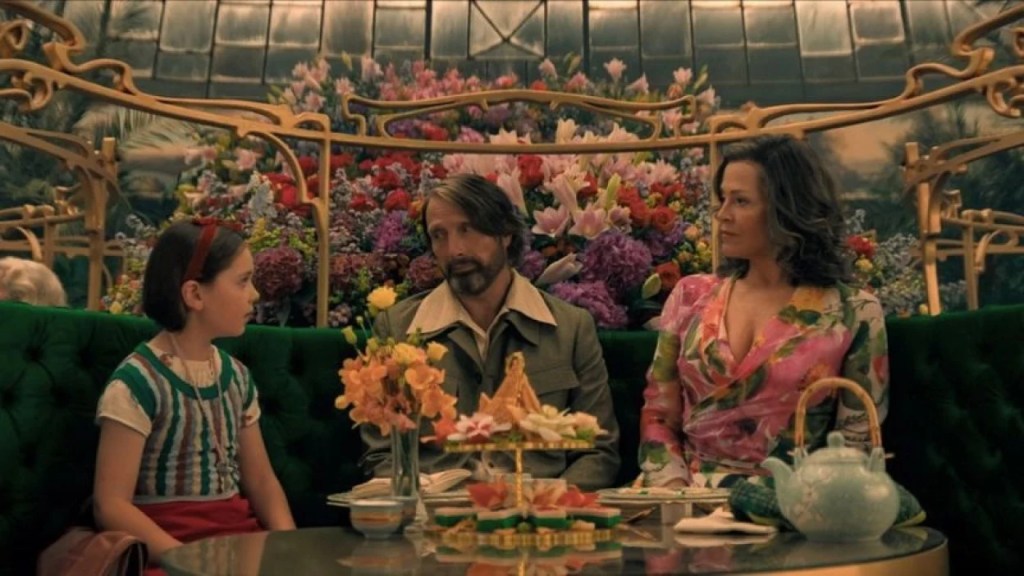
Aurora (Sophie Sloan) is a little girl who lives in a beautiful, antiquated apartment in an unnamed city. She is brave and resourceful with a wild imagination. Aurora has all the clothes, toys and games any girl could ever want. So why is she always so frightened? Because there’s something scary under her bed that won’t go away. It’s a dangerous monster that lives beneath her parquet floorboards, and she’s convinced he’ll eat you up if you ever step on the floor at night. So she gets around on a wooden hippo with wheels, using her mop as a paddle. Her parents tell her repeatedly that there’s nothing under her bed, just dust bunnies, but Aurora refuses to listen. She ends up sleeping on her outdoor fire escape to keep ahead of the monsters. One night she follows a stranger down a dark ally, where she witnesses him slaughtering a dragon. Here’s someone who can keep her safe from the monster — and he lives in her building! When her parents disappear one night she knows she needs help to stay alive. So she attempts to hire her downstairs neighbour (Mads Mikkelsen: The Promised Land, Indiana Jones and the Dial of Destiny, Riders of Justice, Another Round, The Hunt) as a hitman, to kill the monster hiding beneath her bed.
Problem is he doesn’t believe in monsters; he thinks someone was sent to get him, and killed her parents by mistake. But in
the end, he agrees to help her. This news gets her boss very angry. Uptight and evil Laverne (Sigourney Weaver) wants Aurora dead, since she witnessed one of his assignments (he’s a professional hired killer). Soon others start appearing at her door including a suspicious guy with a moustache (David Dastmalchian) and a dressed-to-kill social worker (Sheila Atim). Who are all these people really? And will no-one listen to Aurora about the monster under her bed?
Dust Bunny is a whimsical horror movie seen through the eyes of a young girl, balancing crime and the supernatural. The hitman making friends with a little girl harkens back to Luc Besson’s classic The Professional (1992), starring Jean Reno and a very young Natalie Portman). But the look and style of this movie is totally different. This is not noir, it’s horror fantasy. It’s exquisitely detailed with flowers painted on walls, brightly coloured outfits and creaky, steampunk gears in an ancient elevator. Sophie Sloan is great as the spunky Aurora and a good foil for a gruff Mads Mickelson. The other adults are all comical caricatures but still fun to watch. And the special effects are amazing using animation and puppetry to convey what Aurora can see.
Though scary in parts, I think Dust Bunny is suitable both for kids and grown ups.
I like this one.
One Battle After Another
Wri/Dir: Paul Thomas Anderson (Licorice Pizza)
It’s a couple decades ago, somewhere in the American Southwest. An underground revolutionary faction, known as “The French 75”, is carrying out their latest plan: to liberate hundreds of undocumented workers from an ICE-type detention centre. Members of the group have memorized codes and passwords, and only use their nicknames.
Like JunglePussy and Mae West. Perfidia Beverley Hills (Teyana Taylor) is one of the organizers, and her lover Bob aka Rocket Man (Leonardo DiCaprio) is their fireworks expert. Over the course of the action that night, Perfidia, in a power move, forces their chief enemy, a hardboiled military officer named Col Lockjaw (Sean Penn) to have coercive sex with her. This leaves Lockjaw infatuated, and Perfidia pregnant. After the baby is born, Perfidia is captured by Lockjaw, and rats on her allies, in exchange for witness protection. But she manages to escape to Mexico, while Bob and their newborn-baby Willa hide out in a sanctuary city in California.
17 years later, Bob has become a useless pothead whose only responsibility is keeping his daughter Willa (Chase Infiniti) safe. She can never leave their house without carrying a tracking device, just in case the feds discover who Bob really
is: an underground leftist revolutionary. Willa studies martial arts with her sensei (Benecio Del Toro) and has a close-knit group of friends, named Bluto, Bobo, Riri and Autumn. They’re all getting ready for their high school dance. But little does she realize: her Mom, Perfidia — who she always thought was dead — is back in town; Col Lockjaw is planning a massive attack in order to capture his potential biological daughter; and Bob — following the capture of a key member of the French 75 — is called back to duty by the revolutionary group of his youth. What will become of this estranged family, their allies and their enemies?
One Battle after Another is an amazingly complex and satirical action thriller about a tiny cadre of underground revolutionaries and their rivals the CIA, Ice and the military. Add to this an underground railroad that helps threatened migrants; The Christmas Adventurers — a white supremacist elite fraternity courting Lockjaw as a member — and a monastery full of bad-ass nuns with secret connections… and that’s only part of the complex plot of this movie.
It’s inspired by Thomas Pynchon’s Vineland, but is set in the present, not the 1970s. Its dialogue is detailed and rich but always tongue in cheek, especially the outlandish names of characters and organizations. It’s also an out-and-out action thriller, with chases and close escapes, gun fights and explosions. Sean Penn acts like someone who has been chopped up and sewn back together, Teyana Taylor is perfection as the double/triple or quadruple agent; this is the first time I’ve ever seen Chase Infiniti, but she’s a powerhouse, and Leo Dicaprio — I’m no fan, but he’s so good in this movie, constantly beaten down but always surviving, like a Die Hard character but on the left. One of his best roles ever.
The film is beautifully shot in valleys and deserts, in a cinematographic style I’ve never seen before, like a camera mounted to the front of cars as they go up and down a hilly highway. Amazing! Soundtrack, costumes, art direction and the huge cast — many unforgettable roles I haven’t even mentioned yet — all so good.
One Battle After Another is an unforgettable movie. I recommend this one.
Dust Bunny and Silent Night Deadly Night both open in Toronto this weekend; And One Battle after another is still playing in some repertory cinemas; check your local listings.
This is Daniel Garber at the Movies, each Saturday morning, on CIUT 89.5 FM and on my website culturalmining.com.
Daniel Garber talks with Zacharias Kunuk about The Wrong Husband at #TIFF50
Hi, this is Daniel Garber at the Movies for culturalmining.com and CIUT 89.5 FM.
Photos by Jeff Harris.
It’s 400 years ago in the north. Kaujak and Sapa have known one another since they were babies and they were promised to one another. But when kaujak’s father dies suddenly — at the sometime as a stranger, Sapa leaves for a hunting trip. While he is gone, a man with no wife who is a figure of fun, arrives by Kayak. He takes her and her daughter Kajuak away. In the new area people are not kind and life is bad. But Kaujak continues to fight back. And always lurking in the background is a terrible beast, a giant troll who takes people away.
Will the proposed young couple ever see each each there again? Or will Kaujak be forced to marry the wrong husband?
The Wrong Husband is a new film from Nunavut that interprets ancient stories and the oral tradition with traditional ways of life. It combines the supernatural; with religion to make a moving emotional Romeo and Juliet story. The story is told in Inuktitut with an Indigenous cast. The film is directed and co-written by award-winning Inuit director Zacharias Kunuk. His feature Atanarjuat: The Fast Runner
won the Camera d’Or at Cannes and countless Canadian prizes, and was a critical and commercial success. Other notable films include The Journals of Knud Rasmussen and Maliglutit or Searchers. The Wrong Husband had its Canadian Premier at the Toronto International Film Festival.
I spoke with Zacharias Kunuk on site during TIFF50 at the Royal York Hotel.
The Wrong Husband is opening in Canada on Nov 28, 2025.
Winner: Best Canadian Feature Film Award, TIFF ’25.
It’s all lies! Films reviewed: Jay Kelly, Zodiac Killer Project, Wicked: For Good
Hi, this is Daniel Garber at the Movies for culturalmining.com and CIUT 89.5 FM.
This week, I’m looking at three new movies, about people who lie. There’s a movie star who smiles for the cameras, onscreen and off; two witches and a wizard who hides behind his curtain, and a filmmaker who looks at what lies behind True Crime documentaries.
Jay Kelly
Co-Wri/Dir: Noah Baumbach
Jay Kelly (George Clooney) a major Hollywood star known for his action movies, is wrapping up the last scene of his latest film. He gets a few days off before starting his next feature after attending a tribute to him in Tuscany, as his friend and manager, Ron (Adam Sandler) keeps reminding him. But then a series of unfortunate events begins to occur. Ron tells him that Peter (Jim Broadbent) a noted director who launched Jay’s career when he was just an acting student — has died. And his younger daughter says she’s heading off to backpack and ride the rails in Europe before starting University in the fall… meaning his nest will be empty from now on. So when he runs into Tim (Billy Crudup) at Peter’s funeral — a blast from the past who he hasn’t seen in decades — he decides to join him for a drink at one of their old LA haunts. Tim was a method actor, someone so good he could read a menu aloud in a way that will make you cry. But their drinks turn to fisticuffs when Tim blames Jay for stealing his first role, sleeping with his girlfriend and generally ruining his life. Jay leaves the reunion with a black eye and Tim with a broken nose and a smouldering grudge.
So Jay decides on a change of plans: he’ll fly to Europe and surprise his daughter in Paris for some spontaneous fun. But nothing can be spontaneous for an A-list movie star. Jay flies there in his private jet, with a huge entourage, including his manager, hair stylist, PA, bodyguard and publicist (Laura Dern). But aside from his adoring fans, he can’t seem to make friends, spend time with his family, or do anything of lasting value. What’s a lonely, rich-and-famous guy to do?
Jay Kelly is a sardonic look at the hollowness of a Hollywood movie star’s life. Jay Kelly seems to be modelled on George
Clooney’s own career; they even show clips from Clooney’s past films at Jay Kelly’s tribute, thus blurring the line between reality and fiction. Jay Kelly is always flashing his pearly whites, but seems to have no actual feelings, just poses — that his director, or his publicist tells him to do. The movie’s not bad, but it’s hard to have deep feelings about someone so fake, a character that only finds his true self on the silver screen. It’s like he’s always acting. The biggest surprise is Adam Sandler in a serious role, without any bombastic elements. He’s actually good!
Jay Kelly is a cute light story, with a dark undertone. While not fantastic, it’s still worth watching.
Zodiac Killer Project
Dir: Charlie Shackleton
Charlie Shackleton is a documentary filmmaker from the UK who is obsessed with the case of the Zodiac Killer. He was a notorious serial killer who murdered any number of victims in the 1960s around the SF Bay Area, but was never caught. Part of his mystique was the many killings later attributed to him, and the series of cryptic letters sent to his victims and fans. Charlie wants to make a documentary based on a book by a policeman who actually encountered the killer… but negotiations with the authors of the book falls through, thus killing any chance of making the Zodiac Killer doc. Instead he decides to make a doc about how he would have made the doc he can’t make.
So the movie ends up being a spoken word-essay — Charlie’s words throughout — as he walks us through what he would have shot, scene by scene: a road stop outside of San Francisco; an urban street corner in Vallejo; a modernistic suburban church. Mundane images all, but always accompanied by clanky music and his eerie descriptions of what eyewitnesses saw in their search for the Zodiac Killer. Added to this are short clips and commentary of other True Crime docs, including films like Joe Berlinger and Bruce
Sinofsky’s Paradise Lost trilogy, about the three teenagers falsely accused of ritual child murder in West Memphis, Arkansas.
(Which is a great series, btw). But what Charlie points out is, many True Crime directors manipulate viewers using music, camera work and edited interviews to put the suspicion on someone the filmmakers want to blame, but who may or may not be responsible for the crime. And he calls into question the myth of the documentary director as an impartial observer rather than a biased manipulator of the truth.
Zodiac Killer Project is not a normal movie, by any stretch of the imagination (though it is pretty funny) It’s a filmmaker’s monologue on (what I think is) a very interesting topic, that is the deception and self-righteousness behind an entire genre — True Crime; accompanied by extended film images of, frankly, mundane locations. If you’re a cineaste, a movie buff, or a true crime fan, I think you’ll like this one; I do. But if you go expecting the bread-and-butter of True Crime media, the titillating images, the exploitational gross-outs, or self righteous harrumphing about the killer’s innate barbarism, you ain’t gonna find it here.
Wicked: for Good
Dir: Jon M. Chu
It’s another day in the Land of Oz, but things have changed over the past few years. Elphaba (Cynthia Erivo) has been in hiding ever since a massive government propaganda campaign has labeled her the “Wicked Witch of the West”. Her former best friend Glinda (Ariana Grande) is a figurehead who appears before the public in a mechanical bubble. She has no real magic but her job is to keep the peasants calm. She publicly professes her love for handsome Prince Fiyero (Jonathan Bailey) a captain in the army, but he pines only for the green-faced Elphaba. And Elphaba’s little sister Nessarose (Marissa Bode) is now an autocratic Governor, passing vindictive laws. But Nessa, too, suffers from setbacks: her long-time companion, the Munchkin Buck (Ethan Slater) has had enough of her (he’s secretly in love with Glinda.) And under the under the direction of the two scheming bullies with the only real power in this world — the Wizard of Oz (Jeff Goldblum) and Madame (Michelle Yeoh) — Oz is passing ever more draconian laws, including the stripping of all rights from animals, who once lived and worked side by side with
humans. Will Elphaba and Glinda ever be friends again? Can they stop the Wizard’s nefarious plans? And who will Prince Fiyero choose to marry?
Wicked: for Good is part two of the film adaptation of the hit Broadway musical. It’s an intriguingly revisionist version of the original Wizard of Oz story. Dorothy and the cowardly Lion appear but only as insipid background characters, The Wizard of Oz is a bad guy, and the Wicked Witch of the West a potential heroine. It’s 2 1/2 hours long but never boring, including three new songs by Stephen Schwartz that weren’t in the original play. Now, personally, I’m not a fan of that genre of music, but Cynthia Erivo and Ariana Grande’s voices are a pleasure to listen to. It’s visually dead-on, from the artificial, candy-coloured palate of the Emerald City, to cute and rustic Munchkinland. And I love the Art Deco, steam-punk machinery everywhere. It’s exquisite. Great production values all around: sets, costumes, elaborate dance numbers, and, of course, the flying monkeys.
It does feel like the second part of a two-act play — following a year-long intermission — and it is a much darker ride than last year’s Wicked — but I still enjoyed it.
Jay Kelly, Wicked for good and Zodiac Killer Project are all playing now in Toronto; check your local listings.
This is Daniel Garber at the Movies, each Saturday morning, on CIUT 89.5 FM and on my website culturalmining.com.
Halloween-y. Films reviewed: Sew Torn, Kryptic
Hi, this is Daniel Garber at the Movies for culturalmining.com and CIUT 89.5 FM.
Rarely have I seen two movies by the same director playing simultaneously, but that’s what’s happening right now. Richard Linklater (known for classics like Dazed and Confused, Boyhood, and Before Sunrise) is releasing two pictures. Blue Moon is a theatrical-style drama about the night when Rogers & Hart are replaced by Rogers & Hammerstein as the ruling
Broadway musical pair (starring Ethan Hawke, Andrew Scott and Margaret Qualley). And Nouvelle Vague is a tribute to the French New Wave, and in particular, the filming of Jean-Luc Godard’s seminal film Breathless (À bout de souffle) in 1960. The movie’s in French, shot in beautiful B&W, and stars Guillaume Marbeck as Godard, Adrien Rouyard as Truffaut, and Zoey Deutch as Jean Seberg.
Together they make a perfect double-feature.
But it is Hallowe’en, so this week, I’m looking at two first-time features, a couple of Hallowe’en-y movies to watch at home this weekend. There’s a seamstress who witnesses a crime, and a zoologist who thinks she’s seen a mythical beast.
Sew Torn
Co-Wri/Dir: Freddy Macdonald
Barbara (Eve Connolly) is depressed. Up till now, she’s led a simple life. She lives in a remote village in the Swiss alps — a land of schnitzels and yodels — sleeps above her mom’s sewing shop. Barbara lives a cartoonish life carrying a flip phone, and driving a tiny, blue putt-putt car with a giant spool of thread and needle mounted on the back. She calls herself the Travelling Seamstress, and makes house-calls even for the tiniest job. Problem is her mom died recently, and she doesn’t know what to do now. Her work and life seem meaningless without her mother’s guidance. Though technically a grown up, she still feels and acts like a child. But life goes on.
Today’s appointment? Sewing a single button onto a wedding dress worn by a strident, middle-aged woman on her way to the ceremony (Caroline Goodall). But on the road she interrupts a shocking accident involving two armed criminals. Both men — a young guy (Calum Worthy) and a motorcyclist
— lie bleeding on the tarmac, surrounded by plastic packages of white powder, and a suitcase full of Swiss francs. A drug deal gone wrong. But the criminals are strangers, and with all that money up for grabs… should she commit a perfect crime? Or call the police? Or just drive away, like it never happened? Each choice holds potential pitfalls. And what she doesn’t realize is the crime boss behind the whole operation (John Lynch) is cruel, ruthless and headed her way. Which path should Barbara take, and how will they change her future?
Sew Torn is an ingenious, crime/thriller, about a clever seamstress confronting dangerous killers. It’s also a mother-
daughter / father- son coming of age story, with each of the young characters dealing with the legacy of their parents. The story is told and retold, as Barbara experience her various choices. The characters are cute, and the scenery appropriately incongruous. What’s really great are the intricate Rube Goldberg devices Barbara creates to fight off the criminals. All her schemes involve spools of thread, sharp needles and the ubiquitous sewing machines… adding still more surprises to this delightfully violent crime thriller.
Sew Torn is so good.
Kryptic
Dir: Kourtney Roy
Kay Hall (Chloe Pirrie) is a tall, gaunt woman with lanky hair and an intense gaze. She’s part of an afternoon hiking club walking through the hills and mountains of southern BC. Their tour guide tells them they’re in an area teeming with mythical creatures: The Ogopogos, the Sasquatch, the Windigo. In fact, a woman named Barbara Valentine disappeared a few years ago, so it’s important to stick together. Hearing this, Kay promptly veers away from the group into a nearby ravine in the hopes of catching a photo of the local monster. You see, she’s a veterinarian but also a cryptozoologist, in search of the unknown. And then she sees him, on a nearby hill: tall, hairy, stinky and dangerous… and headed her way. She wakes up dazed and confused, covered with a viscous white fluid… and no idea who she is. She has to use her driver’s license to find her name, her car and her home. And she’s haunted by sexually violent visions of her encounter with the creature.
The next day, she sets out on a journey through southwestern BC, in search of the beast… by tracing the steps of the missing Barbara Valentine. She follows the clues through rustic
motels, sleazy roadhouses and trailer parks teeming with drug-fuelled swinger parties. And as she gets closer to finding out the truth, she discovers her own crucial role in all this. What dangerous secrets will her search reveal? Who is she…and what is her attraction to the cryptic beast?
Kryptic is a low-budget, monster/body horror flick set in rural BC, about a woman’s memory, identity and sexual attraction. There’s a fair amount of nudity, pervy sex and gory violence within a haze of alcohol and cannabis smoke. The story is OK (occasionally verging on the ridiculous) but it really takes off
with all the strange characters — mainly women — she meets along the way. Like a faded glamour star running a motel, a die-hard monster hunter dressed like the beast, a barfly with crucial info, and a woman who claims to have had carnal encounters with the monster. Chloe Pirrie is great as Kay, wavering between naive and brazen, whenever her eyes glow green. Kamantha Naidoo is tough but sympathetic. Also notable are Pam Kearns, Jennifer Copping and Patti Allan. I also like the softly threatening and surreal feel of much of the film.
Though far from perfect, Kryptic still has lots of unexpected images to look at on a cold Hallowe’en night.
Sew Torn is now streaming on Shudder while Kryptic is available on Hollywood Suite. And the two Linklater movies — Blue Moon and Nouvelle Vague — are both playing at the TIFF Lightbox in Toronto; check your local listings.
This is Daniel Garber at the Movies, each Saturday morning, on CIUT 89.5 FM and on my website culturalmining.com.
Hocus-pocus. Films reviewed: Good Fortune, Black Phone 2, Frankenstein
Hi, this is Daniel Garber at the Movies for culturalmining.com and CIUT 89.5 FM.
Fall film festival season continues in Toronto with all sorts of movies to catch your fancy. Rendezvous with Madness shows movies about addiction and mental health, accompanied by discussions with the audience. They also have a knack for finding unknown amazing films whose directors or stars end up famous just a few years later (I saw my first Joaquin Trier flick at Rendezvous with Madness!) Also opening soon are Planet in Focus, with docs about environmentalism and climate change, and Toronto after Dark, on through the weekend, a pioneer in horror and fantasy.
But this week, in honour of Hallowe’en, I’m looking at three movies with a bit of hocus-pocus. There’s a man with a guardian angel, a brother and sister who can speak to the dead, and a mad scientist who wants to builds a new human… out of dead body parts.
Good Fortune
Co-Wri/Dir: Aziz Ansari
Arj (Aziz Ansari) is at a low point in his life. He has a degree in archaeology and lives in LA, but the only work he can find is gig work, deliveries or standing in long lines so rich people don’t have to. He’s so poor he has to sleep in his car. There were a few bright spot in his life; he meets Elena (Keke Palmer) a union organizer at a big box hardware store, and they even went on a date; and he got a short term job as a personal assistant to a billionaire venture capitalist named Jeff (Seth Rogan) whose main activity seems to be sitting in saunas and ice baths. But as luck would have it, he gets fired from the job, things go bad with Elena and even his car — his only possession — gets towed. He’s penniless, in debt, and all alone. What does he have left to live for?
What Arj doesn’t know is he has a guardian angel named Gabriel (Keanu Reeves) looking out for him. In order to save his his life Gabriel — breaking all the angel rules — appears to him. He tells him that he has lots to live for, that money can’t buy happiness, and that Jeff is just as down as he is. And to prove it, he switches their lives. Now Arj has the swank mansion while Jeff is at the gig jobs, barely making enough money to pay for his next meal. The problem is Jeff hates his new life, while Arj has zero complaints about being rich. Gabriel did a boo boo by directly interfering with human lives, and his angel boss Martha (Sandra Oh) tells him, if he doesn’t fix it up, he’s going to lose his wings. Can Arj get Elena to see him again? Will he voluntarily give up all his newfound
wealth? Can Jeff survive in his new environment? Will Gabriel manage to make everything right again?
Good Fortune is a light comedy co-written, directed and starring Aziz Ansari. It’s cute and funny, if not terribly original. It combines A Christmas Carol, Eddie Murphy’s Trading Places, and It’s a Wonderful Life, with a bit of updating with current details. I like its portrayal of poverty, in all its miserableness, and the mundane life of Angels is fun, too. Seth Rogan does his same old schtick, but he does it well, Keke Palmer has a low-key role, Aziz is personable, and Keanu Reeves actually smiles — haven’t seen that in a few decades.
Good Fortune is nothing spectacular but it is cute and totally watchable.
Black Phone 2
Co-Wri/Dir: Scott Derrickson
It’s wintertime in the early 1980s in the Colorado Rockies. Finney, Gwen and Ernie are three teenaged counsellors in training at a Christian winter camp. There’s a forest, a lake and some spectacular mountains in the background. And they sleep in heated log cabins. But where are all the campers? They stayed home, due to a record- breaking blizzard that closed all the roads. Then why are the three of them there? Gwen (Madeleine McGraw) — who has prophetic dreams — keeps getting messages from her dead mother that tell her to go to this camp. Ernie (Miguel Mora) has a major crush on Gwen and will follow her anywhere. And Finney (Mason Thames) wants to keep on eye on his little sister to make sure nothing bad happens. And the two of them know a lot about bad things happening. A couple years ago, Finn was kidnapped by a sadistic masked serial killer called the Grabber (Ethan Hawke) who murdered countless kids. But a black phone in the basement cell where Finney was locked up allowed him to speak with ghosts of the kids who had died there, and — with the help of Gwen who located him through her dreams — managed to survive, escape and kill the Grabber. But now, years later, the dead seem to be communicating with Finney again, with broken down payphone constantly ringing when he walks past (he dulls his terrifying memories with lots of cannabis). Gwen is even more affected, caught in a fugue state in her half- awake dreams,
where she she sleepwalks through the snow in her pyjamas, looking for something.
Now at this deserted camp they are haunted by three scary murdered children sending scratchy messages through Gwen’s dreams and through a broken payphone. And worst of all, the Grabber has somehow reappeared. Can the three of them manage to find the dead boys, solve the mystery of the camp, and survive the return of the terrifying serial killer? Or are they all doomed to die?
Black Phone 2 is a follow-up to the very scary original from a few years back. It keeps all the same characters and actors, plus a few new ones: the camp’s owner Mando (Demián Bichir) and his cowboy daughter Mustang (Arianna Rivas). The story is dominated this time by Gwen not Finney. I love the grainy dream sequences that bridge between sleep and reality. And the pace is steady throughout the film. There are some frightening parts, but it just doesn’t seem as scary as the first one. I think we’re supposed to be terrified to see an invisible Grabber iskating on the ice with a mask on but it just looks kinda silly. The plot of the first movie was straightforward and direct. This one is convoluted and confusing. And it includes a fair amount of spiritual messages and scriptural quotes that don’t really add to the story or to its scariness.
Again totally watchable, good horror, just not as scary as the original one.
Frankenstein
Co-Wri/Dir: Guillermo Del Toro
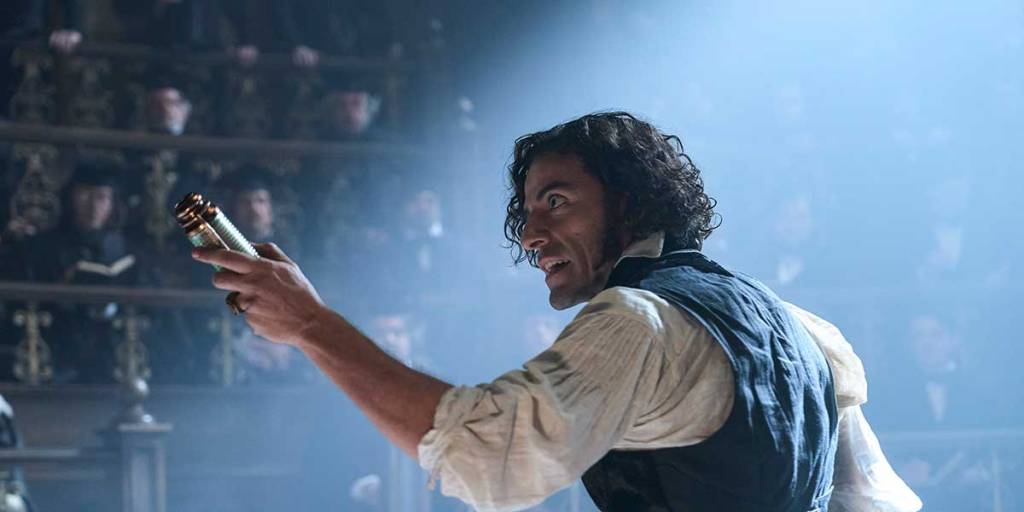
Victor Frankenstein (Oscar Isaac) is a medical student in Victorian England. The son of a minor aristocrat, the world is his for the taking. But when he shows his research in a dramatic performance before his professors — by bringing the head and torso of a dead man back to life using electric shocks — he is immediately expelled. Luckily he finds a benefactor (Christoph Waltz) from the continent to sponsor his research. Frankenstein sets up his laboratory in an isolated castle. Like a modern prometheus, he goes through piles of dead bodies, cutting out the choicest bits to create his new, superior man. He is joined by his milquetoast younger brother William (Felix Kammerer) and William’s beautiful and intelligent bride Elizabeth (Mia Goth – she has perfect name for this movie). But when the creature (Jacob Elordi) is brought to life using a bolt of lightning, he doesn’t turn out as expected: he is a monster, a brainless slug who can only say one word. His experiment a failure, Frankenstein flees his castle burns down his laboratory, leaving career in ruins, and allowing the monster to die…or did he?
The rest of the movie follows the creature as he grows, learns to speak and read, discovers his own strength and power, and to differentiate between good and bad. But how will he turn
out? And will humans ever accept him?
Guillermo del Toro’s Frankenstein is an entirely new look at Mary Shelley’s novel, unlike any version before it. The green-faced, flat-headed Frankenstein is nowhere to be seen. Elordi is amazing as this tabula rasa with unexpected powers and emotions. He’s a completely sympathetic character for the first time. It’s the scientist who is the real monster in this movie, but one with motives and who can feel remorse. It takes place in locations you’d never associate with Frankenstein, starting aboard a ship in the Arctic.
There’s also an extended chapter set in a cabin in the woods with a blind hermit. Yes, this Frankenstein is a gothic horror
movie — which he’s been making all his life, like Crimson Peak (2015) — but this one takes it to a higher level. It’s visually stunning, wonderfully acted, it’s long but never boring, and besides the violence, gore and horror, there’s also romance and pathos, friendship, beauty and self-discovery.
What can I say — this is one great Frankenstein.
Frankenstein and Good Fortune which both premiered at TIFF, and Black Phone 2 all open in Toronto this weekend; check your local listings.
This is Daniel Garber at the Movies, each Saturday morning, on CIUT 89.5 FM and on my website culturalmining.com.
Not always pretty. Films reviewed: I Really Love my Husband, Orwell: 2+2=5, Roofman
Hi, this is Daniel Garber at the Movies for culturalmining.com and CIUT 89.5 FM.
TIFF is over but Fall Film Festival Season continues in Toronto. FeFF or Female Eye Film Festival is entering its 23rd year, showcasing features, shorts and docs directed by women. This year’s theme is Always Honest, Not Always Pretty, so you can expect some challenging and surprising work from women around the world. Expect innovative screenings, many with the directors present, as well as pitches, workshops and tributes.The festival runs from October 14-19, at the TIFF Lightbox, the Women’s Art Associations of Canada and the City Playhouse Theatre in Vaughan.
So this week, I’m looking at three movies, one from FeFF and two from TIFF. There’s honeymooners in the Caribbean, a famous writer on a tiny Scottish isle, and an ingenious thief, who lives, undetected, in a big box store.
I Really Love my Husband
Co-Wri/Dir: G.G. Hawkins
Teresa (Madison Lanesey) lives in LA with her husband Drew (Travis Quentin Young). They’ve been married for a year but have yet to go on a real honeymoon. They both work at unfulfilling professions with little time for amorous interludes. But that’s about to change: Theresa and Drew are heading south for a week, to relax and spend time with each other on the sandy beaches of Bocas del Toro, Panama. It’s a chain of Caribbean islands known for their blue skies and warm waves. And even when the airline lose their baggage and the promised welcome meal is nowhere to be seen, they are still happy with the place. The manager, a boyish, non-binary beach bum named Paz (Arta Gee), is ready to help make their stay more comfortable, however they can. For Theresa, that means thinking outside the marital envelope. She urges Drew to join with her in seducing Paz. Though hesitant at first, Drew dives into the three-way, head first, and their marriage feels stronger than ever. And Paz promises to take them to
their secret island for one final fling.
But the mood starts to shift when jealousy rears its ugly head. A fourth wheel joins the group to make things even more confusing. Kiki (Lisa Jacqueline Starrett) a ginger-haired influencer with a venomous tongue, is a reality-show reject voted off the island. But she stays on, planting bad ideas in the couples’ heads, Can Teresa and Drew’s marriage endure all these complications? Can the insecure Teresa keep her anger in check?
I Really Love my Husband is a funny, bittersweet rom-com about the doubts plaguing a couple of millennials on a belated honeymoon. It pokes fun at a whole generation — from breakfast fasting to mushroom edibles to friendship stones — exposing some of the worst and silliest trends and fads. The characters are as worried about ratings and social networks as they are about actual love and affection. For a first-time feature by a new director with a largely unknown cast, this is a fun slice of life. Madison Lanesey is nicely sardonic, Arta Gee appropriately chill, and Travis Quentin Young always sweet strumming his guitar. Though not totally original, I Really Love my Husband does seem to capture the zeitgeist of LA’s millennials.
Orwell: 2+2=5
Dir: Raoul Peck
It’s the late 1940s in Scotland’s Inner Hebrides on a tiny, inaccessible island called Jura. George Orwell is there to write a novel in an isolated home, inaccessible by cars. His young son, his sister and their housekeeper keep him company as he sits by his typewriter. He’s dying of tuberculosis but wants to make sure his last book is completed and published. The novel is called 1984 and becomes a crucial part of contemporary culture, even today. You’ve probably heard of Big Brother; or at least the surveillance based reality show it inspired. It has been made into many films and TV shows and is referenced everywhere, Words like sexcrime and concepts like doublethink are firmly imbedded in our culture. The book is about the perpetual war between competing totalitarian nations. But more than that, it’s about the propaganda, mass surveillance and thought- control ordinary people are subject to. The hero, Winston Smith, works for the Ministry of Truth propagandizing Newspeak to the nation. But eventually he too falls victim to the machinations of the government of Oceania, ruled by Big Brother. He is tortured because, although he accepts their ludicrous proposition that 2+2=5, and espouses their slogans (War is Peace!, Ignorance is Strength! Freedom
is Slavery!), he doesn’t really believe them. This story shows that the contents and concepts of 1984 are as relevant today as when Orwell wrote them.
Orwell 2+2=5 is a combination documentary, docudrama and diatribe about Orwell, his writing and its influence on popular culture. It covers not just 1984 but Orwell’s earlier books, including Burmese Days, Homage to Catalonia (he volunteered to fight fascism in the Spanish Civil War), and Animal Farm, his allegorical look at Stalinist Russia. It’s based on both his books and his private correspondence. The movie also uses clips from the many film adaptations of 1984 to tell that story. And finally, it includes a barrage of brand-new news footage of leaders like Trump, Putin, Orban and Xi Jinping. These are altered with Orwellian slogans superimposed in bright colours over the media images.
Raoul Peck is a well-known Haitian documentary filmmaker, and maybe it’s because I already know so much about Orwell and his writings, this movie — with the exception of his last days on Jura — wasn’t as mind blowing as it might have been if it were all new. And it can’t compare to other docs like Peck’s I Am Not Your Negro, his biography of James Baldwin. Even so, Orwell 2+2=5 does stand as a historical document with a good dose of agit-prop.
Roofman
Co-Wri/Dir: Derek Cianfrance
It’s the early 2000s in Charlotte, North Carolina. Jeffrey Manchester (Channing Tatum) is the happy father of a young daughter and twin infants. He’s smart, nimble and observant. But he is underpaid and overworked as his job, and can’t seem to keep the family afloat. When he has to resort to regifting his own childhood toys for his daughter’s birthday party, he realizes something must change. He resorts to a life of crime, involving no violence. He robs McDonalds restaurants by an ingenious method: cutting a hole in the roof after dark, and stealing the cash. After dozens of such robberies the press subs him “Roofman”. His family moves up the social ladder, living the american dream of life with a swank car and and a nicely decorated home. Alas, he is finally caught, and sent to prison. His wife cuts him off, and he can’t even talk to his own kids anymore.
Later, following an ingenious plan, he escapes from prison undetected and looks for a place to hide. Most surprisingly he discovers an unsurveilled corner of a Toys R Us big box store with enough hidden space to make set up a tiny apartment. He initially survives on peanut M&Ms pilfered from the shelves, but eventually moves on to pawning video games and DVDs. And he learns the layout of the cameras and computers, making him virtually invisible… though in plain site. He
surveils the store management instead of vice versa. He has a crush on one employee Leigh (Kirsten Dunst) a single mom with two teenaged daughters. They eventually meet, unexpectedly, at an evangelical church toy drive (he “donates” toys stolen from his Toys R Us). Sparks fly and they become very close, but with Jeff still concealing his life of crime and his current home. Can he start a new life in his own home town without getting caught? Or should he just get the hell out of there?
Roofman is an exciting adventure / romance / comedy based entirely on a true storytelling. It’s funny, clever and constantly surprising. Channing Tatum is brilliant as Jeff, displaying an acrobatic sense of movement and timing, climbing walls, crawling through ceiling tiles or swooshing around cars on foot to avoid detection. The rest of the cast is also great: former teen actor Kirsten Dunst has eased comfortably into middle age and her character is very empathetic; Lakeith Stanfield is Steve, his sketchy war buddy; Aussie Ben Mendelsohn as guileless Pastor Ron, and Peter Dinklage appropriately dislikable as toy store manager Mitch. Filmmaker Derek Cianfrance (he directed the passionate Blue Valentine and the dark The Place Beyond the Pines) hasn’t made a movie in ages, but if he’s looking for a comeback, this is it.
I like Roofman a lot.
Roofman and premiered at TIFF and open in Toronto, this weekend; check your local listings; and I really love my husband is coming soon to FIFF.
This is Daniel Garber at the Movies, each Saturday morning, on CIUT 89.5 FM and on my website culturalmining.com.
Outstanding, great… or just ugly? Films reviewed: Eleanor the Great, Out Standing, The Ugly
Hi, this is Daniel Garber at the Movies for culturalmining.com and CIUT 89.5 FM.
Toronto Palestine Film Festival is on right now, with movies, shorts and docs by and about Palestinians, as well music, cuisine and art to share with other Canadians. This is it’s 17th year and it’s never been more relevant, so check it out.
But this week, I’m looking at three new movies that premiered at TIFF and are all opening theatrically this weekend. There’s an elderly woman who tells a lie, a woman with an “ugly” face who disappears without a trace, and a female officer in the Canadian Army who wishes a certain photo would just go away.
Eleanor the Great
Dir: Scarlett Johansson
Eleanor Morganstein (June Squibb) is a grandmother in her 90s. Since her husband died ten years back, she has shared her Florida condo with her best friend Bessie whom she’s known for 70 years. They do everything together, and work well as a team. Where Bessie is timid, Eleanor is brash and outspoken. If there’s something Bessie wants, Eleanor knows how to get it, even if it involves telling a few fibs. She has chutzpah to spare. But when Bessie suddenly dies, she realizes there’s no reason to stick around, so she packs up her stuff and flies back to New York for the first time in decades. She’s staying with her daughter Lisa (Jessica Hecht) and her grandson Max (Will Price). She’s hoping for some quality time but Lisa’s a worrywart and Max is always busy at school. So she takes up her daughter’s offer to attend some classes at the JCC she signed her up for; maybe she’ll make some friends. The first class is a washout — broadway musicals — so she wanders into another group almost by accident. It’s a support group for Holocaust survivors, and the members urge Eleanor — as a newcomer — to tell her story. She’s not a holocaust survivor, but her best friend Bessie was… and she knows all her memories, especially the death of her brother. So, in deference to Bessie, she tells them to the group as if they’re her own. Why not, right? It goes over well… a bit too well, actually. A teenaged college student Nina (Erin Kellyman) is auditing the group and soon bonds with Eleanor (her mom recently died and her dad is distant and
withdrawn.) The two women bond and start sharing intimate stories.
Nina is in a journalism class, and wants to make a video of her telling her holocaust memories as part of an assignment. Then things get really out of hand: Nina’s dad (Chiwetel Ejiofor) happens to be a popular TV news journalist… and he wants to make Eleanor his next feature. But what will happen to her friendship with Nina — never mind her own family — once the truth inevitably comes out?
Eleanor the Great is a nice, light movie-of-the-week-type drama about death, mourning, and inter-generational relations. It’s a very simple and easy movie, part comedy, part weeper. What’s good about it is the acting. June Squibb — who really is in her 90s — is great as the energetic, down-home Eleanor. (She played another rebellious granny in last year’s hit Thelma.) This is Scarlett Johansson’s first time as a director, and luckily she doesn’t bite off more than she can chew. She concentrates on characters — Squibb and Kellyman are both great in their roles — more than the basic story. And you know what? That’s good enough.
I wouldn’t call Eleanor the Great great, but it’s worth the watch.
Out Standing
Co-Wri/Dir: Mélanie Charbonneau
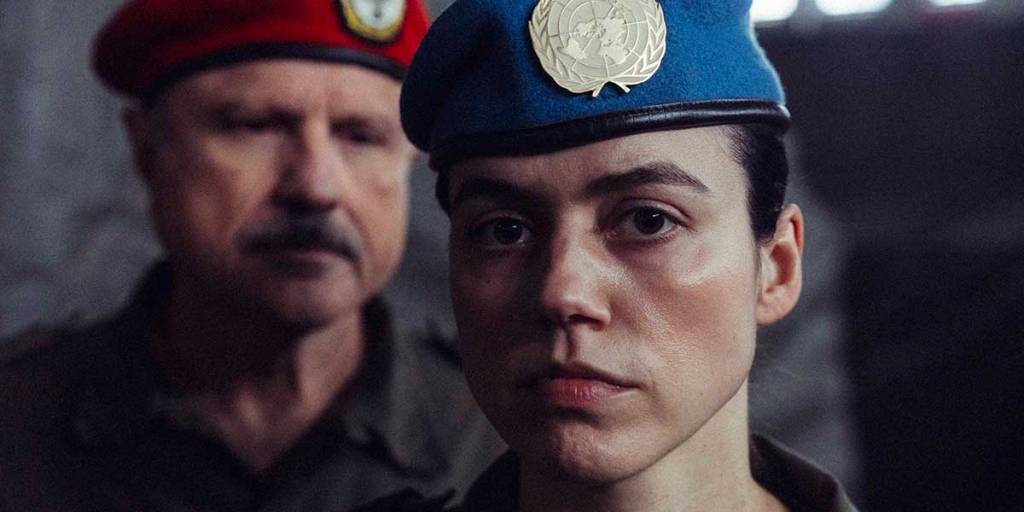
It’s the 1990s, and Captain Perron is leading a troop of UN peacekeeping forces in the former Yugoslavia. Why is this unusual? Sandra Perron (Nina Kiri) is a Canadian woman, the first to lead a squad of infantry soldiers in combat, and the first female to serve in the prestigious 22nd division, known as the Van Doos. Raised as an army brat in bases across Canada, she comes from a long line of soldiers, so it makes sense that she is following in her father’s vocation. She trained as a cadet and received commendations while still a teenager. And she’s the first woman to survive the brutal training that squadron demands. But there’s a photo circulating from her past that’s threatening to derail her military career. It’s a picture of her tied to a tree, barefoot, in the snow and semiconscious.
It was part of her training in a Prisoner of War exercise that went far beyond the normal treatment soldiers are forced to endure. A Canadian woman facing treatment tantamount to torture at CFB Gagetown in New Brunswick. But Captain Perron isn’t the one who released the photo, one fact she didn’t want the photo circulated. She had endured years of hazing bullying, harassment, obscene phone calls, sabotage to her kit, and a hidden campaign by certain officers to get rid of her. They detest the idea of serving alongside or under the command of a woman. And unlike the other women who
attempted to to join the Van Doos, she alone managed to survive and not quit.
Out Standing is a biopic about a trailblazing woman in the Canadian Armed Forces. It’s both moving and disturbing. The title, based on her memoirs, refers both to her achievements and to the notorious photo of her standing tied to a tree. (That pic was eventually published by the press, triggering a wave of shock and disgust across the country, and, one hopes, an improvement in how women are treated in the military.) Nina Kiri gives an excellent performance, totally believable as Perron.
While Hollywood churns out dozens of war movies each year, showcasing the latest weapons and fighter planes, you rarely see a Canadian one. This one is full of details carefully chosen to distinguish how soldiers behave here. The military culture is quite different. Unlike in the US there’s no Sir-yes-sir! And instead of saluting a Canadian soldier stand sharply at attention. I never knew this because you never see it in movies. For this alone it’s a eye-opener. The film is not perfect — there’s a particularly clumsy scene near the end — but altogether it’s a compelling and disturbing look at a Canadian woman’s life in the military.
The Ugly
Wri/Dir: Yeon Sang-ho (Peninsula, Train to Busan)
Lim Yeon-gyu (Kwon Hae-hyo) is a well-known carver of dojang, the name stamps used in Korea like a signature on official documents. He built up his business from scratch while raising his son as a single parent. (His wife ran away soon after the baby was born.) He trained his son Lim Dong-hwan (Park Jeong-min) in every aspect of the craft. Now an adult he is taking over the family business. At this moment, a documentary filmmaker (HAN Ji-hyeon) is celebrating this dad’s life as a national treasure. Why did she choose this man for her documentary? He’s been blind since birth, which makes his many accomplishments even more impressive. But filming is put on hold when a surprise announcement arrives. They’ve found Dong-hwan’s mother decades after she disappeared. Turns out she’s been dead all that time and only her bones remain. This comes as a total shock to Dong-hwan, and it just gets worse.
First his mother’s long lost relatives arrive for the funeral but they’re despicable people who just want to make sure he doesn’t claim any family inheritance.They bullied and beat his mother, a veritable Cinderella raised by this cruel family. It’s also the first time he hears his mother described as ugly. Ugly how? He longs to see a photo of her, something to display at the funeral, but there are no photos anywhere. Of course his blind father doesn’t have one. While Dong-hwan is trying to process all this new information, the filmmaker leaps on it as a great story and insists on continuing the documentary but with a new twist: who killed his mom and why? Together, over a series of interviews with hidden cameras, they uncover
events and people from her past as the tragic puzzle gradually falls into place.
The Ugly is a mystery about a kind-hearted woman — the main character’s mother — and how she is horribly treated because of her looks. It’s a heart wrenching story, a dark, bleak view of humanity with only Dong-hwan (and his mother) as redeeming characters. The story is told as a series of interviews with the various characters and extended flashbacks to what actually happened (The actor who plays Dong-hwa also plays his blind father as a young man in the flashbacks, while Jung Young-hee plays his mother, but always from behind or from the side, without ever revealing her face). In Yeon Sang-ho’s previous movies (Peninsula, Train to Busan) the action hero is surrounded by mutants or zombies or killers. The Ugly is about normal people but they’re just as hideous.
The Ugly is a powerful and dark look at human cruelty and physical beauty.
Eleanor the Great, Out Standing and the Ugly all open this weekend in Toronto; check your local listings. This is Daniel Garber at the Movies, each Saturday morning, on CIUT 89.5 FM and on my website culturalmining.com.
Men, music and sports. Films reviewed: The History of Sound, Him, EPIC: Elvis Presley in Concert
Hi, this is Daniel Garber at the Movies for culturalmining.com and CIUT 89.5 FM.
TIFF is over but the movies keep coming. So this week, I’m looking at three new American movies, two about music and one about sports. There are two men recording folk songs in the forest, an ambitious quarterback at a training camp in the desert, and a former teen idol wowing audiences on a Vegas stage.
The History of Sound
Dir: Oliver Hermanus
It’s the early 20th Century in rural Kentucky. Lionel (Paul Mescal) likes listening to his father sing while he plays the fiddle. Music for him is different from most folks: he has synesthesia. This means each musical note has a distinct colour, flavour and meaning. Eventually his love of music and beautiful voice wins him a full scholarship to the New England Conservatory of Music. At a Boston pub one night, he recognizes a song his father used to play, coming from a young man at the piano. David (Josh O’Connor) knows every word. As an ethnomusicologist, he wants to collect as many distinct folk songs and ballads as he can, before they are lost forever. David has perfect pitch and a photographic memory. The two trade songs they know, and somehow, end up in bed together that night. That chance encounter turns into regular trysts at David’s apartment.
Later he invites Lionel to join him in a fieldwork project. They roam across the state of Maine, recording songs everywhere from logging camps to schoolhouses, And they record it all on wax cylinders (this is before flat discs are invented) carefully
stored in a leather satchel. And each night they sleep together in a tiny tent. Is this true love? And what will happen to their relationship after the project is finished?
The History of Sound is a touching, bittersweet gay romance — before the word gay existed — set within the larger context of war and music. It’s directed by South African filmmaker Oliver Hermanus (Moffie) and its based on a short story by Ben Shattuck. I wonder if the characters are modelled on Alan Lomax, the ethnomusicologist who recorded thousands of songs and started the folk music revival in the 1950s. Paul Mescal is spot-on as the sensitive kid in a clapboard shack who grows up to be a cosmopolitan musician; as is Josh O’Connor’s portrayal of an enigmatic musical genius with hidden secrets. The images are as lovely as the music in this tender and moving film.
I really liked it.
Him
Co-Wri/Dir: Justin Tipping
It’s San Antonio, Texas, and their NFL team, the Saviours, is looking for a new quarterback to replace their MVP Isaiah White (Marlon Wayans), due to retire in a year. Cameron Cade (Tyriq Withers) is a young quarterback who lives for football — his father trained him for this since he was a little kid. When he’s offered the position if he agrees to an intense one-on-one, bootcamp with his idol Isaiah White, of course he says yes; this is the fulfillment of all his dream. Thing is, he recently had a serious injury that left him with a bad concussion and a track of staples in his head. If he aggravates his brain, it might end his football career before it starts. But as his father always told him, No Pain, No Gain. Cameron heads out to the training camp in the desert.
There he encounters absolute luxury: gourmet food and priceless art in a spacious brutalist palace. There are saunas and ice baths, and daily blood transfusions for Isaiah. Cameron too tastes this luxury — and sexual temptations — offered by Isaiah’s entourage, especially the grotesquely made-up wife Elsie White (Julia Fox), an influencer who sells her own line of sex toys. Isaiah is the GOAT — the Greatest of All Time — and his virulent fans wear goat horns on their
heads. Cameron, on the other hand, holds onto silver cross. He’s given a series of Squid-Game-like ordeals he must endure before Isaiah gives him the nod. And as the tasks grow increasingly horrific, his morals are severely challenged. Can he pass the tests? And is he ready to give up his innate morality and embrace pro-sports and all it offers?
Him is a psychological thriller about a young man confronting his hero (who is also his nemesis) even as he uncovers the dark underbelly of pro football. It’s produced by Jordan Peele, so you might expect a suspense/thriller with mind-blowing surprises. If so, you’ll be sorely disappointed. What you’ll get instead is more like a highly-stylized, extended music video than a horror film. There’s lots of dazzle and flash — and an equal amount of blood — but it’s never scary or surprising. And director Tipping uses film techniques like a kid playing with toys. Why are people shown in in infrared X-rays? Why a long fashion shot sequence in what’s supposed to be a scary scene? Why do cowboy-hatted cheerleaders continue dancing in the face of horrific deaths? There are some great visual cues — like the aluminium stitches in his skull evoking the side of a football — but it’s all show, no substance in this cheap morality play.
Him is fun to look at, but there’s nothing there.
EPIC: Elvis Presley in Concert
Dir: Baz Luhrmann
It’s the 1950s. Elvis is the King of Rock and Roll with a series of hits and the nation goes wild over his thrusting pelvis and his soulful voice. Later, he is drafted into the army where he serves two years. Afterwards he turns to Hollywood where hue churns out a series of hits alongside sex goddesses like Ann-Margaret. And late in the 1960s he signs a multi-year contract to perform before sold-out audiences at a Las Vegas Casino. He’s up there every day, dressed in eggshell blue jumpsuits, covered in silver studs, sequins and spangles, joking with the crowds, and sweating buckets. He is accompanied by a retinue of back up singers, musicians and elaborate lighting. And that is basically how Elvis spends the rest of his life, until he collapses and dies in Graceland, age 42.
EPIC: Elvis Presley in Concert is a combination documentary and musical performance. Just two years ago, we had both Baz Lurhmann’s biopic Elvis and Sofia Coppola’s Priscilla, two similar stories told from different points of view, neither of which were particularly good. And now, out of nowhere comes this third one. I’m not an Elvis fan, nor do I like the kitschy

Buzz Luhrmann at EPIC’s world premiere at TIFF50: Photo (c) Jeff Harris
and gaudy films of Baz Luhrmann. Which is why I’m shocked at how much I enjoyed this movie (I saw it on an IMAX screen at TIFF last week, almost by accident.) Ostensibly just a musical record it’s actually a succinct and tight history of the man, so much better than those bloated biopics.
It’s fantastic, a masterpiece of creative editing, colour restoration and music mixing. It’s absolutely stunning. The songs he sings are mainly hits from the 1960s cover-versions of Bridge Over Troubled Water, You’ve lost that Loving Feeling, and even gospel songs. And over the course of a single song, we see him on stage, in rehearsal, or in the recording studio, shot over many years, but without a break in the music. And despite Luhrmann’s gaudy excess, somehow his capture of Elvis in a psychedelic shirt or sparkling gold belt buckles just looks right.
EPIC is the perfect concert film.
Him and The History of Music both open this weekend in Toronto; check your local listings; EPIC: Elvis Presley In Concert played at TIFF and will be released soon.
This is Daniel Garber at the Movies, each Saturday morning, on CIUT 89.5 FM and on my website culturalmining.com.
TIFF gems. Films reviewed: Girl, I Swear, Cover-Up
Hi, this is Daniel Garber at the Movies for culturalmining.com and CIUT 89.5 FM.
TIFF, Toronto’s International Film Festival is winding down after a busy week, but there is still a lot to see, including the People’s Choice awards offering free screenings of the winning films tomorrow. So this week I’m looking at three terrific movies that premiered at TIFF but aren’t getting the degree of coverage I think they deserve. There’s a coming-of-age story about a girl in Taiwan, a biopic about a man in Scotland, and a documentary about a legendary American journalist.
Girl
Wri/Dir: Shu Qi
Lin Xiaoli (Bai Xiao-Ying) is a working class tween in middle school in Taiwan. She lives with her mom, and her domineering stepdad who terrorizes her mother and her. Xiaoli hides inside a zip-up wardrobe in her bedroom as protection from his violent outbursts. He works as a mechanic in his Uncle’s garage, and usually comes home drunk to the gills. Her Mom works in a hair salon and makes artificial flowers at home to earn extra money, but takes out her anger on her much smaller daughter. Xiaoli takes care of her younger sister, who is favoured by both her parents. At school she tries to stay unnoticed to avoid more of the violence and anxiety he gets at home.
Until she meets a vivacious girl named Li Lily (Lin Pin-Tung). Lily lived in the States for a few years but now she’s back and living with her grandparents who let her do whatever she
wants. Though the too are complete opposites, Lily is helping Xiaoli climb out of her shell. And one day they cut class, wear makeup, smoke a cigarette, go to a video cafe, sing songs, and eventually meet a bunch teenaged boys riding motor scooters. But will this day change her life in a good way… or in a bad way?
Girl is a realistic coming-of- age drama set in the previous millennium (with no computers or cel phones) and full of poignant details. It’s a very moving story about parental abuse passed down through generations, but it’s also full of hope. It follows the points of view of all the main characters, not just
Xiaoli. Now, I have a rule, I avoid first films at TIFF directed by actors. Why? They’re usually crap. Vanity pics, Oscar bate, self-serving vehicles or relentless navel gazing. Shu Qi is a very famous Taiwanese actress, and Girl is her first try at directing. Luckily, it’s really good. She has acted in three movies by Hou Hsiao Hsien and Girl resembles his films in both style and content, though a totally original take. It’s rough and violent in parts, which is hard to handle in a realistic movie, but there’s lots of sweet stuff, too.
Girl is an excellent first feature.
I Swear
Wri/Dir: Kirk Jones
It’s the late 1990s. John Davidson (Scott Ellis Watson) is a popular teenager in Galashiels, Scotland He’s starting at a new school, getting friendly with a girl he fancies, and is the prized goalie on the local boys’ football team. His Dad has even arranged for a scout to the next match. But then something unexpected happens. He starts twitching in class, just a little at first, like a nervous tic. But it soon turns to rapid movements, facial contortions, and barking sounds. Followed by spitting, random punching and the uttering of the most offensive words. He gets caned by the headmaster for acting the ckown, his mother makes him eat his meals on the floor facing the fireplace. HIs father abandons his family. His onetime girlfriend slaps his face and other kids bully him at school, But none of it is intentional; he has Tourette’s syndrome.
Decades later, John (Robert Aramayo) still lives with his mother, heavily sedated, not allowed to speak with anyone for fear of an incident. A miserable existence indeed. Until he runs into an old school friend who invites him for dinner at home. He repeatedly declines — for good reason — until his friend’s mom Dottie (Maxine Peake), a psychiatric nurse
diagnosed with cancer, insist he come in for spaghetti dinner. The first thing he says to her is You’re dying of cancer, haha! before skulking away, mortified. But Dottie brushes it off as the most honest thing she’s heard in years. She invites him back, and tells him to stop apologizing for things that aren’t his fault. Eventually he moves in to try to live a normal life. But is that possible with Tourettes?
I Swear is a comedy/drama, based on a true story, about one man’s life with Tourette’s. The title refers to the profane and deeply offensive words that spew forth from his moth at the worst possible times. It’s mortifying but also excruciatingly funny, and the two actors who play him, Watson and Aramayo, exude sympathy and humour in every scene, despite their seemingly insurmountable problems. I laughed my ass off for most of this film (whenever I wasn’t crying out of sympathy). I Swear tells a heart-warming story, even as it educates — without lecturing — about Tourette’s.
I strongly recommend this feel-good movie.
Cover-Up
Wri/Dir: Laura Poitras (All The Beauty and the Bloodshed)
and Mark Obenhaus
It’s the 1960s and America is at war. Sy Hersh, a freelance reporter, hears a rumour of mass murder in Vietnam by American troops. He speaks with GIs on base and the soldiers accused of these crimes. He also got a hold of a secret military investigation the massacre. And the facts he finds are horrifying. There include synchronized sexual assaults and murders of hundreds of women, men and children, and even babies, by American soldiers. Hersh blames My Lai on General Westmoreland and others who ordered the mass killings — which happened in a number of places on the same day — solely for the purpose of raising the body count. They needed more dead bodies to prove they were winning the war. The story has major repercussions all the way to the top — Nixon and Kissinger were recorded calling Hersh a son of a bitch — and played a role in turning public sentiment away from the war. For Hersh, My Lai is the first of many crucial stories he breaks in the decades to come. He becomes the NY Times daily reporter on the Watergate scandal. He uncovers US involvement in Pinochet’s bloody coup in Chile and the assassination of
Allende; illegal CIA infiltration of anti-war groups, the secret bombing of Cambodia, the invasion of Gaza (ongoing), and the abuse and torture of Iraqis by American soldiers during the Gulf War at the infamous Abu Ghraib prison.
Cover-Up is a journalistic documentary about journalism itself. It features historical documents and period photos and film — many very disturbing — new interviews with people involved in the stories, and extended talks with Sy Hersh, who at the age of 88 is still a full-time journalist. You get to see
him see at work talking to anonymous sources and vetting incoming photos and leaks. He’s a bit prickly about protecting his sources even from the documentary makers (who take care never to reveal anyone still alive), because it’s that core of consciences bureaucrats, soldiers, and spies who still uphold the constitution and flout illegal coverups. They’re the sources who keep freedom of the press alive.
After the TIFF screening, Hersh said that American journalism is in a bad state with reporters running scared. How many important stories are being gagged or stifled now — or in the past — under White House pressure? It shows how badly we need more adversarial journalists who question the powers that be and uncover what they’re hiding.
And that’s what Cover-Up is all about.
I Swear, Girl and Cover-Up all played at TIFF and should be released over the next few months. This is Daniel Garber at the Movies, each Saturday morning, on CIUT 89.5 FM and on my website culturalmining.com.
Hi, this is Daniel Garber at the Movies for culturalmining.com and CIUT 89.5 FM.
it’s the work of award-winning documentary filmmaker Tasha Hubbard, known for her powerful docs featuring indigenous subjects. Meadowlarks is her first narrative feature. I last interviewed Tasha in 2019 on this show about
leave a comment