Daniel Garber talks with Joshua Oppenheimer about The End at #TIFF24

Posted in Class, Disaster, Family, Interview, Musical, post-apocalypse, Science Fiction by CulturalMining.com on December 15, 2024

Photograph by Jeff Harris.

Hi, this is Daniel Garber at the Movies for culturalmining.com and CIUT 89.5 FM.

It’s some time in the not so distant future. A tight-knit family live in a mansion furnished with old masters and French impressionist paintings on their wall. Their stay-at-home mom is fastidious with keeping things in order. Dad is a retired powerhouse exec who made a killing in the Indonesian oil industry.  And their beloved homeschooled 20-year-old son who is curious about the world and loves playing with his toy train set. This lovely, peaceful household is complemented by their faithful butler, Mom’s best friend, and a doctor who is always on call. But something is wrong here. Why is their skin so pallid, their lighting unnatural, and why don’t they ever go outside? It’s because they’re living in a bunker, hidden deep underground as the planet burns. These people may be the only survivors of the end of the world.

The End is also a new film, a musical drama about the last survivors of climate catastrophe. It’s fascinating and devastating, infused with dry, dark comedy. The End is directed and co-written by award-winning filmmaker Joshua Oppenheimer, best known for his shocking documentaries The Act of Killing and the Look of Silence.

I spoke with Joshua Oppenheimer on-site at TIFF.

The End opens theatrically in Toronto on Dec 13, 2024.

Americans abroad. Films reviewed: Queer, September 5, Oh Canada

Posted in 1950s, 1960s, 1970s, Addiction, Canada, Dreams, drugs, Germany, Journalism, LGBT, Mexico, Resistance, Sex, Sports, TV, US, War by CulturalMining.com on December 14, 2024

Hi, this is Daniel Garber at the Movies for culturalmining.com and CIUT 89.5 FM.

This week I’m looking at three new movies set in the 1950s, 60s and 70s, about Americans abroad. There’s a novelist in Mexico City, a TV sportswriter in Munich, and a documentary filmmaker in Montreal.

Queer 

Dir: Luca Guadagnino (I am Love, A Bigger Splash, Call me by your Name, Suspiria)

It’s the 1950s in Mexico City. William Lee (Daniel Craig) is a middle-aged American writer addicted to heroine who hangs around local bar called Ship Ahoy. If he doesn’t get completely drunk he might spend the night with a man he meets. He’s friends with other flamboyant ex-pats, especially Joe (Jason Schwartzman) a portly, bearded man who shares Lee’s lascivious predilections. Lately, he has had his eyes on Eugene Alerton (Drew Starkey), an ex-GI who spends most of his days playing chess with an older red-haired woman. Eugene is no “queer”, but is up to talking with Lee.

After repeated drinks, and some opiates he eventually shares Lee’s bed in his seedy rental. Lee is smitten, Eugene content. Later the two head south in their quest for ever more potent drugs culminating in a journey toward the ultimate psychedelic experience. They end up in the Ecuadorean Amazon, in a remote shack guarded by a vicious but slow-moving three toed sloth. Inside, a mysterious doctor (Lesley Manville) holds the answers to all their questions. Is Eugene the man of his dreams? Will they ever reach hallucinatory nirvana? Or is life just an illusion?

Queer is a bizarre, sex-and-drug-filled psychedelic fantasy. It’s divided into three chapters: their meeting in Mexico City; their journey south; and their adventures in Ecuador.  It’s adapted from William S Burroughs’ semi-autobiographical novel written in the 1950s but not published for another 34 years. It swerves wildly between actual memoirs and pure imagination. Burroughs was a writer in the beat movement, and was married and had a son with another writer Joan Vollmer (perhaps she’s the red-haired woman Mary in the film).

The thing is, Queer is not a grave, serious movie, it’s a high-camp comic fantasy. Psychedelia has always been difficult to film, and there’s a fine line between the profound and the ridiculous. Some scenes, like the unfortunate semi-nude, interpretive dance sequence, falls on the (unintentionally) funny side. Others scenes were kinda cool. It’s a beautiful film to watch, for its music, set, costumes and art direction. Shot entirely in Rome’s Cinecitta, it’s never meant to look realistic. Daniel Craig plays Burroughs not as the usual chill junkie observer, but as a panting and sweating horndog, with bulging eyes, nearly choking on his own lust. 

If your looking for a sentimental romance a la Call Me by You Name, or a deeply profound meditation on psychedelic trips, this ain’t it. But if you just want a weird and funny drug-infused dream-filled movie with lots of soft-core gay sex, you’ll probably have a great time.

September 5

Co-Wri/Dir: Tim Fehlbaum

It’s September 5, 1972 at the Munich Summer Olympics and the crowds are roaring. Americans are glued to their sets watching the US cleaning up, with swimmer Mark Spitz winning an unheard of seven gold medals.  ABC is the perennial loser of the top three networks. So their sportscasters are thrilled to have won exclusive coverage rights. The team behind the cameras are hard at work. Geoffrey Mason (John Magaro) is the newbie, trying to prove his chops. His boss Marvin (Ben Chaplin) wants things to run smoothly, and his boss’s boss (Peter Sarsgaard) is thinking of the bigger picture. Jacques (Zinedine Soualem) is their French cameraman with Marianne (Leonie Benesch) the only woman on the team, is a German journalist, and their de facto translator. Everything is great until they hear gunshots… not at the games, but at the nearby Olympic village. A group of masked militants, known as the Black September Organization is holding Israel’s Olympic team hostage. 

Suddenly, the ABC sportscasters realize they are the only American TV journalists in Munich. They have the cameras, the boom mics and the broadcast and satellite rights ready to send stories home. They shift their telephoto lenses from pointing toward the swimming pools to the athletes’ dormitories, trying to catch a glimpse of the hostages. What will happen next? Will German authorities step in? And can a sports crew handle crisis news?

September 5 is a journalistic thriller about 24 hours at the Munich Olympics. Despite its title, this isn’t about the Israel/Palestine conflict — they barely delve into it. That’s just the backdrop. What it really looks at is how a team of US journalists — at the right place at the wrong time —  figure out how to get the news out even as the crisis grows. I love the period details: giant-sized spools of reel-to-reel videotapes, and how little white tiles on a black background were superimposed onto a sports channel screen. So cool. I’ve never heard of Swiss director Tim Fehlbaum before, but he keeps the action moving in the midst of constantly shifting mayhem. The acting is ok, but best by far is Leonie Benesch who starred in last year’s The Teacher’s Lounge. I went into this movie full of dread. It’s clearly Oscar-bait; Hollywood churns out journalistic dramas every year. But this one is surprisingly good, and had my heart pumping all the way through. If you’re looking for some journalistic excitement, check out September 5. 

Oh Canada

Co-Wri/Dir: Paul Schrader (First Reformed)

Based on the story by Russell Banks   

Leo Fife (Richard Gere) is a renowned documentary filmmaker in Montreal. He is getting ready for an interview in his own living room in the grand old home he shares with his wife Emma (Uma Thurman).  The director, Malcolm (Michael Imperioli) and his crew are longtime admirers of Leo’s legendary work. After crossing the northern border in the 1960s to protest the war in Vietnam, he ended filming docs that changed the course of history. He uncovered the use of Agent Orange at the military base in Gagetown, New Brunswick, and became a university prof teaching young journalists how to make movies. Now, decades later, Leo is on his deathbed, dying of cancer, so Malcolm wants to record his final thoughts.

Leo treats this film as a confession — he wants to clear the record. He starts by talking about his first wife and son, a family he left behind in Virginia. But she’s not the only skeleton in his closet. His past life is full of lies, deceptions and possibly terrible acts. Emma doesn’t like him talking like this and wants him to stop. Leo’s nurse thinks can’t take all this stress. But the filmmakers persist and Leo perseveres.  Are any of his stories true? Was he a good man or a bad man? And what do we really know about Leo Fife?

Oh Canada is a fictional story about a day in the life of an American filmmaker and activist recalling his past. It’s a simple concept with a slight plot. It’s structurally divided between the documentary being made about him, and his hidden past, shown in a series of flashbacks (He is played by Jacob Elordi as his younger self.) The film is  almost too simple. But with Paul Schrader at the helm, you know there’s going to be more to it. He wrote Taxi Driver and Raging Bull for Scorsese, and directed movies like The Yakuza (1974) First Reformed (2017) and American Gigolo (1980) that also starred Richard Gere.

Unfortunately, Gere is the weakest part of this film; he rants and complains, but there’s no heart in his performance. The film’s called Oh Canada, but it’s really Oh America. It was entirely shot there, with so-called Canadian characters using americanisms like “restroom”. What’s interesting is Schrader’s use of false visual narratives. There are  flashback scenes where Elordi as a young Leo is suddenly replaced by a contemporary Gere while all the other characters remain unchanged. Likewise, the names of past lovers seem to melt away. Perhaps Leo has dementia, or maybe this contrasts Leo’s current story with his past truths. Also interesting is the way we see Leo’s face throughout the eye of Malcolm’s camera, giving it a meta aspect that messes with your brain.

Oh Canada is not one of Schrader’s better films, but there’s enough stuff going on to keep it intriguing. 

Oh Canada, Queer and September 5 all open this weekend in Toronto; check your local listings.

This is Daniel Garber at the Movies, each Saturday morning, on CIUT 89.5 FM and on my website culturalmining.com.

Returns. Films reviewed: All We Imagine as Light, The Return PLUS Streaming Sites!

Posted in Feminism, Friendship, Greece, India, Italy, Royalty, soldier, War, Women by CulturalMining.com on December 7, 2024

Hi, this is Daniel Garber at the Movies for culturalmining.com and CIUT 89.5 FM.

As the days grow shorter and colder, people tend to snuggle up at home. I’m here to tell you to get off your collective asses and go see a real movie on a big screen! But I know some of you are going to stay at home so today, I’m going to talk about some of the streaming sites out there you might want to join. And I’m looking two new dramas. A warrior king in ancient Greece returning to his island, and three nurses in Mumbai returning to Kerala.

Streaming Sites

Here are some streaming sites you might want to try.

First the free ones: CBC Gem, Kanopy and Tubi. CBC Gem has ads, but also plays some great docs, including There are no Fakes. You can find Tubi — a commercial site — online, again with irritating ads but a huge selection of middlebrow films. You can check out terrific movies on Kanopy using your library card, but you’re limited to a certain number per month. Britbox and Acorn TV both specialize in British TV series, especially detective mysteries. If you want Miss Marple peeking over your shoulder, this is what you want. Apple TV produces all their own stuff, including Slow Horses and the great Steve McQueen’s new film Blitz. On the other hand, the Apple TV app itself is extremely aggressive — you can only watch full screen and it flips back to the main site every time you navigate away.

If you’re into horror, thriller and the supernatural Shudder is the site for you. It’s exceptionally well-curated, with excellent art-house movies right beside slashers. Paramount+ has a seemingly endless supply of cop and military shows, plus CIA, FBI, firemen, navy, and — count ‘em! — 7 different NCIS spinoffs! Not my thing, but they do land some good movies like Smile 2, playing right now. Crave gives you access to everything HBO makes, as well as Canadian movies you might otherwise miss like the NFB doc Wilfred Buck. Criterion has the rights to some of the best movies of all time, from early Kurosawa to recent releases. MUBI streams new movies likely heading for the Oscars this year, including Maria, Girl with the Needle and The Substance.

And finally Netflix, the grande-dame of all streamers, has the most consistent and sheer quantity of good TV and self-produced movies, like Emilia Perez… but it’s getting way too expensive! They even have a new website called netflixinyourneighbourhood.ca which takes you to

THE MADNESS. The Donut Shop, 617 Parkdale Avenue, Hamilton, Ontario, featured in Episode 107 of The Madness. Cr. Courtesy of Netflix © 2024

locations where their movies are shot: in places like Toronto, Ottawa, Hamilton, Brockville, Dundas and Oshawa!

I still think movies should be seen in theatres but if you’re determined to stay at home, those are some of streaming sites you might want to subscribe to.

All We Imagine as Light
Wri/Dir: Payal Kapadia

It’s present-day Mumbai.
Prabha (Kani Kusruti) is a middle-aged hospital nurse. She is skilled at her job, teaching young trainees how to get over their feelings of revulsion. She spends time with a starry-eyed Doctor Manoj, who writes poems to her, but she is still very much married. Her husband moved to Germany to work in a factory, and he may as well not exist. Prabha shares an apartment with Anu (Divya Prabha), a vivacious young nurse at the same hospital. She likes shopping, fashion and romance, and most of all her secret boyfriend Shiaz (Hridhu Haroon). They’re in love (or at least young lust) but frustrated; it’s hard to find a private space to be together. More than that, she’s Hindu and he’s Muslim, and never the twain shall meet – their families will prevent that. Finally, Parvaty (Chhaya Kadam), an older nurse and a close friend of Prabha’s, is facing eviction from her home. Developers want to tear it down to build a high-rise condo. Since she’s a widow and doesn’t have the proper papers to prove the place is hers, they’re sending goons to her door to kick her out.

For all these reasons the three of them end up back in Kerala, the place of their birth in southwest India. They stay in a beautiful beach town, where the three of them can finally shake off the heavy responsibility and stress of life in that big city. But how long will this last?

All We Imagine as Light is a personal, intimate drama about the lives of three women in Mumbai. It’s notable for a number of reasons. This is director Payal Kapadia’s first feature, and tells her story from a distinctly feminine gaze. It deals with big contemporary political and social issues — like Parvaty attending an angry tenants’ rights meeting — but also the importance of personal friendships among the three woman. In look and style, this film is strictly European cinema verite, about as far from Bollywood as a movie could possibly be. But it is set in Bombay and exults in that city, from the slums to the skyscrapers, with stunning aerial views of rooftop clotheslines and raucous street festivals. There’s amazing footage taken through the window of a fast-moving commuter train. Some scenes have documentary-style unidentified voices, expressing their bittersweet love and hatred for that city that never sleeps, spoken in a plethora of languages: Hindi, Gujarati, Malayalam, and Bengali. I liked this movie for it’s emotions, but found much of it bleak and slow-moving; the story drags you down until it finally shifts from Mumbai to the beaches of Kerala, two-thirds of the way through.

But by the end it redeems itself with an unexpectedly satisfying finish.

All We Imagine as Light has been nominated for Best Foreign Language Film at the Golden Globes.

The Return
Dir: Uberto Pasolini

It’s 1200 BC in ancient Greece, and the island of Ithaca has no ruler. Decades ago, it was a mighty kingdom, ruled by the hero Odysseus — known for his bravery, fighting skills and intelligence. He devised the Trojan Horse and led the army that defeated Troy. But the soldiers — and their leader — never came home, and Ithaca has gone to seed. The queen, Penelope (Juliette Binoche) sits alone in her tower, weaving cloth, as she patiently waits for Odysseus’s return. Their son, Telemachus (Charlie Plummer) doesn’t know his father except from legends. The palace is filled aggressive brutes from abroad, each wanting to marry the widow Penelope so they can take over the kingdom. But is she actually a widow?

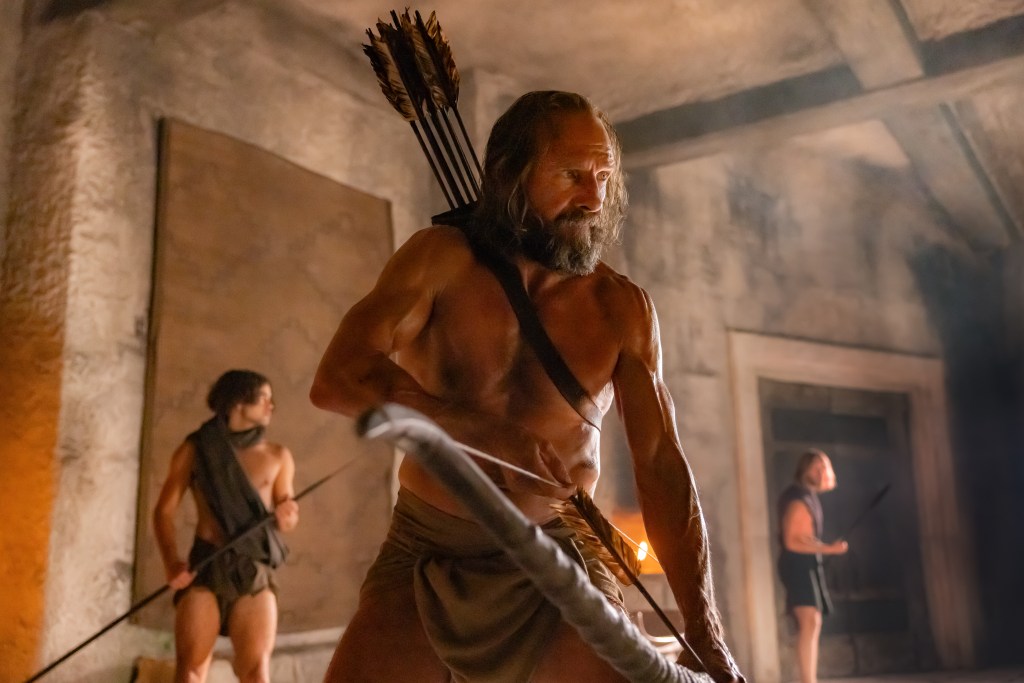
Around this time, the battle-scarred body of a soldier washes up on shore. He’s barely alive, but is nursed back to health by an honest pig farmer named Eumeo (Claudio Santamaria) and his sons. It is of course Odysseus (Ralph Fiennes), but without any uniform or weapon. He’s actually naked. He wraps himself in a blanket and carries a bowl — the clothing of a homeless beggar. And when he approaches the palace, almost no one recognizes him. Only Eurycleia (Ángela Molina), both his and his son Telemachus’s nurse as a child, realizes who

The Return, directed by Uberto Pasolini, with Ralph Fiennes (Odysseus), Juliette Binoche (Penelope), Charlie Plummer (Telemachus), Marwan Kenzari (Antinous), Claudio Santamaria (Eumaeus).

that beggar is. Is he still fit to be king? Can one man, tired and old, confront a bloodthirsty mob of young toughs? And will Penelope ever forgive him for staying away so long?

The Return is a magnificent retelling of a chapter in Homer’s The Odyssey. But it’s not about triumphant heroes; it’s more about the grinding effects war has upon both the victors and the vanquished. It contrasts Odysseus’s shame and self-doubt with Penelope’s eternal fidelity. Yes, this is an ancient greek story, with swords and sandals, but it feels very immediate. Parts of it even resemble a Hollywood action/thriller, with chase scenes and some very bloody fights.

The film was shot among the rocky cliffs of Corfu and the ruins of an ancient castle, which is echoed in the soundtrack. I love the dramatic look and sound of waves crashing on the sharp rocks. Though the women are all wrapped up, most of the male actors are dressed in togas or prancing around half naked, with Ralph Fiennes going full monty at the drop of a hat. I didn’t used to like him much, but after Conclave and now this one, I gotta admit, he’s a really good actor. Juliette Binoche is skillfully understated as Penelope, and Dutch actor Marwan Kenzari is very creepy as Antinous, the threateningly oleaginous suitor closest to Penelope.

The Return is a really good movie.

The Return and All we Imagine as Light is on at the TIFF Lightbox in Toronto; and Standing on the Shoulders of Kitties, A Trailer Park Boys movie featuring Bubbles and his band on tour, is now playing; check your local listings.

This is Daniel Garber at the Movies, each Saturday morning, on CIUT 89.5 FM and on my website culturalmining.com.

Daniel Garber talks with Ali Weinstein about her new doc Your Tomorrow

Posted in Canada, documentary, History, Protest, Toronto by CulturalMining.com on November 30, 2024

Hi, this is Daniel Garber at the Movies for culturalmining.com and CIUT 89.5 FM.

It’s the 1970s in Toronto, just a few years after the Centennial and Expo 67, and pride is running high. A huge new theme park, built on four islands made of reclaimed land on Lake Ontario, is opening to great fanfare. It offers an outdoor concert stadium, a geodesic Cinesphere, the first one ever built to show IMAX movies, and a kids’ park with playgrounds, music and automatons. It’s surrounded by tall trees, grassy areas and flowers everywhere. It’s called Ontario Place, and is packed with visitors.

Flash forward to the 2020s. Ontario Place is still attracting crowds but, after decades of neglect,  many of its pavilions have closed down permanently, and the park itself ain’t what it used to be. But it still has nature trails, forests and a pebble beach. And then Premier Doug Ford announces the park is closing down for renovations. They’re fencing it off to clear cut trees and tear up the park in order to build a gigantic, private, for-profit European health spa and water park on public land, following a big-money, backroom deal.  People across the province are shocked… and the protests begin. But no one knows exactly what will become of this beloved park in the days to come.

Your Tomorrow is the name of a new Canadian documentary about Ontario Place, its history and the people who love it in this crucial period of change in its future. It follows visitors, locals and park employees to get a cross section of views. Delving deeply into people, nature and politics, it silently observes  the skateboarders, polar bear swimmers, security guards and concert-goers who still flock to the park. It’s both low-key and heart breaking. The film is written, directed and produced by award winning filmmaker Ali Weinstein, who made the quirky Mermaids in 2016 and #Blessed in 2020. (My interview with Ali, Blessed, 2020)

Your Tomorrow had its world premiere at #TIFF24 and opens theatrically at Toronto’s Hot Docs Ted Rogers Cinema on Friday, December 6.

I spoke with Ali Weinstein in Toronto via ZOOM.

Tough Cookies. Films reviewed: Maria, Flow, The G

Posted in 1950s, 1960s, 1970s, Animals, Animation, Corruption, Crime, France, Latvia, Opera, Vengeance, Women by CulturalMining.com on November 30, 2024

Hi, this is Daniel Garber at the Movies for culturalmining.com and CIUT 89.5 FM.

With a rapidly aging population, the traditional image of frightened, little-old cat ladies is gradually shifting to one of strength and cunning. Witness new TV shows like Matlock. So this week I’m looking at two new movies about tough older women and one about a cat. There’s an opera diva in Paris preparing her swan song; a rustbelt widow who wants to go out with a bang; and a cat on a sailboat in a world covered in water.

Maria

Dir: Pablo Larraín (Reviews: Spencer, The Club)

It’s 1977 in Paris, and Maria Callas (Angelina Jolie: Salt, The Tourist, Unbroken) — one of the greatest divas in opera history, is not doing well. She rarely eats, often never leaving the bedroom of her palatial apartments for days at a time. She rarely speaks with anyone anymore, aside from her servants. She runs her butler ragged (Pierfrancesco Favino: The Hummingbird, in a red monkey suit) and she relies on her cook (Alba Rohrwacher: Sworn Virgin, Hungry Hearts, The Ties/Lucci ) for judgement on the quality of her vocal chords. 

But she’s not completely alone. She is seeing a pianist for his unvarnished opinion on whether her legendary “voice” has returned. And has agreed to an unheard-of interview with a young journalist named Mandrax (Kodi Smit-McPhee: The Road, The Congress, The Power of the Dog, Memoir of a Snail). But Maria faces a number of problems. She refuses to see a doctor, despite her rapidly declining health, and she won’t stop popping Quaaludes, leading to frequent hallucinations and delusions. Can her devoted servants save her life? Or is this the end?

Maria is a biopic about the death of a legendary Greek-American diva. The movie begins with her demise at age 53, then goes back in time to show what led up to it. This includes flashbacks to her chubby adolescence in German-occupied Athens in WWII, her failed marriage, and at the peak of career, including trysts with Aristotle  Onassis and JFK. 

But is this biopic any good? I have very mixed feelings about that. I love the beautifully shot interiors, the ostentatious costumes and the amazing arias provided by recordings of Callas herself. Italian actors Rohrwacher and Favino provide wonderfully painful performances. And, as the latest in a series of films about famous woman by Chilean director Pablo Larraín it has good pedigree, especially Spencer (with Kristen Stewart as Princess Diana). But this movie depends on Angeline Jolie, and she doesn’t carry it off. She always seems to be acting. I don’t see Maria Callas here, I see Jolie posing for the camera, with  a haughty face here and a dramatic gestures there; so you rapidly lose sympathy with the main character. Perhaps Maria Callas really did act like that, even behind closed doors, but Jolie plays her somewhere between high camp and kitsch. 

Maria is never boring… just a bit embarrassing. 

Flow

Co-Wri/Dir: Gints Zilbalodis

It’s some time in the future, somewhere in the world. A small grey cat with golden eyes and pointy ears is enjoying a walk in the woods. The cat lives by an abandoned old house surrounded by enormous cat statues. The cat is very shy, and fears, most of all, a pack of feral dogs. Suddenly, there’s a stampede of animals running in one direction, full speed. They‘re trying to avoid a massive flood, sweeping away everything in its path. But cat and a friendly, white dog are among its victims. Survival instinct kicks in and eventually cat manages to climb on board a tattered sailboat. There Cat discovers a gentle, sloth-like capybara already on board. Other animals make their way onto the sailboat, including an ingenious lemur, that big, white dog and a majestic-looking phoenix. Together they form an uneasy friendship as they brave a dangerous water-covered world. But can they learn to get along? And is this world worth living in?

Flow is a brilliantly animated film about a picaresque journey by a mismatched troupe of animals. It’s tender, heart moving and lovely to watch. It’s all about friendship and cooperation learned by animals living in a gently hostile world. And though they behave a tiny bit like humans, there are no people in the story, and no dialogue either; just grunts meows and barks. Dogs still want to fetch. Cats want to catch fish.  

And though it’s post-apocalyptic, there is nothing futuristic in this film; human technology is limited to abandoned ancient cities, glass bottles and sailboats; no cars or smartphones to be seen. The science fiction comes in with its universality, where animals from different continents, along with mythical beasts like sea monsters, can randomly encounter and learn from one another. I just watched Flow, and I already want to see it again.

Flow is Latvia’s Oscar submission for Best International Feature.

The G

Wri/Dir: Karl R. Hearne

It’s a rust-belt city somewhere in North America. Ann Hunter (Dale Dickey) is a tough cookie in her 70s, who is feeling depressed. You can see it  in every wrinkle on her face. She lives with her ailing husband in their fully-owned condo. He was once a tough guy, but is rapidly sliding into immobility and dementia. She grudgingly takes care of him, and drowns her sorrows in rot-gut alcohol straight from the bottle. Aside from him, she only spends time with Emma, step-granddaughter (Romane Denis). Emma models her life on The G (as she calls her grandmother) someone who doesn’t take crap from anyone. The G also helps her out financially, and doles out hardboiled words of wisdom.

But everything changes when a man in a suit  named Rivera (Bruce Ramsay), out of the blue, breaks down The G’s front door, accompanied by two toughs:  Matt (Joey Scarpellino), a handsome but simple-minded gardener; and Ralph, a psychopath with bleach blond hair (Jonathan Koensgen). Together they violently shove Ann and her husband into a van, who wind up locked in a threadbare room without a phone, in a nursing home that feels more like a prison. This is your new home, Rivera says, and there’s nothing you can do to stop me. He’s now their legal guardian and has the documents to prove it; their doctor (a silent partner in the scam) has declared them both incompetent. No one’s allowed to go in or out for the first month. He roughs up her husband to try to find the proverbial pot of gold he thinks they’re hiding. But they underestimate the G, her stubbornness, and her shady connections back in Texas.

Meanwhile, Emma is shocked when she discovers her grandparents have suddenly disappeared, leaving behind just a torn-up home. She scours the city to find them, and makes friends with a caretaker who works at the home (who also happens to be Matt, the friendly thug). It’s too late to save her grandpa but she vows to get the G out of there. And even while Emma is trying to free her, the G has vowed vengeance on all her enemies — and she’s not messing around. Who can they trust? Can two women best a criminal organization? Or will they end up buried alive? 

The G is a great revenge thriller about the very real phenomenon of organized criminals attacking and abusing the elderly. It’s dark and disturbing. Dale Dickey blows this movie out of the water, supported by a good Quebecois cast. (It’s shot in Montreal). If you’re looking for a gratifyingly violent revenge flic, this is the one to see.

Maria and Flow are now playing at the TIFF Lightbox, with Maria streaming on MUBI on December 11th; and The G is opening across Canada; check your local listings.

This is Daniel Garber at the Movies, each Saturday morning, on CIUT 89.5 FM and on my website culturalmining.com.

Blacks, Jews and Irishmen. Films reviewed: The Piano Lesson, A Real Pain, Small Things Like These

Posted in 1930s, 1980s, African-Americans, Family, Ghosts, Ireland, Nun, Pittsburg, Poland, Theatre by CulturalMining.com on November 8, 2024

Hi, this is Daniel Garber at the Movies for culturalmining.com and CIUT 89.5 FM.

Fall Film Festival Season continues with the EU Film Fest, showing free films from across Europe at Spadina Theatre starting on the 14th.

This week, I’m looking at three family dramas. There’s Black siblings in Pittsburgh, Jewish cousins in Warsaw, and an Irish dad with his five daughters, in… well, Ireland.

The Piano Lesson

Dir: Malcolm Washington

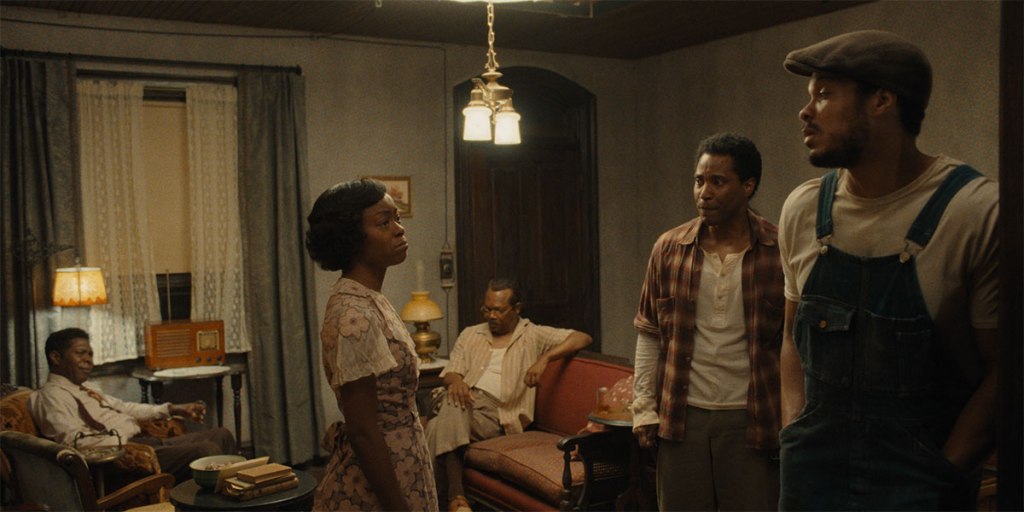
It’s 1936. Boy Willie Charles (John David Washington) and his friend Lymon are driving north from Mississippi with a truckload of watermelons, to visit his sister Berniece (Danielle Deadwyler) in Pittsburgh, Pennsylvania. She’s living with their uncle Doaker (Samuel L. Jackson). Once they sell the melons, Boy Willie plans to take his share of the profit (along with his savings) to purchase Sutter’s land. That’s the same place where his great grandparents were slaves, and where he still toils the land as a share-cropper. This is his one chance to own it.  But he’ll only have enough money if he sells the family piano. That’s why he’s visiting Pittsburgh. But Berniece refuses to sell it. Why? She grew up playing that piano, and more to the point it has family faces elegantly carved into the wood itself, dating back to pre-Civil War days. Besides, she says, that piano is haunted… and the ghost is getting meaner.  Meanwhile various family and friends, like a trickster and a preacher, are congregating at this house with different motives for being there. Can Boy Willie and Berniece come to terms about the piano? Or will bad spirits — both supernatural and human — ruin everything first?

The Piano Lesson is an excellent filmed version of playwright August Wilson’s drama. Fine acting all around, with Danielle Deadwyler outstanding as Berniece. Now, plays and movies are two different things. Actors emote louder and move bigger on stage (so everyone can see and hear them). And even the blocking and dialogue is different. Movies are no more real, but different. This Piano Lesson is very much a play. So I was a bit put off by it’s style… until the my brain started watching it as a play, at which point I really liked it.

If you notice a lot of Washingtons here, it’s no coincidence. Denzel Washington is the producer, and actor John David and director Malcolm are both sons of his. Denzel is committed to putting all ten of August Wilson’s Pittsburg Cycle on the big screen to preserve crucial Black American culture. Witness Fences in 2016 and Ma Rainey’s Black Bottom in 2020. The Piano Lesson is a fine addition to this series and should be watched.

A Real Pain

Wri/Dir: Jesse Eisenberg 

Benji and David Kaplan are cousins in their 30s, as close as brothers, but totally different. Benji (Kieran Culkin) is loud, gregarious, obnoxious and larger than life. He likes to raise a ruckus and mess things up. He lives alone in Binghamton, NY. David is shy, insecure and withdrawn. He’s married with a small kid and lives in Manhattan. He’s in a constant state of dithering and worrying. They’re travelling together to Poland to explore their family’s heritage. Their grandmother was Polish and a Holocaust survivor.

Benji was very close to her and devastated by her recent death, much more so than David. They’re part of a small tour group, all Jewish. Their guide (Will Sharpe) is a nerdy  English guy, very accommodating. Also on the tour are Marcia (Jennifer Grey) who suffers from intergenerational trauma;  Eloge (Kurt Egyiawan) from Winnipeg but originally from Rwanda where he survived Tutsi genocide; and a middle-class couple whose family immigrated from Poland generations ago but want to see where they came from. (“We’re Mayflower Jews”, he says).

Their journey takes in cultural and historical sites across Poland, but the closer they get to the concentration camp where their grandmother was imprisoned, the more agitated Benji gets.  He slips into shouted diatribes and lectures, causing scenes within their group and in public places — to David’s acute embarrassment. Can they both make it through the whole tour? Or will one of them drop out?

A Real Pain is a low-key, social comedy — yes, a comedy — about the uncomfortable dynamics within a family. it’s actually pretty funny, No slapstick or pratfalls, rather unexpected squirmy riffs on the two main characters’ personalities. (Like Benji telling David his bare feet are gorgeous, making him stare at them for the rest of the trip.)  It’s told in a series of clever vignettes over the course of the trip,  all hovering over unvoiced feelings of personal and collective mourning.   I’m always suspicious when actors play at directing, but this is no vanity pic. Eisenberg stays suitably subdued, letting Culkin go wild.

I like this movie.

Small Things Like These

Dir: Tim Mielants

It’s winter in a small town in Ireland in the 1980s. Bill Furlong (Cillian Murphy) is a working man who scrubs coal dust off his hands and face each day. But he doesn’t work in a coal mine; he has his own business, built from scratch, selling coal. His wife Eileen (Eileen Walsh) and his eldest daughter handle the finances. One day, he’s making a delivery when he’s alarmed to see a teenaged girl being dragged, kicking and screaming, into the local convent. That’s not right. She may be unmarried and pregnant, but why are they kidnapping that poor girl? 

So he steps inside to take a look. It’s the Magdalene Laundries, a Church organization that operates across Ireland, to care for unwed mothers. They put the babies up for adoption, and the girls and young women are trained to work as industrial laundresses. But to Bill it seems almost like a prison, where the girls are treated horribly. When one girl runs over, begging him to help her escape, he doesn’t know to do. The nuns quickly disabuse him of any notions he might have, and rush him out the front door. 

But Bill has history. He was brought up in this same town by his own single mum, who chose to stay away from that convent. He was bullied as a child because of this, but he still remembers how his mother — and her employer, an independently wealthy woman — defied the church. He feels he has to do something for that girl. But the nuns have their fingers in every pie; the school, government, they’re even a client of his own business. Should he confront the cold-eyed Sister Mary (Emily Watson) who runs everything? Or should he just worry about  his own family, and pretend nothing is wrong?

Small Things Like These is a deeply-moving drama about families, moral dilemmas and the checkered history of the Catholic Church in Ireland. This is the third such movie, after The Magdalene Sisters and Philomena, but its repercussions are still very much alive. Cillian Murphy —  who you probably recognize from Oppenheimer or Peaky Blinders — once again pulls you into the character he plays. He rarely speaks but the emotion in his features really affect you. So if you’re looking for a real tear-jerker, this is the one to watch.

A Real Pain, Small Things Like These, and The Piano Lesson all open in Toronto this weekend; check your local listings.

This is Daniel Garber at the Movies, each Saturday morning, on CIUT 89.5 FM and on my website culturalmining.com.

Daniel Garber talks with Jeff Harris about #TIFF24!

Hi, this is Daniel Garber at the Movies for culturalmining.com and CIUT 89.5 FM.

Photo of Jeff by Daniel Roher

TIFF is the most important film festival in this hemisphere, that gives us hints about the upcoming Awards season, what movies we should look out for, and where contemporary cinema is going. It ended six weeks ago, so it’s a good time to take a look at what TIFF brought us — the hits, flops, changes and sleepers, and just about the TIFF vibe itself. Jeff Harris is a professional photog who has covered TIFF for more than two decades, in photos and features for Macleans, The Walrus, and culturalmining among other outlets. So I’m very pleased have friend of the show Jeff Harris, here, in person, for a spirited discussion about this year’s TIFF.

TIFF 24 RECAP – PART 1

Films discussed include:

  • The Substance
  • The Assessment
  • Bird
  • Heretic
  • Emilia Pérez
  • The End
  • Fanatical: The Catfishing of Tegan and Sara
  • Elton John: Never Too Late
  • The Tragically Hip: No Dress Rehearsal
  • Piece By Piece
  • Better Man

TIFF 24 RECAP – PART 2

Films discussed include:

  • Paul Anka: His Way
  • The Luckiest Man in America
  • The Last Republican
  • The Order
  • The Seed of the Sacred Fig
  • The Girl with the Needle
  • Kill the Jockey
  • Nightbitch

TIFF 24 RECAP – PART 3

Films discussed include:

  • The Life Of Chuck
  • The Wild Robot
  • Mother Mother
  • Pepe
  • Dahomey
  • The Brutalist
  • Riff Raff
  • Nutcrackers

Films reviewed: Your Monster, Drive Back Home, Conclave

Posted in 1970s, Canada, Catholicism, LGBT, Monsters, Politics, Religion, Romantic Comedy, Theatre, Thriller by CulturalMining.com on October 26, 2024

Hi, this is Daniel Garber at the Movies for culturalmining.com and CIUT 89.5 FM.

More Film Festivals are coming up soon, with ReelAsian, Cinefranco and BITS, Blood in the Snow, just around the corner.

But this week, I’m looking at three great new movies. There’s a consortium of cardinals locked in their chambers; a monster discovered in a closet by a NY actress, and a Toronto man forced out of his closet by the police. 

Your Monster

Wri/Dir: Caroline Lindy

It’s present day Manhattan. Laura (Melissa Barrera) is a triple threat — she can sing, dance and act. She’s helping her boyfriend Jacob (Edmund Donovan) write his breakout musical, soon to open on Broadway with her in the lead role. But when she gets sick — the big C! — and needs surgery, he dumps her — out of the blue — while still in hospital. And casts another actress (Meghann Fahy), in her part. The surgery is a success but Laura is a total wreck. She’s doubly devastated, both from the sudden end of her five year relationship and for being cheated out of her big break. Her anger, frustration and self pity are all ready to explode. That’s when she makes an unexpected discovery. There’s a monster in her closet!

The creature (Tommy Dewey) is an actual monster, bearded with long hair, sharp teeth and leonine features, who talks like a dude. Apparently he has lived there all her life (she grew up in this house) she just never saw him before. It’s hate and fear at first sight. He threatens to tear out her throat and eat her alive — and tells her to leave the place and never come back. Meanwhile, Laura shows up for the audition uninvited and becomes the understudy for her own role. But things gradually warm up at home, as Laura and her monster get to know each other. But can she take him to the Halloween Ball? Will she ever get to perform her role on stage? And will her boyfriend ever take her back?

Your Monster is a very cute, rom-com/horror with a fair bit of singing, too. It’s a riff on Disney’s Beauty and the Beast but with a funnier monster and brooding beauty with a lot of anger inside. Melissa Barrera and Tommy Dewey have lots of chemistry while Edmund Donovan is suitably villainous as the bad boyfriend. He looks strangely like Jared Kushner. The movie as a whole is enjoyable and adorable.  It takes a funny concept to its extreme. I like the costumes, I like tight script — the whole movie is much better than I expected. There’s a play within the play (half the scenes are rehearsals or performances) but even the “real” home scenes are theatrical. Your Monster will make a great date movie, but just keep in mind there’s a bit of horror within this rom-com.

Drive Back Home

Wri/Dir: Michael Clowater

It’s 1970 in the village of Stanley, New Brunswick. 

Weldon (Charlie Creed-Miles) is a mechanic who lives with his mom, his wife and his son in the house he was born and grew up in.  One night he gets a long distance phone call from Toronto. His estranged younger brother Perly (Alan Cumming) — an advertising exec who he hasn’t heard from in many years — has been arrested for gross indecency (meaning consensual sex with another man). The cop lays it out. If you can pick him up and take him home, all charges will be dropped. If not, he’s going to prison for five years. So Weldon loads up his pickup truck with enough sandwiches and gasoline for a long trip and leaves his village for the first time in his life. He’s terrified of having to speak French so he takes a circuitous route avoiding Montreal altogether.

He picks up Perly from the cop shop but there is no love lost between them. Perly is a city boy who wears a jaunty cravat while his big brother is a hick, who’s never seen a high-rise apartment or an answering machine. He just wants to drive back home. Perly isn’t a happy camper either: His marriage is a shambles, his career has tanked and his dog is dead, since the cops arrested him. But what’s left for him in Toronto? And so they begin their long journey home. But what secrets will be revealed along the way?

Drive Back Home is a bittersweet drama about family and trauma. It’s done in the style of classic  Canadian Road movies,  like Don Shebib’s Goin’ Down the Road, but this one is about leaving the big city. Their trip through rural Ontario and Quebec alternates between scenic beauty, rustic kindness, and vicious, small-town bigotry. Canada was still rife with homophobic hatred at the time —  it was only decriminalized a year earlier, and there are disturbing gay-bashing scenes in this film along with a lot of homophobic F bombs.

The two main actors are English and Scottish but both quite good, and maintain decent Canadian accents, gruff for Creed Miles and arch for Cumming. The rest of the cast features prominent Canadian actors, with Clare Coulter as Adelaide, the hard-ass mom, Guy Sprung, as a Francophone farmer, Dan Beirne as a priest and Alexandre Bourgeois as a young guy they meet in a roadhouse bar. Drive Back Home is a moving look at Canada’s bad ol’ days.

Conclave

Dir: Edward Berger

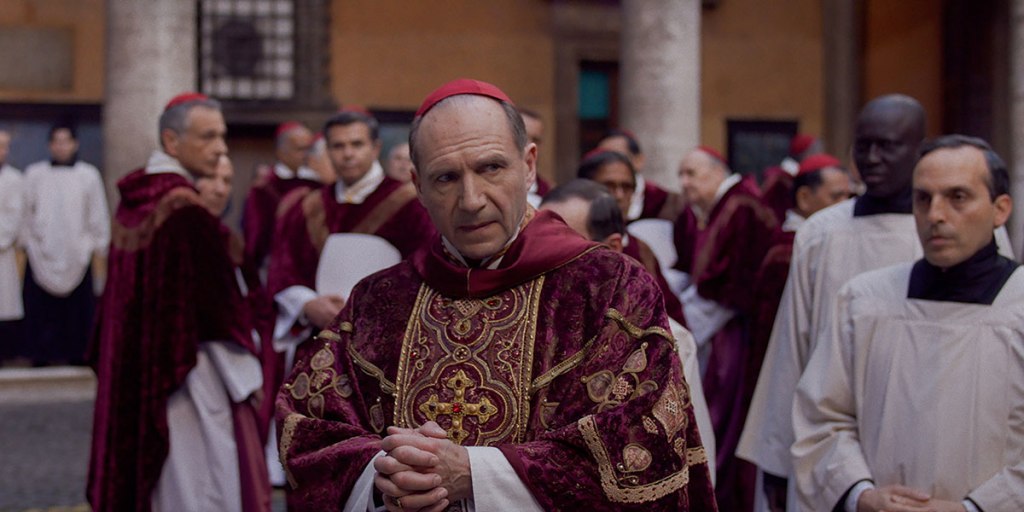
A hush hangs over the Vatican; his holiness the Pope is dead. And the world’s Cardinals, in red robes with white mitres, are congregating to choose the next pontiff from within their group. Ballots are secret, but until one receives 2/3 of the votes, they are literally locked-in, no contact with the outside world. What are their criteria for the next pope? He must be virtuous and humble, but also healthy and strong. And he must be honest as the Pope is infallible. Bishop Lawrence (Ralph Fiennes) is the Dean in charge of the highly secretive process. The most popular candidates: Bellini (Stanley Tucci), a modest liberal reformer, Tedesco (Sergio Castellitto), a bombastic traditionalist, and the highly respected Adeyami (Lucian Msamati). But Lawrence is privy to new information just before the lockdown. A drunken monsignor alleges the Pope fired Tremblay (John Lithgow) just before he died. And mystery man, Benitez (Carlos Diehz), appears out of nowhere claiming to be the Cardinal of Kabul, Afghanistan. And then there are the nuns, including Sister Agnes (Isabella Rossellini) who remain silent but see and hear everything. Which bishop will they choose to turn the conclave’s smoke from black to white?

Conclave is a stunningly- good thriller about secrets and subterfuge within the Vatican. The constant changes of political alliances as well as shocking revelations will keep your rapt attention until the very end. It presents a Vatican that’s both exquisite and decadent, with black mould spreading on it’s columns. It’s all the work of German director Edward Berger who made All Quiet on the Western Front, with Volker Bertelmann’s powerful music, and fascinating camerawork. It was filmed at Rome’s famous Cinecitta studio who are always deft at recreating the Vatican. I love this constant attention to detail — red sealing wax, Latin prayers, and tortellini soup.The acting is superb, especially Ralph Fiennes. I’ve never been a fan, but he is just sooo good in this role, maybe his best I’ve ever seen. Altogether, this makes Conclave a great night out.

Your Monster and Conclave both open this weekend in Toronto; check your local listings. And Drive Back Home is having its Toronto premiere tonight at CAMH on Queen West as part of the Rendezvous with Madness film fest.

This is Daniel Garber at the Movies, each Saturday morning, on CIUT 89.5 FM and on my website culturalmining.com.

Daniel Garber talks with Guy Maddin, Evan Johnson and Galen Johnson about their new film Rumours at #TIFF24

Posted in Brain, Canada, comedy, Diplomacy, Fantasy, Germany, Psychological Thriller, Science Fiction, Sex by CulturalMining.com on October 20, 2024

Photographs by Jeff Harris

Hi, this is Daniel Garber at the Movies for culturalmining.com and CIUT 89.5 FM.

Somewhere in Germany, the G7 is holding a summit at a chateau beside an archaeological peat bog site. The leaders of the top western economies — Canada, France, Germany, Italy, Japan, the UK and the US — are working hard to write a caring communique pledging future improvements in our world. Until something strange happens — all of the support staff suddenly disappear, and this elite cabal of Presidents and Prime Ministers are left to fend for themselves. And there are strange creatures dancing in the woods. Can these hapless leaders band together in time to stop the dangers threaten this planet? Or will they be reduced to suspicious conspiracies and petty rumours?

Rumours is also the name of a bizarre and funny new feature that premiered at TIFF. It combines geo-politics with ancient mythologies and otherworldly forces. Throw in some sexual intrigue and the threat of global apocalypse and you have something very different from anything you’ve ever seen. Rumours is the work of award-winning Winnipeg (review)  filmmaker Guy Maddin (Interview: Seances, 2013) and his collaborators Evan Johnson and Galen Johnson.  Guy Maddin is known for his uniquely baffling film images that range from unsettling Canadiana to creepy fantasies (Interview: Louis Negin, Keyhole, 2012) infused with perverse sexual neuroses… and more than a few laughs. Guy has worked with Evan and Galen Johnson for a decade now (Interview: The Forbidden Room,  2015).

I spoke with Guy Maddin, Evan Johnson and Galen Johnson in person, at TIFF24.

Rumours had it’s North American premiere at TIFF and is now playing in Toronto.

Assorted monsters. Films reviewed: The Apprentice, Piece by Piece, Don’t F**k with Ghosts

Posted in 1980s, Biopic, Canada, comedy, documentary, Donald Trump, Ghosts, Hiphop, Music, Winnipeg by CulturalMining.com on October 12, 2024

Hi, this is Daniel Garber at the Movies for culturalmining.com and CIUT 89.5 FM.

Toronto’s fall film festival season is in full swing with Planet in Focus, celebrating it’s 25th anniversary. It’s running from Tuesday through Sunday next week, with international features and shorts on climate change, activism, environmentalism  and indigenous issues. And on Friday, October 18, there’s a free screening at Hot Docs of We Will Be Brave, about Good Guise, a Toronto collective that sparks conversations around healthy masculinity through art. That’s part of the For Viola series honouring Viola Desmond.

But this is also October, when ghouls and ghosties flock to our screens. So this week, I’m talking about three new movies about various types of monsters. There’s a monstrously popular music producer from Virginia Beach; a notorious real estate developer trained by a monster in New York; and two guys searching for ghosts in Winnipeg.

The Apprentice

Dir: Ali Abassi (Review: Border)

It’s the mid 1970s, and  New York is a wreck, with soaring crime, homelessness and bankruptcy. When the Mayor asks the feds for help, Gerald Ford tells them to “drop dead”. Into the world emerges an ambitious young developer. Donald Trump (Sebastian Stan) was born rich, but cowers under his oppressive father’s rule. Fred Trump (Martin Donovan) a real estate developer from Queens, made his fortune building segregated public housing. Donald is stuck at crap jobs, collecting rent and evicting destitute tenants. But he has big ideas. His plan? To buy the venerable Commodore, an old hotel with 2000 rooms on 42nd street a hotbed of porn palaces and drug dealers. But how can he raise the money with his dad being sued by the feds for his racist rental practices? Donald has an idea. He joins an exclusive club with the hopes of meeting a certain lawyer he thinks can solve all his problems. The lawyer is Roy Cohn (Jeremy Strong) a notorious rightwing  attorney with ties to organized crime. Cohn played a central role in the McCarthy Hearings, and still brags about executing the Rosenbergs. He agrees to take on Donald as his protege, and teaches him his three crucial rules: Attack, attack, attack (whether lawsuits, blackmail or intimidation)  Deny everything , and always declare victory, even when you lose. (See: 2020 election). The club is also where he meets the beautiful and brash Ivana (Maria Bakalova), whom he is destined to marry. She will instill in him a love of garish, nouveau-riche interiors. The film follows these three people’s intertwined lives through the 70s and 80s until Cohn’s death. 

The Apprentice (absolutely no connection to Trump’s much later reality show) is a very dark biopic about the origin of Trump’s bizarre motivations and strategies. Sebastian Stan gives an excellent portrayal of Trump; he’s actually sympathetic for his earnestness and naivety in the beginning, but who spirals into something deeply disturbing by the end. This is not an SNL parody, it’s a realistically developed character. Likewise, Strong plays Roy Cohn as a dead-eyed, sybaritic bully, hosting gay orgies, even while publicly denying his sexuality to the end. He doesn’t look like Roy Cohn, but he sure does act like him. With a great selection of 70s and 80s pop songs throughout the film, and the grotesque golden opulence of Trump’s homes captured on grainy colour film of  the era, The Apprentice is a funny and disturbing biopic.

Piece by Piece

Co-Wri/Dir: Morgan Neville (Review: Best of Enemies)

Pharrell Williams is a highly successful music producer, musician, singer, composer and fashion designer. His work spans the genres from hiphop, to pop music and electronica. But his life hasn’t always been that way. He grows up in a working-class housing area in Virginia Beach, Va. and starts drumming at an early age using kitchen utensils. He’s into Star Trek, Stevie Wonder and Greek Gods (his apartment is actually named Atlantis!) He soon forms a band with his schoolmates, and later, starts working at a nearby recording studio, learning the ins and outs of music producing. 

He soon rises in popularity, both for his own work, and that of the stars he works with, a who’s who of hip hop and pop. He has a succession of hits with Kendrick Lamar, Snoopdog, Timbaland, and Jay-Z, then branches out to include pop stars like Justin Timberlake, Gwen Stefani, Robin Thicke, and Daft Punk, all producing worldwide hits. They come to him for the tracks he creates and samples, as well as a certain je ne sais quoi he adds to their music. But how long will his popularity last?

Piece by Piece is a documentary about the life and career of Pharrell Williams. It’s narrated by Pharrell himself, in an interview with the director, as well as talking heads of most of the stars he’s worked with. What’s unusual about this doc is it’s all done using LEGO animation. Instead of the actual people, you see LEGO people who waddle when they walk and have basic faces painted onto cylindrical plastic heads. But does it work? I’m of mixed feelings. I was expecting a LEGO movie — fast moving, constant jokes, mind-blowing psychedelic animation —  featuring Pharrell, but what I got was an interview with Pharrell using the style of LEGO. (Picture the movie Barbie, but without people just Barbie and Ken dolls) There are some cool creative parts. I love the animation of waves on the beach, the re-creation of video clips, and a cool conceit running through the story — Pharrell’s magic musical touch symbolized by glowing geometric shapes that he puts together for that perfect beat. And I loved the constant music. But in general the images and interviews were more or less the same as any music doc venerating its star— largely unremarkable.  A LEGO recording studio is still just a recording studio. And those  LEGO people are just irritating. This movie is OK, but I was not blown away. 

Don’t F**k with Ghosts

Co-Wri/Dir: Stuart Stone

Stu and Adam (Stuart Stone and Adam Rodness, who co-wrote the script) are a pair of Toronto filmmakers pitching their latest project — Bigfoot! But their financiers have another idea in mind: put together a film proving the existence of ghosts, and it’s sure to be a hit. But, just in case, they take their contract to a ginger- bearded entertainment lawyer (Josh Cruddas) for help.  He warns them to find some real ghosts or else they won’t get paid. So they head off to Winnipeg “the Murder Capital of Canada”. And to help them find the spooks, they enlist a series of experts to help them in their quest. It seems Winnipeg is also the capital of supernatural hustlers: ouija board specialists, psychics, aura readers, fortune tellers, magicians, clowns… even a “ghost sherpa” (Tony Nappo), who takes them on a strange journey involving smoking jackets,  psilocybin and a jacuzzi. They finally locate a house where some grizzly murders once took place. But will they ever find any real ghosts?

Don’t F**k with Ghosts is a low-budget, semi-supernatural Canadian comedy, done in the form of a reality show. So there’s the usual bickering between the two main characters (who also happen to be in-laws), hot mic “gotcha” scenes, and various other embarrassments “accidentally” caught on camera. And no spoilers, but I will say there are some unexpectedly well-done special effects toward the end.

Is Don’t F**k with Ghosts scary? No, not a bit. But is it funny? Well, not too bad…

The Apprentice, Piece by Piece, and Don’t F**K with Ghosts all open this weekend in Toronto; check your local listings. This is Daniel Garber at the Movies, each Saturday morning, on CIUT 89.5 FM and on my website culturalmining.com.