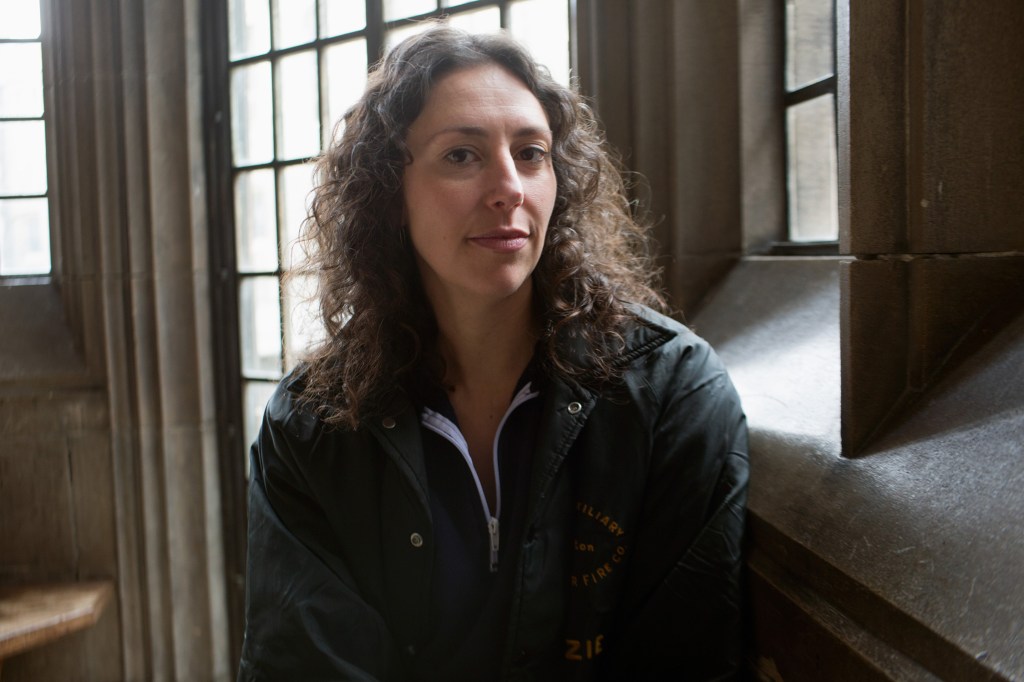
Jeff Harris talks with Ali Weinstein about her new documentary Your Tomorrow

Photograph and Interview by Jeff Harris
Your film points out a stark contrast between 1970s Toronto (when Ontario Place was opened) versus today. What exactly is going on?
I’m really quite sad and devastated about what’s happening at Ontario Place right now to be honest. I was never a fan of what’s been chosen to go on the west island because I don’t think it that it retains the spirit of Ontario Place as it was meant to be, this lasting place of exploration, education and fun for Ontarians. I tried to not make the film itself be an essay for my own personal point of view, I tried really hard to show the place as it was and I heard different reactions from people where they’ve watched the film and said “yeah, it does need to be redeveloped”. In terms of what’s coming next I don’t think it’s in line with what Ontario Place was meant to be and I think that the original spirit of Ontario Place is a really beautiful one, one that should be fought for today because we have even fewer places to be outside and to be in nature in this city.

The city has only gotten far far far more dense in the last 50 years and you have places like Liberty Village that didn’t exist in 1971 when Ontario Place opened… now there’s a tonne of condos where people don’t have their own outdoor space but next door is this beautiful waterfront land with forested areas to walk, and nature and birds and foxes. There is so much nature present at Ontario Place so I don’t really understand the vision when it comes to turning it into a spa.
What are the concerns about the spa?
The fact that it’s not a Canadian venture, it’s a European / Austrian owned spa that has this very not transparent deal with a 95 year lease that has been signed. I have a hard time imagining that my great grandchildren are gonna have the desire to go to the same spa that some people today might go to as a one off. I think there were probably many other visions for that land that got sent into the government when they opened it up proposals in 2019 that could have been tourist attractions, that could have made money for the province if they really prioritized that and they could have stayed with the original intent of being about Ontario and teaching people the history, the indigenous history of Ontario, what we have to be proud of as a province and that could have been more the focus as opposed to something indoor, foreign owned, and the vision just doesn’t feel like it’s towards longevity with the spa.
There’s a great line in the film where one of the protesters points out that this natural park is essentially a spa already!
She was part of a group of people that used the beach all the time, they would swim, hang out, exercise on the beach and it was a place for physical and mental wellbeing. I think a lot of the people that started to congregate at Ontario Place, many of them found the space during the pandemic when everyone was going loopy and stuck at home and isolated. People found community there and found other like-minded people there who wanted to be active, to be outdoors — and this was in their backyard! So when they talk about it already being a spa, they mean it’s been so beneficial for them. I felt that way myself going to Ontario Place.

Are you a fan of spas?
I enjoy going to a spa here and there… and some of my favourite parts of being at a spa are going with friends, going to catch up with people, to have sometimes a cultural experience like I love going to the Russian Spa, or the Korean Spa. The type of spa that’s going to be built at Ontario Place, I don’t foresee it being a place that people are going to go to repeatedly… it’s being marketed as a tourist attraction and I don’t know why that would go in the heart of the city on this very valuable prime land. It’s one of the few parts of the waterfront that’s actually accessible to residents of Toronto, where they can swim and boat and paddle board and run and jog and cycle and birdwatch and fish and so many different things so I think that the idea of it being a place of well being is interesting messaging from the government. So many people were using it for exactly that during the pandemic! It became this defecto public park because the government wasn’t doing anything with it.
Your Tomorrow had its world premiere at #TIFF24 and will have its broadcast premiere with TV Ontario on March 23rd at 9pm.
Journeys. Films reviewed: The Fabulous Four, Doubles, Crossing
Hi, this is Daniel Garber at the Movies for culturalmining.com and CIUT 89.5 FM.
Picture this: you’re watching a big-screen movie with your friends, but you’re sitting on the grass, not in a theatre. Huh? The Toronto Outdoor Picture Show (TOPS) lets you watch really great movies for free under the stars in parks across the city, in Fort York, the Corktown Commons, The Christie Pits and Bell Manor Park. Featured movies include Wim Wenders’ Perfect Days, Boots Riley’s Sorry to Bother You, and Stephen Soderbergh’s Out of Sight, to name just three. And there’s the Toronto Palestine Film Fest, showing a free film on August 9th at the Christie Pits — with music, food and items for sale by local artisans followed by an outdoor screening of Alam, The Flag, directed by Firas Khoury.
But this week, I’m looking at three new movies about journeys. We’ve got four old college friends heading to Key West for a wedding, a Trinidadian flying to Toronto in search of his long-gone father; and a retired woman with a teenaged boy in Georgia going to Istanbul in search of a missing girl.
The Fabulous Four
Dir: Jocelyn Moorhouse
Marilyn, Lou, Alice and Kitty, are friends from university, who have stayed close — though separate — for over half a century. Now they are back together again, face to face in quaint Key West, Florida. Marilyn (Bette Midler) a flamboyant homemaker, is getting remarried there; her long-time husband died just a few months earlier. Her adult daughter is opting out; she thinks it’s too soon. Lou (Susan Sarandon), never married, who has devoted her life instead to her career as an accomplished surgeon. She’s earnest, stubborn and moralistic. When she’s not at the hospital, she’s probably playing with her beloved cats or reading a novel by Hemingway. Kitty (Sheryl Lee Ralph) is a successful cannabis grower and manufacturer, known for her powerful edibles. But she’s had a falling out with her daughter who joined a religious sect that strictly forbids sex, drugs and rock’n’roll. She wants Kitty to move into an old-age home. Finally, Alice (Megan Mullally), a successful recording artist, is an unapologetically free spirit. Like Lou, she never married, but unlike the uptight surgeon, Alice will bed any man she fancies — or as her friends describe her, she’s a postmenopausal wolf in heat. But there is tension among the four. Marilyn and Lou have been feuding since they were roommates in a Manhattan apartment after graduating. Kitty and Alice had to trick Lou into coming — she doesn’t even know about Marilyn’s wedding.
But things get better after a few days in Key West. The formerly sullen Lou is glowing now after a random encounter with a local bar owner named Ted (Bruce Greenwood). And the four of them have fun on boat rides, paragliding and exploring the restaurants and
bars. But tension still remains between Marilyn and Lou, that threaten the wedding itself. What is their fight about? Why has it lasted so long? And can it be resolved?
The Fabulous Four is a comedy about a reunion of four aging women who get together for their last big blast. It’s goofy and a bit campy. The plot is paint-by-numbers with very few surprises. The drunk or stoned jokes are tired, but there are a few funny bits: like Lou taking down a bicycle thief using a sex toy. But it gets bogged down with predictable, age-related gags about incontinence and old people not knowing what TikTok is. So lots of eyerolling and a bit of cringiness, but luckily no extreme humiliation. And I was never bored — how could I be, with Susan Sarandon and Bette Midler in the same movie? It’s written and directed by women, which might explain why there was more niceness and less outrageousness than your average teen comedy.
Doubles
Wri/Dir: Ian Harnarine
Dhani (Sanjiv Boodhu) operates a doubles stand with his mother in Trinidad. (Doubles are snacks made of curried chana between two pieces of soft yellow fried bread.) Times are hard, and they really need more money. But their property is all in his dad’s name. He moved to Canada many years ago to advance his career, and never came back. Now he’s a rich man, a successful chef who owns a fancy restaurant and a big house, while his family back home is still struggling to get by. So Dhani buys a ticket and flies to Toronto for a week to work out the financials. But his mother stresses, don’t be like your father — he’s probably living with some other woman. Come right back.
But when he arrives on a cold winter day, he discovers it’s nothing like he expected. He visits his father, Ragbir (Errol Sitahal) at his Caribbean restaurant. Turns out he’s not the chef, he’s the dishwasher. He lives in a small house without any luxuries. And he meets Anita (Rashaana Cumberbatch) a greeter at the restaurant. She calls him her brother from another mother — a half sister he never knew about. And the biggest surprise: Ragbir is dying of
cancer and needs a bone-marrow donor to save his life. Can Dhani accept his father’s unexpected condition? And is he willing to donate the needed bone marrow?
Doubles is a poignant drama about father-son relationships and the immigrant experience. It’s a rough story, harrowing at parts, especially as the father’s health declines (in a great portrayal by Errol Sitahal.) Visually, I found the movie very drab and plain looking — the locations, people, places — in both Trinidad and Toronto. I assume that’s intentional, but it amounts to the opposite of eye candy. At the same time, the characters and story seem sad but real, and it’s the first time I’ve seen Trinidadians explicitly portrayed in a Canadian movie before. And — no spoilers — despite the heavy topics, the film does close on a happier note. And it’s being released theatrically just in time for Caribana!
Crossing
Wri/Dir: Levan Akin
Achi (Lucas Kankava) is a young layabout in a beachside house by the Black Sea in Georgia, not far from the Turkish border. He lives with his abusive brother, his sister-in-law and their crying baby. He wants to move somewhere far away but he’s unemployed and flat broke. Ms. Lia (Mzia Arabuli) is a dignified, retired school teacher from the same village. She’s looking for her beloved niece, Tekla. She hasn’t seen her in many years, but is knocking on doors to find her, and apologize for something she did way back when. His brother claims he’s never heard of her, but Achi jumps at the chance to talk with Ms Lia. He says he remembers Tekla, a transwoman who lived in the place a few doors down. But she moved to Istanbul and gave him her address before she left. He offers to take her there and even do a bit of translating. With some reservations, she agrees, and buys their tickets. When they arrive they are both impressed by the city’s grandeur and beauty. And with the help of two street urchins, he finds the place in the red light district she’s supposed to be working at. But she’s not there, and no one has heard of her. Lia becomes increasingly anxious about locating Tekla, even as friction builds between Lia and Achi as he looks for ways to live in the new city and earn a living.
At the same time all this is going on, Evrim, a young woman (Deniz
Dumanli) is following her own path. She works at a social welfare NGO called Pink Life, where she helps needy LGBT and other people in that area. She’s also passing through the byzantine legal process of transitioning her gender. As a transwoman, she is often harassed as a sex worker, but she’s actually an accredited lawyer, one of the few people who know how to confront the police when they overstep their bounds.
Lia and Achi eventually meet up with Evrim to try to locate Tekla. What will Lia do if she finds her? Will Achi stay in Istanbul if Lia returns to Georgia? And what about Evrim?
Crossing is an amazing adventure and drama following the lives of an unusual group of people navigating their way through the underbelly of of Istanbul’s culture. It’s a coming of age film about kinship and discovery. Great acting, beautiful cinematography and an excellent script. We get to see their encounters with the people they meet — Evrim on the street, Achi in a nightclub, and Lia in the night market. The characters are fascinating and multifaceted, revealing their hidden histories as the story progresses. At the same time, it’s a total tearjerker, with a number of deeply-moving scenes.
Interestingly, Crossing is only the second Georgian movie I’ve ever seen, and — surprise! — its by the same filmmaker, Swedish-born Georgian director Levan Akin (And Then We Danced).
I strongly recommend this movie.
The Fabulous Four and Doubles open in Toronto this weekend with Crossing playing at the TIFF Lightbox; check your local listings. This is Daniel Garber at the Movies, each Saturday morning, on CIUT 89.5 FM and on my website www.culturalmining.com.
Organized religion. Films reviewed: Hand of God, Agnes, Benedetta
Hi, this is Daniel Garber at the Movies for culturalmining.com and CIUT 89.5 FM.
It’s December and we’re entering holiday season, so I thought it’s time to talk about movies involving religion. So this week I’m looking at three new movies with (small c) catholic themes. There’s an adolescent boy in 1980s Naples who witnesses the “Hand of God”, a lesbian nun in renaissance Tuscany who is in love with God, and another nun in the US who may be possessed by the Devil.
Co-Wri/Dir: Paul Verhoeven
It’s the 1600s in Tuscany Italy. Benedetta (Virginie Efira) is a beautiful young nun with blond hair and a quick wit. She was placed in small town convent as a young girl, paid for by a rich dowry her parents gave the Abbess (Charlotte Rampling). Now Benedetta is married to God, both metaphorically, and literally, in her mind. She goes through vivid spells, where she has sex with a violent Jesus after he slays all her attackers with a sword. She also has a streak of cruelty since she was told that suffering, by oneself and others, brings one closer to God. The cynical Abbess thinks Benedetta’s trances are just an elaborate hoax. But everything changes when Bartolomea (Daphné Patakia) a gorgeous young novice, appears at their doorstep.
She is illiterate, and the victim of horrific abuses from her father and brothers. Benedetta takes her under her wing, nurtures her and schools her in divinity, reading and math. In exchange, Bartolomea sleeps with her, awakening hidden desires. Could this be love? Benadetta says she’s having chaste, spiritual sex
with Jesus himself, not carnal passion with the young novice. And her spontaneous stigmata — bleeding that appears in her hands and feet like Jesus on the cross — attracts pilgrims and followers from far and wide seeking advice and cures. But when she’s caught using a wooden statue of the Virgin Mary as a sex toy, things take a turn for the worse. A cruel Nuncio (Lambert Wilson) arrives from plague-ridden Florence for an inquisition. Will he manage to wring a confession from the two women? Or will Benedetta’s spiritual powers protect her from being burned at the stake?
Benedetta (based on actual historical records) is a bittersweet and passionate look at the life and love of a lesbian nun in Northern Italy. It’s sexually explicit with lots of matter-of-fact nudity throughout the film as well as some horrific violence (remember, this is a movie by the great Paul Verhoeven who knows well how to keep bums in seats). This is a visually stunning film, with sumptuous views of sunlit cathedrals, long-flowing costumes, diaphanous bed curtains and beautiful faces and bodies. Never has a convent looked so erotic. But it’s also a fascinating look at faith in the face of cynical religious practices. Benedetta is a beautiful and shocking film.
Wri/Dir: Mickey Reece
Sister Agnes (Hayley McFarland) is a young nun in a convent whose birthday celebration turns into a disaster. Now he’s tied to her bed, foaming at the mouth and speaking in strange otherworldly voices. What is going on?Enter Father Donoghue (Ben Hall). He’s a grizzled priest with a shady past, but also many successful exorcisms under his belt. And he takes a newby with him, the devout Benjamin (Jake Horowitz) a divinity student who has yet to take his vows. Father Donoghue doesn’t believe that they’re actually possessed, just that they think they are. And only the elaborate song and dance of an exorcism will allow them to give it up. At the convent, Mother Superior (Mary Buss) a stickler for rules, is much less enthusiastic. She’s not comfortable with men under her roof,
especially a young one without a priest’s collar. But she allows it to proceed. And the routine exorcism takes an unexpected turn.
The story picks up with Sister Agnes’s friend Sister Mary (Molly C. Quinn). She left the convent after the incident. Now she works at two jobs — a convenience store and a laundromat, —and is trying to live a normal life. But she doesn’t know what to do or how to act. Can she keep the faith? Matters aren’t helped when she meets a cynical stand up comic at a local dive bar (Sean Gunn). Can he teach her what she needs to know?
Agnes is a look at faith, and self-doubt within the church. It starts as a genre pic, a conventional, low-budget horror, but it ends up as a deeper and darker melodrama propelled by scary undertones. It’s called Agnes, but it’s actually in two acts, the second part mainly about Sister Mary. It’s unpredictable and uncomfortable, and sometimes a bit bloody. This may be the first Mickey Reece film I’ve ever watched but I can see why this indie filmmaker has such an avid following. The film has an interesting mix of experimental film and conventional, even kitschy, horror, comparable to avant-garde filmmakers like Ben Wheatley and Peter Strickland. Not for everyone, but I enjoyed it — and I think want to see more Mickey Reece.
Dir: Paolo Sorrentino
It’s 1984. Fabietto (Filippo Scotti) is a young man at Don Bosco high school in Naples, Italy. He is precocious and well-read, — constantly quoting classic verse — but has neither friends nor sexual experience. He gets most of his advice from his big brother (who shares a room with him) and his parents. Dad (Toni Servillo) is a self-declared communist while his mom (Teresa Saponangelo) is a inveterate practical joker. Then there are all the odd-ball neighbours in their apartment building (including a former countess) and his even stranger family members. But foremost in Fabio’s eyes is his aunt Patrizia (Luisa Ranieri). She suffers from delusions which cause her to innocently expose her flawless naked body at unusual times — which provide fodder
for the sexually-starved Fabio’s fantasies.
It’s also the year when rumour has it that international soccer star Maradona may start playing for the local team — an obsession of most of his family. Third on Fabietto’s list — after sex and football — are the movies. Fellini is casting extras in Napoli — he goes to the audition — while another up-and-coming director is shooting his latest film downtown. That director is also dating the very actress Fabio is dying to meet. Will he ever fulfill any of his wishes? And how will this pivotal year affect the rest of his life?
Hand of God (the title refers to a legendary goal scored by Maradona) is a coming-of-age story based on the filmmaker’s
own recollections. It seems like the straight version of the popular Call Me By Your Name, another Italian feature. Set in the 80s, it’s also about a precocious adolescent’s first sexual experiences, situated within a quirky but loving family. There’s lots of 80s music, fashion and hairstyles to look at. Filippo Scotti also happens to looks a hell of a lot like Timothée Chalamet. That said, it is its own film, and fits very firmly within Sorentino’s work, including his fascination with celebrities as characters,
perennial actors like the great Toni Servillo hapless men, as well as the requisite “naked woman with perfect breasts” who manages to turn up, in one form or another, in all his movies. Although Hand of God isn’t that original, and a bit contrived, it does have some very funny and a few honestly shocking scenes that should not be missed. I liked this one.
Hand of God and Benedetta both open theatrically in Toronto this weekend at the TIFF Bell Lightbox; check your local listings; and Agnes starts next Friday at the Carlton Cinema in Toronto.
This is Daniel Garber at the Movies, each Saturday morning, on CIUT 89.5 FM and on my website, culturalmining.com
Secrets and Lies. Films reviewed: The Secret Garden, She Dies Tomorrow, The Burnt Orange Heresy
Hi, this is Daniel Garber at the Movies for culturalmining.com and CIUT 89.5 FM.
This week I’m looking at three new movies about secrets and lies. There’s a little girl with a secret garden, an art critic with a secret past, and a woman whose future night be ending tomorrow.
Dir: Marc Munden
Based on the book by Frances Hodgson Burnett
It’s 1947. Mary (Dixie Egerickx) is a little English girl raised by servants in India. They dress her, feed her and bring her whatever she wants. She likes telling stories and playing with dolls. But when her parents both die, she’s shipped back to England to live in the stately Misselthwaite Manor. It’s a huge mansion with secret rooms and passageways, haunted each night by scary voices eachoing in the halls. It’s owned Mary’s uncle, the reclusive Lord Craven (Colin Firth) and strictly supervised by the housekeeper Mrs Medlock (Julie Walters). who warns Mary, keep quiet, eat your porridge, and stay away from forbidden rooms or Lord Craven will send you off to boarding school! Needless to say Mary hates it there.
But things take a turn when she discovers she’s not the only kid there. Colin (Edan Hayhurst) is the source of the wailing cries she hears each night. He’s pale and bedridden and never leaves his room – he’s her first cousin. And there’s young Dickon (Amir Wilson) who knows his way around the estate grounds and the misty moors beyond. When a little bird leads Mary to an ivy covered gate, she‘s delighted to find a walled garden, full of sunlight,
flowers, butterflies and a bit of magic. It’s a wonderful place where she can play with Dickon, and tell stories. Can Mary keep her beloved garden? Will Colin ever leave his room? Will Lord Craven come out of his shell? And what other secrets does Misselthwaite Manor hold?
The Secret Garden is a new adaptation of the famous children’s book written more than a hundred years ago. It’s definitely a kids’ movie, but the children aren’t cutesy they’re interesting, argumentative and rude… and their characters develop over the course of the film. The acting is good all around. It deals with issues like death, loss and depression within the exciting adventure story. I wasn’t crazy about the excessive use of CGIs reflecting Mary’s internal thoughts, but, like I said, it’s a kids’ movie. And its multi-racial cast provides a nice break from the traditional, lily-white British historical dramas.
I enjoyed this movie.
Wri/Dir: Amy Seimetz
Amy (Kate Lyn Sheil) is a young woman who has it all: a lover, a devoted friend, and her first house – she just moved in today. She’s happy, healthy and financially secure, and hasn’t touched a drop of alcohol for months. So why is she so depressed? Because she just found out she’s going to die. Really soon. And there’s nothing she can do about it. There’s no medical report, or threatening letter or anything… she just knows, deep down inside. How should she spend her last 24 hours? Making love? Saying goodbye?
Instead, Amy grabs a bottle of liquor, puts on her favourite sequined gown, and goes into the backyard to do some gardening. That’s where her best friend Jane (Jane Adams) finds her a few hours later. She tries to understand Amy’s feelings of fear and dread and calm her down, talk some sense into her. But a few hours later, it’s Jane who is sure she’s going to die. And she passes it on to her brother at a birthday party where it spreads to others throughout the building. Is this mass delusion? A psychological virus? And can it be stopped?
She Dies Tomorrow is an uncategorizable movie, with equal parts dark
comedy, horror, fantasy and satirical social drama. It’s about a highly contagious virus that makes people believe they’re about to die and then (maybe) kills them. It’s also about what we choose to do in our last 24 hours. It dramatizes the infection using a series of intensely coloured flashes of light – red, blue, green – accompanied by murmuring voices inside characters’ heads. And it alternates the scary parts with inane conversations about the sex lives of dolphins and dune-buggy rides, all set in a southwestern American desert town. Although She Dies Tomrrow was made before the current pandemic, its surreal and impressionistic feel perfectly captures the current malaise infecting everyone right now.
Dir: Giuseppe Capotondi
Based on the novel by Charles Willford
James (Claes Bang) is a handsome but cynical art critic who lives in northern Italy. He earns his living selling his books and giving lectures to American tourists. His theme? it’s not the artists who make art great it’s the critics. Berenice (Elizabeth Debicki) is a strikingly beautiful woman with an acid tongue. She mysteriously appears at one of his lectures and calls his bluff. It’s art, truth and beauty that’s important, not criticism and spin. They end up making passionate love in his apartment.
James invites her on a trip to Lac Como, to visit Joseph Cassidy (Mick Jagger) a dilletente who married into money and is famous as an art collector.
Cassidy supports eccentric artist Jerome Debney (Donald Sutherland) who lives on his estate, with the hope he will someday create a masterpiece. Although critically acclaimed, all of his paintings were destroyed in a series of fires, and he allows no one, not even his benefactor to look at his work. Cassidy offers James a deal – you can have an exclusive interview with Debney if you bring me one of his paintings… And I don’t care how you get it. Will James get the painting? Will
his relentless ambition lead to unforeseen ends? And what is Berenice’s role in all this?
The Burnt Orange Heresy is a taut, tense noir thriller about deceit and lies within the rotten world of fine art. It’s full of twists and surprises throughout the film. The beautiful settings, clever dialogue and attractive cast stand in sharp contrast to its dark – and sometimes violent – theme. Debicki and Bang are fantastic, like a modern day Katherine Hepburn and Cary Grant, shifting from lovers to friends to potential rivals. I liked this one a lot, but beware: it’s anything but a romantic comedy.
The Secret Garden, She Dies Tomorrow, and The Burnt Orange Heresy, all open today in Toronto, theatrically or VOD – check your local listings.
This is Daniel Garber at the Movies each Friday morning on CIUT 89.5 FM and on my website culturalmining.com.
When I grow up… Films reviewed: Fighting With My Family, Never Look Away
Hi, this is Daniel Garber at the Movies for culturalmining.com and CIUT 89.5 FM.
One question every kid hears is What do you want to be when you grow up? When I was three I wanted to be a fire truck. But how many stay true to their earliest ambitions? This week I’m looking at two movies about people who stick to their childhood passions. There’s an historical drama from Germany about an aspiring artist and a biopic from the UK about a perspiring wrestler
Wri/Dir: Stephen Merchant
Saraya Knight (Francis Pugh) is a thirteen-year-old girl in a working-class neighbourhood in Norwich. Her mom and dad (Lena Headey, Nick Frost) run a business: the WAW, or World Association of Wrestlers. But like everything else in that world, it’s a bit of an exaggeration. They have one gym where they train local kids to wrestle, and take their family’s matches on the road in their shiny white van. Her life is fully immersed in the sport. Black haired and petite, Saraya uses black eyeliner and dresses in heavy metal gear. She has posters of her wrestling heroes on her wall and even made her own
championship belt out of cardboard. But she has one problem: she chokes under stress.
So her big brother Zack (Jack Lowden) takes her into the ring and teaches her how to wrestle. He is her sparring partner, and they soon become an accomplished tag team. She’s a natural. But they have bigger ambitions: to be make it to the top. So when the WWE is coming to the UK they sign up for the tryouts. This is Zack and Saraya’s one chance to make it big. The auditions are led by Coach (Vince Vaughan) a hard-boiled veteran who takes no prisoners. Will Zack get in? And will he take Saraya with him? Turns out, Coach chooses her, not him!
Suddenly she finds herself in Florida surrounded by palm trees, suntans and bikinis while Zack is left in Norwich taking care of his new baby. Saraya — now called Paige — is overwhelmed by the gruelling, boot-camp workouts and the loneliness she faces. Zack feels abandoned so he cuts her off. And the fledgling wrestlers she’s paired with are all former models, dancers and cheerleaders… who don’t know how to wrestle. Professionals finesse their jabs, throws and punches so they don’t hurt so much.
Her parents and all the kids at the gym back home are rooting for her, but Paige is filled with doubt. Can the little “freak from Norwich” ever make it in pro-wrestling?
Fighting With My Family is a very cute, palatable and easy-to-watch comedy biopic, about the real female pro wrestler known as Paige. I have to admit I knew next to nothing about pro wrestling before I watched it.
What did I learn? That this sport is “fixed”, but it’s not “fake”… the wrestling part is real, and it can really hurt. That it’s a theatrical performance, much like a circus. That you have to win over an audience if you want to make it. And that your persona, while a big exaggeration, has to have some truth in it or no one will believe it. The movie is filled with salty language but no sex or violence (except in the ring). Pugh and Lowden are great as the brother and sister. Yes, it’s predictable and sentimental and I’m not going to call it a “great movie”, but I had a good time watching it.
Never Look Away (Werk Ohne Autor)
Wri/Dir: Florian Henckel von Donnersmarck
1937, Germany.
Little Kurt, with his aunt Elisabeth (Saskia Rosendahl), visits an exhibition in Dresden filled with avant-garde art. He loves the beautiful colours of fauvism, the strange distortions of cubism, and challenging images by Grozs, Kandinsky,
Mondrian. But is he too young to understand the art show was put on by the Nazi government to condemn this art as bad and “degenerate”? No, he understands perfectly what they’re saying, and rejects it all.
But he listens to his aunt when she warns him to keep his drawings secret. Later, when the lovely but
eccentric aunt has a strange episode they lock her up in a mental hospital. While she is there, top-ranked Nazi doctors decide to throw away not just “degenerate” art but imperfect people. Anyone with a mental illness, physical disability or a developmental handicap is sent to the gas chambers. Doctors write
either a blue “minus” (keep) or a red “plus” (kill) on their files. This includes Elisabeth, condemned to death by a top Nazi gynecologist (Sebastian Koch).
Later, after the war, Kurt (Tom Schilling) is accepted into the Dresden Art Academy. But now his talent is stifled by the communist government who only want him to paint socialist realism: stern men and
rosy-cheeked women harvesting wheat as they stare toward a brighter future. At the academy he meets the kind and beautiful Ellie Seeband (Paula Beer), and wins her heart. Even under communism, Ellie is a “golden pheasant” from a rich, high-ranked family. They fall in love and meet for secret trysts. But when
her parents come home they have to be extra cautious. While her mother is sympathetic, her father, Professor Karl Seeband, tries his best to break them up. But what no one realizes, this professor is the same doctor who sent Kurt’s aunt Elizabeth to her death!
Kurt and Ellie eventually make it to West Germany, where he joins the prestigious art academy in Düsseldorf, and lands a private studio to create the art he really wants to make. The art
professor tells him his work is good but not yet special, but he still detects the talent hidden there. Will Kurt ever find his true calling? Will Seebald’s hidden war crimes be exposed? Can Ellie emerge from beneath her oppressive father’s shadow?
Never Look Away is an epic, fictionalized drama about the life of a well- known artist, spanning German
history from the Nazi era, to the communist east, and to the changes in the west in the 50s and 60s. It stars some of Germany’s biggest names: tiny Tom Schilling with his high-pitched voice is still playing young men in his late thirties (and he’s great as Kurt). Paula Beer
(Transit) is sweet as Ellie, Sebastian Koch is suitably sinister as the hidden Nazi Zeebald, and Saskia Rosendahl (who was amazing in Lore) once again wins as Elisabeth. The cinematography and music are all wonderful. But something seems missing from this huge drama.
At one point Kurt makes an
interesting point: Take six random numbers. On their own they have no meaning. But if they are the winning numbers on a lottery ticket suddenly they become important and beautiful. I went into this movie blind, knowing nothing about it. While watching it, I kept thinking what’s the big deal about Kurt? But when he starts experimenting with smeared, black-and-white, photorealist paintings, I thought, wait a minute, those look like Gerhard Richter’s paintings! And suddenly the movie makes sense. It becomes a winning lottery ticket. Not a perfect movie – not as good as this director’s Lives of Others – but definitely worth watching.
Oscar nominee Never Look Away and Fighting With My Family both open today in Toronto; check your local listings.
This is Daniel Garber at the Movies, each Friday morning, on CIUT 89.5 FM and on my website, culturalmining.com.
Daniel Garber talks with Sofia Bohdanowicz about Maison du Bonheur
Hi, this is Daniel Garber at the Movies for culturalmining.com and CIUT 89.5 FM.
Juliane is a retired astrologer in her 70s who lives in a Paris apartment in the 18th arrondissement, in Montmartre. She believes her personal presentation – hair, makeup, clothes, and shoes – must always be impeccable. Her life should be full of delicious food,
lovely colours and fast friends. And her apartment, part of Haussmanns original design, should be a veritable “house of happiness”.
Maison du Bonheur is a wonderful new documentary that follows Juliane over the course of a month by a
Canadian filmmaker who comes to stay with her. It records the mundane, yet fascinating, details of the everyday life of a classic parisienne, even as it subtly reveals her — and the filmmaker’s — unspoken secret histories. The film was directed, shot and edited on a microbudget by Toronto-based Sofia Bohdanowicz. Winner of the Jay Scott Prize, the Emerging Canadian Directors award (at VIFF) and many more, this is Sofia’s second film.
Maison du Bonheur opens tonight at the TIFF Bell Lightbox in Toronto.
I spoke with Sofia at CIUT 89.5 FM.
Daniel Garber talks with Alison McAlpine about her new doc CIELO
Hi, this is Daniel Garber at the Movies for culturalmining.com and CIUT 89.5 FM.
Have you ever stared at the night sky and the stars and planets up there? What does it mean and how does it relate to our lives?
A new documentary premiering next Friday looks at the skies above the Atacama desert in
northern Chile, the scientists and astronomers who observe them, and the people born there and who live beneath them.
It explores the filmmaker’s personal impression and interactions with the people she meets. It’s an astronomical,
spiritual, anthropological look at life in a desert beneath the vast bright stars.
The film is called Cielo, and its filmmaker is Alison McAlpine. Alison’s award-winning and critically acclaimed documentaries have played at film festivals around the world. 
I spoke to Alison McAlpine in Montreal by telephone from CIUT 89.5 FM in Toronto.
Cielo opens in Toronto on Friday, August 10.
Disruptions. Films reviewed: Marlina the Murderer, Darken, North Mountain
Hi, this is Daniel Garber at the Movies for culturalmining.com and CIUT 89.5 FM.
It’s Canada Day weekend – a good time for fireworks, beer, and maybe a movie. So I’ve been looking around for films not from south of the border — and three unusual ones caught my eye. Two are from Canada — and one from Indonesia — and two of the three are directed by and feature women.
This week I’m looking at three movies about people whose lives are disrupted by unexpected visitors. There’s a Mi’kmaq trapper fighting off thieves in eastern Canada, a widow fighting off rapists in eastern Indonesia, and a Toronto nurse fighting medieval soldiers… in a parallel universe.
Marlina the Murderer in Four Acts
Dir: Mouly Surya
It’s present day Sumba, an island in Eastern Indonesia near Flores and Timor Leste. Marlina (Marsha Timothy) is a sad and lonely widow. Her only child died years ago, and her husband’s body sits beside her in her home, wrapped in traditional cloth, awaiting his funeral. All she has left are her cattle, chickens and pigs. But her sad relections are interrupted one day by a visitor
on a motorbike. It’s Marcus (Egy Fedly) an evil, long-haired outlaw from a nearby town. He heard she’s alone and comes there to take advantage. I have a gang of six more men on their way, he says. You’re a woman all alone, so we own you now. You’re going to cook us a meal. We will steal your cattle and anything else you own. And — if
you’re lucky — we’ll rape you, but not kill you. And there’s nothing you can do about it.
Marlina is sickened and terrified… but not helpless. She poisons four of the men with her chicken soup, and when Marcus sexually assaults her, Marlina, in a moment of desperation, grabs a machete and chops off his head! Not knowing what else to do, she
decides to turn herself in to the local police.
At the truck-taxi stop she meets a neighbour named Novi (Dea Panendra) who reacts rather mildly to the dead man’s head she’s carrying. Novi is more concerned with her own problems. She’s ten months pregnant but the baby just won’t come out! So they set off down the long and twisting road to the nearest town.
But two of the killers are still after her. Will Novi ever give birth? Should Marlina turn herself in? And what will she do with Marcus’s head?
Marlina the Murderer is a genre-busting drama, part revenge pic, part feminist western, part art house dark comedy. It has an amazingly calm tone in the midst of horrible crime. There are horses, and posses, and road
trips and fights. I haven’t seen many Indonesian movies, so I’m far from an expert, but the two stars were both in great action movies I actually have seen: Headshot and The Raid 2 – which is a good sign. And it introduces the music, customs and amazing scenery and people of Sumba, a place I had never heard of before this film, but now at least have experienced a taste of it.
Marlina the Murderer is a brilliant, rich and baffling movie.
Dir: Audrey Cummings
Eve (Bea Santos) is a Toronto nurse who’s feeling down. She’s depressed and her life has lost its point. Until one day she runs into a woman on a sidewalk calling for help. The woman is dressed in a strange medieval leather outfit and is bleeding from a knife wound. She asks Eve to rescue her friends. But when Eve opens a door to a nearby building, she finds herself, like Alice in Wonderland, in a whole other world.
It’s a land called Darken, composed of a series of linked rooms and hallways, It’s always indoors in Darken and always nighttime. It’s governed by a goddess who provides life through her blood and is ruled by an autocratic priestess named Clarity (Christine Horne). It serves as a refuge for outcasts from different eras, all of whom live peacefully together. That is, until now.
The Mother Goddess is out of the picture, and Clarity has declared war on all dissidents. Her spear-wielding guards –
all decked out in Game of Thrones gear – provide her the muscle; and a lackey (Ari Millen) — who reminds me of the young Penguin on Gotham — defends her legal rulings.
But Eve falls in with the rebels, including the fierce Kali (Olunike Adeliyi) and the kindly Mercy (Zöe Belkin) who communicates using sign language. Which side will win? And can Eve ever get back to her normal world?
Darken is a science fiction/fantasy set in a parallel universe. It ranges from unexpected plot twists to absolute cheese. Above all, this feature shouts TV, from the set design, to the lighting, to the acting and the script. There
are even scenes that fade to black as if they’re saying: Insert Ad Here. And I find shows shot entirely on dark blue sets claustrophobic. But that’s just me.
On the other hand, women-centred science fiction or fantasy movies are rarer than an affordable apartment in
Toronto. And this one has a a goddess, an evil priestess, a heroine, and noble fighters — all played by women. The men are there as peripheral characters or arm candy.
And for that reason alone it might be worth seeing.
Dir: Bretten Hannam
Wolf (Justin Rain) is a young hunter/trapper in a Nova Scotia forest. He knows every rock and tree on North Mountain: where to set the snares, where to hunt the deer. He lives a traditional Mi’kmaq life in his Grandmother’s wooden cabin, a life still lit by candlelight. He uses a bow and
arrow to kill the animals he eats, and honours and respects each life he sacrifices. It’s a simple, quiet existence, punctuated by monthly visits to the town store where he catches up with Mona (Meredith MacNeil), a long time friend.
Nothing changes except the seasons, until… he finds an older man’s body leaning against a tree. He’s bleeding, barely alive, and is holding a leather satchel filled with cold, hard American cash. Wolf tends to his wounds until Crane (Glenn Gould) comes back to life. Turns out he’s from this place and speaks the same language.
Their first conversations are fraught with violence and fistfights and filled with suspicion. But at some point their initial violent antipathy shifts to something very different: they become lovers! And just as they’re making sense of it,
a group of strangers comes to the mountain. A posse of crooked cops and organized criminals. They want the cash and don’t care who they kill to get it. Can a pair of indigenous lovers wielding bow, arrow and tomahawk overcome a heavily-armed contingent?
North Mountain is half violent thriller, half passionate, aboriginal gay love story. Rain and Gould (of Plains Cree and Mi’kmaq heritage, respectively) are excellent as the two lovers, and the action – including references to Peckinpaw’s ultra-violent Straw Dogs – is as heart-pounding as any good thriller.
North Mountain, Darken and Marlina the Murderer all open today in Toronto; check your local listings.
This is Daniel Garber at the Movies, each Friday morning, on CIUT 89.5 FM and on my website culturalmining.com.
Hi, this is Daniel Garber at the Movies for culturalmining.com and CIUT 89.5 FM.
market only really want to see action movies preferably based on either a plastic toy or video game, or else set somewhere in the superhero Universe. The bog studios bet big bucks on this prediction. But is it true? Aren’t there any movies without middle- aged men in tights that interest today’s youth?
Lightbox, offers exactly that: a selection of innovative international features and shorts, aimed at 14-24 year olds, programmed by youth, for youth and about youth. The films and events are curated by a diverse posse of teenagers who apparently really know their stuff. Curators include cinephiles, movie geeks and future filmmakers, aged 14-18.


1 comment