Wolf men and assassins. Films reviewed: Wolf Man, Soundtrack to a Coup d’Etat
Hi, this is Daniel Garber at the Movies for culturalmining.com and CIUT 89.5 FM.
It may be cold outside, but things are burning up on the big screen. This week I’m looking a two new movies, a thriller horror and a documentary. There are wolf men in Oregon, and assassins in Congo.
Wolf Man
Co-Wri/Dir: Leigh Whannell
It’s present-day San Francisco. Blake (Christopher Abbot) is a lapsed writer who devotes his life to his wife and daughter. Charlotte (Julia Garner) is a careerist who is rarely at home, so Blake takes on the parenting role. He spends all his time with their precocious 10-year-old daughter, Ginger (Matilda Firth). But he and Charlotte are constantly bickering about her absentee-mom-ism. So when a package arrives with his late father’s will and a set of keys, he wonders if this is the miracle they need to keep thew family together. He has inherited — a house, a barn, and countless acres of lush green forest — the beautiful country he grew up in. Blake suggests the three of them go on a road trip together for some quality time. Young Blake was raised in isolation by a hard-ass survivalist who was strict and demanding toward his motherless son. That’s why Blake is so indulgent towards Ginger, who still dresses like a Disney princess at age 10.
So off they head for his isolated cabin in remote Oregon. But
what Blake seems to have forgotten is there are wolves in them thar hills! Big bad wolves, mean ugly wolves, the kind who stand on two feet and like wolfing down people like them. Sure enough, as they approach their farm one of them woolfies drives their u-haul off the road… and they’re forced to run for their lives. Luckily the house is still wolf-proof, with iron bars on all the windows. Unluckily, Blake gets himself slashed by the Wolf Man, and he’s changing into something different. Can he keep his vulpine urges in check and protect his family from harm? Or will he be the biggest danger to them of all?
Wolf Man is a cabin-in-the-woods werewolf movie with a few new twist. In this version, people don’t turn into wolves on a full moon and then change back again; they’re in it for the long haul. And these werewolves aren’t sleek, or sexy or furry, never mind cute or loveable. They’re more like zombies infected with a horrible virus that makes their teeth and hair fall out and their skin go bumpy and gross. These werewolves want to eat flesh and blood, preferably human. Once infected, they can no longer speak or understand people.
There’s no sex in this movie, not even a kiss, it’s totally sterile. In this neck of the woods everyone’s a guy, with literally no women at all. And every man could be a wolf man. Women and girls are urban sophisticates, while men and boys are potential redneck killers. Christopher Abbot plays Blake as a male Oprah mom who is inevitably drawn back to the dangerous manliness he grew up with. Julia Garner’s Charlotte is a less developed character, just an aloof woman forced to either scream and run or fight back.
There are a lot of misfires in this movie. Charlotte dresses in black and white like an English barrister emerging from a courtroom; but turns out she’s a journalist leaving her newsroom… huh?? Blake who grew up in a world of misery and death that he left far behind, now decides to take his family back there… for vacation? Why? There are some good parts, too. Like when the story is told through a werewolf’s eyes and ears, we hear the pounding footsteps of a tiny insect, and see the world as a glowing colourful prism — very cool.
But not enough to save a story that doesn’t quite cut it.
Soundtrack to a Coup d’Etat
Co-Wri/Dir: Johan Grimonprez
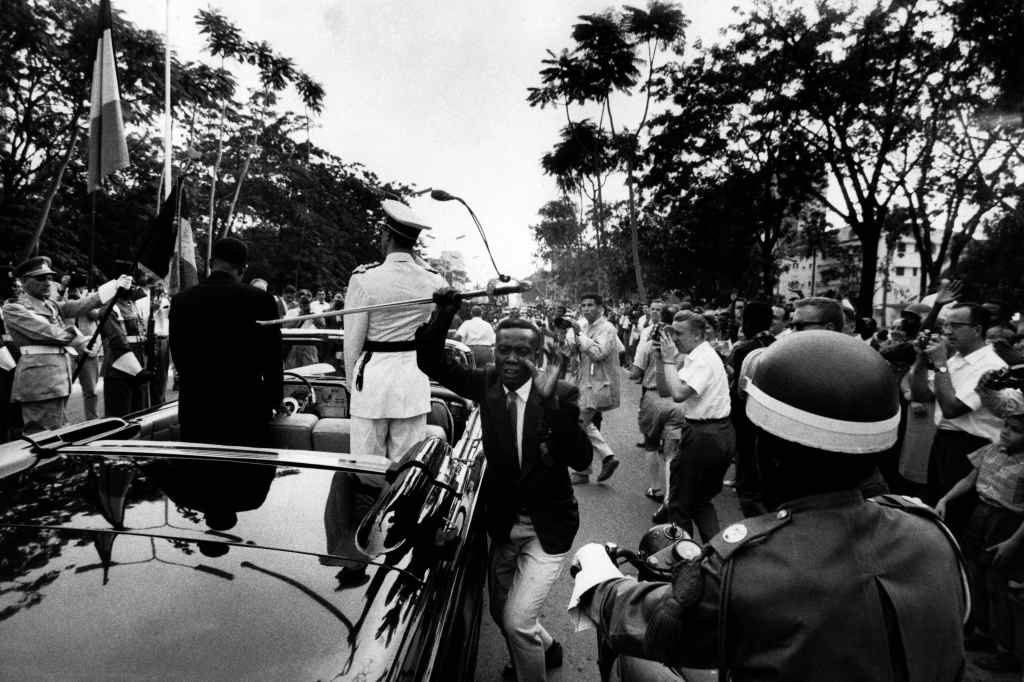
It’s June 30, 1960, and the Democratic Republic of Congo is reborn as a free, democratic state, after nearly a century of brutal colonial rule under the King of Belgium. Leopold II is notorious for chopping off the hands of men, women and children who didn’t produce their quota of rubber. Congo (under the Union Minière) is a very rich country full of diamonds, copper, tin, and uranium, extracted and shipped to Europe and the US. Its rubber and copper were crucial to winning the world wars and their uranium fuelled the atomic bombs dropped on Japan. Its first elected prime minister, Patrice Lumumba, gives a speech on independence day, celebrating the transfer of power from their previous colonial rulers. He rightly condemns the colonial atrocities and speaks out in favour of the non-aligned movement (former colonies in Europe and Asia). While his speech is well-received locally, Europeans — including the Belgian
royal family — are shocked and aghast. Will they lose control of the Union Minière, and will the US give up its uranium source? Not a chance. They accuse Lumumba of being a communist, despite his stressing independence and nationalism. So they declare Katanga, an area rich in minerals, as independent from the DRC. The seceded state is essentially ruled by white Europeans and Rhodesian mercenary police and a military that operates with impunity, kidnapping miners and bombing uncooperative villages.
The US (especially the CIA), fearing the so-called communist Lumumba, launch a two-pronged campaign: a covert one, involving assassinations, bombings, kidnappings and regime change; and a diplomatic one, where famous American jazz musicians are flown to independent African states to perform as ambassadors of Jazz. Louis Armstrong, Dizzy Gillespie, Nina Simone and Max Roach, have no idea they ware working
for a CIA front. By January, 1961, the wildly popular Lumumba is dead, assassinated in Katanga with Belgian and American complicity.
Soundtrack of a Coup d’Etat is a fantastic documentary that retells the events of those six months. The doc is 2 1/2 hours long, so I can only give you the briefest outline of what it’s about. But the film itself is amazing, covering everything from pan-African nationalism and the Cold War, to non-aligned nations, colonialism, and the UN. We hear Malcolm X in Harlem, Andrée Blouin on women’s rights in Africa, Castro in NY, and Nikita Khrushchev’s famous shoe speech (where apparently he didn’t actually say what they said he said) in the general assembly. It’s filled with compelling imagery: Alan Dulles the head of the CIA smoking his pipe; a North Rhodesian mercenary recounting the tens of thousands of people they killed with impunity; the Soviets crushing Hungary, and Voice of America broadcasts. There are hilarious propaganda newsreels like the US parachuting record players and vinyl discs across the iron curtain. And through it all, jazz music from America to Africa.
The film is made of excerpts from previously-made audio
documentaries combined with non-stop black and white footage and stills. Most cuts are only about 2-3 seconds, giving the whole film the feeling of a glorious collage of African history. (It’s similar to the films of Adam Curtis, but without his spoken narration.) Many of the subtitles are large fonts superimposed on photos in blues, yellows and pinks, like the cover of a Blue Note jazz album.
A crucial historical document and a work of art, Johan Grimonprez’s Soundtrack to a Coup d’Etat is a must-see.
Soundtrack to a Coup d’Etat and Wolf Man both open this weekend in Toronto; check your local listings.
This is Daniel Garber at the Movies, each Saturday morning, on CIUT 89.5 FM and on my website culturalmining.com.
leave a comment