Outstanding, great… or just ugly? Films reviewed: Eleanor the Great, Out Standing, The Ugly
Hi, this is Daniel Garber at the Movies for culturalmining.com and CIUT 89.5 FM.
Toronto Palestine Film Festival is on right now, with movies, shorts and docs by and about Palestinians, as well music, cuisine and art to share with other Canadians. This is it’s 17th year and it’s never been more relevant, so check it out.
But this week, I’m looking at three new movies that premiered at TIFF and are all opening theatrically this weekend. There’s an elderly woman who tells a lie, a woman with an “ugly” face who disappears without a trace, and a female officer in the Canadian Army who wishes a certain photo would just go away.
Eleanor the Great
Dir: Scarlett Johansson
Eleanor Morganstein (June Squibb) is a grandmother in her 90s. Since her husband died ten years back, she has shared her Florida condo with her best friend Bessie whom she’s known for 70 years. They do everything together, and work well as a team. Where Bessie is timid, Eleanor is brash and outspoken. If there’s something Bessie wants, Eleanor knows how to get it, even if it involves telling a few fibs. She has chutzpah to spare. But when Bessie suddenly dies, she realizes there’s no reason to stick around, so she packs up her stuff and flies back to New York for the first time in decades. She’s staying with her daughter Lisa (Jessica Hecht) and her grandson Max (Will Price). She’s hoping for some quality time but Lisa’s a worrywart and Max is always busy at school. So she takes up her daughter’s offer to attend some classes at the JCC she signed her up for; maybe she’ll make some friends. The first class is a washout — broadway musicals — so she wanders into another group almost by accident. It’s a support group for Holocaust survivors, and the members urge Eleanor — as a newcomer — to tell her story. She’s not a holocaust survivor, but her best friend Bessie was… and she knows all her memories, especially the death of her brother. So, in deference to Bessie, she tells them to the group as if they’re her own. Why not, right? It goes over well… a bit too well, actually. A teenaged college student Nina (Erin Kellyman) is auditing the group and soon bonds with Eleanor (her mom recently died and her dad is distant and
withdrawn.) The two women bond and start sharing intimate stories.
Nina is in a journalism class, and wants to make a video of her telling her holocaust memories as part of an assignment. Then things get really out of hand: Nina’s dad (Chiwetel Ejiofor) happens to be a popular TV news journalist… and he wants to make Eleanor his next feature. But what will happen to her friendship with Nina — never mind her own family — once the truth inevitably comes out?
Eleanor the Great is a nice, light movie-of-the-week-type drama about death, mourning, and inter-generational relations. It’s a very simple and easy movie, part comedy, part weeper. What’s good about it is the acting. June Squibb — who really is in her 90s — is great as the energetic, down-home Eleanor. (She played another rebellious granny in last year’s hit Thelma.) This is Scarlett Johansson’s first time as a director, and luckily she doesn’t bite off more than she can chew. She concentrates on characters — Squibb and Kellyman are both great in their roles — more than the basic story. And you know what? That’s good enough.
I wouldn’t call Eleanor the Great great, but it’s worth the watch.
Out Standing
Co-Wri/Dir: Mélanie Charbonneau
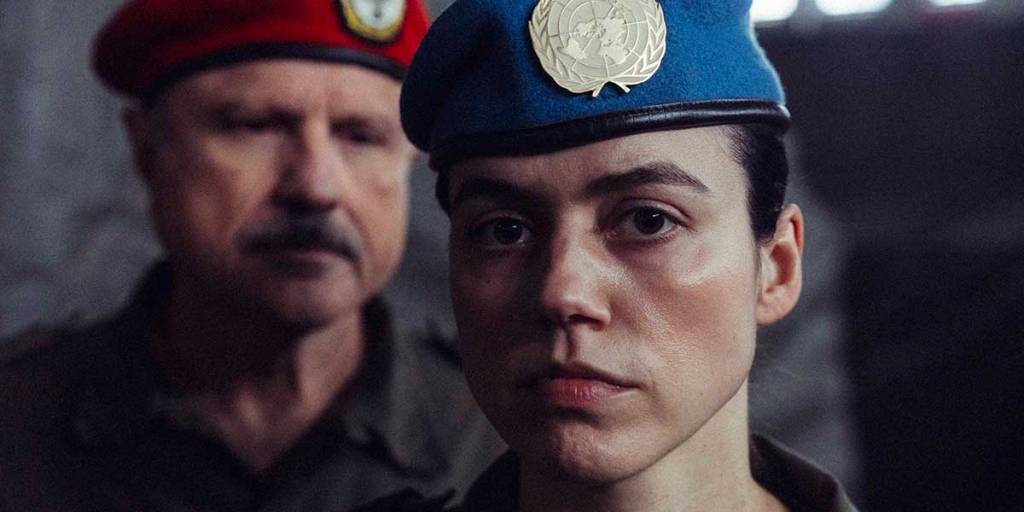
It’s the 1990s, and Captain Perron is leading a troop of UN peacekeeping forces in the former Yugoslavia. Why is this unusual? Sandra Perron (Nina Kiri) is a Canadian woman, the first to lead a squad of infantry soldiers in combat, and the first female to serve in the prestigious 22nd division, known as the Van Doos. Raised as an army brat in bases across Canada, she comes from a long line of soldiers, so it makes sense that she is following in her father’s vocation. She trained as a cadet and received commendations while still a teenager. And she’s the first woman to survive the brutal training that squadron demands. But there’s a photo circulating from her past that’s threatening to derail her military career. It’s a picture of her tied to a tree, barefoot, in the snow and semiconscious.
It was part of her training in a Prisoner of War exercise that went far beyond the normal treatment soldiers are forced to endure. A Canadian woman facing treatment tantamount to torture at CFB Gagetown in New Brunswick. But Captain Perron isn’t the one who released the photo, one fact she didn’t want the photo circulated. She had endured years of hazing bullying, harassment, obscene phone calls, sabotage to her kit, and a hidden campaign by certain officers to get rid of her. They detest the idea of serving alongside or under the command of a woman. And unlike the other women who
attempted to to join the Van Doos, she alone managed to survive and not quit.
Out Standing is a biopic about a trailblazing woman in the Canadian Armed Forces. It’s both moving and disturbing. The title, based on her memoirs, refers both to her achievements and to the notorious photo of her standing tied to a tree. (That pic was eventually published by the press, triggering a wave of shock and disgust across the country, and, one hopes, an improvement in how women are treated in the military.) Nina Kiri gives an excellent performance, totally believable as Perron.
While Hollywood churns out dozens of war movies each year, showcasing the latest weapons and fighter planes, you rarely see a Canadian one. This one is full of details carefully chosen to distinguish how soldiers behave here. The military culture is quite different. Unlike in the US there’s no Sir-yes-sir! And instead of saluting a Canadian soldier stand sharply at attention. I never knew this because you never see it in movies. For this alone it’s a eye-opener. The film is not perfect — there’s a particularly clumsy scene near the end — but altogether it’s a compelling and disturbing look at a Canadian woman’s life in the military.
The Ugly
Wri/Dir: Yeon Sang-ho (Peninsula, Train to Busan)
Lim Yeon-gyu (Kwon Hae-hyo) is a well-known carver of dojang, the name stamps used in Korea like a signature on official documents. He built up his business from scratch while raising his son as a single parent. (His wife ran away soon after the baby was born.) He trained his son Lim Dong-hwan (Park Jeong-min) in every aspect of the craft. Now an adult he is taking over the family business. At this moment, a documentary filmmaker (HAN Ji-hyeon) is celebrating this dad’s life as a national treasure. Why did she choose this man for her documentary? He’s been blind since birth, which makes his many accomplishments even more impressive. But filming is put on hold when a surprise announcement arrives. They’ve found Dong-hwan’s mother decades after she disappeared. Turns out she’s been dead all that time and only her bones remain. This comes as a total shock to Dong-hwan, and it just gets worse.
First his mother’s long lost relatives arrive for the funeral but they’re despicable people who just want to make sure he doesn’t claim any family inheritance.They bullied and beat his mother, a veritable Cinderella raised by this cruel family. It’s also the first time he hears his mother described as ugly. Ugly how? He longs to see a photo of her, something to display at the funeral, but there are no photos anywhere. Of course his blind father doesn’t have one. While Dong-hwan is trying to process all this new information, the filmmaker leaps on it as a great story and insists on continuing the documentary but with a new twist: who killed his mom and why? Together, over a series of interviews with hidden cameras, they uncover
events and people from her past as the tragic puzzle gradually falls into place.
The Ugly is a mystery about a kind-hearted woman — the main character’s mother — and how she is horribly treated because of her looks. It’s a heart wrenching story, a dark, bleak view of humanity with only Dong-hwan (and his mother) as redeeming characters. The story is told as a series of interviews with the various characters and extended flashbacks to what actually happened (The actor who plays Dong-hwa also plays his blind father as a young man in the flashbacks, while Jung Young-hee plays his mother, but always from behind or from the side, without ever revealing her face). In Yeon Sang-ho’s previous movies (Peninsula, Train to Busan) the action hero is surrounded by mutants or zombies or killers. The Ugly is about normal people but they’re just as hideous.
The Ugly is a powerful and dark look at human cruelty and physical beauty.
Eleanor the Great, Out Standing and the Ugly all open this weekend in Toronto; check your local listings. This is Daniel Garber at the Movies, each Saturday morning, on CIUT 89.5 FM and on my website culturalmining.com.
Is Halloween Cancelled? Films reviewed: Peninsula, Antebellum, Anything for Jackson
Hi, this is Daniel Garber at the Movies for culturalmining.com and CIUT 89.5 FM.
Is nothing sacred? They’re cancelling Hallowe’en! No trick-or-treating, no candy, and no parties. I get it, it’s a pandemic. But it’s still Hallowe’en. So, to fight the COVID blues you might try watching scary movies at home.
This week I’m looking at three new horror movies, all violent, gory and sure to keep you up at night. There’s zombies in South Korea, a time warp in the Confederate deep south; and Satanic retirees in Southern Ontario.
Dir: Sang-ho Yeon
Jung Seok (Gang Dong-Won) is a former soldier living in Hong Kong. He’s a refugee, one of the last to escape the Korean peninsula before all other countries closed their gates to them. A pandemic, caused by a lethal virus created in a biotech laboratory, infected the entire population, turning them all into jerky, writhing zombies that feast on human flesh. The few, uninfected survivors – like Jung Seok and his brother in law Chul-min (Kim Do-Yoon) – are despised and feared. So when shady Hongkong gangsters offer them a deal, they take it. The job? Return to the zombie-infested peninsula to recover an armoured car full of US dollars, and drive it to
the Port of Incheon to board a waiting tanker. If they survive, they keep a share of the spoils and can restart their ruined lives. Easier said than done.
Turns out, there’s not just zombies there. Chul-min is captured inside the money truck by crazed former soldiers from a rogue army base. Chul-min is forced to fight against zombies in a make-shift stadium for the soldiers’ entertainment. Jung Seok, on the ther hand, is rescued by two baby drivers, little kids who mow down zombies on the street for fun. They take him back to their family – their mom Min Jung (Jung-hyun Lee) and a deranged grandpa who thinks he’s communicating by radio with a “GI Jane” who will come to rescue them. Can Jung Seok and
his newfound family rescue Chul-min, find the cash and drive it to Incheon in time?
Peninsula is a gripping, action thriller set in a dystopian futuristic Korea. It’s a sequel to Train to Busan, the hit zombie movie from a few years back. It incorporates themes from movies like Mad Max, Hunger Games and The Walking Dead – good people forced to live in distorted versions of their world in order to stay alive. It follows the rules of the zombie genre – Zombies are blind at night, attracted to light and loud noises, travel in packs – but there are enough new situations and human characters to keep it interesting. Peninsula is pretty good.
Wri/Dir: Gerard Bush, Christopher Renz
Dr Veronica Henley (Janelle Monáe) is a writer, academic and activist who is famous for her appearances on cable news panels. She specializes in the intersectionality of race, class and gender as a roadmap for revolution. She’s off to a prestigious conference where she’s giving a speech. But she is troubled by horrible recurring nightmares where she’s trapped as a slave in pre-civil war America. One day, she receives a puzzling call from an unidentified southern white woman (Jena Malone) whose voice is laden with sinister white-supremacist undertones. Veronica dismisses her as another crank. But after a girl’s night out with her best friends (including Gabourey Sidibe), she is kidnapped and knocked out. When she awakens, she’s caught in her own terrifying dream: trapped in a
southern plantation run by Confederate soldiers. She’s forced by overseers on horseback to pick cotton by day, and is sexually assaulted at night. She and the others are robbed of their freedom, identity, their bodies and even their names, and are forbidden from talking to one another on pain of death. What hell is this? Is it time travel, or just another dream? And can she ever escape?
Antebellum is a very scary movie where the horrific world of American slavery serves as the ultimate horror setting for contemporary Black characters. It also adds subtle references to the rise of modern-day white supremacists — Confederate soldiers march with torches just like the alt-right in Charlottesville. Janelle Monáe is great as the modern-day heroine trapped in a disgusting simulacrum of plantation slavery. But the movie suffers from editing problems – it depends on a twist ending (no spoilers) that doesn’t fit right with the supposed “magic” and time travel elements. But maybe I’m analyzing it too much. If you’re in the mood for extreme horror, violence (and some satisfying revenge sequences) you’ll like Antebellum.
Dir: Justin G Dyck
Wri: Keith Cooper
Audrey and Henry (Sheila McCarthy, Julian Richings) are an older, married couple in a small Canadian city. He’s a family doctor and she takes care of their home. Once a week they meet a group of unusual hobbyists at their local library. What’s unusual about their group? They are a Satanic coven. And what do they want from Satan? They want their little grandson Jackson back (he died in a car crash) and they’ll do anything to make it happen. So they kidnap a pregnant woman Shannon (Konstantina Mantelos) and lock her in a soundproof basement room. They don’t want to hurt her – Audrey keeps saying “Sorry!” and crochets little handcuff cozies so Shannon’s wrists don’t chafe – they just want Jackson’s soul to possess her foetus.
Let’s not make this unpleasant, Audrey says.
And they have a thousand-year-old guidebook to tell them what to do. But their fool-proof plan starts to unravel. Rory, who shovels their snow, keeps turning up at the wrong time. A police woman drops by to investigate a missing person. And Ian (Josh Cruddas), a super-creepy ginger-bearded devil-worshipper from their coven, discovers their secret and tries to take
over. Worse than all of them, supernatural demons begin to haunt their home. Will they ever see their grandson again? Or have they let loose horrible creatures from hell?
Anything for Jackson is a great horror movie about ordinary, kindly Canadians doing awful things. While it starts as a dark comedy, it soon becomes a scary horror movie powered by monsters, ghosts and demons. Sort of a supernatural Fargo, or Rosemary’s Baby but from the point of view of the Satanists. The special effects are on the cheap side, but the acting and story are quite good.
I like this movie.
Anything for Jackson is premiering at Blood in the Snow, Canada’s horror, genre and underground film festival on right now; you can watch Antebellum on disc and VOD; and Peninsula is also available to rent or to own.
This is Daniel Garber at the Movies each Friday morning on CIUT 89.5 FM and on my website culturalmining.com.
War and remembrance. Films reviewed: Hacksaw Ridge, Birth of a Nation, Seoul Station
Hi, this is Daniel Garber at the Movies for culturalmining.com and CIUT 89.5 FM.
November 11th is Remembrance Day, when we remember the death and destruction of war. Even wars fought for good reasons may result in horrible deaths for soldiers and ordinary people. This week I’m looking at movies about war. There are armies of zombies in Seoul who want to eat people, a secret slave army in Virginia that wants to free people, and a man who joins the US army in WWII… but refuses to kill people.
Hacksaw Ridge
Dir: Mel Gibson
It’s the 1930s. Desmond Doss (Andrew Garfield) is a young man who lives in the Blue Ridge Mountains of Virginia with his drunk Dad (Hugo Weaving) and religious Mom (Rachel Griffiths). As a kid he loved climbing cliffs and rassling with his brother Hal. But when he saw how close to death his brother came when he hit him in the head with a brick, he swore never to hurt or kill another person again. As a Seventh Day Adventist he takes the Sixth Commandment — thou shalt not kill – very seriously. Years later,
he rescues a man injured in an accident by putting a tourniquet on his leg. He has studied medicine on his own since he can’t go to college. At the hospital he meets the beautiful and smart Dorothy (Teresa Palmer) a nurse. It’s love at first sight.
But it’s 1941 and the country is at war. Young men all rush to join the army and Doss is no exception. But he joins as a medic to save lives, not as a fighter to kill people. He and Dorothy plan to get married after boot camp. But then reality hits. You can’t be in the army and refuse to carry a gun. They offer him a Section 8 – a psychiatric discharge. But he refuses to quit. He’s not crazy, he’s not un-American, he’s not unpatriotic. The army disagrees. Soldiers beat him and bully him, and on
his wedding day the Army throws him in the brig, leaving Dorothy waiting at the altar. Will he be court-martialed?
Somehow he makes it to Okinawa, in time for a crucial battle. They must climb Hacksaw Ridge, a sheer cliff, to face a never-ending battalion of Japanese soldiers. Can Doss use his medic skills to save his fellow soldiers?
Hacksaw Ridge is a heartfelt war movie about a conscientious objector who goes into battle without a gun. For a movie about a heroic man opposed to killing, there’s also an ungodly amount of gory carnage shown in minute detail. Not for the squeamish.
Interestingly, the entire cast, except for Andrew Garfield and Vince Vaughan, is Australian. And with all those thin-lipped, lantern-jawed, soldiers, I had a hard time telling them apart. (Didn’t that guy just die in a foxhole? Must have been someone else…). Garfield, though, stands out as the stubborn, jug-eared Doss. If you like heroic war movies, this one pushes all the right buttons.
Birth of a Nation
Dir: Nate Parker
Nat Turner (Nate Parker) is born to loving parents and grandparents in a wooden house in Virginia in the early 19th century. At an early age mystics declare him a born leader, with special birthmarks on his belly. He grows up a student of the bible, reading to himself at night. And he happily marries a beautiful woman when they fall in love.,But he is also an African American in the south which means… he is also a slave. The slave owner Sam Turner (Armie Hammer) played with him as a child and they share the
same last name. When earnings are down Sam hires him out to other plantations to preach to fellow slaves, to help calm potential unrest. Nat delivers the sermons, while Sam keeps the cash.
It is on these visits that Nat Turner witnesses the truly horrifying nature of slavery. A young girl kept like a dog with collar and leash. Men set upon by vicious dogs. Families broken up and sold like cattle at auctions. Heinous torture – worse than you can imagine – for crimes as simple as looking a white man directly in the eyes. Women are subject to
horrific rape. Murder and lynching — always white violence against blacks — is not even considered a crime. So Nat Turner decides enough is enough and organizes a small army to fight back. But can a handful of men and woman overturn slavery itself?
Birth of a Nation is a fictionalized retelling of the famous Nat Turner rebellion. The movie
concentrates more on Nat’s life in the years leading up to it than on the battle itself. The film is disturbing, dealing with topics rarely shown in mainstream movies. Even so, it has a mainstream feel to it: flickering candles, gushing music, and Hollywood kisses in profile. The title itself reclaims D.W. Griffith’s wildly popular silent movie from 1915 which glorified the Ku Klux Klan and inspired countless terrorist attacks on black Americans. This is a good film about a neglected part of US history, downplayed or glossed over in most movies.
Seoul Station
Dir: Sang-ho Yeon
It’s a typical day at the central train station in Seoul, Korea. It’s used by commuters everyday. But it’s also a mecca for the disenfranchised — the poor, the mentally ill and the homeless. Hye-sun is a young runaway, a former sex worker who lives with her wimpish boyfriend. They are separated by a massive zombie attack — and the virus is spreading. He teams up with her father, while she follows a deranged, homeless man. Hye-sun communicates with her boyfriend whenever they can find a signal on their phones. When she turns to the police for help, they lock her up in a jail cel. Later, a large group of people trapped in an area besieged by zombies appeals to the army. But instead of rescuing them, the soldiers fire water canons and teargas… not at the zombies, but at their fellow citizens. Who will survive the zombie onslaught?
Seoul Station is an animated prequel to the hit horror film Train to Busan. Characters are drawn with clean black outlines against realistic backgrounds. Seoul is portrayed as a desolate place, its dim skies lit only by neon crosses. This may be a zombie movie but it’s also an unsparing look at the maltreatment of the homeless and disenfranchised in modern Korea.
Birth of a Nation is now playing and Hacksaw Ridge opens today in Toronto; check your local listings. Seoul Station is playing at the upcoming ReelAsian Film Festival. Go to reelasian.com for showtimes. This is Daniel Garber at the Movies, each Friday morning, on CIUT 89.5 FM and on my website, culturalmining.com


leave a comment