Men, music and sports. Films reviewed: The History of Sound, Him, EPIC: Elvis Presley in Concert
Hi, this is Daniel Garber at the Movies for culturalmining.com and CIUT 89.5 FM.
TIFF is over but the movies keep coming. So this week, I’m looking at three new American movies, two about music and one about sports. There are two men recording folk songs in the forest, an ambitious quarterback at a training camp in the desert, and a former teen idol wowing audiences on a Vegas stage.
The History of Sound
Dir: Oliver Hermanus
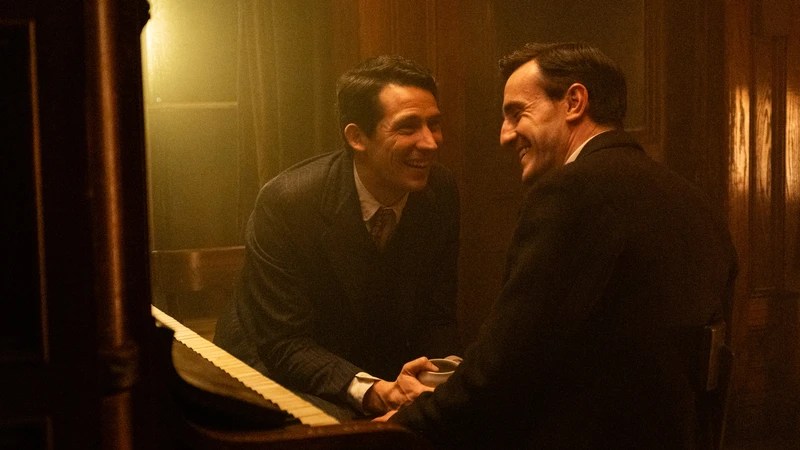
It’s the early 20th Century in rural Kentucky. Lionel (Paul Mescal) likes listening to his father sing while he plays the fiddle. Music for him is different from most folks: he has synesthesia. This means each musical note has a distinct colour, flavour and meaning. Eventually his love of music and beautiful voice wins him a full scholarship to the New England Conservatory of Music. At a Boston pub one night, he recognizes a song his father used to play, coming from a young man at the piano. David (Josh O’Connor) knows every word. As an ethnomusicologist, he wants to collect as many distinct folk songs and ballads as he can, before they are lost forever. David has perfect pitch and a photographic memory. The two trade songs they know, and somehow, end up in bed together that night. That chance encounter turns into regular trysts at David’s apartment.
Later he invites Lionel to join him in a fieldwork project. They roam across the state of Maine, recording songs everywhere from logging camps to schoolhouses, And they record it all on wax cylinders (this is before flat discs are invented) carefully
stored in a leather satchel. And each night they sleep together in a tiny tent. Is this true love? And what will happen to their relationship after the project is finished?
The History of Sound is a touching, bittersweet gay romance — before the word gay existed — set within the larger context of war and music. It’s directed by South African filmmaker Oliver Hermanus (Moffie) and its based on a short story by Ben Shattuck. I wonder if the characters are modelled on Alan Lomax, the ethnomusicologist who recorded thousands of songs and started the folk music revival in the 1950s. Paul Mescal is spot-on as the sensitive kid in a clapboard shack who grows up to be a cosmopolitan musician; as is Josh O’Connor’s portrayal of an enigmatic musical genius with hidden secrets. The images are as lovely as the music in this tender and moving film.
I really liked it.
Him
Co-Wri/Dir: Justin Tipping
It’s San Antonio, Texas, and their NFL team, the Saviours, is looking for a new quarterback to replace their MVP Isaiah White (Marlon Wayans), due to retire in a year. Cameron Cade (Tyriq Withers) is a young quarterback who lives for football — his father trained him for this since he was a little kid. When he’s offered the position if he agrees to an intense one-on-one, bootcamp with his idol Isaiah White, of course he says yes; this is the fulfillment of all his dream. Thing is, he recently had a serious injury that left him with a bad concussion and a track of staples in his head. If he aggravates his brain, it might end his football career before it starts. But as his father always told him, No Pain, No Gain. Cameron heads out to the training camp in the desert.
There he encounters absolute luxury: gourmet food and priceless art in a spacious brutalist palace. There are saunas and ice baths, and daily blood transfusions for Isaiah. Cameron too tastes this luxury — and sexual temptations — offered by Isaiah’s entourage, especially the grotesquely made-up wife Elsie White (Julia Fox), an influencer who sells her own line of sex toys. Isaiah is the GOAT — the Greatest of All Time — and his virulent fans wear goat horns on their
heads. Cameron, on the other hand, holds onto silver cross. He’s given a series of Squid-Game-like ordeals he must endure before Isaiah gives him the nod. And as the tasks grow increasingly horrific, his morals are severely challenged. Can he pass the tests? And is he ready to give up his innate morality and embrace pro-sports and all it offers?
Him is a psychological thriller about a young man confronting his hero (who is also his nemesis) even as he uncovers the dark underbelly of pro football. It’s produced by Jordan Peele, so you might expect a suspense/thriller with mind-blowing surprises. If so, you’ll be sorely disappointed. What you’ll get instead is more like a highly-stylized, extended music video than a horror film. There’s lots of dazzle and flash — and an equal amount of blood — but it’s never scary or surprising. And director Tipping uses film techniques like a kid playing with toys. Why are people shown in in infrared X-rays? Why a long fashion shot sequence in what’s supposed to be a scary scene? Why do cowboy-hatted cheerleaders continue dancing in the face of horrific deaths? There are some great visual cues — like the aluminium stitches in his skull evoking the side of a football — but it’s all show, no substance in this cheap morality play.
Him is fun to look at, but there’s nothing there.
EPIC: Elvis Presley in Concert
Dir: Baz Luhrmann
It’s the 1950s. Elvis is the King of Rock and Roll with a series of hits and the nation goes wild over his thrusting pelvis and his soulful voice. Later, he is drafted into the army where he serves two years. Afterwards he turns to Hollywood where hue churns out a series of hits alongside sex goddesses like Ann-Margaret. And late in the 1960s he signs a multi-year contract to perform before sold-out audiences at a Las Vegas Casino. He’s up there every day, dressed in eggshell blue jumpsuits, covered in silver studs, sequins and spangles, joking with the crowds, and sweating buckets. He is accompanied by a retinue of back up singers, musicians and elaborate lighting. And that is basically how Elvis spends the rest of his life, until he collapses and dies in Graceland, age 42.
EPIC: Elvis Presley in Concert is a combination documentary and musical performance. Just two years ago, we had both Baz Lurhmann’s biopic Elvis and Sofia Coppola’s Priscilla, two similar stories told from different points of view, neither of which were particularly good. And now, out of nowhere comes this third one. I’m not an Elvis fan, nor do I like the kitschy

Buzz Luhrmann at EPIC’s world premiere at TIFF50: Photo (c) Jeff Harris
and gaudy films of Baz Luhrmann. Which is why I’m shocked at how much I enjoyed this movie (I saw it on an IMAX screen at TIFF last week, almost by accident.) Ostensibly just a musical record it’s actually a succinct and tight history of the man, so much better than those bloated biopics.
It’s fantastic, a masterpiece of creative editing, colour restoration and music mixing. It’s absolutely stunning. The songs he sings are mainly hits from the 1960s cover-versions of Bridge Over Troubled Water, You’ve lost that Loving Feeling, and even gospel songs. And over the course of a single song, we see him on stage, in rehearsal, or in the recording studio, shot over many years, but without a break in the music. And despite Luhrmann’s gaudy excess, somehow his capture of Elvis in a psychedelic shirt or sparkling gold belt buckles just looks right.
EPIC is the perfect concert film.
Him and The History of Music both open this weekend in Toronto; check your local listings; EPIC: Elvis Presley In Concert played at TIFF and will be released soon.
This is Daniel Garber at the Movies, each Saturday morning, on CIUT 89.5 FM and on my website culturalmining.com.
Oscar contenders, 2023. Films reviewed: Saint Omer, The Son, Living
Hi, this is Daniel Garber at the Movies for culturalmining.com and CIUT 89.5 FM.
This week, I’m looking at three potential Oscar contenders opening this weekend. There’s a writer in Paris attending a trial, a bureaucrat in London whose life is a trial, and a Dad dealing with the trials and tribulations of a mentally ill son.
Wri/Dir: Alice Diop
It’s the early 2000s in a Parisian suburb. Laurence Coly (Guslagie Malanda) is on trial for murder. She admits to leaving the infant on a beach to be washed away with the tides one moonlit night, but why she did it is not so simple. She’s a Senegalese-French woman from Dakar, in Paris as a student. She is beautiful, articulate, poised and intelligent; not your usual murder suspect. As her mother (Salimata Kamate) told her, education and politesse are the two most important traits. But after a series of events she ends up living in a small apartment as a grey-haired, married man’s mistress — no longer in university, with no friends, no job, no future. And virtually no one knows she was pregnant nor that she gave birth at home. She existed in a strange limbo world.
All of this is taken in by Rama (Kayije Kagame) a novelist and
university prof in Paris. She is following the trial in person, for a new book she’s writing about Medea. Like Laurence, she’s a French intellectual, and a black woman of West African background. More than that, she’s estranged from her mother and is in her first trimester of pregnancy. In a sea of white faces in the courtroom, she feels both a connection and a revulsion toward Laurence. Could this be me on trial? she wonders. And will I be a fit mother?
Saint Omer is a devastatingly powerful courtroom drama as seen through an observer’s eyes. It’s the opposite of a Law & Order episode — no smoking guns or pot twists. Rather it’s Laurence’s retelling of her story before judge and jury Rama’s reactions that carries all the power. It’s intentionally filled with subtle ambiguity so you’re never quite sure whether Laurence is lying and being coached to do so, or if she’s completely sincere. With women holding most of the key roles — including the judge and the defence council — it strips away some misconceptions. The acting (by actress Malanda and artist/performer Kagame) is superb, and the filmmaking amazing. This is documentary filmmaker Alice Drop’s first drama. Somehow, she takes the drab wooden panels of a classroom and a courtroom and turns them into something pulsing with emotion.
This is a great movie.
Wri/Dir: Florian Zeller
Beth and Peter (Vanessa Kirby, Hugh Jackman) are a newly married, upper-middle class couple with a new baby. All I going well until they get an unexpected knock on the door. His teenaged son Nicholas (Zen McGrath) says he can’t take living his mom anymore (Laura Dern) a full-time nurse whom Peter divorced and abandoned a few years earlier. What a dilemma! He can’t turn away his own flesh and blood, can he? But Nicholas is difficult to live with. It seems he stopped going to school months ago — without telling his parents. And Beth finds him scary. What if he does something to our baby— how can I trust him? So they check him into a psych ward without his consent. But what can they do in the long run with this troublesome teen?
The Son is an overwrought melodrama about divorced parents forced to care for their troubled son. It deals with anguish, anger and regret but only from the parents’ perspective, never from the son’s. He’s just a pain in the ass… and possibly a threat! This movie falls in that sub-genre of sympathetic parents forced to deal with sons who “selfishly” choose to become drug addicts or mental ill. How dare they! Despite what the parents try, those bad sons are criminals and liars at heart who can never be trusted. This dreadful collection of
never-watch movies includes Beautiful Boy, with Timothy Chalamet and Ben is Back, starring Julia Roberts and Lucas Hedges. This one has equal star power, and is just as hard to watch. It’s especially disappointing because it’s Florian Zeller’s follow-up to The Father a few years back about an elderly man slipping into dementia (Anthony Hopkins, who also appears in this film), as its unreliable narrator. But don’t be fooled. The Son has no redeeming features and is truly one of the worst movies of 2022.
Living
Wri/Dir: Oliver Hermanus
It’s Londin in the 1950s. Williams (Bill Nighy) is a mundane municipal bureaucrat, the head of public works at County Hall. He spends most of his time at his desk — along with his subordinates Rusbridger, Middleton and Hart — keeping busy by ignoring piles of files and requests. Whenever troublesome locals appear, like a group of mothers requesting they build a tiny playground in a vacant lot, they’re quickly disposed of by sending them to another department in the endless bureaucratic labyrinth of city hall. The newly-hired Wakeling is quickly discouraged from working too hard — an empty inbox means you’re doing something wrong. The sole woman, Margaret (Aimee Lou Wood), is thinking of quitting to take a managerial job at a local restaurant. Since his wife died,
Williams has lived a humdrum existence sharing his home with his adult son and daughter-in- law. But everything changes when his doctor brings him some terrible `news: incurable cancer, 6 months left to live. Suddenly everything takes on new meaning as he decides to start enjoying life and making things better for others. But is it too late?
Living is a period drama about life in post-war London. It captures the spark that can be reawakened in even the most humdrum person’s existence. It follows the night Williams spends in the demimonde led by an alcoholic bohemian he meets in a cafe; the days spent helping Margaret, for the chance to share in her youth and vitaity; and a project he hoped to complete in his final days.
I approached this movie with trepidation, because it’s a remake of Kurosawa’s Ikiru, one of my favourite movies of all time, which I didn’t want to see ruined. Happily, Living it is wonderful film in its own right. Maybe only a writer like UK novelist Kazuo Ishiguro could transport a story from Tokyo to London, while staying true to its original meaning and structure, even while giving this very Japanese film a distinctly English feel. Bill Nighy (who usually plays silly characters in crap movies) is wonderfully understated in this one. And South African director Oliver Hermanus, who brought us the great Moffie, again puts his all into the film he’s making.
I recommend this movie.
Living, Saint Omer, and The Son all open this weekend in Toronto, with the latter two playing at the TIFF Bell Lightbox; check your local listings.
This is Daniel Garber at the Movies, each Saturday morning, on CIUT 89.5 FM and on my website, culturalmining.com.
Implanted ideas. Films reviewed: Held, Kenny Scharf: When Worlds Collide, Moffie
Hi, this is Daniel Garber at the Movies for culturalmining.com and CIUT 89.5 FM.
This week I’m looking at three new movies — a doc, a war drama and a thriller horror — about ideas implanted into our minds. There’s an eighties artist digging up TV images from the sixties; a soldier in eighties South Africa with Cold War racism and homophobia drilled into his head; and a married couple forced to re-enact outdated sexual roles by the orders of a device… drilled into their skulls.
Held
Dir: Travis Cluff, Chris Lofing
Emma and Henry (Jill Awbrey and Bart Johnson) are a married couple, both professionals. They plan to meet at a remote luxury resort in order to bring the spark back into their relationship. Eight years ago they had an amazing vacation in Monterey, just the two of them; but lately, they’ve been drifting apart. Emma arrives first, driven by a vaguely suspicious-looking guy named Joe (Rez Kempton). Why does he ask so many personal questions? She’s relieved to see the house is protected by a large wall. She checks out the digs — it’s a minimalist wonder, all glass and white walls, and incredibly safe from intruders. There are alarms and code systems everywhere, a modern kitchen, and a lovely orchard just outside. And Henry left her some flowers on the doorstep — red roses… how romantic!
When Henry arrives, they share a toast over glasses of whiskey. But then things get weird. They both start to feel dizzy — are
there roofies in their drinks? They wake up the next morning in a daze. Their cel phones are gone. Emma is dressed in an old-school negligee. Did someone do this to her in her sleep? And the roses? Henry says they weren’t from him. Their clothes have all disappeared, replaced by 6os-style dresses for her and suits for him, and large TV screens that play old-school songs urging them to dance a foxtrot. Dance?
The doors are all locked, and a strange detached voice starts giving them orders. Obey us! If you follow our directions you will not be harmed! Mr Creepy Voice wants them to stick to traditional sexual roles — men open doors for women, who respond by thanking them. If they disobey, they get zapped by a high-power, hugely painful device that’s been implanted into their heads the night before. And now they’re expected to make love under a watchful eye. Who is this maniac and what’s his agenda? Is it Jordan Peterson? Or an incel? Why does he cling to outdated sexual norms? And will they ever escape from this bizarre house of horrors?
Held is a heart pounding , psychological thriller about a couple held hostage for no known reason. There’s a big revelation about two-thirds of the way through (no spoilers) which I predicted… but even so, it gripped me till the very end. It is quite violent and disturbing, so not for the faint of heart, but I found Held a super-twisted and scary movie, just the thing for late-night viewing.
Kenny Scharf: When Worlds Collide
Wri/Dir:Max Basch, Malia Scharf
Kenny Scharf is born into post-war LA, the land of artificial smiles, perma-tans, non-stop TV and brightly coloured plastic. He grows up in a nuclear family amidst the prefab suburbs of the San Fernando valley. He likes art and design and has a steady hand that can draw a perfect line without a ruler. But Andy Warhol and New York City beckons and he ends up a student at SVA (the School of Visual Arts) beside Keith Haring with whom he eventually shares an apartment in Times Square. It’s the early 1980s, and together with the younger Jean-Michel Basquiat, the three start spreading their art all over the city: on subways, toasters, TV
sets, and crumbing tenement walls. Kenny can’t stop putting painting on everything he sees.
Eventually people with money start to notice, and the East Village art scene explodes. Kenny Scharf’s work incorporates found art, day-glo colours, and cartoonish TV images of George Jetson, Barney Rubble and 1950s suburban housewives. These figures are vomited across canvas in a cosmic orgy of detailed mayhem, the work of spray paint and fine brush strokes. Grotesque smiles and googly-eyed faces adorn his prolific paintings and sculptures, like a Peewee’s Playhouse of fine art. The East
Village art scene spills over into the world of performance, music, fashion and nightclubs, blurring the lines. Kenny is doing it all. Next comes money and fame, one-man shows and installations,…until it finally crashes and burns. Many of the artists die in the AIDS epidemic, but Kenny survives, moving back to LA with his Brazilian wife and kids and continuing his work.
Kenny Scharf: When Worlds Collide (the title is from one of his massive paintings) is a documentary look at his life and art, from childhood to the present, presented using never-seen period footage, video, recordings and art. It’s an amazing story brought to life. To be honest, I’m always suspicious of docs on living artists — did they make this film just to raise his recognition and pump up the value of his work? Who knows? But life as an artist is never easy. This film is co-directed by another artist, Kenny’s own daughter Malia, which lets us look into his private life and thoughts, and his never-ending outflow of colour and plastic… while steering clear of any stories of sex, drugs and debauchery. It’s her dad… what do you want?
I liked this movie.
Moffie
Wri/Dir: Oliver Hermanus
It’s 1982 in Apartheid South Africa. All white boys and men are required to serve in the army for two years starting at age 16. Nick (Kai Luke Brümmer) is still wet behind the ears and doesn’t want to go. But his mother and boorish step-father send him off with a big celebration. His father slips him a porn mag to keep him company. But Playboy centrefolds are not his thing. The train to the camp is loud and rough, filled with oafs drinking till they puke, picking fights and shouting racist abuse at any African they pass. Nick makes one friend on the way, Michael (Matthew Vey), an anglo and a nice guy to boot. At the base, they are spat on, kicked, punched and made to repeat inane
slogans by an especially sadistic sergeant. All hatred is aimed toward the three enemies of the state — Africans, communists, and homosexuals. And heaven help anyone caught supporting any of them, or worse being one of them. The sleeping quarters are filled with testosterone-fuelled idiots, spouting racist nonsense but exuding a constant masculine sexuality that clouds Nick’s thoughts.
But war is war (there’s a longstanding border conflict with neighbouring Angola) and they’re expected to fight. When Nick finds himself sharing a sleeping bag in a foxhole with a friendly soldier named Stassen (Ryan de Villiers) he’s forced to reassess his sense of desire and sexuality. But will he survive this two year ordeal?
Moffie (the title is an Afrikaans anti-gay slur), is a realistic internal look at the unrelenting racism and paranoia drilled into the psyche of white South Africans’ during Apartheid. (Unspoken, but implied, is the the violence that this visited upon the non-white South African majority on a daily basis) It’s also an intensely moving story, full of lust and longing, regret and horror. Dialogue alternates between Afrikaans and English. It has stunning cinematograpy, and a great soundtrack. The acting is fantastic, with a largely unknown cast, many on screen for the first time. Moffie is a powerful war film.
I recommend this movie.
Moffie opens today on VOD on Apple TV and in the summer on IFC Films Unlimited; Held also starts today on VOD on AppleTV, iTunes and other platforms; and Kenny Scharf: When Worlds Collide will open next Thursday.
This is Daniel Garber at the Movies, each Friday morning, on CIUT 89.5 FM and on my website, culturalmining.com.


leave a comment