It’s all lies! Films reviewed: Jay Kelly, Zodiac Killer Project, Wicked: For Good
Hi, this is Daniel Garber at the Movies for culturalmining.com and CIUT 89.5 FM.
This week, I’m looking at three new movies, about people who lie. There’s a movie star who smiles for the cameras, onscreen and off; two witches and a wizard who hides behind his curtain, and a filmmaker who looks at what lies behind True Crime documentaries.
Jay Kelly
Co-Wri/Dir: Noah Baumbach
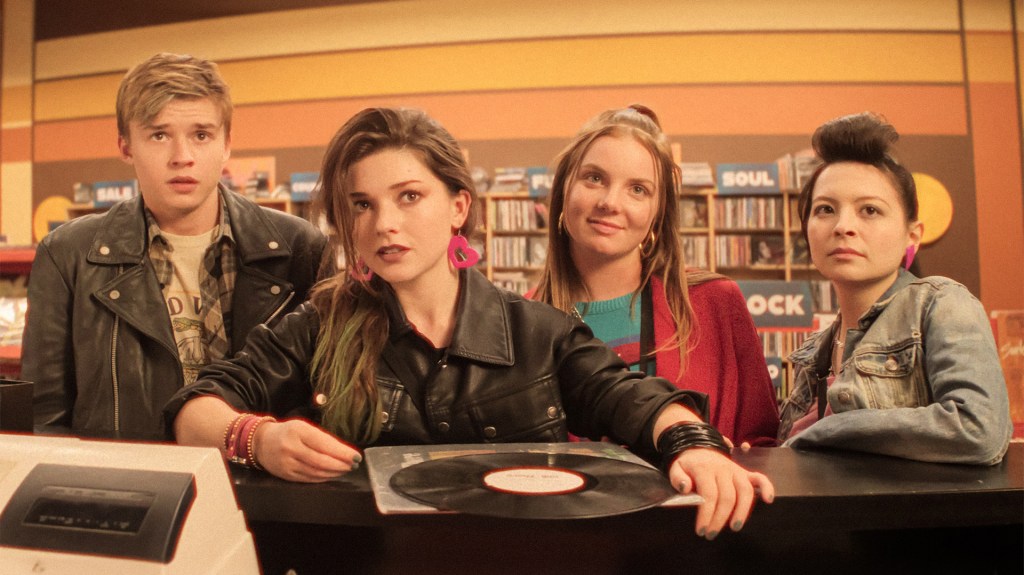
Jay Kelly (George Clooney) a major Hollywood star known for his action movies, is wrapping up the last scene of his latest film. He gets a few days off before starting his next feature after attending a tribute to him in Tuscany, as his friend and manager, Ron (Adam Sandler) keeps reminding him. But then a series of unfortunate events begins to occur. Ron tells him that Peter (Jim Broadbent) a noted director who launched Jay’s career when he was just an acting student — has died. And his younger daughter says she’s heading off to backpack and ride the rails in Europe before starting University in the fall… meaning his nest will be empty from now on. So when he runs into Tim (Billy Crudup) at Peter’s funeral — a blast from the past who he hasn’t seen in decades — he decides to join him for a drink at one of their old LA haunts. Tim was a method actor, someone so good he could read a menu aloud in a way that will make you cry. But their drinks turn to fisticuffs when Tim blames Jay for stealing his first role, sleeping with his girlfriend and generally ruining his life. Jay leaves the reunion with a black eye and Tim with a broken nose and a smouldering grudge.
So Jay decides on a change of plans: he’ll fly to Europe and surprise his daughter in Paris for some spontaneous fun. But nothing can be spontaneous for an A-list movie star. Jay flies there in his private jet, with a huge entourage, including his manager, hair stylist, PA, bodyguard and publicist (Laura Dern). But aside from his adoring fans, he can’t seem to make friends, spend time with his family, or do anything of lasting value. What’s a lonely, rich-and-famous guy to do?
Jay Kelly is a sardonic look at the hollowness of a Hollywood movie star’s life. Jay Kelly seems to be modelled on George
Clooney’s own career; they even show clips from Clooney’s past films at Jay Kelly’s tribute, thus blurring the line between reality and fiction. Jay Kelly is always flashing his pearly whites, but seems to have no actual feelings, just poses — that his director, or his publicist tells him to do. The movie’s not bad, but it’s hard to have deep feelings about someone so fake, a character that only finds his true self on the silver screen. It’s like he’s always acting. The biggest surprise is Adam Sandler in a serious role, without any bombastic elements. He’s actually good!
Jay Kelly is a cute light story, with a dark undertone. While not fantastic, it’s still worth watching.
Zodiac Killer Project
Dir: Charlie Shackleton
Charlie Shackleton is a documentary filmmaker from the UK who is obsessed with the case of the Zodiac Killer. He was a notorious serial killer who murdered any number of victims in the 1960s around the SF Bay Area, but was never caught. Part of his mystique was the many killings later attributed to him, and the series of cryptic letters sent to his victims and fans. Charlie wants to make a documentary based on a book by a policeman who actually encountered the killer… but negotiations with the authors of the book falls through, thus killing any chance of making the Zodiac Killer doc. Instead he decides to make a doc about how he would have made the doc he can’t make.
So the movie ends up being a spoken word-essay — Charlie’s words throughout — as he walks us through what he would have shot, scene by scene: a road stop outside of San Francisco; an urban street corner in Vallejo; a modernistic suburban church. Mundane images all, but always accompanied by clanky music and his eerie descriptions of what eyewitnesses saw in their search for the Zodiac Killer. Added to this are short clips and commentary of other True Crime docs, including films like Joe Berlinger and Bruce
Sinofsky’s Paradise Lost trilogy, about the three teenagers falsely accused of ritual child murder in West Memphis, Arkansas.
(Which is a great series, btw). But what Charlie points out is, many True Crime directors manipulate viewers using music, camera work and edited interviews to put the suspicion on someone the filmmakers want to blame, but who may or may not be responsible for the crime. And he calls into question the myth of the documentary director as an impartial observer rather than a biased manipulator of the truth.
Zodiac Killer Project is not a normal movie, by any stretch of the imagination (though it is pretty funny) It’s a filmmaker’s monologue on (what I think is) a very interesting topic, that is the deception and self-righteousness behind an entire genre — True Crime; accompanied by extended film images of, frankly, mundane locations. If you’re a cineaste, a movie buff, or a true crime fan, I think you’ll like this one; I do. But if you go expecting the bread-and-butter of True Crime media, the titillating images, the exploitational gross-outs, or self righteous harrumphing about the killer’s innate barbarism, you ain’t gonna find it here.
Wicked: for Good
Dir: Jon M. Chu
It’s another day in the Land of Oz, but things have changed over the past few years. Elphaba (Cynthia Erivo) has been in hiding ever since a massive government propaganda campaign has labeled her the “Wicked Witch of the West”. Her former best friend Glinda (Ariana Grande) is a figurehead who appears before the public in a mechanical bubble. She has no real magic but her job is to keep the peasants calm. She publicly professes her love for handsome Prince Fiyero (Jonathan Bailey) a captain in the army, but he pines only for the green-faced Elphaba. And Elphaba’s little sister Nessarose (Marissa Bode) is now an autocratic Governor, passing vindictive laws. But Nessa, too, suffers from setbacks: her long-time companion, the Munchkin Buck (Ethan Slater) has had enough of her (he’s secretly in love with Glinda.) And under the under the direction of the two scheming bullies with the only real power in this world — the Wizard of Oz (Jeff Goldblum) and Madame (Michelle Yeoh) — Oz is passing ever more draconian laws, including the stripping of all rights from animals, who once lived and worked side by side with
humans. Will Elphaba and Glinda ever be friends again? Can they stop the Wizard’s nefarious plans? And who will Prince Fiyero choose to marry?
Wicked: for Good is part two of the film adaptation of the hit Broadway musical. It’s an intriguingly revisionist version of the original Wizard of Oz story. Dorothy and the cowardly Lion appear but only as insipid background characters, The Wizard of Oz is a bad guy, and the Wicked Witch of the West a potential heroine. It’s 2 1/2 hours long but never boring, including three new songs by Stephen Schwartz that weren’t in the original play. Now, personally, I’m not a fan of that genre of music, but Cynthia Erivo and Ariana Grande’s voices are a pleasure to listen to. It’s visually dead-on, from the artificial, candy-coloured palate of the Emerald City, to cute and rustic Munchkinland. And I love the Art Deco, steam-punk machinery everywhere. It’s exquisite. Great production values all around: sets, costumes, elaborate dance numbers, and, of course, the flying monkeys.
It does feel like the second part of a two-act play — following a year-long intermission — and it is a much darker ride than last year’s Wicked — but I still enjoyed it.
Jay Kelly, Wicked for good and Zodiac Killer Project are all playing now in Toronto; check your local listings.
This is Daniel Garber at the Movies, each Saturday morning, on CIUT 89.5 FM and on my website culturalmining.com.
It’s dangerous! Films reviewed: Daniela Forever, Apocalypse in the Tropics, We Were Dangerous
Hi, this is Daniel Garber at the Movies for culturalmining.com and CIUT 89.5 FM.
Guillermo del Toro, the celebrated director who splits his time between Mexico and Canada, has curated a series of classic Canadian horror movies called From Rabid to Skinamarink: Canadian Movie Madness, playing at the TIFF Lightbox this weekend. I happen to have seen everyone of them myself, and I totally agree with del Toro’s selection. You can catch Canadian gems like the feminist werewolf drama Ginger Snaps, Vincenzo Natali’s cult-hit Cube, Kyle Edward Ball’s experimental Skinamarink, and many more.
But this week, I’m looking at three new movies from abroad: a surreal fantasy from Spain, a politically documentary from Brazil, and a period drama from New Zealand.
Daniela Forever
Wri/Dir: Nacho Vigalondo
It’s present-day Madrid. Nicolas (Henry Golding: Crazy Rich Asians) is a popular DJ at the city’s hottest nightclubs. But he is thrown into a deep depression when his girlfriend, an artist named Daniela (Beatrice Grannò: The White Lotus) is killed by a negligent driver just outside his home. But things take a turn for the better when a good friend of his, Victoria (Nathalie Poza), tells him of a new, experimental drug that might be just what he needs. But it’s top secret, filled with non-disclosure clauses, and requires regular visits to the pharmaceutical labs. The scientists there tell him each pill, if taken just before bed, will produce lucid dreams, real visions where he can control the content and won’t forget about them when he wakes up. This means he can bring Daniela back to life, at least while he sleeps. But he soon discovers its limitations: he can’t dream about something he’s never seen. If he turns down an ally he’s never visited, it will be covered in unformed, writhing grey matter. Kinda creepy.
Daniela seems artificial at first, but as time progresses, she starts turning real. She even produces creative ideas and thoughts that he doesn’t remember ever experiencing in the awake world. And far from seeming etherial, his lucid dreams are now wide- screen images in living colour, while awake
time is small and drab. He can take Daniela to new places just by thinking about them and opening a door, and change the city of Madrid into something out of one of her paintings. But he soon realizes, not everything is going the way he planned. And when things from his dream world start appearing in awake time, he has to wonder what is real? Can he be in love with someone who doesn’t exist? And can she ever really love him if she’s just a figure of his imagination?
Forever Daniela is a highly- creative science fiction romance about love, death and reality. While it sounds like a Black Mirror jump-scare thriller, it actually avoids most “bad” things except for the sadness of mourning. It also has a very surprising twist at the end (no spoilers). The film is Spanish, but most of the dialogue is in English. Henry Golding (Crazy Rich Asians) is appealing as the leading man, but runs into a bit of acting trouble when he tries to do a full-fledged meltdown. The special effects are excellent, fooling around with unusual concepts like daytime light and shadows in a nighttime environment. I quite like the writer/director Nacho Vigalondo
for the way he incorporates horror movie elements within an otherwise realistic context (like his film Colossal a few years ago.) So if you’re looking for something that’s surreal and supernatural but told in a positive, though bittersweet, way, I think you’ll like Daniela Forever.
Apocalypse in the Tropics
Wri/Dir: Petra Costa
Brasilia — a capital city designed, planned and built from the ground up — was meant to be modern, secular and democratic. But after a coup-d’etat in 1964, Brazil became something other than democratic: a military dictatorship which ruled for the next two decades. So when a new, populist right-wing leader with military ties emerged in the 2010s, many Brazilians were wary of democracy falling again. But Jair Bolsonaro was different, a politician who changed his power base when he forged ties with evangelical Christians.
Apocalypse in the Tropics traces Brazilian politics over the past decade and the rise in religion within government policies. It also gives background, from the building of the capital, through the military coup, American evangelist Billy Graham, the return to democracy, and more recent developments. It uses beautiful period footage, lush music and symbolic paintings — like Hieronymus Bosch’s Garden of Earthly Delights — as a metaphoric portrayal of millenarian changes in Brazilian politics. It is narrated by the filmmaker and includes her one-on-one interviews with Bolsonaro, current President Luiz Inácio Lula da Silva, and the wildly popular televangelist, Silas Malafaia, who served as
Bolsonaro’s right-hand man. We witness Malafaia’s sermons before huge crowds — shouting his opposition to same-sex marriage, abortion rights, and feminism — as well as intimate conversations aboard his private plane. The doc also shows new footage of the beloved capital Brazilia occupied and trashed by massive demonstrators, who called for a coup after Bolsonaro’s defeat.
Apocalypse in the Tropics is a follow-up to Petra Costa’s 2019 film The Edge of Democracy with similar footage, style, and topic but concentrating this time on religion’s role in government policies. I’m not sure if this is a sequel, a reshoot or a continuation, but either way, it’s as aesthetically beautiful as it is disturbing.
We Were Dangerous
Wri/Dir Josephine Stewart-Te Whiu
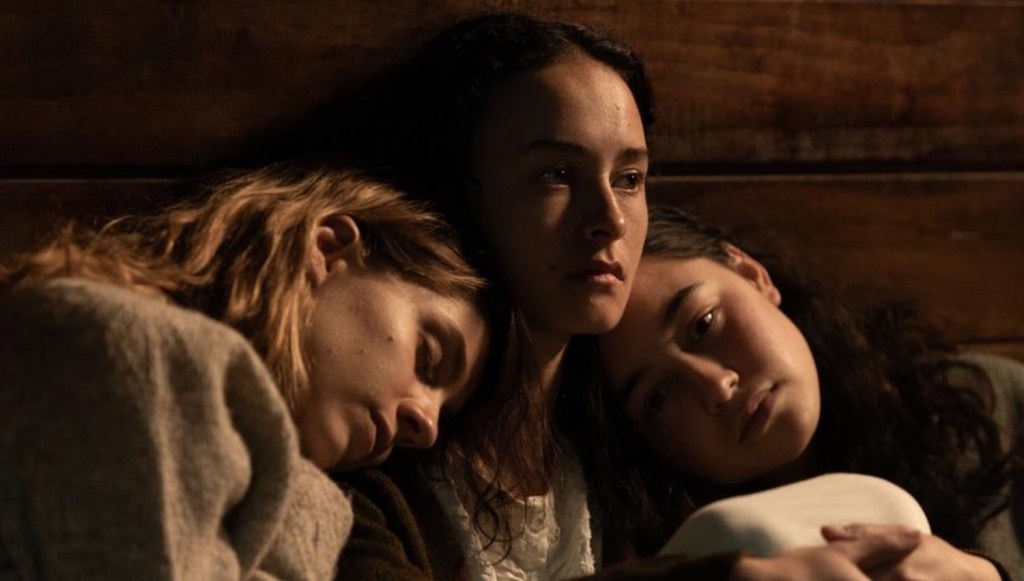
It’s the 1950s on a small island somewhere off the coast of New Zealand, where three girls share a cabin: Daisy, Nelly and Lou (Manaia Hall, Erana James, and Nathalie Morris). They were sent there by the authorities or their parents. Te Motu is a school for “incorrigible” girls or, as the administrators call them, “whores, queers, delinquents and sexual deviants.” Many are orphans or runaways caught stealing food, like Daisy or Nelly. Lou is the exception. She comes from a rich family but was caught making out with her (female) tutor. The school operates under the strict rule of Matron (Rima Te Wiata), who has a cruel streak a mile long. Raised by nuns, she feels the only way to cure these girls’ bad attitudes is through the bible and the lash. Naturally the girls all want to get the hell out of there, but it’s hard to escape from an isolated island in the south pacific. The purpose of the school is to turn bad girls into happy homemakers. They are given lessons in diction and manners but not reading or math.
Matron is frustrated by their outcome: She says they are “too stupid for school, to uncivilized to be maids and too barbaric to work”. Every so often, Matron is visited by men in suits from the mainland, one of whom suggests a horrifying treatment. But when Nelly find out, the three girls decide they have to do something to stop it.
We Were Dangerous is a moving, coming-of-age story about girls surviving in 1950s New Zealand. It’s bright and exuberant, full of playfulness and dancing, Haka and history, and though fictional, it tackles the very real issue of the mistreatment of indigenous girls. The acting is excellent all around, full of subtle clues and delightful details. For a first film, Stewart-Te Whiu avoids many potential stumbles and instead gives us a solid film that’s fun to watch. It played at ImagineNative this year, and is definitely worth seeing.
Apocalypse in the Tropics is playing this weekend at HotDocs and will be streaming on Netflix this coming week; Daniela Forever opens this weekend in Toronto; check your local listings; and We Were Dangerous is available now on VOD.
This is Daniel Garber at the Movies, each Saturday morning, on CIUT 89.5 FM and on my website culturalmining.com.
Blacks, Jews and Irishmen. Films reviewed: The Piano Lesson, A Real Pain, Small Things Like These
Hi, this is Daniel Garber at the Movies for culturalmining.com and CIUT 89.5 FM.
Fall Film Festival Season continues with the EU Film Fest, showing free films from across Europe at Spadina Theatre starting on the 14th.
This week, I’m looking at three family dramas. There’s Black siblings in Pittsburgh, Jewish cousins in Warsaw, and an Irish dad with his five daughters, in… well, Ireland.
The Piano Lesson
Dir: Malcolm Washington
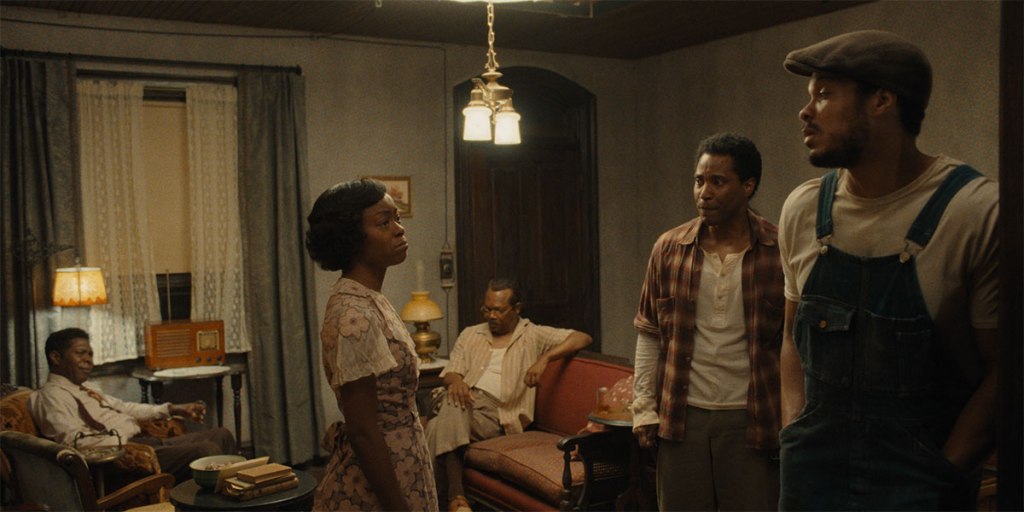
It’s 1936. Boy Willie Charles (John David Washington) and his friend Lymon are driving north from Mississippi with a truckload of watermelons, to visit his sister Berniece (Danielle Deadwyler) in Pittsburgh, Pennsylvania. She’s living with their uncle Doaker (Samuel L. Jackson). Once they sell the melons, Boy Willie plans to take his share of the profit (along with his savings) to purchase Sutter’s land. That’s the same place where his great grandparents were slaves, and where he still toils the land as a share-cropper. This is his one chance to own it. But he’ll only have enough money if he sells the family piano. That’s why he’s visiting Pittsburgh. But Berniece refuses to sell it. Why? She grew up playing that piano, and more to the point it has family faces elegantly carved into the wood itself, dating back to pre-Civil War days. Besides, she says, that piano is haunted… and the ghost is getting meaner. Meanwhile various family and friends, like a trickster and a preacher, are congregating at this house with different motives for being there. Can Boy Willie and Berniece come to terms about the piano? Or will bad spirits — both supernatural and human — ruin everything first?
The Piano Lesson is an excellent filmed version of playwright August Wilson’s drama. Fine acting all around, with Danielle Deadwyler outstanding as Berniece. Now, plays and movies are two different things. Actors emote louder and move bigger on
stage (so everyone can see and hear them). And even the blocking and dialogue is different. Movies are no more real, but different. This Piano Lesson is very much a play. So I was a bit put off by it’s style… until the my brain started watching it as a play, at which point I really liked it.
If you notice a lot of Washingtons here, it’s no coincidence. Denzel Washington is the producer, and actor John David and director Malcolm are both sons of his. Denzel is committed to putting all ten of August Wilson’s Pittsburg Cycle on the big screen to preserve crucial Black American culture. Witness Fences in 2016 and Ma Rainey’s Black Bottom in 2020. The Piano Lesson is a fine addition to this series and should be watched.
A Real Pain
Wri/Dir: Jesse Eisenberg
Benji and David Kaplan are cousins in their 30s, as close as brothers, but totally different. Benji (Kieran Culkin) is loud, gregarious, obnoxious and larger than life. He likes to raise a ruckus and mess things up. He lives alone in Binghamton, NY. David is shy, insecure and withdrawn. He’s married with a small kid and lives in Manhattan. He’s in a constant state of dithering and worrying. They’re travelling together to Poland to explore their family’s heritage. Their grandmother was Polish and a Holocaust survivor.
Benji was very close to her and devastated by her recent death, much more so than David. They’re part of a small tour group, all Jewish. Their guide (Will Sharpe) is a nerdy English guy, very accommodating. Also on the tour are Marcia (Jennifer Grey) who suffers from intergenerational trauma; Eloge (Kurt Egyiawan) from Winnipeg but originally from Rwanda where he survived Tutsi genocide; and a middle-class couple whose family immigrated from Poland generations ago but want to see where they came from. (“We’re Mayflower Jews”, he says).
Their journey takes in cultural and historical sites across Poland, but the closer they get to the concentration camp where their
grandmother was imprisoned, the more agitated Benji gets. He slips into shouted diatribes and lectures, causing scenes within their group and in public places — to David’s acute embarrassment. Can they both make it through the whole tour? Or will one of them drop out?
A Real Pain is a low-key, social comedy — yes, a comedy — about the uncomfortable dynamics within a family. it’s actually pretty funny, No slapstick or pratfalls, rather unexpected squirmy riffs on the two main characters’ personalities. (Like Benji telling David his bare feet are gorgeous, making him stare at them for the rest of the trip.) It’s told in a series of clever vignettes over the course of the trip, all hovering over unvoiced feelings of personal and collective mourning. I’m always suspicious when actors play at directing, but this is no vanity pic. Eisenberg stays suitably subdued, letting Culkin go wild.
I like this movie.
Small Things Like These
Dir: Tim Mielants
It’s winter in a small town in Ireland in the 1980s. Bill Furlong (Cillian Murphy) is a working man who scrubs coal dust off his hands and face each day. But he doesn’t work in a coal mine; he has his own business, built from scratch, selling coal. His wife Eileen (Eileen Walsh) and his eldest daughter handle the finances. One day, he’s making a delivery when he’s alarmed to see a teenaged girl being dragged, kicking and screaming, into the local convent. That’s not right. She may be unmarried and pregnant, but why are they kidnapping that poor girl?
So he steps inside to take a look. It’s the Magdalene Laundries, a Church organization that operates across Ireland, to care for unwed mothers. They put the babies up for adoption, and the girls and young women are trained to work as industrial laundresses. But to Bill it seems almost like a prison, where the girls are treated horribly. When one girl runs over, begging him to help her escape, he doesn’t know to do. The nuns quickly disabuse him of any notions he might have, and rush him out the front door.
But Bill has history. He was brought up in this same town by his own single mum, who chose to stay away from that convent. He was bullied as a child because of this, but he still remembers how his mother — and her employer, an independently wealthy woman — defied the church. He feels he has to do something for that girl. But the nuns have their fingers in every pie; the school, government, they’re even a client of his own business. Should he confront the cold-eyed Sister Mary (Emily Watson) who runs everything? Or should he just worry about his own family, and pretend nothing is wrong?
Small Things Like These is a deeply-moving drama about families, moral dilemmas and the checkered history of the Catholic Church in Ireland. This is the third such movie, after The Magdalene
Sisters and Philomena, but its repercussions are still very much alive. Cillian Murphy — who you probably recognize from Oppenheimer or Peaky Blinders — once again pulls you into the character he plays. He rarely speaks but the emotion in his features really affect you. So if you’re looking for a real tear-jerker, this is the one to watch.
A Real Pain, Small Things Like These, and The Piano Lesson all open in Toronto this weekend; check your local listings.
This is Daniel Garber at the Movies, each Saturday morning, on CIUT 89.5 FM and on my website culturalmining.com.
Trapped. Films reviewed: Captives, Here, Emilia Pèrez
Hi, this is Daniel Garber at the Movies for culturalmining.com and CIUT 89.5 FM.
Toronto Fall Film Festival Season continues with Cinefranco showing contemporary French language movies from around the world at the Carlton Cinema. But this week, I’m looking at three new movies about traps. There’s a big-hearted woman trapped in a male drug-lord’s body, a French woman trapped in a mental hospital, and a movie camera trapped… in somebody’s living room!
Captives
Co-Wri/Dir: Arnaud des Pallières
It’s Paris in the late 19th century. Fanni Devander (Mélanie Thierry) is an elegant and educated woman searching for her mother. She disappeared when Fanni was just a child, but she has reasons to believe she is locked away somewhere in the city’s mental hospital. So Fanni voluntarily checks herself in to try to find her. Pitié-Salpêtrière is a home for the destitute, people with mental illness, learning disabilities or epilepsy, convicted criminals and even some foundling children. The one common factor is they’re all “undesirables” and all women. But once inside she realizes you can check in, but you can’t check out. It’s a de facto prison, presided over by the Matronly Bobette (Josiane Balasko), and a hench-woman who would make Nurse Ratchet look like Florence Nightingale. Bobette’s one obsession is to perfectly execute their upcoming ball featuring her patients singing and dancing before a crowd of wealthy patrons.
Fanni quickly learns the ropes and makes allies with Hersilie, a music teacher (Carole Bouquet) and a lesbian school teacher with an eating disorder. And she finally meets a nearsighted older woman named Camomile (Yolande Moreau) who just might be her real mother. Can Fanni perform at the ball and safely escape
with her supposed mother? Or will they all be stuck there forever?
Captives is a fascinating historical thriller about the treatment of women in state institutions. It’s harrowing in parts — including scenes of torture — as Fanni navigates class and hierarchy within this enclosed universe. I purposely only mentioned some of the characters and plot turns, because the surprise is what makes it worth watching. But rest assured, it’s full of great acting, pathos, and beautiful period costumes — even within that terrible place.
I like this one.
Here
Dir: Robert Zemeckis (Reviews: Flight, Allied)
Ricky (Tom Hanks) is a teenaged baby boomer living the American dream. His Dad and Mom (Paul Bettany and Kelly Reilly) have lived in a house across the street from Ben Franklin’s historical home since they bought it on the GI Bill after WWII. Now Ricky and his kid brother and sister happily share the place, congregating in the living room for holidays, dinners, or just to watch TV. Ricky wants to be an artist, while his girlfriend Margaret (Robin Wright) dreams of going to law school. Unfortunately, when she gets pregnant while they’re both still in high school, they marry and settle down, still within Ricky (now called Richard’s) parents’ home. Life goes on, and the decades pass, and people are born, live and die. But will they always stay “here” in the same house?
Here is a movie about a place, specifically a living room facing the picture window and the street beyond. The camera never movies. It follows this location not just for Ricky’s family, but also the dinosaurs, the ice age, indigenous people, Ben Franklin, and various couples across the 20th century, constantly jumping back and forth in time. The one constant is the frame, the fourth wall, which never shifts. Picture this: a pop-up square will appear with different furniture and wallpaper in it, taking you to another era, in the style of a virtual staging of a house for sale on a real estate
website. Indeed we get to meet real estate agents throughout the twentieth century. Which makes sense because its really about the place, not the meat puppets who wander around in it.
Does this new, experimental concept work? No! It’s indescribably awful.
I cannot convey the aesthetic revulsion I felt viewing this horrible non-movie movie. It features a de-aged, 68-year-old Tom Hanks playing himself as a teenager with a fake young teenage face plastered on, but who still talks and walks like the old man he is. What were they thinking?! Here is a tired, platitudinous high-concept exercise in futility disguised as an innovative film. All the characters are painful cliches, including a token black family whose sole purpose seems to be to recite a version of Ta-Nehisi Coates Letter to My Son… to their son.
Keep in mind, Zemeckis is known both for classics like Back to the Future but also unforgivable, semi-animated dreck like Polar Express and Forrest Gump. Here falls neatly into the dreck pile.
Emilia Pérez
Co-Wri/Dir: Jacques Audiard
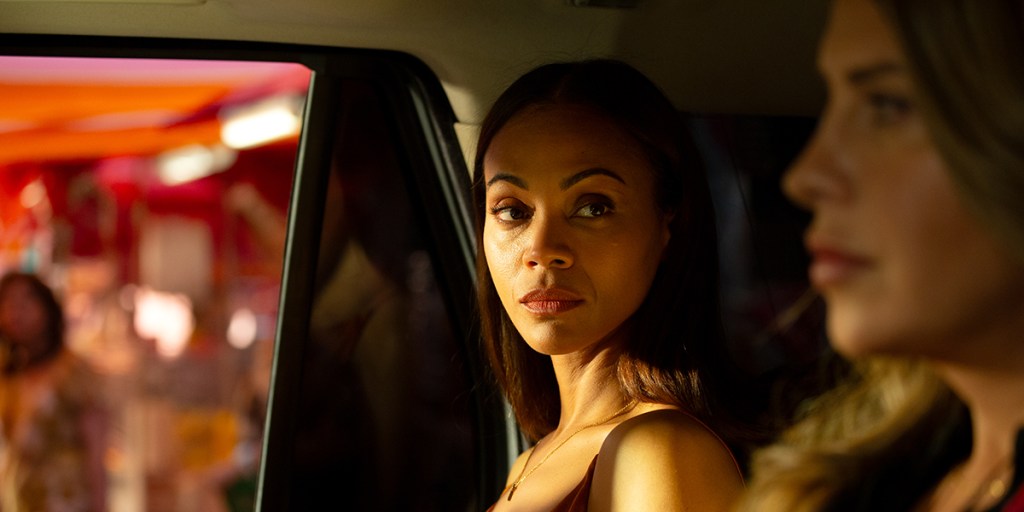
Rita (Zoe Saldaña) is an ambitious young defence lawyer in Mexico City. She spends hours crafting powerful opening statements for trials, but, as a black woman — originally from the Dominican Republic — she gets none of the credit. But somebody is watching her and appreciates her skill. She finds out who, when she’s kidnapped with a black hood over her head and driven into the middle of the desert. There she meets the notorious head of a huge drug cartel, personally responsible for countless killings. Juan “Manitas” Del Monte, the cartel chief, needs her to help him disappear, in a way no one — including his wife Jessi (Selena Gomez) — will ever find him again.
The twist? This murderous, pock-marked, bearded monster… is trans, and wants to shed the awful male body and face, to live the rest of her life as an attractive woman. She needs someone she can trust to handle all this, both the finances and the surgery, leaving no paper trail. In exchange, Rita will have all the money she needs for the rest of her life, and her own private firm.
Years later, she meets with a potential client, a fabulously rich European woman named Emilia Pèrez (Karla Sofía Gascón). It’s
her client from years back, who wants to re-enter the world and be reunited with her beloved family, all of whom think she is dead. And to atone for some of her past sins without revealing who she was. What will happen to these three remarkable women in the next chapter of their lives?
Emilia Pérez is an incredibly passionate and shocking movie. It’s simultaneously an action-thriller, an epic drama, and a musical. Yes, that’s right, a musical, where characters do break into songs and dances throughout the film. But with its latin beats and shouting crowds, it’s the sort of songs you rarely encounter in a musical. Zoe Saldaña is amazing as this tough-as-nails lawyer, and Karla Sofía Gascón, a Spanish actress I’ve never seen before, is unmatchable, both as Perez, and as the drug lord Manitas. (She’s a transwoman herself.) French director Audiard (who previously brought us masterpieces like A Prophet, and Rust and Bone) seems to have no trouble creating a Mexican musical. I gotta say, Netflix churns out a load of content, most of which is forgettable crap, but, every year, they also produce a few really remarkable films. Emilia Pèrez is one of those.
I strongly recommend this movie.
Here and Amelia Perez both open this weekend in Toronto; check your local listings. And Captives is having its English Canada premiere at 8:45 tonight (Saturday, Nov 2, 2024) at Cinefranco at the Carlton.
This is Daniel Garber at the Movies, each Saturday morning, on CIUT 89.5 FM and on my website culturalmining.com.
My, my. Films reviewed: My Animal, Maestro
Hi, this is Daniel Garber at the Movies for culturalmining.com and CIUT 89.5 FM.
This week, I’m looking at two new films opening this weekend — a horror movie from Canada and a biopic from the US. There’s a young conductor with his eyes on Carnegie Hall, and a young werewolf with her eyes on a figure skater at the hockey rink.
My Animal
Dir: Jacqueline Castel
Wri: Jae Matthews
It’s a cold day in the 1980s somewhere in Northern Ontario. Heather (Bobbi Salvör Menuez) is a young woman with blood-red hair. She reads women’s bodybuilding magazines on the sly and watches female pro-wrestlers late at night on TV. She’s athletic herself — works part-time at the arena’s snack bar — and hopes to join the local hockey team as goalie. Heather lives in the outskirts of town with her grizzled dad who runs a diner (Stephen McHattie), her angry, alcoholic mom (Heidi von Palleske) and the twins Cooper and Hardy (Charles and Harrison Halpenny). She and her little brothers inherited red hair from their mom and an unusual trait from their Dad. That’s why their mom keeps everyone shackled to their beds whenever there’s a full moon. Can’t have them
running around unwatched after midnight — they might bite someone! Yup… they’re werewolves.
Everyone knows everyone in this town, so when a new face appears at the rink, Heather takes notice. Jonny (Amandla Stenberg) is a beautiful, young, pro figure skater. She’s kept under tight control by her effeminate father (who is also her ice-dance-partner) and her domineering baseball-player boyfriend (Cory Lipman).
But when Heather meets Jonny, they both sense something electric between them. They start going out late at night to parties and adventures, like dropping acid at the casino with their friend Otto (Joe Apollonio). Heather says she wants to show Jonny new things — if she’s not too scared to try. Are they just friends? Or something more? Will Jonny accept Heather’s shape-shifting… never mind her sexuality? Or will Heather’s late-night risk-taking lead to violence, or even death?
My Animal is a beautiful look at a bittersweet romance between a lesbian, hockey-playing werewolf and a (possibly) straight figure skater. Although the two lead roles (starring the wonderful Stenberg and cool newcomer Menuez) are played by Americans, they, and the movie itself, feel totally Canadian, from the Zamboni to the snack bar to the snow-swept highway. (It was shot in Timmins, Ontario). I love the look of this film, playing with red, black and white, from Heather’s dark red bed sheets and ginger hair, to the hockey uniforms and maple leaf flags at the rink. From its gorgeous nighttime photography, to its blurry 80s music tracks, it’s relatively low-budget and simple but really good. Appropriately — and keeping with the red and white colour scheme — it won Best Director, Best Screenplay & Best Cinematography at the Blood in the Snow Film Festival. My Animal picks up on paths paved by classic female werewolf pics like Ginger Snaps.
I liked this one a lot.
Maestro
Co-Wri/Dir: Bradley Cooper
It’s 1943 in New York City. Leonard Bernstein (Bradley Cooper) is a musician, composer and conductor in his mid-20s, who suddenly gets a phone call from Carnegie Hall. Their regular conductor is ill, and they want Lennie to come in that day, without any rehearsals, to take his place. He leaps into the role, feeling the music and motivating al the musicians to play with passion. The concert is broadcast live on radio, nationwide, to huge response. This kickstarts his future as a conductor and suddenly the world is his oyster. He celebrates his newfound success with his boyfriend David (Matt Bomer) also a musician, and his career starts to soar.
Later, he meets Felicia Montealegre (Carey Mulligan) a broadway actress originally from Chile.
They fall in love and raise three children together. He composes movie and stage scores for hit musicals like West Side Story and Candide, and brings largely unknown composers, like Mahler, into the public eye. But Lennie is never quite ready to give up his gay sex life, and has a series of longtime lovers. Can Lennie and Felicia’s relationship weather both his superstar status and his sexuality? Or will it tear their marriage apart?
Maestro is a biopic about the personal and professional life of the celebrated conductor Leonard Bernstein. The musical side of this film is a visual and audio treat, with extended performances recreated with detailed care, in the original locations, Carnegie Hall, Tanglewood, and a cathedral in London. Beautiful music and photography. The film itself is told chronologically in three parts. The 40s and 50s are filmed in the style of movies from that period — gorgeous black and white, with elliptical scene changes, where he’ll leave his bedroom and walk straight onto a stage in front of a cheering crowd. Cooper perfectly captures Bernstein’s physicality in his conducting, jumping on the platform, thrusting a hand forward or balancing on one foot. The second part is in a
grainier faded colour film to represent the 60s and 70s, while the third section is also in colour but with sharp photography, following his increasing fame and his faltering marriage. These are punctuated by word-for-word recreations of actual interviews.
But there’s a big difference between accuracy and reality. The script seems to be based on actual letters and diaries that Lennie and Felicia wrote at the time. This makes their lines sound scripted or transcribed, not real. And in the first section they speak with mannered voices, as if they were characters in a 1940s movie.
Mulligan is wonderful as Felicia, but you wonder, why — in a movie that puts Bernstein’s gayness
front and centre — are we seeing detailed and extended private arguments between Lennie and Felicia, while his relationships with men are kept opaque? And for a movie about sexuality, why is it so non-sexual? Aside from an occasional post- coital cigarette (he was a chain smoker) or a short kiss, it’s kept anodyne and almost fully-dressed, a movie you could watch with your grandparents without blushing.
There are many delightful parts of the film, with good acting all around, and, as I said, the concerts are magnificent… I just never felt like I was learning anything new about Leonard and Felicia or delving deeply into their psyches.
Maestro is playing now at the TIFF Bell Lightbox, and opening soon at other theatres across Canada — check your local listings. My Animal is also playing nationally at select theatres.
This is Daniel Garber at the Movies, each Saturday morning, on CIUT 89.5 FM and on my website, culturalmining.
Halloweeniness! Films reviewed: Five Nights at Freddy’s, The Killer, Suzume
Hi, this is Daniel Garber at the Movies for culturalmining.com and CIUT 89.5 FM.
Toronto Fall Film Festival Season continues with Rendezvous with Madness, showing and discussing films about addiction and mental health, on now through November 5th. And on the horizon are Cinefranco, showing great French- language movies from Canada, Europe and Africa starting Nov 3rd; and ReelAsian Film Fest, celebrating its 27th incarnation, featuring pan-Asian cinema, events and media artists beginning on Nov 8th.
But this week I’m talking about three new genre movies — an action- thriller, a horror and an animated fantasy — just in time for Halloween. There’s a hitman tying up loose ends, a night watchman guarding animatronic beasts, and a Japanese schoolgirl closing doors.
Five Nights at Freddy’s
Co-Wri/Dir: Emma Tammi
(Based on the game by Scott Cawthon)
Mike (Josh Hutcherson) is a night watchman at a crumbling, former kids’ pizza emporium. He’s working there because, since their parents died, he needs to take care of his little sister Abby (Piper Rubio). Abby is withdrawn and introverted; she spends most of her days drawing pictures. Mike is especially protective of her, since their brother Garret was abducted by a stranger years earlier and never found. Now he’s worried social services will take her away and give custody to their sinister aunt Jane (Mary Stuart Masterson). And without a steady job, he’s a lost cause.
The thing is, Freddy’s is a weird and creepy place, filled with rusty old animatronic figurines — Freddy, Foxie, Bonnie, Chica, and Cupcake — life-sized robotic creatures that once welcomed kids to the restaurant… until children started disappearing in the 1980s, and the place was closed down. Luckily, Vanessa (Elizabeth Lail) a friendly local cop, is always dropping by to make sure Mike is OK. (Is there a possible romance brewing?) But once ghosts of the abducted kids start appearing in his dreams — and he wakes up with real-life wounds — Mike starts to question the entire job. And when Abby gets involved
and is playing with the animatronic creatures, things start to look ominous. Can Mike protect Abby from her new “friends”? Will Aunt Jane take her away? And will he ever discover what happened to their brother Garret?
Five Nights at Freddy’s is a light kids’ horror movie about a haunted restaurant, a sort of a Chuck E Cheese from hell. It’s based on a computer game from the early 2000s, which dictates a lot of the characters, plot and even the images. Which gives an ultra-simplistic feel to the movie. The movie mainly takes place inside the dusty pizza emporium, filled with retro video screens and pinball machines; and the scenes with the animatronic characters are uniquely creepy and cool. But in general, the film is predictable, repetitive and not terribly original. But I’ve never actually played the game. The audience where I saw it was screaming and yelling at every line, revelation or scene-change, so, clearly, if you’re already a fan, you’ll love it. Personally, I enjoyed watching it, but found it instantly forgettable.
The Killer
Dir: David Fincher
A self-described ordinary man (Michael Fassbender) who likes egg McMuffins and 70s sitcoms is camping out in a Paris office building, across from a hotel. He enjoys listening to The Smiths whenever he needs to relax. He normally lives in a palatial estate in the Dominican Republic. So what is he doing in Paris and why is he sleeping on a table? He’s a hitman assigned to assassinate a stranger through hotel window. Don’t take it the wrong way; he’s not a bad guy, it’s just his job. But when the assignment goes wrong, everything falls apart. Now he thinks killers are tracking him, and his girlfriend is attacked and almost killed inside his home. Who can he trust? So he sets out to discover who exactly has turned on him, and once he figures that out, he plans to systematically kill them all. But will he succeed in his revenge plot?
The Killer is an action/thriller based on a graphic novel and told from the viewpoint of a sympathetic murderer. There are chase scenes and stake-outs, fistfights and shoot-outs, everything you’d expect in a thriller. It’s chock-full of violence and death, but the twist is it’s narrated in a light and breezy voice-over by the killer himself.
Fassbender is a great actor, here at his wiriest, and surrounded by a top-notch cast: including Tilda Swinton, Charles Parnell and Arliss Howard. And it’s directed by David Fincher who brought us Fight Club and The Usual Suspects. And it has recurring gags, like the killer using fake names taken from 70s sitcoms (Archie Bunker and Richie Cunningham) to hide his identity. So why isn’t it very good? The problem is the story is more pointless than it is funny or exciting or interesting. It’s lots of action, not so many thrills. The plot itself is plodding, going from numbered chapter to chapter about the next person he’s going to encounter and possibly kill. It just leaves you feeling hollow — killers killing killers. Sure, The Killer is totally watchable as an action movie, it just doesn’t live up to its potential. Instead it elevates mundaneness into mock profundity.
Suzume
Wri/Dir: Shinkai Makoto
Suzume is a teenage girl in Kyushu, Japan. She has lived with her aunt since her single mom died when she was four, but she’s still troubled by nightmares. One day, on her way to school, a handsome young man asks her for directions to an abandoned part of town. Intrigued, she follows him and discovers a strange, freestanding door and a small statue of a cat. After she walks through the door, everything seems the same… and yet somehow different. She can now see things other people can’t — like a huge red plume rising into the sky. The cat, Daijin, comes to life and starts talking. The stranger, named Souta, explains what’s going on. He’s a closer, one of only a few people who can close those doors using a special key. The red plume is actually a giant worm — it’s what causes the earthquakes and tsunamis in Japan. And it will be a disaster unless he closes these doors wherever they start to open. But when the cat turns Souta into a little, three-legged chair, things start to get more complicated. Can Suzume do Souta’s work? Can she turn him back into a human? Can they stop Daijin the cat from causing any more problems? And what will Suzume’s aunt do if she just takes off?
Suzume is a beautiful fantasy-adventure about a girl trying to save the
world. It’s a picaresque story that spans Japan’s islands, historic sites and the very diverse people at work — from a hostess bar to a bath house — she meets on her journey. It’s fascinating, exciting, and full of surprises. Beautiful images and a nostalgic soundtrack — full of Japanese pop songs from the 70s and 80s — make it a pleasure to watch. It’s especially meaningful in Japan because it takes place in 2023, exactly 100 years after the Great Kanto Earthquake flattened Tokyo. Add to this a semi-romantic story full of world-altering decisions (no spoilers) and you’ll get why it’s so good. The director Shinkai Makoto who brought us the smash hit Your Name again deftly handles tricky stuff like time and space and alternate realities and unrequited love.
If you like Japanese anime, Suzume is a must-see.
Five Nights at Freddy’s and Suzume both open this weekend in Toronto — check your local listings — with The Killer showing exclusively at the TIFF Bell Lightbox.
This is Daniel Garber at the Movies, each Saturday morning, on CIUT 89.5 FM and on my website, culturalmining.com.
Sharks! Films reviewed: NYAD, Dicks: the Musical
Hi, this is Daniel Garber at the Movies for culturalmining.com and CIUT 89.5 FM.
Toronto Fall Film Festival season continues with three festivals on this weekend: ImagineNative, showing indigenous films from around the world, including an art crawl! Toronto After Dark, with action, horror and fantasy and a devoted audience of fans like you’ve never seen; and Planet in Focus showing some great ecological documentaries, including world premiers.
But this week I’m talking about two more movies that played at TIFF and are now opening theatrically in Toronto this weekend. There’s a long-distance swimmer battling sharks, and two Wall Street sharks searching for their hidden history.
NYAD
Dir: Jimmy Chin, Elizabeth Chai Vasarhelyi
Diana Nyad (Annette Benning) is a long-distance swimmer, at the top of her game. A competitive swimmer since she was a teen, she broke world records for marathon swimming, starting in 1970. She swims in Naples, Lake Ontario, the English Channel, and other challenges around the world. But her biggest dream is to do something no one has ever done before: swimming from Havana, Cuba to Key West, Florida. But those are shark infested waters, so they build a special metal shark tank to save her from being eaten. Sadly, the swim proves to be a washout, and after that failure, she gives up competitive
swimming altogether, becoming a TV sportscaster instead.
Thirty years later, on her 60th birthday, she has an epiphany: looking at herself in the mirror she just sees a “bag of bones”. But with the encouragement of her best friend (and ex-lover) Bonnie Stoll (Jodie Foster), she decides to give it one more try… but only if she agrees to be Diana’s coach. This time, they’re going to do it right. Bonnie finds a guy who knows how to scare away approaching sharks, and a captain who never speaks but knows how to handle a boat. Most important, she finds her a navigator (Rhys Ifans) who knows how to read the gulf stream and the weather to avoid swimming against the tide.
After extensive training they all go to Cuba to start the journey. Diana is armed with a playlist of hundreds of songs inside her head to keep swimming to the rhythm, and Bonnie has food and water to drop into her mouth all along the way
(Diana is not allowed to board or even hold onto the boat for a short rest.) Can a woman in her sixties accomplish something no one in the world has done before? Or is it just a delusion?
Nyad is an inspirational biopic about the famous long-distance swimmer and her many tries at accomplishing a seemingly impossible goal. In general, I hate biopics, sports movies, and inspirational stories. But in this case, it totally works. I wanted to see it mainly because it’s directed by Jimmy Chin and Elizabeth Chai Vasarhelyi, a husband-and-wife team of documentarians who specialize in movies about driven individuals trying to accomplish the dangerous and impossible. Like Free Solo, their Oscar-winning doc about a mountain climber who wants to scale a sheer cliff without nets or other safety measures. But this is their first try directing actors. Annette Benning plays Diana realistically, as a sometimes difficult, self-centred woman with a 60-year-old body without the usual Hollywood nips and tucks. Jodie Foster and Rhys Ifans deliver reserved but supportive performances. And the underwater photography is brilliant, all the way through.
If you feel like giving up, watch Nyad for some reasons to keep on trying.
Dicks: The Musical
Dir: Larry Charles
It’s present-day Manhattan. Trevor (Aaron Jackson) and Craig (Josh Sharp) are dicks — in the sense they are selfish, insensitive and obnoxious. They both sleep with beautiful women on one nights stands and make big bucks in sales, due to their ruthless ambition — they’re Number One in their respective regions. They live next door to each other, but they’ve never actually met. Until Gloria, their hard-ass boss (Megan Thee Stallion), brings them together in a company-wide competition. It’s hate at first sight… until they make a startling discovery: they’re not just cut-throat rivals, they’re identical twins, separated at birth! They were each raised by one of their parents.
With their sudden ties, they put their careers on hold in favour of a new goal: to meet each other’s parents discover why they did it, and perhaps to bring them together again. Since this is a musical comedy, they switch places using wigs and

disguises. Turns out, both their parents are totally whack. Harris (Nathan Lane), their Dad, is gay and has no interest in remarrying a woman. Furthermore, he keeps a pair of tiny demons with pointy teeth in his apartment; he calls them the sewer boys, Backpack and Whisper. Evelyn (Megan Mullally) has been a recluse since her vagina fell out, and presumably ran away. Can the two dicks ever get their parents back together again?
Dicks: The Movie is a funny, very campy musical-comedy based on the play of the same name, written by the two stars. Each song is more ridiculous than the one before, featuring an amazing number with Megan Thee Stallion. And there’s a thread of absurdity running through the entire film. It simultaneously makes fun of musical comedy while totally embracing it. And it really is hilarious, like a Parent Trap without kids, or a Fringe comedy with a bigger budget. It’s
directed by Larry Charles, best known for Seinfeld, Borat and Curb Your Enthusiasm, so expect lots of ribald, in-your-face comedy. Bowen Yang narrates the story playing God as a gay man, while Nathan Lane and Megan Mullally are hilarious as the eccentric parents. But it’s mainly all about writers and stars Jackson and Sharp.
Never heard of them before, but I can’t wait for the next thing they do.
Dicks the Musical and Nyad both open this weekend in Toronto; check your local listings.
This is Daniel Garber at the Movies, each Saturday morning, on CIUT 89.5 FM and on my website, culturalmining.com.
Summer tentpoles. Films reviewed: The Deepest Breath, Mission: Impossible — Dead Reckoning, Indiana Jones and the Dial of Destiny
Hi, this is Daniel Garber at the Movies for culturalmining.com and CIUT 89.5 FM.
A tentpole is a movie that, despite its extremely high budget, is expected to help a studio stay afloat so they can make lots of mid- or low-budget movies — the films I try to cover. But since a lot of these tentpoles are popping up this summer and inundating us with ads and publicity, I can’t completely ignore them. So this week, I’m looking at two of them — an action movie and an action/adventure — plus a sports doc.
The Deepest Breath
Wri/Dir: Laura McGann
Alessia Zecchini is an Italian woman whose dream — since she was a little girl — has always been to free dive. Freediving refers to an extreme sport usually done in natural settings. While there are many variations, it generally involves swimming straight down underwater as deep as you can go, and then turning around and swimming back up to the surface. The type Alessia competes in involves a weighted rope that she follows when swimming down and up. The deeper you go, the better your chance of winning a competition or breaking a world record. But countless people go deep-sea diving — what sets this type apart? Free diving is done without scuba gear; competitors hold their breath the entire time they’e underwater. (We’re talking two, three or four minutes or longer!) It’s considered an extreme sport because if you swim too deep you might black out and drown. So there are safety divers who accompany you, to mitigate the danger — they propel your body to the surface if you pass out. One such safety diver is Stephen Keenan, an Irishman known for his skills and dedication. The two become close in their repeated dives. But can they remain safe in such a dangerous sport?
The Deepest Breath is a sports documentary about Stephen, Allessia and other free divers both in and out of competition, as well as talking-head interviews with their friends and relatives. I was attracted to this documentary because I love underwater
photography — the deep blues, the colourful fish, the coral reefs, whales and orca people might see as they explore the depths. And the photography is quite beautiful. But I hadn’t realized that most of the movie would just be people competing as they swim down and then up again. Free climbing — rock climbing without ropes or nets — is a highly skilled and very hazardous sport. (A great doc called Free Solo came out a few years ago). Free diving is not the equivalent. It’s just about who can hold their breath the longest as they swim up and down a rope, like a human yo-yo.
There are historical precedents, like women in Japan known as ama (海女) who used to swim topless in deep and rocky waters searching for pearls in oyster beds. But they did it as an occupation, not as a hobby. For the life of me, why do people risk their lives at something so pointless? I also found the movie manipulative: misleading audiences about implied relationships which may or may not have been real, while dropping false hints about the death of certain characters (no spoilers).
If you are a fan of (or a competitor in) free diving or other extreme sports, you’ll love this movie. Otherwise… maybe not.
Mission: Impossible — Dead Reckoning, Part 1
Dir: Christopher McQuarrie
Ethan Hunt (Tom Cruise) is a spy who carries out top secret assignments as part of the IMF — the Impossible Mission Team, known only to Kittridge, his boss (Henry Czerny) who works for the US government, and other members of the team. His mission? To rescue a special key from another agent, Ilsa (Rebecca Ferguson) and bring it back. But this is no ordinary key. When interlocked with a second, one, this key can activate a lethal weapon so powerful it makes atomic bombs look like BB guns. The key was stolen from the Russians by an unknown entity, possibly an example of artificial intelligence gone rogue. Hunt liberates the key, but his plans are interrupted by a new player on the scene. Grace (Hayley Atwell) is a beautiful and glamorous thief, who can pick any pocket and open any lock. She’s working for Gabriel (Esai Morales), a mysterious and ruthless villain who represents The Entity — that unknown person, group or computer program seeking to rule the world. And her nimble fingers soon take possession of the key. It’s up to Hunt and his team to follow her through scenic spots in Europe and get back the key, before the Entity blows us all up. But who can he trust?
Mission: Impossible — Day of Reckoning is a light, fun movie with non-stop action. I find Mission: Impossible movies annoying for their ponderous plots and Tom Cruise-centric focus. This time, it’s funnier than usual, and also has many interesting characters: Ilsa,
Grace, but also a deranged assassin named Paris (Pom Klementieff) and a diffident criminal broker known only as The White Widow (Vanessa Kirby). That’s right, this is an action movie with four fascinating female central characters! That’s rare. The stunts and special effects are really impressive, as is the scenery in Rome, Venice, and across the continent.
On the other hand, the dialogue in this movie is atrocious. I mean abysmally bad, in some scenes. A sequence set in the Pentagon may live on in history as some of the worst lines ever written. (Could it have been written by AI? No, it’s even worse than that.) It’s also Part One of a two-part series, so you’ll have to watch another one next year to tie up the loose ends.
But if you’re looking for pure summer entertainment, check this one out.
Indiana Jones and the Dial of Destiny
Dir: James Mangold
It’s 1944 in Nazi Germany. Indiana Jones (a de-aged Harrison Ford) is an archaeologist known for his bravery and derring-do. With his side-kick Basil Shaw (Toby Jones), they’re hoping to find a priceless relic amongst countless crates of stolen loot. They are captured and tortured by their cruel adversaries, but manage to escape, along with part of an ancient Greek device invented by Archimedes— the Dial of Destiny. Flash forward 25 years to Manhattan in the late 1960s. Indie is now an over-the-hill college professor, whose get up and go has got up and went. His treasure-hunting days are over, his wife (Karen Allen) has left him and his students don’t care what he says. But everything changes when Helena Shaw (Phoebe Waller-Bridge), Basil’s daughter, shows up unannounced. She grabs the dial and runs off with it to Morocco. She’s not the only one interested in this dial — government agents want it, too, and so does Dr Voller (Mads
Mikkelsen) a former Nazi turned NASA rocket scientist who Indie and Basil encountered back in 1944. Indie reverts to his old personality, and complete with hat and whip, he flies off to Morocco. And after some jostling and negotiations, he joins Helena and her loyal street-urchin pal Teddy (Ethann Isidore) on a transcontinental journey to locate the other half of the dial. But who will get there first?
Indiana Jones and the Dial of Destiny is the latest, and possibly the last of the movie franchise. Considering Harrison Ford is 81 now, I think he carries it off pretty well. Does the movie work? Totally. It’s a family-oriented action/ adventure film. Maybe I like it for the
nostalgia factor, which is the basis of the whole series — Spielberg and Lucas made Raiders of the Lost Arc in the 80s in an attempt to recapture the movies they grew up with. But it has enough twists and turns, secrets and surprises, to keep you interested, start to finish. Mads Mikkelsen plays a perfect villain, and Phoebe Waller-Bridge is great, too. I actually really liked this one — it redeems the whole series.
One thing I don’t normally do is compare two movies, but I was struck by how similar this movie is to the latest Mission: Impossible. They both have chase scenes driving tiny cars pursued by gun-crazed drivers — a yellow Fiat 500 in Rome in Mission: Impossible, vs a Morrocan tuk-tuk in Indiana Jones. They both have half of a device with incredible power — a key and a dial — and are searching for the other half. They both have fight scenes on the roof of a fast-moving train passing in and out of tunnels. And
there’s a clever pick-pocket — Grace in Mission, Teddy in Indie — who befuddles both the hero and the villains. And each of these tentpoles cost about $350 million each to make: That’s more than the budget of every feature made in Canada that year put together. Which is better? I liked them both, but I’d say Dial of Destiny is the better one.
Indiana Jones and thee Dial of Destiny is playing now, Mission: Impossible — Dead Reckoning, Part 1 and The Deepest Breath both open this weekend; check your local listings.
This is Daniel Garber at the Movies, each Saturday morning, on CIUT 89.5 FM and on my website, culturalmining.com.
Outcastes. Films reviewed: The Childe, Nimona
Hi, this is Daniel Garber at the Movies for culturalmining.com and CIUT 89.5 FM.
It’s the Canada Day long weekend — what better time is there to catch up on some movies? You might want to make time for a fascinating new documentary called Making Time about some rebellious and original horologists, people who literally make time.
But this week I’m looking at two new movies — an action thriller, and an animated fairy tale — about outcastes, and how we can embrace differences. There’s a mixed-race man who discovers his dad is a millionaire… and a commoner accused of murdering a queen!
The Childe
Wri/Dir: Park Hoon-jung
Marco (Kang Tae-Ju) is an impoverished young man in the Philippines who lives with his ailing mother. He’s an amateur boxer saving as much money as he can to pay for her operation, but it’s never enough. So when a strange man shows up representing a wealthy client in Seoul, Korea, his ears perk up. The man offers to pay for the surgery and then some; in return, Marco would have to fly to Seoul immediately to meet the client. Why him? Because the millionaire is Marco’s dad and he wants to meet his son before he dies. Now people call Marco a “Kopino” — his biological father (who he’s never met) is Korean and his mom Filipina. She insisted he study English and Korean when he was growing up, so he’ll be able to communicate with him when he gets there.
So off he flies to Korea, first class, but he finds the people he meets are not particularly friendly. Not just unfriendly, but outright abusive, calling him a mutt — and worse — because of his mixed background. Which quickly turns to actual danger — some people are trying to kill him. There’s a sadistic and sinister young man (Kim Seon-ho) who constantly chews gum and sips coca-cola as he brags about his
expensive shoes and car. He tells Marco that he’s his best friend, even as he kidnaps him (some friend). Then there’s a woman named Yun-ju (Go Ara) who clearly wants him gone And his half brother Han (Kim Kang-woo) and half sister each of whom have evil plans of their own all involving Marco. What’s so special about him? What do they want from him? And why do some of them want him dead?
The Childe is a very fast- moving action-thriller shot in SE Asia and Korea. Lots of fights, excellent chase scenes and plot twists. Although quite violent, most of it takes okay off-camera, giving the film a lighter tone. Kim Seon-ho is sufficiently creepy to be humorous, and Kang Tae-Ju is just right as the hapless hero. And — no spoilers — I did not guess the big revelation near the end. Nothing deep here — The Childe is an action movie, after all — but it is totally watchable.
Nimona
Dir: Nick Bruno, Troy Quane
(Based on the graphic novel by ND Stevenson)
Picture a medieval town with modern technology. That’s where
Ballister Boldheart lives.. It’s a walled city — to keep out monsters — with a castle, a benevolent queen and knights in shining armour. But it’s also a place with flying cars, cel phones and video cameras. Ballister is a knight himself, or about to become one. The queen has declared henceforth that a commoner like Ballister, not just royalty, can become a knight. This is a historic occasion, and he — along his boyfriend, Ambrosius Goldenloin, a knight himself — are overjoyed at this upcoming change. Until something terrible happens in front of thousands of onlookers. While handing his sword to the queen, a laser beam shoots out of it, killing her on the spot. And this is done in front of the horrified face of his lover who sees it all. Next thing you know, he goes from noble hero to public enemy #1, and is thrown into the dungeon.
That’s where he meets a punky and spunky young girl dressed in pink named Nimona. She wants to work for Ballister as his henchman. She likes killing people and blowing things up, and who better to do it with than an arch-villain like him. But when he explains he’s innocent, she
says she’ll work for him anyway. But what can a little girl do that a knight like Ballister cannot? A whole lot, it turns out. She has special powers that let her turn into a rhinoceros, a mouse, a gorilla or a whale in a moment’s notice. The little girl is just one of her identities. Can they escape from the prison, clear his good name, find the killer, and win back his boyfriend? Or will he languish behind bars to the bitter end?
Nimona is a very cute animated fairy tale with science fiction and fantasy elements worked in. It’s made in a traditional style, but frequently shifts to other designs for flashbacks and origin stories woven throughout — love the art direction. (The killing of the queen is strangely close to Alec Baldwin’s tragic shooting on a movie set
immediately after being handed a weapon, but I’m pretty sure this was made before the real-life incident happened.)
Riz Ahmed plays the voice of Ballister, with Chloe Grace Moretz as Nimona — two actors who always seem to choose just the right movies to appear in (this is another one). Nothing earth-shattering about this one — it’s basically for kids or families — but it is fun, exciting and quite touching in parts. Ballister and Ambrosius happen to be gay, but it’s not central to the plot, any more than Ballister’s brown skin. So if you’re looking for something fun that also has a message and is very well made, check out Nimona.
The Childe opens theatrically this weekend in Toronto; check your local listings; and Nimona is now streaming on Netflix.
This is Daniel Garber at the Movies, each Saturday morning, on CIUT 89.5 FM and on my website, culturalmining.com.
Adapted from plays. Films reviewed: The Whale, Matilda
Hi, this is Daniel Garber at the Movies for culturalmining.com and CIUT 89.5 FM.
With holiday season upon us, it’s a time when students and their parents have a chance to take some time off. And if you can’t afford a ticket, there are lots of Christmas movies playing for free at the Hot Docs Cinema at Bloor and Bathurst. So in honour of Christmas break, this week I’m looking at two new movies adapted from plays, with an educational theme. There’s a college professor who is ashamed to show his face to his students, and a little schoolgirl who dares to talk back to her headmistress.
Dir: Darren Aronofsky
Charlie (Brendan Fraser) is a college teacher who conducts his classes on his computer. And he never shows his face. He says it’s because he’s technologically inept but the real reason is he weighs 600 pounds and doesn’t want to show himself on camera. He works out of his home, and gets everything delivered to his door. And he’s visited daily by a nurse named Liz (Hong Chau) who takes care of him, drops off food and keeps him company each day. They’re friends but also share a common history. She constantly warns him that his extreme weight pushes his blood pressure to dangerous levels — he may be dead in a matter of weeks — but Charlie refuses to make any changes to his diet or habits; it’s almost as if he wants to die.
But his usual life is interrupted by some unexpected visitors. First a stranger, a young Christian missionary named Thomas (Ty Simpkins). Thomas walks through the door uninvited just as Charlie, who is masturbating to gay porn in his living room, has a blood pressure incident. Barely able to speak, he hands
Thomas a piece of paper and tells him to read it aloud: it’s an essay on Moby Dick which is the only thing that can calm his racing heart, and possibly save his life. Later, another visitor comes by, a rude and foulmouthed teenaged girl named Ellie (Sadie Sink). She is his daughter, who he hasn’t seen since he walked out of his marriage a decade earlier. She wants to know why he left her and why he never visits. Can Charlie reconcile with his daughter? How does he know Liz? Why is the missionary there? Why is one bedroom of his home kept permanently locked? And why is he so depressed that he’s committing slow suicide by overeating?
The Whale is an extremely moving drama about a day in the life of an isolated gay man who punishes himself for something from his past. It deals with his extreme physical disabilities; in his 50s Charlie is less mobile than an old man, but his brain is as sharp as ever. Adapted from his own play by Samuel D. Hunter, it’s told theatrically in a series of acts all within his
home, almost as if it were on a stage, with the players entering and exiting in turn. Each character has a history and a secret, eventually revealed, which adds great dramatic tension to the story. And the acting is superb, most of all Brendan Fraser.
At the same time, the Whale Was clearly made to win prizes. I’ve seen enough movies to know when an actor uses prostheses (Charlie is portrayed wearing a “fat suit”) and plays someone with a disability — whether a mental or physical illness or handicap — you know it’s Oscar bait. The thing is, Fraser is clearly a good actor and has a natural heft to his body, so I don’t think he needed all this extra elaborate makeup and costume. What is disturbing is the degree if Charlie’s self-loathing: he practically begs other people to call him hideous, grotesque and ugly. The thing is, it’s all in his mind. He’s actually a kind and pleasant guy, not the monster he’s trying to be. Don’t confuse the character’s psychology with the point of the film. And aside from a truly gross binging scene, The Whale is really a beautiful and tender film.
Dir: Matthew Warchus
Matilda Wormwood (Alisha Weir) is a little girl who has never been to school. Her parents consider her a burden, so she lives in a tiny room in the attic, and educates herself at the local mobile library, where the kindly Mrs Phelps (Sindhi Vee) gives her a pile of books to read each day along with sage advice. But everything changes when a truant officer shows up at her door ordering her parents to send her to school. She starts her classes the next day at Crunchem Hall, a scary gothic structure behind a foreboding metal gate. It’s ruled by the cruel Headmistress Agatha Trunchbull (an unrecognizable Emma Thompson), who treats it as somewhere between a boot camp and prison, not a place for fun and games or learning. Her strict rules are enforced by older students who serve as her henchmen. And woe to any student who is caught, or even accused of, disobeying. They might have their ears stretched, or their pigtails pulled by Miss Trunchbull herself. Or worst of all, they could be sent to The Chokey, a miserable, one-person jail, a dark, wooden shack festooned with chains and locks. No, not the Chokey! Luckily, there is hope. Her teacher Miss Honey
(Lashana Lynch) is as kind as the Headmistress is cruel. She quickly recognizes Matilda’s genius, and takes her under her wing. But the headmistresses is out to get her: she vows to break Matilda’s spirit and put her in her place. Will Matilda defy the Headmistress? And can she she outsmart her? Or will she end up in the Chokey?
Matilda is a fantastic kids’ musical, full of catchy songs and dances and a plethora of quirky characters within the huge ensemble cast, in the manner of Oliver! or Annie, but funnier. Based on the book by Roald Dahl, it’s full of Dickensian references but without Victorian morality to weigh it down: Matilda is a naughty girl who gets back at her tormenters with tricks of her own (She turns her father’s hair green and puts crazy glue on his hat brim.) Though it’s a timeless story, the art direction suggest a campy retro 1980s setting. Weir is a good
Matilda, and Emma Thompson plays Miss Trunchbull to the hilt as an olympic hammer thrower, an intimidating fascist dictator, bedecked in khaki from head to toe. And Lashana Lynch is very sweet as Miss Honey. There’s also a story within the story, a fairytale about an acrobat and an escapologist; Matilda tells a chapter of that story to the librarian each day, like a modern-day Scheherazade. It’s very English, but with a nicely multi-racial cast. My only criticism is they occasionally get carried away with CGI effects, but not enough to spoil the film.
Kids will adore Matilda: the Musical, and I think grown-ups will too.
The Whale opens next weekend; check your local listings. Matilda is now playing theatrically in Toronto at the TIFF Bell Lightbox, and will start streaming on Netflix on Christmas Day.
This is Daniel Garber at the Movies, each Saturday morning, on CIUT 89.5 FM and on my website, culturalmining.com.


leave a comment