Men, music and sports. Films reviewed: The History of Sound, Him, EPIC: Elvis Presley in Concert

Posted in 1920s, 1960s, Christianity, Corruption, documentary, Folk Music, Football, LGBT, Music by CulturalMining.com on September 20, 2025

Hi, this is Daniel Garber at the Movies for culturalmining.com and CIUT 89.5 FM.

TIFF is over but the movies keep coming.  So this week, I’m looking at three new American movies, two about music and one about sports. There are two men recording folk songs in the forest, an ambitious quarterback at a training camp in the desert, and a former teen idol wowing audiences on a Vegas stage.

The History of Sound

Dir: Oliver Hermanus

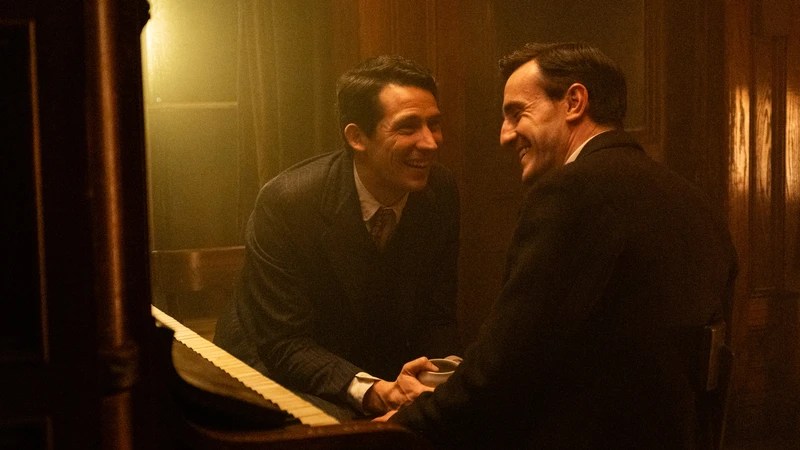
It’s the early 20th Century in rural Kentucky. Lionel (Paul Mescal) likes listening to his father sing while he plays the fiddle. Music for him is different from most folks: he has synesthesia. This means each musical note has a distinct colour, flavour and meaning. Eventually his love of music and beautiful voice wins him a full scholarship to the New England Conservatory of Music. At a Boston pub one night, he recognizes a song his father used to play, coming from a young man at the piano.  David (Josh O’Connor) knows every word. As an ethnomusicologist, he wants to collect as many distinct folk songs and ballads as he can, before they are lost forever. David has perfect pitch and a photographic memory. The two trade songs they know, and somehow, end up in bed together that night. That chance encounter turns into regular trysts at David’s apartment.

Later he invites Lionel to join him in a fieldwork project. They roam across the state of Maine, recording songs everywhere from logging camps to schoolhouses, And they record it all on wax cylinders (this is before flat discs are invented) carefully stored in a leather satchel. And each night they sleep together in a tiny tent. Is this true love? And what will happen to their relationship after the project is finished?

The History of Sound is a touching, bittersweet gay romance — before the word gay existed — set within the larger context of war and music. It’s directed by South African filmmaker Oliver Hermanus (Moffie) and its based on a short story by Ben Shattuck. I wonder if the characters are modelled on Alan Lomax, the ethnomusicologist who recorded thousands of songs and started the folk music revival in the 1950s. Paul Mescal is spot-on as the sensitive kid in a clapboard shack who grows up to be a cosmopolitan musician; as is Josh O’Connor’s  portrayal of an enigmatic musical genius with hidden secrets. The images are as lovely as the music in this tender and moving film.

I really liked it.

Him

Co-Wri/Dir: Justin Tipping

It’s San Antonio, Texas, and their NFL team, the Saviours, is looking for a new quarterback to replace their MVP Isaiah White (Marlon Wayans), due to retire in a year. Cameron Cade (Tyriq Withers) is a young quarterback who lives for football — his father trained him for this since he was a little kid. When he’s offered the position if he agrees to an intense one-on-one, bootcamp with his idol Isaiah White, of course he says yes; this is the fulfillment of all his dream. Thing is, he recently had a serious injury that left him with a bad concussion and a track of staples in his head. If he aggravates his brain, it might end his football career before it starts. But as his father always told him, No Pain, No Gain. Cameron heads out to the training camp in the desert. 

There he encounters absolute luxury: gourmet food and priceless art in a spacious brutalist palace. There are saunas and ice baths, and daily blood transfusions for Isaiah. Cameron too tastes this luxury — and sexual temptations — offered by Isaiah’s entourage, especially the grotesquely made-up wife Elsie White (Julia Fox), an influencer who sells her own line of sex toys. Isaiah is the GOAT — the Greatest of All Time — and his virulent fans wear goat horns on their heads. Cameron, on the other hand, holds onto silver cross. He’s given a series of Squid-Game-like ordeals he must endure before Isaiah gives him the nod. And as the tasks grow increasingly horrific, his morals are severely challenged. Can he pass the tests? And is he ready to give up his innate morality and embrace pro-sports and all it offers?

Him is a psychological thriller about a young man confronting his hero (who is also his nemesis) even as he uncovers the dark underbelly of pro football. It’s produced by Jordan Peele, so you might expect a suspense/thriller with mind-blowing surprises. If so, you’ll be sorely disappointed. What you’ll get instead is more like a highly-stylized, extended music video than a horror film. There’s lots of dazzle and flash — and an equal amount of blood — but it’s never scary or surprising. And director Tipping uses film techniques like a kid playing with toys. Why are people shown in in infrared X-rays? Why a long fashion shot sequence in what’s supposed to be a scary scene? Why do cowboy-hatted cheerleaders continue dancing in the face of horrific deaths? There are some great visual cues — like the aluminium stitches in his skull evoking the side of a football — but it’s all show, no substance in this cheap morality play. 

Him is fun to look at, but there’s nothing there.

EPIC: Elvis Presley in Concert

Dir: Baz Luhrmann

It’s the 1950s. Elvis is the King of Rock and Roll with a series of hits and the nation goes wild over his thrusting pelvis and his soulful voice.  Later, he is drafted into the army where he serves two years. Afterwards he turns to Hollywood where hue churns out a series of hits alongside sex goddesses like Ann-Margaret. And late in the 1960s he signs a multi-year contract to perform before sold-out audiences at a Las Vegas Casino. He’s up there every day, dressed in eggshell blue jumpsuits, covered in silver studs, sequins and spangles, joking with the crowds, and sweating buckets. He is accompanied by a retinue of back up singers, musicians and elaborate lighting. And that is basically how Elvis spends the rest of his life, until he collapses and dies in  Graceland, age 42.

EPIC: Elvis Presley in Concert is a combination documentary and musical performance. Just two years ago, we had both Baz Lurhmann’s biopic Elvis and Sofia Coppola’s Priscilla, two similar stories told from different points of view, neither of which were particularly good. And now, out of nowhere comes this  third one. I’m not an Elvis fan, nor do I like the kitschy

Buzz Luhrmann at EPIC’s world premiere at TIFF50: Photo (c) Jeff Harris

and gaudy films of Baz Luhrmann. Which is why I’m shocked at how much I enjoyed this movie (I saw it on an IMAX screen at TIFF last week, almost by accident.) Ostensibly just a musical record it’s actually a succinct and tight history of the man, so much better than those bloated biopics. 

It’s fantastic, a masterpiece of creative editing, colour restoration and music mixing. It’s absolutely stunning. The songs he sings are mainly hits from the 1960s cover-versions of Bridge Over Troubled Water, You’ve lost that Loving Feeling, and even gospel songs. And over the course of a single song, we see him on stage, in rehearsal, or in the recording studio, shot over many years, but without a break in the music. And despite Luhrmann’s gaudy excess, somehow his capture of Elvis in a psychedelic shirt or sparkling gold belt buckles just looks right. 

EPIC is the perfect concert film.

Him and The History of Music both open this weekend in Toronto; check your local listings;  EPIC: Elvis Presley In Concert played at TIFF and will be released soon.

This is Daniel Garber at the Movies, each Saturday morning, on CIUT 89.5 FM and on my website culturalmining.com.

Precarious relationships. Films reviewed: Lurker, The Roses, Splitsville

Posted in comedy, Family, Friendship, Psychological Thriller, Sex by CulturalMining.com on August 30, 2025

Hi, this is Daniel Garber at the Movies for culturalmining.com and CIUT 89.5 FM.

Some couples are made in heaven. Others seem like accidents waiting to happen. This week, I’m looking at three new movies about strained relationships. There’s a power couple whose marriage has lost its strength; a pair of couples whose open marriages are closing up fast; and a Stan who wants to be closer to his idol.

Lurker
Wri/Dir: Alex Russell

Matthew (Théodore Pellerin: Genesis, Solo) is a young man who lives with his mom. He likes music, fashion and art, and loves shooting videos using an obsolete camera. He works in an LA clothing store — along with an even younger guy named Jamie (Sunny Suljic: mid90s) — and devotes a lot of his spare time to updating his socials. But his life is changed forever when Oliver (Archie Madekwe) wanders — seemingly at random — into his store.

Matthew seizes the day, and subtly change the music tracks being played to ones he knew would appeal to Oliver. Why? Because Matthew has been stanning him for years — he’s a superfan. And it seems to work: he is invited to hang with Oliver’s entourage in his swank home. He’s insulted and belittled but is gradually accepted into that crowd (and he never tells them he’s a Stan for Oliver). He shoots videos and starts doing crucial work for the band. They become — almost — good friends. He’s in hog heaven. And as he rises up the ladder in his precipitous climb to peripheral stardom, he discretely stabs his rivals — that is, anyone who threatens his newfound status — in the back. He ends up accompanying the band on their trip to London… but he takes one step too far, and once again he is just a normal person. But he has one more trick up his sleeve. Can he work his way back into the sphere of that celebrity? And at what cost?

Lurker is a fascinatingly eerie psychological drama about the rise, fall and rise of an ordinary person within the life of a celebrity. (It’s in the style of classic movies like All About Eve or A Star is Born. But it’s not about someone trying to replace a star, but rather to be closer to the star, a part of his life.) And there’s a non-sexual homoerotic subtext to the whole film as Matthew and Oliver’s power dynamic keeps shifting. Madekwe is an English actor in movies like Midsommer and Saltburn, and Pellerin is a fantastic young Quebecois, in movies by Sophie Dupuis and Xavier Dolan, and they work well together. This is writer-director Alex Russell’s first feature ( he’s best known for TV shows like The Bear) but he clearly has something going here that works.

Lurker is a good (and kinda creepy) movie.

The Roses
Dir: Jay Roach

Ivy and Theo (Olivia Coleman, Benedict Cumberbatch) are a happily married professional couple in northern California. Theo is a prize winning architect, while Ivy is a chef. They met at a business meeting in London where they had impromptu, furtive sex in a walk-in fridge — instant kismet. They left England forever and set up camp in America, to raise their twin kids whom they both love dearly. That was ten years ago.

Theo’s careers has blossomed: he has built his magna opus; a modern nautical museum with a sailboat planted on the roof. Ivy mainly cooks at home but recently opened a sleepy crab shack on the beach. But one evening unexpected gale-force winds drastically alter both their lives. The winds blow down his masterpiece, leaving the glass and wooden building, and his reputation as an architect, in ruins. But that same night a leading food critic braved the storm and ate a meal at her restaurant… and the rave review launches her career.

Soon Theo is taking care of the twins (training them for some athletic prize) while Ivy’s food empire continues to grow. The busier Ivy gets, the more depressed and resentful Theo becomes. Their marriage in tatters, they try counselling and other measures, but nothing seems to work. Can the Roses get back together? Or is their marriage doomed to fail?

The Roses is a remake of the hit 1989 film The War of the Roses, a dark comedy about the tooth-and-nail fight over a house by a divorcing couple. This version leaves out the war, and concentrates more on the laughs. Unfortunately it’s not very funny. There’s a bunch of Saturday Night Live veterans (Kate McKinnon, Andy Samberg), and famous comic actors (like Jamie Demetrioum, Zoe Chao, and Sunita Mani) who read their lines before the camera, but they’re extremely unfunny. I love Olivia Coleman (The Favourite, The Lost Daughter, Mothering Sunday,  Empire of Light) and usually like Benedict Cumberbatch ((Doctor Strange, Spiderman, The Power of the Dog) but their usual dry, caustic wit is not evident here. And any War of these Roses is left until the final 15 minutes.

The Roses isn’t terrible, but it’s not very good, either.

Splitsville
Dir: Michael Angelo Covino

Carey and Paul (Kyle Marvin, Michael Angelo Covino) have been best friends since they were kids. Carey’s scruffy, messy but always sympathetic; he works as a teacher in a private school. Paul is a hotshot real estate dealer, putting together huge ventures in Manhattan. They both “married up”, ordinary guys with beautiful women. Carey’s partner Ashley (Adria Arjona) is a counsellor, and a firecracker in bed. They’ve only been together a short time. Julie (Dakota Johnson) is a professional potter who looks like a model. She and Paul have been married for awhile, and have a rambunctious son to show for it. Carey and Ashley are on their way to visit Paul and Julie in their lakeside villa for a summer vacation, when a chain of events changes their lives. Ashley performs a sexual act on Carey as he’s driving the car, but it’s witnessed by another car driving past, leading to a major accident, death, and Ashley wanting a divorce. (Hence the title Splitsville.) Carey arrives at Paul and Julie’s a complete mess. They comfort Carey and tel him they have an open marriage. And when Paul drives back to the city, Carey sleeps with Julie since it doesn’t matter anyway. But it does matter, which leads to a major dustup between the best friends. And puts Paul and Julie’s marriage into question. Can either couple get back together? Can Carey and Paul’s friendship be repaired? And who will end up with whom?

Splitsville is a cute sex-comedy about relationships. Apparently Covino and Marvin, the actors and co-writers, are friends in real life, which comes through both in their patter and their physical interactions; you get the feeling they’ve been having no-holds-barred punch-outs and wrestling matches since they were toddlers. Some of the scenes are totally original — like when Carey is trying to hold onto a bunch of goldfish in plastic bags while on a roller coaster ride. And there are novel situations, too: Carey decides to continue to live with Ashley after they split up, and he takes pains to make friends with each guy she sleeps with, so all the guys end up sticking around in their tiny apartment. There are lots of amusing scenes that make you chuckle, but it rarely makes you laugh. And way too many dick jokes (including a lot of visual ones).

Splitsville may not be the best date movie, but it’s not bad, ether.

Splitsville, Lurker and The Roses all open this weekend in Toronto; check your local listings. This is Daniel Garber at the Movies, each Saturday morning, on CIUT 89.5 FM and on my website culturalmining.com.

Dangerous jobs? Movies reviewed: Love Hurts, Dark Nuns, Bring Them Down

Posted in Action, Farming, Ireland, Korea, Nun, Organized Crime, Religion, Romantic Comedy, Vengeance by CulturalMining.com on February 8, 2025

Hi, this is Daniel Garber at the Movies for culturalmining.com and CIUT 89.5 FM.

Look at Me, a movie from Nova Scotia about an insecure, bisexual actor with an eating disorder, is finally opening in Toronto! In a review about year ago, I called it a “scathing — and humorous — self-examination that exposes Taylor Olsen’s innermost thoughts and fears.” Check it out.

But this week, I’m looking at three new movies (two by first-time directors) from around the world. They’re all about people who work at peaceful and innocuous jobs who encounter danger and even death. There’s a Catholic nun in South Korea, a real estate agent in Milwaukee, Wisconsin, and a sheep farmer in rural Ireland.

Dark Nuns

Dir: Hyeok-jae Kwon

Somewhere in Korea, a teenaged boy named Hae-Jun (Moon Woo-jin) is suffering from a serious illness. The doctors are baffled by his condition; nothing they try is working. But Sister Giunia (Song Hye-kyo) a Catholic nun, identifies the problem immediately: the boy is possessed. You see, Sister Giunia is a Dark Nun, a woman born with indigenous shamanistic powers. She can hear what demons say. And this boy needs a full-blown exorcism. But she can’t do it alone.

She turns to Sister Michela (Jeon Yeo-been), a much younger nun, for help. A Dark Nun like herself, Michela is adept at reading tarot cards, and can use her powers to see vision,  and manifestations of evil. But she is a nun now, and a nurse. She said goodbye to all that mumbo-jumbo years ago, and, besides it’s expressly forbidden by the Church — especially Father Paolo (Lee Jin-wook). He may be a scholar of exorcism, but he doesn’t believe in it. But Giunia is convinced the boy will die unless they intervene. Can she get sister Michela to come aboard? Will the church ever let them do it? And can two nuns and a  stammering shaman defeat Satan himself?

Dark Nuns is a pretty typical exorcism/horror movie but with a twist: It incorporates Buddhism and Shamanism within a Catholic ritual. There are a lot of quirks in this movie. Like why do all the Korean priests and nuns have Italian names, like Paolo, and Michela? Are they Ninja Turtles? And the exorcism seemed way off: heavy on the holy water — she pours gallon after gallon of it on the kid! — but awfully light on bibles, crosses or rosary beads. Then there’s the biggest problem of all: it’s a horror movie, but it just isn’t scary. What’s good about this movie? I like the way it compares Korean patriarchal neo-Confucianism with a Catholic Church keeping women out of positions of power. I’m intrigued by the culture-clash of Christianity meets Shamanism. But if you’re looking for a Korean horror movie about shamans and possession, you should watch last year’s Exhuma, instead.

Love Hurts

Dir: Jonathan Eusebio

It’s Valentine’s Day in the suburbs of Milwaukee, and  Marvin Gable (Ke Huy Quan) is busy baking heart-shaped cookies. No, he’s not in love or in a relationship; all his efforts are focussed on his career as a real estate agent. And he considers all his clients as his friends. But everything changes when a valentine’s day letter appears on his desk. Rose (Ariana DeBose) is back in town. You see, before he went straight, he used to be a killer employed by his older brother Knuckles (Daniel Wu) who is a powerful local gangster. And killing Rose was his last job. The thing is, he didn’t kill her and now everyone wants to have a word to Marvin Gable. There’s the poet-assassin Raven (Mustafa Shakir) along with a slew of other killers, with weird names like King, Otis Merlo and Kippy. Can he dodge the bullets and kill the killers, without harming all the clients trying to buy his houses? Or will he be dragged back into a dark world he thought he had left far behind?

Love Hurts is an action movie about people trying to kill each other. Despite the extreme violence it’s told a light and somewhat humorous manner. Unfortunately, it’s also tedious and predictable. The dialogue is dumb, the plot is basically non-existent. (There is also a rom-com sub-plot, with various characters falling in love with their respective crushes, but that seems like an afterthought more than part of the story.) So what’s good about it? Two things. Jonathan Eusebio is obviously a first-time director, but what he is not  new at is fight scenes. He’s a highly experienced fight choreographer, and luckily most of the movie consists of creative takes on people throwing knives and kicks as they destroy the interiors of houses and video stores. This I like. First time I’ve ever witnessed a killing using a bubble tea straw. And the cast is appealing too. It’s nice to see Ke Huy Quan back again after his big comeback in Everything, Everywhere, All at Once. He’s funny! So are Ariana DeBose, Lio Tipton, Sean Astin and Drew Scott… the whole crew.

Is this a good movie? Not really, but it’s very light, easy to watch, and the fight scenes are well-done. 

Bring Them Down

Wri/Dir: Chris Andrews

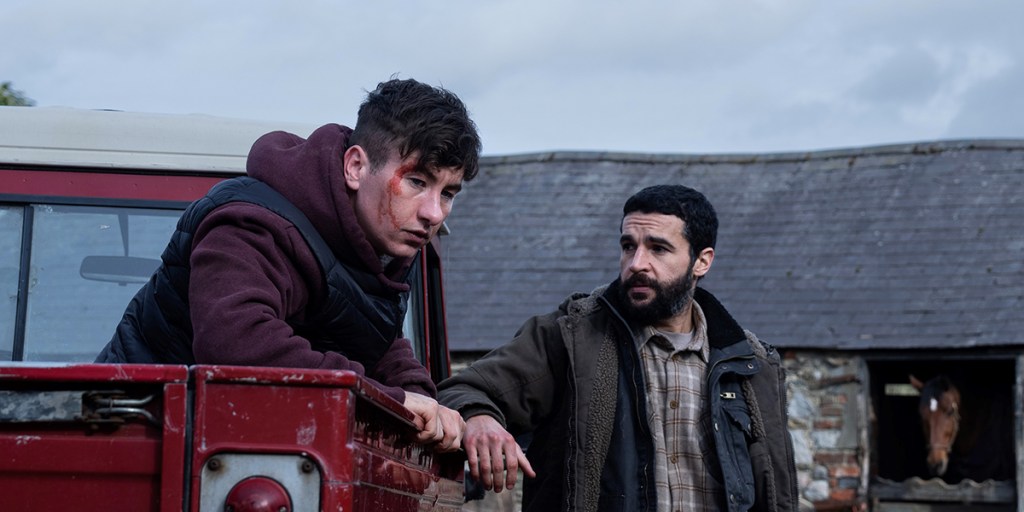
It’s rural Ireland in the present day. Michael (Christopher Abbott) runs a one-man sheep farm, where prize-winning rams graze on rocky hillsides. His abusive dad Ray (Colm Meaney) sits in the kitchen all day shouting angry epithets in Irish at Michael about all the things he’s doing wrong. In the next sheep farm over, young Jack Keeley (Barry Keoghan) does much the same as Michael but not very well. His dad Gary (Paul Ready)  — who is Michael’s age — tries to keep things going but the farm is bleeding money. Gary is married to Caroline (Nora-Jane Noone), Michael’s ex, and Jack can see his parents are not getting along. Michael hasn’t seen her for 20 years, ever since a car accident killed his mother and sent Caroline to hospital with serious injuries (The accident was Michael’s fault).

But their relatively bucolic lives are interrupted when two rams disappear from Michael’s flock. And there’s only one place they can go — to the Keeley farm just over the hill. But Jack claims they both suddenly died and he threw their bodies into a pit…a very unlikely story. This signals the start of a feud between the two families, involving simmering grudges, sheep poachers, and organized crime. Can their conflicts ever be resolved? Or are both farms headed for ruin, violence and possibly even death?

Bring Them Down is a violent, suspenseful drama about escalating grudges between two houses. It’s done in that chop-up style popular among some European arthouse directors where the narrative is not told chronologically. Your perception of “who is to blame for what” gradually shifts as new scenes fill in the blanks. I liked the acting and the dialogue — half of which is in Irish — and it has a compelling plot. The settings are just beautiful, with wide panoramic views of hillsides at dusk and dawn, and images like Michael carrying a lame sheep draped over his shoulders. There are also some strikingly original tableaux like the sheep at an auction house. This is a good first film — it reminds me of Frozen River and Winter’s Bone, all serious looks at crime in rural settings. But why are all these movies about brooding Irish men so depressing? What miserable lives these people seem to lead! If there were a bit of humour or love, Bring them Down would have been a lot easier to take.

But it’s still a good movie, anyway.

Dark Nuns, Love Hurts, and Bring them Down are all opening this weekend in Toronto; check your local listings. This is Daniel Garber at the Movies, each Saturday morning, on CIUT 89.5 FM and on my website culturalmining.com.

Tough Cookies. Films reviewed: Maria, Flow, The G

Posted in 1950s, 1960s, 1970s, Animals, Animation, Corruption, Crime, France, Latvia, Opera, Vengeance, Women by CulturalMining.com on November 30, 2024

Hi, this is Daniel Garber at the Movies for culturalmining.com and CIUT 89.5 FM.

With a rapidly aging population, the traditional image of frightened, little-old cat ladies is gradually shifting to one of strength and cunning. Witness new TV shows like Matlock. So this week I’m looking at two new movies about tough older women and one about a cat. There’s an opera diva in Paris preparing her swan song; a rustbelt widow who wants to go out with a bang; and a cat on a sailboat in a world covered in water.

Maria

Dir: Pablo Larraín (Reviews: Spencer, The Club)

It’s 1977 in Paris, and Maria Callas (Angelina Jolie: Salt, The Tourist, Unbroken) — one of the greatest divas in opera history, is not doing well. She rarely eats, often never leaving the bedroom of her palatial apartments for days at a time. She rarely speaks with anyone anymore, aside from her servants. She runs her butler ragged (Pierfrancesco Favino: The Hummingbird, in a red monkey suit) and she relies on her cook (Alba Rohrwacher: Sworn Virgin, Hungry Hearts, The Ties/Lucci ) for judgement on the quality of her vocal chords. 

But she’s not completely alone. She is seeing a pianist for his unvarnished opinion on whether her legendary “voice” has returned. And has agreed to an unheard-of interview with a young journalist named Mandrax (Kodi Smit-McPhee: The Road, The Congress, The Power of the Dog, Memoir of a Snail). But Maria faces a number of problems. She refuses to see a doctor, despite her rapidly declining health, and she won’t stop popping Quaaludes, leading to frequent hallucinations and delusions. Can her devoted servants save her life? Or is this the end?

Maria is a biopic about the death of a legendary Greek-American diva. The movie begins with her demise at age 53, then goes back in time to show what led up to it. This includes flashbacks to her chubby adolescence in German-occupied Athens in WWII, her failed marriage, and at the peak of career, including trysts with Aristotle  Onassis and JFK. 

But is this biopic any good? I have very mixed feelings about that. I love the beautifully shot interiors, the ostentatious costumes and the amazing arias provided by recordings of Callas herself. Italian actors Rohrwacher and Favino provide wonderfully painful performances. And, as the latest in a series of films about famous woman by Chilean director Pablo Larraín it has good pedigree, especially Spencer (with Kristen Stewart as Princess Diana). But this movie depends on Angeline Jolie, and she doesn’t carry it off. She always seems to be acting. I don’t see Maria Callas here, I see Jolie posing for the camera, with  a haughty face here and a dramatic gestures there; so you rapidly lose sympathy with the main character. Perhaps Maria Callas really did act like that, even behind closed doors, but Jolie plays her somewhere between high camp and kitsch. 

Maria is never boring… just a bit embarrassing. 

Flow

Co-Wri/Dir: Gints Zilbalodis

It’s some time in the future, somewhere in the world. A small grey cat with golden eyes and pointy ears is enjoying a walk in the woods. The cat lives by an abandoned old house surrounded by enormous cat statues. The cat is very shy, and fears, most of all, a pack of feral dogs. Suddenly, there’s a stampede of animals running in one direction, full speed. They‘re trying to avoid a massive flood, sweeping away everything in its path. But cat and a friendly, white dog are among its victims. Survival instinct kicks in and eventually cat manages to climb on board a tattered sailboat. There Cat discovers a gentle, sloth-like capybara already on board. Other animals make their way onto the sailboat, including an ingenious lemur, that big, white dog and a majestic-looking phoenix. Together they form an uneasy friendship as they brave a dangerous water-covered world. But can they learn to get along? And is this world worth living in?

Flow is a brilliantly animated film about a picaresque journey by a mismatched troupe of animals. It’s tender, heart moving and lovely to watch. It’s all about friendship and cooperation learned by animals living in a gently hostile world. And though they behave a tiny bit like humans, there are no people in the story, and no dialogue either; just grunts meows and barks. Dogs still want to fetch. Cats want to catch fish.  

And though it’s post-apocalyptic, there is nothing futuristic in this film; human technology is limited to abandoned ancient cities, glass bottles and sailboats; no cars or smartphones to be seen. The science fiction comes in with its universality, where animals from different continents, along with mythical beasts like sea monsters, can randomly encounter and learn from one another. I just watched Flow, and I already want to see it again.

Flow is Latvia’s Oscar submission for Best International Feature.

The G

Wri/Dir: Karl R. Hearne

It’s a rust-belt city somewhere in North America. Ann Hunter (Dale Dickey) is a tough cookie in her 70s, who is feeling depressed. You can see it  in every wrinkle on her face. She lives with her ailing husband in their fully-owned condo. He was once a tough guy, but is rapidly sliding into immobility and dementia. She grudgingly takes care of him, and drowns her sorrows in rot-gut alcohol straight from the bottle. Aside from him, she only spends time with Emma, step-granddaughter (Romane Denis). Emma models her life on The G (as she calls her grandmother) someone who doesn’t take crap from anyone. The G also helps her out financially, and doles out hardboiled words of wisdom.

But everything changes when a man in a suit  named Rivera (Bruce Ramsay), out of the blue, breaks down The G’s front door, accompanied by two toughs:  Matt (Joey Scarpellino), a handsome but simple-minded gardener; and Ralph, a psychopath with bleach blond hair (Jonathan Koensgen). Together they violently shove Ann and her husband into a van, who wind up locked in a threadbare room without a phone, in a nursing home that feels more like a prison. This is your new home, Rivera says, and there’s nothing you can do to stop me. He’s now their legal guardian and has the documents to prove it; their doctor (a silent partner in the scam) has declared them both incompetent. No one’s allowed to go in or out for the first month. He roughs up her husband to try to find the proverbial pot of gold he thinks they’re hiding. But they underestimate the G, her stubbornness, and her shady connections back in Texas.

Meanwhile, Emma is shocked when she discovers her grandparents have suddenly disappeared, leaving behind just a torn-up home. She scours the city to find them, and makes friends with a caretaker who works at the home (who also happens to be Matt, the friendly thug). It’s too late to save her grandpa but she vows to get the G out of there. And even while Emma is trying to free her, the G has vowed vengeance on all her enemies — and she’s not messing around. Who can they trust? Can two women best a criminal organization? Or will they end up buried alive? 

The G is a great revenge thriller about the very real phenomenon of organized criminals attacking and abusing the elderly. It’s dark and disturbing. Dale Dickey blows this movie out of the water, supported by a good Quebecois cast. (It’s shot in Montreal). If you’re looking for a gratifyingly violent revenge flic, this is the one to see.

Maria and Flow are now playing at the TIFF Lightbox, with Maria streaming on MUBI on December 11th; and The G is opening across Canada; check your local listings.

This is Daniel Garber at the Movies, each Saturday morning, on CIUT 89.5 FM and on my website culturalmining.com.

Journeys. Films reviewed: The Fabulous Four, Doubles, Crossing

Posted in Canada, Friendship, Georgia, Migrants, Sex Trade, Trans, Turkey, Women by CulturalMining.com on July 27, 2024

Hi, this is Daniel Garber at the Movies for culturalmining.com and CIUT 89.5 FM.

Picture this: you’re watching a big-screen movie with your friends, but you’re sitting on the grass, not in a theatre. Huh? The Toronto Outdoor Picture Show (TOPS) lets you watch really great movies for free under the stars in parks across the city, in Fort York, the Corktown Commons, The Christie Pits and Bell Manor Park. Featured movies include Wim Wenders’ Perfect Days, Boots Riley’s Sorry to Bother You, and Stephen Soderbergh’s Out of Sight, to name just three. And there’s the Toronto Palestine Film Fest, showing a free film on August 9th at the Christie Pits — with music, food and items for sale by local artisans followed by an outdoor screening of Alam, The Flag, directed by Firas Khoury.

But this week, I’m looking at three new movies about journeys. We’ve got four old college friends heading to Key West for a wedding, a Trinidadian flying to Toronto in search of his long-gone father; and a retired woman with a teenaged boy in Georgia going to Istanbul in search of a missing girl.

The Fabulous Four

Dir: Jocelyn Moorhouse

Marilyn, Lou, Alice and Kitty, are friends from university, who have stayed close — though separate — for over half a century. Now they are back together again, face to face in quaint Key West, Florida. Marilyn (Bette Midler) a flamboyant homemaker, is getting remarried there;  her long-time husband died just a few months earlier. Her adult daughter is opting out; she thinks it’s too soon. Lou (Susan Sarandon), never married, who has devoted her life instead to her career as an accomplished surgeon. She’s earnest, stubborn and moralistic. When she’s not at the hospital, she’s probably playing with her beloved cats or reading a novel by Hemingway. Kitty (Sheryl Lee Ralph) is a successful cannabis grower and manufacturer, known for her powerful edibles. But she’s had a falling out with her daughter who joined a religious sect that strictly forbids sex, drugs and rock’n’roll. She wants Kitty to move into an old-age home. Finally, Alice (Megan Mullally), a successful recording artist, is an unapologetically free spirit. Like Lou, she never married, but unlike the uptight surgeon, Alice will bed any man she fancies — or as her friends describe her, she’s a postmenopausal wolf in heat. But there is tension among the four. Marilyn and Lou have been feuding since they were roommates in a Manhattan apartment after graduating. Kitty and Alice had to trick Lou into coming — she doesn’t even know about Marilyn’s wedding. 

But things get better after a few days in Key West. The formerly sullen Lou is glowing now after a random encounter with a local bar owner named Ted (Bruce Greenwood). And the four of them have fun on boat rides, paragliding and exploring the restaurants and bars. But tension still remains between Marilyn and Lou, that threaten the wedding itself. What is their fight about? Why has it lasted so long? And can it be resolved?

The Fabulous Four is a comedy about a reunion of four aging women who get together for their last big blast. It’s goofy and a bit campy. The plot is paint-by-numbers with very few surprises. The drunk or stoned jokes are tired, but there are a few funny bits: like Lou taking down a bicycle thief using a sex toy. But it gets bogged down with predictable, age-related gags about incontinence and old people not knowing what TikTok is. So lots of eyerolling and a bit of cringiness, but luckily no  extreme humiliation. And I was never bored — how could I be, with Susan Sarandon and Bette Midler in the same movie? It’s written and directed by women, which might explain why there was more niceness and less outrageousness than your average teen comedy.

Doubles

Wri/Dir: Ian Harnarine 

Dhani (Sanjiv Boodhu) operates a doubles stand with his mother in Trinidad. (Doubles are snacks made of curried chana between two pieces of soft yellow fried bread.) Times are hard, and they really need more money. But their property is all in his dad’s name. He moved to Canada many years ago to advance his career, and never came back. Now he’s a rich man, a successful chef who owns a fancy restaurant and a big house, while his family back home is still struggling to get by. So Dhani buys a ticket and flies to Toronto for a week to work out the financials. But his mother stresses, don’t be like your father — he’s probably living with some other woman. Come right back.

But when he arrives on a cold winter day, he discovers it’s nothing like he expected. He visits his father, Ragbir (Errol Sitahal) at his Caribbean restaurant.  Turns out he’s not the chef, he’s the dishwasher. He lives in a small house without any luxuries. And he meets Anita (Rashaana Cumberbatch) a greeter at the restaurant. She calls him her brother from another mother — a half sister he never knew about. And the biggest surprise: Ragbir is dying of cancer and needs a bone-marrow donor to save his life. Can Dhani accept his father’s unexpected condition? And is he willing to donate the needed bone marrow?

Doubles is a poignant drama about father-son relationships and the immigrant experience. It’s a rough story, harrowing at parts, especially as the father’s health declines (in a great portrayal by Errol Sitahal.) Visually, I found the movie very drab and plain looking — the locations, people, places — in both Trinidad and Toronto. I assume that’s intentional, but it amounts to the opposite of eye candy. At the same time, the characters and story seem sad but real, and it’s the first time I’ve seen Trinidadians explicitly portrayed in a Canadian movie before. And — no spoilers — despite the heavy topics, the film does close on a happier note. And it’s being released theatrically just in time for Caribana!

Crossing

Wri/Dir: Levan Akin

Achi (Lucas Kankava) is a young layabout in a beachside house by the Black Sea in Georgia, not far from the Turkish border. He lives with his abusive brother, his sister-in-law and their crying baby. He wants to move somewhere far away but he’s unemployed and flat broke. Ms. Lia (Mzia Arabuli) is a dignified, retired school teacher from the same village. She’s looking for her beloved niece, Tekla. She hasn’t seen her in many years, but is knocking on doors to find her, and apologize for something she did way back when. His brother claims he’s never heard of her, but Achi jumps at the chance to talk with Ms Lia. He says he remembers Tekla, a transwoman who lived in the place a few doors down. But she moved to Istanbul and gave him her address before she left. He offers to take her there and even do a bit of translating. With some reservations, she agrees, and buys their tickets. When they arrive they are both impressed by the city’s grandeur and beauty. And with the help of two street urchins, he finds the place in the red light district she’s supposed to be working at. But she’s not there, and no one has heard of her. Lia becomes increasingly anxious about locating Tekla, even as friction builds between Lia and Achi as he looks for ways to live in the new city and earn a living.

At the same time all this is going on, Evrim, a young woman (Deniz Dumanli) is following her own path. She works at a social welfare NGO called Pink Life, where she helps needy LGBT and other people in that area. She’s also passing through the byzantine legal process of transitioning her gender. As a transwoman, she is often harassed as a sex worker, but she’s actually an accredited lawyer, one of the few people who know how to confront the police when they overstep their bounds. 

Lia and Achi eventually meet up with Evrim to try to locate Tekla. What will Lia do if she finds her? Will Achi stay in Istanbul if Lia returns to Georgia? And what about Evrim?

Crossing is an amazing adventure and drama following the lives of an unusual group of people navigating their way through the underbelly of of Istanbul’s culture. It’s a coming of age film about kinship and discovery. Great acting, beautiful cinematography and an excellent script. We get to see their encounters with the people they meet — Evrim on the street, Achi in a nightclub, and Lia in the night market. The characters are fascinating and multifaceted, revealing their hidden histories as the story progresses. At the same time, it’s a total tearjerker, with a number of deeply-moving scenes. 

Interestingly, Crossing is only the second Georgian movie I’ve ever seen, and — surprise! — its by the same filmmaker, Swedish-born Georgian director Levan Akin (And Then We Danced).

I strongly recommend this movie.

The Fabulous Four and Doubles open in Toronto this weekend with Crossing playing at the TIFF Lightbox; check your local listings. This is Daniel Garber at the Movies, each Saturday morning, on CIUT 89.5 FM and on my website www.culturalmining.com.

Films reviewed: Orlando: My Political Biography, Fallen Leaves

Posted in 1600s, 1700s, 1800s, 1900s, Finland, France, LGBT, Noir, Politics, Romantic Comedy, Trans by CulturalMining.com on November 25, 2023

Hi, this is Daniel Garber at the Movies for culturalmining.com and CIUT 89.5 FM.

Toronto’s Fall film festival season continues in December with the Jayu Human Rights film festival showing insightful documentaries on pertinent issues, along with a slam poetry competition at the Ace Hotel.

But this week, I’m looking at two new European movies that played at TIFF this year and are now in cinemas. There are trans shape-shifters in France and lonely job-seekers in Finland.

Orlando: My Political Biography

Wri/Dir: Paul B. Preciado

It’s 17th century, Elizabethan England. Orlando is a teenaged boy, a handsome courtier in the Queen’s castle. He’s also an aspiring writer, waxing lyrical on oak trees and winter frosts. He falls in love with Sasha, a blonde, Russian aristocrat. But at the age of 30, he wakes from a deep sleep transformed into a woman. Orlando’s life takes her (and him) through various guises over hundreds of years, to capitals as far away as Constantinople, until finally returning by ship to 20th century London, where they finally complete and publish their book. Such is the “biography” of Orlando in Virginia Woolf’s famous novel. So what’s different about this film?

For one thing, the entire cast is trans or non-binary, as is Preciado, the director. And the cast is huge. Each version of Orlando is played by another actor, their sex, gender and sexuality presented in a myriad of ways.  Orlando is plural in this incarnation.  Not just that, Orlando’s race, colour and language also shifts, with the actors ages ranging from small children to the elderly. Some characters wear chainmail like Joan of Arc, while others recline, luxuriantly,  in an Ottoman seraglio. The one common factor is their Elizabethan white neck ruffs, the fashion of the day.

Orlando, My Political Biography is not the first film version of the novel — far from it.  It seems to attract the most experimental and avant garde filmmakers out there.  German director Ulrike Ottinger made Freak Orlando in 1981 which entirely rejects the conventions of both narrative and art movies. English director Sally Potter (see: The Roads Not Taken, The Party,  Ginger and Rosa)’s Orlando of 1992 starred Tilda Swinton as the various Orlandos and featured Jimmy Sommerville singing up in a tree.

But this French political biography adopts Bertolt Brecht’s (and Jean-Luc Godard’s) method of deliberately alienating the audience to promote a political stand. Each Orlando introduces their scene by announcing directly to the camera their real /adopted name and personal history, followed by their Orlando passage, often reading directly from a copy of Woolf’s book. But it remains engaging because of the beauty of the photography and costumes and the sincerity of the players in the film. Settings vary from deliberately artificial backdrops to an exquisite forest and a grotesque Parisian catacomb.

The political stance is complex, and involves a rejection of the accepted binary. Some take issue with psychiatrists, surgeons and pharmacists having control of their identities and bodies. Says one young Orlando: you must hate your genitals if you want the doctor to give you hormones… but I don’t hate my genitals. Says another: I adopted a ridiculous caricature of masculinity for a year after transitioning before realizing I shouldn’t erase my personal history just because I’m trans.

Orlando, My Political Biography is equal parts intellectual lecture, political diatribe, performance art, and cinematic experiment, and, most surprisingly… it works.

Fallen Leaves

Wri/Dir: Aki Kaurismaki

It’s typical day in Helsinki, Finland. 

Ansa (Alma Pöysti), a single woman in her thirties, works at a low-paying job in a supermarket. She lives in a small apartment and subsists on frozen microwave dinners. She likes listening to relaxing music, but her bakelite radio only plays bad news from the Ukrainian war these days. She does go out occasionally to a local karaoke bar, with her best friend Liisa (Nuppu Koivu). There she encounters — but doesn’t actually meet — Holappa (Jussi Vatanen). Holappa is a depressed guy who works as a welder at a small factory. He lives in the company dorm, along with acquaintances and his best friend and confident Huotari (Janne Hyytiäinen). He handles his depression with constant drinking, which only gets him more depressed. After a few near misses they finally meet face to face. Their first date? A zombie movie at a local rep cinema. Sparks fly and they vow to meet again soon. But various unfortunate coincidences seem destined to keep these soulmates far apart. Can they ever find happiness together? Or is this a relationship that can never happen?

Fallen Leaves is a tragicomic proletarian love story par excellence. Its also a deadpan comedy, which despite it’s nearly tragic atmosphere, will have you laughing and crying all the way through. If you’ve ever seen an Aki Kaurismaki  movie before you’ll instantly recognize his style: seedy bars, bearded bikers, dark rock n roll, and a noir-ish, retro feel. Similar to Jim Jarmusch, but much funnier. It also deals with real-life issues like alcoholism and poverty. Ansa loses her job for taking home an expired cookie instead of throwing it away, while Holappa is driven close to self- destruction by his constant boozing. If you haven’t seen his movies before, Fallen Leaves is a great one to start.

Everything in this film is retro. Finland is the high-tech home of Nokia and Supercell, but in Kaurismaki’s world the characters use avocado coloured landlines,  with cel phones or video games nowhere to be seen. Computers seem relegated to internet cafes. Phone numbers are written on slips of paper, blown away with the wind. Movie theatres only play classics, and every bar is on skid row. 

At the same time, there’s always a niceness and sweetness burbling just below the surface of the humdrum futility of everyday life. Fallen Leaves is a wonderfully depressing movie with a feel-good atmosphere. I love this movie.

Fallen Leaves and Orlando My Political Biography are  both playing now at the TIFF Bell Lightbox, and at other theatres across Canada — check your local listings.

This is Daniel Garber at the Movies, each Saturday morning, on CIUT 89.5 FM and on my website culturalmining.com.

Same-sex couples. Films reviewed: Unicorns, Solo, Rotting in the Sun

Posted in Art, Canada, Cross-dressing, Drag, Gay, Montreal, Quebec, Romance, Screwball Comedy, Sex, UK by CulturalMining.com on September 30, 2023

Hi, this is Daniel Garber at the Movies for culturalmining.com and CIUT 89.5 FM.

Fall Film Festival Season in Toronto continues in October with ImagineNative — brilliant films and art by and about indigenous people in Canada and around the world from 17-22; and Planet in Focus,  the International Environmental film festival, with features, docs and talks on nature, activism, and climate change, from the 12-22. 

This week, I’m looking at three new movies about same-sex relationships, two of which played at #TIFF23. There’s a straight mechanic who unwittingly falls for a drag queen in a London pub; a Quebecois drag queen who falls for a French one in a Montreal bar; and a Chilean artist who meets an American influencer on a nude beach in Mexico.

Unicorns

Co-Dir: Sally El Hosaini, James Krishna Floyd

Luke (Ben Hardy) is a mechanic who lives in Essex, near London. He works at his father’s garage, and spends the rest of his time with his 5 year old son. His wife abandoned them when his kid was still a baby, but luckily his dad will babysit if he’s out on a date. For Luke dating usually means furtive sex and one-night stands with women he hooks with online. But one day, after leaving a London curry house, he stumbles into a nearby nightclub, and is riveted by the eyes of a beautiful woman performing an alluring dance on stage. Clearly, the feelings are mutual — Aysha seeks him out afterwards, for a snog and a grope at the stage door. Only afterwards does Luke realize the woman is actually a man in drag. He freaks and leaves. Aysha (Jason Patel) is disappointed — he thought Luke knew they were in a South Asian drag bar. But Luke is straight and almost sickened by what happened.

Still, there is something there. Luke agrees to act as a paid driver (and unpaid bodyguard) for Aysha and her fellow drag queens. They need transportation to get them safely to private “gaysian” (gay+asian) parties on the down low, in places like Manchester. The tips she gets at these parties pays her rent. Gradually, they get to know one another better. When Aysha really hits it off with his son, Luke starts thinking maybe she is just the woman he’s looking for. Problem is, he’s not trans, he’s a man named Afik. Aysha is just his drag name. Will the attraction still be there if Aysha goes away? And can a straight white man and a gay South Asian drag queen form a couple?

Unicorns is a poignant, romantic drama about two people from two sides of a deep divide. And while there is some shocking violence and unexpected plot turns, the filmmakers  keep it real and subtle. This is co-director James Krishna Floyd’s (of mixed heritage) first feature, and does an excellent job of it. Ben Hardy is a well-known heart throb and soap star in the UK, while Jason Patel is a newcomer — this is his first role. Luckily, the two have amazing chemistry and are compelling to watch. 

This is a good first movie.

Solo

Wri/Dir: Sophie Dupuis

Simon (Theodore Pellerin) is the youngest drag artist at a Montreal bar. He’s naive, trusting and sexually inexperienced. He performs elaborate acts dressed in outfits his older sister helps design. And he always looks forward to visiting his Dad, stepmother and sister for Sunday brunch. His mother is an internationally famous  opera star, who left the family for greener pastures when he was a teen. But everything changes when Olivier (Félix Maritaud) a charismatic older guy in his late twenties shows up at the drag bar direct from Paris. Simon is blown away by his sex-centred drag performances, and wants to learn from him. Soon they are an item, in and out of bed, and onstage. Simon will do anything Olivier wants: moving in together, staying away from his family, even how Simon should perform his own acts.

But the concessions all seem to be one-way. Olivier sleeps with other men, insults Simon’s judgement, and plays mental tricks on him. Around this time, Simon hears some shocking news: his mother is coming to Montreal, back from a triumphant tour off Europe. He hasn’t seen her in years, so this will be the crucial reunion Simon has been longing for and waiting for for so long. How will their meeting go? What role will Olivier play? And will she come to watch his Solo drag performance? 

Solo is a moving and tender portrayal — set within Montreal’s drag community — of a young man forced to face his demons and figure out who are his friends and who are his enemies. I know very little about the drag scene (I’ve never seen Rupaul’s Drag Race, for example) but it doesn’t require outside knowledge to understand what the movie’s trying to say. Theodore Pellerin is amazing as Simon, and — though much less sympathetic — so is Félix Maritaud. And for a movie about drag it’s surprisingly devoid of camp. If you’re looking for a tear-jerker with lots of musical performances, you’ll enjoy Solo.

Rotting in the Sun

Dir: Sebastian Silva

Sebastian Silva (Sebastian Silva) is a jaded Chilean artist and filmmaker who lives in an apartment in Mexico. He enjoys reading books about suicide and depression. When he’s not dodging work deadlines or dealing with construction noise in his minimalist apartment, he’s likely walking his dog Chima, doing pop art paintings of giant cartoony penises, or snorting bumps of  pentobarbital. His beleaguered housekeeper Señora Vero (Catalina Saavedra, in a great performance) takes it all in, but never comments.

On the recommendation of a colleague he takes some time off to relax at a gay nude beach in Zicatela, but is non-plussed by all the body parts on display. When he almost drowns there, he meets Jordan Firstman (Jordan Firstman) an instagram influencer. Jordan thinks it’s Kismet — he saw one of Sebastian’s films just the night before, and here they both are washing up on shore. They must collaborate on a production. Sebastian is less enthusiastic, but Jordan insists. But when he arrives at Sebastian’s door in the city, he is nowhere to be seen. Is he ghosting him? Or has something really bad happened to Sebastian? And will Jordan ever solve this mystery?

Rotting in the Sun is a contemporary indie film in the style of a highly-sexualized comedy. It’s equal parts mystery, screwball comedy, and scathing social satire, with a fair amount of nonchalant, explicit sex. Silva reimagines Mexico as an uber-gay paradise, where the local park fountain has a statue of Michelangelo’s David, the beaches are packed with nude men, and every room in his apartment reveals an orgy behind closed doors. This constant decadence is contrasted with the panicky and naive Señora Vero desperately trying to hide Sebastian’s whereabouts. Silva and Firstman play exaggerated versions of themselves, to hilarious effect.

You know the expression “a bag of dicks”? This movie is a dump truck of dicks. But if you don’t mind looking at lots and lots and lots of penises, you’ll get a kick out of this shockingly subversive comedy. 

Unicorns had its world premiere at TIFF;  Solo had its Toronto premiere there and opens this weekend in Toronto; check your local listings. And Rotting in the Sun — along with a selection of other films by Sebastian Silva —  is now streaming on Mubi.

This is Daniel Garber at the Movies, each Saturday morning, on CIUT 89.5 FM and on my website, culturalmining.com.

Exposing secrets. Films reviewed: John Wick: Chapter 4, The Five Devils, Ithaka

Posted in Action, Australia, documentary, Fighting, France, Journalism, LGBT, Magic, Prison, Protest by CulturalMining.com on March 25, 2023

Hi, this is Daniel Garber at the Movies for culturalmining.com and CIUT 89.5 FM.

This week, I’m looking at three new movies — an action film, a mysterious drama, and a documentary— from the US, France and Australia. There’s an assassin battling a secret organization, a little girl sticking her nose into hidden places, and a journalist jailed for bringing secret war crimes into the light. 

John Wick: Chapter 4

Dir: Chad Stahelski

John Wick (Keanu Reeves) is a Belorussian assassin, under the control of a powerful, international cabal known as The High Table. He’s infamous for his relentless killing skills; he can wipe out an entire squadron with a just a pair of nunchucks. Wick wants out, but to do that he needs to be free. So he embarks on a complex series of tasks to complete before the Table frees him. In the meantime, The Marquis (Bill Skarsgård), the head honcho, wants him dead… so he gets Wick’s former best friend and partner to kill him.

Caine (Donnie Yen) is an expert martial arts fighter and shooter who happens to be blind. So Wick turns to another old friend, Shimazu (Sanada Hiroyuki) a hotelier in Osaka. Even though he could lose everything, he still agrees to hide Wick from the Marquis’ agents. Meanwhile, the marquis has put a multimillion dollar mark on Wick’s head, a reward that its steadily rising, letting loose an army of killers out for a quick buck, including a man with a dog known as the tracker (Shamier Anderson). Can Wick survive this army of killers? Or will this be his final showdown?

John Wick: Chapter 4 is nearly three hours of non-stop violence. The characters and storyline is strictly cookie-cutter, but the settings — in New York, Osaka, Paris, Berlin and Jordan — is vast and opulent. Every chamber has cathedral ceilings and gaudy rococo elegance. And the fight choreography is spectacularly orchestrated. The cast — including Laurence Fishburne, Ian McShane and the late Lance Reddick — are fun to watch. No one will call this a great movie, but if you enjoy endless fight scenes with hundreds of extras whether among the writhing bodies of a Berlin nightclub or in a traffic jam around the Arc de Triomphe, John Wick 4 will satisfy.

The Five Devils (Les cinq diables)

Co-Wri/Dir: Léa Mysius

Vicki (Sally Dramé) is a bright young girl who lives in a small village in the French alps. Joanne, her mom (Adèle Exarchopoulos) teaches aqua fitness, while Jimmy, her dad (Moustapha Mbengue) is a fireman. But Vicki has no friends, and is constantly bullied at school, perhaps because she’s mixed-race in a mainly white town (her mom is white, her dad’s from Senegal.)  Vicki has a unique skill no one else knows about: she can identify anything or anyone purely by its scent. If she picks up a leaf she instantly knows what kind of animal bit it, and its size, age, even its feelings.  And she can recognize people at twenty paces, blindfolded, just by their smell. Vicki starts finding things, and like an alchemist, puts them into jars, carefully labelling each one.

But when a surprise visit by her aunt Julia, her father’s sister (Swala Emati), things start to change. There’s something in Julia’s past that has turned the whole village against her. When Vicki discovers how to harness her power of smell to travel, temporarily, back in time, she finds that she may have played a role in Julia’s younger life.  But can she influence what already happened?

The Five Devils is a very cool French mystery/drama with a hint of the supernatural and a sapphic twist. The alps may be majestic but they hide a sinister past, and a stultifyingly provincial and xenophobic culture. This is conveyed in the large, tacky murals and oddly dated architecture that pops up everywhere. The three female leads Exarchopoulos, Dramé and Emati are amazing (with full points on the Bechdel test). Mysius is an accomplished scriptwriter who has worked with such luminaries as Claire Denis and Jacques Audiard. You can tell. And an unexpected twist at the very end will have you leaving the theatre with an extra jolt. 

I like this movie.

Ithaka

Wri/Dir: Ben Lawrence

Twenty years ago this month, US- and British-led forces invades Iraq under the pretence of finding Weapons of Mass Destruction supposedly threatening the west. Nothing is ever found and over 200,000 civilians are killed, 4 million displaced, and the entire middle east thrown into disarray, leading to the rise of fundamentalists like ISIS, unrest and civil war from which, 20 years later, it has yet to recover. In 2010,  army specialistChelsea Manning anonymously releases a huge trove of secret military files to Wikileaks, a website founded specifically to expose things like war crimes and corruption, without endangering news sources and reporters who cover them.

It’s founded by Australian journalist and hactivist Julian Assange. That’s when Wikileaks catches the world’s attention by exposing, on video, the US military gunning down innocent civilians in Iraq in cold blood, including Reuters journalists. None of the perpetrators of these — and countless other war crimes — ever served time, but Manning is arrested and jailed, while Assange is forced to seek refuge in the Ecuador Embassy in London. He is afraid  that travelling to Sweden for questioning will lead to him being extradited to the US. His fears are correct, and he is later jailed in Belmarsh, a maximum security prison in London, awaiting deportation to the US on charges of espionage. He remains there today. 

Ithaka is a  personal and intimate documentary about Assange in jail in London during the trial, and the events that led up to it. Using original interviews and contemporary news reports, it fills in the blanks you may have missed. It also reveals the CIA’s involvement, including plots to murder him. The doc follows two people: John Shipton, Assange’s dad, and Stella Moris, his wife and the mother of their two sons. Shipton is an Australian house builder and peace activist. Moris is the Johannesburg-born daughter of Swedish and Spanish parents who were active in the anti-Apartheid movement. She also serves as his lawyer. Assange is off camera, but his cel phone voice is often present.

For a man like Assange, who has done more to expose government and corporate corruption than almost any other journalist today, to be charged with espionage and threatened with life in prison is a travesty of justice.  His suffering and deterioration in solitary confinement is cruel and unusual punishment. If you want to learn more about him, or to show your support, Ithaka is a good place to start. 

John Wick Chapter 4 and The Five Devils open in Toronto this weekend; check you local listings. Ithaka is now playing at the Hot Docs cinema.

This is Daniel Garber at the Movies, each Saturday morning, on CIUT 89.5 FM and on my website, culturalmining.com.