Broken. Films reviewed: Parthenope, The Unbreakable Boy, The Monkey
Hi, this is Daniel Garber at the Movies for culturalmining.com and CIUT 89.5 FM.
This week, I’m looking at three new movies: there’s a boy with breakable bones, a toy monkey who could break your bones, and a woman whose beauty breaks every man’s heart.
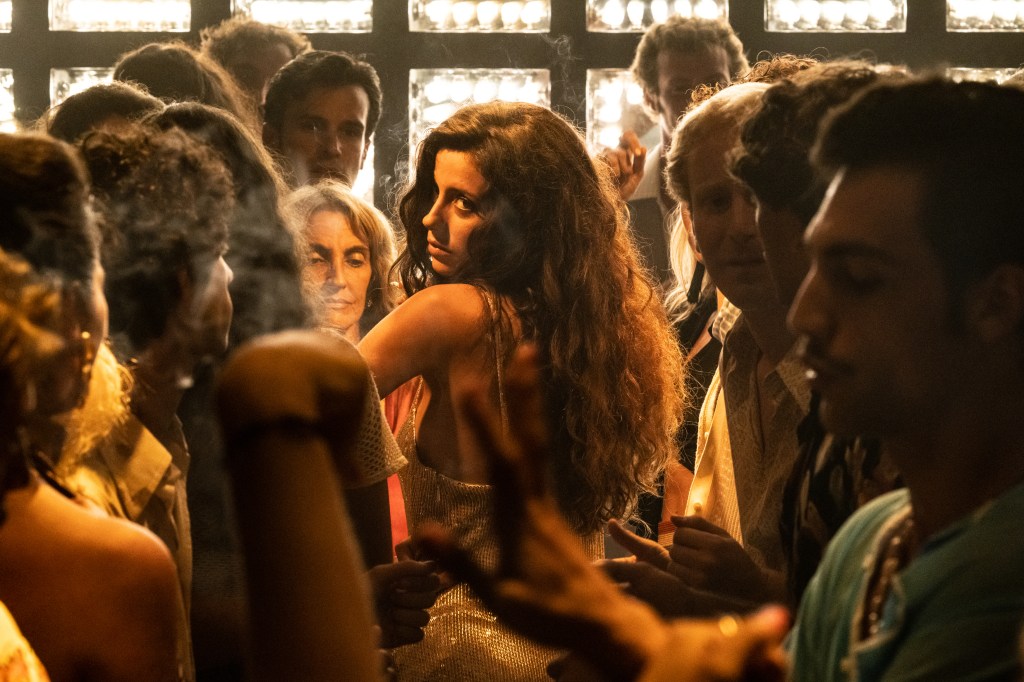
Parthenope
Wri/Dir: Paolo Sorrentino (Reviews: Youth, Hand of God, The Great Beauty)
It’s Naples, 1950 and a woman gives birth in the waters of the Tyrrhenian Sea. The baby is called Parthenope, named for both the city and the Greek myth. She grows up to be a young woman of epic beauty and legendary intellect (Celeste Dalla Porta). Men who try to seduce her, find their own words silenced by her pithy comebacks. Her days are filed with a search for beauty, happiness and meaning. She absorbs everything she reads, from John Cheever to Claude Levi-Strauss. Her closest friends are her brother Sandrino (Dario Aita) and Raimondo (Daniele Rienzo) the son of a maid. Together they form sort of a quasi menage a trois.
Parthenope aces her orals and is accepted into the prestigious anthropology department at the local university. From there she follows three very different paths: Academia — a professor takes her under his wing; Love, deciding which of her countless suitors should she consent to sleep with; and the
city of Naples, itself. Along the way she encounters a corrupt and carnal bishop, a depressed superstar diva, a millionaire with a private helicopter, and many others. But will any of these people provide her with the answers she seeks?
Parthenope is a gorgeous and sumptuous look at post-war Naples as seen through the eyes of a beautiful woman as she lives her life. Celeste Dalla Porta is appealing to watch, but she is opaque and impenetrable: she merely observes without ever doing anything. Paolo Sorrentino is known for his his beautiful images, especially women as objects of desire. But he doesn’t seem to know what to do with a woman as his subject. Instead we get a hollow simulacrum of a main character, who drifts aimlessly but happily through her life as she encounters quirky strangers. I love the photography, the scenery, the people and the music — a collection of bright and shiny colours — but watching Parthenope leaves you feeling like you just flipped the glossy pages of a fashion magazine: superficially attractive but pointless.
The Unbreakable Boy
Co-Wri/Dir: Jon Gunn (Reviews: Ordinary Angels, I Still Believe, American Underdog, Jesus Revolution)
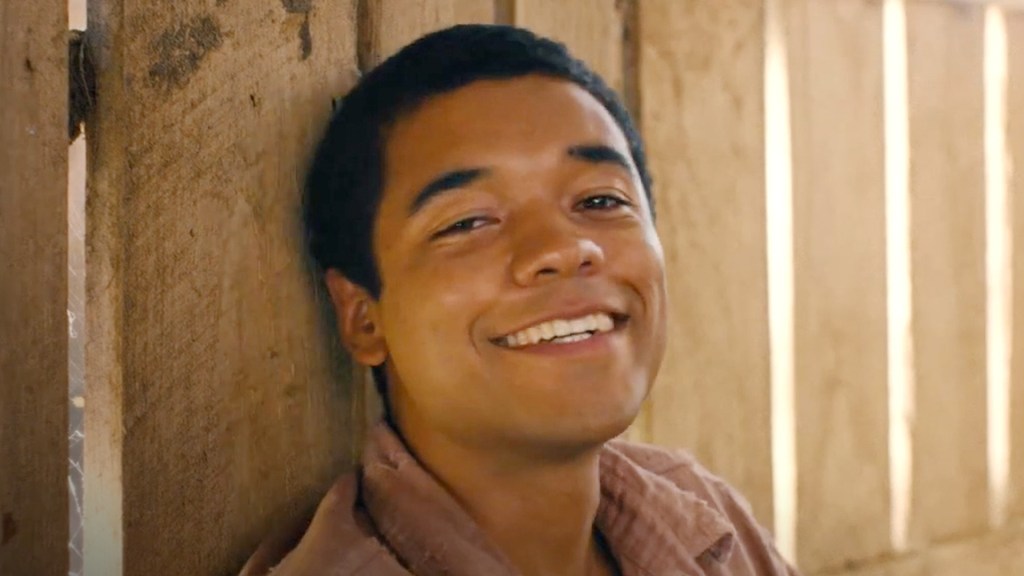
Scott (Zachary Levi) is a young salesman with big ambitions: he plans to move to Manhattan someday and make it big. But in the meantime, he likes golf, fine wine and travelling. He spends most of his time with his best friend Joe, a burley bearded man who is always giving him advice (Drew Powell). One day he meets a pretty and charming woman named Teresa (Meghann Fahy). Sparks fly, and nine months later, she gives birth to Austin (Jacob Laval). They’re not married but decide to bring him up together. But there’s a catch: he requires special care. Like his mom, Austin has Osteogenesis imperfecta (OI), a genetic condition that makes your bones very brittle. He suffers his first fracture in the birth canal, with many more breakages to follow. Eventually he is joined by a younger brother, Logan, who doesn’t share his breakability.
13 years later, Austin — aka the Aus-man — is now a happy school kid with a vivid imagination. He’s also on the autistic spectrum, but contrary to stereotypes, he’s outgoing, talkative and attends normal classes. He talks constantly, just like his dad. (I forgot to mention: Scott’s best friend Joe is imaginary) But all is not well. The family is deeply in debt. Austin is bullied at school. And Scott is drinking way too much, especially since he lost his job. Can the family pull itself back together? Or are they headed for ruin?
The Unbreakable Boy is a very cute, true story about an ordinary family working together to overcome their problems. As narrated by Jacob Laval as the Aus Man, it’s simple, touching and funny. I like the way it demystifies kids with
medical conditions and autism. And unlike most medical dramas, it’s not a weeper, though perhaps overly earnest. One warning: it is a faith-based movie, generally a red flag for cringe. Not my thing. Thankfully this one avoids most of the problems of that genre; preachiness and finger wagging and in-your-face prayers. If you’re in the mood for a light, informative, feel-good Christian movie that won’t make you squirm, check this one out.
The Monkey
Wri/Dir: Osgood Perkins (Reviews: Longlegs, Gretel and Hansel)
Hal and Bill (Christian Convery) are identical twins, but they couldn’t be more different. Bill, who was born a few minutes earlier, is self confident, athletic and aggressive. Hal is withdrawn and wears glasses as he tries to keep out of Bill’s way. But his brother is a bully, humiliating and hurting Hal on a daily basis, using a posse of popular girls as his private army. The two live with their single Mom (Tatiana Maslany) ever since their Dad, an airline pilot, walked away one day and never came back. When the boys go through the many souvenirs he brought home from around the world, they uncover something very unusual. It’s a mechanical automaton that’s an organ-grinder monkey. You wind him up and he plays a drum to the sound of carnival music. A harmless toy, right? Not exactly. When the drumstick comes down something terrible happens. Like when their babysitter is accidentally decapitated at a Benihana restaurant. But when it kills their beloved mother, the boys decided to hide the monkey somewhere that it can do no more harm. They are adopted by their aunt and uncle, a pair of swingers in small-town Maine. But they too are eventually killed in gruesome accidents. Was the money to blame?
Flash-forward 25 years. Hal (Theo James) still lives in Maine close to his teenaged son Petey (Colin O’Brien). He visits him only once a year, to lesson the chances of the cursed monkey in harming him. But then two cataclysmic events threaten Hal’s normal
life. First, Petey’s stepfather Ted (Elijah Wood) announces his plans to adopt him, making this the last time Hal will see him. Second, a series of terrible events are killing countless people in and around the town he grew up in. Can Hal find that damned Monkey and stop it from killing someone else? And can he simultaneously spend his last days with his son while keeping him out of danger?
The Monkey is a shocking and disgustingly hilarious movie about an evil toy and the people it affects. It’s done in a retro style, like Mad Magazine meets the Twilight Zone. It’s directed by Oz Perkins, known for his stylized movies that feel like fairytales (Gretel and Hansel) or nightmares (Longlegs). With this one, based on a short story by Stephen King, he seems to have found a happy medium. Simultaneously comical and grotesque, you watch the movie waiting with baited breath for the next disaster to happen. Theo James is perfect as the hapless Hal, but so is every other character in this weird movie, each given their own minute of ghastly glory: a pawn shop owner, a girl gang, a real estate agent, a pot dealer, a televangelist… it’s a limitless, mind-blowing romp. The Monkey is grotesque comedy/horror at its peak.
I love this movie.
Parthenope, The Unbreakable Boy, and The Monkey all open this weekend in Toronto; check your local listings.
This is Daniel Garber at the Movies, each Saturday morning, on CIUT 89.5 FM and on my website culturalmining.com.
Dangerous places. Films reviewed: Flight Risk, Presence, Nickel Boys
Hi, this is Daniel Garber at the Movies for culturalmining.com and CIUT 89.5 FM.
Mike Leigh’s Hard Truths is finally opening theatrically this weekend; I loved it at TIFF, it’s one of the best movies of the year and Marianne Jean-Baptiste’s performance as Pansy is unparalleled — don’t miss Hard Truths.
But this week I’m looking at three more movies set in dangerous places. There’s a witness in a prop plane in Alaska, a family in a haunted house, and two teens in a reform school that’s rotten to the core.
Flight Risk
Dir: Mel Gibson (Review: Hacksaw Ridge)
Winston (Topher Grace) is a bookkeeper on the lam. He used to work for the mob, but when they found out he was pocketing too much of their earnings he decided to run. Now he’s hidden away in a remote corner of Alaska where he’s sure they’ll never find him. They didn’t find him, but a pair of US Marshalls did. The cops are led by the hardboiled Madolyn (Michelle Dockery). She’s eager to be on active duty, after years stuck at her desk. She promises Winston full immunity if he agrees to testify. Now she just has to safely bring him to the lower 48. But first to an international airport in Anchorage. It’ll be a short ride over some mountains, and they’ll be on their way. Sure enough, there’s an old prop plane waiting on the tarmac the next morning. The pilot, Daryl (Mark Wahlberg) is a bit of a character, who directs his non-stop patter toward Madolyn. She sits beside him in the cockpit, with Winston — a potential flight risk — safely chained down in the back. Everything’s going perfectly until they realize the plane isn’t heading in the right direction. And the face on Daryl’s pilot license? Well, it isn’t Daryl. Who is in danger, who is dangerous, and who can safely fly the plane to Anchorage?
Flight Risk is a compact, action-thriller set aboard an old prop plane flying over the Alaskan mountains. It’s fast-moving,
funny and a bit violent. The characters are all cartoonish: Mark Wahlberg has his head shaved with a deranged smile like Jack Nicholson in the Shining. Michelle Dockery, an English actress makes a good tough-as-nails cop. And Topher Grace completes the triumvirate playing Winston as an awkward petty criminal trying to overcome his fears. It feels like those Covid-era movies, with its small cast and single location. But in this case, it’s the constant fights and the changing balance of power in a tiny enclosed space — aboard a fast-moving plane — that give this film its oomph.
Flight Risk is no masterpiece, but I enjoyed it.
Presence
Dir: Steven Soderbergh (The Laundromat, Side Effects, And Everything is Going Fine)
A typical family is moving into their new home. It’s beautiful, quite old, with lots of wood and windows. Chloe and Tyler (Callina Liang, Eddy Maday) each have their own room, but that doesn’t stop them from bugging each other. Tyler is a self-centred high school jock who wants to join the in crowd, and will do anything to get there. To booster his chances, he brings a popular, but suspect, guy Ryan (West Mulholland) into the house. Ryan has his eyes on Tyler’s younger sister Chloe, who is going through the trials and tribulations of adolescence and self doubt. Their Mom and Dad (Lucy Liu and Chris Sullivan) are also adjusting. She’s the main breadwinner in this family, and is facing a crisis at work. Has she been cooking the books? Dad — an educator — is more laid back, but still senses trouble, especially when it’s interfering with their relationship. But none of them seem aware of a bigger problem that affects them all: The place is haunted! There’s a ghostly presence in this house, that has been there a long time, and is not going anywhere. It floats through the place, unseen and unheard, observing everything but doing nothing. Until it starts letting itself be known. Is this presence a ghost or a poltergeist? Is it good or evil? And what will it do to this family?
Presence is a typical family drama but seen through the eyes of a ghost. The camera (meaning the presence) never leaves the house, and if someone steps outside we can’t hear what they’re saying. It’s not a real horror movie; while there is a
hint of the supernatural, and a fair bit of suspense, it doesn’t overpower the drama.
And yet… I quite liked this movie. Steven Soderbergh is hit and miss. Some of his films are cheap-looking and predictable, filled with clichéd characters and cookie-cutter stories. Others are innovative and surprising. This one totally works
If you’re looking for a typical horror movie, this ain’t it, but if you want something new and different, you should check out Presence.
Nickel Boys
Co-Wri/Dir: RaMell Ross (Hale County This Morning, This Evening)
(Based on the novel by Colson Whitehead)
It’s the early 1960s in segregated Tallahassee, Fla. Elwood (Ethan Herisse) is an earnest and polite young student who lives with his grandmother (Aunjanue Ellis-Taylor). He loves reading and studying and is interested in Black American history and the civil rights movement happening all around him. When his history teacher, Mr Hill — an actual Freedom Rider! — gets him a scholarship at a prestigious Black technical school, everything is falling into place. Until, Elwood, while hitchhiking to his new school is arrested for riding while black! The driver of the car he’s in — a total stranger — is charged with some crime, and Elwood is his accessory. He ends up sentenced to serve time at a notorious reform school called Nickel Academy.
Nickel is a cesspool of corruption and cruelty, a school in name only. The kids are rented out as prison labour, like picking oranges off a tree. When he defends a little kid being beaten up at the school, Elwood is the one punished, not the bullies. And the punishment is severe: beaten until he bleeds or locked into a “sweat box”. Worse than that are the kids who suddenly “disappear”, never to be seen again. Luckily one kid stands up for him and becomes his best friend. Turner (Brandon Wilson) is as cynical as Elwood is idealistic. Elwood’s Nana has hired a lawyer to overturn his sentence — that’s what keeps him going. Turner — from Texas — has
never had it easy, so he has no hope, just the will to survive. For a black kid in the Jim Crow south, the law doesn’t mean much. He tells Elwood that to get out of this place alive you have to know the rules. There are no laws, or right and wrong; last till you’re 18 and you’ll be free.
But as time passes, and Elwood’s future looks increasingly bleak, he starts to keep copious records of the violence crimes and corruption at Nickel Academy. Can he get the information to the authorities? Will it do any good? And which of the Nickel boys will survive?
Nickel Boys is an excellent historical drama about two young black men trapped in a horrific reform school. While historical in its details, it’s experimental and unconventional in its form. Most scened are shot from Elwood’s or Turner’s POV, with the focus often the ground, the sky, someone else’s hands or feet or the inside of his own head. It’s disconcerting at the beginning but you get used to it. The narrative is not completely linear either, with time jumping forward 20 and
40 years, to show what happens to Elwood in the future. It’s full of compelling memorable images, like kids picking oranges using high wooden stilts. The two main actors are newcomers but very good in their portrayals. But over everything hangs the awful truth of the terrible crimes at these sorts of places (like the Residential Schools in Canada).
Nickel Boys is both moving and upsetting to watch.
Nickel Boys is now playing, with Flight Risk and Presence both opening in Toronto this weekend; check your local listings.
This is Daniel Garber at the Movies, each Saturday morning, on CIUT 89.5 FM and on my website culturalmining.com.
Returns. Films reviewed: All We Imagine as Light, The Return PLUS Streaming Sites!
Hi, this is Daniel Garber at the Movies for culturalmining.com and CIUT 89.5 FM.
As the days grow shorter and colder, people tend to snuggle up at home. I’m here to tell you to get off your collective asses and go see a real movie on a big screen! But I know some of you are going to stay at home so today, I’m going to talk about some of the streaming sites out there you might want to join. And I’m looking two new dramas. A warrior king in ancient Greece returning to his island, and three nurses in Mumbai returning to Kerala.
Streaming Sites
Here are some streaming sites you might want to try.
First the free ones: CBC Gem, Kanopy and Tubi. CBC Gem has ads, but also plays some great docs, including There are no Fakes. You can find Tubi — a commercial site — online, again with irritating ads but a huge selection of middlebrow films. You can check out terrific movies on Kanopy using your library card, but you’re limited to a certain number per month. Britbox and Acorn TV both specialize in British TV series, especially detective mysteries. If you want Miss Marple peeking over your shoulder, this is what you want. Apple TV produces all their own stuff, including Slow Horses and the great Steve McQueen’s new film Blitz. On the other hand, the Apple TV app itself is extremely aggressive — you can only watch full screen and it flips back to the main site every time you navigate away.
If you’re into horror, thriller and the supernatural Shudder is the site for you. It’s exceptionally well-curated, with excellent art-house movies right beside slashers. Paramount+ has a seemingly endless supply of cop and military shows, plus CIA, FBI, firemen, navy, and — count ‘em! — 7 different NCIS spinoffs! Not my thing, but they do land some good movies like Smile 2, playing right now. Crave gives you access to everything HBO makes, as well as Canadian movies you might otherwise miss like the NFB doc Wilfred Buck. Criterion has the rights to some of the best movies of all time, from early Kurosawa to recent releases. MUBI streams new movies likely heading for the Oscars this year, including Maria, Girl with the Needle and The Substance.
And finally Netflix, the grande-dame of all streamers, has the most consistent and sheer quantity of good TV and self-produced movies, like Emilia Perez… but it’s getting way too expensive! They even have a new website called netflixinyourneighbourhood.ca which takes you to

THE MADNESS. The Donut Shop, 617 Parkdale Avenue, Hamilton, Ontario, featured in Episode 107 of The Madness. Cr. Courtesy of Netflix © 2024
locations where their movies are shot: in places like Toronto, Ottawa, Hamilton, Brockville, Dundas and Oshawa!
I still think movies should be seen in theatres but if you’re determined to stay at home, those are some of streaming sites you might want to subscribe to.
All We Imagine as Light
Wri/Dir: Payal Kapadia
It’s present-day Mumbai.
Prabha (Kani Kusruti) is a middle-aged hospital nurse. She is skilled at her job, teaching young trainees how to get over their feelings of revulsion. She spends time with a starry-eyed Doctor Manoj, who writes poems to her, but she is still very much married. Her husband moved to Germany to work in a factory, and he may as well not exist. Prabha shares an apartment with Anu (Divya Prabha), a vivacious young nurse at the same hospital. She likes shopping, fashion and romance, and most of all her secret boyfriend Shiaz (Hridhu Haroon). They’re in love (or at least young lust) but frustrated; it’s hard to find a private space to be together. More than that, she’s Hindu and he’s Muslim, and never the twain shall meet – their families will prevent that. Finally, Parvaty (Chhaya Kadam), an older nurse and a close friend of Prabha’s, is facing eviction from her home. Developers want to tear it down to build a high-rise condo. Since she’s a widow and doesn’t have the proper papers to
prove the place is hers, they’re sending goons to her door to kick her out.
For all these reasons the three of them end up back in Kerala, the place of their birth in southwest India. They stay in a beautiful beach town, where the three of them can finally shake off the heavy responsibility and stress of life in that big city. But how long will this last?
All We Imagine as Light is a personal, intimate drama about the lives of three women in Mumbai. It’s notable for a number of reasons. This is director Payal Kapadia’s first feature, and tells her story from a distinctly feminine gaze. It deals with big contemporary political and social issues — like Parvaty attending an angry tenants’ rights meeting — but also the importance of personal friendships among the three woman. In look and style, this film is strictly European cinema verite, about as far from Bollywood as a movie could possibly be. But it is set in Bombay and exults in that city, from the slums to the skyscrapers, with stunning aerial views of rooftop clotheslines and raucous street festivals. There’s amazing footage taken through the window of a fast-moving commuter train. Some scenes have documentary-style unidentified voices, expressing their bittersweet love and hatred for that
city that never sleeps, spoken in a plethora of languages: Hindi, Gujarati, Malayalam, and Bengali. I liked this movie for it’s emotions, but found much of it bleak and slow-moving; the story drags you down until it finally shifts from Mumbai to the beaches of Kerala, two-thirds of the way through.
But by the end it redeems itself with an unexpectedly satisfying finish.
All We Imagine as Light has been nominated for Best Foreign Language Film at the Golden Globes.
The Return
Dir: Uberto Pasolini
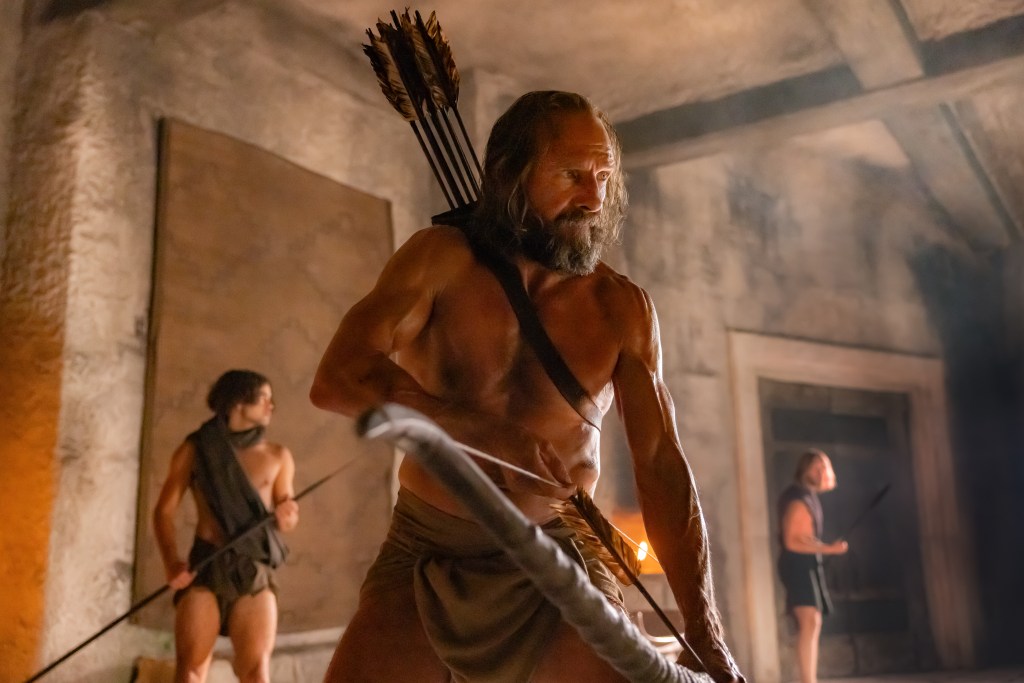
It’s 1200 BC in ancient Greece, and the island of Ithaca has no ruler. Decades ago, it was a mighty kingdom, ruled by the hero Odysseus — known for his bravery, fighting skills and intelligence. He devised the Trojan Horse and led the army that defeated Troy. But the soldiers — and their leader — never came home, and Ithaca has gone to seed. The queen, Penelope (Juliette Binoche) sits alone in her tower, weaving cloth, as she patiently waits for Odysseus’s return. Their son, Telemachus (Charlie Plummer) doesn’t know his father except from legends. The palace is filled aggressive brutes from abroad, each wanting to marry the widow Penelope so they can take over the kingdom. But is she actually a widow?
Around this time, the battle-scarred body of a soldier washes up on shore. He’s barely alive, but is nursed back to health by an honest pig farmer named Eumeo (Claudio Santamaria) and his sons. It is of course Odysseus (Ralph Fiennes), but without any uniform or weapon. He’s actually naked. He wraps himself in a blanket and carries a bowl — the clothing of a homeless beggar. And when he approaches the palace, almost no one recognizes him. Only Eurycleia (Ángela Molina), both his and his son Telemachus’s nurse as a child, realizes who

The Return, directed by Uberto Pasolini, with Ralph Fiennes (Odysseus), Juliette Binoche (Penelope), Charlie Plummer (Telemachus), Marwan Kenzari (Antinous), Claudio Santamaria (Eumaeus).
that beggar is. Is he still fit to be king? Can one man, tired and old, confront a bloodthirsty mob of young toughs? And will Penelope ever forgive him for staying away so long?
The Return is a magnificent retelling of a chapter in Homer’s The Odyssey. But it’s not about triumphant heroes; it’s more about the grinding effects war has upon both the victors and the vanquished. It contrasts Odysseus’s shame and self-doubt with Penelope’s eternal fidelity. Yes, this is an ancient greek story, with swords and sandals, but it feels very immediate. Parts of it even resemble a Hollywood action/thriller, with chase scenes and some very bloody fights.
The film was shot among the rocky cliffs of Corfu and the ruins of an ancient castle, which is echoed in the soundtrack. I love the dramatic look and sound of waves crashing on the sharp rocks. Though the women are all wrapped up, most of the male actors are dressed in togas or prancing around half naked, with Ralph Fiennes going full monty at the drop of a hat. I didn’t used to like him much, but after Conclave and now this one, I gotta admit, he’s a really good actor. Juliette Binoche is skillfully understated as Penelope, and Dutch actor Marwan Kenzari is very creepy as Antinous, the threateningly oleaginous suitor closest to Penelope.
The Return is a really good movie.
The Return and All we Imagine as Light is on at the TIFF Lightbox in Toronto; and Standing on the Shoulders of Kitties, A Trailer Park Boys movie featuring Bubbles and his band on tour, is now playing; check your local listings.
This is Daniel Garber at the Movies, each Saturday morning, on CIUT 89.5 FM and on my website culturalmining.com.
Assorted monsters. Films reviewed: The Apprentice, Piece by Piece, Don’t F**k with Ghosts
Hi, this is Daniel Garber at the Movies for culturalmining.com and CIUT 89.5 FM.
Toronto’s fall film festival season is in full swing with Planet in Focus, celebrating it’s 25th anniversary. It’s running from Tuesday through Sunday next week, with international features and shorts on climate change, activism, environmentalism and indigenous issues. And on Friday, October 18, there’s a free screening at Hot Docs of We Will Be Brave, about Good Guise, a Toronto collective that sparks conversations around healthy masculinity through art. That’s part of the For Viola series honouring Viola Desmond.
But this is also October, when ghouls and ghosties flock to our screens. So this week, I’m talking about three new movies about various types of monsters. There’s a monstrously popular music producer from Virginia Beach; a notorious real estate developer trained by a monster in New York; and two guys searching for ghosts in Winnipeg.
The Apprentice
Dir: Ali Abassi (Review: Border)
It’s the mid 1970s, and New York is a wreck, with soaring crime, homelessness and bankruptcy. When the Mayor asks the feds for help, Gerald Ford tells them to “drop dead”. Into the world emerges an ambitious young developer. Donald Trump (Sebastian Stan) was born rich, but cowers under his oppressive father’s rule. Fred Trump (Martin Donovan) a real estate developer from Queens, made his fortune building segregated public housing. Donald is stuck at crap jobs, collecting rent and evicting destitute tenants. But he has big ideas. His plan? To buy the venerable Commodore, an old hotel with 2000 rooms on 42nd street a hotbed of porn palaces and drug dealers. But how can he raise the money with his dad being sued by the feds for his racist rental practices? Donald has an idea. He joins an exclusive club with the hopes of meeting a certain lawyer he thinks can solve all his problems. The lawyer is Roy Cohn (Jeremy Strong) a notorious rightwing attorney with ties to organized crime. Cohn played a central role in the
McCarthy Hearings, and still brags about executing the Rosenbergs. He agrees to take on Donald as his protege, and teaches him his three crucial rules: Attack, attack, attack (whether lawsuits, blackmail or intimidation) Deny everything , and always declare victory, even when you lose. (See: 2020 election). The club is also where he meets the beautiful and brash Ivana (Maria Bakalova), whom he is destined to marry. She will instill in him a love of garish, nouveau-riche interiors. The film follows these three people’s intertwined lives through the 70s and 80s until Cohn’s death.
The Apprentice (absolutely no connection to Trump’s much later reality show) is a very dark biopic about the origin of Trump’s bizarre motivations and strategies. Sebastian Stan gives an excellent portrayal of Trump; he’s actually sympathetic for his earnestness and naivety in the beginning, but who spirals into something deeply disturbing by the end. This is not an SNL parody, it’s a realistically developed character. Likewise, Strong plays Roy Cohn as a dead-eyed, sybaritic bully, hosting gay orgies, even while publicly denying his sexuality to the end. He doesn’t look like Roy Cohn, but he sure does act like him. With a great selection of 70s and 80s pop songs throughout the film, and the grotesque golden opulence of Trump’s homes captured on grainy colour film of the era, The Apprentice is a funny and disturbing biopic.
Piece by Piece
Co-Wri/Dir: Morgan Neville (Review: Best of Enemies)
Pharrell Williams is a highly successful music producer, musician, singer, composer and fashion designer. His work spans the genres from hiphop, to pop music and electronica. But his life hasn’t always been that way. He grows up in a working-class housing area in Virginia Beach, Va. and starts drumming at an early age using kitchen utensils. He’s into Star Trek, Stevie Wonder and Greek Gods (his apartment is actually named Atlantis!) He soon forms a band with his schoolmates, and later, starts working at a nearby recording studio, learning the ins and outs of music producing.
He soon rises in popularity, both for his own work, and that of the stars he works with, a who’s who of hip hop and pop. He has a succession of hits with Kendrick Lamar, Snoopdog, Timbaland, and Jay-Z, then branches out to include pop stars like Justin Timberlake, Gwen Stefani, Robin Thicke, and Daft Punk, all producing worldwide hits. They come to him for the tracks he creates and samples, as well as a certain je ne sais quoi he adds to their music. But how long will his popularity last?
Piece by Piece is a documentary about the life and career of Pharrell Williams. It’s narrated by Pharrell himself, in an interview with the director, as well as talking heads of most of the stars he’s worked with. What’s unusual about this doc is it’s all done using LEGO animation. Instead of the actual people, you see LEGO people who waddle when they walk and have basic faces
painted onto cylindrical plastic heads. But does it work? I’m of mixed feelings. I was expecting a LEGO movie — fast moving, constant jokes, mind-blowing psychedelic animation — featuring Pharrell, but what I got was an interview with Pharrell using the style of LEGO. (Picture the movie Barbie, but without people just Barbie and Ken dolls) There are some cool creative parts. I love the animation of waves on the beach, the re-creation of video clips, and a cool conceit running through the story — Pharrell’s magic musical touch symbolized by glowing geometric shapes that he puts together for that perfect beat. And I loved the constant music. But in general the images and interviews were more or less the same as any music doc venerating its star— largely unremarkable. A LEGO recording studio is still just a recording studio. And those LEGO people are just irritating. This movie is OK, but I was not blown away.
Don’t F**k with Ghosts
Co-Wri/Dir: Stuart Stone
Stu and Adam (Stuart Stone and Adam Rodness, who co-wrote the script) are a pair of Toronto filmmakers pitching their latest project — Bigfoot! But their financiers have another idea in mind: put together a film proving the existence of ghosts, and it’s sure to be a hit. But, just in case, they take their contract to a ginger- bearded entertainment lawyer (Josh Cruddas) for help. He warns them to find some real ghosts or else they won’t get paid. So they head off to Winnipeg “the Murder Capital of Canada”. And to help them find the spooks, they enlist a series of experts to help them in their quest. It seems Winnipeg is also the capital of supernatural hustlers: ouija board specialists, psychics, aura readers, fortune tellers, magicians, clowns… even a “ghost sherpa” (Tony Nappo), who takes them on a strange journey involving smoking jackets, psilocybin and a
jacuzzi. They finally locate a house where some grizzly murders once took place. But will they ever find any real ghosts?
Don’t F**k with Ghosts is a low-budget, semi-supernatural Canadian comedy, done in the form of a reality show. So there’s the usual bickering between the two main characters (who also happen to be in-laws), hot mic “gotcha” scenes, and various other embarrassments “accidentally” caught on camera. And no spoilers, but I will say there are some unexpectedly well-done special effects toward the end.
Is Don’t F**k with Ghosts scary? No, not a bit. But is it funny? Well, not too bad…
The Apprentice, Piece by Piece, and Don’t F**K with Ghosts all open this weekend in Toronto; check your local listings. This is Daniel Garber at the Movies, each Saturday morning, on CIUT 89.5 FM and on my website culturalmining.com.
Depression. Films reviewed: The Crow, Between the Temples
Hi, this is Daniel Garber at the Movies for culturalmining.com and CIUT 89.5 FM.
Depression can lead to strange decisions. This week I’m looking at two new movies, a supernatural action thriller, and an unusual romantic comedy. There’s a lover who can’t live after his girlfriend dies; and a cantor who can’t sing after his wife dies.
The Crow
Dir: Rupert Sanders
It’s an unnamed big city somewhere in the world. Shelly (FKA twigs) is a piano prodigy, who, with help from her ambitious mom and some shady investors headed by the mysterious Mr Roeg (Danny Huston), has risen to the top. She is living the highlife in a swank apartment and hanging with beautiful people at exclusive nightclubs.
Eric (Bill Skarsgård: John Wick Chapter 4) is a ne’er-do-well who grew up on a rundown farm with neglectful parents. Now, he finds himself in the big city, his face and body covered in meaningful tattoos. He lives a precarious life with hoody friends, with a secret space to hide out in — a warehouse filled with plastic covered mannequins. His interests range from goth music to the pen and ink drawings he scratches on scraps of paper.
So how did they both end up locked in a juvie rehab centre? For Eric it’s a foregone conclusion, but Shelly is there for drug possession. But her life is in danger after discovering she has footage on her cel phone of a heinous crime, committed by the dark and powerful Mr Roeg. When Eric and Shelly meet in the rehab/prison it’s love at first sight. They escape and run away, to the big city where they make passionate love in haut couture fashions while spilling bottles of champagne over each others’ bodies. But Mr Roeg’s bad guys soon catch up, murdering them both. That’s when Eric has to decide: should he pass back into the world of the living to seek revenge and Shelly from hell? Or will he let himself die and pass on to heaven?
The Crow is a supernatural action/thriller about young lovers caught
between life and death. It has attractive stars, opulent sets, cool fashions and a good music playlist. Along with some extended fight scenes. The thing is, the movie doesn’t really make sense, it’s hard to sympathize with the hollow main characters, and it’s full of unexplained plot turns and dead ends. It feels like an unresolved two-hour music video. It begins in a city like Chicago, but where everyone has English accents. There are cobblestone streets and European opera houses. The movie is called the Crow, but aside from some black birds flying in the background, they don’t have much to do with it. Eric stains his face with black mascara to match the iconic Crow movie poster, but we never find out why.
I didn’t hate this movie, but it is a big pointless mess.
Between the Temples
Co-Wri/Dir: Nathan Silver
Ben (Jason Schwartzman: Asteroid City, My Entire Highschool Sinking into the Sea, The Overnight, Saving Mr Banks, A Glimpse Inside the Mind of Charles Swan III) is a middle aged guy in upstate New York. He’s been sad and withdrawn since his wife died. Now he lives with his two moms, Judith and Meira Gottlieb (Dolly De Leon, Caroline Aaron). They’re taking care of him in this time of need. They’re also constantly setting him up with new girlfriends to replace his dearly departed… in which he has no interest. He’s a cantor who works at the local synagogue but lost his ability to sing when his wife died. And what good is a cantor who can’t chant? Which drives him into a deeper depression in an ongoing cycle. He reaches rock-bottom one day when he lies down on a highway hoping the next truck will end it all. Instead the sympathetic driver helps him up and drops him off at a roadside bar. There, the teetotalling Ben gets totally sloshed on Mudslides (a white Russian with Irish cream). This leads to a drunken fistfight with a random stranger and a shiner on his face. But that’s where he meets a new friend, a sympathetic older woman, who looks somehow familiar. And then he remembers: it’s Mrs O’Connor (Carol Kane) his music teacher when he was a small child. And she’s a widow, too.
Gradually they spend more time together, sharing their stories. Mrs O’Connor (now reverting to her
original name, Carla Kessler) explains she was a red-diaper baby, the child of American communists. As a teenager she liked listening to her friends singing at their bar mitzvahs but she didn’t understand and totally rejected any religious meaning. But now, 60 years later, she wants to have a Bat Mitzvah herself. Couldn’t Ben, a real cantor, teach her how to do it? He agrees, and they enter an intimate professional relationship focussed on singing. As it turns out she’s the only one who can make him laugh. But can this lead to something more serious? And can a 40 year old man hit it off with a 70 year old woman?
Between the Temples is a cute and clever romantic comedy. It’s all about the humour in uncomfortable situations and family misunderstandings, both his and hers. I have to mention the classic Harold and Maude, but aside from the intergenerational theme and the nice hippy-ish soundtrack, this one is original and stands on its own. Carole Kane is marvellous as Carla — she’s a comic genius who with her curly blonde hair and enormous eyes has kept her waifish, childlike look in her 70s. Jason Schwartzman is great for his dry delivery. And Dolly De Leon (Triangle of Silence) is excellent as Ben’s Filipina Jewish mother.
With an amazing cast, this small, subtle comedy is warm and effective.
The Crow and Between the Temples both open this weekend in Toronto; check your local listings. This is Daniel Garber at the Movies, each Saturday morning, on CIUT 89.5 FM and on my website culturalmining.com.
Fractured families. Films reviewed: Good One, Close to You
Hi, this is Daniel Garber at the Movies for culturalmining.com and CIUT 89.5 FM.
In Anna Karenina, Tolstoy said “All happy families are alike; each unhappy family is unhappy in its own way”.
Sometimes this leads to families torn at the seams, impossible to repair. While others can find the happy side of life. This week I’m looking at two new movies about cross-generational, fractured families. There’s a teenaged girl going camping with her divorced dad, and a trans man repairing relations with his estranged family.
Good One
Wri/Dir: India Donaldson
It’s a summer’s day in New York City. Sam (Lily Collias) is a high school student who lives with her mom; her parents are divorced. She spends most of her time fooling around with her girlfriend who is heading off to University in the fall. But this weekend, she’s preparing for some quality time with her dad, Chris (James Le Gros). Chris is an uptight, clean-freak who resented his ex-wife’s affair, but loves his daughter dearly and unconditionally. That’s why he’s taking her on a camping trip, along with his best friend, and his best friend’s son. Matt (Danny McCarthy) is an actor-turned-salesman. He’s also a bit of a douche, known for his inappropriate comments. Don’t take Matt seriously, says Chris, he has no filter. But his son is mad at him, so he ends up coming alone. Matt’s also irresponsible — he forgets things like basic clothes, camping equipment and even a sleeping bag.
But soon enough, they’re at a camp sight, telling ghost stories and cooking instant ramen over a small fire. They reveal certain secrets from their past and share their deepest beliefs. But when Matt says something to Sam she considers deeply offensive, the tenor of the whole trip shifts. Will the adults learn from their mistakes? Or is it up to the children to teach them?
Good One is low-key, low-budget realistic movie about father/daughter relations. It seems at first like a traditional “generation gap” comedy, but it’s much more subtle than just that. It’s never in your face, you have to think about their facial expressions and what they’re really saying to get the full meaning. The acting is
great — James Le Gros and Danny McCarthy serve as a surrogate Oscar and Felix (the Odd Couple) but as real people, never exaggerated caricatures. I’ve seen Le Gros in dozens of movies, but this is the first I’ve heard of Lily Collias — it’s from her refreshing point of view that we see this film. It’s a lovely looking and sounding film, the dramatic scenes alternating with long nature shots of grey rocks, green leaves and flowing water. It’s lit by campfires at night and sunlight by day. And it’s laced with relaxing acoustic guitar. For a first film (this is India Donaldson’s first feature) this is really good. It may be subtle but it’s never boring.
The title says it all — it’s a good one.
Close To You
Co-Wri/Dir: Dominic Savage
It’s winter in Toronto. Sam (Elliot Page) is a transman in his thirties who rents a room in a friend’s house in Kensington Market. He’s thin and muscular with short black hair, often in a red toque. He likes his new life: single, bisexual, exploring the city, with a good job, and a sense of freedom he never knew growing up. But today he’s taking the train back to ground-zero: his hometown, Cobourg. He’s going to see his family for his Dad’s birthday. It’s also the first time since his transition four years earlier, and he’s really wound up about it. He’s a failure, he’s inadequate, he’s not married like his siblings, and his life in no way resembles his parents’s solidly middle class home. All these thoughts are swirling around his mind and he’s ready to throw in the towel’s but decides to go anyway — he can always leave. And on the train, he recognizes the face of someone important to him as a
teenager. Katherine (Hillary Baack) was his best friend… will she remember him?
Cobourg, isn’t Selma Alabama in the 1960s. No one looks at him funny or calls him names. His parents (Wendy Crewson, Peter Outerbridge) are overjoyed to see him again. But one of his in-laws (David Reale) seems less than enthusiastic. Will they accept his changes? Can he survive this reunion? And will he ever see Cat again?
Close to You is a dramatic, personal portrayal of the anxiety facing a man’s first visit back to his family since his transition. There’s also some unexpected sex and romance (no spoilers). It’s well-acted and realistically told. Locations range from Toronto’s Kensington Market and Union Station to the picturesque streets of Cobourg. It’s co-written by Elliot Page, who you’ve probably seen in hit movies and shows like Juno and The Umbrella Academy. I think the story is partially based on a fictionalized version of Page’s own experiences — like Sam, he transitioned about 4 years ago, though as a major movie star and celebrity always in the public eye, Page’s life is very different from the introverted Sam. This is a very Canadian movie that casts actors who are deaf or black without out that identity ever entering the story line. In Canada, bigotry is quiet, not overt, but still there. It accurately portrays the pain of snide remarks, deadnaming and misgendering. It’s also sympathetic to other members of Sam’s family, struggling with their adult son’s changes.
There have been hundreds of coming out movies about lesbians and gay men, but very few about transgendered men in the same situation. So there’s a real thirst for films like this one.
I liked Close to You.
Close to You and Good One both open this weekend in Toronto; check your local listings.
This is Daniel Garber at the Movies, each Saturday morning, on CIUT 89.5 FM and on my website www.culturalmining.com.
Reduplicatives. Films reviewed: Didi, Sing Sing, Kneecap
Hi, this is Daniel Garber at the Movies for culturalmining.com and CIUT 89.5 FM.
Any given movie can be placed somewhere between truth and fiction — just depends on how close a fictionalization sticks to the true story. But when actors play themselves it tends to shift toward the truth side. This week, I’m looking at three great new movies that deal in dramatizations, semi-autobiographies, and fictionalizations. There’s a group of actors in a maximum security prison, some Irish rappers in Belfast, and a Taiwanese-American adolescent in the Bay Area.
Didi (弟弟)
Wri/Dir: Sean Wang
Chris (Izaac Wang) is a preteen schoolboy in Fremont, California in the Bay Area. He lives with his Mom (Joan Chen) his big sister Vivian (Shirley Chen) and his elderly grandmother Nai-nai (Zhang Li Hua). Missing from this picture is his dad who supports the family from his job in their native Taiwan but whom they rarely see in person. Home life is fractious at best — Chris is waging a long war with Vivian, and their practical jokes are getting increasingly extreme. Nai-nai feels isolated and takes out her anger on his mom, while she just tries to keep the family from falling apart. At school and in the streets, Chris’ best bro is Fahad (Raul Dial), who hangs with the rest of their crew. They’re all Asian-Americans — Filipino, Korean, Indian — but no one else is Taiwanese. He goes to his first house parties, and decides to meet a girl. He has crush on Madi (Mahaela Park) but doesn’t know what to do once they meet. And this is a seminal year. Vivian is heading off to college, and Nai-nai is rapidly aging. His mom pressures him to take tutoring with her friends’ kids, but he can’t stand that group.
When his first try at dating ends ends up in a fiasco, he feels betrayed by his usual crew. So he tries to make new, cooler friends. He approaches three skaters at a skate park and proposes shooting their videos. He doesn’t know the first thing about it, but at least he has new friends to hang with. He reinvents himself and hides his
ethnicity (I’m half, he says). But as his anger, frustrations, insecurities and self-doubt build up, and his whole life feels uncertain, he doesn’t know which way to turn. Can Chris survive the unbearable pressures of adolescence?
Didi (the title means younger brother in Chinese) is a semi-autobiographical coming-of-age story about Sean Wang’s own life growing up in Fremont in 2008. It feels honest and real, full of the angst and heartbreak of youth. It’s full of myspace and early texting, his computer screens filled with nihilistic accidents and explosions. Something about this movie really hit me; yes it’s a coming-of-age story with many of the expected scenes, but without any of the usual cliches. The acting is all-around great and for a first feature this one’s a real accomplishment.
I quite liked this one.
Sing Sing
Dir: Greg Kwedar
It’s Sing Sing, the infamous, maximum security prison, 30 miles up the river from New York City. Divine G (Coleman Domingo) is a long-time prisoner there, known for his acting and oratory skills, as well as his kind and giving nature. He’s also a star of the plays they put on at the prison. And they’re looking for new participants. Like Clarence “Divine Eye” Macklin (played by himself). Macklin shakes down people in the yard and always displays a tough, gangsta image. But Divine G recognizes his talent and encourages him to join up. And at the same time he’s working on the play, he also helps other prisoners appeal for parole or pardons. He himself was wrongfully convicted, but has less luck than the people he helps.
Now prisoners don’t just act there, they also direct, come up with the story, and do the production work as well. But despite his efforts to help him, Macklin brushes him off and puts down the acting exercises. This year’s play is made up of a fantastical amalgam of concepts: pirates, aliens, ancient Egyptians, and Shakespeare’s Hamlet, to name just a few. But obstacles threaten the whole production. Will Divine Eye learn to get along with Divine G? And can this experimental play work?
Sing Sing is a wonderfully revealing and well-acted drama about people putting on a show while incarcerated. It tells, sequentially, all the stages of putting on a play: auditions,
exercises, read- throughs, dress-rehearsals and the show itself. Some of the main characters are played by accomplished actors, like the wonderful Coleman Domingo, and Paul Raci as the director. But co-star Clarence “Divine Eye” Macklin plays himself; the film is based on his own story. Other formerly incarcerated performers play themselves or other prisoners. More than that, it fleshes out the true stories of the characters they play. Some of the actors — huge bruisers with facial tattoos — if you ran into them in a dark alley, you’d probably scream and run away. But they’re actually nice, creative, and intelligent guys who needed something like this. Rehabilitation Through the Arts (RTA) is a highly successful program that gives meaning and purpose to the lives of prisoners. Within three years of being released from prison in New York State, 43% are back behind bars. But for participants in RTA the 3-year recidivism rate is less than 3%. That shows you how important it is.
Despite the desolate, horrific and overcrowded conditions in prisons, this drama will make you feel good about the world again.
Kneecap
Co-Wri/Dir: Rich Peppiatt
(Co-written by Móglaí Bap, Mo Chara)
JJ teaches music and the Irish language to bored students at a public school in West Belfast. He also speaks Irish at home with his girlfriend. They’re interrupted in bed one night by a phone call asking her to translate at the police station. She doesn’t want to, so JJ goes in her stead. The suspect is Liam, a lad in trackies arrested at a rave in the woods, who claims to speak only Irish no English. The detective wants JJ to help with the interrogation. She’s also curious about Liam’s notebook, filled with scrawled poems. Thing is, speaking Irish has a political dimension, too — it’s been an act of rebellion since long before independence from the British. So JJ stealthily sides with Liam, pocketing the book while Liam distracts the detective. JJ loves the rhymes, and wants Liam to rap them, in Irish, to hip hop beats (something never done before). Liam says, never without Naoise, his best pal and business partner.
They’re childhood friends, since Naoise’s IRA dad taught them to speak Irish before he went underground. Now they’re not just besties, they’re the main local dealers in drugs and hallucinogens. They agree to make a go of it, and come up with a name, Kneecap. (Kneecapping was a form of torture and punishment during The
Troubles). Naoise calls himself Móglaí Bap, Liam’s handle is Mo Chara, and JJ is DJ Próvai. But he has to hide his face behind an Irish-flag-striped balaclava, or risk losing his job. Their first gig is at a local pub before a handful of old geezers. But word spreads, and soon enough, kids everywhere are copying their rhymes to JJ’s backbeats.
But not everyone loves them. The police detective is watching them closely, with veiled threats. A vigilante group — Radical Republicans Against Drugs — threaten physical punishment for snorting coke on stage. Naoise’s dad says their performance jeopardizes the cause. And even Liam’s clandestine girlfriend, Georgia — a Protestant no less! — hurls abuse at him as they have passionate sex in her bedroom. Will this Irish rap trio become famous? Or will they die trying?
Kneecap is a fast-moving musical, and a sex-and-drug-filled romp, with a large dose of Irish republican politics. This hilariously fictionalized biopic of the hiphop trio shows the nitty gritty of their sketchy lives. Surprisingly, the three chose to play themselves… and more surprising, they can actually act! They’re good. The rest of the cast are pro actors, including Josie Walker as the cop and Jessica Reynolds as Georgia, Liam’s sex friend. Gerry Adams plays himself, and Michael Fassbender — who was Bobby Sands in Steve McQueen’s gruelling Hunger — plays a similar role as Naoise’s underground Dad.
The film is stylized in presentation, with lots of cute animated details worked into the live action, plus occasional drug-filled fantasies using claymation. Even the violence — be it from guns or police clubs — is fantasy-like not gruesome. Most of the dialogue, and the rap, is in Irish/Gaelige, a once nearly dead language having a modern renaissance. Now, I don’t speak the language, but still, many of the Irish speakers in the movie sounded like absolute beginners, sounding out the words; but at least the three mains were speaking like it’s their native tongue, which is quite remarkable.
I found Kneecap a lot of fun.
Didi, Sing Sing and Kneecap all open in Toronto at the TIFF Lightbox this weekend; check your local listings.
This is Daniel Garber at the Movies, each Saturday morning, on CIUT 89.5 FM and on my website culturalmining.com.
Parents and their children. Films reviewed: Tuesday, Kidnapped
Hi, this is Daniel Garber at the Movies for culturalmining.com and CIUT 89.5 FM.
Sunday is Fathers Day, so this week I’m looking at two movies about parents and children. There’s a mother whose daughter is threatened by a big ugly bird, and parents whose son is kidnapped by the Pope.
Tuesday
Wri/Dir: Daina Oniunas-Pusic
Tuesday (Lola Petticrew) is a teenaged girl in London who is dying of an incurable disease. She likes comics and drawing. She spends most of her time in her bedroom with her Nurse Billie (Leah Harvey) or else in the walled garden outside her home, because she is too weak to get around anymore. She only sees her mother at night when she comes home from work. Until a stranger shows up in her life. It’s a huge bird, like a giant parrot, covered in filthy, black feathers. He is death incarnate, and he’s come to take her away by placing his wing over her body. But instead, she asks to talk to him. She helps him clean up, revealing colourful plumage, and she tells him a joke — the first time he’s laughed in centuries. So he lets her live, for now, but she can’t tell anyone about him. Meanwhile Tuesday’s mom Zora (Julia Louis-Dreyfus), has a secret of her own. She quit work a long time ago, to take care of her dying daughter. But she can’t face it; instead she spends all day sitting alone in a nearby park, doing nothing. And she’s been selling off all their possessions to help pay for the nurse. But everything changes when Tuesday tells her about her imaginary friend… and Zora is shocked to find she’s telling the truth. But she refuses to accept her daughter’s death, and takes an extraordinarily drastic step to stop the inevitable from happening. But what will these new changes bring to the family and the world and can Zora ever accept the inevitable loss waiting to happen.
Tuesday is an unusual but strangely moving fantasy about a
mother and daughter confronting death. It starts out a bit odd, and gradually turns into a very strange movie indeed. But while it deals with some horrific ideas, it’s not a horror movie. It has supernatural elements, but it’s not meant to be scary. And despite its religious concepts of life and death, it’s not a faith-based movie. What it is is a very moving, mother/daughter drama about death. Julie Louis Dreyfuss, best known for her deadpan comedy in Seinfeld and Veep, plays it straight in this one, and really bares her soul in a deeply moving performance. And Lola Petticrew is equally sympathetic as Tuesday. This is nothing like most movies you see, but very effective nonetheless; come prepared both to laugh and cry.
I really liked this movie.
Kidnapped
Co-Wri/Dir: Marco Bellocchio
It’s the 1850s in a middle-class neighbourhood in Bologna. Salomone Mortara (Fausto Russo Alesi) lives with his wife Marianna Padovani Mortara (Barbara Ronchi) and their children. One night there is a banging on their front door: it’s the police demanding an inspection. They want to see Edgardo Mortara, an angelic little boy, number six of eight kids. Local officials are apologetic, but they must hand him over, under the orders of Father Feletti (Fabrizio Gifuni), the local inquisitor. But surely there’s some mistake, they say, what could this little boy have done? He was secretly baptized as a baby by his maid, they say, and no Christian child can be brought up in a Jewish family. Bologna — and much of Italy — was then part of the Papal States, where the government, the police, and the judiciary were all under the direct rule of the Vatican’s representatives and ultimately Pope Pius IX. And despite their vehement objections and petitions, they whisk the crying child off to Rome.
He is brought to the House of Catachumens, a special school for converts to be taught the Latin Mass. Little Edgardo (Enea Sala) misses his family terribly but a friend he meets says if you want to go home soon, just cooperate and learn the prayers, you don’t have to believe them. His flabbergasted father and devastated mother are desperately trying to get him out of there, but to no avail. But the story has caught the eye of the international press, making
banner headlines in Paris, London and New York. And this makes Pope Pius IX even more steadfast in his beliefs. Will the family all convert to Catholicism to get back their son? Will Pope Pius relent and let him go home again? And who will the little boy choose as his guardians: his Mama and Papa or Il Papa, the Pope himself?
Kidnapped: The Abduction of Edgardo Mortara is an overwhelming drama based on true historic events. Though little-known today, it had a huge affect on world politics, history and, ultimately, the unification of Italy. It takes place in their homes of Bologna, The Roman Ghetto, in courtrooms, on canals, and within the Vatican itself. Its powerful music, lush photography and opulent sets and costumes support the passionate almost melodramatic acting. Barbara Ronchi is fantastic as Mrs Mortara, while Paolo Pierobon as Pope Pius comes across as a creepily salacious Mafia don, cuddling up to his favourite little boy and letting him hide beneath his robes (as he had huddled in his mother’s skirts when first abducted.) It also veers into fantasy within the dreams of various characters, from little Edgardo who dreams of de-crucifying Jesus so he can go home, and the Pope who has nightmares of being forcibly circumcised by a gang of rabbis. Kidnapped is an amazingly powerful historical drama set within the changing tides of 19th century Europe.
On a personal note, my childhood next door neighbour, Mrs Sharon Stahl, ended up writing her doctoral theological dissertation on this case, so I had head about it many years ago and it’s amazing to finally see it dramatized on the big screen.
Fantastic movie.
Tuesday is now playing at the TIFF Lightbox, and Kidnapped also opened this weekend; check your local listings.
This is Daniel Garber at the Movies, each Saturday morning, on CIUT 89.5 FM and on my website culturalmining.com.
It’s all about the mood. Films reviewed: Bob Marley: One Love, The Taste of Things
Hi, this is Daniel Garber at the Movies for culturalmining.com and CIUT 89.5 FM.
Many film critics — including myself — say that the most important part of a movie is the story. But that’s not always true. This week, I’m looking at two new movies where it’s all about the vibe, all about the mood, not the plot. There’s a cook cooking in 19th century France, and a musician making music in 1970s Jamaica.
Bob Marley: One Love
Dir: Reinaldo Marcus Green
It’s 1976, in Kingston Jamaica. Bob Marley (Kingsley Ben-Adir) and the Wailers are riding high with a string of worldwide hits. But the city is in turmoil, rocked by gang violence in the run up to a crucial election. US guns are flooding into the country. Bob Marley plans a “Smile Jamaica” concert to bring peace and lessen the tension between supporters of the leftist PM Manning and the pro-American conservative candidate Seaga. Bob — known as Skipper to his friends — is Rastafari, an anti-colonialist, afrocentric religion calling for a return to Africa from Babylon. But just days before the concert, Bob, Rita Marley (Lashana Lynch), and others were shot and wounded in a planned assassination attempt, with cars full of armed gang members invading their compound to stop them from singing. The concert goes through as planned, but they are forced to move to London for safety.
There, they put together their next album, Exodus, and embark on a tour of Europe, to be followed by a triumphant trip to Africa, Bob Marley’s dream. The album is a
huge hit, and his fame grows. But there’s trouble brewing between Bob and Rita, who have known each other since they were kids. They also face financial questions — are they being cheated out of their money by backroom management? And a wound to his foot from a soccer game isn’t healing like it should. Can Bob and Rita work out their problems? Will they ever make it to Africa? And can Bob Marley and the Wailers return to Jamaica and live in peace?
Bob Marley: One Love is the long-awaited biopic about the musician and his life. Aside from a few flashbacks to his childhood and his start as a musician, the film focuses on two years of his life in the 1970s. So we see the musicians playing, in studio and at stadium concerts, hanging out in nightclubs and concert halls, or writing new songs at home. We also see them smoking spliffs (a Rastafarian sacrament) and playing soccer or fussball in their off hours. But what we don’t get much of is Bob Marley’s inner thoughts, his love life, his heart and soul. This is a common problem in hagiographic biopics that are approved every step off the way by his family.
Bob Marley is sanctified, but not humanized — there seems to be a glass wall separating the audience from the character. At the same time, there are some fascinating revelations about his past, and interesting glimpses into the workings of Jamaican music scene (mainly through flashbacks). So we get to see Scratch Perry in studio, and the Wailers grooving on stage. The script is not great, it drags a bit, but photography is quite pretty, and the acting (largely played by British actors speaking Jamaican patois) is believable. Most important of all is the music, which sets the vibe that keeps the film moving all the way to the finish.
It’s the music that makes Bob Marley: One Love worth seeing.
The Taste of Things (La passion de Dodin Bouffant)
Co-Wri/Dir: Tran Anh Hung
It’s the late 19th century, in France. Eugenie (Juliette Binoche) is an haut cuisine cook at a chateau, surrounded by a lush vegetable garden. She’s preparing an elaborate meal for Dodin (Benoît Magimel) and his fellow gourmets. She’s assisted by Violette, the maid, and supervised by Dodin. And what a meal it is, with each dish requiring multiple stages, and dozens of steps. Even something as simple as consommé is actually a complex, refined broth known for its subtle flavours. We follow each step, from picking vegetables in the garden, to sautéing the meat, simmering it, and removing the scum.
This day, there’s a new face in the kitchen, Violette’s young niece. Pauline (Bonnie Chagneau-Ravoire) has a preternatural ability to taste all the elements of a dish, despite not yet developing a refined palate. Perhaps she’ll become Eugenie’s apprentice some day? In the meantime Eugenie takes pains to hide her occasional dizzy spells.
After 20 years, Dodin and Eugenie have an unusual relationship; they work together,
effortlessly in the kitchen, like a well oiled machine. And at night, if she chooses to do so, Eugenie leaves her chamber unlocked so Dodin can spend the night.
But it’s hard to tell if they are lovers, boss and worker, or husband and wife (with all that entails). What future dishes will they prepare? And will they ever tie the knot?
The Taste of Things is a mouth-watering look at 19th century French cooking. It’s nominally about a relationship, but not really. There’s also a visit to dine with a wealthy prince, and a look at strange new gardening techniques. But the plot is unimportant. As I watched this movie, I wasn’t thinking about why Eugenie has dizzy spells, or trying to keep track of Didot’s gourmet friends. It’s inconsequential.
It’s the food that’s important, the cooking and the eating. I was kept drooling for two hours, trying to guess what they’re making. Oh, that’s vol au vent! What’s with the meringue? Is it Baked Alaska? (a.k.a. omelette à la norvégienne). I was mentally
cooking alongside the burbling, burnished copper pots on the wood-burning stove. And the eating is remarkable, too, including a scene where the gourmets cover their heads with white napkins as they consume a tiny songbird (known as ortalans) whole.
Certainly, Binoche and Magimel have chemistry — apparently they were once a couple in real life — but not enough to carry the movie. It’s the food — and the mood — that makes watching it worthwhile.
Bob Marley: One Love and The Taste of Things are both playing now in Toronto; check your local listings.
This is Daniel Garber at the Movies, each Saturday morning, on CIUT 89.5 FM and on my website culturalmining.com.
Mark your calendars, boys and girls, because the annual Canada’s Top Ten film series starts in just a few weeks. If you’re into highly original movies, you really gotta check this out. I’ve already reviewed many of them, or interviewed them already, but there’s lots left to discover.
Cronenberg’s The Shrouds, a truly bizarre mystery about an entrepreneur who invents burial shrouds that allow you to see in real time the decaying buried body of your loved one. It stars Vincent Cassell, Diane Kruger and Guy Pearce. Or Kazik Radwanski (
brilliant Matt & Mara, with an almost totally improvised script follows old friends (Matt Johnson, Deragh Campbell) who suddenly meet each other again, opening a real can of worms. There are also short films at this festival — I can’t wait to see NFB animator
curious what Canadian actor Connor Jessup is up to now with his short film Julian and the Wind. He starred in the movies
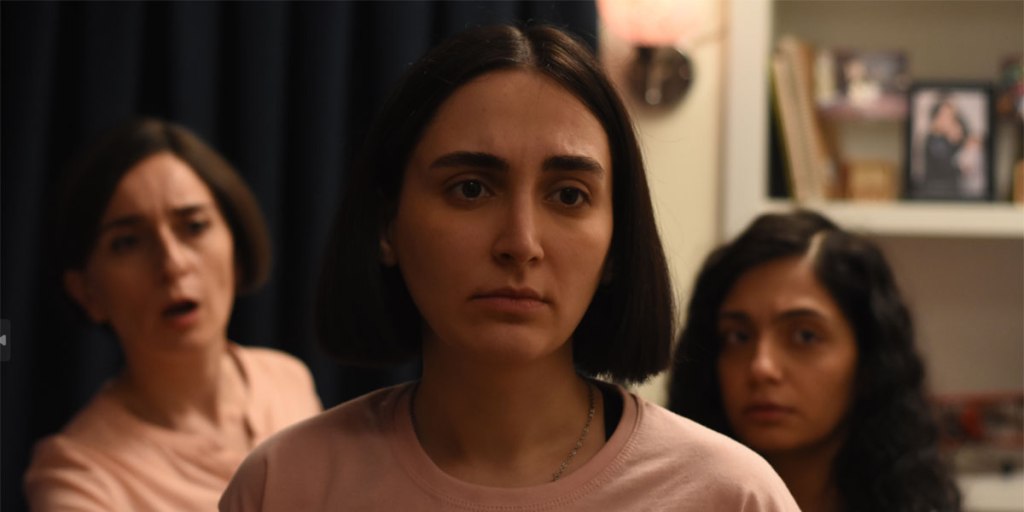
The Seed of the Sacred Fig
influence of an authoritarian government on all of their lives. It was shot entirely in Iran, on the sly, by noted director Mohammad Rasoulof who smuggled it out of the country. (It was edited in Germany.)
The Room Next Door
daughter). And though deathly afraid of death, Ingrid agrees. They move to a gorgeous isolated wood-and-glass
between. Instead it is subtle, soft, and gentle. And yet it still clearly is Almodovar’s work. The set design, colour palette, camerawork, the
leave a comment