Kill, Pray, Dead? Films reviewed: All You Need is Kill, Dead Man’s Wire, The Testament of Ann Lee
Hi, this is Daniel Garber at the Movies for culturalmining.com and CIUT 89.5 FM.
This week, I’m looking at three great new movies with terrifying titles. There’s a religious leader giving her last will and testament, a hostage-taker with populist appeal, and a futuristic killer… who might save the planet.
All You Need is Kill
Co-Dir: Ken’ichirô Akimoto, Yukinori Nakamura
It’s the near future in a sparsely-populated, rural part of Japan. Rita (Ai Mikami) is a young woman waking up to another day. She has bright red hair in a pageboy haircut, with a jaded look on her face. She volunteers at a government project to care for the roots and branches of a giant plant. Exactly one year earlier, an enormous piece of vegetation — known as Darol — landed there from outer space and spread its tentacles for miles in all directions. The mother plant is a giant tower with colourful pointed leaves. It seems weird but harmless, and the volunteers, who wear helmeted space suits, scrub clean its enormous roots each day. Until today, when suddenly the plant spits out a small army of giant-legged flowers — like colourful daisies with hairy petals — resulting in mayhem,destruction and death. Only Rita fights back, killing one of the flowers before being overwhelmed by an intense wave of red light.
Next thing you know, she’s waking up in bed again as if nothing ever happened! Sure enough everyone else at work is alive and well, with no memories of the previous day. Was it just a dream? No, the daisy-monsters attack again, and
everybody — including Rita — dies. This repeats over and over, like a never-ending groundhog day. She tries to escape, tp hide, she trains herself on new fighting techniques she even climbs into an enormous metal exoskeleton… but she always dies in the end.
Life and resistance seem futile, with the red tentacles poised to colonize the earth. Until one day she spots a guy standing alone, observing her with a tiny, flying drone. She is angry and upset… until he tells her, he’s just like her, remembering each day too. And Rita is his hero. Keiji (Natsuki Hanae) is a geek who likes playing computer games and gazing at the stars, keeping himself far removed from danger. But together… can they defeat these awful killer daisies, and save the earth?
All You Need is Kill is an animated, science fiction fantasy, with a bit of unexpected romance thrown in. Based on a Japanese novella by Hiroshi Sakurazaka, it’s already been made into a Hollywood sci-fi action movie, Edge of Tomorrow with Tom Cruise… This one has a very different feel and a female lead. I like the noir mood, set against endless highways and deserted gas stations (rather than quaint Japanese towns). And I love the Rita character as the unflappable, existential heroine, full of nihilistic tendencies. But most of all, I love the art and animation, the colour blast of psychedelic images and cool settings.
All you Need is Kill is satisfying sci-fi anime, without any cheap AI gimmicks.
Dead Man’s Wire
Dir: Gus Van Sant
It’s a cold winter day in Indianapolis in 1977. Tony Kiritsis (Bill Skarsgård: Nosferatu, The Crow, John Wick 4) is in a downtown high-rise. He has an appointment with the head of Meridian Mortgage, the bank he deals with. But M.L.
Hall (Al Pacino), the CEO, is not available: he’s in Florida, drinking cocktails and nibbling burritos. So the vice-president, ML’s son, Dick (Dacre Montgomery) says he’ll meet with him instead. But Tony has a bone to pick. A rather big one. He owned a plot of land he was going to turn into a shopping mall, until he was double-crossed by ML Hall, sabotaging his plans, ruining his life and swindling him out of his fortune. He wants revenge, restitution for the money he lost and a sincere apology. So he walks out of the building with a long gun wired to Dick Hall’s head (what’s known as a dead man’s wire). Any false move… kaboom!
But by this point, the cops have surrounded the building with snipers ready to kill. A cub reporter (Myha’la) who previously only did human interest stories, is there with her news van, scooping the story with eyewitness updates. And in the background is the smouldering Voice of Indianapolis (Coleman Domingo) on transistor and car radios everywhere. Tony manages to take Dick to his apartment, armed with
explosives, and release his demands. But can a regular guy take on a City Hall, a powerful bank and the police force… and survive?
Dead Man’s Wire is a dramatization of a true event that gripped a city in the 1970s. There’s a definite Luigi Mangione feel to it, with a “I’m mad as hell and I’m not going to take it anymore!” vibe, of an ordinary person taking on a corrupt system. The acting is excellent. Bill Skarsgård — with his nervous moustache — wavers between funny and intense, Dacre Montgomery (he played Billy Hargrove in Stranger Things) transforms from terrified Dad to resigned hostage, and Al Pacino manages to convey the repulsiveness of his character in just a few minutes of screen time.
Gus Van Sant is one of the best American directors, but he hasn’t been making many movies — this is his first one in eight years. And though this is a true crime thriller, he aims toward character study rather than cheap, excitement. It’s a period piece and he gets that 1970s midwest urban feel spot on, but also feels oddly appropriate for right now.
And despite the provocative title, Dead Man’s Wire is probably the most laid-back, True Crime thriller you’ll ever see.
The Testament of Ann Lee
Co-Wri/Dir: Mona Fastvold (The World to Come)
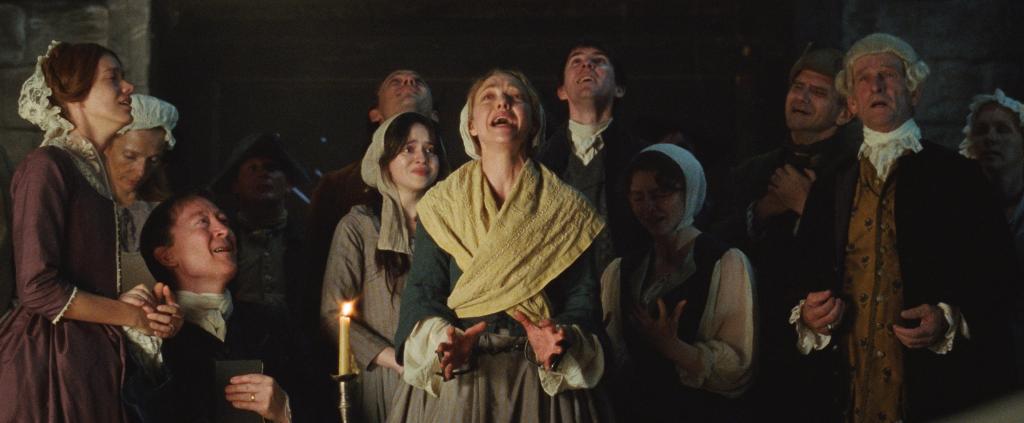
It’s Manchester, England in the mid-18th century. Ann Lee (Amanda Seyfried: The Housemaid, Seven Veils, First Reformed, Gringo, Lovelace, Red Riding Hood) is a little girl living a miserable life. She sleeps in a room with a dozen others, including her parents having sex. Put to work in a factory at a very early age — there are no child labour laws — she receives virtually no schooling outside of religious lessons. But she goes out of her way to protect her even younger brother William (Lewis Pullman: The Stranger Prey at Night, The Starling Girl). She eventually marries, but despite repeated tries with her new husband Abraham (Christopher Abbott), all their children die as infants. She joins a new religion, starts preaching to a flock, and begins to gain followers. And though she is childless her devotees call her Mother Lee. After increasingly brutal persecution, she emigrates to the American colonies, alongside her brother and her flock (sponsored by a rich parishioner).
They are called the Shakers, for the ecstatic dancing that is
central to their religion. They force all sins from their bodies by expelling puffs of air even as they dance and writhe in a sexual-seeming way. They sing songs of joy and gratitude, hold egalitarian meetings and are similar to the Quakers, with one crucial difference: No more sex of any kind. Devotees are not born as Shakers they join them in their own free will. As popularity grows, they form colonies all across New England. They become known for their skillful carpentry (furniture made without nails or glue) weaving, and simple, pure lifestyles. Men and women are treated equally, and believe the Messiah will return in female form. But other sects brand them as witches and heretics, and start to attack them and burn down their places of worship. What will happen to Ann Lee and her followers in the new world?
The Testament of Ann Lee is a sweeping, epic historical drama about the Shakers and their founder Ann Lee. It’s also musical, with characters breaking into religious songs and chants throughout the film. They dress in lovely white dresses, and dance in semi-orgasmic circles of ecstasy. The beauty of this story and richness of the characters is portrayed in visually, audibly and emotionally stunning ways. Even the fonts used in the credits are attractive. Which is not surprising, since Fastvold and her creative partner Brady Corbet brought us The Brutalist last year. One small quibble: Amanda Seyfried’s attempt at a Manchester accent. Which she more than made up for in her passionate — and enigmatic — portrayal of Ann Lee.
Highly informative and exquisitely crafted, The Testament of Ann Lee is definitely worth seeing.
The Testament of Ann Lee, Dead Man’s Wire and All You Need is Kill all open in Toronto this weekend; check your local listings.
This is Daniel Garber at the Movies, each Saturday morning, on CIUT 89.5 FM and on my website culturalmining.com.
International Women’s Day! Films reviewed: True Mothers, The World to Come, My Salinger Year
Monday is International Women’s Day, so this week I’m looking at three new movies that celebrate women. There’s a woman who encounters her adopted son’s birth mother; an aspiring writer in 1990s Manhattan; and two women in 19th century, upstate New York.
Wri/Dir: Naomi Kawase
Satoko (Hiromi Nagasaku) is a married professional woman in Western Japan. She and her husband enjoy their kids-free lifestyle — fine dining, travel, and a high-rise luxury condo. But they long for a family of their own, and so far, it isn’t working., despite various medical interventions. Then one day on a talk show they see a woman telling about her organization. It’s called Baby Baton because the infant is passed on like a baton from the birth mother to its new parents. Adoptees have to pass rigorous requirements, including that one parent must quit their job and become a full-time house parent. Unsurprisingly, Satoko takes that role. And they bring home the newborn baby of a 14-year-old junior high girl named Hikari (Aju Makita). That was five
years ago. Now they are devoted to their adorable adopted son, Asato. But their world is turned upside down by a knock on the door by a woman who claims to be the boy’s mother. And, she says, she wants him back.
True Mothers is a touching intimate story of two women’s lives. The movie is divided in half, The first part is all about Satoko and her husband and son, the trials and tribulations of raising a child. The second half is about Hikari the birth mother, and her life since giving up the baby. It explores her time on a misty remote island off Hiroshima (at the Baby Baton headquarters), where she spends the final months of her pregnancy, but also the dark turn her life takes afterwards. Naomi Kawase is one of very few female directors in Japan, and as in all her movies, the story is gently told but full of pathos. Well-acted and very moving with lovely cinematography, True Mothers pulls no punches when dealing with the reality of fertility, unplanned pregnancy, and the other side of adoption.
Very nice movie.
Dir: Mona Fastvold
It’s the 1850s in rural upstate New York. Abigail (Katherine Waterston) is a morose young woman with a stern demeanour and long black hair. She lives in a farmhouse with her husband Dyer (Casey Affleck). They have a flock of sheep, chickens and milk cows. They used to have a little daughter, the light of their lives, but she died before she was five. Since then, it’s been a loveless marriage and the two barely speak to each other, just coasting through life without a purpose. Dyer records financial records in his ledger, while Abigail writes her thoughts and observations in a black-bound diary. But everything changes when they meet their new neighbours who rent a farm over the hill. Tallie (Vanessa Kirby) has ginger hair and fiery eyes, and she swooshes past in elegant gowns. Her husband Finney (Christopher Abbott) has a dark side carrying bitter grudged just waiting to explode. Abigail and Tallie become instant friends, sharing thoughts, sharp observations, secrets. Their husbands notice the change — why are they smiling? Why are they so
happy? Could these two friends like each other more than their husbands?
The World to Come is a passionate and poetic romance, about two women who find love along the harsh frontier. It’s narrated by Abigail’s diary entries and love letters from Jan to July of the same year, and the story is told in a literary style, like the turning pages of a book. But it’s not all talk, it’s a beautifully shot movie full of burnished wood, wrought iron, fireplaces, cotton dresses and candlelight. It’s filmed on location, with harsh winter blizzards and beautiful spring days. And while not explicit, there are sensuous scenes of Abigail and Tallie kissing furtively in dark doorways, or sneaking off into the woods. Very famous cast: Vanessa Kirby plays Princes Margaret in The Crown, and Katherine Waterston is in Fantastic Beasts and Inherent Vice. And the husbands, Christopher Abbot and Casey Affleck, are very well known, as well. While I wasn’t deeply moved by this movie, I did care about what happens to the characters, and the film itself is visually very nice to look at.
Wri/Dir: Phillippe Falardeau (Based on the Memoir by Joanna Rackoff)
It’s the 1990s in Manhattan. Joanna (Margaret Qualley) is a young grad student and aspiring poet, who is visiting the city to experience literary New York. She has a boyfriend back in Berkeley, but in the meantime she’s camping out in her best friend Jenny’s cramped Village apartment. Her “room” is a tiny space in the corner separated by a folding paper screen. And she lands a plumb job; not as a a writer or working for a publisher, but in the office of a venerable agency. The company is headed by Margaret (Sigourney Weaver) who looks like a stately Susan Sontag. Margaret’s biggest client is
JD Salinger, author of Catcher in the Rye and Franny and Zooey, whom she calls Jerry. He hasn’t published anything since the ’60s, but he’s still wildly popular. As Margaret’s assistant, Joanna’s main job is dealing with the bags of fan mail delivered each day. Salinger is a recluse, and never sees any mail — they shred each letter, but not before reading it, and sending out a hand-typed — we’re talking typewriters here, no computers allowed in the office — form letter, saying thank try for your kind letter, unfortunately JD Salinger won’t see it.
Meanwhile Joanna is luxuriating in the literary life: having lunch at the Waldorf, rubbing shoulders with famous authors (though never Salinger). She goes to poetry readings at the right cafes and moves in with her handsome new boyfriend Don (Douglas
Booth), a working-calls writer who’s also a bit of a dick. Will Joanna stay on in Manhattan or return to California? Can she forge a career as a literary agent? And will she ever meet Salinger?
My Salinger Year is a true memoir based on the writer’s own early career. It’s delightful to watch —who would have guessed we could feel nostalgic for the 90s? She experiences the city, wandering into places like the New Yorker magazine’s offices. And it’s full of wonderful vignettes about the quirky people she meets in her office (played by Colm Feore, and others.) It also shows us the writers of the fan mail, each of whom addresses the audience directly, reciting the texts of their letters. The film
is made by Quebec director Philippe Falardeau (Monsieur Lazhar) and is shot around Montreal. As always, his movies are full of warm, funny characters and lots of detail; he doesn’t gloss over what’s going on. Falardeau also has some weird trademarks — characters break into music videos or start dancing — which I don’t quite get, but luckily it doesn’t detract from the story. You can tell Sigourney Weaver and Margaret Qualley loved making this movie, and if you’re into writing or reading books, or the whole literary milieu, you’ll enjoy it, too.
True Mothers, The World to Come, and My Salinger Year are all playing today on VOD or streaming sites.
This is Daniel Garber at the Movies, each Friday morning, on CIUT 89.5 FM and on my website, culturalmining.com


leave a comment