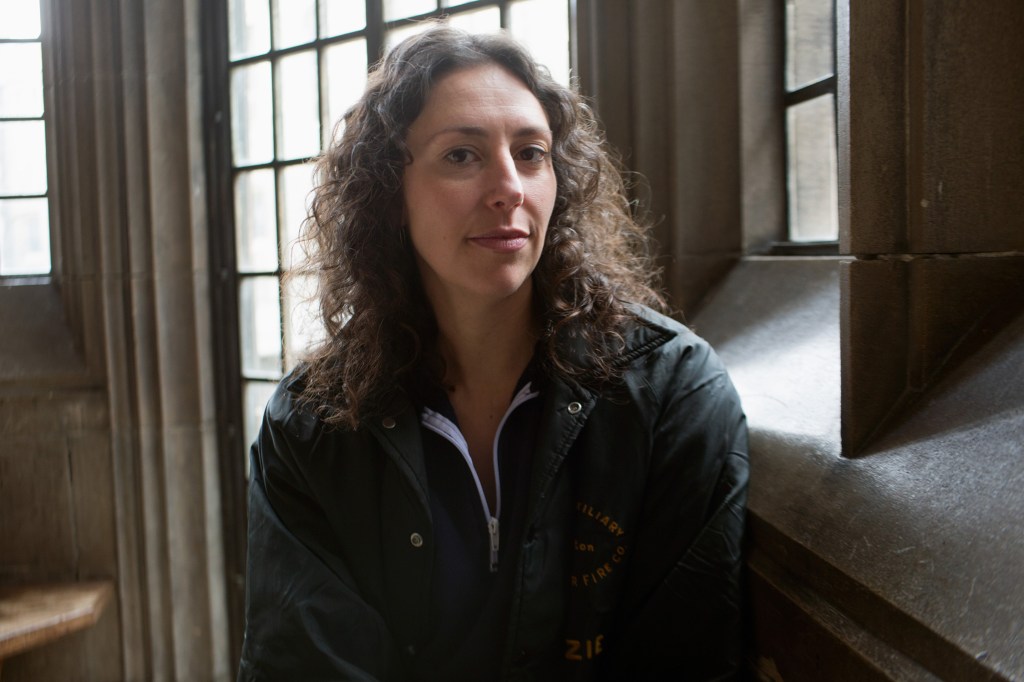
Jeff Harris talks with Ali Weinstein about her new documentary Your Tomorrow

Posted in Canada, documentary, History, Protest, Toronto by CulturalMining.com on February 6, 2025

Photograph and Interview by Jeff Harris

Your film points out a stark contrast between 1970s Toronto (when Ontario Place was opened) versus today. What exactly is going on? 

I’m really quite sad and devastated about what’s happening at Ontario Place right now to be honest. I was never a fan of what’s been chosen to go on the west island because I don’t think it that it retains the spirit of Ontario Place as it was meant to be, this lasting place of exploration, education and fun for Ontarians. I tried to not make the film itself be an essay for my own personal point of view, I tried really hard to show the place as it was and I heard different reactions from people where they’ve watched the film and said “yeah, it does need to be redeveloped”. In terms of what’s coming next I don’t think it’s in line with what Ontario Place was meant to be and I think that the original spirit of Ontario Place is a really beautiful one, one that should be fought for today because we have even fewer places to be outside and to be in nature in this city.

The city has only gotten far far far more dense in the last 50 years and you have places like Liberty Village that didn’t exist in 1971 when Ontario Place opened… now there’s a tonne of condos where people don’t have their own outdoor space but next door is this beautiful waterfront land with forested areas to walk, and nature and birds and foxes. There is so much nature present at Ontario Place so I don’t really understand the vision when it comes to turning it into a spa.

What are the concerns about the spa?

The fact that it’s not a Canadian venture, it’s a European / Austrian owned spa that has this very not transparent deal with a 95 year lease that has been signed. I have a hard time imagining that my great grandchildren are gonna have the desire to go to the same spa that some people today might go to as a one off. I think there were probably many other visions for that land that got sent into the government when they opened it up proposals in 2019 that could have been tourist attractions, that could have made money for the province if they really prioritized that and they could have stayed with the original intent of being about Ontario and teaching people the history, the indigenous history of Ontario, what we have to be proud of as a province and that could have been more the focus as opposed to something indoor, foreign owned, and the vision just doesn’t feel like it’s towards longevity with the spa. 

There’s a great line in the film where one of the protesters points out that this natural park is essentially a spa already!

She was part of a group of people that used the beach all the time, they would swim, hang out, exercise on the beach and it was a place for physical and mental wellbeing. I think a lot of the people that started to congregate at Ontario Place, many of them found the space during the pandemic when everyone was going loopy and stuck at home and isolated. People found community there and found other like-minded people there who wanted to be active, to be outdoors — and this was in their backyard! So when they talk about it already being a spa, they mean it’s been so beneficial for them. I felt that way myself going to Ontario Place.

Are you a fan of spas?

I enjoy going to a spa here and there… and some of my favourite parts of being at a spa are going with friends, going to catch up with people, to have sometimes a cultural experience like I love going to the Russian Spa, or the Korean Spa. The type of spa that’s going to be built at Ontario Place, I don’t foresee it being a place that people are going to go to repeatedly… it’s being marketed as a tourist attraction and I don’t know why that would go in the heart of the city on this very valuable prime land. It’s one of the few parts of the waterfront that’s actually accessible to residents of Toronto, where they can swim and boat and paddle board and run and jog and cycle and birdwatch and fish and so many different things so I think that the idea of it being a place of well being is interesting messaging from the government. So many people were using it for exactly that during the pandemic! It became this defecto public park because the government wasn’t doing anything with it.

Your Tomorrow had its world premiere at #TIFF24 and will have its broadcast premiere with TV Ontario on March 23rd at 9pm.

Daniel Garber talks with Ali Weinstein about her new doc Your Tomorrow

Posted in Canada, documentary, History, Protest, Toronto by CulturalMining.com on November 30, 2024

Hi, this is Daniel Garber at the Movies for culturalmining.com and CIUT 89.5 FM.

It’s the 1970s in Toronto, just a few years after the Centennial and Expo 67, and pride is running high. A huge new theme park, built on four islands made of reclaimed land on Lake Ontario, is opening to great fanfare. It offers an outdoor concert stadium, a geodesic Cinesphere, the first one ever built to show IMAX movies, and a kids’ park with playgrounds, music and automatons. It’s surrounded by tall trees, grassy areas and flowers everywhere. It’s called Ontario Place, and is packed with visitors.

Flash forward to the 2020s. Ontario Place is still attracting crowds but, after decades of neglect,  many of its pavilions have closed down permanently, and the park itself ain’t what it used to be. But it still has nature trails, forests and a pebble beach. And then Premier Doug Ford announces the park is closing down for renovations. They’re fencing it off to clear cut trees and tear up the park in order to build a gigantic, private, for-profit European health spa and water park on public land, following a big-money, backroom deal.  People across the province are shocked… and the protests begin. But no one knows exactly what will become of this beloved park in the days to come.

Your Tomorrow is the name of a new Canadian documentary about Ontario Place, its history and the people who love it in this crucial period of change in its future. It follows visitors, locals and park employees to get a cross section of views. Delving deeply into people, nature and politics, it silently observes  the skateboarders, polar bear swimmers, security guards and concert-goers who still flock to the park. It’s both low-key and heart breaking. The film is written, directed and produced by award winning filmmaker Ali Weinstein, who made the quirky Mermaids in 2016 and #Blessed in 2020. (My interview with Ali, Blessed, 2020)

Your Tomorrow had its world premiere at #TIFF24 and opens theatrically at Toronto’s Hot Docs Ted Rogers Cinema on Friday, December 6.

I spoke with Ali Weinstein in Toronto via ZOOM.

Art and deception. Films reviewed: Propaganda: The Art of Selling Lies, The Art of Self Defense, Push

Hi, this is Daniel Garber at the Movies for culturalmining.com and CIUT 89.5 FM.

The things you see online – or on TV for that matter – aren’t always true (suprised?). This week I’m looking at three movies, two docs and one dark comedy, about lies and deceptions. There’s a man who trains in the art of karate, a look at the art of selling lies, and a look at the lies of selling real estate.

Propaganda: The Art of Selling Lies

Dir: Larry Weinstein

What is Propaganda? Is it art and literature? Or brainwashing and fake news? The word comes from a benign Catholic term meaning the propagation of faith, the planting the seeds. The Vatican opened a department of propaganda to counter Martin Luther’s austere reforms. It combined the opulance of baroque cathedrals, the lure of incense and all the lush frescos, paintings and marble statues you’ve seen. But art and magic and religion were around long before that, and so, says this documentary, was propaganda. Some historians trace it as far back as Neandrathal cave paintings.

Propaganda is easy to spot in other cultures but very hard to see in your own.  Many people were entanced by dictators like Hitler and Stalin thanks to their skillful use of films (like Leni Riefenstahl’s Triumph of the Will) radio broadcasts and posters. But with the shift to digital culture, it has taken on new forms; like patently false news stories online, repeated ad infinitum, until people start to believe it.

Propaganda: The Art of Selling Lies is a fun, light documentary that talks to a lot of artists and writers – Astra Taylor, Ai Weiwei and Kent Monkman – but also musicians, analysts and others. It shoots a constant barrage of propaganda at you, images from the past 100 years, shown in harsh black and white periodically blanketed in fields of red. A lot of it is familiar but there are also some bizarre juxtapositions you’ve never heard of: like the racing cars that now drive around the former Nazi Nuremberg Stadium. Or Laibach, a Slovenian band known for its fascistic costumes and images, who performed in North Korea before a concert hall of nonplussed party apparatchiks and university students. Very funny.

The Art of Self Defense

Wri/Dir: Riley Stearns

It’s the 1990s in small-town America. Casey (Jesse Eisenberg) is a shy accountant who lives with his dachshund. He’s a 98-pound weakling who works in an office full of alpha males. But when he’s violently attacked by strangers on motorbikes he decides something has got to change. No more sand will be kicked in his face! He joins a local karate dojo with its own set of hierarchical rules. Everyone is ranked by their belt colour. There’s Anna (Imogen Poots) who teaches the kids class; get on her wrong side and she’ll beat you to a pulp. And at the top of the heap is Sensei (Alessandro Nivola).

He says karate is not just a martial art, it’s a way of life. You must punch with your feet and kick with your hands. Casey is starry-eyed, and ready to do whatever Sensei tells him. You must become more masculine, he says.  Stop learning French, start learning German. And throw out those adult contemporary CDs; only listen to metal! Casey takes the blue pill. He leaves his job and devotes his life to karate. He worships Sensei, has a secret crush on Anna, and proudly displays his low-ranked yellow belt for all to see.

But something is not right. When he joins the mysterious night classes he is exposed to a violent world of hyper-masculinity he doesn’t subscribe to. He is asked to perform dubious tasks outside of the dojo. Is this place only about karate? Or is it a cult? And what is hidden behind Sensei’s secret door?

The Art of Self Defense is a low-budget, uncategorizable, odd sort of a movie, part dark comedy, part mystery, with a bit of violence and horror mixed in. It’s slow to develop, but picks up nicely about halfway through. It’s filled with wood paneling, old computers and ugly clothes from the 90s, which adds a humorous tinge. But It’s hard to tell whether it’s being satirical or straightforward, comic or scary. Jesse Eisenberg is totally believable as the wimpy accountant trying to become more manly, and Allessandro Nivola is good as the mysterious sensei.

Take it as a cautionary tale about the search for masculinity, self-confidence and the cult of martial arts and you’ll enjoy this dark comedy.

Push

Dir: Fredrik Gertten

There’s a housing crisis in the world’s cities and no one knows seems to know what’s going on. In Toronto there’s a shortage of affordable apartments, with stagnant wages, soaring rents and home prices quadrupling. Speculators are buying up land as a bankable commodity, something bought and sold, with little thought given to the people who live there. And in many cities entire blocks of housing sit empty, because rent income is dwarfed by what they can earn from the constant increase in value of the buildings themselves. What’s going on?

Enter Leilani Farha, the United Nations Special Rapporteur on Adequate Housing. She’s a mom from Ottawa who travels around the world collecting data and advocating on behalf of tenants everywhere. She views housing not as an investment but as a right.

This documentary looks at the dire situation in the world’s cities – from Milan to Berlin, Seoul to Valpariaso – where people are facing the same situations: gentrification, renoviction, and the displacing of average- and low-income earners from the world’s cities.

It explores the role of organized crime in the housing crisis. They use property investment as a way of laundering money by over investing in legit properties, driving up demand and prices and hiding their illicit profits.

It looks at how the financial sector is turning housing into an investment commodity, with the people who live in them entirely erased from the equation. One particularly notorious player is Blackstone – founded by former Lehman Brothers execs – a voracious American property investment company that swooped into the real estate market after the stockmarket crash of 2008. Now they’re making money by buying up public housing for profit, while neglecting the people they were actually built for.

And it looks at the role of pensions, both government and private, which invest in housing to grow their capital, but, unintentionally, lead to skyrocketing prices and increasing homelessness.

Push is an incredibly important and informative documentary that explains in simple terms the economics, politics and effects of this crisis. It uses experts – like Joseph Stiglitz, Saskia Sassen and Roberto Saviano – to explain the reasons behind the crisis. But it also talks with ordinary people around the world. It shows the multiple, small-scale problems people face as well as the large-scale disasters, like the Grenfell Tower Fire in London. They are all related. And it’s the great Leilani Farha who is trying to confront these problems in a new way.

I recommend this doc.

Propaganda: The Art of Lies, Push, and The Art of Self Defense all open today in Toronto; check your local listings.

This is Daniel Garber at the Movies, each Friday morning, on CIUT 89.5 FM and on my website, culturalmining.com.

Daniel Garber talks with producer Jason Charters and director Larry Weinstein about Dreaming of a Jewish Christmas

Posted in China, Christianity, Christmas, Christmas songs, Cultural Mining, documentary, Eating, Judaism, Music, Toronto by CulturalMining.com on December 22, 2017

Hi, this is Daniel Garber at the Movies for culturalmining.com and CIUT 89.5 FM.

It’s the 1960s. Chestnuts roasting on an open fire… outside the snow is falling and friends are calling yoo-hoo… it’s Christmastime in the city. Mom, Dad and the two kids get in the car to go out for their traditional family dinner. Is it ham? Turkey? No… it’s Chinese food! Beause these folks are dreaming of a “Jewish Christmas”.

Dreaming of a Jewish Christmas is a new documentary that looks at the secular celebration of a religious holiday in North America and how it’s reflected in popular culture – especially in Christmas songs. It re-eneacts a 1960s dinner in Chinatown with new performances of classic Christmas songs by Steven Page, Dione Taylor and Aviva Chernick.

The film was produced in Toronto by Jason Charters and Liam Romalis at Riddle Films and directed by Oscar nominee Larry Weinstein.

I spoke with Jason in studio at CIUT and with Larry via telephone.

Dreaming of a Jewish Christmas is playing on CBC Documentary Channel on Dec 24 and Dec 25.