Huge changes. Films reviewed: Cloud, Don’t Let’s Go to the Dogs Tonight, Eddington
Hi, this is Daniel Garber at the Movies for culturalmining.com and CIUT 89.5 FM.
This week I’m looking at three great new dramas about people facing huge changes in far-flung places. There’s a man in Japan pursued by unknown enemies; a girl in Zimbabwe on the eve of an election; and a sheriff in New Mexico at the dawn of a pandemic.
Cloud
Wri/Dir: Kiyoshi Kurusawa
It’s present-day Tokyo. Yoshi (Masaki Suda) is a guy in his 20s with a certificate from a vocational school. He’s socially and emotionally challenged. Yoshi lives in a cramped apartment with his girlfriend Akiko (Kotone Furukawa). He works in a factory, pressing clothes, but after three years is still struggling financially with no chance of advancement. Luckily, he has a side hustle: a reselling site where he marks-up cheap goods online and sells them for profit: French designer knock-offs, electronic devices, collectible toys; the content doesn’t matter, just the speed of turnover and how much profit he makes. At the moment, he’s doing so well he decides to quit his factory job, turn his reselling site into a full time occupation and relocate to a large house in the countryside with cheap rent. Akiko agrees to move with him, and he hires a local kid, Sano (Daiken Okudaira) as his assistant. And with the business doing so well, he figures he can relax now and let the cash pour in. But it’s never that simple.
Strange things start happening. Yoshi is knocked off his motorcycle by a wire stretched across a road. Someone tosses a chunk of metal through his glass window. And Sano does an ego-surf on Yoshi’s site and finds online chatter from dissatisfied customers threatening to kill him. (He keeps his website completely anonymous). At the same time, local police are investigating him for fraud, Akiko is reaching her breaking point, and Yoshi fires Sano for using his computer without permission, leaving him all alone in his country home. But when armed masked strangers start showing up at his door, Yoshi realizes it’s time to drop everything and get the hell out of there. Who are these angry strangers? What do they want? And how can he get away?
Cloud is both an almost surreal, cyber suspense thriller and a
cautionary crime drama. Masaki Suda’s plays Yoshi as a man without any self-awareness… who assumes no one else notices him either.
It starts as a slow-burn, but explodes, halfway through, into a violent, action/thriller, with more than one totally unexpected plot turn. Though the main character spends much of his time staring at a distressingly dull website, waiting for buyers to check in, the outside world is full of geometric sets with sharp turns, cloudy windows, green forests and dark shadows. With lush music played against abandoned warehouse walls, Cloud lets suspense carry us through to the shocking finish.
I like this suspenseful crime-thriller a lot.
Don’t Let’s Go to the Dogs Tonight
Co-Wri/Dir: Embeth Davidtz
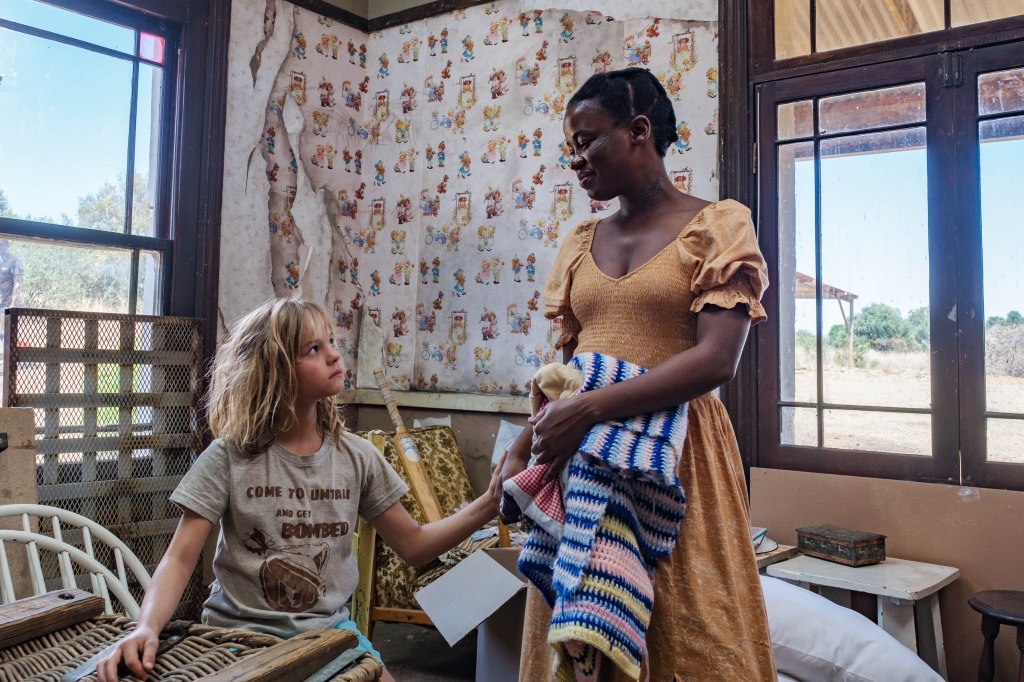
It’s 1980 in Zimbabwe-Rhodesia. The Bush War is over, and white minority rule has ended, pending its first democratic election. Bobo Fuller (Lexi Venter) is a seven-year old girl who lives with her family on a dried out cattle ranch. She wears her face dirty and blonde hair tangled. Bobo smokes cigarettes and rides her motorbike around the farm with a rifle strapped across her back. She fears two things: ticks and terrorists.
Her mom Nicola (Embeth Davidtz) makes it clear she will never leave her land. As grandma likes to say, we have breeding, not money. She’s a heavy drinker, prone to guzzling brandy and dancing with abandon during her manic episodes. Bobo’s Dad is more reasonable, but disappears for weeks at a time. Her older sister (Rob Van Vuuren) lives there too, but has no time for her bratty little sister.
So Bobo is essentially raised by Sarah (Zikhona Bali) their nanny and housekeeper. Bobo tries ordering her around like a grown up — bring me my porridge! — but Sarah sets her
straight: she’s too young to be bossy. And it’s Sarah who tells her stories, answers her questions and explains what happens to us after we die.
The family gets together with other whites in nearby farms for parties and barbecues. But there’s tension in the air as they await results from the election. Sarah, too is worried: she might be targeted by nationalists if seen taking care taking care of a girl like Bobo. What will happen after the election? And will any changes be permanent?
Don’t Let’s Go to the Dogs Tonight is a drama based on the memoirs of Alexandra “Bobo” Fuller. It’s full of abrasive characters and their casual racism, and pulls no punches in their portrayal. The whole film is shot through the eyes of a little girl, so with the camera kept low, we might just see people’s legs from under a table or an obscured lens when she’s squinting at the sun.
Actress Embeth Davidtz evokes her own South African background (where the movie was shot) in telling Bobo’s story. This is her first time directing, and its a fascinating adventure in creativity. And though her excellent portrayal of a difficult, bi-polar Mom — alongside Zikhona Bali’s terrific turns as Sarah — , it’s really about Lexi Venter as Bobo, who gives a natural performance in every scene, either as the centre of attention or as quiet observer.
Don’t Let’s Go to the Dogs Tonight is an excellent memoir of a difficult period of history.
Eddington
Wri/Dir: Ari Aster
It’s April, 2020 in Eddington, a small town in New Mexico, just as the Covid lockdowns mask mandates are kicking in. Working class Joe Cross (Joaquin Phoenix) is the town Sheriff, just as his dad was before him. He lives in a ramshackle home with his catatonically depressed wife Louise (Emma Stone) and her conspiracy-theory addled mother Dawn (Deirdre O’Connell). He works with his two faithful officers Michael (Micheal Ward) and Lodge (Clifton Collins, Jr).
On the better side of town lives the upper-middle-class Mayor Ted Garcia (Pedro Pascal) — a smooth talker and a consummate politician — who is running for re-election. He is expected to open a mysterious tech conglomerate on the outskirts of town. His son, Eric (Matt Gomez Hidaka) is an arrogant and spoiled rich kid. He hangs out with his friend Brian (Cameron Mann), drinking beer and smoking pot. They are both after idealistic high school student Sarah (Amélie Hoeferle) who they try to impress by quoting Angela Davis. Then comes the news that George Floyd, a Black man in Minneapolis, has been killed by police. Demonstrations follow but the small town is already divided on ideological grounds, with everything recorded on cel phones and posted online: those who wear masks with social distancing, vs those who don’t. But as tensions build, and Mayor Ted publicly humiliates Sheriff Joe, he declares he’s running for mayor, too.
Eddington is a sharp and scathing social satire about life in
America during the pandemic. It’s half dark- comedy and half thriller/horror as it devolves from light absurdity into a hellish fantasy. It covers a huge variety of topics, including religious cults, false memory syndrome, big tech, culture wars, white supremacy, the dark state, and indigenous relations… to name just a few. I love all of Ari Aster’s movies — Heredity, Midsommer and Beau is Afraid — and Eddington, though more of a Western than strictly horror, continues his cycle. While Joaquin Phoenix’s Joe is the film’s focus, it’s actually an ensemble cast with at least 20 crucial roles.
Eddington is brilliant, hilarious and shocking… putting his magnifying glass on all of us, just a few years ago.
it’s a must-see.
Cloud, Don’t Let’s Go to the Dogs Tonight , and Eddington all open this weekend in Toronto; check your local listings.
This is Daniel Garber at the Movies, each Saturday morning, on CIUT 89.5 FM and on my website culturalmining.com.
Japanese women. Films reviewed: Wife of a Spy, Mio’s Cookbook, The Brightest Roof in the Universe
Hi, this is Daniel Garber at the Movies for culturalmining.com and CIUT 89.5 FM.
Toronto’s spring Film festival season continues. Toronto Jewish Film Festival finishes this weekend, with two great French films, Summer of 85 a gay mystery romance set in the 80s and directed by Francois Ozon; and The Specials, a crowd pleaser by Olivier Nakache and Éric Toledano, best known for the hugely popular Intouchable. It’s about a makeshift social services centre in Paris for hard-to-handle kids with autism.
But this week, I’m talking about another TJFF, the Toronto Japanese Film Festival. This one is also digital, but each film plays for the duration of the festival, until June 27th. And as always, it’s deftly programmed, with movies ranging from samurai to Yakuza to family dramas, romance, comedies, action, anime, and even some movies adapted from manga.
This week, I’m looking at three new Japanese features told from a female point of view. There’s a cook trying to capture the flavours of her childhood, a high school girl who seeks answers on top of a roof, and a wife who can’t decide whether her husband is an adulterer… or a spy.
Dir: Kiyoshi Kurosawa
It’s the 1940s in Kobe Japan where Satoku and and Yusaku are a happily married couple. Satoku (Aoi Yu) is a movie actress and Yusaku (Takahashi Issey) a rich businessman who owns an import-export corporation. Japan is at war, but they continue live a western-style life of peaceful luxury. But everything changes when Yusaku and their nephew Fumio return from a business trip in. Manchuria. a Japanese puppet state in Northeastern China. There they witnessed unspeakable atrocities and war crimes committed by the notorious Kwantung Army (aka Kantogun), an elite branch of the Japanese military. And they brought a young Japanese woman back with them.
Satoku sees only the young woman and knows nothing of the war crimes — is her husband cheating on her?. Meanwhile, a childhood friend named Taiji relocates to Kobe. She remembers him as a kind young man. But now he’s a member of the dreaded Kempeitai, the Japanese Gestapo. He criticizes her for wearing dresses instead of kimonos and for drinking foreign whiskey not Japanese. He’s also secretly in love with her. And he suspects Fumio
and possibly even Yusaku, are traitors spreading Japanese war secrets to the enemy. Or is he just trying to break up their marriage?
But when she discovers the truth about the horrors of war, she confronts her husband — does he have proof? Eventually she has to decide whether to become a spy herself or turn in her husband to the police.
Wife of a Spy is great WWII thriller, full of jealousy, intrigue and numerous unexpected plot twists. Japan is not like Germany where filmmakers have produced hundreds or thousands of movies about their dark past. Rarely do you see Japanese films like this one. This movie is made for TV so everything is on a smaller scale with a more compact feel than a theatrical film, but under the direction of Kurosawa Kiyoshi and with its really good acting and script, (along with costumes, sets and music), it keeps the suspense building till the very end.
Great movie.
Dir: Haruki Kadokawa
It’s 1801. Mio and Noe are two 12 year-old girls in Osaka. They vow to be best friends forever. One day they encounter a fortune teller who says Noe is destined for great success, while Mio will have to pass through dark clouds before she reaches blue skies. The same night a huge flood sweeps away both their houses. Mio is an orphan adopted by a woman, and Noe completely disappears. Fast forward ten years.
Now Mio (Matsumoto Honoka) lives in Edo (Tokyo) and works as a cook in a small restaurant. But her love of the sweeter, subtler flavours of Osaka that she’s used to are not popular in her customers in Edo who prefer stronger, saltier tastes. So after much experimentation and hard work she comes up with a perfect blending of the two cuisines. She creates the perfect chawan-mushi egg custard, and her fickle customers love it. Soon, there are lineups around the block. Word reaches Yoshiwara, the red light district, where a mysterious courtesan who never shows her face in public and is known only as Asahi (played by Nao), sends an emissary to bring one back for her to taste. Meanwhile two men are also interested in her cooking: an aristocrat (Kubozuka Yusuke) and a doctor who frequents both the restaurant and the Yoshiwara district. But evil forces — in the form of competing restaurant owners — are working against her. They steal her recipes, send bullies to scare away customers and even set fire to her workplace. Can a woman become a famous chef in Edo? Will Mio ever find her childhood
friend? And will she find love in the confines of her restaurant?
Mio’s Cookbook is a lovely drama about friendship, cooking, class, religion, sex work, and the floating world of the pleasure district. It’s full of fascinating details about Japanese cuisine — each new dish she creates is displayed and labeled for you to see — and tons of period touches about life 200 years ago. It’s directed by Kadokawa Haruki, the notorious former movie producer, once heir to the Kadokawa publishing empire but who fell from grace in a cocaine scandal in the 1990s. A Japanese Spielberg, he knows how to craft a complex plot with many characters by pressing all the right buttons to keep the crowd wanting more. This is an enjoyable film that left me feeling… well, very hungry afterwards.
The Brightest Roof in the Universe
Dir: Fujii Michihito
Tsubame (Kiyohara Kaya) is a high school girl in a town somewhere in Japan. She has a crush on her next door neighbour Toru (Ito Kentaro) a banjo-playing dude who thinks of her more as a younger sister. She recently split up with her boyfriend after he posted cruel anonymous texts about her on everybody’s cel. And at home, her parents (her dad and step-mom) are preparing for a new baby. But will it take her place in the family? Tsubame has lots to worry about, which she does on the roof of a building where she takes Japanese calligraphy classes. Until one day she realizes she’s not alone up on that roof. There’s a tough-as-nails old lady up there, too, who rides around on a kids’ scooter.
This strange granny is outspoken and opinionated and makes Tsubame feel uncomfortable. There’s something about her she just doesn’t get. But eventually they become friend and confidants. Turns out Hoshi-ba (Momoi Kaori) — meaning granny from the stars — has special powers. She says she can fly and can solve almost any problem. In exchange for Hoshi-ba’s favours, Tsubame starts doing things for her — like finding her long-lost
grandson who lives somewhere amidst all the rooftops in the town. Is Hoshi-ba real or imaginary? And can she fulfil Hoshi-ba’s wish?
The Brightest Roof in the Universe is a sweet and absorbing coming of age story that touches on family, friendship and love. It also deals with more obscure topics like ink brush painting, jellyfish and astronomy It’s slow paced but not boring, and told in a series of revelatory chapters, some of which are total surprises.
It’s also a sentimental tear-jerker, but in a nice way. I like this movie, too.
Wife of a Spy, The Brightest Roof in the Universe, and Mio’s Cookbook are all playing, now through June 27th at the Toronto Japanese Film Festival.
This is Daniel Garber at the Movies, each Friday morning, on CIUT 89.5 FM and on my website, culturalmining.com


leave a comment