Not tourists. Films reviewed: Souleymane’s Story, The Legacy of Cloudy Falls
Hi, this is Daniel Garber at the Movies for culturalmining.com and CIUT 89.5 FM.
August is when people scour the earth for vacation spots, where they can soak up the glamour and romance of famous locales without ever actually living there. This week I’m looking at two new movies about the people who live in popular tourist destinations. There are asylum-seekers in Paris, and psychic-debunkers in Niagara Falls.
Souleymane’s Story
Co-Wri/Dir: Boris Lojkine
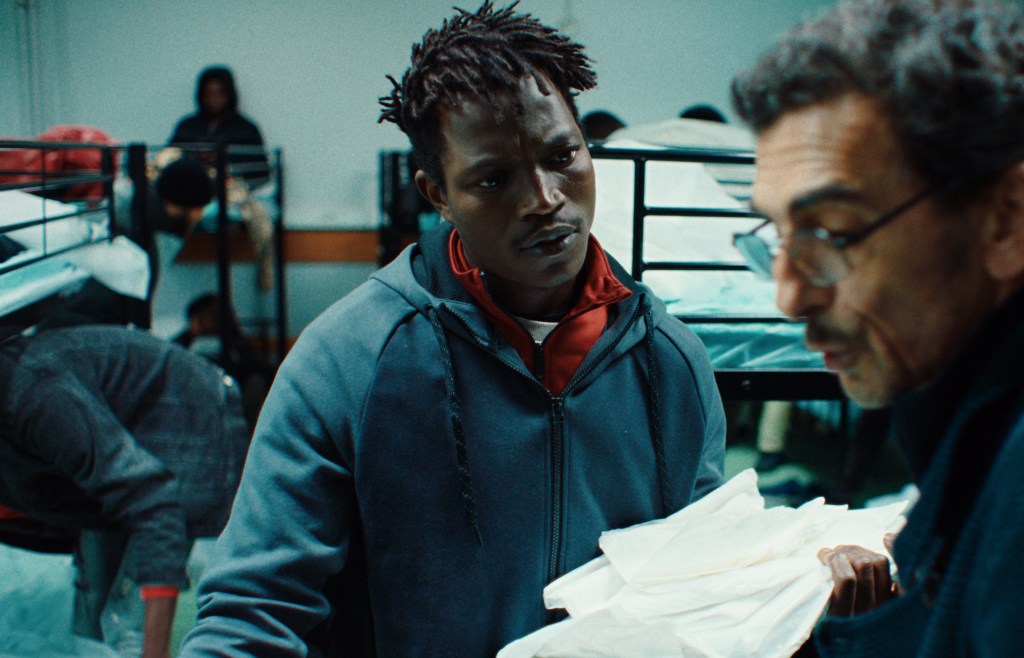
Souleymane Sangaré (Abou Sangaré) is a young man on a bike. His friends call him Souleye de Paris. He earns his keep delivering meals to paid customers across the city using his smartphone to record the deliveries and pass on his next assignment. Other young men from West Africa look up to him as a role model, and beg him to help them become couriers too. But Souleymane’s life is more complicated than it seems.
Originally from Guinee, he arrived in France as a refugee seeking asylum. His beloved girlfriend back home (they speak by phone) is talking about marrying someone else, and his mother seems particularly out of touch when he speaks with her. He is homeless, and sleeps in a dormitory far from the Gare du Nord. But he never gets a full night’s sleep because he is forced to wake up in the middle of the night to electronically reserve his next night’s bed. He catches a bus ride to and from the shelter, and if he’s late he’s forced to sleep in the rough.
Even his delivery job is done on the sly, using someone else’s name who takes a large cut of each transaction (he’s undocumented and can’t work legally.) And everything he does is done for one goal: his asylum interview scheduled in just a few days. He’s studying hard to pass that ordeal. And to do that correctly, he needs to hire a coach to fill in the forms and train him on exactly what to say.
So when an accident messed up a single delivery, his carefully constructed life suddenly becomes precarious. Can Souleymane keep his job, pay his asylum coach, and pass the government interview? Or will he be sent back to the country he fled?
Souleymane’s Story is a powerful, fast-moving, slice-of-life drama about a refugee in Paris. Souleymane is in constant motion, on a bike, climbing staircases, on trying to catch the
metro or a bus. Most of the movie is in the form of a flashback as he waits for his immigration interview. And as it slowly builds to that event, everything leading p to it is exposed, climaxing in a heart wrenching, tear jerking finish. The dialogue shifts between French and a number of other West African languages, showing the polyglot nature of life in the big city.
I don’t recognize the director or any of the actors, but it has a realistic feel.
Good movie.
The Legacy of Cloudy Falls
Wri/Dir: Nick Butler
It’s summertime in the city of Niagara Falls. A group of long-term tenants at a seedy apartment building live in close proximity. Terry (Andrew Moodie) is a single, middle-aged gay, Black man who runs an unsuccessful souvenir shop. He spends his lonely days surrounded by fridge magnets and snow globes that nobody seems to want. But he has one goal: to locate the son of a man he once knew. Terry fantasizes about his next door neighbour, Edwin, a compulsive, body-conscious young man who lifts weights and decorates himself with home-made tattoos. Edwin (Josh Dohy) just appeared there one day,
claiming he is the nephew of the hotel’s owner but Terry has never seen them together.
Brigit (Grace Glowicki) sees herself as a debunker of the lies and scams perpetrated by fortune tellers and mind-readers. (She’s also having an affair with a croupier at the casino, but that’s another story.) She has a website devoted to her whistle-blowing, which no one seems to read. Still, she’s ready to catch her Moby Dick, a man named Walter Pryce, due to arrive in town soon. Pryce is a tele-psychic whose YouTube videos are watched by millions, and who Brigit vows to take down.
Finally there’s Riley (Amanda Martínez) a cynical, compulsive liar, who pretends she’s the director of a talent agency. She keeps her boss semi-conscious through the use of sleeping powders generously sprinkled into her drinks. But she feels strangely drawn to Calvin (Richard Zeppieri) a shy man who appears at the office one day, with dreams of becoming a professional actor. These are just a few of the plot streams happening simultaneously in and around the apartments as recounted in a nasal voice by Rita (Susan Berger) a senior with bottle-red hair who sees everything going on at the Cloudy Falls.
The Legacy of Cloudy Falls is a comedy/drama about a group of quirky and tragically lonely characters as they interact with one another. (I kept hearing the lyrics to Eleanor Rigby in the back of my mind.) Vendettas, scams and conspiracy theories ebb and flow like the misty waterfall nearby. Amid walls
painted with UFOs, no one seems to do what they’re supposed to be doing but somehow, still continue to get along. This film is retro kitsch mixed with Wes Anderson-style odd-balls. There’s something about Niagara Falls that brings all these strange people to one place — especially in movies. (I’m thinking Albert Shin’s Disappearance at Clifton Hill from 2019, for example).
This is director Nick Butler’s first feature after a series of shorts and many years oworking in casting for various TV series — which may explain the episodic nature of this film — stories that are linked and coexist but have their own separate narratives.
So if you’re in the mood for something whack but oddly compelling, check out this one.
The Legacy of Cloudy Falls opens on August 25 in Toronto, with Souleymane’s Story playing this weekend at the TIFF Lightbox; check your local listings.
This is Daniel Garber at the Movies each Saturday Morning on CIUT 89.5 FM and on my website www.culturalmining.com.
Wolf men and assassins. Films reviewed: Wolf Man, Soundtrack to a Coup d’Etat
Hi, this is Daniel Garber at the Movies for culturalmining.com and CIUT 89.5 FM.
It may be cold outside, but things are burning up on the big screen. This week I’m looking a two new movies, a thriller horror and a documentary. There are wolf men in Oregon, and assassins in Congo.
Wolf Man
Co-Wri/Dir: Leigh Whannell
It’s present-day San Francisco. Blake (Christopher Abbot) is a lapsed writer who devotes his life to his wife and daughter. Charlotte (Julia Garner) is a careerist who is rarely at home, so Blake takes on the parenting role. He spends all his time with their precocious 10-year-old daughter, Ginger (Matilda Firth). But he and Charlotte are constantly bickering about her absentee-mom-ism. So when a package arrives with his late father’s will and a set of keys, he wonders if this is the miracle they need to keep thew family together. He has inherited — a house, a barn, and countless acres of lush green forest — the beautiful country he grew up in. Blake suggests the three of them go on a road trip together for some quality time. Young Blake was raised in isolation by a hard-ass survivalist who was strict and demanding toward his motherless son. That’s why Blake is so indulgent towards Ginger, who still dresses like a Disney princess at age 10.
So off they head for his isolated cabin in remote Oregon. But
what Blake seems to have forgotten is there are wolves in them thar hills! Big bad wolves, mean ugly wolves, the kind who stand on two feet and like wolfing down people like them. Sure enough, as they approach their farm one of them woolfies drives their u-haul off the road… and they’re forced to run for their lives. Luckily the house is still wolf-proof, with iron bars on all the windows. Unluckily, Blake gets himself slashed by the Wolf Man, and he’s changing into something different. Can he keep his vulpine urges in check and protect his family from harm? Or will he be the biggest danger to them of all?
Wolf Man is a cabin-in-the-woods werewolf movie with a few new twist. In this version, people don’t turn into wolves on a full moon and then change back again; they’re in it for the long haul. And these werewolves aren’t sleek, or sexy or furry, never mind cute or loveable. They’re more like zombies infected with a horrible virus that makes their teeth and hair fall out and their skin go bumpy and gross. These werewolves want to eat flesh and blood, preferably human. Once infected, they can no longer speak or understand people.
There’s no sex in this movie, not even a kiss, it’s totally sterile. In this neck of the woods everyone’s a guy, with literally no women at all. And every man could be a wolf man. Women and girls are urban sophisticates, while men and boys are potential redneck killers. Christopher Abbot plays Blake as a male Oprah mom who is inevitably drawn back to the dangerous manliness he grew up with. Julia Garner’s Charlotte is a less developed character, just an aloof woman forced to either scream and run or fight back.
There are a lot of misfires in this movie. Charlotte dresses in black and white like an English barrister emerging from a courtroom; but turns out she’s a journalist leaving her newsroom… huh?? Blake who grew up in a world of misery and death that he left far behind, now decides to take his family back there… for vacation? Why? There are some good parts, too. Like when the story is told through a werewolf’s eyes and ears, we hear the pounding footsteps of a tiny insect, and see the world as a glowing colourful prism — very cool.
But not enough to save a story that doesn’t quite cut it.
Soundtrack to a Coup d’Etat
Co-Wri/Dir: Johan Grimonprez
It’s June 30, 1960, and the Democratic Republic of Congo is reborn as a free, democratic state, after nearly a century of brutal colonial rule under the King of Belgium. Leopold II is notorious for chopping off the hands of men, women and children who didn’t produce their quota of rubber. Congo (under the Union Minière) is a very rich country full of diamonds, copper, tin, and uranium, extracted and shipped to Europe and the US. Its rubber and copper were crucial to winning the world wars and their uranium fuelled the atomic bombs dropped on Japan. Its first elected prime minister, Patrice Lumumba, gives a speech on independence day, celebrating the transfer of power from their previous colonial rulers. He rightly condemns the colonial atrocities and speaks out in favour of the non-aligned movement (former colonies in Europe and Asia). While his speech is well-received locally, Europeans — including the Belgian
royal family — are shocked and aghast. Will they lose control of the Union Minière, and will the US give up its uranium source? Not a chance. They accuse Lumumba of being a communist, despite his stressing independence and nationalism. So they declare Katanga, an area rich in minerals, as independent from the DRC. The seceded state is essentially ruled by white Europeans and Rhodesian mercenary police and a military that operates with impunity, kidnapping miners and bombing uncooperative villages.
The US (especially the CIA), fearing the so-called communist Lumumba, launch a two-pronged campaign: a covert one, involving assassinations, bombings, kidnappings and regime change; and a diplomatic one, where famous American jazz musicians are flown to independent African states to perform as ambassadors of Jazz. Louis Armstrong, Dizzy Gillespie, Nina Simone and Max Roach, have no idea they ware working
for a CIA front. By January, 1961, the wildly popular Lumumba is dead, assassinated in Katanga with Belgian and American complicity.
Soundtrack of a Coup d’Etat is a fantastic documentary that retells the events of those six months. The doc is 2 1/2 hours long, so I can only give you the briefest outline of what it’s about. But the film itself is amazing, covering everything from pan-African nationalism and the Cold War, to non-aligned nations, colonialism, and the UN. We hear Malcolm X in Harlem, Andrée Blouin on women’s rights in Africa, Castro in NY, and Nikita Khrushchev’s famous shoe speech (where apparently he didn’t actually say what they said he said) in the general assembly. It’s filled with compelling imagery: Alan Dulles the head of the CIA smoking his pipe; a North Rhodesian mercenary recounting the tens of thousands of people they killed with impunity; the Soviets crushing Hungary, and Voice of America broadcasts. There are hilarious propaganda newsreels like the US parachuting record players and vinyl discs across the iron curtain. And through it all, jazz music from America to Africa.
The film is made of excerpts from previously-made audio
documentaries combined with non-stop black and white footage and stills. Most cuts are only about 2-3 seconds, giving the whole film the feeling of a glorious collage of African history. (It’s similar to the films of Adam Curtis, but without his spoken narration.) Many of the subtitles are large fonts superimposed on photos in blues, yellows and pinks, like the cover of a Blue Note jazz album.
A crucial historical document and a work of art, Johan Grimonprez’s Soundtrack to a Coup d’Etat is a must-see.
Soundtrack to a Coup d’Etat and Wolf Man both open this weekend in Toronto; check your local listings.
This is Daniel Garber at the Movies, each Saturday morning, on CIUT 89.5 FM and on my website culturalmining.com.
Death and Life. Films reviewed: Broken Diamonds, Old, Can You Bring It: Bill T. Jones and D-Man in the Waters
Hi, this is Daniel Garber at the Movies for culturalmining.com and CIUT 89.5 FM.
Movies in Toronto are taking off. I saw a press screening in a movie theatre this week for the first time in 16 months! It felt a little bit strange and awkward but I can already feel myself adjusting to it. TIFF has announced its first batch of movies, including the world premier of the musical Dear Evan Hansen to open the festival (I’m reviewing another movie starring Ben Platt today). The ICFF is now running a series of outdoor movies including the 1911 silent classic, L’Inferno from Danté’s Divine Comedy. And actual, indoor movie theatres are also open now, even in Toronto, showing new, trashy popcorn movies.
This week, I’m looking at three “deadly” American movies – a drama, a doc and a fantasy/horror – all opening this weekend on various platforms. There’s a brother and sister brought together after a death, a dance performance inspired by a death, and tourists at a beach resort facing death.
Dir: Peter Sattler
Scott (Ben Platt) is a young writer with a goal. He’s quitting his day job, selling all his possessions and flying off to Paris to write his first novel. At least that was his plan until his estranged father suddenly dies. Which brings him together with his sister Cindy (Lola Kirke). Cindy was once the big shot in the family, pretty, smart, an aspiring actress. She was the apple of her father’s eye while Scott was always an afterthought. But she’s been living in a mental institution on and off since high school. But, perhaps because of the turmoil of losing her dad, she acts out and gets kicked out and now she’s suddenly homeless. She moves back into the empty family home. Now it’s up to Scott to take care of his big sister… or at least until he moves to Paris.
But it’s not that simple. They have a long history to work out. And when Cindy goes off her meds, things start to spiral out of control. Can Scott act like a grown up and take responsibility for once? Can he help Cindy adjust to life outside of institutions? Is he his sister’s keeper? And will he ever get to Paris?
Broken Diamonds is a touching movie about a few weeks in the
lives of adult siblings. It deals with family issues like death and inheritance, living with mental illness, and other people facing their own hidden demons. Though largely told through Scott’s eye’s, it’s sympathetic toward Cindy’s plight. The acting is good and the tone is light. That said, I found the story overly simplistic — neither Scott not Cindy seem to have any friend, lover or relative in their lives other than each other, but they haven’t spoken in years. And did they have to portray schizophrenia as a disease where “split personalities” with different names and voices start to appear as soon as she’s off meds? It also has a painfully awful and unnecessary denouement tacked onto the credits, so if you decide to see this movie — and it’s seriously not bad, it’s watchable, it’s touching, and well-acted — run out of the theatre when the closing titles start to roll!
Can You Bring It: Bill T. Jones and D-Man in the Waters
Dir: Tom Hurwitz, Rosalynde LeBlanc
It’s the 1980s in New York City. Bill T Jones and Arnie Zane have a dance company in which they both perform. They’re also lovers. They met in the apex of gay culture and abandon in the late 70s. But now it’s the 80s and the AIDS epidemic is decimating the gay community, including the world of dance. Many of the people they work with, including Keith Haring who does their sets, and Alvin Ailey who commissions their work, are dying. Then Arnie dies too, throwing their company into disarray. As part of the grieving process, Jones decides to create a totally different kind of dance. The dancers are multiracial, men and women, gay and straight, and people with different body types, not just the stereotypical “look” dancers usually have. It incorporates athleticism and the Aids crisis within a fusion of elements of traditional ballet and modern dance. He calls it “post-modern” dance.
This spectacular dance opens to rave reviews and packed
audiences. And over the past 30+ years it’s been performed in hundreds of productions. And what a performance — bodies being tossed into the air; diving off one dancer’s back into another’s arms. And despite it’s modernity, it’s set to 19th century music by Mendelsohn.
The film shows footage from the original production in the late 1980s, and interviews with many of those dancers. It also follow a young group at a university, going through the process of auditioning, rehearsing and putting together a new version of the same dance. Bill T Jones is present both in the original production and visiting this new one to offer advice during their rehearsals.
Can You Bring It: Bill T. Jones and D-Man in the Waters is a documentary that traces the genesis and meaning of the original production and how it retains its relevance and dynamism today. It’s both an historical document and an important work of art. Personally, I would rather have seen more dancing and less talking, but found it interesting nevertheless.
Wri/Dir:M. Night Shyamalan
Prisca and Guy (Vicky Krieps and Gael Garcia Bernal) are a married couple with two precocious kids: daughter Maddox, age 7 and Trent who is 6. Guy is an actuary and Prisca is a museum curator. They’ve just arrived at a luxury resort, for what might be their last time together. Prisca is facing a medical condition and their marriage is on the rocks. Maybe a few days on a beautiful tropical island can solve all their problems? Soon they’re in a minibus headed for a private beach for a day of sun and fun. The resort has even packed huge picnic hampers of food for them to enjoy. And it’s a stunning beach with white sand and crystal waters, surrounded by steep cliffs, reached only through a passageway in the rocks. Joining them on this excursion are an angry doctor with his
elderly mother, his model-like wife and their little girl; another couple — she’s a psychologist and he’s a nurse; and a famous rapper with his girlfriend.But strange things start happening. A dead body washes up on shore. And something’s wrong with the kids — they’re growing up. As in puberty! In just an hour they’ve turned into teenagers with Trent and the other former 6-year-old sneaking away to make out in a tent. They’re in love, and before you know it she’s pregnant! What is going on?
It seems that on this beach they’re all aging at the rate of 10 years an hour, which means they could all be dead of old age by the end of the day. Their cel phones don’t work, and anyone who tries to leave becomes dizzy and faint at the border of the beach. What is happening… and why? And will anyone escape?
Old — based on a graphic novel — operates on a really neat sci-fi fantasy premise. It’s not just horror, there are lots of intriguing and unexpected parts. There are some impossible missteps, most of which I can’t mention without revealing the ending. For example, a psychologist with epilepsy has a tonic clonic seizure at the hotel but doesn’t bother bringing her anti-seizure meds with her on a trip the next day? Lot’s of little errors like that. But even so, I found it a surprising and fascinating story, beginning to end. M Night Shyamalam has been churning out a series of not-so-great movies since The Sixth Sense (1999), but maybe Old means he’s getting better again.
Old and Broken Diamonds both open this weekend, either theatrically or VOD check your local listings; and you can now watch Can You Bring It: Bill T. Jones and D-Man in the Waters at the Digitall TIFF Bell Lightbox and at Virtual Hotdocs.
This is Daniel Garber at the Movies, each Saturday morning, on CIUT 89.5 FM and on my website, culturalmining.com
Self-reflexive. Films reviewed: Akilla’s Escape, Truman & Tennessee, Censor
Hi, this is Daniel Garber at the Movies for culturalmining.com and CIUT 89.5 FM.
This week I’m looking at three new movies — a crime drama, a horror movie and a documentary. — that also look at themselves. There’s a possible killer named Akilla, a horror movie about horror movies, and a doc about two famous gay writers… who write about themselves.
Co-Wri/Dir: Charles Officer
It’s present-day Toronto. Akilla (Saul Williams) is a smart and well-read guy, who was born in Jamaica, grew up in Queens NY, and ended up in Toronto as a teenager. He has built a career with a successful grow-op he calls “the farm” for twenty years, but feels it’s time for a change. There’s been a rash of gang violence and he wants out. But on the same day, he interrupts a robbery gone wrong, leaving dead bodies in its wake. Most of the remaining local gangsters get away with two bags full of cash and drugs which should be in the hands of organized crime. But one of them — whom Akilla knocks out during the robbery — is still lying unconscious on the floor. And when he pulls off his mask, he sees young Sheppard (Thamela Mpumlwana), a 15-year-old boy who reminds him of himself at that age. He doesn’t want to hand him over to the mob because they’ll kill him… but he also needs to recover the stolen cash and drugs — otherwise
he’ll be the one to suffer. Can he get Sheppard to confess, avoid a hitman from the Greek mob, and catch a fugitive killer… without dying himself?
Akilla’s Escape is a complex and engrossing crime drama set within Toronto’s Jamaican community. Through a series of flashbacks, it’s told in three parallel stories about people dragged into a life of crime largely against their own will: young Akilla in Queens, Sheppard in Toronto, and adult Akilla in the present day. It’s nicely shot in a distinctive style coloured with reds and yellows to differentiate the different time periods. Saul Williams is really good as Akilla, both thoughtful and intense; and, in a twist, Sheppard and the 15-year-old Akilla are both played by the same actor, Thamela Mpumlwana!
Interesting movie — I like this one.
Truman & Tennessee: an intimate conversation
Dir: Lisa Immordino Vreeland
Truman Capote and Tennessee Williams first met in the 1940s when they both were rising stars. Capote was still a teenager while Williams was in his late twenties. And they both were gay authors. Tennessee was a compulsive writer dedicated to his craft, while Truman yearned for celebrity, not just success. Tennessee wrote a series of incredibly successful plays, most of which were later turned into hit movies, all about the lives, loves and tragedies of southern woman. You’ve probably seen at least some of them: The Glass Menagerie, Cat on a Hot Tin Roof, A Streetcar Named Desire, to name just a few. Truman Capote wrote novels, memoirs and true crime reports, like In Cold Blood, Breakfast at Tiffany’s, and Other Voices, Other Rooms. They went on vacations together, along with their long-term lovers, to exotic locales in Italy and Morocco.
They both drank heavily and popped pills supplied by the notorious “Doctor Feelgood”. But by the 1970s their fractious friendship ended in bitter rivalries. Truman wrote a story with a character based on Tennessee, whom he described as “a chunky, paunchy, booze puffed runt with a play moustache glued above laconic lips who has a corn-pone voice.” In response,
Truman is said to have “gone so far in his shtick that all his work will be seen now in the shimmer of a poised stiletto”.
This documentary is composed of scenes from their films, still photos (by photographers like Richard Avedon and Cecil Beaton), and a few key TV interviews (with David Frost and Dick Cavett). Visually it’s experimental, with lush green leaves, trees and rippling water superimposed kaleidoscopically on much of the period footage, giving the film a drifting, ethereal feel.
It’s narrated by the authors themselves, as voiced by actors Zachary Quinto (Star Trek) as Tennessee Williams and Jim Parsons (Big Bang Theory) as Truman Capote. It’s full of personal details of their superstitions, phobias, addictions, jealousy, loneliness and lust. Did you know that Truman Capote wanted Marilyn Monroe, not Audrey Hepburn, to play Holly Golightly in Breakfast at Tiffany’s (which was based on an actual friend of his)? And Tennessee Williams tells all his viewers to walk out of his movies just before they’re over, because, he says, Hollywood’s happy endings ruin them all. These just give you a taste of all the secrets revealed in this movie.
If you like these two writers, you must see this doc.
Co-Wri/Dir: Prano Bailey-Bond
It’s the mid-1980s in Thatcher’s Britain. Enid (Niamh Algar) works for the censor board. In teams of two they rate, classify, cut or ban the many videos flooding the country. She’s meticulous in her work, logging frame by frame any images she thinks show too much. Scenes that don’t make the grade include a gouged eyeball that “looks too realistic”, or “excessively visible genitalia”. Pressure is especially strong these days because the tabloid press blames a rise in crime on the prevalence of “video nasties” — low-budget horror movies washing up on the sacred shores of Albion.
Things get worse when a gruesome real-life murder seems to mimic a scene from a horror movie she once approved. And once the papers print her name, she is inundated by paparazzi, journalists and non-stop anonymous obscene phone calls to her home. Meanwhile, at work, she is visited by a particularly sleazy and salacious film producer, who says she would be perfect to star in his next movie. Turns out his past video nasties include a film about two teenaged sisters, one of whom was violently killed. Thing is, Enid’s own sister disappeared
after a walk in the woods when they were both still little girls, and she has made it her life-long goal either to find her or find out what happened to her. Is this film somehow related to her and her sister? Is the film studio a murder machine, making snuff films? Or is it all in her head?
Censor is a psychological horror pic that traces a bureaucrat’s slide from proper office worker into the depths of violence and depravity. It’s about the making and censoring of those low-budget horror movies in the 80s, but it’s also a horror movie in its own right. Its style matches the videos it’s sampling — the music, sound effects, costumes — giving the whole film a surreal feeling.
This is good, over-the-top horror.
Akilla’s Escape is now playing on VOD; Truman & Tennessee: an intimate conversation opens today digitally at the Rogers HotDocs cinema; and Censor also opens today on your favourite VOD platform.
This is Daniel Garber at the Movies, each Friday morning, on CIUT 89.5 FM and on my website, culturalmining.com
Histories. Films reviewed: Hollywood, Capital in the Twenty-First Century
(Home recording, no music)
Hi, this is Daniel Garber at the Movies for culturalmining.com and CIUT 89.5 FM.
History, they say, is written by the victors, but that doesn’t mean there aren’t other histories still out there. This week I’m looking at two stories, a doc and a TV drama. There’s a pessimistic, economic history of the world; and an optimistic, revisionist history of Hollywood.
Creators: Ian Brennan, Ryan Murphy
It’s just after WWII in LA. Young people from small towns across the US are flocking to Hollywood in search of fame and fortune in the movies. People like Jack (David Corenswet), a handsome young actor who lines up each day at Ace studios on the chance of a day’s paid work as an extra. But a pretty face is no guarantee of steady work in Hollywood. So when a mysterious man named Ernie (Dylan McDermott) recruits him for a day job at a gas station he welcomes the extra income. He’s stuck in a loveless marriage with his pregnant wife who works at the famed Schwab’s Pharmacy (where actors hang out to get discovered). Camille (Laura Harrier) is a beautiful actress on contract at Ace, where she attends locution lessons to
perfect her elegant mid-atlantic accent. Still she’s stuck playing demeaning roles as maids, simply because she’s black. Rock Hudson (Jake Picking) is a talentless but good looking actor who thinks his luck has changed when he is signed by an agent named Henry (Jim Parsons). But the power broker demands sexual favours from all his clients.
Luckily, these three actors all have love interests. Jack soon discovers his job isn’t about pumping gas. It’s a front for male sex workers to peddle their wares for Hollywood’s rich and famous. Powerful women, including an older woman named Avis (Patti LuPone), grant him a chance for a foot in the door in a real movie. At the gas station, he works beside Archie (Jeremy Pope) a black writer hoping Ace studios will produce his script about a failed actress
who kills herself by jumping off the famed Hollywood sign. His first client is none other than Rock Hudson, looking for male companionship. Camille is in a relationship with Raymond (Darren Criss) a director at Ace. He says he’s part-Asian but can pass as white. And he wants to direct that movie Archie wrote, bringing all the main characters of the series together in one production. But is Ace Studios – and America – ready for a multi-racial romance?
Hollywood is a TV mini-series that appears to give an insider’s view of the post-war movie industry, but actually it makes it all up. The infamous casting couch – where directors or producers forced woman to have sex with them in exchange for a part – is reversed here to make men both the victims and the objects of desire. In this fantasy world, 1940s Hollywood produces movies written by, directed by, and starring non-whites. Studios are headed by women, actors come out publicly as gay and the Academy Awards happily nominates lots of African-Americans. In reality, desegregation and repeal of
Jim Crow laws was decades away, “miscegenation” – mixed racial marriage – was still illegal, homosexuality was a crime, and even today Hollywood (and the Oscars) are still as white as snow.
About the only true part of this series is the gas station used as a front for male hustlers. All of this was revealed in a book and a documentary featuring the late, great Scotty Bowers (I interviewed him here in 2018.) The Netflix series is the story of his career… but he’s never mentioned by name, even once. I don’t dislike the series – it’s never boring, it’s fun to watch and has beautiful production values along with many interesting new players in the cast – but, like most Netflix productions, historical accuracy applies to hairstyles but never to the script.
Capital in the Twenty-First Century
Dir: Justin Pemberton
Based on the book by Thomas Piketty
What is capital? How is it distributed? How has that changed over the past three centuries? These are just some of the questions dealt with in this new documentary. In the 18th Century 99% of capital – meaning wealth, money and land – was controlled by the aristocracy, less than 1% of the people. Life expectancy was low, and life for the poor was nasty, brutish and short. But revolutionis, in France and elsewhere, didn’t mean a transfer of power and weath from the top to the bottom. Government was still controlled
by those with the most money and laws were passed to ensure they didn’t lose their wealth. The rise of colonialism in the Americas, Africa and Asia led to more wealth in Europe extracted from the lands and people they now controlled. Slave-based agriculture generated even more capital – in the form of human beings – now bought, sold and traded like commodities. And people working
in factories could be arrested even for quitting a job, and imprisoned for being poor or in debt. But, following the widespread death and destruction of WWI and the following worldwide depression, came the first signs of a transfer of power and capital from huge corporate monopolies and the very rich to the rest of the people.
Following WWII, the remaining aristocracy was heavily taxed, and wealth was transferred to the average person in the form of housing, education, health and the welfare state. People were finally rewarded for study and hard work. They were able to move up from poverty. This lasted for a few decades, until it began to unravel with new ideologies introduced by Thatcher and Reagan.
Unions and welfare were suddenly bad. Greed was good. And once again, wealth was transferred from the poor and shrinking middle class back up to the top 1%. That’s where we are now.
How can we reverse these awful changes?
This documentary is a fascinating — and fast-moving – condensed look at economic history over the past 300 years and how it affects us today. It’s narrated by Pickety and other economists in a very accessible and easy to understand way. And it’s beautiful to look at, filled with thousands of tiny,
quick film clips, mostly one to three seconds long, of stately homes and Victorian factories, mints printing dollar bills, Thatcher talking to schoolgirls, and people breathing through face masks in a horribly polluted Beijing. The images and music are as meticulously researched as they are lovely. Constant eye-candy.
Even the talking heads, those usually dull academics interviewed in the doc, are enthusiastic and interesting, and uniformly filmed against lavish backgrounds and scenery. And it’s filled with cool sequences. l loved one about a psychological experiment where volunteers play Monopoly without a level playing field – it favours certain players at random. These newly “rich” players are recorded acting rude, scarfing pretzels and generally behaving entitled as soon as they discovered the rules were tilted in their favour. So if you want to learn about history and economics and what to do about it, but don’t feel like reading thousands of pages, Capital in the 21st Century is a great place to feed your brain without wearing it out.
Hollywood is now streaming on Netflix; Capital opens May 8 in Toronto at the Hotdocs Virtual Theatre; check your local listings.
This is Daniel Garber at the Movies each Friday morning on CIUT 89.5 FM and on my website culturalmining.com.
“What is Democracy?” Daniel Garber talks with Astra Taylor about her new documentary
Hi, this is Daniel Garber at the Movies for culturalmining.com and CIUT 89.5 FM.
Photos by Jeff Harris
Is democracy justice or is it freedom? And if it’s freedom, is it freedom to think and say what you want, or is it freedom from hunger, poverty, and homelessness? Or is it just choosing which political party to vote for once every four years?
Should democracy just exist inside a nation, or should
it extend across borders? Is majority rule fair and equal?
What is democracy, anyway?
A new documentary poses just that question to intellectuals and the
hoi polloi in America and across the Atlantic. It talks to barbers and doctors, students and politicians, in legislatures and at Trump rallies, to try to determine what democracy actually is.
It’s called What Is Democracy and is written and directed by noted documentary filmmaker Astra Taylor, whose works include Examined Life and Zizek!
What is Democracy had its world premier at #TIFF18.
I spoke with Astra Taylor at NFB’s Toronto headquarters during TIFF. Her film is opening soon.


leave a comment