Different. Films reviewed: Father Mother Sister Brother, Primate, The Choral
Hi, this is Daniel Garber at the Movies for culturalmining.com and CIUT 89.5 FM.
This week I’m looking at three very different movies from diverse genres: historical drama, suspense horror, and an arthouse tryptic. There’s a choir in England, a killer chimp in Hawaii, and three sets of adults visiting their parents in the US, France and Ireland.
Father Mother Sister Brother
Wri/Dir: Jim Jarmusch (Only Livers Left Alive, Paterson)
Jeff (Adam Driver: Ferrari, White Noise, House of Gucci, Marriage Story, The Report, Black KKKlansman, Paterson, Hungry Hearts, ) and Emily (Mayim Bialik) are on a long road trip to visit their dad (Tom Waites: The Ballad of Buster Scruggs, The Old Man & the Gun ). They’re worried about him: his health, well-being and financial status, ever since their mom — his wife — died. Maybe he needs some money? He lives in a remote wooden house beside a frozen pond, somewhere in New England. But their annual visits are always short, awkward and perfunctory. Meanwhile, in Dublin, Ireland, two sisters Lilith (Vicky Krieps: The There Musketeers, Old ) and Timothea (Cate Blanchett: Black Bag, Borderlands, Tar, Nightmare Alley, Don’t Look Up, Stateless, Truth, Blue Jasmine, Hanna,) are visiting their Mom (Charlotte Rampling: Benedetta, The Sense of an Ending, 45 Years, ) for high tea. She lives in an elegant home where they meet once a year. But the adult daughters are too busy playing pranks and hiding secrets to pay much attention to their Mom’s petits fours. And sister and brother Skye and Billy (Indya Moore, Luka Sabbat) are paying a final visit to their late parents’ long-time flat in Paris after visiting the family storage locker. Can parents ever understand their kids? Are adult children really grow up? And can family dynamics
ever evolve past childhood?
Father Mother Sister Brother is a triptych that looks at three sets of families in sequence: uptight, white-bread American sister-brothers with a cooler dad, eccentric sisters still terrified of their very chill mom, and hip Black-American sister-brothers from Paris whose much cooler parents recently died in an accident. The segments all share an unusual number of themes: Long drives, short visits, skateboarders on the street, discussions about water, whether a certain brand of wristwatch they’re wearing is real or counterfeit. So my immediate impression is it has great acting — Vicky Krieps, Tom Waits, Cate Blanchett, and Charlotte Rampling! I love Jarmusch’s distinctive style and wonderful cinematography, its visual and musical dynamics with a well-planned pace. But it’s way too repetitive to the point where it felt like an extended product-placement for Rolex. Once is cute, twice is funny, three times is just repetitive. But when I though about it some more, a week afterwards, I started to appreciate it as a baroque theme and variation, building on the original chapter but with slightly new twists each time. A slice-of-life from each family, put together to form a still life, a triptych.
Does it work? I’ll give it a qualified yes. It’s not my favourite Jim Jarmusch film, too long, too slow, too repetitive, but it does leave you with enough images to make it worth seeing.
The Choral
Dir: Nicholas Hytner
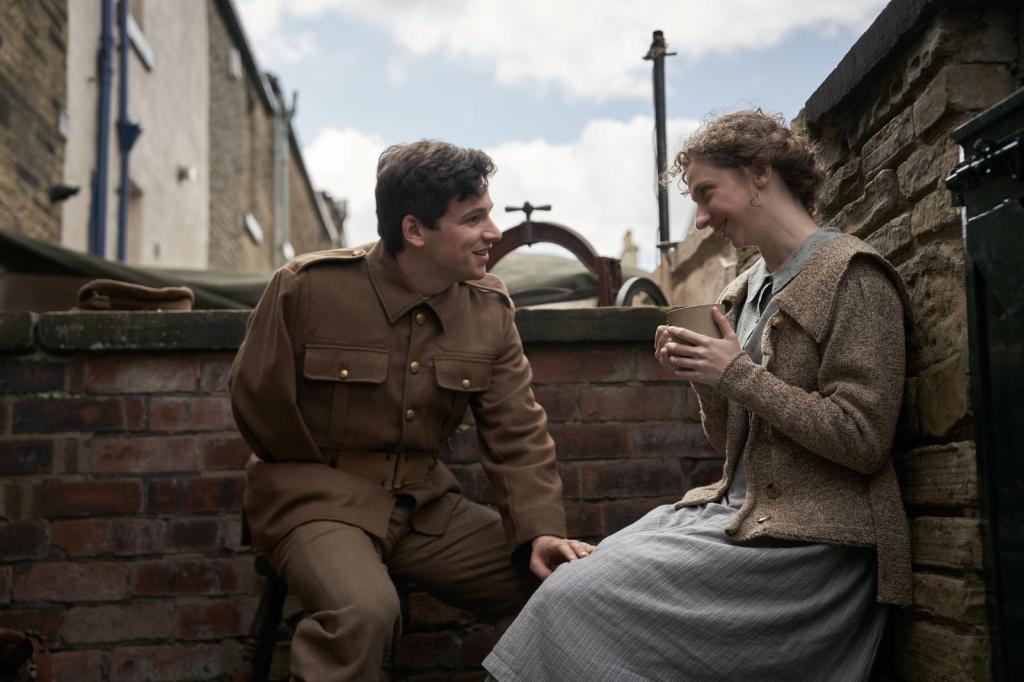
It’s a one-factory town in England during WWI. The local industrialist sponsors a chorus each year at Christmastime, there’s a noticeable dearth in participants with all the young men rushing off to join the army. Gone too is their chorus master. So they are forced to compromise and rehire someone controversial from their past, a certain Mr Guthrie (Ralph Fiennes: The Return, Conclave, A Bigger Splash). Though well- known in the music world, he carries a stain: he only recently returned from the Kaiser’s Germany, the enemy his country is fighting. The fact he had a male lover in Germany is also suspect but never spoken of. Another problem is what can they sing? All the local favourites are written by Bach, Brahms, Beethoven or Handel, Germans all. They decide to perform The Dream of Gerontius — an Oratorio by Elgar who A) is still alive, and B) still English.
Next they hold auditions and manage to find one returned soldier missing an arm, but with a angelic voice (Jacob Dudman), a young woman in the Salvation Army named Mary (Amara Okereke) whose notes are pure as the driven snow, and their benefactor — the industrialist — who sings an
adequate baritone. But can the chorus be ready in time? And what will they do when Elgar himself shows up?
The Choral is a wonderful period drama about trying to put on a show despite all the hurdles in their way. With a large ensemble cast, it follows diverse storielines and covers wide ground: local prejudices, patriotism and hatred, first sexual experiences, love, valour, passion, rejection… and the dark cloud of war hanging over it all. I love the music, the acting,
cinematography, but the movie itself is even bigger than the sum of its parts. I think we owe that to the writer, Alan Bennett, and the director Nicholas Hytner. You may be familiar with their past collaborations on stage and screen: The History Boys, The Madness of King George, and The Old Lady in the Van, to name a few. Like them the Choral is once again both grand and intimate, dealing with heavy issues but always light and clever.
I quite enjoyed this one.
Primate
Co-Wri/Dir: Johannes Roberts (Resident Evil: Welcome to Raccoon City, The Strangers: Prey at Night)
It’s another perfect day in Hawaii, and Lucy (Johnny Sequoyah) is really happy to be flying home again. Yes, she likes going to college but she also misses her family and home in Hawaii. Her late mom was a linguist who worked with apes in the style of Jane Goodall. And their dad (Troy Kotsur), is a bestselling author who was born deaf. So she and her shy little sister grew up speaking American Sign Language with their dad and another sign-and-spoken language with the chimpanzee Ben, who, though he sleeps in his own caged enclosure, is almost considered a part of their family. Coming home with her are her BFF Kate (Victoria Wyant), Kate’s brother Nick (Benjamin Cheng) who Lucy has a secret crush on, her frenemy Hannah (Jess Alexander), and a pair of himbos Hannah was hitting on aboard the plane.
And, as luck would have it, their dad is going away for a day to do some book signings, so they have the home — a multilevel glass- walled, playground with a stucco, lunar-landscape tunnel that leads to the backyard, and an Infiniti pool by the edge of a cliff — all to themselves. Which means it’s time to par-tay! They light up their pre-rolls and pop open their beers and start having fun.
But that’s when things go bad. Ben, the chimpanzee has rabies and is going ape-crazy, attacking and maybe even killing some of these college kids. Dad is far away, and all seven of them have misplaced their cel phones! Oh no! What can they do? Who will survive this murderous ape?
Primate is a suspense thriller/horror about college kids vs a
killer chimp. It’s stupid-funny and basically plotless — just how to survive this rabid monkey till someone calls 9-1-1 — but it is fun. Lots of surprises, with the ominous chimp (still dressed in brightly-coloured kids clothes) swinging from the rafters, breaking through windows and, you know, killing people.
Personally, I found the goriness unnecessary — I don’t like watching people’s faces getting torn off — but I guess gorno is part of its horror appeal. And lest you think I’m spoiling it, the movie tells you about rabies before the first line is spoken, and Ben peels the skin off someone’s face in the first five minutes, so I’m not telling you anything they didn’t already want you to know.
Yes, it’s super-simplistic, and breaks down logically very quickly, but as a movie, it pushes all the right buttons.
Primate, The Choral and Father Mother Sister Brother all open in Toronto this weekend; check your local listings.
This is Daniel Garber at the Movies, each Saturday morning, on CIUT 89.5 FM and on my website culturalmining.com.
Whence America? Films reviewed: Paterson, Tell Them We Are Rising: The Story of Black Colleges and Universities
Hi, this is Daniel Garber at the Movies for culturalmining.com and CIUT 89.5 FM.
The recent executive order known as the Muslim Ban has made the lives of hundreds of thousands of American citizens and residents uncertain. So uncertain that some refugee claimants are fleeing the Land of the Free, seeking sanctuary across the frozen border in Canada.
Whence America? Where is that country heading?
This week, I’m looking at two movies that give a more optimistic look at life in the United States. There’s a new documentary about Historically Black Colleges, and a quirky drama about the state of life in a post-industrial town.
Tell Them We Are Rising: The Story of Black Colleges and Universities
Dir: Stanley Nelson
Did you know that under slavery, it was actually illegal for African Americans to learn to read and write? And that even slave owners – who could beat, sexually assault or even murder their slaves with impunity — were legally forbidden from educating them? It was in the best interest of the Government and slave owner to keep black Americans ignorant, docile, and illiterate.
To counter this, after emancipation and the civil war, African Americans realized education was the most important way to rise up from slavery. The first colleges were opened based on the writings of scholars like Frederick
Douglas. And like Douglas, the first students were born into slavery. Early education efforts were aimed at skilled trades or religion, but as the movement grew it shifted to academic subjects.
Two schools of thought emerged. Southerner Booker T. Washington believed in a business-oriented outlook, centred on entrepreneurship but was opposed to any protests or political action confronting the status quo. W.E.B. Du Bois took the opposite stance, and led the movement toward equal rights.
Many of the early colleges were run by whites, who imposed harsher disciplinary policies on black students students.
Fisk University harshly segregated the students by sex and forbade social interaction. This led to a protest and an organized walkout until the school President resigned.
By the 1930s and 40s, the teachers and administration positions were increasingly filled by blacks, many of whom had been educated at these same colleges and universities. The US was still strictly segregated under so-called separate but equal laws. So all the best and the brightest students flocked to these schools, becoming the new black middle class. Doctors, lawyers, teachers, preachers and judges all passed through these schools, including renowned Supreme Court Justice Thurgood Marshall (Howard University Law School).
By the the 1950s and ’60s these schools also became a hotbed of black-led political movements. Civil rights
actions — like sit-ins at segregated lunch counters — were spearheaded by students at black universities..
100 years after it was a crime for blacks to read or write, the Brown v Board of Education decision promised to end segregation in schools. But this had an unexpected negative impact on black colleges. With white universities now open to black students, there was a brain drain of top applicants to ivy league schools.
Today there are still over 100 black colleges and universities, some thriving, but others crumbling for lack of funds.
Tell Them We Are Rising: The Story of Black Colleges and Universities is the first documentary to tell the full history of this important but not-widely-known institution. It’s narrated by voiceovers and talking heads: historians and former students and professors from these schools. It’s beautifully illustrated with period photos and film clips touching all aspects of black college life, including educational, political movements and social: fraternities, and sororities, sports and music.
It’s by director Stanley Nelson who also made the excellent The Black Panthers: Vanguard of the Revolution.
Paterson
Dir: Jim Jarmusch
Paterson (Adam Driver) is a bus driver who lives with his girlfriend, Laura, in a small house in Paterson, NJ. He lives a routine life. He carries a lunchpail to work each morning, and a notebook to write down any poems that might occur to him. He eats lunch in a tiny national park. After work he talks with Laura over dinner. And each night he walks his dog to a neighbourhood bar and stays
for a drink or two, chewing the fat.
Laura (Golshifteh Farahani) is an artist who remembers her dreams. She covers everything around her in rough swaths of black and white. Clothes, chairs, curtains, cupcakes… their home is her canvas. Except for his basement where he goes to tinker with things and think. The two of them have a symbiotic relationship. he is the observer, passively
taking in what he sees and hears around him. She is the dynamic one, planning their future, and launching business projects that may or may not succeed.
The town of Paterson serves as the third character in the movie. It’s the first city in North America designed as an industrial centre powered by a series of 18th century canals and mills. It has become an artistic hub for New Yorkers who can’t afford the high rents of that city. Jarmusch includes these brick factories and waterfalls in all his outdoor shots. What he doesn’t show is the parts of town with a large and vibrant middle eastern community there. Instead they’re represented by Laura, played by a Persian American actor. (Paterson is also the place where Trump falsely claimed Muslims were dancing on their rooftops during 9-11.) Maybe it’s because I’ve visited Paterson the town, but I was really tickled by this movie.
Paterson is a richly minimalist film that leaves you feeling good about the state of the world.
Paterson opens today in Toronto; check your local listings. And Tell Them We Are Rising: The Story of Black Colleges and Universities is playing on February 15th at the opening night of the Toronto Black Film Festival. Go to torontoblackfilm.com for more information.
This is Daniel Garber at the Movies, each Friday morning, on CIUT 89.5 FM and on my website, culturalmining.com
Motown Movies. Films reviewed: Brick Mansions, Super Duper Alice Cooper, Only Lovers Left Alive PLUS Hot Docs
Hi, this is Daniel Garber at the Movies for culturalmining.com and CIUT 89.5 FM, looking at high-brow and low-brow movies, indie, cult, foreign, festival, documentary, genre and mainstream films, helping you see movies with good taste, movies that taste good, and how to tell the difference.
This week, I’m looking at three interesting movies with a connection to Motor City (Detroit). There’s a Hot Docs documentary about a stadium rocker; an art-house drama about a faded rocker; and an action flic about two guys caught between a rock and a hard place.
Brick Mansions
Dir: Camille Delamarre (Based on Luc Besson’s Banlieu 13)
Brick Mansions is the name of a derelict housing project in a future Detroit. The city has built a huge guarded wall around it. Why? High crime rates. The wall also blocks all the city services like schools, fire department or police. But thousands of people still live there. It’s ruled by a drug lord named Tremaine (RZA of Wu Tang fame) along with his odious henchmen, including a giant white bodyguard,
a chubby lieutenant, and a sexy hit-woman in garters and fishnet stockings who carries a cat o’ nine tails.
The corrupt police are all paid off, so what happens in Brick Mansions stays in Brick Mansions. And just one man, Milo (David Belle), fights back. He steals Tremaine’s drugs and flushes them down the drain, to keep the block drug-free. So Tremaine kidnaps his girlfriend in retaliation. In his crusade to free her and bring Tremaine to justice, Milo kills a crooked cop.
Then a neutron bomb is detected inside Brick Mansions, all hell breaks loose. The Mayor calls Damien, their best undercover cop (the late, Fast and Furious’ Paul Walker’s last film) and teams him up with cop-killer Milo. Can the two of them work together, stop Tremaine, rescue his girlfriend, and save the city from nuclear annihilation? And can Detroit’s corruption-ridden government be trusted?
Forget the story for a minute – the plot is not important. This movie is really about parkour. Parkour is a sport involving jumping on and off buildings, platforms, swinging and sliding on wires, spinning around poles. Sort of an acrobatic martial art, where life is one big obstacle
course. The star, David Belle, is one of that sport’s French founders, and he gets to show off his military cirque de soleil-ish prowess in scene after scene.
Brick Mansions is not meant as a great movie. It’s a “B movie”, a stoooopid movie, riddled with inconsistencies, with an ignorant take on issues like race. But I enjoyed it anyway, for the great action and fast-moving, choreographed fighting.
Super-Duper Alice Cooper: a Doc Opera
Dir: Reg Harkema
Alice Cooper was originally, the name of a group, not a man. Vince Furnier is born in Detroit, the son of a preacher man, whose family moves to Phoenix, Arizona for health reasons. By high school, he’s heavily into Salvador Dali and Beatlemania. He starts an insect-named band with his high school buddies (first the Earwigs, then the Spiders) and they start getting radio play while still teenagers. The thing is, they aren’t very good or special. Better at the spectacle than the music. They soon discover that, in LA, image is everything. They meet a girl group in Frank Zappa’s basement who help them with their makeup, cultivating a glam look. Soon enough, they’re wearing sequinned Ice-Capades
jumpsuits, and appearing on stage with lots of props and animals. And using a Ouija board they channel a Victorian witch named Alice Cooper (or so they claim). And that becomes the name of the group.
Next, at a rock festival in Toronto, comes the infamous chicken incident (He says didn’t actually bite off the head; it was the audience’s fault). The rest is fame and super-stardom. Furnier gradually morphs into the ever-more-outrageous and self-destructive character, Alice. Their shows become more elaborate, even as Alice Cooper’s fame grows. Eventually the group collapses, Alice goes solo, and he crashes and burns in a bubbling cauldron of eye make-up, skeletons, groupies, drugs and alcohol. This movie is a lot of fun. It manages without a single talking head. Instead, the voices of rock stars, agents and producers narrate an oral history, illustrated by countless animated still photos, period film clips and concert tapes. Very creative, ingenious, fast-moving. And it’s all tied together with silent film footage of Dr Jeckyl and Mr Hyde, the two Alice Coopers. Vince, the straight-laced preacher’s son, and Alice, the outrageous performer, both in the same body. All of this punctuated with hits like Eighteen, Schools Out, and No More Mr Guy. It’s a intensely edited documentary. I’ve never been an Alice Cooper fan, but found it super-duper to watch.
Dir: Jim Jarmusch
Adam (Tom Hiddleston) is a reclusive rock musician who lives in a crumbling, bombed-out mansion in downtown Detroit. He lives a languorous existence, playing the lute, listening to vinyl, and mourning the loss of culture and refinement. His only visitor is Ian (Anton Yelchin) his dealer, who brings him the good stuff and keeps his fans at bay.
His long time, on-again, off-again lover Eve (Tilda Swinton) lives far away, in Algiers, where she hangs out with presumed-dead cultural icons like Christopher Marlowe. She’s equally
listless, with the air of a pre-Raphaelite opium eater. But neither Adam nor Eve is addicted to drugs. It’s human blood they need – they’re vampires. But they don’t kill the “Zombies” anymore (that’s their word for muggles), they just drink plastic pouches of blood smuggled out of hospitals.
Life continues, but things are disrupted when Eve’s sexy sister suddenly shows up in Detroit. Ava (Mia Wasikowska) is noisy and selfish, and doesn’t stick to his moral guidelines. When
she sees blood, she takes it, even if it’s still in a friend’s veins. Will Adam and Eve ever be reunited? Will their love last forever? And will this movie ever end?
I have mixed feelings about this film. It has incredible night photography of faded Algiers and post-apocalyptic Detroit. Just amazing. And I could listen to the soundtrack all day. But the story is weak and the movie too slow and long. Either you buy into the conceit — that vampires are a
secret nation of underground Goth hipsters, addicted to blood, not heroin – or reject it. I rejected it. It felt like a never-ending Lady of the Camellias. The whole faded rock-star/junkie as hero-vampire? Just die already.
This movie would work better as a coffee table book with an accompanying music playlist.
Only Lovers Left Alive and Brick Mansions open today: check your local listings. And Super Duper Alice Cooper – along with many other fantastic documentaries are playing now at Hot Docs. Rush tickets at daytime screenings are free for students and seniors. Go to hotdocs.ca for more info.
This is Daniel Garber at the Movies, each Friday morning on CIUT 89.5 FM and on my website, culturalmining.com

leave a comment