Trapped. Films reviewed: Captives, Here, Emilia Pèrez
Hi, this is Daniel Garber at the Movies for culturalmining.com and CIUT 89.5 FM.
Toronto Fall Film Festival Season continues with Cinefranco showing contemporary French language movies from around the world at the Carlton Cinema. But this week, I’m looking at three new movies about traps. There’s a big-hearted woman trapped in a male drug-lord’s body, a French woman trapped in a mental hospital, and a movie camera trapped… in somebody’s living room!
Captives
Co-Wri/Dir: Arnaud des Pallières
It’s Paris in the late 19th century. Fanni Devander (Mélanie Thierry) is an elegant and educated woman searching for her mother. She disappeared when Fanni was just a child, but she has reasons to believe she is locked away somewhere in the city’s mental hospital. So Fanni voluntarily checks herself in to try to find her. Pitié-Salpêtrière is a home for the destitute, people with mental illness, learning disabilities or epilepsy, convicted criminals and even some foundling children. The one common factor is they’re all “undesirables” and all women. But once inside she realizes you can check in, but you can’t check out. It’s a de facto prison, presided over by the Matronly Bobette (Josiane Balasko), and a hench-woman who would make Nurse Ratchet look like Florence Nightingale. Bobette’s one obsession is to perfectly execute their upcoming ball featuring her patients singing and dancing before a crowd of wealthy patrons.
Fanni quickly learns the ropes and makes allies with Hersilie, a music teacher (Carole Bouquet) and a lesbian school teacher with an eating disorder. And she finally meets a nearsighted older woman named Camomile (Yolande Moreau) who just might be her real mother. Can Fanni perform at the ball and safely escape
with her supposed mother? Or will they all be stuck there forever?
Captives is a fascinating historical thriller about the treatment of women in state institutions. It’s harrowing in parts — including scenes of torture — as Fanni navigates class and hierarchy within this enclosed universe. I purposely only mentioned some of the characters and plot turns, because the surprise is what makes it worth watching. But rest assured, it’s full of great acting, pathos, and beautiful period costumes — even within that terrible place.
I like this one.
Here
Dir: Robert Zemeckis (Reviews: Flight, Allied)
Ricky (Tom Hanks) is a teenaged baby boomer living the American dream. His Dad and Mom (Paul Bettany and Kelly Reilly) have lived in a house across the street from Ben Franklin’s historical home since they bought it on the GI Bill after WWII. Now Ricky and his kid brother and sister happily share the place, congregating in the living room for holidays, dinners, or just to watch TV. Ricky wants to be an artist, while his girlfriend Margaret (Robin Wright) dreams of going to law school. Unfortunately, when she gets pregnant while they’re both still in high school, they marry and settle down, still within Ricky (now called Richard’s) parents’ home. Life goes on, and the decades pass, and people are born, live and die. But will they always stay “here” in the same house?
Here is a movie about a place, specifically a living room facing the picture window and the street beyond. The camera never movies. It follows this location not just for Ricky’s family, but also the dinosaurs, the ice age, indigenous people, Ben Franklin, and various couples across the 20th century, constantly jumping back and forth in time. The one constant is the frame, the fourth wall, which never shifts. Picture this: a pop-up square will appear with different furniture and wallpaper in it, taking you to another era, in the style of a virtual staging of a house for sale on a real estate
website. Indeed we get to meet real estate agents throughout the twentieth century. Which makes sense because its really about the place, not the meat puppets who wander around in it.
Does this new, experimental concept work? No! It’s indescribably awful.
I cannot convey the aesthetic revulsion I felt viewing this horrible non-movie movie. It features a de-aged, 68-year-old Tom Hanks playing himself as a teenager with a fake young teenage face plastered on, but who still talks and walks like the old man he is. What were they thinking?! Here is a tired, platitudinous high-concept exercise in futility disguised as an innovative film. All the characters are painful cliches, including a token black family whose sole purpose seems to be to recite a version of Ta-Nehisi Coates Letter to My Son… to their son.
Keep in mind, Zemeckis is known both for classics like Back to the Future but also unforgivable, semi-animated dreck like Polar Express and Forrest Gump. Here falls neatly into the dreck pile.
Emilia Pérez
Co-Wri/Dir: Jacques Audiard
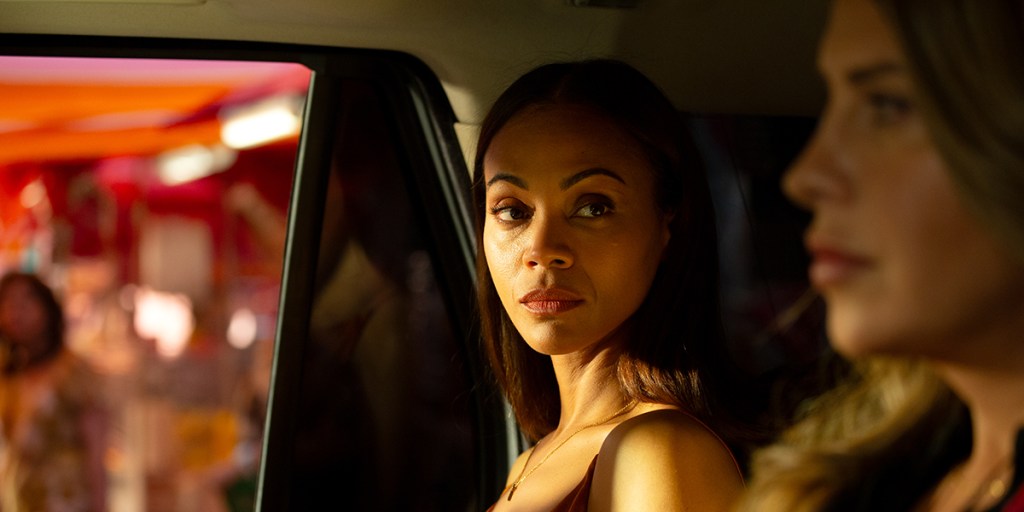
Rita (Zoe Saldaña) is an ambitious young defence lawyer in Mexico City. She spends hours crafting powerful opening statements for trials, but, as a black woman — originally from the Dominican Republic — she gets none of the credit. But somebody is watching her and appreciates her skill. She finds out who, when she’s kidnapped with a black hood over her head and driven into the middle of the desert. There she meets the notorious head of a huge drug cartel, personally responsible for countless killings. Juan “Manitas” Del Monte, the cartel chief, needs her to help him disappear, in a way no one — including his wife Jessi (Selena Gomez) — will ever find him again.
The twist? This murderous, pock-marked, bearded monster… is trans, and wants to shed the awful male body and face, to live the rest of her life as an attractive woman. She needs someone she can trust to handle all this, both the finances and the surgery, leaving no paper trail. In exchange, Rita will have all the money she needs for the rest of her life, and her own private firm.
Years later, she meets with a potential client, a fabulously rich European woman named Emilia Pèrez (Karla Sofía Gascón). It’s
her client from years back, who wants to re-enter the world and be reunited with her beloved family, all of whom think she is dead. And to atone for some of her past sins without revealing who she was. What will happen to these three remarkable women in the next chapter of their lives?
Emilia Pérez is an incredibly passionate and shocking movie. It’s simultaneously an action-thriller, an epic drama, and a musical. Yes, that’s right, a musical, where characters do break into songs and dances throughout the film. But with its latin beats and shouting crowds, it’s the sort of songs you rarely encounter in a musical. Zoe Saldaña is amazing as this tough-as-nails lawyer, and Karla Sofía Gascón, a Spanish actress I’ve never seen before, is unmatchable, both as Perez, and as the drug lord Manitas. (She’s a transwoman herself.) French director Audiard (who previously brought us masterpieces like A Prophet, and Rust and Bone) seems to have no trouble creating a Mexican musical. I gotta say, Netflix churns out a load of content, most of which is forgettable crap, but, every year, they also produce a few really remarkable films. Emilia Pèrez is one of those.
I strongly recommend this movie.
Here and Amelia Perez both open this weekend in Toronto; check your local listings. And Captives is having its English Canada premiere at 8:45 tonight (Saturday, Nov 2, 2024) at Cinefranco at the Carlton.
This is Daniel Garber at the Movies, each Saturday morning, on CIUT 89.5 FM and on my website culturalmining.com.
Golden. Films reviewed: The Old Man & the Gun, Let the Corpses Tan, The Sisters Brothers
Hi, this is Daniel Garber at the Movies for culturalmining.com and CIUT 89.5 FM.
This week I’m looking at three genre movies -– a heist, a western and a retro horror/thriller — about the search for gold. There’s an old bank robber lookin’ for love while stealing krugerrands, two brothers in the old west working as hitmen while searching for gold nuggets, and criminals in Corsica killing for gold bars.
Dir: David Lowery
It’s the 1980s in Texas. Forrest Tucker (Robert Redford) is the consummate gentleman, always kind and charming, especially with the ladies. He meets one such woman named Jewel (Cissie Spacek) by the side of the road where her car overheated. She’s a widow with a ranch but no family or friends nearby. He gives her a ride and they share lunch at a
roadside diner. But when he jokingly tells her what he does for a living she doesn’t believe him. Who would think such a kindly old man is a bank robber?
But a bank robber he is, and a damned good one. Working with his partners Teddy and Waller (Danny Glover, Tom Waits) they pull off a stream of successful bank heists from Dallas to St Louis, without ever firing a shot or leaving a single fingerprint behind. That is until detective Hunt (a
moustachioed Casey Affleck) connects the dots between these seemingly unrelated crimes. (This is long before google.) Can Tucker quit bankrobbing and settle down with Jewel before Hunt tracks him down?
The movie is based on a true story about a career criminal and escape artist but it’s so much more than that. It’s a tender love story (between Tucker and Jewel), and a buddy drama (between him and his respectful rival, the cop). It’s well-acted, wonderfully directed and with a classic script of the kind I thought Hollywood had forgotten how to write. It even has some filmmaking tricks – like a clever history of his escape attempts – inserted in an unexpected place.
What a feel-good movie this one is.
Let the Corpses Tan (Laissez bronzer les cadavres)
Dir: Hélène Cattet, Bruno Forzani
It’s a sundrenched day at a cliffside bed and breakfast in Corsica. Madame Luce (Elina Löwensohn) – a sultry, middle aged woman with a pageboy haircut – is your hostess, but don’t expect a five star rating. It’s a BnB… from hell. The rooms are made of crumbling rock shelters and
breakfast means fried eggs served with live ammo. The guests include a scheming criminal, a crooked lawyer, a young tough, and a smash-faced thug. The only paying guest, Max Bernier, is an over-the-hill novelist from Paris in a perpetual drunken stupor. What are they all there for?
A heist, of course, in the form of a Brinks truck carrying a case of solid gold bars. They carry it off — killing two cops and the driver in the
process — but then things start to go wrong. Bernier’s beautiful young wife and kid show up unexpectedly, and a pair of motorcycle cops, dressed in black leather, stop by to take a look around. At this point, gunshots start and rarely stop till the end of the movie. Some of the bad guys realize they’ve been stabbed in the back. Soon
everyone on the mountainside is either a hostage or hostage taker, a shooter or a victim (or a potential sex partner) in a final shootout for the gold.
But this plot description doesn’t do justice to what this film really is. It’s an over-the-top horror/thriller/heist movie, flawlessly done in the style of 1960s spaghetti westerns. It’s intense, from the saturated colour to the Morricone score. Every gun shot — and there are thousands – is followed by a mammoth splash of blood; every cigarette is lit with a whoosh of flame that fills the screen; every stabbing has a disgustingly loud squishing sound. There are extreme close ups, with a single eye or curled lip filling the entire screen. And lots of gratuitous nudity and violence, especially when the drunken novelist imagines stylized sex scenes from his own books.
See this one on a big screen.
Dir: Jacques Audiard
It’s the 1850s in the Oregon territory, and the country has gone gold crazy. Eli and Charlie Sisters (John C Reilly, Joaquin Phoenix) are brothers who earn their living shooting to kill. Eli is smart and kind at heart, while Charlie takes after their dad, a drunk, mean bastard. They work for a shady robber baron known as the Commodore. Their latest job? Meet up with another man
who will provide them with their victim.
Meanwhile, in a town nearby, is the idealistic Hermann Warm (Riz Ahmed) a brilliant scientist who is flat broke. He has an invention that could make him a millionaire. It’s a chemical he claims will make panning for gold easy as pie. On his travels he meets an upper-class adventurer named John Morris (Jake Gyllenhall). Warm likes Morris’s polite relaxed manner and sees him as a genuinely nice
guy. As they travel he share his secret, though not the details, with him. What he doesn’t know is Morris – like the Sisters Brothers – works for the evil Commodore, and that he plans to hand over his erstwhile friend to those killers. But things aren’t necessarily what they seem. The hunters become the hunted with posses tracking the Sisters brothers for their past crimes. The four find themselves on
the same side, at least temporarily, but who can be trusted?
The Sisters Brothers is French director Audiard’s first English language film, and he totally pulls it off. This is an excellent western that captures the frantic expansion of the gold rush towns in the old west with entire settler towns appearing, on-screen. We watch characters discover new technology like toothbrushes and hot-water plumbing. It captures the utopian politics of the time (though completely ignoring the plight of indigenous people). Reilly and Phoenix make great shootists, but it’s Riz Ahmed who really steals the show. The Sisters Brothers (based on Canadian writer Patrick deWitt’s novel), is a wonderful, new take on the classic western.
The Old Man & the Gun, Let the Corpses Tan and The Sisters Brothers — all great movies, though for different reasons — all open today in Toronto; check your local listings.
This is Daniel Garber at the Movies, each Friday morning, on CIUT 89.5 FM and on my website, culturalmining.com.
War and Peace. Movies reviewed: À la vie, Dheepan
Hi, this is Daniel Garber at the Movies for culturalmining.com and CIUT 89.5 FM.
The War and Peace Report is Democracy Now’s morning news show – it’s on the radio right after this one. Be sure to stay tuned because today
host Amy Goodman is broadcasting from Toronto. So my theme this week is war and peace, and I’m looking at two new dramas from France. There are three war survivors who carry their emotional baggage to the beach, and three other war survivors who arrive with minimal baggage at a crime-filled housing complex.

À la vie
Dir: Jean-Jacques Zilbermann
It’s the early 1960s in Calais, France. Hélène and Lili are good friends meeting up to spend three days relaxing on the beach in Berck in northern France. Hélène (Julie Depardieu) is a wispy, ginger- haired woman, always loving and giving. She works as a men’s tailor in Paris. Lili (Johanna ter Steege) arrives by bus from Amsterdam, a smartly-dressed modern woman with blonde hair. And she brings a surprise: their third friend, the voluptuous but petulant Rose (Suzanne Clément). She flew in all the way from Montreal for this get-together. And what is it that connects these three woman and why haven’t they seen each other since 1945?
They’ve been separated because they were all prisoners at Auschwitz. They survived
together thanks to Lili getting them work in the kitchen. But in the death march at the end of the war they were separated, and thought the youngest one, Rose, died there. Now the three of them are together again, and all three married other survivors. Lili is divorced, Rose has a troubled marriage in Quebec, and Helene, though she loves her husband, Henri, lives a sexless life. She’s still a virgin since her husband suffered horrible mutilation in the camps.
They are staying at a beachside apartment courtesy of Raymond, a handsome communist
from the French Resistance during the war. He still has a thing for the married Hélène. Haunted by their past the three friends save every scrap of food and reuse teabags over and over. They catch up on their missing history as they play in the waves. The beach is filled with girls in bikinis and boys in trunks, Club Mickey, and everyone dancing the twist. Especially a young animateur, a camp counsellor on the beach named Pierre. He likes Hélène, and he’ll kiss her if she lets him. Will Helene be faithful to her husband, forge a relationship with a rich communist or a try a fling with the Club Mickey counsellor?
A La Vie is a light friendship drama set against a heavy topic – Holocaust survivors. Aside from the period nostalgia – beach life in 1960s France — the best thing about the movie is the three friends and the actors who play them so well. Julie Depardieu as hesitant Helene Gerard Depardieu’s daughter, Dutch actress ter Steege is excellent as Lili, and Suzanne Clement (as Rose) who’s featured in Xavier Dolan’s movies – she’s fantastic as Rose. A light movie, but well done.
Dheepan
Dir: Jacques Audiard
Dheepan and Yalini (Jesuthasan Antonythasan and Kalieaswari Srinivasan) are a young Tamil couple in France. They arrive in France with their cute daughter Illayaal (Claudine Vinasithamby) and are resettled in a public housing complex. They are refugees from the Sri Lankan civil war. At last they have escaped the horror of death and violence, and can live like a normal family in France. The thing is, they’re not actually a family at all. Dheepan is a former Tamil Tiger who needed to get out of Sri Lanka, fast. They put together a fake family, strangers from the refugee camp
that would match the description on his visa – a married couple with a young daughter. It worked, but what will their life be like in France?
Not great. Far from paradise, their lives are cold, dark and miserable. They soon discover their housing complex is a haven for Russian gangsters, and a hangout for sketchy teenage druggies. Dheepan works as a caretaker for the buildings and Yalini finds work as a caregiver for a dying old man. Their fake daughter is doing worst of all, with no support at home; her parents are at best indifferent to her problems, and at worst outright mean to her.
But they face even more trouble from the outside. Yalini’s patient is the father
of an especially violent gang leader, holed up in his apartment, facing attacks from rival gangs. She’s Hindu but wears a make-shift hijab to stop unwanted sexual advances. Dheepan, though he keeps his head low, gets involved in conflicts between the buildings. And Tamil Tigers based in France want him to return to the fold and act as a gun runner for them. With a major gang war on the horizon, and violence escalating, Dheepan is forced to return to his past role as a soldier and fight
for his family’s lives.
Dheepan is a dramatic action/thriller with a good story, but it didn’t exactly grab me. It was interesting to watch, but I could only observe, not connect with the main characters. I was troubled that it portrays refugees as potential sleeper-cell terrorists. It’s directed by Audiard – who made two fantastic French movies, The Prophet and Rust and Bone — so maybe I set my bar especially high. Dheepan isn’t as good as those two, but it’s definitely still worth seeing.
Dheepan is playing now and À la vie opens today in Toronto; check your local listings.
This is Daniel Garber at the Movies, each Friday morning, on CIUT 89.5 FM and on my website, culturalmining.com.
Movies about Sex and Disabilities. Films reviewed: Hyde Park on the Hudson, Rust and Bone PLUS Morgan, Beeswax.
Hi, this is Daniel Garber at the Movies for culturalmining.com and CIUT 89.5 FM, looking at high-brow and low-brow movies, indie, cult, foreign, festival, documentary, genre and mainstream films, helping you see movies with good taste, movies that taste good, and how to tell the difference.
In movies, disabilities were traditionally there to provide tragedy and pathos. People have an accident and end up in a wheelchair or a bed… my life is over, I will never work again, so sad. Or else they were a signal of great personal triumph. Look ma, I survived! Occasionally, you’d have the villain in horror movie, bitter, evil, deformed, taking out his pain on other people. Witches with canes, super-villains in wheelchairs…
Then came the movie-of-the-week disabled person as the frail victim, the pitied, while their counterpart character is the strong, powerful, and privileged one. They either die or “get better”.
We haven’t even reached the point where disabled people become the equivalent of the token black neighbour or gay best
friend. (exceptions: Drake on Degrassi).
That’s why it’s neat to have two new movies with normal, fascinating, multidimensional, central characters who have, but aren’t defined by, their disability. The disability is part of the plot but not the central reason for the character. And, most important, people with disabilities are shown to be sexual.
This week I’m looking at two new movies, both romantic dramas, one light, one powerful — where one of the two main characters – the one with more education, wealth and power – has a disability.

Bill Murray as FDR in a wheelchair
Hyde Park on the Hudson
Dir: Andrew Michel
It’s the 1930s, the Great Depression, and Daisy (Laura Linney) has fallen into hard times. So she likes it when she gets summoned to visit a distant relative Franklin (Bill Murray) who is doing much better. He’s a stamp collector — he’s staying at his mother’s estate in the Hudson Valley in Western NY. Oh yeah… and he’s the President. FDR to be exact. Well they get along famously and one day he takes her for a drive into the hills, leaving his Secret Service agents behind. And what happens at the top of the hill? (Cover your ears, kiddies…) She gives him a handjob.
And so begins their long-term relationship. He builds a secret house for their trysts – he’s married to Eleanor Roosevelt – and they form a warm and loving special relationship. But the movie also focuses on another special relationship: One crucial weekend, when King George and Queen Elizabeth – in sort of a prequel to The King’s Speech – are visiting the states to get them to get on board in the soon-to-come war against Hitler.
The Queen (the current Queen’s mother) is portrayed as a shrewish manipulator with the young, stammering George as a weakling, prey to her machinations. What are hot dogs and why are they asking us to eat? Why did they put political cartoons of George III on the wall? They’re insulting us!
Then there’s Roosevelt — he had polio as a kid. At the time, in official photos, his disability was always hidden, never
spoken of, never photographed. But as this a backstage view of his life, he’s constantly being lifted from room to room or moving about in a specially-designed wheelchair. The same is true of their relationship:
I liked it. It feels like a PBS Masterpiece Theatre episode, complete with stately homes and royalty, but with stupendous acting and subtle writing. This is actually a good, touching movie, an historical drama based on newly discovered material about a person – Daisy – who is largely unknown. Some historical details seem questionable – were his servants really white not black? – and some are surprising – The Canadian PM William Lyon Mackenzie King was the one who brought George and Elizabeth to meet FDR that weekend, yet he was nowhere to be seen. (As usual, Canada is erased from the picture.)
The acting is great, both Bill Murray and Laura Linney are fantastic. The casting didn’t worry too much about looking like the real thing – Eleanor Roosevelt as a very beautiful woman? She was known for her inner beauty more than her movie-star good looks – it was more about conveying their personalities. While the characters’ feelings are kept largely opaque, it still conveys the story.
Rust and Bone
Dir: Jacques Audiard
Ali is a ne’er-do-well single dad and fighter from Belgium. He has to take his cute kid Sam to the south of France to stay with his sister when his wife, a junkie, ends up in jail. He’s a terrible father, self-centred and irresponsible, a negative role-model. His sister, and her husband, a trucker are responsible and take on the child-rearing responsibilities.
But Ali (Matthias Schoenaerts) is Sam’s dad, so he takes care of him as much as he can, which isn‘t much.
He’s irresponsible but also totally spontaneous. He sees a woman he likes, sleeps with her, moves on, no strings. If they’re free – they text they’re “OP” (operational) and they meet.
He has no job experience but is good fighter, so he lands a job as a bouncer at a nightclub. There he meets Stephanie (Marion Cotillard) an older woman, very beautiful, who works as an orca trainer (!) at Marineland. She’s not there for a
pick-up; she just wants to be the object of desire by others.
Ali helps her when a fight breaks out and treats her with respect… even though he always says the wrong thing (he’s a Flemish speaker.)
Then Stephanie has a serious accident at work with the orcas, and her life changes. She’s caught in a funk of self-pity and hatred. Ali, meanwhile is moving up to sketchy work as a security guard and open air Mixed martial arts fights where he gets a cut of the bets in the fight.
So depressed Steph calls him up – maybe this odd couple can get together and help each other survive? Will he bring her back to life? Will she teach him to behave in a civilized way? Will he take responsibility as a father? Will they ever have an actual relationship?
I don’t want to give away any more of the story – and it’s a terrific story! – but suffice it to say, it’s a deeply moving romance, a drama, a family story, a boxing movie, and lots more. The director, Audiard – he made A Prophet, another great movie — is fantastic, all the supporting actors (especially Corrinne Maseiro as Ali’s sister and Armand Verdure as Sam, his son) are amazing. But the two main leads Schoenaerts and Cotillard – are powerfully perfect in their roles.
Morgan
Dir: Michael D. Akers
Also worth mentioning is the low-budget drama Morgan (Dir: Michael D. Akers) that was screened at this year’s Inside-Out LGBT Film Festival in Toronto. In this film, Morgan (Leo Minaya), a competitive bike racer is disabled in an accident on a steep hill in Central Park, which is on the very path of the tournament he wants to win. After a struggle, and with the help of a caring boyfriend Dean (Jack Kesy) who he first meets on a basketball court, he
decides to tackle the race once again, this time using a bike adjusted to fit his disability. This movie sensitively shows how partners can learn to treat a disability as a normal, erotic part of their sex lives.
Beeswax
Dir: Andrew Bujalski
And the realistic film Beeswax, from two years ago, also doesn’t shy away from sex involving a person with a disability. A nice, comfortable film, Beeswax is about the secrets and tensions shared by two sisters (played by real-life twins Tilly Hatcher, Maggie Hatcher), one of whom uses a wheelchair.
Hyde Park on the Hudson opens today, and Rust and Bone opens next Friday, Dec 21st. I don’t reveal my top ten movies of the year until the end of the month, but I guarantee Rust and Bone will be in that list. Also now playing is the very cute Korean romance A Werewolf Boy, which played at TIFF this year, about a boy raised by wolves, the girl who dog-trained him to behave like a person, and the romance that grew between them.
This is Daniel Garber at the Movies, each Friday morning on CIUT 89.5 FM and on my website, culturalmining.com .


2 comments