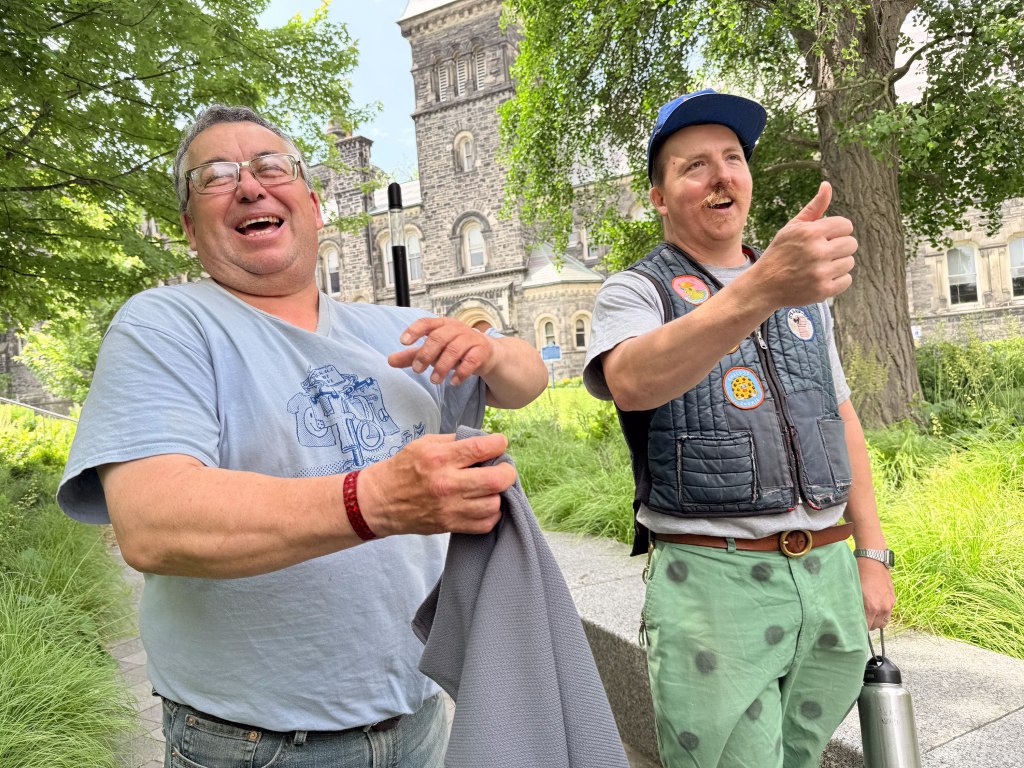
Daniel Garber talks with Seth and Peter Scriver about Endless Cookie

Posted in 1980s, 1990s, Animation, Canada, documentary, Family, Hudson's Bay, Indigenous, Toronto by CulturalMining.com on June 14, 2025

Hi, this is Daniel Garber at the Movies for culturalmining.com and CIUT 89.5 FM.

Photos by Jeff Harris.

It’s the 2010s in the Shamatawa First Nation in an isolated part of Northern Manitoba. Seth, who comes from Toronto’s Kensington Market, is visiting his half-brother Peter, so they can make a documentary together. But he’s armed with a voice recorder not a camera. Peter is telling stories about their histories on the reserve and in the big city — the images of the people involved will be added later.  But that still doesn’t explain why the people we’re watching look like tube socks, rubber bands or giant cookies?

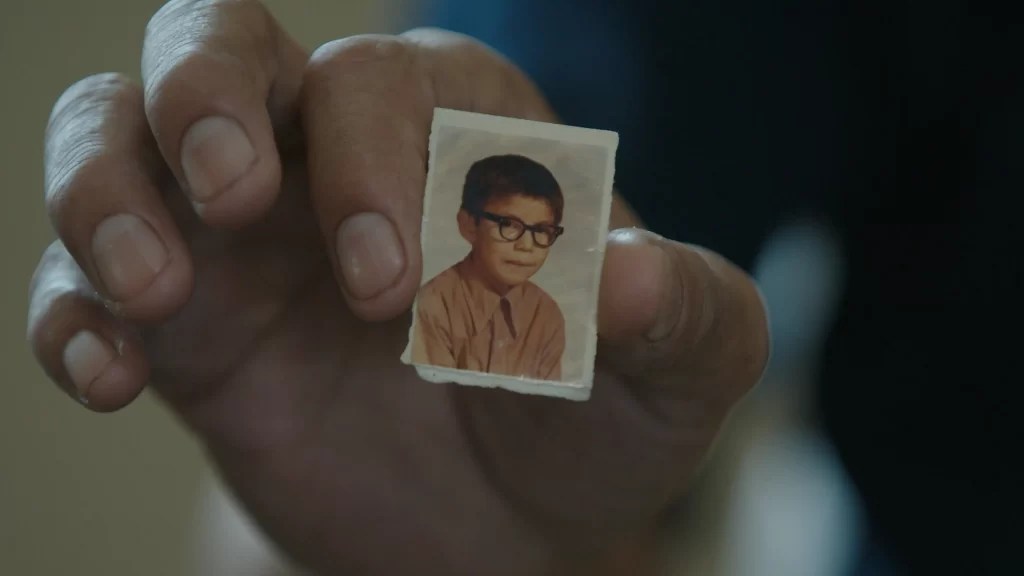
Endless Cookie is a brightly-coloured animated documentary that uses wild and grotesque illustrations and verite recorded voices to present an oral history of two very different parts of Canada: Shamatawa and Toronto. It focuses on the lives, histories, and stories, of the filmmakers Seth and Peter Scriver, their friends and families. It’s hilarious, visceral and chaotic, and not like anything you’ve ever seen before. Seth is a Toronto-based writer, sculptor, carpenter, comic book artist and animator, whose first film Asphalt Watches won best Canadian first feature at TIFF in 2013. Peter is a storyteller, writer and woodcarver, who has served as Chief and Magistrate of the Shamattawa First Nation in Northern Manitoba. He lived in Toronto as a teen. A skilled hunter and trapper, he now works as a Canadian Ranger while he raises his nine amazing kids.  Their film, Endless Cookie, was the opening night feature at ImagineNative and won the Hot Docs Rogers Audience award for Best Canadian Doc. 

Endless Cookie is now playing at the TIFF Lightbox.

I spoke with Peter and Seth Scriver in-person at CIUT 89.5 FM.

Daniel Garber talks with Damien Eagle Bear about #Skoden at ImagineNative!

Posted in Addiction, Alberta, Canada, documentary, Indigenous, Internet, Social Networks by CulturalMining.com on May 31, 2025

Hi, this is Daniel Garber at the Movies for culturalmining.com and CIUT 89.5 FM.

It’s a few years back on the social networks. A new image appears, that of an  older indigenous man posed with his fists raised as if for a fight. The meme catches people’s eyes and goes viral, appearing everywhere, accompanied by disrespectful slogans. Then, in a complete turn around, the meme is relaunched, this time accompanied by a puzzling indigenous expression: #Skoden, and becomes a symbol of native power, humour and identity. And a call to action… What is Skoden and who is the man in the meme? 

#Skoden is the name of a new documentary about both internet memes and real people. It’s also a tribute to the late Pernell Bad Arm, the Blackfoot man depicted in the photo, by talking with his friends and relatives who remember him. #Skoden is written, directed and produced by award-winning documentary filmmaker Damien Eagle Bear, from the Kainai First Nation of the Blackfoot Confederacy.  Damien’s films are known both for their playful irreverence and the crucial cultural points they cover. Th e doc was filmed in Lethbridge Alberta and on the Blood Reserve of the traditional Blackfoot Territory. #Skoden had its world Premier at Hotdocs where it won the Earl A. Glick Emerging Canadian Filmmaker Award.

I spoke with Damien from Toronto via ZOOM.

#Skoden is screening at the ImagineNative film festival on June 4th, 2025.

Magical kids. Films reviewed: The New Boy, Butterfly Tale, Once Within a Time

Hi, this is Daniel Garber at the Movies for culturalmining.com and CIUT 89.5 FM.

You’ve heard of Peter Pan, right? He’s most famous for not growing up and for believing in fairies. And it’s true, kids are more likely to believe in magic than grown ups. This week, I’m looking at three new movies about the innocence and magic of childhood. There’s a disabled, teenaged butterfly that wants to migrate with his flock; an indigenous boy with magical powers sent to a church-run school; and a group of kids forced to face a fairytale apocalypse.

The New Boy

Wri/Dir: Warwick Thornton (Sweet Country)

It’s the 1940s at a remote Australian Benedictine monastery. Sister Eileen (Kate Blanchett) is excited because there’s a new student arriving soon. She runs the place, ever since the head Benedictine monk died — she keeps this detail a secret from the outside world. The new boy (Aswan Reid) is indigenous, can’t speak English, and has had virtually no contact with white Australia. He has blond hair and brown skin. He sleeps on the floor, not on a bed, and finds forks and spoons a mystery. At the same time, he can conjure up glowing particles to light his way, using just his hands. And he has magical powers: he can speak to trees, and cures people bitten by poisonous snakes.

The sisters teach him out to use an outhouse (which he finds both funny and revolting), and about western ways and foods. Above all, Sister Eileen wants to convert him to Christianity — she lives him deeply, and wants to save his soul. She uses a life-sized wooden statue of Jesus writhing on the cross as the catalyst. She hopes to change him completely, and ultimately to baptize him and give him a Christian name. Will he convert? And what will happen if he does?

The New Boy is a gentle, bittersweet look at religion, colonization, forced assimilation and residential schools (known as boarding schools in Australia), as seen through one boy’s eyes. I found it both inspiring and tragic. Kate Blanchett is wonderful as the scheming but good-hearted nun, while young actor Aswan Reid is remarkable as the unnamed new boy. (The movie opens with a violent fight between him and a soldier in the bush, just one of many surprising scenes he manages to convey without uttering a single word.) Director Warwick Thornton based it partly on his own experiences as a boy in Alice Springs, and those personal details and feelings come through. 

I liked The New Boy a lot.

Butterfly Tale

Dir: Sophie Roy

Patrick (Mena Massoud) is a young monarch butterfly who recently made the transition from caterpillar. He and his best friend Marty are looking forward to joining his village on their annual migration to Mexico. He is especially excited about spending quality time with the girl he’s crushing on, Jennifer (Tatiana Maslany). But there’s a problem. Patrick emerged from his cocoon with mismatched wings, so he’s disabled and can’t fly. And Marty is still a caterpillar. They are teased and bullied by the bigger butterflies as “butter fails”.

Worse still, Patrick’s mom, a leading flier in the “flutter” (what they call their butterfly community) wants him to stay home in the winter. But Patrick and Marty are determined to get there by hook or by crook. Jennifer, a strong flier, is pulling a leaf filled with milkweed so they can all eat on the way. Patric and Marty stowaway aboard that leaf! Little did they know they’ll face tornadoes, big box stores and angry birds posing life threatening dangers on the way. Will Patrick ever learn to fly? Will Marty ever make the transition from caterpillar to butterfly? And will Jennifer get over her hangups? 

Butterfly Tale is an animated, coming-of-age road movie about anthropomorphic  butterflies. They’re basically people, with human hair, faces, and bodies but with big butterfly wings coming out of their backs. They wear T-shirts and hoodies, and worry about adolescent insecurities. (They even have to stop the flight along the way to take a leak.) Little kids might really identify with the characters and like this movie; it has good role models for children with disabilities, and deals with environmental issues. The thing is, it’s not original or funny or risky or challenging anywhere, just a typical adolescent drama, where the people happen to be butterflies. I’m not saying it was uninteresting — it kept my attention the whole time — there just wasn’t much to it.

Once Within a Time

Wri/Dir: Godfrey Reggio

Once upon a time, a bunch of happy kids follow the beckoning voice of a goddess onto a stage. After riding a merry-go-round they start to notice strange happenings. An Adam-and-Eve-like young couple in wire masks take a piece of fruit from a sinister looking apple-man, unleashing terrible events. Smart phones generate robots, a chimp in a monkey suit and another in a VR helmet, huge industrial power-towers, a baobab tree exploding into a mushroom cloud.  Ecological and geopolitical devastation is at hand! Can we survive the end of this world… or maybe start a new one?

Once Within a Time is a phantasmagorical, magic-lantern fable performed on a two dimensional stage beneath a prominent proscenium arch. It’s equal parts live-action, documentary footage, still images, and 3-D stop-motion animation. 

I first saw Godfrey Reggio’s Koyaanasqatsi as a teenager and the barrage of apocalyptic images of corporate uniformity combined with Philip Glass’s pounding music left deep marks in my psyche. This one is kinder and gentler but still effective. It’s co-directed and edited by Jon Kane with amazing vintage special affects from irises to rear projections to dual spectroscope photos. There are tinted black & white shots, shadow puppets, grotesque masks, and dancing robots that evoke everything from Georges Méliès to Guy Maddin to the late Peewee Herman’s Playhouse.  Who knew the apocalypse could be so beautiful? It’s less than an hour in length, but provides about three times that in intensity. If you can, see it on a big screen and just let the images and music overwhelm you.

Great movie. 

Butterfly Tale is now playing in Toronto; check your local listings. The New Boy is a feature at the ImagineNative film festival starting next week. And Once Within a Time is playing tomorrow (Sunday, October 15th, at 5 pm) at the TIFF Bell Lightbox.

This is Daniel Garber at the Movies, each Saturday morning, on CIUT 89.5 FM and on my website, culturalmining.com.

Women in trouble. Films reviewed: Halloween Ends, Tár

Posted in Berlin, Drama, Horror, LGBT, Music, Thriller, Women by CulturalMining.com on October 15, 2022

Hi, this is Daniel Garber at the Movies for culturalmining.com and CIUT 89.5 FM.

Toronto Fall Film Fest season continues with ImagineNative Film + Media Arts Festival from the 18th to the 23rd for in-person movies, with online screenings continuing till the end of the month. ImagineNative, celebrating indigenous works from Canada and around the world, features 19 full-length films and over a hundred shorts.

And there are some real goodies to watch; here are four I really like: Slash/Back is about a group of teenaged girls who fight back against mysterious zombie aliens in Nunavut. We Are Still Here tells eight stories from Australia and Aotearoa; Rosie, set in Montreal in the 1980s, looks at a 6-year-old indigenous girl adopted by an aunt she’s never met; and Bones of Crows is an epic, 100-year-long drama about the life of a Cree woman who barely survives a residential school as a piano prodigy, later becomes a code operator in WWII, and what happens in the years to follow. Bones of Crows, Rosie, We Are Still Here, and Slash/Back or just four of the many fantastic films, videos, games and art at ImagineNative.

This week, I’m looking at two new movies about women in trouble. There’s a Berlin conductor facing increasing setbacks, and a small-town woman in Illinois facing a serial killer… and decides to fight back.

Halloween Ends

Co-Wri/Dir: David Gordon Green 

It’s Halloween night in a small town in Illinois. Haddonfield is famous for all the wrong reasons: it’s the site of repeated attacks by a demented and violent serial killer. He has terrorized the locals for half a century, wearing a white mask and carrying a long blade. But Michael Myers has disappeared, possibly forever, and Laurie Strode (Jamie Lee Curtis) — who survived his first incarnation as a young babysitter, and has fought him off countless times since then — is glad to see him gone. Now she lives with her granddaughter Allyson (Andi Matichak) who works as a nurse at a local medical centre. With her parents (Laurie’s daughter) gone (both killed by Michael Myers, along with dozens of others) Alyson sticks around to keep her grandma company. Laurie spends her time writing a book about the essence of pure evil, based on her own experiences fighting the monster. And she also wants to stop this malaise from infecting the whole town. 

But there’s a new factor in the equation. Former college student Corey Cunningham (Canadian actor Rohan Campbell) also experienced bad times as a babysitter in this benighted town. But unlike Laurie and Allyson who emerged as fighters and survivors, Corey has a different reputation. The kid he babysat was killed one halloween night in a terrible accident that locals blame on him. Now his life is confined to working in his dad’s junkyard on the edge of town. But Laurie recognizes him as a kindred spirit and introduces herself to Corey. (Dubbed Psycho meets Freakshow by a gang of high school bullies.) Allyson and Corey hit it off — could they build a future together? But when the bullies throw Corey off a bridge and leave him for dead, and an unknown man drags him into a drain pipe, something changes in his psyche… signalling the return of the notorious Michael Myers. Can Corey be saved and will he and Laurie escape this town forever? Or has he been infected by the same evil that drives the monster? And who will triumph in their final showdown: Laurie or Michael Myers?

Halloween Ends is the final chapter in David Gordon Green’s trilogy, after Halloween, and Halloween Kills, based on John Carpenter’s original classic. This one is missing much of the humour of the first chapter and the unbelievable hysteria of crowds in the second film. This one is extremely dark, violent, bloody and gory. That said, I liked the introduction of Corey and his nihilistic, crash-and-burn relationship with Allyson. Myers plays a much smaller role, almost a cameo, this time. It also lets Jamie Lee Curtis have her final, final, FINAL Halloween showdown… well, at least in this trilogy. 

The entire film takes place in the present, but is firmly set in a retro environment: cars, houses, clothing, hair — even the soundtrack, titles, art direction, and camerawork — all come from decades past, giving it a very cool look. If you’re craving a dystopian, nihilistic “burn-it-all-down!” thriller/horror then Halloween Ends will probably satisfy your urges, but otherwise, you may find the pessimistic violence and gore too much to handle.

Tár

Wri/Dir: Todd Field

Lydia Tár (Cate Blanchett) is a musician at the peak of her career. Not only is she one of the world’s only female conductors — Leonard Bernstein was her mentor — but she’s also a noted composer. She conducts the Berlin symphony orchestra, and is working on her magnum opus — a recording of Mahler’s fifth symphony, the only one she hasn’t yet tackled — to complete her legacy. Lydia enjoys jetting around the world in a private plane, always accompanied by her assistant. Francesca (Noémie Merlant) is a doe- eyed young woman who worships the ground Lydia walks on, making sure her complex life is run smoothly. There is no husband in the picture — she calls herself a U-Haul lesbian — but she does have a family life. In Berlin,  she lives with her partner Sharon (Nina Hoss) and their young daughter. She sees Sharon at home and at work — she’s First Violin, who holds a special bond with a conductor without which a symphony can’t operate. 

But things start to go wrong when Lydia becomes infatuated with a new cellist in the orchestra. Olga (Sophie Kauer) is a 25-year-old Russian with a fiery temperament and dark hair; she’s a passionate player. She wears green suede boots and Lydia can’t stop staring at her. She wants to get to know her better. But Lydia is a conductor with all eyes on her, all the time; Francesca, Sharon, and even the entire orchestra can clearly see what’s going on. Ghosts from her past misdeeds start to appear again. A former protege commits suicide. A music student she insulted at a Julliard master class accuses her of racism. Is Lydia’s carefully-constructed image and career just a house of cards waiting to collapse?

Tár is a stunning movie that explore the labyrinthine world of classical music and the people who inhabit it. Cate Blanchett gives a nuanced portrayal of a character that walks the fine line between confidence and arrogance, creativity and uncontrolled behaviour.

Is she a free thinker or a sexual predator? A natural-born leader or an authoritarian dictator? And would she be in hot water if she were a man? The supporting actors — Merlant, Hoss, and Kauer, as well as Mark Strong and Zethphan Smith-Gneist — all portray characters as deeply developed as Blanchett’s. Tár is an uncomfortable movie but a fascinating one to watch. 

TAR and Halloween Ends both open in theatres this weekend; check your local listings.

This is Daniel Garber at the Movies, each Saturday morning, on CIUT 89.5 FM and on my website, culturalmining.com.

Indigenous films at TIFF22. Movies reviewed: Ever Deadly, We Are Still Here

Posted in Australia, Canada, documentary, Drama, History, Indigenous, Inuit, New Zealand, Nunavut by CulturalMining.com on September 10, 2022

Hi, this is Daniel Garber at the Movies for culturalmining.com and CIUT 89.5 FM.

TIFF, the Toronto International Film Festival is back again with guns ablazin’, after a two-year hiatus. Yes, TIFF didn’t actually stop over the past two years — there were some great films online in 2020 and some in-person shows during last-year’s hybrid version, but very few people were in actual attendance. No celebs, no parties, no volunteers, no lineups, and no red carpets. When the anti-piracy laws popped up on your home screen, there was no crowd there to say Grrrrr. You couldn’t turn to the stranger sitting beside you and ask what did you think of this movie. It felt more like a simulacrum than an actual event.

Well, this year it’s on again, 

They’re sticking a toe in the water to see how it feels. It’s called the TIFF Experience (whatever that means) and you can experience it right now, if you go down to King Street West in Toronto, between Peter and University. Even if you’re not up to going indoors yet, they’re showing outdoor screenings of classic movies. On stage, there are free concerts, and there are always sponsors handing out free samples to munch on, street performers, people dressed up, fans waiting to photograph arriving celebrities, the whole kit and kaboodle. This is pre-recorded so I can’t promise that’s what it will be but that’s prediction. It’s actually fun. That’s just on this weekend, so if you’re in Toronto, you should drop by.

This week I’m talking about two new movies playing at TIFF, both on indigenous peoples in the two antipodes. There’s throat singing in the far north and a new telling of history,  far, far south of the equator.

But first here are a few other TIFF movies I can’t wait to see. 

MOVIES AT TIFF

Chevalier (Stephen Williams) is about a little-known Guadaloupe-born composer in Paris during Mozart’s era. I want see it because it stars Kelvin Harrison Jr, one of the best new actors around who creates an entirely new character for each movie he’s in to the point he’s virtually unrecognizable.

Steven Spielberg has a world premier at TIFF with The Fablemans, his first autobiographical movie. Why do I want to see it? I’m just really curious to see what he did.

Women Talking is based on a book by Mirriam Toews about a Mennonite-type colony. It stars Rooney Mara, Claire Foy, Jessie Buckley, Sheila McCarthy, Frances McDormand, but I really want to see it because it’s directed by Sarah Polley.

The Kingdom Exodus is about a weird Danish hospital. It’s a TV show, something I rarely bother to watch at TIFF, and I know nothing about it, but the reason I want to see it is it’s directed by Lars von Trier, and I’ll watch anything he makes, no matter how painful.

And finally I hope to catch The Hotel, about a bunch of Chinese people stranded in a hotel in Thailand during 2020’s Spring Festival, just as the pandemic lockdown hit. I want to see it because it’s directed by Wang Xiaoshuai, who is an under-appreciated but skilled and thoughtful filmmaker.

Ever Deadly

Dir:Tanya Tagaq and Chelsea McMullan

Tanya Tagaq is an Inuit throat singer and performance artist from Nunavut. Ever Deadly documents a performance accompanied by musicians and singers. It’s experimental, avant-garde music interspersed with stories and poems recited as part of the concert. Throat singing is a traditional Inuit art form, but she also experiments with it, in a unique, highly sexual, sensual, visceral, animalistic and at times even supernatural voice. If you’ve seen her before you’ll know what I mean. The film is also about her family’s history, and that of Canada. Her nomadic grandparents were forcibly relocated to a barren arctic area, with nowhere to hunt or fish, in order to claim sovereignty of the land along the northwest passage. Chelsea McMullan also includes stunning scenes of the stark arctic landscape, polar bears, migrating birds, aurora borealis. And not just the visuals but also the sounds like the unique squeaking crunch of walking on pebbles on a beach. There are vintage footage and photos contrasting lawmakers in parliament with Inuit kids gleefully eating bloody raw seal meat. And grotesque, highly-sexualized animated drawings.

If you’ve ever seen Tagaq perform you’ll know exactly why you should see this, but if you haven’t, it’s time for you to experience it.

We Are Still Here

Dir: (Various)

At the height of the British Empire maps were coloured pink on every continent, showing both colonies and the so-called Dominions, areas, like Canada, Australia and New Zealand that were settled by Europeans who make up most of their populations. But these places weren’t empty when the British arrived. 

This film rewrites the history of Australia, New Zealand and the South Pacific as seen from an indigenous point of view. It’s made by eight filmmakers, four each from Australia and Aotearoa, and it consists of a number of scenes set in the past, present and future. The first British ships appear on the horizon to a mother and daughter catching fish. A settler lost in the bush demands an aboriginal guide show him the way back to his town. A Maori village debates whether to go to war against settlers, ending in a Haka war dance. And a soldier in the trenches of Gallipoli, has an unusual conversation with his enemy, a Turkish soldier. There’s also a dystopian view if the future, and a number set in the present day, including a clandestine graffiti artist and a young protestor. One of the most moving ones is about an ordinary guy, a tradesman, just trying to buy a bottle of wine from a grog shop (liquor store), who is stopped each time by an abusive cop because he’s indigenous, and it’s Northern Territory where, apparently, it’s legal to routinely treat some people as second-class citizens.

I shy away from reviewing short films because they’re too short and there are too many of them. But We Are Still Here functions as a feature film, telling all the stories not as individual short films, but interwoven into a common coherent thread, jumping back and forth between then and now. It’s nicely done and relevant, very moving, and made by indigenous filmmakers. And it helps restore parts of history that have up to now been erased.

We are Still Here and Ever Deadly are both playing at TIFF;  Festival Street is open all weekend.

This is Daniel Garber at the Movies, each Saturday morning, on CIUT 89.5 FM and on my website, culturalmining.com

Daniel Garber talks with Trevor Cameron about his new documentary Shadow of Dumont at ImagineNative

Posted in 1900s, Canada, Cree, documentary, Guns, Indigenous, Métis, War by CulturalMining.com on October 23, 2020

Hi, this is Daniel Garber at the Movies for culturalmining.com and CIUT 89.5 FM.

Trevor Cameron is a Toronto-based writer who has always wanted to make a film about his ancestors… and one in particular. Gabriel Dumont the famed Métis leader who fought in the Battle of Batoche in the Northwest Rebellion (also a famed translator, buffalo hunter, war hero and storyteller). But Trevor didn’t know much about him. Where did he come from, where did he go after the rebellion, what did he do with his life and what became of him?

To answers these question, he got in a camper van and headed out west, to follow in Dumont’s footsteps more than a century later. And he documented his journey on film. The result? A light-hearted road movie about one man discovering his past called Shadow of Dumont.

Shadow of Dumont was written and directed by Trevor Cameron, the award-winning screenwriter, director, and roller-derby champ, known for his work on TV shows like Wapos Bay and Guardians: Evolution. Trevor Cameron’s new documentary Shadow of Dumont premiered at the ImagineNative Film + Media Arts Festival in Toronto.

I spoke with Trevor via Zoom.

Against the Grain. Films reviewed: Judy vs Capitalism, Monkey Beach, The Trial of the Chicago 7

Posted in 1960s, Canada, Depression, documentary, drugs, Ghosts, Indigenous, Magic, Police, Politics, Poverty, Protest, Resistance, Trial, War by CulturalMining.com on October 23, 2020

Hi, this is Daniel Garber at the Movies for culturalmining.com and CIUT 89.5 FM.

Toronto’s Fall Film Festival Season continues with ImagineNative Film + Media Arts Festival, the world’s largets indigenous film festival, and Rendezvous with Madness, the first and largest arts and mental health festival in the world, both running through Sunday, the 25th.

This week I’m talking about three new movies – a doc, a drama and a courtroom pic – about people who go against the grain. There’s a young woman resisting ghosts, another woman fighting anti-abortion activists; and boomers protesting the war in Vietnam.

Judy vs Capitalism

Dir: Mike Holboom

Judy Rebick is a well-known activist and writer in Toronto. As a former Trotskyite revolutionary turned writer and TV commentator, she’s a pro-choice feminist and socialist known for slogans like “Radical is Practical”. She can be seen everywhere, from CBC panels to tent-city protests. A new documentary looking at her life divides it into six stages: Family – her dad was a baseball player quick to pick fights; Weight – she says she has a pair of hips “like two battleships”; Feminism – women’s bodies and the violence they face; Abortion – her hands-on role in legalizing reproductive rights in Canada; Others – her struggles with depression and mental health; and End Notes – her views on various political topics, like the rise of neo-liberalism, the war in Gaza, and as head of NAC, the National Action Committee on the Status of Women.

Did you know she single-handedly fought off a man trying to stab Dr Henry Morgantaler with a pair of garden shears? This film includes footage of that in slow motion. Each section begins with a speech – some mundane talks in lecture halls, others shouted through a bullhorn at a rally. Judy vs Capitalism is directed by artist/filmmaker Mike Holboom in his patented style: clear sound and straightforward narration, combined with avant-garde images: slow motion, high speed, underwater photography, blurred and melting visuals, random faces… basically Holboom’s interpretations of Rebick’s moods, memories, thoughts and ideas rather than the typical clips you might expect in a conventional biography.  Judy vs Capitalism is an experimental look at a Canadian icon.

Monkey Beach

Dir: Loretta Todd (Based on the novel by Eden Robinson)

Lisa (Grace Dove) is a young woman who lives in East Vancouver. She’s been there for the past two years with nothing to show for it but a bad hangover. Till her friend Tab tells her it’s time to go home, back to her family in the Haisla community in Kitimat. So she does. Her family is shocked but delighted to to see her – they weren’t even sure she was still alive. There’s her mom and dad, her little brother Jimmy (Joel Oulette) a swimming champ, and her Uncle Mick (Adam Beach) who told her at an early age to say “f*ck the oppressors!” Then there’s her grandma Ma-Ma-Oo (Tina Lameman) who taught Lisa everything she knows… including things she doesn’t want to know. Like why a little man with red hair keeps appearing. A crow talks to her, and ghosts (people who should be dead) appear to her in real, human form. (Tab, for example, was murdered but she’s still around.) Worst of all are the dreams and premonitions she keeps having – that her brother Jimmy, the swimmer – is going to drown. Are her powers a gift or a curse? Can she ever live normally? And can she keep Jimmy out of the water?

Monkey Beach is a good YA drama filmed in the gorgeous forests and waters of Kitimat in the pacific northwest, with a uniformly good indigenous cast. It incorporates traditional Haisla culture and practices with contemporary, realistic social problems, sprinkled with the supernatural. And it flashes back and forth between the present day and Lisa’s childhood. I like this movie but I can’t help but compare it to the CBC TV series Trickster, which is edgier, faster-moving and more complex. They’re both based on Eden Robinson’s novels – Monkey Beach was her first, showing many of the themes later explored in Son of a Trickster. That said, if you’re a fan of Trickster, you’ll want to see Monkey Beach, too.

The Trial of the Chicago 7

Wri/Dir: Aaron Sorkin

It’s the summer of ‘68 in the USA, and the youth are restless. Robert Kennedy and Martin Luther King had just been killed, with demonstrations springing up across the country. The US is embroiled in an increasingly senseless war in Vietnam and it’s an election year. So droves of young people converge on the Democratic National Convention in Chicago, to have their voices heard. The protests are brutally crushed by police and state troopers. Nixon is elected in November, and the protest leaders, known as the Chicago 7, are arrested and put on trial. The defendants are from the SDS – Students for a Democratic Society, a radical group that sprung out of the labour movement – led by Tom Hayden (Eddie Redmayne) and Rennie Davis (Alex Sharp); the Yippies, founded by Abbie Hoffman (Sacha Baron Cohen) and Jerry Rubin who use performance and pranks to forward their agenda; anti-war activist David Dellinger (John Carroll Lynch);  and Bobby Seale (Yahya Abdul-Mateen II) co-founder of the Black Panther Party, known both for its militant image and progressive social programs. The charge? Conspiracy, even though these group leaders had never met one other.

The Trial of the Chicago 7 is two-hour film that manages to condense hundreds of days of testimony into a few key scenes. This includes a shocking re-enactment of the binding and gagging of Bobby Seale in the courtroom. The script’s pace is fast, the production values excellent, and the acting is superb, especially Baron-Cohen in an unusual funny-serious role, Mark Rylance as their lawyer, William Kunstler, Frank Langella as the unjust judge Julius Hoffman, and Lynch as the veteran pacifist. Women are invisible in this film, except as receptionists, wives-of and one undercover FBI agent. I was glued to the screen the entire time. Still, it leaves me with an uneasy feeling Aaron Sorkin has done some subtle, historic slight of hand. He portrays the anti-war movement as mainly about honouring and saving the lives of American soldiers, not Vietnamese civilians. It buries the aims of the defendants beneath petty squabbles. And somehow he takes a protest aimed squarely at Democratic politicians — the hawks and conservative Democrats in a city and state run by that party — into a Democrats vs Republican division…!

Hmm…

Judy vs Capitalism is at Rendezvous with Madness; Monkey Beach is at ImagineNative, both through Sunday; and The Trial of the Chicago 7 is now streaming on Netflix.

This is Daniel Garber at the Movies each Friday morning on CIUT 89.5 FM and on my website culturalmining.com.

Time. Films reviewed: Anthem of a Teenage Prophet, Jordan River Anderson: The Messenger, Pain and Glory

Posted in Canada, documentary, Indigenous, LGBT, Movies, Romance, Spain, Suburbs, Supernatural, Theatre by CulturalMining.com on October 25, 2019

Hi, this is Daniel Garber at the Movies for culturalmining.com and CIUT 89.5 FM.

Time is malleable. This week I’m looking at three examinations of time. There’s a Spanish drama about a director reclaiming his past, a YA drama about a teen who can see the future, and a documentary about the present-day problems of indigenous, special-needs kids.

Anthem of a Teenage Prophet

Dir: Robin Hays

It’s 1997 in small-town Stokum, Michigan. Luke (Cameron Monaghan) is a highschooler in small town. He’s into skating, music and art. He lives with his straightlaced dad and flaky mom (Juliette Lewis). He used to climb towers with the tall and wiry Fang (Grayson Gabriel) his best friend since kindergarten, but they had a falling out. Now he’s hanging with Stan, a popular B-ball jock, and Stan’s girlfriend Faith (Peyton List). But everything changes when he follows Stan to a party at Fang’s place. After lots of drinking and smoking, Luke has a vision: Someone will be killed in the morning in a hit-and-run just outside their school. They dismiss this as a stoner daydream, but record it on video, just for fun. And sure enough, best friend Stan winds up dead, exactly as predicted.

Eyewitness news picks up the story and soon there are media trucks parked out on his front lawn. He’s stared at at school, and somehow blamed for Stan’s death. Only Faith stands up for him. Will his prophetic dreams continue and can he use it to save people from dying? Are Faith and Luke just mourning Stan or is their something more between them? And what happened between Luke and Fang that soured their friendship, and will they ever make up?

Anthem of a Teenage Prophet is based on a popular YA novel, and holds many of its standard features: rudderless youth looking for meaning, potential love story, friendship, bullying, and prejudice; and a hint of the supernatural. And it’s set in the late 90s, a world of Thrasher, Mortal Combat, white rap and ironic T-shirts. Beautiful scenery (it was actually shot in BC) nice soundtrack and credible acting, Anthem is a good, though not great, teen movie.

Jordan River Anderson, The Messenger

Dir: Alanis Obomsawin

Norway House is a beautiful Cree community in northern Manitoba. But, due to pregnancy complications, little Jordan River Anderson was born in a Winnipeg Children’s Hospital. There he received constant attention from doctors, therapists and experts helping the boy communicate and understand what was going on around him. He was partially paralyzed, could not speak and breathed using a respirator. But he could only spend limited time with his parents and family since he needed constant care. Most special-needs kids are eventually sent from hospital to their parents home or a halfway house with caregivers near to their family. But Jordan never left the hospital – he died there. Neither the province nor the federal government would put up the funds it required for the move, care and refurbishing.

Why? Because he’s indigenous.

Enter Cindy Blackstock, a lawyer and social worker specializing in indigenous cases. She crafts a bill, The Jordan Principle, to ensure no child would be left unfunded to to intergovernmental disputes. It is passed unanimously in the House of Commons. Jordan’s Principle says that a child of need will be cared for by the first level of governmental contacted. All is well. Sadly no. Not a single kid is helped since it’s passage. The government budgets the funds to fight Jordans Principle in court, but not a penny more in its budget to pay for care needed for indigenous special needs kids.

Jordan River Anderson The Messenger is the sixth in a series of documentaries by Alanis Obomsawin, outlining the struggles between First Nations and the Canadian government since the founding of this country. It follows Blackstocks legal battles and the very personal stories, captured in photos and home videos, by Jordan and other indigenous families with special needs kids. This is a one-hour documentary that deals with a heartbreaking story, but one that ends on a hopeful note.

Photo of Alanis Obomsawin by Jeff Harris.

Pain and Glory

Wri/Dir: Pedro Almodovar

It’s present day Madrid. Salvador (Antonio Banderas) is a celebrated Spanish director at the peak of his career. He is looking back at his old notebooks, and letters, taking stock of his life. And he finds it miserable. His body is failing him, his creative well has gone dry. No sex, no love, no pleasure aside from swimming. But as he looks at his life two periods come back to him. As a child he lives with his mother (Penelope Cruz), who takes in laundry, and his father. They are forced to make their home in whitewashed caves, underground. But young Salvador (Asier Flores) is a precocious lad, singled out for his talent by a priest at his school. He teaches a handsome teenaged bricklayer Eduardo (César Vicente) how to read and write. In return poses for a painting by Eduardo. Little Salvador idolizes Eduardo but doesn’t understand his feelings. With his parents now gone, what remains from his childhood?

The other period he reflects on is making his first movie in the early 1980s. It is being shown at the Cinematheque in Madrid, and they want him to appear alongside that films lead actor Alberto (Asier Etxeandia). The problem is Alberto is a heroin addict, hates Salvadors guts and they haven’t seen each other for more than thirty years, What was the scandal that led to such a long lasting grudge? Can it be mended? And who is the missing piece in that puzzle?

Pain and Glory is a fantastic and fascinating autobiographical film by Pedro Almodover. It is ostensibly fictional, the names have been changed, but is clearly based largely on Almodovars life. It plays with time, character and genre, flashing back to early times, and repeating short scenes with subtle differences. It starts with Salvador writing a book, but somewhere, secretly turns into him crafting a film, leaving the viewer to piece it together. Lush and colorful, moving and funny, Pain and Glory is an intricate recreation of Almodovars own life andwork.

Pain and Glory starts today, and Anthem of a Teenage Prophet starts next Friday in Toronto; check your local listings; and Jordan River Anderson, The Messenger is one of many movies at ImagineNATIVE through Sunday.

This is Daniel Garber at the Movies, each Friday morning, on CIUT 89.5 FM and on my website, culturalmining.com.

Questioning Authority. Films reviewed: Empty Metal, The Oath, The Happy Prince

Posted in 1800s, Biopic, comedy, France, Indigenous, LGBT, Politics, Protest, Resistance, Supernatural, UK, US by CulturalMining.com on October 19, 2018

Hi, this is Daniel Garber at the Movies for culturalmining.com and CIUT 89.5 FM.

Toronto’s Fall Film Festival season continues with Imaginenative, in its 20th year. Imaginenative looks at indigenous film and media arts on the big screen and in galleries. There are scary movies, docs, short films, video games VR, and lectures. Look out for Alanis Obomsawin, a retrospective of Métis director Marjorie Beaucage, CBC’s Rosanna Deerchild on Colton Boushie, and Oscar winner Zacharias Kunuk’s latest. There are dozens of things to see and do, from North America and around the world, and many of them are free.

This week I’m looking at three new movies about people who question authority. There’s a writer in exile for breaking a law, an American in trouble for ignoring a law, and indigenous revolutionaries fighting the law… using telepathic powers!

Empty Metal

Wri/Dir: Adam Khalil, Bayley Sweitzer

It’s present day America, where native protesters face rows of armed state troopers. Aliens, a three member electropunk band in Brooklyn, are obsessed by the upcoming apocalypse, and sad they might miss the end of the world. So when they are approached by a young indigenous activist on their first band tour, they are wary, but intrigued by what she offers them. She says they can play a crucial role in the upcoming collapse of everything… but they will have to communicate telepathically. She is advised by three elders – a Zen like white man with a shaved head, a white bearded Rastafarian, and a matronly indigenous activist – who plot the group’s future. Meanwhile, a posse of white, NRA militiamen are training in the woods for their own armed insurrection. And observing – and listening to – everything are unseen government intellegence agents using drones and cellphone listening devices. Who will survive this never ending battle between surveillance and subversion? And why are these people body worshipping a wild boar and opening umbrellas on sunny days?

Empty Metal is a strange and disjointed but ultimately satisfying look at music, art and politics. Some of the images are baffling – what’s with the frying eggyolks and stirring soup? But what seems at first like a series of unrelated events and bizarre practices gradually coalesces into a coherent narrative. It ends up as a cool, if unusual, arthouse espionage drama.

And it’s having it’s Canadian premier at ImageineNative.

The Oath

Wri/Dir: Ike Barinholtz

Chris and Kai (Barinholtz and Tiffany Haddish) are a middle class liberal couple hosting a big Thanksgiving dinner for all of Chris’s family. Since he’s known for his outspoken views, Kai makes him promise to stay away from political discussions. But his vows all evaporate when his little brother’s girlfriend Abbie (Meredith Hagner) shows up. She’s a poster child for Fox News views and doesn’t care who knows it. Get ready for big fights over turkey. But there’s a bigger issue splitting the family – and the country – apart. That’s an oath the president declares all citizens must sign, affirming their loyalty and patriotism. And the deadline for signing is Black Friday, the day after Thanksgiving. Who has signed the oath and who has stood firm? And what will happen to people who refuse to sign?

Things take a turn for the worse when quasi-official government agents show up to enforce the new law. Peter (John Cho), is a reasonable guy, but his partner Mason (Billy Magnussen) is another story. He’s a rude, crude pit bull, longing for a fight. And he’s carrying a gun. When things violent can Chris keep his family safe? Or are they headed for disaster?

The Oath is a dark comedy about life in a divided America under a Trump-like president (they never say his name). It’s also a look at masculinity, with Chris changing from a mansplaining but progressive white guy to a stand-your-ground defender of family and home. Basically a drawing room comedy, it deals with stereotypes and politics, in a funny, though violent, way.

I liked this movie.

The Happy Prince

Wri/Dir: Rupert Everett

It’s the 1890s. Oscar Wilde (Rupert Everett) is a London playright and novelist at the height of his career, rich, famous and wildly popular. He has a happy life at home with his wife (Emily Watson) and two young sons, whom he loves to tell bedtime stories. He’s also gay, a felony at that time. His love affair with an aristocrat, Bosie Douglas lands him in the notorious Reading Jail for two years hard labour. And his career, reputation and homelife disappear overnight. Now he’s in France under an assumed name, living off a tiny allowance. His affairs are handled by a former lover named Robbie Ross. Robbie (Edwin Thomas) is still deeply in love with Oscar Wilde, but thewriter still carries a torch for the diffident Bosie, the cause of all his problems. And when Bosie  (Colin Morgan: Merlin) shows up again, things start to go wrong. Will Oscar Wilde die lonely and neglected in Paris or living life to its fullest?

The Happy Prince is a look at the last years of Oscar Wilde’s life, but is also a fascinating glimpse of the marginal nature of gay life nearly a century before it was legalized in the U.K.. Though solidly upper class, Oscar spends time with beggars, thieves, sailors, street urchins and drag queens. Or running away from bigoted cricketers armed with lead pipes. Rupert Everett plays Oscar – in excellent French and English — as a tragicomic figure, whether witty and urbane, or rude and lusty.

This movie is a lot of fun.

The Oath, The Happy Prince both open today in Toronto; check your local listings. Empty Metal is playing tonight go to Imaginenative.org for details.

This is Daniel Garber at the Movies, each Friday morning, on CIUT 89.5 FM and on my website, culturalmining.com.

Runaways. Films reviewed: Across the Waters, Wonderstruck

Posted in 1920s, 1940s, 1970s, Denmark, Fantasy, Jazz, Kids, Manhattan, Movies, Nazi, WWII by CulturalMining.com on October 20, 2017

Hi, this is Daniel Garber at the Movies for culturalmining.com and CIUT 89.5 FM.

Film Festival season continues in Toronto. Planet in Focus is an environmental film festival that bring eco heroes – like astronaut Roberta Bondar – to Toronto along with amazing documentaries from around the world. Everything from a grocery co-op in Brooklyn to a plastic recycling plant in Shandong, China to Genetically Modified Organisms, which are, well, everywhere. Go to Planetinfocus.org for more information.

ImagineNative is indigenous films and media arts, including an art crawl around the city, a wall is a screen, and many workshops, breakfasts and events. It has scary movies, westerns, docs, dramas, animation and so much more. Go to imaginenative.org for details.

This week I’m looking at two movies about people running away. One has a boy and a girl running away to New York City to find family. And the other has a father fleeing Copenhagen to save his family.

Across the Waters

Dir: Nicolo Donato (Brotherhood)

It’s 1943, in German-occupied Copenhagen. It’s an uneasy peace, but because of an agreement the Germans leave the Danes alone. Arne (David Dencik) is a guitarist in a jazz band. He is passionately in love with his wife Miriam (Danica Curcic) and they spend all their free time having sex. But only after they put their 6 year old son to bed. Jacob (Anton Dalgård Guleryüz) likes listening to Danish poems and playing with his teddy bear. Everything is going fine – no need to worry about the Nazis; this is Denmark, not Poland. Until that knock on the door comes one night – the Germans are coming! Run! Now!

The family is Jewish and the Nazis are there to take them away.

There’s only one way to escape; and that’s by boat to neutral Sweden. But how? They make their way north to a small port called Gilleleje, where they hear the fisherman are helping people across the sea. But when they get there things aren’t as good as they hoped.

One fisherman named Kaj is demanding high fares. But Arne and Miriam are nearly broke. There are way too many refugees in the town to keep them a secret from the Nazis. While some of the locals – the police chief, the pastor – are risking their lives to save fellow Danes, others have questionable motives. Who can be trusted, and who is collaborating? And will the family escape to Sweden?

Across the Waters is a fictional retelling of a true story. The movie is Danish but it was shot in Ireland to give it that period, seaside look. I always like a good WWII drama, and there have been some great Danish films, like Flame and Citron and Land of Mine, that deal with the topic. This one is smaller and more of a family drama than an action thriller, but it does keep the tension and suspense at a high level. (Including a scene reminiscent of Melville’s Army of Shadows.)

Worth seeing.

WonderStruck

Wonderstruck

Dir: Todd Haynes

It’s the late 1970s in Gunflint Lake, Minnesota. Ben (Oakes Fegley) is a 12 year old boy who lives with his aunt’s family. He suffers from strange dreams since his mom, a librarian, was killed in a car accident. Some nightmares involve being chased by wolves, but others are stranger still. They tell a continuous story, night after night, and they’re silent, and in black and white — just like an old movie.

These dreams tell a parallel story about Rose (Millicent Simmonds) a 12-year-old girl who lives in her father’s mansion in 1927 like a bird in a gilded cage. He’s a rich, divorced man in Hoboken, New Jersey. Rose’s head is in the stars – she spends most of her days reading title cards at silent movies or collecting photos she cuts from magazines. She’s obsessed with a certain pale-skinned movie actress named Lillian Mayhew (Julianne Moore).

Rose doesn’t go to school. But when she discovers her local theatre is switching to talkies she she knows it’s time for a change. She’s deaf and can only communicate by writing things down or reading words on a screen. So she bobs her hair and takes the ferry into Manhattan where she hopes to find the legendary actress.

Ben, meanwhile, is an orphan. His mom never told him who his birth father was. But looking through her things he finds an old bookmark with a message. It was tucked into a book about a museum collection, and the message was written by someone named Danny who visited their town before he was born. Could this be his dad?

But when he tries to call him up long distance, lightening strikes — literally. The electric shock travels through the phone line, leaving Ben deaf (just like Rose). But he catches a bus to New York City anyway, arriving at the Port Authority carrying just the name of a bookstore and a handful of cash. There he meets another 12-year-old named Jamie (Jaden Michael) who befriends him and says he’ll help him find his (possible) dad.

Jamie gives Ben a place to stay… a storage rooms at the Museum of Natural History (where Jamie’s father works). Will Ben find his dad? And will Rose find the movie star? Can two deaf 12-year-olds survive in a huge city? And what connects the two runaways?

Wonderstruck is a wonderful kids movie about seeking the unknown. It’s full of dreams, coincidences, and flashbacks, too many for it to be a real story. But it works great as a kids’ fantasy. It’s also beautifully made, using amazing animated paper models to tell part of the story. And through ingenious special effects, it incorporates the two main characters into what looks like period footage — of streetlife in New York in the gritty but colourful 70s,  and the fuzzy black-and-white 20s.

Just wonderful.

Wonderstruck opens today in Toronto; check your local listings. Across the Waters is playing Sunday afternoon as part of the Chai Tea and Movies programme. Go to tjff.com for details.

This is Daniel Garber at the Movies, each Friday morning, on CIUT 89.5 FM and on my website, culturalmining.com.