Hocus-pocus. Films reviewed: Good Fortune, Black Phone 2, Frankenstein

Posted in 1800s, 1980s, Class, comedy, Gothic, Horror, Supernatural by CulturalMining.com on October 18, 2025

Hi, this is Daniel Garber at the Movies for culturalmining.com and CIUT 89.5 FM.

Fall film festival season continues in Toronto with all sorts of movies to catch your fancy. Rendezvous with Madness shows movies about addiction and mental health, accompanied by discussions with the audience. They also have a knack for finding unknown amazing films whose directors or stars end up famous just a few years later (I saw my first Joaquin Trier flick at Rendezvous with Madness!)  Also opening soon are Planet in Focus, with docs about environmentalism and climate change, and Toronto after Dark, on through the weekend, a pioneer in horror and fantasy.

But this week, in honour of Hallowe’en, I’m looking at three movies with a bit of hocus-pocus. There’s a man with a guardian angel, a brother and sister who can speak to the dead, and a mad scientist who wants to builds a new human… out of dead body parts.

Good Fortune

Co-Wri/Dir: Aziz Ansari

Arj (Aziz Ansari) is at a low point in his life. He has a degree in archaeology and lives in LA, but the only work he can find is gig work, deliveries or standing in long lines so rich people don’t have to. He’s so poor he has to sleep in his car. There were a few bright spot in his life; he meets Elena (Keke Palmer) a union organizer at a big box hardware store, and they even went on a date; and he got a short term job as a personal assistant to a billionaire venture capitalist named Jeff (Seth Rogan) whose main activity seems to be sitting in saunas and ice baths. But as luck would have it, he gets fired from the job, things go bad with Elena and even his car — his only possession — gets towed. He’s penniless, in debt, and all alone. What does he have left to live for?

What Arj doesn’t know is he has a guardian angel named Gabriel (Keanu Reeves) looking out for him. In order to save his his life Gabriel — breaking all the angel rules — appears to him. He tells him that he has lots to live for, that money can’t buy happiness, and that Jeff is just as down as he is. And to prove it, he switches their lives. Now Arj has the swank mansion while Jeff is at the gig jobs, barely making enough money to pay for his next meal. The problem is Jeff hates his new life, while Arj has zero complaints about being rich. Gabriel did a boo boo by directly interfering with human lives, and his angel boss Martha (Sandra Oh) tells him, if he doesn’t fix it up, he’s going to lose his wings. Can Arj get Elena to see him again? Will he voluntarily give up all his newfound wealth? Can Jeff survive in his new environment? Will Gabriel manage to make everything right again?

Good Fortune is a light comedy co-written, directed and starring Aziz Ansari. It’s cute and funny, if not terribly original. It combines A Christmas Carol, Eddie Murphy’s Trading Places, and It’s a Wonderful Life, with a bit of updating with current details. I like its portrayal of poverty, in all its miserableness, and the mundane life of Angels is fun, too. Seth Rogan does his same old schtick, but he does it well, Keke Palmer has a low-key role, Aziz is personable, and Keanu Reeves actually smiles — haven’t seen that in a few decades. 

Good Fortune is nothing spectacular but it is cute and totally watchable.

Black Phone 2

Co-Wri/Dir:  Scott Derrickson

It’s wintertime in the early 1980s in the Colorado Rockies. Finney, Gwen and Ernie are three teenaged counsellors in training at a Christian winter camp. There’s a forest, a lake and some spectacular mountains in the background. And they sleep in heated log cabins. But where are all the campers? They stayed home, due to a record- breaking blizzard that closed all the roads. Then why are the three of them there? Gwen (Madeleine McGraw) — who has prophetic dreams — keeps getting messages from her dead mother that tell her to go to this camp. Ernie (Miguel Mora) has a major crush on Gwen and will follow her anywhere. And Finney (Mason Thames) wants to keep on eye on his little sister to make sure nothing bad happens. And the two of them know a lot about bad things happening. A couple years ago, Finn was kidnapped by a sadistic masked serial killer called the Grabber (Ethan Hawke) who murdered countless kids. But a black phone in the basement cell where Finney was locked up allowed him to speak with ghosts of the kids who had died there, and — with the help of Gwen who located him through her dreams — managed to survive, escape and kill the Grabber. But now, years later, the dead seem to be communicating with Finney again, with broken down payphone constantly ringing when he walks past (he dulls his terrifying memories with lots of cannabis). Gwen is even more affected, caught in a fugue state in her half- awake dreams, where she she sleepwalks through the snow in her pyjamas, looking for something.

Now at this deserted camp they are haunted by three scary murdered children sending scratchy messages through Gwen’s dreams and through a broken payphone. And worst of all, the Grabber has somehow reappeared. Can the three of them manage to find the dead boys, solve the mystery of the camp, and survive the return of the terrifying serial killer? Or are they all doomed to die?

Black Phone 2 is a follow-up to the very scary original from a few years back. It keeps all the same characters and actors, plus a few new ones: the camp’s owner Mando (Demián Bichir) and his cowboy daughter Mustang (Arianna Rivas). The story is dominated this time by Gwen not Finney. I love the grainy dream sequences that bridge between sleep and reality. And the pace is steady throughout the film. There are some frightening parts, but it just doesn’t seem as scary as the first one. I think we’re supposed to be terrified to see an invisible Grabber iskating on the ice with a mask on but it just looks kinda silly. The plot of the first movie was straightforward and direct. This one is convoluted and confusing. And it includes a fair amount of spiritual messages and scriptural quotes that don’t really add to the story or to its scariness.

Again totally watchable, good horror, just not as scary as the original one.

Frankenstein

Co-Wri/Dir: Guillermo Del Toro

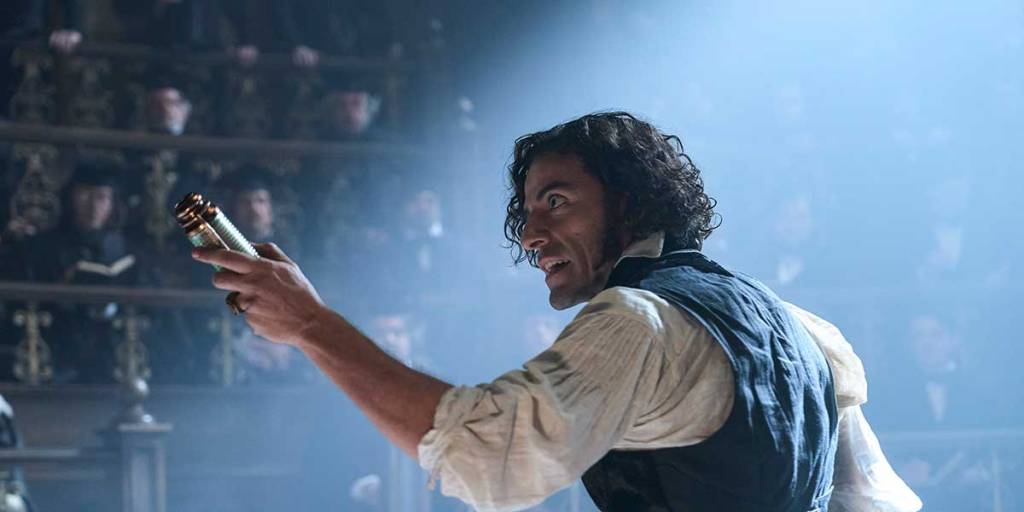
Victor Frankenstein (Oscar Isaac) is a medical student in Victorian England. The son of a minor aristocrat, the world is his for the taking. But when he shows his research in a dramatic performance before his professors — by bringing the head and torso of a dead man back to life using electric shocks — he is immediately expelled. Luckily he finds a benefactor (Christoph Waltz) from the continent to sponsor his research.  Frankenstein sets up his laboratory in an isolated castle. Like a modern prometheus, he goes through piles of dead bodies, cutting out the choicest bits to create his new, superior man. He is joined by his milquetoast younger brother William (Felix Kammerer) and William’s beautiful and intelligent bride Elizabeth (Mia Goth – she has perfect name for this movie). But when the creature (Jacob Elordi) is brought to life using a bolt of lightning, he doesn’t turn out as expected: he is a monster, a brainless slug who can only say one word. His experiment a failure, Frankenstein flees his castle burns down his laboratory, leaving career in ruins, and allowing the monster to die…or did he?

The rest of the movie follows the creature as he grows, learns to speak and read, discovers his own strength and power, and to differentiate between good and bad. But how will he turn out? And will humans ever accept him? 

Guillermo del Toro’s Frankenstein is an entirely new look at Mary Shelley’s novel, unlike any version before it. The green-faced, flat-headed Frankenstein is nowhere to be seen. Elordi is amazing as this tabula rasa with unexpected powers and emotions. He’s a completely sympathetic character for the first time. It’s the scientist who is the real monster in this movie, but one with motives and who can feel remorse. It takes place in locations you’d never associate with Frankenstein, starting aboard a ship in the Arctic. 

There’s also an extended chapter set in a cabin in the woods with a blind hermit. Yes, this Frankenstein is a gothic horror movie — which he’s been making all his life, like Crimson Peak (2015) — but this one takes it to a higher level. It’s visually stunning, wonderfully acted, it’s long but never boring, and besides the violence, gore and horror, there’s also romance and pathos, friendship, beauty and self-discovery.  

What can I say — this is one great Frankenstein.

Frankenstein and Good Fortune which both premiered at TIFF, and Black Phone 2 all open in Toronto this weekend; check your local listings.

This is Daniel Garber at the Movies, each Saturday morning, on CIUT 89.5 FM and on my website culturalmining.com.

It’s dangerous! Films reviewed: Daniela Forever, Apocalypse in the Tropics, We Were Dangerous

Posted in 1950s, Brazil, Coming of Age, Fantasy, High School, Horror, Indigenous, Maori, New Zealand, Politics, Religion, Romance, Spain by CulturalMining.com on July 12, 2025

Hi, this is Daniel Garber at the Movies for culturalmining.com and CIUT 89.5 FM.

Guillermo del Toro, the celebrated director who splits his time between Mexico and Canada, has curated a series of classic Canadian horror movies called From Rabid to Skinamarink: Canadian Movie Madness, playing at the TIFF Lightbox this weekend.  I happen to have seen everyone of them myself, and I totally agree with del Toro’s selection.  You can catch Canadian gems like the feminist werewolf drama Ginger Snaps, Vincenzo Natali’s cult-hit Cube, Kyle Edward Ball’s experimental Skinamarink, and many more. 

But this week, I’m looking at three new movies from abroad: a surreal fantasy from Spain, a politically documentary from Brazil, and a period drama from New Zealand.

Daniela Forever

Wri/Dir: Nacho Vigalondo

It’s present-day Madrid. Nicolas (Henry Golding: Crazy Rich Asians) is a popular DJ at the city’s hottest nightclubs. But he is thrown into a deep depression when his girlfriend, an artist named Daniela (Beatrice Grannò: The White Lotus) is killed by a negligent driver just outside his home. But things take a turn for the better when a good friend of his, Victoria (Nathalie Poza), tells him of a new, experimental drug that might be just what he needs. But it’s top secret, filled with non-disclosure clauses, and requires regular visits to the pharmaceutical labs. The scientists there tell him each pill, if taken just before bed, will produce lucid dreams, real visions where he can control the content and won’t forget about them when he wakes up. This means he can bring Daniela back to life, at least while he sleeps. But he soon discovers its limitations: he can’t dream about something he’s never seen. If he turns down an ally he’s never visited, it will be covered in unformed, writhing grey matter. Kinda creepy.

Daniela seems artificial at first, but as time progresses, she starts turning real. She even produces creative ideas and thoughts that he doesn’t remember ever experiencing in the awake world. And far from seeming etherial, his lucid dreams are now wide- screen images in living colour, while awake time is small and drab. He can take Daniela to new places just by thinking about them and opening a door, and change the city of Madrid into something out of one of her paintings. But he soon realizes, not everything is going the way he planned. And when things from his dream world start appearing in awake time, he has to wonder what is real? Can he be in love with someone who doesn’t exist? And can she ever really love him if she’s just a figure of his imagination?

Forever Daniela is a highly- creative science fiction romance about love, death and reality. While it sounds like a Black Mirror jump-scare thriller, it actually avoids most  “bad” things except for the sadness of mourning. It also has a very surprising twist at the end (no spoilers). The film is Spanish, but most of the dialogue is in English. Henry Golding (Crazy Rich Asians) is appealing as the leading man, but runs into a bit of acting trouble when he tries to do a full-fledged meltdown. The special effects are excellent, fooling around with unusual concepts like daytime light and shadows in a nighttime environment. I quite like the writer/director Nacho Vigalondo

for the way he incorporates horror movie elements within an otherwise realistic context (like his film Colossal a few years ago.) So if you’re looking for something that’s surreal and supernatural but told in a positive, though bittersweet, way, I think you’ll like Daniela Forever.

Apocalypse in the Tropics

Wri/Dir: Petra Costa

Brasilia — a capital city  designed, planned and built from the ground up — was meant to be modern, secular and democratic. But after a coup-d’etat in 1964, Brazil became something other than democratic: a military dictatorship which ruled for the next two decades. So when a new, populist right-wing leader with military ties emerged in the 2010s, many Brazilians were wary of democracy falling again. But Jair Bolsonaro was different, a politician who changed his power base when he forged ties with evangelical Christians. 

Apocalypse in the Tropics traces Brazilian politics over the past decade and the rise in religion within government policies. It also gives background, from the building of the capital, through the military coup, American evangelist Billy Graham, the return to democracy, and more recent developments. It uses beautiful period footage, lush music and symbolic paintings — like Hieronymus Bosch’s Garden of Earthly Delights —  as a metaphoric portrayal of millenarian changes in Brazilian politics. It is narrated by the filmmaker and includes her one-on-one interviews with Bolsonaro, current President Luiz Inácio Lula da Silva, and the wildly popular televangelist, Silas Malafaia, who served as Bolsonaro’s right-hand man. We witness Malafaia’s sermons before huge crowds — shouting his opposition to same-sex marriage, abortion rights, and feminism — as well as intimate conversations aboard his private plane. The doc also shows new footage of the beloved capital Brazilia occupied and trashed by massive demonstrators, who called for a coup after Bolsonaro’s defeat. 

Apocalypse in the Tropics is a follow-up to Petra Costa’s 2019 film The Edge of Democracy with similar footage, style, and topic but concentrating this time on religion’s role in government policies. I’m not sure if this is a sequel, a reshoot or a continuation, but either way, it’s as aesthetically beautiful as it is disturbing. 

We Were Dangerous

Wri/Dir  Josephine Stewart-Te Whiu

It’s the 1950s on a small island somewhere off the coast of New Zealand, where three girls share a cabin: Daisy, Nelly and Lou (Manaia Hall, Erana James, and Nathalie Morris). They were sent there by the authorities or their parents. Te Motu is a school for “incorrigible” girls or, as the administrators call them, “whores, queers, delinquents and sexual deviants.” Many are orphans or runaways caught stealing food, like Daisy or Nelly. Lou is the exception. She comes from a rich family but was caught making out with her (female) tutor. The school operates under the strict rule of Matron (Rima Te Wiata), who has a cruel streak a mile long. Raised by nuns, she feels the only way to cure these girls’ bad attitudes is through the bible and the lash. Naturally the girls all want to get the hell out of there, but it’s hard to escape from an isolated island in the south pacific. The purpose of the school is to turn bad girls into happy homemakers. They are given lessons in diction and manners but not reading or math. Matron is frustrated by their outcome: She says they are “too stupid for school, to uncivilized to be maids and too barbaric to work”. Every so often, Matron is visited by men in suits from the mainland, one of whom suggests a horrifying treatment. But when Nelly find out, the three girls decide they have to do something to stop it.

We Were Dangerous is a moving, coming-of-age story about girls surviving in 1950s New Zealand. It’s bright and exuberant, full of playfulness and dancing, Haka and history, and though fictional, it tackles the very real issue of the mistreatment of indigenous girls. The acting is excellent all around, full of subtle clues and delightful details. For a first film, Stewart-Te Whiu avoids many potential stumbles and instead gives us a solid film that’s fun to watch. It played at ImagineNative this year, and is definitely worth seeing.


Apocalypse in the Tropics is playing this weekend at HotDocs and will be streaming on Netflix this coming week; Daniela Forever opens this weekend in Toronto; check your local listings; and We Were Dangerous is available now on VOD.

This is Daniel Garber at the Movies, each Saturday morning, on CIUT 89.5 FM and on my website culturalmining.com.

Humans and machines. Films reviewed: L’homme Parfait, Pinocchio

Posted in 1930s, Animation, comedy, Fairytales, Family, Fantasy, France, Italy, Robots, Science Fiction by CulturalMining.com on November 11, 2022

Hi, this is Daniel Garber at the Movies for culturalmining.com and CIUT 89.5 FM.

In these troubled times, many feel daunted by quickly-changing technology, and wait with trepidation the eventual coming of the Singularity: the day robots and artificial intelligence become smarter than humans. What will happen to us after the Singularity?

This week I’m looking at two new movies about the increasingly thin line separating people from machines. There’s a woodcutter in Italy who creates a puppet that acts like a boy; and a woman in France who buys a robot that acts like a man. 

L’homme parfait

Co-wri/Dir: Xavier Durringer

It’s the near future, somewhere in France.

Franck and Florence (Didier Bourdon, Valérie Karsenti) are a happily unmarried middle-aged couple with two kids, Max and Victoire. Florence has an office job, while Franck works from home. He’s an actor who is writing that blockbuster screenplay which will turn his career around. But it’s been three years now with no sign of progress, and his agent isn’t exactly banging on his door with acting jobs. And even though Franck is at home all day, it’s Florence who ends up cooking, cleaning and taking care of the kids. But enough is enough. She puts in an order and two days later a large box arrives at their door. Meet Bobby (Pierre-François Martin-Laval): a realistic-looking male robot: strong, smart and friendly. He has artificially blue eyes and speaks in a monotone. With a variety of built-in options, from Salsa dancing to Krav Maga, soon Bobby is whipping up boeuf bourgognon, ironing their sheets and telling bedtime stories to the kids. And his artificial intelligence means, like Siri, he listens to — and remembers —  everything he hears. 

But there are side effects.  Florence may love all the free time she has now, but Franck feels stripped of all his fatherly duties. Bobby is better at bowling. Bobby can fix a broken car engine in a flash. Bobby can select the best wine, say the right thing, buy the right gift. Franck feels increasingly left out. And when he accidentally sees Bobby’s “standard equipment” he feels second-rate and useless. Meanwhile, Florence feels sexually neglected and doesn’t understand why. Is Bobby ruining their marriage? Will Florence ever activate Bobby’s forbidden love-love button? Or can Franck reactivate their relationship?

L’homme parfait is a French comedy about robots, technology and middle-age crises. It’s also a clear knock-off of last year’s German hit I’m Your Man (they actually give it a nod by saying Bobby is manufactured in Germany). It’s conventional, predictable, and anything but subversive, in the style of those cheap-ass Hollywood comedies in the ‘80s and ‘90s.  That said, it did make me laugh more than once. What can I say — no one will call L’homme parfait a great movie, but it is a funny, low-brow sex-comedy in an emerging sub-genre: humanoid robots. 

Pinocchio

Dir: Guillermo del Toro and Mark Gustafson

Geppetto is a wood carver who lives with his beloved son Carlo in a small village in Tuscany. He carves everything in town from wooden clogs for Carlo, to Christ on the Cross in their local church. But when a WWI bomb drops on the village killing his son, Geppetto becomes a reclusive alcoholic, spending all his time crying by Carlo’s grave. Two decades later, in drunken rage, he chops down a knotty pine tree that grew from a pinecone Carlo found on his last day alive, and roughly carves a new boy — with wobbly knees and elbows, rough-hewn hair and a long piece of wood for a nose —  all modelled on his son. He calls him little pine, or Pinocchio. What he doesn’t realize is a blue cricket  (the story’s narrator) lives inside a hole in the wood the boy is made of.

After Geppetto passes out, a magical wood sprite, out of sympathy for the old man, brings Pinocchio to life. She gives the cricket responsibility of taking care of the kid and teaching him right from wrong. The new-born boy is clumsy and dangerous, a tabula rasa taking in all around him. He exalts in learning and gleefully smashes everything he sees. Soon the discovers Pinocchio with different reactions. Some call him an abomination, the work of the Devil. Podesta, a member of Mussolini’s Fascist Party, thinks Pinocchio can be the ultimate weapon, a soldier who cannot die. And a sleazy carnival barker named Count Volpe, and his sinister sidekick, a monkey named Spazzatura, see him as a money-maker, a living puppet he can exploit at his circus.  Being pulled in all directions, can Pinocchio ever find his way back to his father and creator Gepetto?

Pinocchio is a dark retelling of the 19th century Italian classic. It’s masterfully-made using stop-motion animation of dolls and puppets, in the style of Rudolph the Red-Nosed Reindeer or A Nightmare Before Christmas. Gone are the cutesy Disney costumes and hats; this Pinocchio is bare-bones wood all the way, with clothing hacked onto his body. The naughty boy is made of knotty pine. It’s partly a musical, with characters spontaneously breaking into song (some good, some not), especially at the circus. But it’s also, like all of del Toro’s movies, dark, sad and scary. It deals with theft, alcoholism and death. And by transplanting the story into fascist wartime Italy (similar to Spain in Pan’s Labyrinth), he makes it even darker. 

In addition to Gregory Mann, David Bradley and Ewen McGregor — as, Pinocchio, Geppetto and the cricket — other voices include Tilda Swinton, Kate Blanchett, Rob Perlman, and Finn Wolfhard as Candlewick, Pinocchio’s frenemy. But it’s the characters themselves, animated on the screen, that really make this movie. If I saw this as a little kid, I guarantee, Pinocchio would have given me nightmares. But as a grown-up, I found it a sad and very moving story, beautifully made. 

Pinocchio is now playing at the TIFF Bell Lightbox, and L’homme parfait is one of many films screening at Cinefranco till Tuesday and then digitally till the end of the month. 

This is Daniel Garber at the Movies, each Saturday morning, on CIUT 89.5 FM and on my website, culturalmining.com.

Men on the Run. Films reviewed: Flee, Red Rocket, Nightmare Alley

Posted in 1930s, 1940s, 1990s, Afghanistan, Animation, Circus, Clash of Cultures, comedy, documentary, Drama, melodrama, Movies, Refugees, Sex Trade, Texas, Thriller by CulturalMining.com on December 18, 2021

Hi, this is Daniel Garber at the Movies for culturalmining.com and CIUT 89.5 FM.

With Award Season quickly approaching — from the Golden Globes to the Golden Turkeys — the studios are releasing a lot of its big ticket movies in hopes of being considered for some of the major prizes up for grabs. This week I’m looking at three potential Oscar nominations, all stories about men trying to flee from their dark pasts for a potentially better future. There’s a man who leaves a burning house to join the circus, a middle-aged porn star who leaves LA to find a job in small-town Texas, and a young man who runs for his life from Afghanistan in hopes of finding a better one in Europe.

Red Rocket

Co-Wri/Dir: Sean Baker

Mikey Sabre (Simon Rex) is down on his luck. He was an LA porn star in his heyday, along with his wife, 

Lexi (Bree Elrod). But the good times are long gone. Now he’s back home in Texas City, Texas, with no money, no possessions, no reputation, the prodigal husband knocking at his ex-wife’s door. Naturally she and her mother, Lil (Brenda Deiss) want nothing to do with him, but he manages to sweet talk his way into letting him sleep on their couch. And after an exhausting search for employment — no one will hire a former sex worker — he falls back on his teenage job as a pot dealer. And soon enough, with the help of his blue happy pills, he’s sleeping wth Lexi again each night.  But everything changes when he meets a beautiful naive young woman with red hair, who works at the local donut shop. Her name is Strawberry (Suzanna Son), who loves pink hearts and everything sweet. Mikey becomes infatuated by her, both as a focus of his lust and his imagined ticket to wealth. He tells her he’ll take her away from this dead-end town and introduce her to the top names in Hollywood porn, after, of course, she turns 18. Wait… what?

Red Rocket is an outrageous  comedy about the misadventures of a former male porn star, including an extended across town by a panicking naked Mikey brandishing his Sabre. This is Sean Baker’s third such film — Tangerine about two black transwomen in LA, and The Florida Project, told through the eyes of kids in Orlando — shot, guerilla-style, on location on a budget using mainly first-time actors (who, I have to say, are all great!) And he helps normalize marginal sex workers by defying the usual stereotypes. At the same time, a movie about a predatory 40-year-old guy seducing a Lolita-like teenaged girl is not the same as rambunctious kids in Florida or wisecracking transwomen in LA. Don’t worry, everyone gets their comeuppance in the end, but Red Rocket will make you squirm and cringe uncomfortably along the way.

Flee

Co-Wri/Dir: Jonas Poher Rasmussen

Amin is born in Kabul where he grows up under communist rule, watching Bruce Lee movies and dancing to pop music on his walkman. Now he lives in Copenhagen with Kasper, his lover — they’re thinking of buying a house in the countryside. After that is, he finishes his post-doctoral work at Princeton. But how did he get from Afghanistan to Denmark? When the US-backed Mujahideen invaded Kabul his family is forced to flee. Russia is the only place offering a tourist visa — but Moscow is a mess; the the Soviet Union has just collapsed and is now run by oligarchs and corrupt police. Now they’re stuck in limbo, supported by his older brother a janitor in Sweden. Can the family stay together? Can they ever make it to somewhere safe? Or will unscrupulous human traffickers lead them to disaster?

Flee is a deeply moving drama about one man’s journey as a refugee from danger to sanctuary, and all the moral compromises he is forced to make along the way. It’s sort of a documentary, in that it’s a true story told by the man it happened to, even though it’s voiced by actors using animated characters. And by animation, I don’t mean cute animals with big eyes, I mean lovely, hand-made drawings that portray what actually happened. Far from being the heavy, ponderous lesson I was dreading, Flee has a wonderfully surprising story, elegantly told.

Nightmare Alley

Co-Wri/Dir: Guillermo del Toro

It’s the dustbowl during the Great Depression. Stan Carlisle (Bradley Cooper) is a bright and fit young man with great ambitions and a shady past. Leaving a dead man in a burnt house behind him, he sets out to find his fortune He comes upon a circus, and makes his way through the tents to Nightmare Alley, the area where the carnies do their work out of sight. He gets hired as a roustabout, hammering nails, pitching tents, but soon rises quickly within the circus ranks. Zeena  the Seer (Toni Collette) seduces him, and in return she provides access to her partner Ezra (Richard Jenkins) an aging alcoholic. Ezra holds a little black book outlining exactly how to con strangers out of their money by convincing them you can read their minds and talk to the dead. But he warns Stan, don’t fall into the trap of believing you it’s real — that can kill you. Meanwhile, Stan only has eyes for the beautiful and innocent Molly  Cahill (Rooney Mara), the electric woman. She’s fiercely defended by the other carnies, but they let her go when she says they’re in love. 

They move to the big city where they find great success in their psychic act. Stan loves their new rich lifestyle, while Molly pines for her previously life at the circus. But trouble brews in the form of a femme fatale, a beautiful blonde woman with an ivory-handled gun who attends one of their acts. Dr Lilith Ritter (Cate Blanchett) is a successful psychoanalyst who listens to — and records — the confessions of the richest and most powerful men in the city… and she is intrigued by Stan’s psychic abilities. (She completely ignores Molly). Perhaps they can combine their resources for even greater success? 

Nightmare Alley is a dark movie about an ambitious but ruthless man in his quest for success. Bradley Cooper is credible in the lead, but even better are all the supporting actors, from Willem Dafoe to Cate Blanchett. It has a novelistic storyline with a plethora of characters, almost like a classic Hollywood film, which makes sense.  Based on a novel, it’s a remake of the 1949 film noir of the same name, starring Tyrone Power and Joan Blondell. And it fits perfectly in del Toro’s body of work, with his love of freaks, legerdemain, underdogs, young women with pageboy haircuts, and of course many actors who appeared in his previous films. Guillermo del Toro (who shoots his movies in studios and locations around Toronto) has a troupe of actors he uses over and over, like Ron Perlman, dating back to his earliest movies. NIghtmare Alley is quite long — two and a half hours — but kept my attention all the way to a perfectly twisted finish. It’s a good, classic drama.

I quite like this one.

Red Rocket, Flee and Nightmare Alley all theatrically in Toronto this weekend; check your local listings.

This is Daniel Garber at the Movies, each Saturday morning, on CIUT 89.5 FM and on my website, culturalmining.com

It’s Halloween! Films reviewed: Last Night In Soho, Antlers, Locke & Key

Posted in 1960s, Bullying, Comics, Coming of Age, Family, Fashion, Ghosts, Halloween, Horror, Indigenous, Kids, Monsters, Time Travel, UK by CulturalMining.com on October 30, 2021

Hi, this is Daniel Garber at the Movies for culturalmining.com and CIUT 89.5 FM.

Awooooooo…!
It’s Hallowe’en again — the perfect time to watch some spooky and scary movies!

This week, I’m looking at a fashion student in London who travels back in time from her attic apartment; a family in Massachusetts who find keys that open locked doors; and a school boy in the Pacific Northwest who always keeps his father’s door locked… from the outside.

Last Night In Soho
Co-Wri/Dir: Edgar Wright (Scott Pilgrim vs the World)

Eloise (Thomasin McKenzie) is an idealistic young student at a fashion college in North London. Though raised in remote Cornwall, she already sews her own dresses and wants to follow in her grandmother and mom’s footsteps as a designer. She’s also obsessed by the early 1960s — the fashions, the people and the music — and she constantly listens to her grandma’s old discs on a portable record player. But she can’t stand the condescending attitude of her roommate Jocasta and most of the other students. So she rents an attic bed-sit flat in Soho, and gets a job at a local pub to pay for it. But everything changes on her first night in her new home. She awakens to find herself in Soho, circa 1964!, experiencing life through the eyes of young woman named Sandie (Anya Taylor-Joy: Queen’s Gambit)! Where Ellie is shy with mousy brown hair, Sandie is blonde, brash and self-confident. She marches into the Cafe de Paris and declares she’ll be the next singer on that famous stage. When Ellie wakes up in the morning, things are back to normal, but she feels. different. She starts sewing a 60’s style dress based on what she wore the night before in Soho. And she starts mimicking Sandie’s look and lifestyle — dying her hair, wearing makeup and sticking up for herself. But gradually she realizes 60s Soho wasn’t the fun place she imagined — it was actually full of exploitation, violence and organized crime. And the separation between the two worlds starts to blur… with the ghosts of Sandie’s far-off dangers appearing in her real life in modern London. Is Eloise losing her mind? And can she ever escape from this dual existence?

Last Night in Soho is a cool, fun and sometimes scary coming-of-age story loosely wrapped in a time-travel theme. Throw in life in London, 60s girl groups, fashion, Soho burlesque and seedy organized crime, and you have a fascinating and unique world to explore. Thomasin McKenzie (Leave No Trace) gives a terrific performance as a young woman trying to hang on to her sanity, while Anya Taylor-Joy (you might recognize her from the TV series The Queen’s Gambit) is a dynamo as her alter ego. Throw in some real ’60s stars — Terrence Stamp as a sleazy barfly, and an almost unrecognizable Diana Rigg as a curmudgeonly landlady — and you’re left with a lot to watch.

Great movie.

Antlers
Co-WriDir: Scott Cooper (Hostiles)

Julia (Keri Russell) is a school teacher in a mining town in the Pacific northwest. She lives with her brother Paul (Jesse Plemons), the local sheriff. She fled to California 20 years earlier to escape her abusive father. But now that he’s dead, she feels safe to move back again. Little does she know there are other dangers in this small town. In any case, she’s having trouble fitting in. None of the 12 year olds in her class participate, or even seem interested, in what she’s teaching. And one kid in particular, Lucas (Jeremy T Thomas) looks malnourished, bullied and fearful. And he draws terrifying pictures at his desk. She reaches out to help him, but though needy, he rejects her. You see, his dad ran a meth lab in an abandoned mine where something terrible happened.

Now his dad and his seven-year-old brother are ill with a strange disease — the can only eat raw flesh. Lucas keeps them locked up in the attic, bringing them small animals he traps and any roadkill he can find. But it’s not enough. So here we have a do-gooder teacher who wants to save what she sees as an abused and neglected child, while he’s trying desperately to keep his family alive. But when Lucas’s dad tries some human flesh, he really starts to change, both physically and mentally. Can a little boy keep a monster at bay? Or will it take a schoolteacher to stop this cannibal killer?

Antlers is a bloody and gory — though not all that scary — horror movie set among the gorgeous lakes and mountains of Western Canada. Strangely, the monster in the story — modelled on the Windigo, a rapacious half-human, half-animal creature — is part of the Anishinaabe culture in the east, not the Pacific Northwest. And aside from Graham Greene (as a walk-on indigenous explainer), everyone else is white. That said, I like the acting, and the fact the characters are not all strictly good or bad, more nuanced than in your typical scary movie. Antlers is a chilling — though slow-paced — horror-thriller with enough blood and guts to keep you satisfied on Hallowe’en.

Locke & Key
Developed by Meredith Averill, Aron Eli Coleite and Carlton Cuse, based on the graphic novel by Joe Hill and Gabriel Rodriguez

It’s the present day in small-town Mathesen, Massachusetts. The Locke family — eldest son Tyler (Connor Jessup: BlackbirdCloset Monster ), Middle sister Kinsey (Emilia Jones) and the youngest Bode (Jackson Robert Scott) — and their mom (Darby Stanchfield) have just relocated from Seattle. Their dad died in a terrible incident so maybe a new environment will help them get over it. They move into the stately family home, a huge, but crumbling, mansion known as the Key House. It’s been in the family for generations. While the Lockes know next-to-nothing about their history, everyone in this town knows exactly who they are. The two eldest enroll in the local prep school — Tyler joins the hockey team while Kinsey falls in with a crowd of amateur filmmakers — while Bode is left to explore the mansion. And what he discovers is magical — a series of keys, each with its own properties. One lets you walk through a door and emerge wherever you want to be. Another lets you enter someones mind and explore their memories. Soon Tyler and Kinsey join in, but their mother and their uncle Duncan (Aaron Ashmore) can’t comprehend anything magical, even when they experience it themselves. Only kids can remember it. But all is not just fun and games, There’s an evil shape-shifting demon, a beautiful woman known as Dodge, who covets these keys for her own nefarious purposes. Who will triumph in the end?

Locke & Key is a wonderful TV series that’s part adventure, part horror, part psychological thriller and part family drama. I’m purposely revealing very little because I don’t spoil the plot, but it’s well acted — with a mainly Canadian cast — and lots of unexpected plot turns and cool special effects. And the series was shot right here, just outside CIUT’s broadcast studios in the gothic hallways of Hart House (pre-Covid, of course.) So if you’re looking for something Hallowe’en-y to binge on, you have to check out Locke & Key.

Locke & Key seasons 1 and 2 are streaming now on Netflix; Antlers and Last Night in Soho both open this weekend; check your local listings.

This is Daniel Garber at the Movies, each Saturday morning, on CIUT 89.5 FM and on my website, culturalmining.com.

Decline and Fall. Films reviewed: Ottolenghi and the Cakes of Versailles, The Strain, The Humorist

Posted in Action, Communism, Cooking, Disaster, Disease, documentary, Food, France, Horror, New York City, Russia, TV, USSR, Vampires by CulturalMining.com on May 29, 2020

Unedited, no music

Hi, this is Daniel Garber at the Movies for culturalmining.com.

It’s Spring Film Festival Season in Toronto, without cinemas but with exciting new movies still being shown online. I’m recording at home via CIUT, from my house to yours, so I apologize for the sound quality. This week I’m looking at three films, one each from TJFF and Hot Docs, as well as a TV series. There’s decadence in Versailles, pandemic and mayhem in New York, and decline in 80s Moscow.

Ottolenghi and the Cakes of Versailles

Dir: Laura Gabbert

Yotam Ottolenghi is a London-based chef, restauranteur and cookbook author. A few years ago he receives an unusual offer from New York’s Metropolitan Museum of Art (“The Met”): to pull together an event recreating the desserts of the Palace of Versailles, from Louis XIV till Louis XVI. He contacts five chefs from around the world to fly in and show their stuff. But these are no ordinary chefs; they each have an unusual style all their own. Dinara Kasko, a young woman from Ukraine, assembles architecturally-inspired cakes with gravity-defying minimalist structures on the outside, and fantastic layers on the inside. Dominique Ansel – inventor of the Cronut – features new takes on classic French patisseries at his Manhattan restaurant. Sam Bompas of London’s Bompas and Parr, injects life into that much-neglected cooking form: jellies and moulds. Ghaya Oliveira is a multi-talented Tunisian chef who evokes her grandmother’s ideas while creating French pastries; and Janice Wong, a Cordon Bleu-trained Singaporean culinary artist who paints and sculpts using chocolates.

This wonderful documentary shows the chefs at work behind the scenes at The Met, recreating the splendour, decadence and opulence of Louis XIV’s Versailles. The unique works they create especially for the show are really amazing, suggesting the architecture, the formal gardens, and the open-court style of that palace, where ordinary people, if elegantly dressed, were allowed to enter the palace grounds, a space traditionally fenced off from the public. The film also provides much needed historical context: Starving Parisians stormed the palace in 1789, while the documentary is set in an ostentatious Manhattan not too long before the pandemic lockdown. Parallels anyone?

The Strain (Season 1)

Created by Guillermo del Toro and Chuck Hogan

Dr Goodweather (Corey Stoll) is a NY epidemiologist who works for the CDC. He’s separated from his wife and son because he’s always on call for emergencies. He works alongside Nora (Mia Maestro) an Argentinian-born doctor. They are called into action when a 747 lands at JFK. Everyone on board – including the pilots – are dead. Is it a terrorist hijacking? No, it’s a highly contagious virus. Called to action, the doctors attempt to stop its spread before it infects everyone in the city. But they are thwarted by corrupt officials who allow an intricately-carved wooden box (a coffin?) out of the protected area. And it turns out that the infected passengers are really dead, just temporarily comatose. They’re actually still alive, or perhaps undead. Once infected, people change into zombie-like vampires under the thrall of an unseen master.

What’s unusual about this virus is how it spreads. A red, phallic piece of flesh, like a blind moray eel, shoots out from the infected person’s neck and sucks their victim’s blood. The disease carriers cluster in colonies underground and only come out at night. Manhattan quickly collapses into chaos with widespread crime, looting and mayhem due to the pandemic. But still no quarantine to stop its spread. Luckily, a Scooby Gang of mismatched players form a team. There’s Mr Setrakian (David Bradley) an old man with secrets fro the past who carries a silver sword; Vassily (Kevin Durand) is a public rat catcher who knows his way through all of Manhattan’s dark tunnels; Dutch Velders (Ruta Gedmintas) a champion hacker who disables the internet. They face a cabal of powerful men who want the infection to continue for their own nefarious purposes. But can the doctors and their allies stop the infection? Or is it too late?

The Strain is a great action/horror/thriller TV series about an uncontrolled pandemic, corrupt billionaires amd politicians, and the frontline medical workers trying to stop them. It has mystery, romance, sex, and violence with a good story arc, gradually revealed. It’s uncannily appropriate now, and for Toronto residents it’s fun to spot the localations – it was shot here. So if you’re looking for a good pandemic drama, and don’t know where to find it, look for The Strain.

The Humorist

Wri/Dir: Mikhail Idov

It’s 1984 in the Soviet Union. The Soyuz T-12 is in the sky, Chernenko heads a geriatric government, and Ronald Reagan casually talks about dropping atomic bombs on Russia. Boris Arkadiev (Aleksey Agranovich) is a successful comedian who has it all, adored by fans and government officials alike. He travels across the nation with a stand-up monologue called The Mellow Season, a tame routine about a trained monkey. Born in Byelorussia, he now lives in a nice Moscow apartment with his lawyer wife Elvira, and his two kids, his adoring six-year-old Polina and his rebellious teenage son Ilya. In public, he’s a national icon. But behind the scenes he’s an arrogant alcoholic, a prolific womanizer, and an all-around prick. Aside from himself, he worships the two Russian idols: vodka and the space program. He left religion behind but is conscious of anti-Jewish murmurs wherever he goes. And he’s a total sell-out. Once a serious but unsuccessful novelist, he went on to be a TV writer with his friend and rival Simon. Boris gave in to the official censors, while the less-successful Simon resisted. Now Boris is like the trained monkey in his monologue, performing on cue whenever ordered to do so.

But a series of events change his outlook. An unexpected encounter with a cosmonaut makes him rethink destiny, God and existence. And when he learns about the audacious black comics working in LA from his actor pal Maxim (Yuri Kolokolnikov) he realizes how dull and tired his own comedy has become. Will he stay a depressed, trained monkey for his corrupt masters in the army and KGB? Or will he risk his job, family and reputation by speaking from the heart?

The Humorist is an excellent dark comedy, set in the last days of the Soviet Union. Agranovich is great as a troubled, over-the-hill comic, like a Soviet Phillip Roth anti-hero. It’s brilliantly constructed starting with a garden party in Latvia, but degenerating into a soiree at a high-ranked party-member’s villa. It’s peak-decadence, where sagging old generals in formal wear dine with American porn playing elegantly on a TV in the background (they think it’s high society). The men later retreat to a banya wearing Roman togas, in a scene straight out of Shakespeare’s Julius Caesar. The Humourist has an absurdist, almost surreal tone, where a midnight knock on the door could mean interrogation or the exact opposite. It’s filled with disturbing scenes of long underground corridors and empty Aeroflot planes. It kept me gripped — and squirming — until the end.

Great movie.

Ottolenghi and the Cakes of Versailles is now streaming at Hotdocs; The Humourist is playing online at TJFF, and you can find The Strain streaming, VOD, or on DVD.

This is Daniel Garber at the Movies each Friday morning on CIUT 89.5 FM and on my website culturalmining.com.

NAFTA movies? Films reviewed: Giant Little Ones, Sólo con Tu Pareja PLUS Sui Generis: An Alternative History of Mexican Cinema

Posted in 1990s, Bullying, Canada, comedy, Coming of Age, Cultural Mining, Depression, LGBT, Mexico, Movies, Sex by CulturalMining.com on March 29, 2019

Hi, this is Daniel Garber at the Movies for culturalmining.com and CIUT 89.5 FM.

If you’ve been watching movies over the past few years, you may have noticed a big change. Some of the biggest Oscars are going to directors like Guillermo Del Toro, Alfonso Cuaron and Alejandro Gonzales Iñaritu.

When did Mexico start making movies? The answer is: Mexico has been making great movies for a very long time… we just never knew about it. But there is one way to fill in that gap in our collective memories.

Sui Generis refers to unique species or bodies of work. Sui Generis: An Alternative History of Mexican Cinema is a suprising series of films at TIFF Cinematheque. It’s programmed by Diana Sanchez and Guillermo del Toro and includes some really famous movies – like Buñuel’s Avenging Angel – and an equal number I’ve never heard of. Surprises include anti-church satires, political protests, bizarre fantasies and fantastical films that transcend the genres we know. There’s also a sexual frankness largely missing in Hollywood movies under the Hays Code (1930-1968), but legal in Mexico.

Aside from Buñuel’s films and a few others, I had never heard of most of these movies, but Mexican cinephiles weep over the importance and uniqueness of these selections; a staple on late-night Mexican TV  but rarely seen on the big screen. This series features directors like Ripstein, Buñuel, Cuaron, del Toro and many others, from the 1930s up to recent times.

It’s quirky, eclectic and grand. I recommend this series.

This week I’m looking at movies from Canada and Mexico. There’s a Mexican sex farce about a man who bites off more than he can chew; and a Canadian coming-of-age drama about a boy forced to choke back his tears.

Giant Little Ones

Wri/Dir: Keith Behrman

It’s a middle class suburb somewhere in North America Franky (Josh Wiggins) is about to turn 17 at a big party. All his teammates from the swim team will be there, his divorced mom (Maria Bello) will be away that night, lots of alcohol and music, and his beautiful but vapid girlfriend says she’s ready to spend the night with him. And his best friend Ballas (Darren Mann) will be there to cheer him on. They’ve been inseparable since childhood and the two are popular and respected at school. This will be a life changing night for Franky… but not in the way he expects it.

The party ends early when his mom comes home, and his girlfriend decides not to stay. So the two drunk best friends end up crashing in Franky’s bed, and something happens in the dark. Ballis rushes home, and the next day everything’s different. Rumours about Franky start spreading, he’s blanked in the hallways and ghosted on instagram. People say he’s gay and did something to Ballas, who does nothing to defend his former best friend.

Only a few people stick by him. Mouse (Niamh Wilson) his out lesbian lab partner who packs a fake appendage in her jeans teaches him how to live with bullying (but I’m not gay! says Franky. Doesn’t matter says Mouse); and Natasha, Ballas’s sister (Taylor Hickson). She was once popular too, until she was “slut shamed” after something terrible happened to her. They turn to each other, first as pariahs and friends, but it gradually turns into something more.

Adding to the complications is Franky’s divorced gay Dad (Kyle MacLachlan). Franky hasn’t spoken to him since he moved away to live with his lover. He’s ready to offer advice but first Franky has to conquer his own homophobia. What really happened that night with Ballas? Will they ever be friends again? Is he in love with Natasha, or is it something else? And will things ever get better at school?

Giant Little Ones is an excellent coming-of-age drama, well acted, and based on an elegantly symmetrical script. It’s tender, funny and surprising, without leaving you depressed. I’ve seen this Canadian movie twice now, and it was just as moving the second time through.

Sólo con tu pareja (1991) (a.k.a. Love in the Time of Hysteria)

Wri/Dir: Alfonso Cuarón

Tomás Tomás (Daniel Giménez Cacho) is known for his sexual prowess and enormous ego. He sleeps with a different beautiful woman every night. He’s also fond of challenges and pranks like running naked down the stairwell to the lobby each morning to pick up the morning paper before anyone sees him. He’s handsome and fit, with a successful career as an advertising creative and lives in a swank apartment building in a good Mexico city neighbourhood. He lives two doors away from Dr Mateo Mateos (Luis de Icaza) and his wife, both good friends, who give him the keys to their apartment while they are away for the weekend.

But Tomas’s limits are challenged one night when he is faced with more than even he can handle. Mateo’s statuesque nurse Sylvia (Dobrina Cristeva) is arriving for a date, while his boss Gloria is also dropping by

LOVE IN THE TIME OF HYSTERIA, (aka SOLO CON TU PAREJA), Daniel Gimenez Cacho, 1991. ©IFC Films

to hear his advertising pitch for a brand of canned Jalapeños (and maybe a bit of spicy fun). Soon enough he’s bedding his boss in Mateo’s flat, Sylvia in his own, and is forced to inch his way naked back and forth between the bedroom windows and satisfy both women without letting either one know about the other. To make matters worse, he finds himself infatuated by a new tenant in the flat between

the two rooms. Clarisa is a flight attendant (Claudia Ramírez) and when he sees her robotic miming of seat belts and oxygen masks he sees through her window heid smitten. But can one man keep three women satisfied at one time? Alas, no.

He is fired from his job, and the vengeful nurse falsifies his medical tests telling him he is HIV positive, plunging him into a deep depression. Will Tomas discover the truth and change his ways? Or will he succumb to despair and throw himself off the tallest tower in Mexico City?

Sólo con Tu Pareja is a seldom seen, silly screwball comedy from the early 90s. It’s also Cuaron’s first feature film, long before his big hits like Gravity, Roma and Y Tu Mama Tambien. This is no masterpiece, but it is a fun and interesting look at a totally different era. It reminds me of the 1960s comedy Boeing, Boeing, starring Jerry Lewis and Tony Curtis, also about a promiscuous man who juggles three flight attendant gilfriends in one Paris apartment. This one is also dated, but better than Boeing Boeing — the women in this movie have personalities, and Daniel Giménez Cacho is on fire as Tomas. And it adds a pair of Japanese businessmen, some mariachi musicians and a Montezuma lookalike to give it a more Mexican feel.

Giant Little Ones opens today in Toronto; check your local listings; and you can see Sólo con Tu Pareja just tonight at the Tiff Bell Lightbox as part of the fantastic TIFF Cinematheque Mexican film series called Sui Generis: An Alternative History of Mexican Cinema, on now.

This is Daniel Garber at the Movies, each Friday morning, on CIUT 89.5 FM and on my website, culturalmining.com.

Heavy Hitters. Films Reviewed: Wonder Wheel, Roman J Israel, Esq, The Shape of Water

Posted in African-Americans, Baltimore, Cold War, Drama, Fantasy, L.A., Movies, Women by CulturalMining.com on December 8, 2017

Hi, this is Daniel Garber at the Movies for culturalmining.com and CIUT 89.5 FM.

It’s December now, and that’s when the movie awards start to pile up. This week I’m looking at some of the hard-hitters — movies with famous directors or stars — that might be up for a prize. There’s a kitchen sink drama in Coney Island, a legal drama in LA, and a romantic drama in a secret Baltimore laboratory.

Wonder Wheel

Wri/Dir: Woody Allen

It’s the 1950s in Coney Island. Humpty and Ginny are a middle aged couple living in a rundown apartment overlooking the ferris wheel. Humpty (Jim Belushi) is an angry drunk, currently on the wagon, who manages the carousel. Ginny (Kate Winslet) is a former actress who is a waitress at the clam shack… or as she puts it, she’s playing the part of “Waitress” in an on-going drama. She has a little kid from her first marriage, Richie, who is a petty thief and an aspiring arsonist, lighting fires wherever he can. Life in this dysfunctional family is far from perfect but at least it’s stable. That is until two things turn their lives upside down.

First Humpty’s estranged daughter Carolina (Juno Temple) shows up out of nowhere. They haven’t spoken for five years, not since she married a racketeer. Now she’s on the lam, a marked woman since she turned canary and sang about the mob to the cops. She moves into their crowded home, working with Ginny at the Clam House. The second thing that happens is Ginny meets Mickey (Justin Timberlake), a lifeguard on the beach. He’s a grad student at NYU and loves the idea of dating a dramatic older woman. Soon they are secretly meeting under the boardwalk for afternoon delights. But then Mickey meets Carolina and everything starts to unravel.

After watching Wonder Wheel, I kept wondering: did I just see a great movie or a terrible one? It’s certainly very different from Woody Allen’s European comedies. It feels more like a stage play, with characters reciting the lines of a script, from Mickey the lifeguard who narrates by speaking directly to the camera, to Ginny who says things like: “I’m consumed with jealousy!” I think that’s intentional.  But I’m not so sure most of the characters wanted to speak exactly like Woody, down to his stammer and pauses. Still, the look of the movie – from the period costumes to the lurid colours of neon lights, and the unexpectedly jarring camerawork – is stunning and surprising. Does this mean Woody Allen is still experimenting?

So is Wonder Wheel a good movie or not? Hmmm… I guess so.

Roman J Israel, Esq.

Wri/Dir: Dan Gilroy

Roman (Denzel Washington) is a defense lawyer in present day LA. He’s a partner in a small law firm – he minds the office while his partner goes to court. He’s an old-fashioned guy. He wears big round glasses and ill-fitting clothes. He rides the bus to an office full of foolscap and post-it notes. He works under the watchful gaze of pictures of Angela Davis and Bayard Rustin. He sacrificed marriage, a social life and material possessions, in exchange for devoting his life to civil rights and equality under the law. That is until his law partner of 30 years has a heart attack. Suddenly Roman finds himself jobless, friendless and nearly homeless.

A slick corporate colleague of his boss named George (Colin Farrell) offers him a low-level job at his firm. He refuses. But when he can’t find paying work, is mocked at a meeting of young activists, and is attacked by a mugger on the way home, he is faced with a tough decision: stay true to his ideals or sell out and enjoy the profits? Only Maya (Carmen Ejogo) – a woman he meets at an NGO – still believes in him. He ends up making an ethically dubious decision, and has to deal with the consequences.

Roman J Israel, Esq. is billed as a thriller – and there are a few tense moments – but it’s basically a character study of a man forced to re-examine his values in a changing world. Denzel Washington is great as Roman – he really gets into the part, portraying him as an oddball but a sympathetic and believable one. The story is very simple, but it’s the details surrounding this fascinating character that keeps you interested.

The Shape of Water

Dir: Guillermo del Toro

It’s Baltimore in 1962. Elisa Esposito (Sally Hawkins) is an elegant cleaning woman at a top secret government lab. She loves hard boiled eggs and bathtubs and lives above a movie theatre. She is mute, but communicates with her two friends using sign language. There’s Zelda (Octavia Spence) a talkative woman who translates and covers for her at work; and Giles (Richard Jenkins) a lonely illustrator in his 60s who lives with his cats in the apartment next door.

Elisa lives a routine life, until something strange shows up in a glass tank! Like The Creature from the Black Lagoon, he’s part human, part fish. Elisa is scared but intrigued. She offers him hard boiled eggs which he scarfs down. Gradually she teaches him to communicate through sign language, and exposes him to music, art and human emotions. Could this be love? If only life were so simple. The creature arrived with Strickland (Michael Shannon) the agent in charge of the project. He’s a racist misogynist who takes sadistic pleasure in torturing the creature with a cattle prod. He plans to kill him and take him apart to study. And lurking in the shadows at the lab is a soviet spy who observes everything – including Elisa communicating with the creature. Can their love survive?

The Shape of Water is an amazing movie, modelled on classic Hollywood films. I’ve seen it twice now, and it didn’t drag for a moment. It’s funny, romantic, surprising, violent, and exciting. The music, the art direction, the singing and dancing, the dream sequences, the surreal sex scenes, the Cold War/cloak-and-dagger feel…. this movie has just about everything. Sally Hawkins is an unusual romantic lead, but she’s perfect as Elisa. Shannon is a hateable — but understandable — villain. Spence and Jenkins as, respectively, her comic and melancholy sidekick, are both spot on.

This is a wonderful movie: I recommend it.

Roman J. Israel, Esquire is now playing. Wonder Wheel and The Shape of Water open today in Toronto; check your local listings.

This is Daniel Garber at the Movies, each Friday morning, on CIUT 89.5 FM and on my website, culturalmining.com.

Halloween Mansions. Movies reviewed: Jem and the Holograms, Crimson Peak, The Hexecutioners

Posted in Canada, Gothic, Halloween, Horror, L.A., Movies, Music, UK, Women by CulturalMining.com on October 23, 2015

Hi, this is Daniel Garber at the Movies for culturalmining.com and CIUT 89.5 FM.

Hallowe’en is a time of ghosts, ghouls and the walking dead. But it’s also a time for costumes, wigs and other disguises. This week I’m looking at three movies. There’s a gothic-horror melodrama about a woman trapped in a haunted mansion in England; another scary pic about two women trapped in a haunted mansion in Ontario; and a kids’ movie about four sisters who form a rock band in disguise and move to a mansion in L.A.

tumblr_nr8saftnQK1tv61rvo1_1280Jem and the Holograms
Dir: John M. Chu

When Jerrica (Aubrey Peeples) was just a little girl, her dad, an inventor in Los Angeles, died. All he left her was his final invention, a mysterious, white contraption. Now she and her sister Kimber (Stephanie Scott) live in a small town with her two half-sisters, and her aunt (Molly Ringwald). This mix-and-match family gets along swimmingly — no evil step-sisters here. tumblr_nr8sg2DJX41tv61rvo1_1280They’re into fashion, music and social networking online. They make their own music, too, but Jerrica is too shy to show her talents to the world. But she records a private tape as “Jem” using a fake wig with pink stripes painted on her face. Kimber posts the tape online, and Jem is suddenly web-famous.

Who is this mysterious songster, viewers want to know? Within days top LA record exec Erika Raymond (Juliette Lewis) is knocking at her door, ready to sign her to her label. But not without the rest of my band Jem, insists. Jem packs up her father’s tumblr_nr8sfdJW7c1tv61rvo1_1280invention and the four of them relocate to an LA mansion under the care of Rio (Ryan Guzman), Erika’s son.

They perform at key locations to adoring crowds, even as they follow the clues her dad’s invention provides her. Will the band survive success? Can record exec Erika be trusted? Will Jem get a swelled head as the leader of the band? And is something tumblr_nr8scclpo41tv61rvo1_1280happening between pretty Jem and handsome Rio?

Jem and the Holograms is a movie for teen girls, based on a Saturday morning cartoon from the 1980s. On the plus side, it gives girls a chance to dream of becoming rockstars not just princesses. And the songs are catchy. But for grown-ups like me, the story is hackneyed and predictable, with not much to offer aside from a chance to see 80s and 90s stars Juliette Lewis and Molly Ringwald have it out.

cpt_photo_0Crimson Peak
Dir: Guillermo del Toro

It’s turn of the 19th Century in boomtown Buffalo, NY. Edith (Mia Wasikowska) is a free-thinker and the heiress to a fortune.  She lives with her protective father and is visited by her late mother in the form of a dark wraith warning of future perils: Beware the Crimson Peak! Lovely Edith wears angelic dresses with winglike shoulder pads, and her pale blonde hair falls in ringlets on her face. She wants to becpt_photo_12 a professional writer and hones her skills at the local press. And she is relentlessly courted by the dependable Dr. Alan McMichael (Charlie Hunnam).

But then a stranger appears in town with his sister. Lucille and Thomas Sharpe (Jessica Chastain, Tom Hiddleston) are baronets, here to raise money. Thomas has cpt_photo_2invented a steampunk contraption that mines clay for bricks, a sought-after commodity. Edith’s father turns him down, but Edith, is drawn into his air of mystery. And after a romantic waltz they fall hopelessly in love, marry, and head off to his mansion in the English moors.

But all is not well. Her father dies in mysterious circumstances. Thomascpt_photo_5 seems to spend more time with his sister than with her, and they have yet to consummate their marriage. And Edith is growing steadily weaker and more tired, her face becoming pale with dark circles under her eyes. But she can still see the ghosts haunting the cpt_photo_15strange mansion, and she is shocked to discover the secrets the haunted mansion holds.

I liked this gothic melodrama. It follows Guillermo del Toro’s usual pattern of young women discovering ghosts hiding in draughty haunted mansions. Though this one seems a bit campier than usual. The look is amazing, especially the scarlet clay that bleeds through the white snow around the mansion. It has its cheesy parts, for sure, and Jessica Chastain, as the scheming sister, isn’t as good as the other three. But a good watch if you like period gothic horror.

Liv Collins as Malison McCourt in The HexecutionersThe Hexecutioners
Dir: Jesse Thomas Cook

Malison (Liv Collins) is a prim and proper career woman who lives in a threadbare apartment with just her cat to keep her company. Her neighbour Mr Poole (Walter Borden) is her landlord, a bible thumper who curses her name. She works for a euthanasia corporation assisting voluntary suicides since they changed the laws a few years earlier. But her first assignment goes terribly wrong, so she is sent on her next job with an old pro. Olivia (Sarah Power) is a vamp in black stockings who smokes, drinks, cusses and carries a sixgun. Nudity and death don’t faze her.

They arrive at a spooky, three-storey mansion lit by candles and 24347_320_470heated by a blazing fire. It’s surrounded by a foreboding hedge maze filled with hideous statues. They have to spend three nights there, until their assignment is complete. The house has a single servant, Edgar (Wil Burd), a creepy and skinny man with a shock of long black hair. His hobby is strangling pregnant possoms. And their client is an old man with a terribly deformed face. He wants to die, but in a very specific way. Mal begins to suffer night terrors – a common symptom of this job – and has a recurrent nightmare. She keeps seeing a strange, suicidal ritual repeated by a death cult wearing hideous masks. Then she begins to see them even when she’s awake! Are these hauntings related to the house — or are the two women to blame for their appearance?

The Hexecutioners is a good example of a slow-build horror. It’s more spooky than scary for most of the film. Its not perfect: some scenes felt repetitive, and I wasn’t crazy about the music-video-style montages that pop up here and there. But the small cast is uniformly excellent,  and it’s great to see a home- grown horror movie that harkens back to early Cronenberg.

Crimson Peak is playing now, The Hexecutioners premiered at Toronto After Dark, a festival of horror, action, fantasy and sci-fi movies, that continues through tonight; and Jem and the Holograms open today. Check your local listings. Also opening is Room, a fantastic movie about a mom and her little boy who live together in a hidden room. I reviewed Room during TIFF, and it’s a must-see. Don’t miss it.

This is Daniel Garber at the Movies, each Friday morning, on CIUT 89.5 FM and on my website, culturalmining.com

Mid-July Popcorn Movies. Films Reviewed: Pacific Rim, Red 2, The Conjuring

Posted in 1970s, CGI, Cold War, Cultural Mining, Espionage, Horror, Science Fiction, Supernatural, Uncategorized, violence by CulturalMining.com on July 18, 2013

Hi, this is Daniel Garber at the Movies for culturalmining.com and CIUT 89.5 FM, looking at high-brow and low-brow movies, indie, cult, foreign, festival, documentary, genre and mainstream films, helping you see movies with good taste, movies that taste good, and how to tell the difference.

It’s hot. It’s so hot the city sucked up the most energy ever recorded recorded in one day. There are rolling blackout across the town. How to beat the heat? You guessed it. Movies. I was in an IMAX theatre on Monday in flip-flops and shorts and I had to keep moving my fingers and toes to avoid freezer burn. So this week I’m talking about popcorn movies, the kind that keep you interested as you decompress in your seat. One’s a violent action/comedy that’s spy vs spy; one’s an action/fantasy of robots vs sea monsters; and there’s a chiller/horror that’s ghost busters vs evil spirits.

RED 2Red 2

Dir: Dean Parisot

Frank and Sarah (Bruce Willis and Mary-Louise Parker) live a quiet suburban life. He’s retired from his days as a CIA killer. But he finds himself pulled back into it – and Sarah, a civilian, insists on coming too. Soon enough, they’re flying off to Paris, London and Moscow in a private jet, searching for a forgotten relic of the cold war. It’s unclear if it’s a person, an item or a sleeper cell. Whatever it is, there could be a major world disaster if it’s not neutralized. But even while he’s searching, he’s also being sought by two assassins who are hired to kill him. Han (Lee Byung-hun) a Korean killer, and Victoria (Helen Mirren) an MI6 assassin, are both his former friends and colleagues.

Frank puts together a team. He joins forces with various cold war colleagues and former Red 2 Zeta-Jones Parker Willisenemies. Sarah is just along for the ride… but she soon becomes an amateur spy, herself. The group must avoid a ruthless American operative (who is trying to cover-up the whole operation), locate a missing British scientist, and save the world… without being killed themselves.

This movie’s not bad – it’s actually quite entertaining. Cute, even. There’s a huge cast of very skilled actors playing simple, cookie-cutter roles, but they do it well, and seem to be having fun. There’s Anthony Red 2 MirrenHopkins, John Malkovich, David Thewlis and Catherine Zeta-Jones. Lots of really good chase scenes, shoot outs, loads of gratuitous death and violence, and cool, improvised hand-to-hand combat – like in Die Hard. There are also lots of split-second visual gags, (like an elderly woman playing a double bass.)

On the other hand, there’s nothing particularly original or surprising about the story – the plot’s completely predictable. One of the catch phrases the characters keep repeating is “I didn’t see that one coming”.

Really? ‘Cause I sure did.

Charlie Hunnam Pacific RimPacific Rim

Dir: Guillermo del Toro

It’s the near future, and giant sea monsters from outer space are terrorizing port cities all around the Pacific Ocean. So the various governments build giant robots (known as Jaegers) to go up against the Godzilla-like creatures. But since they’re so big, they need two people to control one robot. They merge their minds and memories in a “neural handshake” and together battle the bad guys. Teams usually consist of siblings, lovers or best friends. But when the robot teams fail to stop the monsters (known as Kaiju) from attacking, the governments decide to scrap the robot plan and build giant walls instead. Big mistake!Pacific Rim Kikuchi

Only a few of the Jaegers are still around. It’s up to their trained drivers – the Jaegermeisters, if you will — and their commander, to try to defeat the monsters, once and for all.

This was another entertaining movie. Excellent special-effect CGIs – better than Transformers 3 Pacific Rim Jaeger(and that says a lot) — and a fun story. It has a very complicated plot, with a huge cast. Mako and Raleigh (Rinko Kikuchi, Charlie Hunnam) are good as the dedicated robot riders, as is Idris Elba as their commander Pentecost. And a comic sub-plot (involving the non-combatant scientists who are trying to defeat the sea monsters through research, not war) helps to counter the relentless fighting. To tell the truth, I was a little bit disappointed in the script, since I like the director, del Toro, a lot, and was hoping for something more like Pan’s Labyrinth than Hellboy. But it was still a hell a lot of fun for an action movie.

The Conjuring Lili TaylorThe Conjuring (based on a true story)

Dir: James Wan

It’s 1971. Demon hunters Ed and Lorraine Warren (Patrick Wilson, Vera Farmiga) give lectures on how to detect or debunk reports of haunted houses and possessed dolls. Lorraine is particularly sensitive to otherworldly beings. Most of their investigations turn out to be just scaredpeople hearing the wind. But when they are contacted by a family from Rhode Island, they sense this is the real deal.

Carolyn (Lili Taylor), her trucker-husband Roger, and their five daughters, have recently moved PATRICK WILSON, VERA FARMIGA, LILI TAYLOR, RON LIVINGSTON, photo Michael Tackett THE CONJURING Warner Brosinto a beautiful old house set in a bucolic garden with a big tree and a still pond. But the family soon begins to notice strange things, every night at 3:07 AM. One daughter feels a hand pulling her leg when she’s fast asleep. The youngest has an imaginary friend, Rory, who appears whenever she plays a music box with a spinning spiral on a round mirror. A sleep-walker is drawn to an old wardrobe that came with the house. And mom wakes up each morning with strange bruises on her body.

So the Warrens set up shop inside the house, with cameras and microphones, to record paranormal activity. And, soon enough, real, scary things start to happen, culminating in a battle to exorcise evil from their immortal souls.

The Conjuring Vera FarmigaThis is a very scary ghost movie. I’ve gotten used to cheap, found-footage movies, like the Paranormal Activity series (which I liked), so it was nice to see a classic-style, well-made-movie movie that scares your socks off. Sure, a lot of the scenes were snatched from films like Poltergeist and The Exorcist. You also have to wonder: who buys their kids hideously ugly dolls, or music boxes with hypnotic powers? Come on.

But it also had some totally new kinds of scary scenes involving cubby-holes, dusty basements, tunnels and crawl spaces. They provided some new claustrophobic images to be terrified by late at night. The hide and clap game, the dusty basement, the scene in the wardrobe: these are all super chilling scenes. And while the male actors were both milquetoasts, it’s the women — stoic Vera Farmiga and especially Lili Taylor as the mom in a cosmic meltdown mode — who steal the show.

Pacific Rim is playing now, and Red 2 and The Conjuring both open today (check your local listings.)

This is Daniel Garber at the Movies, each Friday morning on CIUT 89.5 FM and on my website,culturalmining.com