It’s all lies! Films reviewed: Jay Kelly, Zodiac Killer Project, Wicked: For Good
Hi, this is Daniel Garber at the Movies for culturalmining.com and CIUT 89.5 FM.
This week, I’m looking at three new movies, about people who lie. There’s a movie star who smiles for the cameras, onscreen and off; two witches and a wizard who hides behind his curtain, and a filmmaker who looks at what lies behind True Crime documentaries.
Jay Kelly
Co-Wri/Dir: Noah Baumbach
Jay Kelly (George Clooney) a major Hollywood star known for his action movies, is wrapping up the last scene of his latest film. He gets a few days off before starting his next feature after attending a tribute to him in Tuscany, as his friend and manager, Ron (Adam Sandler) keeps reminding him. But then a series of unfortunate events begins to occur. Ron tells him that Peter (Jim Broadbent) a noted director who launched Jay’s career when he was just an acting student — has died. And his younger daughter says she’s heading off to backpack and ride the rails in Europe before starting University in the fall… meaning his nest will be empty from now on. So when he runs into Tim (Billy Crudup) at Peter’s funeral — a blast from the past who he hasn’t seen in decades — he decides to join him for a drink at one of their old LA haunts. Tim was a method actor, someone so good he could read a menu aloud in a way that will make you cry. But their drinks turn to fisticuffs when Tim blames Jay for stealing his first role, sleeping with his girlfriend and generally ruining his life. Jay leaves the reunion with a black eye and Tim with a broken nose and a smouldering grudge.
So Jay decides on a change of plans: he’ll fly to Europe and surprise his daughter in Paris for some spontaneous fun. But nothing can be spontaneous for an A-list movie star. Jay flies there in his private jet, with a huge entourage, including his manager, hair stylist, PA, bodyguard and publicist (Laura Dern). But aside from his adoring fans, he can’t seem to make friends, spend time with his family, or do anything of lasting value. What’s a lonely, rich-and-famous guy to do?
Jay Kelly is a sardonic look at the hollowness of a Hollywood movie star’s life. Jay Kelly seems to be modelled on George
Clooney’s own career; they even show clips from Clooney’s past films at Jay Kelly’s tribute, thus blurring the line between reality and fiction. Jay Kelly is always flashing his pearly whites, but seems to have no actual feelings, just poses — that his director, or his publicist tells him to do. The movie’s not bad, but it’s hard to have deep feelings about someone so fake, a character that only finds his true self on the silver screen. It’s like he’s always acting. The biggest surprise is Adam Sandler in a serious role, without any bombastic elements. He’s actually good!
Jay Kelly is a cute light story, with a dark undertone. While not fantastic, it’s still worth watching.
Zodiac Killer Project
Dir: Charlie Shackleton
Charlie Shackleton is a documentary filmmaker from the UK who is obsessed with the case of the Zodiac Killer. He was a notorious serial killer who murdered any number of victims in the 1960s around the SF Bay Area, but was never caught. Part of his mystique was the many killings later attributed to him, and the series of cryptic letters sent to his victims and fans. Charlie wants to make a documentary based on a book by a policeman who actually encountered the killer… but negotiations with the authors of the book falls through, thus killing any chance of making the Zodiac Killer doc. Instead he decides to make a doc about how he would have made the doc he can’t make.
So the movie ends up being a spoken word-essay — Charlie’s words throughout — as he walks us through what he would have shot, scene by scene: a road stop outside of San Francisco; an urban street corner in Vallejo; a modernistic suburban church. Mundane images all, but always accompanied by clanky music and his eerie descriptions of what eyewitnesses saw in their search for the Zodiac Killer. Added to this are short clips and commentary of other True Crime docs, including films like Joe Berlinger and Bruce
Sinofsky’s Paradise Lost trilogy, about the three teenagers falsely accused of ritual child murder in West Memphis, Arkansas.
(Which is a great series, btw). But what Charlie points out is, many True Crime directors manipulate viewers using music, camera work and edited interviews to put the suspicion on someone the filmmakers want to blame, but who may or may not be responsible for the crime. And he calls into question the myth of the documentary director as an impartial observer rather than a biased manipulator of the truth.
Zodiac Killer Project is not a normal movie, by any stretch of the imagination (though it is pretty funny) It’s a filmmaker’s monologue on (what I think is) a very interesting topic, that is the deception and self-righteousness behind an entire genre — True Crime; accompanied by extended film images of, frankly, mundane locations. If you’re a cineaste, a movie buff, or a true crime fan, I think you’ll like this one; I do. But if you go expecting the bread-and-butter of True Crime media, the titillating images, the exploitational gross-outs, or self righteous harrumphing about the killer’s innate barbarism, you ain’t gonna find it here.
Wicked: for Good
Dir: Jon M. Chu
It’s another day in the Land of Oz, but things have changed over the past few years. Elphaba (Cynthia Erivo) has been in hiding ever since a massive government propaganda campaign has labeled her the “Wicked Witch of the West”. Her former best friend Glinda (Ariana Grande) is a figurehead who appears before the public in a mechanical bubble. She has no real magic but her job is to keep the peasants calm. She publicly professes her love for handsome Prince Fiyero (Jonathan Bailey) a captain in the army, but he pines only for the green-faced Elphaba. And Elphaba’s little sister Nessarose (Marissa Bode) is now an autocratic Governor, passing vindictive laws. But Nessa, too, suffers from setbacks: her long-time companion, the Munchkin Buck (Ethan Slater) has had enough of her (he’s secretly in love with Glinda.) And under the under the direction of the two scheming bullies with the only real power in this world — the Wizard of Oz (Jeff Goldblum) and Madame (Michelle Yeoh) — Oz is passing ever more draconian laws, including the stripping of all rights from animals, who once lived and worked side by side with
humans. Will Elphaba and Glinda ever be friends again? Can they stop the Wizard’s nefarious plans? And who will Prince Fiyero choose to marry?
Wicked: for Good is part two of the film adaptation of the hit Broadway musical. It’s an intriguingly revisionist version of the original Wizard of Oz story. Dorothy and the cowardly Lion appear but only as insipid background characters, The Wizard of Oz is a bad guy, and the Wicked Witch of the West a potential heroine. It’s 2 1/2 hours long but never boring, including three new songs by Stephen Schwartz that weren’t in the original play. Now, personally, I’m not a fan of that genre of music, but Cynthia Erivo and Ariana Grande’s voices are a pleasure to listen to. It’s visually dead-on, from the artificial, candy-coloured palate of the Emerald City, to cute and rustic Munchkinland. And I love the Art Deco, steam-punk machinery everywhere. It’s exquisite. Great production values all around: sets, costumes, elaborate dance numbers, and, of course, the flying monkeys.
It does feel like the second part of a two-act play — following a year-long intermission — and it is a much darker ride than last year’s Wicked — but I still enjoyed it.
Jay Kelly, Wicked for good and Zodiac Killer Project are all playing now in Toronto; check your local listings.
This is Daniel Garber at the Movies, each Saturday morning, on CIUT 89.5 FM and on my website culturalmining.com.
By Women. Films reviewed: Angela’s Shadow, Samia, Oh, Hi!
Hi, this is Daniel Garber at the Movies for culturalmining.com and CIUT 89.5 FM.
If you’re feeling overwhelmed by big, blockbuster movies, try something smaller. Cinecycle is having a free, open screening of super-8 films this Sunday. Bring your own or watch other people’s — just no videos, please. Also on now at the TIFF Lightbox is Marlee Matlin: Not Alone Anymore, a surprisingly intimate documentary about the Oscar winning deaf actress — a really great doc.
Speaking of films directed by women, this week I’m looking at three more movies wth female directors. There’s a girl in Somalia running in circles, a woman north of Ottawa pulled in two directions, and a couple in New York… whose relationship is tied up in knots.
Angela’s Shadow
Co-Wri/Dir: Jules Koostachin
It’s the 1930s in Ottawa. Angela (Sera-Lys McArthur) is a happy middle-class housewife who lives with her husband Henry (Matthew Kevin Anderson) an aspiring journalist. She’s pregnant with their first child. But everything changes when an urgent letter arrives from her childhood nanny Mary (Renae Morriseau). She writes that she must see Angela on her reserve (Mary is Cree) before the baby is born. While Angela is hesitant, Henry is gung-ho. He loves a good adventure, and hopes to get some good shots and news scoops in Canada’s North. But once they get there, Angela is separated from Henry — she to meet the elders and he to try his hand at “native style” hunting.
Angela is taken to a sacred area where she discovers the
secrets of her past: she was born to a Cree mother and an Irish father, and when both parents died, she was sent to live with her father’s sister in Ottawa. Turns out, Mary is actually her aunt, too, on her mother’s side. This was kept a secret to keep Angela safe from the Residential Schools. And they tell her the meaning of a little girl she keeps imagining.
Henry, meanwhile, is taken on a hunting trip by two young men: Isaiah and Malachi, Angela’s cousins (Asivak and Mahiigan Koostachin). Henry is eager to learn about there way of life, but understands everything from his Christian upbringing. So when he starts to see visions after a sweat lodge, something snaps. And while Angela welcomes her visions and feels an attachment to the land, Henry feels a deep
fear and repulsion, and an urgent need to take his wife out of there. Can they reconcile their differences? Or will their visions prove hazardous to their health?
Angela’s Shadow is an historical drama about a clash of cultures between Anglo and Cree, Christianity and spirituality, and education in residential schools vs the passing on of outlawed culture, language and rituals. Visually, it’s quite lavish, with period costumes, sets, and lush camerawork, a la Murdoch Mysteries. It’s also meticulous in its portrayals of indigenous culture. I found the acting a bit over the top in the beginning, but it redeems itself once it turns into a psychological thriller.
Yes, Angela’s Shadow is a bit melodramatic, but, hey, I like melodramas. This is an engrossing indigenous story about Canada’s chequered history.
Samia
Co-Dir: Yasemin Samdereli, Deka Mohamed
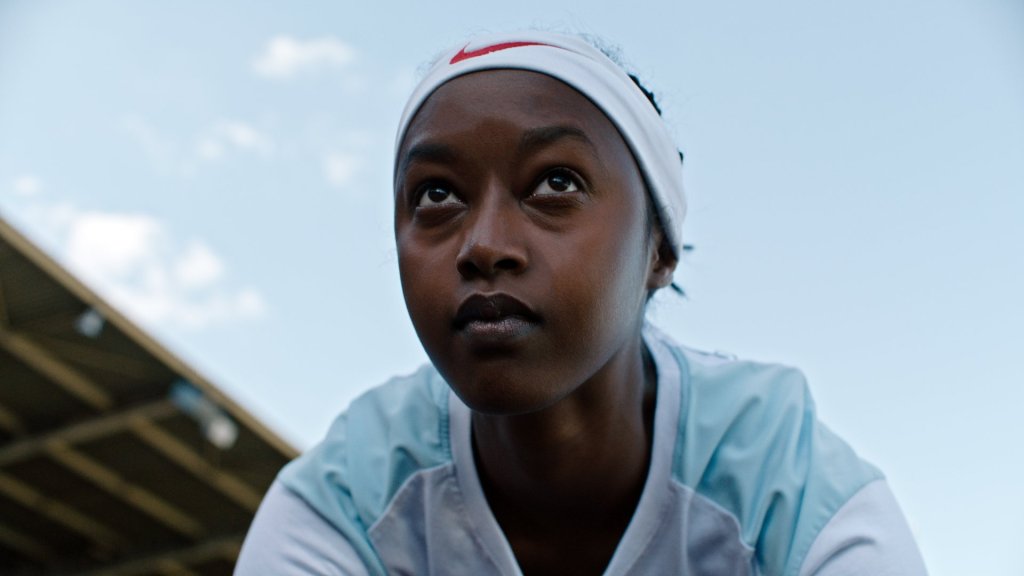
Samia (Riyan Roble) loves to run. Though only a little girl, she places among the top 10 runners in her town’s annual race. She lives in a walled compound with her strict mother, her fun-loving dad, her conservative brother Said, and her singing sister Hodan. She’s also good friends with Ali (Zakaria Mohammed) who is almost like a brother to her; his family shares their compound. But he’s a terrible runner so he appoints himself Samia’s coach.Like Rocky, they train outdoors, racing around corners and down back allies. Their goal? To make her the fastest girl in town! And as they grow older, the teenaged Samia and Ali (llham Mohamed Osman, Elmi Rashid Elmi) discover there’s a world beyond their city, beckoning Samia toward international competition.
But Somalia is unstable, with armed military tanks roaming the streets. Fundamentalists demand all girls wear a head scarf — but what about my running? asks Samia. Regional differences are on the rise and so are religious fights. Local armies and child soldiers are popping up everywhere, making it a dangerous place to live. Can Samia fulfill her dreams in an unstable country? Will she ever make it to the Olympics? And will her family support her if she does?
Samia is a bittersweet, naturalistic biopic inspired by true
events. It’s told in a series of extended flashbacks from her past remembered by an adult Samia, now fleeing Somalia for Italy, via Libya. This is an Italian film, co-directed by a Kurdish German, and an all-Somali cast. It reminds me a lot of Io Capitano (review here) from a few years ago, though this one, while touching and sympathetic, is less triumphant. It’s also rare — the first movie I’ve seen set in Somalia with Somali actors.
I liked this movie.
Oh, Hi!
Co-Wri/Dir: Sophie Brooks
Iris and Isaac (Molly Gordon, Logan Lerman: Indignation, The Lightning Thief) are a young couple in their twenties staying at a BnB in upstate New York. She is pretty, sexy and fond of practical jokes. He is good looking, chill, and open-minded. They’ve been dating for three months, but this one looks like a turning point. Isaac has perfectly arranged everything for the weekend: a beautiful house to stay in with a lake in the back, and delicious meals he cooks for her. And the sex! They are adventurous and passionate together. So when they uncover some bondage material in closet, they decide to try it out. Isaac agrees to be chained to the bed and it works out better than either of them hoped. But somehow the post-coital cuddling leads to some discussions, which reveal she thinks they have a monogamous long term relationship, while he thinks she’s fun and friendly but just another sex partner with no commitment. And all of
this happens while he is still tied to the bed.
Iris does not take this lightly; she feels betrayed. Isaac, on the other hand is genuinely frightened with her jokes about wanting to stab a previous boyfriend to death. And as time passes with little progress, both sides begin to panic. If she lets him go, will he call the cops and have her arrested for kidnapping? Is his life in danger? And when Iris’s best friend Max (Geraldine Viswanathan) and her boyfriend arrive to find Isaac still tied to the bed, it gets even more complicated. How will they ever get themselves out of this colossal mess?
Oh, Hi! is a hilarious sex comedy about trust, relationships and a date gone wrong. While I found some of the relationship psychologizing wasn’t fun, it only made up a small part of the movie. I’ve never seen Molly Gordon before — she co-wrote the script — but she has this uncanny ability to suddenly switch from gorgeous sex-goddess to google-eyed maniac. Logan Lerman is more of the straight man, but carries off his laid-back role quite nicely, considering he’s tied to the bedpost for much of the film. The story itself — along with the unexpected twists it takes — keeps you squirm-laughing almost all the way through. Though the audience at the screening I saw was maybe 80% women (who really seemed to like it), I think there’s lots there for men to think about, too.
This is a very funny movie.
Angela’s Shadow, Samia and Oh, Hi! all open this weekend in Toronto; check your local listings.
This is Daniel Garber at the Movies, each Saturday morning, on CIUT 89.5 FM and on my website culturalmining.com.
Huge changes. Films reviewed: Cloud, Don’t Let’s Go to the Dogs Tonight, Eddington
Hi, this is Daniel Garber at the Movies for culturalmining.com and CIUT 89.5 FM.
This week I’m looking at three great new dramas about people facing huge changes in far-flung places. There’s a man in Japan pursued by unknown enemies; a girl in Zimbabwe on the eve of an election; and a sheriff in New Mexico at the dawn of a pandemic.
Cloud
Wri/Dir: Kiyoshi Kurusawa
It’s present-day Tokyo. Yoshi (Masaki Suda) is a guy in his 20s with a certificate from a vocational school. He’s socially and emotionally challenged. Yoshi lives in a cramped apartment with his girlfriend Akiko (Kotone Furukawa). He works in a factory, pressing clothes, but after three years is still struggling financially with no chance of advancement. Luckily, he has a side hustle: a reselling site where he marks-up cheap goods online and sells them for profit: French designer knock-offs, electronic devices, collectible toys; the content doesn’t matter, just the speed of turnover and how much profit he makes. At the moment, he’s doing so well he decides to quit his factory job, turn his reselling site into a full time occupation and relocate to a large house in the countryside with cheap rent. Akiko agrees to move with him, and he hires a local kid, Sano (Daiken Okudaira) as his assistant. And with the business doing so well, he figures he can relax now and let the cash pour in. But it’s never that simple.
Strange things start happening. Yoshi is knocked off his motorcycle by a wire stretched across a road. Someone tosses a chunk of metal through his glass window. And Sano does an ego-surf on Yoshi’s site and finds online chatter from dissatisfied customers threatening to kill him. (He keeps his website completely anonymous). At the same time, local police are investigating him for fraud, Akiko is reaching her breaking point, and Yoshi fires Sano for using his computer without permission, leaving him all alone in his country home. But when armed masked strangers start showing up at his door, Yoshi realizes it’s time to drop everything and get the hell out of there. Who are these angry strangers? What do they want? And how can he get away?
Cloud is both an almost surreal, cyber suspense thriller and a
cautionary crime drama. Masaki Suda’s plays Yoshi as a man without any self-awareness… who assumes no one else notices him either.
It starts as a slow-burn, but explodes, halfway through, into a violent, action/thriller, with more than one totally unexpected plot turn. Though the main character spends much of his time staring at a distressingly dull website, waiting for buyers to check in, the outside world is full of geometric sets with sharp turns, cloudy windows, green forests and dark shadows. With lush music played against abandoned warehouse walls, Cloud lets suspense carry us through to the shocking finish.
I like this suspenseful crime-thriller a lot.
Don’t Let’s Go to the Dogs Tonight
Co-Wri/Dir: Embeth Davidtz
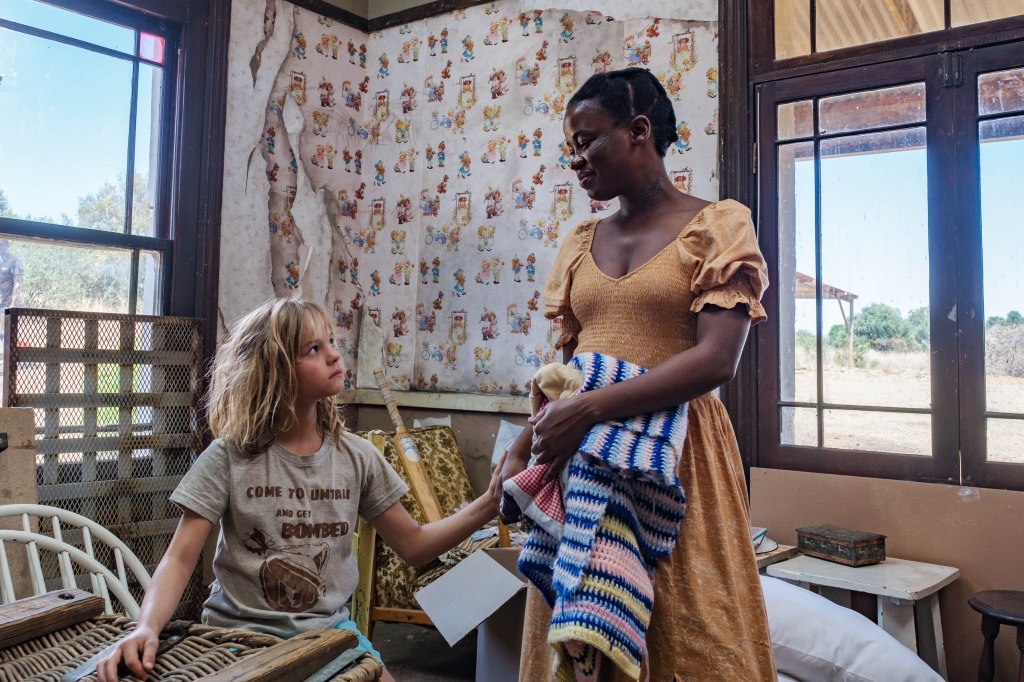
It’s 1980 in Zimbabwe-Rhodesia. The Bush War is over, and white minority rule has ended, pending its first democratic election. Bobo Fuller (Lexi Venter) is a seven-year old girl who lives with her family on a dried out cattle ranch. She wears her face dirty and blonde hair tangled. Bobo smokes cigarettes and rides her motorbike around the farm with a rifle strapped across her back. She fears two things: ticks and terrorists.
Her mom Nicola (Embeth Davidtz) makes it clear she will never leave her land. As grandma likes to say, we have breeding, not money. She’s a heavy drinker, prone to guzzling brandy and dancing with abandon during her manic episodes. Bobo’s Dad is more reasonable, but disappears for weeks at a time. Her older sister (Rob Van Vuuren) lives there too, but has no time for her bratty little sister.
So Bobo is essentially raised by Sarah (Zikhona Bali) their nanny and housekeeper. Bobo tries ordering her around like a grown up — bring me my porridge! — but Sarah sets her
straight: she’s too young to be bossy. And it’s Sarah who tells her stories, answers her questions and explains what happens to us after we die.
The family gets together with other whites in nearby farms for parties and barbecues. But there’s tension in the air as they await results from the election. Sarah, too is worried: she might be targeted by nationalists if seen taking care taking care of a girl like Bobo. What will happen after the election? And will any changes be permanent?
Don’t Let’s Go to the Dogs Tonight is a drama based on the memoirs of Alexandra “Bobo” Fuller. It’s full of abrasive characters and their casual racism, and pulls no punches in their portrayal. The whole film is shot through the eyes of a little girl, so with the camera kept low, we might just see people’s legs from under a table or an obscured lens when she’s squinting at the sun.
Actress Embeth Davidtz evokes her own South African background (where the movie was shot) in telling Bobo’s story. This is her first time directing, and its a fascinating adventure in creativity. And though her excellent portrayal of a difficult, bi-polar Mom — alongside Zikhona Bali’s terrific turns as Sarah — , it’s really about Lexi Venter as Bobo, who gives a natural performance in every scene, either as the centre of attention or as quiet observer.
Don’t Let’s Go to the Dogs Tonight is an excellent memoir of a difficult period of history.
Eddington
Wri/Dir: Ari Aster
It’s April, 2020 in Eddington, a small town in New Mexico, just as the Covid lockdowns mask mandates are kicking in. Working class Joe Cross (Joaquin Phoenix) is the town Sheriff, just as his dad was before him. He lives in a ramshackle home with his catatonically depressed wife Louise (Emma Stone) and her conspiracy-theory addled mother Dawn (Deirdre O’Connell). He works with his two faithful officers Michael (Micheal Ward) and Lodge (Clifton Collins, Jr).
On the better side of town lives the upper-middle-class Mayor Ted Garcia (Pedro Pascal) — a smooth talker and a consummate politician — who is running for re-election. He is expected to open a mysterious tech conglomerate on the outskirts of town. His son, Eric (Matt Gomez Hidaka) is an arrogant and spoiled rich kid. He hangs out with his friend Brian (Cameron Mann), drinking beer and smoking pot. They are both after idealistic high school student Sarah (Amélie Hoeferle) who they try to impress by quoting Angela Davis. Then comes the news that George Floyd, a Black man in Minneapolis, has been killed by police. Demonstrations follow but the small town is already divided on ideological grounds, with everything recorded on cel phones and posted online: those who wear masks with social distancing, vs those who don’t. But as tensions build, and Mayor Ted publicly humiliates Sheriff Joe, he declares he’s running for mayor, too.
Eddington is a sharp and scathing social satire about life in
America during the pandemic. It’s half dark- comedy and half thriller/horror as it devolves from light absurdity into a hellish fantasy. It covers a huge variety of topics, including religious cults, false memory syndrome, big tech, culture wars, white supremacy, the dark state, and indigenous relations… to name just a few. I love all of Ari Aster’s movies — Heredity, Midsommer and Beau is Afraid — and Eddington, though more of a Western than strictly horror, continues his cycle. While Joaquin Phoenix’s Joe is the film’s focus, it’s actually an ensemble cast with at least 20 crucial roles.
Eddington is brilliant, hilarious and shocking… putting his magnifying glass on all of us, just a few years ago.
it’s a must-see.
Cloud, Don’t Let’s Go to the Dogs Tonight , and Eddington all open this weekend in Toronto; check your local listings.
This is Daniel Garber at the Movies, each Saturday morning, on CIUT 89.5 FM and on my website culturalmining.com.
Wolf men and assassins. Films reviewed: Wolf Man, Soundtrack to a Coup d’Etat
Hi, this is Daniel Garber at the Movies for culturalmining.com and CIUT 89.5 FM.
It may be cold outside, but things are burning up on the big screen. This week I’m looking a two new movies, a thriller horror and a documentary. There are wolf men in Oregon, and assassins in Congo.
Wolf Man
Co-Wri/Dir: Leigh Whannell
It’s present-day San Francisco. Blake (Christopher Abbot) is a lapsed writer who devotes his life to his wife and daughter. Charlotte (Julia Garner) is a careerist who is rarely at home, so Blake takes on the parenting role. He spends all his time with their precocious 10-year-old daughter, Ginger (Matilda Firth). But he and Charlotte are constantly bickering about her absentee-mom-ism. So when a package arrives with his late father’s will and a set of keys, he wonders if this is the miracle they need to keep thew family together. He has inherited — a house, a barn, and countless acres of lush green forest — the beautiful country he grew up in. Blake suggests the three of them go on a road trip together for some quality time. Young Blake was raised in isolation by a hard-ass survivalist who was strict and demanding toward his motherless son. That’s why Blake is so indulgent towards Ginger, who still dresses like a Disney princess at age 10.
So off they head for his isolated cabin in remote Oregon. But
what Blake seems to have forgotten is there are wolves in them thar hills! Big bad wolves, mean ugly wolves, the kind who stand on two feet and like wolfing down people like them. Sure enough, as they approach their farm one of them woolfies drives their u-haul off the road… and they’re forced to run for their lives. Luckily the house is still wolf-proof, with iron bars on all the windows. Unluckily, Blake gets himself slashed by the Wolf Man, and he’s changing into something different. Can he keep his vulpine urges in check and protect his family from harm? Or will he be the biggest danger to them of all?
Wolf Man is a cabin-in-the-woods werewolf movie with a few new twist. In this version, people don’t turn into wolves on a full moon and then change back again; they’re in it for the long haul. And these werewolves aren’t sleek, or sexy or furry, never mind cute or loveable. They’re more like zombies infected with a horrible virus that makes their teeth and hair fall out and their skin go bumpy and gross. These werewolves want to eat flesh and blood, preferably human. Once infected, they can no longer speak or understand people.
There’s no sex in this movie, not even a kiss, it’s totally sterile. In this neck of the woods everyone’s a guy, with literally no women at all. And every man could be a wolf man. Women and girls are urban sophisticates, while men and boys are potential redneck killers. Christopher Abbot plays Blake as a male Oprah mom who is inevitably drawn back to the dangerous manliness he grew up with. Julia Garner’s Charlotte is a less developed character, just an aloof woman forced to either scream and run or fight back.
There are a lot of misfires in this movie. Charlotte dresses in black and white like an English barrister emerging from a courtroom; but turns out she’s a journalist leaving her newsroom… huh?? Blake who grew up in a world of misery and death that he left far behind, now decides to take his family back there… for vacation? Why? There are some good parts, too. Like when the story is told through a werewolf’s eyes and ears, we hear the pounding footsteps of a tiny insect, and see the world as a glowing colourful prism — very cool.
But not enough to save a story that doesn’t quite cut it.
Soundtrack to a Coup d’Etat
Co-Wri/Dir: Johan Grimonprez
It’s June 30, 1960, and the Democratic Republic of Congo is reborn as a free, democratic state, after nearly a century of brutal colonial rule under the King of Belgium. Leopold II is notorious for chopping off the hands of men, women and children who didn’t produce their quota of rubber. Congo (under the Union Minière) is a very rich country full of diamonds, copper, tin, and uranium, extracted and shipped to Europe and the US. Its rubber and copper were crucial to winning the world wars and their uranium fuelled the atomic bombs dropped on Japan. Its first elected prime minister, Patrice Lumumba, gives a speech on independence day, celebrating the transfer of power from their previous colonial rulers. He rightly condemns the colonial atrocities and speaks out in favour of the non-aligned movement (former colonies in Europe and Asia). While his speech is well-received locally, Europeans — including the Belgian
royal family — are shocked and aghast. Will they lose control of the Union Minière, and will the US give up its uranium source? Not a chance. They accuse Lumumba of being a communist, despite his stressing independence and nationalism. So they declare Katanga, an area rich in minerals, as independent from the DRC. The seceded state is essentially ruled by white Europeans and Rhodesian mercenary police and a military that operates with impunity, kidnapping miners and bombing uncooperative villages.
The US (especially the CIA), fearing the so-called communist Lumumba, launch a two-pronged campaign: a covert one, involving assassinations, bombings, kidnappings and regime change; and a diplomatic one, where famous American jazz musicians are flown to independent African states to perform as ambassadors of Jazz. Louis Armstrong, Dizzy Gillespie, Nina Simone and Max Roach, have no idea they ware working
for a CIA front. By January, 1961, the wildly popular Lumumba is dead, assassinated in Katanga with Belgian and American complicity.
Soundtrack of a Coup d’Etat is a fantastic documentary that retells the events of those six months. The doc is 2 1/2 hours long, so I can only give you the briefest outline of what it’s about. But the film itself is amazing, covering everything from pan-African nationalism and the Cold War, to non-aligned nations, colonialism, and the UN. We hear Malcolm X in Harlem, Andrée Blouin on women’s rights in Africa, Castro in NY, and Nikita Khrushchev’s famous shoe speech (where apparently he didn’t actually say what they said he said) in the general assembly. It’s filled with compelling imagery: Alan Dulles the head of the CIA smoking his pipe; a North Rhodesian mercenary recounting the tens of thousands of people they killed with impunity; the Soviets crushing Hungary, and Voice of America broadcasts. There are hilarious propaganda newsreels like the US parachuting record players and vinyl discs across the iron curtain. And through it all, jazz music from America to Africa.
The film is made of excerpts from previously-made audio
documentaries combined with non-stop black and white footage and stills. Most cuts are only about 2-3 seconds, giving the whole film the feeling of a glorious collage of African history. (It’s similar to the films of Adam Curtis, but without his spoken narration.) Many of the subtitles are large fonts superimposed on photos in blues, yellows and pinks, like the cover of a Blue Note jazz album.
A crucial historical document and a work of art, Johan Grimonprez’s Soundtrack to a Coup d’Etat is a must-see.
Soundtrack to a Coup d’Etat and Wolf Man both open this weekend in Toronto; check your local listings.
This is Daniel Garber at the Movies, each Saturday morning, on CIUT 89.5 FM and on my website culturalmining.com.
Returns. Films reviewed: All We Imagine as Light, The Return PLUS Streaming Sites!
Hi, this is Daniel Garber at the Movies for culturalmining.com and CIUT 89.5 FM.
As the days grow shorter and colder, people tend to snuggle up at home. I’m here to tell you to get off your collective asses and go see a real movie on a big screen! But I know some of you are going to stay at home so today, I’m going to talk about some of the streaming sites out there you might want to join. And I’m looking two new dramas. A warrior king in ancient Greece returning to his island, and three nurses in Mumbai returning to Kerala.
Streaming Sites
Here are some streaming sites you might want to try.
First the free ones: CBC Gem, Kanopy and Tubi. CBC Gem has ads, but also plays some great docs, including There are no Fakes. You can find Tubi — a commercial site — online, again with irritating ads but a huge selection of middlebrow films. You can check out terrific movies on Kanopy using your library card, but you’re limited to a certain number per month. Britbox and Acorn TV both specialize in British TV series, especially detective mysteries. If you want Miss Marple peeking over your shoulder, this is what you want. Apple TV produces all their own stuff, including Slow Horses and the great Steve McQueen’s new film Blitz. On the other hand, the Apple TV app itself is extremely aggressive — you can only watch full screen and it flips back to the main site every time you navigate away.
If you’re into horror, thriller and the supernatural Shudder is the site for you. It’s exceptionally well-curated, with excellent art-house movies right beside slashers. Paramount+ has a seemingly endless supply of cop and military shows, plus CIA, FBI, firemen, navy, and — count ‘em! — 7 different NCIS spinoffs! Not my thing, but they do land some good movies like Smile 2, playing right now. Crave gives you access to everything HBO makes, as well as Canadian movies you might otherwise miss like the NFB doc Wilfred Buck. Criterion has the rights to some of the best movies of all time, from early Kurosawa to recent releases. MUBI streams new movies likely heading for the Oscars this year, including Maria, Girl with the Needle and The Substance.
And finally Netflix, the grande-dame of all streamers, has the most consistent and sheer quantity of good TV and self-produced movies, like Emilia Perez… but it’s getting way too expensive! They even have a new website called netflixinyourneighbourhood.ca which takes you to

THE MADNESS. The Donut Shop, 617 Parkdale Avenue, Hamilton, Ontario, featured in Episode 107 of The Madness. Cr. Courtesy of Netflix © 2024
locations where their movies are shot: in places like Toronto, Ottawa, Hamilton, Brockville, Dundas and Oshawa!
I still think movies should be seen in theatres but if you’re determined to stay at home, those are some of streaming sites you might want to subscribe to.
All We Imagine as Light
Wri/Dir: Payal Kapadia
It’s present-day Mumbai.
Prabha (Kani Kusruti) is a middle-aged hospital nurse. She is skilled at her job, teaching young trainees how to get over their feelings of revulsion. She spends time with a starry-eyed Doctor Manoj, who writes poems to her, but she is still very much married. Her husband moved to Germany to work in a factory, and he may as well not exist. Prabha shares an apartment with Anu (Divya Prabha), a vivacious young nurse at the same hospital. She likes shopping, fashion and romance, and most of all her secret boyfriend Shiaz (Hridhu Haroon). They’re in love (or at least young lust) but frustrated; it’s hard to find a private space to be together. More than that, she’s Hindu and he’s Muslim, and never the twain shall meet – their families will prevent that. Finally, Parvaty (Chhaya Kadam), an older nurse and a close friend of Prabha’s, is facing eviction from her home. Developers want to tear it down to build a high-rise condo. Since she’s a widow and doesn’t have the proper papers to
prove the place is hers, they’re sending goons to her door to kick her out.
For all these reasons the three of them end up back in Kerala, the place of their birth in southwest India. They stay in a beautiful beach town, where the three of them can finally shake off the heavy responsibility and stress of life in that big city. But how long will this last?
All We Imagine as Light is a personal, intimate drama about the lives of three women in Mumbai. It’s notable for a number of reasons. This is director Payal Kapadia’s first feature, and tells her story from a distinctly feminine gaze. It deals with big contemporary political and social issues — like Parvaty attending an angry tenants’ rights meeting — but also the importance of personal friendships among the three woman. In look and style, this film is strictly European cinema verite, about as far from Bollywood as a movie could possibly be. But it is set in Bombay and exults in that city, from the slums to the skyscrapers, with stunning aerial views of rooftop clotheslines and raucous street festivals. There’s amazing footage taken through the window of a fast-moving commuter train. Some scenes have documentary-style unidentified voices, expressing their bittersweet love and hatred for that
city that never sleeps, spoken in a plethora of languages: Hindi, Gujarati, Malayalam, and Bengali. I liked this movie for it’s emotions, but found much of it bleak and slow-moving; the story drags you down until it finally shifts from Mumbai to the beaches of Kerala, two-thirds of the way through.
But by the end it redeems itself with an unexpectedly satisfying finish.
All We Imagine as Light has been nominated for Best Foreign Language Film at the Golden Globes.
The Return
Dir: Uberto Pasolini
It’s 1200 BC in ancient Greece, and the island of Ithaca has no ruler. Decades ago, it was a mighty kingdom, ruled by the hero Odysseus — known for his bravery, fighting skills and intelligence. He devised the Trojan Horse and led the army that defeated Troy. But the soldiers — and their leader — never came home, and Ithaca has gone to seed. The queen, Penelope (Juliette Binoche) sits alone in her tower, weaving cloth, as she patiently waits for Odysseus’s return. Their son, Telemachus (Charlie Plummer) doesn’t know his father except from legends. The palace is filled aggressive brutes from abroad, each wanting to marry the widow Penelope so they can take over the kingdom. But is she actually a widow?
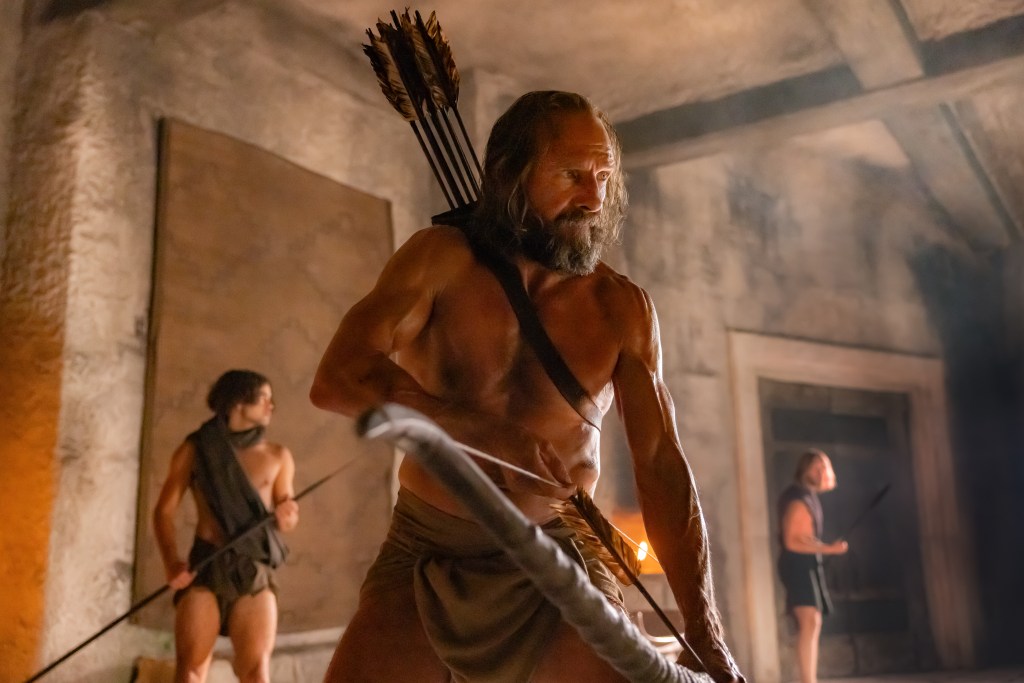
Around this time, the battle-scarred body of a soldier washes up on shore. He’s barely alive, but is nursed back to health by an honest pig farmer named Eumeo (Claudio Santamaria) and his sons. It is of course Odysseus (Ralph Fiennes), but without any uniform or weapon. He’s actually naked. He wraps himself in a blanket and carries a bowl — the clothing of a homeless beggar. And when he approaches the palace, almost no one recognizes him. Only Eurycleia (Ángela Molina), both his and his son Telemachus’s nurse as a child, realizes who

The Return, directed by Uberto Pasolini, with Ralph Fiennes (Odysseus), Juliette Binoche (Penelope), Charlie Plummer (Telemachus), Marwan Kenzari (Antinous), Claudio Santamaria (Eumaeus).
that beggar is. Is he still fit to be king? Can one man, tired and old, confront a bloodthirsty mob of young toughs? And will Penelope ever forgive him for staying away so long?
The Return is a magnificent retelling of a chapter in Homer’s The Odyssey. But it’s not about triumphant heroes; it’s more about the grinding effects war has upon both the victors and the vanquished. It contrasts Odysseus’s shame and self-doubt with Penelope’s eternal fidelity. Yes, this is an ancient greek story, with swords and sandals, but it feels very immediate. Parts of it even resemble a Hollywood action/thriller, with chase scenes and some very bloody fights.
The film was shot among the rocky cliffs of Corfu and the ruins of an ancient castle, which is echoed in the soundtrack. I love the dramatic look and sound of waves crashing on the sharp rocks. Though the women are all wrapped up, most of the male actors are dressed in togas or prancing around half naked, with Ralph Fiennes going full monty at the drop of a hat. I didn’t used to like him much, but after Conclave and now this one, I gotta admit, he’s a really good actor. Juliette Binoche is skillfully understated as Penelope, and Dutch actor Marwan Kenzari is very creepy as Antinous, the threateningly oleaginous suitor closest to Penelope.
The Return is a really good movie.
The Return and All we Imagine as Light is on at the TIFF Lightbox in Toronto; and Standing on the Shoulders of Kitties, A Trailer Park Boys movie featuring Bubbles and his band on tour, is now playing; check your local listings.
This is Daniel Garber at the Movies, each Saturday morning, on CIUT 89.5 FM and on my website culturalmining.com.
Tough Cookies. Films reviewed: Maria, Flow, The G
Hi, this is Daniel Garber at the Movies for culturalmining.com and CIUT 89.5 FM.
With a rapidly aging population, the traditional image of frightened, little-old cat ladies is gradually shifting to one of strength and cunning. Witness new TV shows like Matlock. So this week I’m looking at two new movies about tough older women and one about a cat. There’s an opera diva in Paris preparing her swan song; a rustbelt widow who wants to go out with a bang; and a cat on a sailboat in a world covered in water.
Maria
Dir: Pablo Larraín (Reviews: Spencer, The Club)
It’s 1977 in Paris, and Maria Callas (Angelina Jolie: Salt, The Tourist, Unbroken) — one of the greatest divas in opera history, is not doing well. She rarely eats, often never leaving the bedroom of her palatial apartments for days at a time. She rarely speaks with anyone anymore, aside from her servants. She runs her butler ragged (Pierfrancesco Favino: The Hummingbird, in a red monkey suit) and she relies on her cook (Alba Rohrwacher: Sworn Virgin, Hungry Hearts, The Ties/Lucci ) for judgement on the quality of her vocal chords.
But she’s not completely alone. She is seeing a pianist for his unvarnished opinion on whether her legendary “voice” has returned. And has agreed to an unheard-of interview with a young journalist named Mandrax (Kodi Smit-McPhee: The Road, The Congress, The Power of the Dog, Memoir of a Snail). But Maria faces a number of problems. She refuses to see a doctor, despite her rapidly declining health, and she won’t stop popping Quaaludes, leading to frequent
hallucinations and delusions. Can her devoted servants save her life? Or is this the end?
Maria is a biopic about the death of a legendary Greek-American diva. The movie begins with her demise at age 53, then goes back in time to show what led up to it. This includes flashbacks to her chubby adolescence in German-occupied Athens in WWII, her failed marriage, and at the peak of career, including trysts with Aristotle Onassis and JFK.
But is this biopic any good? I have very mixed feelings about that. I love the beautifully shot interiors, the ostentatious costumes and the amazing arias provided by recordings of Callas herself. Italian actors Rohrwacher and Favino provide wonderfully painful performances. And, as the latest in a series of films about famous woman by Chilean director Pablo Larraín it has good pedigree, especially Spencer (with Kristen Stewart as Princess Diana). But this movie depends on Angeline Jolie, and she doesn’t carry it off. She always seems to be acting. I don’t see Maria Callas here, I see Jolie posing for the camera, with a haughty face here and a dramatic gestures there; so you rapidly lose sympathy with the main character. Perhaps Maria Callas really did act like that, even behind closed doors, but Jolie plays her somewhere between high camp and kitsch.
Maria is never boring… just a bit embarrassing.
Flow
Co-Wri/Dir: Gints Zilbalodis
It’s some time in the future, somewhere in the world. A small grey cat with golden eyes and pointy ears is enjoying a walk in the woods. The cat lives by an abandoned old house surrounded by enormous cat statues. The cat is very shy, and fears, most of all, a pack of feral dogs. Suddenly, there’s a stampede of animals running in one direction, full speed. They‘re trying to avoid a massive flood, sweeping away everything in its path. But cat and a friendly, white dog are among its victims. Survival instinct kicks in and eventually cat manages to climb on board a tattered sailboat. There Cat discovers a gentle, sloth-like capybara already on board. Other animals make their way onto the sailboat, including an ingenious lemur, that big, white dog and a majestic-looking phoenix. Together they form an uneasy friendship as they brave a dangerous water-covered world. But can they learn to get along? And is this world worth living in?
Flow is a brilliantly animated film about a picaresque journey by a mismatched troupe of animals. It’s tender, heart moving and lovely to watch. It’s all about friendship and cooperation learned by
animals living in a gently hostile world. And though they behave a tiny bit like humans, there are no people in the story, and no dialogue either; just grunts meows and barks. Dogs still want to fetch. Cats want to catch fish.
And though it’s post-apocalyptic, there is nothing futuristic in this film; human technology is limited to abandoned ancient cities, glass bottles and sailboats; no cars or smartphones to be seen. The science fiction comes in with its universality, where animals from different continents, along with mythical beasts like sea monsters, can randomly encounter and learn from one another. I just watched Flow, and I already want to see it again.
Flow is Latvia’s Oscar submission for Best International Feature.
The G
Wri/Dir: Karl R. Hearne
It’s a rust-belt city somewhere in North America. Ann Hunter (Dale Dickey) is a tough cookie in her 70s, who is feeling depressed. You can see it in every wrinkle on her face. She lives with her ailing husband in their fully-owned condo. He was once a tough guy, but is rapidly sliding into immobility and dementia. She grudgingly takes care of him, and drowns her sorrows in rot-gut alcohol straight from the bottle. Aside from him, she only spends time with Emma, step-granddaughter (Romane Denis). Emma models her life on The G (as she calls her grandmother) someone who doesn’t take crap from anyone. The G also helps her out financially, and doles out hardboiled words of wisdom.
But everything changes when a man in a suit named Rivera (Bruce Ramsay), out of the blue, breaks down The G’s front door, accompanied by two toughs: Matt (Joey Scarpellino), a handsome but simple-minded gardener; and Ralph, a psychopath with bleach blond hair (Jonathan Koensgen). Together they violently shove Ann and her husband into a van, who wind up locked in a threadbare room without a phone, in a nursing home that feels more like a
prison. This is your new home, Rivera says, and there’s nothing you can do to stop me. He’s now their legal guardian and has the documents to prove it; their doctor (a silent partner in the scam) has declared them both incompetent. No one’s allowed to go in or out for the first month. He roughs up her husband to try to find the proverbial pot of gold he thinks they’re hiding. But they underestimate the G, her stubbornness, and her shady connections back in Texas.
Meanwhile, Emma is shocked when she discovers her grandparents have suddenly disappeared, leaving behind just a torn-up home. She scours the city to find them, and makes friends with a caretaker who works at the home (who also happens to be Matt, the friendly thug). It’s too late to save her grandpa but she vows to get the G out of there. And even while Emma is trying to free her, the G has vowed vengeance on all her enemies — and she’s not messing around. Who can they trust? Can two women best a criminal organization? Or will they end up buried alive?
The G is a great revenge thriller about the very real phenomenon of organized criminals attacking and abusing the elderly. It’s dark and disturbing. Dale Dickey blows this movie out of the water, supported by a good Quebecois cast. (It’s shot in Montreal). If you’re looking for a gratifyingly violent revenge flic, this is the one to see.
Maria and Flow are now playing at the TIFF Lightbox, with Maria streaming on MUBI on December 11th; and The G is opening across Canada; check your local listings.
This is Daniel Garber at the Movies, each Saturday morning, on CIUT 89.5 FM and on my website culturalmining.com.
Good Euro at #TIFF24. Films reviewed: Miséricordia, Vermiglio, The Girl with the Needle
Hi, this is Daniel Garber at the Movies for culturalmining.com and CIUT 89.5 FM.
There was a dearth of European movies at TIFF this year with far fewer high-profile films from countries like France, Benelux, Scandinavia, Romania and Poland. But there were still some very good ones. So this week, I’m talking about three new European films that were featured at TIFF. There’s a mom with a baby in Copenhagen, an army deserter in Tyrol, and a funeral-goer in southeastern France.
Miséricordia
Dir: Alain Guiraudie (Review: Stranger by the Lake)
Jeremie (Félix Kysyl) is a boyish-looking man from Toulouse returning to the tiny village of L’Aveyron in southeastern France. He’s there for a funeral, the untimely death of the village’s baker. Jeremie knows the village and all its people very well, as he was the baker’s assistant for many years. He asks the baker’s widow, Martine (Catherine Frot), if he can stay there for a few days.
She puts him up in her adult son Vincent’s old room (Jean-Baptiste Durand) — which still look’s like it’s a kid’s room. Vincent, though, is a married adult, a tough guy known for his moodiness and sudden bursts of anger. Then there’s Walter (David Ayala), the town recluse, a large, droopy man with coarse features who seldom speaks with anyone other than his dog and Vincent. And an Abbey from an ancient monastery who always seems to turns up when anything significant happens.
So Jeremie’s presence upsets the local rhythm. Vincent treats Jeremie like they’re still kids, picking play-fights with him, grabbing and punching. He uses his key to barge in on Jeremie in bed at 4 am (on his way to work, he says). He suspects Jeremie is sleeping with his
mom. But in reality, Jeremie seems more attracted to the late baker than his wife. When Jeremie drops by Walter’s place for some chat and a few glass of the local pastis — Walter warns him not to let Vincent know he was there. With his tongue and inhibitions loosened Jeremie comes on to Walter sexually which shocks and confuses the much bigger man. By the next morning there’s a dead body buried in the woods, a witness, a killer trying to keep it a secret, and the gendarmes starting an investigation. Whodunnit, who will get caught, and what will happen to the rest of the characters?
Miséricordia is a cross between dark comedy and film noir. Like a stage play, it’s full of dialogue overheard through half open doors, people disappearing behind curtains or hiding in someone else’s bed. It deals with lust and passion — and compassion, anger but also forgiveness (Misericordia is Latin for mercy). And a fair amount of unexpected erotic nudity. It’s shot on grainy colour film, among the ancient whitewashed houses, stone monastery, and the wilds of the nearby forests — it’s visually beautiful. Alain Guiraudie who directed the great Stranger by the Lake once again crafts an unusual mystery with a queer undercurrent.
This is a really good movie.
Vermiglio
Dir: Maura Delpero
It’s near the end of WWII in a mountainous village tucked away in Tyrolia, northern Italy. Two faces arrive in town one day, one familiar, one unknown. They are both deserters, Italian soldiers press-ganged into the German army, but the stranger, a Sicilian named Pietro (Giuseppe De Domenico), knows only this friend Attilio, he served with. He also saved his life and practically carried him all the way home. Pietro’s Italian is totally different to them so he seldom speaks. They put them up in a barn, just to be safe, and feed them.
The patriarch of this village is Cesare (Tommaso Ragno) a highly respected schoolteacher with ten kids of his own. Most of the kids sleep together, some three to a bed, and there’s a constant stream of patter and dialogue within the family. The oldest daughter is Lucia (Martina Scrinzi), named after the village’s patron saint. There’s also Flavia, the precocious daughter and Ada the religious one. Lucia knows nothing about sex, but does know she likes Pietro. They flirt, court, kiss, and marry. He signs up for the adult literacy lessons his new father-in-law teaches. And finally, as Lucia’s belly grows, he abruptly leaves the village for a short visit home in far-off Sicily. But when he fails to return after months away without even a postcard, Lucia begins to worry. What has happened to her Pietro?
Vermiglio gives a look at the consequences of ambition, rivalry, love and betrayal in an isolated village where everyone knows what everyone else is doing. It follows all the members of this family, though especially the daughters and their hard-working mother (10 kids!) over the course of one year.There’s a lovely ebb and flow, with
characters appearing and disappearing, deftly interwoven throughout the film in dialogue and action. Though linear in structure there’s no clear explanation of much of what is going on — you have to figure that out yourself. Filmed under soft natural lighting, you’re as likely to see an extreme closeups of milking a cow’s udders, as you are a furtive kiss. I found Vermiglio fascinating and empathetic — you really care about what happens to all these characters.
I like this one.
The Girl with the Needle
Co-Wri/Dir: Magnus von Horn
It’s WWI in Copenhagen Denmark. Karoline (Vic Carmen Sonne) works in a sweatshop making uniforms. She hasn’t heard from her husband Peter since he enlisted with the Germans, and without his income she’s behind on her rent and faces eviction. In desperation she visits the factory owner Jørgen (Joachim Fjelstrup) and asks for her military widow’s pension. But without any proof of his death, there’s nothing he can do. But he does find her attractive and soon they are having furtive sex in back alleys. Inevitably she gets pregnant so he does the honourable thing and proposes… until his aristocratic mother stops him cold. Not only won’t he marry her, she must be
fired from her job. Meanwhile, it seems her husband was not killed at the battlefront, but he’s unrecognizable. Peter (Besir Zeciri) now wears a mask to cover his face that had been blown off and them sewn back together. Peter now works at a carnival freak show revealing his face for a few krone.
In desperation, Karoline takes a knitting needle to a public bath and attempts to kill the foetus in her womb by jabbing it, but ends up injuring herself and nearly passing out. But she’s spotted by Dagmar (Trine Dyrholm) who runs a local candy store, and her pretty, blonde daughter Erena (Ava Knox Martin). She nurses her and tells her what to do if she starts bleeding again. And she gives her a bag of candy with the shop’s address on it. Dagmar is always there when there’s no one else to turn to. And when she finally gives birth, penniless and homeless, Caroline shows up at the candy store asking for help give away her baby. She can’t afford to pay her — this is a business, Dagmar reminds her — but agrees to let her stay there for now, as an
on-call wet nurse. Many young women pass through there with their kids, so she’s always ready to lend a hand. But what really happens to those babies?
Based on a true story, The Girl with the Needle is a powerful movie about a horrifying case that shocked the world (no spoilers). It shows us a Copenhagen riddled with friction and sharp divisions between the haves and have-nots. It also repeats a theme of disturbing images of grotesquely deformed faces. It’s shot in glorious black and white by the Polish cinematographer Michal Dymek, who also filmed Jerzy Skolimowski’s EO two years ago. There’s some serious acting here, especially the three main women. This is one of those jaw-dropping movies where you go in expecting a conventional, scary-type horror movie, but you end up watching something much bigger than that. This is a fantastic and very disturbing movie, but with a touch of hope.
And it’s Denmark’s choice for the Oscar for best international Feature.
Keep your eyes peeled for Miséricordia, The Girl with the Needle, and Vermiglio, that all played at TIFF and should be opening theatrically over the next year.
This is Daniel Garber at the Movies, each Saturday morning, on CIUT 89.5 FM and on my website culturalmining.com.
Life, death. Films reviewed: Lisa Frankenstein, Perfect Days
Audio: Coming soon!
Hi, this is Daniel Garber at the Movies for culturalmining.com and CIUT 89.5 FM.
This weekend is Lunar New Year, a time to push out the old year and bring in the new one, and to think about long-gone ancestors. This week, I’m looking at two new movies both opening this weekend about life and death. There’s an older man who lives his life to the fullest, and a young woman who exults in death and misery.
Lisa Frankenstein
Dir: Zelda Williams
It’s the 1980s. Lisa Swallows (Kathryn Newton) is a unhappy teenager in Wisconsin. She is socially awkward with frizzy hair who loves reading sad poems and listening to The Cure. She works part-time mending garments at a dry cleaner. She moved there with her hapless father who recently remarried after her mom died. Her new stepmother (Carla Gugino), a Nurse Ratchet manqué, treats her like trash. But her stepsister, Taffy, a popular and chirpy cheerleader, (Liza Soberano) goes out of her way to cheer Lisa up. She lets her use her makeup and wear her clothes, to no avail. Lisa prefers to hangout in cemeteries mooning over long-dead young men. The one living guy she’s crushing on is Micheal (Henry Eikenberry), the editor of the school paper. But he already has a girlfriend, a goth rocker who is bigger and meaner than Lisa.
After an awkward incident at a pool party, she gets sloshed on Absinthe and ends up in Bachelor’s Grove, her secret
graveyard hangout. And, unknowingly, in a pique of drunken wishful thinking, she conjures back to life a young man buried there more than a century earlier. And soon she hears a knocking at her door. It’s a moaning monster (Cole Sprouse) covered in dirt with worms crawling out of his ears, and missing a number of body parts. She screams and runs away, but, gradually she figures out who he is and what he means to her. And after washing him, dressing him up, and putting him in the tanning bed, she decides he isn’t half bad. Lisa changes too, gaining new self-confidence. And she puts her seamstress skills to work by sewing new organs he gives her onto his body. The thing is, these body parts come from people he murders. Will Lisa become a Bonny to his Clyde? And can a human find love with a reanimated corpse?
Lisa Frankenstein is a mildly humorous, high school horror rom-com about a self-styled Dr Frankenstein and the dead man she resurrects. It’s done in a brightly-coloured campy aesthetic, with lots of goth-punk tunes playing in the background. The problem is, it’s not as funny as it thinks it is. It has a slapdash feel to it, and comes across as clunky and misguided. And it seems to side with the conventional, popular kids, portraying the oddballs and introverts as the psycho-killer bad guys. It borrows liberally from horror-comedies like Edward Scissorhands and Buffy the Vampire Slayer, but without any pathos for the main characters. There are some good parts: a gross-funny sex scene, and some lovely paper silhouettes that tell the monster’s back story. But most of the movie is as painfully awkward and misbegotten as the monster himself.
I found Lisa Frankenstein disappointing.
Perfect Days
Co-Wri/Dir: Wim Wenders
It’s present-day Tokyo. Hirayama (Koji Yakusho) is a single man in his sixties. He lives a simple life.in a spotless, but threadbare, apartment in a rundown part of town. He likes reading novels, listening to music in his little white minivan he drives and eating lunch outdoors on a park bench. He is thoroughly dedicated to his profession, performing each task with scrupulous care and attention. He’s never late and never breaks the rules, checking off each task as he completes it. What’s surprising, though, is the nature of his job. He cleans the toilets in public parks. And he does so with a smile on his face and a kind word to passersby.
But his daily routine is disrupted by a young assistant, Takashi (Emoto Tokio). Takashi is filled with troubles — he’s undependable, always broke, and perpetual problems with his girlfriend. He needs special attention and special favours. And he’s trying Hirayama’s patience. And when an unexpected visitor shows up at his door in a very expensive car delivering unexpected news, he has to rethink his life. How did Hirayama end up where he is today? What is he running away from? And who will take his place when he retires?
Perfect Days is a wonderful study of a few days in the life of a
kind, generous and warmhearted man. It’s a joy to watch. Dialogue is sparse to non-existent evoking Jaques Tati and Charlie Chaplin in its perfect simplicity. But it’s not silent. Music plays a big role, mainly singers from the 60s and 70s — Patti Smith, Velvet Underground, Van Morrison — on the cassette tapes he listens to as he drives around. The movie is filled with details, and tiny, continuous storylines, like the anonymous notes he finds in a crack in a wall in a ladies room. Even the toilets themselves are amazing! Things like opaque, tinted glass that magically becomes transparent when you leave the booth, and rest stops disguised as rustic log cabins. And thankfully, no potty mouth or toilet humour anywhere. Though directed by German filmmaker Wim Wenders, this is a quintessentially Japanese movie; it’s even their Oscar nominee this year.
Perfect Days is a perfect film.
Lisa Frankenstein and Perfect Days both open this weekend in Toronto; check your local listings.
This is Daniel Garber at the Movies, each Saturday morning, on CIUT 89.5 FM and on my website culturalmining.com.
Girls. Film reviewed: Ru, Totem, Four Daughters
Hi, this is Daniel Garber at the Movies for culturalmining.com and CIUT 89.5 FM.
There are lots of movies for girls about princesses, fairies and Barbie dolls, but not many about girls as, well, girls. This week I’m looking at three great new movies about girls and young women. There are four sisters in Tunisia, a Vietnamese girl arriving in 1970s Quebec, and a seven-year-old girl in Mexico going to a strange birthday party.
Ru
Dir: Charles-Olivier Michaud
It’s a small town in Quebec in the 1970s. Tinh (Chloé Djandji) is a young girl who has just arrived with her family in Canada. She feels strange, alienated and out of place. A tiny home in small-town Quebec is totally different from the luxurious mansion they lived in in Saigon. It’s also nothing like the leaky ship and the wretched refuge camps she lived through afterwards. (Her family is part of the so-called “boat people” who fled South Vietnam after the fall of Saigon in 1975.) Luckily, her family is befriended by the Girards who are helping them adjust to life in Quebec, introducing them to snow, tapping maple syrup and eating peanut butter on toast. And they have a daughter Tinh’s age she can play with. The problem is, Tinh can’t speak French, just Vietnamese. Her parents can — they were well to do and educated in French when Indochina was still a French colony. But the courses are starting to make sense. And she enjoys hanging out at the only Chinese restaurant in town, run by a Haitian man, and listening to the harrowing stories of other Vietnamese refugees (dramatized on the screen). But will she ever adjust to this new — and very different — life?
Ru is a fictionalized retelling of novelist Kim Thúy’s
childhood. It’s a new — and very different – look at the immigration experience from what you usually see. The film only covers her first few months in Quebec but packs a huge amount of story in that small space. It also shows, through flashbacks, her life in Saigon, and the frightening period she spent at sea. It also riffs on life in Quebec, some funny, others sad. A couple of the scenes struck me as jarring. Tinh is haunted by the killing of a bread vendor she witnessed, but in the movie she’s calling out “bread for sale” but carrying flowers, not bread. (Is this a deliberate aesthetic move by the director or just an editing mistake?) And “moving still photos” was a new gimmick in Quebec film about 15 years ago but looks dated now. Otherwise, though, RU is a fascinating, warm and engrossing look back in time.
I quite liked this one.
TOTEM
Wri/Dir: Lila Avilés
It’s present-day Mexico. Sol (Naima Senties) is a seven-year-old girl getting ready for a big party. She puts on a multicoloured fright wig and a clown’s red nose before her mom drops her off at her grandfather’s house. There will be food and drinks, music and performances, cake and presents, and lots of friends and relatives. She quietly takes it all in. Her bratty cousin Esther cuts up money with a pair of scissors. One neurotic aunt burns the cake she’s baking. Her grandpa — a psychiatrist — is busy pruning a Bonsai tree. Sol wanders off to explore nature, making friends with the snails and beetles she meets. But underlying it all is a dark, unspoken thought that makes everyone tense and depressed. This party is for her Dad (Mateo Garcia Elizonda) a young artist. He’s dying of cancer, and can barely get out of bed. Will he make it outside to the party? How will people react? And what will happen afterwards?
Totem is a lovely movie about a happy and sad party as seen through the eyes of a little girl. It paints a vivid picture of an eccentric, middle-class family in Mexico. It’s filled with realistic details — not the kind that are thrown into a film to make it look quirky or twee; it seems like a real-life family here. Visually, it’s intimate and close up, using a hand-held camera in confined, and sometimes obstructed, spaces. The dialogue is ongoing, but the point of view is constantly changing. And in its tribute to Mesoamerican culture, red, yellow and terra-cotta colours, and Aztec animals, swirls and suns fill the screen.
Totem is a wonderfully happy-sad story.
Four Daughters
Dir: Kaouther Ben Hania
Olfa is a single mom in Tunisia with four beautiful daughters: Ghofrane, Rahma, Eya and Tayssir. There here to tell us about their remarkable lives. Olfa grew up without her dad so functioned as the protector of her sisters. She cut her hair short and dressed like a boy to stop gangs of men from invading their home. She later married a good-for-nothing man she only slept with once a year to have another kid. He didn’t stay very long either when he only had daughters. The girls take different paths. Some become rebels. One dresses like a goth. Another has a boyfriend without her mom’s approval. She spanks her daughters when she thinks they’re going overboard. But when Olfa goes to Libya to earn a living — she’s the only one supporting the family — things start to fall apart, and two of the daughters disappear. What happened and what led them to their strange fate?
Four Daughters is a really unusual docu-drama that retells Olfa and her daughters’ real stories, and then acts them out for the screen. The two younger ones play themselves, but the two older ones are played by actresses (Ichraq Matar and Nour Karoui) because Ghofrane and Rahma aren’t there anymore (no spoilers). And Majd Mastoura plays all the male characters, including Olfa’s lover, a fugitive who escapes from prison during the Tunisian Revolution in 2010. It’s sort of an experimental film that never lets you forget the scenes you’re seeing are true, but not real; they’re recreations. The mother or the sisters themselves are often giving directions to the actresses on camera so they do the scene accurately. But though they are constantly breaking the fourth wall, it still manages to be a shocking and emotional journey through
their lives. It deals in depth with family, ostracism, puberty, sex, sexism, feminism, violence, men, religion and pop culture in the Arab world like you’ve never seen it before.
Four Daughters is a gorgeous and fascinating film about women in Tunisia, before and after the revolution. It’s a thousand times better than any “reality show.”
Ru and Totem both open this weekend, with Four Daughters — which has been nominated for a Best Documentary Oscar — is on at the TIFF Bell Lightbox in Toronto; check your local listings.
This is Daniel Garber at the Movies, each Saturday morning, on CIUT 89.5 FM and on my website culturalmining.com.
If you’re looking for a fun night out, check out a beautifully renovated movie palace known as
The Burning Season
romance set in Algonquin Park. The very first scene shows the teenaged couple taking vows of secrecy in front of a big fire, but from there it jumps forward to the faulty marriage many years later. The rest of the movie fills in the blanks, summer by summer, going back in time in reverse chronological order. Winnipeg director Sean Garrity has a history of making identifiably Canadian movies — including location, story, actors and music — but often with a dark, twisted theme. This one is co-written by Garrity’s long-time collaborator Jonas Chernick (
We Grown Now
games they play, the comic books they read, the TV shows, the video games, the music they listen to? What are their favourite sports teams? Not in this movie. When they play hooky it’s to go to an art museum but back home do they start drawing and painting their own art? No.
Evil Does Not Exist
ruin their idyllic, back-to-nature lifestyle and contaminate their water with a leaking septic tank upstream. Can the two sides find common ground?
leave a comment