Blacks, Jews and Irishmen. Films reviewed: The Piano Lesson, A Real Pain, Small Things Like These
Hi, this is Daniel Garber at the Movies for culturalmining.com and CIUT 89.5 FM.
Fall Film Festival Season continues with the EU Film Fest, showing free films from across Europe at Spadina Theatre starting on the 14th.
This week, I’m looking at three family dramas. There’s Black siblings in Pittsburgh, Jewish cousins in Warsaw, and an Irish dad with his five daughters, in… well, Ireland.
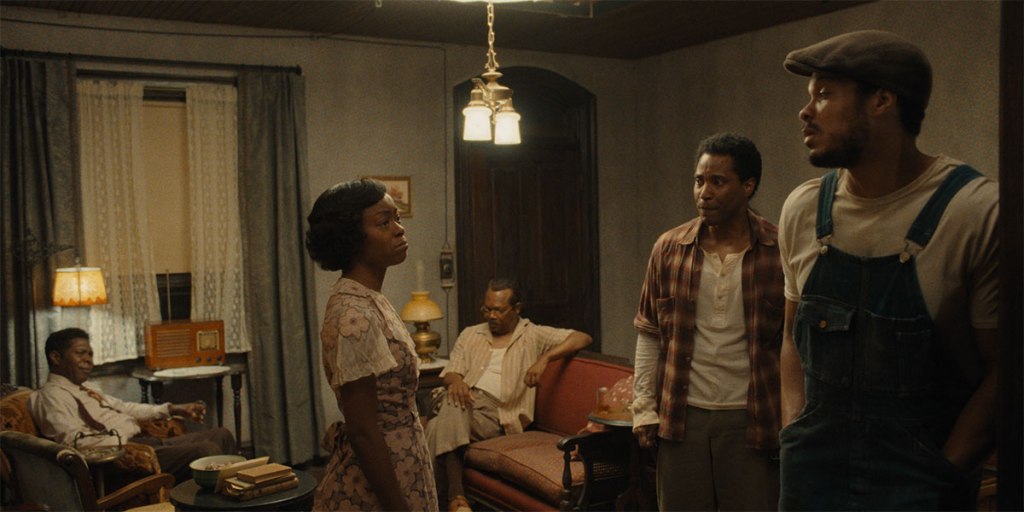
The Piano Lesson
Dir: Malcolm Washington
It’s 1936. Boy Willie Charles (John David Washington) and his friend Lymon are driving north from Mississippi with a truckload of watermelons, to visit his sister Berniece (Danielle Deadwyler) in Pittsburgh, Pennsylvania. She’s living with their uncle Doaker (Samuel L. Jackson). Once they sell the melons, Boy Willie plans to take his share of the profit (along with his savings) to purchase Sutter’s land. That’s the same place where his great grandparents were slaves, and where he still toils the land as a share-cropper. This is his one chance to own it. But he’ll only have enough money if he sells the family piano. That’s why he’s visiting Pittsburgh. But Berniece refuses to sell it. Why? She grew up playing that piano, and more to the point it has family faces elegantly carved into the wood itself, dating back to pre-Civil War days. Besides, she says, that piano is haunted… and the ghost is getting meaner. Meanwhile various family and friends, like a trickster and a preacher, are congregating at this house with different motives for being there. Can Boy Willie and Berniece come to terms about the piano? Or will bad spirits — both supernatural and human — ruin everything first?
The Piano Lesson is an excellent filmed version of playwright August Wilson’s drama. Fine acting all around, with Danielle Deadwyler outstanding as Berniece. Now, plays and movies are two different things. Actors emote louder and move bigger on
stage (so everyone can see and hear them). And even the blocking and dialogue is different. Movies are no more real, but different. This Piano Lesson is very much a play. So I was a bit put off by it’s style… until the my brain started watching it as a play, at which point I really liked it.
If you notice a lot of Washingtons here, it’s no coincidence. Denzel Washington is the producer, and actor John David and director Malcolm are both sons of his. Denzel is committed to putting all ten of August Wilson’s Pittsburg Cycle on the big screen to preserve crucial Black American culture. Witness Fences in 2016 and Ma Rainey’s Black Bottom in 2020. The Piano Lesson is a fine addition to this series and should be watched.
A Real Pain
Wri/Dir: Jesse Eisenberg
Benji and David Kaplan are cousins in their 30s, as close as brothers, but totally different. Benji (Kieran Culkin) is loud, gregarious, obnoxious and larger than life. He likes to raise a ruckus and mess things up. He lives alone in Binghamton, NY. David is shy, insecure and withdrawn. He’s married with a small kid and lives in Manhattan. He’s in a constant state of dithering and worrying. They’re travelling together to Poland to explore their family’s heritage. Their grandmother was Polish and a Holocaust survivor.
Benji was very close to her and devastated by her recent death, much more so than David. They’re part of a small tour group, all Jewish. Their guide (Will Sharpe) is a nerdy English guy, very accommodating. Also on the tour are Marcia (Jennifer Grey) who suffers from intergenerational trauma; Eloge (Kurt Egyiawan) from Winnipeg but originally from Rwanda where he survived Tutsi genocide; and a middle-class couple whose family immigrated from Poland generations ago but want to see where they came from. (“We’re Mayflower Jews”, he says).
Their journey takes in cultural and historical sites across Poland, but the closer they get to the concentration camp where their
grandmother was imprisoned, the more agitated Benji gets. He slips into shouted diatribes and lectures, causing scenes within their group and in public places — to David’s acute embarrassment. Can they both make it through the whole tour? Or will one of them drop out?
A Real Pain is a low-key, social comedy — yes, a comedy — about the uncomfortable dynamics within a family. it’s actually pretty funny, No slapstick or pratfalls, rather unexpected squirmy riffs on the two main characters’ personalities. (Like Benji telling David his bare feet are gorgeous, making him stare at them for the rest of the trip.) It’s told in a series of clever vignettes over the course of the trip, all hovering over unvoiced feelings of personal and collective mourning. I’m always suspicious when actors play at directing, but this is no vanity pic. Eisenberg stays suitably subdued, letting Culkin go wild.
I like this movie.
Small Things Like These
Dir: Tim Mielants
It’s winter in a small town in Ireland in the 1980s. Bill Furlong (Cillian Murphy) is a working man who scrubs coal dust off his hands and face each day. But he doesn’t work in a coal mine; he has his own business, built from scratch, selling coal. His wife Eileen (Eileen Walsh) and his eldest daughter handle the finances. One day, he’s making a delivery when he’s alarmed to see a teenaged girl being dragged, kicking and screaming, into the local convent. That’s not right. She may be unmarried and pregnant, but why are they kidnapping that poor girl?
So he steps inside to take a look. It’s the Magdalene Laundries, a Church organization that operates across Ireland, to care for unwed mothers. They put the babies up for adoption, and the girls and young women are trained to work as industrial laundresses. But to Bill it seems almost like a prison, where the girls are treated horribly. When one girl runs over, begging him to help her escape, he doesn’t know to do. The nuns quickly disabuse him of any notions he might have, and rush him out the front door.
But Bill has history. He was brought up in this same town by his own single mum, who chose to stay away from that convent. He was bullied as a child because of this, but he still remembers how his mother — and her employer, an independently wealthy woman — defied the church. He feels he has to do something for that girl. But the nuns have their fingers in every pie; the school, government, they’re even a client of his own business. Should he confront the cold-eyed Sister Mary (Emily Watson) who runs everything? Or should he just worry about his own family, and pretend nothing is wrong?
Small Things Like These is a deeply-moving drama about families, moral dilemmas and the checkered history of the Catholic Church in Ireland. This is the third such movie, after The Magdalene
Sisters and Philomena, but its repercussions are still very much alive. Cillian Murphy — who you probably recognize from Oppenheimer or Peaky Blinders — once again pulls you into the character he plays. He rarely speaks but the emotion in his features really affect you. So if you’re looking for a real tear-jerker, this is the one to watch.
A Real Pain, Small Things Like These, and The Piano Lesson all open in Toronto this weekend; check your local listings.
This is Daniel Garber at the Movies, each Saturday morning, on CIUT 89.5 FM and on my website culturalmining.com.
Films reviewed: Your Monster, Drive Back Home, Conclave
Hi, this is Daniel Garber at the Movies for culturalmining.com and CIUT 89.5 FM.
More Film Festivals are coming up soon, with ReelAsian, Cinefranco and BITS, Blood in the Snow, just around the corner.
But this week, I’m looking at three great new movies. There’s a consortium of cardinals locked in their chambers; a monster discovered in a closet by a NY actress, and a Toronto man forced out of his closet by the police.
Your Monster
Wri/Dir: Caroline Lindy
It’s present day Manhattan. Laura (Melissa Barrera) is a triple threat — she can sing, dance and act. She’s helping her boyfriend Jacob (Edmund Donovan) write his breakout musical, soon to open on Broadway with her in the lead role. But when she gets sick — the big C! — and needs surgery, he dumps her — out of the blue — while still in hospital. And casts another actress (Meghann Fahy), in her part. The surgery is a success but Laura is a total wreck. She’s doubly devastated, both from the sudden end of her five year relationship and for being cheated out of her big break. Her anger, frustration and self pity are all ready to explode. That’s when she makes an unexpected discovery. There’s a monster in her closet!
The creature (Tommy Dewey) is an actual monster, bearded with long hair, sharp teeth and leonine features, who talks like a dude. Apparently he has lived there all her life (she grew up in this house) she just never saw him before. It’s hate and fear at first sight. He threatens to tear out her throat and eat her alive — and tells her to
leave the place and never come back. Meanwhile, Laura shows up for the audition uninvited and becomes the understudy for her own role. But things gradually warm up at home, as Laura and her monster get to know each other. But can she take him to the Halloween Ball? Will she ever get to perform her role on stage? And will her boyfriend ever take her back?
Your Monster is a very cute, rom-com/horror with a fair bit of singing, too. It’s a riff on Disney’s Beauty and the Beast but with a funnier monster and brooding beauty with a lot of anger inside. Melissa Barrera and Tommy Dewey have lots of chemistry while Edmund Donovan is suitably villainous as the bad boyfriend. He looks strangely like Jared Kushner. The movie as a whole is enjoyable and adorable. It takes a funny concept to its extreme. I like the costumes, I like tight script — the whole movie is much better than I expected. There’s a play within the play (half the scenes are rehearsals or performances) but even the “real” home scenes are theatrical. Your Monster will make a great date movie, but just keep in mind there’s a bit of horror within this rom-com.
Drive Back Home
Wri/Dir: Michael Clowater
It’s 1970 in the village of Stanley, New Brunswick.
Weldon (Charlie Creed-Miles) is a mechanic who lives with his mom, his wife and his son in the house he was born and grew up in. One night he gets a long distance phone call from Toronto. His estranged younger brother Perly (Alan Cumming) — an advertising exec who he hasn’t heard from in many years — has been arrested for gross indecency (meaning consensual sex with another man). The cop lays it out. If you can pick him up and take him home, all charges will be dropped. If not, he’s going to prison for five years. So Weldon loads up his pickup truck with enough sandwiches and gasoline for a long trip and leaves his village for the first time in his life. He’s terrified of having to speak French so he takes a circuitous route avoiding Montreal altogether.
He picks up Perly from the cop shop but there is no love lost between them. Perly is a city boy who wears a jaunty cravat while his big brother is a hick, who’s never seen a high-rise apartment or an answering machine. He just wants to drive back home. Perly isn’t a happy camper either: His marriage is a shambles, his career has tanked and his dog is dead, since the cops arrested him. But what’s left for him in Toronto? And so they begin their long journey home. But what secrets will be revealed along the way?
Drive Back Home is a bittersweet drama about family and trauma. It’s done in the style of classic Canadian Road movies, like Don
Shebib’s Goin’ Down the Road, but this one is about leaving the big city. Their trip through rural Ontario and Quebec alternates between scenic beauty, rustic kindness, and vicious, small-town bigotry. Canada was still rife with homophobic hatred at the time — it was only decriminalized a year earlier, and there are disturbing gay-bashing scenes in this film along with a lot of homophobic F bombs.
The two main actors are English and Scottish but both quite good, and maintain decent Canadian accents, gruff for Creed Miles and arch for Cumming. The rest of the cast features prominent Canadian actors, with Clare Coulter as Adelaide, the hard-ass mom, Guy Sprung, as a Francophone farmer, Dan Beirne as a priest and Alexandre Bourgeois as a young guy they meet in a roadhouse bar. Drive Back Home is a moving look at Canada’s bad ol’ days.
Conclave
Dir: Edward Berger
A hush hangs over the Vatican; his holiness the Pope is dead. And the world’s Cardinals, in red robes with white mitres, are congregating to choose the next pontiff from within their group. Ballots are secret, but until one receives 2/3 of the votes, they are literally locked-in, no contact with the outside world. What are their criteria for the next pope? He must be virtuous and humble, but also healthy and strong. And he must be honest as the Pope is infallible. Bishop Lawrence (Ralph Fiennes) is the Dean in charge of the highly secretive process. The most popular candidates: Bellini (Stanley Tucci), a modest liberal reformer, Tedesco (Sergio Castellitto), a bombastic traditionalist, and the highly respected Adeyami (Lucian Msamati). But Lawrence is privy to new information just before the lockdown. A drunken monsignor alleges the Pope fired Tremblay (John Lithgow) just before he died. And mystery man, Benitez (Carlos Diehz), appears out of nowhere claiming to be the Cardinal of Kabul, Afghanistan. And then there are the nuns, including Sister Agnes (Isabella Rossellini) who remain
silent but see and hear everything. Which bishop will they choose to turn the conclave’s smoke from black to white?
Conclave is a stunningly- good thriller about secrets and subterfuge within the Vatican. The constant changes of political alliances as well as shocking revelations will keep your rapt attention until the very end. It presents a Vatican that’s both exquisite and decadent, with black mould spreading on it’s columns. It’s all the work of German director Edward Berger who made All Quiet on the Western Front, with Volker Bertelmann’s powerful music, and fascinating camerawork. It was filmed at Rome’s famous Cinecitta studio who are always deft at recreating the Vatican. I love this constant attention to detail — red sealing wax, Latin prayers, and tortellini soup.The acting is superb, especially Ralph Fiennes. I’ve never been a fan, but he is just sooo good in this role, maybe his best I’ve ever seen. Altogether, this makes Conclave a great night out.
Your Monster and Conclave both open this weekend in Toronto; check your local listings. And Drive Back Home is having its Toronto premiere tonight at CAMH on Queen West as part of the Rendezvous with Madness film fest.
This is Daniel Garber at the Movies, each Saturday morning, on CIUT 89.5 FM and on my website culturalmining.com.
Daniel Garber talks with Guy Maddin, Evan Johnson and Galen Johnson about their new film Rumours at #TIFF24

Photographs by Jeff Harris
Hi, this is Daniel Garber at the Movies for culturalmining.com and CIUT 89.5 FM.
Somewhere in Germany, the G7 is holding a summit at a chateau beside an archaeological peat bog site. The leaders of the top western economies — Canada, France, Germany, Italy, Japan, the UK and the US — are working hard to write a caring communique pledging future improvements in our world. Until something strange happens — all of the support staff suddenly disappear, and this elite cabal of Presidents and Prime Ministers are left to fend for themselves. And there are strange creatures dancing in the woods. Can these hapless leaders band together in time to stop the dangers threaten this planet? Or will they be reduced to suspicious conspiracies and petty rumours?

Rumours is also the name of a bizarre and funny new feature that premiered at TIFF. It combines geo-politics with ancient mythologies and otherworldly forces. Throw in some sexual intrigue and the threat of global apocalypse and you have something very different from anything you’ve ever seen. Rumours is the work of award-winning Winnipeg (review) filmmaker Guy Maddin (Interview: Seances, 2013) and his collaborators Evan Johnson and Galen Johnson. Guy Maddin is known for his uniquely baffling film images that range from unsettling Canadiana to creepy fantasies (Interview: Louis Negin, Keyhole, 2012) infused with perverse sexual neuroses… and more than a few laughs. Guy has worked with Evan and Galen Johnson for a decade now (Interview: The Forbidden Room, 2015).

I spoke with Guy Maddin, Evan Johnson and Galen Johnson in person, at TIFF24.
Rumours had it’s North American premiere at TIFF and is now playing in Toronto.
Depression. Films reviewed: The Crow, Between the Temples
Hi, this is Daniel Garber at the Movies for culturalmining.com and CIUT 89.5 FM.
Depression can lead to strange decisions. This week I’m looking at two new movies, a supernatural action thriller, and an unusual romantic comedy. There’s a lover who can’t live after his girlfriend dies; and a cantor who can’t sing after his wife dies.
The Crow
Dir: Rupert Sanders
It’s an unnamed big city somewhere in the world. Shelly (FKA twigs) is a piano prodigy, who, with help from her ambitious mom and some shady investors headed by the mysterious Mr Roeg (Danny Huston), has risen to the top. She is living the highlife in a swank apartment and hanging with beautiful people at exclusive nightclubs.
Eric (Bill Skarsgård: John Wick Chapter 4) is a ne’er-do-well who grew up on a rundown farm with neglectful parents. Now, he finds himself in the big city, his face and body covered in meaningful tattoos. He lives a precarious life with hoody friends, with a secret space to hide out in — a warehouse filled with plastic covered mannequins. His interests range from goth music to the pen and ink drawings he scratches on scraps of paper.
So how did they both end up locked in a juvie rehab centre? For Eric it’s a foregone conclusion, but Shelly is there for drug possession. But her life is in danger after discovering she has footage on her cel phone of a heinous crime, committed by the dark and powerful Mr Roeg. When Eric and Shelly meet in the rehab/prison it’s love at first sight. They escape and run away, to the big city where they make passionate love in haut couture fashions while spilling bottles of champagne over each others’ bodies. But Mr Roeg’s bad guys soon catch up, murdering them both. That’s when Eric has to decide: should he pass back into the world of the living to seek revenge and Shelly from hell? Or will he let himself die and pass on to heaven?
The Crow is a supernatural action/thriller about young lovers caught
between life and death. It has attractive stars, opulent sets, cool fashions and a good music playlist. Along with some extended fight scenes. The thing is, the movie doesn’t really make sense, it’s hard to sympathize with the hollow main characters, and it’s full of unexplained plot turns and dead ends. It feels like an unresolved two-hour music video. It begins in a city like Chicago, but where everyone has English accents. There are cobblestone streets and European opera houses. The movie is called the Crow, but aside from some black birds flying in the background, they don’t have much to do with it. Eric stains his face with black mascara to match the iconic Crow movie poster, but we never find out why.
I didn’t hate this movie, but it is a big pointless mess.
Between the Temples
Co-Wri/Dir: Nathan Silver
Ben (Jason Schwartzman: Asteroid City, My Entire Highschool Sinking into the Sea, The Overnight, Saving Mr Banks, A Glimpse Inside the Mind of Charles Swan III) is a middle aged guy in upstate New York. He’s been sad and withdrawn since his wife died. Now he lives with his two moms, Judith and Meira Gottlieb (Dolly De Leon, Caroline Aaron). They’re taking care of him in this time of need. They’re also constantly setting him up with new girlfriends to replace his dearly departed… in which he has no interest. He’s a cantor who works at the local synagogue but lost his ability to sing when his wife died. And what good is a cantor who can’t chant? Which drives him into a deeper depression in an ongoing cycle. He reaches rock-bottom one day when he lies down on a highway hoping the next truck will end it all. Instead the sympathetic driver helps him up and drops him off at a roadside bar. There, the teetotalling Ben gets totally sloshed on Mudslides (a white Russian with Irish cream). This leads to a drunken fistfight with a random stranger and a shiner on his face. But that’s where he meets a new friend, a sympathetic older woman, who looks somehow familiar. And then he remembers: it’s Mrs O’Connor (Carol Kane) his music teacher when he was a small child. And she’s a widow, too.
Gradually they spend more time together, sharing their stories. Mrs O’Connor (now reverting to her
original name, Carla Kessler) explains she was a red-diaper baby, the child of American communists. As a teenager she liked listening to her friends singing at their bar mitzvahs but she didn’t understand and totally rejected any religious meaning. But now, 60 years later, she wants to have a Bat Mitzvah herself. Couldn’t Ben, a real cantor, teach her how to do it? He agrees, and they enter an intimate professional relationship focussed on singing. As it turns out she’s the only one who can make him laugh. But can this lead to something more serious? And can a 40 year old man hit it off with a 70 year old woman?
Between the Temples is a cute and clever romantic comedy. It’s all about the humour in uncomfortable situations and family misunderstandings, both his and hers. I have to mention the classic Harold and Maude, but aside from the intergenerational theme and the nice hippy-ish soundtrack, this one is original and stands on its own. Carole Kane is marvellous as Carla — she’s a comic genius who with her curly blonde hair and enormous eyes has kept her waifish, childlike look in her 70s. Jason Schwartzman is great for his dry delivery. And Dolly De Leon (Triangle of Silence) is excellent as Ben’s Filipina Jewish mother.
With an amazing cast, this small, subtle comedy is warm and effective.
The Crow and Between the Temples both open this weekend in Toronto; check your local listings. This is Daniel Garber at the Movies, each Saturday morning, on CIUT 89.5 FM and on my website culturalmining.com.
Bad destinations. Films reviewed: Borderlands, Only Flows the River, Cuckoo
Hi, this is Daniel Garber at the Movies for culturalmining.com and CIUT 89.5 FM.
Looking for fun and adventure? Look no further. This week I have three new movies from around the world: a supernatural thriller set in Bavaria, a dark mystery in northwestern China, and an action comedy that takes place…in outer space!
Borderlands
Co-Wri/Dir: Eli Roth
It’s outer space in a post-apocalyptic future dominated by a multi planetary corporation known as Atlas. The worst place in the universe is the planet Pandora, once prosperous, but now decrepit and desolate. That’s where Atlas CEO’s daughter still lives. Pandora is a mecca for treasure hunters looking for a legendary vault, one that will provide limitless wealth to its discoverer. Tiny Tina (Ariana Greenblatt) Atlas’s teenaged daughter, still lives there. But when she is kidnapped by Roland, an ex-soldier (Kevin Hart) and Krieg, a deranged, masked muscleman (Florian Munteanu) Atlas is furious, not least because his daughter may hold the key to that vault. So Atlas (Edgar Ramírez) approaches Lilith (Cate Blanchett) to bring her home. Lilith is a hard-boiled bounty hunter, notorious for her ruthlessness; she’ll shoot anyone who gets in her way. And she hates Pandora more than most, having lived a traumatic childhood there. But business is business, so when Atlas offers an enormous sum of money to compete this “simple” job, she flies off to rescue Tiny Tina.
Problem is it’s anything but simple. Tiny Tina doesn’t want to be rescued. She’s also dangerous: the cute teddy bears she carries are lethal explosives. Eventually they form a truce: Lilith, Roland Tina, and Krieg, along with Claptrap — a wise-cracking R2D2 — and Tannis (Jamie Lee Curtis) an academic with a sketchy past. But can they fight off all those dangerous treasure hunters? And who in this group can be trusted?
Borderlands is a science fiction action/comedy based on a video game. It’s filled with strangely shaped vehicles, scary monsters and cool weapons. It has pretty good special effects and a stellar cast. Unfortunately, the movie kinda sucks. It’s like a third-rate Mad Max. Eli Roth, is a competent, though gory, horror director, but he totally missed the boat with this one. The story stays close to the original game, but who wants to watch characters advancing to higher levels in a game you’re not playing? It just doesn’t translate into a movie plot: Cross a bridge before it
collapses. Enter the elevator before the bad guys attack… Boooring. The jokes are not funny, the script is awful, the CGI is relentless, and the characters are shamelessly stolen from movies like Blade Runner, Star Wars, Indiana Jones and Tank Girl.
Perhaps fans of the game will enjoy seeing their favourite characters on the big screen, but otherwise I can’t see any reason to watch this.
Only the River Flows
Co-Wri/Dir: Wei Shujun
It’s the early 1990’s in China. Detective Ma Zhe (Zhu Yilong) is a recent arrival to Banpo, a rundown small town on the Yellow River. HIs wife is pregnant with their one child, He was an award winning cop back in Yunnan before transferring here and the ambitious Police Chief (Hou Tianlai) has high hopes. He wants to move the police HQ to an abandoned cinema. But first, Ma’s team must prove its crime-solving talent. Lucky for Ma a kid finds a dead body by the riverbank. It’s an old lady who tends her geese but rarely interacts with anybody else. She lives with a formerly homeless drifter she adopted, who people in the village call Mad Man. However any evidence was washed away with the flowing river. A similar killing is discovered a few days later by the river; a local poet, whose writing ties him to a single woman.
There are a lot of seemingly unconnected clues. A cassette tape found near a crime contains crucial information recorded on it. One interrogated witness admits his guilt —- but is he telling the truth? The more clues they find, the less sure Ma is. And the longer he takes to close the file, the more agitated his ping-pong-playing Police Chief becomes. Eventually, truth merges with fantasy until Ma can’t tell his dreams from reality. Can he regain his clear
head and catch the real killer (or killers)? Or will this case be his last?
Only the River Flows is a policier portraying an earlier China that’s dirty and poor. Though it involves a series of killings, the mystery is less important than the mood: dark, wet and crumbling. There are some surprisingly memorable scenes: like a primitive CSI where they strike a hog carcass to determine which knife was used in the killing. The film manages to be cynical and satirical, without being out-and-out depressing, poking fun at things like the PRCs obsession with official banners and awards. The acting is good, but the camerawork and art direction is great, infusing the film with a miserable nostalgia. I’ve never seen a film by Wei Shujun before, but his reputation precedes him. And he was born after the film takes place.
Not bad at all.
Cuckoo
Wri/Dir: Tillman Singer
It’s the forests of Bavaria, in the not-so-distant past. Gretchen (Hunter Schafer) is a depressed and angry 17-year-old who carries a switchblade in her pocket. She likes scowling and playing goth music on her electric guitar. She was sent to Germany to stay with her divorced dad, his second wife and their kid Alma (Mila Lieu) after her mom died. They live in a modern house near a seedy, isolated resort — named after the cuckoo — that they want to develop. The hotel is owned and run by a slimy control freak named Herr König (Dan Stevens), who hires Gretchen to work at the front desk; We need more English speakers, he says.
But she soon discovers this guesthouse is no picnic. Female visitors are prone to vomiting and keeling over in the lobby. Strange noises and powerful invisible waves, coming from nowhere, wreak havoc with their brains. And when Gretchen rides her bike home one night — over Herr Konig’s objections — she is closely followed and nearly killed by a terrifying hooded woman — with round glasses and grasping claws — running all the way. She narrowly escapes by seeking refuge inside the local hospital. But the police dismiss her scary experiences as a prank by local kids. Her family and their friends (except her mute half-sister Alma, and a bearded detective named Henry) seem to have turned against her. The longer Gretchen stays there, the more beaten up she gets, with an arm in a sling and gauze across her forehead. But every attempt to escape is thwarted by invisible forces, fueled by time gaps in her memory. Can she ever get away from this godforsaken place? And who are the scary people here: Demons? Vampires? Werewolves?
Cuckoo is a highly-original story of a sensitive teenaged girl
trapped in a bizarre situation. It’s a fantasy thriller/horror but different from anything I’ve seen. It’s not set in any particular era but probably the 1990s. (Picture older hospital rooms, endless rows of filing cabinets) Writer-Director Tillman Singer also composed some of the songs. The acting is excellent, and more than that, the actors really seem to enjoy their strange characters, especially Hunter Schafer (Euphoria) and Dan Stevens (Downton Abbey). Cuckoo is funny, sexy, scary, totally unpredictable and weird as all get-out.
I loved this one.
Borderlands, Only the River Flows, and Cuckoo all open this weekend in Toronto; check your local listings.
This is Daniel Garber at the Movies, each Saturday morning, on CIUT 89.5 FM and on my website culturalmining.com.
Reduplicatives. Films reviewed: Didi, Sing Sing, Kneecap
Hi, this is Daniel Garber at the Movies for culturalmining.com and CIUT 89.5 FM.
Any given movie can be placed somewhere between truth and fiction — just depends on how close a fictionalization sticks to the true story. But when actors play themselves it tends to shift toward the truth side. This week, I’m looking at three great new movies that deal in dramatizations, semi-autobiographies, and fictionalizations. There’s a group of actors in a maximum security prison, some Irish rappers in Belfast, and a Taiwanese-American adolescent in the Bay Area.
Didi (弟弟)
Wri/Dir: Sean Wang
Chris (Izaac Wang) is a preteen schoolboy in Fremont, California in the Bay Area. He lives with his Mom (Joan Chen) his big sister Vivian (Shirley Chen) and his elderly grandmother Nai-nai (Zhang Li Hua). Missing from this picture is his dad who supports the family from his job in their native Taiwan but whom they rarely see in person. Home life is fractious at best — Chris is waging a long war with Vivian, and their practical jokes are getting increasingly extreme. Nai-nai feels isolated and takes out her anger on his mom, while she just tries to keep the family from falling apart. At school and in the streets, Chris’ best bro is Fahad (Raul Dial), who hangs with the rest of their crew. They’re all Asian-Americans — Filipino, Korean, Indian — but no one else is Taiwanese. He goes to his first house parties, and decides to meet a girl. He has crush on Madi (Mahaela Park) but doesn’t know what to do once they meet. And this is a seminal year. Vivian is heading off to college, and Nai-nai is rapidly aging. His mom pressures him to take tutoring with her friends’ kids, but he can’t stand that group.
When his first try at dating ends ends up in a fiasco, he feels betrayed by his usual crew. So he tries to make new, cooler friends. He approaches three skaters at a skate park and proposes shooting their videos. He doesn’t know the first thing about it, but at least he has new friends to hang with. He reinvents himself and hides his
ethnicity (I’m half, he says). But as his anger, frustrations, insecurities and self-doubt build up, and his whole life feels uncertain, he doesn’t know which way to turn. Can Chris survive the unbearable pressures of adolescence?
Didi (the title means younger brother in Chinese) is a semi-autobiographical coming-of-age story about Sean Wang’s own life growing up in Fremont in 2008. It feels honest and real, full of the angst and heartbreak of youth. It’s full of myspace and early texting, his computer screens filled with nihilistic accidents and explosions. Something about this movie really hit me; yes it’s a coming-of-age story with many of the expected scenes, but without any of the usual cliches. The acting is all-around great and for a first feature this one’s a real accomplishment.
I quite liked this one.
Sing Sing
Dir: Greg Kwedar
It’s Sing Sing, the infamous, maximum security prison, 30 miles up the river from New York City. Divine G (Coleman Domingo) is a long-time prisoner there, known for his acting and oratory skills, as well as his kind and giving nature. He’s also a star of the plays they put on at the prison. And they’re looking for new participants. Like Clarence “Divine Eye” Macklin (played by himself). Macklin shakes down people in the yard and always displays a tough, gangsta image. But Divine G recognizes his talent and encourages him to join up. And at the same time he’s working on the play, he also helps other prisoners appeal for parole or pardons. He himself was wrongfully convicted, but has less luck than the people he helps.
Now prisoners don’t just act there, they also direct, come up with the story, and do the production work as well. But despite his efforts to help him, Macklin brushes him off and puts down the acting exercises. This year’s play is made up of a fantastical amalgam of concepts: pirates, aliens, ancient Egyptians, and Shakespeare’s Hamlet, to name just a few. But obstacles threaten the whole production. Will Divine Eye learn to get along with Divine G? And can this experimental play work?
Sing Sing is a wonderfully revealing and well-acted drama about people putting on a show while incarcerated. It tells, sequentially, all the stages of putting on a play: auditions,
exercises, read- throughs, dress-rehearsals and the show itself. Some of the main characters are played by accomplished actors, like the wonderful Coleman Domingo, and Paul Raci as the director. But co-star Clarence “Divine Eye” Macklin plays himself; the film is based on his own story. Other formerly incarcerated performers play themselves or other prisoners. More than that, it fleshes out the true stories of the characters they play. Some of the actors — huge bruisers with facial tattoos — if you ran into them in a dark alley, you’d probably scream and run away. But they’re actually nice, creative, and intelligent guys who needed something like this. Rehabilitation Through the Arts (RTA) is a highly successful program that gives meaning and purpose to the lives of prisoners. Within three years of being released from prison in New York State, 43% are back behind bars. But for participants in RTA the 3-year recidivism rate is less than 3%. That shows you how important it is.
Despite the desolate, horrific and overcrowded conditions in prisons, this drama will make you feel good about the world again.
Kneecap
Co-Wri/Dir: Rich Peppiatt
(Co-written by Móglaí Bap, Mo Chara)
JJ teaches music and the Irish language to bored students at a public school in West Belfast. He also speaks Irish at home with his girlfriend. They’re interrupted in bed one night by a phone call asking her to translate at the police station. She doesn’t want to, so JJ goes in her stead. The suspect is Liam, a lad in trackies arrested at a rave in the woods, who claims to speak only Irish no English. The detective wants JJ to help with the interrogation. She’s also curious about Liam’s notebook, filled with scrawled poems. Thing is, speaking Irish has a political dimension, too — it’s been an act of rebellion since long before independence from the British. So JJ stealthily sides with Liam, pocketing the book while Liam distracts the detective. JJ loves the rhymes, and wants Liam to rap them, in Irish, to hip hop beats (something never done before). Liam says, never without Naoise, his best pal and business partner.
They’re childhood friends, since Naoise’s IRA dad taught them to speak Irish before he went underground. Now they’re not just besties, they’re the main local dealers in drugs and hallucinogens. They agree to make a go of it, and come up with a name, Kneecap. (Kneecapping was a form of torture and punishment during The
Troubles). Naoise calls himself Móglaí Bap, Liam’s handle is Mo Chara, and JJ is DJ Próvai. But he has to hide his face behind an Irish-flag-striped balaclava, or risk losing his job. Their first gig is at a local pub before a handful of old geezers. But word spreads, and soon enough, kids everywhere are copying their rhymes to JJ’s backbeats.
But not everyone loves them. The police detective is watching them closely, with veiled threats. A vigilante group — Radical Republicans Against Drugs — threaten physical punishment for snorting coke on stage. Naoise’s dad says their performance jeopardizes the cause. And even Liam’s clandestine girlfriend, Georgia — a Protestant no less! — hurls abuse at him as they have passionate sex in her bedroom. Will this Irish rap trio become famous? Or will they die trying?
Kneecap is a fast-moving musical, and a sex-and-drug-filled romp, with a large dose of Irish republican politics. This hilariously fictionalized biopic of the hiphop trio shows the nitty gritty of their sketchy lives. Surprisingly, the three chose to play themselves… and more surprising, they can actually act! They’re good. The rest of the cast are pro actors, including Josie Walker as the cop and Jessica Reynolds as Georgia, Liam’s sex friend. Gerry Adams plays himself, and Michael Fassbender — who was Bobby Sands in Steve McQueen’s gruelling Hunger — plays a similar role as Naoise’s underground Dad.
The film is stylized in presentation, with lots of cute animated details worked into the live action, plus occasional drug-filled fantasies using claymation. Even the violence — be it from guns or police clubs — is fantasy-like not gruesome. Most of the dialogue, and the rap, is in Irish/Gaelige, a once nearly dead language having a modern renaissance. Now, I don’t speak the language, but still, many of the Irish speakers in the movie sounded like absolute beginners, sounding out the words; but at least the three mains were speaking like it’s their native tongue, which is quite remarkable.
I found Kneecap a lot of fun.
Didi, Sing Sing and Kneecap all open in Toronto at the TIFF Lightbox this weekend; check your local listings.
This is Daniel Garber at the Movies, each Saturday morning, on CIUT 89.5 FM and on my website culturalmining.com.
Separated. Films reviewed: I Used to be Funny, Longing, Robot Dreams
Hi, this is Daniel Garber at the Movies for culturalmining.com and CIUT 89.5 FM.
Not all love is sexual, and not all relationships lead to marriage. This week, I’m looking at three bittersweet dramas about people separated, against their will, from those they love. There’s a teenaged girl separated from her nanny (who is also a standup comic); a man separated from his biological son (who is also dead); and a dog separated from his best friend (who is also a robot).
I Used To Be Funny
Wri/Dir: Ally Pankiw
Sam (Rachel Sennott: Shiva Baby) is a standup comic in downtown Toronto. She shares an apartment with friends and fellow comics Paige and Philip (Sabrina Jalee, Caleb Hearon). But Sam can’t do her act anymore. She rarely showers, changes her clothes, or eats. She dumped her longtime boyfriend Noah (Ennis Esmer), and she quit the day job that used to pay her rent. Now she just sits around all day, staring at the wall. Why? Well, obviously she’s severely depressed. She’s also recovering from a traumatic violent event.
Things used to be better. She had a job in the suburbs as a nanny for a troubled 12-year-old named Brooke (Olga Petsa). Brooke’s mother was dying in hospital, her aunt had little free time and her dad was always busy — he’s a cop. But now Brooke has disappeared and her aunt doesn’t even know where to look for her. And when Brooke throws a rock through her window, Sam decides maybe she should join the effort to find the runaway and bring her home. But where is she hiding, why is she angry at Sam, and what will happen if she finds her?
I Used to Be Funny is a bittersweet comedy about a wise-
But it’s also Sam dealing with a not-at-all funny event — no spoilers here. It costars many Canadian comic actors, including Hoodo Hersi, Dan Beirne (The Twentieth Century, Great, Great, Great) and Jason Jones in a rare serious role. Rachel Sennott is excellent as Sam.
I Used to be Funny is a humorous look at depression and assault.
Longing
Wri/Dir: Savi Gabizon
Daniel Bloch (Richard Gere) is a successful businessman, and committed bachelor. He enjoys sex, not commitment or kids. He owns a factory and lives in a luxurious penthouse suite looking down on Manhattan. But when a when a surprise visitor arrives at his door, he is floored by her message. Rachel (Suzanne Clément) is a Canadian woman he had a fling with 20 years earlier. She reveals she was pregnant when she returned to Canada, later married and raised Allen — his biological son — with another man she married. But Allen died in an accident two weeks earlier. Daniel is floored. She hasn’t come for money or legal action, just to tell him the news. So he travels north to Hamilton, to attend a memorial and find out more about the son he never knew. And what he found was both frightening and endearing.
He talks to the people who played a key role in his son’s life, and discovers some surprising facts. He was a piano virtuoso. His best friend (Wayne Burns) says Allen was involved in a drug deal. A much younger girl (Jessica Clement) was in love with him, but says the feelings were not reciprocal. And his school teacher Alice (Diane Kruger) says he was obsessed with her and painted romantic poems about her on the school walls. What was Daniel’s son really like? And what can he do to remember someone he never knew?
Longing is a quirky, disjointed drama about kinship and death as a father desperately tries to become a belated part of his late son’s life. Richard Gere underplays his role, almost to the point of absurdity, but it somehow makes sense within the nature of his character. It’s also about the boy’s parents, not just Daniel and Rachel, but his other de facto parents And it all takes place in a very posh and elegant version of Hamilton, unlike any Hamilton I’ve ever seen. This is a strange movie that sets up lots of tension-filled revelations, but then attempts to resolve them all using an absurd ceremony.
Longing never blew me away, but it stayed interesting enough to watch.
Robot Dreams
Co-Wri/Dir: Pablo Berger
It’s the early 1980s in the East Village of NY City. There are tons of people, but they’re not people, they’re animals. Literally. Bulls and ducks, racoons and gorillas. Dog — a dog with floppy ears and a pot belly — lives there, alone in an apartment, gazing longingly out the window at happy couples cavorting in the summer sun. Dog plays pong by himself, or eats TV dinners while watching TV. He’s bored and lonely, with no one to play Pong with or just hang out. Until he orders a robot — as advertised on TV, some assembly required — and waits eagerly for it to arrive. He’s a delight with tubular arms, a mailbox shaped trunk, an elongated German helmet as a head, with round eyes and a happy smile. They are instant friends, maybe soulmates. They go rollerskating in central park, take pictures in a photo booth. Feelings grow. Another day they head out for the beach. They sunbathe and swim together — a perfect day. Until the robot finds himself rusted solid just as the beach is closing for the night. And despite Dog’s efforts, he is too heavy to drag home, so he comes back one next day to get him. But the beach is closed for the season, locked up behind a metal fence. And despite repeated tries, Dog can’t
seem to rescue Robot from his sandy prison. Can Robot survive for a year, unmoving, in the great outdoors? And will that spark between Robot and Dog still remain in the spring?
Robot Dreams is an amazing animated film about friendship and loss. It’s called Robot Dreams because much of the film takes place inside the robot’s imagination as he lay on the beach, It’s set in the grittiness of 1980s New York, with graffiti-filled subways, punks in East Village, break dancing teens and Jean-Michel Basquiat. Remember Zootopia, that animated movie where everyone is an animal? Robot Dreams is the flip side of
that, darker, cooler, adult, more Fritz the Cat than Disney or Pixar. There’s also no dialogue, but it’s anything but silent, with constant music and grunts and quick-changing gags and cultural references. But it’s also very moving — you can feel the pathos between Dog and Robot. I saw this movie cold (without reading any descriptions) and it wasn’t till afterwards that I realized it’s by Pablo Berger, the Spanish director who, more than a decade ago, made the equally amazing Blancanieves, a silent, B&W version of Snow White as a toreador. The man’s a genius.
I totally love Robot Dreams.
I Used To Be Funny, Longing and Robot Dreams all open theatrically this weekend in Toronto; check your local listings.
This is Daniel Garber at the Movies each Saturday morning on CIUT 89.5 FM and on my website culturalmining.com.
Rising. Films reviewed: Backspot, The Goldman Case, Handling the Undead
Hi, this is Daniel Garber at the Movies for culturalmining.com and CIUT 89.5 FM.
Toronto’s Spring Film Festival Season continues with Inside Out closing, TJFF opening, and soon followed by three more: the Toronto Japanese Film Fest offers you the chance to watch the best of contemporary Japanese cinema, including samurai, anime, dramas and arthouse films, running June 6-20 at the Japanese Canadian Cultural Centre; The Future of Film Showcase celebrating rising young Canadian talent with three world premieres, including the directorial debut for actor Aaron Poole, at the lovely Paradise Theatre from June 20-23; and the ICFF Lavazza Inclucity festival set for June 27th and continuing through most of July, featuring films from Italy and around the world, accompanied by delicious food and projected, outdoors, on a giant screen in the Distillery District.
But this week I’m looking at three new features. There’s an ambitious young cheerleader trying to rise to the top; a convicted criminal trying to elevate his innocence; and dead bodies rising from their graves.
Backspot
Co-Wri/Dir: D.W. Waterson
Riley (Devery Jacobs) is a high school student obsessed with cheerleading. Along with her best friend — and girlfriend — Amanda (Kudakwashe Rutendo) they hope to get a place on with the Thunderhawks squad, the highly competitive award-winning varsity team at their school. They do handsprings, half turns and everything else they need, to qualify, acrobatically. But despite how hard they try, it seems unlikely. Until that team has an accident leaving three empty spots open to new members. And no one is more surprised than Riley and Amanda when they both win places. (Riley is the back spot — part of the base of the human formations they build on the floor.) The third member, for the centre spot, is Tracy (Shannyn Sossamon) known for her slim build, perfect face and hair. As not-so-perfect cheerleaders point out, it’s as much about your looks as it is about your talent.
The Thunderhawks is headed by two alpha leaders: the cold-as-ice head coach Eileen (Evan Rachel Wood) of the “winning is
everything” school of thought; and assistant coach Devon (Thomas Antony Olajide) just as much of a perfectionist, but with a hidden secret life. Before joining the Thunderhawks, Riley and Amanda were inseparable, cuddling at the movies while pigging out on popcorn and liquorice (Amanda is a part-timer at a movie theatre). But as Riley becomes more and more tense, her hear of failure turning into panic attacks, they wonder whether their relationship can stand this much pressure. Can Riley balance her sports life with her love life and family? Can she survive all the potential accidents that come with the sport? Or will it drive her off the cliff?
Backspot is a good sports movie about friendships, relationships and competition. It’s a local film, set in Toronto, and stars indigenous actress Devery Jacobs (known for Reservation Dogs) of the Kahnawa:ke Mohawk nation, in a very strong performance. And they all seem to do their own stunts and acrobatics, which is very impressive. I like both the sports parts and the home parts of the film. The one small thing I wish for, though, is more camera time spent on the actual performance and less on the endless rehearsals and training. The grand finale has less oomph than its lead up. Still, it’s an exciting and moving portrait of women’s sports.
The Goldman Case
Dir: Cédric Kahn
It’s the 1970s in a Paris courtroom. Pierre Goldman (Arieh Worthalter) is on trial for the murder of two women in the armed robbery of a pharmacy. He was convicted of this crime earlier, but has always pled innocent to that crime, and is now at a retrial of his case. He wrote a celebrated autobiography in prison, outlining his story, and many supporters are there in the courtroom, calling for his freedom. Born in German-occupied France to two Jewish Polish-born Communist members of the French resistance, he later became a radical leftist himself. He travelled to Cuba and Venezuela to join the revolutionaries there, but rejected the protests of 1968 as a performance. In Paris he supported himself through small-scale holdups and robberies. He admits to those crimes but not to violence or murder, insists he would never kill someone, especially not a woman, and would never rat out another person to the authorities, even if their testimony could set him free.
At the trial, Goldman is a loose cannon, interrupting his own lawyers, calling the court system a farce, and accusing he police force as being a racist organization. His lawyer (Arthur Harari) is increasingly frustrated, saying Goldman is committing suicide with his impromptu testimony. But will he be found guilty or innocent of the crimes of murder?
The Goldman Case is a powerful, dramatic retelling of an actual
famous trial. No flashbacks, no memories, no reenactments of the crime, merely a series of witnesses, testimonies and cross-examinations. Just the facts. The acting is superb, with Arieh Worthalter winning this year’s Cesar for best actor for his amazing characterization of Goldman. In North America, we’re inundated by such trials — both real and imaginary — in the news, on TV shows, and in courtroom dramas. But French trials — which portray a very different legal system — are becoming increasingly popular, in films such as Anatomy of a Fall and Saint Omer. There’s a different kind of emotion and drama there. Courtroom dramas can be tedious, but this one kept my attention. I wanted to see this movie because its director Cedric Kahn tells stories like this of non-conformist anti-heroes who reject mainstream society while holding onto certain core beliefs. This one fills that pattern exactly. The Goldman Case is an intriguing drama about real events.
Handling the Undead
Co-Wri/Dir: Thea Hvistendahl
It’s present-day Oslo, Norway. Three families are going through a period of mourning, having lost people near and dear to their hearts. A single mom (Renate Reinsve) and father Mahler have been catatonic since the death of her little boy. She works in an industrial kitchen, while he is retired, but they can barely speak to one another. An elderly woman (Bente Børsum) is bereft when her longtime romantic lover and partner dies. She misses dancing and talking and listening to music together. And when Eva dies in an unexpected accident, her close-knit family — her husband, David (Anders Danielsen Lie: The Worst Person in the World, Oslo, August 31st ) a standup comic, their rebellious teenage daughter Flora, and their young son Kian — is left shocked and rudderless. They walk through their day on autopilot, celebrating the boy’s birthday but with little happiness.
But something strange is in the air after a city-wide power outage. Grandpa — who slept on his grandson’s grave — hears a knocking underground. He digs up the coffin, and carries him home with him. David is in hospital when his wife — who died in the accident — seems to stir again. And when Tora reclaims her lover’s living body from her casket laying in state at the funeral home, she feels like it’s a gift of the gods Somehow, the dead are waking up again. But are they still the same people the living remember?
Handling the Undead is a very slow and low-key horror movie about how ordinary people react to a seeming miracle, despite all indications to the countrary. It’s beautiful shot indoors and out among natural beauty and scenic islands on the water. And it has a compelling soundtrack. It’s based on the novel by John Ajvide Lindqvist who also wrote Let the Right One In, and like that one, despite elements of the supernatural, much of the story is devoted
to ordinary mundane lives. So part of the movie is devoted to the rebellious daughter and her boyfriend, just hanging out in their shack smoking drugs and having sex — nothing to do with the undead. There are also repeated scenes of ritual cleansing of the dead bodies, both loving and grotesque. The living interact with the undead, with one, the single mom, going so far as to carry her son to a cabin on an isolated island, to avoid trouble with the police. But there’s a dark enveloping metaphoric cloud of misery and sorrow hanging over city that seems totally empty and deserted. If you’re looking for a screaming, bloody, slasher film, you’re looking in the wrong place. But if you like pondering, pensive, Nordic art-house horror… this is a good one for you.
The Goldman case is playing at the Toronto Jewish film festival, and Handling the Dead and Backspot both open theatrically this weekend in Toronto; check your local listings.
This is Daniel Garber at the Movies, each Saturday morning, on CIUT 89.5 FM and on my website
culturalmining.com.
Born, reborn. Films reviewed: Spark, Wilfred Buck, Babes
Hi, this is Daniel Garber at the Movies for culturalmining.com and CIUT 89.5 FM.
Toronto’s Spring Festival season continues with TJFF, the Toronto Jewish Film Festival, starting on May 30th. I haven’t seen any of the films yet but some of them look really interesting: The Catskills, a doc about the heyday of borscht belt comics; Just Now Jeffrey, a coming-of-age comedy set during the last days of Apartheid South Africa; The Goldman Case, an historical chronicle of a French revolutionary; The Anarchist Lunch, a doc about the 30 year-long friendship of a group of Vancouver leftists; and Midas Man, a biopic about Brian Epstein, the man who made the Beatles into stars.
But this week I’m looking at three new features, two directed by first timers and one by an accomplished pro. There are two women preparing for births, a man who sees the same day constantly reborn, and another man who passes his knowledge on to the next generation.
Spark
Wri/Dir: Nicholas Giuricich
Aaron (Theo Germaine) is a young artist who lives with his platonic roommate Dani (Vico Ortiz). He’s single and on the prowl, looking for a lover, but with not much luck. So he is intrigued when he gets a mysterious invitation in a red envelope. A friend of his is planning a big party and she want to match up some of her friends before they arrive. So Aaron drives to the appointed place. He’s an artist at heart and draws little sketches on post-it notes to lead his potentially perfect match to his car. He is pleased to meet Trevor (three-time Olympic medalist Danell Leyva) a swarthy and smouldering athlete. In an otherwise empty house they tenuously chat, take a selfie, and pour a couple Old Fashioneds. Aaron is smitten, Trevor less so. But sparks do fly, and they wind up having passionate sex. But just at the point of climax… Aaron wakes up, groggy headed, and back in his own bed. Was that all a dream? But when Dani repeats the same
things they had said the day before, and his publisher calls again for his drawings which he had sent him yesterday, he realizes something: it’s as if that day never happened. In fact, it’s the same day. He goes through the steps again, with Trevor, this time trying to fix his past mistakes, but to no avail — he’s back in his home, in a flash, right after sex. He repeats this date, over and over, testing out tiny changes to see how they might effect him or Trevor’s reactions, but no luck. Is he doing something wrong? What can he change to fix things? Or is he trapped in a never-ending cosmic sex loop.
Spark is a queer fantasy drama about a man caught in the never-ending cycle of a repeated day. I like these kinds of movies, from Groundhog Day to Russian Doll, where people are caught in a time warp. It’s also “queer” in that it’s about a gay relationship of sorts, between Aaron a gay transman who desires Trevor, presumably a gay cis man. And this is where it gets even more interesting. First that Aaron’s gender and his sexuality are never mentioned by anyone in the film; they don’t need explanation — they’re accepted as given. And Aaron is played by a non-binary actor, Theo Germaine, who was also a terrific — though very different character — in the TV series The Politician. Dani is played a non-binary performer as well. Perhaps in some future world this will be commonplace, but for now at least this is rare in its casually deft handling of identity, gender and sexuality within a science fiction milieu.
Very good first feature.
Wilfred Buck
Wri/Dir: Lisa Jackson
Wilfred Buck is an indigenous astronomer, educator and writer. He was born in the Opaskwayak Cree Nation in Northern Manitoba, near the Saskatchewan border. As a child he learned the thrill of the hunt with his friends, fishing at a nearby lake. As a young man, he made his way south to Winnipeg, where he was jailed almost immediately. In the 1960s, he fell in with a bad crowd, there. He liked the music, the drugs and alcohol a little too much, and ended up living on the streets, a self-described liar, thief and drug dealer. He was harassed, beaten up and almost drowned left to die in icy waters. But things started to change when he was taken under the wing of elders from his first nation and educated about his culture. He learned about rocks and nature, participated in a pow wow, and gradually learned about preparing crucial ceremonies like the Sun Dance: how to build a sweat lodge, and when to present tobacco. And he learned to look up into the night sky and
understand the stars there. He became a knowledge keeper and an astronomer telling stories of what the constellations are, where the stars point and what they mean.
I grew up loving trips to the planetarium where the astronomer pointed out the three stars of Orion’s belt, or the chair-shaped throne of Cassiopeia. I took it for granted that they were discovered and named by the ancient Greeks and were accompanied by their stories. But what I didn’t know was that there are whole other constellations up there with their own stories attached to them. Wilfred Buck has devoted his life to passing on this knowledge of the skies to a new generation.
Wilfred Buck is a beautiful retelling of this charismatic man’s life story, partly narrated, partly reenacted, partly composed of period footage. Actors recreate the four stages of his life. All this is combined with the man himself pointing out gorgeous images in the night skies and on a planetarium dome. This story is both inspiring and invaluable as Buck passes on his knowledge to new generations.
Babes
Dir: Pamela Adlon
It’s early morning on Thanksgiving Day in New York City. Eden and Dawn (Ilana Glazer, Michelle Buteau) are meeting in Greenwich Village for a movie. It’s a tradition, one the best friends have kept for decades, ever since they were neighbours in Astoria, Queens. Eden, a yoga teacher, still lives there but Dawn is a dentist now, married with a kid and lives in a fancy brownstone in the Upper West Side. And she’s 9 months pregnant. But their tradition changes suddenly when her water breaks. To make sure it’s a birth to remember Eden sets out to buy her the most luxurious and expensive sushi ever… but is turned away from the hospital. Instead she shares it with a stranger in a red tux she meets in the subway. She ends up sleeping with Claude (Stephan James) and a few months later, she’s pregnant! He’s out of the picture, but she can’t wait to see her experience through from now till birth with her besty Dawn by her side. But how much time can a married mom with a full-time job, a 3 year old, and a crying newborn devote to her friend?
Babes is a comedy about how two friends deal with pregnancy and
giving birth. It’s funny, surprising and audacious. It looks at morning sickness, amniocentesis, labour, placentas, lactation, breastfeeding, daycare, and everything — I mean everything — else, in an entirely new way. But it’s mainly just funny schtick, both in dialogue and their whole-body style of acting. The lines are clever and twisted, with virtually nothing I can repeat verbatim on daytime radio. I was laughing my head off, especially in the first half hour. And the bawdy acting — things like Dawn on mushrooms shooting imaginary jets of breast milk across the room, or Eden crawling between Dawn’s legs to see how dilated her vagina looks — is just brilliant. They’re both former standup and sketch comics — Ilana Glazer is known for Broad City, Michelle Buteau for Survival of the Thickest — and with their totally different body types, size and ethnicity, they play off each other with a sort of sloppy synchronicity. Not every gag works, and the serious parts of the story are less interesting than the funny ones. It’s also loaded with scatological references, way too many for my taste, but at least they talk about their bowel movements rather than showing them. And the men serve mainly as sidekicks — this is a women’s movie. Does’t matter; the side roles, from Elena Ouspenskaia as a doula, to Susanna Guzman as a babysitter, there are a couple dozen great characters.
Babes knows how to work it just fine.
Wilfred Buck now playing at the Hot Docs cinema in Toronto; Spark had its world premiere last night at the Inside Out Film Festival; and Babes opens this weekend at the TIFF Lightbox in Toronto; check your local listings.
This is Daniel Garber at the Movies, each Saturday morning, on CIUT 89.5 FM and on my website culturalmining.com.
Three Women. Films reviewed: Immaculate, Exhuma, The Queen of my Dreams
Hi, this is Daniel Garber at the Movies for culturalmining.com and CIUT 89.5 FM.
This week, I’m looking at three new movies about three distinct women from three different religions. There’s a nun fighting for her life in Italy, a shaman fighting demons in Korea, and a Canadian woman fighting with her Mom in Karachi.
Immaculate
Dir: Michael Mohan
Sister Cecilia (Sydney Sweeney) is a novice at a convent in Italy. It’s an ancient edifice dating back hundreds of years, with an airy courtyard surrounded by lovely white pillars, and situated amongst Italy’s rolling hills. She has just arrived from Michigan, but is already taking her vows of chastity, poverty and obedience. She was invited to join the convent by Father Sal Tedeschi (Álvaro Morte) a former scientist who, like Cecilia, had a calling. Her job? To tend to the sick and dying, mainly older nuns who have lived their entire lives within their stone walls. There is little privacy there, especially for novices. Anyone can wander into their rooms, day or night.
But something strange is going on. When she touches a relic of the true cross, she faints. She wakes up days later with few memories of what happened. She goes to confession but her priest seems to fade away inside the booth. And one morning she throws up in the shared baths. Could that be morning sickness? Could she be pregnant? Bishops and doctors examine her closely: she is still a virgin. Which makes this an immaculate conception! It’s a miracle! It’s the second coming! Soon people are gazing at her in awe, reaching out to touch
her face. But this is not why Cecilia took her vows. She doesn’t trust the convent’s doctor — who just happens to be an obstetrician in a convent full of nuns. And then there are the frightening sisters who cover their faces in masques of red gauze to carry out enforcement. When her only friend, Sister Gwen (Benedetta Porcaroli) disappears, Cecilia realizes she has get out of this place — or this nun will be done. But how can she escape?
Immaculate is a thriller/horror about an innocent young woman trapped in an Italian house of by some religious fanatics. But for a movie about a nunnery there sure are a lot of breasts on display… draped in damp white diaphanous gowns in the baths or partly exposed late at night. That’s half of this exploitation movie: soft-core porn. The other half, though, is extreme, bloody violence and sadistic torture — what I call “gorno”: Disgusting, extended violence you’re forced to watch for its titillating effect. This leaves the movie both ridiculous and over the top, and more gross than scary, in the manner of an Italian Giallo movie from the 70s… but without any camp.
That said, I actually liked Sydney Sweeney as the innocent woman who fights back. And while this is clearly a B movie, it does end on a suitably shocking note.
Exhuma
Wri/Dir: Jang Jae-hyun
Hwarim (Kim Go-eun) is a young Korean woman on a Japanese flight to LA. She’s going there to investigate a client from a filthy-rich Korean family that suffers from strange dreams and illnesses. Not just the man himself, but his new born baby, and other relatives. She’s a shaman, travelling with her coworker Bong-Gil a heavily-tattooed, former baseball player (Lee Do-hyun) who can see visions and dreams. They determine evil forces are at work here, and call for an exhumation of a distant ancestor’s grave to rectify some unknown problem. The family agrees and pays them a hefty salary to make it work. Back in Korea, they turn to Kim a geomancer (Choi Min-sik) and his assistant. He knows about how Yin and Yang, Feng Shui and the Five Elements all must be correctly aligned to make for a peaceful grave. But the grave they find is anything but peaceful. The coffin is buried beneath an unmarked tombstone, on a distant hilltop near North Korea, reachable only through a chain-locked road where no one ever goes. It’s home to a skulk of foxes and a pit of snakes. And despite their lengthy shamanic
rituals, somehow an ancient evil spirit escapes from the grave wreaking havoc on everyone nearby. It’s not just a ghost that says “boo”; it takes on a physical form, looking for humans as his slaves, to feed him sweet melons and mincemeat. And woe be to him or her who disobeys. Human livers taste just as good. Can these four brave souls defeat a dark evil from a rich family’s hidden past?
Exhuma is a supernatural horror/thriller about a fight against the deep, dark mysteries from Korea’s history (including references to their brutal occupation under Imperial Japan). The film is done in an interesting way, incorporating actual shamanic rituals into the story. In one scene, to the sound of pounding drums, Hwarim does an extended ecstatic dance around the bodies of four hogs impaled on skewers. Not the sort of thing you usually see in a horror movie.
Exhuma was a huge hit in Korea when it was released there a month ago, and I’m not at all surprised.
I like this one.
The Queen of My Dreams
Wri/Dir: Fawzia Mirza
It’s 1999 in Toronto. Azra (Amrit Kaur) is an aspiring actress with a steady girlfriend. She has been on bad terms with her mother Mariam (Nimra Bucha: Polite Society) since she was caught playing spin the bottle with a girl at her teenage birthday party. But she still communicates with her friendly Dad (Hamza Haq: Transplant) a doctor. The one thing Azra has in common with her mother is their obsession with an old Bollywood movie starring Sharmila Tagore. But when her Dad suddenly dies on a visit to Karachi, Pakistan, Azra and her brother must fly there for the funeral. This sets off a series of revealing memories both from Azra and Mariam. Suddenly we’re
transported back to 1969, when Mariam is a totally different person and Karachi a swinging city, filled with bars, discos, VW bugs and Beatlemania.
Mariam is a rebel who rejects her parents’ arranged marriages when she falls for her future husband. Then we’re in Sydney, Nova Scotia, in 1989. Young Azra (wonderfully played by Ayana Manji) joins her mom’s work as a Tupperware lady. These scenes are a coming of age replete with a moustache on her upper lip, her first dance with a boy, and being excused from class during Christian prayers. But can the 1999 mother and daughter reconcile with their pasts in 1989 Nova Scotia and 1969 Karachi and learn to love each other again?
The Queen of my Dreams is a wonderful family drama that deftly weaves three eras and three generations across two continents. It deals with religion and sexuality, rules that are made to be broken and others that are upheld. I don’t know if this film is autobiographical or not, but it really rings true. Amrit Kaur plays both the adult Azra and a younger version of Mariam, while Hamza Haq plays the Dad both in youth and middle age. Not just that: Nimra Bucha (Mariam) and Kaur in their daydreams are both transformed into the main character in their favourite Bollywood film. Sounds really complicated, right? It’s not! It’s totally accessible and understandable with wonderful realistic characters, funny lines and deeply moving dialogue. The production design deserves a special mention. The ’60s scenes use traditional film to perfectly capture the look of Kodacolor movies from the period, through costumes, hair, locations, cars — and especially its cinematography. And on top of everything else, this is Fawzia Mirza first feature film.
I’ve seen The Queen of my Dreams twice now and I still love it.
Exhuma opens at the TIFF Lightnox; Immaculate, and The Queen of My Dreams also playing this weekend in Toronto; check your local listings.
This is Daniel Garber at the Movies, each Saturday morning, on CIUT 89.5 FM and on my website culturalmining.com.
1 comment