Dysfunctional Dystopia? Films reviewed: Sentimental Value, The Running Man, Left-Handed Girl
Hi, this is Daniel Garber at the Movies for culturalmining.com and CIUT 89.5 FM.
Still more Fall film festivals coming at you in Toronto, with the EU film fest — free films from each country of the European Union, plus Ukraine — and Ekran, the Polish Film Festival. So much to see, but look out for Agnieszaka Holland’s biopic of Franz Kafka (called Franz) at Ekran.
But this week, I’m looking at three great new movies, one action and two dramas. There’s an estranged family in Oslo; a fugitive on the run in a dystopian America, and a dysfunctional family in Taipei, Taiwan.
Sentimental Value
Co-Wri/Dir: Joachim Trier
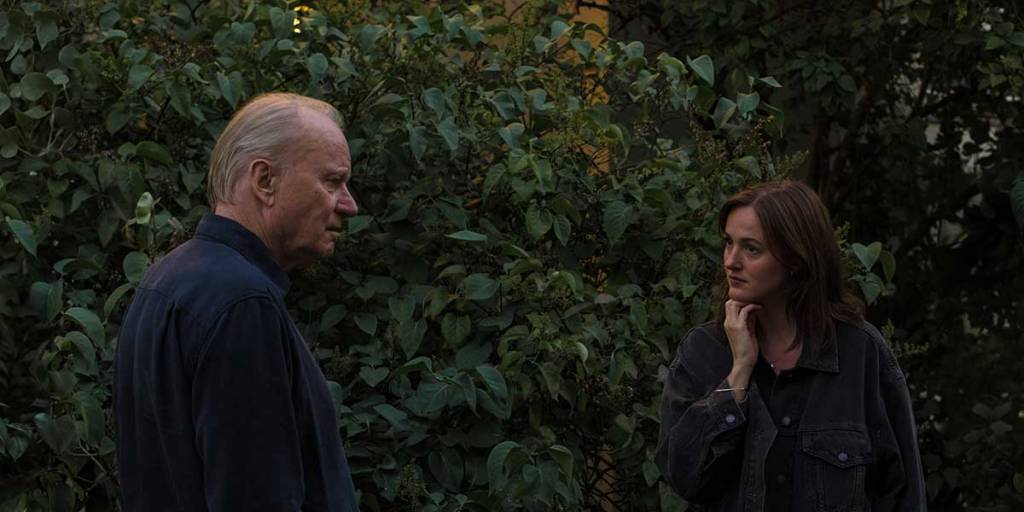
Nora Borg (Renate Reinsve) is a successful stage actress who lives in a grand old house in Oslo. It’s been in her family for generations: it’s where her grandmother killed herself, and where she grew up with her sister Agnes (Inga Ibsdotter Lilleaas) and their mom. Their dad, Gustav, (Stellan Skarsgård) disappeared after their divorce when she was still young, and they haven’t heard much from him in decades. Until now. Their mom just died and she and her sister have to deal with the house and go through all their family’s possessions (that’s the “sentimental value” of the title). And dad owns part of the house, too. But he has a second reason for showing up.
He wants to make a movie there, to use the house as his set. He’s a famous film director, but not in his prime anymore; he hasn’t shot a movie in decades. And he wants Nora in the main role of what is likely his swan song. You’re the only one who can do it, he says, just read the script! Nora refuses; bad blood runs deep. So, partly to get the funding he needs to make the picture, Gustav casts a Hollywood actress to play the role that Nora turned down. Rachel Kemp (Elle Fanning) is a big name, and she’s also a fan of Gustav’s work. What will happen to the house? Will Gustav make his film? And will they ever be on speaking terms again?
Sentimental Value is dramatic comedy about a Norwegian family. It’s full of clever asides and wide-ranging topics, but with a solid core at its centre. What makes Trier such a good director (The Worst Person in the World, Thelma, Oslo August 31st) is he creates believable characters in tough situations but without losing his sense of humour. He constantly plays around with his audience as to what is real and what is
artifice: we see Nora having a deep, emotional breakdown and then discover she’s acting a role on a stage set. He also uses biting satire to get his points across, skewering the superficiality of both Hollywood and bourgeois Norwegian society. He also repeatedly casts from a company of actors in his films. Elle Fanning and Swedish actor Stellan Skarsgård are new, but Renate Reinsve and Anders Danielsen Lie are familiar faces if you’ve ever seen Trier’s movies (and if you haven’t, you should).
Sentimental Value is moving, funny and full of good stuff to think about. I really liked this one.
The Running Man
Co-Wri/Dir: Edgar Wright
Based on a story by Steven King
It’s some point in the not-so-distant future in a dystopian America. A few rich people live luxurious lives, but the majority eke out a precarious existence within the endless sprawl of urban slums. They’re constantly surveilled by cameras, drones and DNA detectors while a brutal paramilitary police force patrols the streets. What keeps the people satisfied? Watching the reality shows and game shows broadcast from a single, big-brother-like monopoly network which controls the government, big business and media.
Ben Richards (Glen Powell) is a skilled labourer and union rep. He also has a volatile temper. He points out dangerous problems on the shop floor, which in this world gets you fired. So he’s out of work, his wife depends on tips in a hostess bar, and their 5 year old daughter is dying of an ordinary flu because they can’t afford basic medicine. What to do? There’s only one choice left: compete on THE RUNNING MAN, a reality show where all contestants try to survive for 30 days being hunted by a gang of professional killers. The winner gets a huge cash prize. And the losers pay with their lives. Luckily, the show’s producer, Dan Killian (Josh Brolin) takes a liking to Ben Richards — he’s smart, strong and most of all, angry! And the audience starts to like him… and his messages of rebellion. Can Ben outsmart the powers that be and survive? Or will the Network crush him, like they did with every Runner before him?
The Running Man is a non-stop action movie, with good
acting and an interesting plot. It’s set in the future, but done in a 1980s style, with zines, nerds and gadgets over spacemen and phasers. There are chase scenes using planes, trains and automobiles, and fiery explosions that level a city block. Glen Powell is wonderful in the lead role, appealing and heroic, painted like a Luigi Mangione fighting the corporate super-villain played by a slimy Josh Brolin. Director Edgar Wright — who brought us Toronto’s greatest Scott Pilgrim vs the Universe — keeps it funny and nerdy; he even casts Michael Cera as a nerdy revolutionary.
The Running Man is a lot of fun to watch.
Left-Handed Girl
Co-Wri/Dir: Shih-Ching Tsou
It’s Taipei’s night market, and a small family is moving into a tiny apartment nearby: I-Jing (Nina Ye) a little girl with a wild imagination, I-Ann (Shih-Yuan Ma) a diffident teenager with a chip on her shoulder, and their hardworking mom (Janel Tsai). She’s opening up a noodle stall to pay their basic rent cheque. Dad is nowhere to be seen; he ran off years ago, leaving the family high and dry. I-Jing quickly adjusts to her new kindergarten class and life in the constantly-moving marketplace. She even helps Johnny (Brando Huang) — a huckster with a heart of gold who sells carnival junk to unsuspecting shoppers — by making announcements on his loudspeaker. Mom is constantly busy, cooking and cleaning her stall, but can’t seem to earn a living. She also takes time to visit her ex-husband, now dying of cancer in hospital. Sadly he leaves his
abandoned family nothing but funeral debts and a pet meerkat. And I-Ann — who was once top of her class until she suddenly dropped out — works as a scantily-clad “betel nut beauty” selling smokes and the addictive chewing treat from her boyfriend’s shop.
But things get tense when the kids’ Mom is forced to visit their grandparents to ask for some money to tide them over. Mom’s brother is the golden boy who can do no wrong, and her two sisters both live in nice houses and are unsympathetic about her economic condition. And worst of all is grandpa, who scolds i-Jing for being left handed. He tells her left hand belongs to the devil (which she interprets as having an evil hand over which she has no control.) Now grandma is smuggling migrants through airports, mom faves eviction from the market, I-Ann missed her last period, and tiny I-Jing is turning into an avid shoplifter, using her “devil’s hand” to do the dirty work. Can this dysfunctional family ever pull itself back together?
Left-Handed Girl is a social drama about a family of women living on the brink. It’s tender, shocking and hilarious. It’s full of fast, clang-y music, flashy lights and hyper-saturated colour. It’s specifically Taiwanese in details (from bubble tea to class snobbery) but universal in its emotional appeal. And it’s co-written and edited by Sean Baker (Tangerine, The Florida Project, Red Rocket, Anora), who swept the Oscars last year with Anora. The characters speak Chinese but it’s clearly a Sean Baker movie, full of imperfect women in precarious times. And its Taiwanese-American director Shih-Ching Tsou worked on all of Baker’s films, so this is part of a long term partnership, with her taking the helm. And it’s Taiwan’s selection for best international Oscar.
I loved Left-Handed Girl, too.
Sentimental Value — opening this weekend — and Left-Handed Girl — next weekend — both played at TIFF. And The Running Man is now playing across Canada; check your local listings.
This is Daniel Garber at the Movies, each Saturday morning, on CIUT 89.5 FM and on my website culturalmining.com.
A donkey and a wolf. Films reviewed: Eo, She Said
Hi, this is Daniel Garber at the Movies for culturalmining.com and CIUT 89.5 FM.
Fall Film Festival Season continues in Toronto with the EU film festival, offering free screenings from across Europe from now till Dec 2 at the Alliance Française. The Ekran film festival is also on now, showing the latest Polish movies at the Revue Cinema on Roncevalles; and Blood in the Snow or B.I.T.S. features made-in-Canada horror movies next week at the Elizabeth Bader Theatre from November 24-26th.
But this week I’m looking at two new movies about animals. There’s a defenceless donkey in Poland, and a dangerous wolf in Hollywood.
EO
Co-Wri/Dir: Jerzy Skolimowski
Eo is an adorable miniature donkey who works at a one-ring circus. He is lovingly cared for by a woman dressed in red, who performs with him on stage. But when animal rights activists close the circus down, Eo finds himself pulling a wooden cart full of scrap metal at a junk yard. Later he is trucked off to an elegant estate that raises championship horses. From there he’s sold to a farmer, wanders through a wolf-filled forest on his own, and fights off dangerous football hooligans. His journeys take him across Europe, among the rich and poor, the kind and cruel, but will he ever be reunited with his long lost love?
Eo is an incredibly beautiful and tender film about an adorable
donkey and the people — both good and bad — he encounters. Oe never speaks, but conveys his emotions through tear-filled eyes, cuddling gestures and loud angry wails. This is not a cutesy animal movie, it’s about adult emotions — like lust, betrayal, cruelty and violence. Stunningly cinematic, the film tells its story in an impressionistic manner, as seen through a donkey’s eyes. Periodically the entire screen is blood red; but there are also breathtaking, panoramic views of palazzi in Italy, manors in Poland, magnificent white horses, ancient, arched bridges,
green fields, flowing rivers, and dark skies: gorgeous images that can only be appreciated on a big screen. There’s very little dialogue, in Polish, English, French and Italian, with most of the meaning conveyed visually. There are cameo appearances by actors like Isabelle Huppert, but Eo (and the donkeys who play him) is the real star.
Jerzy Skolimowski, who attended the Łódź Film School, is not as well known as fellow alumni Andrzej Wajda, Roman Polanski and Krzysztof Kieślowski, but I think his films are just as amazing, with a dream-like quality.
OE must not be missed.
It’s 2015, in New York City. Meghan Twohey and Jodi Kantor are two investigative reporters within the juggernaut of that Gray Lady, the New York Times. Meghan (Grey Mulligan) is following a string of women all of whom say the Republican candidate for president, Donald Trump, sexually harassed them in the past. But they are all afraid to come forward in public. When she finally does get a woman willing to reveal her name in print, she suffers terribly, sent packages of human excrement in the mail, while Meghan gets death threats. So she takes maternal leave to care for her first baby.
Meanwhile, cub reporter Jodi Kantor (Zoe Kazan), also married with two young kids, is pursuing a very different story. Hollywood actress Rose McGowan is hinting that someone at Miramax, that extraordinarily successful independent movie studio, sexually harassed her in the past. Jodi wants to find out whodunnit — Rose isn’t saying — and to get her to commit to details on the record. So she turns to Meghan for help. How do I get women to talk? The two of them join forces, doing extensive research stretching back decades, using legal documents, withdrawn lawsuits, secret payments, and
clandestine Non-disclosure agreements. They discover there are women as far away as London and Hong Kong who suffered from horrible incidents of bullying, abuse, and sexual assault, all of which were later covered up. And the arrows pointed toward one man: Harvey Weinstein. Can the reporters get even one woman to commit using her name in an article against the formidable and frightening Hollywood powerbroker? Or will the paper be forced to retract it’s allegations?
She Said is a fascinating retelling of two journalists pursuing a major story just a few years ago. It takes us deep into the weeds of investigative journalism. And it’s told like a police procedural, as the journalists slowly uncover the facts. The thing is, computer screens and cel phones do not make for good cinema. Hollywood seems to churn out these newsroom dramas every couple years, including Spotlight about the Boston Globe’s revelation of pedophile priests, and The Post about the Washington Post and the Pentagon Papers. This is one is about the New York Times. So we sit through lots of dull editorial meetings.
Luckily, most of the story takes us out of the office and into the real world, with the reporters knocking on doors and approaching victims who haven’t spoken of the incidents for 30 years. This — and the victims’ own stories, always spoken verbally, never reenacted— is where it gets interesting and moving. The film faces problems telling a history that’s still happening (Although convicted and in prison, Weinstein has yet to be tried for many other alleged crimes.) And it’s all about real, living people, so it runs the risk of anodyne (if truthful) portrayals of the characters. Luckily the acting is terrific, and the characters — not just the reporters, but the sources — are believable. And Maria Schrader is an excellent German director (she did last year’s I’m Your Man), who knows how to avoid those excessive blubbery, gushing “Hollywood moments” that ruin so many movies. She Said might not be a great movie, but it is the first one about this major issue, and projects it on a wider screen. As they keep saying in the movie, it’s not about one man, it’s about an entire system that protects and supports the powerful and persecutes their victims.
EO is playing tonight at Ekran, Toronto’s Polish film festival, and opens next Friday at the TIFF Bell Lightbox. She Said starts this weekend; check your local listings.
This is Daniel Garber at the Movies, each Saturday morning, on CIUT 89.5 FM and on my website, culturalmining.com.
Body Consciousness. Movies reviewed: Body, My Skinny Sister, Kilo Two Bravo
Hi, this is Daniel Garber at the Movies for culturalmining.com and CIUT 89.5 FM.
North Americans spend over $60 billion a year on gym memberships and diets, obsessing over their weight and fitness. Body image is omnipresent. This week I’m looking at three movies about bodies. There’s a Swedish drama about a girl who envies her sister’s body; a Polish drama about a man who finds bodies, a woman who talks to dead bodies and a young woman who wishes her own body would just go away; and a UK war movie about a squadron of soldiers in Afghanistan just trying to keep their bodies alive.
Body
Dir: Malgorzata Szumowska
Anna (Maja Ostaszewska) is a psychotherapist who treats teenaged girls with eating disorders. She works at a prestigious medical centre in Warsaw where she uses the latest techniques to make them comfortable with their bodies. She lives alone, and shares her bed with a Great Dane. Janusz (Janusz Gajos) is a lawyer who deals with death on a daily basis.
He prosecutes rapists and murderers, and treats his job as part CSI, part detective sleuth. We always see him at the crime scene, never in court. He lives with his bleached-blonde daughter Olga (Justyna Suwala). Olga has had an eating disorder since her mom died, which she blames on her dad. This dysfunctional family lives a passive
aggressive life, with Olga never eating and Januzs always drinking. They coexist uneasily, leaving notes to each other taped around the house, with the spirit of the dead woman hanging over everything. That is until Olga attempts to kill herself. Januzs has her committed to a mental hospital under Anna’s care.
But they don’t know that Anna is not just a therapist, but also a spiritualist who believes she can talk to the dead. It’s up to her to convince Olga and Januzs to accept each other and to reach out to the dead woman’s ghost.
Death, murder, suicide, mental illness… this sounds like a depressingly heavy movie, right? Wrong! It’s a delightfully absurdist look at how dysfunctional families cope with death and mourning. The movie consists of dozens of short scenes, many of which have hilarious or shocking details. (For example, the body of a suicide victim who turns out not to be dead.) And it’s peppered with subtle, political digs at contemporary polish society — issues like abortion, anti-semitism, sexism, and alcoholism. Szumowska is a director to look out for. I liked two of her earlier movies from Poland and France (In the Name of, Elles) and this one is even better.
My Skinny Sister
Wri/Dir: Sanna Lenken
Stella (Rebecka Josephson) is a pudgy, red-haired ten-year-old. She is smart but extremely self-conscious. Her older sister Katja (Amy Diamond) is a prize-winning figure skater. She practices daily with her German athletioc coach Jacob (Maxim Mehmet) and is highly competitive. Stella idolizes her but is also jealous of her. How come Katja gets all her parents’ attention? Why is she so thin and athletic, when Stella is just ordinary? And how come she gets to spend so much time with
Jacob? Stella has a crush on him and is sure he’d feel the same way if he just got to know her.
But then she learns something else about her sister: Katja is eating funny. She won’t eat junk food – athletes in training can’t eat things like that! – but Stella catches her gorging out of a trash can and throwing it all up later. But when Stella confronts her she makes her promise not to tell anyone – especially Jacob or their parents. Stella is torn: anorexia could be killing her sister, so telling their parents might save her life. But deep down she wants to see Katja fail. Maybe that will get Stella the attention she deserves.
My Skinny Sister is a realistic coming-of-age drama about eating disorders, told from Stella’s point of view. It shows how even parents who love their kids — and do everything with their kids in mind — can still do everything exactly wrong.
Kilo Two Bravo
Dir: Paul Katis
Tug (Mark Stanley) is a medic in the British Army, based in Helmand, Afghanistan. He works at an encampment on a hilltop in Kajiki, near a major dam and a big reservoir. Most of his work consists of providing band aids and inspecting grunts’ penises for sexually transmitted diseases. That is until
someone spots suspicious activity happening down in the wadi. The Taliban is active in the area and might threaten the dam.
So a few soldiers venture down the rocks to reconoiter. That’s when it happens: one of them steps on a mine blowing of a mine and some fingers. It’s up to Tug to stop the bleeding and get him to a hospital in Kabul. The problem is, where there’s one landmine, there are always more. And as the soldiers climb down they find
themselves walking on eggshells in a minefield. Each soldier they try to rescue could lead to more casualties. A false step, a kicked rock, a dropped water bottle… boom! Another deadly explosion. And adding to the danger is an incoming helicopter that could ignite even more mines, imperiling them all.
Kilo Two Bravo is a suspense-filled drama that keeps you tense for most of the film.
And it doesn’t skimp on gore: there are long medical sequences – gaping wounds, flying limbs — not for the squeamish. It’s a War is Hell-type story, where there’s no easy enemy, no Taliban soldiers to fight. Just the invisible foe hidden all around you in the minefield. If you’ve heard the term PTSD, and wondered where it comes from, this movie will show you. Kilo is neither a pro-war nor an anti-war film; rather, it’s a sympathetic look at the soldiers themselves.
Kilo Two Bravo opens today in Toronto, check your local listings; My Skinny Sister is part of Rendezvous With Madness Film Festival featuring movies about addiction and mental health. And Body opened the Ekran Toronto Polish Film Festival and is playing at the EU film festival which starts today. Also opening today is Gaspar Noe’s Love.
This is Daniel Garber at the Movies, each Friday morning, on CIUT 89.5 FM and on my website, culturalmining.com.


leave a comment