Not always pretty. Films reviewed: I Really Love my Husband, Orwell: 2+2=5, Roofman

Posted in 2000s, comedy, Crime, documentary, Folk Hero, History, LGBT, Sex, Travel by CulturalMining.com on October 11, 2025

Hi, this is Daniel Garber at the Movies for culturalmining.com and CIUT 89.5 FM.

TIFF is over but Fall Film Festival Season continues in Toronto. FeFF or Female Eye Film Festival is entering its 23rd year, showcasing features, shorts and docs directed by women. This year’s theme is Always Honest, Not Always Pretty, so you can expect some challenging and surprising work from women around the world. Expect innovative screenings, many with the directors present, as well as pitches, workshops and tributes.The festival runs from October 14-19, at the TIFF Lightbox, the Women’s Art Associations of Canada and the City Playhouse Theatre in Vaughan.

So this week, I’m looking at three movies, one from FeFF and two from TIFF. There’s honeymooners in the Caribbean, a famous writer on a tiny Scottish isle, and an ingenious thief, who lives, undetected, in a big box store.

I Really Love my Husband

Co-Wri/Dir: G.G. Hawkins

Teresa (Madison Lanesey) lives in LA with her husband Drew (Travis Quentin Young). They’ve been married for a year but have yet to go on a real honeymoon. They both work at unfulfilling professions with little time for amorous interludes. But that’s about to change: Theresa and Drew are heading south for a week, to relax and spend time with each other on the sandy beaches of Bocas del Toro, Panama. It’s a chain of Caribbean islands known for their blue skies and warm waves. And even when the airline lose their baggage and the promised welcome meal is nowhere to be seen, they are still happy with the place. The manager, a boyish, non-binary beach bum named Paz (Arta Gee), is ready to help make their stay more comfortable, however they can. For Theresa, that means thinking outside the marital envelope. She urges Drew to join with her in seducing Paz. Though hesitant at first, Drew dives into the three-way, head first, and their marriage feels stronger than ever. And Paz promises to take them to their secret island for one final fling.

But the mood starts to shift when jealousy rears its ugly head. A fourth wheel joins the group to make things even more confusing. Kiki (Lisa Jacqueline Starrett) a ginger-haired influencer with a venomous tongue, is a reality-show reject voted off the island. But she stays on, planting bad ideas in the couples’ heads, Can Teresa and Drew’s marriage endure all these complications? Can the insecure Teresa keep her anger in check?

I Really Love my Husband is a funny, bittersweet rom-com about the doubts plaguing a couple of millennials on a belated honeymoon. It pokes fun at a whole generation — from breakfast fasting to mushroom edibles to friendship stones — exposing some of the worst and silliest trends and fads. The characters are as worried about ratings and social networks as they are about actual love and affection. For a first-time feature by a new director with a largely unknown cast, this is a fun slice of life. Madison Lanesey is nicely sardonic, Arta Gee appropriately chill, and Travis Quentin Young always sweet strumming his guitar. Though not totally original, I Really Love my Husband does seem to capture the zeitgeist of LA’s millennials.

Orwell: 2+2=5

Dir: Raoul Peck

It’s the late 1940s in Scotland’s Inner Hebrides on a tiny, inaccessible island called Jura. George Orwell is there to write a novel in an isolated home, inaccessible by cars. His young son, his sister and their housekeeper keep him company as he sits by his typewriter. He’s dying of tuberculosis but wants to make sure his last book is completed and published. The novel is called 1984 and becomes a crucial part of contemporary culture, even today.  You’ve probably heard of Big Brother; or at least the surveillance based reality show it inspired. It has been made into many films and TV shows and is referenced everywhere, Words like sexcrime and concepts like doublethink are firmly imbedded in our culture.  The book is about the perpetual war between competing totalitarian nations. But more than that, it’s about the propaganda, mass surveillance and thought- control ordinary people are subject to. The hero, Winston Smith, works for the Ministry of Truth propagandizing Newspeak to the nation. But eventually he too falls victim to the machinations of the government of Oceania, ruled by Big Brother. He is tortured because, although he accepts their ludicrous proposition that 2+2=5, and espouses their slogans (War is Peace!, Ignorance is Strength! Freedom is Slavery!), he doesn’t really believe them. This story shows that the contents and concepts of 1984 are as relevant today as when Orwell wrote them.

Orwell 2+2=5 is a combination documentary, docudrama and diatribe about Orwell, his writing and its influence on popular culture. It covers not just 1984 but Orwell’s earlier books, including Burmese Days, Homage to Catalonia (he volunteered to fight fascism in the Spanish Civil War), and Animal Farm, his allegorical look at Stalinist Russia. It’s based on both his books and his private correspondence. The movie also uses clips from the many film adaptations of 1984 to tell that story. And finally, it includes a barrage of brand-new news footage of leaders like Trump, Putin, Orban and Xi Jinping. These are altered with Orwellian slogans superimposed in bright colours over the media images.

Raoul Peck is a well-known Haitian documentary filmmaker, and maybe it’s because I already know so much about Orwell and his writings, this movie — with the exception of his last days on Jura — wasn’t as mind blowing as it might have been if it were all new. And it can’t compare to other docs like Peck’s I Am Not Your Negro, his biography of James Baldwin. Even so, Orwell 2+2=5 does stand as a historical document  with a good dose of agit-prop.

Roofman

Co-Wri/Dir: Derek Cianfrance

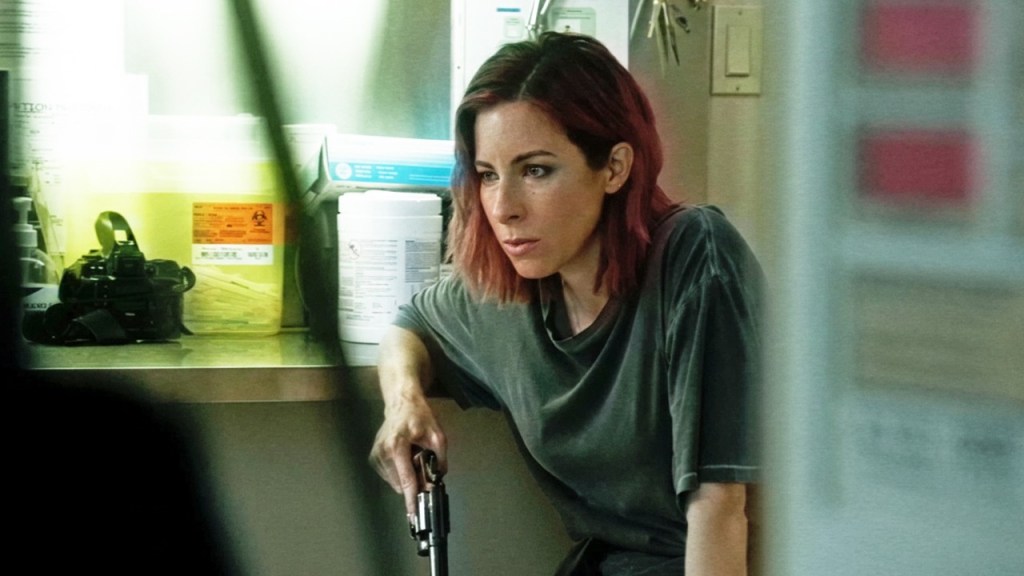
It’s the early 2000s in Charlotte, North Carolina. Jeffrey Manchester (Channing Tatum) is the happy father of a young daughter and twin infants. He’s smart, nimble and observant. But he is underpaid and overworked as his job, and can’t seem to keep the family afloat. When he has to resort to regifting his own childhood toys for his daughter’s birthday party, he realizes something must change. He resorts to a life of crime, involving no violence. He robs McDonalds restaurants by an ingenious method: cutting a hole in the roof after dark, and stealing the cash. After dozens of such robberies the press subs him “Roofman”. His family moves up the social ladder, living the american dream of life with a swank car and and a nicely decorated home. Alas, he is finally caught, and sent to prison. His wife cuts him off, and he can’t even talk to his own kids anymore.

Later, following an ingenious plan, he escapes from prison undetected and looks for a place to hide. Most surprisingly he discovers an unsurveilled corner of a Toys R Us big box store with enough hidden space to make set up a tiny apartment. He initially survives on peanut M&Ms pilfered from the shelves, but eventually moves on to pawning video games and DVDs. And he learns the layout of the cameras and computers, making him virtually invisible… though in plain site. He surveils the store management instead of vice versa. He has a crush on one employee Leigh (Kirsten Dunst) a single mom with two teenaged daughters. They eventually meet, unexpectedly, at an evangelical church toy drive (he “donates” toys stolen from his Toys R Us). Sparks fly and they become very close, but with Jeff still concealing his life of crime and his current home. Can he start a new life in his own home town without getting caught? Or should he just get the hell out of there?

Roofman is an exciting adventure / romance / comedy based entirely on a true storytelling. It’s funny, clever and constantly surprising. Channing Tatum is brilliant as Jeff, displaying an acrobatic sense of movement and timing, climbing walls, crawling through ceiling tiles or swooshing around cars on foot to avoid detection. The rest of the cast is also great: former teen actor Kirsten Dunst has eased comfortably into middle age and her character is very empathetic; Lakeith Stanfield is Steve, his sketchy war buddy; Aussie Ben Mendelsohn as guileless Pastor Ron, and Peter Dinklage appropriately dislikable as toy store manager Mitch. Filmmaker Derek Cianfrance (he directed the passionate Blue Valentine and the dark The Place Beyond the Pines)  hasn’t made a movie in ages, but if he’s looking for a comeback, this is it.

I like Roofman a lot. 

Roofman and premiered at TIFF and open in Toronto, this weekend; check your local listings; and I really love my husband is coming soon to FIFF.

This is Daniel Garber at the Movies, each Saturday morning, on CIUT 89.5 FM and on my website culturalmining.com.

Outstanding, great… or just ugly? Films reviewed: Eleanor the Great, Out Standing, The Ugly

Posted in 1990s, Canada, Drama, Family, Korea, Mystery, Psychology, War by CulturalMining.com on September 27, 2025

Hi, this is Daniel Garber at the Movies for culturalmining.com and CIUT 89.5 FM.

Toronto Palestine Film Festival is on right now, with movies, shorts and docs by and about Palestinians, as well  music, cuisine and art to share with other Canadians. This is it’s 17th year and it’s never been more relevant, so check it out.

But this week, I’m looking at three new movies that premiered at TIFF and are all opening theatrically this weekend.  There’s an elderly woman who tells a lie, a woman with an “ugly” face  who disappears without a trace, and a female officer in the Canadian Army who wishes a certain photo would just go away.

Eleanor the Great

Dir: Scarlett Johansson 

Eleanor Morganstein (June Squibb) is a grandmother in her 90s. Since her husband died ten years back, she has shared her Florida condo with her best friend Bessie whom she’s known for 70 years. They do everything together, and work well as a team. Where Bessie is timid, Eleanor is brash and outspoken. If there’s something Bessie wants, Eleanor knows how to get it, even if it involves telling a few fibs. She has chutzpah to spare. But when Bessie suddenly dies, she realizes there’s no reason to stick around, so she packs up her stuff and flies back to New York for the first time in decades. She’s staying with her daughter Lisa (Jessica Hecht) and her grandson Max (Will Price). She’s hoping for some quality time but Lisa’s a worrywart and Max is always busy at school. So she takes up her daughter’s offer to attend some classes at the JCC she signed her up for; maybe she’ll make some friends. The first class is a washout —  broadway musicals —  so she wanders into another group almost by accident. It’s a support group for Holocaust survivors, and the members urge Eleanor — as a newcomer — to tell her story. She’s not a holocaust survivor, but her best friend Bessie was… and she knows all her memories, especially the death of her brother.  So, in deference to Bessie, she tells them to the group as if they’re her own. Why not, right? It goes over well… a bit too well, actually. A teenaged college student Nina (Erin Kellyman) is auditing the group and soon bonds with Eleanor (her mom recently died and her dad is distant and withdrawn.) The two women bond and start sharing intimate stories. 

Nina is in a journalism class, and wants to make a video of her telling her holocaust memories as part of an assignment.  Then things get really out of hand: Nina’s dad (Chiwetel Ejiofor) happens to be a popular TV news journalist… and he wants to make Eleanor his next feature. But what will happen to her friendship with Nina — never mind her own family — once the truth inevitably comes out?

Eleanor the Great is a nice, light movie-of-the-week-type drama about death, mourning, and inter-generational relations. It’s a very simple and easy movie, part comedy, part weeper. What’s good about it is the acting. June Squibb — who really is in her 90s — is great as the energetic, down-home Eleanor. (She played another rebellious granny in last year’s hit Thelma.) This is Scarlett Johansson’s first time as a director, and luckily she doesn’t bite off more than she can chew. She concentrates on characters — Squibb and Kellyman are both great in their roles — more than the basic story. And you know what? That’s good enough.

I wouldn’t call Eleanor the Great great, but it’s worth the watch.

Out Standing

Co-Wri/Dir: Mélanie Charbonneau

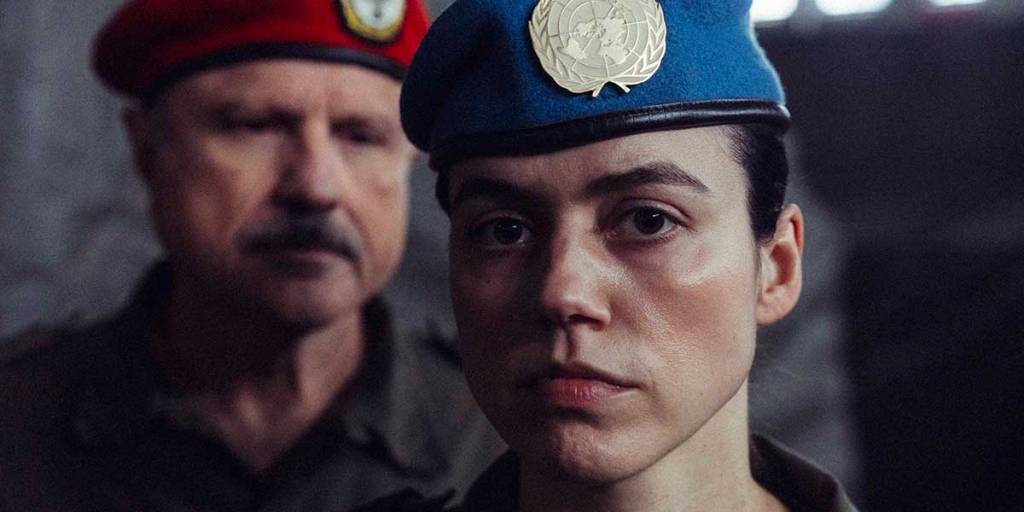
It’s the 1990s, and Captain Perron is leading a troop of UN peacekeeping forces in the former Yugoslavia. Why is this unusual? Sandra Perron (Nina Kiri) is a Canadian woman, the first to lead a squad of infantry soldiers in combat, and the first  female to serve in the prestigious 22nd division, known as the Van Doos.  Raised as an army brat in bases across Canada, she comes from a long line of soldiers, so it makes sense that she is following in her father’s vocation. She trained as a cadet and received commendations while still a teenager. And she’s the first woman to survive the brutal training that squadron demands. But there’s a photo circulating from her past that’s threatening to derail her military career. It’s a picture of her tied to a tree, barefoot, in the snow and semiconscious.

It was part of her training in a Prisoner of War exercise that went far beyond the normal treatment soldiers are forced to endure. A Canadian woman facing treatment tantamount to torture at CFB Gagetown in New Brunswick. But Captain Perron isn’t the one who released the photo, one fact she didn’t want the photo circulated. She had endured years of hazing bullying, harassment, obscene phone calls, sabotage to her kit, and a hidden campaign by certain officers to get rid of her. They detest the idea of serving alongside or under the command of a woman. And unlike the other women who attempted to to join the Van Doos, she alone managed to survive and not quit. 

Out Standing is a biopic about a trailblazing woman in the Canadian Armed Forces. It’s both moving and disturbing. The title, based on her memoirs,  refers both to her achievements and to the notorious photo of her standing tied to a tree. (That pic was eventually published by the press, triggering a wave of shock and disgust across the country, and, one hopes, an improvement in how women are treated in the military.) Nina Kiri gives an excellent performance, totally believable as Perron. 

While Hollywood churns out dozens of war movies each year, showcasing the latest weapons and fighter planes, you rarely see a Canadian one. This one is  full of details carefully chosen to distinguish how soldiers behave here. The military culture is quite different. Unlike in the US there’s no Sir-yes-sir! And instead of saluting a Canadian soldier stand sharply at attention. I never knew this because you never see it in movies. For this alone it’s a eye-opener. The film is not perfect — there’s a particularly clumsy scene near the end — but altogether it’s a compelling and disturbing look at a Canadian woman’s life in the military.

The Ugly

Wri/Dir: Yeon Sang-ho (Peninsula, Train to Busan)

Lim Yeon-gyu (Kwon Hae-hyo) is a well-known carver of dojang, the name stamps used in Korea like a signature on official documents.  He built up his business from scratch while raising his son as a single parent. (His wife ran away soon after the baby was born.) He trained his son Lim Dong-hwan (Park Jeong-min) in every aspect of the craft. Now an adult he is taking over the family business. At this moment, a documentary filmmaker (HAN Ji-hyeon) is celebrating this dad’s life as a national treasure. Why did she choose this man for her documentary? He’s been blind since birth, which makes his many accomplishments even more impressive. But filming is put on hold when a surprise announcement arrives. They’ve found Dong-hwan’s mother decades after she disappeared. Turns out she’s been dead all that time and only her bones remain. This comes as a total shock to Dong-hwan, and it just gets worse. 

First his mother’s long lost relatives arrive for the funeral but they’re despicable people who just want to make sure he doesn’t claim any family inheritance.They bullied and beat his mother, a veritable Cinderella raised by this cruel family. It’s also the first time he hears his mother described as ugly. Ugly how? He longs to see a photo of her, something to display at the funeral, but there are no photos anywhere. Of course his blind father doesn’t have one. While Dong-hwan is trying to process all this new information,  the filmmaker leaps on it as a great story and insists on continuing the documentary but with a new twist: who killed his mom and why? Together, over a series of interviews with hidden cameras, they uncover events and people from her past as the tragic puzzle gradually falls into place. 

The Ugly is a mystery about a kind-hearted woman — the main character’s mother — and how she is horribly treated because of her looks. It’s a heart wrenching story, a dark, bleak view of humanity with only Dong-hwan (and his mother) as redeeming characters. The story is told as a series of interviews with the various characters and extended flashbacks to what actually happened (The actor who plays Dong-hwa also plays his blind father as a young man in the flashbacks, while Jung Young-hee plays his mother, but always from behind or from the side, without ever revealing her face). In Yeon Sang-ho’s previous movies (Peninsula, Train to Busan) the action hero is surrounded by mutants or zombies or killers. The Ugly is about normal people but they’re just as hideous.

The Ugly is a powerful and dark look at human cruelty and physical beauty.

Eleanor the Great, Out Standing and the Ugly all open this weekend in Toronto; check your local listings. This is Daniel Garber at the Movies, each Saturday morning, on CIUT 89.5 FM and on my website culturalmining.com.

TIFF gems. Films reviewed: Girl, I Swear, Cover-Up

Posted in comedy, Coming of Age, Disabilities, documentary, Journalism, Psychiatry, Scotland, Taiwan, War by CulturalMining.com on September 13, 2025

Hi, this is Daniel Garber at the Movies for culturalmining.com and CIUT 89.5 FM.

TIFF, Toronto’s International Film Festival is winding down after a busy week, but there is still a lot to see, including the People’s Choice awards offering free screenings of the winning films tomorrow. So this week I’m looking at three terrific movies that premiered at TIFF but aren’t getting the degree of coverage I think they deserve. There’s a coming-of-age story about a girl in Taiwan, a biopic about a man in Scotland, and a documentary about a legendary American journalist.

Girl

Wri/Dir: Shu Qi

Lin Xiaoli  (Bai Xiao-Ying) is a working class tween in middle school in Taiwan. She lives with her mom, and her domineering stepdad who terrorizes her mother and her. Xiaoli hides inside a zip-up wardrobe in her bedroom as protection from his violent outbursts. He works as a mechanic in his Uncle’s garage, and usually comes home drunk to the gills. Her Mom works in a hair salon and makes artificial flowers at home to earn extra money, but takes out her anger on her much smaller daughter. Xiaoli takes care of her younger sister, who is favoured by both her parents. At school she tries to stay unnoticed to avoid more of the violence and anxiety he gets at home. 

Until she meets a vivacious girl named Li Lily (Lin Pin-Tung). Lily lived in the States for a few years but now she’s back and living with her grandparents who let her do whatever she wants. Though the too are complete opposites, Lily is helping Xiaoli climb out of her shell. And one day they cut class, wear makeup, smoke a cigarette, go to a video cafe, sing songs, and eventually meet a bunch teenaged boys riding motor scooters. But will this day change her life in a good way… or in a bad way?

Girl is a realistic coming-of- age drama set in the previous millennium (with no computers or cel phones) and full of poignant details. It’s a very moving story about parental abuse passed down through generations, but it’s also full of hope. It follows the points of view of all the main characters, not just Xiaoli.  Now, I have a rule, I avoid first films at TIFF directed by actors. Why? They’re usually crap. Vanity pics, Oscar bate, self-serving vehicles or relentless navel gazing. Shu Qi is a very famous Taiwanese actress, and Girl is her first try at directing. Luckily, it’s really good. She has acted in three movies by Hou Hsiao Hsien and Girl resembles his films in both style and content, though a totally original take. It’s rough and violent in parts, which is hard to handle in a realistic movie, but there’s lots of sweet stuff, too.  

Girl is an excellent first feature.

I Swear

Wri/Dir: Kirk Jones

It’s the late 1990s. John Davidson (Scott Ellis Watson) is a popular teenager in Galashiels, Scotland He’s starting at a new school, getting friendly with a girl he fancies, and is the prized goalie on the local boys’ football team. His Dad has even arranged for a scout to the next match. But then something unexpected happens. He starts twitching in class, just a little at first, like a nervous tic. But it soon turns to rapid movements, facial contortions, and barking sounds. Followed by spitting, random punching and the uttering of the most offensive words. He gets caned by the headmaster for acting the ckown, his mother makes him eat his meals on the floor facing the fireplace. HIs father abandons his family. His onetime girlfriend slaps his face and other kids bully him at school, But none of it is intentional; he has Tourette’s syndrome.

Decades later, John (Robert Aramayo) still lives with his mother, heavily sedated, not allowed to speak with anyone for fear of an incident. A miserable existence indeed.  Until he runs into an old school friend who invites him for dinner at home. He repeatedly declines — for good reason — until his friend’s mom Dottie (Maxine Peake), a psychiatric nurse diagnosed with cancer, insist he come in for spaghetti dinner. The first thing he says to her is You’re dying of cancer, haha! before skulking away, mortified. But Dottie brushes it off as the most honest thing she’s heard in years. She invites him back, and tells him to stop apologizing for things that aren’t his fault. Eventually he moves in to try to live a normal life. But is that possible with Tourettes?

I Swear is a comedy/drama, based on a true story, about one man’s life with Tourette’s.  The title refers to the profane and deeply offensive words that spew forth from his moth at the worst possible times. It’s mortifying but also excruciatingly funny, and the two actors who play him, Watson and Aramayo, exude sympathy and humour in every scene, despite their seemingly insurmountable problems. I laughed my ass off for most of this film (whenever I wasn’t crying out of sympathy). I Swear tells a heart-warming story, even as it educates —  without lecturing — about Tourette’s.

I strongly recommend this feel-good movie.

Cover-Up

Wri/Dir: Laura Poitras (All The Beauty and the Bloodshed)

and Mark Obenhaus

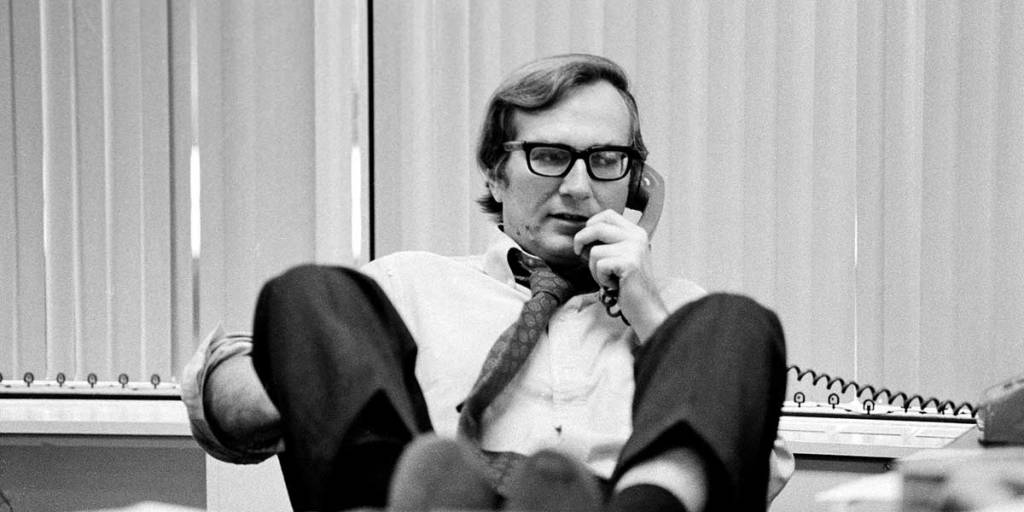
It’s the 1960s and America is at war. Sy Hersh, a freelance reporter, hears a rumour of mass murder in Vietnam by American troops. He speaks with GIs on base and the soldiers accused of these crimes. He also got a hold of a secret military investigation the massacre. And the facts he finds are horrifying. There include synchronized sexual assaults and murders of hundreds of women, men and children, and even babies, by American soldiers. Hersh blames My Lai on General Westmoreland and others who ordered the mass killings — which happened in a number of places on the same day — solely for the purpose of raising the body count. They needed more dead bodies to prove they were winning the war. The story has major repercussions all the way to the top — Nixon and Kissinger were recorded calling Hersh a son of a bitch — and played a role in turning public sentiment away from the war. For Hersh, My Lai is the first of many crucial stories he breaks in the decades to come. He becomes the NY Times daily reporter on the Watergate scandal. He uncovers US involvement in Pinochet’s bloody coup in Chile and the assassination of Allende; illegal CIA infiltration of anti-war groups, the secret bombing of Cambodia, the invasion of Gaza (ongoing), and the abuse and torture of Iraqis by American soldiers during the Gulf War at the infamous Abu Ghraib prison. 

Cover-Up is a journalistic documentary about journalism itself. It features historical documents and period photos and film — many very disturbing —  new interviews with people involved in the stories, and extended talks with Sy Hersh, who at the age of 88 is still a full-time journalist.  You get to see him see at work talking to anonymous sources and vetting incoming photos and leaks. He’s a bit prickly about protecting his sources even from the documentary makers (who take care never to reveal anyone still alive), because it’s that core of consciences bureaucrats, soldiers, and spies who still uphold the constitution and flout illegal coverups. They’re the sources who keep freedom of the press alive.

After the TIFF screening, Hersh said that American journalism is in a bad state with reporters running scared. How many important stories are being gagged or stifled now — or in the past — under White House pressure? It shows how badly we need more adversarial journalists who question the powers that be and uncover what they’re hiding.

And that’s what Cover-Up is all about.

I Swear, Girl and Cover-Up all played at TIFF and should be released over the next few months. This is Daniel Garber at the Movies, each Saturday morning, on CIUT 89.5 FM and on my website culturalmining.com.

By Women. Films reviewed: Angela’s Shadow, Samia, Oh, Hi!

Hi, this is Daniel Garber at the Movies for culturalmining.com and CIUT 89.5 FM.

If you’re feeling overwhelmed by big, blockbuster movies, try something smaller. Cinecycle is having a free, open screening of super-8 films this Sunday. Bring your own or watch other people’s — just no videos, please.  Also on now at the TIFF Lightbox is Marlee Matlin: Not Alone Anymore, a surprisingly intimate documentary about the Oscar winning deaf actress — a really great doc.

Speaking of films directed by women, this week I’m looking at three more movies wth female directors. There’s a girl in Somalia running in circles, a woman north of Ottawa pulled in two directions, and a couple in New York… whose relationship is tied up in knots.

Angela’s Shadow

Co-Wri/Dir: Jules Koostachin

It’s the 1930s in Ottawa. Angela (Sera-Lys McArthur) is a happy middle-class housewife who lives with her husband Henry (Matthew Kevin Anderson) an aspiring journalist.  She’s pregnant with their first child.  But everything changes when an urgent letter arrives from her childhood nanny Mary (Renae Morriseau). She writes that she must see Angela on her reserve (Mary is Cree) before the baby is born. While Angela is hesitant, Henry is gung-ho. He loves a good adventure, and hopes to get some good shots and news scoops in Canada’s North. But once they get there, Angela is separated from Henry — she to meet the elders and he to try his hand at “native style” hunting.

Angela is taken to a sacred area where she discovers the secrets of her past: she was born to a Cree mother and an Irish father, and when both parents died, she was sent to live with her father’s sister in Ottawa. Turns out, Mary is actually her aunt, too, on her mother’s side. This was kept a secret to keep Angela safe from the  Residential Schools. And they tell her the meaning of a little girl she keeps imagining.

Henry, meanwhile, is taken on a hunting trip by two young men: Isaiah and Malachi, Angela’s cousins (Asivak and Mahiigan Koostachin). Henry is eager to learn about there way of life, but understands everything from his Christian upbringing. So when he starts to see visions after a sweat lodge, something snaps. And while Angela welcomes her visions and feels an attachment to the land, Henry feels a deep fear and repulsion, and an urgent need to take his wife out of there. Can they reconcile their differences? Or will their visions prove hazardous to their health?

Angela’s Shadow is an historical drama about a clash of cultures between Anglo and Cree, Christianity and spirituality, and education in residential schools vs the passing on of outlawed culture, language and rituals. Visually, it’s quite lavish, with period costumes, sets, and lush camerawork, a la Murdoch Mysteries. It’s also meticulous in its portrayals of indigenous culture. I found the acting a bit over the top in the beginning, but it redeems itself once it turns into a psychological thriller. 

Yes, Angela’s Shadow is a bit melodramatic, but, hey,  I like melodramas. This is an engrossing indigenous story about Canada’s chequered history.

Samia

Co-Dir: Yasemin Samdereli, Deka Mohamed   

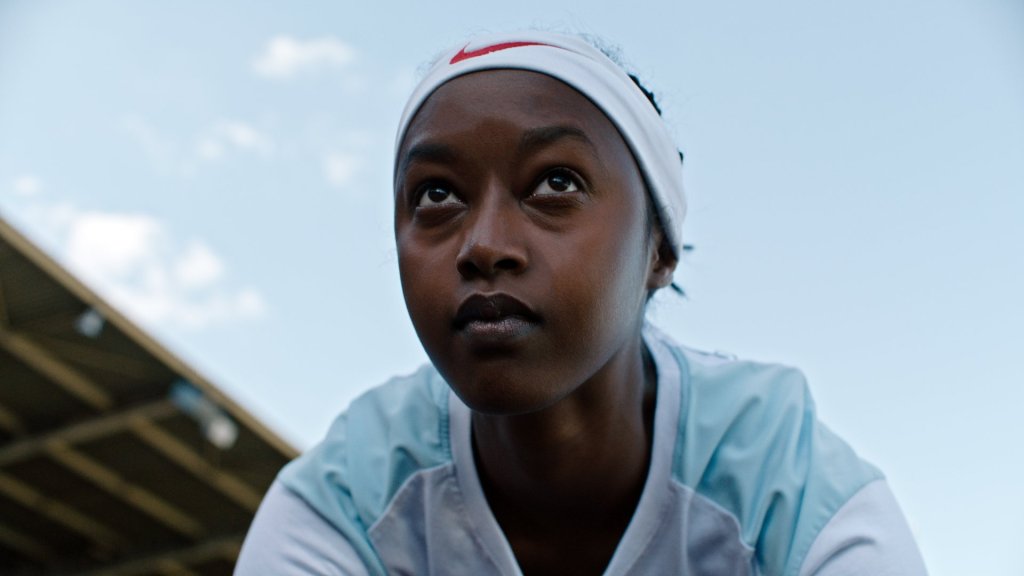
Samia (Riyan Roble) loves to run. Though only a little girl, she places among the top 10 runners in her town’s annual race. She lives in a walled compound with her strict mother, her fun-loving dad, her conservative brother Said, and her singing sister Hodan. She’s also good friends with Ali (Zakaria Mohammed) who is almost like a brother to her; his family shares their compound. But he’s a terrible runner so he appoints himself Samia’s coach.Like Rocky, they train outdoors, racing around corners and down back allies. Their goal? To make her the fastest girl in town! And as they grow older, the teenaged Samia and Ali (llham Mohamed Osman, Elmi Rashid Elmi) discover there’s a world beyond their city, beckoning Samia toward international competition.

But Somalia is unstable, with armed military tanks roaming the streets. Fundamentalists demand all girls wear a head scarf — but what about my running? asks Samia. Regional differences are on the rise and so are religious fights. Local armies and child soldiers are popping up everywhere, making it a dangerous place to live. Can Samia fulfill her dreams in an unstable country? Will she ever make it to the Olympics? And will her family support her if she does?

Samia is a bittersweet, naturalistic biopic inspired by true events. It’s told in a series of extended flashbacks from her past remembered by an adult Samia, now fleeing Somalia for Italy, via Libya. This is an Italian film, co-directed by a Kurdish German, and an all-Somali cast. It reminds me a lot of Io Capitano (review here) from a few years ago, though this one, while touching and sympathetic, is less triumphant. It’s also rare — the first movie I’ve seen set in Somalia with Somali actors.

I liked this movie.

Oh, Hi!

Co-Wri/Dir: Sophie Brooks

Iris and Isaac (Molly Gordon, Logan Lerman: Indignation, The Lightning Thief) are a young couple in their twenties staying at a BnB in upstate New York. She is pretty, sexy and fond of practical jokes. He is good looking, chill, and open-minded. They’ve been dating for three months, but this one looks like a turning point. Isaac has perfectly arranged everything for the weekend: a beautiful house to stay in with a lake in the back, and delicious meals he cooks for her. And the sex! They are adventurous and passionate together. So when they uncover some bondage material in closet, they decide to try it out. Isaac agrees to be chained to the bed and it works out better than either of them hoped. But somehow the post-coital cuddling leads to some discussions, which reveal she thinks they have a monogamous long term relationship, while he thinks she’s fun and friendly but just another sex partner with no commitment. And all of this happens while he is still tied to the bed.

Iris does not take this lightly; she feels betrayed. Isaac, on the other hand is genuinely frightened with her jokes about wanting to stab a previous boyfriend to death. And as time passes with little progress, both sides begin to panic. If she lets him go, will he call the cops and have her arrested for kidnapping? Is his life in danger? And when Iris’s best friend Max (Geraldine Viswanathan) and her boyfriend arrive to find Isaac still tied to the bed, it gets even more complicated. How will they ever get themselves out of this colossal mess?

Oh, Hi! is a hilarious sex comedy about trust, relationships and a date gone wrong. While I found some of the relationship psychologizing wasn’t fun, it only made up a small part of the movie. I’ve never seen Molly Gordon before —  she co-wrote the script — but she has this uncanny ability to suddenly switch from gorgeous sex-goddess to google-eyed maniac. Logan Lerman is more of the straight man, but carries off his laid-back role quite nicely, considering he’s tied to the bedpost for much of the film. The story itself — along with the unexpected  twists it takes — keeps you squirm-laughing almost all the way through. Though the audience at the screening I saw was maybe 80% women (who really seemed to like it), I think there’s lots there for men to think about, too.

This is a very funny movie.

Angela’s Shadow, Samia and Oh, Hi! all open this weekend in Toronto; check your local listings.

This is Daniel Garber at the Movies, each Saturday morning, on CIUT 89.5 FM and on my website culturalmining.com.

Scary creatures. Films reviewed: Jurassic World Rebirth, 40 Acres, Sorry Baby

Posted in Action, African-Americans, Canada, Cannibalism, College, comedy, Dinosaurs, post-apocalypse, Science Fiction by CulturalMining.com on July 5, 2025

Hi, this is Daniel Garber at the Movies for culturalmining.com and CIUT 89.5 FM.

Yorgos Lanthimos, who brought us films like The Favourite and Poor Things, didn’t come from nowhere; he’s been directing weird, original movies for two decades. One of his first — and one of my first reviews on this show — is Dogtooth, which still holds a place in my heart. It’s being re-released on the big screen in July, so if you haven’t seen it, now’s your chance.

But this week, I’m looking at three new movies about people dealing with scary creatures. There are dinosaurs on the equator, cannibals on the prairies, and a monster in a New England college town.

Jurassic World: Rebirth

Dir: Gareth Edwards

It’s present-day New York City, where giant, benign  dinosaurs amble through city parks. Bennet (Scarlett Johansson) is a hard-boiled mercenary who dares to go where you’re not supposed to be to steal things you aren’t supposed have. Her latest client? A certain Mr Krebs (Rupert Friend), the sketchy rep of a Big Pharma multinational. And the job? To bring back blood samples from three of the biggest and most dangerous dinosaurs in the world: one from the sea, one from the sky, and one from the ground. The only place these creatures live is around the equator, in areas international law says we can’t go. But Bennet will, along with her longtime collaborator Kinkaid (Mahershala Ali) and their henchmen. Rounding out the pack is Dr Loomis (Jonathan Bailey) a palaeontologist whose dream has always been to see the dinosaurs (whose fossils he studies) alive and in the flesh.

Along the way they rescue a family whose plans — to sail across the Atlantic —  are capsized when their boat is attacked by a giant sea monster. They all end up on an island, full of hybrid dinosaurs created in labs a generation ago by genetic scientists who abandoned the project when it became too dangerous. But which of them will survive 24 hours among those killer beasts?

Jurassic World: Rebirth is an action adventure, the latest instalment in the ongoing franchise. It’s a cautionary tale of what happens when ambitious scientists bring dinosaurs back to life to build a profitable theme park. Ironically, while the theme parks are gone, the movie feels like a series of carnival rides. First you’re in a speedboat escaping something in the water, then you’re hanging from a cliff, avoiding killer Pterodactyls… Which makes it fun and entertaining, but in an entirely predictable way.

I loved the thrill of the raptors in the first Jurassic Park, but the weird and artificial dino-hybrids in this version look more sad or silly than scary. 

40 Acres

Co-Wri/Dir: R.T. Thorne 

It’s the near future in rural Canada after an apocalyptic pandemic has left the whole world in ruins, starving for food. Hailey Freeman (Danielle Deadwyler) lives on the same farm her African-American ancestors moved to after the US Civil War. She’s a hard-ass mom who rules her family like a sergeant (she spent time in the military). Her oldest son, Manny, (Kataem O’Connor) still responds to her questions with only a yes ma’am / no ma’am. Though they live a calm and peaceful life — trading goods with other farmers using shortwave radio and a shared depot —  just outside the gate marauders rove around, trying to break into farms and steal their coveted farmland. The Freemans are a blended family, Black and indigenous, with Galen as Dad (Michael Greyeyes) Hailey as Mom, the older kids from previous marriages, and the younger kids born here. They are trained not just how to plant and harvest, but also how to handle heavy artillery, hidden beneath their house. Hailey may operate in a constant state of paranoia, but there are reasons for her extreme caution. If the predators at the gate break through, they won’t just take the farm, they’ll eat the family. Yes, the outsiders are cannibals!

But Manny is growing up, and when he sees a beautiful young woman (Milcania Diaz-Rojas) swimming in a lake outside the farm, he is stricken with equal parts love and lust. And when she appears at the fence begging for help he sneaks her inside. Can she be trusted? Or is she a cannibal? And could this mean the end of the Freemans?

40 Acres is a post-apocalyptic, science fiction action thriller. It’s gripping, surprising and pretty scary. It presents an unusual point of view, combining an American individualistic, top-down, gun-friendly “get off of my lawn” attitude with a multicultural, work-together Canadian ethos. It’s also a zombie-pocalypse movie, but without the walking dead — it’s humans who do the killing and eating. And in between violent shootouts and fights, the lovely cinematography gives us lots of misty cornfields and lush forests on which to feast our eyes. But the biggest reason to see 40 Acres is Danielle Deadwyler, a dynamic powerhouse in her role as Hailey. 

All I can say is: Wow!

Sorry Baby

Wri/Dir Eva Victor

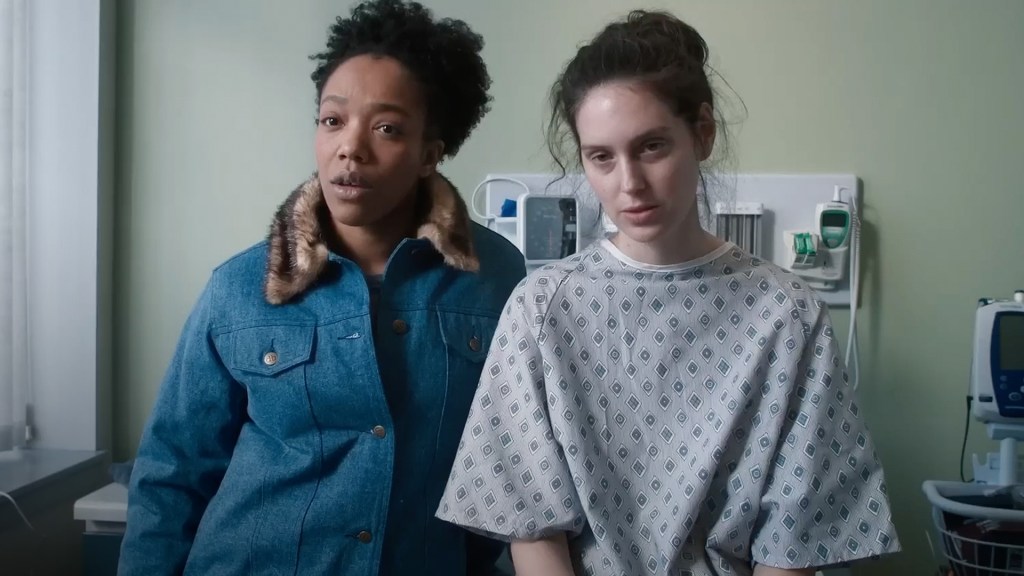
Agnes is an assistant prof in English Lit at a small liberal arts college in New England. She’s lonely, depressed and frightened living in a draughty home with just her cat to keep her company. Well, that and a neighbour who  occasionally drops to share her bed (Lucas Hedges). Thankfully, her best friend and former housemate Lydie (Naomi Ackie) is back for a much-needed visit. They lived together as grad students, but while Lydie found work — and a female lover — in New York City, Agnes is trapped in the same college,  with same home, same faculty, same courses… she even works out of the same office that used to belong to her thesis advisor. On the surface, she has achieved all the measures of academic success… so why is Agnes so miserable?

Flashback to a few years ago. Even as she is struggling to finish her grad thesis, something very bad happens to her: she is sexually assaulted on campus by someone she knows very well. Though Lydie is supportive, her doctor and the school administration are not. The bad thing is made worse by how messed up she gets afterwards. How can Agnes deal with, accept and overcome her past? 

Sorry Baby is a deeply personal coming-of-age story about one woman’s life in the academic world and the dark incident that colours it. Now, I bet you’re thinking: this is an important issue, but it sounds like a real drag so I don’t want to watch it. And listening to how I just described it, I understand why you’d think that. But you’d be totally wrong. This is a very funny, sardonic dark comedy, with quirky characters and realistic situations anyone can relate to; the sexual assault is never shown, only talked about. And the film is packed with brilliant scenes: Agnes talking with a snack bar owner, meeting Lydie’s unfriendly partner and their new baby, serving jury duty, her relationship with her sex buddy, and dealing with her fellow student and detestable rival Natasha (wonderfully played by Kelly McCormack). So I really liked watching this movie but was wondering who is this actress I’ve never seen before, sort of a new Aubrey Plaza?  But it wasn’t till the final credits rolled that I realized the writer/director is also the lead actress! Eva Victor plays a literary version of herself. 

Sorry, Baby is her first film and it’s pretty fantastic.

Jurassic World: Rebirth, 40 Acres and Sorry Baby all open this weekend in Toronto; check your local listings.

This is Daniel Garber at the Movies, each Saturday morning, on CIUT 89.5 FM and on my website culturalmining.com.

A coup, a cult and a cry. Films reviewed: The Penguin Lessons, AUM: the cult at the end of the world, Bob Trevino Likes It

Posted in 1970s, 1990s, Argentina, comedy, documentary, Family, High School, Japan, Protest, Religion, Social Networks, US by CulturalMining.com on March 29, 2025

Hi, this is Daniel Garber at the Movies for culturalmining.com and CIUT 89.5 FM.

In these times of extreme uncertainty, many people feel there’s something missing in their lives but they’re not sure what. Some turn to new religions for spiritual fulfillment, others to pets they can love, or to chosen families to replace their inadequate biological ones.

So this week, I’m looking at three new movies, two dramas and a documentary about people trying to replace something missing. There’s an English teacher in Argentina who talks to a penguin, a  caregiver in Kentucky looking for a replacement dad, and a religious cult in Japan trying to bring about the end of the world.

The Penguin Lessons 

Dir: Peter Cattaneo

(Based on a true story)

It’s March, 1976 in Buenos Aires, Argentina. Tom Michell (Steve Coogan) is a newly-hired English teacher at a boys’ prep school for rich kids. It’s run by the strictly by-the-book Headmaster Buckle (Jonathan Pryce). No pets and no politics. Divorced, middle-aged and jaded, Michell cares little about morals. He describes himself as like Hemingway but without money and who never wrote anything. The boys in his class are spoiled and unruly; they don’t listen to a word he says. But bombs and rifles can be heard even within the walls of this elite academy. There’s a US-backed coup d’etat going on out there to install a military dictatorship! When the school closes for a week, Michell and fellow-teacher Tapio, a hapless Finn (Björn Gustafsson) head out to the Punta del Este in Uruguay to sit out the coup. But a romantic seaside stroll with a woman Michell meets turns —  much to his chagrin — into a mission to save a flock of birds caught in an oil spill. They clean a penguin’s feathers, but by morning, the woman’s gone, and the penguin won’t leave him alone. He reluctantly takes him back to the school, in the hopes of donating him to a zoo. But the school kids adore him, and actually start to pay attention as long as the bird is around. But all is not well. Plainclothes police are disappearing anyone who disagrees with the government, including the beautiful but opinionated Sofia (Vivian El Jaber), the school’s cleaning woman.

Can a little penguin bring peace to the school and pull them all together? What will happen if Headmaster catches him with the bird? And will Michell ever stick his neck out to challenge the status quo?

The Penguin Lessons is a touching, cute, nostalgic and easily digestible story set during a dark and sinister era. Director Cattaneo brought us similar English crowd-pleasers like The Full Monty. And I’ll see anything with Steve Coogan in it. This movie is full all the cliched crowd pleasers: kids, animals, history, and a wise-cracking cynic who might have a soul. But I don’t care. That penguin is just soooo cute. 

OK, I admit it, I’ve been played, I’m a sucker of a critic who fell for a bird… but so will you. 

I liked this movie.

AUM: The Cult at the End of the World

Wri/Dir: Ben Braun, Chiaki Yanagimoto

It’s March, 1995 in Tokyo when something unexpected and terrifying happens. Someone lets loose poison gas at Kasumigaseki station, where three train lines converge. 5,800 people are injured and 13 of them killed. And this is a planned attack, not an accident. Who is responsible and why did they do it?

Decades early, a child named Chizuo is born into a post-WWII family with visual disabilities. Years later he opens a yoga school to attract paying customers. Somewhere along the way, it changes first into a religious sect, and later into a bonafide cult with tens of thousands of members. The group is called Aum Shinrikyo, and they set up headquarters on the banks of the sacred Mt Fuji.  Their guru, now known as Shoko Asahara, with long hair and beard and flowing pink robes, convinces his worshippers that he is a god with supernatural powers. Popular music and anime videos extolling Asahara attract lots of favourable media attention, and detached young Japanese join in droves to experience miracles like levitation. These followers drink his bathwater or take tiny transfusions of his blood, even as he drains their bank accounts dry. Others have wires attached to their brains. Only bland food is permitted, no sex, no free-thinking. The cult expands internationally, migrating to Moscow once the Soviet Union falls, converting countless Russians to their cause. And while they’re there, they get ahold of military-grade artillery, chemical and biological weapons which they ship back to Japan. And eventually this leads to the horrific Sarin gas killings, in Tokyo and Matsumoto.

AUM: The Cult at the End of the World is an extensive, shocking and at terrifying documentary about this bizarre and dangerous cult. It covers the story throughout Asahara’s life and beyond, using period footage and new talking-head interviews. It goes right to the source — its victims, innocent people wrongly blamed for Aum’s crimes, journalists who follow the story, and advocates who — long before the sarin attacks — were trying to free friends and relatives from their clutches. Perhaps most chilling of all are the interviews with Joyu the high-ranked Aum Shinrikyo member who was allegedly behind some of its most heinous chemicals weapons.

I found this documentary extremely engrossing and well researched, narrated  in the form of an oral history by those most affected by these atrocities. I couldn’t stop watching this one. I wonder why there have been loads of movies about the Manson Family, but relatively few on Aum Shinrikyo. This one helps fill that gap.

Bob Trevino Likes It

Wri/Dir: Tracie Laymon 

(Based on a true story) 

It’s present-day northern Kentucky. Lily Trevino (Barbie Ferreira) is young woman who works as a caregiver for Dapne (Laureen “Lolo” Spencer) a woman with a degenerative condition. Lily has no friends, and 

her boyfriend dumped her using texts. Robert Trevino, her dad (French Stewart) is a flippantly cruel and self-centred man-boy responsible for most of Lily’s neuroses. He blames her for ruining his life (her mom died as an addict when she was a child). But things hit rock-bottom when her dad cuts off all communication with her. In a desperate search on Facebook to see what he’s up to, she ends up “liking” a different Bob Trevino. This Bob (John Leguizamo) is everything her own father is not. He’s kind, honest and giving, someone who pays attention to her texts. Bob works as a contractor out of his trailer. He has few hobbies — he likes gazing at the shooting stars, while his wife Jeanie (Rachel Bay Jones) is into making scrap books. When childless Bob and parentless Lily finally meet face to face, they feel a familial warmth they can’t quite explain. Jeanie thinks Lily’s a grifter or an aspiring catfish, trying to get his money. While insecure Lily is afraid of messing things up. Can two people, who live in different states ever have a real friendship? And is this new friendship superficial or deep?

Bob Trevino Likes It is a very cute, very sweet tear-jerker of a movie about friendship, kinship and chosen families. Much of the story is told through text messages and Facebook posts. Barbie Ferreira plays Lily as a non-stop faucet. She weeps in the opening, she cries in the middle and bawls at the end. And as the viewer, I cried along with her. John Leguizamo — once known for his over-the-top comedy — is at his most restrained in this one. But despite all the tears, it’s told in a light, humorous way.

This is a really nice indie movie.

Bob Trevino Likes It is now playing across Canada, with The Penguin Lessons opening this weekend in Toronto; check your local listings. And Aum is now available on VOD.

This is Daniel Garber at the Movies, each Saturday morning, on CIUT 89.5 FM and on my website culturalmining.com.

Returns. Films reviewed: All We Imagine as Light, The Return PLUS Streaming Sites!

Posted in Feminism, Friendship, Greece, India, Italy, Royalty, soldier, War, Women by CulturalMining.com on December 7, 2024

Hi, this is Daniel Garber at the Movies for culturalmining.com and CIUT 89.5 FM.

As the days grow shorter and colder, people tend to snuggle up at home. I’m here to tell you to get off your collective asses and go see a real movie on a big screen! But I know some of you are going to stay at home so today, I’m going to talk about some of the streaming sites out there you might want to join. And I’m looking two new dramas. A warrior king in ancient Greece returning to his island, and three nurses in Mumbai returning to Kerala.

Streaming Sites

Here are some streaming sites you might want to try.

First the free ones: CBC Gem, Kanopy and Tubi. CBC Gem has ads, but also plays some great docs, including There are no Fakes. You can find Tubi — a commercial site — online, again with irritating ads but a huge selection of middlebrow films. You can check out terrific movies on Kanopy using your library card, but you’re limited to a certain number per month. Britbox and Acorn TV both specialize in British TV series, especially detective mysteries. If you want Miss Marple peeking over your shoulder, this is what you want. Apple TV produces all their own stuff, including Slow Horses and the great Steve McQueen’s new film Blitz. On the other hand, the Apple TV app itself is extremely aggressive — you can only watch full screen and it flips back to the main site every time you navigate away.

If you’re into horror, thriller and the supernatural Shudder is the site for you. It’s exceptionally well-curated, with excellent art-house movies right beside slashers. Paramount+ has a seemingly endless supply of cop and military shows, plus CIA, FBI, firemen, navy, and — count ‘em! — 7 different NCIS spinoffs! Not my thing, but they do land some good movies like Smile 2, playing right now. Crave gives you access to everything HBO makes, as well as Canadian movies you might otherwise miss like the NFB doc Wilfred Buck. Criterion has the rights to some of the best movies of all time, from early Kurosawa to recent releases. MUBI streams new movies likely heading for the Oscars this year, including Maria, Girl with the Needle and The Substance.

And finally Netflix, the grande-dame of all streamers, has the most consistent and sheer quantity of good TV and self-produced movies, like Emilia Perez… but it’s getting way too expensive! They even have a new website called netflixinyourneighbourhood.ca which takes you to

THE MADNESS. The Donut Shop, 617 Parkdale Avenue, Hamilton, Ontario, featured in Episode 107 of The Madness. Cr. Courtesy of Netflix © 2024

locations where their movies are shot: in places like Toronto, Ottawa, Hamilton, Brockville, Dundas and Oshawa!

I still think movies should be seen in theatres but if you’re determined to stay at home, those are some of streaming sites you might want to subscribe to.

All We Imagine as Light
Wri/Dir: Payal Kapadia

It’s present-day Mumbai.
Prabha (Kani Kusruti) is a middle-aged hospital nurse. She is skilled at her job, teaching young trainees how to get over their feelings of revulsion. She spends time with a starry-eyed Doctor Manoj, who writes poems to her, but she is still very much married. Her husband moved to Germany to work in a factory, and he may as well not exist. Prabha shares an apartment with Anu (Divya Prabha), a vivacious young nurse at the same hospital. She likes shopping, fashion and romance, and most of all her secret boyfriend Shiaz (Hridhu Haroon). They’re in love (or at least young lust) but frustrated; it’s hard to find a private space to be together. More than that, she’s Hindu and he’s Muslim, and never the twain shall meet – their families will prevent that. Finally, Parvaty (Chhaya Kadam), an older nurse and a close friend of Prabha’s, is facing eviction from her home. Developers want to tear it down to build a high-rise condo. Since she’s a widow and doesn’t have the proper papers to prove the place is hers, they’re sending goons to her door to kick her out.

For all these reasons the three of them end up back in Kerala, the place of their birth in southwest India. They stay in a beautiful beach town, where the three of them can finally shake off the heavy responsibility and stress of life in that big city. But how long will this last?

All We Imagine as Light is a personal, intimate drama about the lives of three women in Mumbai. It’s notable for a number of reasons. This is director Payal Kapadia’s first feature, and tells her story from a distinctly feminine gaze. It deals with big contemporary political and social issues — like Parvaty attending an angry tenants’ rights meeting — but also the importance of personal friendships among the three woman. In look and style, this film is strictly European cinema verite, about as far from Bollywood as a movie could possibly be. But it is set in Bombay and exults in that city, from the slums to the skyscrapers, with stunning aerial views of rooftop clotheslines and raucous street festivals. There’s amazing footage taken through the window of a fast-moving commuter train. Some scenes have documentary-style unidentified voices, expressing their bittersweet love and hatred for that city that never sleeps, spoken in a plethora of languages: Hindi, Gujarati, Malayalam, and Bengali. I liked this movie for it’s emotions, but found much of it bleak and slow-moving; the story drags you down until it finally shifts from Mumbai to the beaches of Kerala, two-thirds of the way through.

But by the end it redeems itself with an unexpectedly satisfying finish.

All We Imagine as Light has been nominated for Best Foreign Language Film at the Golden Globes.

The Return
Dir: Uberto Pasolini

It’s 1200 BC in ancient Greece, and the island of Ithaca has no ruler. Decades ago, it was a mighty kingdom, ruled by the hero Odysseus — known for his bravery, fighting skills and intelligence. He devised the Trojan Horse and led the army that defeated Troy. But the soldiers — and their leader — never came home, and Ithaca has gone to seed. The queen, Penelope (Juliette Binoche) sits alone in her tower, weaving cloth, as she patiently waits for Odysseus’s return. Their son, Telemachus (Charlie Plummer) doesn’t know his father except from legends. The palace is filled aggressive brutes from abroad, each wanting to marry the widow Penelope so they can take over the kingdom. But is she actually a widow?

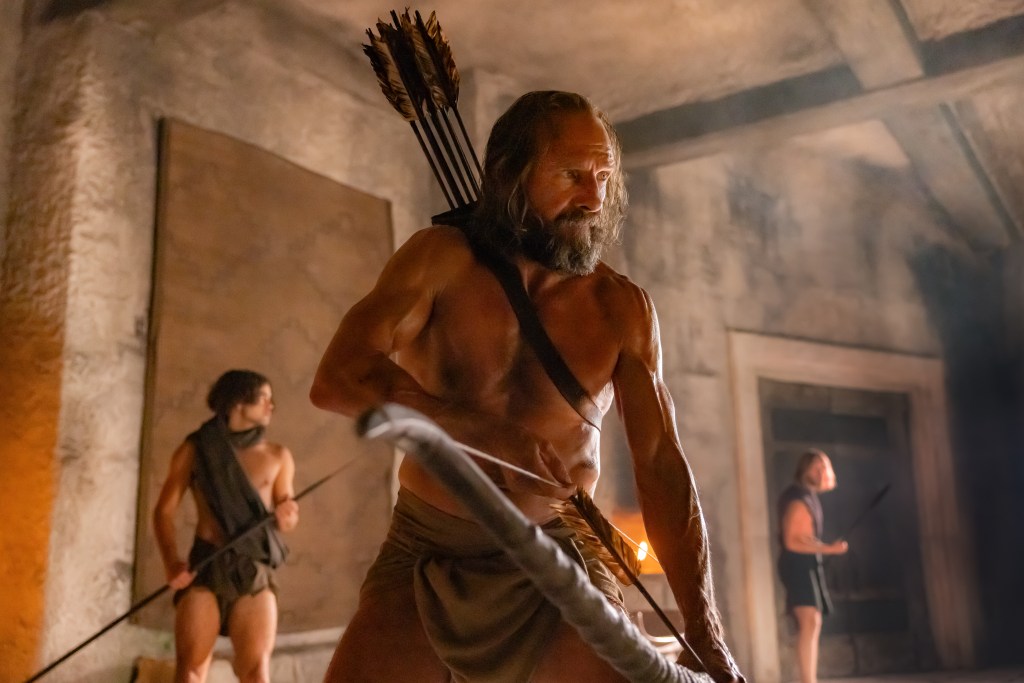
Around this time, the battle-scarred body of a soldier washes up on shore. He’s barely alive, but is nursed back to health by an honest pig farmer named Eumeo (Claudio Santamaria) and his sons. It is of course Odysseus (Ralph Fiennes), but without any uniform or weapon. He’s actually naked. He wraps himself in a blanket and carries a bowl — the clothing of a homeless beggar. And when he approaches the palace, almost no one recognizes him. Only Eurycleia (Ángela Molina), both his and his son Telemachus’s nurse as a child, realizes who

The Return, directed by Uberto Pasolini, with Ralph Fiennes (Odysseus), Juliette Binoche (Penelope), Charlie Plummer (Telemachus), Marwan Kenzari (Antinous), Claudio Santamaria (Eumaeus).

that beggar is. Is he still fit to be king? Can one man, tired and old, confront a bloodthirsty mob of young toughs? And will Penelope ever forgive him for staying away so long?

The Return is a magnificent retelling of a chapter in Homer’s The Odyssey. But it’s not about triumphant heroes; it’s more about the grinding effects war has upon both the victors and the vanquished. It contrasts Odysseus’s shame and self-doubt with Penelope’s eternal fidelity. Yes, this is an ancient greek story, with swords and sandals, but it feels very immediate. Parts of it even resemble a Hollywood action/thriller, with chase scenes and some very bloody fights.

The film was shot among the rocky cliffs of Corfu and the ruins of an ancient castle, which is echoed in the soundtrack. I love the dramatic look and sound of waves crashing on the sharp rocks. Though the women are all wrapped up, most of the male actors are dressed in togas or prancing around half naked, with Ralph Fiennes going full monty at the drop of a hat. I didn’t used to like him much, but after Conclave and now this one, I gotta admit, he’s a really good actor. Juliette Binoche is skillfully understated as Penelope, and Dutch actor Marwan Kenzari is very creepy as Antinous, the threateningly oleaginous suitor closest to Penelope.

The Return is a really good movie.

The Return and All we Imagine as Light is on at the TIFF Lightbox in Toronto; and Standing on the Shoulders of Kitties, A Trailer Park Boys movie featuring Bubbles and his band on tour, is now playing; check your local listings.

This is Daniel Garber at the Movies, each Saturday morning, on CIUT 89.5 FM and on my website culturalmining.com.

Girls. Film reviewed: Ru, Totem, Four Daughters

Posted in 1970s, Canada, Coming of Age, documentary, Family, Feminism, Kids, Mexico, Quebec, Tunisia by CulturalMining.com on January 27, 2024

Hi, this is Daniel Garber at the Movies for culturalmining.com and CIUT 89.5 FM.

There are lots of movies for girls about princesses, fairies and Barbie dolls, but not many about girls as, well, girls. This week I’m looking at three great new movies about girls and young women. There are four sisters in Tunisia, a Vietnamese girl arriving in 1970s Quebec, and a seven-year-old girl in Mexico going to a strange birthday party.

Ru

Dir: Charles-Olivier Michaud

It’s a small town in Quebec in the 1970s. Tinh (Chloé Djandji) is a young girl who has just arrived with her family in Canada. She feels strange, alienated and out of place. A tiny home in small-town Quebec is totally different from the luxurious mansion they lived in in Saigon. It’s also nothing like the leaky ship and the wretched refuge camps she lived through afterwards. (Her family is part of the so-called “boat people” who fled South Vietnam after the fall of Saigon in 1975.) Luckily, her family is befriended by the Girards who are helping them adjust to life in Quebec, introducing them to snow, tapping maple syrup and eating peanut butter on toast. And they have a daughter Tinh’s age she can play with. The problem is, Tinh can’t speak French, just Vietnamese. Her parents can — they were well to do and educated in French when Indochina was still a French colony. But the courses are starting to make sense. And she enjoys hanging out at the only Chinese restaurant in town, run by a Haitian man, and listening to the harrowing stories of other Vietnamese refugees (dramatized on the screen). But will she ever adjust to this new — and very different — life?

Ru is a fictionalized retelling of novelist Kim Thúy’s childhood. It’s a new — and very different – look at the immigration experience from what you usually see. The film only covers her first few months in Quebec but packs a huge amount of story in that small space. It also shows, through flashbacks, her life in Saigon, and the frightening period she spent at sea. It also riffs on life in Quebec, some funny, others sad. A couple of the scenes struck me as jarring. Tinh is haunted by the killing of a bread vendor she witnessed, but in the movie she’s calling out “bread for sale” but carrying flowers, not bread. (Is this a deliberate aesthetic move by the director or just an editing mistake?) And “moving still photos” was a new gimmick in Quebec film about 15 years ago but looks dated now. Otherwise, though, RU is a fascinating, warm and engrossing look back in time.

I quite liked this one.

TOTEM

Wri/Dir: Lila Avilés

It’s present-day Mexico. Sol (Naima Senties) is a seven-year-old girl getting ready for a big party. She puts on a multicoloured fright wig and a clown’s red nose before her mom drops her off at her grandfather’s house. There will be food and drinks, music and performances, cake and presents, and lots of friends and relatives. She quietly takes it all in. Her bratty cousin Esther cuts up money with a pair of scissors. One neurotic aunt burns the cake she’s baking. Her grandpa — a psychiatrist — is busy pruning a Bonsai tree. Sol wanders off to explore nature, making friends with the snails and beetles she meets. But underlying it all is a dark, unspoken thought that makes everyone tense and depressed. This party is for her Dad (Mateo Garcia Elizonda) a young artist. He’s dying of cancer, and can barely get out of bed. Will he make it outside to the party? How will people react? And what will happen afterwards?

Totem is a lovely movie about a happy and sad party as seen through the eyes of a little girl. It paints a vivid picture of an eccentric, middle-class family in Mexico. It’s filled with realistic details — not the kind that are thrown into a film to make it look quirky or twee; it seems like a real-life family here. Visually, it’s intimate and close up, using a hand-held camera in confined, and sometimes obstructed, spaces. The dialogue is ongoing, but the point of view is constantly changing. And in its tribute to Mesoamerican culture, red, yellow and terra-cotta colours, and Aztec animals, swirls and suns fill the screen.

Totem is a wonderfully happy-sad story.

Four Daughters

Dir: Kaouther Ben Hania

Olfa is a single mom in Tunisia with four beautiful daughters: Ghofrane, Rahma, Eya and Tayssir. There here to tell us about their remarkable lives. Olfa grew up without her dad so functioned as the protector of her sisters. She cut her hair short and dressed like a boy to stop gangs of men from invading their home. She later married a good-for-nothing man she only slept with once a year to have another kid. He didn’t stay very long either when he only had daughters. The girls take different paths. Some become rebels. One dresses like a goth. Another has a boyfriend without her mom’s approval. She spanks her daughters when she thinks they’re going overboard. But when Olfa goes to Libya to earn a living — she’s the only one supporting the family — things start to fall apart, and two of the daughters disappear. What happened and what led them to their strange fate?

Four Daughters is a really unusual docu-drama that retells Olfa and her daughters’ real stories, and then acts them out for the screen. The two younger ones play themselves, but the two older ones are played by actresses (Ichraq Matar and Nour Karoui) because Ghofrane and Rahma aren’t there anymore (no spoilers).  And Majd Mastoura plays all the male characters, including Olfa’s lover, a fugitive who escapes from prison during the Tunisian Revolution in 2010. It’s sort of an experimental film that never lets you forget the scenes you’re seeing are true, but not real; they’re recreations. The mother or the sisters themselves are often giving directions to the actresses on camera so they do the scene accurately. But though they are constantly breaking the fourth wall, it still manages to be a shocking and emotional journey through their lives. It deals in depth with family, ostracism, puberty, sex, sexism, feminism, violence, men, religion and pop culture in the Arab world like you’ve never seen it before. 

Four Daughters is a gorgeous and fascinating film about women in Tunisia, before and after the revolution. It’s a thousand times better than any “reality show.”

Ru and Totem both open this weekend, with Four Daughters — which has been nominated for a Best Documentary Oscar — is on at the TIFF Bell Lightbox in Toronto; check your local listings. 

This is Daniel Garber at the Movies, each Saturday morning, on CIUT 89.5 FM and on my website culturalmining.com.

Fighting. Films reviewed: Seagrass, The Hunger Games: The Ballad of Songbirds and Snakes, Testament

Posted in Canada, Family, Politics, Protest, Quebec, Satire, Science Fiction, violence, Y.A. by CulturalMining.com on November 12, 2023

Hi, this is Daniel Garber at the Movies for culturalmining.com and CIUT 89.5 FM.

Fall Film Festival Season keeps on rolling. I had the pleasure of attending the opening-night screening of the ReelAsian film festival. It’s the delightful comedy/drama The Queen Of My Dreams, directed by Fawzia Mirza. It follows a queer Toronto woman in Karachi for a funeral as she recalls her own and her estranged mother’s) history in Pakistan in the 60s and Halifax in the 80s — all while listening and dancing to Bollywood songs. ReelAsian is in its 27th year showing films from across that continent and in the asian diaspora, now through November 19th. And the Shorts not Pants festival opens on November 17th. In case you’re wondering it’s not about cut-offs or basketball shorts — it’s a curated short film festival, which I’ve heard is quite good.

This week, I’m looking at three new movies — one of which is playing at ReelAsian. There’s a fight over a painting in Montreal, a fighting couple on an island near Nanaimo, and a fight to the death in the city of Panem.

Seagrass

Wri/Dir: Meredith Hama-Brown

It’s the summer of 2011. Judith and Steve (Ally Maki, Luke Roberts) are riding a ferry with their kids to a rocky island near Nanaimo, BC. They’re renting a cabin complete with a kitchen, and there’s even a swimming pool with lots of games and hikes planned for all the kids there. It’s a shady forest that leads to a mysterious dark cave on the shore. The couple in the next cabin, Pat and Carol (Chris Pang and Sarah Gadon) —  a white and asian pair like Judith and Steve — swear the last time they spent on the island was a life-changer. The thing is, they’re not there for a vacation. It’s a place where couples can look at their relationship and try to work out their differences through daily group therapy sessions. The kids, Steph and Emmy (Nyha Huang Breitkreuz,  Remy Marthaller) have problems of their own to work out. 10-year-old Steph doesn’t want to babysit her 6-year-old sister — she’d rather mess around with friends at get-togethers. 

The problem is Judith is depressed — she’s been that way since her mom died many months earlier. And now she’s regretting she never talked with her about the internment camps Japanese Canadians were put in during WWII. Or what happened to her dad’s fishing boat. It’s like there’s a ghost or spirit lurking above the family — is it the kids’ late grandmother or just the general bad feelings?  It’s not just that, Judith isn’t sleeping with Steve anymore. And Steve is increasingly jealous and angry that Pat — the husband next-door — seems to be spending too much time with Judith. As the pressure builds it begins to affect the kids too, leading to a potentially frightening conclusion.

Seagrass is a stunning look at secrets revealed at a getaway in British Columbia. It’s also about identity, history and family, especially of Japanese-Canadians. I found it very moving, a bit of a tear-jerker actually. At the same time, it makes you uneasy to watch the story unfold, and the unexpected revelations it leads to. It’s not your typical marriage counselling movie; it’s equally about the kids, and the subtle racism they face. The cast is uniformly great, but especially Ally Maki as a woman on the verge of a nervous breakdown. This movie also does amazing things  both visually and audibly, from pop songs to eerie sound effects.

Great movie.

The Hunger Games: The Ballad of Songbirds and Snakes

Dir: Francis Lawrence

Coriolanus Snow (Tom Blyth) is a young man with a keen intellect. He’s handsome, popular and ambitious. He lives in Panem, the capital city of a post-apocalyptic world. A top student at the Academy, the training grounds for the nation’s top leaders, he’s in line for the Plinth prize. He needs to win it because, although he’s from an aristocratic family, he’s poor. So poor, his cousin Tigris makes his shirt buttons out of bathroom tiles, and school lunches keep him alive. 

But the scholarship is at risk when Dean Highbottom (Peter Dinklage) declares all students must participate in the Hunger Games as a mentor to a tribute, the kids sent to the capital from each outlying district. Lucy Gray (Rachel Zegler) from District 12 is his Tribute — if she wins the Hunger Games, Coriolanus gets the prize money. So he will do anything to keep her alive. She’s a pretty songbird — from a long line of travelling musicians — who dresses in colourful outfits. The two hit it off, and prove a formidable team of underdogs. Will they beat the odds, and survive? And is there relationship more than just a game?

The Hunger Games: The Ballad of Songbirds and Snakes is a gripping action-adventure movie based on the dystopian YA novels. I read avidly the trilogy when it first came out, but was less attached to the related movies — I only watched the first one, maybe because I knew what was going to happen. But this one took me by surprise; it’s a prequel, set half a century before the other books. So I found it exciting, dark and gripping. It is violent — after all, this game is about 24 kids murdering one another in a stadium. But this is set in the early years of the Hunger Games: the capital is battle-scarred and decrepit. Drones sent to the tributes are primitive and dangerous, as likely to kill a player as to send them food or water. These hunger games are darker and grittier. I like the novelistic turns of plot, and the truly evil characters, especially Dr. Volumnia Gaul wonderfully played by Viola Davis as a mad scientist who creates terrifying animals — the snakes and birds of the title — to stymie the districts and their tributes. Zegler is good as Lucy, singing as much as she talks, and Blyth is great as the conflicted Corio. The explosions and pyrotechnics look fantastic on a big screen, so if you’re into this kind of  movie, see it now, not on some future TV streamer.  

Testament

Wri/Dir: Denys Arcand

Jean-Michel Bouchard (Rémy Girard) is a retired writer and archivist in Montreal. He still has an office but lives in a venerable, public retirement home. Never married, no kids, but he still has many friends to spend time with.  Suzanne Francoeur (Sophie Lorain) is the directrice of the building, and keeps her eagle eye on anything that could disrupt her tightly-run edifice. But when a group of college protesters set up camp across the street chanting Free First Nations! she isn’t sure how to handle it. The anglophone demonstrators say the building is full of racist art.

The issue at hand? A 19th century fresco on a wall in the music room depicting Champlain’s first meeting with the Iroquois. The protesters say the French are settler-colonists in fancy dress while indigenous men are depicted as primitive barbarians, while the women are topless. Meanwhile, Jean- Michel’s close friend Roger, a fitness and health food nut, suddenly drops dead right in front of him. Jean- Michel receives a literary prize, but is mistaken for someone else with a similar name. And Suzanne seems to be standing just outside his door whenever a young woman visits him in his bedroom — why is she there? As the tension from the protesters grows, media, Quebec nationalists, bureaucrats and politicians all descend on the home. Can Jean-Michel stop the madness? Or is this the beginning of the end? And what will happen to the mural?

Testament is a political and social satire about Quebec’s aging boomers, as their rule ends. Denys Arcand has been covering this cohort for four decades, in films like The Decline of the American Empire, The Barbarian Invasions, and The Fall of the American Empire. This one shares similar themes and some of the same actors as well. The characters are stereotypical and amusing — anglo protesters are buffoons, seniors are clueless busybodies, feminists snarl, while politicians tell baldfaced lies — but he pokes at the politics from all sides. It has a huge cast, including Robert Lepage (who had his own controversy involving indigenous issues) as an effete arts/politics leader in an hilarious parody of himself. There’s also a romantic subplot — no spoilers — and, surprisingly, some very moving moments.

If you want to understand Quebec cultural politics — with a lot of laughs — you must watch Denys Arcand’s Testament. 

Seagrass is playing at the TIFF Bell Lightbox, one of many great films at the ReelAsian Film Festival. Testament and Hunger Games both open this weekend in Toronto; check your local listings. 

This is Daniel Garber at the Movies, each Saturday morning, on CIUT 89.5 FM and on my website, culturalmining.com.

Directed by Women. Films reviewed: The Blue Caftan, Priscilla, Rodéo

Posted in 1960s, Biopic, Canada, Drama, drugs, Family, LGBT, Morocco, Quebec, Road Movie, Romance by CulturalMining.com on November 4, 2023

Hi, this is Daniel Garber at the Movies for culturalmining.com and CIUT 89.5 FM.

Fall Film Festival Season in Toronto continues in November with Cinéfranco presenting its 26th year of Canadian and International Francophone cinema. This means not just great movies from France, Belgium and Switzerland, but also a Spotlight on the African Diaspora, with films from Congo, Senegal, Tunisia, Algeria and Morocco as well as four new Québec features curated by La Tournée Québec Cinéma.

This week, I’m looking at three new movies directed by women — two of which are playing at Cinéfranco. There’s a craftsman in Morocco with eyes on his apprentice; a trucker in Québec on a road trip with his daughter, and the wife of a certain rock’n’roll singer in a mansion called Graceland. 

The Blue Caftan

Co-Wri/Dir: Maryam Touzani 

Salé, Morocco.

Haliim and Mina (Saleh Bakri, Lubna Azabal) are a childless couple with a small tailor’s shop in the town’s marketplace. Mina is petite with angular features, her black hair pulled back. She runs the front of the store, balancing the books. Halim works at the back. He is tall with blue eyes and a moustache. He’s a maalem, a trained craftsman who sews and embroiders in the traditional way.  No sewing machines here; he does everything by hand. But customers complain he’s taking too long. They want modern, chic clothes not old fashioned caftans. To speed up the process, Mina hires a new apprentice, but with low expectations. They cheat, they steal and they quit after just a few months of training. But Yousef (Ayoub Missioui) is a quiet and gentle soul who really wants to learn. Money is not his goal, he says — he has supported himself since he was eight. But as they all work together on an exquisite blue caftan embroidered with gold thread, Mina notices an unusual dynamic: Halim seems taken by the young  apprentice, who is always close to her husband. And the couple is facing another crisis that could totally change their. Can they solve these problems together?

The Blue Caftan is a beautiful and touching story about an unexpected menage a trois in Morocco. It’s languid and subtle, with a sensual, though not explicit, undertone.  The camera focuses on Halim’s fingers touching Yousef’s hand as he guides him in sewing a thread… or the bare feet of two men revealed behind a door at the local hammam — or bathhouse — looking for some furtive sex. Belgian actress Lubna Azabal gives a powerful as Mina, while Saleh Bakri will move you to tears. I’ve never seen Ayoub Missioui before but he also gives a great performance within the triangle. 

The Blue Caftan captures not just the look of small-town Morocco, but also the the constant sounds of the souk: the voices, music and calls to prayer always drifting through the windows along with the smell of ocean air. 

A beautiful movie. 

Priscilla

Co-Wri/Dir: Sofia Coppola

It’s the late 1950s. Priscilla Beaulieu (Cailee Spaeny) is a 14-year-old American girl on a military base near Bad Nauheim, West Germany. She’s an army brat, living a typical  American life but overseas.  She misses her friends back home and feels stifled on the base. Enter Elvis Presley (Jacob Elordi) the 24-year-old superstar. He’s drafted into the army but manages to live a life of luxury and stardom while serving his time.  But when his pimp — I mean superior officer — asks Priscilla if she’d like to meet Elvis, everything changes. It sets in motion a years-long courtship and their eventual marriage many years later.  And a strange courtship it is. They share a bed, but sex is forbidden. Elvis is always on pharmaceuticals, but when he slips her a sedative, she wakes up two days later with no recollection of what happened.  He chooses what dresses she can wear, what colour to dye her hair — she’s almost like his own personal Barbie doll. And he is always somewhere far away, shooting a movie in Hollywood with Ann-Margaret or recording a record with The Boys, his entourage of old friends and musicians who never leave his side. Is Elvis is cheating on her? Will they ever consummate their relationship? Or will she remain an icon of virtue and purity in his eyes, but with no life of her own?

Priscilla is a biopic about the life of Elvis’s girlfriend and wife from the late 50s to the early 70s. And in the world of celebrity biopics, this a strange one, where the main character functions mainly as a side kick or an afterthought to the much more famous singer. It feels like all the fun stuff is happening off screen, and we’re left with Priscilla waiting for Elvis to come home. We constantly hear about his manager the Colonel but he rarely appears (no Tom Hanks in this version, thank God). As in most of Sofia Coppola’s films, there’s an air of detachment and ennui that only a third-generation Hollywood icon could feel. And though skilfully made, Priscilla left me feeling like I missed the real movie and had to watch this substitute instead. 

Rodéo (Eng. title: Stampede)

Wri/Dir: Joëlle Desjardins Paquette

Serge Jr (Maxime Le Flaguais) is a trucker in Eastern Quebec. He is macho, with long hair and a beard and quick to fight, especially after too much to much to drink.  Maybe that’s why his wife Jessica divorced him.  He likes death metal music, and his prized green semi. He has the truck jacked up with flashing lights and horns, the perfect thing for drag racing. But most of all, he loves his daughter Lily (Lilou Roy-Lanouette). She’s cute, blonde and sharp as a tack. Only ten, but she can already scare grownups with her foul mouth, loud yells and lethal karate moves. But when Serge keeps Lily overnight at a truck rally, against custody rules, Jessica cuts off all ties. She won’t let Lily see her dad anymore.  Until he shows up one day at her karate dojo, ready to roll. They’re heading out on a cross country drive, just the two of them — with Jessica’s permission, he says — to participate in the biggest truck drag race in the country — the Calgary Stampede! So she climbs into his truck and they take off, due west. But is there more to this trip than meets the eye?

Rodéo is a working-class, father-daughter road movie about meeting strange people, getting into trouble, and discovering the much- hated Canada — outside of Quebec — for the very first time. It’s also a bit of a thriller, as the two reveal their secrets and lies even as a larger world closes in on them. The camerawork and art direction is stunning, with flashing coloured lights and clouds of mist, steam and smoke mysteriously following the two of them on their journey. And the acting — and accents — are first rate. 

I like this movie.

Priscilla just opened at the TIFF Bell Lightbox, with the Blue Caftan and Rodéo/Stampede both playing at Cinéfranco at the Carlton Cinema in Toronto.

This is Daniel Garber at the Movies, each Saturday morning, on CIUT 89.5 FM and on my website, culturalmining.com.