Trapped. Films reviewed: Captives, Here, Emilia Pèrez

Posted in 1800s, 1950s, 1960s, 1970s, AI, Crime, Family, France, Mental Illness, Mexico, Musical, Tom Hanks, Trans, Women by CulturalMining.com on November 1, 2024

Hi, this is Daniel Garber at the Movies for culturalmining.com and CIUT 89.5 FM.

Toronto Fall Film Festival Season continues with Cinefranco showing  contemporary French language movies from around the world at the Carlton Cinema. But this week, I’m looking at three new movies about traps. There’s a big-hearted woman trapped in a male drug-lord’s body, a French woman trapped in a mental hospital, and a movie camera trapped… in somebody’s living room!

Captives

Co-Wri/Dir: Arnaud des Pallières

It’s Paris in the late 19th century. Fanni Devander (Mélanie Thierry) is an elegant and educated woman searching for her mother. She disappeared when Fanni was just a child, but she has reasons to believe she is locked away somewhere in the city’s mental hospital. So Fanni voluntarily checks herself in to try to find her. Pitié-Salpêtrière is a home for the destitute, people with mental illness, learning disabilities or epilepsy, convicted criminals and even some foundling children. The one common factor is they’re all “undesirables” and all women. But once inside she realizes you can check in, but you can’t check out. It’s a de facto prison, presided over by the Matronly Bobette (Josiane Balasko),  and a hench-woman who would make Nurse Ratchet look like Florence Nightingale. Bobette’s one obsession is to perfectly execute their upcoming ball featuring her patients singing and dancing before a crowd of wealthy patrons. 

Fanni quickly learns the ropes and makes allies with Hersilie, a music teacher (Carole Bouquet)  and a lesbian school teacher with an eating disorder. And she finally meets a nearsighted older woman named Camomile (Yolande Moreau) who just might be her real mother. Can Fanni perform at the ball and safely escape with her supposed mother? Or will they all be stuck there forever? 

Captives is a fascinating historical thriller about the treatment of women in state institutions. It’s harrowing in parts — including scenes of torture — as Fanni navigates class and hierarchy within this enclosed universe. I purposely only mentioned some of the characters and plot turns, because the surprise is what makes it worth watching. But rest assured, it’s full of great acting, pathos, and beautiful period costumes — even within that terrible place.

I like this one.

Here

Dir: Robert Zemeckis (Reviews: Flight, Allied)

Ricky (Tom Hanks) is a teenaged baby boomer living the American dream. His Dad and Mom (Paul Bettany and Kelly Reilly) have lived in a house across the street from Ben Franklin’s historical home since they bought it on the GI Bill after WWII. Now Ricky and his kid brother and sister happily share the place, congregating in the living room for holidays, dinners, or just to watch TV. Ricky wants to be an artist, while his girlfriend Margaret (Robin Wright) dreams of going to law school. Unfortunately, when she gets pregnant while they’re both still in high school, they marry and settle down, still within Ricky (now called Richard’s) parents’ home. Life goes on, and the decades pass, and people are born, live and die. But will they always stay “here” in the same house?

Here is a movie about a place, specifically a living room facing the picture window and the street beyond. The camera never movies. It follows this location not just for Ricky’s family, but also the dinosaurs, the ice age, indigenous people, Ben Franklin, and various couples across the 20th century, constantly jumping back and forth in time. The one constant is the frame, the fourth wall, which never shifts. Picture this: a pop-up square will appear with different furniture and wallpaper in it, taking you to another era, in the style of a virtual staging of a house for sale on a real estate website. Indeed we get to meet real estate agents throughout the twentieth century. Which makes sense because its really about the place, not the meat puppets who wander around in it.

Does this new, experimental concept work?  No!  It’s indescribably awful.

I cannot convey the aesthetic revulsion I felt viewing this horrible non-movie movie. It features a de-aged, 68-year-old Tom Hanks playing himself as a teenager with a fake young teenage face plastered on, but who still talks and walks like the old man he is. What were they thinking?! Here is a tired, platitudinous high-concept exercise in futility disguised as an innovative film. All the characters are painful cliches, including a token black family whose sole purpose seems to be to recite a version of Ta-Nehisi Coates Letter to My Son… to their son.

Keep in mind, Zemeckis is known both for classics like Back to the Future but also unforgivable, semi-animated dreck like Polar Express and Forrest Gump. Here falls neatly into the dreck pile.

Emilia Pérez

Co-Wri/Dir: Jacques Audiard 

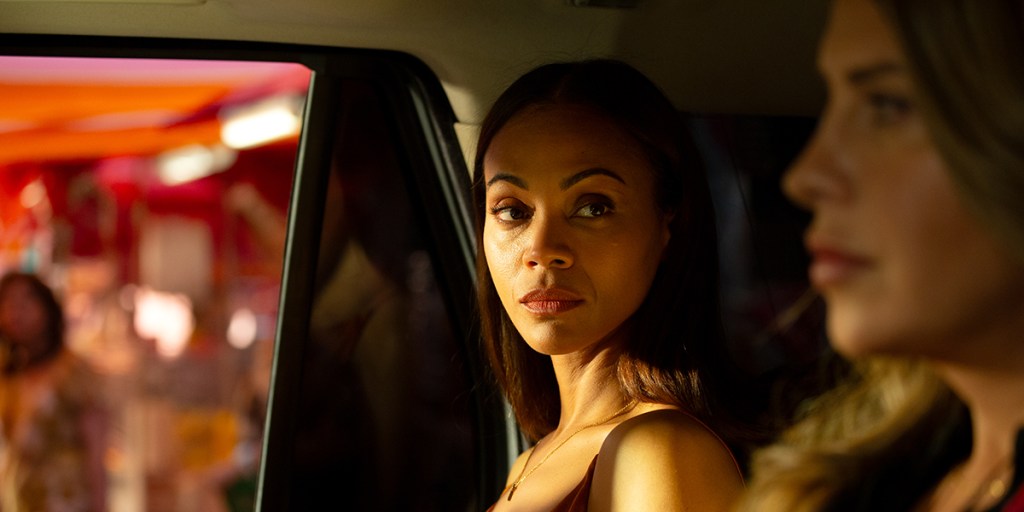
Rita (Zoe Saldaña) is an ambitious young defence lawyer in Mexico City. She spends hours crafting powerful opening statements for trials, but, as a black woman —  originally from the Dominican Republic — she gets none of the credit. But somebody is watching her and appreciates her skill. She finds out who, when she’s kidnapped with a black hood over her head and driven into the middle of the desert. There she meets the notorious head of a huge drug cartel, personally responsible for countless killings. Juan “Manitas” Del Monte, the cartel chief, needs her to help him disappear, in a way no one — including his wife Jessi (Selena Gomez) — will ever find him again.

The twist? This murderous, pock-marked, bearded monster… is trans, and wants to shed the awful male body and face, to live the rest of her life as an attractive woman. She needs someone she can trust to handle all this, both the finances and the surgery, leaving no paper trail. In exchange, Rita will have all the money she needs for the rest of her life, and her own private firm.

Years later, she meets with a potential client, a fabulously rich European woman named Emilia Pèrez (Karla Sofía Gascón). It’s her client from years back, who wants to re-enter the world and be reunited with her beloved family, all of whom think she is dead. And to atone for some of her past sins without revealing who she was. What will happen to these three remarkable women in the next chapter of their lives?

Emilia Pérez is an incredibly passionate and shocking movie. It’s simultaneously an action-thriller, an epic drama, and a musical. Yes, that’s right, a musical, where  characters do break into songs and dances throughout the film. But with its latin beats and shouting crowds, it’s the sort of songs you rarely encounter in a musical.  Zoe Saldaña is amazing as this tough-as-nails lawyer, and Karla Sofía Gascón, a Spanish actress I’ve never seen before, is unmatchable, both as Perez, and as the drug lord Manitas. (She’s a  transwoman herself.) French director Audiard (who previously brought us masterpieces like A Prophet, and Rust and Bone) seems to have no trouble creating a Mexican musical. I gotta say, Netflix churns out a load of content, most of which is forgettable crap, but, every year, they also produce a few really remarkable films. Emilia Pèrez is one of those.

I strongly recommend this movie.

Here and Amelia Perez both open this weekend in Toronto; check your local listings. And Captives is having its English Canada premiere at 8:45 tonight (Saturday, Nov 2, 2024) at Cinefranco at the Carlton.

This is Daniel Garber at the Movies, each Saturday morning, on CIUT 89.5 FM and on my website culturalmining.com.

Directed by Women. Films reviewed: The Blue Caftan, Priscilla, Rodéo

Posted in 1960s, Biopic, Canada, Drama, drugs, Family, LGBT, Morocco, Quebec, Road Movie, Romance by CulturalMining.com on November 4, 2023

Hi, this is Daniel Garber at the Movies for culturalmining.com and CIUT 89.5 FM.

Fall Film Festival Season in Toronto continues in November with Cinéfranco presenting its 26th year of Canadian and International Francophone cinema. This means not just great movies from France, Belgium and Switzerland, but also a Spotlight on the African Diaspora, with films from Congo, Senegal, Tunisia, Algeria and Morocco as well as four new Québec features curated by La Tournée Québec Cinéma.

This week, I’m looking at three new movies directed by women — two of which are playing at Cinéfranco. There’s a craftsman in Morocco with eyes on his apprentice; a trucker in Québec on a road trip with his daughter, and the wife of a certain rock’n’roll singer in a mansion called Graceland. 

The Blue Caftan

Co-Wri/Dir: Maryam Touzani 

Salé, Morocco.

Haliim and Mina (Saleh Bakri, Lubna Azabal) are a childless couple with a small tailor’s shop in the town’s marketplace. Mina is petite with angular features, her black hair pulled back. She runs the front of the store, balancing the books. Halim works at the back. He is tall with blue eyes and a moustache. He’s a maalem, a trained craftsman who sews and embroiders in the traditional way.  No sewing machines here; he does everything by hand. But customers complain he’s taking too long. They want modern, chic clothes not old fashioned caftans. To speed up the process, Mina hires a new apprentice, but with low expectations. They cheat, they steal and they quit after just a few months of training. But Yousef (Ayoub Missioui) is a quiet and gentle soul who really wants to learn. Money is not his goal, he says — he has supported himself since he was eight. But as they all work together on an exquisite blue caftan embroidered with gold thread, Mina notices an unusual dynamic: Halim seems taken by the young  apprentice, who is always close to her husband. And the couple is facing another crisis that could totally change their. Can they solve these problems together?

The Blue Caftan is a beautiful and touching story about an unexpected menage a trois in Morocco. It’s languid and subtle, with a sensual, though not explicit, undertone.  The camera focuses on Halim’s fingers touching Yousef’s hand as he guides him in sewing a thread… or the bare feet of two men revealed behind a door at the local hammam — or bathhouse — looking for some furtive sex. Belgian actress Lubna Azabal gives a powerful as Mina, while Saleh Bakri will move you to tears. I’ve never seen Ayoub Missioui before but he also gives a great performance within the triangle. 

The Blue Caftan captures not just the look of small-town Morocco, but also the the constant sounds of the souk: the voices, music and calls to prayer always drifting through the windows along with the smell of ocean air. 

A beautiful movie. 

Priscilla

Co-Wri/Dir: Sofia Coppola

It’s the late 1950s. Priscilla Beaulieu (Cailee Spaeny) is a 14-year-old American girl on a military base near Bad Nauheim, West Germany. She’s an army brat, living a typical  American life but overseas.  She misses her friends back home and feels stifled on the base. Enter Elvis Presley (Jacob Elordi) the 24-year-old superstar. He’s drafted into the army but manages to live a life of luxury and stardom while serving his time.  But when his pimp — I mean superior officer — asks Priscilla if she’d like to meet Elvis, everything changes. It sets in motion a years-long courtship and their eventual marriage many years later.  And a strange courtship it is. They share a bed, but sex is forbidden. Elvis is always on pharmaceuticals, but when he slips her a sedative, she wakes up two days later with no recollection of what happened.  He chooses what dresses she can wear, what colour to dye her hair — she’s almost like his own personal Barbie doll. And he is always somewhere far away, shooting a movie in Hollywood with Ann-Margaret or recording a record with The Boys, his entourage of old friends and musicians who never leave his side. Is Elvis is cheating on her? Will they ever consummate their relationship? Or will she remain an icon of virtue and purity in his eyes, but with no life of her own?

Priscilla is a biopic about the life of Elvis’s girlfriend and wife from the late 50s to the early 70s. And in the world of celebrity biopics, this a strange one, where the main character functions mainly as a side kick or an afterthought to the much more famous singer. It feels like all the fun stuff is happening off screen, and we’re left with Priscilla waiting for Elvis to come home. We constantly hear about his manager the Colonel but he rarely appears (no Tom Hanks in this version, thank God). As in most of Sofia Coppola’s films, there’s an air of detachment and ennui that only a third-generation Hollywood icon could feel. And though skilfully made, Priscilla left me feeling like I missed the real movie and had to watch this substitute instead. 

Rodéo (Eng. title: Stampede)

Wri/Dir: Joëlle Desjardins Paquette

Serge Jr (Maxime Le Flaguais) is a trucker in Eastern Quebec. He is macho, with long hair and a beard and quick to fight, especially after too much to much to drink.  Maybe that’s why his wife Jessica divorced him.  He likes death metal music, and his prized green semi. He has the truck jacked up with flashing lights and horns, the perfect thing for drag racing. But most of all, he loves his daughter Lily (Lilou Roy-Lanouette). She’s cute, blonde and sharp as a tack. Only ten, but she can already scare grownups with her foul mouth, loud yells and lethal karate moves. But when Serge keeps Lily overnight at a truck rally, against custody rules, Jessica cuts off all ties. She won’t let Lily see her dad anymore.  Until he shows up one day at her karate dojo, ready to roll. They’re heading out on a cross country drive, just the two of them — with Jessica’s permission, he says — to participate in the biggest truck drag race in the country — the Calgary Stampede! So she climbs into his truck and they take off, due west. But is there more to this trip than meets the eye?

Rodéo is a working-class, father-daughter road movie about meeting strange people, getting into trouble, and discovering the much- hated Canada — outside of Quebec — for the very first time. It’s also a bit of a thriller, as the two reveal their secrets and lies even as a larger world closes in on them. The camerawork and art direction is stunning, with flashing coloured lights and clouds of mist, steam and smoke mysteriously following the two of them on their journey. And the acting — and accents — are first rate. 

I like this movie.

Priscilla just opened at the TIFF Bell Lightbox, with the Blue Caftan and Rodéo/Stampede both playing at Cinéfranco at the Carlton Cinema in Toronto.

This is Daniel Garber at the Movies, each Saturday morning, on CIUT 89.5 FM and on my website, culturalmining.com.

Humans and machines. Films reviewed: L’homme Parfait, Pinocchio

Posted in 1930s, Animation, comedy, Fairytales, Family, Fantasy, France, Italy, Robots, Science Fiction by CulturalMining.com on November 11, 2022

Hi, this is Daniel Garber at the Movies for culturalmining.com and CIUT 89.5 FM.

In these troubled times, many feel daunted by quickly-changing technology, and wait with trepidation the eventual coming of the Singularity: the day robots and artificial intelligence become smarter than humans. What will happen to us after the Singularity?

This week I’m looking at two new movies about the increasingly thin line separating people from machines. There’s a woodcutter in Italy who creates a puppet that acts like a boy; and a woman in France who buys a robot that acts like a man. 

L’homme parfait

Co-wri/Dir: Xavier Durringer

It’s the near future, somewhere in France.

Franck and Florence (Didier Bourdon, Valérie Karsenti) are a happily unmarried middle-aged couple with two kids, Max and Victoire. Florence has an office job, while Franck works from home. He’s an actor who is writing that blockbuster screenplay which will turn his career around. But it’s been three years now with no sign of progress, and his agent isn’t exactly banging on his door with acting jobs. And even though Franck is at home all day, it’s Florence who ends up cooking, cleaning and taking care of the kids. But enough is enough. She puts in an order and two days later a large box arrives at their door. Meet Bobby (Pierre-François Martin-Laval): a realistic-looking male robot: strong, smart and friendly. He has artificially blue eyes and speaks in a monotone. With a variety of built-in options, from Salsa dancing to Krav Maga, soon Bobby is whipping up boeuf bourgognon, ironing their sheets and telling bedtime stories to the kids. And his artificial intelligence means, like Siri, he listens to — and remembers —  everything he hears. 

But there are side effects.  Florence may love all the free time she has now, but Franck feels stripped of all his fatherly duties. Bobby is better at bowling. Bobby can fix a broken car engine in a flash. Bobby can select the best wine, say the right thing, buy the right gift. Franck feels increasingly left out. And when he accidentally sees Bobby’s “standard equipment” he feels second-rate and useless. Meanwhile, Florence feels sexually neglected and doesn’t understand why. Is Bobby ruining their marriage? Will Florence ever activate Bobby’s forbidden love-love button? Or can Franck reactivate their relationship?

L’homme parfait is a French comedy about robots, technology and middle-age crises. It’s also a clear knock-off of last year’s German hit I’m Your Man (they actually give it a nod by saying Bobby is manufactured in Germany). It’s conventional, predictable, and anything but subversive, in the style of those cheap-ass Hollywood comedies in the ‘80s and ‘90s.  That said, it did make me laugh more than once. What can I say — no one will call L’homme parfait a great movie, but it is a funny, low-brow sex-comedy in an emerging sub-genre: humanoid robots. 

Pinocchio

Dir: Guillermo del Toro and Mark Gustafson

Geppetto is a wood carver who lives with his beloved son Carlo in a small village in Tuscany. He carves everything in town from wooden clogs for Carlo, to Christ on the Cross in their local church. But when a WWI bomb drops on the village killing his son, Geppetto becomes a reclusive alcoholic, spending all his time crying by Carlo’s grave. Two decades later, in drunken rage, he chops down a knotty pine tree that grew from a pinecone Carlo found on his last day alive, and roughly carves a new boy — with wobbly knees and elbows, rough-hewn hair and a long piece of wood for a nose —  all modelled on his son. He calls him little pine, or Pinocchio. What he doesn’t realize is a blue cricket  (the story’s narrator) lives inside a hole in the wood the boy is made of.

After Geppetto passes out, a magical wood sprite, out of sympathy for the old man, brings Pinocchio to life. She gives the cricket responsibility of taking care of the kid and teaching him right from wrong. The new-born boy is clumsy and dangerous, a tabula rasa taking in all around him. He exalts in learning and gleefully smashes everything he sees. Soon the discovers Pinocchio with different reactions. Some call him an abomination, the work of the Devil. Podesta, a member of Mussolini’s Fascist Party, thinks Pinocchio can be the ultimate weapon, a soldier who cannot die. And a sleazy carnival barker named Count Volpe, and his sinister sidekick, a monkey named Spazzatura, see him as a money-maker, a living puppet he can exploit at his circus.  Being pulled in all directions, can Pinocchio ever find his way back to his father and creator Gepetto?

Pinocchio is a dark retelling of the 19th century Italian classic. It’s masterfully-made using stop-motion animation of dolls and puppets, in the style of Rudolph the Red-Nosed Reindeer or A Nightmare Before Christmas. Gone are the cutesy Disney costumes and hats; this Pinocchio is bare-bones wood all the way, with clothing hacked onto his body. The naughty boy is made of knotty pine. It’s partly a musical, with characters spontaneously breaking into song (some good, some not), especially at the circus. But it’s also, like all of del Toro’s movies, dark, sad and scary. It deals with theft, alcoholism and death. And by transplanting the story into fascist wartime Italy (similar to Spain in Pan’s Labyrinth), he makes it even darker. 

In addition to Gregory Mann, David Bradley and Ewen McGregor — as, Pinocchio, Geppetto and the cricket — other voices include Tilda Swinton, Kate Blanchett, Rob Perlman, and Finn Wolfhard as Candlewick, Pinocchio’s frenemy. But it’s the characters themselves, animated on the screen, that really make this movie. If I saw this as a little kid, I guarantee, Pinocchio would have given me nightmares. But as a grown-up, I found it a sad and very moving story, beautifully made. 

Pinocchio is now playing at the TIFF Bell Lightbox, and L’homme parfait is one of many films screening at Cinefranco till Tuesday and then digitally till the end of the month. 

This is Daniel Garber at the Movies, each Saturday morning, on CIUT 89.5 FM and on my website, culturalmining.com.

Daniel Garber talks with documentary filmmaker Joanne Belluco about Stuck, premiering at Cinefranco

Posted in Art, Canada, Covid-19, documentary, Language, Music, Theatre by CulturalMining.com on October 23, 2021

Hi, this is Daniel Garber at the Movies for culturalmining.com and CIUT 89.5 FM.

What do these people have in common?

A writer and storyteller in Toronto; a dancer in France; a stand-up comic in New Brunswick; a theatre director in Sudbury; a cinematographer in Winnipeg; an electronic musician in Northern Ontario; and a brother/sister musical duo in Montreal? 

They’re all francophone Canadians who work in the performing arts. And during the pandemic they all find themselves stuck! Stuck à la maison, stuck at home.

Stuck is also the name of a  new documentary feature  that looks at the effect of the coronavirus — and the restrictions it brought — on these people’s lives and careers.

Stuck was directed by Joanne Belluco, a French-born, Toronto-based documentary filmmaker, producer, writer and journalist.

I spoke with Joanne in Toronto via ZOOM.

Stuck is having its world premiere at Toronto’s Hot Docs Cinema on November 1, at 7:30 pm at Toronto’s CineFranco film festival.

More festival films. Ammonite, Labyrinth of Cinema, La Belle Époque

Posted in Dinosaurs, France, Japan, Lesbian, Meta, Movies, Romance, Science, Time Travel, UK by CulturalMining.com on November 13, 2020

https://culturalmining.com/wp-content/uploads/2020/11/garber-november-13-20-review-1.mp3Hi, this is Daniel Garber at the Movies for culturalmining.com and CIUT 89.5 FM.

Toronto is a Red Zone and movie theatres are closed, but the fall film festival season continues with ReelAsian, featuring films from East, Southeast and South Asia and the diaspora; and Cinefranco showing new, French-language films from Europe, Africa, and Quebec.

This week I’m looking at three new festival movies. There are three young Japanese guys sent back in time; an English woman who digs up dinosaur bones; and a grumpy French artist who wants to go back in time… so people will stop treating him like a dinosaur.

Ammonite

Wri/Dir: Francis Lee

It’s the 1840s in Lyme Regis, a small town in Dorset, England. Mary Anning (Kate Winslet) lives with her mother Molly in a small house attached to a tourist shop. She sells seashells by the seashore. Fossils, to be exact, the remains of ancient dinosaurs. Her archaeological findings are on display in the British Museum, but, as a woman, she gets no credit for her discoveries and is blocked from joining the male scientists. But she continues her dogged work each day on the cliffs and pebbled beach. Which is why she is uninterested when Murchison, a rich London dilettante, knocks on her door, unannounced. Mary is gruff and headstrong and has no time for fools. But he persists. He loves her work and wants her to mentor him. And he’ll pay her well for her time. He’s accompanied by his young wife Charlotte (Saoirise Ronan) who suffers from melancholia. But when he takes off for the continent, Mary is stuck taking care of the depressed woman. She’s uninterested in frail, pale Charlotte until she takes ill and almost dies. She nurses her back to health, and the two women discover an unknown connection. Is it love, lust or just a passing fantasy? And what will happen when Murchison comes back?

Ammonite is a beautiful historical drama, a romance based on real-life characters. Kate Winslet and Saorise Ronan play the passionate pair, in a relationship riddled with jealousy, class-differences and misunderstandings… but also friendship as they explore new grounds, both emotionally and sexually. With really great performances set against a stark, cold world of water, pebbles and bones, Ammonite is an exquisite love story.

Labyrinth of Cinema

Wri/Dir: Nobuhiko Obayashi

A movie theatre near Hiroshima, Japan is closing down after many years, so everyone in town shows up. There’s Noriko – an innocent young girl in a sailor suit (Rei Yoshida) who says she learns about history by going to movies; Mario, a nerdy film buff (Takuro Atsuki); Hōsuke – a war movie fanatic with little round glasses (Takahito Hosoyamada); and Shigeru – a flashy-dressed, son of a buddhist monk (Yoshihiko Hosoda) who moonlights as a debt collector for the Yakuza. But as the movie starts, they step into the actual film and find themselves transported to the past. They’re in the Tokugawa era, the days of the samurai, feudal Japan ridden with uprisings and civil war. Later they’re soldiers in the Japanese Imperial army, invading China. And they end up trapped in Hiroshima on the day of the atom bomb. And at each stage of history, despite their efforts, they witness young Noriko in danger – whether as a Chinese spy, a sex slave, or a starving Japanese girl. Can they protect innocent Noriko without being killed themselves? Or will they fall into the trap of senseless, nationalistic war?

Labyrinth of Cinema is a highly-stylized retelling of modern Japanese history through movies. It starts out at a confusing, frantic pace, jumping from scene to scene recreating silent films with comical overacting. Later it slows a bit as the scenes get darker and more troubling. Over the course of this three hour epic, it uncovers aspects of Japanese history – war atrocities, women-led armies, the Kenpeitai, the slaughter of Okinawans – shown in the manner of films in each era: jerky movements in the 19th century; melodramatic scenes in the 30s and 40s.  It’s narrated by the poems of Nakahara Chuya, and the screen is kept busy with superimposed, sidebar quotes. The various characters are played by the same group of actors alternating roles in a theatrical style. This is director Obayashi’s last film – he died of cancer after completing it this summer – who was known both for his TV commercials and his horror movies. Labyrinth of Cinema is a long, devastating survey of history and war. If you want to really understand Japan, you should watch this experimental film.

La Belle Époque

Wri/Dir: Nicolas Bedos

Victor (Daniel Auteuil) was once a successful cartoonist known for his graphic novels and editorial cartoons. But when his newspaper goes digital he loses his job, and no one reads his comics anymore. Now in his sixties he’s unemployed, bitter and depressed, a dinosaur who can’t keep up with the times. He’s been married to Marianne – a beautiful Freudian psychoanalyst (Fanny Ardant) – for decades, but the spark is gone. She can’t stand his constant complaining anymore. So one night she kicks him out with just his clothes, a portfolio of drawings, and a small paper card he received at a dinner party.

It’s an exclusive invitation issued by Time Travellers, a high-priced service that lets you revisit the past. In their vast studio, they recreate clients’ own memories, using actors and scripts, accurate down to the smallest detail.  Victor goes back to that day in the 70s when he first met his wife in a bar called La Belle Époque. The Time Travellers CEO Antoine (Guillaume Canet) is an arrogant perfectionist, a tyrant who treats his actors like trash. He views each scene with hidden cameras and, using tiny mics, shouts directions into his actor ears. He hires his tempestuous on-again, off-again girlfriend Margot (Doria Tillier) to play Marianne, because he wants this recreation to be flawless – he feels he owes Victor a personal debt. But she’s too good, and Victor thinks he’s falling in love again… and not with his wife. Can the marriage be saved? Or will this hi-tech re-creation lead to disaster?

La Belle Époque is a satirical French comedy about romance, nostalgia, and second chances. It deals with French stereotypes: the men are either insensitive boors or intellectual bores, the women moody harridans. His re-created memories are funny and surprising but still just a simulacrum.  But as the story develops, you begin to care about the characters, and join in with their laughs, tears and surprises. La Belle Époque uses a fascinating concept to make a very entertaining movie

La Belle Époque will play at Cinefranco film festival which starts next Friday;  Labyrinth of Cinema is showing at  ReelAsian film festival from November 12th through 19th; and Ammonite which premiered at TIFF, opens theatrically today across Canada (check your local listings), and digitally on December 4th.

This is Daniel Garber at the Movies each Friday morning on CIUT 89.5 FM and on my website culturalmining.com.


Birth, Death, Birth. Films reviewed: Dead Dicks, In Safe Hands, The Report

Posted in Adoption, Bipolar, Canada, Family, France, Horror, Politics, Suspense, Suspicion, Terrorism, Torture, US by CulturalMining.com on November 15, 2019

Hi, this is Daniel Garber at the Movies for culturalmining.com and CIUT 89.5 FM.

Fall festival season continues in Toronto, with ReelAsian ending tonight and the EU Film Fest still going strong. Coming soon are Blood in the Snow (aka BITS), featuring Canadian Horror and Genre movies, and CineFranco with French language movies, from Canada and around the world.

This week I’m looking at three movies, two about births and two about deaths. We’ve got mysterious rebirths wanted by no one, a newborn infant wanted by everyone, and a horrifying CIA program they want no one to know anything about.

Dead Dicks

Wri/Dir: Chris Bavota, Lee Paula Springer

Becca (Jillian Harris) is a young bartender who works downtown. But much of her time is filled with taking care of her big brother Richie (Heston Horwin). Richie is a depressed artist with anger issues given to playing music full blast while scribbling in his sketchbook. When there parents died he served as the adult in the family, but now the roles are reversed. She’s forced to deal with his angry neighbours and make sure he takes his meds. So when she she is called away from her job by frantic texts, she thinks this is just another one of Richie’s episodes. But it’s not.

She arrives to see an apartment in disarray, with a huge mouldy patch formed above his bed, and Richie wandering around naked, in a daze. His brain feels fuzzy he says. Turns out he killed himself just a few minutes before. And almost immediately expelled, fully grown, through a hole in the wall. But the dead body he left behind is still there, hanging in the closet. And another one in the bathtub, and another one in the kitchen. Living Richie is surrounded by all the dead Dicks from his repeated suicide attempts. He’s experimenting, he says.

But that leaves Richie and Becka with a pile of dead Dicks to get rid of, a mysterious birth canal on his wall and an angry neighbour (Matt Keyes) who could get them arrested by threatening to call the cops. What is causing all these rebirths? What does it mean? And what are the unanticipated consequences?

Dead Dicks is a bizarre, low budget film, part horror, part mystery, part comedy. The film does not encourage death by suicide. Rather, It deals with issues of family and mental illness, within a weird fantasy setting. It manages to be grotesque and gruesome, with very few special effects, and an absurd humorous streak running through it.

In Safe Hands (Pupille)

Dir: Jeanne Herry

It’s present-day Brest, in French Brittany.

A young woman arrives at a hospital in labour. She’s a college student and says the pregnancy is the result of a one-night stand, and says she doesn’t want the baby. This starts a dozen gears spinning into action, notifying dozens of doctors, nurses, psychiatrists, midwives, social workers, foster parents, and adoption agencies. And little Theo, the baby, is the centre of attention. He is transferred to an incubator, with lots of faces peering down at him. But can his lack of contact with his birth mother damage him for life? Or will a concerted effort place this baby into safe loving hands?

In Safe Hands is mainly a dramatization of the process of birth and adoption, but there are a few interestingside plots along the way. Jean (Gilles Lellouche) is a married dad who takes care ofhis own daughter and two troubled foster boys who takes care of Theo as he awaits adoption. Karine (Sandine Kiberlain) works for the adoption and fostering program and has a thing for Jean… but will an affair upset the adoption process? Alice Langlois (Élodie Bouchez) is single and works describing action at live plays for the visually impaired. She applied for adoption when she was attached. A social worker is concerned both for the privacy of the birth mother and of the baby who might one day wish to get in contact with her. And many, many others, all centred around a wordless, Yodalike baby who seems to take everything in. It was interesting from a parenting and adoption point of view, exposing all the hidden parts of the mechanism of adoption, but isn’t very satisfying as a dramatic or romantic movie, more just as an educational docudrama, as acted by famous French movie stars.

The Report

Wri/Dir: Scott Z. Burns

It’s post 9-11 Washington, DC.

Dan Jones (Adam Driver) is a young college grad appointed to a group to write a bipartisan internal report on the CIA for the Senate Intelligence Committee. The committee is headed b Sen. Diane Feinstein (Annette Bening). Dan is locked up in a dark basement in a nameless bureaucratic and told to find out what the CIA has done since 9/11. It turns out their practices, supposedly enacted to stop terrorism, were immoral, illegal and of no value whatsoever for intelligence. Specifically, he uncovers the practice of “enhanced interrogation techniques,” a policy previously known as torture and banned by the Geneva Convention.

They were under the direction of two psychologists, James Mitchell and John Bruce Jessen (Douglas Hodge and T Ryder Smith) working on contract with no experience in interrogation. They stripped prisoners naked, chained them to walls, waterboarded them and nailed them – live – into wooden coffins, covering their skin with crawling insects. The torture yielded no intel, yet was repeated for many years in blacksites around the world.

Dan outlines these heinous war crimes in a long report to the committee, shocking senators by its findings. But instead of offering support and investgating their own lawbreakers, the CIA initiates a coverup, threatening Dan himself with jail time if he releases his findings. And the CIA sends operatives to spy on the Senate itself in order to coverup the findings. Will Dan Jones’s report ever see the light of day? And will the war criminals be punished?

The Report is a good political drama about the illegal use of torture by the CIA, but a thriller it’s not. It incorporates elements of All the President’s Men, and is nicely shot with lots of fluorescent lights and stark, brutalist architecture. Driver is great as the persistent policy geek, with an understated Bening as a veteran Senator. Warning: there are a few highly disturbing reenactments of the torture itself, which are extremely hard to watch. Much more common are the reenactments of the culprits – John Yoo, Jose Rodrigues, John Brennan (Ted Levine), Cheney, and the psychologists – war criminals who leave a very bad taste in one’s mouth.

I liked this one.

Dead Dicks will be playing at Blood in the Snow, In Safe Hands at Cinefranco, and The Report at the Tiff Bell Lightbox all starting one week from today.

This is Daniel Garber at the Movies, each Friday morning, on CIUT 89.5 FM and on my website, culturalmining.com.

Does isolation mean alienation? Films reviewed: Une Colonie, The Grizzlies, High Life

Posted in Coming of Age, High School, Indigenous, Inuit, Nunavut, Quebec, Science Fiction, Sex, Sports, Witches, Women by CulturalMining.com on April 19, 2019

Hi, this is Daniel Garber at the Movies for culturalmining.com and CIUT 89.5 FM.

Does isolation mean alienation? Or can it be its cure? This week I’m looking at three movies about people who choose to live their lives in isolated areas. There’s an astronaut with a baby in outerspace, a girl in a village in rural Québec, and a lacrosse team in a remote town in Nunavut.

Une Colonie (A Colony)

Dir: Geneviève Dulude-De Celles

It’s the first day of high school and Mylia (Emilie Bierre) is overwhelmed. She’s a 14-year-old girl from rural Quebec. She’s used to seeing her mom and dad, her four-year-old sister Camille (Irlande Côté) and some chickens and cows. When she wants to get away she hides in secret shelters she builds in the woods. But she doesn’t know how to handle the noise and stress of her new school and the hundreds of people there. And she doesn’t quite understand her new classes in history and citizenship. What does that mean, anyway?

Luckily she makes two friends with different paths to choose from. Jacinthe (Cassandra Gosselin-Pelletier) is sophisticated, sexually active and popular. She offers the pretty but naïve Mylia an exciting life full of “lipstick parties”, online challenges and social networking. She sets her up on alcohol-infused dates with strange boys she has nothing in common with. But she also whispers behind her back, spreading rumours that her mother is a stripper.

The second path is offered by Jimmy (Jacob Whiteduck-Lavoie) a neighbour from the Ibanaki Nation. He has strange powers – like taming wild animals – as well as a trampoline he lets Camille bounce on. But he is forced to sit through a history class that describe his people as “simple savages” engaged in depraved orgies. He is bullied for not speaking “proper” Québec French. And he hates seeing Mylia act like the rest of them, people who always colour within the lines. Can Mylia hold onto her idyllic, rural life even as she learns to conform and mature?

Une Colonie is a wonderfully thoughtful coming-of-age story seen through the eyes of a young woman. It deals with Québec both as colony and colonizer and the blurred lines separating the two. It doesn’t fully explain everything you see — it lets you make sense of it as the story is revealed. Une Colonie won best picture and Emilie Bierre best actress at the Canadian Screen Awards, and rightly so. This is a terrific movie, espcially for a first film.

The Grizzlies

Dir: Miranda de Pencier

It’s 2004 in Kugluktuk, a small village in Nunuavut. Russ (Ben Schnetzer) is an idealistic but inexperienced high school teacher newly arrived from the south. He starts by meeting his students. There’s Kyle (Booboo Stewart) who runs away from home each night. Zach (Paul Nutarariaq) punches him in the face when he tells him to speak English. Spring (Anna Lambe) is deeply in love with her boyfriend. Miranda (Emerald MacDonald) is silent but observes everything.

Russ may speak no Inuktitut but he can still see a problem… an epidemic of death by suicide. He decides to do something about it: start a lacrosse team! He manages to pull a team together, and even gets them a place on the national championships in Toronto. But can the Grizzlies raise the money, convince the local council to support them, and overcome the many social problems they face? Or is Russ just another fly-by-night white saviour from the south, quick to make promises he can’t keep?

The Grizzlies, based on a true story, is a typical sports movie, about an unlikely team that tries to overcome its obvious obstacles using heart, grit and comradery. What’s different is it’s shot in Nunavut, in English and Inuktitut, with a mainly Inuit and indigenous cast. And it interweaves realistic scenes of actual culture — you get to see people sharing and eating raw seal meat — with the dark side of history, including issues like the residential schools. It’s not earth-shattering, but The Grizzlies works as a meaningful movie that’s also fun to watch.

High Life

Wri/Dir: Claire Denis

It’s the future.

Monte (Robert Pattinson) is a single dad raising an infant girl at work and at home. They live on a space ship hurtling towards a distant blackhole. How did they get there and where did the baby come from? Through a series of flashbacks we see what life was like back on earth and later on board the spacecraft. It used to be peopled by healthy young astronauts working together both as scientists and as scientific subjects, experimenting and being experimented on.

The ship has everything they need: regular video reports sent from earth, a garden growing succulent fruit and vegetables in a misty arboretum; areas for exercise; and spacesuits for outdoor repairs. There’s also an orgasmic chamber that spins, throbs and penetrates anyone needing sexual release.

They are ruled by a doctor in a white lab coat (Juliette Binoche). She dispenses pills in exchange for sperm samples from the men, and use of the women’s wombs. She calls herself a shaman who wants to create life in outer space. Only Monte, nicknamed the Monk, refuses to participate. But far from placid and cooperative, an atmosphere of violence and sexuality hangs heavily over the voyage. It turns out these astronauts were chosen for their good genes inside prisons back on Earth, where they were serving life sentences for violent crimes. What will happen to them?

High Life is an unusual and fascinating space fantasy like few movies you’ve ever seen. Instead of flashing lights, laser beams or robotic mechanicals, this movie stresses bodily fluids – with semen, breast milk, drool, and unexplained pools of milky white discharge spilling onto the metal floors. It shifts from sex and violence to warm scenes of family bonding. The cast is uniformly amazing from the stoic Pattinson to the witchlike Binoche.

I’ve seen High Life twice now, and I liked it even more the second time. Claire Denis is a genius.

The Grizzlies and High Life both open today in Toronto; check your local listings. Une Colonie is showing as part of Cinefranco’s Tournée du Quebec.

This is Daniel Garber at the Movies, each Friday morning, on CIUT 89.5 FM and on my website, culturalmining.com

Hidden identities. Films reviewed: Made in France, Moonlight, The Handmaiden

Posted in 1930s, 1990s, African-Americans, Crime, Cultural Mining, Drama, France, Korea, LGBT, Sex, Terrorism, Thriller by CulturalMining.com on October 28, 2016

Hi, this is Daniel Garber at the Movies for culturalmining.com and CIUT 89.5 FM.

Hallowe’en weekend is a time of mysteries and hidden identities. If you want to stay home and shiver, there’s a new movie streaming channel called shudder.com that only does the scary. Everything from Japanese horror, to low budget slashers, to classics like Werner Herzog’s Nosferatu. (And don’t miss The Editor, the hilarious spoof of 1970s Italian giallo horror.) But if you want to head out, there are some great movies opening in Toronto. This Hallowe’en, no monsters; instead I am looking at hidden identities. There’s a shy Korean maid who’s actually a con artist, a French terrorist who’s actually an undercover journalist, and a black kid in 90s Miami, whose sexual identity is a secret… even to himself.

img_3644-640x426Made in France

Dir: Nicolas Boukhrief

Sam (Malik Zidi) is a red-bearded, freelance journalist, the son of an Algerian dad and a French Marxist mom. To research a story, he attends a radical mosque that holds meetings in a metal-gated storage locker. There he meets three other French men. Christophe (Francois Civil) is a rich Catholic guy who sees himself as img_3865-640x426a gangsta, like Tony Montano in Scarface. Driss (Nassim Si Ahmed) is a tough boxer, radicalized while in prison for drug offences. Sidi (Ahmed Drame) is a good son, whose African cousin was killed by French soldiers in Mali. Ironically, only Sam, the undercover journalist, has any religious training or can speak Arabic.

img_8249-640x426They fall under the command of a mysterious man named Hassan (Dimitri Storoge). His motives are a secret. He says he trained at a bootcamp in Pakistan and is in contact with a terrorist group. Sam is married with a kid, and is staying in a flop house to keep them safe. But when he reports his story to the police, they threaten him with prison unless he stays with the cel and finds img_9133-640x426out who their “big boss” is. Can he survive life with this ragtag gang and the sinister Hassan? And will innocent people die in the process?

Made in France is a tight thriller told from the point of view of would-be homegrown terrorists. It has never been screened there, for obvious reasons – it was made just before the terrible Charlie Hebdo shootings and postponed again following the Bataclan massacre. But it still stands up as a good crime thriller.

MoonlightMoonlight

Wri/Dir: Barry Jenkins

Chiron is a small, shy kid who lives in a mainly black neighbourhood in 1990s Miami. He is relentlessly bullied after school, with his crack-head mom never there to defend him. Juan (Mahershala Ali, Luke Cage) comes to his rescue when he sees the kid chased into an abandoned building. He takes him home where his wife feeds and comforts him. But Chiron remains completely silent, not trusting himself to speak. Juan vows to be his protector and Moonlightserves as his mentor, teaching him to swim at the local beach. The boy views him in awe and adulation. Ironically, Juan is the neighbourhood drug kingpin, the one supplying the crack that’s destroying his mother.

Chiron is relentlessly bullied and beaten up. Only one friend, Kevin, shows any affection. He can’t understand why he lets other kids beat him up, and call him the “F” word. He gradually matures, but is always drawn back to that stretch of moonlit beach where he formed and later expressed his sexual identity.

MoonlightMoonlight is a superb coming-of-age drama, portrayed by mainly unknown black actors. It’s moving and surprising. The gradually-paced, subtle story is told in three chapters: as kid, adolescent and adult (wonderfully played by Alex Hibbert, Ashton Sanders, Trevante Rhodes)

Chiron goes through a troubled childhood, an explosion in high school, adopting an unexpected persona as a grown-up. But in each section he revisits his declining mother, his unreliable best friend Kevin,  and that stretch of moonlit beach. Fantastic film, brilliantly told.

97b32291-67f9-48f7-a0c7-bcf7a46c6544The Handmaiden

Dir: Chan-Wook Park

It’s 1930s Korea. Sook-Hee (Kim Tae-Ri) is a shy handmaiden who lives in a grotesque mansion run by a fabulously rich Japanese baron. Hired for her Japanese ability, she works for an uptight heiress named Lady Hideko (Kim Min-Hee). Imperial Japan annexed Korea in 1910, and is now trying to Japanize the entire country.  When a suitor arrives seeking the Lady’s hand in marriage, Sook-hee serves as her confidant. The 383a2f0a-21c2-41ac-bb80-cc81816180dedashing Count Fujiwara (Ha Jung-Woo) has swept her off her feet and promises a wonderful life in Japan. But Sook-Hee seems to have fallen hopelessly in love with her naïve mistress, and wants to school her in the Sapphic arts. This love triangle spells trouble.

But wait! Nothing is quite what it seems. All the players in this drama are actually Korean speakers. Uncle Kouzuki is a nouveau riche 30465dc1-7ad7-4f9f-96c0-809875d0d181Korean robber baron who invested his money in Japanese erotic books. His proper niece reads them aloud to a select crowd of well-paying gentlemen. Meanwhile, both Sook-Hee and the Count belong to a Korean street gang of pickpockets and con artists, who, in a complex scheme,  have infiltrated the mansion to defraud them of their millions. Jealousy, lust romance and deceit swirl around 0981b274-14bd-480d-9e06-5bc5179f5ed7this strange foursome. But who’s fooling whom?

Based on Sarah Waters’ Dickinsian novel, The Handmaiden is a fun, sexual romp relocated from Victorian England to prewar Korea. With trapezes, bondage, marionettes, even tentacles, this movie is a total perv-fest. The story is told and retold from the point of view of the three characters. But far from a lesson in lesbian politics, the movie seems told from a male perspective, its twisted plot serving mainly as a vehicle for the audience’s sexual titillation.

Made in France is playing tonight as part of the Cinefranco International Film Festival. Go to cinefranco.com for details. Moonlight and The Handmaiden both open today in Toronto: check your local listings. This is Daniel Garber at the Movies, each Friday morning, on CIUT 89.5 FM and on my website, culturalmining.com.

Creative Help. Movies Reviewed: Desert Dancer, True Story, Masters of Suspense

Posted in comedy, Crime, Cultural Mining, Dance, Drama, Iran, Journalism, Movies, Quebec by CulturalMining.com on April 17, 2015

Hi, this is Daniel Garber at the Movies for culturalmining.com and CIUT 89.5 FM.

Do you have a story to tell but need help getting it down on paper? Or maybe you just want to express yourself, but you can’t do it alone – you need other people to work with. This week I’m looking at three movies. An accused murderer looking for a journalist to tell his story; an Iranian student seeking friends to dance with; and a successful Quebec novelist hiring a ghostwriter to write his book for him.

Desert DancerDesert Dancer
Dir: Richard Raymond

Afshin is a little boy in southern Iran who loves to dance. His teacher recognizes his creative nature but knew school wasn’t the place for it. o He signs him up for classes at the Saba Arts Academy. There he learns that in Iran there are two worlds: the outside world where you have to toe the line, and the inside world where you can do what you want… as long as nobody finds out.

Flash forward and Afshin (Reece Ritchie) goes to University in the big city – Teheran. A place where he can go wild, he thinks. But there, too, he learns he 69757-M-166_Still-Request-3834_rgbneeds to be careful. The Basaji – the morality police – keep their eyes out for anything too western or licentious. And thugs who work for President Ahmadinejad’s party – it’s an election year – are even worse, violently suppressing dissent and protest. He must be careful. He meets a circle of friends on campus and they decide to do something creative. With the help of Elaheh (Freida Pinto) the daughter of a modern dancer, they create a dance club on campus. So what? You may be thinking. What’s the big deal? The big deal is that the country is like that small town in Footloose – dancing is forbidden.

_SDM0097.jpgSo they continue dancing secretly, behind closed doors. But for Afshin that’s not enough. If a tree falls in a forest and no one is there… So they plan a public performance far away from intruding eyes. They will dance in the desert, among the rocks and sand dunes. But, he doesn’t realize that one member of the club has an older brother who wants him to report on his friends, find out what their up to, and catch them in the act.. Can Afshin and his friends perform their dance? Or will they end up in prison… or worse?

Based on a true story, Desert Dancer is good look at life in present-day Iran. The two stars, Reece Ritchie and Freida Pinto are neither Persian nor dancers, but they are both good actors, so that’s not so important. The movie itself is the problem. It’s too earnest and plodding, and not moving enough. It’s hard to make the personal struggle of one amateur dancer… into a Gandhi.

image-165c3f6f-e645-47fb-8611-a97bc1a663ecTrue Story
Dir: Rupert Goold

Mike (Jonah Hill) is a celebrated reporter who jets around the world writing feature stories for the NY Times Magazine. But when they catch him fudging facts in an article, They fire him. Deeply embarrassed, he goes back home to Wyoming to be with his wife Jill (Felicity Jones). Then something strange happens: a story falls into his lap. An American is arrested in Mexico for fleeing after murdering his wife and three kids. And the name he gives is Michael Finkel – that’s Mike’s name. He’s intrigued so he visits the man in a high security prison. Christian Longo (James Franco) says he used Mike’s name when he was on the lam image-ecb2619b-6986-479a-9948-91d08c2d2f4bbecause he had read all his articles and respected him. So he gives Mike all his handwritten papers that he says show the real story of what happened to his wife and three children. It’s a chilling and scary story, told in scribbles and drawings. They make a deal – the disgraced reporter gets a potential bestseller and a reputation, while Chris gets a professional reporter to tell his image-9f77255b-a544-49bc-89ab-0e1544dc83bcside of the story. But it can’t be released until after the trial. Who’s fooling who? Are Chris’s stories true? Or are they made from whole cloth?

True Story is not a great movie, but it’s not a bad one, either. Hill and Franco have already made two movies together – both silly pothead comedies. This one is serious. So are they believable as accused killer and reporter? Yeah… I guess. It’s the director’s first feature, and you can tell. There are some painfully bad scenes, slow and awkward, especially Jonah Hill’s scenes at the start of the movie. And the film as a whole is a bit of a letdown. Luckily there’s enough meat in the middle to keep you watching and interested.

10662147_685552898180782_20430642239133877_oMasters of Suspense
Dir: Stéphane Lapointe

Hubert Wolfe (Michel Cote) is a rare thing — a rich, successful pulp novelist – out of Quebec. Books and movies about detective Scarlett Noe, has brought him fame and fortune. He might even get to date the actress who plays Scarlett (Maria de Medeiros). But nobody knows — except one man — that he doesn’t actually write the books. Dany Cabana (Robin Aubert) has been his ghostwriter for a dozen years, churning out the novels but getting none of the glory or respect.

Dany is married with a kid, and ready to ready to start on the latest book: “Paradise Zombie”. But his wife leaves him because she considers him a failure — she doesn’t realize he’s a successful ghostwriter – he has a non-disclosure contract). Dany stops writing and drowns his sorrows at the bar. Allyssa the bartender (Anne Hopkins) is a Louisiana expat who in the past kept him up-to-date with story ideas from the swamps back home. But now the ghostwriter has to hire a ghostwriter. He subcontracts to Quentin (Antoine Betrand) a daycare worker who also writes kids books. Quentin is a good storyteller but, 10712657_716892658380139_5127358223572381622_ovirginal and shy around grownups, he still lives with his mom. All three face an imminent deadline: the book must be finished immediately. Somehow they all end up in New Orleans, where the novel takes place. But, in a Romancing the Stone-type reversal, they land up in real trouble, involving criminals, voodoo zombies and redneck cops. They’re all in way over their heads. Will they ever finish the book and escape to the safety of Montreal?

This is a fun, cute, mainstream story out of Quebec. Like a lot of Quebec comedy, it goes for dubious ethnic stereotypes, like scenes involving African Americans as fanatical, half-naked voodoo worshippers. But they’re equal opportunity insulters – everyone in the film is seedy, rude and dubious.  I enjoyed it. See it just for the fun of it.

Desert Dancer and True Story both open today in Toronto: check your local listings.  Masters of Suspense plays tonight – its English Canada debut – as part of the Cinefranco film festival: go to cinefranco.com for details. And be sure to check out the imagesfestival, which continues through the weekend.

This is Daniel Garber at the Movies, each Friday morning, on CIUT 89.5 FM and on my website, culturalmining.com.

Spring Film Festival Season. Movies Reviewed: Next time I aim for the heart, Tomorrow is always too long, Clouds of Sils Maria

Posted in Acting, Art, Drama, France, Movies, Scotland by CulturalMining.com on April 10, 2015

Hi, this is Daniel Garber at the Movies for culturalmining.com and CIUT 89.5 FM. It’s Spring Film Festival Season. Cinefranco is a festival of French language movies from countries like Canada, France, Tunisia, and Belgium. Images Festival shows art expressed in the form of moving images: films and videos, showing off-screen in galleries, and on screen at the AGO. So I’m combining the two this week, shaking the pot, and adding a bit extra. A French art film in English; an English art film in Scottish; and a French crime thriller… en Francais. 269b36e876e375e05083f78293992209_S

Next Time I Aim for the Heart / La prochaine fois je viserai le cœur

Dir: Cedric Anger

It’s the late 1970s in France. Out on lonely highways and suburban streets all is not well. Young women are being shot and some killed by an unknown man in a car. The serial killer sends hand-written notes to the police after each killing. Still, the cops are stymied, no one can describe the man or the car he drives, and he always gets away. Enter Franck (Guillaume Canet) He’s not a policeman, but a member of France’s gendarmerie — the national force (much like the RCMP) that operate in small towns and rural areas across the country. Gendarmes (the la-prochaine-fois-je-viserai-le-coeur-guillaume-canetones who wear that distinctive round top hat) are controlled by the Ministry of Defence, and comes through in Franck’s formal, militaristic manner. He’s gaunt, thin-lipped, tense. Always polite, he follows the rules and catches the criminals. He’s seeing the Sophie (Ana Girardot) the gorgeous young woman who does his laundry. She is smitten by him – a true gentleman – not like the slovenly men she knows. He’s also a prized detective, praised by la-prochaine-fois-je-viserai-le-coeur-ana-girardot-1his chief and respected by his squad. And they are all on the lookout for the crazed, vicious serial killer, whose crimes are escalating, but who always seems to escape. The gendarmes need to catch him before their rivals, the police force. Seems like a typical policier, right? The good cop searching for the deranged killer. But there’s a twist (and this is not a spoiler): Franck, the gendarme is also the serial killer! Whoa!

This is based on a true story and makes for a pretty good thriller. It has a dark and brooding tone to it, and leaves the viewer unsettled – who can you trust? And the whole story is told solely la-prochaine-fois-je-viserai-le-coeur-guillaume-canet-1from Franck’s point of view – the rest of the characters, including Sophie, are opaque. So you’re forced to sympathize with Franck – and you do – but he’s a troubled soul, and a loner/ nutbar/killer too, so how sympathetic can you be? Also, the guy’s psychotic – you wonder why it isn’t obvious to his fellow cops. Visually, the movie is great, shot in rural fields and forests, or in offices and homes, always with blow up colour photos subtly placed on the walls. Neat effect. And Canet is excellent as Franck. tomorrow is always too long

Tomorrow is always too long

Dir: Phil Collins

It’s an ordinary day in Glasgow, Scotland. People go to school, to the pub or to jail. But on a normal day, do you suddenly break into complex dance steps, and start singing wonderful indie pop sings by Cate Le Bon, accompanied by the Royal Scottish National Orchestra? This is a very strange movie, filled with ordinary people doing extraordinary things, the complex mixed with the mundane. It’s like watching TV with someone else holding the remote control, and constantly changing channels. Now you see Mindy the bored psychic touting for calls; a tawdry male phone sex line; an infomercial selling products for women who enjoy being patted down by security guards at airports; three people in sparkling glam makeup answering trivia questions; or a grizzly guy in a garish tam o’shanter buttering bread.

Huh? Exactly.

These scenes alternate with silhouette animation (by Matthew Robins) giving a stylized look at Glasgow’s underground: with nightclubs, drugs, and furtive sex in the bushes. This is definitely art, but it’s also great fun. You can tell it’s art because the performers all keep blasé, chill expressions as they dance. No jazz hands or smiley faces here. But it’s also a thoroughly entertaining portrait of one day in the life of the city of Glasgow, and a lot of the people who live there. Art you can love. 52501167-6576-45cc-a057-e4f607bf0e35

Clouds of Sils Maria

Dir: Olivier Assayas

Maria Enders (Juliette Binoche) is a very famous French actress, who is heading by train for Switzerland. She’s going to a town near Zurich to honour a playwright who, twenty years earlier, wrote the first play she ever performed in. The play is about a young woman who works at a company, and her older boss – actually the head of the firm. The older woman becomes infatuated with her, leading to tragic end. When the play premiered, Maria was a brash, young woman – totally unknown. Now she’s a seasoned professional. She owes Melchior, the playwright, a lot. But when circumstances change she’s asked to be in the play again… but this time as 3cc6e467-ae1e-4c7c-9f22-8fb65ae63788the older woman. This jars her. She thinks of herself as a beautiful young actress, but, while still beautiful, she’s clearly middle aged now.

All her emotions and worries are confessed to her young PA (personal assistant) Valentine (Kristen Stewart). And once Maria takes the part, she decides to stay in the Swiss town to learn her role. So Val plays the other part when the two of them rehearse. But Val senses a weird change, where Maria seems to be losing her grip – is she the boss in the play in love with the younger woman? Or is she an actress boss, obsessed with her PA? Val’s patience is also running low. 52e4e874-5796-45ed-94e1-073d90b85524

And a third woman Joanne (Chloë Grace Moretz), enters the picture. She’s the tempestuous teenaged actress playing Maria’s former role. She’s a Lindsay Lohan-type, chased by paparazzi, in and out of rehab. And all three acting out their roles against foggy, stark Alpen scenery. This is an intimate portrait of Juliette Binoche. The three actors were all convincing and absorbing. And I can appreciate the film intellectually. But it’s a bit too “meta” – play within a play, actors playing actors playing characters – to be deeply moving.

The Clouds of Sils Maria opens today in Toronto; Tomorrow is Always Too Long opened the Images festival which continues all week: go to imagesfestival.com for times and galleries. Next Time I Aim for the Heart plays next weekend at the Bloor Cinema. Go to cinefranco.com for times and locations of these and many other French language films.

This is Daniel Garber at the Movies, each Friday morning, on CIUT 89.5 FM and on my website, culturalmining.com