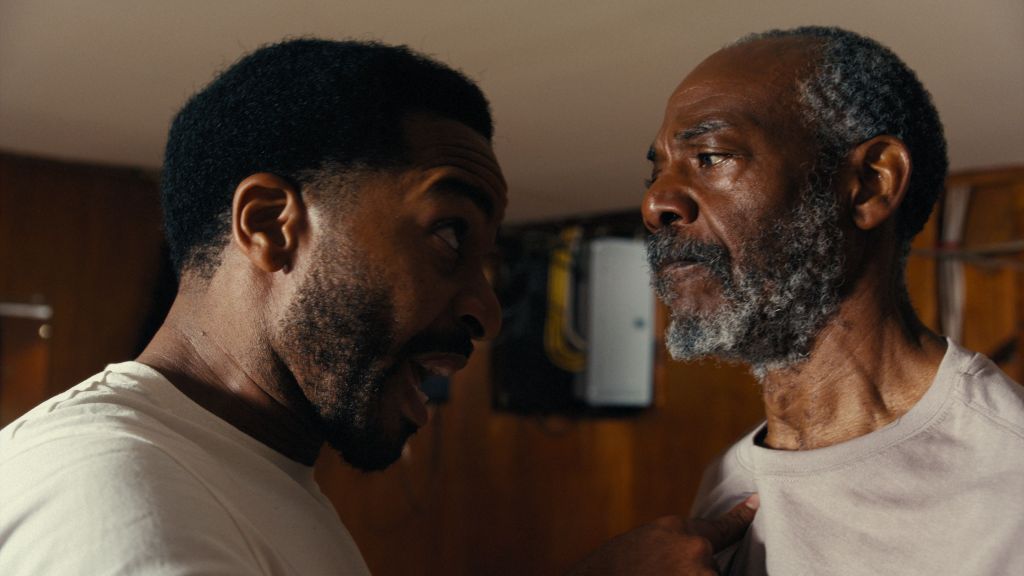
Three generations. Films reviewed: My Dead Friend Zoe, Exhibiting Forgiveness
Hi, this is Daniel Garber at the Movies for culturalmining.com and CIUT 89.5 FM.
It may be the closing of Black History Month, but there are still good movies opening this weekend. So this week, I’m looking at two new American movies, about three-generation families. There’s an Army vet with PTSD whose grandpa has dementia; and an artist with a young son whose dad is addicted to crack.
My Dead Friend Zoe
Co-Wri/Dir: Kyle Hausmann-Stokes
Merit (Sonequa Martin-Green) is a US Army Vet who lives in Portland, Oregon. She was a lightweight vehicle mechanic in Afghanistan, but hasn’t done much since she was discharged. The fact is, like many vets she is depressed and suffers from PTSD. That’s why she goes to a military support group especially for people like her. And she always brings her best friend and fellow vet Zoe (Natalie Morales) with her. Zoe’s the only one who could understand what she’s been going through. But to the group leader, Dr Cole (Morgan Freeman) that’s not enough. He wants her to tell them all what’s the matter. You see, Zoe is dead, and Merit’s the only one who can see her. And unless she shares with the group, Dr Cole won’t sign the form keeping her out of jail.
Then she gets a long distance phone call from her mom
(Gloria Reuben). Merit’s Grandpa (Ed Harris) has lived alone in a beautiful lakeside home outside of Portland since Merit’s Grandma died. He was spotted wandering on a country road near his house. For Merit’s mom, that means he has dementia and so, for his own good, he has to be locked up in a nursing home.
But Grandpa is as stubborn as Merit. They’re both war vets — he’s the one who inspired her to sign up — and they carry similar mental scars. Will Grandpa agree to leave his home? Can Merit ever admit her terrible secret? And why is Zoe still around?
My Dead Friend Zoe is a gentle comedy-drama about the very serious effects war has on American soldiers, and the multigenerational trauma it brings to a mixed-race family. (Like most war movies, it never mentions the people they killed on the other side.) The movie is divided among flashbacks to Merit and Zoe in Afghanistan; Merit and (dead) Zoe in the present day; and the time spent with her Grandfather. Part weeper, part comedy (plus a tiny bit of romance) it has big name stars — like Ed Harris and Morgan Freeman — but not all that much happens. It’s not bad — I like Sonequa Martin-Green and Natalie Morales as Merit and Zoe, and their relationship is the most interesting part of the story — but as a whole, the film is missing its drive.
Exhibiting Forgiveness
Wri/Dir: Titus Kaphar
Tarrell (André Holland) is an artist who lives with his nuclear family in a pretty American suburb. His wife Aisha (Andra Day), also an artist, is a singer-songwriter, and they both adore their three-year-old son. Tarrell paints realistic aspects of his personal history inspired by his own memories and snapshots. They’re painted on enormous, larger-than-life canvases, mounted on the towering walls of their studio. His last show was a smashing success and his agent is pressing him for another (lucrative) show, ASAP. But the images in his paintings are not bucolic… they recall past traumas that Tarrell lived through but has yet to deal with. He frequently wakes up in bed, screaming from night terrors.
Meanwhile, in a bad part of town, La’Ron (John Earl Jelks) a homeless addict with a long, grey beard, struggles to make it through each day. He ekes out his meagre existence collecting spare change for shining hubcaps and washing cars outside a
skid-row liquor store. But when he ends up in hospital, near-dead after a severe beating by a stickup crook, he decides it’s time to go clean. His brother offers him temporary shelter, and sends him to rehab. His estranged wife Joyce (Aunjanue Ellis-Taylor) forgives him once again in hopes of future familial reconciliation. But what does homeless La’Ron have to do with artist Tarrell? He’s his father, and bad blood flows between them. He taught his son that as a black man, no one will care about him, no one will help him, and unless he gets tough and works extra hard, he’ll never survive and no one will care. But to Tarrell, the abuse visited upon him by his father was mean, self-serving and
sadistic, exploiting his son’s labour to pay for his crack habit. And now La’ron shows up at his door again — what is it he wants now? Can father and son talk honestly? Has La’ron’s nature change? Can Tarrell ever forgive him? And can this extended family be saved?
Exhibiting Forgiveness is a multigenerational look at the hidden fissures and cruelty of masculinity unintentionally visited by fathers upon their sons. It’s rich and moving in its portrayals. The story is told both as a drama and as an artist’s representation of current and past events. We see Tarrell paint three youths; one of them his younger self (Ian Foreman). He later erases two of them by obliterating their images with whitewash on the canvas. In another he cuts his teenaged self out of a painting with an x-acto knife, later draping the missing image on a chair,
So I’m watching this movie with the striking canvases in the paintings — this is not just anonymous crap-art made-up for the movie, it’s the real stuff — but when Tarrell violates the art by splashes white paint or cutting it up… I was a bit disturbed, thinking, OK, the director is making a point, but he’s also destroying another artist’s work. So I looked him up afterwards: The director is an artist, the paintings are his, and cutting up and altering his own canvases is an integral part of his work. He’s primarily an artist, and this is his first film. Watching the movie, I liked the passion of the acting and the emotional (and physical) violence in the characters they portrayed. But once I connected it with Titus Kaphar’s physical art, it suddenly became something much bigger than the sum of its parts.
Exhibiting Forgiveness is an impressive first feature.
My Dead Friend Zoe opens this weekend in Toronto; check your local listings; and Exhibiting Forgiveness is now available on VOD.
This is Daniel Garber at the Movies, each Saturday morning, on CIUT 89.5 FM and on my website culturalmining.com.
Black History. Films reviewed: A United Kingdom, I Am Not Your Negro
Hi, this is Daniel Garber at the Movies for culturalmining.com and CIUT 89.5 FM.
It’s Black History Month, so I’m looking at some historical movies that fit the profile. There’s a British drama about forbidden love and a united kingdom, and a French documentary about a writer’s look at African Americans in the divided United States.
A United Kingdom
Dir: Amma Asante
It’s London in the 1950s. Ruth (Rosamund Pike) is an attractive, professional woman who lives with her parents. One night she meets a handsome student from Oxford at a dance. After a few dates he reveals he’s a prince, destined to become the king of a far off country called Bechuanaland. They fall in love, decide to marry, and move there… it’s like a fairy tale. But they face one problem. Seretse Khama (David Oyelowo) is black, and Ruth is white. This doesn’t
matter much to them, but it does to the people around them.
Ruth’s parents are dead set against it, and as a mixed race couple they face abuse and even violence from strangers on the streets of London. In Bechuanaland, a British protectorate in Southern Africa, Seretse also faces trouble. He’s going against tradition by not choosing a wife from his own tribe. His uncle, the current Regent, objects strongly. And then there’s Sir Alistair Canning (Jack Davenport), a highly-placed diplomat in the foreign service. He’s condescending, snotty, racist and sexist – he
assumes Ruth works in a typing pool (because she’s a woman) when she’s actually an underwriter at Lloyds of London. And he has ulterior motives.
Bechuanaland (now Botswana) is a British protectorate completely surrounded by Rhodesia (Zimbabwe), South Africa and South-West Africa (Namibia). Since 1948, South Africa has been under apartheid rules which make it illegal for whites and blacks to marry. For the king of Bechuanaland to openly flout these racist laws might undermine South
Africa’s legitimacy. South Africa is a commonwealth member and the region is a huge source of mineral wealth for multinationals. Under current laws, Seretse and Ruth are not legally permitted to share a drink in a restaurant… in the land he’s supposed to rule!
Politics is strange. Seretse is forced into exile, while Ruth – and their new baby – remain in Africa. Can Ruth and Seretse win the trust of their countrymen? Can they win the sympathy of the British public? Can they bring justice and prosperity to a remote arid country? And can love hold a separated family together?
A United Kingdom is a historical drama, with equal helpings of romance and British parliamentary politics. It’s based on a true story I knew nothing about. Although it ends abruptly, it has a surprisingly fascinating story. I liked this movie.
I Am Not Your Negro
Dir: Raoul Peck (Written by James Baldwin)
James Baldwin was an African American writer, the author of Notes of a Native Son, and novels like Giovanni’s Room. Born in Harlem he took part in the civil rights movement of the 50s and 60s. But because of the racism and potential violence he faced in America he left for Paris where he spent most of his life. He joined the expat community there, including Nina Simone and Josephine Baker. He wanted to be known not as a black writer, not as a gay writer, but
as a writer.
This film follows Baldwin’s writings on three important figures in the struggle for civil rights: Medgar Evers, Malcolm X, and Martin Luther King, Jr.,
They represented, respectively, the NAACP, Black Muslims, and the Southern Christian Leadership Conference. All three were spied on and harassed by the FBI and labeled “dangerous”, and all three were assassinated before the age of 40.

Courtesy of the Mississippi Department of Archives and History.
Baldwin looks back at their stories and his encounters with them, but also sets himself apart. He’s not a Muslim, not a Christian, not a member of the NAACP or the Black Panther Party.
The title, I Am Not Your Negro, is Baldwin’s central point. The story of the Negro in America, he says, is the story of America, and it’s not a pretty story. It’s a history of violence and racism.There is no difference between the North and South, Baldwin says, just the way you castrate us. He covers slavery, lynching, segregation, and incarceration. And the film neatly connects the slaying of Medgar Evers by a white supremacist with current racist murders, like the deaths of Tamir Rice and Trayvon Martin
Samuel L Jackson’s narration of Baldwin’s prophetic words alternates with Baldwin’s own voice: on the Dick Cavett show and at the Cambridge Debates. Baldwin – and director Peck — tells his story with a barrage of Hollywood images. From the pink-scrubbed face of a dancing Doris Day, to John Wayne’s
confidence in killing native Americans. Baldwin recalls his childhood shock at a John Wayne Western when he realized he’s not the “cowboy”, he’s the “Indian”.
I Am Not Your Negro is about the fear and violence faced by African Americans. It’s a terrific documentary, a cinematic essay told through the masterful use of period still images. These are not the photos and clips you’re used to but jaw-dropping, newfound pictures. There’s lush nighttime footage and a fantastic juxtapositions of words and images. (The film reminds me of the work Adam Curtis.) It’s nominated for an Oscar for best documentary.
A United Kingdom and I Am Not Your Negro both start today in Toronto; check your local listings. Also opening this weekend: if you’re a cat person, there’s Kedi, about the street cats of Istanbul; or if you’re a zombie or a zombie-lover, there’s the wonderful horror movie The Girl with all the Gifts (read the review here).
This is Daniel Garber at the Movies, each Friday morning, on CIUT 89.5 FM and on my website, culturalmining.com
Whence America? Films reviewed: Paterson, Tell Them We Are Rising: The Story of Black Colleges and Universities
Hi, this is Daniel Garber at the Movies for culturalmining.com and CIUT 89.5 FM.
The recent executive order known as the Muslim Ban has made the lives of hundreds of thousands of American citizens and residents uncertain. So uncertain that some refugee claimants are fleeing the Land of the Free, seeking sanctuary across the frozen border in Canada.
Whence America? Where is that country heading?
This week, I’m looking at two movies that give a more optimistic look at life in the United States. There’s a new documentary about Historically Black Colleges, and a quirky drama about the state of life in a post-industrial town.
Tell Them We Are Rising: The Story of Black Colleges and Universities
Dir: Stanley Nelson
Did you know that under slavery, it was actually illegal for African Americans to learn to read and write? And that even slave owners – who could beat, sexually assault or even murder their slaves with impunity — were legally forbidden from educating them? It was in the best interest of the Government and slave owner to keep black Americans ignorant, docile, and illiterate.
To counter this, after emancipation and the civil war, African Americans realized education was the most important way to rise up from slavery. The first colleges were opened based on the writings of scholars like Frederick
Douglas. And like Douglas, the first students were born into slavery. Early education efforts were aimed at skilled trades or religion, but as the movement grew it shifted to academic subjects.
Two schools of thought emerged. Southerner Booker T. Washington believed in a business-oriented outlook, centred on entrepreneurship but was opposed to any protests or political action confronting the status quo. W.E.B. Du Bois took the opposite stance, and led the movement toward equal rights.
Many of the early colleges were run by whites, who imposed harsher disciplinary policies on black students students.
Fisk University harshly segregated the students by sex and forbade social interaction. This led to a protest and an organized walkout until the school President resigned.
By the 1930s and 40s, the teachers and administration positions were increasingly filled by blacks, many of whom had been educated at these same colleges and universities. The US was still strictly segregated under so-called separate but equal laws. So all the best and the brightest students flocked to these schools, becoming the new black middle class. Doctors, lawyers, teachers, preachers and judges all passed through these schools, including renowned Supreme Court Justice Thurgood Marshall (Howard University Law School).
By the the 1950s and ’60s these schools also became a hotbed of black-led political movements. Civil rights
actions — like sit-ins at segregated lunch counters — were spearheaded by students at black universities..
100 years after it was a crime for blacks to read or write, the Brown v Board of Education decision promised to end segregation in schools. But this had an unexpected negative impact on black colleges. With white universities now open to black students, there was a brain drain of top applicants to ivy league schools.
Today there are still over 100 black colleges and universities, some thriving, but others crumbling for lack of funds.
Tell Them We Are Rising: The Story of Black Colleges and Universities is the first documentary to tell the full history of this important but not-widely-known institution. It’s narrated by voiceovers and talking heads: historians and former students and professors from these schools. It’s beautifully illustrated with period photos and film clips touching all aspects of black college life, including educational, political movements and social: fraternities, and sororities, sports and music.
It’s by director Stanley Nelson who also made the excellent The Black Panthers: Vanguard of the Revolution.
Paterson
Dir: Jim Jarmusch
Paterson (Adam Driver) is a bus driver who lives with his girlfriend, Laura, in a small house in Paterson, NJ. He lives a routine life. He carries a lunchpail to work each morning, and a notebook to write down any poems that might occur to him. He eats lunch in a tiny national park. After work he talks with Laura over dinner. And each night he walks his dog to a neighbourhood bar and stays
for a drink or two, chewing the fat.
Laura (Golshifteh Farahani) is an artist who remembers her dreams. She covers everything around her in rough swaths of black and white. Clothes, chairs, curtains, cupcakes… their home is her canvas. Except for his basement where he goes to tinker with things and think. The two of them have a symbiotic relationship. he is the observer, passively
taking in what he sees and hears around him. She is the dynamic one, planning their future, and launching business projects that may or may not succeed.
The town of Paterson serves as the third character in the movie. It’s the first city in North America designed as an industrial centre powered by a series of 18th century canals and mills. It has become an artistic hub for New Yorkers who can’t afford the high rents of that city. Jarmusch includes these brick factories and waterfalls in all his outdoor shots. What he doesn’t show is the parts of town with a large and vibrant middle eastern community there. Instead they’re represented by Laura, played by a Persian American actor. (Paterson is also the place where Trump falsely claimed Muslims were dancing on their rooftops during 9-11.) Maybe it’s because I’ve visited Paterson the town, but I was really tickled by this movie.
Paterson is a richly minimalist film that leaves you feeling good about the state of the world.
Paterson opens today in Toronto; check your local listings. And Tell Them We Are Rising: The Story of Black Colleges and Universities is playing on February 15th at the opening night of the Toronto Black Film Festival. Go to torontoblackfilm.com for more information.
This is Daniel Garber at the Movies, each Friday morning, on CIUT 89.5 FM and on my website, culturalmining.com
leave a comment