Freedom or death? Films reviewed: The Seed of the Sacred Fig, The Room Next Door PLUS Canada’s Top Ten!

Posted in 2020s, Death, Family, Friendship, Iran, Protest, Spain, Thriller, Women, Writers by CulturalMining.com on January 11, 2025

Hi, this is Daniel Garber at the Movies for culturalmining.com and CIUT 89.5 FM.

Mark your calendars, boys and girls, because the annual Canada’s Top Ten film series starts in just a few weeks. If you’re into highly original movies, you really gotta check this out. I’ve already reviewed many of them, or interviewed them already, but there’s lots left to discover.  Things like David Cronenberg’s The Shrouds, a truly bizarre mystery about an entrepreneur who invents burial shrouds that allow you to see in real time the decaying buried body of your loved one. It stars Vincent Cassell, Diane Kruger and Guy Pearce. Or Kazik Radwanski (Interview: 2013)  & Samantha Chater’s brilliant Matt & Mara, with an almost totally improvised script follows old friends (Matt Johnson, Deragh Campbell) who suddenly meet each other again, opening a real can of worms. There are also short films at this festival — I can’t wait to see NFB animator Torill Kove’s latest short Maybe Elephants; her films are just enchanting. And I’m curious what Canadian actor Connor Jessup is up to now with his short film Julian and the Wind. He starred in the movies Blackbird (2013) Closet Monster (2016) and the Netflix series Locke and Key (2021) but I have never seen his own work. These are just a few of the great movies in Canada’s Top Ten and they’re all showing at the TIFF Lightbox in Toronto.

But this week, I’m looking at two new movies, one from Iran (via Germany), and another one from Spain (via the US). There are three female activists looking for freedom in Tehran; and two female writers looking for peace in New York.

The Seed of the Sacred Fig

Co-Wri/Dir: Mohammad Rasoulof

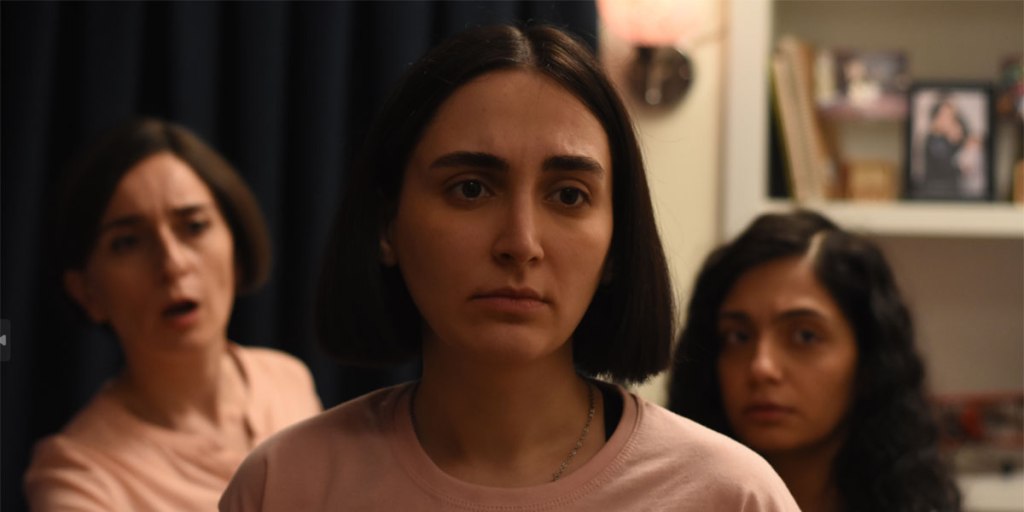
Najmeh (Soheila Golestani) and Iman (Missagh Zareh) are a happily married couple in Tehran. They live out their two daughters, Rezvahn (Mahsa Rostami) and Sana (Setareh Maleki). The kids fight a lot, but the family is still close and trusting; no secrets here. But everything changes once their Dad — a government bureaucrat — gets a promotion. He is issued a gun for protection, due to the nature of his new position. You see, he is now sort of a judge within the Islamic Revolutionary Court. This means convicting and sentencing anyone accused of disobeying religious or political laws, ranging from women who expose their uncovered hair, to anyone caught insulting the Supreme Leader or the government itself. And especially anyone caught at a pro-democracy demonstration.  

But when Rezvahn’s best friend Sadaf gets beaten up at a demo, and they hide her in the apartment they have to keep it from her Dad. Is he responsible for this crackdown? And when his gun disappears, Iman suspects everyone. Has his family turned on him? A wall of distrust divides the family, threatening its very existence. Can they reconcile or is it too late?

The Seed of the Sacred Fig is a powerful and harrowing drama about distrust and betrayal, within a family torn apart by the influence of an authoritarian government on all of their lives. It was shot entirely in Iran, on the sly, by noted director Mohammad Rasoulof who smuggled it out of the country. (It was edited in Germany.)  He fled for obvious reasons: he was sentenced to 8 years in prison, and corporal punishment — that’s whipping — for his film work.

Two thirds of it was shot within a claustrophobic apartment in Tehran, two years ago, right when a women-led, pro-democracy movement was in full swing. The final third was shot outdoors in a spectacularly eerie lunar landscape, shifting in tone from tense psychological drama to a genuine action/thriller. This movie is neither short nor easy to watch, but it is amazing. 

I recommend this one.

The Room Next Door

Co-Wri/Dir: Pedro Almodovar

Ingrid (Julianne Moore) is a successful novelist who lives in New York. At a book signing — her latest one is about her fear of dying — an old acquaintance approaches her. She tells Ingrid that Martha (Tilda Swinton), her old friend from University days, is dying of cancer. Can’t she visit her in hospital? Ingrid hasn’t seen her in decades, though they had been quite close. They even once had a boyfriend in common, Damian (John Turturro). And while Ingrid stayed close to home, Martha (Tilda Swinton) became a renowned war reporter for the NY Times. Her travels took her around the world covering frontline battles in West Africa and the Middle East. They are both happy to see each other again, and Ingrid loves keeping Martha company as she recounts some of her past adventures. 

That is until Martha makes a big request. Her death is inevitable, but she hopes Ingrid will stay with her in the room next door (hence the title) so someone will be around when the inevitable happens. (Ingrid is estranged from her only daughter). And though deathly afraid of death, Ingrid agrees. They move to a gorgeous isolated wood-and-glass  country home. But what will happen next?

The Room Next Door is a touhing, gentle story about two old friends reunited under bittersweet circumstances. Though clearly an Almodovar movie it differs in two ways. This is his first English language feature, and the dialogue seems stilted and clumsy, at least at the very beginning, but interestingly, I stopped noticing it after the first few minutes. Second, the passionate melodrama, the sex, the outrageous humour I expect to see in any Almodovar movie aren’t there. Any conflicts, secrets, betrayals or revelations are few and far between. Instead it is subtle, soft, and gentle. And yet it still clearly is Almodovar’s work. The set design, colour palette, camerawork, the  structure and the music are instantly recognizable. I love the gorgeous, two-coloured wooden lounge chairs by the swimming pool, the clothes they wear, the soundtrack. Almodovar loves long, intricately told flashbacks, and stories within stories like The Arabian Nights. It satisfies your brain and your heart. And Tilda Swinton and Julianne Moore are just right in their roles. 

So in the end, though The Room Next Door was not the Almodovar film I expected to see, it was still satisfying to watch.

The Room Next Door and The Seed of the Sacred Fig are both opening this weekend in Toronto; check your local listings.

This is Daniel Garber at the Movies, each Saturday morning, on CIUT 89.5 FM and on my website culturalmining.com.

Surprising fantasy lives. Films reviewed: Sometimes I Think about Dying, Argylle

Posted in comedy, Depression, Espionage, Fantasy, Romance, Romantic Comedy, Thriller, Writers by CulturalMining.com on February 3, 2024

Hi, this is Daniel Garber at the Movies for culturalmining.com and CIUT 89.5 FM.

February is Black History Month, which is the best time to celebrate black cinema from a historical perspective. The Toronto Black Film Festival is running from Feb 14-19th, showing new features, docs and shorts. This year they’re celebrating actress Pam Grier, with her 70s film Foxy Brown, and in a tribute to the late, great Charles Officer, they’re showing Akilla’s Escape, a thriller set in Toronto. And Sway, Emmanuel Kabongo’s new thriller is having its Canadian premiere at this same festival. Mubi, the streaming site for avant-garde, indie and festival films, is programming black cinema this month in their Cut to Black series. You should check out  Samuel D. Pollard’s excellent  documentary MLK/FBI about J Edgar Hoover’s wiretapping and execrable treatment of the Rev. Dr. Martin Luther King, Jr, and his family.

This week, I’m looking at something completely different: two new movies about lonely women with surprising fantasy lives. There’s an office worker who dreams of dying, and a reclusive novelist who dreams of adventure.

Sometimes I Think about Dying

Dir: Rachel Lambert

Fran (Daisy Ridley) — best known as Rey in the Star Wars movies) is a young woman in a small coastal town in the pacific northwest. She works at a dull office job, in charge of supplies and flow charts. Fran likes beige sweaters and cottage cheese. She spends all day staring out the window at ships docking in the harbour, loading and unloading containers by crane. Basically, she’s depressed, bored and lonely; she lives alone and never goes out. The only unusual thing about her — something that she’ll never confess to anyone else — is the strange fantasies that bounce around her head. She pictures herself lying in a grassy forest… dead. She enjoys the calm and peacefulness of being a corpse. She isn’t suicidal, she isn’t a zombie, she just likes the concept.

Until one day, a stranger arrives at the office, taking the place of Fran’s recently retired coworker. Robert (Dave Merheje) comes directly from Montreal. He’s bald and bearded with a dry sense of humour. His big secret is he has never worked in an office job before, and is completely baffled by the culture. They bond through texting, and he eventually asks her out on a date. And suddenly Fran’s life changes for the better. Her fantasies shift from grassy knolls to funeral pyres! They go to an actual party and meet new friends. But will she ever open up to him? Can she reveal her secret? And will she ever smile?

Sometimes I Think about Dying is a tender social satire about the boredom of daily life and the bubbling cauldron of emotions lurking just beneath the surface. It feels like an Aki Kaurismaki movie transplanted to small-town USA. Daisy Ridley — the British actor best known as fighter-pilot Rey in the Star Wars franchise — is subtly funny as Fran. And Canadian actor and stand-up comic Dave Merheje is good as her “normal guy” foil Robert. It’s a simple movie, but with enough twisted humour to keep you interested. 

It’s cute.

Argylle

Dir: Matthew Vaughn

Elly Conway (Bryce Dallas Howard) is a frumpy middle-aged woman who lives with her cat Alfie in a log cabin between a picturesque mountain and a lake. She earns her living writing action novels about a dashing spy named Argylle, who roams the planet on daring missions. Elly, on the other hand, is a homebody who is deathly afraid of flying and will only leave her home to attend a book launch in a nearby city. Her books are bestsellers, with her devoted fans eagerly awaiting #5 in the series. But her mom (Catherine O’Hara) — who proffers advice on all her books before they’re published — says the ending just doesn’t do it.

So she sets off on a train ride to hash through the manuscript with her mother. But everything changes on that train ride, when a stranger — a bearded long-haired man in dirty clothes —  aggressively takes the seat across from her and refuses to move. He’s a  fan of her books, he says. Turns out the entire train knows exactly who she is… and for some reason, they think her books are the key to the secret world of espionage, and for that reason, want her dead! 

This strange man (Sam Rockwell) turns out to be a spy himself, fighting for the good guys. He manages to fight off dozens of would be assassins and brings Elly to safety. She grabs her cat and they fly off to Europe. But this is just the first step in a whirlwind journey of international intrigue, where the CIA — the good guys?! — are fighting the bad guys (a sinister cabal known as The Division) for worldwide domination. Why does everyone think her fiction is prophetic?  Can frumpy Elly solve these mysteries? And will she ever know the truth?

Argylle is a highly stylized roller-coaster ride of light comedy and high-speed action. The bright colours and extreme violence and mass murder — but with no blood — is fueled by a non-stop infectious disco soundtrack. The movie begins with scenes from her novels where Argylle (a plastic-looking Henry Cavill) and his teammates have unbelievable ridiculous shoot outs and chase scenes in exotic locales. But it soon resets to “real life” where things are slightly more believable. The thing is, it all starts to merge, to the point where “reality’ is even more extreme than “fiction”. In Elly’s mind, her fictional spy Argylle periodically takes the place of her less appealing cohort.

The story makes marginal sense, with so many U-turns and double crosses your head will spin. But that’s not what the movie is about. It’s there for sheer entertainment — a ride on planes, trains and ice skates — as the film chugs along its merry way. Visually, it’s one giant green screen, with endless CGI and special effects, to the point where it’s almost a cartoon. Is that Henry Cavill’s face and hair or a computer generated plastic figurine? Is that Bryce Howard’s breasts or a CGI simulacrum? Who knows? Who cares!

This is all about spectacle, with some truly spectacular scenes of mass murder muted by bright billows of pink and lavender smoke. There’s gun porn, with the camera caressing thousands of assault weapons lined up in a shiny-white tribute to machine guns. And major star power, including Dua Lipa, John Cena, Ariana DeBose, Bryan Cranston, and Samuel L Jackson.

Is Argylle a good movie?

No!! It’s ridiculous, high-budget schlock… but it’s also eye-candy perfection.

Argylle starts this weekend, and Sometimes I think about Dying opens next week; check your local listings. 

This is Daniel Garber at the Movies, each Saturday morning, on CIUT 89.5 FM and on my website culturalmining.com.

MassachuTIFF! Films reviewed: Dumb Money, The Holdovers, American Fiction

Posted in 1960s, 1970s, comedy, Coming of Age, High School, Movies, Resistance, Satire, Wall Street, Writers by CulturalMining.com on September 23, 2023

Hi, this is Daniel Garber at the Movies for culturalmining.com and CIUT 89.5 FM.

TIFF23 is over but it has ushered in Toronto’s Fall Film Festival Season. Toronto Palestine Film Fest offers film screenings, live concert performances and museum installations, starting on Sept 27th. And you can catch eight short dance films, called “8-Count” at the Hot Docs cinema on the 27th and at York U on the 28th. But this week, I’m talking about three more great movies that played at TIFF, all from the USA, all set in Massachusetts. There’s a prep school student named Tully, a novelist with the nom de plume Studd, and an online investor known as Roaring Kitty.

Dumb Money

Dir: Craig Gillespie

Keith Gill (Paul Dano) is a investment analyst in Brockton, Massachusetts who posts his financial details daily online on a  sub/Reddit. He works out of his basement. One day he notices a stock he likes is undervalued, so he buys 50,000 shares and posts the recerd  on YouTube. It’s GameStop, a shopping mall chain that buys and sells video games and equipment. And when it goes viral, and everyone starts buying them, the prices climb. The chain doesn’t go bankrupt and ordinary people — the dumb money of the movie title — start making good money on sites like Robinhood. That’s good for everyone, right? No — not for short sellers. Those are the wall street tycoons who make their fortunes by betting on the future price of a stock being lower than the current price. But this one is soaring exponentially, resulting in a short squeeze where the short sellers have to buy back shares at a much higher rate than they bet on. Can Keith — and all his followers — keep GameStop shares afloat? Or will Wall Street triumph once again? 

Dumb Money is a simple but very fun movie — based on a true story that happened just two years ago — about ordinary investors trying to beat Wall Street at their own game. It follows Gill, his wife Caroline (Shailene Woodley) his bro Kevin (Pete Davidson), and the many small investors across the country: a nurse, some college students, even a mall employee of GameStop (played by actors including America Ferrera, Anthony Ramos). They’re pitted against the Wall Street short sellers (Vincent d’Onofrio, Seth Rogan). Most of the characters never actually meet one another, but somehow it all holds together. It’s a lot like The Big Short, but the heroes and heroines are regular people not just a bunch of rich guys playing the system. There’s a warm and rustic feel to this  movie — a nostalgia for last year! —  with nice characters you want to get to know. Nothing spectacular but Dumb Money is highly entertaining and a hell of a lot of fun.

For some reason, I really like this one. 

American Fiction

Co-Wri/Dir: Cord Jefferson

Thelonious Ellison (Jeffrey Wright) known as “Monk” to his family and friends is an upper-middle writer and academic. He’s spending time with his family in Massachusetts after being unceremoniously put on leave from his college for displaying the “N word” in class — white students said it made them feel “uncomfortable”. Coming from a family of doctors (he’s a PhD), Monk has very high standards when it comes to literature. He sneers at pulp fiction. Unfortunately his novels aren’t selling.  What is selling is We’s Lives in Da Ghetto, written by an equally upper-middle-class, college-educated writer, Sintara Golden (Issa Rae).  Monk holds fast to his ideals: he’s a writer who is black, not a black writer. But his agent (Jon Ortiz) wonders why Monk can’t write more “black”. In a fit of pique, Monk churns out the trashiest novel he can imagine, full of dreadful stereotypes and contrived black slang, gangstas, single parent families and crack dealers. But to his surprise and disgust, there’s an instant bidding war for the book, finally offering him 3/4 of million dollars. (He wrote it under the pen name Stagg R. Lee, posing as a fugitive from the law.) He wants to come clean  and call off the deal, but he does need the money to pay for a nursing home for her mom (Leslie Uggams). But as his mythical fame starts to grow, and Hollywood comes knocking at his door, he winders how long the truth comes out?

American Fiction is a scathing comedy about academia, literature, movies and white American attitudes toward Blacks. It’s also an interesting family drama — with his clever divorced sister Lisa, his incorrigible divorced brother Cliff (Sterling K Brown) and the family maid Lorraine (Myra Lucretia Taylor). It’s also a potential romance, when he meets Coraline (Erika Alexander) a neighbour to the family’s beach house. This is director Cord Jefferson’s first feature, but he makes a mature, clever movie. He takes what could have been a simple farce, and turns it into something bigger than that. Jeffrey Wright is perfect as Monk, never hamming or mugging, just honing his character to a sharp and pithy — but flawed — person. 

Great movie.

The Holdovers

Dir: Alexander Payne

It’s December, 1969 at Barton Academy, an elite prep school in New England. Mr Hunham (Paul Giamatti) the hard-ass classics teacher, is put in charge of the kids who have nowhere to go over the winter holidays. Although its Christmas, he assigns the kids homework. These boys are troglodytes and its up to Hunham to whip them into shape, or at least try to. He’s the kind of guy who drops quotes in Latin and ancient greek to no one else’s amusement. He has a glass eye and smells like old fish. Cooking and cleaning is done by Mary Lamb (Da’Vine Joy Randolph). She works at Barton so her son can study there and go to University. But, unlike the rich kids he couldn’t afford to pay for college. So he got drafted and died in Vietnam. Mary is still at the school, because where else is she going to go? Then there’s the students — Jason, an heir to a aviation fortune but his hair is too long for his dad’s wishes; the class pot dealer, Kountse, and Alex and Ye-Joon two little kids, too far from home — their parents are in Salt Lake City and Seoul. But after an unexpected event, only one student is left with Mary and Mr Hunham.

Angus Tully (Dominic Sessa) is the smartest kid in class, gangly and arrogant, but also a trouble maker. His divorced parents are rich but neglectful, so he’s been kicked out of a long list of prestigious boarding schools. If it happens again he’ll be sent to military school, a fate worse than death. Can the three of them, Angus, Mr Hunham and Mary, form a truce and act like a makeshift family? Or will they drive each other crazy first?

The Holdovers is a remarkably good coming-of-age comedy/drama with a compelling story and fantastic acting. It tugs at your heart without ever resorting to sentimentality. Paul Giamatti is always good, in this case as an unusual anti-hero, while the other two, Dominic Sessa and Da’Vine Joy Randolph, are totally new faces (never seen them in a movie before) but they’re both so good. They are three-dimensional and real, arrogant and vulnerable, and totally believable.  I went into this movie with zero expectations, and was shocked by how good it is. I’m purposely not giving away the plot — no spoilers —  but I can’t see anyone not liking this movie.

All three of these movies played at #TIFF23. with American Fiction winning the People’s Choice Award, and The Holdovers the runner up. Dumb Money opens this weekend across Canada; check your local listings.

This is Daniel Garber at the Movies, each Saturday morning, on CIUT 89.5 FM and on my website, culturalmining.com.

Two Thimothées. Films reviewed: Dune, The French Dispatch

Posted in 1950s, 1960s, 1970s, Art, Canada, Food, France, Journalism, Science Fiction, Supernatural, Writers by CulturalMining.com on October 23, 2021

Hi, this is Daniel Garber at the Movies for culturalmining.com and CIUT 89.5 FM.

Nostalgia is an interesting phenomenon that changes with the times, where past events are coloured by present-day attitudes. This week, I’m looking at two new movies: one set in the future but based on a novel from the 1960s; and the other set in the past but based on American perceptions of a Europe that never was.

Dune

Dir: Denis Villeneuve (Based on the book by Frank Herbert)

It’s the future. The universe is divided up by ruthless feudal planets looking to increase their wealth and power through extraction of precious minerals. One prize planet is Arrakis, seemingly inhospitable and covered in sand dunes, with gigantic killer worms living just beneath the surface. However the sand yields “spice” a highly coveted group of elements that make intergalactic travel possible. But the planet is populated by the fiercely independent Fremen. Paul (Thimothée Chalamet) the son of a Duke, is sent there after a cruel leader is forced to leave. Paul’s dad is a decorated military hero  (Oscar Isaac) and his mom is a sorceress (Rebecca Ferguson). So the multilingual young man has been trained from an early age both in martial arts and complex mental powers. He can predict the future through his dreams. He hopes to secure the planet while leaving the Fremen unharmed. But various international forces are working against him and his family— was he sent to the planet merely to be eliminated? 

Dune is a science fiction, space movie with a complex novelistic plot and many characters. It’s breathtakingly beautiful, done in the style of the cover art of 1970s paperbacks. I’m talking gorgeous costumes with the Fremen dressed like multi-ethnic saharan Tuareg, and concrete beige spaceships rendered in a brutalist style. And it’s shot in IMAX, meaning it’s a tall movie not a wide movie. I saw it at TIFF at the Cinesphere, where 50-foot sandworms lunge at you from the screen, like they’re about to swallow you up. That said, while I loved the movie aesthetically, it didn’t move me emotionally at all. Maybe because I read the book in junior high so I knew what was going to happen, or maybe because it’s the first of a three part series and doesn’t really end, or maybe because science fiction isn’t supposed to make you cry. Whatever the reason, I think Dune is a fantastic, though unfulfilling, movie to see.

The French Dispatch 

Dir: Wes Anderson

It’s the Twentieth Century, Newspapers are revered, and even smaller cities have foreign correspondents. One such paper, based in Liberty Kansas, opens a bureau in France, known as the French Dispatch, to replace their usual colour Sunday supplement. They spare no expense, hiring the finest writers to ruminate on topics of their choice, including Berensen (Tilda Swinton) on art, Krementz (Frances McDormand) on politics, and Wright (Jeffrey Wright) on food. At its peak it has more than half a million subscribers, but when the editor (Bill Murray) dies, it publishes its final issue. This film dramatizes three of its best stories. In the first chapter, Berensen looks at Moses Rosenthaler (Benicio Del Toro) a killer locked away fin a prison for the criminally insane. He paints abstract canvases of his prison guard Simone (Lea Seydoux) who poses nude for him. But can a shady art dealer (Adrian Brody) save him from obscurity? In the second story, seasoned journalist Krementz covers the student uprisings of the 1960s, where she befriends young Zefirelli (Timothée Chalamet) who calls for revolution. But will her carnal attraction to the much younger student compromise her neutrality as a journalist? In the third story, ostensibly a look at a chef who works at the police station, turns into an action thriller, as a detective’s young son is kidnapped by a hardened criminal. Can a food critic write a credible eye-witness report on organized crime?

The French Dispatch is, of course, total fiction. These exciting stories are set not in Paris, but in a tiny town called Ennui-sur-Blasé. And the magazine is not the New Yorker — its from Liberty, Kansas, pop: 123. What it is is a highly-stylized, funny and quirky look at old school journalists and the stories they told. It’s loaded with in-jokes and thousands of obscure cultural references. Camera work is as precise as a graphic novel moving from panel to panel. Scenes vary between sharp black and white, faded colour or the garish tones of the 70s. Styles cover everything from animated comics, to stage plays, to old tabloid flash-photos. It’s almost overwhelming in its visual impact. French Dispatch is a brilliant illustration of mid-century, middle-class culture… and wonderful to watch.

Dune and The French Dispatch both open this weekend; check your local listings.

This is Daniel Garber at the Movies, each Saturday morning, on CIUT 89.5 FM and on my website, culturalmining.com

Self-reflexive. Films reviewed: Akilla’s Escape, Truman & Tennessee, Censor

Posted in 1950s, 1980s, Canada, Crime, documentary, drugs, Gay, Horror, Jamaica, Toronto, UK, Writers by CulturalMining.com on June 18, 2021

Hi, this is Daniel Garber at the Movies for culturalmining.com and CIUT 89.5 FM.

This week I’m looking at three new movies — a crime drama, a horror movie and a documentary. — that also look at themselves. There’s a possible killer named Akilla, a horror movie about horror movies, and a doc about two famous gay writers… who write about themselves.

Akilla’s Escape

Co-Wri/Dir: Charles Officer

It’s present-day Toronto. Akilla (Saul Williams) is a smart and well-read guy, who was born in Jamaica, grew up in Queens NY, and ended up in Toronto as a teenager. He has built a career with a successful grow-op he calls “the farm” for twenty years, but feels it’s time for a change. There’s been a rash of gang violence and he wants out. But on the same day, he interrupts a robbery gone wrong, leaving dead bodies in its wake. Most of the remaining local gangsters get away with two bags full of cash and drugs which should be in the hands of organized crime. But one of them — whom Akilla knocks out during the robbery — is still lying unconscious on the floor. And when he pulls off his mask, he sees young Sheppard (Thamela Mpumlwana), a 15-year-old boy who reminds him of himself at that age. He doesn’t want to hand him over to the mob because they’ll kill him… but he also needs to recover the stolen cash and drugs — otherwise he’ll be the one to suffer.  Can he get Sheppard to confess, avoid a hitman from the Greek mob, and catch a fugitive killer… without dying himself?

Akilla’s Escape is a complex and engrossing crime drama set within Toronto’s Jamaican community. Through a series of flashbacks, it’s told in three parallel stories about people dragged into a life of crime largely against their own will: young Akilla in Queens, Sheppard in Toronto, and adult Akilla in the present day. It’s nicely shot in a distinctive style coloured with reds and yellows to differentiate the different time periods. Saul Williams is really good as Akilla, both thoughtful and intense; and, in a twist, Sheppard and the 15-year-old Akilla are both played by the same actor, Thamela Mpumlwana! 

Interesting movie — I like this one.

Truman & Tennessee: an intimate conversation

Dir: Lisa Immordino Vreeland 

Truman Capote and Tennessee Williams first met in the 1940s when they both were rising stars.  Capote was still a teenager while Williams was in his late twenties. And they both were gay authors.  Tennessee was a compulsive writer dedicated to his craft, while Truman yearned for celebrity, not just success. Tennessee wrote a series of incredibly successful plays, most of which were later turned into hit movies, all about the lives, loves  and tragedies of southern woman. You’ve probably seen at least some of them: The Glass Menagerie, Cat on a Hot Tin Roof, A Streetcar Named Desire, to name just a few. Truman Capote wrote novels, memoirs and true crime reports, like In Cold Blood, Breakfast at Tiffany’s, and Other Voices, Other Rooms. They went on vacations together, along with their long-term lovers, to exotic locales in Italy and Morocco.

They both drank heavily and popped pills supplied by the notorious “Doctor Feelgood”. But by the 1970s their fractious friendship ended in bitter rivalries.  Truman wrote a story with a character based on Tennessee, whom he described as “a chunky, paunchy, booze puffed runt with a play moustache glued above laconic lips who has a corn-pone voice.” In response, Truman is said to have “gone so far in his shtick that all his work will be seen now in the shimmer of a poised stiletto”. 

This documentary is composed of scenes from their films, still photos (by photographers like Richard Avedon and Cecil Beaton), and a few key TV interviews (with David Frost and Dick Cavett). Visually it’s experimental, with lush green leaves, trees and rippling water superimposed kaleidoscopically on much of the period footage, giving the film a drifting, ethereal feel.

It’s narrated by the authors themselves, as voiced by actors Zachary Quinto (Star Trek) as Tennessee Williams and Jim Parsons (Big Bang Theory) as Truman Capote. It’s full of personal details of their superstitions, phobias, addictions, jealousy, loneliness and lust. Did you know that Truman Capote wanted Marilyn Monroe, not Audrey Hepburn, to play Holly Golightly in Breakfast at Tiffany’s (which was based on an actual friend of his)? And Tennessee Williams tells all his viewers to walk out of his movies just before they’re over, because, he says, Hollywood’s happy endings ruin them all. These just give you a taste of all the secrets revealed in this movie.

If you like these two writers, you must see this doc.

Censor

Co-Wri/Dir: Prano Bailey-Bond

It’s the mid-1980s in Thatcher’s Britain. Enid (Niamh Algar) works for the censor board. In teams of two they rate, classify, cut or ban the many videos flooding the country. She’s meticulous in her work, logging frame by frame any images she thinks show too much. Scenes that don’t make the grade include a gouged eyeball that “looks too realistic”, or “excessively visible genitalia”. Pressure is especially strong these days because the tabloid press blames a rise in crime on the prevalence of “video nasties” — low-budget horror movies washing up on the sacred shores of Albion.

Things get worse when a gruesome real-life murder seems to mimic a scene from a horror movie she once approved. And once the papers print her name, she is inundated by paparazzi, journalists and non-stop anonymous obscene phone calls to her home. Meanwhile, at work, she is visited by a particularly sleazy and salacious film producer, who says she would be perfect to star in his next movie. Turns out his past video nasties include a film about two teenaged sisters, one of whom was violently killed. Thing is, Enid’s own sister disappeared after a walk in the woods when they were both still little girls, and she has made it her life-long goal either to find her or find out what happened to her. Is this film somehow related to her and her sister? Is the film studio a murder machine, making snuff films? Or is it all in her head?

Censor is a psychological horror pic that traces a bureaucrat’s slide from proper office worker into the depths of violence and depravity. It’s about the making and censoring of those low-budget horror movies in the 80s, but it’s also a horror movie in its own right. Its style matches the videos it’s sampling —  the music, sound effects, costumes — giving the whole film a surreal feeling.

This is good, over-the-top horror.

Akilla’s Escape is now playing on VOD; Truman & Tennessee: an intimate conversation opens today digitally at the Rogers HotDocs cinema; and Censor also opens today on your favourite VOD platform.

This is Daniel Garber at the Movies, each Friday morning, on CIUT 89.5 FM and on my website, culturalmining.com