American battles. Films reviewed: G20, Drop, Warfare PLUS National Canadian Film Day!

Posted in 2000s, Action, Diplomacy, Iraq War, Suspense, Terrorism, US, violence, War, Women by CulturalMining.com on April 12, 2025

Hi, this is Daniel Garber at the Movies for culturalmining.com and CIUT 89.5 FM.

Yearning for some Can-Con? We’ll mark your calendars: next Wednesday is Canada Film Day with over 1700 screenings and discussions about great Canadian movies across this country! In Toronto alone, directors and actors like Sophie Desraspe, Helen Lee, Eric Peterson, and Cody Lightning will be there at the screenings.  There’s also a Town Hall discussion of Canadian culture with Don McKellar, Mary Walsh and Elle-Maija Tailfeathers. Canadian Films suddenly seem acutely relevant. Go to canfilmday.ca for showtimes.

But this week, I’m looking at three new movies from south of the border. There are Navy Seals in Iraq attacked by armed combatants; the US President locked in hand-to-hand combat with international terrorists; and a single mom terrorized by her cel phone.

G20 

Dir: Patricia Riggen

It’s a resort hotel in Capetown, South Africa, and US President Danielle Sutton (Viola Davis), America’s first black female POTUS is preparing for the G20 summit. When she’s not practicing martial arts with her Secret Service bodyguard Manny (Ramón Rodríguez) she’s hanging with her family:  loving husband Derek and her two teenaged kids. Serena, the older one, (Marsai Martin) is an accomplished hacker who can sneak, undetected, out of any building, even the White House. President Sutton is decked out in an elegant red evening gown — complete with cape — for the all-important photo-op. But something is rotten in the city of Capetown. There’s a conspiracy at work, led by evil Aussie mercenaries. And now armed soldiers are rounding up the presidents and their families! If they can pull this off, they’ll have trillions in “untraceable” crypto currency, and the leaders of the most powerful nations in the world will grovel at their feet.  

But some of the leaders have escaped their clutches. Sutton, the elderly Korean First Lady, the pompous British PM, and a few others have form an impromptu posse. Can this ragtag group of heads of state beat the musclebound mercenaries in a contest of physical strength and mental acuity? Or is this world doomed?

G20 is a ludicrous but fun action thriller, told from the point of view of a female, superhero-type president. This is not a unique movie theme: Many Americans love venerating their presidents. Think: Harrison Ford in Air Force One or even Abraham Lincoln Vampire Hunter. But G20 is so silly… The villains carry the bitcoin wallet — with all the money — as if it’s a physical object, a MacGuffin they have to possess. And they eforce the leaders to read a nonsense speech (the quick brown fox jumps over the lazy dog) so they can make a deep-fake video… as if world leaders haven’t made hundreds of speeches already. A 60-year-old president who’s also an Iraq War hero and also a jiujitsu champ. Sure, why not…? It’s just a movie. The main story may be a hackneyed farce, but Viola Davis is a joy to watch.

Not a masterpiece but a watchable TV movie.

Drop

Dir: Christopher Landon

Violet (Meghann Fahy) is dressed-up but nervous. She’s on her first date since her husband died, five years ago. A single mom and an online therapist, she likes working from home so she can keep a close eye on Toby, her adorable, autistic son. But her wacky sister Jen (Violett Beane) insists she step out of her shell and have some fun. Jen’s babysitting Toby tonight to give her all the time she needs. And if there’s no chemistry with the guy she’s meeting, she can always just leave. So here she is in a fancy restaurant with a dramatic view of the city. In comes Henry (Brandon Sklenar) her first date, and there’s instant attraction. Henry is handsome, rugged and friendly, and has a steady job at City Hall. He likes her looks, her smarts and her honesty.  They go to their table and start the date.                

But the electricity between is interrupted by anonymous memes and texts that keep appearing on her phone, apparently dropped by someone somewhere in the restaurant. The messages become threatening, along with a warning: if you tell anything to Henry (the guy she just met) we’ll kill your son. Followed by live security footage from her home… with a masked man roving her halls with a gun. Whoever it is has control of all her security cameras and all the cels in the restaurant. They can see and hear everything she’s doing. They want her to commit a crime  in plain view, and there’s no way to stop them. Can Violet save her son and outsmart this invisible villain on this date from hell?

Drop is a classic suspense thriller that plays on our fear of technology and surveillance. Afterwards I realized there are some major plot holes or impossibilities, but they don’t stand out while watching it. It’s a tightly budgeted Blumhouse movie so the actors are likeable but not A-list, and everything takes place in two tight locations – her home and the restaurant. It uses psychological fear instead of pyrotcechnics. And it works. This is a good, traditional suspense thriller, the kind where the tension keeps growing and never lets up.

I like this one.

Warfare

Co-Wri/Co-Dir: Alex Garland (Ex Machina, Annihilation, Civil War), Ray Mendoza

It’s November, 2006, in Ramadi, a city in central Iraq, between Baghdad and Fallujah. Ray (D’Pharaoh Woon-A-Tai) is leading a squad of Navy Seals on a mission. They commandeer two houses, knocking down walls and pushing the families into their bedrooms. They’re setting up for a long wait, until a marine unit arrives with tanks to evacuate them. But armed enemy soldiers are setting up on nearby roofs, taking pot-shots at them. And when the tank finally arrives, the Seals are ambushed by an IED buried in the road. The Iraqi soldiers they are working with are killed, while some of their own are badly injured. They have to pull their bodies back into the house and try to save who they can. Can they fight off the insurgents until the Marines arrive? And who will survive this tense battle?

Warfare is a hyper-realistic depiction of an actual battle in Iraq as remembered by the US soldiers who were there (including writer/director Ray Mendoza). It’s not like your usual war movie. The film favours accuracy over character- building or back stories. And the characters speak in military jargon, full of Frogmen (navy seals), Bushmen (an aerial unit, overhead) and many more I couldn’t catch. The cast is excellent, especially Woon-A-Tai, Will Poulter (The Revenant, We’re The MIllers,  Midsommar) and Cosmo Jarvis — it really felt like you’re there, witnessing actual soldiers, showing bravery, camaraderie, and brotherhood. What the movie doesn’t deal with is why? Why were they there at all? What did that particular mission accomplish? Where are all those WMDs, the supposed reason for this war? Thousands of US soldiers were killed there, and many times more tragically killed themselves afterwards. And an estimated one million civilians in Afghanistan, Pakistan and the Middle East were wiped out, millions more displaced and the whole region made unstable till today… and for what? 

I’m glad I saw Warfare — it’s a rare chance to experience a non-jingoistic, up-close and personal look at US soldiers on the frontline. But don’t go to this docudrama expecting to be entertained. Because fun… it ain’t

G20 is now screening on Prime Video, and Warfare and Drop both open this weekend in Toronto; check your local listings. This is Daniel Garber at the Movies, each Saturday morning, on CIUT 89.5 FM and on my website culturalmining.com.

Broken. Films reviewed: Parthenope, The Unbreakable Boy, The Monkey

Posted in 1950s, 1960s, 1970s, Autism, comedy, Family, Horror, Italy, Women by CulturalMining.com on February 22, 2025

Hi, this is Daniel Garber at the Movies for culturalmining.com and CIUT 89.5 FM.

This week, I’m looking at three new movies: there’s a boy with breakable bones, a toy monkey who could break your bones, and a woman whose beauty breaks every man’s heart. 

Parthenope

Wri/Dir: Paolo Sorrentino (Reviews: Youth, Hand of God, The Great Beauty)

It’s Naples, 1950 and a woman gives birth in the waters of the Tyrrhenian Sea. The baby is called Parthenope, named for both the city and the Greek myth. She grows up to be a young woman of epic beauty and legendary intellect (Celeste Dalla Porta). Men who try to seduce her, find their own words silenced by her pithy comebacks. Her days are filed with a search for beauty, happiness and meaning. She absorbs everything she reads, from John Cheever to Claude Levi-Strauss. Her closest friends are her brother Sandrino (Dario Aita) and Raimondo (Daniele Rienzo) the son of a maid. Together they form sort of a quasi menage a trois.

Parthenope aces her orals and is accepted into the prestigious anthropology department at the local university. From there she follows three very different paths: Academia — a professor takes her under his wing; Love, deciding which of her countless suitors should she consent to sleep with; and the city of Naples, itself. Along the way she encounters a corrupt and carnal bishop, a depressed superstar diva, a millionaire with a private helicopter, and many others. But will any of these people provide her with the answers she seeks?

Parthenope is a gorgeous  and sumptuous look at post-war Naples as seen through the eyes of a beautiful woman as she lives her life. Celeste Dalla Porta is appealing to watch, but she is opaque and impenetrable: she merely observes without ever doing anything. Paolo Sorrentino is known for his his beautiful images, especially women as objects of desire. But he doesn’t seem to know what to do with a woman as his subject. Instead we get a hollow simulacrum of a main character, who drifts aimlessly but happily through her life as she encounters quirky strangers. I love the photography, the scenery, the people and the music — a collection of bright and shiny colours — but watching Parthenope leaves you feeling like you just flipped the glossy pages of a fashion magazine: superficially attractive but pointless.

The Unbreakable Boy

Co-Wri/Dir: Jon Gunn (Reviews: Ordinary Angels, I Still Believe, American Underdog, Jesus Revolution)

Scott (Zachary Levi) is a young salesman with big ambitions: he plans to move to Manhattan someday and make it big. But in the meantime, he likes golf, fine wine and travelling. He spends most of his time with his best friend Joe, a burley bearded man who is always giving him advice (Drew Powell). One day he meets a pretty and charming woman named Teresa (Meghann Fahy). Sparks fly, and nine months later, she gives birth to Austin (Jacob Laval). They’re not married but decide to bring him up together. But there’s a catch: he requires special care. Like his mom, Austin has Osteogenesis imperfecta (OI), a genetic condition that makes your bones very brittle. He suffers his first fracture in the birth canal, with many more breakages to follow. Eventually he is joined by a younger brother, Logan, who doesn’t share his breakability.  

13 years later, Austin — aka the Aus-man — is now a happy school kid with a vivid imagination. He’s also on the autistic spectrum, but contrary to stereotypes, he’s outgoing, talkative and attends normal classes. He talks constantly, just like his dad. (I forgot to mention: Scott’s best friend Joe is imaginary) But all is not well. The family is deeply in debt. Austin is bullied at school. And Scott is drinking way too much, especially since he lost his job. Can the family pull itself back together? Or are they headed for ruin?

The Unbreakable Boy is a very cute, true story about an ordinary family working together to overcome their problems. As narrated by Jacob Laval  as the Aus Man, it’s simple, touching and funny. I like the way it demystifies kids with medical conditions and autism. And unlike most medical dramas, it’s not a weeper, though perhaps overly earnest. One warning: it is a faith-based movie, generally a red flag for cringe. Not my thing. Thankfully this one avoids most of the problems of that genre; preachiness and finger wagging and in-your-face prayers. If you’re in the mood for a light, informative, feel-good Christian movie that won’t make you squirm, check this one out.

The Monkey

Wri/Dir: Osgood Perkins (Reviews: Longlegs, Gretel and Hansel)

Hal and Bill (Christian Convery) are identical twins, but they couldn’t be more different. Bill, who was born a few minutes earlier, is self confident, athletic and  aggressive. Hal is withdrawn and wears glasses as he tries to keep out of Bill’s way. But his brother is a bully, humiliating and hurting Hal on a daily basis, using a posse of popular girls as his private army.  The two live with their single Mom (Tatiana Maslany) ever since their Dad, an airline pilot, walked away one day and never came back. When the boys go through the many souvenirs he brought home from around the world, they uncover something very unusual. It’s a mechanical automaton that’s an organ-grinder monkey. You wind him up and he plays a drum to the sound of carnival music. A harmless toy, right? Not exactly. When the drumstick comes down something terrible happens. Like when their babysitter is accidentally decapitated at a Benihana restaurant. But when it kills their beloved mother, the boys decided to hide the monkey somewhere that it can do no more harm. They are adopted by their aunt and uncle, a pair of swingers in small-town Maine. But they too are eventually killed in gruesome accidents. Was the money to blame? 

Flash-forward 25 years. Hal (Theo James) still lives in Maine close to his teenaged son Petey (Colin O’Brien). He visits him only once a year, to lesson the chances of the cursed monkey in harming him. But then two cataclysmic events threaten Hal’s normal life. First, Petey’s stepfather Ted (Elijah Wood) announces his plans to adopt him, making this the last time Hal will see him. Second, a series of terrible events are killing countless people in and around the town he grew up in. Can Hal find that damned Monkey and stop it from killing someone else? And can he simultaneously spend his last days with his son while keeping him out of danger?

The Monkey is a shocking and disgustingly hilarious movie about an evil toy and the people it affects. It’s done in a retro style, like Mad Magazine meets the Twilight Zone. It’s directed by Oz Perkins, known for his stylized movies that feel like fairytales (Gretel and Hansel) or nightmares (Longlegs). With this one, based on a short story by Stephen King, he seems to have found a happy medium. Simultaneously comical and grotesque, you watch the movie waiting with baited breath for the next disaster to happen. Theo James is perfect as the hapless Hal, but so is every other character in this weird movie, each given their own minute of ghastly glory: a pawn shop owner, a girl gang, a real estate agent, a pot dealer, a televangelist… it’s a limitless, mind-blowing romp. The Monkey is grotesque comedy/horror at its peak.

I love this movie. 

Parthenope, The Unbreakable Boy, and The Monkey all open this weekend in Toronto; check your local listings.

This is Daniel Garber at the Movies, each Saturday morning, on CIUT 89.5 FM and on my website culturalmining.com.

Freedom or death? Films reviewed: The Seed of the Sacred Fig, The Room Next Door PLUS Canada’s Top Ten!

Posted in 2020s, Death, Family, Friendship, Iran, Protest, Spain, Thriller, Women, Writers by CulturalMining.com on January 11, 2025

Hi, this is Daniel Garber at the Movies for culturalmining.com and CIUT 89.5 FM.

Mark your calendars, boys and girls, because the annual Canada’s Top Ten film series starts in just a few weeks. If you’re into highly original movies, you really gotta check this out. I’ve already reviewed many of them, or interviewed them already, but there’s lots left to discover.  Things like David Cronenberg’s The Shrouds, a truly bizarre mystery about an entrepreneur who invents burial shrouds that allow you to see in real time the decaying buried body of your loved one. It stars Vincent Cassell, Diane Kruger and Guy Pearce. Or Kazik Radwanski (Interview: 2013)  & Samantha Chater’s brilliant Matt & Mara, with an almost totally improvised script follows old friends (Matt Johnson, Deragh Campbell) who suddenly meet each other again, opening a real can of worms. There are also short films at this festival — I can’t wait to see NFB animator Torill Kove’s latest short Maybe Elephants; her films are just enchanting. And I’m curious what Canadian actor Connor Jessup is up to now with his short film Julian and the Wind. He starred in the movies Blackbird (2013) Closet Monster (2016) and the Netflix series Locke and Key (2021) but I have never seen his own work. These are just a few of the great movies in Canada’s Top Ten and they’re all showing at the TIFF Lightbox in Toronto.

But this week, I’m looking at two new movies, one from Iran (via Germany), and another one from Spain (via the US). There are three female activists looking for freedom in Tehran; and two female writers looking for peace in New York.

The Seed of the Sacred Fig

Co-Wri/Dir: Mohammad Rasoulof

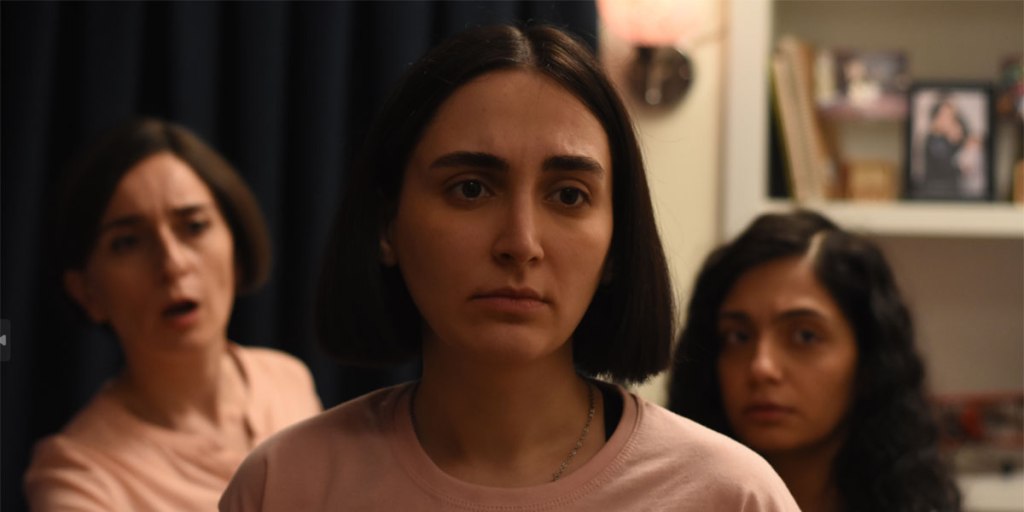
Najmeh (Soheila Golestani) and Iman (Missagh Zareh) are a happily married couple in Tehran. They live out their two daughters, Rezvahn (Mahsa Rostami) and Sana (Setareh Maleki). The kids fight a lot, but the family is still close and trusting; no secrets here. But everything changes once their Dad — a government bureaucrat — gets a promotion. He is issued a gun for protection, due to the nature of his new position. You see, he is now sort of a judge within the Islamic Revolutionary Court. This means convicting and sentencing anyone accused of disobeying religious or political laws, ranging from women who expose their uncovered hair, to anyone caught insulting the Supreme Leader or the government itself. And especially anyone caught at a pro-democracy demonstration.  

But when Rezvahn’s best friend Sadaf gets beaten up at a demo, and they hide her in the apartment they have to keep it from her Dad. Is he responsible for this crackdown? And when his gun disappears, Iman suspects everyone. Has his family turned on him? A wall of distrust divides the family, threatening its very existence. Can they reconcile or is it too late?

The Seed of the Sacred Fig is a powerful and harrowing drama about distrust and betrayal, within a family torn apart by the influence of an authoritarian government on all of their lives. It was shot entirely in Iran, on the sly, by noted director Mohammad Rasoulof who smuggled it out of the country. (It was edited in Germany.)  He fled for obvious reasons: he was sentenced to 8 years in prison, and corporal punishment — that’s whipping — for his film work.

Two thirds of it was shot within a claustrophobic apartment in Tehran, two years ago, right when a women-led, pro-democracy movement was in full swing. The final third was shot outdoors in a spectacularly eerie lunar landscape, shifting in tone from tense psychological drama to a genuine action/thriller. This movie is neither short nor easy to watch, but it is amazing. 

I recommend this one.

The Room Next Door

Co-Wri/Dir: Pedro Almodovar

Ingrid (Julianne Moore) is a successful novelist who lives in New York. At a book signing — her latest one is about her fear of dying — an old acquaintance approaches her. She tells Ingrid that Martha (Tilda Swinton), her old friend from University days, is dying of cancer. Can’t she visit her in hospital? Ingrid hasn’t seen her in decades, though they had been quite close. They even once had a boyfriend in common, Damian (John Turturro). And while Ingrid stayed close to home, Martha (Tilda Swinton) became a renowned war reporter for the NY Times. Her travels took her around the world covering frontline battles in West Africa and the Middle East. They are both happy to see each other again, and Ingrid loves keeping Martha company as she recounts some of her past adventures. 

That is until Martha makes a big request. Her death is inevitable, but she hopes Ingrid will stay with her in the room next door (hence the title) so someone will be around when the inevitable happens. (Ingrid is estranged from her only daughter). And though deathly afraid of death, Ingrid agrees. They move to a gorgeous isolated wood-and-glass  country home. But what will happen next?

The Room Next Door is a touhing, gentle story about two old friends reunited under bittersweet circumstances. Though clearly an Almodovar movie it differs in two ways. This is his first English language feature, and the dialogue seems stilted and clumsy, at least at the very beginning, but interestingly, I stopped noticing it after the first few minutes. Second, the passionate melodrama, the sex, the outrageous humour I expect to see in any Almodovar movie aren’t there. Any conflicts, secrets, betrayals or revelations are few and far between. Instead it is subtle, soft, and gentle. And yet it still clearly is Almodovar’s work. The set design, colour palette, camerawork, the  structure and the music are instantly recognizable. I love the gorgeous, two-coloured wooden lounge chairs by the swimming pool, the clothes they wear, the soundtrack. Almodovar loves long, intricately told flashbacks, and stories within stories like The Arabian Nights. It satisfies your brain and your heart. And Tilda Swinton and Julianne Moore are just right in their roles. 

So in the end, though The Room Next Door was not the Almodovar film I expected to see, it was still satisfying to watch.

The Room Next Door and The Seed of the Sacred Fig are both opening this weekend in Toronto; check your local listings.

This is Daniel Garber at the Movies, each Saturday morning, on CIUT 89.5 FM and on my website culturalmining.com.

Returns. Films reviewed: All We Imagine as Light, The Return PLUS Streaming Sites!

Posted in Feminism, Friendship, Greece, India, Italy, Royalty, soldier, War, Women by CulturalMining.com on December 7, 2024

Hi, this is Daniel Garber at the Movies for culturalmining.com and CIUT 89.5 FM.

As the days grow shorter and colder, people tend to snuggle up at home. I’m here to tell you to get off your collective asses and go see a real movie on a big screen! But I know some of you are going to stay at home so today, I’m going to talk about some of the streaming sites out there you might want to join. And I’m looking two new dramas. A warrior king in ancient Greece returning to his island, and three nurses in Mumbai returning to Kerala.

Streaming Sites

Here are some streaming sites you might want to try.

First the free ones: CBC Gem, Kanopy and Tubi. CBC Gem has ads, but also plays some great docs, including There are no Fakes. You can find Tubi — a commercial site — online, again with irritating ads but a huge selection of middlebrow films. You can check out terrific movies on Kanopy using your library card, but you’re limited to a certain number per month. Britbox and Acorn TV both specialize in British TV series, especially detective mysteries. If you want Miss Marple peeking over your shoulder, this is what you want. Apple TV produces all their own stuff, including Slow Horses and the great Steve McQueen’s new film Blitz. On the other hand, the Apple TV app itself is extremely aggressive — you can only watch full screen and it flips back to the main site every time you navigate away.

If you’re into horror, thriller and the supernatural Shudder is the site for you. It’s exceptionally well-curated, with excellent art-house movies right beside slashers. Paramount+ has a seemingly endless supply of cop and military shows, plus CIA, FBI, firemen, navy, and — count ‘em! — 7 different NCIS spinoffs! Not my thing, but they do land some good movies like Smile 2, playing right now. Crave gives you access to everything HBO makes, as well as Canadian movies you might otherwise miss like the NFB doc Wilfred Buck. Criterion has the rights to some of the best movies of all time, from early Kurosawa to recent releases. MUBI streams new movies likely heading for the Oscars this year, including Maria, Girl with the Needle and The Substance.

And finally Netflix, the grande-dame of all streamers, has the most consistent and sheer quantity of good TV and self-produced movies, like Emilia Perez… but it’s getting way too expensive! They even have a new website called netflixinyourneighbourhood.ca which takes you to

THE MADNESS. The Donut Shop, 617 Parkdale Avenue, Hamilton, Ontario, featured in Episode 107 of The Madness. Cr. Courtesy of Netflix © 2024

locations where their movies are shot: in places like Toronto, Ottawa, Hamilton, Brockville, Dundas and Oshawa!

I still think movies should be seen in theatres but if you’re determined to stay at home, those are some of streaming sites you might want to subscribe to.

All We Imagine as Light
Wri/Dir: Payal Kapadia

It’s present-day Mumbai.
Prabha (Kani Kusruti) is a middle-aged hospital nurse. She is skilled at her job, teaching young trainees how to get over their feelings of revulsion. She spends time with a starry-eyed Doctor Manoj, who writes poems to her, but she is still very much married. Her husband moved to Germany to work in a factory, and he may as well not exist. Prabha shares an apartment with Anu (Divya Prabha), a vivacious young nurse at the same hospital. She likes shopping, fashion and romance, and most of all her secret boyfriend Shiaz (Hridhu Haroon). They’re in love (or at least young lust) but frustrated; it’s hard to find a private space to be together. More than that, she’s Hindu and he’s Muslim, and never the twain shall meet – their families will prevent that. Finally, Parvaty (Chhaya Kadam), an older nurse and a close friend of Prabha’s, is facing eviction from her home. Developers want to tear it down to build a high-rise condo. Since she’s a widow and doesn’t have the proper papers to prove the place is hers, they’re sending goons to her door to kick her out.

For all these reasons the three of them end up back in Kerala, the place of their birth in southwest India. They stay in a beautiful beach town, where the three of them can finally shake off the heavy responsibility and stress of life in that big city. But how long will this last?

All We Imagine as Light is a personal, intimate drama about the lives of three women in Mumbai. It’s notable for a number of reasons. This is director Payal Kapadia’s first feature, and tells her story from a distinctly feminine gaze. It deals with big contemporary political and social issues — like Parvaty attending an angry tenants’ rights meeting — but also the importance of personal friendships among the three woman. In look and style, this film is strictly European cinema verite, about as far from Bollywood as a movie could possibly be. But it is set in Bombay and exults in that city, from the slums to the skyscrapers, with stunning aerial views of rooftop clotheslines and raucous street festivals. There’s amazing footage taken through the window of a fast-moving commuter train. Some scenes have documentary-style unidentified voices, expressing their bittersweet love and hatred for that city that never sleeps, spoken in a plethora of languages: Hindi, Gujarati, Malayalam, and Bengali. I liked this movie for it’s emotions, but found much of it bleak and slow-moving; the story drags you down until it finally shifts from Mumbai to the beaches of Kerala, two-thirds of the way through.

But by the end it redeems itself with an unexpectedly satisfying finish.

All We Imagine as Light has been nominated for Best Foreign Language Film at the Golden Globes.

The Return
Dir: Uberto Pasolini

It’s 1200 BC in ancient Greece, and the island of Ithaca has no ruler. Decades ago, it was a mighty kingdom, ruled by the hero Odysseus — known for his bravery, fighting skills and intelligence. He devised the Trojan Horse and led the army that defeated Troy. But the soldiers — and their leader — never came home, and Ithaca has gone to seed. The queen, Penelope (Juliette Binoche) sits alone in her tower, weaving cloth, as she patiently waits for Odysseus’s return. Their son, Telemachus (Charlie Plummer) doesn’t know his father except from legends. The palace is filled aggressive brutes from abroad, each wanting to marry the widow Penelope so they can take over the kingdom. But is she actually a widow?

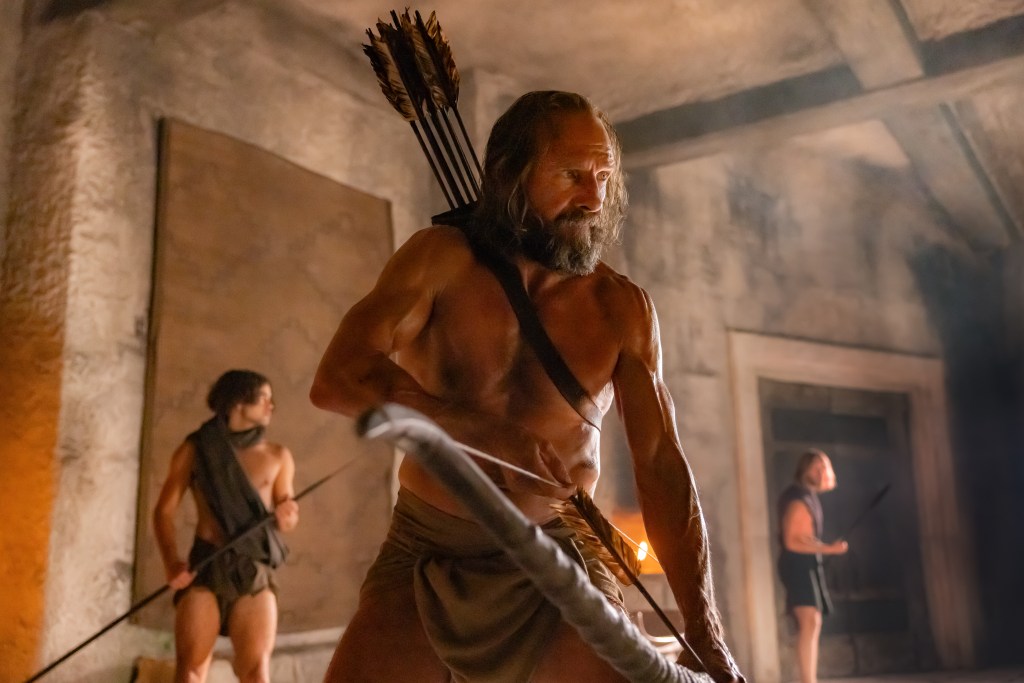
Around this time, the battle-scarred body of a soldier washes up on shore. He’s barely alive, but is nursed back to health by an honest pig farmer named Eumeo (Claudio Santamaria) and his sons. It is of course Odysseus (Ralph Fiennes), but without any uniform or weapon. He’s actually naked. He wraps himself in a blanket and carries a bowl — the clothing of a homeless beggar. And when he approaches the palace, almost no one recognizes him. Only Eurycleia (Ángela Molina), both his and his son Telemachus’s nurse as a child, realizes who

The Return, directed by Uberto Pasolini, with Ralph Fiennes (Odysseus), Juliette Binoche (Penelope), Charlie Plummer (Telemachus), Marwan Kenzari (Antinous), Claudio Santamaria (Eumaeus).

that beggar is. Is he still fit to be king? Can one man, tired and old, confront a bloodthirsty mob of young toughs? And will Penelope ever forgive him for staying away so long?

The Return is a magnificent retelling of a chapter in Homer’s The Odyssey. But it’s not about triumphant heroes; it’s more about the grinding effects war has upon both the victors and the vanquished. It contrasts Odysseus’s shame and self-doubt with Penelope’s eternal fidelity. Yes, this is an ancient greek story, with swords and sandals, but it feels very immediate. Parts of it even resemble a Hollywood action/thriller, with chase scenes and some very bloody fights.

The film was shot among the rocky cliffs of Corfu and the ruins of an ancient castle, which is echoed in the soundtrack. I love the dramatic look and sound of waves crashing on the sharp rocks. Though the women are all wrapped up, most of the male actors are dressed in togas or prancing around half naked, with Ralph Fiennes going full monty at the drop of a hat. I didn’t used to like him much, but after Conclave and now this one, I gotta admit, he’s a really good actor. Juliette Binoche is skillfully understated as Penelope, and Dutch actor Marwan Kenzari is very creepy as Antinous, the threateningly oleaginous suitor closest to Penelope.

The Return is a really good movie.

The Return and All we Imagine as Light is on at the TIFF Lightbox in Toronto; and Standing on the Shoulders of Kitties, A Trailer Park Boys movie featuring Bubbles and his band on tour, is now playing; check your local listings.

This is Daniel Garber at the Movies, each Saturday morning, on CIUT 89.5 FM and on my website culturalmining.com.

Tough Cookies. Films reviewed: Maria, Flow, The G

Posted in 1950s, 1960s, 1970s, Animals, Animation, Corruption, Crime, France, Latvia, Opera, Vengeance, Women by CulturalMining.com on November 30, 2024

Hi, this is Daniel Garber at the Movies for culturalmining.com and CIUT 89.5 FM.

With a rapidly aging population, the traditional image of frightened, little-old cat ladies is gradually shifting to one of strength and cunning. Witness new TV shows like Matlock. So this week I’m looking at two new movies about tough older women and one about a cat. There’s an opera diva in Paris preparing her swan song; a rustbelt widow who wants to go out with a bang; and a cat on a sailboat in a world covered in water.

Maria

Dir: Pablo Larraín (Reviews: Spencer, The Club)

It’s 1977 in Paris, and Maria Callas (Angelina Jolie: Salt, The Tourist, Unbroken) — one of the greatest divas in opera history, is not doing well. She rarely eats, often never leaving the bedroom of her palatial apartments for days at a time. She rarely speaks with anyone anymore, aside from her servants. She runs her butler ragged (Pierfrancesco Favino: The Hummingbird, in a red monkey suit) and she relies on her cook (Alba Rohrwacher: Sworn Virgin, Hungry Hearts, The Ties/Lucci ) for judgement on the quality of her vocal chords. 

But she’s not completely alone. She is seeing a pianist for his unvarnished opinion on whether her legendary “voice” has returned. And has agreed to an unheard-of interview with a young journalist named Mandrax (Kodi Smit-McPhee: The Road, The Congress, The Power of the Dog, Memoir of a Snail). But Maria faces a number of problems. She refuses to see a doctor, despite her rapidly declining health, and she won’t stop popping Quaaludes, leading to frequent hallucinations and delusions. Can her devoted servants save her life? Or is this the end?

Maria is a biopic about the death of a legendary Greek-American diva. The movie begins with her demise at age 53, then goes back in time to show what led up to it. This includes flashbacks to her chubby adolescence in German-occupied Athens in WWII, her failed marriage, and at the peak of career, including trysts with Aristotle  Onassis and JFK. 

But is this biopic any good? I have very mixed feelings about that. I love the beautifully shot interiors, the ostentatious costumes and the amazing arias provided by recordings of Callas herself. Italian actors Rohrwacher and Favino provide wonderfully painful performances. And, as the latest in a series of films about famous woman by Chilean director Pablo Larraín it has good pedigree, especially Spencer (with Kristen Stewart as Princess Diana). But this movie depends on Angeline Jolie, and she doesn’t carry it off. She always seems to be acting. I don’t see Maria Callas here, I see Jolie posing for the camera, with  a haughty face here and a dramatic gestures there; so you rapidly lose sympathy with the main character. Perhaps Maria Callas really did act like that, even behind closed doors, but Jolie plays her somewhere between high camp and kitsch. 

Maria is never boring… just a bit embarrassing. 

Flow

Co-Wri/Dir: Gints Zilbalodis

It’s some time in the future, somewhere in the world. A small grey cat with golden eyes and pointy ears is enjoying a walk in the woods. The cat lives by an abandoned old house surrounded by enormous cat statues. The cat is very shy, and fears, most of all, a pack of feral dogs. Suddenly, there’s a stampede of animals running in one direction, full speed. They‘re trying to avoid a massive flood, sweeping away everything in its path. But cat and a friendly, white dog are among its victims. Survival instinct kicks in and eventually cat manages to climb on board a tattered sailboat. There Cat discovers a gentle, sloth-like capybara already on board. Other animals make their way onto the sailboat, including an ingenious lemur, that big, white dog and a majestic-looking phoenix. Together they form an uneasy friendship as they brave a dangerous water-covered world. But can they learn to get along? And is this world worth living in?

Flow is a brilliantly animated film about a picaresque journey by a mismatched troupe of animals. It’s tender, heart moving and lovely to watch. It’s all about friendship and cooperation learned by animals living in a gently hostile world. And though they behave a tiny bit like humans, there are no people in the story, and no dialogue either; just grunts meows and barks. Dogs still want to fetch. Cats want to catch fish.  

And though it’s post-apocalyptic, there is nothing futuristic in this film; human technology is limited to abandoned ancient cities, glass bottles and sailboats; no cars or smartphones to be seen. The science fiction comes in with its universality, where animals from different continents, along with mythical beasts like sea monsters, can randomly encounter and learn from one another. I just watched Flow, and I already want to see it again.

Flow is Latvia’s Oscar submission for Best International Feature.

The G

Wri/Dir: Karl R. Hearne

It’s a rust-belt city somewhere in North America. Ann Hunter (Dale Dickey) is a tough cookie in her 70s, who is feeling depressed. You can see it  in every wrinkle on her face. She lives with her ailing husband in their fully-owned condo. He was once a tough guy, but is rapidly sliding into immobility and dementia. She grudgingly takes care of him, and drowns her sorrows in rot-gut alcohol straight from the bottle. Aside from him, she only spends time with Emma, step-granddaughter (Romane Denis). Emma models her life on The G (as she calls her grandmother) someone who doesn’t take crap from anyone. The G also helps her out financially, and doles out hardboiled words of wisdom.

But everything changes when a man in a suit  named Rivera (Bruce Ramsay), out of the blue, breaks down The G’s front door, accompanied by two toughs:  Matt (Joey Scarpellino), a handsome but simple-minded gardener; and Ralph, a psychopath with bleach blond hair (Jonathan Koensgen). Together they violently shove Ann and her husband into a van, who wind up locked in a threadbare room without a phone, in a nursing home that feels more like a prison. This is your new home, Rivera says, and there’s nothing you can do to stop me. He’s now their legal guardian and has the documents to prove it; their doctor (a silent partner in the scam) has declared them both incompetent. No one’s allowed to go in or out for the first month. He roughs up her husband to try to find the proverbial pot of gold he thinks they’re hiding. But they underestimate the G, her stubbornness, and her shady connections back in Texas.

Meanwhile, Emma is shocked when she discovers her grandparents have suddenly disappeared, leaving behind just a torn-up home. She scours the city to find them, and makes friends with a caretaker who works at the home (who also happens to be Matt, the friendly thug). It’s too late to save her grandpa but she vows to get the G out of there. And even while Emma is trying to free her, the G has vowed vengeance on all her enemies — and she’s not messing around. Who can they trust? Can two women best a criminal organization? Or will they end up buried alive? 

The G is a great revenge thriller about the very real phenomenon of organized criminals attacking and abusing the elderly. It’s dark and disturbing. Dale Dickey blows this movie out of the water, supported by a good Quebecois cast. (It’s shot in Montreal). If you’re looking for a gratifyingly violent revenge flic, this is the one to see.

Maria and Flow are now playing at the TIFF Lightbox, with Maria streaming on MUBI on December 11th; and The G is opening across Canada; check your local listings.

This is Daniel Garber at the Movies, each Saturday morning, on CIUT 89.5 FM and on my website culturalmining.com.

Trapped. Films reviewed: Captives, Here, Emilia Pèrez

Posted in 1800s, 1950s, 1960s, 1970s, AI, Crime, Family, France, Mental Illness, Mexico, Musical, Tom Hanks, Trans, Women by CulturalMining.com on November 1, 2024

Hi, this is Daniel Garber at the Movies for culturalmining.com and CIUT 89.5 FM.

Toronto Fall Film Festival Season continues with Cinefranco showing  contemporary French language movies from around the world at the Carlton Cinema. But this week, I’m looking at three new movies about traps. There’s a big-hearted woman trapped in a male drug-lord’s body, a French woman trapped in a mental hospital, and a movie camera trapped… in somebody’s living room!

Captives

Co-Wri/Dir: Arnaud des Pallières

It’s Paris in the late 19th century. Fanni Devander (Mélanie Thierry) is an elegant and educated woman searching for her mother. She disappeared when Fanni was just a child, but she has reasons to believe she is locked away somewhere in the city’s mental hospital. So Fanni voluntarily checks herself in to try to find her. Pitié-Salpêtrière is a home for the destitute, people with mental illness, learning disabilities or epilepsy, convicted criminals and even some foundling children. The one common factor is they’re all “undesirables” and all women. But once inside she realizes you can check in, but you can’t check out. It’s a de facto prison, presided over by the Matronly Bobette (Josiane Balasko),  and a hench-woman who would make Nurse Ratchet look like Florence Nightingale. Bobette’s one obsession is to perfectly execute their upcoming ball featuring her patients singing and dancing before a crowd of wealthy patrons. 

Fanni quickly learns the ropes and makes allies with Hersilie, a music teacher (Carole Bouquet)  and a lesbian school teacher with an eating disorder. And she finally meets a nearsighted older woman named Camomile (Yolande Moreau) who just might be her real mother. Can Fanni perform at the ball and safely escape with her supposed mother? Or will they all be stuck there forever? 

Captives is a fascinating historical thriller about the treatment of women in state institutions. It’s harrowing in parts — including scenes of torture — as Fanni navigates class and hierarchy within this enclosed universe. I purposely only mentioned some of the characters and plot turns, because the surprise is what makes it worth watching. But rest assured, it’s full of great acting, pathos, and beautiful period costumes — even within that terrible place.

I like this one.

Here

Dir: Robert Zemeckis (Reviews: Flight, Allied)

Ricky (Tom Hanks) is a teenaged baby boomer living the American dream. His Dad and Mom (Paul Bettany and Kelly Reilly) have lived in a house across the street from Ben Franklin’s historical home since they bought it on the GI Bill after WWII. Now Ricky and his kid brother and sister happily share the place, congregating in the living room for holidays, dinners, or just to watch TV. Ricky wants to be an artist, while his girlfriend Margaret (Robin Wright) dreams of going to law school. Unfortunately, when she gets pregnant while they’re both still in high school, they marry and settle down, still within Ricky (now called Richard’s) parents’ home. Life goes on, and the decades pass, and people are born, live and die. But will they always stay “here” in the same house?

Here is a movie about a place, specifically a living room facing the picture window and the street beyond. The camera never movies. It follows this location not just for Ricky’s family, but also the dinosaurs, the ice age, indigenous people, Ben Franklin, and various couples across the 20th century, constantly jumping back and forth in time. The one constant is the frame, the fourth wall, which never shifts. Picture this: a pop-up square will appear with different furniture and wallpaper in it, taking you to another era, in the style of a virtual staging of a house for sale on a real estate website. Indeed we get to meet real estate agents throughout the twentieth century. Which makes sense because its really about the place, not the meat puppets who wander around in it.

Does this new, experimental concept work?  No!  It’s indescribably awful.

I cannot convey the aesthetic revulsion I felt viewing this horrible non-movie movie. It features a de-aged, 68-year-old Tom Hanks playing himself as a teenager with a fake young teenage face plastered on, but who still talks and walks like the old man he is. What were they thinking?! Here is a tired, platitudinous high-concept exercise in futility disguised as an innovative film. All the characters are painful cliches, including a token black family whose sole purpose seems to be to recite a version of Ta-Nehisi Coates Letter to My Son… to their son.

Keep in mind, Zemeckis is known both for classics like Back to the Future but also unforgivable, semi-animated dreck like Polar Express and Forrest Gump. Here falls neatly into the dreck pile.

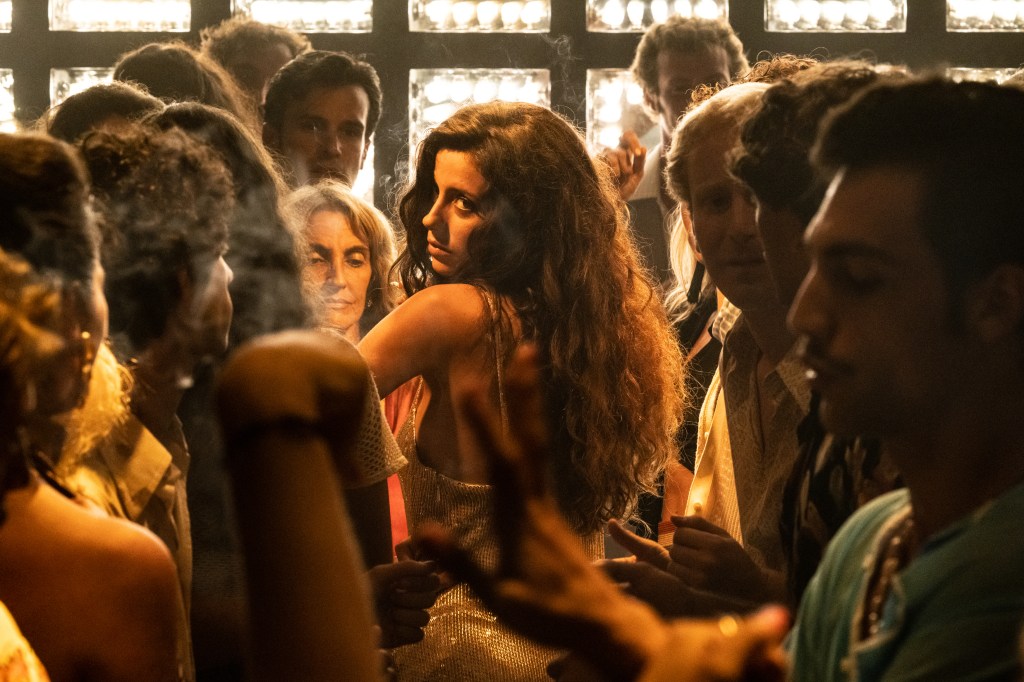
Emilia Pérez

Co-Wri/Dir: Jacques Audiard 

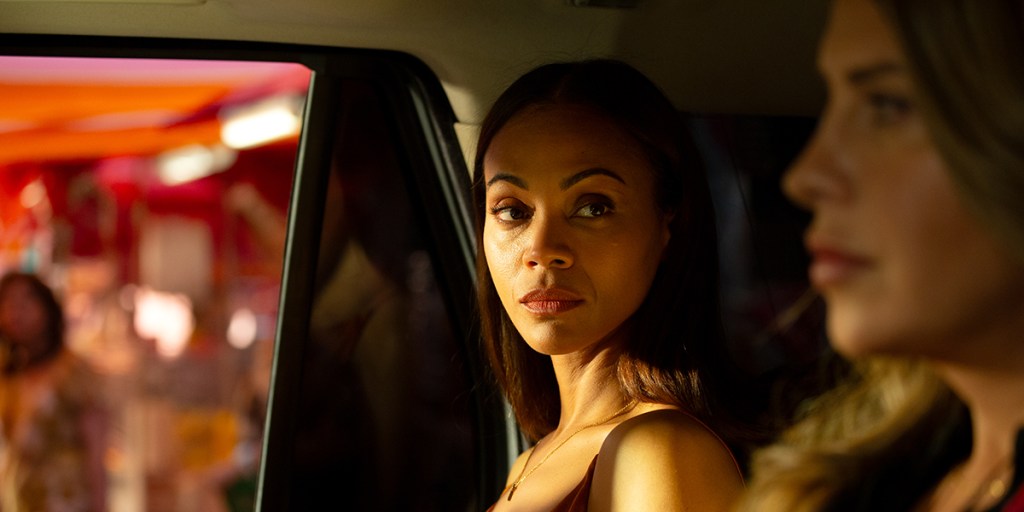
Rita (Zoe Saldaña) is an ambitious young defence lawyer in Mexico City. She spends hours crafting powerful opening statements for trials, but, as a black woman —  originally from the Dominican Republic — she gets none of the credit. But somebody is watching her and appreciates her skill. She finds out who, when she’s kidnapped with a black hood over her head and driven into the middle of the desert. There she meets the notorious head of a huge drug cartel, personally responsible for countless killings. Juan “Manitas” Del Monte, the cartel chief, needs her to help him disappear, in a way no one — including his wife Jessi (Selena Gomez) — will ever find him again.

The twist? This murderous, pock-marked, bearded monster… is trans, and wants to shed the awful male body and face, to live the rest of her life as an attractive woman. She needs someone she can trust to handle all this, both the finances and the surgery, leaving no paper trail. In exchange, Rita will have all the money she needs for the rest of her life, and her own private firm.

Years later, she meets with a potential client, a fabulously rich European woman named Emilia Pèrez (Karla Sofía Gascón). It’s her client from years back, who wants to re-enter the world and be reunited with her beloved family, all of whom think she is dead. And to atone for some of her past sins without revealing who she was. What will happen to these three remarkable women in the next chapter of their lives?

Emilia Pérez is an incredibly passionate and shocking movie. It’s simultaneously an action-thriller, an epic drama, and a musical. Yes, that’s right, a musical, where  characters do break into songs and dances throughout the film. But with its latin beats and shouting crowds, it’s the sort of songs you rarely encounter in a musical.  Zoe Saldaña is amazing as this tough-as-nails lawyer, and Karla Sofía Gascón, a Spanish actress I’ve never seen before, is unmatchable, both as Perez, and as the drug lord Manitas. (She’s a  transwoman herself.) French director Audiard (who previously brought us masterpieces like A Prophet, and Rust and Bone) seems to have no trouble creating a Mexican musical. I gotta say, Netflix churns out a load of content, most of which is forgettable crap, but, every year, they also produce a few really remarkable films. Emilia Pèrez is one of those.

I strongly recommend this movie.

Here and Amelia Perez both open this weekend in Toronto; check your local listings. And Captives is having its English Canada premiere at 8:45 tonight (Saturday, Nov 2, 2024) at Cinefranco at the Carlton.

This is Daniel Garber at the Movies, each Saturday morning, on CIUT 89.5 FM and on my website culturalmining.com.

Daniel Garber talks with Sook-Yin Lee and Dan Beirne about Paying for It

Posted in 1990s, Books, Canada, Comics, Philosophy, Sex, Sex Trade, Toronto, Women by CulturalMining.com on August 24, 2024

Photographs by Jeff Harris

Hi, this is Daniel Garber at the Movies for culturalmining.com and CIUT 89.5 FM.

It’s the late 1990s in Toronto.

Sunny and Chester — a VJ and a cartoonist — live together in a house in Kensington Market. Up to now, they’ve been in a loving, monogamous relationship but their sex-life is kaput. So Sunny suggests they broaden their sexual outlook, and seek new partners.

This leaves a void in Chester’s life: sex. Finding a new girlfriend is out of the question. Dating is costly, time-consuming and rarely leads to sex. So he decides to try a different path. What will happen to Chester’s and Sunny’s lives when he starts “paying for it”?  

Paying for It is a new film about sex work and relationships, told from the point of view of the John. It’s brilliant, shocking, hilarious and touching. Based on Chester Brown’s graphic novel by the same name, it’s directed and co-written by Sook-Yin Lee. The film stars Dan Beirne as Chester and Emily Lê as Sunny. Dan is a prolific Canadian TV and film actor who is also one of the funniest and most underrated actors working today. Dan has starred in countless TV shows and movies including Great Great Great and The Twentieth Century. The multi-talented Sook-Yin is a producer, director, actor, and musician who began as a VJ on MuchMusic, and went on to direct films like Octavio is Dead, and starring in pictures like Shortbus.

Paying for It is having its world premiere at TIFF on Friday, September 6th at 930 PM.

I spoke with Sook-Yin Lee and Dan Beirne in-person and in-studio at CIUT 89.5 FM.

Journeys. Films reviewed: The Fabulous Four, Doubles, Crossing

Posted in Canada, Friendship, Georgia, Migrants, Sex Trade, Trans, Turkey, Women by CulturalMining.com on July 27, 2024

Hi, this is Daniel Garber at the Movies for culturalmining.com and CIUT 89.5 FM.

Picture this: you’re watching a big-screen movie with your friends, but you’re sitting on the grass, not in a theatre. Huh? The Toronto Outdoor Picture Show (TOPS) lets you watch really great movies for free under the stars in parks across the city, in Fort York, the Corktown Commons, The Christie Pits and Bell Manor Park. Featured movies include Wim Wenders’ Perfect Days, Boots Riley’s Sorry to Bother You, and Stephen Soderbergh’s Out of Sight, to name just three. And there’s the Toronto Palestine Film Fest, showing a free film on August 9th at the Christie Pits — with music, food and items for sale by local artisans followed by an outdoor screening of Alam, The Flag, directed by Firas Khoury.

But this week, I’m looking at three new movies about journeys. We’ve got four old college friends heading to Key West for a wedding, a Trinidadian flying to Toronto in search of his long-gone father; and a retired woman with a teenaged boy in Georgia going to Istanbul in search of a missing girl.

The Fabulous Four

Dir: Jocelyn Moorhouse

Marilyn, Lou, Alice and Kitty, are friends from university, who have stayed close — though separate — for over half a century. Now they are back together again, face to face in quaint Key West, Florida. Marilyn (Bette Midler) a flamboyant homemaker, is getting remarried there;  her long-time husband died just a few months earlier. Her adult daughter is opting out; she thinks it’s too soon. Lou (Susan Sarandon), never married, who has devoted her life instead to her career as an accomplished surgeon. She’s earnest, stubborn and moralistic. When she’s not at the hospital, she’s probably playing with her beloved cats or reading a novel by Hemingway. Kitty (Sheryl Lee Ralph) is a successful cannabis grower and manufacturer, known for her powerful edibles. But she’s had a falling out with her daughter who joined a religious sect that strictly forbids sex, drugs and rock’n’roll. She wants Kitty to move into an old-age home. Finally, Alice (Megan Mullally), a successful recording artist, is an unapologetically free spirit. Like Lou, she never married, but unlike the uptight surgeon, Alice will bed any man she fancies — or as her friends describe her, she’s a postmenopausal wolf in heat. But there is tension among the four. Marilyn and Lou have been feuding since they were roommates in a Manhattan apartment after graduating. Kitty and Alice had to trick Lou into coming — she doesn’t even know about Marilyn’s wedding. 

But things get better after a few days in Key West. The formerly sullen Lou is glowing now after a random encounter with a local bar owner named Ted (Bruce Greenwood). And the four of them have fun on boat rides, paragliding and exploring the restaurants and bars. But tension still remains between Marilyn and Lou, that threaten the wedding itself. What is their fight about? Why has it lasted so long? And can it be resolved?

The Fabulous Four is a comedy about a reunion of four aging women who get together for their last big blast. It’s goofy and a bit campy. The plot is paint-by-numbers with very few surprises. The drunk or stoned jokes are tired, but there are a few funny bits: like Lou taking down a bicycle thief using a sex toy. But it gets bogged down with predictable, age-related gags about incontinence and old people not knowing what TikTok is. So lots of eyerolling and a bit of cringiness, but luckily no  extreme humiliation. And I was never bored — how could I be, with Susan Sarandon and Bette Midler in the same movie? It’s written and directed by women, which might explain why there was more niceness and less outrageousness than your average teen comedy.

Doubles

Wri/Dir: Ian Harnarine 

Dhani (Sanjiv Boodhu) operates a doubles stand with his mother in Trinidad. (Doubles are snacks made of curried chana between two pieces of soft yellow fried bread.) Times are hard, and they really need more money. But their property is all in his dad’s name. He moved to Canada many years ago to advance his career, and never came back. Now he’s a rich man, a successful chef who owns a fancy restaurant and a big house, while his family back home is still struggling to get by. So Dhani buys a ticket and flies to Toronto for a week to work out the financials. But his mother stresses, don’t be like your father — he’s probably living with some other woman. Come right back.

But when he arrives on a cold winter day, he discovers it’s nothing like he expected. He visits his father, Ragbir (Errol Sitahal) at his Caribbean restaurant.  Turns out he’s not the chef, he’s the dishwasher. He lives in a small house without any luxuries. And he meets Anita (Rashaana Cumberbatch) a greeter at the restaurant. She calls him her brother from another mother — a half sister he never knew about. And the biggest surprise: Ragbir is dying of cancer and needs a bone-marrow donor to save his life. Can Dhani accept his father’s unexpected condition? And is he willing to donate the needed bone marrow?

Doubles is a poignant drama about father-son relationships and the immigrant experience. It’s a rough story, harrowing at parts, especially as the father’s health declines (in a great portrayal by Errol Sitahal.) Visually, I found the movie very drab and plain looking — the locations, people, places — in both Trinidad and Toronto. I assume that’s intentional, but it amounts to the opposite of eye candy. At the same time, the characters and story seem sad but real, and it’s the first time I’ve seen Trinidadians explicitly portrayed in a Canadian movie before. And — no spoilers — despite the heavy topics, the film does close on a happier note. And it’s being released theatrically just in time for Caribana!

Crossing

Wri/Dir: Levan Akin

Achi (Lucas Kankava) is a young layabout in a beachside house by the Black Sea in Georgia, not far from the Turkish border. He lives with his abusive brother, his sister-in-law and their crying baby. He wants to move somewhere far away but he’s unemployed and flat broke. Ms. Lia (Mzia Arabuli) is a dignified, retired school teacher from the same village. She’s looking for her beloved niece, Tekla. She hasn’t seen her in many years, but is knocking on doors to find her, and apologize for something she did way back when. His brother claims he’s never heard of her, but Achi jumps at the chance to talk with Ms Lia. He says he remembers Tekla, a transwoman who lived in the place a few doors down. But she moved to Istanbul and gave him her address before she left. He offers to take her there and even do a bit of translating. With some reservations, she agrees, and buys their tickets. When they arrive they are both impressed by the city’s grandeur and beauty. And with the help of two street urchins, he finds the place in the red light district she’s supposed to be working at. But she’s not there, and no one has heard of her. Lia becomes increasingly anxious about locating Tekla, even as friction builds between Lia and Achi as he looks for ways to live in the new city and earn a living.

At the same time all this is going on, Evrim, a young woman (Deniz Dumanli) is following her own path. She works at a social welfare NGO called Pink Life, where she helps needy LGBT and other people in that area. She’s also passing through the byzantine legal process of transitioning her gender. As a transwoman, she is often harassed as a sex worker, but she’s actually an accredited lawyer, one of the few people who know how to confront the police when they overstep their bounds. 

Lia and Achi eventually meet up with Evrim to try to locate Tekla. What will Lia do if she finds her? Will Achi stay in Istanbul if Lia returns to Georgia? And what about Evrim?

Crossing is an amazing adventure and drama following the lives of an unusual group of people navigating their way through the underbelly of of Istanbul’s culture. It’s a coming of age film about kinship and discovery. Great acting, beautiful cinematography and an excellent script. We get to see their encounters with the people they meet — Evrim on the street, Achi in a nightclub, and Lia in the night market. The characters are fascinating and multifaceted, revealing their hidden histories as the story progresses. At the same time, it’s a total tearjerker, with a number of deeply-moving scenes. 

Interestingly, Crossing is only the second Georgian movie I’ve ever seen, and — surprise! — its by the same filmmaker, Swedish-born Georgian director Levan Akin (And Then We Danced).

I strongly recommend this movie.

The Fabulous Four and Doubles open in Toronto this weekend with Crossing playing at the TIFF Lightbox; check your local listings. This is Daniel Garber at the Movies, each Saturday morning, on CIUT 89.5 FM and on my website www.culturalmining.com.

Through the grapevine. Films reviewed: Twisters, Widow Clicquot

Posted in 1800s, Action, Climate Change, Disaster, Feminism, France, Thriller, Tornadoes, Women by CulturalMining.com on July 20, 2024

Hi, this is Daniel Garber at the Movies for culturalmining.com and CIUT 89.5 FM.

Is your headspace being dominated by thoughts of politics and elections? If so, you need some distractions! I’ve got just the thing for a hot day like today. This week, I’m looking at two new summer movies — an historical drama and a disaster-thriller — both about strong women. There’s a widow who risks the wrath of grapes, and a meteorologist who throws caution to the wind.

Twisters

Dir: Lee Isaac Chung (Review: Minari)

Kate (Daisy Edgar-Jones) is a meteorologist. Not the weatherman who writes numbers on a green screen on your local TV news; she’s the real thing, with an important job at a government bureau in New York City. So what is she doing in Oklahoma? The state is facing an unusual number of major tornadoes all at once. She was invited down there by Javi (Anthony Ramos), an old classmate and study-buddy who worked with her on her experiment involving using polymers to stop tornadoes. But the experiment went wrong, killing the rest of their team, thus taking away any desire she once had to chase tornadoes. And yet here she is back in Oklahoma. She’s lending a hand to Javi’s corporate sponsors, who supply shiny white SUVs in exchange for some crucial tornado info. 

But she faces severe competition. The place is swarming with adventure seekers, journalists and  tourists. Tyler (Glenn Powell) is a cowboy huckster — a self-described “Tornado Wrangler” — who sells T-shirts and coffee mugs with his own grinning face on them. He’s a “chaser”, someone who seeks out tornadoes and gets as close to them as he can without being sucked away. His gimmick is to shoot fireworks up into tornadoes as they pass by. Looks great on YouTube… He drives a souped-up red jeep, and speeds ahead of Javi’s white vans. But Kate is in a league all her own. She can look at a dandelion and predict, with amazing accuracy, which way the next tornado is coming.  And Tyler starts to take note. Who should Kate side with — serious Javi, or aw-shucks Tyler? And will any of them survive the big storm on the horizon?

Twisters is a thriller  disaster movie about… well, tornadoes and the people who chase them. That’s most of the movie. It’s kind of a sequel to the movie Twister (1996) but shares none of the same characters, actors, or plot lines, except that they’re both about tornado chasers. There’s definite electricity between Kate and Tyler —  Glenn Powell is brimming with charisma, and the appealing Englishwoman Daisy Edgar-Jones plays a credible American (though not much off an Oklahoman) — but those sparks never catch fire. If you’re expecting love, lust or sex, you chose the wrong movie. There’s not even a single kiss here. What you do get is amazing special effects: collapsing water towers, exploding oil refineries, roofs torn off buildings, streetcars running off their tracks…and lots sandlots of people holding onto something solid to avoid being swept away.  I don’t know about you, but I really like disaster movies. Who needs a plot when you get to watch the world collapse?

Widow Clicquot

Dir: Thomas Napper

It’s the early 1800s in Napoleonic France. Madame Barbe-Nicole Ponsardin Clicquot (Haley Bennet) is a wealthy aristocrat from Champagne. In her early twenties she is married off to the equally rich François Clicquot (Tom Sturridge) who inherited vast vineyards. Although she dislikes him at first — he is somewhere between eccentric and crazy — she grows to love his childlike, playful exuberance. The guy has tousled hair and wears diaphanous pirate shirts, while Madame dresses in breezy white blouses. Soon he has her singing to grape vines, too. When she’s not  in the vineyards, she’s in her laboratory studying wine sediment in beakers and test tubes.  But  eventually his eccentricity turns erratic, sometimes  slipping into accidental violence. Madame sends their daughter off to the Abbee, but by their 6th year together, he is dead.

Now she’s a widow, and heir to the estate, but the trustees have never heard of a woman vintner. They offer her a fair settlement and tell her to take the money and run. Never!, cries widow Clicquot. These vines, this terroir it’s Francois’ soul! And she feels personally attached to it, too. But everything goes wrong. They buy cheap glass bottles which explode. And selling wine across borders is a no-no during the Napoleonic wars. She turns to Louis (Sam Riley) a wine salesman, for help. She needs to get her latest concoction — a dry pink wine with tiny bubbles — to the market. It’s the only thing that can save her grapes and the chateau she lives in. But will her new type of wine ever catch on?

Widow Clicquot is a historical drama filled with the expected stories: passionately swooning lovers, double-crossing colleagues, floppy hair and costumes and verdant green valleys. It’s also about a rich woman who dares to fights the system. Not all that much happens in this movie which makes it drag in the middle. Tom Sturridge is ridiculous as the flakey husband, Haley Bennet is better though still stiff, as Madame, and Sam Riley as the travelling salesman is the best of those three. I was dreading a total corporate kiss-ass for the famous champagne maker, but it wasn’t that way at all. It’s based on a book that portrays her as a determined woman, despite her flaws, so two points for that. It’s not a spoiler that she is the famous Veuve Clicquot who basically invented modern champagne. And I liked the historical aspects.

Widow Clicquot is not a great movie, but lubricate yourself with enough flutes of Veuve and you won’t really care.

Widow Clicquot and Twisters both open this weekend in Toronto; check your local listings.

This is Daniel Garber at the Movies, each Saturday morning, on CIUT 89.5 FM and on my website culturalmining.com.

Born, reborn. Films reviewed: Spark, Wilfred Buck, Babes

Posted in Breasts, comedy, Indigenous, Inside Out, LGBT, New York City, Science, Science Fiction, Time Travel, Winnipeg, Women by CulturalMining.com on May 25, 2024

Hi, this is Daniel Garber at the Movies for culturalmining.com and CIUT 89.5 FM.

Toronto’s Spring Festival season continues with TJFF, the Toronto Jewish Film Festival, starting on May 30th. I haven’t seen any of the films yet but some of them look really interesting:  The Catskills, a doc about the heyday of borscht belt comics; Just Now Jeffrey, a coming-of-age comedy set during the last days of Apartheid South Africa; The Goldman Case, an historical chronicle of a French revolutionary; The Anarchist Lunch, a doc about the 30 year-long friendship of a group of Vancouver leftists; and Midas Man, a biopic about Brian Epstein, the man who made the Beatles into stars.

But this week I’m looking at three new features, two directed by first timers and one by an accomplished pro.  There are two women preparing for births, a man who sees the same day constantly reborn, and another man who passes his knowledge on to the next generation. 

Spark
Wri/Dir: Nicholas Giuricich

Aaron (Theo Germaine) is a young artist who lives with his platonic roommate Dani (Vico Ortiz). He’s single and on the prowl, looking for a lover, but with not much luck. So he is intrigued when he gets a mysterious invitation in a red envelope.  A friend of his is planning a big party and she want to match up some of her friends before they arrive. So Aaron drives to the appointed place. He’s an artist at heart and draws little sketches on post-it notes to lead his potentially perfect match to his car. He is pleased to meet Trevor (three-time Olympic medalist Danell Leyva) a swarthy and smouldering athlete. In an otherwise empty house they tenuously chat, take a selfie, and pour a couple Old Fashioneds. Aaron is smitten, Trevor less so. But sparks do fly, and they wind up having passionate sex. But just at the point of climax… Aaron wakes up, groggy headed, and back in his own bed. Was that all a dream? But when Dani repeats the same things they had said the day before, and his publisher calls again for his drawings which he had sent him yesterday, he realizes something: it’s as if that day never happened. In fact, it’s the same day. He goes through the steps again, with Trevor, this time trying to fix his past mistakes, but to no avail — he’s back in his home, in a flash, right after sex. He repeats this date, over and over, testing out tiny changes to see how they might effect him or Trevor’s reactions, but no luck. Is he doing something wrong? What can he change to fix things? Or is he trapped in a never-ending cosmic sex loop.

Spark is a queer fantasy drama about a man caught in the never-ending cycle of a repeated day. I like these kinds of movies, from Groundhog Day to Russian Doll, where people are caught in a time warp. It’s also “queer” in that it’s about a gay relationship of sorts, between Aaron a gay transman who desires Trevor, presumably a gay cis man. And this is where it gets even more interesting. First that Aaron’s gender and his sexuality are never mentioned by anyone in the film; they don’t need explanation — they’re accepted as given. And Aaron is played by a non-binary actor, Theo Germaine, who was also a terrific — though very different character — in the TV series The Politician. Dani is played a non-binary performer as well. Perhaps in some future world this will be commonplace, but for now at least this is rare in its casually deft handling of identity, gender and sexuality within a science fiction milieu.

Very good first feature.

Wilfred Buck 

Wri/Dir: Lisa Jackson

Wilfred Buck is an indigenous astronomer, educator and writer. He was born in the Opaskwayak Cree Nation in Northern Manitoba, near the Saskatchewan border. As a child he learned the thrill of the hunt with his friends, fishing at a nearby lake. As a young man, he made his way south to Winnipeg, where he was jailed almost immediately. In the 1960s, he fell in with a bad crowd, there. He liked the music, the drugs and alcohol a little too much, and ended up living on the streets, a self-described liar, thief and drug dealer.  He was harassed, beaten up and almost drowned left to die in icy waters. But things started to change when he was taken under the wing of elders from his first nation and educated about his culture. He learned about rocks and nature, participated in a pow wow, and gradually learned about preparing crucial ceremonies like the Sun Dance: how to build a sweat lodge, and when to present tobacco.  And he learned to look up into the night sky and understand the stars there. He became a knowledge keeper and an astronomer telling stories of what the constellations are, where the stars point and what they mean.

I grew up loving trips to the planetarium where the astronomer pointed out the three stars of Orion’s belt, or the chair-shaped throne of Cassiopeia. I took it for granted that they were discovered and named by the ancient Greeks and were accompanied by their stories. But what I didn’t know was that there are whole other constellations up there with their own stories attached to them. Wilfred Buck has devoted his life to passing on this knowledge of the skies to a new generation.

Wilfred Buck is a beautiful retelling of this charismatic man’s life story, partly narrated, partly reenacted, partly composed of period footage.  Actors recreate  the four stages of his life. All this is combined with the man himself pointing out gorgeous images in the night skies and on a planetarium dome. This story is both inspiring and invaluable as Buck passes on his knowledge to new generations. 

Babes

Dir: Pamela Adlon 

It’s early morning on Thanksgiving Day in New York City. Eden and Dawn (Ilana Glazer, Michelle Buteau) are meeting in Greenwich Village for a movie. It’s a tradition, one the best friends have kept for decades, ever since they were neighbours in Astoria, Queens. Eden, a yoga teacher, still lives there but Dawn is a dentist now, married with a kid and lives in a fancy brownstone in the Upper West Side. And she’s 9 months pregnant. But their tradition changes suddenly when her water breaks. To make sure it’s a birth to remember Eden sets out to buy her the most luxurious and expensive sushi ever… but is turned away from the hospital. Instead she shares it with a stranger in a red tux she meets in the subway. She ends up sleeping with Claude (Stephan James) and a few months later, she’s pregnant! He’s out of the picture, but she can’t wait to see her experience through from now till birth with her besty Dawn by her side. But how much time can a married mom with a full-time job, a 3 year old, and a crying newborn devote to her friend?

Babes is a comedy about how two friends deal with pregnancy and giving birth. It’s funny, surprising and audacious. It looks at morning sickness, amniocentesis, labour, placentas, lactation, breastfeeding, daycare, and everything — I mean everything — else, in an entirely new way. But it’s mainly just funny schtick, both in dialogue and their whole-body style of acting. The lines are clever and twisted, with virtually nothing I can repeat verbatim on daytime radio. I was laughing my head off, especially in the first half hour. And the bawdy acting — things like Dawn on mushrooms shooting imaginary jets of breast milk across the room, or Eden crawling between Dawn’s legs to see how dilated her vagina looks — is just brilliant. They’re both former standup and sketch comics — Ilana Glazer is known for Broad City, Michelle Buteau for Survival of the Thickest  — and with their totally different body types, size and ethnicity, they play off each other with a sort of sloppy synchronicity. Not every gag works, and the serious parts of the story are less interesting than the funny ones. It’s also loaded with scatological references, way too many for my taste, but at least they talk about their bowel movements rather than showing them. And the men serve mainly as sidekicks — this is a women’s movie. Does’t matter; the side roles, from Elena Ouspenskaia as a doula, to Susanna Guzman as a babysitter, there are a couple dozen great characters. 

Babes knows how to work it just fine.

Wilfred Buck now playing at the Hot Docs cinema in Toronto; Spark had its world premiere last night at the Inside Out Film Festival; and Babes opens this weekend at the TIFF Lightbox in Toronto; check your local listings. 

This is Daniel Garber at the Movies, each Saturday morning, on CIUT 89.5 FM and on my website culturalmining.com.