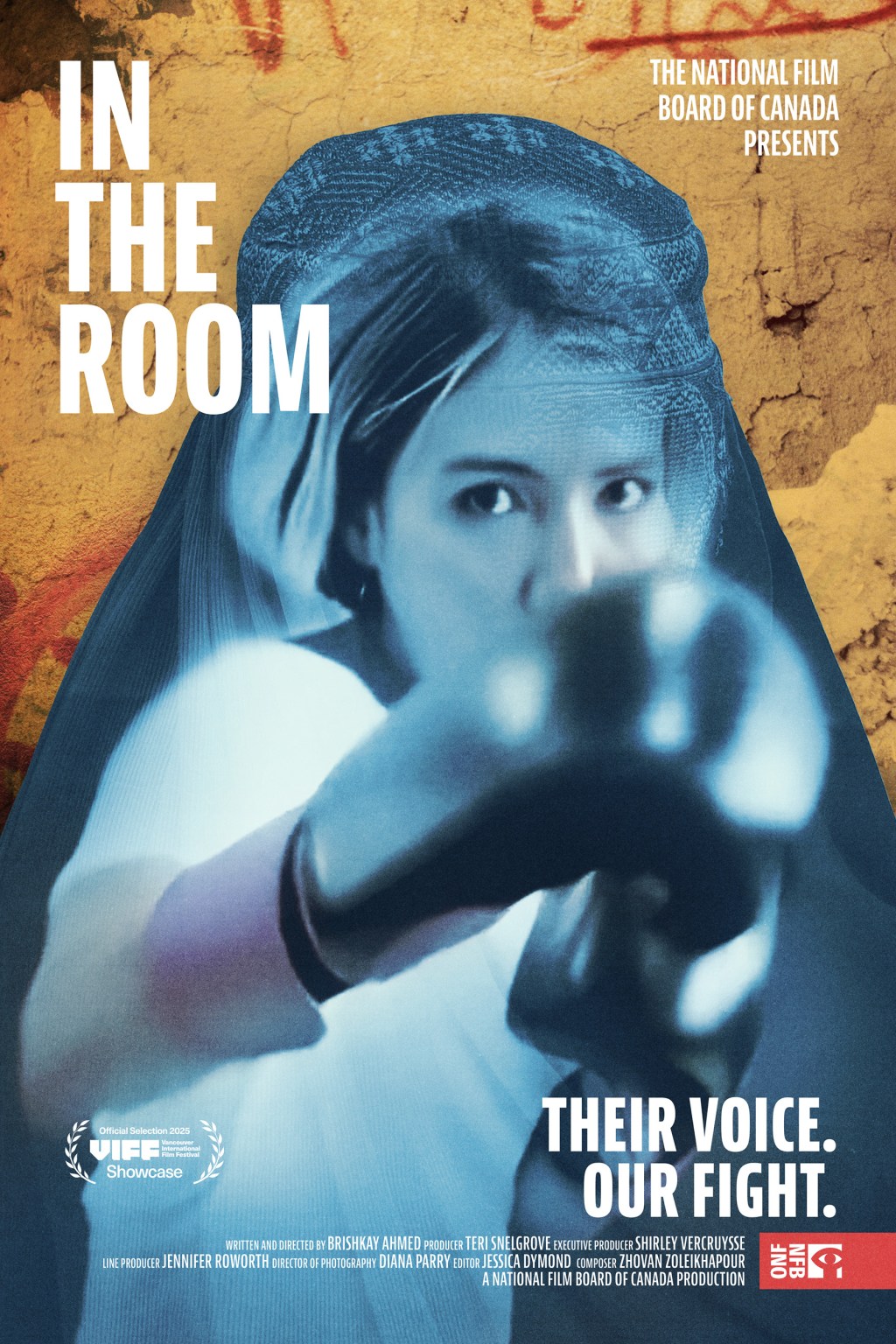
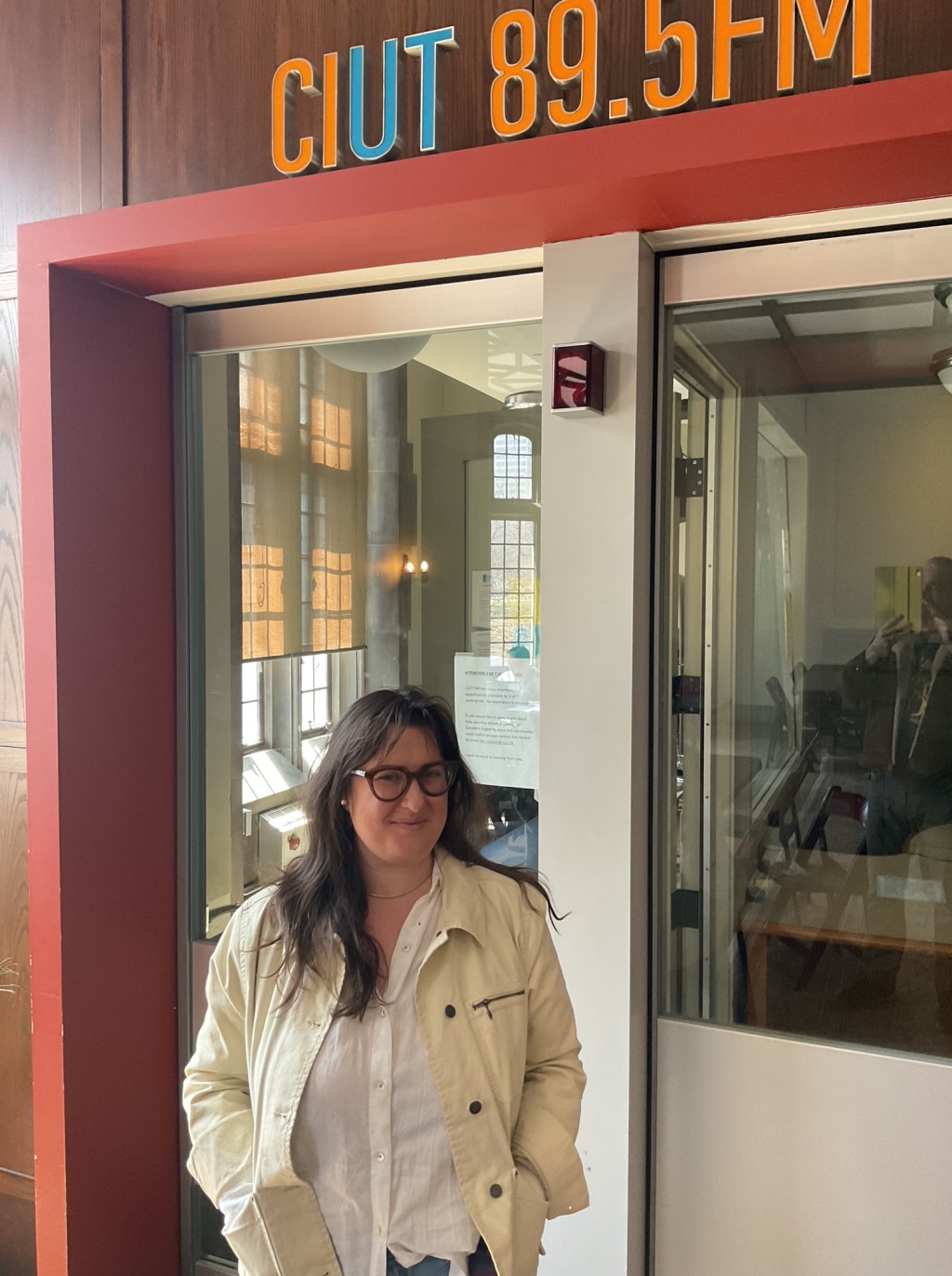
Daniel Garber talks with Brishkay Ahmed about In the Room
Hi, this is Daniel Garber at the Movies for culturalmining.com and CIUT 89.5 FM.
It’s August, 2021 in Kabul Afghanistan. The Taliban is at the city gates and large crowds are congregating at the airport. Some manage to get out, but the women who remain face unheard of restrictions imposed by the Taliban. Restrictions in dress, education, work and general daily life: there’s no school after grade 6, women barred from universities, government work and from most professions, along with freedom of speech, expression, and even congregating in
public… leaving some women virtually locked away in their rooms.
In the Room is a new NFB documentary about a group of dynamic ex-pat Afghan women who don’t fit neatly into their stereotypes. We meet a model, a TV news chief, an influencer and an actor and activist, in this unusual doc. The film is by noted Canadian documentarian Brishkay Ahmed whose work has frequently taken her back to the country of her birth. She’s known for her films In the Rumbling Belly of Motherland, Story of Burqa. The film won the Audience Award Showcase at its premiere at VIFF in Vancouver and played at the Reelworld film festival Toronto.
I spoke with Brishkay in Vancouver via Zoom.
Beginning on Tuesday, November 25, the National Film Board of Canada (NFB) will release In The Room for free streaming across the country on nfb.ca and the NFB app.
Outstanding, great… or just ugly? Films reviewed: Eleanor the Great, Out Standing, The Ugly
Hi, this is Daniel Garber at the Movies for culturalmining.com and CIUT 89.5 FM.
Toronto Palestine Film Festival is on right now, with movies, shorts and docs by and about Palestinians, as well music, cuisine and art to share with other Canadians. This is it’s 17th year and it’s never been more relevant, so check it out.
But this week, I’m looking at three new movies that premiered at TIFF and are all opening theatrically this weekend. There’s an elderly woman who tells a lie, a woman with an “ugly” face who disappears without a trace, and a female officer in the Canadian Army who wishes a certain photo would just go away.
Eleanor the Great
Dir: Scarlett Johansson
Eleanor Morganstein (June Squibb) is a grandmother in her 90s. Since her husband died ten years back, she has shared her Florida condo with her best friend Bessie whom she’s known for 70 years. They do everything together, and work well as a team. Where Bessie is timid, Eleanor is brash and outspoken. If there’s something Bessie wants, Eleanor knows how to get it, even if it involves telling a few fibs. She has chutzpah to spare. But when Bessie suddenly dies, she realizes there’s no reason to stick around, so she packs up her stuff and flies back to New York for the first time in decades. She’s staying with her daughter Lisa (Jessica Hecht) and her grandson Max (Will Price). She’s hoping for some quality time but Lisa’s a worrywart and Max is always busy at school. So she takes up her daughter’s offer to attend some classes at the JCC she signed her up for; maybe she’ll make some friends. The first class is a washout — broadway musicals — so she wanders into another group almost by accident. It’s a support group for Holocaust survivors, and the members urge Eleanor — as a newcomer — to tell her story. She’s not a holocaust survivor, but her best friend Bessie was… and she knows all her memories, especially the death of her brother. So, in deference to Bessie, she tells them to the group as if they’re her own. Why not, right? It goes over well… a bit too well, actually. A teenaged college student Nina (Erin Kellyman) is auditing the group and soon bonds with Eleanor (her mom recently died and her dad is distant and
withdrawn.) The two women bond and start sharing intimate stories.
Nina is in a journalism class, and wants to make a video of her telling her holocaust memories as part of an assignment. Then things get really out of hand: Nina’s dad (Chiwetel Ejiofor) happens to be a popular TV news journalist… and he wants to make Eleanor his next feature. But what will happen to her friendship with Nina — never mind her own family — once the truth inevitably comes out?
Eleanor the Great is a nice, light movie-of-the-week-type drama about death, mourning, and inter-generational relations. It’s a very simple and easy movie, part comedy, part weeper. What’s good about it is the acting. June Squibb — who really is in her 90s — is great as the energetic, down-home Eleanor. (She played another rebellious granny in last year’s hit Thelma.) This is Scarlett Johansson’s first time as a director, and luckily she doesn’t bite off more than she can chew. She concentrates on characters — Squibb and Kellyman are both great in their roles — more than the basic story. And you know what? That’s good enough.
I wouldn’t call Eleanor the Great great, but it’s worth the watch.
Out Standing
Co-Wri/Dir: Mélanie Charbonneau
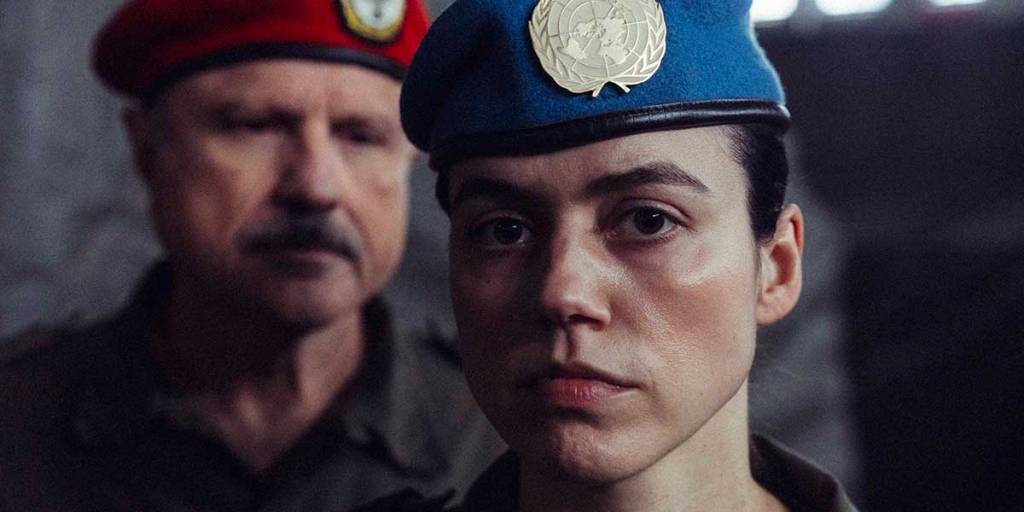
It’s the 1990s, and Captain Perron is leading a troop of UN peacekeeping forces in the former Yugoslavia. Why is this unusual? Sandra Perron (Nina Kiri) is a Canadian woman, the first to lead a squad of infantry soldiers in combat, and the first female to serve in the prestigious 22nd division, known as the Van Doos. Raised as an army brat in bases across Canada, she comes from a long line of soldiers, so it makes sense that she is following in her father’s vocation. She trained as a cadet and received commendations while still a teenager. And she’s the first woman to survive the brutal training that squadron demands. But there’s a photo circulating from her past that’s threatening to derail her military career. It’s a picture of her tied to a tree, barefoot, in the snow and semiconscious.
It was part of her training in a Prisoner of War exercise that went far beyond the normal treatment soldiers are forced to endure. A Canadian woman facing treatment tantamount to torture at CFB Gagetown in New Brunswick. But Captain Perron isn’t the one who released the photo, one fact she didn’t want the photo circulated. She had endured years of hazing bullying, harassment, obscene phone calls, sabotage to her kit, and a hidden campaign by certain officers to get rid of her. They detest the idea of serving alongside or under the command of a woman. And unlike the other women who
attempted to to join the Van Doos, she alone managed to survive and not quit.
Out Standing is a biopic about a trailblazing woman in the Canadian Armed Forces. It’s both moving and disturbing. The title, based on her memoirs, refers both to her achievements and to the notorious photo of her standing tied to a tree. (That pic was eventually published by the press, triggering a wave of shock and disgust across the country, and, one hopes, an improvement in how women are treated in the military.) Nina Kiri gives an excellent performance, totally believable as Perron.
While Hollywood churns out dozens of war movies each year, showcasing the latest weapons and fighter planes, you rarely see a Canadian one. This one is full of details carefully chosen to distinguish how soldiers behave here. The military culture is quite different. Unlike in the US there’s no Sir-yes-sir! And instead of saluting a Canadian soldier stand sharply at attention. I never knew this because you never see it in movies. For this alone it’s a eye-opener. The film is not perfect — there’s a particularly clumsy scene near the end — but altogether it’s a compelling and disturbing look at a Canadian woman’s life in the military.
The Ugly
Wri/Dir: Yeon Sang-ho (Peninsula, Train to Busan)
Lim Yeon-gyu (Kwon Hae-hyo) is a well-known carver of dojang, the name stamps used in Korea like a signature on official documents. He built up his business from scratch while raising his son as a single parent. (His wife ran away soon after the baby was born.) He trained his son Lim Dong-hwan (Park Jeong-min) in every aspect of the craft. Now an adult he is taking over the family business. At this moment, a documentary filmmaker (HAN Ji-hyeon) is celebrating this dad’s life as a national treasure. Why did she choose this man for her documentary? He’s been blind since birth, which makes his many accomplishments even more impressive. But filming is put on hold when a surprise announcement arrives. They’ve found Dong-hwan’s mother decades after she disappeared. Turns out she’s been dead all that time and only her bones remain. This comes as a total shock to Dong-hwan, and it just gets worse.
First his mother’s long lost relatives arrive for the funeral but they’re despicable people who just want to make sure he doesn’t claim any family inheritance.They bullied and beat his mother, a veritable Cinderella raised by this cruel family. It’s also the first time he hears his mother described as ugly. Ugly how? He longs to see a photo of her, something to display at the funeral, but there are no photos anywhere. Of course his blind father doesn’t have one. While Dong-hwan is trying to process all this new information, the filmmaker leaps on it as a great story and insists on continuing the documentary but with a new twist: who killed his mom and why? Together, over a series of interviews with hidden cameras, they uncover
events and people from her past as the tragic puzzle gradually falls into place.
The Ugly is a mystery about a kind-hearted woman — the main character’s mother — and how she is horribly treated because of her looks. It’s a heart wrenching story, a dark, bleak view of humanity with only Dong-hwan (and his mother) as redeeming characters. The story is told as a series of interviews with the various characters and extended flashbacks to what actually happened (The actor who plays Dong-hwa also plays his blind father as a young man in the flashbacks, while Jung Young-hee plays his mother, but always from behind or from the side, without ever revealing her face). In Yeon Sang-ho’s previous movies (Peninsula, Train to Busan) the action hero is surrounded by mutants or zombies or killers. The Ugly is about normal people but they’re just as hideous.
The Ugly is a powerful and dark look at human cruelty and physical beauty.
Eleanor the Great, Out Standing and the Ugly all open this weekend in Toronto; check your local listings. This is Daniel Garber at the Movies, each Saturday morning, on CIUT 89.5 FM and on my website culturalmining.com.
TIFF gems. Films reviewed: Girl, I Swear, Cover-Up
Hi, this is Daniel Garber at the Movies for culturalmining.com and CIUT 89.5 FM.
TIFF, Toronto’s International Film Festival is winding down after a busy week, but there is still a lot to see, including the People’s Choice awards offering free screenings of the winning films tomorrow. So this week I’m looking at three terrific movies that premiered at TIFF but aren’t getting the degree of coverage I think they deserve. There’s a coming-of-age story about a girl in Taiwan, a biopic about a man in Scotland, and a documentary about a legendary American journalist.
Girl
Wri/Dir: Shu Qi
Lin Xiaoli (Bai Xiao-Ying) is a working class tween in middle school in Taiwan. She lives with her mom, and her domineering stepdad who terrorizes her mother and her. Xiaoli hides inside a zip-up wardrobe in her bedroom as protection from his violent outbursts. He works as a mechanic in his Uncle’s garage, and usually comes home drunk to the gills. Her Mom works in a hair salon and makes artificial flowers at home to earn extra money, but takes out her anger on her much smaller daughter. Xiaoli takes care of her younger sister, who is favoured by both her parents. At school she tries to stay unnoticed to avoid more of the violence and anxiety he gets at home.
Until she meets a vivacious girl named Li Lily (Lin Pin-Tung). Lily lived in the States for a few years but now she’s back and living with her grandparents who let her do whatever she
wants. Though the too are complete opposites, Lily is helping Xiaoli climb out of her shell. And one day they cut class, wear makeup, smoke a cigarette, go to a video cafe, sing songs, and eventually meet a bunch teenaged boys riding motor scooters. But will this day change her life in a good way… or in a bad way?
Girl is a realistic coming-of- age drama set in the previous millennium (with no computers or cel phones) and full of poignant details. It’s a very moving story about parental abuse passed down through generations, but it’s also full of hope. It follows the points of view of all the main characters, not just
Xiaoli. Now, I have a rule, I avoid first films at TIFF directed by actors. Why? They’re usually crap. Vanity pics, Oscar bate, self-serving vehicles or relentless navel gazing. Shu Qi is a very famous Taiwanese actress, and Girl is her first try at directing. Luckily, it’s really good. She has acted in three movies by Hou Hsiao Hsien and Girl resembles his films in both style and content, though a totally original take. It’s rough and violent in parts, which is hard to handle in a realistic movie, but there’s lots of sweet stuff, too.
Girl is an excellent first feature.
I Swear
Wri/Dir: Kirk Jones
It’s the late 1990s. John Davidson (Scott Ellis Watson) is a popular teenager in Galashiels, Scotland He’s starting at a new school, getting friendly with a girl he fancies, and is the prized goalie on the local boys’ football team. His Dad has even arranged for a scout to the next match. But then something unexpected happens. He starts twitching in class, just a little at first, like a nervous tic. But it soon turns to rapid movements, facial contortions, and barking sounds. Followed by spitting, random punching and the uttering of the most offensive words. He gets caned by the headmaster for acting the ckown, his mother makes him eat his meals on the floor facing the fireplace. HIs father abandons his family. His onetime girlfriend slaps his face and other kids bully him at school, But none of it is intentional; he has Tourette’s syndrome.
Decades later, John (Robert Aramayo) still lives with his mother, heavily sedated, not allowed to speak with anyone for fear of an incident. A miserable existence indeed. Until he runs into an old school friend who invites him for dinner at home. He repeatedly declines — for good reason — until his friend’s mom Dottie (Maxine Peake), a psychiatric nurse
diagnosed with cancer, insist he come in for spaghetti dinner. The first thing he says to her is You’re dying of cancer, haha! before skulking away, mortified. But Dottie brushes it off as the most honest thing she’s heard in years. She invites him back, and tells him to stop apologizing for things that aren’t his fault. Eventually he moves in to try to live a normal life. But is that possible with Tourettes?
I Swear is a comedy/drama, based on a true story, about one man’s life with Tourette’s. The title refers to the profane and deeply offensive words that spew forth from his moth at the worst possible times. It’s mortifying but also excruciatingly funny, and the two actors who play him, Watson and Aramayo, exude sympathy and humour in every scene, despite their seemingly insurmountable problems. I laughed my ass off for most of this film (whenever I wasn’t crying out of sympathy). I Swear tells a heart-warming story, even as it educates — without lecturing — about Tourette’s.
I strongly recommend this feel-good movie.
Cover-Up
Wri/Dir: Laura Poitras (All The Beauty and the Bloodshed)
and Mark Obenhaus
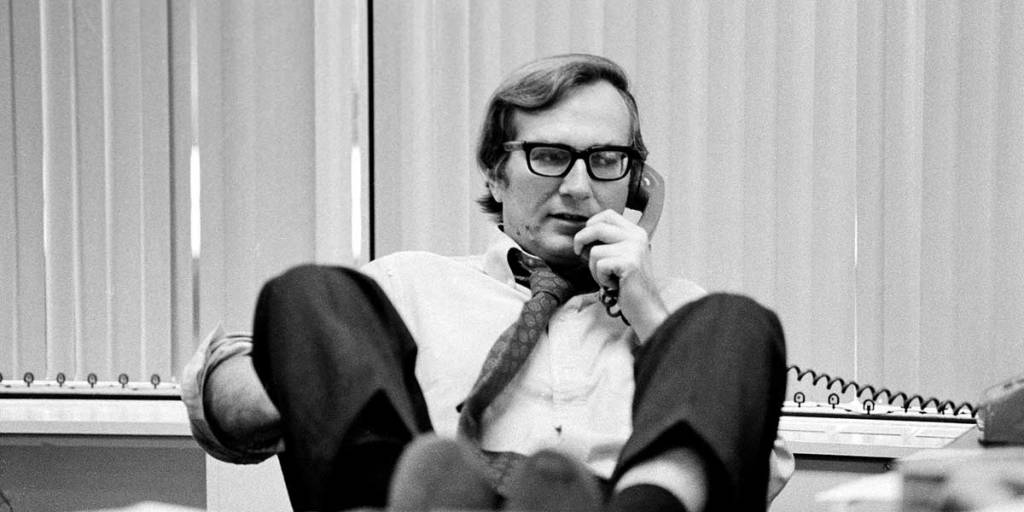
It’s the 1960s and America is at war. Sy Hersh, a freelance reporter, hears a rumour of mass murder in Vietnam by American troops. He speaks with GIs on base and the soldiers accused of these crimes. He also got a hold of a secret military investigation the massacre. And the facts he finds are horrifying. There include synchronized sexual assaults and murders of hundreds of women, men and children, and even babies, by American soldiers. Hersh blames My Lai on General Westmoreland and others who ordered the mass killings — which happened in a number of places on the same day — solely for the purpose of raising the body count. They needed more dead bodies to prove they were winning the war. The story has major repercussions all the way to the top — Nixon and Kissinger were recorded calling Hersh a son of a bitch — and played a role in turning public sentiment away from the war. For Hersh, My Lai is the first of many crucial stories he breaks in the decades to come. He becomes the NY Times daily reporter on the Watergate scandal. He uncovers US involvement in Pinochet’s bloody coup in Chile and the assassination of
Allende; illegal CIA infiltration of anti-war groups, the secret bombing of Cambodia, the invasion of Gaza (ongoing), and the abuse and torture of Iraqis by American soldiers during the Gulf War at the infamous Abu Ghraib prison.
Cover-Up is a journalistic documentary about journalism itself. It features historical documents and period photos and film — many very disturbing — new interviews with people involved in the stories, and extended talks with Sy Hersh, who at the age of 88 is still a full-time journalist. You get to see
him see at work talking to anonymous sources and vetting incoming photos and leaks. He’s a bit prickly about protecting his sources even from the documentary makers (who take care never to reveal anyone still alive), because it’s that core of consciences bureaucrats, soldiers, and spies who still uphold the constitution and flout illegal coverups. They’re the sources who keep freedom of the press alive.
After the TIFF screening, Hersh said that American journalism is in a bad state with reporters running scared. How many important stories are being gagged or stifled now — or in the past — under White House pressure? It shows how badly we need more adversarial journalists who question the powers that be and uncover what they’re hiding.
And that’s what Cover-Up is all about.
I Swear, Girl and Cover-Up all played at TIFF and should be released over the next few months. This is Daniel Garber at the Movies, each Saturday morning, on CIUT 89.5 FM and on my website culturalmining.com.
Daniel Garber talks with Anastasia Trofimova about Russians at War
Hi, this is Daniel Garber at the Movies for culturalmining.com and CIUT 89.5 FM.
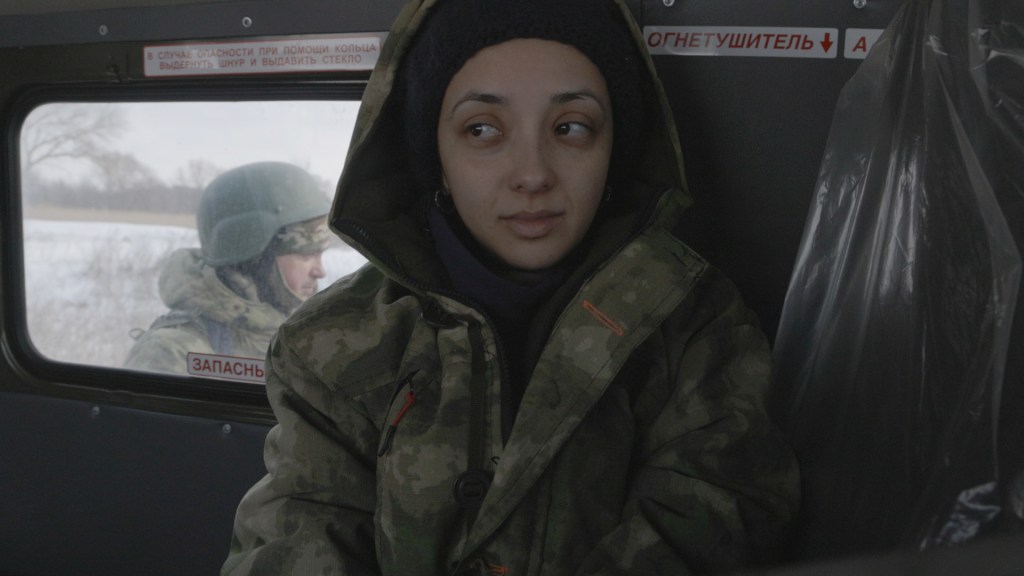
It’s 2023 near the Ukraine/Russian border, and things are bleak. Cities are filled with empty bombed out apartments, and in nearly deserted villages only the old, poor and infirm remain. Countless soldiers have been killed there, with new recruits taking their place, as they prepare to fight and kill the enemy, even as
medics drive around looking for the wounded and the dead. Capturing all this is a woman with a camera, named Anastasia, asking probing questions of the soldiers she’s with. Are they justified in what they are doing? Do they want to be there? And all this is taking place… on the Russian side!
Russians at War is the name of a new documentary that goes across the border to film Russian soldiers in their war against
Ukraine. It captures the cynicism, pessimism and fear of a never-ending war machine. It’s produced, directed and photographed by award-winning Russian- Canadian documentarian Anastasia Trofimova known for her TV work in the Middle East, Africa and Eastern Europe and as a fixer and translator for the CBC, New York Times, Magnum Photos, and the Washington Post . This is her first feature.
I spoke with Anastasia about her controversial film from Toronto, via ZOOM.
Her documentary will be released online (russiansatwar.com) on August 12, 2025.
Daniel Garber talks with Lena MacDonald about Betrayal at Hotdocs
Hi, this is Daniel Garber at the Movies for culturalmining.com and CIUT 89.5 FM.
It’s 1981 in Liberia, West Africa. Cindor Reeves is a young man in a small town. But when his sister marries strongman Charles Taylor, his life totally changes. He moves from his humble home into a mansion in Monrovia the capital. He gains wealth, glamour and a father-figure to learn from. Taylor teaches him right from wrong. So he us crushed when he discovers his idol is actually a corrupt politician, amassing great wealth by exploiting everything from rubber plantations to blood diamonds. And when Taylor begins a campaign of mass killings, transnational wars armed with child soldiers, blood diamonds, international weapon deals and even collusion with Al Qaeda, Cindor decides it’s time to act. He
presents his findings to an international court intending to stop the violence. But this places him in great physical danger. Is Cindor blowing a whistle… or betraying his own family?
Betrayal is a new documentary that follows the unusual case of Cindor Reeves and Charles Taylor over decades on the world stage. It’s narrated by the film’s subject himself, supplemented by talking heads in the form of journalists, lawyers and public figures. The documentary is illustrated with amazing period news footage and background materials. It’s directed by prize-winning Toronto-based filmmaker Lena Macdonald, who appeared on this show a decade ago about he first documentary feature, the highly-personal Mom and Me. (Full disclosure, I worked with Lena on an early stage of Betrayal, and am blown away by the final version.)
I spoke with Lena MacDonald in person at CIUT.
Betrayal is having its world premiere at Hotdocs on Tuesday April 29th, 2025.
American battles. Films reviewed: G20, Drop, Warfare PLUS National Canadian Film Day!
Hi, this is Daniel Garber at the Movies for culturalmining.com and CIUT 89.5 FM.
Yearning for some Can-Con? We’ll mark your calendars: next Wednesday is Canada Film Day with over 1700 screenings and discussions about great Canadian movies across this country! In Toronto alone, directors and actors like Sophie Desraspe, Helen Lee, Eric Peterson, and Cody Lightning will be there at the screenings. There’s also a Town Hall discussion of Canadian culture with Don McKellar, Mary Walsh and Elle-Maija Tailfeathers. Canadian Films suddenly seem acutely relevant. Go to canfilmday.ca for showtimes.
But this week, I’m looking at three new movies from south of the border. There are Navy Seals in Iraq attacked by armed combatants; the US President locked in hand-to-hand combat with international terrorists; and a single mom terrorized by her cel phone.
G20
Dir: Patricia Riggen
It’s a resort hotel in Capetown, South Africa, and US President Danielle Sutton (Viola Davis), America’s first black female POTUS is preparing for the G20 summit. When she’s not practicing martial arts with her Secret Service bodyguard Manny (Ramón Rodríguez) she’s hanging with her family: loving husband Derek and her two teenaged kids. Serena, the older one, (Marsai Martin) is an accomplished hacker who can sneak, undetected, out of any building, even the White House. President Sutton is decked out in an elegant red evening gown — complete with cape — for the all-important photo-op. But something is rotten in the city of Capetown. There’s a conspiracy at work, led by evil Aussie mercenaries. And now armed soldiers are rounding up the presidents and their families! If they can pull this off, they’ll have trillions in “untraceable” crypto currency, and the leaders of the most powerful nations in the world will grovel at their feet.
But some of the leaders have escaped their clutches. Sutton, the elderly Korean First Lady, the pompous British PM, and a few others have form an impromptu posse. Can this ragtag group of heads of state beat the musclebound mercenaries in a contest of physical strength and mental acuity? Or is this world doomed?
G20 is a ludicrous but fun action thriller, told from the point
of view of a female, superhero-type president. This is not a unique movie theme: Many Americans love venerating their presidents. Think: Harrison Ford in Air Force One or even Abraham Lincoln Vampire Hunter. But G20 is so silly… The villains carry the bitcoin wallet — with all the money — as if it’s a physical object, a MacGuffin they have to possess. And they eforce the leaders to read a nonsense speech (the quick brown fox jumps over the lazy dog) so they can make a deep-fake video… as if world leaders haven’t made hundreds of speeches already. A 60-year-old president who’s also an Iraq War hero and also a jiujitsu champ. Sure, why not…? It’s just a movie. The main story may be a hackneyed farce, but Viola Davis is a joy to watch.
Not a masterpiece but a watchable TV movie.
Drop
Dir: Christopher Landon
Violet (Meghann Fahy) is dressed-up but nervous. She’s on her first date since her husband died, five years ago. A single mom and an online therapist, she likes working from home so she can keep a close eye on Toby, her adorable, autistic son. But her wacky sister Jen (Violett Beane) insists she step out of her shell and have some fun. Jen’s babysitting Toby tonight to give her all the time she needs. And if there’s no chemistry with the guy she’s meeting, she can always just leave. So here she is in a fancy restaurant with a dramatic view of the city. In comes Henry (Brandon Sklenar) her first date, and there’s instant attraction. Henry is handsome, rugged and friendly, and has a steady job at City Hall. He likes her looks, her smarts and her honesty. They go to their table and start the date.
But the electricity between is interrupted by anonymous memes and texts that keep appearing on her phone, apparently dropped by someone somewhere in the restaurant. The messages become threatening, along with a warning: if you tell anything to Henry (the guy she just met) we’ll kill your son. Followed by live security footage from her home… with a masked man roving her halls with a gun. Whoever it is has control of all her security cameras and all the cels in the restaurant. They can see and hear everything she’s doing.
They want her to commit a crime in plain view, and there’s no way to stop them. Can Violet save her son and outsmart this invisible villain on this date from hell?
Drop is a classic suspense thriller that plays on our fear of technology and surveillance. Afterwards I realized there are some major plot holes or impossibilities, but they don’t stand out while watching it. It’s a tightly budgeted Blumhouse movie so the actors are likeable but not A-list, and everything takes place in two tight locations – her home and the restaurant. It uses psychological fear instead of pyrotcechnics. And it works. This is a good, traditional suspense thriller, the kind where the tension keeps growing and never lets up.
I like this one.
Warfare
Co-Wri/Co-Dir: Alex Garland (Ex Machina, Annihilation, Civil War), Ray Mendoza
It’s November, 2006, in Ramadi, a city in central Iraq, between Baghdad and Fallujah. Ray (D’Pharaoh Woon-A-Tai) is leading a squad of Navy Seals on a mission. They commandeer two houses, knocking down walls and pushing the families into their bedrooms. They’re setting up for a long wait, until a marine unit arrives with tanks to evacuate them. But armed enemy soldiers are setting up on nearby roofs, taking pot-shots at them. And when the tank finally arrives, the Seals are ambushed by an IED buried in the road. The Iraqi soldiers they are working with are killed, while some of their own are badly injured. They have to pull their bodies back into the house and try to save who they can. Can they fight off the insurgents until the Marines arrive? And who will survive this tense battle?
Warfare is a hyper-realistic depiction of an actual battle in Iraq as remembered by the US soldiers who were there (including writer/director Ray Mendoza). It’s not like your usual war movie. The film favours accuracy over character- building or back stories. And the characters speak in military jargon, full of Frogmen (navy seals), Bushmen (an aerial unit, overhead) and many more I couldn’t catch. The cast is
excellent, especially Woon-A-Tai, Will Poulter (The Revenant, We’re The MIllers, Midsommar) and Cosmo Jarvis — it really felt like you’re there, witnessing actual soldiers, showing bravery, camaraderie, and brotherhood. What the movie doesn’t deal with is why? Why were they there at all? What did that particular mission accomplish? Where are all those WMDs, the supposed reason for this war? Thousands of US soldiers were killed there, and many times more tragically killed themselves afterwards. And an estimated one million civilians in Afghanistan, Pakistan and the Middle East were wiped out, millions more displaced and the whole region made unstable till today… and for what?
I’m glad I saw Warfare — it’s a rare chance to experience a non-jingoistic, up-close and personal look at US soldiers on the frontline. But don’t go to this docudrama expecting to be entertained. Because fun… it ain’t
G20 is now screening on Prime Video, and Warfare and Drop both open this weekend in Toronto; check your local listings. This is Daniel Garber at the Movies, each Saturday morning, on CIUT 89.5 FM and on my website culturalmining.com.
The thrill of uncertainty. Films reviewed: Harbin, Babygirl, The Brutalist
Hi, this is Daniel Garber at the Movies for culturalmining.com and CIUT 89.5 FM.
First let me wish you all a Happy New Year! With a new year comes renewal, hope… and potential dread. So this week, I’m looking at three new movies where people face potentially dreadful situations, partly of their own making. There’s an abused architect, a compromised CEO, and a sympathetic assassin.
Harbin
Co-Wri/Dir: Min-ho Woo
It’s 1909 in Korea. After defeating a European empire in the Russo-Japanese war, Japan is flush with imperial ambition. They want more colonies on the mainland and are looking hungrily at Korea, Manchuria, Mongolia, and China. But some independence-minded Koreans are regrouping to fight Japan. Their leader, Ahn Jung-geun (Hyun Bin), managed to defeat a Japanese battalion in a bloody battle. But when, following international laws, Anh released the disarmed POWs, their leader Mori (Park Hoon) shot a cannon at their base killing everyone except Anh. Now the survivors are meeting in Vladivostok to decide what to do next. This includes Kim (Jo Woo-jin) his closest ally, and Woo, (Park Jeong-min) his biggest rival. And some of them think Anh is a Japanese mole. To atone for his mistakes and to do something big, he vows to assassinate Ito
Hirobumi (Lilly Franky: Shoplifters, Like Father, Like Son) one of the top statesmen of Imperial Japan who is calling for the annexation of Korea.
To do this killing Anh must make his way to Harbin, a rail hub city right on the border of Russia and northeast China where Ito plans to give a public speech. But If he travels by train he will be caught. He must turn to a former comrade turned bandit, Ms Gong (Jeon Yeo-been) to try to secure explosives. But there is a traitor in their midsts, telling the Japanese all their plans. Can they make it to Harbin undetected, find the rat, fool their enemies, and carry out the assassination? Or are they fated to be erased from their country’s history?
Harbin is a vivid and gripping retelling of a famous historical event. It’s a classic cloak & dagger, full of action, thrills, drama, and deception. It’s done in the traditional style, with the name of each character appearing on the screen to help
you keep track of which moustachioed fighter is which. But easier said than done, when everyone pulls down the brims of their fedoras to cover their faces. The locations are amazing: Anh crawling across the frozen waters of the Tumen River, horse caravans on the sands of Mongolia, ancient Russian train stations… very impressive! The sets and costumes are great too, with a drunken warlord festooned in animal furs or the ceiling lamps aboard a Russian train, swinging from side to side. If you have any interest in action-thrillers, spy stories or even NE Asian history, Harbin is the film for you.
Babygirl
Co-Wri/Dir: Halina Reijn
Romy (Nicole Kidman) is the CEO of a large, successful corporation that makes automated parcel-sorting equipment — similar to what Amazon has in their warehouses. She lives with her husband Jason a play director (Antonio Banderas) and their two teenage daughters, Isabel and Nora. Her life is almost perfect, but is missing a certain…. je ne said quoi. She is not sexually satisfied. One day she is startled by a vicious dog running rampant outside her office tower. She witnesses a random young man calm the dog down and return it to its owner. Later, inside her office, she is introduced to her latest intern; it’s the same guy she saw outside. Samuel (Harris Dickinson) has an unusually forthright manner, almost rude and overbearing for someone so young. He makes her feel unhinged and yet… intrigued. Who is this twerp, and why is he like that? She finds him overconfident and almost ridiculous. And yet… eventually, to her great surprise, they kiss and sparks fly.
Soon she is secretly meeting him in seedy hotel rooms for furtive sex. But he wants more — total domination over her in an S&M relationship. Romy loves her husband and kids has never done anything like this before. Even though he takes the dominant role, in real life she holds all the cards: she’s older, richer and his boss. She has more to lose, though, and it’s that threat that excites her. And she can’t got enough of him. What will happen if word gets out? Has she bit off more than she can chew?
Babygirl is an erotic drama about an older woman’s fling with
a much younger man for the thrill of it all. It’s both highly sexualized and yet uncomfortable to watch in parts. It’s entirely told from Nicole Kidman’s (Before I go to Sleep, Genius, The Beguiled, The Killing of a Sacred Deer, Boy Erased, The Upside, Destroyer, The Goldfinch, Bombshell, The Northman) Romy’s point of view; we share her agony, her ecstasy, her cringing embarrassment (he treats her like a domesticated pet). As Samuel, Dickinson is opaque, functioning mainly as her erotic foil. He’s usually an excellent actor (Beach Rats, Triangle of Sadness, Scrapper, The Iron Claw) but in this movie he takes second all the way. Some people love this movie, others despise it. I’m somewhere in between. The plot is just a slight twist to the hoary old cliche of the powerful executive submitting to a dominatrix. I don’t need to watch a grown woman lick milk from a saucer. But other parts are quite exciting and altogether it’s worth it for Nicole Kidman’s performance.
The Brutalist
Co-Wri/Dir: Brady Corbet
It’s post-WWII. László Tóth (Adrian Brody: Splice, Predators, The French Dispatch, Asteroid City) is a holocaust survivor from Hungary who arrives in America as a displaced person. His wife Erzsébet (Felicity Jones) and niece Zsófia are nowhere to be seen. His cousin Attila (Alessandro Nivola) gives him a place to stay in his furniture store and puts him to work designing and building chairs. Things look up when the son of an oligarch offers him a job redesigning his father’s home library. Laszlo takes to it like a fish out of water, building a modernistic room with synchronized wooden panels and shelves beneath an open skylight. But when the industrialist Harrison Lee Van Buren Sr. (Guy Pearce) sees it, he goes ballistic and fires him without pay. Soon after his cousin falsely accuses him of sleeping with his wife Laszlo finds himself unemployed, homeless and addicted to drugs. He gets work doing manual labour at a ship yard with Gordon (Isaach De Bankolé) a man he
befriended earlier until the industrialist who fired him seeks him out ago. Turns out Laszlo was a Bauhaus architect before the war, and the library was featured in modern architecture. Lee immediately rehires him, this time to build a monumental memorial on a hilltop in honour of his mother. But conflicts still trouble the two men’s relationship. Will Laszlo ever complete his masterpiece? Or will Lee crush him with his oppressive and egoistical nature?
The Brutalist is a moving drama about the American Dream and the class struggle between two men. (The title refers to the Brutalist style of architecture Laszlo favours). It’s a full-fledged four hour epic, compete with an overture, intermission and various story lines within the plot. I’m only giving you a taste of it here, a three-minute review of a four hour movie. It is visually and audibly stunning, both in design and execution, from the score to the crisp camera work, even the surprising credit roll. The acting is superb — I’m referring to Brody, Pierce, Jones and the rest of the large cast. This is a mature film made by a young director and former child actor. I’ve only seen one other movie by him, Vox Luxe, which, while visually interesting, didn’t have much to it. The Brutalist takes a quantum leap beyond that, filling in all the parts left out of his previous work. The movie is exciting, full of both hope and crushing devastation. It’s so well done that I left the theatre assuming it was a biopic, only later realizing it’s entirely fictional.
The Brutalist is a stupendous movie that must be seen to be appreciated.
The Brutalist and Babygirl are now playing in Toronto, with Harbin opening this weekend; check your local listings.
This is Daniel Garber at the Movies, each Saturday morning, on CIUT 89.5 FM and on my website culturalmining.com.
Americans abroad. Films reviewed: Queer, September 5, Oh Canada
Hi, this is Daniel Garber at the Movies for culturalmining.com and CIUT 89.5 FM.
This week I’m looking at three new movies set in the 1950s, 60s and 70s, about Americans abroad. There’s a novelist in Mexico City, a TV sportswriter in Munich, and a documentary filmmaker in Montreal.
Queer
Dir: Luca Guadagnino (I am Love, A Bigger Splash, Call me by your Name, Suspiria)
It’s the 1950s in Mexico City. William Lee (Daniel Craig) is a middle-aged American writer addicted to heroine who hangs around local bar called Ship Ahoy. If he doesn’t get completely drunk he might spend the night with a man he meets. He’s friends with other flamboyant ex-pats, especially Joe (Jason Schwartzman) a portly, bearded man who shares Lee’s lascivious predilections. Lately, he has had his eyes on Eugene Alerton (Drew Starkey), an ex-GI who spends most of his days playing chess with an older red-haired woman. Eugene is no “queer”, but is up to talking with Lee.
After repeated drinks, and some opiates he eventually shares Lee’s bed in his seedy rental. Lee is smitten, Eugene content. Later the two head south in their quest for ever more potent drugs culminating in a journey toward the ultimate psychedelic experience. They end up in the Ecuadorean Amazon, in a remote shack guarded by a vicious but slow-moving three toed sloth. Inside, a mysterious doctor (Lesley Manville) holds the answers to all their questions. Is Eugene the man of his dreams? Will they ever reach hallucinatory
nirvana? Or is life just an illusion?
Queer is a bizarre, sex-and-drug-filled psychedelic fantasy. It’s divided into three chapters: their meeting in Mexico City; their journey south; and their adventures in Ecuador. It’s adapted from William S Burroughs’ semi-autobiographical novel written in the 1950s but not published for another 34 years. It swerves wildly between actual memoirs and pure imagination. Burroughs was a writer in the beat movement, and was married and had a son with another writer Joan Vollmer (perhaps she’s the red-haired woman Mary in the film).
The thing is, Queer is not a grave, serious movie, it’s a high-camp comic fantasy. Psychedelia has always been difficult to film, and there’s a fine line between the profound and the ridiculous. Some scenes, like the unfortunate semi-nude, interpretive dance sequence, falls on the (unintentionally) funny side. Others scenes were kinda cool. It’s a beautiful film to watch, for its music, set, costumes and art direction. Shot
entirely in Rome’s Cinecitta, it’s never meant to look realistic. Daniel Craig plays Burroughs not as the usual chill junkie observer, but as a panting and sweating horndog, with bulging eyes, nearly choking on his own lust.
If your looking for a sentimental romance a la Call Me by You Name, or a deeply profound meditation on psychedelic trips, this ain’t it. But if you just want a weird and funny drug-infused dream-filled movie with lots of soft-core gay sex, you’ll probably have a great time.
September 5
Co-Wri/Dir: Tim Fehlbaum
It’s September 5, 1972 at the Munich Summer Olympics and the crowds are roaring. Americans are glued to their sets watching the US cleaning up, with swimmer Mark Spitz winning an unheard of seven gold medals. ABC is the perennial loser of the top three networks. So their sportscasters are thrilled to have won exclusive coverage rights. The team behind the cameras are hard at work. Geoffrey Mason (John Magaro) is the newbie, trying to prove his chops. His boss Marvin (Ben Chaplin) wants things to run smoothly, and his boss’s boss (Peter Sarsgaard) is thinking of the bigger picture. Jacques (Zinedine Soualem) is their French cameraman with Marianne (Leonie Benesch) the only woman on the team, is a German journalist, and their de facto translator. Everything is great until they hear gunshots… not at the games, but at the nearby Olympic village. A group of masked militants, known as the Black September Organization is holding Israel’s Olympic team hostage.
Suddenly, the ABC sportscasters realize they are the only American TV journalists in Munich. They have the cameras, the boom mics and the broadcast and satellite rights ready to send stories home. They shift their telephoto lenses from pointing toward the swimming pools to the athletes’ dormitories, trying to catch a glimpse of the hostages. What
will happen next? Will German authorities step in? And can a sports crew handle crisis news?
September 5 is a journalistic thriller about 24 hours at the Munich Olympics. Despite its title, this isn’t about the Israel/Palestine conflict — they barely delve into it. That’s just the backdrop. What it really looks at is how a team of US journalists — at the right place at the wrong time — figure out how to get the news out even as the crisis grows. I love the period details: giant-sized spools of reel-to-reel videotapes, and how little white tiles on a black background were superimposed onto a sports channel screen. So cool. I’ve never heard of Swiss director Tim Fehlbaum before, but he keeps the action moving in the midst of constantly shifting mayhem. The acting is ok, but best by far is Leonie Benesch who starred in last year’s The Teacher’s Lounge. I went into this movie full of dread. It’s clearly Oscar-bait; Hollywood churns out journalistic dramas every year. But this one is surprisingly good, and had my heart pumping all the way through. If you’re looking for some journalistic excitement, check out September 5.
Oh Canada
Co-Wri/Dir: Paul Schrader (First Reformed)
Based on the story by Russell Banks
Leo Fife (Richard Gere) is a renowned documentary filmmaker in Montreal. He is getting ready for an interview in his own living room in the grand old home he shares with his wife Emma (Uma Thurman). The director, Malcolm (Michael Imperioli) and his crew are longtime admirers of Leo’s legendary work. After crossing the northern border in the 1960s to protest the war in Vietnam, he ended filming docs that changed the course of history. He uncovered the use of Agent Orange at the military base in Gagetown, New Brunswick, and became a university prof teaching young journalists how to make movies. Now, decades later, Leo is on his deathbed, dying of cancer, so Malcolm wants to record his final thoughts.
Leo treats this film as a confession — he wants to clear the record. He starts by talking about his first wife and son, a family he left behind in Virginia. But she’s not the only skeleton in his closet. His past life is full of lies, deceptions and possibly terrible acts. Emma doesn’t like him talking like this and wants him to stop. Leo’s nurse thinks can’t take all this stress. But the filmmakers persist and Leo perseveres. Are any of his stories true? Was he a good man or a bad man? And what do we really know about Leo Fife?
Oh Canada is a fictional story about a day in the life of an American filmmaker and activist recalling his past. It’s a simple concept with a slight plot. It’s structurally divided between the documentary being made about him, and his
hidden past, shown in a series of flashbacks (He is played by Jacob Elordi as his younger self.) The film is almost too simple. But with Paul Schrader at the helm, you know there’s going to be more to it. He wrote Taxi Driver and Raging Bull for Scorsese, and directed movies like The Yakuza (1974) First Reformed (2017) and American Gigolo (1980) that also starred Richard Gere.
Unfortunately, Gere is the weakest part of this film; he rants and complains, but there’s no heart in his performance. The film’s called Oh Canada, but it’s really Oh America. It was entirely shot there, with so-called Canadian characters using americanisms like “restroom”. What’s interesting is Schrader’s use of false visual narratives. There are flashback scenes where Elordi as a young Leo is suddenly replaced by a contemporary Gere while all the other characters remain unchanged. Likewise, the names of past lovers seem to melt away. Perhaps Leo has dementia, or maybe this contrasts Leo’s current story with his past truths. Also interesting is the way we see Leo’s face throughout the eye of Malcolm’s camera, giving it a meta aspect that messes with your brain.
Oh Canada is not one of Schrader’s better films, but there’s enough stuff going on to keep it intriguing.
Oh Canada, Queer and September 5 all open this weekend in Toronto; check your local listings.
This is Daniel Garber at the Movies, each Saturday morning, on CIUT 89.5 FM and on my website culturalmining.com.
Returns. Films reviewed: All We Imagine as Light, The Return PLUS Streaming Sites!
Hi, this is Daniel Garber at the Movies for culturalmining.com and CIUT 89.5 FM.
As the days grow shorter and colder, people tend to snuggle up at home. I’m here to tell you to get off your collective asses and go see a real movie on a big screen! But I know some of you are going to stay at home so today, I’m going to talk about some of the streaming sites out there you might want to join. And I’m looking two new dramas. A warrior king in ancient Greece returning to his island, and three nurses in Mumbai returning to Kerala.
Streaming Sites
Here are some streaming sites you might want to try.
First the free ones: CBC Gem, Kanopy and Tubi. CBC Gem has ads, but also plays some great docs, including There are no Fakes. You can find Tubi — a commercial site — online, again with irritating ads but a huge selection of middlebrow films. You can check out terrific movies on Kanopy using your library card, but you’re limited to a certain number per month. Britbox and Acorn TV both specialize in British TV series, especially detective mysteries. If you want Miss Marple peeking over your shoulder, this is what you want. Apple TV produces all their own stuff, including Slow Horses and the great Steve McQueen’s new film Blitz. On the other hand, the Apple TV app itself is extremely aggressive — you can only watch full screen and it flips back to the main site every time you navigate away.
If you’re into horror, thriller and the supernatural Shudder is the site for you. It’s exceptionally well-curated, with excellent art-house movies right beside slashers. Paramount+ has a seemingly endless supply of cop and military shows, plus CIA, FBI, firemen, navy, and — count ‘em! — 7 different NCIS spinoffs! Not my thing, but they do land some good movies like Smile 2, playing right now. Crave gives you access to everything HBO makes, as well as Canadian movies you might otherwise miss like the NFB doc Wilfred Buck. Criterion has the rights to some of the best movies of all time, from early Kurosawa to recent releases. MUBI streams new movies likely heading for the Oscars this year, including Maria, Girl with the Needle and The Substance.
And finally Netflix, the grande-dame of all streamers, has the most consistent and sheer quantity of good TV and self-produced movies, like Emilia Perez… but it’s getting way too expensive! They even have a new website called netflixinyourneighbourhood.ca which takes you to

THE MADNESS. The Donut Shop, 617 Parkdale Avenue, Hamilton, Ontario, featured in Episode 107 of The Madness. Cr. Courtesy of Netflix © 2024
locations where their movies are shot: in places like Toronto, Ottawa, Hamilton, Brockville, Dundas and Oshawa!
I still think movies should be seen in theatres but if you’re determined to stay at home, those are some of streaming sites you might want to subscribe to.
All We Imagine as Light
Wri/Dir: Payal Kapadia
It’s present-day Mumbai.
Prabha (Kani Kusruti) is a middle-aged hospital nurse. She is skilled at her job, teaching young trainees how to get over their feelings of revulsion. She spends time with a starry-eyed Doctor Manoj, who writes poems to her, but she is still very much married. Her husband moved to Germany to work in a factory, and he may as well not exist. Prabha shares an apartment with Anu (Divya Prabha), a vivacious young nurse at the same hospital. She likes shopping, fashion and romance, and most of all her secret boyfriend Shiaz (Hridhu Haroon). They’re in love (or at least young lust) but frustrated; it’s hard to find a private space to be together. More than that, she’s Hindu and he’s Muslim, and never the twain shall meet – their families will prevent that. Finally, Parvaty (Chhaya Kadam), an older nurse and a close friend of Prabha’s, is facing eviction from her home. Developers want to tear it down to build a high-rise condo. Since she’s a widow and doesn’t have the proper papers to
prove the place is hers, they’re sending goons to her door to kick her out.
For all these reasons the three of them end up back in Kerala, the place of their birth in southwest India. They stay in a beautiful beach town, where the three of them can finally shake off the heavy responsibility and stress of life in that big city. But how long will this last?
All We Imagine as Light is a personal, intimate drama about the lives of three women in Mumbai. It’s notable for a number of reasons. This is director Payal Kapadia’s first feature, and tells her story from a distinctly feminine gaze. It deals with big contemporary political and social issues — like Parvaty attending an angry tenants’ rights meeting — but also the importance of personal friendships among the three woman. In look and style, this film is strictly European cinema verite, about as far from Bollywood as a movie could possibly be. But it is set in Bombay and exults in that city, from the slums to the skyscrapers, with stunning aerial views of rooftop clotheslines and raucous street festivals. There’s amazing footage taken through the window of a fast-moving commuter train. Some scenes have documentary-style unidentified voices, expressing their bittersweet love and hatred for that
city that never sleeps, spoken in a plethora of languages: Hindi, Gujarati, Malayalam, and Bengali. I liked this movie for it’s emotions, but found much of it bleak and slow-moving; the story drags you down until it finally shifts from Mumbai to the beaches of Kerala, two-thirds of the way through.
But by the end it redeems itself with an unexpectedly satisfying finish.
All We Imagine as Light has been nominated for Best Foreign Language Film at the Golden Globes.
The Return
Dir: Uberto Pasolini
It’s 1200 BC in ancient Greece, and the island of Ithaca has no ruler. Decades ago, it was a mighty kingdom, ruled by the hero Odysseus — known for his bravery, fighting skills and intelligence. He devised the Trojan Horse and led the army that defeated Troy. But the soldiers — and their leader — never came home, and Ithaca has gone to seed. The queen, Penelope (Juliette Binoche) sits alone in her tower, weaving cloth, as she patiently waits for Odysseus’s return. Their son, Telemachus (Charlie Plummer) doesn’t know his father except from legends. The palace is filled aggressive brutes from abroad, each wanting to marry the widow Penelope so they can take over the kingdom. But is she actually a widow?
Around this time, the battle-scarred body of a soldier washes up on shore. He’s barely alive, but is nursed back to health by an honest pig farmer named Eumeo (Claudio Santamaria) and his sons. It is of course Odysseus (Ralph Fiennes), but without any uniform or weapon. He’s actually naked. He wraps himself in a blanket and carries a bowl — the clothing of a homeless beggar. And when he approaches the palace, almost no one recognizes him. Only Eurycleia (Ángela Molina), both his and his son Telemachus’s nurse as a child, realizes who

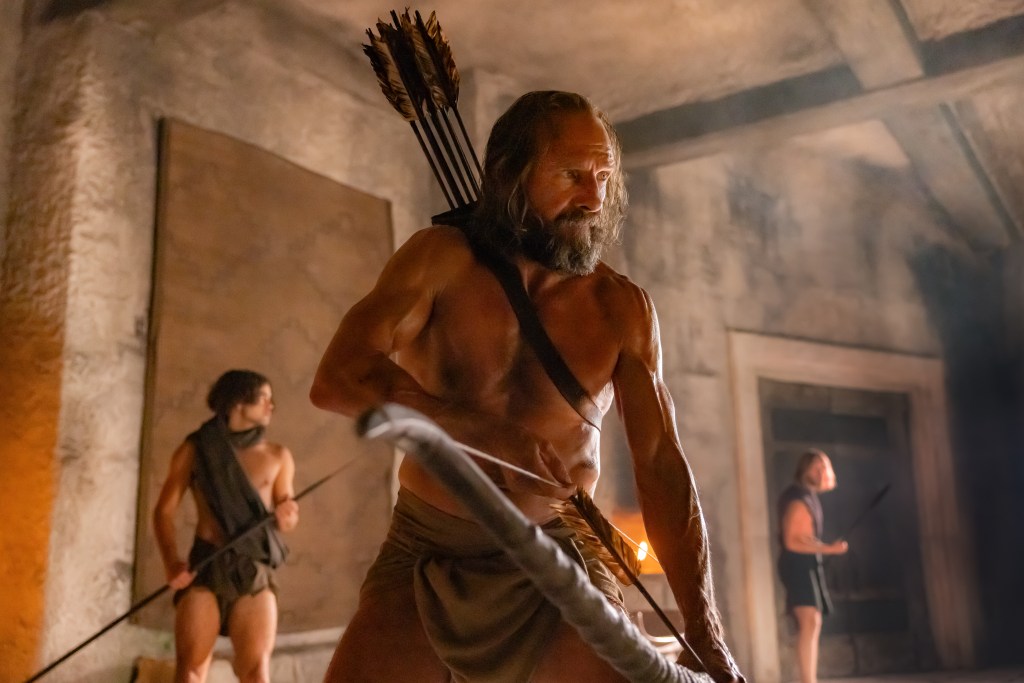
The Return, directed by Uberto Pasolini, with Ralph Fiennes (Odysseus), Juliette Binoche (Penelope), Charlie Plummer (Telemachus), Marwan Kenzari (Antinous), Claudio Santamaria (Eumaeus).
that beggar is. Is he still fit to be king? Can one man, tired and old, confront a bloodthirsty mob of young toughs? And will Penelope ever forgive him for staying away so long?
The Return is a magnificent retelling of a chapter in Homer’s The Odyssey. But it’s not about triumphant heroes; it’s more about the grinding effects war has upon both the victors and the vanquished. It contrasts Odysseus’s shame and self-doubt with Penelope’s eternal fidelity. Yes, this is an ancient greek story, with swords and sandals, but it feels very immediate. Parts of it even resemble a Hollywood action/thriller, with chase scenes and some very bloody fights.
The film was shot among the rocky cliffs of Corfu and the ruins of an ancient castle, which is echoed in the soundtrack. I love the dramatic look and sound of waves crashing on the sharp rocks. Though the women are all wrapped up, most of the male actors are dressed in togas or prancing around half naked, with Ralph Fiennes going full monty at the drop of a hat. I didn’t used to like him much, but after Conclave and now this one, I gotta admit, he’s a really good actor. Juliette Binoche is skillfully understated as Penelope, and Dutch actor Marwan Kenzari is very creepy as Antinous, the threateningly oleaginous suitor closest to Penelope.
The Return is a really good movie.
The Return and All we Imagine as Light is on at the TIFF Lightbox in Toronto; and Standing on the Shoulders of Kitties, A Trailer Park Boys movie featuring Bubbles and his band on tour, is now playing; check your local listings.
This is Daniel Garber at the Movies, each Saturday morning, on CIUT 89.5 FM and on my website culturalmining.com.
Archnemeses! Films reviewed: Kill, Despicable Me 4, Escape
Hi, this is Daniel Garber at the Movies for culturalmining.com and CIUT 89.5 FM.
Classic novels and movies needed a hero or a heroine to save the day. But in really good stories there’s also a nemesis, an enemy to fight and defeat. This week I’m looking at three new movies, from Korea, India and France — two action thrillers and an animated comedy — about arch-nemeses. There’s a former villain in witness protection, a commando on a train heading in a southern direction and a communist sergeant preparing his own defection!
Kill
Co-Wri/Dir: Nikhil Nagesh Bhat
Amrit (Lakshya) is a commando in a special unit of the Indian army. Along with his best buddy Viresh (Abhishek Chauhan) they lead their troops in tactical operations using martial arts and hand-to-hand combat. But he’s in a bit of a jam. The love of his life, Tulika (Tanya Maniktala) is pledged to another man in an arranged marriage. To elope seems too risky; her father is an oligarch with immense power and wealth. Even so, they arrange for a secret meeting aboard the express train her family are riding south from Amritsar to Delhi. And, right there, with the two of them squeezed into a cramped toilet Amrit proposes marriage, complete with ring. But what neither of them realize is the train has been targeted by a brutal gang of bandits for an attack on the sleeper cars. The dacoits kill the guards, and steal watches, jewelry and cash from everyone there. And they sexually threaten the women. They’re led by a capricious Fani (Raghav Juyal) the nefarious son of the clan’s patriarch. But when Amrit and Viresh see what’s happening, they decide it’s time to fight back… but can just two commandos take on an entire family of bandits?
Kill is a non-stop, violent action movie, the first of its kind out of
India. It’s nothing like Bollywood, no songs, dances, or extended flirting. This is heavy-duty fighting all the way through. This is Lakshya’s first starring role — he’s good-looking and intense, a natural leading man. He plays Amrit as a regular Punjabi drawn almost to madness when he sees his lover threatened. Then he goes berserk. He wears a blood-stained shirt for most of the film, and beware: there’s a lot of blood to be spilt. Much of the action takes place in the aisles of an express train, between cars, on the roof, and out the exit doors. Weapons range from sabres, to rifles, a metal fire extinguisher and the fighters’ bare fists. The fighting is superbly choreographed, really well done. And the sound effects are chilling — the sound of skull hitting metal the slash. Off a knife, the thud if fists hitting flesh…I’ve never seen an Indian movie like this, and I quite enjoyed it. If you can get into intensely violent, non-stop action movies — on the scale of the great Indonesian flic The Raid — then I think you’ll really like Kill.
Despicable Me 4
Dir: Chris Renaud, Patrick Delage
Gru (Steve Carell) is a former supervillain who is now on the straight and narrow. He lives with his beloved wife Lucy (Kristen Wiig), their three adopted daughters, Margo, Edith and Agnes, and their newborn baby son. But he has to dive back into the world of villainy when he is sent on a secret assignment: to return to the criminal boarding school of his childhood, the Lycée Pas Bon. Once there he must capture and jail his lifelong rival Maxime Le Mal (Will Ferrell). Now Gru has his Minions — diminutive bright yellow creatures who obey his orders but are always up to no good — but Maxime has minions of his own: cockroaches! He’s built up a veritable army of the insects, and when he escapes from prison, he vows revenge against Gru and all those around him. To safeguard his family, Gru enters a witness protection program where they are all given new names and identities and a suburban home to live, and told to “blend in”.
The problem is their next door neighbours, the Prescotts, have a precocious but obnoxious daughter named Poppy. She has guessed Gru’s true identity and threatens to expose him unless he helps her pull off a heist of her own. But can Gru keep his family safe while pulling off this audacious caper? Or will they fall prey to Maxime and his cockroach empire?
Despicable Me 4 is an animated kids’ comedy about a former villain facing off against a current villain. It’s the latest in an immensely successful French movie franchise (Reviews: Despicable Me, Minions: The Rise of Gru) about a likeable villain and his makeshift family. It combines simple animation with funny lines and goofy characters, Once again, I viewed it in an audience packed with kids who seem to love it. Personally, it seems to be getting a bit tired, like they’re running out of new ideas. The one genuinely funny aspect are the Minions, all voiced by Pierre Coffin. When they’re around, you’ll be laughing with their silly and imaginative slapstick humour. Despicable Me 4 isn’t great, but it did keep me entertained. And the kids will love it.
Escape
Dir: Lee Jong-pil
It’s present day at the DMZ in North Korea. The Demilitarized Zone — it separates the north from the south — is full of landmines, with sentinels in towers watching closely for any movement on either side. Kyu-nam (Lee Je-hoon) is a Sergeant in the Korean Peoples Army nearing the end of his ten-year term there, and dreads returning to work in a coal mine. There is no family to go home to. He has firmly embraced the national ideology of Juche, or self-reliance. But in Kyu-nam’s case, self-reliance has taken on new meaning. Each night, he sneaks out of his bunker, climbs through a window, and crawls his way across the minefields toward the border, recording all the safe spots along the way. He plans to defect to the South before the next rainfall causes the landmines to shift. But he runs into trouble when a pudgy private named Dong-hyuk (Hong Sa-bin), who idolizes the Sergeant sees his trial runs. Dong-hyuk longs to be reunited with his mother and sister in South Korea. So he tries to escape on his own, using Kyunam’s map… but he mucks things up, putting them both in danger of a firing squad.
But who appears at the desertion trial, but Hyun-sang (Koo Kyo-hwan), a Major with connections. He has connections with Kyu-nam going way back, and declares him a national hero, and sets him up in a cushy job as an aide-de-camp for a drunk general. But Kyu-nam is committed to his plans. Can he reach the border before Hyun-sang can catch him? Or are they doomed to a violent end?
Escape is a fast-moving action thriller, full of complex schemes
and near escapes… along with plenty of unexpected surprises. Koo Kyo-hwan plays the major as a slightly effeminate, upper-class nepo-baby who would rather be a concert pianist than an officer. This villain reveals hints of a secret gay past, adding to his mystery. Lee Je-hoon plays a macho, self-reliant soldier who just wants to choose his own future and have enough food to eat (based on what he heard about the South from the propaganda broadcasts he picked up on his transistor radio). The entire film takes place in the North. It portrays a country filled with poverty, malnutrition and class divisions— based on Party membership — where the ordinary people just scrape by, while the effete elites gorge on fine meats and liquors. I have no idea how accurate it is, but I liked the details, from the socialist realist murals, the giant slogans, and the maroon coloured dress-uniforms the officers wear.
And, of course, its gripping plot that will keep you glued to the screen.
Kill, and Despicable Me 4, both open this weekend in Toronto, and you can catch Escape at the TIFF Lightbox; check your local listings. This is Daniel Garber at the Movies, each Saturday morning, on CIUT 89.5 FM and on my website culturalmining.com.
leave a comment