Parts of history. Films reviewed: Fanon, Train Dreams, Christy

Posted in 1920s, 1950s, 1990s, Algeria, Biopic, Boxing, Class, Colonialism, Lesbian, LGBT, Politics, Psychiatry, Resistance, Trains, violence by CulturalMining.com on November 9, 2025

Hi, this is Daniel Garber at the Movies for culturalmining.com and CIUT 89.5 FM.

Toronto’s Fall Film Festival season continue with two series on right now. Reelasian features films from Asia and its diaspora, including two great ones from Canada: Min Sook Lee’s heart-wrenching doc There are No Words, and Koala Kid’s whimsical, animated Space Cadet. Cinefranco has movies in French from Europe, Africa, and Quebec, including many Toronto premieres: look out for la Venue de l’Avenir by Cedric Klapisch (Ma Part du Gateau), and le Dernier Souffle by the legendary Costa-Gavras. 

But this week, I’m looking at three new films set in historical eras. There’s a lumberjack at the turn of the previous century, a psychiatrist in Algeria in the 1950s, and a female boxer from West Virginia in the 1990s. 

Fanon

Co-Wri/Dir: Jean-Claude Flamand-Barny

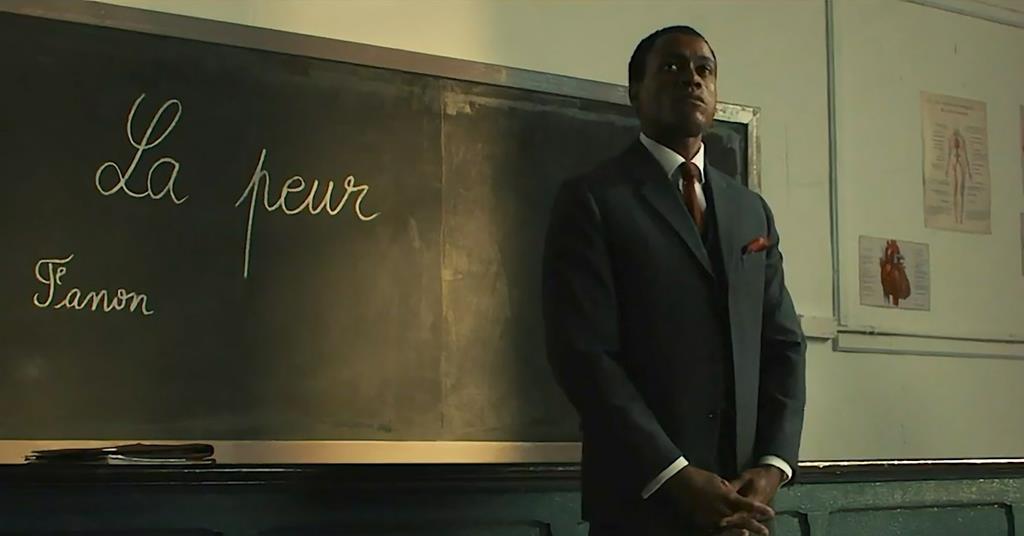
It’s the early 1950s in Algeria. Frantz Fanon (Alexandre Bouyer) is a renowned psychiatrist from the French Island of Martinique. He is starting his new job at a mental hospital. But he’s shocked at how Algerian patients are treated there. In contrast to Europeans, the “savage” north Africans are kept shackled in filthy cells, because of their “barbarous and dangerous” nature. Fanon (who is black) insists his North African patients be treated like any others. He lets them walk in the garden, plant vegetables, play soccer and make friends. Their mental health quickly improves. He’s assisted by diverse Algerian interns and staff: Hocine (Mehdi Senoussi) Jacques (Arthur Dupont) and Alice (Salomé Partouche), all followers of his techniques. But he’s strongly opposed by traditionalists and the French military, who are increasingly violent in their tactics. (Algeria was annexed by France but most of the locals are not considered full citizens.) He and his wife Josie (Déborah François) are upper-middle-class French citizens playing their role supporting the sprawling Empire. Fanon fought the Nazis in WWII. He likes Sartre, elegant suits and and fine wine. But his views are changing. He now writes books (dictated to his wife) about the effect of colonization on the mental health of the colonized in Algeria. Their own self-image is denigrated by their oppressors, he writes, when they internally accept their status as “the other”. Word gets out and he’s invited to join the FLN, (considered terrorists by the French). But the threat of violence reaches his hospital, as personified by Sergeant Rolland (Stanislas Merhar), a particularly violent soldier who checks in as a patient. How can Frantz Fanon simultaneously balance his various roles — as a husband and father, as a Black man serving the French empire, as an innovative psychiatrist, and as an intellectual joining the Algerian struggle for independence?

Fanon is a vibrant biopic about a decade in the life of the renowned author. I find it gripping and fascinating. Alexandre Bouyer is strong and statesman-like in the title role. I’ve known of Fanon for many years — as the author of books like The Wretched of the Earth and Black Skin, White Masks — but never knew about his background in psychiatry. Though occasionally heavy-handed and hagiographic, this movie opened my eyes to the exciting and intellectually stimulating story of his life in Algeria and the history that surrounded it. 

I like this one a lot.

Train Dreams

Co-Wri/Dir: Clint Bentley (Jockey) 

It’s the early twentieth century in the US Northwest. Robert Grainier (Joel Edgerton) is a bearded lumberjack who rarely speaks. He earns his living chopping down trees at migrant lumber camps and building the railroad.  He meets a woman named Gladys (Felicity Jones), they fall in love and build a homestead in a grassy patchl near a flowing river. He cuts all of the wood by hand. Gladys is good with a rifle and shoots foul and deer to eat. The rest they buy in town at a general store owned by Ignatius Jack (Nathaniel Arcand).

He spends lonely months away earning money, but always returns home in the end. He makes friends with a Chinese labourer named Fu Sheng — they don’t talk but that’s fine with Rainier who never has much to stay. But he is shocked when a crowd decides to murder Fu Sheng just because he’s a celestial. He later makes friends with an old-timer named Peebles (William H. Macy) who handles the dynamite explosions. He loves their new baby girl  but his home and family are threatened when a wildfire sweeps through the forest while he’s away. What will Grainier do?

Train Dreams is a series of events in one unremarkable man’s life set along the early 20th century northwestern frontier. A folksy omniscient voice narrates the story, hoping to add profundity; it doesn’t work. The film is meandering,  pointless and stupid. It gives token nods toward environmentalism and against racism but they’re not really part of the plot. I hated this movie from the first few seconds, with its over-produced images and inappropriate soundtrack. We see a guy sawing wood until the camera pulls back revealing…? Nothing, just more trees, as if we’re supposed to applaud the scenery! At times it’s twee, like a Wes Anderson film, but without the humour or intellect. The men all look like they’re posing for a Carhartt fashion shoot. I try to feel sympathy toward Rainier  but he’s deliberately opaque. Worst of all are the Train Dreams of the title — we keep seeing the same montages of flashbacks from previous scenes… but the original ones are as short-lived as his memories of them. 

You might enjoy the pretty pictures in Train Dreams, but I can’t see any other reason to watch this annoying blunderbuss of a film.

Christy

Co-Wri/Dir: David Michôd (The Rover)

It’s 1989 in West Virginia. Christy Salters (Sydney Sweeney) is a high school kid, and a star player on the girls’ basketball team. She’s also in love with her girlfriend Rosie (Jess Gabor), a relationship her mom (Merritt Wever) doesn’t approve. She ends up trying out as a novelty act at a boxing match, and, though she has zero training, she scores a KO on her first try. She’s a natural. She catches the eye of a middle-aged boxing entrepreneur named Jim Martin (Ben Foster). He reluctantly takes her on and lets her train at his gym, but he will not allow her to see — or even talk to — Rosie. He sets her up in a trailer park where he can keep an eye on her. Though a great fighter, she’s isolated and unprotected outside of the ring. 

Christy is a powerhouse. Her career takes off, including a new hairstyle and a trademark pink silk hooded robe to make her look more “feminine”. She knocks out all contenders and after much pressure, the 22-year-old Christy sleeps with the middle- aged Jim… and they eventually marry. 

Her career soars, she meets Don King (hilariously played by Chad Coleman) and is signed to Mike Tyson’s slate. She gains fans worldwide, but her life is micromanaged by her Svengali husband. She may be a professional fighter but he’s twice her size, unstable, and increasingly violent. And he tries matching her up with boxers way above her weight class; that’s just dangerous. Is there any way to escape this oppressive relationship?

Christy is a biopic about the first prizewinning female boxer, who paved the way for a new professional women’s sport. I was hesitant about this one — ugh, yet another boxing movie — but Christy is as good as Rocky. It’s exciting, thrilling and moving, and despite her flaws, Christy Martin’s life is super-sympathetic. Sydney Sweeney is amazing. Yes, it’s Oscar-bait (you can tell by the prosthetic teeth and mullet haircuts, playing down her image as a sex-object) but she totally gets into this role. And Ben Foster is superbly hate-able as Jim — I seriously didn’t realize it was him till the credits rolled; he’s that skillful.

Christy is a good, old-fashioned biopic and a hell of a great boxing movie. 

Train Dreams and Christy both played at TIFF and are opening in Toronto this weekend; check your local listings. And Fanon is premiering today at Cinefranco, 4 pm at the Carlton Cinema.

This is Daniel Garber at the Movies, each Saturday morning, on CIUT 89.5 FM and on my website culturalmining.com.

Hot and cool. Films reviewed: Ne Zha 2, Honey Don’t! PLUS Canadian films at #TIFF50

Posted in Animation, China, comedy, Kids, LGBT, Mystery, Noir, Supernatural, violence by CulturalMining.com on August 23, 2025

Hi, this is Daniel Garber at the Movies for culturalmining.com and CIUT 89.5 FM.

This week, I’m talking about two more hot summer movies, one from China and one from the US. There’s a red-hot demon who wants to live forever, and a cool, hard-boiled detective who faces death on a daily basis.

But first a look at Canadian movies premiering at TIFF’s 50th anniversary.

TIFF Canada

This year, TIFF has programmed dozens of Canadian movies — far two many to mention, but here’s a brief survey of some films worth notice.

First some documentaries:

In Modern Whore director Nicole Bazuin and subject Andrea Werhun  (she was featured in Paying for It: Interview last year) challenge misconceptions about sex work and sex workers. Ni-naadamaadiz: Red Power Rising by Shane Belcourt (Red Rover: review) with Tanya Talaga is about an indigenous youth-led, 90 day armed occupation in Kenora, Ontario, back in 1974. And Min-Sook Lee’s (Migrant Dreams: interview) deeply personal film There Are No Words looks at her own mother’s suicide when she was still a child.

How about some dramas? First, two Canadian films set nowhere in particular: 

There’s Honey Bunch, by Madeleine Sims-Fewer, Dusty Mancinelli,  a psychological thriller about a couple in an isolated rehab centre; and Clement Virgo’s (Brother: Review; The Book of Negroes: Interview) Steal Away, the story of two princesses… of a sort. 

From Atlantic Canada comes Sk+te’kmujue’katik (At the Place of Ghosts) Bretten Hannam’s (Wildwood: Interview) eerie thriller about two Mi’kmaw brothers confronting their past; And Andy Hines’ Little Lorraine, a crime thriller about drug-smugglers in a Cape Breton mining town.

Two Quebec movies look really promising. Philippe Felardeau’s (Monsieur Lazhar: Review) Lovely Day is a comedy drama about the events leading up to a wedding; and Mathieu Denis’ (Corbo: review) The Cost of Heaven, a shocking true-crime family drama that took actually place in Montreal in 2012.

I’m really looking forward to seeing what two young Toronto directors are up to next. Chandler Levack’s (I like Movies: Interview) Mile End Kicks is a romantic comedy about a music critic who moves to Montreal to get her life in order. While Matt Johnson’s (Blackberry: Review) Nirvanna the Band the Show the Movie is a comedy apparently about a failed cover band in Toronto want to play at the Rivoli.

Blood Lines is Gail Maurice’s (Rosie: Interview) singular, same-sex Metis love story from the Prairies. And Tasha Hubbard’s (Nîpawistamâsowin: We Will Stand Up: Interview) Meadowlarks is a real-life drama about four indigenous siblings separated by the Sixties Scoop getting back together again in Banff, Alberta for the first time in 50 years.

And, finally, from the North comes Oscar-winner Zacharias Kunuk’s (Maliglutit: review) The Wrong Husband, an Inuit historical drama / folktale set 4,000 year in the past.

That’s just a sample of some of the Canadian films premiering at TIFF.

Ne Zha 2

Wri/Dir: Jiaozi

It’s hundreds of years ago in China, when demons and gods still roam the earth.  Two supernatural beings, the fiery and impetuous Ne Zha and the calm and focused Ao Bing, once rivals, now find themselves in the same situation.They are both bodyless, floating around like ghosts.  If they don’t get their bodies back soon, they will cease to exist. Once they’re reborn, if they pass three tests, they can drink the potion of immortality. Fortunately, a magical cure involving a giant lotus blossom drenched with semen-like fluid, can bring them back to life.  Unfortunately, it works for Ne Zha but not for Ao Bing. And Ne Zha needs Ao Bing’s steady hand to pass the trials.  So they come to a compromise: Ao Bing’s spirit will share Ne Zha’s body and they’ll try to work together. But can they pass the tests, resist the four dragons, cooperate with the old man of the south in his floating jade castle, stay out of the cauldron of fire, and fight off the thousands of evil demons who may try to eat them?

Ne Zha 2 is an animated kids’ movie straight out of China, about a rambunctious little red devil with pointy teeth, a wide mouth and fierce eyes. It’s a sequel, and is immensely popular in East Asia, even more so than the original. Ne Zha 2 has only played in IMAX in China but has already cleared 2 billion dollars. There’s tons of Chinese cultural and folklore and historical stuff you probably won’t understand, but I think kids will get it. Lots of jokes little kids will laugh at, about  farts, piss, and vomit. There are dozens of characters voiced in English by stars like Michelle Yeoh. The animation is usually great, but there are scenes where the background doesn’t match the characters, which is off-putting. And it’s 2 1/2 hours long, which is a big chunk of your time. So if you curious about what the most popular animated film ever looks like, now’s your chance.

Honey Don’t!

Dir: Ethan Coen

It’s a hot summer’s day in Bakersfield, California; so hot you could fry an egg on the trunk of a car. But you wouldn’t want to do it on this one: it’s upside down in the desert, the wheels still spinning, a woman dead inside. An accident? Or murder? Honey O’Donohue, PI (Margaret Qualley) is there to investigate.  And so is a police detective named Marty (Charlie Day) who practically drools whenever Honey is around. To his eyes, she’s a tall glass of water — and he wants a sip! — but he’s barking up the wrong tree: Honey only sleeps with women… and usually one night stands. And she’s not just a pretty face, she’s sharp, with a dry wit, a hard drinker who can deck any gunman without breaking a nail. She’s at the crime scene because the dead woman is her client — she hired Honey because she felt she was in danger. Turns out she was right, and  dead bodies are piling up for unknown reasons. And all roads lead to a deeply corrupt and lascivious preacher named Drew Devlin (Chris Evans) who clearly has the devil in him. He has wanton sex with parishioners and a side hustle selling drugs for the French Mob. So Honey enlists a rough-looking gumshoe named MG (Aubrey Plaza) to help her catch the bad guys, and find her missing niece. They end up in bed together, repeatedly. Is this love? Or just lust? And will Honey ever find out who’s behind the crime wave?

Honey Don’t! is a very light and fun detective story, loaded with sex and violence, that spoofs old fashioned film noir movies. It quotes generously from Russ Myers’ films like Faster Pussycat, Kill! Kill!, and other cult classics. It’s the work of Ethan Coen — one of the two Coen Brothers — and his partner Tricia Cooke. This is number two of a planned trilogy of Lesbian B-Movies (Cooke is bisexual). Admittedly, I walked out of this movie scratching my head — it’s highly entertaining, but very superficial and doesn’t neatly tie up all the loose ends. But you know what? After a day thinking about it, I kinda like the way it doesn’t completely finish… it feels like the pilot episode of a TV detective series. Margaret Qualley is terrific, and Aubrey Plaza looks and acts totally different from any of her recent roles. So if you’re yearning for 90 minutes of forgettable sex, violence and over-the-top characters, I think you’ll like Honey, Don’t. 

I did.

Honey Don’t and Ne Zha 2 both open this weekend in Toronto; check your local listings.

This is Daniel Garber at the Movies, each Saturday morning, on CIUT 89.5 FM and on my website culturalmining.com.

Short & sweet. Films reviewed: Bride Hard, Pins and Needles, His Father’s Son

Posted in Action, Cabin in the Woods, Canada, comedy, Espionage, Family, Farsi, Friendship, violence by CulturalMining.com on June 21, 2025

Hi, this is Daniel Garber at the Movies for culturalmining.com and CIUT 89.5 FM.

The Toronto Arab Film Festival — which is on now through June 29th —  has shorts and features from 40 countries, including Egypt, Tunisia and Lebanon, that show the diversity of the Arab world. 

But this week, I’m looking at three new movies that are short and sweet: all under 2 hours and two under 90 minutes! There’s family trouble at a dinner table in Toronto, robbery at a wedding party in Georgia, and murder at an isolated cabin in the woods.

Bride Hard

Dir: Simon West (review: The Mechanic, 2011)

Sam and Betsy (Rebel Wilson: Cats, The Hustle, Anna Camp) were best friends as kids but lost touch as adults. So he is overjoyed to be chosen as Betsy’s Maid of Honour at her upcoming wedding. She’s marrying into “old money”; Ryan’s family has a southern plantation where they have brewed whiskey for centuries. But the bachelorette’s destination party in Paris is ruined when Sam cuts out in the middle of a lap dance from a team of male strippers so she could take care of some work duties. You see, what Sam can’t tell them is she’s a secret agent, and the only one who can save the world from weapons of mass destruction. The other guests, including the jealous Virginia (Anna Chlumsky), and the dry Lydia (Da’Vine Joy Randolph: The Holdovers, Shadow Force) don’t buy it, and convince Betsy to dump Sam and make Virginia her new Maid of Honour.

The wedding is opulent, on a lush green island with Irish moss dripping from willow trees owned by the groom’s family. Feeling unwanted, Sam turns to the best man for comfort, the handsome but cynical Chris (Justin Hartley). In her red dress and high heels she says she feels like a dancing girl emoji. But just as the wedding is about to begin, a gang of heavily-armed organized criminals storm the ceremony, led by their evil kingpin (Steven Dorff). They are there to grab the fortune from the family’s vault, and then kill all the guests. Can Sam take on a couple dozen trained killers… and free her best friend and her family?

Bride Hard (geddit? Like Die Hard?) is an action comedy with a slightly novel premise: a powerful female hero fighting crime at a wedding alongside her wise-cracking girlfriends. Sort of like Bridesmaids but with guns and bombs and chase scenes.I think they traded action for a less-funny script — a lot of the jokes were real duds. Luckily, the mainly female cast is very funny despite the lame lines they’re forced to say. Rebel Wilson can make you laugh with just a pose or side glance. And watching all the characters doing their thing is hilarious. 

Bride Hard is silly but fun to watch.

Pins and Needles

Wri/Dir: James Villeneuve

Max (Chelsea Clark) is in a bad mood. She’s on a field trip collecting insect specimens as a grad student in biology, but a fellow student she likes has made her furious. So she’s heading back to the city, along with classmate Keith and his sketchy friend Harold, a part-time drug dealer. It’s a long haul. But after a run in with a cop, they’ve been taking the long route, in unknown territory, to avoid potential trouble. But trouble finds them. First their phones stop working. Then they pop two tires, leaving them stranded.

Keith and Harold stay with the car while Max heads toward a nearby house to ask for help. There’s no-one there… but when she looks back she sees something awful. She sees a couple who appear to be offering a hand to her friends. But as soon as Keith and Harold turn their backs, they are brutally murdered! Max is shocked… and terrified. She runs into the tall grass behind the home to avoid being caught. She figures she can run away and find help. Problem is Max suffers from Type 1 Diabetes… meaning she always keeps her insulin kit close at hand. But it’s in the car, that’s now in that couple’s garage. Though she can never fight off two deranged psycho-killers, she does have one advantage: they don’t know she’s there. Can she fight them off long enough  to grab her kit and run away? Or will this fight be more complicated — and deadly — than she ever imagined?

Pins and Needles is a short, taut cat-and-mouse thriller about an ongoing battle between a desperate woman and two ruthless killers. Clark is good as Max who shifts between wimpy escapee to teethbaring fighter. And Kate Corbett and Ryan McDonald are totally hateable as super villains who are not only sadistic killers who laugh as they murder people, but equally detestable as businesspeople. They both do that deranged killer face really well. While the movie is a rehash of the oft used “cabin in the woods” theme, this one is in a glass and wood mansion, not a creaky cottage.  Perhaps Max is checking her insulin levels a few times too many, but other than that, Pins and Needles is a good horror/ thriller that keeps the tension on high till the final credits roll.

His Father’s Son

Wri/Dir: Meelad Moaphi

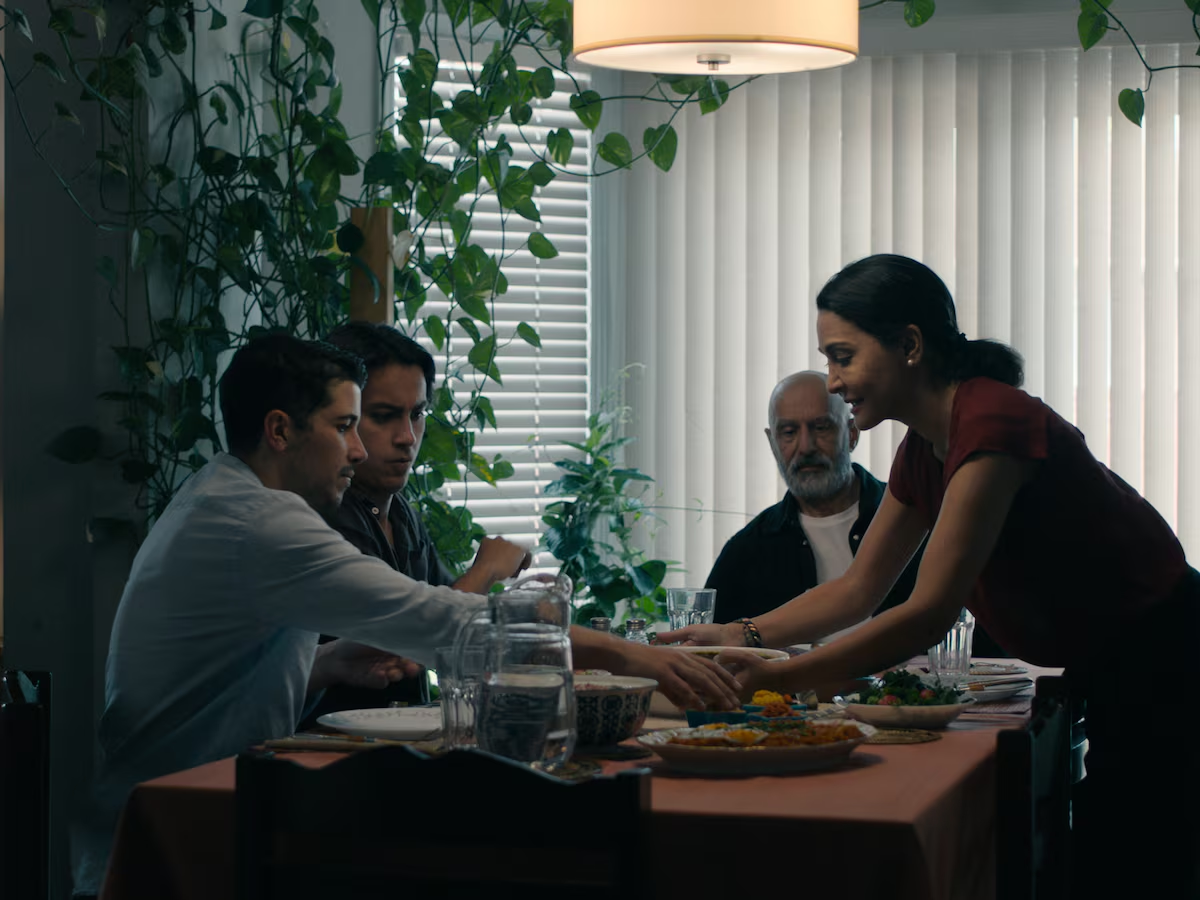
Amir (Alireza Shojaei) is a cook in an upscale French restaurant in Toronto. He has a degree in Engineering, but finds that kind of work boring. His dream? To open up his own place as the executive chef. In the meantime he works long, gruelling hours in the kitchen. His younger brother Mahyar (Parham Rownaghi) has no creative drive — his dreams centre around symbols of wealth: a beautiful woman, a Ferrari to drive or a Rolex watch on his wrist. He’s a crypto bro, who still lives in their parents’ home. Amir regularly eats family dinners with Mahyar, his Mom (Mitra Lohrasb), and his Dad (Gus Tayari) The rest of his free time he spends with his lover a married woman with whom he’s having a secret affair. But his life — and that of his family — comes in the form of an unexpected death. His and his brother’s childhood doctor — who they haven’t seen in decades — has left his entire substantial fortune to Mahyar. There is a new degree of tension in the family, between Amir and his father, and between his parents. Only Mahyar seems blissfully unaware. What is going on, and why won’t his parents talk about it? And can a trip to Niagara Falls provide the answers to Amir’s questions?

His Father’s Son is a family drama set within Toronto’s large Iranian-Canadian community. It feels at first like another look at the immigrant experience in North America, and the clash between traditional parents and their sons who want to break free. But wait! This is not how it turns out at all. It gradually gets more complex, emotionally powerful and surprising. And these changes are not sudden or in your face, they’re subtle, unspoken, in the spaces between what you see, the elliptical passage of time.

The acting — with dialogue in Farsi and English — is terrific all around, but especially Gus Tayari, Mitra Lohrasb, and Alireza Shojaei in the lead role. This is Moaphi’s first film, and though quite short (under 90 minutes) it shows an unexpected maturity, the kind you’d see in films by Asghar Farhadi or Kore-eda Hirokazu.

 His Father’s Son is a well-made drama.

Bride Hard and His Father’s Son both open this weekend in Toronto; check your local listings. Needles and Pins opens theatrically next week in the US, and on VOD in Canada.

This is Daniel Garber at the Movies, each Saturday morning, on CIUT 89.5 FM and on my website culturalmining.com.

Intrigue. Films reviewed: The Phoenician Scheme, The Ritual, Ballerina

Posted in 1920s, 1950s, Action, comedy, Crime, Horror, Nun, Religion, Satanism, Thriller, violence by CulturalMining.com on June 7, 2025

Hi, this is Daniel Garber at the Movies for culturalmining.com and CIUT 89.5 FM.

imagineNative — Toronto’s own indigenous film and media arts festival — is on now through Sunday with docs, films, exhibitions and performances from around the world with both free and paid events.  Check it out!

But this week I’m looking at three new movies: an art house comedy, a religious horror movie and an action thriller. There’s a devious mogul preparing his daughter to take over his busines, a priest attempting an exorcism, and a professional assassin fighting to avenge her dad.

The Phoenician Scheme 

Co-Wri/Dir: Wes Anderson (Reviews: Fantastic Mr Fox, Isle of Dogs, The French Dispatch, Asteroid City)

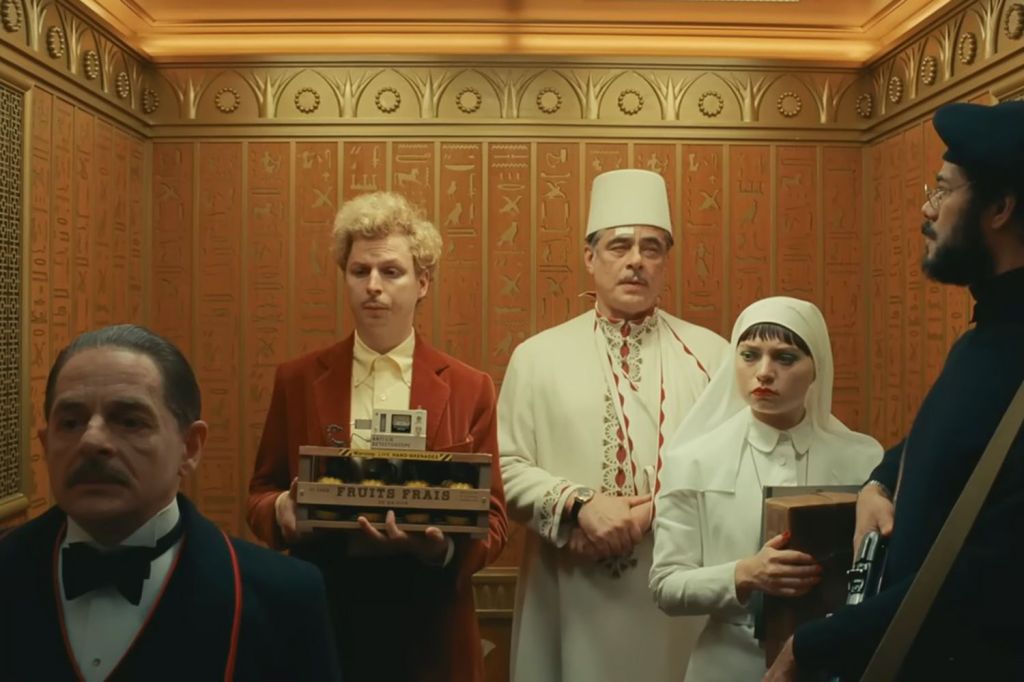
Zsa-Zsa Korda (Benicia Del Toro) is the richest industrialist in the world. He amasses millions by embarking on huge projects in developing countries using virtual slave labour. He’s ruthless and cruel. He has sired a dozen kids whose names he can’t remember and whom he keeps locked up in a threadbare orphanage. Except, one. Liesl (Mia Threapleton) is a novice, brought up in a convent and dresses like a nun but who who has yet to take her vows. Korda is grooming her to take over his huge business interests after he dies. And attempts on his life — like poisons, bombs and sabotaged airplanes — are a routine part of his life. But he always seems to survive. And so he embarks on a grand scheme to involving interconnected tunnels, waterways and cornering global markets. But first he must raise the money from investors. He takes Liesly along with him as he carries out his complex plans. And accompanying them is Bjorn (Michael Cera) a Scandinavian tutor, ostensibly hired to educate his kids, but instead tags along on these journeys. But they face hostile business partners, revolutionaries, spies and assassins, quicksand, plane crashes and other symbols of disaster. Will his scheme be successful? Will Liesl learn to love him? And will he survive the final attempt on his life?

The Phoenician Scheme is an art-house comedy film, the latest in Wes Anderson’s collection. It’s stylized and formalistic, shot in almost two-dimensional geometric settings with precisely directed sequences. Combining social satire with silliness, it’s wacky and always surprising. It consists of a series of segments as he checks off the list of the projects he planned as he swindles repeated capitalists out of their investments. The story line is punctuated by repeated dreams fantasies of Korda — in his near-death experiences — as he faces judgement in Heaven, but always ending up back again on earth. Threapleton is fun to watch as she gradually transforms from an avowed zealot to a lover of luxury, as Korda replaces her rosary with semiprecious stones, and her simple corncob pipe with an inlayed treasure from Cartier. Cera is hilarious as the insect-loving tutor Bjorn, and Del Toro is sufficiently both grand and seedy to convey his anti-hero’s character. Like all of Wes Anderson’s films, many members of his stable of actors reappear in short, cute roles: Tom Hanks, Willem Defoe, Bryan Cranston, Charlotte Gainsbourg, Richard Ayoade, Scarlett Johansson, Ris Ahmet, Bill Murray, and Benedict Cumberbatch, to name just a few. Some people are put off by Anderson’s emphasis on style and form — which, admittedly, doesn’t always work — but in this case, I think he’s made a fine movie that’s a pleasure to watch. 

The Ritual

Co-Wri/Dir: David Midell

It’s the late 1920s in a small town in Iowa and Father Joseph Steiger (Dan Stevens) is mourning the death of his only brother. But his grief is interrupted by a young woman in his parish. Emma Schmidt (Abigail Cowen) says she is possessed by a demon. For many years she has seen doctors and psychiatrists but no one can explain her strange condition. So she has turned to the Church to cure her, and says only an exorcism can free of from her very real torment. This is unheard of, but the ritual has been approved by the local Bishop, with an expert in demonic possession heading their way. Father Theophilus Riesinger (Al Pacino) is a shaggy-haired little monk who wears a cowl and talks like Tevye from Fiddler on the Roof. But he knows the practice of exorcisms inside and out. Along with a bevy of assorted nuns to help out, the ceremony begins. Emma is tied to the bed as her body writhes. She  pukes pea soup and breaks out in weird rashes. The furniture flies around the room as she curses in five languages. But can they exorcise this demon before it consumes her?

The Ritual is a horror movie that (supposedly)  reenacts an actual historical event: the performance of an exorcism in the US. The script is based on documents from that era. Thing is it is also the inspiration for William Friedkin’s iconic film The Exorcist, and the novel, by William Peter Blatty, it was based on. This version has atrocious writing, painful acting, and cheap-ass special effects. Fear and grief is conveyed by actors covering their faces with their hands, over and over. The whole movie is shot with in extreme close-ups using a hand-held camera that jiggle enough to make any viewer feel nauseous. Although the chapters of each ritual is documented, there’s minimal difference from one to the next. It isn’t even vaguely scary, more boring than anything else. It feels more like a Sunday school sermon than a horror movie. Al Pacino? Dan Stevens? These are famous actors! What are they doing in this dreadful movie? They must really be desperate. 

The obvious question is, what possessed the filmmakers to attempt to retell a story that’s already been told so well?

What a clunker. 

Ballerina

Dir: Len Wiseman

Eve (Ana de Armas) is a little girl raised by her father in a hidden palace somewhere in Eastern Europe. She is kept hidden from the rest of the world for her own safety. Until a man named The Chancellor  (Garbiel Byrne) tracks her down, kills her father and takes her away. All she has left to remember her dad by is a music box snow globe with a dancing ballerina inside. She is immediately enrolled in a school run by The Director (Anjelica Huston), a cruel teacher in the tradition of the Ruska Roma who trains her girls to endure the pain of classical ballet dancing. They also learn how to kill their adversaries using fists, kicks, knives or any other dangerous object. Upon graduation, only those with true bloodlust are farmed out across the globe as killers to hire. And Eve is at the top of her class. She is highly successful as an assassin, but has another hidden motive: vengeance for the death of her father and sister.

Her relentless search leads her to a picturesque alpine village filled with jolly bakers and wood carvers. The women have blond braids and rosy cheeks while the men happily quaff steins of pilsener. Unfortunately, everyone in the village, I mean everyone, is a trained killer. And they happen to belong to a criminal outfit in an uneasy truce with the clan works for. Can she find her father’s killer and escape the village alive?

Ballerina is an action/thriller about a young, female assassin out for revenge. Its a spin-off of the John Wick franchise with many of the same recurring characters, including cameos by Keanu Reeves as John Wick himself. The plot is simple, and the script has relatively few lines. What it does have is fighting and lots of it, which it does really well, whether hand to hand or using enormous lethal weapons. The fight choreography is skillful and creative — it’s ballet. And I liked Ana de Armas as the protagonist… enough that if there were another Ballerina movie, I’d watch that one too. This is good action feature.

Ballerina and The Ritual both open this weekend in Toronto and The Phoenecian Scheme expands across Canada; ; check your local listings;

This is Daniel Garber at the Movies, each Saturday morning, on CIUT 89.5 FM and on my website culturalmining.com.

American battles. Films reviewed: G20, Drop, Warfare PLUS National Canadian Film Day!

Posted in 2000s, Action, Diplomacy, Iraq War, Suspense, Terrorism, US, violence, War, Women by CulturalMining.com on April 12, 2025

Hi, this is Daniel Garber at the Movies for culturalmining.com and CIUT 89.5 FM.

Yearning for some Can-Con? We’ll mark your calendars: next Wednesday is Canada Film Day with over 1700 screenings and discussions about great Canadian movies across this country! In Toronto alone, directors and actors like Sophie Desraspe, Helen Lee, Eric Peterson, and Cody Lightning will be there at the screenings.  There’s also a Town Hall discussion of Canadian culture with Don McKellar, Mary Walsh and Elle-Maija Tailfeathers. Canadian Films suddenly seem acutely relevant. Go to canfilmday.ca for showtimes.

But this week, I’m looking at three new movies from south of the border. There are Navy Seals in Iraq attacked by armed combatants; the US President locked in hand-to-hand combat with international terrorists; and a single mom terrorized by her cel phone.

G20 

Dir: Patricia Riggen

It’s a resort hotel in Capetown, South Africa, and US President Danielle Sutton (Viola Davis), America’s first black female POTUS is preparing for the G20 summit. When she’s not practicing martial arts with her Secret Service bodyguard Manny (Ramón Rodríguez) she’s hanging with her family:  loving husband Derek and her two teenaged kids. Serena, the older one, (Marsai Martin) is an accomplished hacker who can sneak, undetected, out of any building, even the White House. President Sutton is decked out in an elegant red evening gown — complete with cape — for the all-important photo-op. But something is rotten in the city of Capetown. There’s a conspiracy at work, led by evil Aussie mercenaries. And now armed soldiers are rounding up the presidents and their families! If they can pull this off, they’ll have trillions in “untraceable” crypto currency, and the leaders of the most powerful nations in the world will grovel at their feet.  

But some of the leaders have escaped their clutches. Sutton, the elderly Korean First Lady, the pompous British PM, and a few others have form an impromptu posse. Can this ragtag group of heads of state beat the musclebound mercenaries in a contest of physical strength and mental acuity? Or is this world doomed?

G20 is a ludicrous but fun action thriller, told from the point of view of a female, superhero-type president. This is not a unique movie theme: Many Americans love venerating their presidents. Think: Harrison Ford in Air Force One or even Abraham Lincoln Vampire Hunter. But G20 is so silly… The villains carry the bitcoin wallet — with all the money — as if it’s a physical object, a MacGuffin they have to possess. And they eforce the leaders to read a nonsense speech (the quick brown fox jumps over the lazy dog) so they can make a deep-fake video… as if world leaders haven’t made hundreds of speeches already. A 60-year-old president who’s also an Iraq War hero and also a jiujitsu champ. Sure, why not…? It’s just a movie. The main story may be a hackneyed farce, but Viola Davis is a joy to watch.

Not a masterpiece but a watchable TV movie.

Drop

Dir: Christopher Landon

Violet (Meghann Fahy) is dressed-up but nervous. She’s on her first date since her husband died, five years ago. A single mom and an online therapist, she likes working from home so she can keep a close eye on Toby, her adorable, autistic son. But her wacky sister Jen (Violett Beane) insists she step out of her shell and have some fun. Jen’s babysitting Toby tonight to give her all the time she needs. And if there’s no chemistry with the guy she’s meeting, she can always just leave. So here she is in a fancy restaurant with a dramatic view of the city. In comes Henry (Brandon Sklenar) her first date, and there’s instant attraction. Henry is handsome, rugged and friendly, and has a steady job at City Hall. He likes her looks, her smarts and her honesty.  They go to their table and start the date.                

But the electricity between is interrupted by anonymous memes and texts that keep appearing on her phone, apparently dropped by someone somewhere in the restaurant. The messages become threatening, along with a warning: if you tell anything to Henry (the guy she just met) we’ll kill your son. Followed by live security footage from her home… with a masked man roving her halls with a gun. Whoever it is has control of all her security cameras and all the cels in the restaurant. They can see and hear everything she’s doing. They want her to commit a crime  in plain view, and there’s no way to stop them. Can Violet save her son and outsmart this invisible villain on this date from hell?

Drop is a classic suspense thriller that plays on our fear of technology and surveillance. Afterwards I realized there are some major plot holes or impossibilities, but they don’t stand out while watching it. It’s a tightly budgeted Blumhouse movie so the actors are likeable but not A-list, and everything takes place in two tight locations – her home and the restaurant. It uses psychological fear instead of pyrotcechnics. And it works. This is a good, traditional suspense thriller, the kind where the tension keeps growing and never lets up.

I like this one.

Warfare

Co-Wri/Co-Dir: Alex Garland (Ex Machina, Annihilation, Civil War), Ray Mendoza

It’s November, 2006, in Ramadi, a city in central Iraq, between Baghdad and Fallujah. Ray (D’Pharaoh Woon-A-Tai) is leading a squad of Navy Seals on a mission. They commandeer two houses, knocking down walls and pushing the families into their bedrooms. They’re setting up for a long wait, until a marine unit arrives with tanks to evacuate them. But armed enemy soldiers are setting up on nearby roofs, taking pot-shots at them. And when the tank finally arrives, the Seals are ambushed by an IED buried in the road. The Iraqi soldiers they are working with are killed, while some of their own are badly injured. They have to pull their bodies back into the house and try to save who they can. Can they fight off the insurgents until the Marines arrive? And who will survive this tense battle?

Warfare is a hyper-realistic depiction of an actual battle in Iraq as remembered by the US soldiers who were there (including writer/director Ray Mendoza). It’s not like your usual war movie. The film favours accuracy over character- building or back stories. And the characters speak in military jargon, full of Frogmen (navy seals), Bushmen (an aerial unit, overhead) and many more I couldn’t catch. The cast is excellent, especially Woon-A-Tai, Will Poulter (The Revenant, We’re The MIllers,  Midsommar) and Cosmo Jarvis — it really felt like you’re there, witnessing actual soldiers, showing bravery, camaraderie, and brotherhood. What the movie doesn’t deal with is why? Why were they there at all? What did that particular mission accomplish? Where are all those WMDs, the supposed reason for this war? Thousands of US soldiers were killed there, and many times more tragically killed themselves afterwards. And an estimated one million civilians in Afghanistan, Pakistan and the Middle East were wiped out, millions more displaced and the whole region made unstable till today… and for what? 

I’m glad I saw Warfare — it’s a rare chance to experience a non-jingoistic, up-close and personal look at US soldiers on the frontline. But don’t go to this docudrama expecting to be entertained. Because fun… it ain’t

G20 is now screening on Prime Video, and Warfare and Drop both open this weekend in Toronto; check your local listings. This is Daniel Garber at the Movies, each Saturday morning, on CIUT 89.5 FM and on my website culturalmining.com.

Archnemeses! Films reviewed: Kill, Despicable Me 4, Escape

Posted in Animation, comedy, Espionage, France, India, Kids, Korea, North Korea, Punjab, Super Villains, Thriller, Trains, violence, War by CulturalMining.com on July 5, 2024

Hi, this is Daniel Garber at the Movies for culturalmining.com and CIUT 89.5 FM.

Classic novels and movies needed a hero or a heroine to save the day. But in really good stories there’s also a nemesis, an enemy to fight and defeat. This week I’m looking at three new movies, from Korea, India and France — two action thrillers and an animated comedy — about arch-nemeses. There’s a former villain in witness protection, a commando on a train heading in a southern direction and a communist sergeant preparing his own defection!

Kill

Co-Wri/Dir: Nikhil Nagesh Bhat

Amrit (Lakshya) is a commando in a special unit of the Indian army. Along with his best buddy Viresh (Abhishek Chauhan) they lead their troops in tactical operations using martial arts and hand-to-hand combat. But he’s in a bit of a jam. The love of his life, Tulika (Tanya Maniktala) is pledged to another man in an arranged marriage. To elope seems too risky; her father is an oligarch with immense power and wealth. Even so, they arrange for a secret meeting aboard the express train her family are riding south from Amritsar to Delhi. And, right there, with the two of them squeezed into a cramped toilet Amrit proposes marriage, complete with ring. But what neither of them realize is the train has been targeted by a brutal gang of bandits for an attack on the sleeper cars. The dacoits kill the guards, and steal watches, jewelry and cash from everyone there. And they sexually threaten the women. They’re led by a capricious Fani (Raghav Juyal) the nefarious son of the clan’s patriarch. But when Amrit and Viresh see what’s happening, they decide it’s time to fight back… but can just two commandos take on an entire family of bandits?

Kill is a non-stop, violent action movie, the first of its kind out of India. It’s nothing like Bollywood, no songs, dances, or extended flirting. This is heavy-duty fighting all the way through. This is Lakshya’s first starring role — he’s good-looking  and intense, a natural leading man. He plays Amrit as a regular Punjabi drawn almost to madness when he sees his lover threatened. Then he goes berserk. He wears a blood-stained shirt for most of the film, and beware: there’s a lot of blood to be spilt. Much of the action takes place in the aisles of an express train, between cars, on the roof, and out the exit doors. Weapons range from sabres, to rifles, a metal fire extinguisher and the fighters’ bare fists. The fighting is superbly choreographed, really well done. And the sound effects are chilling — the sound of skull hitting metal the slash. Off a knife, the thud if fists hitting flesh…I’ve never seen an Indian movie like this, and I quite enjoyed it. If you can get into intensely violent, non-stop action movies — on the scale of the great  Indonesian flic The Raid — then I think you’ll really like Kill. 

Despicable Me 4

Dir: Chris Renaud, Patrick Delage

Gru (Steve Carell) is a former supervillain who is now on the straight and narrow. He lives with his beloved wife Lucy (Kristen Wiig), their three adopted  daughters, Margo, Edith and Agnes, and their newborn baby son. But he has to dive back into the world of villainy when he is sent on a secret assignment: to return to the criminal boarding school of his childhood, the Lycée Pas Bon. Once there he must capture and jail his lifelong rival Maxime Le Mal (Will Ferrell). Now Gru has his Minions — diminutive bright yellow creatures who obey his orders but are always up to no good — but Maxime has minions of his own: cockroaches! He’s built up a veritable army of the insects, and when he escapes from prison, he vows revenge against Gru and all those around him. To safeguard his family, Gru enters a witness protection program where they are all given new names and identities and a suburban home to live, and told to “blend in”.

The problem is their next door neighbours, the Prescotts, have a precocious but obnoxious daughter named Poppy. She has guessed Gru’s true identity and threatens to expose him unless he helps her pull off a heist of her own. But can Gru keep his family safe while pulling off this audacious caper? Or will they fall prey to Maxime and his cockroach empire?

Despicable Me 4 is an animated kids’ comedy about a former villain facing off against a current villain.  It’s the latest in an immensely successful French movie franchise (Reviews: Despicable Me, Minions: The Rise of Gru) about a likeable villain and his makeshift family. It combines simple animation with funny lines and goofy characters, Once again, I viewed it in an audience packed with kids who seem to love it. Personally, it seems to be getting a bit tired, like they’re running out of new ideas. The one genuinely funny aspect are the Minions, all voiced by Pierre Coffin. When they’re around, you’ll be laughing with their silly and imaginative slapstick humour. Despicable Me 4 isn’t great, but it did keep me entertained. And the kids will love it.

Escape

Dir: Lee Jong-pil

It’s present day at the DMZ in North Korea. The Demilitarized Zone — it separates the north from the south — is full of landmines, with sentinels in towers watching closely for any movement on either side. Kyu-nam (Lee Je-hoon) is a Sergeant in the Korean Peoples Army nearing the end of his ten-year term there, and dreads returning to work in a coal mine. There is no family to go home to. He has firmly embraced the national ideology of Juche, or self-reliance. But in Kyu-nam’s case, self-reliance has taken on new meaning. Each night, he sneaks out of his bunker, climbs through a window, and crawls his way across the minefields toward the border, recording all the safe spots along the way. He plans to defect to the South before the next rainfall causes the landmines to shift. But he runs into trouble when a pudgy private named Dong-hyuk (Hong Sa-bin), who idolizes the Sergeant sees his trial runs. Dong-hyuk longs to be reunited with his mother and sister in South Korea. So he tries to escape on his own, using Kyunam’s map… but he mucks things up, putting them both in danger of a firing squad.

But who appears at the desertion trial, but Hyun-sang (Koo Kyo-hwan), a Major with connections. He has connections with Kyu-nam going way back, and declares him a national hero, and sets him up in a cushy job as an aide-de-camp for a drunk general. But Kyu-nam is committed to his plans. Can he reach the border before Hyun-sang can catch him? Or are they doomed to a violent end?

Escape is a fast-moving action thriller, full of complex schemes and near escapes… along with plenty of unexpected surprises. Koo Kyo-hwan plays the major as a slightly effeminate, upper-class nepo-baby who would rather be a concert pianist than an officer. This villain reveals hints of a secret gay past, adding to his mystery. Lee Je-hoon plays a macho, self-reliant soldier who just wants to choose his own future and have enough food to eat (based on what he heard about the South from the propaganda broadcasts he picked up on his transistor radio). The entire film takes place in the North. It portrays a country filled with poverty, malnutrition and class divisions— based on Party membership — where the ordinary people just scrape by, while the effete elites gorge on fine meats and liquors. I have no idea how accurate it is, but I liked the details, from the socialist realist murals, the giant slogans, and the maroon coloured dress-uniforms the officers wear. 

And, of course, its gripping plot that will keep you glued to the screen.

Kill, and Despicable Me 4, both open this weekend in Toronto, and you can catch Escape at the TIFF Lightbox; check your local listings. This is Daniel Garber at the Movies, each Saturday morning, on CIUT 89.5 FM and on my website culturalmining.com.

Fighting. Films reviewed: Seagrass, The Hunger Games: The Ballad of Songbirds and Snakes, Testament

Posted in Canada, Family, Politics, Protest, Quebec, Satire, Science Fiction, violence, Y.A. by CulturalMining.com on November 12, 2023

Hi, this is Daniel Garber at the Movies for culturalmining.com and CIUT 89.5 FM.

Fall Film Festival Season keeps on rolling. I had the pleasure of attending the opening-night screening of the ReelAsian film festival. It’s the delightful comedy/drama The Queen Of My Dreams, directed by Fawzia Mirza. It follows a queer Toronto woman in Karachi for a funeral as she recalls her own and her estranged mother’s) history in Pakistan in the 60s and Halifax in the 80s — all while listening and dancing to Bollywood songs. ReelAsian is in its 27th year showing films from across that continent and in the asian diaspora, now through November 19th. And the Shorts not Pants festival opens on November 17th. In case you’re wondering it’s not about cut-offs or basketball shorts — it’s a curated short film festival, which I’ve heard is quite good.

This week, I’m looking at three new movies — one of which is playing at ReelAsian. There’s a fight over a painting in Montreal, a fighting couple on an island near Nanaimo, and a fight to the death in the city of Panem.

Seagrass

Wri/Dir: Meredith Hama-Brown

It’s the summer of 2011. Judith and Steve (Ally Maki, Luke Roberts) are riding a ferry with their kids to a rocky island near Nanaimo, BC. They’re renting a cabin complete with a kitchen, and there’s even a swimming pool with lots of games and hikes planned for all the kids there. It’s a shady forest that leads to a mysterious dark cave on the shore. The couple in the next cabin, Pat and Carol (Chris Pang and Sarah Gadon) —  a white and asian pair like Judith and Steve — swear the last time they spent on the island was a life-changer. The thing is, they’re not there for a vacation. It’s a place where couples can look at their relationship and try to work out their differences through daily group therapy sessions. The kids, Steph and Emmy (Nyha Huang Breitkreuz,  Remy Marthaller) have problems of their own to work out. 10-year-old Steph doesn’t want to babysit her 6-year-old sister — she’d rather mess around with friends at get-togethers. 

The problem is Judith is depressed — she’s been that way since her mom died many months earlier. And now she’s regretting she never talked with her about the internment camps Japanese Canadians were put in during WWII. Or what happened to her dad’s fishing boat. It’s like there’s a ghost or spirit lurking above the family — is it the kids’ late grandmother or just the general bad feelings?  It’s not just that, Judith isn’t sleeping with Steve anymore. And Steve is increasingly jealous and angry that Pat — the husband next-door — seems to be spending too much time with Judith. As the pressure builds it begins to affect the kids too, leading to a potentially frightening conclusion.

Seagrass is a stunning look at secrets revealed at a getaway in British Columbia. It’s also about identity, history and family, especially of Japanese-Canadians. I found it very moving, a bit of a tear-jerker actually. At the same time, it makes you uneasy to watch the story unfold, and the unexpected revelations it leads to. It’s not your typical marriage counselling movie; it’s equally about the kids, and the subtle racism they face. The cast is uniformly great, but especially Ally Maki as a woman on the verge of a nervous breakdown. This movie also does amazing things  both visually and audibly, from pop songs to eerie sound effects.

Great movie.

The Hunger Games: The Ballad of Songbirds and Snakes

Dir: Francis Lawrence

Coriolanus Snow (Tom Blyth) is a young man with a keen intellect. He’s handsome, popular and ambitious. He lives in Panem, the capital city of a post-apocalyptic world. A top student at the Academy, the training grounds for the nation’s top leaders, he’s in line for the Plinth prize. He needs to win it because, although he’s from an aristocratic family, he’s poor. So poor, his cousin Tigris makes his shirt buttons out of bathroom tiles, and school lunches keep him alive. 

But the scholarship is at risk when Dean Highbottom (Peter Dinklage) declares all students must participate in the Hunger Games as a mentor to a tribute, the kids sent to the capital from each outlying district. Lucy Gray (Rachel Zegler) from District 12 is his Tribute — if she wins the Hunger Games, Coriolanus gets the prize money. So he will do anything to keep her alive. She’s a pretty songbird — from a long line of travelling musicians — who dresses in colourful outfits. The two hit it off, and prove a formidable team of underdogs. Will they beat the odds, and survive? And is there relationship more than just a game?

The Hunger Games: The Ballad of Songbirds and Snakes is a gripping action-adventure movie based on the dystopian YA novels. I read avidly the trilogy when it first came out, but was less attached to the related movies — I only watched the first one, maybe because I knew what was going to happen. But this one took me by surprise; it’s a prequel, set half a century before the other books. So I found it exciting, dark and gripping. It is violent — after all, this game is about 24 kids murdering one another in a stadium. But this is set in the early years of the Hunger Games: the capital is battle-scarred and decrepit. Drones sent to the tributes are primitive and dangerous, as likely to kill a player as to send them food or water. These hunger games are darker and grittier. I like the novelistic turns of plot, and the truly evil characters, especially Dr. Volumnia Gaul wonderfully played by Viola Davis as a mad scientist who creates terrifying animals — the snakes and birds of the title — to stymie the districts and their tributes. Zegler is good as Lucy, singing as much as she talks, and Blyth is great as the conflicted Corio. The explosions and pyrotechnics look fantastic on a big screen, so if you’re into this kind of  movie, see it now, not on some future TV streamer.  

Testament

Wri/Dir: Denys Arcand

Jean-Michel Bouchard (Rémy Girard) is a retired writer and archivist in Montreal. He still has an office but lives in a venerable, public retirement home. Never married, no kids, but he still has many friends to spend time with.  Suzanne Francoeur (Sophie Lorain) is the directrice of the building, and keeps her eagle eye on anything that could disrupt her tightly-run edifice. But when a group of college protesters set up camp across the street chanting Free First Nations! she isn’t sure how to handle it. The anglophone demonstrators say the building is full of racist art.

The issue at hand? A 19th century fresco on a wall in the music room depicting Champlain’s first meeting with the Iroquois. The protesters say the French are settler-colonists in fancy dress while indigenous men are depicted as primitive barbarians, while the women are topless. Meanwhile, Jean- Michel’s close friend Roger, a fitness and health food nut, suddenly drops dead right in front of him. Jean- Michel receives a literary prize, but is mistaken for someone else with a similar name. And Suzanne seems to be standing just outside his door whenever a young woman visits him in his bedroom — why is she there? As the tension from the protesters grows, media, Quebec nationalists, bureaucrats and politicians all descend on the home. Can Jean-Michel stop the madness? Or is this the beginning of the end? And what will happen to the mural?

Testament is a political and social satire about Quebec’s aging boomers, as their rule ends. Denys Arcand has been covering this cohort for four decades, in films like The Decline of the American Empire, The Barbarian Invasions, and The Fall of the American Empire. This one shares similar themes and some of the same actors as well. The characters are stereotypical and amusing — anglo protesters are buffoons, seniors are clueless busybodies, feminists snarl, while politicians tell baldfaced lies — but he pokes at the politics from all sides. It has a huge cast, including Robert Lepage (who had his own controversy involving indigenous issues) as an effete arts/politics leader in an hilarious parody of himself. There’s also a romantic subplot — no spoilers — and, surprisingly, some very moving moments.

If you want to understand Quebec cultural politics — with a lot of laughs — you must watch Denys Arcand’s Testament. 

Seagrass is playing at the TIFF Bell Lightbox, one of many great films at the ReelAsian Film Festival. Testament and Hunger Games both open this weekend in Toronto; check your local listings. 

This is Daniel Garber at the Movies, each Saturday morning, on CIUT 89.5 FM and on my website, culturalmining.com.

Daniel Garber talks with Mehdi Fikri about After the Fire at #TIFF23

Posted in 2000s, Corruption, Drama, France, Movies, Police, Protest, violence by CulturalMining.com on September 16, 2023

Hi, this is Daniel Garber at the Movies for culturalmining.com and CIUT 89.5 FM.

Photograph by Jeff Harris

Driss, Malika, Karim and Nour are close-knit siblings who live in the banlieux of Strasbourg, France, sworn by their late mother to stay together. When the black sheep, Karim turns to drugs and petty crime, Malika writes him off as a lost cause. But when he is arrested and dies in police custody, she decides to take action. And as she finds herself the main spokesperson for large scale protesters and rioters, she must learn to navigate the world of French politics, justice, media and police. Can Malika find justice for Karim after the fires have ended?

After the Fire is a stirring, dynamic, and hard-hitting look at immigrant communities — personified by one family — fighting back against an oppressive establishment. It’s exciting, surprising and deeply moving. It’s French writer and filmmaker Mehdi Fikri’s first feature, and it had it’s world premiere at TIFF.

Mehdi talks about the justice system, political films, BPM, La haine, Camélia Jordana, media training, Algerian music… and more!

I spoke with Mehdi in person at #TIFF23.

From Paper to Film. Films reviewed: My Name is Andrea, The Zen Diary

Posted in 1980s, Buddhism, Cooking, documentary, Feminism, Food, Japan, Poetry, Protest, US, Vegetarianism, violence, Women, 日本映画 by CulturalMining.com on June 10, 2023

Hi, this is Daniel Garber at the Movies for culturalmining.com and CIUT 89.5 FM.

Toronto’s Spring Film Festival season continues with the Jewish Film festival closing this weekend and the Japanese Film Festival just starting up. And ICFF, the Italian Contemporary Film Festival starting in two weeks.

This week, I’m looking at two new movies playing at the two TJFFs, both based on writings and their writers. There is a radical feminist on violence against women, and a zen Buddhist on sustainable vegetarianism.

My Name is Andrea

Wri/Dir: Pratibha Parmar

Based on the writings of Andrea Dworkin

Andrea Dworkin was a poet, a writer and a radical feminist theorist who wrote about the outrage of violence against women, abuse, harassment and rape. Born in the 1940s in Camden, NJ, she grew up in a happy, middle-class family in suburban Cherry Hill. She was assaulted as a teenager, and later, as a college student protesting against the War in Vietnam, she was arrested and sent to the notorious Women’s House of Detention in New York. There she and other political prisoners were subject to horrible abuses by the doctors there. (Her testimony against the prison led to its eventual closing.) She travelled to Europe where she was exposed to the writings of Franz Fanon, Kate Millet and others, which, together with her own experiences, helped develop her radical feminist theory that the patriarchal system of power was based on violence against. And as a poet and writer, she expanded her critique to include the arts by deconstructing the male gaze within literature 

She was also an activist, participating in movements like Take Back the Streets, the aftermath of the École Polytechnique massacre and later, along with Catherine McKinnon, in the movement of Women Against Pornography. She died in 2005. 

My Name is Andrea is an unusual biographical documentary, that looks at Dworkin’s life, her writings and her philosophy. It includes early home movies, TV footage and personal letters and notes. What’s unusual is there’s no outside narrator or recent talking heads; instead it relies on recordings of her own voice (and those of other people she talked to) to advance the narrative. And since much of her writing was never recorded, a number of actors — including Christine Lahti, Ashley Judd and Amandla Stenberg — take on her role. I’ve read some of her writing before but this is one of the first times I’ve heard her voice and she was an extremely passionate speaker, whether giving a speech at Cambridge or on the Phil Donahue show. And it also lets her own voice defend herself from misrepresentation of her ideas (at various times she was accused of hating men, of calling intercourse rape, and of advocating obscenity laws). My Name is Andrea is a fascinating tribute to Dworkin’s work.

The Zen Diary

Wri/Dir: Yuji Nakae

Based on the book “Tsuchi wo Kurau Hibi; Waga Shojin Juuni ka Getsu” by Mizukami Tsutomu

Tsutomu (Sawada Kenji) is a prize-winning Japanese novelist who lives alone in a remote farmhouse in the mountains. His wife died 13 years earlier but he still keeps her ashes. He’s under pressure by Machiko, his publisher (Matsu Takako ) to write another book, so he decides to record what happens each month over the course of a year (hence the title). Interestingly, while this includes big events in his life, it’s also about the minutiae of living. As a kid, he was a novice monk at a Buddhist monastery in Kyoto, where he was trained in cooking, cleaning, planting, harvesting and foraging for food. He brings those childhood memories into play as an elderly man who is also a vegetarian.

Everything he does is done by hand: from cleaning rice to finding edible roots in the garden. He digs up bamboo shoots in a forest and looks for mushrooms and fiddleheads on the hillside. Even seemingly inedible vegetables — like the first sprouts of certain tree leaves in the spring — are delicately picked, scrubbed clean, cut-up and cooked. He shines the wooden floor on his hands and knees. He also visits his elderly mother-in-law who lives in a tiny shack, and trades foods with far-off neighbours. But a surprise death — and the threat of his own mortality — makes him rethink his daily life. Should he settle things and prepare to die? Or forge ahead with new projects?

The Zen Diary is a subtle, low-key drama about life off the grid. It feels almost like a documentary, but the parts are actually all played by actors (Sawada Kenji has been a pop idol, composer, actor and celebrity for 60 years.) And the book it’s based on is real — it’s Mizukami Tsutomu’s last work (he died in 2004). There’s something deeply satisfying and inspiring about watching the foods being made from the dirt to the table — and some of the dishes he makes, like tofu made from sesame seeds and daikon with miso, look truly delicious. It’s also a  bittersweet story about death and remembrance, family, kinship and relationships. The storyline is simple, and the film is extremely low-key, but it leaves you with something you didn’t have deep inside you before you saw this movie.

The Zen Diary is playing at the Japanese Canadian Culture Centre on June 17th, at the Toronto Japanese Film Festival; and My Name is Andrea played at the Toronto Jewish Film Festival.

This is Daniel Garber at the Movies, each Saturday morning, on CIUT 89.5 FM and on my website, culturalmining.com.

Talking, listening, fighting back. Films reviewed: No Bears, Puss in Boots, Women Talking

Posted in 2000s, Animals, Animation, Fairytales, Fantasy, Iran, Movies, Religion, Turkey, violence, Women by CulturalMining.com on December 24, 2022

Hi, this is Daniel Garber at the Movies for culturalmining.com and CIUT 89.5 FM.

It’s holiday time with lots of new movies for people of all ages. This week I’m looking at three new movies opening on Christmas weekend. There are women in a barn, talking; a movie director in a village, listening; and a cat in a hat, fighting. 

No Bears

Wri/Dir: Jafar Panahi

Jafar Panahi is an Iranian  filmmaker from Tehran. His current project is about a glamorous middle-aged couple trying to escape to freedom in Europe. But Panahi is forbidden by law from making movies or leaving the country. So he’s doing the next best thing: directing his film in long-distance using his cellphone and laptop. It’s being shot in a picturesque city in Turkey, while he’s renting an apartment in a tiny Azerbaijani village in Iran. It’s close to the border an area rife with black market smugglers. Panahi can speak some Azeri but is unfamiliar with local traditions. So he likes talking pictures of the locals. And here’s where he runs into trouble.

A young couple wants to get married and leave the village. But the woman was promised to another man at birth. Now everyone thinks Panahi caught the young couple in a photograph. The couple want him to destroy the photo, while the groom’s family want a copy to prove her dishonour. Meanwhile, across the border, another crisis is threatening the film movie. As he gets pulled deeper and deeper into the world of local politics and feuds, his work — and possibly his life — is at risk. Will he ever finish his film? And what will happen to the two couples — the actor-lovers in Turkey and secret lovers back home?

No Bears is a neorealist movie about making a film, the film he’s making, and how real life gets in the way. It’s about honour, revenge and identity. It also exposes the image of “the director as a dispassionate observer and documentarian” as a myth. Panahi’s very presence in a small village disrupts their lives and leads to unforeseen consequences. He plays himself, who in real life is forbidden from making films — accused of propaganda against the system. Any movie that’s against the system is one I want to watch. But this means it was shot openly in Turkey but secretly in Iran. No Bears  is a clever, humorous and complex film with an unexpected conclusion. I liked this one.

Puss in Boots: The Last Wish

Co-Dir:  Joel Crawford, Januel Mercado

Puss in Boots is a cat in a hat who wears boots, and carries a sword. He’s known for both his fencing skills and his rapier-like wit. He lives a fairytale life — literally. He exists in a world where those stories are real. He’s both a hero and an outlaw, sought by bounty-hunters everywhere. But as a cat with nine lives he has no fear of death and will fight monsters and villains, alike. Until one day his doctor tells him he’d better slow down because he’s on his last life. If he is killed again, that’s the end, no more Puss in Boots.  So he reluctantly decides  to retire. He gives up his identity, and becomes an ordinary orange cat named Pickles in a home for abandoned cats. Now he has to use a litter box, eat cat chow and say “meow”.  How humiliating! But his past catches up to him with some surprise visitors: Kitty Softpaws, another outlaw he left standing at the altar; and Goldilocks and the Three Bears. They all want him to help find a map to a fallen star that can grant a wish. Goldilocks wants a proper family, Kitty is looking for her future, and Puss in Boots wants his 9 lives back. Accompanied by a little dog named Perro he sets out to steal the map from the evil Little Jack Horner (who is now quite big and bakes pies for living). But he must fight off his rivals, journey through a mystical forest, and find the magic star if he wants to stay alive. And he is being pursued by a truly scary villain, the Big Bad Wolf, a huge killer carrying a sickle in each hand.

Puss in Boots is a kids’ cartoon comedy set in the world of Shrek, where nursery rhymes and fairytales coexist with Alice in Wonderland and the Wizard of Oz. It’s somehow simultaneously a spaghetti western and medieval Europe.  It features the voices of Antonio Banderas, Salma Hayek and Florence Pugh. What’s good about it? I’ll watch any cartoon, especially one with cool psychedelic images. This one has a few funny bits, along with a neat journey-adventure story. On the negative side, it’s not very funny, the lines are predictable and the story is both unoriginal and forgettable. And I’m not sure why they switch to two-dimensional jerky animation whenever there’s a fight scene. But I still enjoyed it, even if it’s just glowing bright colours on a giant screen. 

Women Talking

Dir: Sarah Polley

It’s summertime at an Anabaptist colony somewhere in the US. It’s 2010, but it could be 1910; forget about cel phones and computers. There are no cars, radios, no electric lights — they still use lanterns. Even more unusual, there are no men around, only women and kids. What’s going on?

One of the women woke up in the middle of the night to find a man physically attacking her. She fought him off and beat him with a stick. Suddenly everything made sense. Countless women in the colony had woken up in the past with bruises and blood, but up till now, the men had insisted out was just a dream, her imagination or the work of Satan. Turns out the men have been raping women for years now and denying it, using cow tranquilizers. Now they are at the police station baling out one of their attackers. So all the women face an enormous decision: should they stay and fight back? Or should they just pack up the kids and go, leaving the place forever?

They designate the women and girls from three families to decide for all of them. Now they’re gathered in a barn to debate the issues and make the big decision. And one man, a school teacher named August — not part of the colony; his family was excommunicated  — is there to record it all on paper; the women were never taught to read or write. What will their decision be?

Women Talking is a movie about women talking, but it is much deeper than that. It’s a devastating story, a scathing indictment of endemic physical and sexual violence against women in their own homes. Though it’s never shown on the screen, nor are its perpetrators, its results are always apparent. One woman has a scar on her face, one woman is mysteriously pregnant, others have missing teeth or black eyes, and another has panic attacks, seemingly for no reason. And now they’re really angry, not just for the violence, but because they’ve been lied to for so many years. There’s a spontaneous wellspring of grassroots feminism suddenly bursting loose.

The storytelling is very simple — it sticks to the barn, the fields, their houses and horses and buggies; it’s all they’ve experienced. At the same time, perhaps because they can’t write, they are amazingly eloquent speakers. It’s based on the novel by Canadian author Miriam Toewes who grew up in a Mennonite community. (The film never specifies their denomination or location, giving it a timeless, universal feeling.) It provides an internal view of life in the colony, with different opinions expressed passionately by each character. And it’s very well-acted by an ensemble cast, including Rooney Mara, Jesse Buckley, Claire Foy, Frances McDormand, Sheila McCarthy, Ben Whishaw. And despite the grave topic, the movie itself is more fulfilling than depressing. I’ve seen it twice, and appreciated it much more the second time — Women Talking is a subtle movie that deserves your attention. 

Puss n Boots: The Last Wish, No Bears and Women Talking, all opened this weekend; check your local listings.

This is Daniel Garber at the Movies, each Saturday morning, on CIUT 89.5 FM and on my website, culturalmining.com.