Dangerous, exotic. Films reviewed: Sinners, Yadang: the Snitch, The Legend of the Ochi
Hi, this is Daniel Garber at the Movies for culturalmining.com and CIUT 89.5 FM.
Hotdocs International Documentary Film festival is on now in Toronto, with free daytime admission for students and seniors. So get out there and watch some docs!
But this week I’m looking at three new movies about unexpected dangers in exotic locales. There are vampires in the Mississippi Delta, snitches in the drug wars of South Korea, and elusive, sharp-toothed creatures on an island in Carpathia.
Sinners
Wri/Dir: Ryan Coogler
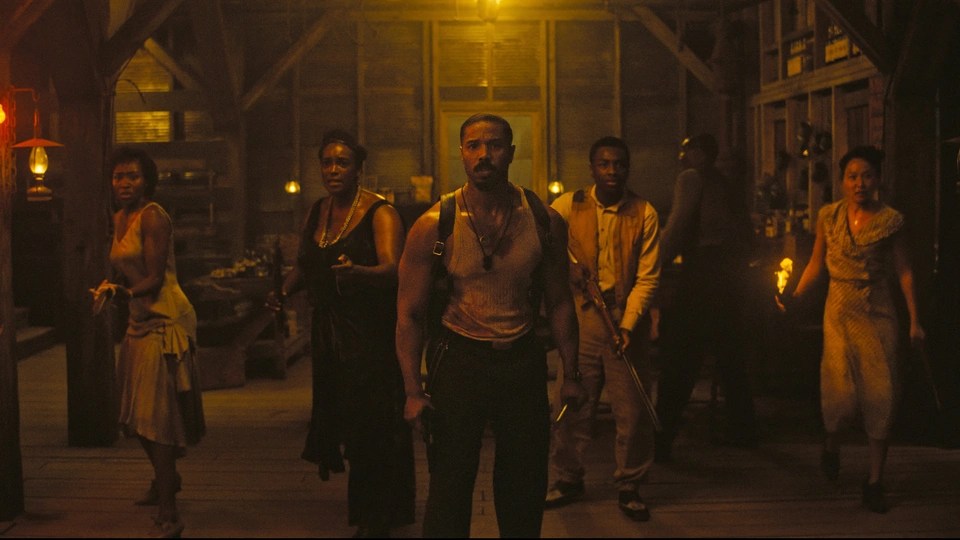
It’s 1932 in a small town in the Mississippi Delta. The Smokestack brothers aka Smoke and Stack (Michael B Jordan: The Fantastic Four, Chronicle) are identical twin who spent years making money working for the mob in Chicago. Now they’re back in town with a truck full of bootleg alcohol, a wad of cash and big ideas on how to make it rich. Namely, they’re opening a juke joint in an abandoned woodmill they bought from a local good ol’ boy. They’re rounding up the necessary musicians, like their cousin Sammie (Miles Caton), the preacher’s son, on blues guitar and Delta Slim (Delroy Lindo) on the piano and mouth organ. Bo and Grace Chow furnish the provisions and Cornbread minds the door. Even Smoke’s and Stack’s ex-partners show up: Mary (Hailee Steinfeld) a glamorous married woman who can pass for white, and Annie (Wunmi Mosaku) an experienced practitioner of Hoodoo. By sunset the place is hopping, the
customers are drinking and gambling, everything is going great, until… a mysterious, smiling stranger who loves Irish music (Jack O’Connell; Seberg, Unbroken, ’71, Starred Up ) appears at the door asking to be let in. They don’t know who he is but he just looks shifty. Turns out he’s a vampire who wants all their blood — not to wipe them out, just to turn everyone over to the dark side. But can the people on the inside keep the demons on the outside until the sun comes up in the morning?
The Sinners is a black history drama about life in the Jim Crow south in the 1930s combined with the action and horror of a conventional genre movie, that succeeds on both fronts. It’s rich in meticulous historical detail in the background: sharecroppers picking cotton in the same fields as their grandparents had as slaves, paid in company scrip not dollars; chain gangs on the highway; and the omnipresent KKK.
All this is counterposed with raunchy dialogue and the sexualized dancing and singing of the juke joint. Every character has a backstory, devoid of cookie-cutter cliches. The costumes, scenery and especially the music — from delta blues to Irish folk songs — evoke that period in a way only a movie can. The acting is superb, though I do wish Michael B Jordan made Smoke and Stack a little less identical. The vampires are more conventional. They still hate garlic, sunlight and stakes through the heart but interestingly these demons lose also racial prejudice once they become vampires. Put this all together and you end up with this amazing movie that’s multifaceted, educational and really fun to watch.
Yadang: The Snitch
Dir: Hwang Byeong-gug
It’s present-day Korea. Lee Kang-su (Kang Ha-neul) is a self-confident young man with a perpetual grin. Why does he swagger and show off his gold lighter? It’s because he’s always two steps ahead of anyone else. He’s a yadang, an informant, and plays a crucial role in the government’s war on drugs. But things weren’t always this way. He was incarcerated after being falsely accused of drug dealing, where he was beaten up and bullied on a daily basis. Until Ku Gwan-hee (Yoo Hai-jin) an ambitious prosecutor pulled him out of that world to be his personal Yadang. Now the two of them are pledged as eternal brothers, functioning like a well-oiled machine, pulling off repeated sting operations and arrests of drug kingpins and thugs across the country. Much to the chagrin of a police detective trying to arrest those same criminals. So Det. Oh Sang-jae (Park Hae-joon) a.k.a. the Jade Emperor of Narcotics Division, finds a Yadang of his own, a rising young actress (Chae Won-been) who is caught using illegal amphetamines as diet pills. Now the lines are drawn and the two sides — the prosecutors and the police — are in direct competition. But the Prosecutor, in his rapid rise to the top, has to make some uncomfortable political alliances, including a rich junkie named Cho Hoon, whose dad just happens to be running for President. Will Cho-hoon’s influence on the Prosecutors rise in power threaten the Yadang’s status and the delicate balance of that world?
Yadang: the Snitch is a Korean action-thriller about
crime, corruption, and the complex relationships among politicians, police and informants in the world of organized drug-crime. Fast moving and compelling, it maintains a frenetic pace throughout the film, with some flashbacks that last only a few seconds. It’s dizzying. It’s also quite violent, sometimes disturbingly so. Luckily, it has interesting characters and a clever plot with enough double- and triple-crosses to keep you guessing until the very end.
Yadang: The Snitch is an entertaining action flic.
The Legend of Ochi
Wri/Dir: Isaiah Saxon
Yuri (Helena Zengel) is a teenaged girl who lives with her dad and adopted brother, Petro. She likes reading library books and listening to loud music. Her farm is on a mountainous island in the Black Sea, off the coast of Romania, and though it’s decades since the fall of Ceausescu, people there still drive Ladas and keep to the old ways. Above all, they fear the Ochi, mythical beasts unique to their island who live in trees, attack sheep and kidnap children. Her Dad (Willem Dafoe) lives in constant fear of the Ochi. He leads a ragtag army of children to capture and kill the monsters… though they have never been successful. Her step-brother Petro (Finn Wolfhard) is a member too, though her rarely speaks. Yuri, on the other hand, is angry at her father and wonders why her mother (Emily Watson) abandoned her. (It’s the Ochi! says her dad.)
One day, when her father sends her out to do her rounds, she finds a small ochi with its paw caught in an animal trap. She frees him and takes him home in her knapsack. He looks like a blue-faced koala until he bares his teeth revealing long pointed fangs. But Yuri is not afraid, she nurses him back to health and eventually the two form an unexpected bond. But can she get him back to his homeland without her father finding out?
The Legend of Ochi is a highly-original adventure story about a young girl and the creature she befriends. It’s warm and delightful. While on the surface it’s a kids’ movie, the
sumptuous, painted scenery and retro feel makes it an instant cult classic. (Think ET, and Charlie and the Chocolate Factory.) It’s full of panpipes and medieval crusaders overladen with Soviet kitsch. Even the odd faces of the kids in the army are straight out of Dr Seuss. I’ve never heard of director Isaiah Saxon before, but I get the impression he’s been doodling pictures of Ochis since he was a little kid. And they are amazing: not cheap-ass CGI, but a combination of puppetry and animatronics that make them seem totally real in their own fantastical way.
I love this movie.
The Legend of the Ochi, Yadang: The Snitch and The Sinners all open this weekend in Toronto; check your local listings. This is Daniel Garber at the Movies, each Saturday morning, on CIUT 89.5 FM and on my website culturalmining.com.
Bobby, Robbie and Tom. Films reviewed: A Complete Unknown, Better Man, Nosferatu
Hi, this is Daniel Garber at the Movies for culturalmining.com and CIUT 89.5 FM.
Christmas is coming in just a few days, so this week I’m looking at three new movies — two musical biopics and a gothic horror — all opening on the 25th. There’s a young man named Bobby who hails from Minnesota, another named Robbie who looks like a gorilla, and a third named Tom who is headed for Transylvania.
A Complete Unknown
Co-Wri/Dir:James Mangold (Indiana Jones…)
It’s 1961 in Greenwich Village. Bobby Dylan (Timothée Chalamet: Dune, The French Dispatch, Call Me by Your Name, ) is a 19 year old boy from Minnesota, who arrives penniless with just a guitar on his back. The Village is the centre of the folk revival sweeping across America, alongside the civil rights and anti-war movements. Bobby is looking for his hero Woody Guthrie (Scoot McNairy), and tracks him down at a Psychiatric Hospital in New Jersey. Guthrie is suffering from a debilitating case of Hunnington’s disease. He communicates using grunts and gestures, but clearly likes Bobby’s songs. Pete Seeger (Edward Norton) — the folk giant and political activist — is there too, visiting Woody. He takes Bob under his wing and later introduces him at an open mic show at the Gaslight Cafe. There he meets the beautiful and talented Joan Baez (Monica Barbaro), a wildly popular folksinger and activist in her own right.
Bob’s still broke and prone to couch surfing, but soon settles into a casual relationship with Sylvie Russo (Elle Fanning: Somewhere, Super 8, Ginger and Rosa, Neon Demon, Twentieth Century Women, The Beguiled, The Roads Not Taken, Mary Shelley). Is it love? And despite his unconventional voice, he quickly attracts fans — including stars like Johnny Cash — and his recording career takes off. Joan Baez adapts some of his songs with great success, and the two of them go on tour together — where they become intimate on and off stage. But Bob feels constrained by the folk community and wants to forge new
musical pathways. What will happen when Bob Dylan goes electric?
A Complete Unknown: The Ballad of a True Original is a biopic about Bob Dylan. It spans a relatively short period of his life and music from his arrival in New York until the Newport Folk Festival of 1965. Chalamet is excellent as the young Bob Dylan, portraying him both as kind and self centred, ambitious and indifferent… usually sitting around in his underwear strumming a guitar. Norton is surprisingly believable as Pete Seeger. Elle Fanning, as Dylan’s neglected lover, seems less real, more of a cinematic concoction to add a romantic undertone to the story. Indeed, much of the plot and characters are invented out of whole cloth— with Dylan’s approval.
What’s really good though is the music. 75% of the movie is
just singing and playing instruments, performed by the actors themselves. Maybe it’s me, but those songs, those joyful songs… they made me sing along and literally brought tears to my eyes. Live concerts, jams, hootenannies, jamborees, recording gigs… this movie includes everything. Whatever its false notes or historical inaccuracies, the music makes it.
I enjoyed this movie so much.
Better Man
Co-Wri/Dir: Michael Gracey
It’s the 1980s in Stoke-on-Trent, England. Robbie Williams (Jonno Davies) is a boy who lives with his dad, mum and grandmother (Steve Pemberton, Kate Mulvany, and Alison Steadman). He goes to Catholic school where he’s the class clown. He loves singing, acting and telling jokes. He’s not particularly talented but he is charming and cheeky, always ready with a smile, a wink, and a wiggle. He longs for approval from his neglectful father, but rarely gets it. So he vows to become famous some day to prove his worth. Unfortunately he’s the only one who thinks he can make it. Still, somehow he passes the auditions and is invited to join a new boy band called Take That.
Robbie doesn’t mind performing semi-clad at gay bars; their popularity is growing, and their catchy tunes are being listened to. And when they finally make it big, he is dazzled by the adoration of countless fans. He falls for the allure of alcohol, drugs and willing sex partners. But why isn’t he making much money? It’s because he doesn’t write the songs, he just performs them.His drug use is getting out of hand. When he quits the band for a solo career, thing look rough. Will his own talent ever be recognized? Will his father ever be
proud of him? And can he overcome the self doubt that plagues his career?
Better Man is a music biopic about the rise, fall and rise again of the pop singer and performer. The music and plot of this film are both pretty basic. What’s interesting is how he is portrayed. Through the use of CGI, Robbie Williams looks like a human but with the features and fur of a chimpanzee. No one ever mentions it, he doesn’t eat bananas or climb trees, but throughout the movie, he looks like an ape. It represents the self-doubt and insecurity that drives him.
Director Michael Gracey had his start as an animator who learned special effects from the ground up, which leaves him with a vast supply of techniques to dazzle audiences. He has no fear of green screens and embraces CGI whole heartedly. Most of the movie feels like a non-stop, never-ending music video, expertly made. I’m not a fan of boy-band pop, but the sparkling presentation makes Better Man fun to watch.
Nosferatu
Co-Wri/Dir: Robert Eggers (Lighthouse Eggers interview, The Northman, The VVitch Reviews)
It’s the 1830s in a small port city in Northern Germany. Thomas and Ellen Hutter (Nicholas Hoult, Lily-Rose Depp) are a young couple, passionately in love. To support their family and any future kids, Tom has a new position at a financial firm, run by the eccentric Mr Knock. Tom is a Bob Cratchit, always trying to please his boss. His first assignment: to visit a fabulously wealthy noble, have him sign a contract, and accompany him back to the city. It seems like a simple task. But Ellen is dead-set against it. Count Orlov cannot be trusted — he will kill you, Tom, she says. How does she know? The nightmares she’s had since adolescence predict it.
But, despite her warnings, Tom heads off to Transylvania. Count Orlov’s (Bill Skarsgård) castle is intimidating, set amongst the stark Carpathian mountain, and none of the local villagers dare to go with him, even draped in ropes of garlic. Tom braves it on his own, but finds the Count mysterious and oppressive. The castle is filled of vicious wolves and with rats.
Tom wakes up each morning feeling drained, with teeth marks on his torso.
Meanwhile, back in Germany, Ellen is tormented with nightmares, driving her toward insanity, despite help from her friends Friedrich and Anna (Aaron Taylor-Johnson, Emma Corrin). Tom disappears and, when the Count arrives in the German town, unaccompanied, people start dropping dead from the plague. Can Tom and Ellen free themselves of Count Orlov’s treachery? And what are this vampire’s real motives?
Nosferatu is a remake of Murnau’s 1922 silent film, which in turn was an adaptation of Bram Stoker’s Dracula. But far from being just another vampire movie, this one is totally original. It’s sexualized, scary, funny and grotesque. I saw it in IMAX in all its gothic glory.
Murnau’s Nosferatu was a masterpiece of German expressionism, both modern and iconoclastic; Ironically, this one, made a century later, is deeply rooted in the distant past. Robert Eggers loves this old stuff, and pays meticulous attention to every word of the script and every frame of the film. It’s full of unnecessary but delightful scenes, like Roma singers and Magyar slap dancers, and rat infested canals. Eggers went to Transylvania just to capture that castle on film. He gives us a new Dracula, no Bela Lugosi accent or widow’s peak. This Nosferatu is a burly, imposing man, draped in fur robes, with a grand Hungarian moustache. His skin and muscles are rotting away, putrid with decay. He is driven not by an insatiable thirst for human blood but by lust: he covets a woman.
If you’re into new explorations in horror, I think you’ll love Nosferatu.
Better Man, A Complete Unknown, and Nosferatu all open on Christmas Day in Toronto; check your local listings.
This is Daniel Garber at the Movies, each Saturday morning, on CIUT 89.5 FM and on my website culturalmining.com.
Movies with two directors. Films reviewed: Abigail, Unsung Hero, Sasquatch Sunset
Hi, this is Daniel Garber at the Movies for culturalmining.com and CIUT 89.5 FM.
Not everyone likes every type of movie. Some want to be excited or scared, others want to be gently reassured, and still others expect to be intellectually stimulated. So this week I’m looking at three new movies — a horror, a family drama, and a strange arthouse flick — basically, something for everyone. There’s a group of kidnappers lured by a huge ransom, a family of Australian musicians with big ambitions, and a near-family of near-humans with very big feet.
Abigail
Dir: Matt Bettinelli-Olpin, Tyler Gillett (Review: Ready or Not)
Abigail (Alisha Weir) is a poor little rich girl who loves ballet dancing. Though still very young, she is diligently rehearsing the lead role in Swan Lake, complete with tutu and toe shoes. Until she is injected with sedative, dragged from her mansion, and wakes up chained to a bed in a creepy castle far away. Who is responsible? A gang of professional criminals, none of whom have ever met before, but promised 7 million in cash each, if they can babysit Abigail until the whopping ransom arrives the next day.
The gang consists of Frank (Dan Stevens) a canny former cop, Dean (the late Angus Cloud) their ginger-bearded pothead driver; Peter (Kevin Durand) a musclehead enforcer, Sammy (Kathryn Newton) an expert hacker who favours expensive jewelry; Rickles (William Catlett) a sniper and former marine, and Joey (Melissa Barrera), their de-facto organizer. She’s the only one talking with the little girl… who is very frightened
and distraught. To calm her down, Joey promises nothing bad will happen to her, pinky swear.
But things take a turn when one of the gang is discovered in the kitchen, headless. Even worse, they find out Abigail’s dad is one of the richest — and most dangerous — men in the world, known for cruelly torturing and killing anyone who crosses his path. And then there’s little Abigail herself: she’s not actually a girl — she’s a centuries-old vampire who feeds on human blood… who happens to like ballet. Can the gang escape this house of horrors? Or will they be killed, one by one?
Abigail is a violent and gory vampire horror/thriller. It’s a reboot of the classic story: “if you can stay in a haunted house overnight I’ll give you a million bucks”. It also plays on Agatha Christie’s And Then There Were None, Rian Johnson’s Glass Onion, or Tim Story’s The Blackening, where characters
locked in an old house are killed, one by one. That said, the characters — and plot turns — in Abigail are different enough to keep you interested. Yes, there are cliches — a house full of suits of armour and widows that close and lock themselves — but it also adds shocking new twists to the old vampire myths — like, what happens to vampires when they die? (No spoilers).
If you like mystery and horror, with lots of blood guts and gore, tempered a fair amount of ballet dancing, I think you’ll enjoy Abigail.
Unsung Hero
Wri/Dir: Richard L. Ramsey, Joel Smallbone
It’s 1991. David Smallbone (Joel Smallbone) is a successful music promoter in Sydney, Australia. He lives with his pregnant wife Helen (Daisy Betts) and six kids in an enormous mansion, and manages tours by big musical stars. But when a bad business deal leaves him completely broke, they all decide to fly halfway around the globe to Memphis, Tennessee. But the promised job awaiting him… wasn’t there, and the pre-arranged rental house was completely empty. Luckily Mum is a quick thinker, and turns their suitcases into beds — who needs furniture, anyway? The kids love playing cricket in the empty rooms. But she still has eight mouths to feed — David, Helen, Becca, Daniel, Luke, Joel, Josh and Ben — three times a day, and no money to do it. But the heavens are shining bright on the Smallbones and they soon find work gardening and house cleaning, including with some of his former musical clients. The kids are pitching in, too, when they’re not being home-schooled. They have a money jar to pay for food and rent, and a wall chart with things they want and want to pray for; the Smallbones are a devout Christian family. It’s at a Church
service that everyone notices what a beautiful and angelic voice Becca, the oldest daughter has (Kirrilee Berger). This provides David with the motivation he needs to get a music contract signed for Becca, thus saving their family from wrack and ruin. But can David and Becca do it? Or will the family fly back to Australia with their collective tails between their legs?
Unsung Hero is a biopic of the real-life Smallbone family, before the kids became famous, as seen through their mother Helen’s eyes. It shows how they pulled themselves back up after a major setback. It’s a faith-based movie, where praying and church play central roles throughout the film. The father David (circa 1991), is played by his actual son (in 2024). And the music they produce — from the beautiful singing of Kirrilee Berger, to the band For King + Country that Joel and Luke later founded — is good. Not to my taste, but it’s actually good. The problem comes from producing a biopic where the subjects have a central role in its content. I grew up in a family of seven and we kids fought verbally and physically all the time. In this movie, though, they are so kind and whitewashed they make the Brady Bunch kids seem like gangstas. Maybe that’s true in this family, but it rings false to me. Way too Hallmark-y. There are also a number of basic faux pas. Like having a flashback within a flashback in the opening scenes — that’s just clumsy editing.
If you want to watch an inspiring and positive 90s- era story about a musical family’s Christian life, you might like Unsung Hero. Otherwise, I don’t think you’ll get much out of it.
Sasquatch Sunset
Dir: David Zellner, Nathan Zellner
Somewhere in the redwood forests in Northern California, a pack of four unclassified animals are wandering around searching for food. They are covered in brown and grey hair, walk on two legs, and have opposing thumbs. Are they human, or are they animals? They are Sasquatches, popularly known as the Bigfoot. And they are a lot like us. They eat, sleep and have sex. Urinate, defecate, and puke when they eat something poisonous. They give birth and die. They play, communicate, make music and look at the stars in the sky. And they come in at least two genders and a number of sizes.
They commune with nature, and vice versa; snakes, skunks, deer and porcupines happily coexist, and even play with them. Sasquatch are mainly vegetarian though they do eat fish. They also make mistakes, especially the biggest of the four, the alpha Sasquatch. He has a tendency to stick his “stick” where it doesn’t belong. And the other three react loudly and
emphatically when he does something he shouldn’t do. But when they encounter signs of humans — felled trees, camping equipment, a paved road — they are shaken to their core. Will they ever spot one of us?
Sasquatch Sunset is a very weird, arthouse film about the journey of Sasquatches in their natural habitat and the encroaching presence of humans. It feels partly like a nature documentary or an anthropological newsreel, but it’s also very funny at times. Sad too. And it has actual characters. They don’t have names but let’s call them the big, mean one, the relaxed one with breasts, the pensive intellectual and the adolescent (Nathan Zellner, Riley Keough, Jesse Eisenberg, Christophe Zajac-Denek). There is also dialogue — grunts and whoops, the banging of sticks and lots of jumping around and screeching. At first, I couldn’t tell them apart or even what their sex is — they‘re all really hairy! — but it gradually becomes quite apparent. And by the end I think you’ll feel for them and understand them, too.
Sasquatch Sunset is a very strange movie, but I liked it.
Abigail and Sasquatch Sunset, open this weekend in Toronto, while Unsung Hero starts next Friday; check your local listings.
This is Daniel Garber at the Movies, each Saturday morning, on CIUT 89.5 FM and on my website culturalmining.com.
Scary? Films reviewed: The Beasts, The Last Voyage of the Demeter
Hi, this is Daniel Garber at the Movies for culturalmining.com and CIUT 89.5 FM.
August is Emancipation Month in Toronto, commemorating the end of slavery in the British commonwealth, including Canada. So in honour of that there’s a free screening of RasTa: A Soul’s Journey, at Daniels Spectrum in Regent Park on August 13th.
But this week I’m looking at two new, scary movies. There are sailors who want to abandon ship, and farmers who don’t want to leave their land.
The Beasts
Co-Wri/Dir: Rodrigo Sorogoyen
Antoine (Denis Ménochet) and Olga (Marina Foïs) are a middle aged professional couple living in Galicia in northwestern Spain. He’s a burly, reserved man, while she is direct and no-nonsense. They gave up their lives and careers to settle among the rocky hills, growing organic tomatoes and vegetables. They love the simple life, working hard, breathing the fresh air and taking long walking through the nearby forests and hills They get along well with some of their neighbours, but not all of them. And especially not Xan and Lorenzo, a pair of wiry, adult brothers who keep nomadic horses. Lorenzo (Diego Anido) may be simple-minded but is prone to cruel, practical jokes, with Antoine as the victim. Xan (Luis
Zahera) is much worse. Xan insults him, calls him a derogatory name for French people, mutters veiled threats and even spits at him.
At the centre of their dispute is a contract which Antoine and Olga refuse to sign. A multinational energy corporation wants to turn the village into a wind farm. But after all the money, time and work they have put into it, they don’t want to throw it all away for a small buyout. It’s their home. This is what makes their neighbours so angry. They want to leave their ancestral homes forever. And as their fight grows, it gradually turns to violence. What will become of them?
The Beasts is an intense, dark drama played out in a clash of cultures and class. The film starts with a group of men physically wrestling with horses in slow motion. This motif comes up later in the movie in an
unexpected way. It’s billed as a thriller, but it’s not — I’d call it more of a slow-burn drama, spread out over more than two hours. The dialogue is in French, Spanish and (I’m guessing) Galician, since it doesn’t sound like any Spanish I’ve ever heard before.
Is it a good movie? I like the characters, and the acting and the drama, and its beautiful cinematography, locations and music. But the film has a weird structure, with a very long ending after an intense chapter in the middle. It’s less thrilling or scary than it is creepy and disturbing, though it does have a satisfying finish. I just don’t quite get the point of this movie. If you like feeling uncomfortable for a couple hours but not really challenged, then you’ll probably like The Beasts.
The Last Voyage of the Demeter
Dir: André Øvredal
It’s the 1890s and the three-masted Demeter is loading at a Romanian dock, preparing for its voyage to Dover, England. Captain Eliot (Liam Cunningham) has mustered all his sailors on the ship, as well as Wojchek, his first mate (David Dastmalchian), Joseph, his bible-thumping cook (Jon Jon Briones) and his eight-year-old grandson Toby (Woody Norman). It’s the captain’s last voyage so he wants to pass on some of his lore. The only unfamiliar face is Clemens (Corey Hawkins), the ship’s doctor. Not a sailor, but he does hold a medical degree from Cambridge (very uncommon for a black man in Victorian England). But with such a small crew, even the doctor has to take his turn steering the ship and on night watch. But the most unusual thing is this ship’s cargo: a series of large wooden crates filled
with dirt and branded with a sinister-looking mark. The locals refuse even to board the ship, but the crew is happy that there’s a big cash bonus if they deliver the cargo in time.
Unfortunately, things start to go wrong pretty quickly. First, a female stowaway is found on board — and sailors considered women on ships bad luck. Anna (Aisling Franciosi) is half dead, speechless and frightened. Clemens keeps her alive with frequent blood transfusions. Then all the ship’s animals — from livestock, to a dog, to even the rats hidden in the hold — are found dead. And then the crew starts disappearing, one by one. Is this a disease? A stowaway killer? Or something even worse? And will the Demeter and its crew ever reach its destination?
The Last Voyage of the Demeter is a well-crafted thriller/horror about a vampire on board a ship, based on Bram Stoker’s Dracula. And — no spoilers here — if this vampire looks familiar, it’s because he’s Nosferatu, the cadaverous, long fingered, pointy-eared creature made famous by the silent German expressionist masterpiece by FW Murnau, released a full century ago (1922). This Nosferatu can fly,
swim, hypnotize its victims and seemingly pass through walls. He’s almost indestructible. The film is beautifully shot in a German studio, with the camera flying down long passageways, into the galley, under tables and up to the sailmasts. The soundtrack is punctuated with tapping sounds that reverberate the length of the ship. The acting is quite good all around. And this vampire is a scary one.
The one thing that’s missing is pathos — with a few exceptions, you don’t feel close or attached to most of the characters. But that’s a minor problem in a good horror movie. And this one gives new life to a very old vampire.
The Last Voyage of the Demeter and the Beasts are both opening this weekend in Toronto, with The Beasts playing at the TIFF Bell Lightbox.
This is Daniel Garber at the Movies, each Saturday morning, on CIUT 89.5 FM and on my website, culturalmining.com.
Fighting the big fight. Films reviewed: How to Blow up a Pipeline, Renfield PLUS #HotDocs30
Hi, this is Daniel Garber at the Movies for culturalmining.com and CIUT 89.5 FM.
This coming Wednesday is Canadian Film Day, where you can see great Canadian movies for free all across the country. And Hot Docs — is right around the corner offering documentaries from Canada and around the world. It’s their 30th anniversary, and once again daytime screenings are free for seniors and students, so don’t miss it.
This week, I’ll be talking about films to look out for at Hot Docs as well as two new features — a horror comedy and a suspense thriller. There are radical activists in Texas fighting Big Oil, and a servant in New Orleans fighting Big Vampire.
Films coming to Hot Docs

Photo by Angela Gzowski Photography
The festival opens with the first pan-polar indigenous documentary about the Inuit in Greenland and Nunavut. It’s called Twice Colonized.
In You Were My First Boyfriend the filmmaker looks back at her traumatic high school days.
Someone Lives Here is about the young guy in Toronto who built those tiny wooden houses, providing shelter for the homeless during the pandemic.
Praying for Armageddon is about the political power wielded by evangelical groups in the US.
Love to Love You, Donna Summer is a tribute to the queen of disco.
Lac Megantic is the first documentary on that railway disaster in Quebec.
And Satan Wants You retraces the satanic panic that sprung up in the US in the 1980s.
These are just a few of the many films coming to Hotdocs, that caught my eye.
How to blow up a Pipeline
Co-Wri/Dir: Daniel Goldhaber
If you heard that bombs exploding near Odessa are affecting world oil prices, you’d probably say Of course! There’s a war on in Ukraine. But what if the explosion is near Odessa, Texas? And the bombing is planned by young radical climate activists making a statement about Big Oil? This is a film about a group with loose ties across the country who get together in Texas to blow up an oil pipeline in two places, to make a big statement felt worldwide, because West Texas Crude determines the world’s price of oil
Who is this diverse group sharing a single goal?
Xochitl (Ariela Barer) and Theo (Sasha Lane) have been best friends since childhood. They grew up beside an oil refinery, and now Xochitl has terminal cancer, a type of leukemia specific to people who live near oil refineries. Xochitl’s lover, Alisha (Jayme Lawson) is also there. Michael (Forrest Goodluck) is from North Dakota where his indigenous community couldn’t prevent a pipeline from running through their town. Rowan and Logan (Kristine Froseth,
Lukas Gage) are anti-fa-type activists who up to now have done low-key actions. And Dwayne (Jake Weary) is a Texan, married with a kid, whose ancestral homestead was demolished by another oil company using eminent domain. Shawn (Marcus Scribner) met Dwayne while working as the sound guy on a documentary.
How to Bomb a Pipeline is not a documentary, it’s a suspense /thriller about this diverse crew trying to build bombs and set them off without getting caught. They use public access information that’s online and work out careful plans… but things don’t go exactly how they plan it. And at least one member of the group is a rat, reporting progress to the police. I liked this movie; it was pretty good alternating between the group at work and flashbacks showing the backstories of each member. If you’re into watching (un-)civil disobedience by radical activists, told in a gripping style, you might like How to Bomb a Pipeline.
Renfield
Dir: Chris McKay
It’s present-day New Orleans. Renfield (Nicholas Hoult) is an Englishman, new to the city but with the same old job, one he really hates. So he joins a 12 step group for people in co-dependency relationships. But it will take more than 12 steps to get quit his job. You see he’s Dracula’s servant, the one who brings the vampire (Nicolas Cage) bodies to feast on. TO be a better person, he kills the rotten spouses or lovers spouses of other people in his group. But Dracula wants more: Bring me a busload of nuns, cheerleaders and innocent tourists! Dracula commands. But though he has ever disobeyed his master, he does have some superpowers: insects are to Renfield as spinach is to Popeye. Chew up a cricket and he can fight off an armed gang. And he does exactly that when heir to a criminal family, the notorious Lobos clan comes after him. Tedward Lobo (Ben Schwartz) wants to prove his skills to his mother the mob boss, but Renfield is a thorn in his side. The fight is witnessed by Officer Quincy (Awkwafina) a traffic officer
who is the only cop in New Orleans not on the take. She tells the Renfield he’s a hero, something he’s never been called before. Together they vow to bring an end to crime. But what will Dracula do if he ever finds out?
Renfield is a very funny horror/action/comedy. I went this one expecting total crap, so I was pleasantly surprised at how good it is. Nicolas Cage is always hit and miss — he’s prone to hamming it up, and is in a lot of dreadful clunkers. But he’s terrific as Dracula, the perfect blend of disgusting, sleazy, scary and funny. He’s on a roll. And he never breaks character. Nicholas Hoult is just as good as a meek serial killer/hero, and Awkwafina serves as the perfect foil. In
fact everyone plays their roles really well. If you can’t stand blood, stay away. This movie is Fangoria material. Lots of violence spilled guts and cut off limbs, in a semi-comical way. But if that’s no problem I think you’ll enjoy this one.
Hotdocs begins on April 27th. Renfield and How to Blow Up a Pipeline both open across Canada this weekend; check your local listings.
This is Daniel Garber at the Movies, each Saturday morning, on CIUT 89.5 FM and on my website, culturalmining.com.
Northern Europe. Films reviewed: The Good Traitor, Boys from County Hell, About Endlessness
Hi, this is Daniel Garber at the Movies for culturalmining.com and CIUT 89.5 FM.
I don’t care what they tell you, movies are not the same without the whole movie experience — going out, choosing a movie, standing in line, eating popcorn… and sitting in a large space beside a crowd of strangers laughing, booing or screaming to the same things you are. You can’t get that watching a laptop or a flat screen TV.
Remember TimePlay? That movie trivia game you used to play before the film starts? Well, they’re about to launch a TimePlay app, replicating the movie experience, where you get to compete against other movie buffs in real time (The winner gets Cineplex Scene card points). I tried it out this week in a trial run for media, and it’s goofy but a lot of fun.
This week I’m looking at three very different movies, all from northern Europe; an existential arthouse film, a comedy/ horror, and an existential arthouse film, and an historical drama. There’s a Swedish storyteller, a Celtic vampire, and a Danish diplomat.
Dir: Christina Rosendahl
It’s 1939 in Washington DC, on the brink of WWII. Henrik Kauffmann (Ulrich Thomsen) is the Danish Ambassador, who lives with his brilliant wife Charlotte (Denise Gough) and their two young daughters. It’s a pleasant life, drinking champagne by the swimming pool or mingling at a cocktail party… but beneath the surface, everyone knows Hitler is going to invade Denmark. Should they just let it happen? Or should they do what they can to stop it? The Nazis march in and the Danish government declares nothing bad is happening here. But Henrik and an earnest young Danish lawyer (Mikkel Boe Følsgaard) decide to do something drastic. They declare themselves representatives of the Free Danish Government in exile. And they’re joined by a dozen other Danish Embassies around the world. But can they do for money? And will they get US government support them. (The US stayed out of the war until Pearl Harbour in late 1941).
This is where the real power comes to play. It’s Charlotte, his
brilliant wife. Her family has been friends with the Roosevelts since long before she met Henrik. But can she convince FDR to side with her husband? But there’s a twist; Henrik had a fling with Zilla, Charlotte’s vivacious younger sister (Zoë Tapper) a decade earlier in Beijing. And now she’s sure they’re sleeping together again in Washington. Will Charlotte and Henrik’s troubled relationship influence the geopolitical fate of the world?
The Good Traitor is a fascinating WWII drama viewed from afar, within the safe confines of Washington’s diplomatic corps. It gives hints at the importance of diplomacy and politics in world events, and how much of it takes place behind closed doors. And so do their personal relationships. This is a very tame retelling of true events, with no battles, no death, no violence, except for a shocking twist (no spoilers). But I liked it.
Dir: Chris Baugh
Eugene (Jack Rowan) is a youngish guy who lives in a small Irish town called Six Mile Hill. Its main claim to fame is its association with Dracula author Bram Stoker, and an ancient cairn (that’s a pile of stones) on a field. It’s said to be the burial place of a legendary vampire known as the Abhartach. When he’s not cleaning up an old house his mother left him, Eugene is probably hanging at the local pub with his best mates William (Fra Fee) his girl friend Claire (Louisa Harland) and SP (Michael Hough) the bearded maniac. They earn extra bucks as tour guides for gullible tourists. But one night, in the dark, William is brutally slaughtered near the cairn. Is there something to this vampire myth? Things are brought to a head when Eugene’s dad Francie, a hard-ass contractor, hires him to tear down the cairn, to make way for a development plan, damn the possible consequences. But someone, or something, doesn’t like that. Have they gone to far? And is the entire village in danger if the Abhartach returns?
Boys from County Hell is a horror comedy, with an emphasis on
the horror, but told in a lighter style. That means lots of blood, in the most disgusting way possible (when a vampire gets close, blood starts to flow spontaneously from the eyes and noses of anyone nearby.) But there are also a lot of over-the-top violence of the dark humour type, and quite a few surprises — there’s a mystery element. This is a very Irish movie, meaning you may have to turn on the subtitles to understand what some of them are saying. I haven’t seen a good vampire movie in quite a while, and this one varies from a lot of the cliches. The cast is appealing and the pace never drags. I quite liked this one, too.
Wri/Dir: Roy Andersson
A middle-aged man and woman are sitting on a park bench on a hillside overlooking a vast grey city. They tell each other interlocking stories, about men or women they saw — either in a dream, in a fantasy or in reality (it’s never made clear) People like an awkward virginal young man staring longingly at a busty hairdresser watering a dying potted palm. Or a man who gets increasingly frustrated by a stranger who ignores him passing by on an outdoor staircase, who he recognizes as someone he had bullied years ago in public school. And a catholic priest having a nervous breakdown because he lost his faith while preparing the communion — with a psychiatrist who refuses to see him because he doesn’t want to miss the bus home. Add to this Hitler in his
bunker, a father killing his daughter in an honour killing, prisoners in a Siberia trudging toward a gulag, and an ethereal couple in their nightgowns floating far above a city.
If you’ve ever seen a Roy Andersson movie, you’ll understand that there’s no linear narrative, no main characters, or plot, per se. Rather it’s a series of vignettes that together share a theme. In this one this Ione the theme seems to be about the unrelenting melancholy, frustration and futility, passing from generation to generation. Everything is ordinary, sepia toned and middling in its regularity. People wear plain, dumpy clothes, with average bodies and faces, People rarely speak and the camera hardly moves.
It sounds like I hated this movie, but I actually loved it. About Endlessness avoids prettiness like the plague, and is never twee. And it somehow manages to imbue common, depressing thoughts with an ethereal majesty.
The Good Traitor is now playing in VOD, Boys from County Hell starts streaming today on Shudder, and Beyond Endlessness opens next Friday at the Digital TIFF Bell Lightbox. And Timeplay is now running online every Sunday, Tuesday and Thursday at 8:30 pm ET.
This is Daniel Garber at the Movies, each Friday morning, on CIUT 89.5 FM and on my website, culturalmining.com
Decline and Fall. Films reviewed: Ottolenghi and the Cakes of Versailles, The Strain, The Humorist
Unedited, no music
Hi, this is Daniel Garber at the Movies for culturalmining.com.
It’s Spring Film Festival Season in Toronto, without cinemas but with exciting new movies still being shown online. I’m recording at home via CIUT, from my house to yours, so I apologize for the sound quality. This week I’m looking at three films, one each from TJFF and Hot Docs, as well as a TV series. There’s decadence in Versailles, pandemic and mayhem in New York, and decline in 80s Moscow.
Ottolenghi and the Cakes of Versailles
Dir: Laura Gabbert
Yotam Ottolenghi is a London-based chef, restauranteur and cookbook author. A few years ago he receives an unusual offer from New York’s Metropolitan Museum of Art (“The Met”): to pull together an event recreating the desserts of the Palace of Versailles, from Louis XIV till Louis XVI. He contacts five chefs from around the world to fly in and show their stuff. But these are no ordinary chefs; they each have an unusual style all their own. Dinara Kasko, a young woman from Ukraine, assembles architecturally-inspired cakes with gravity-defying minimalist structures on the outside, and fantastic layers on the inside. Dominique Ansel – inventor
of the Cronut – features new takes on classic French patisseries at his Manhattan restaurant. Sam Bompas of London’s Bompas and Parr, injects life into that much-neglected cooking form: jellies and moulds. Ghaya Oliveira is a multi-talented Tunisian chef who evokes her grandmother’s ideas while creating French pastries; and Janice Wong, a Cordon Bleu-trained Singaporean culinary artist who paints and sculpts using chocolates.
This wonderful documentary shows the chefs at work behind the scenes at The Met, recreating the splendour, decadence and opulence of Louis XIV’s Versailles. The unique works they create especially for the show are really amazing, suggesting the architecture, the formal gardens, and the open-court style of that palace, where ordinary people, if elegantly dressed, were allowed to enter the palace grounds, a space traditionally fenced off from the public. The film also provides much needed historical context: Starving Parisians stormed the palace in 1789, while the documentary is set in an ostentatious Manhattan not too long before the pandemic lockdown. Parallels anyone?
Created by Guillermo del Toro and Chuck Hogan
Dr Goodweather (Corey Stoll) is a NY epidemiologist who works for the CDC. He’s separated from his wife and son because he’s always on call for emergencies. He works alongside Nora (Mia Maestro) an Argentinian-born doctor. They are called into action when a 747 lands at JFK. Everyone on board – including the pilots – are dead. Is it a terrorist hijacking? No, it’s a highly contagious virus. Called to action, the doctors attempt to stop its spread before it infects everyone in the city. But they are thwarted by corrupt officials who allow an intricately-carved wooden box (a coffin?) out of the protected area. And it turns out that the infected passengers are really dead, just temporarily comatose. They’re actually still alive, or perhaps undead. Once infected, people change into zombie-like
vampires under the thrall of an unseen master.
What’s unusual about this virus is how it spreads. A red, phallic piece of flesh, like a blind moray eel, shoots out from the infected person’s neck and sucks their victim’s blood. The disease carriers cluster in colonies underground and only come out at night. Manhattan quickly collapses into chaos with
widespread crime, looting and mayhem due to the pandemic. But still no quarantine to stop its spread. Luckily, a Scooby Gang of mismatched players form a team. There’s Mr Setrakian (David Bradley) an old man with secrets fro the past who carries a silver sword; Vassily (Kevin Durand) is a public rat catcher who knows his way through all of Manhattan’s dark tunnels; Dutch Velders (Ruta Gedmintas) a champion hacker who disables the internet. They face a cabal of powerful men who want the infection to continue for their own nefarious purposes. But can the doctors and their allies stop the infection? Or is it too late?
The Strain is a great action/horror/thriller TV series about an uncontrolled pandemic, corrupt billionaires amd politicians, and the frontline medical workers trying to stop them. It has mystery, romance, sex, and violence with a good story arc, gradually revealed. It’s uncannily appropriate now, and for Toronto residents it’s fun to spot the localations – it was shot here. So if you’re looking for a good pandemic drama, and don’t know where to find it, look for The Strain.
Wri/Dir: Mikhail Idov
It’s 1984 in the Soviet Union. The Soyuz T-12 is in the sky, Chernenko heads a geriatric government, and Ronald Reagan casually talks about dropping atomic bombs on Russia. Boris Arkadiev (Aleksey Agranovich) is a successful comedian who has it all, adored by fans and government officials alike. He travels across the nation with a stand-up monologue called The Mellow Season, a tame routine about a trained monkey. Born in Byelorussia, he now lives in a nice Moscow apartment with his lawyer wife Elvira, and his two kids, his adoring six-year-old Polina and his rebellious teenage son Ilya. In public, he’s a national icon. But behind the scenes he’s an arrogant alcoholic, a prolific womanizer, and an all-around prick. Aside from himself, he worships the two Russian idols: vodka and the space program. He left religion behind but is conscious of anti-Jewish murmurs wherever he goes. And he’s a total sell-out. Once a serious
but unsuccessful novelist, he went on to be a TV writer with his friend and rival Simon. Boris gave in to the official censors, while the less-successful Simon resisted. Now Boris is like the trained monkey in his monologue, performing on cue whenever ordered to do so.
But a series of events change his outlook. An unexpected encounter with a cosmonaut makes him rethink destiny, God and existence. And when he learns about the audacious black comics working in LA from his actor pal Maxim (Yuri Kolokolnikov) he realizes how dull and tired his own comedy has become. Will he stay a depressed, trained monkey for his corrupt masters in the army and KGB? Or will he risk his job, family and reputation by speaking from the heart?
The Humorist is an excellent dark comedy, set in the last days of the Soviet Union. Agranovich is great as a troubled, over-the-hill comic, like a Soviet Phillip Roth anti-hero. It’s brilliantly constructed starting with a garden party in Latvia, but degenerating into a soiree at a high-ranked party-member’s villa. It’s peak-decadence, where sagging old generals in formal wear dine with American porn playing elegantly on a TV in the background (they think it’s high society). The men later retreat to a banya wearing Roman togas, in a scene straight out of Shakespeare’s Julius Caesar. The Humourist has an absurdist, almost surreal tone, where a midnight knock on the door could mean interrogation or the exact opposite. It’s filled with disturbing scenes of long underground corridors and empty Aeroflot planes. It kept me gripped — and squirming — until the end.
Great movie.
Ottolenghi and the Cakes of Versailles is now streaming at Hotdocs; The Humourist is playing online at TJFF, and you can find The Strain streaming, VOD, or on DVD.
This is Daniel Garber at the Movies each Friday morning on CIUT 89.5 FM and on my website culturalmining.com.
Good genres. Films reviewed: Ishtar, Tokyo Vampire Hotel, Hereditary
Hi, this is Daniel Garber at the Movies for culturalmining.com.
As I frequently say, don’t confuse highbrow cinema with good movies, and genre films with bad movies. Good and bad exist in both worlds. This week I’m looking at three entertaining, genre movies: a comedy thriller, a horror movie and a horror/comedy. We’ve got lounge singers in a hotel in war-torn North Africa, a singles retreat in a hotel run by vampires, and a family living in a dollhouse-like home… that might be haunted.
Wri/Dir: Elaine May
Lyle Rogers (Warren Beatty) is a gullible rube from the sticks; while Chuck Clarke (Dustin Hoffman) is a fast-talking pickup artist from Queens. Together they’re Rogers and Clarke a musical duo of singer-songwriters in New York. They think they’re going to be the next Lennon and McCartney or Simon and Garfunkel, but they are missing one key element: talent! Needless to say, they’re going nowhere fast. Their savings are gone, and their girlfriends have left them, and their agent is far from helpful. But he does have a gig for them at a hotel in Morocco. Sounds good! So they fly, off via the remote (fictional) kingdom of Ishtar. 
But Ishtar is on the brink of revolution. And an ancient map that a local archaeologists has just found is the only spark needed to light that fire. Lyle and Chuck are clueless, of course, and just want to perform their act. But the hapless Americans are quickly drawn into this intrigue.
There’s a shifty American CIA agent (Charles Grodin) who convinces Chuck he can help their career; and a fiery revolutionary named Shirra (Isabelle Adjani) disguised as a young man who seduces Lyle to get him to help her cause. Will Rogers and Clarke split up? As fate
would have it they end up in a camel caravan in the Sahara desert, pursued by militants, mercenaries, gun runners, nomads and US bombers, all convinced they have that crucial map.
When Ishtar came out in 1987 it was a collasal flop with many critics calling it the worst movie ever made. I disagree. I finally watched it and I think it’s a hoot. It’s funny and politically astute; when was the last mainstream comedy you saw with the CIA and US military as the bad guys? OK, its cultural impressions are rather obtuse, but it’s
making fun of the American characters’ disguises not the locals. And it takes place before the “regime change” wars yet to come.
More than that, here are Warren Beatty and Dustin Hoffman — former icons — making fun of the whole generation of baby boomers, saying how did they all end up so uncool? Even their improvisational songs are bad-funny. If you’re yearning to see a forgotten piece of 80s culture, check out Ishtar.
Wri/Dir: Sion Sono
It’s 2022 in Tokyo, Japan, and something big is about to happen. Manami (Tomite Ami) can feel it. She’s about to turn 22 and is having strange thoughts. Like buzzing away at her hair until she looks like Eleven on Stranger Things. But when she witnesses a mass shooting inside a restaurant that kills everyone but her she really freaks. She barely escapes and owes her life to a mysterious woman named K (Kaho). That’s when Manami discovers the killings
were committed by rival gangs searching for her. She is crucial to their plans, but she doesn’t know why.
Meanwhile, a major Tokyo hotel has invited singles to a special event – a dating weekend for coupling up. What the guests don’t know is the hotel is run by vampires. And they’re the main course. Add a rivalry between two vampire lineages, the Draculs and the Corvins, fighting for power; a Transylvania/Japan connection, and a Prime Minister who might destroy the world,
and there you have it: a bloody, non-stop battle royale fought by rival vampires and hotel guests in a Tokyo hotel.
If you think that’s a lot of plot for one movie, you’re right. It’s actually a condensed version of a TV series, edited to fit into a single film. There are love affairs, Romanian castles, hidden rivers, a female killer dressed in pink, and sinister royal matriarchs, one of whom runs a secret world of blood orgies involving thousands of slaves… hidden inside her vagina! Tokyo Vampire Hotel isn’t for everyone, but I found it shocking, disgusting, sexy and hilarious.
Director Sion Sono is one of my favourite Japanese directors, a master schlockmeister unmatched when it comes to rivers of blood. Every frame uses saturated colours, and lightning-fast editing.
He treats blood as an art form, spilling it everywhere in a grotesquely beautiful way.
Wri/Dir: Ari Aster
Annie and Steve (Toni Collette and Gabriel Byrne) are a happy middle aged couple with two kids. Peter (Alex Wolff) is a pothead in high school crushing on a girl from class. Charlie (MIllly Shapiro) is younger and a bit tetched in the head. She draws strange pictures and puts scraps of wood and metal together to make little dolls. She must have got that from her
mom, an artist, who builds intricate doll houses that recreate important aspects of her own family’s lives. They live in a beautiful if isolated wooden home filled with her doll houses.
But ever since Annie’s own mother died, strange things keep happening in her house. Things like doors opening by themselves, and nonsense words found scrawled on walls. Charlie wanders off when she should be at home, Peter awakens
from hideous nightmares, and mom finds herself sleepwalking holding a knife in a fugue state. What can it all mean? But when decapitated birds lead to human deaths, Annie feels she has to stop this. But what is she fighting aganst? And is she too late?
Hereditary is a chilling thriller/horror, beautifully made. You’re never quite sure if your watching Peter’s pot-fueled nightmares, Annie’s sleepwalking visions, life inside her intricate dollhouse dioramas, or
real life. And by “real life” I mean supernatural goings on.
Scene changes are so skillfully done, it shifts seamlessly through these conflicting realities. This is director Ari Aster’s first feature but the acting, art direction and camera work turns a conventional story into a remarkable film.
Great movie.
Hereditary opens today in Toronto; Ishtar is at TIFF Cinematheque as part of Funny Girl: The Films of Elaine May; and Tokyo Vampire Club is playing at Toronto’s Japanese Film Festival.
This is Daniel Garber at the Movies, each Friday morning, on CIUT 89.5 FM and on my website, culturalmining.com.
Caught up. Movies Reviewed: A Girl Walks Home Alone at Night, Why Don’t You Play in Hell?, Leviathan
Hi, this is Daniel Garber at the Movies for culturalmining.com and CIUT 89.5 FM.
There aren’t many blockbusters released in January, so it’s a good time to catch up on less commercial films. So this week I’m looking at movies about people caught in a bad place: an art-house indie horror, an over-the-top comedy/horror/musical, and a serious drama. There’s an Iranian guy caught between a drug dealer and a vampire, a Japanese filmmaker caught between rival yakuza gangs, and a Russian caught by corrupt politicans.
A Girl Walks Home Alone at Night
Dir: Ana Lily Amirpour
Bad City is a place for lost souls. It’s a desert town filled with oil rigs and refineries, separated from the rest of the world by a row of distant mountains. The streets are deserted except for a few people. Arash (Arash Marandi) is a Persian James Dean, who works as a gardener at a rich woman’s mansion. And at home he takes care of his dad, Hossain. Hossein (Marshall Mannesh) is depressed and slowly committing suicide by using drugs. Then there’s the track-suited,
tattooed drug dealer and all-around asshole; the sex worker who peddles her wares in dark alleys, and a little kid with a skateboard who observes it all. And finally there’s a girl who walks home alone at night (Sheila Vand).
The girl – who is kept nameless – wears the conservative Iranian chador – an outfit that covers her head and body in an unbroken shroud. But hidden underneath the chador she’s like Marjane Satrapi in the graphic novel Persepolis, with black eye liner and a striped French jersey. She dances to Emo dirges at home, and only ventures outside at night to wander the dark streets… and look for human blood to drink. She’s a vampire.
Arash owns nothing but his treasured sports car and loses that to the thug. But due to a strange turn of events he suddenly finds himself
surrounded by money, power and drugs. He ends up at a costume party dressed in the cape and collar of Dracula. And in an ecstasy-induced haze he encounters the nameless girl who walks home alone at night. Is it true love? Or will she eat him?
This is a cool — though somewhat opaque — indie film, shot in beautiful black and white. It’s filled with sex, drugs, rock and roll – all in farsi. It takes place in a limbo world caught somewhere between the American Southwest and Iranian oil fields. It’s a slow moving mood piece, like Jim Jarmusch directing a Becket play, but from a feminine perspective. Interesting movie.
Why Don’t You Play in Hell? (地獄でなぜ悪い)
Dir: Sono Sion
A team of aspiring college film geeks called the “F*ck Bombers” vow to make a real movie, starring one of their own – a Bruce Lee lookalike. But 10 years pass and still no luck. Meanwhile, two rival yakuza gangs are in a permanent state of war. The Muto gang dress in Godfather suits and carry guns, while the Ikegami gang wear classic kimono, armed with genuine Samurai swords.
Teenaged Mitsuko – the daughter of the Muto gang boss — is famous
for a jingle she sang as a child on a TV toothpaste ad. And the Ikegami boss still has a deeply-buried crush on her (they met in a bloodbath 10 years earlier). Her yakuza dad is bankrolling a film starring his reluctant daughter. But things start to unravel when the famous director quits in disgust. Who can make a movie produced by organized criminals? Especially when a gang war is about to erupt. Confusion, violence and mayhem ensues.
In walks the Movie Club members to the rescue… maybe they could take over the movie? But would rival gangs ever agree to let film geeks record a bloody and violent showdown on 35 mm film… as it happens?
My bare-bones description does not do justice to this fantastic musical
comedy – including an unbelievably blood-drenched, 30-minute-long battle scene. It has to be seen to be believed, and the film is finally opening on the big screen in Toronto. Sono Sion is one of my favourite Japanese directors. His movies are outrageous and shockingly violent but also amazingly sentimental, earnest and goofy at the same time: an odd, but oddly pleasing combination.
Leviathan
Dir: Andrey Zvyagintsev
Kolya (Alexey Serebryakov) is a mechanic who lives in northern Russia by the sea. His family has lived there for three generations and Kolya built his home with his own two hands. His son Roma is a bit spoiled but doing OK at school, and his beautiful second wife works at the fish cannery. Their marriage is going well.
But there’s trouble at City Hall. They want to seize his house and land
to build something… municipal. Kolya is furious and he’s not going to take this lying down. He’s a real hothead. He’s sure the Mayor is up to no good – just wants to build himself a mansion. So Kolya calls his army buddy in Moscow to give him a hand. Dima (Vladimir Vdovitchenkov) is a lawyer. He comes to town fully loaded with files on the very corrupt mayor
Vadim. The man has “blood on his hands” he says, and he has the documents to prove it. This should stop the mayor in his tracks.
So things are looking up. The trial looks promising, and if not, he can always file an appeal. And there’s a picnic and shooting party to look forward to. A local cop has invited the whole gang, family and friends, to head out to the cliffs to shoot a few bottles with their rifles and AK47s. And boy do these guys have a lot of empty vodka bottles to
shoot!
Meanwhile Vadim, the criminal mayor (Roman Madyanov) is plotting Kolya’s downfall. He’s an incredibly arrogant, abusive and greedy politician, a raging alcoholic, and he doesn’t care who knows it. He has the judges, the police, even the local church on his side. This sets off a series of unforeseen events that turn Kolya’s life into a Jobean ordeal of despair.
Leviathan is a fantastic movie, a slice-of-life look at modern Russia. Breathtaking, stark scenery, really great acting. But it’s also a devastating indictment of corruption and how it affects regular people there. The story starts slow, but gradually grows, driving toward an unexpectedly powerful finish. It’s also relevant: It’s nominated for an Oscar – best foreign film – but just last week Russia’s Culture Ministry threatened to censor this movie. That would be a real shame, because it’s a great film.
Leviathan, Why Don’t You Play in Hell, and a Girl Walks Home Alone at Night all open today in Toronto: check your local listings. Also opening is Still Alice, starring Julianne Moore as a professor with early-onset Alzheimers – I’ll talk about this next week – and the 50 Year Argument, a documentary about the New York Review of Books.
This is Daniel Garber at the Movies, each Friday Morning for CIUT 89.5 FM and on my website culturalmining.com
Hi, this is Daniel Garber at the Movies for culturalmining.com and CIUT 89.5 FM.
Relax, I’m From the Future
about ordinary people bungling there way through time. I admit it, I’ll watch any time-travel movie, no matter how bad. Luckily, this one’s pretty good, both quirky and funny, with some clever, new time-travel twists, and minimal special effects. The costumes are great and the director
Strange Way of Life
western, complete with panoramic scenery, twangy orchestral music, the whole shebang, but with a new, gay twist. This includes a frankly erotic —
Humanist Vampire Seeking Consenting Suicidal Person (Vampire humaniste cherche suicidaire consentant)
realize there’s something more between them. But how long can it last?


leave a comment