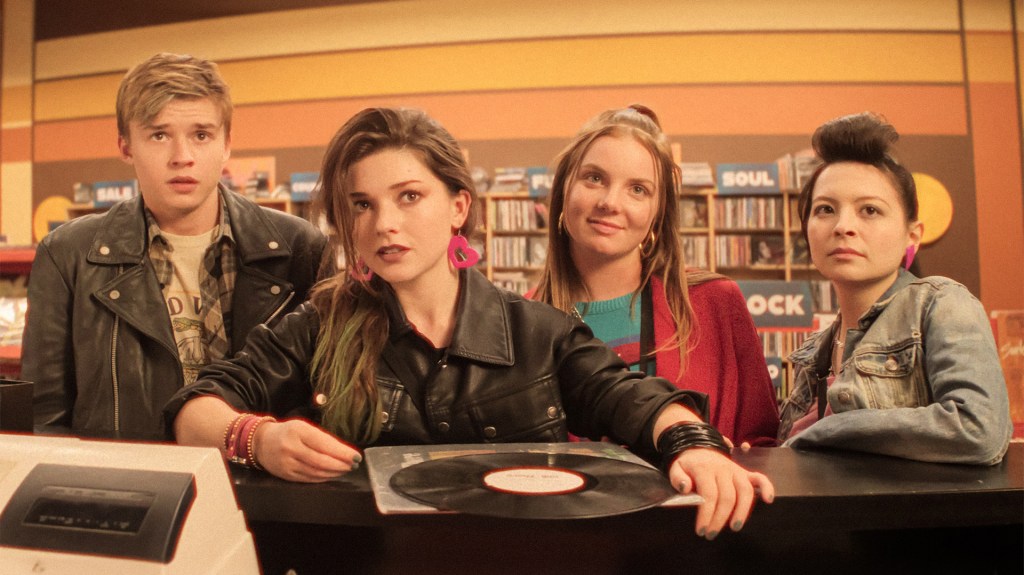
Sensory extremes. Films reviewed: Black Bag, Novocaine

Posted in Action, comedy, Espionage, Romance, South Africa, Thriller, Torture, UK by CulturalMining.com on March 15, 2025

Hi, this is Daniel Garber at the Movies for culturalmining.com and CIUT 89.5 FM.

March break is coming to a close, so I have two genre movies — an action comedy and a spy thriller — you might want to watch this weekend. There’s a London spy who suspects everyone, and a San Diego bank manager who feels nothing.

But before that I’m going to tell you about some other movies you might not know about. 

Unusual movies to catch in Toronto

If you’re into the indie music scene, there’s a special screening tonight at the TIFF Lightbox. We Forgot to Break Up is a movie about the rise and fall of a small-town gender queer band that goes from performing in a barn in rural Ontario to attempting to make it big in downtown Toronto. Its headed by rising young actor/musician Lane Webber, the songs are by Torquil Campbell, and the soundtrack includes Peaches, Gentleman Reg, and The Hidden Cameras. I saw this one at Inside Out last year, and I quite liked it.

Also playing at the Lightbox is the new Goethe Institute’s series Extra.Ordinary showing three great new German flics. I haven’t seen any of these yet (two will be Toronto premieres) but GoetheFilms programming is always top-notch. Similarly, the Japan Foundation is screening Still Walking, a classic by fave director Kore-eda Hirokazu, next week.

And finally, I bet you’ve never heard of Terrible Fest, have you? Well it’s a Super 8, B-Movie short film festival at Eyesore Cinema on March 25 and 30th, including titles like these: Wallet Monster, Dirty Show with Video Hoser, Air Fryer Slaughter, and of course that future cult-classic Girls Just Want to Have Kill. You can get a pass to all the films for just 12 bucks.

So, if you feel like going to a movie, but don’t want something too conventional, there are still alternatives to see.

Black Bag

Dir: Steven Soderbergh

George (Michael Fassbender) is a high ranked bureaucrat at Mi6, London’s international spy agency. He’s trying to find the identity of a suspected double agent. But instead of one name, the asset gives him a list with five names on it, and only one is the traitor. So he invites them all to a dinner party. Interestingly, four of the 5 are couples: Freddie and Clarissa (Tom Burke, Marisa Abela) and James and Zoe (Regé-Jean Page, Naomie Harris). And the fifth? It’s his own wife Kathryn (Cate Blanchett) whom he loves dearly, but if she’s the double agent, it’s his duty to catch her in the act. 

Apparently, one of them possesses information about a top secret weapon and is peddling it to the Russians. This weapon is so terrible it could kill tens of thousands and plunge us into WWIII. And to George’s dismay, Kate is on a secret mission on the Continent, exchanging information for cash. Can George uncover the truth? Is Katherine the villain? And if so, will he turn her in?

Black Bag is a classic British spy-thriller, with everything going for it. It’s done in the style of a Le Carre novel. Michael Fassbender, Cate Blanchett and Naomie Harris provide star appeal. And the director/writer team of Steven Soderbergh with David Koepp are a winning combination (they released another movie Presence, just a few weeks ago, which I liked).  So why does Black Bag suck so bad? The script is terrible, with an array of dull, unsympathetic characters, and a cookie-cutter plot. The witty repartee you expect from a British spy movie is totally missing. But I manly blame this one on Soderbergh himself, its director, editor and cinematographer. He’s like a film student with his first video camera, fooling around just for fun as he figures out how it works. The opening scene follows George around from behind until it finally reveals his face. Why? No reason, it doesn’t surprise you or advance the story, it’s just there. In other scenes we get to watch all the characters looking up from below their chins. Overly-bright candles at a dinner table obscure the characters’ faces. (What do audiences want to see? Candles or faces?) The music seems off-kilter with the mood. It’s all just so sloppy, distracting and off-putting, making the whole movie feel like a rush-job.  

Admittedly, the story does get interesting in the last 15-20 minute, but it’s way too late to redeem this dud.

What a shame, Black Bag could have been so good.

Novocaine

Dir: Dan Berk, Robert Olsen

Nathan Caine (Jack Quaid) is a mild-mannered assistant manager at a San Diego savings bank who lives a highly- sheltered life. He doesn’t drink, he doesn’t go on dates, he doesn’t even go out at night. All sharp corners in his office are blunted by tennis balls. He won’t even chew sharp foods — anything that hasn’t been through a blender will never get past his lips. Why? He’s afraid he’ll hurt himself and not know it. You see, he suffers from a rare medical condition called CIPA; he can’t feel pain. When he was a school kid, bullies beat him up just for the novelty of it; they called him Novocaine.

When Nate’s not at work, he spends most of his time playing video games with online friends, including his best buddy Roscoe (Jacob Batalon) a guy he’s never actually met. But everything changes one day when Sherry (Amber Midthunder), a woman he has a major crush on at work, shows genuine interest in him. They actually go on a date, and it’s like a door to a whole new world opens up for him. He tries solid food (Is this what pie is? I love pie!) and has sex for the first time. He decides Sherry is is his life partner, the love of his life, the reason for his existence… and he will never let her go. That’s why he’s so upset when a gang of murderous thieves (dressed in Santa suits) storm into the bank, kill the manager, clear out the safe and drive off with Sherry as their hostage. The cops seem uninterested in catching the criminals — they even suspect Nate. He decides to throw caution to the wind, and hunt down those criminals himself, using his medical condition as sort of a super power. They can’t stop him because he feels no pain. Can he defeat the bad guys through willpower alone? And will he get to Sherry in time? 

Novocaine is a brand-new take on gory action/ comedy, with a twisted plot, funny characters and surprisingly good acting. Jack Quaid is the ultimate Hollywood nepo-baby, the offspring of Dennis Quaid and Meg Ryan. Awful, right? No —  in Novocaine, he’s amazing, both endearing and self-effacing. Amber Midthunder (who is currently starring in two different movies) is very appealing, and together they have obvious chemistry.

Novocaine has all the requisite action sequences — fight scenes, shoot outs and chases — but it manages to combine them in new ways. I can’t stand “gorno” or torture porn; it’s upsetting to watch people suffering from excessive, constant pain. And there’s tons of it in this movie: Nate gets shot by arrows, scalded with boiling oil, tortured with knives and scissors, muscles bruised and bones broken. But because he is totally oblivious to pain, he turns squirms into laughter. Obviously the violence is explicit and plentiful, so if you can’t stand it, stay away. But there are so many clever, disarming twists that the violence never overpowers the laughs.

I found Novocaine totally entertaining.

Black Bag and Novocaine both open this weekend in Toronto; check your local listings.

This is Daniel Garber at the Movies, each Saturday morning, on CIUT 89.5 FM and on my website culturalmining.com.

Bobby, Robbie and Tom. Films reviewed: A Complete Unknown, Better Man, Nosferatu

Posted in 1800s, 1960s, 1990s, Folk, Gothic, Horror, Music, Thriller, UK, Vampires by CulturalMining.com on December 21, 2024

Hi, this is Daniel Garber at the Movies for culturalmining.com and CIUT 89.5 FM.

Christmas is coming in just a few days, so this week I’m looking at three new movies — two musical biopics and a gothic horror — all opening on the 25th. There’s a  young man named Bobby who hails from Minnesota, another named Robbie who looks like a gorilla, and a third named Tom who is headed for Transylvania. 

A Complete Unknown

Co-Wri/Dir:James Mangold (Indiana Jones…)

It’s 1961 in Greenwich Village. Bobby Dylan (Timothée Chalamet: Dune, The French Dispatch, Call Me by Your Name, ) is a 19 year old boy from Minnesota, who arrives penniless with just a guitar on his back. The Village is the centre of the folk revival sweeping across America, alongside the civil rights and anti-war movements. Bobby is looking for his hero Woody Guthrie (Scoot McNairy), and tracks him down at a Psychiatric Hospital in New Jersey. Guthrie is suffering from a debilitating case of Hunnington’s disease. He communicates using grunts and gestures, but clearly likes Bobby’s songs. Pete Seeger (Edward Norton) — the folk giant and political activist — is there too, visiting Woody. He takes Bob under his wing and later introduces him at an open mic show at the Gaslight Cafe. There he meets the beautiful and talented Joan Baez (Monica Barbaro), a wildly popular folksinger and activist in her own right.

Bob’s still broke and prone to couch surfing, but soon settles into a casual relationship with Sylvie Russo (Elle Fanning: Somewhere, Super 8, Ginger and Rosa, Neon Demon, Twentieth Century Women, The Beguiled,  The Roads Not Taken, Mary Shelley). Is it love? And despite his unconventional voice, he quickly attracts fans — including stars like Johnny Cash — and his recording career takes off. Joan Baez adapts some of his songs with great success, and the two of them go on tour together — where they become intimate on and off stage. But Bob feels constrained by the folk community and wants to forge new musical pathways. What will happen when Bob Dylan goes electric?

A Complete Unknown: The Ballad of a True Original is a biopic about Bob Dylan. It spans a relatively short period of his life and music from his arrival in New York until the Newport Folk Festival of 1965. Chalamet is excellent as the young Bob Dylan, portraying him both as kind and self centred, ambitious and indifferent… usually sitting around in his underwear strumming a guitar. Norton is surprisingly believable as Pete Seeger. Elle Fanning, as Dylan’s neglected lover, seems less real, more of a cinematic concoction to add a romantic undertone to the story. Indeed, much of the plot and characters are invented out of whole cloth— with Dylan’s approval.

What’s really good though is the music. 75% of the movie is just singing and playing instruments, performed by the actors themselves. Maybe it’s me, but those songs, those joyful songs… they made me sing along and literally brought tears to my eyes. Live concerts, jams, hootenannies, jamborees, recording gigs… this movie includes everything. Whatever its false notes or historical inaccuracies, the music makes it. 

I enjoyed this movie so much.

Better Man

Co-Wri/Dir: Michael Gracey

It’s the 1980s in Stoke-on-Trent, England. Robbie Williams (Jonno Davies) is a boy who lives with his dad, mum and grandmother (Steve Pemberton, Kate Mulvany, and Alison Steadman). He goes to Catholic school where he’s the class clown. He loves singing, acting and telling jokes. He’s not particularly talented but he is charming and cheeky, always ready with a smile, a wink, and a  wiggle. He longs for approval from his neglectful father, but rarely gets it. So he vows to become famous some day to prove his worth. Unfortunately he’s the only one who thinks he can make it. Still, somehow he passes the auditions and is invited to join a new boy band called Take That.

Robbie doesn’t mind performing semi-clad at gay bars; their popularity is growing, and their catchy tunes are being listened to. And when they finally make it big, he is dazzled by the adoration of countless fans. He falls for the allure of alcohol, drugs and willing sex partners.  But why isn’t he making much money? It’s because he doesn’t write the songs, he just performs them.His drug use is getting out of hand. When he quits the band for a solo career, thing look rough. Will his own talent ever be recognized? Will his father ever be proud of him? And can he overcome the self doubt that plagues his career?

Better Man is a music biopic about the rise, fall and rise again of the pop singer and performer. The music and plot of this film are both pretty basic. What’s interesting is how he is portrayed. Through the use of CGI, Robbie Williams  looks like a human but with the features and fur of a chimpanzee. No one ever mentions it, he doesn’t eat bananas or climb trees, but throughout the movie, he looks like an ape. It represents the self-doubt and insecurity that drives him.

Director Michael Gracey had his start as an animator who learned special effects from the ground up, which leaves him with a vast supply of techniques to dazzle audiences. He has no fear of green screens and embraces CGI whole heartedly. Most of the movie feels like a non-stop, never-ending music video, expertly made. I’m not a fan of boy-band pop, but the sparkling presentation makes Better Man fun to watch.

Nosferatu 

Co-Wri/Dir: Robert Eggers (Lighthouse Eggers interview, The Northman, The VVitch Reviews)

It’s the 1830s in a small port city in Northern Germany. Thomas and Ellen Hutter (Nicholas Hoult, Lily-Rose Depp) are a young couple, passionately in love. To support their family and any future kids, Tom has a new position at a financial firm, run by the eccentric Mr Knock. Tom is a Bob Cratchit, always trying to please his boss. His first assignment: to visit a fabulously wealthy noble, have him sign a contract, and accompany him back to the city. It seems like a simple task. But Ellen is dead-set against it. Count Orlov cannot be trusted — he will kill you, Tom, she says. How does she know? The nightmares she’s had since adolescence predict it.

But, despite her warnings, Tom heads off to Transylvania. Count Orlov’s (Bill Skarsgård) castle is intimidating, set amongst the stark Carpathian mountain, and none of the local villagers dare to go with him, even draped in ropes of garlic. Tom braves it on his own, but finds the Count mysterious and oppressive. The castle is filled of vicious wolves and with rats. Tom wakes up each morning feeling drained, with teeth marks on his torso.

Meanwhile, back in Germany, Ellen is tormented with nightmares, driving her toward insanity, despite help from her friends Friedrich and Anna (Aaron Taylor-Johnson, Emma Corrin). Tom disappears and, when the Count arrives in the German town, unaccompanied, people start dropping dead from the plague. Can Tom and Ellen free themselves of Count Orlov’s treachery? And what are this vampire’s real motives? 

Nosferatu is a remake of Murnau’s 1922 silent film, which in turn was an adaptation of Bram Stoker’s Dracula. But far from being just another vampire movie, this one is totally original. It’s sexualized, scary, funny and grotesque. I saw it in IMAX in all its gothic glory. 

Murnau’s Nosferatu was a masterpiece of German expressionism, both modern and iconoclastic; Ironically, this one, made a century later, is deeply rooted in the distant past. Robert Eggers loves this old stuff, and pays meticulous attention to every word of the script and every frame of the film. It’s full of unnecessary but delightful scenes, like Roma singers and Magyar slap dancers, and rat infested canals. Eggers went to Transylvania just to capture that castle on film. He gives us a new Dracula, no Bela Lugosi accent or widow’s peak. This Nosferatu is a burly, imposing man, draped in fur robes, with a grand Hungarian moustache. His skin and muscles are rotting away, putrid with decay. He is driven not by an insatiable thirst for human blood but by lust: he covets a woman. 

If you’re into new explorations in horror, I think you’ll love Nosferatu.

Better Man, A Complete Unknown, and Nosferatu all open on Christmas Day in Toronto; check your local listings.

This is Daniel Garber at the Movies, each Saturday morning, on CIUT 89.5 FM and on my website culturalmining.com.

World premieres at #TIFF24. Films reviewed: Relay, We Live In Time, Hard Truths

Posted in Action, Drama, Espionage, Family, Mental Illness, Romance, UK by CulturalMining.com on September 14, 2024

Hi, this is Daniel Garber at the Movies for culturalmining.com and CIUT 89.5 FM.

TIFF is on its final weekend, but there are still many movies left to watch, including free screenings on Sunday of all the the Peoples Choice winners. So this week, I’m only talking about movies that had their World Premieres at TIFF. There’s an overly angry woman, a secret agent for hire, and a love affair that turns serious.

Relay

Dir: David Mackenzie (Review: Starred Up)

Ash (Riz Ahmed) runs an unusual business in New York City. It’s for whistle blowers who are afraid  for their lives and their family’s and want to make peace with their previous employer and return the incriminating evidence. The genius of Ash’s work is that neither side — the whistle blower and the corporation — know who he is… and both sides pay him. A win-win situation, at least for him. He relays information using an intermediary phone service connected to an ASL keyboard for the deaf that can’t be traced. And he always keeps one copy of the evidence just in case the employer ever reneges on the deal.

His latest client is a biologist named Sarah (Lily James), a would be whistle-blower who has proof of malfeasance by a big agro conglomerate she worked for. But now she wants out, because she’s afraid a gang of thugs working for the company (Sam Worthington, and three others) are going to kill her. Problem is Ash — who never lets his guard down — is smitten by the beautiful and sympathetic Sarah, who he goes out of his way to protect. Can Ash keep her safe from unknown forces? And is there something deeper going on between them?

Relay is an ingenious action film that doubles as a corporate spy flick. It’s full of complex schemes involving the postoffice, telephone services and communication devices. As well as lethal fights. Riz Ahmed is one of those actors who is so good that you can just go and see anything he’s in. Luckily, Relay is a super-taut thriller, with constant suspense, near-misses and clever chase scenes. Beware: you’ll be his with an enormous twist near the end (no spoilers) that will totally blindside you. I’m still trying to figure out whether it’s plausible ir not, but either way, this is a great thriller.

We Live In Time

Dir: John Crowley (Reviews: The Goldfinch, Brooklyn)

 Almut (Florence Pugh) is a chef in London whose restaurant is taking off. She had a long-term relationship with a woman, but eventually separated. Tobias (Andrew Garfield) works for Weetabix — yes the breakfast cereal —  and has been living with his dad since his first wife divorced him. The two meet with a bang. Literally. She runs him over with her car.  But this is no hit and run. She sticks around until he gets out of hospital, and invites him for dinner at her restaurant. Sparks fly and their relationship begins. But certain obstacles lie in their path. Is there any point to marriage? Should they have kids? And what happens when she is diagnosed with cancer?

We Live In Time is a surprisingly good romance. Most romances veer either toward slapstick comedy or treacly cornball. This one does neither. The time in th entitle is reflected in it’s narrative, which hope back and forth between different stages of their lives. And it’s full of evocative details, like when Almut — the chef — teaches Tobias the best way to crack an egg (on a flat surface, she says) While it’s clearly Oscar bait (what with the cancer and baby details artfully placed), it’s also a fully enjoyable and moving film to watch. Irish director John Crowley knows what he’s doing; he brought us movies the classic Brooklyn. Frances Pugh does Almut as tough but lovable  while Andrew plays it goofy and sweet.

This is good one.

Hard Truths

Co-Wri/Dir: Mike Leigh (Reviews: Peterloo, Mr Turner)

Pansy (Marianne Jean-Baptiste) is a middle-aged woman who lives with her family  in a quiet London suburb. Her husband Curtley (David Webber), a plumbing contractor, is away most of the day, while their son Moses (Tuwaine Barrett) in his twenties locks himself in his room with his ear phones on playing video games.  Perhaps because Pansy is so hard to deal with.  When Moses goes for a walk, she yells at him to stay away from police or he’ll be arrested for walking while black. And when Courtley is home she subjects him to a non-stop abusive barrage of complaints and insults about his work, the neighbours, a baby down the street, animals, germs and being disrespected.

Meanwhile, Pansy’s sister Chantal (Michele Austin) lives with her two successful daughters. Chantal is kind and amiable, listening to problems and gossip as she does her clients’ hair. And she — like everyone else — wonders why her sister Pansy is so angry bitter and paranoid all the time. And can she get her to visit the cemetery on Mother’s Day?

The topics — kinship, loss, mental illness —  seem ordinary but the movie is anything but. Hard Truths is a searing comedy-drama about two black families in London. By comedy-drama I mean you will be laughing uproariously through the first half and then crying through the second. It’s just fantastic. The character development, the dialogue, and the acting are dead on. Marianne Jean-Baptist is so funny and so real and so moving, she’s a phenomenon to behold. If she doesn’t get an Oscar nomination for this, I will be shocked. She co-starred with Brenda Blethyn in another Mike Leigh movie, Secrets and Lies, thirty years ago, and this one is even better. 

I would call Hard Truths a perfect movie.

Relay, We Live in Time, Hard Truths, all had their world premieres at TIFF .

This is Daniel Garber at the Movies, each Saturday morning, on CIUT 89.5 FM and on my website culturalmining.com.


Parents and their children. Films reviewed: Tuesday, Kidnapped

Posted in 1800s, Courtroom Drama, Death, Denial, Drama, Fairytales, Family, Italy, Politics, Religion, Supernatural, UK by CulturalMining.com on June 15, 2024

Hi, this is Daniel Garber at the Movies for culturalmining.com and CIUT 89.5 FM.

Sunday is Fathers Day, so this week I’m looking at two movies about parents and children. There’s a mother whose daughter is threatened by a big ugly bird, and parents whose son is kidnapped by the Pope.

Tuesday

Wri/Dir: Daina Oniunas-Pusic

Tuesday (Lola Petticrew) is a teenaged girl in London who is dying of an incurable disease. She likes comics and drawing. She spends most of her time in her bedroom with her Nurse Billie (Leah Harvey) or else in the walled garden outside her home, because she is too weak to get around anymore. She only sees her mother at night when she comes home from work. Until a stranger shows up in her life. It’s a huge bird, like a giant parrot, covered in filthy, black feathers. He is death incarnate, and he’s come to take her away by placing his wing over her body. But instead, she asks to talk to him. She helps him clean up, revealing colourful plumage, and she tells him a joke — the first time he’s laughed in centuries. So he lets her live, for now, but she can’t tell anyone about him. Meanwhile Tuesday’s mom Zora (Julia Louis-Dreyfus), has a secret of her own. She quit work a long time ago, to take care of her dying daughter. But she can’t face it; instead she spends all day sitting alone in a nearby park, doing nothing. And she’s been selling off all their possessions to help pay for the nurse. But everything changes when Tuesday tells her about her imaginary friend… and Zora is shocked to find she’s telling the truth. But she refuses to accept her daughter’s death, and takes an extraordinarily drastic step to stop the inevitable from happening. But what will these new changes bring to the family and the world and can Zora ever accept the inevitable loss waiting to happen.

Tuesday is an unusual but strangely moving fantasy about a mother and daughter confronting death. It starts out a bit odd, and gradually turns into a very strange movie indeed. But while it deals with some horrific ideas, it’s not a horror movie. It has supernatural elements, but it’s not meant to be scary. And despite its religious concepts of life and death, it’s not a faith-based movie. What it is is a very moving, mother/daughter drama about death. Julie Louis Dreyfuss, best known for her deadpan comedy in Seinfeld and Veep, plays it straight in this one, and really bares her soul in a deeply moving performance. And Lola Petticrew is equally sympathetic as Tuesday. This is nothing like most movies you see, but very effective nonetheless; come prepared both to laugh and cry.

I really liked this movie.

Kidnapped

Co-Wri/Dir:  Marco Bellocchio

It’s the 1850s in a middle-class neighbourhood in Bologna.  Salomone Mortara (Fausto Russo Alesi) lives with his wife Marianna Padovani Mortara (Barbara Ronchi) and their children. One night there is a banging on their front door: it’s the police demanding an inspection. They want to see Edgardo Mortara, an angelic little boy, number six of eight kids. Local officials are apologetic, but they must hand him over, under the orders of Father Feletti (Fabrizio Gifuni), the local inquisitor. But surely there’s some mistake, they say, what could this little boy have done? He was secretly baptized as a baby by his maid, they say, and no Christian child can be brought up in a Jewish family. Bologna — and much of Italy — was then part of the Papal States, where the government, the police, and the judiciary were all under the direct rule of the Vatican’s representatives and ultimately Pope Pius IX. And despite their vehement  objections and petitions, they whisk the crying child off to Rome. 

He is brought to the House of Catachumens, a special school for converts to be taught the Latin Mass. Little Edgardo (Enea Sala) misses his family terribly but a friend he meets says if you want to go home soon, just cooperate and learn the prayers, you don’t have to believe them. His flabbergasted father and devastated mother are desperately trying to get him out of there, but to no avail. But the story has caught the eye of the international press, making banner headlines in Paris, London and New York. And this makes Pope Pius IX even more steadfast in his beliefs. Will the family all convert to Catholicism to get back their son? Will Pope Pius relent and let him go home again? And who will the little boy choose as his guardians: his Mama and Papa or Il Papa, the Pope himself?

Kidnapped: The Abduction of Edgardo Mortara is an overwhelming drama based on true historic events. Though little-known today, it had a huge affect on world politics, history and, ultimately, the unification of Italy. It takes place in their homes of Bologna, The Roman Ghetto, in courtrooms, on canals, and within the Vatican itself. Its powerful music, lush photography and opulent sets and costumes support the passionate almost melodramatic acting. Barbara Ronchi is fantastic as Mrs Mortara, while Paolo Pierobon as Pope Pius comes across as a creepily salacious Mafia don, cuddling up to his favourite little boy and letting him hide beneath his robes (as he had huddled in his mother’s skirts when first abducted.) It also veers into fantasy within the dreams of various characters, from little Edgardo who dreams of de-crucifying Jesus so he can go home, and the Pope who has nightmares of being forcibly circumcised by a gang of rabbis. Kidnapped is an amazingly powerful  historical drama set within the changing tides of 19th century Europe.

On a personal note, my childhood next door neighbour, Mrs Sharon Stahl, ended up writing her doctoral theological dissertation on this case, so I had head about it many years ago and it’s amazing to finally see it dramatized on the big screen.

Fantastic movie.

Tuesday is now playing at the TIFF Lightbox, and Kidnapped also opened this weekend; check your local listings. 

This is Daniel Garber at the Movies, each Saturday morning, on CIUT 89.5 FM and on my website culturalmining.com.

Class. Films reviewed: The Old Oak, Monkey Man, Wicked Little Letters

Posted in 1920s, Action, Clash of Cultures, Class, comedy, Drama, Feminism, India, Politics, Refugees, Thriller, UK, Women by CulturalMining.com on April 6, 2024

Hi, this is Daniel Garber at the Movies for culturalmining.com and CIUT 89.5 FM.

Ordinary people fighting back is an old story, but not a tired one. This week I’m looking at three new movies — one from northern England, one from southern England, and one from India — about people confronting injustice. There are women fighting the courts, a poor man fighting the oligarchs, and a lonely man trying to stop his town’s gradual collapse.

The Old Oak

Dir: Ken Loach (my interview: 2020)

It’s 2016 in a seaside village in northern England. TJ Ballantyne (Dave Turner) is the publican of The Old Oak, one of the few gathering places left standing. But like the town — once a thriving coal pit, but now impoverished and depressed — the pub is not what it used to be. It has few customers aside from a few regulars. The sign is sagging, and half of the building is no longer used.  TJ lives above the pub; he’s lonely and pessimistic. His son won’t speak to him, and he has only a little dog to keep him company. But when a group of Syrian refugees arrives in town, TJ decides to help. Alongside Laura (Claire Rodgerson) he distributes furniture and food — donated through local churches and unions — to the newcomers. They are grateful, but some people resent it. Why are they helping refugees when local kids are going without food and heating? Syrian kids are bullied in schools, and a young photographer Yara (Ebla Mari)’s camera is broken.

What can they do to bring the community together? Together with Yara, Laura, and dozens of volunteers, they reopen a long boarded up section of the Old Oak to provide a place where people can come to eat and spend time together. The photographs on the walls recall the coal miners strike of Thatcher’s England: If you eat together, you stick together, says one sign.  But can they overcome old prejudices to form new friendships? Or will it all fall apart?

The Old Oak is a wonderfully poignant and deeply-moving drama that deals with big issues but on a personal scale. It looks at racism, poverty, unions and scabs, and how geopolitics affect us all.  Like all of Ken Loach’s movies, it  looks at imperfect people from multiple viewpoints. Some you like and end up hating, others seem like villains but you find out later they’re good people. Lots of grey, no black and white (aside from the photographs Yara takes.)

Once again, the script is by Loach’s longtime collaborator Paul Laverty, and the ensemble cast includes both professionals and first-time actors, many hired at the location.

It shows the real Britain, warts and all, not the shiny tourist-attraction you see in Hollywood movies. It’s a tear jerker, with more than one heartbreaking scenes. But it still leaves room for hope. The Old Oak may be Ken Loach’s final film, so you should get out and see it. I really like this film.

Monkey Man

Co-Wri/Dir: Dev Patel

Kid (Dev Patel) is a man with a vengeance — to punish those whose crimes he witnessed as a small child. Raised by his mother in a forest in rural India, he now lives in an unnamed megalopolis in the mythical state of Yatana (= torment, anguish). It is ruled by a god-king followed by throngs of devoted cult-like followers. They kick farmers off their land for corporate profit and persecute minorities with impunity. Kid earns his money as a boxer, beaten up regularly by bigger, stronger men. In the ring, he conceals his face behind a monkey mask, in honour of the god Hanuman whose story his mother had told him as a child. Following a complex scheme, he somehow manages to get work inside an exclusive nightclub ruled by a woman named Queenie (Ashwini Kalsekar). She warns him to never disobey her or step out of his class. He gradually works his way up the latter until he makes it into the kitchen. His goal? To shoot  a corrupt police chief named Rana Singh (Sikandar Kher). But his plans all fail, and he ends up a nearly-dead fugitive, his body floating in a canal. He is rescued and brought back to health by a temple dedicated to Shiva, and run by androgynous priests.

They admire that he, an outcaste, dares to fight authority.  But he needs the strength and skill if he wants to succeed. So, to the sounds of a tabla drum, he trains in the temple, gradually building up his stamina and muscles until he its ready to face his enemies to the death once again. But does he even have a chance against the powers that be?

Monkey Man is a class-struggle action-thriller about one man’s quest for personal vengeance and his plan to overthrow by force corrupt and autocratic leaders. It’s told using intricate plotting, involving dozens of people cooperating for a single goal. And it interweaves visions and sounds, like a  child’s picture book, an elaborate mural, and the thumping of a tabla music. There’s a lot of content to digest. The problem is, a large part of the movie consists of chases and violent fights, and they’re not very good. Blurred shots using a jiggly, hand-held camera may be artistic, but they’re unpleasant and hard to look at. Seasickness is not a valid substitute for good fight choreography.

I admire Dev Patel’s first attempt as a director and his transformation into an action hero, but Monkey Man doesn’t cut it.

Wicked Little Letters

Dir: Thea Sharrock

It’s the 1920s in Littlehampton, Sussex, a small town in southern England. Edith Swan (Olivia Colman) is a middle aged educated woman who still lives with her strict parents in a tiny row house. She reads the bible and quotes its teachings; basically, she’s an uptight prig. She shares a wall with Rose (Jessie Buckley) a migrant from the Emerald Isle. She is fond of drinking and carousing, can swear a blue streak, and is often seen wandering in just a slip outside her home. Rose likes her live-in boyfriend Bill (her husband died in WWI) but most of all, adores her daughter Nancy (Elisha Weir). But her neighbour, Edith’s father Edward Swan (Timothy Spall) despises Rose and her libertine ways, and blames her for everything going wrong in Littlehampton. They live in a tenuous detente, until everything changes when Edith receives a piece of hate mail. The unsigned letter is filled with cruel insults and vulgar words.

And when the letters pile up, the police come to investigate. They arrest Rose for the nasty letters and throw her in jail, despite her protests of innocence. The press picks up the story and it becomes a national scandal. But not everyone believes Rose is guilty. A small group of women, led by Police Officer Gladys Moss (Anjana Vasan), think Rose is innocent and set out to prove it. But can they find the true culprit before the trial? And what will happen to Nancy if her mother ends up behind bars?

Wicked Little Letters is a delightful dark comedy, based on a true story; apparently this was a hot topic 100 years ago. Little is the key word: little letters, Littlehampton, and the kind of petty quarrels that can blow up into serious events. This is a movie that knows it’s own boundaries and sticks to them perfectly, without veering off into remote tangents, flashbacks or lengthy soliloquies. It’s tight, set in tiny homes around town, and in the courthouse and jail. The acting is wonderful — everyone’s a character. Olivia Colman and Jesse Buckley previously co-starred in The Lost Daughter, but I like this one much better. And though it’s a period drama set in 1920s England, it uses colourblind casting, with many roles played by black and brown actors, without racial or ethnic issues ever entering the story (except, of course, Rose being Irish in England).

If you’re looking for a fun night out, I think you’ll like this one.

Wicked Little Letters, Monkey Man and The Old Oak all open this weekend in Toronto: check your local listings.

This is Daniel Garber at the Movies, each Saturday morning, on CIUT 89.5 FM and on my website culturalmining.com.

Daniel Garber talks with Mia McKenna-Bruce about How to Have Sex

Posted in Coming of Age, Dance, Greece, High School, Movies, Music, Sex, Sexual Assault, UK, Women by CulturalMining.com on February 10, 2024

Mia McKenna-Bruce Photography: David Reiss, Hair: Ben Talbot, Make-Up: Sara Hill, Styling: Tilly Wheating

Hi, this is Daniel Garber at the Movies for culturalmining.com and CIUT 89.5 FM.

Tara and her two best friends, Em and Skye, have finished school, written their A Levels and want to celebrate. So, like tens of thousands of others, off they go to a mediterranean resort with more sex, drugs, alcohol and loud music than you can shake a stick at. But the elephant in the room is Tara — she’s a “big fat virgin”, and her mates want to make sure she returns home cured of that ailment. But when the time comes, Tara doesn’t know what she’s supposed to do, who she’s doing it with, and whether she has any say in the matter. And when it doesn’t go as planned, she doesn’t know what to do, or who to turn to. Turns out she still doesn’t know how to have sex.

How to Have Sex is a stunning bittersweet, coming-of-age drama about friendship, cultural expectations and consent. It’s writer-director Molly Manning Walker’s first feature and stars Mia McKenna-Bruce as Tara. The film won the prestigious Un Certain Regard Best Film prize at Cannes, and is nominated for best British film at the BAFTA awards. Mia won Best Lead Performance at the British Independent Film Awards and was named Screen International’s ‘Star of Tomorrow’.  She has also appeared in many TV shows and films since 2009, including The Witcher, Jane Austen’s Persuasion, and Vampire Academy. 

How to Have Sex opens in Canada 0n February 9th.

I spoke with Mia in London via Zoom.

Mia won the 2024 BAFTA Rising Star Award on February 18, 2024.

Current cinema. Films reviewed: Destroy All Neighbours, Freud’s Last Session, T.I.M.

Posted in 1940s, AI, Christianity, comedy, Ghosts, Horror, Ireland, Music, Psychiatry, Robots, UK, WWI, WWII by CulturalMining.com on January 13, 2024

Hi, this is Daniel Garber at the Movies for culturalmining.com and CIUT 89.5 FM.

It’s “award season” when prizes are handed out to the best — or most widely publicized — movies. But not every film is prestigious or a blockbuster. So this week, I’m looking at three new movies — one each from the US, Ireland and England — that might otherwise fall through the cracks. There’s a robot with human traits, a music producer turned serial killer, and a psychoanalyst talking about God. 

Destroy All Neighbours

Wri/Dir: Jonah Ray Rodrigues

William (Jonah Ray Rodrigues) lives in a rundown apartment with his girlfriend Emily (Kiran Deol) a lawyer. He’s tall, skinny, and wears unfashionable clothes and nerd glasses. He works in a studio at the soundboard, helping bands record their music. But sometimes he feels like he’s just a knob- turner, going through the motions. His real passion is recording the ultimate prog-rock album, and is constantly coming up with new ideas, but never finishing it.  Emily encourages him to give up and move on, but he feels he has to do it. But he’s getting more and more tired and frustrated by the people around him. At work, his boss is constantly ragging him for being late. And the latest client, Caleb Bang Jansen is insufferable. Even the panhandler where he parks his car is getting on his nerves. At home, Eleanor, the elderly pothead superintendent (Randee Heller) is constantly calling him for help with the fuses. Another neighbour, Phillip, lets his pet pig roam the halls. But worst of all is the new tenant next door. Vlad (Alex Winter) is hideously ugly, aggressive and incredibly loud, playing non-stop euro disco all night long. Vlad lifts weights using buckets of cement attached to his barbell. He’s a scary guy, William is passive aggressive and terrified of face to face confrontations.

When he finally visits Vlad to ask him to turn down the music, they get in a fight and somehow Vlad ends up impaled on a stake, and — accidentally —  decapitated! William doesn’t know what to do, but finally realizes he has to dispose of the body. But things have changed since Vlad —  new bodies keep piling up — always killed unintentionally by him, by strange coincidences. He becomes a serial killer by default, or a serial manslaughterer, as he likes to say. 

But when the all the people he killed come back to life, he realizes something really strange is going on. Can William keep his boss and girlfriend happy, record his prog rock album, stop killing people, and living a normal life? Is he destined for a very dark future? Or is he just losing his marbles?

Destroy all Neighbours (the title says it all) is a comedy/horror movie, with an emphasis on in-your-face, gross-out humour. So there’s lots of disgusting blood and gore, but it’s always so exaggerated it’s funny, not scary, in the manner of Monte Python or Army of Darkness. Jonah Ray Rodrigues is the writer/ director/star and the current host of Mystery Science Theatre 3000. I admit it’s an acquired taste, and some of the gags and schtick fall flat, but I was laughing more than not. I happen to like that kind of humour (in moderation) but, admittedly, it’s not for everyone. So if you’re into bloody horror-comedy set in L.A.s skid row, or even if you’ve ever had annoying neighbours, I think you’ll love Destroy all Neighbours. 

Freud’s Last Session

Co-Wri/Dir: Matt Brown

It’s September, 1939. Germany has invaded Poland and Great Britain is about to go to war. Sigmund Freud (Anthony Hopkins) and his daughter Anna (Liv Lisa Fries) left their homes and vocations in Vienna after the Anschluss — the unification of Austria and the Third Reich, and moved to London. His office is decorated with the art and bric-a-brac of home: Persian rugs, African fertility statues and Catholic saints. Anna continues to research and give lectures on psychoanalysis and child psychology, but Sigmund, due to his age (he’s 83) and poor health (he’s dying of cancer) rarely leaves his home now. But on this day he has an unusual visitor: CS Lewis (Matthew Goode). Lewis is a don at Oxford where he teaches English and has written a book about Pilgrims Progress. (He later goes on to write The Chronicles of Narnia.) And he’s still suffering from shell shock from WWI. But why are they meeting? Lewis wants to talk with Freud about God and religion. He once was an atheist but now has adopted theism and Christianity as his guiding light. Freud, on the other hand, is a committed atheist and finds all religions equally fascinating and equally false. Still, they have a spirited discussion on a wide range of issues. But certain topics are taboo. For example, Freud refuses to talk about the fact that Anna has a female lover. And Lewis considers his own sexual relationship with his late best friend’s mother as something too private to share. Meanwhile, air raid sirens are going off, Freud is struggling with the oral prosthetic he calls his “Monster” and nobody knows what the future will bring. Will this be Freud’s very last session?

Freud’s Last Session is a fictional historical drama adapted from the successful stage play. There’s no evidence that an elderly Freud and a younger Lewis ever actually met; the story functions more as an intellectual exercise than a theatrical drama. So it’s not captivating, but it did keep my attention. They try to perk it up a bit with flashbacks — Lewis in the trenches in WWI; Freud as a small child — but I found them lacklustre at best. There are some clever touches, where Freud ends up reclining on the settee while Lewis takes on the analysts role. Of course it has nice period costumes and sets, but the main reasons to see this film is first the topics and second the acting. The topics range from sex to psychoanalysis to theology. Devotees of Freud and/or Lewis may get a kick out of it, but no major revelations here. The acting, though is delightful. Hopkins walks through his usual role — along with a few artfully-placed wunderbars and ja ja ja and das ist gut! so we don’t forget he’s Austrian. Goode is more passionate, fearful and sad. Best of all is German actress Liv Lisa Fries (from Babylon Berlin) as Anna Freud, who gets to rush around London looking for meds for her Dad.

Freud’s Last Session is not bad, but not noteworthy, either.

T.I.M.

Co-Wri/Dir: Spencer Brown

Abi and Paul Granger (Georgina Campbell, Mark Rowley) are married, professionals, double-income, no kids, moving into a beautiful, modern home in rural England. It’s at the end of a long country road, with open staircases, glass walls and a huge garden, all paid for and arranged by Abi’s employer. She’s an engineer who specializes in AI robotic prostheses.  She designs the human-looking hands of robots. Paul is currently unemployed, but is in line for a corporate position in London. They’re both looking forward to their first child, and are working hard at it each night.

Now this house is completely on the grid. Everything’s smart — smart windows, locks, heating, computers, lighting — all controlled through a central console, and co-ordinated with their smart watches and  phones. The central console, though, is something her company invented. It’s a Technologically Integrated Manservant, T.I.M. for short, or just Tim. Tim (Eamon Farren) is a humanoid robot with perfect male features, blond hair, and artificial intelligence; he’s constantly learning. He’s a prototype: he can cook gourmet foods, do heavy lifting, play the piano, send and answer emails. Abi’s boss is adamant that all his employees have a T.I.M., so they can get rid of the bugs in the system before the upcoming release. Abi, loves her new toy, but Paul is less enthusiastic. Why did T.I.M. barge into their bedroom while they were making love? T.I.M. says Abi’s blood pressure and temperature had risen, he just wanted to make sure she was OK. But Paul suspects T.I.M. of spying on him. He thinks TIM sends messages to Abi whenever Paul visits Rose their only neighbour (Amara Karan), feeding Abi’s suspicious jealousies. And when he catches T.I.M. perving through Abi’s clothes, he knows something is very wrong. Is T.I.M. morphing into something bad? Can a robot even have feelings? And if things go wrong, who will Abi trust: Paul, the fallible human, or T.I.M., the perfect machine?

T.I.M. is a sci-fi thriller about the potential dire consequences of AI given a human form. This isn’t the first humanoid movie — there have been at least a dozen in the past few years — and some of the plot is predictable. And it does have that “pandemic movie feel” to it, with a tiny cast (just four main characters) located in an isolated country setting, but, in this case, it really works. It’s scary, it’s creepy, it’s interesting. It feeds on your worst fears about electronic devices communicating without your knowledge, and the possibility of the singularity, when humans will no longer be essential. I’m not familiar with any of the actors but the cast is good. The storyline is compelling, and most of all, the movie feels believable. So if you ever feel like your smart phone is a bit too smart, you’ll like this scary, sci-fi thriller. It’s a good one.

Freud’s Last Session opens this weekend in Toronto; check your local listings. Destroy All Neighbours is streaming exclusively on shudder.com, starting today; and T.I.M. is now available digitally and on V.O.D. 

This is Daniel Garber at the Movies, each Saturday morning, on CIUT 89.5 FM and on my website culturalmining.com.

Dark movies. Films reviewed: Night Swim, The Zone of Interest, All of us Strangers

Posted in 1940s, Death, Drama, Family, Ghosts, Holocaust, Horror, LGBT, Nazi, Sports, Thriller, UK by CulturalMining.com on January 5, 2024

Hi, this is Daniel Garber at the Movies for culturalmining.com and CIUT 89.5 FM.

With winter comes grey skies and cold winds that can chill you to the bone.  So this week I’m looking at three new movies with a dark theme. There’s an evil swimming pool, a Nazi Commandant, and a man visiting his parents… who died decades earlier.

Night Swim

Co-Wri/Dir: Bryce McGuire

Ray and Eve Waller (Wyatt Hawn Russell, Kerry Condon) are moving into a new home in suburban Minneapolis-St Paul. Their two kids, Izzie and Eliot, are less than pleased to be moving again. Izzie (Amélie Hoeferle) is popular and athletic, so she’ll have no trouble making new friends, but her little brother Eliot (Gavin Warren) is shy and withdrawn. But they are all happy their new home has a huge, built-in swimming pool, whose water comes directly from an underground hot spring. Ray used to be a pro baseball player but was forced to retire because he has Progressive Multiple Sclerosis. He hopes exercise and physio will help him recover and return to pro ball, though his doctor thinks that’s unlikely. Until Ray starts to improve  — with a great gain in strength and stamina — which Rayattributes to the waters in their pool. But all is not well in swimming pool-land. There’s something strange in those waters. Apparently, a little girl drowned there 30 years earlier. Next, Eliot’s cat disappers. And now everyone in the family is seeing creatures — and hearing voices! — when they spend too much time underwater. What is going on? Is this pool haunted? Do its waters hold magical powers? And can it be trusted around Izzie and Eliot?

Nightswim is a thriller/horror where the unlikely villain is a swimming pool. While the title “night swim” hints at skinny dipping (or other vaguely erotic plot devices) this film is strictly P.G. No sex, no nudity, just all around spookiness. Even Izzie’s crush is on a squeaky clean Christian swim club member. It’s all about families and little league. But is it scary? Maybe a little. There are some disturbing and violent scenes, but for the most part it’s pretty tame. I love the underwater camera work — you see the swimmers from an unknown point of view somewhere deep down in the water. Sometimes the pool feels a hundred feet deep. And the cast is pretty good, especially Kerry Condon (The Banshees of Inisherin). On the other hand, there are a lot of red herrings — scares that don’t go anywhere. And there’s a little plastic pool toy, a wind-up boat, that I guess is supposed to terrify moviegoers, but it just doesn’t.

Night Swim is not bad, but it’s not very scary, either. 

The Zone of Interest

Dir: Jonathan Glazer 

It’s the 1940s in Poland. Rudolph Höss (Christian Friedel) is a careerist member of the Nazi SS who is doing very well for himself. He lives a comfortable, middle class life in a nice suburban home with his wife Hedwig (Sandra Hüller) and his daughter and two sons. There are attentive staff to serve their every need, along with all the luxuries of modern living. Rudolf is later transferred to an office job in Germany, but his family stays behind to enjoy their cherished home. He eventually is transferred back again and they continue to live their wonderful lives. Except there’s a twist. His job is Commandant of Auschwitz-Birkenau, a death camp where 1.1 million people were being murdered.

But except for a few small hints of what’s going on inside the camp, it’s pretty easy for the Höss family to ignore all of that. The subtle hints include women fighting over newly-arrived stolen clothes; Rudolf having clandestine sex with a female prisoner; and human body parts floating past Rudolf and the kids while they bathe in the river. In one poignant scene the daughter plays a piano piece she found scrawled on a piece of paper by one of the prisoners. She leaves apples tucked into shrubbery by the wall in the hope of helping the music’s composer. But it all ends up with him and other prisoners killed because of what she did. And that scene is filmed using a green, night-vision camera, presumably from the point of view of the guards.

Zone of Interest is a drama about the lifestyles of the SS during the Holocaust. It’s loosely based on a novel by Martin Amis, and wholly embraces Hannah Arendt’s concept of the “banality of evil” — that the men who carried out mass murder were just boring, ordinary bureaucrats.  But it’s really about the supposition that everyone already knows everything there is to know about the Nazi death camps, so why not make a Holocaust movie all about the Nazis, instead. And Glazer (review: Under the Skin) does that very well. He’s an innovative and fascinating filmmaker.  But let me ask you this: do you really want to spend one hour and 45 minutes watching a boring but creepy Nazi family living their mundane daily lives just outside of Auschwitz? 

I sure don’t. 

All of Us Strangers

Wri/Dir: Andrew Haigh (Lean on Pete, 45 Years)

Adam (Andrew Scott) is a guy in his forties who lives on the 27th floor of a new condo in London. He’s working on a screenplay. Adam is gentle quiet and a bit depressed. One night, when a fire alarm goes off, he has to step out of the building, and he realizes he’s the only one in the tower, except a man he sees in a window. Later, Harry (Paul Mescal) the guy he saw, shows up at his door. He’s a real charmer in his 20s, and talks his way inside.  They chat, flirt, and eventually end up in bed together.

But aside from Harry and the script he’s writing, there’s something else on Adam’s mind. One day he spontaneously hops on a train out to the London suburb where he grew up. He walks to his childhood home and thinks he sees a boy in his old bedroom window. So he knocks on the door. And to his surprise, it’s his Mum and Dad (Claire Foy, Jamie Bell) still living in the same house. Except “living” isn’t quite right; they both died in an accident in the 1980s when he was twelve, leaving his as an orphan. But here they are, the same age as they were then, now younger than Adam is now, but still his parents. They don’t know how long they’ll still be there but they want to make use of this time. Could he take Harry to meet them? How will they react if he tells them he’s gay? Or is this just a fleeting dream?

All of us Strangers is a lovely fantasy drama about isolation and alienation vs family, companionship and love. It’s languidly paced and elegantly presented, though with a surprising end. It’s full of wide, panoramic sunsets, open fields, and empty parks. I’ve never thought of London this way, but in All of us Strangers, this city is nearly empty and full of natural beauty, seen through the window of his high-rise condo. From the excellent tiny cast — Andrew Scott, Paul Mescal, Claire Foy and Jane Bell — to the exquisite cinematography, this is a well-crafted film that manages to be —simultaneously — eerie, dreamlike and romantic.

I like this one.

The Zone of Interest is now playing, with Night Swim and All of us Strangers both opening this weekend in Toronto; check your local listings.

This is Daniel Garber at the Movies, each Saturday morning, on CIUT 89.5 FM and on my website, culturalmining.

Same-sex couples. Films reviewed: Unicorns, Solo, Rotting in the Sun

Posted in Art, Canada, Cross-dressing, Drag, Gay, Montreal, Quebec, Romance, Screwball Comedy, Sex, UK by CulturalMining.com on September 30, 2023

Hi, this is Daniel Garber at the Movies for culturalmining.com and CIUT 89.5 FM.

Fall Film Festival Season in Toronto continues in October with ImagineNative — brilliant films and art by and about indigenous people in Canada and around the world from 17-22; and Planet in Focus,  the International Environmental film festival, with features, docs and talks on nature, activism, and climate change, from the 12-22. 

This week, I’m looking at three new movies about same-sex relationships, two of which played at #TIFF23. There’s a straight mechanic who unwittingly falls for a drag queen in a London pub; a Quebecois drag queen who falls for a French one in a Montreal bar; and a Chilean artist who meets an American influencer on a nude beach in Mexico.

Unicorns

Co-Dir: Sally El Hosaini, James Krishna Floyd

Luke (Ben Hardy) is a mechanic who lives in Essex, near London. He works at his father’s garage, and spends the rest of his time with his 5 year old son. His wife abandoned them when his kid was still a baby, but luckily his dad will babysit if he’s out on a date. For Luke dating usually means furtive sex and one-night stands with women he hooks with online. But one day, after leaving a London curry house, he stumbles into a nearby nightclub, and is riveted by the eyes of a beautiful woman performing an alluring dance on stage. Clearly, the feelings are mutual — Aysha seeks him out afterwards, for a snog and a grope at the stage door. Only afterwards does Luke realize the woman is actually a man in drag. He freaks and leaves. Aysha (Jason Patel) is disappointed — he thought Luke knew they were in a South Asian drag bar. But Luke is straight and almost sickened by what happened.

Still, there is something there. Luke agrees to act as a paid driver (and unpaid bodyguard) for Aysha and her fellow drag queens. They need transportation to get them safely to private “gaysian” (gay+asian) parties on the down low, in places like Manchester. The tips she gets at these parties pays her rent. Gradually, they get to know one another better. When Aysha really hits it off with his son, Luke starts thinking maybe she is just the woman he’s looking for. Problem is, he’s not trans, he’s a man named Afik. Aysha is just his drag name. Will the attraction still be there if Aysha goes away? And can a straight white man and a gay South Asian drag queen form a couple?

Unicorns is a poignant, romantic drama about two people from two sides of a deep divide. And while there is some shocking violence and unexpected plot turns, the filmmakers  keep it real and subtle. This is co-director James Krishna Floyd’s (of mixed heritage) first feature, and does an excellent job of it. Ben Hardy is a well-known heart throb and soap star in the UK, while Jason Patel is a newcomer — this is his first role. Luckily, the two have amazing chemistry and are compelling to watch. 

This is a good first movie.

Solo

Wri/Dir: Sophie Dupuis

Simon (Theodore Pellerin) is the youngest drag artist at a Montreal bar. He’s naive, trusting and sexually inexperienced. He performs elaborate acts dressed in outfits his older sister helps design. And he always looks forward to visiting his Dad, stepmother and sister for Sunday brunch. His mother is an internationally famous  opera star, who left the family for greener pastures when he was a teen. But everything changes when Olivier (Félix Maritaud) a charismatic older guy in his late twenties shows up at the drag bar direct from Paris. Simon is blown away by his sex-centred drag performances, and wants to learn from him. Soon they are an item, in and out of bed, and onstage. Simon will do anything Olivier wants: moving in together, staying away from his family, even how Simon should perform his own acts.

But the concessions all seem to be one-way. Olivier sleeps with other men, insults Simon’s judgement, and plays mental tricks on him. Around this time, Simon hears some shocking news: his mother is coming to Montreal, back from a triumphant tour off Europe. He hasn’t seen her in years, so this will be the crucial reunion Simon has been longing for and waiting for for so long. How will their meeting go? What role will Olivier play? And will she come to watch his Solo drag performance? 

Solo is a moving and tender portrayal — set within Montreal’s drag community — of a young man forced to face his demons and figure out who are his friends and who are his enemies. I know very little about the drag scene (I’ve never seen Rupaul’s Drag Race, for example) but it doesn’t require outside knowledge to understand what the movie’s trying to say. Theodore Pellerin is amazing as Simon, and — though much less sympathetic — so is Félix Maritaud. And for a movie about drag it’s surprisingly devoid of camp. If you’re looking for a tear-jerker with lots of musical performances, you’ll enjoy Solo.

Rotting in the Sun

Dir: Sebastian Silva

Sebastian Silva (Sebastian Silva) is a jaded Chilean artist and filmmaker who lives in an apartment in Mexico. He enjoys reading books about suicide and depression. When he’s not dodging work deadlines or dealing with construction noise in his minimalist apartment, he’s likely walking his dog Chima, doing pop art paintings of giant cartoony penises, or snorting bumps of  pentobarbital. His beleaguered housekeeper Señora Vero (Catalina Saavedra, in a great performance) takes it all in, but never comments.

On the recommendation of a colleague he takes some time off to relax at a gay nude beach in Zicatela, but is non-plussed by all the body parts on display. When he almost drowns there, he meets Jordan Firstman (Jordan Firstman) an instagram influencer. Jordan thinks it’s Kismet — he saw one of Sebastian’s films just the night before, and here they both are washing up on shore. They must collaborate on a production. Sebastian is less enthusiastic, but Jordan insists. But when he arrives at Sebastian’s door in the city, he is nowhere to be seen. Is he ghosting him? Or has something really bad happened to Sebastian? And will Jordan ever solve this mystery?

Rotting in the Sun is a contemporary indie film in the style of a highly-sexualized comedy. It’s equal parts mystery, screwball comedy, and scathing social satire, with a fair amount of nonchalant, explicit sex. Silva reimagines Mexico as an uber-gay paradise, where the local park fountain has a statue of Michelangelo’s David, the beaches are packed with nude men, and every room in his apartment reveals an orgy behind closed doors. This constant decadence is contrasted with the panicky and naive Señora Vero desperately trying to hide Sebastian’s whereabouts. Silva and Firstman play exaggerated versions of themselves, to hilarious effect.

You know the expression “a bag of dicks”? This movie is a dump truck of dicks. But if you don’t mind looking at lots and lots and lots of penises, you’ll get a kick out of this shockingly subversive comedy. 

Unicorns had its world premiere at TIFF;  Solo had its Toronto premiere there and opens this weekend in Toronto; check your local listings. And Rotting in the Sun — along with a selection of other films by Sebastian Silva —  is now streaming on Mubi.

This is Daniel Garber at the Movies, each Saturday morning, on CIUT 89.5 FM and on my website, culturalmining.com.

“I” and “L”. Films reviewed: Every Body, Blue Jean

Posted in 1980s, documentary, Drama, Education, High School, Intersex, Sports, UK, US, Women by CulturalMining.com on June 24, 2023

Hi, this is Daniel Garber at the Movies for culturalmining.com and CIUT 89.5 FM.

Toronto’s Spring Film Festival continues with ICFF, the Italian Contemporary Film Fest, once again showing movies out of doors in the Distillery District. The seats are huge and comfortable, complete with large puffy earphones, and there’s a great selection of movies to watch, starting Tuesday with Freaks Out, a fantasy  about a circus in Rome in the midst of WWII. The festival continues through July 22. 

But this weekend, there’s another big event in this city, the Pride Parade. So, in honour of that, I’m looking at two new movies, a drama and a doc, that fall into the alphabet soup of  2SLGBTQQI+, specifically in the L and the I categories, meaning Lesbian and Intersex. There’s a gym teacher facing trouble in Thatcher’s England, and three Americans coming out as Intersex.

Every Body

Dir: Julie Cohen (RBG)

What is meant by intersex? And why is it kept a secret? And what medical practices and procedures and popular beliefs should be challenged? Intersex refers to people who don’t fall neatly into our typical male/female definitions of sexual anatomy, reproduction and genetics. But it’s not just one thing, it’s many things; there are over 40 different types of people who fall under that definition. And until recently, it was relegated to the shadows and almost never mentioned in public. This is changing.

This new documentary looks at three intersex Americans and what they’re doing to give people like themselves a public face.  Alicia Roth Weigel is a political consultant in Austin, Texas who rose to fame when she testified before state hearings on a so-called Bathroom Bill, intended to prevent trans people from using public washrooms that don’t match their “biological sex”. The thing is, although Alicia presents physically as a woman since birth, her chromosomes are XY — according to this bill she is “biologically” male, and thus should be barred from using women’s washrooms. River Gallo, a stage actor and  screenwriter from New Jersey, was born without male gonads but brought up by their Salvadoran parents as a boy. And as a teenager doctors surgically implanted prosthetic testicles so they could feel  more “male”. Now River presents as a woman but with a notably deep voice. They’re fighting to stop doctors from performing unnecessary cosmetic surgery on kids with atypical genitals. Sean Saifa Wall is a PhD student and intersex advocate originally from the Bronx who was raised as a girl. He was born with testicles inside his body, but doctors castrated him at puberty, saying they could lead to cancer. He ties his struggle for intersex rights with his equally intrinsic identity as a black man.

The documentary first follows all three subjects as they tell their stories, and then talks to them as a group. They are shown the notorious case of David Reimer. Born as a twin boy in Winnipeg, David’s penis was badly damaged in a botched hospital circumcision. Under the guidance of Dr John Money at Johns Hopkins University, he was raised as a girl. Money theorized any child’s gender is fluid until the age of two, and used him as a celebrated case study that proves his theory. But in fact, it didn’t work, and as a child he continued to strongly resist the gender and new name imposed on him, and upon reaching puberty he refused to go on female hormones. Though his case is now well-known in Canada — he made his story public as an adult — a generation of doctors were trained using his specific case as the basis of numerous medical decisions. Finally, the movie brings intersex people together as part of a movement, one that is little known but quickly growing.

Every Body is the first documentary I’ve seen that turns to intersex people for their information, rather than using them as objects to be examined or as research subjects. It shows you a group of people more common than you think — up to 1.7% of the population share intersex traits —  and what should be done, politically, medically, and socially, to better recognize their rights. 

Every Body has fascinating stories — a real eye-opener.

Blue Jean

Wri/Dir: Georgia Oakley

It’s 1988 in Newcastle, England. Jean (Rosy McEwen) is a Phys Ed teacher at a state school. She’s pretty and athletic with bleached blonde hair in a pixie cut.  By day, she coaches the girls’ netball team. By night, she plays snooker at a lesbian bar. She loves spending time with her girlfriend Viv (Kerrie Hayes), who is buxom and butch with a buzz cut. But what she doesn’t want is for the two sides of her life to overlap. Boundaries are crucial. Especially since Thatcher’s government is introducing harsh anti-gay laws; Section 28 would prohibit the “promotion of homosexuality”.

Though broadly sweeping in its scope, the new measures seem aimed particularly at state schools. So Jean keeps her private life completely private. Boundaries! Then there’s her family life to make things even more complicated. Jean is divorced and wants nothing to do with her ex-husband. But when her sister suddenly appears with her  five-year-old nephew when their mom has a stroke, the privacy of her relationship with Viv is also called into question.

Meanwhile, there’s a new girl in her class. Lois (Lucy Halliday) is confident and outspoken with tousled brown hair. Jean likes her and encourages her to join the netball team. And Lois seems to have a bit of crush on her favourite gym teacher. But she has to deal with Siobhan a ginger rival on the team, who is loathe to lose her status as top player, and is prone to starting fights. As a teacher Jean knows how to defuse student problems — she does it on a daily basis. But everything starts to fall apart when she spots Lois playing snooker at her lesbian bar. If Lois comes out at school, and is somehow associated with Jean, her career would be finished. What is a woman  to do?

Blue Jean is an intimate drama about the problems facing a young lesbian teacher in Thatcher’s repressive England. It’s moving and romantic with a rising tension permeating the story. Radio and TV reports in the background about Thatcher’s Section 28 along with period music, provide a constant thread that holds the narrative together. And her mundane work life is presented in opposition to the sex, music and spectacle of her nightlife. This may be writer/director Georgia Oakley’s first film, but she manages to bring together great acting and a compelling story without ever resorting to treacle.

I liked this one a lot. 

Blue Jean is now playing at the TIFF Bell Lightbox and Every Body opens on July 30th in Toronto; check your local listings.

This is Daniel Garber at the Movies, each Saturday morning, on CIUT 89.5 FM and on my website, culturalmining.com.