Trapped. Films reviewed: Captives, Here, Emilia Pèrez

Posted in 1800s, 1950s, 1960s, 1970s, AI, Crime, Family, France, Mental Illness, Mexico, Musical, Tom Hanks, Trans, Women by CulturalMining.com on November 1, 2024

Hi, this is Daniel Garber at the Movies for culturalmining.com and CIUT 89.5 FM.

Toronto Fall Film Festival Season continues with Cinefranco showing  contemporary French language movies from around the world at the Carlton Cinema. But this week, I’m looking at three new movies about traps. There’s a big-hearted woman trapped in a male drug-lord’s body, a French woman trapped in a mental hospital, and a movie camera trapped… in somebody’s living room!

Captives

Co-Wri/Dir: Arnaud des Pallières

It’s Paris in the late 19th century. Fanni Devander (Mélanie Thierry) is an elegant and educated woman searching for her mother. She disappeared when Fanni was just a child, but she has reasons to believe she is locked away somewhere in the city’s mental hospital. So Fanni voluntarily checks herself in to try to find her. Pitié-Salpêtrière is a home for the destitute, people with mental illness, learning disabilities or epilepsy, convicted criminals and even some foundling children. The one common factor is they’re all “undesirables” and all women. But once inside she realizes you can check in, but you can’t check out. It’s a de facto prison, presided over by the Matronly Bobette (Josiane Balasko),  and a hench-woman who would make Nurse Ratchet look like Florence Nightingale. Bobette’s one obsession is to perfectly execute their upcoming ball featuring her patients singing and dancing before a crowd of wealthy patrons. 

Fanni quickly learns the ropes and makes allies with Hersilie, a music teacher (Carole Bouquet)  and a lesbian school teacher with an eating disorder. And she finally meets a nearsighted older woman named Camomile (Yolande Moreau) who just might be her real mother. Can Fanni perform at the ball and safely escape with her supposed mother? Or will they all be stuck there forever? 

Captives is a fascinating historical thriller about the treatment of women in state institutions. It’s harrowing in parts — including scenes of torture — as Fanni navigates class and hierarchy within this enclosed universe. I purposely only mentioned some of the characters and plot turns, because the surprise is what makes it worth watching. But rest assured, it’s full of great acting, pathos, and beautiful period costumes — even within that terrible place.

I like this one.

Here

Dir: Robert Zemeckis (Reviews: Flight, Allied)

Ricky (Tom Hanks) is a teenaged baby boomer living the American dream. His Dad and Mom (Paul Bettany and Kelly Reilly) have lived in a house across the street from Ben Franklin’s historical home since they bought it on the GI Bill after WWII. Now Ricky and his kid brother and sister happily share the place, congregating in the living room for holidays, dinners, or just to watch TV. Ricky wants to be an artist, while his girlfriend Margaret (Robin Wright) dreams of going to law school. Unfortunately, when she gets pregnant while they’re both still in high school, they marry and settle down, still within Ricky (now called Richard’s) parents’ home. Life goes on, and the decades pass, and people are born, live and die. But will they always stay “here” in the same house?

Here is a movie about a place, specifically a living room facing the picture window and the street beyond. The camera never movies. It follows this location not just for Ricky’s family, but also the dinosaurs, the ice age, indigenous people, Ben Franklin, and various couples across the 20th century, constantly jumping back and forth in time. The one constant is the frame, the fourth wall, which never shifts. Picture this: a pop-up square will appear with different furniture and wallpaper in it, taking you to another era, in the style of a virtual staging of a house for sale on a real estate website. Indeed we get to meet real estate agents throughout the twentieth century. Which makes sense because its really about the place, not the meat puppets who wander around in it.

Does this new, experimental concept work?  No!  It’s indescribably awful.

I cannot convey the aesthetic revulsion I felt viewing this horrible non-movie movie. It features a de-aged, 68-year-old Tom Hanks playing himself as a teenager with a fake young teenage face plastered on, but who still talks and walks like the old man he is. What were they thinking?! Here is a tired, platitudinous high-concept exercise in futility disguised as an innovative film. All the characters are painful cliches, including a token black family whose sole purpose seems to be to recite a version of Ta-Nehisi Coates Letter to My Son… to their son.

Keep in mind, Zemeckis is known both for classics like Back to the Future but also unforgivable, semi-animated dreck like Polar Express and Forrest Gump. Here falls neatly into the dreck pile.

Emilia Pérez

Co-Wri/Dir: Jacques Audiard 

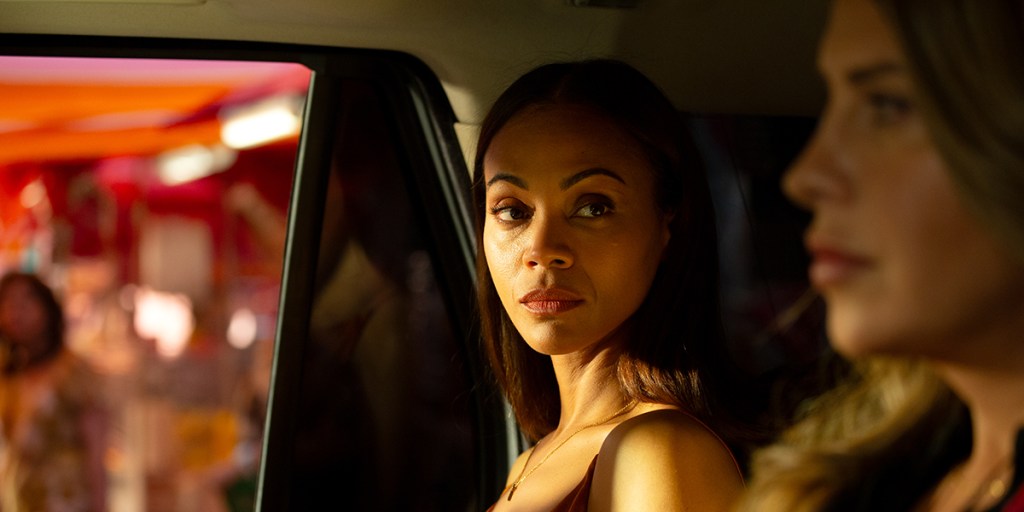
Rita (Zoe Saldaña) is an ambitious young defence lawyer in Mexico City. She spends hours crafting powerful opening statements for trials, but, as a black woman —  originally from the Dominican Republic — she gets none of the credit. But somebody is watching her and appreciates her skill. She finds out who, when she’s kidnapped with a black hood over her head and driven into the middle of the desert. There she meets the notorious head of a huge drug cartel, personally responsible for countless killings. Juan “Manitas” Del Monte, the cartel chief, needs her to help him disappear, in a way no one — including his wife Jessi (Selena Gomez) — will ever find him again.

The twist? This murderous, pock-marked, bearded monster… is trans, and wants to shed the awful male body and face, to live the rest of her life as an attractive woman. She needs someone she can trust to handle all this, both the finances and the surgery, leaving no paper trail. In exchange, Rita will have all the money she needs for the rest of her life, and her own private firm.

Years later, she meets with a potential client, a fabulously rich European woman named Emilia Pèrez (Karla Sofía Gascón). It’s her client from years back, who wants to re-enter the world and be reunited with her beloved family, all of whom think she is dead. And to atone for some of her past sins without revealing who she was. What will happen to these three remarkable women in the next chapter of their lives?

Emilia Pérez is an incredibly passionate and shocking movie. It’s simultaneously an action-thriller, an epic drama, and a musical. Yes, that’s right, a musical, where  characters do break into songs and dances throughout the film. But with its latin beats and shouting crowds, it’s the sort of songs you rarely encounter in a musical.  Zoe Saldaña is amazing as this tough-as-nails lawyer, and Karla Sofía Gascón, a Spanish actress I’ve never seen before, is unmatchable, both as Perez, and as the drug lord Manitas. (She’s a  transwoman herself.) French director Audiard (who previously brought us masterpieces like A Prophet, and Rust and Bone) seems to have no trouble creating a Mexican musical. I gotta say, Netflix churns out a load of content, most of which is forgettable crap, but, every year, they also produce a few really remarkable films. Emilia Pèrez is one of those.

I strongly recommend this movie.

Here and Amelia Perez both open this weekend in Toronto; check your local listings. And Captives is having its English Canada premiere at 8:45 tonight (Saturday, Nov 2, 2024) at Cinefranco at the Carlton.

This is Daniel Garber at the Movies, each Saturday morning, on CIUT 89.5 FM and on my website culturalmining.com.

Fractured families. Films reviewed: Good One, Close to You

Posted in Canada, Drama, Family, LGBT, Toronto, Trans by CulturalMining.com on August 16, 2024

Hi, this is Daniel Garber at the Movies for culturalmining.com and CIUT 89.5 FM.

In Anna Karenina, Tolstoy said “All happy families are alike; each unhappy family is unhappy in its own way”.

Sometimes this leads to families torn at the seams, impossible to repair. While others can find the happy side of life. This week I’m looking at two new movies about cross-generational, fractured families. There’s a teenaged girl going camping with her divorced dad, and a trans man repairing relations with his estranged family.

Good One

Wri/Dir: India Donaldson

It’s a summer’s day in New York City. Sam (Lily Collias) is a high school student who lives with her mom; her parents are divorced. She spends most of her time fooling around with her girlfriend who is heading off to University in the fall. But this weekend, she’s preparing for some quality time with her dad, Chris (James Le Gros). Chris is an uptight, clean-freak who resented his ex-wife’s affair, but loves his daughter dearly and unconditionally. That’s why he’s taking her on a camping trip, along with his best friend, and his best friend’s son. Matt (Danny McCarthy) is an actor-turned-salesman. He’s also a bit of a douche, known for his inappropriate comments. Don’t take Matt seriously, says Chris, he has no filter. But his son is mad at him, so he ends up coming alone. Matt’s also irresponsible — he forgets things like basic clothes, camping equipment and even a sleeping bag. 

But soon enough, they’re at a camp sight, telling ghost stories and cooking instant ramen over a small fire. They reveal certain secrets from their past and share their deepest beliefs. But when Matt says something to Sam she considers deeply offensive, the tenor of the whole trip shifts. Will the adults learn from their mistakes? Or is it up to the children to teach them?

Good One is low-key, low-budget realistic movie about father/daughter relations. It seems at first like a traditional “generation gap” comedy, but it’s much more subtle than just that. It’s never in your face, you have to think about their facial expressions and what they’re really saying to get the full meaning. The acting is great — James Le Gros and Danny McCarthy serve as a surrogate Oscar and Felix (the Odd Couple) but as real people, never exaggerated caricatures. I’ve seen Le Gros in dozens of movies, but this is the first I’ve heard of Lily Collias — it’s from her refreshing point of view that we see this film. It’s a lovely looking and sounding film, the dramatic scenes alternating with long nature shots of grey rocks, green leaves and flowing water.  It’s lit by campfires at night and sunlight by day. And it’s laced with relaxing acoustic guitar. For a first film (this is India Donaldson’s first feature) this is really good. It may be subtle but it’s never boring. 

The title says it all — it’s a good one.

Close To You

Co-Wri/Dir: Dominic Savage

It’s winter in Toronto. Sam (Elliot Page) is a transman in his thirties who rents a room in a friend’s house in Kensington Market. He’s thin and muscular with short black hair, often in a red toque. He likes his new life: single, bisexual, exploring the city, with a good job, and a sense of freedom he never knew growing up. But today he’s taking the train back to ground-zero: his hometown, Cobourg. He’s going to see his family for his Dad’s birthday. It’s also the first time since his transition four years earlier, and he’s really wound up about it. He’s a failure, he’s inadequate, he’s not married like his siblings, and his life in no way resembles his parents’s solidly middle class home. All these thoughts are swirling around his mind and he’s ready to throw in the towel’s but decides to go anyway — he can always leave. And on the train, he recognizes the face of someone important to him as a teenager. Katherine (Hillary Baack) was his best friend… will she remember him?

Cobourg, isn’t Selma Alabama in the 1960s. No one looks at him funny or calls him names. His parents (Wendy Crewson, Peter Outerbridge) are overjoyed to see him again. But one of his in-laws (David Reale) seems less than enthusiastic. Will they accept his changes? Can he survive this reunion? And will he ever see Cat again?

Close to You is a dramatic, personal portrayal of the anxiety facing a man’s first visit back to his family since his transition. There’s also some unexpected sex and romance (no spoilers). It’s well-acted and realistically told. Locations range from Toronto’s Kensington Market and Union Station to the picturesque streets of Cobourg. It’s co-written by Elliot Page, who you’ve probably seen in hit movies and shows like Juno and The Umbrella Academy. I think the story is partially based on a fictionalized version of Page’s own experiences — like Sam, he transitioned about 4 years ago,  though as a major movie star and celebrity always in the public eye, Page’s life is very different from the introverted Sam. This is a very Canadian movie that casts actors who are deaf or black without out that identity ever entering the story line. In Canada, bigotry is quiet, not overt, but still there. It accurately portrays the pain of snide remarks, deadnaming and misgendering. It’s also sympathetic to other members of Sam’s family, struggling with their adult son’s changes.

There have been hundreds  of coming out movies about lesbians and gay men, but very few about transgendered men in the same situation. So there’s a real thirst for films like this one. 

I liked Close to You.

Close to You and Good One both open this weekend in Toronto; check your local listings.

This is Daniel Garber at the Movies, each Saturday morning, on CIUT 89.5 FM and on my website www.culturalmining.com.

Journeys. Films reviewed: The Fabulous Four, Doubles, Crossing

Posted in Canada, Friendship, Georgia, Migrants, Sex Trade, Trans, Turkey, Women by CulturalMining.com on July 27, 2024

Hi, this is Daniel Garber at the Movies for culturalmining.com and CIUT 89.5 FM.

Picture this: you’re watching a big-screen movie with your friends, but you’re sitting on the grass, not in a theatre. Huh? The Toronto Outdoor Picture Show (TOPS) lets you watch really great movies for free under the stars in parks across the city, in Fort York, the Corktown Commons, The Christie Pits and Bell Manor Park. Featured movies include Wim Wenders’ Perfect Days, Boots Riley’s Sorry to Bother You, and Stephen Soderbergh’s Out of Sight, to name just three. And there’s the Toronto Palestine Film Fest, showing a free film on August 9th at the Christie Pits — with music, food and items for sale by local artisans followed by an outdoor screening of Alam, The Flag, directed by Firas Khoury.

But this week, I’m looking at three new movies about journeys. We’ve got four old college friends heading to Key West for a wedding, a Trinidadian flying to Toronto in search of his long-gone father; and a retired woman with a teenaged boy in Georgia going to Istanbul in search of a missing girl.

The Fabulous Four

Dir: Jocelyn Moorhouse

Marilyn, Lou, Alice and Kitty, are friends from university, who have stayed close — though separate — for over half a century. Now they are back together again, face to face in quaint Key West, Florida. Marilyn (Bette Midler) a flamboyant homemaker, is getting remarried there;  her long-time husband died just a few months earlier. Her adult daughter is opting out; she thinks it’s too soon. Lou (Susan Sarandon), never married, who has devoted her life instead to her career as an accomplished surgeon. She’s earnest, stubborn and moralistic. When she’s not at the hospital, she’s probably playing with her beloved cats or reading a novel by Hemingway. Kitty (Sheryl Lee Ralph) is a successful cannabis grower and manufacturer, known for her powerful edibles. But she’s had a falling out with her daughter who joined a religious sect that strictly forbids sex, drugs and rock’n’roll. She wants Kitty to move into an old-age home. Finally, Alice (Megan Mullally), a successful recording artist, is an unapologetically free spirit. Like Lou, she never married, but unlike the uptight surgeon, Alice will bed any man she fancies — or as her friends describe her, she’s a postmenopausal wolf in heat. But there is tension among the four. Marilyn and Lou have been feuding since they were roommates in a Manhattan apartment after graduating. Kitty and Alice had to trick Lou into coming — she doesn’t even know about Marilyn’s wedding. 

But things get better after a few days in Key West. The formerly sullen Lou is glowing now after a random encounter with a local bar owner named Ted (Bruce Greenwood). And the four of them have fun on boat rides, paragliding and exploring the restaurants and bars. But tension still remains between Marilyn and Lou, that threaten the wedding itself. What is their fight about? Why has it lasted so long? And can it be resolved?

The Fabulous Four is a comedy about a reunion of four aging women who get together for their last big blast. It’s goofy and a bit campy. The plot is paint-by-numbers with very few surprises. The drunk or stoned jokes are tired, but there are a few funny bits: like Lou taking down a bicycle thief using a sex toy. But it gets bogged down with predictable, age-related gags about incontinence and old people not knowing what TikTok is. So lots of eyerolling and a bit of cringiness, but luckily no  extreme humiliation. And I was never bored — how could I be, with Susan Sarandon and Bette Midler in the same movie? It’s written and directed by women, which might explain why there was more niceness and less outrageousness than your average teen comedy.

Doubles

Wri/Dir: Ian Harnarine 

Dhani (Sanjiv Boodhu) operates a doubles stand with his mother in Trinidad. (Doubles are snacks made of curried chana between two pieces of soft yellow fried bread.) Times are hard, and they really need more money. But their property is all in his dad’s name. He moved to Canada many years ago to advance his career, and never came back. Now he’s a rich man, a successful chef who owns a fancy restaurant and a big house, while his family back home is still struggling to get by. So Dhani buys a ticket and flies to Toronto for a week to work out the financials. But his mother stresses, don’t be like your father — he’s probably living with some other woman. Come right back.

But when he arrives on a cold winter day, he discovers it’s nothing like he expected. He visits his father, Ragbir (Errol Sitahal) at his Caribbean restaurant.  Turns out he’s not the chef, he’s the dishwasher. He lives in a small house without any luxuries. And he meets Anita (Rashaana Cumberbatch) a greeter at the restaurant. She calls him her brother from another mother — a half sister he never knew about. And the biggest surprise: Ragbir is dying of cancer and needs a bone-marrow donor to save his life. Can Dhani accept his father’s unexpected condition? And is he willing to donate the needed bone marrow?

Doubles is a poignant drama about father-son relationships and the immigrant experience. It’s a rough story, harrowing at parts, especially as the father’s health declines (in a great portrayal by Errol Sitahal.) Visually, I found the movie very drab and plain looking — the locations, people, places — in both Trinidad and Toronto. I assume that’s intentional, but it amounts to the opposite of eye candy. At the same time, the characters and story seem sad but real, and it’s the first time I’ve seen Trinidadians explicitly portrayed in a Canadian movie before. And — no spoilers — despite the heavy topics, the film does close on a happier note. And it’s being released theatrically just in time for Caribana!

Crossing

Wri/Dir: Levan Akin

Achi (Lucas Kankava) is a young layabout in a beachside house by the Black Sea in Georgia, not far from the Turkish border. He lives with his abusive brother, his sister-in-law and their crying baby. He wants to move somewhere far away but he’s unemployed and flat broke. Ms. Lia (Mzia Arabuli) is a dignified, retired school teacher from the same village. She’s looking for her beloved niece, Tekla. She hasn’t seen her in many years, but is knocking on doors to find her, and apologize for something she did way back when. His brother claims he’s never heard of her, but Achi jumps at the chance to talk with Ms Lia. He says he remembers Tekla, a transwoman who lived in the place a few doors down. But she moved to Istanbul and gave him her address before she left. He offers to take her there and even do a bit of translating. With some reservations, she agrees, and buys their tickets. When they arrive they are both impressed by the city’s grandeur and beauty. And with the help of two street urchins, he finds the place in the red light district she’s supposed to be working at. But she’s not there, and no one has heard of her. Lia becomes increasingly anxious about locating Tekla, even as friction builds between Lia and Achi as he looks for ways to live in the new city and earn a living.

At the same time all this is going on, Evrim, a young woman (Deniz Dumanli) is following her own path. She works at a social welfare NGO called Pink Life, where she helps needy LGBT and other people in that area. She’s also passing through the byzantine legal process of transitioning her gender. As a transwoman, she is often harassed as a sex worker, but she’s actually an accredited lawyer, one of the few people who know how to confront the police when they overstep their bounds. 

Lia and Achi eventually meet up with Evrim to try to locate Tekla. What will Lia do if she finds her? Will Achi stay in Istanbul if Lia returns to Georgia? And what about Evrim?

Crossing is an amazing adventure and drama following the lives of an unusual group of people navigating their way through the underbelly of of Istanbul’s culture. It’s a coming of age film about kinship and discovery. Great acting, beautiful cinematography and an excellent script. We get to see their encounters with the people they meet — Evrim on the street, Achi in a nightclub, and Lia in the night market. The characters are fascinating and multifaceted, revealing their hidden histories as the story progresses. At the same time, it’s a total tearjerker, with a number of deeply-moving scenes. 

Interestingly, Crossing is only the second Georgian movie I’ve ever seen, and — surprise! — its by the same filmmaker, Swedish-born Georgian director Levan Akin (And Then We Danced).

I strongly recommend this movie.

The Fabulous Four and Doubles open in Toronto this weekend with Crossing playing at the TIFF Lightbox; check your local listings. This is Daniel Garber at the Movies, each Saturday morning, on CIUT 89.5 FM and on my website www.culturalmining.com.

Daniel Garber talks with Eve Lindley and Luke Gilford about National Anthem

Posted in Horses, LGBT, photography, Romance, Trans, Western by CulturalMining.com on July 20, 2024

Hi, this is Daniel Garber at the Movies for culturalmining.com and CIUT 89.5 FM.

Dylan is a dirt-poor young man who lives with his alcoholic mother and preteen brother in New Mexico. He earns a living as a day labourer doing construction work. His dream? To save enough money to buy an RV and explore the open roads. But everything changes when he is offered a few weeks’ work on an unusual ranch. All the cowboys and cowgirls who live there are LGBT and looking forward to their next queer rodeo. All of which is alien to Dylan. And that’s where he meets Sky, the woman of his dreams: could this be love? And can Dylan figure out where he fits in at this unusual ranch?

National Anthem is a beautiful coming-of-age romantic drama about a young man discovering himself in Southwestern US. It premiered at SXSW and played at TIFF. The film co-stars Charlie Plummer as Dylan and Eve Lindley as Sky along with a diverse, ensemble cast. It’s based on the photo book National Anthem: America’s Queer Rodeo, by Luke Gilford, who also directed the film. Gilford has shot fashion for Prada and music videos for Troye Sivan and Kesha, but this is his first feature film. Co-star Eve Lindley is a noted model and TV and film actress appearing in Bros, After Yang and Dispatches from Elsewhere. 

I spoke with Eve and Luke from Toronto via ZOOM.

National Anthem is now playing in Toronto.

Films reviewed: Orlando: My Political Biography, Fallen Leaves

Posted in 1600s, 1700s, 1800s, 1900s, Finland, France, LGBT, Noir, Politics, Romantic Comedy, Trans by CulturalMining.com on November 25, 2023

Hi, this is Daniel Garber at the Movies for culturalmining.com and CIUT 89.5 FM.

Toronto’s Fall film festival season continues in December with the Jayu Human Rights film festival showing insightful documentaries on pertinent issues, along with a slam poetry competition at the Ace Hotel.

But this week, I’m looking at two new European movies that played at TIFF this year and are now in cinemas. There are trans shape-shifters in France and lonely job-seekers in Finland.

Orlando: My Political Biography

Wri/Dir: Paul B. Preciado

It’s 17th century, Elizabethan England. Orlando is a teenaged boy, a handsome courtier in the Queen’s castle. He’s also an aspiring writer, waxing lyrical on oak trees and winter frosts. He falls in love with Sasha, a blonde, Russian aristocrat. But at the age of 30, he wakes from a deep sleep transformed into a woman. Orlando’s life takes her (and him) through various guises over hundreds of years, to capitals as far away as Constantinople, until finally returning by ship to 20th century London, where they finally complete and publish their book. Such is the “biography” of Orlando in Virginia Woolf’s famous novel. So what’s different about this film?

For one thing, the entire cast is trans or non-binary, as is Preciado, the director. And the cast is huge. Each version of Orlando is played by another actor, their sex, gender and sexuality presented in a myriad of ways.  Orlando is plural in this incarnation.  Not just that, Orlando’s race, colour and language also shifts, with the actors ages ranging from small children to the elderly. Some characters wear chainmail like Joan of Arc, while others recline, luxuriantly,  in an Ottoman seraglio. The one common factor is their Elizabethan white neck ruffs, the fashion of the day.

Orlando, My Political Biography is not the first film version of the novel — far from it.  It seems to attract the most experimental and avant garde filmmakers out there.  German director Ulrike Ottinger made Freak Orlando in 1981 which entirely rejects the conventions of both narrative and art movies. English director Sally Potter (see: The Roads Not Taken, The Party,  Ginger and Rosa)’s Orlando of 1992 starred Tilda Swinton as the various Orlandos and featured Jimmy Sommerville singing up in a tree.

But this French political biography adopts Bertolt Brecht’s (and Jean-Luc Godard’s) method of deliberately alienating the audience to promote a political stand. Each Orlando introduces their scene by announcing directly to the camera their real /adopted name and personal history, followed by their Orlando passage, often reading directly from a copy of Woolf’s book. But it remains engaging because of the beauty of the photography and costumes and the sincerity of the players in the film. Settings vary from deliberately artificial backdrops to an exquisite forest and a grotesque Parisian catacomb.

The political stance is complex, and involves a rejection of the accepted binary. Some take issue with psychiatrists, surgeons and pharmacists having control of their identities and bodies. Says one young Orlando: you must hate your genitals if you want the doctor to give you hormones… but I don’t hate my genitals. Says another: I adopted a ridiculous caricature of masculinity for a year after transitioning before realizing I shouldn’t erase my personal history just because I’m trans.

Orlando, My Political Biography is equal parts intellectual lecture, political diatribe, performance art, and cinematic experiment, and, most surprisingly… it works.

Fallen Leaves

Wri/Dir: Aki Kaurismaki

It’s typical day in Helsinki, Finland. 

Ansa (Alma Pöysti), a single woman in her thirties, works at a low-paying job in a supermarket. She lives in a small apartment and subsists on frozen microwave dinners. She likes listening to relaxing music, but her bakelite radio only plays bad news from the Ukrainian war these days. She does go out occasionally to a local karaoke bar, with her best friend Liisa (Nuppu Koivu). There she encounters — but doesn’t actually meet — Holappa (Jussi Vatanen). Holappa is a depressed guy who works as a welder at a small factory. He lives in the company dorm, along with acquaintances and his best friend and confident Huotari (Janne Hyytiäinen). He handles his depression with constant drinking, which only gets him more depressed. After a few near misses they finally meet face to face. Their first date? A zombie movie at a local rep cinema. Sparks fly and they vow to meet again soon. But various unfortunate coincidences seem destined to keep these soulmates far apart. Can they ever find happiness together? Or is this a relationship that can never happen?

Fallen Leaves is a tragicomic proletarian love story par excellence. Its also a deadpan comedy, which despite it’s nearly tragic atmosphere, will have you laughing and crying all the way through. If you’ve ever seen an Aki Kaurismaki  movie before you’ll instantly recognize his style: seedy bars, bearded bikers, dark rock n roll, and a noir-ish, retro feel. Similar to Jim Jarmusch, but much funnier. It also deals with real-life issues like alcoholism and poverty. Ansa loses her job for taking home an expired cookie instead of throwing it away, while Holappa is driven close to self- destruction by his constant boozing. If you haven’t seen his movies before, Fallen Leaves is a great one to start.

Everything in this film is retro. Finland is the high-tech home of Nokia and Supercell, but in Kaurismaki’s world the characters use avocado coloured landlines,  with cel phones or video games nowhere to be seen. Computers seem relegated to internet cafes. Phone numbers are written on slips of paper, blown away with the wind. Movie theatres only play classics, and every bar is on skid row. 

At the same time, there’s always a niceness and sweetness burbling just below the surface of the humdrum futility of everyday life. Fallen Leaves is a wonderfully depressing movie with a feel-good atmosphere. I love this movie.

Fallen Leaves and Orlando My Political Biography are  both playing now at the TIFF Bell Lightbox, and at other theatres across Canada — check your local listings.

This is Daniel Garber at the Movies, each Saturday morning, on CIUT 89.5 FM and on my website culturalmining.com.

Narrative sovereignty. Films reviewed: El Equipo, Praying for Armageddon, The Stroll, Twice Colonized at #HotDocs30

Hi, this is Daniel Garber at the Movies for culturalmining.com and CIUT 89.5 FM.

Hot Docs International Documentary Film Festival is on its last weekend, but with many more terrific movies yet to be seen. If you’re a student or under 25 or over 60, all daytime screenings are free. So be sure to catch a movie today or tomorrow.

This week I’m looking at some of the movies that played at Hot Docs, including ones dealing with narrative sovereignty. There is archaeology vs the military, religion in international politics, indigenous decolonization, and sex workers reclaiming their history.

El Equipo

Dir: Bernardo Ruiz

It’s 1984, in Buenos Aires, Argentina, the Falklands War has just ended and the military Junta has fallen, leaving a fragile democracy in its place. The rule by military and police has ended but over 10,000 people are missing — the “disappeared”. And the Mothers of the Plaza de Mayo demonstrate daily demanding justice for their lost sons and daughters.

Enter Dr. Clyde Snow, a chain-smoking, martini-quaffing Texan in a cowboy hat. He’s a forensic archaeologist, known for authenticating the remains of notorious Nazi Dr Mengele and the victims of serial killer John Wayne Gacy. He’s in Argentina to rattle some bones and expose the skeletons in the closet. But first he needs some help. He recruits young university students — including Mimi Doretti, Patricia Bernardi, and Luis Fondebrieder — from the anthropology and archaeology departments. They are hesitant at first; if there’s another coup, Snow could easily fly back to North America while the students would be among the first to disappear. But they agree to help excavate unmarked graves to prove they were tortured and killed by the police and military. And in some cases to identify the remains. And after studying with Dr Snow, they become internationally renowned, called to investigate massacres and war crimes around the world.

This very moving film documents the group over 40 years, at the trials in Argentina, as well as projects in El Salvador, Guatemala, Ethiopia, Iraqi Kurdistan and Mexico. 

El Equipo is a crucial film.

Praying for Armageddon

Dir: Sonje Hessen Schei, Michael Rowley

Why does the US have such close ties with Israel? According to the US state department, “Americans and Israelis are united by our shared commitment to democracy, economic prosperity, and regional security. American ties to the State of Israel are strong and longstanding.”

Al Jazeera says: “Washington’s unwavering support for Israel is rooted in the aftermath of World War II, the Cold War, pro-Israeli political influence and PR heft.” But there is another, less well-known reason: American Evangelical Christians’ belief that the Rapture and Armageddon cannot occur without the State of Israel controlling the city of Jerusalem. Only then can Jesus return to earth in the End of Days. Armed with a sword, he will smite all those who don’t believe he’s the Messiah; but this who do will ascend to heaven, leaving the world in its wake. 

These beliefs in Armageddon and the End of Times are absolute and unequivocal. That’s part of the reason why Trump moved the US embassy to Jerusalem, and why Evangelicals send so much support to Israel.

It’s a religious thing.

This documentary digs deep into a world of sword-bearing motorcycle gangs, megachurches and ordinary people who believe wholeheartedly in biblical prophesies. It also looks at violence against Palestinians by settlers in the Occupied Territories that their donations support. Pray for Armageddon is a fascinating look at America through a glass darkly by curious Scandinavian filmmakers. 

The Stroll

Dir: Zackary Drucker, Kristen Lovell

The meatpacking district around 14th street in New York City was for decades  the home of trans sex workers who plied their trade at night in cars and alleys around the empty trucks cleared of carcasses. Many were runaways, largely black or hispanic, ostracized by their families, and rejected by the mainstream community. Their only possible work was sex work. They banded together to protect each other from violent johns and the constant threat of arrest and assault by the brutal 6th Police Precinct, using a law known as “walking while trans.” The district is now a gentrified shopping area, but co-director and subject Kristen Lovell returns to her former neighbourhood as she pieces together their shared history. Many of her friends were murdered, beaten or sexually assaulted by police, murdered or sentenced to long prison sentences, especially since Rudolph Giuliani’s crackdown based on the “broken window policy”.

Through period photos and films and new interviews, the film shows them as they fought for their lives and livelihood, often among a disinterested or hostile larger community. It lionizes heroes like activist Sylvia Rivera, who founded STAR (Street Transvestite Action Revolutionaries) are they were then known. But it also shows explicit photographs and the sex-workers own graphic descriptions — some hilarious, others harrowing — of their work and lives.

Although Lovell was once herself the subject of a documentary, The Stroll reframes their story to their own version of history, not that of an outside filmmaker. 

This is what is meant by narrative sovereignty, where the film’s subject is also a director allowed final say on her own portrayal.  

Another example of narrative sovereignty is: 

Twice Colonized

Dir: Lin Alluna, Aaju Peter

It’s the 1970s. Aaju Peter is a young Greenlandic Inuk and a top student. Her parents support her moving to Denmark (Greenland is its colony) to continue her education. She stays there until she is 18, but when she returns home, she finds she can’t talk to anyone — she speaks Danish now but has lost her Greenlandic language and culture. She quickly marries a Canadian and moves to Iqaluit. She is now a practicing lawyer, an Inuit activist and has served as an international delegate at the EU, and the United Nations fighting for indigenous rights and representation. 

But the film is a highly personal view of her life over a seven year period. We follows her return to Denmark, to revisit her past, and confront her worst fears. It also reveals the impact of a terrible death of one member of her family, as well as a bittersweet reunion with another. With beautiful, stark images of life in the arctic, this is an unvarnished portrait that shows Aaju Peter at her best and worst. 

Twice Colonized, The Stroll, Praying for Armageddon and El Equipo are all playing at the Hot Docs Festival through the weekend. Twice Colonized is also opening theatrically next Friday at the Hot Docs cinema in Toronto.

This is Daniel Garber at the Movies, each Saturday morning, on CIUT 89.5 FM and on my website, culturalmining.com.

Daniel Garber talks with filmmaker Chase Joynt about Framing Agnes at Hot Docs

Posted in 1950s, 1960s, documentary, L.A., LGBT, Mystery, Queer, Secrets, Trans, UCLA by CulturalMining.com on April 23, 2022

Garber-April-23-22-interview

Hi, this is Daniel Garber at the Movies for culturalmining.com and CIUT 89.5 FM.

Photos by Jeff Harris.

It’s the late 1950s in Los Angeles. While the world’s attention is on Christina Jorgensen, the charismatic transgendered celebrity who flew back from Copenhagen as a new woman, a much quieter clinic at UCLA was also conducting treatment and surgery of transgendered patients. And into this office stepped a young woman named Agnes who said despite being a cis male she grew breasts spontaneously upon reaching puberty — a celebrated case. But later Agnes admitted she made it all up so she would qualify for gender reassignment surgery. Why did Agnes have to lie to get much-needed treatment?

Framing Agnes is a new and unusual documentary based on newly uncovered medical files that look at Agnes and her other unsung contemporaries from that era. Made in the style of a 1950s talk show, it includes reenactments, off-screen conversations, period footage as seen through a present-day filter. Using trans actors, it meticilously presents interviews as “real”, immediately followed by footage showing that they’re only acting. It deals with hot topics, ranging from gender, sexuality and identity, to trans youth, and visibility vs invisibility. This first feature is the work of  prize-winning writer and filmmaker Chase Joynt, who co-directed No Ordinary Man, about jazz musician Billy Tipton, and co-authored You Only Live Twice with Toronto artist Mike Holboom.

I spoke with Chase Joynt in Chicago, via Zoom.

Framing Agnes is premiering in Toronto at Hot Docs on Sunday, May 1, 8:30pm at the TIFF Bell Lightbox. 

Films to look out for at #TIFF21 + Titane!

Posted in Disabilities, Disguise, Feminism, Fetish, Horror, Thriller, Torture, Trans by CulturalMining.com on September 11, 2021

Hi, this is Daniel Garber at the Movies for culturalmining.com and CIUT 89.5 FM.

TIFF has just started, in a half digital, half in-person sort of way, and it looks like it’ll be fun… kinda. There are screenings at the TIFF Bell Lightbox, Roy Thomson Hall, Scotibank Theatre, the Princess of Wales and at Cinesphere at Ontario Place, along with various drive-ins. And for those who fear the virus, you can watch it at home… but the selection is not identical. Some filmmakers don’t want their films premiering on your TV or phone.

Seats are all reserved, so no need to line up. And thinking of munching popcorn? Think again. Nothing will come between you and your mask, even during the movies. Scotiabank Theatre has even issued a diktat that they may be searching your bags — not for firearms, but for cameras and potential munchies. They even issued restrictions on the size of shoulder bags, purses or knapsacks!

This is serious stuff, people.

Because of press embargoes at the time I’m recording it, I can only review one non-embargoed film — a story of a woman who is really into cars. But I can also tell you, for your edification — not reviewing, just telling — about some of the movies coming to the festival that I think look good or interesting.

Here are some of the movies I’m looking forward to seeing at TIFF this year:

Saloum

Saloum is a supernatural action thriller set in West Africa. It’s about about a small team of mercenaries known as the hyenas who escape from a coup d’etat in Guinea Bissau only to land their prop plane in a remote part of Senegal only to encounter supernatural dangers. It’s written and directed by Jean Luc Herbulot and comes out of Lacme studios in an innovative outfit based in Dakar. and it’s having its premiere next week as part of Midnight Madness.

Benediction

Benediction is biopic about Siegfried Sassoon, an aristocrat celebrated for his poems about WWII. I think the movie delves into his personal life, including his lovers. And it’s written and directed by the great Terence Davies — that’s the main reason I want to see it. He has an amazing style of filmmaking like no one else.

Attica

Attica is a documentary feature about the notorious prison in New York State, and the uprising there 50 years ago, where dozens of inmates and guards are killed. I want to see this both for the topic, also for the director. It’s made by Stanley Nelson, who has documented crucial parts of American history, including the civil rights movement, the black panthers, and many others His docs are always great.

Alanis Obomsawin

And speaking of great documentary filmmakers, they’re celebrating Alanis Obomsawin this year and playing many of her films at the festival. If you’re a regular listener of this show, you’ve probably heard some of my many interviews with her over the years — but even if you haven’t, you really should catch some of her films playing at TIFF. Working at the National Film Board she’s the one who’s been documenting indigenous history from the inside, since the 1960s.

Dune

I don’t believe I can call any movie a guilty pleasure, but I am actually mildly excited by Dune. It could be dreadful or it could actually be good. I’m sure you’ve heard of it —it’s based on Frank Herbert’s science fiction novel about a royal family on a sand-covered planet. It’s directed by Denis Villeneuve and it stars Timothee Chalamet… I dunno, could be good, could be terrible.

There are so many other movies I’m l’m hoping to see.
There are adaptations of Canadian novels like Maria Chapdelaine and All My Puny Sorrows based on Miriam Toews’ book. And international directors like Norway’s Joachim Trier called The Worst Person in The World; and Chinese director Zhang Yimou’s film set during the Cultural Revolution, called One Second.

Anyway, despite what some people are saying, there are a lot of great — or potentially great — movies out there, and many have tickets still on sale.

Titane
Wri/Dir: Julia Ducournau

The south of France 20 years ago. Alexia, a bratty little girl who doesn’t wear her seatbelt, is in a terrible car accident. She recovers from brain surgery but is left with a prominent scar on one side of her head covered with a titanium plate. Many years later (Agathe Rousselle) she’s as foul tempered as ever, but now is tall, lean and long limbed with blonde hair. She’s a successful model who specializes in car and boat shows — the type of model who wears skimpy revealing clothing as they pose beside and caress in a the vehicles on display. She has many devoted fans but refuses to sign autographs. And she has a sharp metal knitting needle always tucked in her hair.

For unexplained reasons, but maybe because of the childhood car wreck, she is infatuated by cars. I mean really infatuated, She finally fulfills her fantasies by literally having sex with a Cadillac. They don’t show it, but it’s clear from the bouncing fender and flashing headlights that the caddy is as much into her as as she is into it. But something changes after that, and she starts killing people with her knitting needle. First a rabid fam, and later every other human at a beachside sex orgy. Soon the police are tracking her and she has to get away. At a train station she spots a poster for a little boy named Adrien who disappeared more than a decade earlier and presumed dead. Thinking fast, she hides in a \washroom, smashes her nose flat, dyes her hair brown and cuts it short, and uses cloth tape to flatten her breasts. Now she resemble what the poster boy Adrien might look like today. Sure enough, the dead boy’s dad Vincent (Vincent Lindon) says he’d recognize his son anywhere. He drives her home and puts her to bed in the boys room kept intact since he disappeared. But that’s not all.

Vincent, her new dad, is a super macho guy who lifts weights and injects steroids into his bum. He’s the dictatorial head of an all-male fire station. And Adrien/alexia’s room is inside the firestation. So suddenly she’s trapped in the form of a man in an intensely homoerotic workplace where the men all drink beer and rub against each other to disco music. And… she’s pregnant, and the most likely father is the cadillac. Will Vincent discover she’s not his kidnapped son? Will she ever get out of there alive? Or has she finally found her home?

Titane is a stylized, and surreal, totally off-the-wall fantasy, seen through the eyes of an involuntary transgendered anti-hero who has sex with machines. It’s also about the deluded Vincent who will do practically anything to protect his only family member. It plays with concepts of gender, sexuality, self-identity and family. Lots of gratuitous extreme violence, nudity, and weird, weird sex — this movie is not for the squeamish or the sensitive. Agathe Rouselle and Vincent Lindon are both amazing in their roles. I think this movie is strange but brilliant. It won the Palme d’Or at Cannes this year, only the second film directed by a woman to win that. Great movie.

Titane and the other movies I mentioned are all playing at TIFF. Go to tiff.net for details.

This is Daniel Garber at the Movies, each Saturday morning, on CIUT 89.5 FM and on my website, culturalmining.com

Daniel Garber talks with Kourtney Jackson, Max Shoham and Ella Morton about their films at FOFS

Posted in 1940s, Animation, Beauty, Black, Canada, Indigenous, Inuit, Movies, Trans, Women, WWII by CulturalMining.com on July 10, 2021

What do the following three stories have in common? An Inuk recalling her history, language and culture amidst the ice floes of Nunavut; three diverse black women in Toronto sharing the unique hair problems they faced during the pandemic; and a young, Jewish-Romanian couple meeting aboard a ship burgeoning with refugees adrift at sea during WWII. These stories are all films featured in The Future Of Film Showcase — or FOFS. In its eighth year, FOFS has selected 11 new short films made by Canadians under 40. 

Kourtney Jackson is a Toronto-based experimental filmmaker whose hybridized, storytelling transcends the physical body. Her film Wash Day looks at three black women talking about  bodies, hair, skin, beauty and self-love as they each cleanse themselves in a shower.

Max Shoham, an award-winning, prolific maker of animated short films in diverse genres, has been obsessed with movies since Grade 3.  Sophie and Jacob is an animated retelling of Max’s own grandparents’ story about how they met aboard a ship. 

Ella Morton is an artist whose still and moving images incorporating obsolete techniques have taken her across Canada and through Scandinavia. Her film Kajanaqtuq combines manipulated analog formats along with recordings of an Inuk’s recollections of her life so far in Nunavut.

I spoke with Ella, Max and Kourtney via Zoom.

You can watch all films playing at FOFS on CBC Gem for free until July 22nd.

Tricks, Tracks, Traps. Films reviewed: The Killing of Two Lovers, Deliver Us From Evil, In the Earth

Hi, this is Daniel Garber at the Movies for culturalmining.com and CIUT 89.5 FM.

Spring Film Festival Season is on in Toronto, digitally speaking. Coming in the next few weeks are the Toronto Japanese Film festival, the Toronto Jewish Film Festival, Inside Out, Toronto’s LGBT film festival, and events organized by the Toronto Palestine Film Festival.

Starting in two weeks is the ReelAbilities film festival with shorts, features and docs about deaf and disability cultures, including a comedy night. All screenings are pay-what-you-can. Go to reelabilities.org/toronto for more info. 

This week I’m looking at three new movies, from the US, the UK and Korea. There’s  a husband who feels tricked by his wife, a hitman tracked by a killer; and an earth scientist trapped in a psychedelic forest.

The Killing of Two Lovers

Wri/Dir: Robert Machoian

David (Clayne Crawford) lives in a small-town in the southern US. He used to have ambitions to be a singer-songwriter, but now he works as a handyman doing odd jobs to keep his family afloat. He married Nikki (Sepideh Moafi) straight out of high school, and they now have four kids. But the spark is gone. David is living with his Dad now — he and Nikki are on a trial separation. It’s meant to help fix their broken relationship. But when he finds her in bed sleeping with another man, he feels lost and angry, and starts to carry a gun. 

Meanwhile he wants to bond with his kids and keep the family together. His oldest daughter is furious with them both. And the younger ones (played by real-life siblings) are just getting by. Can Nikki and David ever get back together? Or will David’s brooding anger finally explode into violence?

The Death of Two Lovers is a relationship movie done in the style of a high-tension crime pic. It’s told through David’s eyes, so we feel his boiling rage and inner turmoil. He takes out his anger on a boxing dummy, and practices shooting with an old pistol. The soundtrack is full of repeating sounds — slamming car doors, creaking noises — unrelated to the actual images you see. And his encounters with Derek (Chris Coy) his moustached rival looks like it’s headed for disaster. No spoilers, but this is not a crime drama; it’s a movie about the (potential) collapse of a family. The acting is great and bit of a it’s tear-jerker, but it seems trapped within an unclassifiable and misleading genre. 

Deliver Us From Evil

Wri/Dir: Hong Wan-Chan

In-Nam (Hwang Jung-min) is a Korean hitman who kills for money, but only targets organized criminals. His assignment: a ruthless yakuza boss in Tokyo who exploits sex workers. It’s his final assignment; once complete, he plans to retire somewhere with warm beaches and lax banking laws where he can enjoy his blood money in peace…somewhere like Panama? But his dreams are shattered with a blast from the past. His ex-girlfriend he hasn’t seen in 9 years is trying to reach him. Her nine-year-old daughter Yoo-min has been kidnapped. He drops everything and flies to Bangkok to investigate. He’s too late to save her but maybe little Yoo-min is still alive. He hires a local Korean woman named Yoo-Yi (Park Jeong-Min) to translate for him and serve as his guide. She works at a Patpong bar, and needs the extra cash to pay for sex-reassignment surgery. Together they uncover a terrible truth: a ruthless Thai operation that kidnaps small kids, especially Japanese and Koreans in Thailand, to sell their organs to rich people back home! 

What In-Nam doesn’t realize is that he’s a marked man… the hitman is on a hit-list. The Yakuza boss he assassinated had a brother named Ray aka The Butcher (Lee Jung-jae). This guy is ruthless and deranged, and can do terrible things with his very sharp knives. Can In-min rescue Yoomin (and the other kidnapped kids) before their organs are yanked from their innocent bodies? Is little Yoomin — who he’s never met — his own daughter? And who will survive the fight to the death: Ray who is out for vengeance; or In-Min?

Deliver us from Evil is an intense crime action/thriller set in in the underworlds of Korea, Japan and Thailand. The first half hour is a bit dull: too much talk, talk, talk, and not enough action. It’s a complicated plot that needs a lot of explaining. But once it starts going it never let’s you down, with lots of fistfights, marital arts, knives, guns and cars. It’s a world where everyone’s corrupt: competing criminal gangs, local con artists, international syndicates and cops on the take. If you’re disturbed by violence, blood and awful situations— stay away. But if you like action, suspense, intense fighting, and some interesting characters, Deliver Us From Evil is a good watch.

In the Earth

Wri/Dir: Ben Wheatley

It’s England in the near future, where an unknown  virus pandemic is wiping out the population. The country is a mess with food shortages and strange new laws. Martin (Joel Fry), is a mousy scientist who arrives at a nature preserve to study the soil there. (He also has a hidden agenda, to contact Alma another scientist who disappeared, leaving a puzzling diary.) After passing the medical tests,  he sets out into the woods  accompanied by a guide. Olivia (Hayley Squires) is a no-nonsense forest ranger with her hair pulled back in a ponytail. She can assemble a pop tent in a couple minutes and knows every inch of the woods.  But while they slept a stranger  attacked them, stealing their shoes, clothes and Martin’s crucial radio equipment. Luckily they encounter Zach (Reece Shearsmith), an eccentric, bearded, back-to-the-land type who is shacked up nearby. He tends to their wounds, makes them some food and gives them comforting elderflower tea. Unluckily Zach is a lunatic who drugged their tea and tied them up. He says all nature is connected, and we must listen to a common brain to find out her wishes. And this includes using Martin and Olivia in bizarre rituals and possible sacrifices. They must escape!  But a natural mist has settled all around them generating  microscopic mushroom spores and unbearable sounds. What is the truth in these woods? And can Olivia and Martin overcome its allure?

In the Earth is a weird, science-fiction/horror/ fantasy about humans fighting nature — and the earth fighting back. It was filmed just a few months ago during the height of the pandemic in the UK. And it’s full of psychedelic visions and creepy sounds. Ben Wheatley’s movies are unique and either you like them or you don’t. But I thought it was fantastic. There’s a fair amount of violence and gross-outs, but it’s all done in an art-house style, not your typical Hollywood horror. If you’re in the mood for a freaky, indie movie, this one’s for you.

The Killing of Two Lovers Starts today on all major platforms, In the Earth also opens today at the Virtual TIFF Bell Lightbox; and Deliver us From Evil will be available on VOD, digital and on disc on May 25th.

This is Daniel Garber at the Movies, each Friday morning, on CIUT 89.5 FM and on my website, culturalmining.com