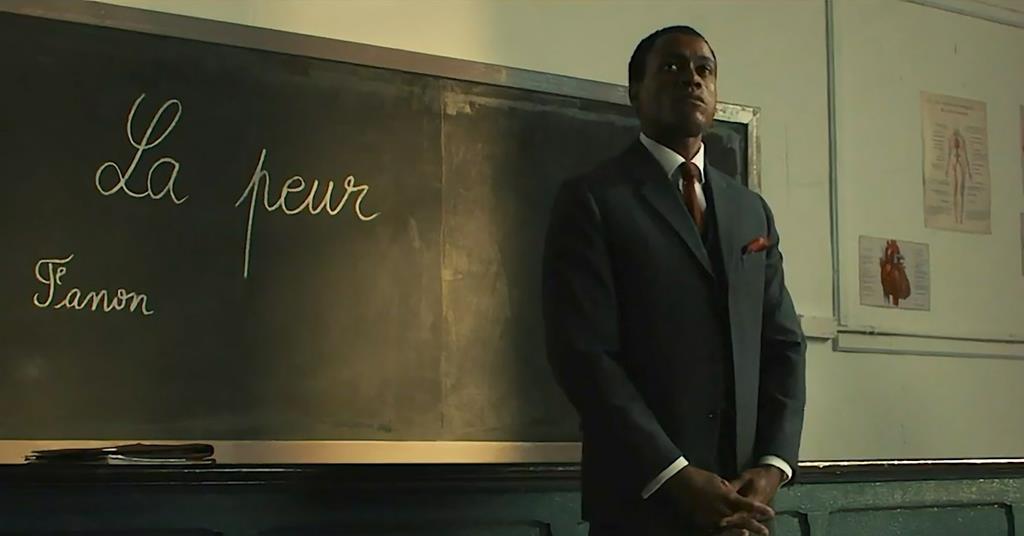
Parts of history. Films reviewed: Fanon, Train Dreams, Christy

Posted in 1920s, 1950s, 1990s, Algeria, Biopic, Boxing, Class, Colonialism, Lesbian, LGBT, Politics, Psychiatry, Resistance, Trains, violence by CulturalMining.com on November 9, 2025

Hi, this is Daniel Garber at the Movies for culturalmining.com and CIUT 89.5 FM.

Toronto’s Fall Film Festival season continue with two series on right now. Reelasian features films from Asia and its diaspora, including two great ones from Canada: Min Sook Lee’s heart-wrenching doc There are No Words, and Koala Kid’s whimsical, animated Space Cadet. Cinefranco has movies in French from Europe, Africa, and Quebec, including many Toronto premieres: look out for la Venue de l’Avenir by Cedric Klapisch (Ma Part du Gateau), and le Dernier Souffle by the legendary Costa-Gavras. 

But this week, I’m looking at three new films set in historical eras. There’s a lumberjack at the turn of the previous century, a psychiatrist in Algeria in the 1950s, and a female boxer from West Virginia in the 1990s. 

Fanon

Co-Wri/Dir: Jean-Claude Flamand-Barny

It’s the early 1950s in Algeria. Frantz Fanon (Alexandre Bouyer) is a renowned psychiatrist from the French Island of Martinique. He is starting his new job at a mental hospital. But he’s shocked at how Algerian patients are treated there. In contrast to Europeans, the “savage” north Africans are kept shackled in filthy cells, because of their “barbarous and dangerous” nature. Fanon (who is black) insists his North African patients be treated like any others. He lets them walk in the garden, plant vegetables, play soccer and make friends. Their mental health quickly improves. He’s assisted by diverse Algerian interns and staff: Hocine (Mehdi Senoussi) Jacques (Arthur Dupont) and Alice (Salomé Partouche), all followers of his techniques. But he’s strongly opposed by traditionalists and the French military, who are increasingly violent in their tactics. (Algeria was annexed by France but most of the locals are not considered full citizens.) He and his wife Josie (Déborah François) are upper-middle-class French citizens playing their role supporting the sprawling Empire. Fanon fought the Nazis in WWII. He likes Sartre, elegant suits and and fine wine. But his views are changing. He now writes books (dictated to his wife) about the effect of colonization on the mental health of the colonized in Algeria. Their own self-image is denigrated by their oppressors, he writes, when they internally accept their status as “the other”. Word gets out and he’s invited to join the FLN, (considered terrorists by the French). But the threat of violence reaches his hospital, as personified by Sergeant Rolland (Stanislas Merhar), a particularly violent soldier who checks in as a patient. How can Frantz Fanon simultaneously balance his various roles — as a husband and father, as a Black man serving the French empire, as an innovative psychiatrist, and as an intellectual joining the Algerian struggle for independence?

Fanon is a vibrant biopic about a decade in the life of the renowned author. I find it gripping and fascinating. Alexandre Bouyer is strong and statesman-like in the title role. I’ve known of Fanon for many years — as the author of books like The Wretched of the Earth and Black Skin, White Masks — but never knew about his background in psychiatry. Though occasionally heavy-handed and hagiographic, this movie opened my eyes to the exciting and intellectually stimulating story of his life in Algeria and the history that surrounded it. 

I like this one a lot.

Train Dreams

Co-Wri/Dir: Clint Bentley (Jockey) 

It’s the early twentieth century in the US Northwest. Robert Grainier (Joel Edgerton) is a bearded lumberjack who rarely speaks. He earns his living chopping down trees at migrant lumber camps and building the railroad.  He meets a woman named Gladys (Felicity Jones), they fall in love and build a homestead in a grassy patchl near a flowing river. He cuts all of the wood by hand. Gladys is good with a rifle and shoots foul and deer to eat. The rest they buy in town at a general store owned by Ignatius Jack (Nathaniel Arcand).

He spends lonely months away earning money, but always returns home in the end. He makes friends with a Chinese labourer named Fu Sheng — they don’t talk but that’s fine with Rainier who never has much to stay. But he is shocked when a crowd decides to murder Fu Sheng just because he’s a celestial. He later makes friends with an old-timer named Peebles (William H. Macy) who handles the dynamite explosions. He loves their new baby girl  but his home and family are threatened when a wildfire sweeps through the forest while he’s away. What will Grainier do?

Train Dreams is a series of events in one unremarkable man’s life set along the early 20th century northwestern frontier. A folksy omniscient voice narrates the story, hoping to add profundity; it doesn’t work. The film is meandering,  pointless and stupid. It gives token nods toward environmentalism and against racism but they’re not really part of the plot. I hated this movie from the first few seconds, with its over-produced images and inappropriate soundtrack. We see a guy sawing wood until the camera pulls back revealing…? Nothing, just more trees, as if we’re supposed to applaud the scenery! At times it’s twee, like a Wes Anderson film, but without the humour or intellect. The men all look like they’re posing for a Carhartt fashion shoot. I try to feel sympathy toward Rainier  but he’s deliberately opaque. Worst of all are the Train Dreams of the title — we keep seeing the same montages of flashbacks from previous scenes… but the original ones are as short-lived as his memories of them. 

You might enjoy the pretty pictures in Train Dreams, but I can’t see any other reason to watch this annoying blunderbuss of a film.

Christy

Co-Wri/Dir: David Michôd (The Rover)

It’s 1989 in West Virginia. Christy Salters (Sydney Sweeney) is a high school kid, and a star player on the girls’ basketball team. She’s also in love with her girlfriend Rosie (Jess Gabor), a relationship her mom (Merritt Wever) doesn’t approve. She ends up trying out as a novelty act at a boxing match, and, though she has zero training, she scores a KO on her first try. She’s a natural. She catches the eye of a middle-aged boxing entrepreneur named Jim Martin (Ben Foster). He reluctantly takes her on and lets her train at his gym, but he will not allow her to see — or even talk to — Rosie. He sets her up in a trailer park where he can keep an eye on her. Though a great fighter, she’s isolated and unprotected outside of the ring. 

Christy is a powerhouse. Her career takes off, including a new hairstyle and a trademark pink silk hooded robe to make her look more “feminine”. She knocks out all contenders and after much pressure, the 22-year-old Christy sleeps with the middle- aged Jim… and they eventually marry. 

Her career soars, she meets Don King (hilariously played by Chad Coleman) and is signed to Mike Tyson’s slate. She gains fans worldwide, but her life is micromanaged by her Svengali husband. She may be a professional fighter but he’s twice her size, unstable, and increasingly violent. And he tries matching her up with boxers way above her weight class; that’s just dangerous. Is there any way to escape this oppressive relationship?

Christy is a biopic about the first prizewinning female boxer, who paved the way for a new professional women’s sport. I was hesitant about this one — ugh, yet another boxing movie — but Christy is as good as Rocky. It’s exciting, thrilling and moving, and despite her flaws, Christy Martin’s life is super-sympathetic. Sydney Sweeney is amazing. Yes, it’s Oscar-bait (you can tell by the prosthetic teeth and mullet haircuts, playing down her image as a sex-object) but she totally gets into this role. And Ben Foster is superbly hate-able as Jim — I seriously didn’t realize it was him till the credits rolled; he’s that skillful.

Christy is a good, old-fashioned biopic and a hell of a great boxing movie. 

Train Dreams and Christy both played at TIFF and are opening in Toronto this weekend; check your local listings. And Fanon is premiering today at Cinefranco, 4 pm at the Carlton Cinema.

This is Daniel Garber at the Movies, each Saturday morning, on CIUT 89.5 FM and on my website culturalmining.com.

Archnemeses! Films reviewed: Kill, Despicable Me 4, Escape

Posted in Animation, comedy, Espionage, France, India, Kids, Korea, North Korea, Punjab, Super Villains, Thriller, Trains, violence, War by CulturalMining.com on July 5, 2024

Hi, this is Daniel Garber at the Movies for culturalmining.com and CIUT 89.5 FM.

Classic novels and movies needed a hero or a heroine to save the day. But in really good stories there’s also a nemesis, an enemy to fight and defeat. This week I’m looking at three new movies, from Korea, India and France — two action thrillers and an animated comedy — about arch-nemeses. There’s a former villain in witness protection, a commando on a train heading in a southern direction and a communist sergeant preparing his own defection!

Kill

Co-Wri/Dir: Nikhil Nagesh Bhat

Amrit (Lakshya) is a commando in a special unit of the Indian army. Along with his best buddy Viresh (Abhishek Chauhan) they lead their troops in tactical operations using martial arts and hand-to-hand combat. But he’s in a bit of a jam. The love of his life, Tulika (Tanya Maniktala) is pledged to another man in an arranged marriage. To elope seems too risky; her father is an oligarch with immense power and wealth. Even so, they arrange for a secret meeting aboard the express train her family are riding south from Amritsar to Delhi. And, right there, with the two of them squeezed into a cramped toilet Amrit proposes marriage, complete with ring. But what neither of them realize is the train has been targeted by a brutal gang of bandits for an attack on the sleeper cars. The dacoits kill the guards, and steal watches, jewelry and cash from everyone there. And they sexually threaten the women. They’re led by a capricious Fani (Raghav Juyal) the nefarious son of the clan’s patriarch. But when Amrit and Viresh see what’s happening, they decide it’s time to fight back… but can just two commandos take on an entire family of bandits?

Kill is a non-stop, violent action movie, the first of its kind out of India. It’s nothing like Bollywood, no songs, dances, or extended flirting. This is heavy-duty fighting all the way through. This is Lakshya’s first starring role — he’s good-looking  and intense, a natural leading man. He plays Amrit as a regular Punjabi drawn almost to madness when he sees his lover threatened. Then he goes berserk. He wears a blood-stained shirt for most of the film, and beware: there’s a lot of blood to be spilt. Much of the action takes place in the aisles of an express train, between cars, on the roof, and out the exit doors. Weapons range from sabres, to rifles, a metal fire extinguisher and the fighters’ bare fists. The fighting is superbly choreographed, really well done. And the sound effects are chilling — the sound of skull hitting metal the slash. Off a knife, the thud if fists hitting flesh…I’ve never seen an Indian movie like this, and I quite enjoyed it. If you can get into intensely violent, non-stop action movies — on the scale of the great  Indonesian flic The Raid — then I think you’ll really like Kill. 

Despicable Me 4

Dir: Chris Renaud, Patrick Delage

Gru (Steve Carell) is a former supervillain who is now on the straight and narrow. He lives with his beloved wife Lucy (Kristen Wiig), their three adopted  daughters, Margo, Edith and Agnes, and their newborn baby son. But he has to dive back into the world of villainy when he is sent on a secret assignment: to return to the criminal boarding school of his childhood, the Lycée Pas Bon. Once there he must capture and jail his lifelong rival Maxime Le Mal (Will Ferrell). Now Gru has his Minions — diminutive bright yellow creatures who obey his orders but are always up to no good — but Maxime has minions of his own: cockroaches! He’s built up a veritable army of the insects, and when he escapes from prison, he vows revenge against Gru and all those around him. To safeguard his family, Gru enters a witness protection program where they are all given new names and identities and a suburban home to live, and told to “blend in”.

The problem is their next door neighbours, the Prescotts, have a precocious but obnoxious daughter named Poppy. She has guessed Gru’s true identity and threatens to expose him unless he helps her pull off a heist of her own. But can Gru keep his family safe while pulling off this audacious caper? Or will they fall prey to Maxime and his cockroach empire?

Despicable Me 4 is an animated kids’ comedy about a former villain facing off against a current villain.  It’s the latest in an immensely successful French movie franchise (Reviews: Despicable Me, Minions: The Rise of Gru) about a likeable villain and his makeshift family. It combines simple animation with funny lines and goofy characters, Once again, I viewed it in an audience packed with kids who seem to love it. Personally, it seems to be getting a bit tired, like they’re running out of new ideas. The one genuinely funny aspect are the Minions, all voiced by Pierre Coffin. When they’re around, you’ll be laughing with their silly and imaginative slapstick humour. Despicable Me 4 isn’t great, but it did keep me entertained. And the kids will love it.

Escape

Dir: Lee Jong-pil

It’s present day at the DMZ in North Korea. The Demilitarized Zone — it separates the north from the south — is full of landmines, with sentinels in towers watching closely for any movement on either side. Kyu-nam (Lee Je-hoon) is a Sergeant in the Korean Peoples Army nearing the end of his ten-year term there, and dreads returning to work in a coal mine. There is no family to go home to. He has firmly embraced the national ideology of Juche, or self-reliance. But in Kyu-nam’s case, self-reliance has taken on new meaning. Each night, he sneaks out of his bunker, climbs through a window, and crawls his way across the minefields toward the border, recording all the safe spots along the way. He plans to defect to the South before the next rainfall causes the landmines to shift. But he runs into trouble when a pudgy private named Dong-hyuk (Hong Sa-bin), who idolizes the Sergeant sees his trial runs. Dong-hyuk longs to be reunited with his mother and sister in South Korea. So he tries to escape on his own, using Kyunam’s map… but he mucks things up, putting them both in danger of a firing squad.

But who appears at the desertion trial, but Hyun-sang (Koo Kyo-hwan), a Major with connections. He has connections with Kyu-nam going way back, and declares him a national hero, and sets him up in a cushy job as an aide-de-camp for a drunk general. But Kyu-nam is committed to his plans. Can he reach the border before Hyun-sang can catch him? Or are they doomed to a violent end?

Escape is a fast-moving action thriller, full of complex schemes and near escapes… along with plenty of unexpected surprises. Koo Kyo-hwan plays the major as a slightly effeminate, upper-class nepo-baby who would rather be a concert pianist than an officer. This villain reveals hints of a secret gay past, adding to his mystery. Lee Je-hoon plays a macho, self-reliant soldier who just wants to choose his own future and have enough food to eat (based on what he heard about the South from the propaganda broadcasts he picked up on his transistor radio). The entire film takes place in the North. It portrays a country filled with poverty, malnutrition and class divisions— based on Party membership — where the ordinary people just scrape by, while the effete elites gorge on fine meats and liquors. I have no idea how accurate it is, but I liked the details, from the socialist realist murals, the giant slogans, and the maroon coloured dress-uniforms the officers wear. 

And, of course, its gripping plot that will keep you glued to the screen.

Kill, and Despicable Me 4, both open this weekend in Toronto, and you can catch Escape at the TIFF Lightbox; check your local listings. This is Daniel Garber at the Movies, each Saturday morning, on CIUT 89.5 FM and on my website culturalmining.com.

Guy stuff. Films reviewed: The Fall Guy, The Ride Ahead, Pelikan Blue

Posted in 1980s, 1990s, Action, Adventure, Australia, Disabilities, documentary, Hungary, Movies, Trains by CulturalMining.com on May 4, 2024

Hi, this is Daniel Garber at the Movies for culturalmining.com and CIUT 89.5 FM.

This week, I have some movies about guy stuff — two documentaries and an action movie. There’s a guy in Sydney not afraid to get his hands dirty, a guy in New Hampshire who wants to know the real dirt, and three guys in Budapest playing dirty with some train tickets.

The Fall Guy

Dir: David Leitch

Colt Seavers (Ryan Gosling) is the stunt double for a heartthrob Hollywood action star named Tom Ryder (Aaron Taylor-Johnson). Tom claims to do all his own stunts but those in the know know it’s Colt falling off buildings, crashing cars, and catching fire. Colt loves the excitement and thrill of doing the undoable — and he’s really good at it, too. Especially at his current film, because he works beside a camera operator named Jody (Emma Blunt). They’re spending time together, on and off duty, trading quips on set or making out behind the klieg lights. It’s his dream job. Until a terrible accident breaks his back, and he disappears from the scene entirely. And from Jody, too. Until, 18 months later, he gets a call from a producer. Gail (Hannah Waddingham), a big shaker and mover, wants him on Tom’s latest flick, a sci-fi action rom-com. He doesn’t want to, until she drops the other shoe: Jody is directing this movie and she specifically asked for him. 

So off he flies to Sydney, Australia, to join a shoot in progress. It’s a shlock-fest about a space cowboy fighting aliens using weapons that look like heavy-metal guitars. Turns out Jody had no idea he’s coming and is still offended he dumped her for no good reason. Then Gail, the producer, asks for Colt’s help. Tom has disappeared with a gang of undesirables and she’s worried he’s in trouble. Can’t Colt find and rescue him? If not they’ll have to cancel the movie… and Jody’s career (this is her first time as a director). Tom agrees, but soon discovers he’s the target of a slew of gunmen, trying to get back a missing video. Can Colt rescue Tom, survive the bullets, catch the baddies and make it back to set in time to woo the love of his life?

The Fall Guy is a combination rom-com and action movie set within the confine of the film industry. So it’s full of references to mediocre movies. I thought the witty banter wasn’t particularly clever, and the plot twists propelling the story pretty threadbare. There are lots of unnecessary jokes written into the script with a nudge and a wink. Like when Jody asks Colt if she should use a split screen in the film she’s directing… immediately after which  The Fall Guy movie starts using a split screen, too. That’s just weak. And yet I walked out of this film feeling totally entertained. Why?

First of all the acting is great, all the main characters well-played, especially Gosling’s Colt Seavers. More than that, though, the action is really good. The chase scenes are elaborate, the fight scenes are like watching ballet, and even the gratuitous explosions — and there are quite a few of them — are just fun to watch. And of course, in a movie about stuntmen, the stunts are all done just right. So if you’re looking for a couple of hours of forgettable entertainment, this one’s for you.

The Ride Ahead

Dir: Dan Habib, Samuel Habib

Samuel Habib is a young man who lives with his parents in Concord New Hampshire. He has tattoos, likes music and sports. He went to public school and is getting ready for college, but realizes he hasn’t yet done a lot of things many high school kids have already done: things like going on a date or having sex. Yes, the media is filled with sexual images and porn but rarely relevant to people like him. Samuel is disabled. The thing is, movies and TV shows portray people like him in one of three ways: get help, get cured or die. He wants some advice that’s relevant to him, preferably NOT from his parents (awkward…) And he can’t stand being talked down to or underestimated by people who only see his disability. So he decides to go to the source and talk with some well-known disabled people, including many of his heroes. He does it — and makes a film out of it.

He meets with musician Keith Jones, co-founder of Krip-Hop, for some basic rules about having sex. Says Jones: “always remember: put a bag on it!”Judy Heumann, the late, great leader of the Disability Rights Movement, says “using a wheelchair means spending a lot of time staring at people’s butts!”

Andrew Peterson who lives with Fetal Alcohol Spectrum Disorder tells how he became a long-distance runner and a sports coach. And Maysoon Zayid, a Palestinian-American

Dan and Samuel Habib, The Ride Ahead at HotDocs, Photo by Jeff Harris

stand-up comic, provides both constant humour and some really tough talk. The film takes Sam (and his father, co-director Dan Habib) across the country, in boats, planes and automobiles, each of which pose separate accessibility issues, especially airplanes; Samuel uses an electric wheelchair to get around and they don’t go well with those tight spaces on planes. He also turns to his own big brother for all-around moral support and inspiration. But will Sam ever move beyond his parents’ house?

The Ride Ahead is a touching, funny and informative documentary told from the subject’s point of view. It helps correct a lot of misconceptions about disabilities, and introduces a lot of other things you probably never considered. The film is made in the form of a dialogue between Samuel, his dad and the people he encounters, often with the camera positioned either facing him or facing out. At times, Samuel’s both the subject and the filmmaker. He can speak, but in the film mainly uses an electronically generated voice whose texts he writes in advance.

I liked this documentary a lot, partly the way it makes people with disabilities the subject not the object. It covers diverse intellectual territory, from disability rights to ableism and disability justice. It also deals frankly with real aspects of everyday life. And the cast and crew, both behind and in front of the camera, from editor to soundtrack, are largely disabled themselves.

The Ride Ahead is a good movie to watch.

Pelikan Blue

Wri/Dir: László Csáki

It’s the late 1980s in Budapest, Hungary and the iron curtain may be rattling but it’s not yet opened. Still, the government is introducing new measures. It’s now legal to keep foreign currency and travel abroad. Everyone, especially young people, are dying to see what it’s like in Western Europe. But train tickets are prohibitively expensive, and no one has any money. When three guys — Rozi, Petya, and Akos — buy a forged ticket on the black market, they are dismayed and disgusted by its poor quality: smudged ink, misspelled words… They’d be caught immediately. They can do better than that using just advanced planning and simple high school chemistry. So they decide to take the bull by the horns, and make themselves some fake tickets. This involves spying on the sellers, stealing some covers, and getting a phony rubber stamp made (not an easy task in communist Hungary). But they also have to buy a cheap ticket, bleach out the ink and carefully enscribe the forgery through a page of Pelican Blue carbon paper.

After much trial and error, they manage to ride a train to Scandinavia for pocket change. But when they get back, rumours leak, and everyone wants a piece of the action. Should they expand their business or get out of it before the police find out? 

Pelikan Blue is a beautiful, animated feature-length documentary that follows the story over three decades, using old voice recordings and new interviews. This is basically a heist movie, but one  involving minimal stakes — just forged tickets across Europe. But what really struck me was the stunning art. It involves the garish lavenders and electric blues of 1980s colours, distinct characters, and simple but instantly recognizable images: a payphone, an answering machines, the brutalist rooftops of Budapest. Backgrounds are brushed with tempera paints, and the faces have squashed noses, and eyes that are tiny green dots. I cannot describe the joy I felt looking at this animation, it’s unique, it’s amazing, it’s handmade, it’s just so cool. There’s also a chill soundtrack of 1990s Hungarian music percolating through the whole film. There are lots of funny parts, and some psychedelic dream sequences, too…I just can’t get enough of Pelikan Blue.

The Fall Guy opens this weekend; check your local listings. The Ride Ahead, Pelikan Blue are two of the many movies playing at Hot Docs through Sunday.

This is Daniel Garber at the Movies, each Saturday morning, on CIUT 89.5 FM and on my website culturalmining.com.

Journeys to redemption. Films reviewed: Ainbo: Spirit of the Amazon, Bullet Train, We Are Living Things 

Posted in Action, Aliens, Amazon, Animation, comedy, Crime, Drama, Fairytales, Indigenous, Japan, Kids, Migrants, Trains by CulturalMining.com on August 13, 2022

Hi, this is Daniel Garber at the Movies for culturalmining.com and CIUT 89.5 FM.

TIFF is back on track again, after two makeshift years, bringing you the world’s best movies, showing only in theatres. King street will be open for celebrity spotting once again, along with free concerts and other spectacles. And the discount ticket packages are on sale only till Sunday, that’s tomorrow, with individual tickets starting as low as eleven dollars each if you’re 25 or younger.

This week I’m looking at three new movies about desperate journeys toward redemption. There’s one girl on a quest to save her Amazon village; two alienated migrants in America on a search for the truth behind alien abductions; and a half-dozen killers on a bullet train trying to kill all the other killers… before they get killed themselves.

Ainbo: Spirit of the Amazon
Dir: Richard Claus, Jose Zelada

It’s present-day in the Kundamo nation of the Amazon. Ainbo is a 12 year old girl who calls herself a legendary hunter but hasn’t quite mastered the bow and arrow. She’s an orphan who lives with her best friend, Zumi, who is next in line for chief. But a dark shadow has fallen on her community, with fish dying and people turning ill. So she sets out on a quest: to talk to the giant mama turtle for direction, discover a powerful weapon, find the source of the poison, and defeat the evil demon Yakaruna.

Fortunately, two odd-looking animals appear beside her to help her on her way. Strangely enough, she can understand everything they say. Dillo and Vaca are her spirit guides but also tricksters, who can only be believed some of the time. Meanwhile, Attak, a mighty hunter, blames the disease on Ainbo, and chases her through the jungle to keep her away. Can Ainbo summon enough inner strength to realize her spiritual goals? Or will her people all die from this mysterious ailment?

Ainbo: Spirit of the Amazon is a delightful, high-quality animated kids movie about a 12 year old girl’s attempt to save her people from destruction. Its told in the manner of a classic folktale, but with modern twists: perhaps their problems come from European developers trying to usurp their land. This is clearly aimed for little kids but I found it totally watchable, including a scene with day-glo psychedelia. I like this one.

Bullet Train
Dir: David Leitch

Ladybug (Brad Pitt) is a freelance criminal who carries out complex thefts around the world. But somehow bad things happen to people around him. Dying of poison, falling off rooves — there seems to be no end to the misery all around him. Luckily, his current job, is a piece of cake: board a bullet train in Tokyo, steal a briefcase full of cash, and get off at the next stop before anyone notices. Simple, right?  Not quite.

He doesn’t realize he’s not the only criminal on board. A well-dressed pair of twins, code-named Tangerine and Lemon (Aaron Taylor-Johnson, Brian Tyree Henry), are professional hitmen and the holders of said briefcase.  Prince (Joey King) is a ruthless and mysterious young woman dressed in a pink, snug-fitting school uniform, with her own agenda. Then there’s Kimura and his dad, both of a yakuza clan, a mysterious killer named The Hornet, and a man named Wolf (Bad Bunny) with vengeance on his mind. And of course the ruler of the underworld himself, White Death. Who will survive this fatal journey?

Bullet Train is a fast-paced, violent action comedy set aboard a Japanese high-speed train. It has a punchy soundtrack and an A-list cast, including Brad Pitt, Aaron Taylor-Johnson, with cameos by Michael Shannon and Sandra Bullock. And it’s based on a book by critically-acclaimed Japanese novelist Kôtarô Isaka. Unfortunately, this big budget movie feels like a third-rate Tarantino knock-off. The screenplay is crap, filled with unfunny jokes and two-dimensional caricatures. It feels like the director has never been to Japan or set foot on a bullet train — he doesn’t even know they’re on raised platforms not normal tracks, or that Japanese vending machines never malfunction. Even the sound recording is poor — I couldn’t make out some of the dialogue in the first scene. While not bad enough to put you to sleep, Bullet Train never rises above the mediocre.

We Are Living Things 
Co-Wri/Dir: Antonio Tibaldi

It’s present-day New York, where two immigrants live very different lives. Solomon (Jorge Antonio Guerrero) lives completely off the grid. Born in Mexico, he crossed the Arizona border as a young man in search of his mother. She completely disappeared and Solomon believes she was abducted by aliens. Now he works as a jack-of-all- trades,  good at plumbing, wiring and carpentry. He likes non-digital devices, like metal detectors and industrial dryers and stays away from computers and cel phones.  He rents a hidden space inside a recycling plant, where no one can find him; he’s undocumented and knows how to make himself invisible. His main objective is to listen to aliens — the ones in outer space — through their radio waves, using a complex device made of a satellite dish and a piece of a magnetic meteorite.

Chuyao (Lü Xingchen) works in a mani-pedi salon. She holds a legal ID, its just not hers. She has cut her hair short and changed her name in an attempt to match the ID, but she looks nothing like the photo. It doesn’t matter, says Tiger (Wang Zao), the man who got it for her; white people think we all look the same. Tiger is a sleazy criminal and her de facto boyfriend, but behaves more like her pimp. He makes her attend private parties for rich clients, sometimes just singing karaoke, but often leading to sketchy or even dangerous after-hour meetings. Worse than that, Tiger has implanted a chip in her neck so he always knows exactly where she is. After a chance meeting, where Solomon discovers Chuyao shares his obsession (she was abducted by aliens back in China), he begins to follow her around, a guardian angel to protect her when she’s in trouble.  Eventually they end up fleeing the city together in an attempt to uncover aliens in Arizona… and perhaps discover each other.

We Are Living Things is a bitter-sweet, art-house drama about the lives of two alienated migrants in America, trying to regain their sense of self-worth. It’s filled with dreams and surveillance footage woven into the narrative. And while there is an undercurrent of sci-fi themes, the real dangers they face are the omnipresent police and ICE agents who permeate their lives. The cinematography is strikingly beautiful, capturing Chuyao’s louche glamour, Solomon’s low-tech machinery, and the glory of the American west. And Guerrero and Lü both have cinematic faces that look great on the screen. Strange and impressionistic, this film will stay in your mind long after it’s over.

You can catch We Are Living Things at the Carlton cinema in Toronto; check your local listings. Ainbo opens in theatres this weekend; and Bullet Train is now playing across North America.
 
This is Daniel Garber at the Movies, each Saturday morning, on CIUT 89.5 FM and on my website, culturalmining.com. 

Canadian Film Day! Movies reviewed: The Decline, The Grey Fox

Posted in 1900s, Canada, Conspiracy Theory, Crime, Quebec, Romance, Snow, Thriller, Trains, violence, Western, Wilderness by CulturalMining.com on April 23, 2020

Hi, this is Daniel Garber at the Movies for culturalmining.com and CIUT 89.5 FM.

It’s spring film festival season in Toronto, but all the theatres are closed… or are they? It’s actually possible to enjoy new movies without ever leaving your home. Images Film Festival went digital this year for the first time, showing art as moving images, not projected on a screen or in an art gallery, but transferred onto your home device. They live-streamed, both movies and dialogues with the artists. National Canadian Film Day (April 22) continues through the week in virtual cinemas throughout the country. This lets you support your local theatres and enjoy new and classic Canadian films. So this week I’m looking at two Canadian movies to celebrate National Film Day. There’s a fugitive looking for love in the Rockies, and a survivalist looking for refuge in Northern Quebec.

The Decline (Jusqu’au déclin)

Dir: Patrice Laliberté

Antoine (Guillaume Laurin) is a happily married man with a young daughter in Montreal. They’re survivalists, intent on preparing for an unknown, unpredictable apocalypse. He knows something terrible is coming he; just doesn’t know what form it will take. So he diligently studies lessons on youtube, and practices late night escapes with his family, just in case. He’s thrilled when a legendary survivalist named Alain (Réal Bossé) invites him up north to visit his compound, and study under the master.

Alain’s estate is everything he hoped for. There’s a geodesic greenhouse, huge storage lockers, and a cosy wooden cabin to sleep in. The forest is bountiful, filled with deer and rabbits – more meat than they could eat. Alain is recruiting the best and the brightest to join him in his utopia. But secrecy and security are top priorities; mustn’t let the unbelievers – or the government – know about this vast hideaway. It would ruin their paradise. So he and the other trainees gladly give up their cel phones and cars. Up here travel is done on foot or by skidoo.

And it’s not just Antoine and Alain. There are others, both first timers, like Rachel (Marie-Evelyne Lessard) a hard-ass army vet; and devotees like Dave (Marc Beaupré) an arrogant douche with a hint of bloodlust in his manner. The snowy woods have paths and roads heading in all directions to confuse outsiders. And there are active snares and booby traps to catch animals (and maybe people). This elite crew trains as hard at hunting and trapping as they do at shooting and self defense. But when the lessons turn to explosive devices, something goes wrong and a member is badly hurt. If they go to a hospital will that reveal their plans? But they can’t just let a person die… can they? Which is more important – safety or secrecy? The group splits up, and the two opposing sides soon find themselves in an all-out war. Who will survive – the newbies or the hardliners?

The Decline is a good, taut action/thriller set in northern Quebec. It’s exciting and surprising. It’s shot in the winter, in stark snowy forests where they have to fight each other but also icy rivers and steep rocky hillsides. Man vs Man (and women) and Man vs Nature. And it shows how things that look fun and exciting on conspiracy-theory websites can prove to be much more sinister in real life. Ths film seems particularly appropriate in the midst of a pandemic.

The Grey Fox

DIr: Phillip Borsos

Bill Miner (Richard Farnsworth) is a pioneer of sorts in the old west. He robs the famed Pony Express and makes his fortune stealing from stage coaches. He is known as the “Gentleman Bandit” taking the loot without firing a shot. But eventually the law catches up to him and he’s locked away in San Quentin. He emerges decades later, older, wiser and grey. But has he learned his lesson? He gets work picking oysters in Washington State, but it just isn’t his style. So he makes his way north on horseback to British Columbia. And on the way he catches his first movie, Thomas Edison’s 12 minute smash hit: The Great Train Robbery! He hires Shorty (Wayne Robson) as a henchman and looks up an old prison buddy named Jack (Ken Pogue) in Kamloops. His goal? To become Canada’s first train robber.

He bides his time, settling into an ordinary life in smalltown BC. There he makes two unexpected friends. Sgt Fernie (Timothy Webber) is a Dudley Do-right Provincial policeman who likes and respects this newcomer. And then there’s Kate (Jackie Burroughs). She’s a feminist firebrand, ahead of her time. She’s middle-aged, unmarried, alone – and loving it. No man is keeping her down. She works as a professional photographer. They meet by chance when he hears her listening to opera music on a hillside. Sparks fly and they become lovers… but will he ever reveal his secret past? Meanwhile, the dreaded Pinkerton private detectives have crossed the border looking for him. Can Bill Miner pull of his final heist? Does Sgt Fernie know his friend’s a robber? Will the Pinkerton’s catch him? And can he and Kate stay together?

The Grey Fox is a classic Canadian movie from the early 80s shot on location in the Canadian Rockies, complete with real steam engines and horses before stunning mountain sunsets. Farnsworth and the much-missed Jackie Burroughs make for an atypical, sweet couple. It’s based on a true story, but The Grey Fox’s nostalgic feel comes not from evoking the old west but rather by harkening back to a gentler and more idealistic 1980s Canada.

The Decline is streaming on Netflix. You can watch The Grey Fox on your TV, computer, phone or device until April 30, in a virtual cinema benefitting independent theatres from Charlottetown to Victoria including Toronto’s Revue Cinema. Go to filmmovement.com/virtual-cinema for more information.  

This is Daniel Garber at the Movies each Friday morning on CIUT 89.5 FM and on my website culturalmining.com.

The Space-Time Continuum. Movies Reviewed: Source Code, Repeaters, American: The Bill Hicks Story, The Tiny Ventriloquist

Everyone loves some good time travel right? Sure you do. You want to go back in time and fix something up, right a wrong, to do something you wished you had done before it was too late. So, this week, I’m looking at four movies — an action thriller, and a psycho-science fiction movie that deal directly with glitches in the time- space continuum, as well as a historical documentary/ biography about a stand up comic who was inspired by his psychedelic trips, and an art film that manipulates old images and sound, using newly created and found footage and graphic art.

Time travel movies used to be simple, you’d climb into your time machine, travel back or forward in time, until you fix whatever the problem was and come back home.

But now (possibly influenced by start-again video games and rebooted computer programs where you always have the chance to erase your mistakes and go back to point zero) we have this sub genre where scenes are repeated over and over and over again.

You are the one variable that can make a difference, but if you mess up, someone is pressing Play Again until you get it right (like in the classic Groundhog Day)

In one new movie,

Source Code

Dir: Duncan Jones

you get to see the same 8 minute episode, throughout the film, until the hero, a US military helicopter pilot In Afghanistan, tries to win his game.

So, the soldier (Jake Gyllenhaal) suddenly awakens on a Chicago commuter train, in the middle of a chat with Christina (Michelle Monaghan), a pretty woman across from him. The problem is, he doesn’t know where he is, what he’s doing, and who are all the strangers seated with him who seem to know him. And when he looks in a bathroom mirror he discovers he’s not there — he’s somehow inside another person! But even as he tries to make sense of it all, he is the victim of a huge explosion on the train whichh catapults him back to his military job.

It turns out he’s part of an experiment called source code, based on the principal that the brain can hold on to 8 minutes of short-term memory, and that after someone dies (like the man on the train) his neuro synapses remain open and retrievable if caught immediately after the heart stops.

So it’s up to him to figure out who the terrorist is, where the bomb was hidden, and then to trackdown the killer and stop a massive nuclear bomb set to go off later in downtown Chicago. he can’t change the past, but he can relive it until he finds out the truth.

Will he solve the crime, catch the bad guy, get to know Christina, and save the world? And will he ever be told why he’s In this program, and allowed out of this hellish space-time loop?

Source Code essentially has the same format as the directors other film Moon (about a man who lives alone on a base on the moon, with only a computer voice to keep him company) — a dialogue between two detached people caught in sort of a loop created by people beyond their understanding. In this one, the ongoing conversation — on the two sides of a video screen — is between the soldier and a female officer (Vera Farmiga) who sends him his assignments.

It’s a neatly imagined science fiction action thriller, even though Gylenhaal doesn’t seem quite up to the part, he’s too opaque, and the story doesn’t exactly make sense, even according to its own plot.

A Canadian film that opens next Friday,

Repeaters

Dir: Carl Bessai

follows a similar pattern.

Three young ne’er-do-well drug addicts — Kyle, Sonia and Weeks –at an isolated rehab center, live through a god-awful day iof depression, bullying, idiocy, neglect, and frustration. The three only have each other to depend on. Pick-up truck Kyle (Dustin Milligan) is rejected by his little sister for something he did; Sonia (Amanda Crew) is unable to talk about an issue with her father who is dying in a hospital; and Weeks (Richard de Klerk) is emotionally crushed by the hate-on his furious father carries for him when he tries to visit him in a prison.

But when they wake up the next morning after a thunderstorm, it’s soon clear the world is reliving the previous day exactly as before, and only those three are aware of it. This totally messes up their sense of destiny and morality. Is there any meaning to life at all? Even if they save a person’s life — or kill him — it all goes back to the same point of restart. (It’s one day, not 8 minutes, in this movie, so it’s not as action- packed as source code.) will they ever confront their own moral dillemmas and right the wrongs they know about?

This is a neat movie about things like where morality fits into one’s own self image, what are the psychological consequences of good and evil that has no effect, and what would you do if you could do anything? It’s also a romance, a bit science fiction, with a lot of psycho-thriller, as the three reveal their own minds to each other as the loops continue.

The next movie is only related to time travel in that the main character was known to mentally float around in a drug induced state.

American: The Bill Hicks Story

Dir: Matt Harlock and Pauk Thomas

Bill Hicks was a counter-culture standup comic in the Seventies and Eighties, known for tackling the topics that are taboo for comedians: not dick jokes, but politics, philosophy, intellectual issues, psychedelia. His jokes combined a Texas drawl, the lilt of a preacher’s revival meeting, and out-of-control, drunken and drug-filled vivid improvisational fantasies, rages and rants.

This moving documentary traces his life from his geeky teen years until his untimely death in his early thirties. Interesting technique for a documentary; there are almost no talking heads – instead the heads, people like his parents, his best friend, other comedians — turn into the movies narrators, like an oral history, with most of the movie comsisting of animated old photos, along with old concert footage.

He started as a thirteen yr old in suburban Houston, Texas. On his first try at drinking alcohol at a night club, he asks his fellow comedians – what’s a good drink (because he’s never had a mixed drink before)? They tell him Margaritas. So he downs seven margaritas at once and then goes on stage and lets loose. He considers alcohol as a disinhibitor, to let his true emotions loose on stage, and psilocybin mushrooms the source of his psychedelic insights. He would go up to a ranch every so often with a bunch of friends to down the mushrooms and see what images they bring.

Hicks was a heavy drinker and a creative psychedelic druggie, and the movie shows some unflattering footage of low period where audience members would buy him drinks during his standup act and he would drink, snort or inhale anything that got sent up the stage. A bt disturbing — like most of his act, where unsobreity was part of his defiance.

American, the Bill Hicks Story, is a very good and interesting movie, of a largely unsung folk-hero, done in the style of a rock-star documentary. My only criticism is that it concentrates too much on the serious biography parts and not enough on his art.

The Tiny Ventriloquist

Dir: Steve Reinke

Here’s another film that played last week’s Images Festival, where experimental art meets the big screen. This movie takes a disjointed look at the director’s own self-reflections towards his art; using his own great narrated shots and photos, along with found footage – of the most surprising kind – cut up and manipulated in an unexpected way.

I’ve always liked Steve Reinke’s work because it’s art, but it’s also always interesting and funny to watch, without the overly tedious or pensive feel, that a lot of video art has. You’re allowed to enjoy it, you’re allowed to laugh or squirm.

So in the same way Steve Hicks would drag political outrage into the usually pablum, fake-shock world of stand-up comedy, Steve Reinke, in the same way, violates the usually dry inner sanctum of art using found porn and other taboo sources (in an artistically valid way, naturally.)

So in this movie you het a combination of uneasy travel footage, spooky monochrome, costumed, home movie dancing, and old crackly recordings. Scenes of flood, water, and old rural western USA. Drunken Dutch soccer hooligans, hunters, real or imagined vaguely threatening child memories, manipulated Peanut’s cartoons, scary medical and industrial footage, and post-apocalyptic fantasies filled with dread.

The most bizarre footage is of a woman shown bear hunting in the woods, followed by a protracted explicit sex, in the form of very low-grade amateur porn, on top of the dead body of the bear. It’s funny: the dry didactic narration, while describing each scene in detail, in order to not offend the viewers it censors parts of the images by covering it with amorphous green-screen colour. Here’s the surprise: he keeps all the hard core porn images, but scribbles out the body of the poor dead bear!

Throughout the piece, vivid footage is alternated with animated simple line drawings. I liked this film, The Tiny Ventriloquist, a lot.

Source Code is now playing, American, the Bill Hicks Story starts today at the Royal Cinema in Toronto (check our local listings), Repeaters opens next Friday and The Tiny Ventriloquist was shown at the Images Festival.

WWII Communists as Rebels and Prison Guards. Movies Reviewed: The Army of Crime, The Way Back, The Edge

This week I’m talking about three European movies that look at the people out of power during and right after WWII.

Some of the best historical movies are about WWII. There’s something more monumental and profound about this huge, all- encompassing war that can’t be matched in movies about, say, the Americans’ war in Vietnam, or France’s in Algeria. And a lot of the fighting boils down to the two prevalent ideologies of the time: right-wing Fascism, and left wing Communism. So this week I’m going to talk about three movies that take very different perspectives on the role of the Communists in eastern and western Europe in WWII.

A few years ago, Western Europe started to examine its own role under the Nazi occupation, both as collaborators and as victims. The resistance – those who fought against the occupiers, often through violent actions – was facing not just the enemy but their own countrymen who sided with the occupiers.

Released in 2006, the Dutch movie, The Black Book, (directed by the fantastic Paul Verhoeven) is a great fictional story of a beautiful Jewish Dutch woman, Rachel (Carice Van Houten) a cabaret singer, who joins the resistance by infiltrating the Nazi’s as a spy—but she ends up being the mistress of a high-ranked, but kind-hearted and handsome Nazi officer (Sebastian Koch). Although fictional, this is a major rethinking of Dutch attitudes toward their German occupiers.

After this, other Western Europeans countries, one by one, made their own dramas about the occupation. The Danes made Flame and Citron, a retelling of two young heroes of the Danish resistance, one a redhead, one blonde, who blew up bridges and carried out espionage. It’s a good, tense drama.

Max Manus (2008), the Norwegian story, is an old-school adventure movie about a brave young man (Aksel Hennie) and his confreres who, on behalf of the Norwegian government in exile, fought against the Nazi’s and their own Quisling government by jumping out of windows and engaging in acts of sabotage against the enemy’s military ships around the Oslo harbour.

Germany had it’s own resistance, as portrayed in the movie Sophie Scholl: The Final Days (2005) , a true historical drama about an upper-class Munich university student, and her friends, who plotted against the Nazis by distributing anonymous leaflets in a movement known as the White Rose.

There were others as well, including the awful American drama Valkyrie, with Tom Cruise as one of the aristocratic military officers who plotted to assassinate Hitler. Quentin Tarantino made a much better American movie. An exaggerated but enjoyable spectacle, Inglorious Basterds, was simultaneously a melodramatic love story, a war-time comic-but-violent action flic, and a tense, espionage thriller.

Well, just when I thought this sub-genre was all played out, comes another very watchable and moving drama called…

The Army of Crime (2009)
Dir: Robert Guédiguian

This is a true story. It’s 1941 in Paris, and the Germans have moved in, the government has fallen, but day-to-day life hasn’t been affected much yet. The policemen are still French, and the shops, schools and institutions still operate the way they always have. But, for immigrants and minorities, things are getting worse. The police are cracking-down, searching homes, and the axe feels like it’s about to drop.

A group of young people who are already doing clandestine protests, independently of one another – communist grafitti, paper flyers dropped from buildings, street scuffles – are brought together under the French poet, Missak Manouchian (Simon Abkarian), who had survived the Armenian Holocaust as a child.

It’s interesting: in the past, the French resistance was shown on TV and in movies as the brave and noble Frenchmen who fought off their Nazi occupiers. In this movie, it’s mainly the French themselves who are collaborating with the Germans, ratting on their neighbours, and zealously joining the police force to catch all the vandals and resistance members that are upsetting their peaceful, occupied lives. And the ones fighting hard against the occupation are immigrants or their children – Armenians, Communists, Jews from Poland, Hungary and Romania; Italian radicals, and Spanish Republicans.

Some are using hidden printers in backrooms, and practice the piano in the front to cover the noise. One teenaged boy continues to compete in swim meets (under a false French name) while he secretly shoots German officers. A shadowy hierarchy — unidentified, but looking like eastern European Communists — impose order and planning on the individual firebrands. The story follows four or five plotlines as the diverse resistance members gradually converge into one unit with the plan to do a dramatic action… or die trying.

This is a good, gripping WWII dramatic thriller of the French resistance as de facto terrorists battling the complacent, majority collaborators who were aiding the occupiers in their nefarious schemes of deportation and death. Their various love stories, families, and historical events are all woven together in this dense, fascinating movie.

But what about the opposite side of the coin? What happened to the Eastern Europeans who opposed the Soviet Union’s occupation, or fell out of favour with the communist party? A new movie, by a very well-known Australian director, looks a group in some ways diametrically opposed to the ones in The Army of Crime.

The Way Back
Dir: Peter Weir

… depicts life in a Siberian gulag, a great escape, and an epic journey (by a few of the survivors) all the way south to India.

Januzs, a Polish man, is sent to Siberia for being “anti-Stalin” when his wife “confesses” his crimes after being interrogated and tortured. He finds himself in an isolated prison camp where the harsh snow and winter itself is the toughest guard. The other prisoners are petty criminals, purged party members, actors, intellectuals, bureaucrats, and anti-communists. The criminals are the highest-ranked ones, and therest cower from them. They move logs and some are sent to work in the mines.

But a group manages to escape, including Januzs, a shady American known only as Mr Smith (Ed Harris) and a rough criminal, Valka (Colin Farrell). An innocent young girl (Saoirse Ronan) they meet outside the prison helps the suspicious and cautious men to get to know one another. They set off on great walk, and here the movie makes a strange shift — from a prison movie to a human travelogue, pitting man against the great outdoors. The scenery is really beautiful, as they travel from the Siberians steppes, the plains of Mongolia, the Gobi desert, Tibet, and the Himalayas.

Cliffs, dunes, lakes, plains, forests, temples – all truly breathtaking and spectacular. I found the story itself, though, less interesting. Their main drives — to go on, to survive, to reach India — seemed incidental to the trip. What was their motivation? And it had a bit – just a bit — of the feel of a cold war-era propaganda flic: We must escape iron curtain and reach free world!

I don’t want to downplay those sentiments, and Stalin’s very real war crimes, but the movie seemed oddly out of date in its fuzzy-religious, anti-communist tone.

I think it’s almost worth seeing it just for the outstanding scenery – almost, but not quite.

Finally, a very different view of Siberian prison camps.

The Edge
Dir: Aleksei Uchitel

…which played at this year’s TIFF, and is the Russian entry for the Oscar in the Best Foreign Language Film category.

Ignat (Vladimir Mashkov) is a decorated war vet who is sent, in uniform, to Siberia just after WWII. There he hooks up with Sofia (Yulia Peresild) to become a sort of a husband/sex partner and a father to her baby. Sofia is surviving, by hook or by crook, having been a servant in Nazi Germany during the war, and then punished by the Soviets. Ignat is obsessed by trains, and wants to get them up and running again. He hears there’s an engine still out there in the forest somewhere, so he decides to bring it back. This is where the story gets really interesting. He finds it, but it’s being guarded by a mysterious, violent creature, whom he has to vanquish in order to get to the steam engine. (I don’t want to give this away, since that character becomes important to the plot).

Ignat becomes obsessed with getting the train across a fallen bridge and over a river so they can all get away. His rival – the mysterious Fishman – represents the authorities he wants to overthrow. Will his train ever work? Will he get away? Will he win over the hearts of the locals?

The Edge is a good, old-school Hollywood-type drama/adventure, laced with the  Russian irony and absurdity that was largely missing from Peter Weir’s movie.

It’s also strangely nostalgic, for the “good old days” just after WWII, despite the bitter losses (war, poverty, death) that went with it. Believe it or not, The Edge is a sort of a feel-good movie about Siberian gulags, told Russian-style.

The Way Back opens in Toronto on January 21st, (check your listings), The Army of Crime is showing in Thornhill, one screening only on Sunday, January 23rd , as part of the Chai, Tea and a Movie series, (go to www.tjff.com for details), and The Edge played at this year’s Toronto International Film Festival.

Also check out a rare chance to see Spike Lee in Toronto, in conversation with Toronto filmmaker Clement Virgo in celebration of Black History Month. They’re appearing at the Varsity Cinema, Tuesday, January 25, 2011, at 7pm.

Summer Popcorn Thrillers! Films reviewed: The Girl Who Played with Fire, Predators, Inception

Summer’s here, and sometimes a movie’s good enough to watch if it lets you sit in a comfortable seat, in a dark, air-conditioned room, while pretty pictures dance on the screen in front of you. If there’s a bit of a plot, credible acting, or a thrilling story – all the better. Escapism is simply getting away from the heat.

This week I’m looking at three very different summer thrillers about groups of people chasing — or being chased by — their opponents.

The Girl who Played with Fire

Dir: Daniel Alfredson

This is number two in the series adapted from Stieg Larsen’s mysteries, that started with The Girl with the Dragon Tattoo. Lisbeth Salander, the super computer hacker, stone cold, secretive, punk-goth detective , and sexually liberated woman-about-town is back in Sweden after a sojourn in warmer climes. Her erstwhile partner, the left-wing journalist Blomkvist, wants to talk to her.

But there’s also a mysterious cabal of baddies that are out to get her, so she has to be extra careful. So she gets Miriam Wu, her ex-lover, to move into her apartment as she reconnoiters the Swedish scene to find out what’s shaking. Who’s doing this? Is it the police? The Russian Mafia? Is it her noxious parole officer from the first movie? Or maybe it’s something from her own past –- the reason she had been jailed as a juvenile. And who’s this blond giant, an almost zombie-like killer, that even a professional boxer can’t hurt? He’s definitely a bad guy, but what’s his role? And is he the mysterious “Zala”?

Throw in some bad-ass bikers (Swedish Hell’s Angels? Who’da thunk it?) a meddlesome poplice detective, and Blomqvist’s journalistic ventures… and you have a lot of plotlines on the same plate, calling out for closure. This movie keeps you interested, it was not bad, there are a few stunning revelations, but it doesn’t have the oomph and the feeling of catharsis of the Girl with the Dragon Tattoo. Too much this, that, and the other – not enough driving plot or satisfying finish. I don’t think we’ll get that until number three in the series.

“Predators”

Dir: Nimrod Antal

…is a new version of the 80’s action movie, Predator. It’s the kind of BOOM BOOM BOOM movie that pulls you in from the first moment, and drags along with them till the last battle. This action/ thriller/ horror pic starts with an unnamed soldier (played by a wiry tougher-looking Adrian Brody) falling through the air, and crash landing in tropical jungle. Where the hell is he? Other, similar alpha dogs, predators all, are plopping down all around him. But are they hunters? Or are they the prey in this most Dangerous Game?

Wherever they are, and whatever they’re all there for, much like the characters in the TV series “Lost”, they soon realize they’re going to have to live together… or die separately, one by one. Brody, Alice Braga (as a hard-ass soldier with a soul), and Lawrence Fishburne (as an whack jungle survivalist) head up an international cast of predators, fighting to stay alive in this treacherous jungle, and trying to see who exactly their enemy or enemies are.

It’s a good, gross and gory, summer B-movie with the feel of Alien, Lost, and Rambo (shorn of all the nasty, 1980s CIA central American guerrilla stuff in the original Predator). Some of the special effects don’t do it — the CGIs and background mattes are often kindergarten-ish — and some of the fight scenes – especially a Samurai style showdown – seem way stupid and out of place, but the movie’s still worth seeing on the big screen for a good crappy action getaway.

Finally, there’s the popular, and bafflingly – to me – critically acclaimed big-budget movie

“Inception”

Dir: Christopher Nolan (and starring Leonardo DiCaprio, Joseph Gordon-Levitt, Ellen Page, Ken Watanabe).

Cobb, an international corporate spy, is hired by a Japanese executive to infiltrate — with his mission impossible team — the dreams of a man, in order to change his mind. Why? Cause this man has inherited the monopoly on big oil – and it should be broken up among competing oil interests. Wow – there’s a motive. Also, if they do this, Cobb’s unnamed criminal charges will be dropped, and Cobb will go back to see his kids in America.

So they build a sequence of dreams, not one, but a whole bunch, each one a dream within a dream. So we get to follow them around, ski-shooting, driving a van in a city, or… going to a mock crime scene. Each dream is precisely calibrated with the others and they’re all going on simultaneously, sort of like in a video game. But, there’s also Cobb’s sub-conscious occasionally intruding into the story line, via a woman from his past – so a bit of intrigue, bit of romance.

I don’t want to ruin it for anyone who hasn’t seen it yet, but it didn’t do it for me. It’s a movie about dreams, but with the most un-dreamlike storylines imaginable, and with all these co-conspirators participating in real-time, inside someone else’s head.

To illustrate this, (and I’m not saying “my dreams are interesting, Nolan’s are boring”) let me tell you my own dream the night I saw this movie, last week.

I’m looking down a desolate stretch of urban highway with telephone lines beside very wide street. It’s all in black and white.

In the distance dark clouds – and what look like three tornadoes — start spinning toward me. I run and hide, inside somewhere… I know I have to stop them somehow, so I make little bombs out of household cleansers and powders in plastic baggies.

The tornadoes have stopped spinning around and are “standing” there in a grassy clearing near a stand of trees. (It’s in colour now.)

In fact they’ve changed form, into three pinkish giant plucked chickens (like the yellow rubber chickens bad comedians used to pull out in lieu of a punch line —— only these guys are three stories tall.) But I know they’re still tornadoes who just happen to look like rubber chickens.

I have to hit one with a bomb-baggie to blast the tornadoes away — but they’re so far away… Will I hit one?

I toss a baggie bomb, but it just bounces off a rubber chicken’s forehead, instead of exploding. I guess it was a dud. But a few seconds later, the giant rubber chicken tornado stiffens and TIMBERRR…! it falls straight to the ground like a tree.

We’re safe again.

Ok – now if someone were to tell me that seeing the tornadoes or rubber chickens would convince me to break apart my monopoly on world oil – I’d say: what are you talking about? Are you crazy? It’s just a dream.

Dreams are weird, not ordinary, not just literal recreations of everyday life, not neatly functioning things. And whatever they are like, they are generated by your brain, from your memories and according to your internal method of seeing and understanding the world. They may be strange, but they’re understood and accepted as your own internal reality.

So if someone were to rewrite your dreams so they were turned into a three hour action-adventure movie – wouldn’t you notice something a little … odd about them? Like the fact that they have absolutely nothing to do with the normal functioning of your brain?

Anyway, “Inception” was not awful. The movie had some neat themes — like a subtle reference to Matteo Ricci’s Memory Palace, where Cobb is able to store his own memories in mental compartment in a self-created city inside his mind. I also liked the some of the spectacular background special effects, like the images of crumbling buildings (that you can catch in the trailers and TV commercials). But on the whole, it was just another much too long, convoluted action movie, with a science fiction twist and ridiculous plot. It’s a B-movie disguised as a deep drama, another vapid Ocean’s 11-style caper flick pretending to be something deep.

Caught in a Trap. Films reviewed: Shutter Island, Punishment Park, Last Train Home

You walk into a theatre, sit down, relax, stretch your legs, maybe eat a bit of popcorn, maybe nibble at some candy you smuggled in, and get set for sitting in one place for 90 minutes, 2 hours, maybe two and a half hours.

You don’t know the people in front of you, the people behind you, and very likely some of the people sitting right beside you. The lights go out, it’s dark, and you’re in a room full of strangers… so why doesn’t that bother you? Why doesn’t it make you feel claustrophobic to be trapped in a movie theatre? I think it’s because you’re not trapped there, and you chose to go there, and you’re there to enter an open space projected on a giant screen – it’s that huge opening to a world, looking through a looking glass, through a crystal ball, down a rabbit hole – you’re opening something for a little while, you’re escaping – maybe that’s why they call movies escapist – it’s just the opposite of being trapped somewhere.

I think that’s part of the attraction of movies – getting inside of a place you can’t visit physically, being a guest in a different world for a short time.

But the movies you see are sometimes about people caught in a trap. Here are a few movies about people caught somewhere but can’t seem to get out.

In Shutter Island, the new film directed by Martin Scorsese, US Marshall Daniels takes the ferry to a remote cliff-covered island with an old lighthouse off the coast of Massachusetts. It’s 1952. There’s a hospital-cum-prison for the criminally insane there, and it’s a place that, it’s said, once you’re inside it, there’s no way to escape. But a woman who committed a terrible crime has escaped, so Daniels, (Leonardo DiCaprio) and his partner Chuck (Mark Ruffallo) are called in to solve this unexplainable mystery. And Daniels has a secret goal of his own – to try to find out what happened to the man who brutally murdered hiswife and three children, and seems to have disappeared. Was he hiding on this island? And what really was going on in that old lighthouse?

Once he arrives there, Daniels is gradually stripped of his symbols of power as a Marshall – he is forced to give up his gun, his badge, his shoes, even his suit, and is soon dressed in a the white clothes of the orderlies there. But he begins to suspect that the psychiatrists have been slipping him drugs, and begins to have realistic hallucinations of his own. As one character he meets tells him, once you’re here they can decide you’re crazy, and anything you can say to them will just prove you really are crazy. It’s a deadly trap – an island with no way out, and hospital that’s said to conduct terrible experiments on its patients. He’s also haunted by memories of liberating the Dachau concentration camp in Germany – one psychiatrist at the hospital feels like a Nazi to him

I don’t want to give away the plot – and it’s a twisted one, approaching Mulholland Drive proportions – but the movie left me more or less satisfied with the various plot turns. It isn’t a great movie, but an entertaining one – though 2 ½ hrs long. The scary hospital scenes and the dramatically towering cliffs were really effective, though the brittleness of the video it was shown on left me a bit more chilled than I would have liked – I prefer the warmth of film over digital’s nails-on–the-blackboard feel.

The anti-psychiatry themes of imprisonment, despair and cruel and despotic psychiatrists persecuting patients are strong in this film at first, but fizzle away in the convoluted plot. DiCaprio’s performance was not bad, but I still see him as a kid trying to play a grown up, and he doesn’t convince me. He keeps squinting his eyes and scrunching up his forehead to look perplexed – I guess that’s what they call “acting”.

So, not a terrific film, it’s no Taxi Driver, but it wasn’t bad either; you can see it as a Hollywood dramatic-thriller and leave it at that.

I saw a very unusual but very good film last week, that I had never really heard of, even though it was made in 1971, called Punishment Park, directed by Peter Watkins (who also made movies like the amazing biopic Edvard Munch).

It’s a fake documentary about a group of anti-war protestors who are put on trial by a panel consisting of corporate head, a politician, a judge, a suburban housewife, a union worker – basically The Man — versus activists of different stripes (a feminist, a pacifist, a black-power activist, and some violent militants).

After a long tribunal consisting of diatribes and shouting matches between the two sides – (with some of the defendants being restrained or even gagged for talking out of turn) they are all sentenced to absurdly long prison terms – or given the option of choosing three days in Punishment Park.

The European documentary filmmakers are allowed to record all this for their TV stations, and to follow them to Punishment Park – a bizarre obstacle course in the middle of the desert, sort of an Outward Bound, but to the death, or a proto-reality show – a “Survivor: California” – where they have three days to cross the desert until they reach an American flag on a pole. The protestors and activists are followed by armed police and soldiers chasing after them with automatic weapons. So they are caught in a trap to which there seems to be no escape.

The whole movie really looks like a documentary. It was shot on an almost square aspect ratio of 1-1.33 (the way TV news footage used to look), with the European filmmakers observing this odd American event off-camera, but staying detached as documentary makers tend to do. Watkins eventually brings himself into the story when he finally notices the absurdity and severity of the punishment – and his sees his own crew at risk. If you get a chance to see this amazing movie – hopefully it will play again at the rep cinemas — don’t miss it, it’s as compelling and a propos in 2010 as the day it was made.


Last Train Home, a Canadian documentary, directed by Fan Lixin, about migrant workers in China, follows an everyman couple in their annual pilgrimage from their sewing machines in a factory in the east to their family farm in the west. Once a year, at Spring Festival (Chinese New Year), they take a train ride from Guangdong all the way to Sichuan – it’s their only chance to see their teenage daughter and younger son.

China’s population went from 20% urban, 80% rural in 1980 to nearly a 50-50 split over just 30 years. Fan Lixin captures the enormousness of this huge, migrant population, (estimated between 100 and 300 million people) as it rushes, en masse, home for the holidays. Scenes like the ones in Guangzhou station, with a human flood of people trying to catch a train or even to get their bags on board, are great; he also caught the mood of the crowds during the massive, three-day power outage that stranded hundreds of thousands of people a few years ago.

We don’t learn that much about the migrant couple he follows except that their lives seem dingy and miserable and alienated; they even speak in a Sichuan dialect incomprehensible in eastern China. Their annual visit home is the one time they can spend time with their family. Ironically, bad relations arise between the parents (who never see their kids, but are devoting their lives to them so they can study and escape life as a peasant), and the kids themselves (especially the angry daughter) who feel they’ve been abandoned. They’re caught in the double-bind of trying to escape the farm but feeling trapped in the city.

A lot of Chinese movies in the past dealt with educated former city dwellers who had been sent down to the countryside during the Cultural Revolution — movies like Jia Zhangke’s Platform or Wang Xiaoshuai’s Shanghai Dreams – and long to move back to the big city again. In those films, cities are wonderful and interesting, while farms are boring and backbreaking and pointless. Life is miserable in the yellow dirt. Cities used to be the beacon of hope, farms just a bitter life to escape from.

Last Train Home, on the other hand, contrasts the polluted, miserable life in the cities with a bucolic green and beautiful view of the countryside – a sort of back-to-the-farm, idyllic vision of rural life. The viewer glories in breathtaking scenes of snow covered terraces in Sichuan, and quiet days on the farm filled with pretty insects. Cities are only for hard work (we never see the couple during their free time in Guandong), while farms are places to stand quietly and contemplate their natural beauty.

Aesthetically, you wish for more country scenes and less of the miserable, polluted, and crowded cities you’re forced to watch for most of the movie. And you wonder why anyone ever left the farm.

But Last Train Home does give a largely unseen glimpse into the family lives of Chinese migrant workers.

– Daniel Garber, February 24, 2010