Dysfunctional Dystopia? Films reviewed: Sentimental Value, The Running Man, Left-Handed Girl
Hi, this is Daniel Garber at the Movies for culturalmining.com and CIUT 89.5 FM.
Still more Fall film festivals coming at you in Toronto, with the EU film fest — free films from each country of the European Union, plus Ukraine — and Ekran, the Polish Film Festival. So much to see, but look out for Agnieszaka Holland’s biopic of Franz Kafka (called Franz) at Ekran.
But this week, I’m looking at three great new movies, one action and two dramas. There’s an estranged family in Oslo; a fugitive on the run in a dystopian America, and a dysfunctional family in Taipei, Taiwan.
Sentimental Value
Co-Wri/Dir: Joachim Trier
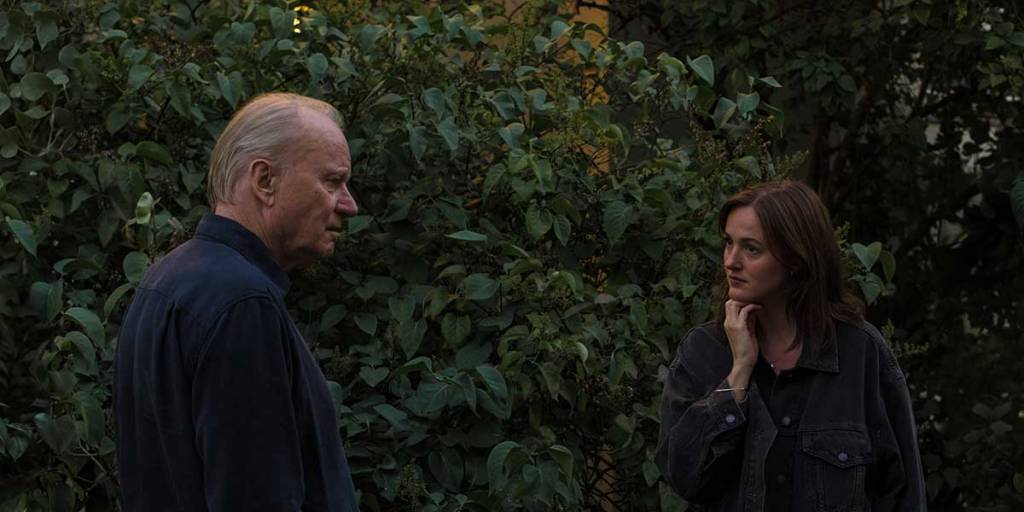
Nora Borg (Renate Reinsve) is a successful stage actress who lives in a grand old house in Oslo. It’s been in her family for generations: it’s where her grandmother killed herself, and where she grew up with her sister Agnes (Inga Ibsdotter Lilleaas) and their mom. Their dad, Gustav, (Stellan Skarsgård) disappeared after their divorce when she was still young, and they haven’t heard much from him in decades. Until now. Their mom just died and she and her sister have to deal with the house and go through all their family’s possessions (that’s the “sentimental value” of the title). And dad owns part of the house, too. But he has a second reason for showing up.
He wants to make a movie there, to use the house as his set. He’s a famous film director, but not in his prime anymore; he hasn’t shot a movie in decades. And he wants Nora in the main role of what is likely his swan song. You’re the only one who can do it, he says, just read the script! Nora refuses; bad blood runs deep. So, partly to get the funding he needs to make the picture, Gustav casts a Hollywood actress to play the role that Nora turned down. Rachel Kemp (Elle Fanning) is a big name, and she’s also a fan of Gustav’s work. What will happen to the house? Will Gustav make his film? And will they ever be on speaking terms again?
Sentimental Value is dramatic comedy about a Norwegian family. It’s full of clever asides and wide-ranging topics, but with a solid core at its centre. What makes Trier such a good director (The Worst Person in the World, Thelma, Oslo August 31st) is he creates believable characters in tough situations but without losing his sense of humour. He constantly plays around with his audience as to what is real and what is
artifice: we see Nora having a deep, emotional breakdown and then discover she’s acting a role on a stage set. He also uses biting satire to get his points across, skewering the superficiality of both Hollywood and bourgeois Norwegian society. He also repeatedly casts from a company of actors in his films. Elle Fanning and Swedish actor Stellan Skarsgård are new, but Renate Reinsve and Anders Danielsen Lie are familiar faces if you’ve ever seen Trier’s movies (and if you haven’t, you should).
Sentimental Value is moving, funny and full of good stuff to think about. I really liked this one.
The Running Man
Co-Wri/Dir: Edgar Wright
Based on a story by Steven King
It’s some point in the not-so-distant future in a dystopian America. A few rich people live luxurious lives, but the majority eke out a precarious existence within the endless sprawl of urban slums. They’re constantly surveilled by cameras, drones and DNA detectors while a brutal paramilitary police force patrols the streets. What keeps the people satisfied? Watching the reality shows and game shows broadcast from a single, big-brother-like monopoly network which controls the government, big business and media.
Ben Richards (Glen Powell) is a skilled labourer and union rep. He also has a volatile temper. He points out dangerous problems on the shop floor, which in this world gets you fired. So he’s out of work, his wife depends on tips in a hostess bar, and their 5 year old daughter is dying of an ordinary flu because they can’t afford basic medicine. What to do? There’s only one choice left: compete on THE RUNNING MAN, a reality show where all contestants try to survive for 30 days being hunted by a gang of professional killers. The winner gets a huge cash prize. And the losers pay with their lives. Luckily, the show’s producer, Dan Killian (Josh Brolin) takes a liking to Ben Richards — he’s smart, strong and most of all, angry! And the audience starts to like him… and his messages of rebellion. Can Ben outsmart the powers that be and survive? Or will the Network crush him, like they did with every Runner before him?
The Running Man is a non-stop action movie, with good
acting and an interesting plot. It’s set in the future, but done in a 1980s style, with zines, nerds and gadgets over spacemen and phasers. There are chase scenes using planes, trains and automobiles, and fiery explosions that level a city block. Glen Powell is wonderful in the lead role, appealing and heroic, painted like a Luigi Mangione fighting the corporate super-villain played by a slimy Josh Brolin. Director Edgar Wright — who brought us Toronto’s greatest Scott Pilgrim vs the Universe — keeps it funny and nerdy; he even casts Michael Cera as a nerdy revolutionary.
The Running Man is a lot of fun to watch.
Left-Handed Girl
Co-Wri/Dir: Shih-Ching Tsou
It’s Taipei’s night market, and a small family is moving into a tiny apartment nearby: I-Jing (Nina Ye) a little girl with a wild imagination, I-Ann (Shih-Yuan Ma) a diffident teenager with a chip on her shoulder, and their hardworking mom (Janel Tsai). She’s opening up a noodle stall to pay their basic rent cheque. Dad is nowhere to be seen; he ran off years ago, leaving the family high and dry. I-Jing quickly adjusts to her new kindergarten class and life in the constantly-moving marketplace. She even helps Johnny (Brando Huang) — a huckster with a heart of gold who sells carnival junk to unsuspecting shoppers — by making announcements on his loudspeaker. Mom is constantly busy, cooking and cleaning her stall, but can’t seem to earn a living. She also takes time to visit her ex-husband, now dying of cancer in hospital. Sadly he leaves his
abandoned family nothing but funeral debts and a pet meerkat. And I-Ann — who was once top of her class until she suddenly dropped out — works as a scantily-clad “betel nut beauty” selling smokes and the addictive chewing treat from her boyfriend’s shop.
But things get tense when the kids’ Mom is forced to visit their grandparents to ask for some money to tide them over. Mom’s brother is the golden boy who can do no wrong, and her two sisters both live in nice houses and are unsympathetic about her economic condition. And worst of all is grandpa, who scolds i-Jing for being left handed. He tells her left hand belongs to the devil (which she interprets as having an evil hand over which she has no control.) Now grandma is smuggling migrants through airports, mom faves eviction from the market, I-Ann missed her last period, and tiny I-Jing is turning into an avid shoplifter, using her “devil’s hand” to do the dirty work. Can this dysfunctional family ever pull itself back together?
Left-Handed Girl is a social drama about a family of women living on the brink. It’s tender, shocking and hilarious. It’s full of fast, clang-y music, flashy lights and hyper-saturated colour. It’s specifically Taiwanese in details (from bubble tea to class snobbery) but universal in its emotional appeal. And it’s co-written and edited by Sean Baker (Tangerine, The Florida Project, Red Rocket, Anora), who swept the Oscars last year with Anora. The characters speak Chinese but it’s clearly a Sean Baker movie, full of imperfect women in precarious times. And its Taiwanese-American director Shih-Ching Tsou worked on all of Baker’s films, so this is part of a long term partnership, with her taking the helm. And it’s Taiwan’s selection for best international Oscar.
I loved Left-Handed Girl, too.
Sentimental Value — opening this weekend — and Left-Handed Girl — next weekend — both played at TIFF. And The Running Man is now playing across Canada; check your local listings.
This is Daniel Garber at the Movies, each Saturday morning, on CIUT 89.5 FM and on my website culturalmining.com.
TIFF gems. Films reviewed: Girl, I Swear, Cover-Up
Hi, this is Daniel Garber at the Movies for culturalmining.com and CIUT 89.5 FM.
TIFF, Toronto’s International Film Festival is winding down after a busy week, but there is still a lot to see, including the People’s Choice awards offering free screenings of the winning films tomorrow. So this week I’m looking at three terrific movies that premiered at TIFF but aren’t getting the degree of coverage I think they deserve. There’s a coming-of-age story about a girl in Taiwan, a biopic about a man in Scotland, and a documentary about a legendary American journalist.
Girl
Wri/Dir: Shu Qi
Lin Xiaoli (Bai Xiao-Ying) is a working class tween in middle school in Taiwan. She lives with her mom, and her domineering stepdad who terrorizes her mother and her. Xiaoli hides inside a zip-up wardrobe in her bedroom as protection from his violent outbursts. He works as a mechanic in his Uncle’s garage, and usually comes home drunk to the gills. Her Mom works in a hair salon and makes artificial flowers at home to earn extra money, but takes out her anger on her much smaller daughter. Xiaoli takes care of her younger sister, who is favoured by both her parents. At school she tries to stay unnoticed to avoid more of the violence and anxiety he gets at home.
Until she meets a vivacious girl named Li Lily (Lin Pin-Tung). Lily lived in the States for a few years but now she’s back and living with her grandparents who let her do whatever she
wants. Though the too are complete opposites, Lily is helping Xiaoli climb out of her shell. And one day they cut class, wear makeup, smoke a cigarette, go to a video cafe, sing songs, and eventually meet a bunch teenaged boys riding motor scooters. But will this day change her life in a good way… or in a bad way?
Girl is a realistic coming-of- age drama set in the previous millennium (with no computers or cel phones) and full of poignant details. It’s a very moving story about parental abuse passed down through generations, but it’s also full of hope. It follows the points of view of all the main characters, not just
Xiaoli. Now, I have a rule, I avoid first films at TIFF directed by actors. Why? They’re usually crap. Vanity pics, Oscar bate, self-serving vehicles or relentless navel gazing. Shu Qi is a very famous Taiwanese actress, and Girl is her first try at directing. Luckily, it’s really good. She has acted in three movies by Hou Hsiao Hsien and Girl resembles his films in both style and content, though a totally original take. It’s rough and violent in parts, which is hard to handle in a realistic movie, but there’s lots of sweet stuff, too.
Girl is an excellent first feature.
I Swear
Wri/Dir: Kirk Jones
It’s the late 1990s. John Davidson (Scott Ellis Watson) is a popular teenager in Galashiels, Scotland He’s starting at a new school, getting friendly with a girl he fancies, and is the prized goalie on the local boys’ football team. His Dad has even arranged for a scout to the next match. But then something unexpected happens. He starts twitching in class, just a little at first, like a nervous tic. But it soon turns to rapid movements, facial contortions, and barking sounds. Followed by spitting, random punching and the uttering of the most offensive words. He gets caned by the headmaster for acting the ckown, his mother makes him eat his meals on the floor facing the fireplace. HIs father abandons his family. His onetime girlfriend slaps his face and other kids bully him at school, But none of it is intentional; he has Tourette’s syndrome.
Decades later, John (Robert Aramayo) still lives with his mother, heavily sedated, not allowed to speak with anyone for fear of an incident. A miserable existence indeed. Until he runs into an old school friend who invites him for dinner at home. He repeatedly declines — for good reason — until his friend’s mom Dottie (Maxine Peake), a psychiatric nurse
diagnosed with cancer, insist he come in for spaghetti dinner. The first thing he says to her is You’re dying of cancer, haha! before skulking away, mortified. But Dottie brushes it off as the most honest thing she’s heard in years. She invites him back, and tells him to stop apologizing for things that aren’t his fault. Eventually he moves in to try to live a normal life. But is that possible with Tourettes?
I Swear is a comedy/drama, based on a true story, about one man’s life with Tourette’s. The title refers to the profane and deeply offensive words that spew forth from his moth at the worst possible times. It’s mortifying but also excruciatingly funny, and the two actors who play him, Watson and Aramayo, exude sympathy and humour in every scene, despite their seemingly insurmountable problems. I laughed my ass off for most of this film (whenever I wasn’t crying out of sympathy). I Swear tells a heart-warming story, even as it educates — without lecturing — about Tourette’s.
I strongly recommend this feel-good movie.
Cover-Up
Wri/Dir: Laura Poitras (All The Beauty and the Bloodshed)
and Mark Obenhaus
It’s the 1960s and America is at war. Sy Hersh, a freelance reporter, hears a rumour of mass murder in Vietnam by American troops. He speaks with GIs on base and the soldiers accused of these crimes. He also got a hold of a secret military investigation the massacre. And the facts he finds are horrifying. There include synchronized sexual assaults and murders of hundreds of women, men and children, and even babies, by American soldiers. Hersh blames My Lai on General Westmoreland and others who ordered the mass killings — which happened in a number of places on the same day — solely for the purpose of raising the body count. They needed more dead bodies to prove they were winning the war. The story has major repercussions all the way to the top — Nixon and Kissinger were recorded calling Hersh a son of a bitch — and played a role in turning public sentiment away from the war. For Hersh, My Lai is the first of many crucial stories he breaks in the decades to come. He becomes the NY Times daily reporter on the Watergate scandal. He uncovers US involvement in Pinochet’s bloody coup in Chile and the assassination of
Allende; illegal CIA infiltration of anti-war groups, the secret bombing of Cambodia, the invasion of Gaza (ongoing), and the abuse and torture of Iraqis by American soldiers during the Gulf War at the infamous Abu Ghraib prison.
Cover-Up is a journalistic documentary about journalism itself. It features historical documents and period photos and film — many very disturbing — new interviews with people involved in the stories, and extended talks with Sy Hersh, who at the age of 88 is still a full-time journalist. You get to see
him see at work talking to anonymous sources and vetting incoming photos and leaks. He’s a bit prickly about protecting his sources even from the documentary makers (who take care never to reveal anyone still alive), because it’s that core of consciences bureaucrats, soldiers, and spies who still uphold the constitution and flout illegal coverups. They’re the sources who keep freedom of the press alive.
After the TIFF screening, Hersh said that American journalism is in a bad state with reporters running scared. How many important stories are being gagged or stifled now — or in the past — under White House pressure? It shows how badly we need more adversarial journalists who question the powers that be and uncover what they’re hiding.
And that’s what Cover-Up is all about.
I Swear, Girl and Cover-Up all played at TIFF and should be released over the next few months. This is Daniel Garber at the Movies, each Saturday morning, on CIUT 89.5 FM and on my website culturalmining.com.
Point of View. Films reviewed: Beyond the Infinite Two Minutes, Only The Animals, My Missing Valentine
Hi, this is Daniel Garber at the Movies for culturalmining.com and CIUT 89.5 FM.
A story can change a lot depending on who tells it. This week I’m looking at three new movies — from Japan, Taiwan and France — that retell their stories from different points of view.
There’s a woman in a French village who disappears in a blizzard; another woman, in Taipei, who wakes up to find a whole day is missing; and a guy in Tokyo who finds he can talk to himself on a video monitor… two minutes in the future.
Beyond the Infinite Two Minutes (ドロステのはてで僕ら)
Dir: Yamaguchi Junta
It’s closing time in Tokyo. Kato (Tosa Kazunari) is an ordinary young man in his twenties who runs a small cafe and is in an amateur rock band with his friends. He also has a crush on Megumi (Asakura Aki), the woman next door, who he’s never had the nerve to approach. He rents a room upstairs in a 5-storey walk-up. But everything changes when he discovers he’s not alone in his room. Someone is talking to him through his computer screen from the monitor in the cafe downstairs. What’s really weird is he’s the one talking on the screen… but from two minutes in the future.
Huh…?
He tests this by running back downstairs to the cafe and speaking into the monitor there. Sure enough, it’s him in his bedroom from two minutes in
the past. A nifty trick perhaps, but what use is it? Well for one thing, maybe he can finally ask Megumi for a date? Soon his friends from the band drop by and are mesmerized by the phenomenon. They up the ante by bringing the upstairs screen down to the cafe, facing the other monitor. Now, the images are repeated endlessly on both screens; one into the past and the other into future, two minutes at a time, revealing secrets that no one should know. Like an angry yakuza gangster who appears in the near
future wielding a sharp knife. Can they right the wrongs and reset time? Or have they permanently upset the cosmic space-time continuum?
Beyond the Infinite Two Minutes is a brilliantly-made, low-budget sci-fi comedy. It’s almost like a stage play, as the action rarely strays from the apartment and the cafe. It also manages to convey — credibly — the concept of time travel with virtually no special effects.
This movie is a lot of fun.
Only The Animals (Seules les bêtes)
Co-WriDir: Dominik Moll
Alice (Laure Calamy) is a married woman who lives in a tiny mountainous French hamlet. She makes her rounds along cliffside roads to handle insurance claims for farmers who live there. She lives with her grumpy husband Michel (Denis Menochet) but is having a torrid affair with another farmer, Joseph (Damien Bonnard), a young reclusive farmer on a downward spiral since his mother died. She sees him once a week on her rounds. But everything changes when a rich woman, who lives in a rented stone house with her husband, disappears in a blizzard.
Turns out Evelyne (Valeria Bruni Tedeschi) was having a fling with a beautiful young waitress, half her age, she met at a seaside resort. Marion (Nadia Tereszkiewicz) is in love and follows her to her country home. But now Evelyne is gone. Is she dead or merely missing? And who is responsible — Alice, Michel, Joseph, Marion, or Evelyne herself…? Or
perhaps someone else? (There’s a subplot involving a young man (Guy Roger ‘Bibisse’ N’Drin) who runs a catfish scheme out of Côte D’Ivoire.)
Only The Animals is an intriguing and actually quite moving mysterious drama about a possible murder in a picturesque mountainside village. It’s gripping and shocking, without losing sympathy for any of the characters, no matter how bizarre or tragic some of them are. The mystery is gradually revealed as each scene is retold in chapters, Rashomon-style, from the point of view of each of the main characters. And each retelling reveals more about what happened before and after the scene — even though you’ve watched it already — explaining some of the characters’ seemingly erratic behaviour. This is a very cool look at the dysfunctional lives of a group of French farmers.
Wri/Dir: Chen Yu-Hsun
Yang Hsiao-chi (Patty Lee) is a young woman in her late twenties who leads an uneventful life. Originally from a small town, she works at a boring job in a local post office in Taipei, Taiwan. She sees the same people everyday, like the weirdo who buys one stamp to mail a letter, and an irate middle aged man who complains about everything. Her only friend is a faceless late-night radio host she listens to in her tiny rented room. Until… she meets a handsome prince who promises her the world. Not a prince exactly; Liu Wen-sen (former HK fashion model and windsurfer Duncan Chow) is a dance-aerobics instructor in a local park with a day job in the blockchain industry. He’s rich, kind, generous and modest — raised an orphan he devotes his life to helping needy kids. And he likes Yang Hsiao-chi, who has never had a boyfriend before. Their big date will be on Valenitine’s day, the next day. Is this all too good to be true? Alas, she awakens the next morning to discover her new boyfriend has
disappeared, and so has Valentine’s day: it’s been completely erased. What is going on?
This is where the second point of view enters the picture. We discover there’s another man who likes Hsiao-chi. Wu Kui-Tai (Liu Kuan-ting) is a local bus driver who sees her everyday. And he’s also the guy who stands in her line to buy a single stamp at the post office. And he knows exactly what happened to her during that missing day.
My Missing Valentine is sort of a romantic comedy, a rom-com, but its plot is so off the wall that it actually qualifies as a romantic fantasy or science fiction pic. Throw in a human lizard who lives in Hsiao-chi’s closet and you’ve got one of the weirdest romances you’ve probably ever seen. It’s very cute without being gushy and very entertaining to watch.
My Missing Valentine and Beyond the Infinite Two Minutes are both playing at the Reel Asain Film Festival, which runs from November 10th-19th; Only The Animals opens this weekend in Toronto; check your local listings.
This is Daniel Garber at the Movies, each Saturday morning, on CIUT 89.5 FM and on my website, culturalmining.com
Women around the world. Films reviewed: Nina Wu, White Elephant, French Exit
Hi, this is Daniel Garber at the Movies for culturalmining.com and CIUT 89.5 FM.
Spring is here and so is Toronto’s film festival season, even with all the theatres still closed. First up is the Canadian Film Fest which is on now.
This week I’m looking at three new dramas about women around the world. There’s an actress haunted by an audition in Taipei; a high school girl crushing on a white guy in Scarborough; and an insolvent socialite retiring in Paris.
Nina Wu (Wu Kexi) is an aspiring actress in Taiwan. Originally part of a rural theatre company, she moved to Taipei to make it big, but so far, six years on her big break has yet to show itself, So when her agent offers a possible role in a festival-type feature looking for an unknown actress to play a complex character in a psychological drama, she jumps at the chance. But there’s always a catch: the part calls for full frontal nudity and explicit sex. That’s not all — there’s a gruelling, and highly competitive hiring process she has to past through first. Luckily she lands the lead role. Unluckily, the director, in order to get a “real” performance out of her, treats her like hell on set and off. He works her into a frenzy, slaps her face, insults her and puts her very life in danger. She understands what an actor has to go through to deliver a spectacular performance. But that’s not all. A dark, hidden
secret from the recent past, still haunts her, and is gradually pushing her to the edge. Someone is stalking her. She has disconnected memories of walking down endless narrow corridors in a red gown, passing identically dressed women at every corner. What is happening? What does it all mean? And can she survive?
Nina Wu is an exquisitely beautiful mystery-thriller about the life of an actress suffering from PTSD. It’s about her, her dreams and hallucinations, as well as the movie in the movie.
So at any given moment she could be acting her role, having a nightmare, or experiencing a hallucination — and you don’t always know which one it is. Nina Wu is a collaboration between the director, Midi Z, originally from the Shan State in Myanmar, and Wu Kexi a stunning and emotionally powerful Taiwanese actress, based on her own experiences. With haunting music, striking costumes and set, beautiful cinematography and a fascinating story, Nina Wu shows the dark side of the movie industry coated with a vibrant and flashy gloss.
Its the mid-nineties at a Scarborough high school. Puuja (Zaarin Bushra) is a
16-year-old Toronto-born girl who doesn’t quite fit in. She’s too Canadian for her Indian-born friends Preet and Amit (Gurleen Singh, Dulmika Kevin Hapuarachchi), too Indian for Indo-Caribbeans, and too brown for the white kids. Her main pastime is going to movies and hanging at Tim Horton’s. But when a random encounter at a theatre with a white guy she thinks is cute, things start to change. Trevor (Jesse Nasmith) doesn’t go to her school, but he’s from the neighbourhood, and hangs with his friends nearby. He seems to like her, at least as a friend. Pujaa starts lightening her hair, changing her style and wearing green-tinted contact lenses to fit in. But can a brown girl date a white guy in Scarborough? Or is their Romeo and Juliet friendship bound to fail?
White Elephant is a look at the racial division, rivalry and prejudice among kids in a multi-cultural community, as seen through the eyes of Puuja. It’s a shorter than average-film, just one hour long, but it covers a lot of ground.
There are some strange details. I’ve never heard of Canadians putting their hands on their hearts during the national anthem — that’s an Americanism. And why would Pooja’s Calcutta-born Dad scolds her for not speaking Hindi. (Wouldn’t he speak Bengali?) But these are minor quibbles. Acting was good all around, the costume design was fun, and the film gave a voice to groups rarely seen on the screen.
French Exit
Dir: Azazel Jacobs
(Based on the novel by Patrick DeWitt)
Frances (Michelle Pfeiffer) is a Park Avenue socialite known for her attitude. She can cut down the fiercest critic with a withering glance, and if snubbed by a waiter she’s apt to set her table on fire. She’s not one to be underestimated. When her husband died she withdrew her nondescript son Malcolm (Lucas Hedges) from prep school and brought him home. Eight years later, the coffers run dry, and she’s insolvent. So she sells her jewelry and paintings and pulls a “French exit” —an unannounced getaway — on an ocean liner with a satchel full of Euros. She’s accompanied by Malcolm and their cat. Malcolm is sad because his girlfriend Susan (Imogen Poots) refuses to follow him to Paris. (Oh to be young-ish and in love-ish again, says Frances.) They set up house in her best friend Joan’s pied à terre and start to enjoy life in Paris. And they soon have a motley crew of friends
dropping by: Madame Reynard, a lonely fan, Madeleine, a psychic, Julius, a private detective, and others. Frances is spreading the wealth, handing off wads of cash to everyone she meets. It’s almost as if she’s trying to use it all up before she says goodbye. But first she must find her runaway cat, whom she believes is a reincarnation of her late husband. Can Malcolm adjust to life in Paris? Will he ever see Susan again? What is the real reason Frances came to Paris? And what will happen when her money runs out?
French Exit is a leisurely-paced, whimsical story, based on a novel. Lucas Hedges as Malcolm is so low key and introverted, you can barely notice him; while Michelle Pfeiffer Frances is a fantastical creation. It feels like a modern-day version of Auntie Mame. It’s written by Canadian novelist Patrick DeWitt based on his own recent book, which gives it lots of room to develop characters and supply funny lines. It may be light and inconsequential, but it’s a pleasure to watch.
French Exit and Nina Wu both open today; and White Elephant is playing at the Canadian Film Festival.
This is Daniel Garber at the Movies, each Friday morning, on CIUT 89.5 FM and on my website, culturalmining.com
East Asia. Movies reviewed: The Assassin, Miss Hokusai, Port of Call
Hi, this is Daniel Garber at the Movies for culturalmining.com and CIUT 89.5 FM.
Toronto’s fall film festival season continues in November.
Rendezvous with Madness opens tonight, featuring films and documentaries made by or about people with mental health or addiction issues. Each screening is followed by a
panel discussion. And don’t miss the ReelAsian International Film Festival which started last night. I find movies from East Asia doubly interesting, not just for the story, acting and cinematography, but also for the cultural insights. This week, I’m looking at three Asian movies: a true crime drama set in contemporary Hong Kong, a martial arts epic set in Tang dynasty China, and Japanese anime set in 19th Century Edo.
The Assassin
Dir: Hou Hsiao-hsien
Nie Yinniang (Shu Qi) is a young woman in Tang dynasty China born into high-ranked family. As children, she and Tian Ji’an – a first cousin (Chang Chen) — are given matching disks carved from yellow jade, as a symbol of their future marriage. But destinies change. So to save her life, her mother sends the 10-year-old away to study with a Taoist nun.
But what does she study? She leaves there with a moral drive to defend the empire against all foes, both inside and at its fringes. With her long black
hair hanging down, the beautiful Nie Yinniang now dresses in black robes to remain unseen, a veritable Chinese ninja. She can handle a sword like none other. Her profession? Assassin. The kind who can take down an official on horseback in the midst of a royal retinue and disappear a second later.
But does she have the mental toughness to kill on command? She refuses to kill a target when she sees him protecting his child. The nun says “to be
a true assassin, first kill the one that victim loves, then the victim himself.” And she sends her back to her beginnings with a mission. Kill the one she loves most — Tian Ji’An!
This sounds like just another martial arts movie, and it does have some excellent sword fights, battles and chase scenes. But don’t go to this movie expecting an ordinary action film. Cause it ain’t. It’s by renowned Taiwanese director Hou Hsiao-hsien, known for his stunning visual and musical style, cultural sensitivity… and sloooow pace. Cloak and dagger politics, sumptuous costumes, stilted language, they’re all there, but without the driving music and non-stop action of most Wushu movies. This is suitable for Hou Hsiao-hsien fans, but anyone looking for a crouching tiger or a hidden dragon will search in vain.
Miss Hokusai
Dir: Hara Keiichi
Based on the manga Sarusuberi by Sugiura Hinako
O-ei is an accomplished painter in 19th century Edo (now called Tokyo), known for her scary images of hell, and erotic portraits of women. She spends her days painting in her father’s studio, or trolling the lanes of Yoshiwara, the red light district. She lives in the floating world of actors, sex workers, geisha, samurai and nouveau-riche merchants. And she visits her blind little sister, sent away by their dad who doesn’t like being near disabled people. The movie follows episodes from her life, both realistic and fantastical: painting her first
dragon (the spirit has to possess you), seeing demons, even witnessing a long-necked geisha’s out-of-body experience. And her first sexual experience with a man, an onna-gata kabuki actor, who spends his life dressed as a woman.
Based on a true story, you may be wondering how come you’ve never heard of her? The answer is simple: she lived under the shadow of one of
the most famous Japanese artists of all time, Hokusai. His ukiyo-e block prints of mount Fuji and his big blue cresting wave are still ubiquitous images when you think of Japan. He was quite the showman, creating the world’s largest brush painting of Zen Buddhist monk Daruma, using a brush bigger than he was.
Miss Hokusai is both faithful to, and a victim of, Japanese anime based on manga. It follows the winding pace and endless variations of Japanese manga, not the neat beginning/middle/end of a western graphic novel. I like its non-judgemental view of the pre-Meiji demi-monde, and it’s all-around Japaneseness. Just wish it had a more linear plot.
Port of Call
Dir: Philipp Yung
Wang Jiamei (Jessie Li) is a student at a Catholic high school in Hong Kong. Originally from Hunan on the mainland, she arrived with her ambitious divorced mom and her innocent little sister. Her dad is a layabout gambler who makes his money whenever Manchester United loses a game. She picks up the local language but can’t fit in. She feels cold and detached inside, alienated. When a girl at the next desk slits her wrist in class, she doesn’t even blink. She drops out and drifts from job to job. A modelling agency sends her to one gig – she becomes the poster girl – literally – in an ad warning about domestic violence. Prophetic.
Ting (Michael Ning) is a friendless, chubby boy whose mother was killed in
a truck accident when he was a kid. After online chatting, he had hired Kama (Jiamei’s name she uses as an escort.) But their meeting leads to a series of horrific events. And when she completely disappears her mother calls the cops to investigate. Detective Chong (Aaron Kwok) quickly determines she’s not missing, she’s dead. But her body is nowhere to be found. Until Ting walks into a police station and confesses all.
Through a series of flashbacks and courtroom testimony, the three
characters – the murderer, the relentless detective and the dead victim – all reveal their secrets, feelings, histories and surprising motivations. What starts out as a simple police procedural turns into a moving — and at times shocking – drama of a case that had Hong Kongers glued to the tabloids just a few years ago.
Port of Call is a bit long and has some truly disgusting scenes. But it captures a feeling unique to parts of Hong Kong: gritty, grimy, cramped and crowded. The great performances by two unknown actors (plus veteran singer/star Aaron Kwok), its indie soundtrack, the unmistakable images of HK cinematographer Christopher Doyle, plus a surprise ending, all place this film a step above most true crime movies.
The Assassin is playing now in Toronto at the TIFF Bell Lightbox, and you can catch Miss Hokusai and Port of Call at the ReelAsian Film Festival. This is Daniel Garber at the Movies, each Friday morning, on CIUT 89.5 FM and on my website culturalmining.com.
Sons of Women. Films reviewed: Good Men, Good Women: The Films of Hou Hsiao-hsien, The Boys from Fengkuei, Flowers of Shanghai, PLUS Seventh Son
Hi, this is Daniel Garber at the Movies for culturalmining.com and CIUT 89.5 FM.
Hou Hsiao-Hsien was born in Canton, China in 1947. His family fled to Taiwan with the Nationalists when he was just an infant. Since then he has emerged as one of postwar Taiwan’s most famous directors (along with Ang Lee and Tsai Mingliang).
His movies tell a fragmented history of his country, one story at a time. He deals with ordinary, working-class people, often dislocated and trying to make their way. His characters struggle with differences of
language, status, age, class and money. But his films also includes love, sex, jealousy, conformity and insecurity.
Most of his films take place in Taiwan, though there are some exceptions, such as Flight of the Red Balloon (France) or Café Lumière (Japan). The times range from the 19th Century (Flowers of Shanghai), to the 1940s (City of Sadness), to the present day, or even in three eras simultaneously (Three Times).
Some critics call him one of the most important and influential
directors, anywhere, comparing the style he helped pioneer – the Taiwanese New Wave — to movements like the French New Wave and Italian Neorealism. He’s known for his minimalism, slow pace, long takes and an avoidance of quick editing and obvious special effects.
More often than not, he sets up a nicely-arranged tableau and lets the action take place within that frame. Sort of like a stage play but within a shifting proscenium arch.
Well, there’s a retrospective playing this month in Toronto called Good Men, Good Women: The Films of Hou Hsiao-hsien. It was put together by Richard I. Suchenski, Amber Wu and Teresa Huang and is on a world tour. The series projects pristine prints, rarely seen.
This week I’m looking at two of Hou Hsiao-hsien’s movies. One’s an early film about good men, the other a later film about good women. And, in keeping with my commitment to highbrow/ lowbrow films, I’m also reviewing a fantasy-drama about a medieval guy who hunts for witches… but ends up falling in love with one.
The Boys from Fengkuei (1983)
Three small-town boys — Ah Ching and his two friends — live in a tiny windswept island off the coast of Taiwan. They should be doing their homework but they’d rather be outside gambling and carousing. But after a big fight goes wrong they flee to an abandoned seaside shack. They make their way to Kaohsiung, a big city on the main island. But they soon find life in the big city is not what they expected. They get poorly paid jobs, and their money making ventures – like selling tapes on the street – don’t earn them much money. Their parents expect them to return home to work at an easy factory job. And they soon find themselves victims of conmen, gangsters and sophisticated city folk. But can they find true love in the big city?
I found this movie fascinating, not just because of its realistic coming-of-age portrait of life in Taiwan. It also goes against what I thought was Hou Hsiao-hsien’s directing style: slow, stationary, and dominated by long takes of seated conversations. This movie has fights and chase scenes, crowds and a lot of movement. As programmer Richard I. Suchenski pointed out in his introductory lecture on Hou (Jan 29, 2015), The Boys of Fengkuei fits closely within his oeuvre. It shares the long takes, carefully composed scenes and the stationary, framed shots of his later films.
Flowers of Shanghai (1998)
It’s late 19th century Shanghai. Rich men hang out in the entertainment parlours, gambling, drinking, smoking opium and courting the courtesans there. These entertainers the so-called flowers of Shanghai. are known for their beauty and poise. They are carefully trained from an early age, brought up inside the houses. They have their own servants, and answer to the middle aged “auntie” the Madams who rule the business. They cultivate relationships with the rich men who visit them gradually saving up the money they earn. Eventually, they either marry their favourite boyfriend or purchase their independence outright and set up their own businesses. This line of work was one of the few allowing girls to advance from penniless orphan to rich, powerful and socially advanced woman.
The scenes alternate from the men all drinking and dining at a common table to the interiors of the individual houses and the women behind closed doors. The stories are simple: women in rival houses competing for the lovesick but fickle male patrons; discussions of their worth and wealth — both the businessmen and the women; and anger over arranged marriages and love.
In this movie the camera slowly pans back and forth but almost never cuts away from the scene in each brothel. The lighting has a golden glow, generated from the oil lamps on set (portraying scenes without electric lighting). What I found most fascinating was the language – you rarely get to hear dialogue spoken in Shanghainese – another example of Hou Hsiao-hsien’s commitment to realism. This is a beautiful film but like many if his movies, one that requires concentration and commitment to appreciate.
And on a entirely different note…
The Seventh Son
Dir: Sergei Bodrov
It’s the dark ages in Europe, a time of dragons, knights and witches. Tom (Ben Barnes) is a young man who slops the pigs at his remote family farm. There’s gotta be something better than this, he thinks. So when Gregory – an odd man with a pointy yellow beard – comes by seeking an apprentice, Tom jumps at the chance. Gregory (Jeff Bridges) is a knight and (like Tom) is the seventh son of a seventh son which gives him special powers and a sense of commitment. He’s an arrogant, foul-mouthed alcoholic. He’s also a Spook, a man who fights the creatures of darkness. He promises to teach Tom how to fight these demons and witches. Tom can’t wait. But before he leaves, his mother places a special charm around his neck
that she says will protect him from evil.
The first witch he encounters is Alice (Swedish actress Alicia Vikander) – a beautiful young woman. And when they first hold hands sparks fly… literally! A blue flame shoots out from their hands. Hmmm… But what he doesn’t know is she works as a spy for Mother Malkin (Julianne Moore). Mother Malkin is the evil queen a witch who can turn herself into a dragon. And when the red moon rises, something that happens only once a century, she and her evil cronies plan to take over the world. Will the knights beat the witches and slay the dragons? Or will Tom be slain like all the other apprentices that proceeded him? And what about Alice… is she a good witch or a bad witch?
The Seventh Son is an OK fantasy with a very predictable plot too much CGIs, very long battle scenes, and bad Twilight-style romantic element. There are at least four cliffhangers in this movie – and I mean people literally hanging onto or falling off of cliffs. I guess that’s what you get with 3D and IMAX as the main attractions. Jeff Bridges emotes wildly, Julianne Moore is wonderful as the evil queen, while Ben Barnes is a dull leading man. Most interesting thing is the sets. The women (a.k.a. the evil
witches) live in a celebration of Orientalism, replete with Persian rugs, lapis lazuli tiling, and geometric screens. They recline on pillows beside incense burners. The men all dress in rough-hewn burlap and carry rusty swords. The battle of the sexes told in 100 minutes in 3-D.
Seventh Son opens today in Toronto—check your local listings; and the films of Hou Hsiao-hsien: Good Men, Good Women continue all this month at the TIFF Bell Lightbox. Go to tiff.net for times.
This is Daniel Garber at the Movies, each Friday morning on CIUT 89.5 FM and on my website, culturalmining.com


leave a comment