It’s dangerous! Films reviewed: Daniela Forever, Apocalypse in the Tropics, We Were Dangerous
Hi, this is Daniel Garber at the Movies for culturalmining.com and CIUT 89.5 FM.
Guillermo del Toro, the celebrated director who splits his time between Mexico and Canada, has curated a series of classic Canadian horror movies called From Rabid to Skinamarink: Canadian Movie Madness, playing at the TIFF Lightbox this weekend. I happen to have seen everyone of them myself, and I totally agree with del Toro’s selection. You can catch Canadian gems like the feminist werewolf drama Ginger Snaps, Vincenzo Natali’s cult-hit Cube, Kyle Edward Ball’s experimental Skinamarink, and many more.
But this week, I’m looking at three new movies from abroad: a surreal fantasy from Spain, a politically documentary from Brazil, and a period drama from New Zealand.
Daniela Forever
Wri/Dir: Nacho Vigalondo
It’s present-day Madrid. Nicolas (Henry Golding: Crazy Rich Asians) is a popular DJ at the city’s hottest nightclubs. But he is thrown into a deep depression when his girlfriend, an artist named Daniela (Beatrice Grannò: The White Lotus) is killed by a negligent driver just outside his home. But things take a turn for the better when a good friend of his, Victoria (Nathalie Poza), tells him of a new, experimental drug that might be just what he needs. But it’s top secret, filled with non-disclosure clauses, and requires regular visits to the pharmaceutical labs. The scientists there tell him each pill, if taken just before bed, will produce lucid dreams, real visions where he can control the content and won’t forget about them when he wakes up. This means he can bring Daniela back to life, at least while he sleeps. But he soon discovers its limitations: he can’t dream about something he’s never seen. If he turns down an ally he’s never visited, it will be covered in unformed, writhing grey matter. Kinda creepy.
Daniela seems artificial at first, but as time progresses, she starts turning real. She even produces creative ideas and thoughts that he doesn’t remember ever experiencing in the awake world. And far from seeming etherial, his lucid dreams are now wide- screen images in living colour, while awake
time is small and drab. He can take Daniela to new places just by thinking about them and opening a door, and change the city of Madrid into something out of one of her paintings. But he soon realizes, not everything is going the way he planned. And when things from his dream world start appearing in awake time, he has to wonder what is real? Can he be in love with someone who doesn’t exist? And can she ever really love him if she’s just a figure of his imagination?
Forever Daniela is a highly- creative science fiction romance about love, death and reality. While it sounds like a Black Mirror jump-scare thriller, it actually avoids most “bad” things except for the sadness of mourning. It also has a very surprising twist at the end (no spoilers). The film is Spanish, but most of the dialogue is in English. Henry Golding (Crazy Rich Asians) is appealing as the leading man, but runs into a bit of acting trouble when he tries to do a full-fledged meltdown. The special effects are excellent, fooling around with unusual concepts like daytime light and shadows in a nighttime environment. I quite like the writer/director Nacho Vigalondo
for the way he incorporates horror movie elements within an otherwise realistic context (like his film Colossal a few years ago.) So if you’re looking for something that’s surreal and supernatural but told in a positive, though bittersweet, way, I think you’ll like Daniela Forever.
Apocalypse in the Tropics
Wri/Dir: Petra Costa
Brasilia — a capital city designed, planned and built from the ground up — was meant to be modern, secular and democratic. But after a coup-d’etat in 1964, Brazil became something other than democratic: a military dictatorship which ruled for the next two decades. So when a new, populist right-wing leader with military ties emerged in the 2010s, many Brazilians were wary of democracy falling again. But Jair Bolsonaro was different, a politician who changed his power base when he forged ties with evangelical Christians.
Apocalypse in the Tropics traces Brazilian politics over the past decade and the rise in religion within government policies. It also gives background, from the building of the capital, through the military coup, American evangelist Billy Graham, the return to democracy, and more recent developments. It uses beautiful period footage, lush music and symbolic paintings — like Hieronymus Bosch’s Garden of Earthly Delights — as a metaphoric portrayal of millenarian changes in Brazilian politics. It is narrated by the filmmaker and includes her one-on-one interviews with Bolsonaro, current President Luiz Inácio Lula da Silva, and the wildly popular televangelist, Silas Malafaia, who served as
Bolsonaro’s right-hand man. We witness Malafaia’s sermons before huge crowds — shouting his opposition to same-sex marriage, abortion rights, and feminism — as well as intimate conversations aboard his private plane. The doc also shows new footage of the beloved capital Brazilia occupied and trashed by massive demonstrators, who called for a coup after Bolsonaro’s defeat.
Apocalypse in the Tropics is a follow-up to Petra Costa’s 2019 film The Edge of Democracy with similar footage, style, and topic but concentrating this time on religion’s role in government policies. I’m not sure if this is a sequel, a reshoot or a continuation, but either way, it’s as aesthetically beautiful as it is disturbing.
We Were Dangerous
Wri/Dir Josephine Stewart-Te Whiu
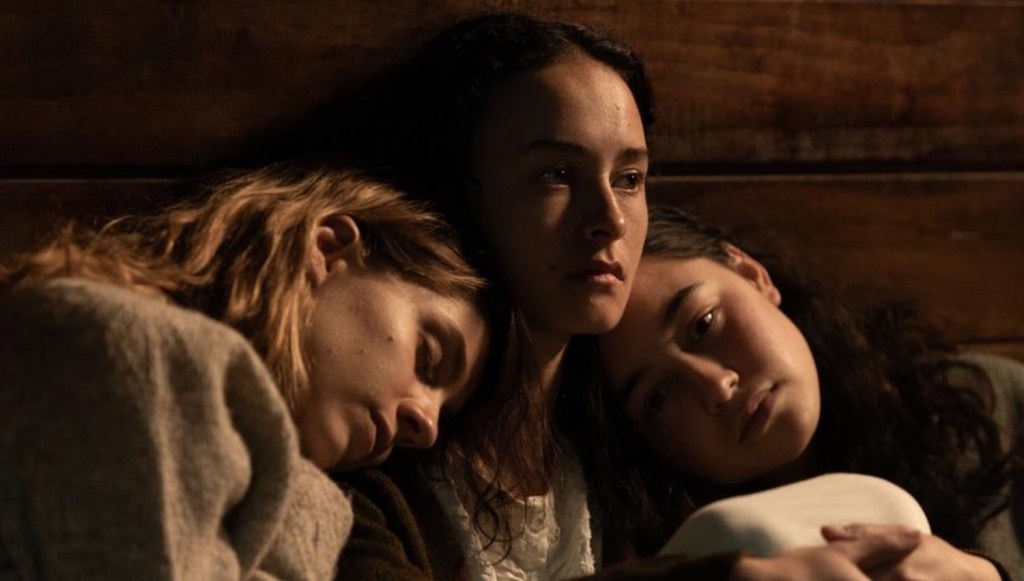
It’s the 1950s on a small island somewhere off the coast of New Zealand, where three girls share a cabin: Daisy, Nelly and Lou (Manaia Hall, Erana James, and Nathalie Morris). They were sent there by the authorities or their parents. Te Motu is a school for “incorrigible” girls or, as the administrators call them, “whores, queers, delinquents and sexual deviants.” Many are orphans or runaways caught stealing food, like Daisy or Nelly. Lou is the exception. She comes from a rich family but was caught making out with her (female) tutor. The school operates under the strict rule of Matron (Rima Te Wiata), who has a cruel streak a mile long. Raised by nuns, she feels the only way to cure these girls’ bad attitudes is through the bible and the lash. Naturally the girls all want to get the hell out of there, but it’s hard to escape from an isolated island in the south pacific. The purpose of the school is to turn bad girls into happy homemakers. They are given lessons in diction and manners but not reading or math.
Matron is frustrated by their outcome: She says they are “too stupid for school, to uncivilized to be maids and too barbaric to work”. Every so often, Matron is visited by men in suits from the mainland, one of whom suggests a horrifying treatment. But when Nelly find out, the three girls decide they have to do something to stop it.
We Were Dangerous is a moving, coming-of-age story about girls surviving in 1950s New Zealand. It’s bright and exuberant, full of playfulness and dancing, Haka and history, and though fictional, it tackles the very real issue of the mistreatment of indigenous girls. The acting is excellent all around, full of subtle clues and delightful details. For a first film, Stewart-Te Whiu avoids many potential stumbles and instead gives us a solid film that’s fun to watch. It played at ImagineNative this year, and is definitely worth seeing.
Apocalypse in the Tropics is playing this weekend at HotDocs and will be streaming on Netflix this coming week; Daniela Forever opens this weekend in Toronto; check your local listings; and We Were Dangerous is available now on VOD.
This is Daniel Garber at the Movies, each Saturday morning, on CIUT 89.5 FM and on my website culturalmining.com.
Separated. Films reviewed: I Used to be Funny, Longing, Robot Dreams
Hi, this is Daniel Garber at the Movies for culturalmining.com and CIUT 89.5 FM.
Not all love is sexual, and not all relationships lead to marriage. This week, I’m looking at three bittersweet dramas about people separated, against their will, from those they love. There’s a teenaged girl separated from her nanny (who is also a standup comic); a man separated from his biological son (who is also dead); and a dog separated from his best friend (who is also a robot).
I Used To Be Funny
Wri/Dir: Ally Pankiw
Sam (Rachel Sennott: Shiva Baby) is a standup comic in downtown Toronto. She shares an apartment with friends and fellow comics Paige and Philip (Sabrina Jalee, Caleb Hearon). But Sam can’t do her act anymore. She rarely showers, changes her clothes, or eats. She dumped her longtime boyfriend Noah (Ennis Esmer), and she quit the day job that used to pay her rent. Now she just sits around all day, staring at the wall. Why? Well, obviously she’s severely depressed. She’s also recovering from a traumatic violent event.
Things used to be better. She had a job in the suburbs as a nanny for a troubled 12-year-old named Brooke (Olga Petsa). Brooke’s mother was dying in hospital, her aunt had little free time and her dad was always busy — he’s a cop. But now Brooke has disappeared and her aunt doesn’t even know where to look for her. And when Brooke throws a rock through her window, Sam decides maybe she should join the effort to find the runaway and bring her home. But where is she hiding, why is she angry at Sam, and what will happen if she finds her?
I Used to Be Funny is a bittersweet comedy about a wise-
But it’s also Sam dealing with a not-at-all funny event — no spoilers here. It costars many Canadian comic actors, including Hoodo Hersi, Dan Beirne (The Twentieth Century, Great, Great, Great) and Jason Jones in a rare serious role. Rachel Sennott is excellent as Sam.
I Used to be Funny is a humorous look at depression and assault.
Longing
Wri/Dir: Savi Gabizon
Daniel Bloch (Richard Gere) is a successful businessman, and committed bachelor. He enjoys sex, not commitment or kids. He owns a factory and lives in a luxurious penthouse suite looking down on Manhattan. But when a when a surprise visitor arrives at his door, he is floored by her message. Rachel (Suzanne Clément) is a Canadian woman he had a fling with 20 years earlier. She reveals she was pregnant when she returned to Canada, later married and raised Allen — his biological son — with another man she married. But Allen died in an accident two weeks earlier. Daniel is floored. She hasn’t come for money or legal action, just to tell him the news. So he travels north to Hamilton, to attend a memorial and find out more about the son he never knew. And what he found was both frightening and endearing.
He talks to the people who played a key role in his son’s life, and discovers some surprising facts. He was a piano virtuoso. His best friend (Wayne Burns) says Allen was involved in a drug deal. A much younger girl (Jessica Clement) was in love with him, but says the feelings were not reciprocal. And his school teacher Alice (Diane Kruger) says he was obsessed with her and painted romantic poems about her on the school walls. What was Daniel’s son really like? And what can he do to remember someone he never knew?
Longing is a quirky, disjointed drama about kinship and death as a father desperately tries to become a belated part of his late son’s life. Richard Gere underplays his role, almost to the point of absurdity, but it somehow makes sense within the nature of his character. It’s also about the boy’s parents, not just Daniel and Rachel, but his other de facto parents And it all takes place in a very posh and elegant version of Hamilton, unlike any Hamilton I’ve ever seen. This is a strange movie that sets up lots of tension-filled revelations, but then attempts to resolve them all using an absurd ceremony.
Longing never blew me away, but it stayed interesting enough to watch.
Robot Dreams
Co-Wri/Dir: Pablo Berger
It’s the early 1980s in the East Village of NY City. There are tons of people, but they’re not people, they’re animals. Literally. Bulls and ducks, racoons and gorillas. Dog — a dog with floppy ears and a pot belly — lives there, alone in an apartment, gazing longingly out the window at happy couples cavorting in the summer sun. Dog plays pong by himself, or eats TV dinners while watching TV. He’s bored and lonely, with no one to play Pong with or just hang out. Until he orders a robot — as advertised on TV, some assembly required — and waits eagerly for it to arrive. He’s a delight with tubular arms, a mailbox shaped trunk, an elongated German helmet as a head, with round eyes and a happy smile. They are instant friends, maybe soulmates. They go rollerskating in central park, take pictures in a photo booth. Feelings grow. Another day they head out for the beach. They sunbathe and swim together — a perfect day. Until the robot finds himself rusted solid just as the beach is closing for the night. And despite Dog’s efforts, he is too heavy to drag home, so he comes back one next day to get him. But the beach is closed for the season, locked up behind a metal fence. And despite repeated tries, Dog can’t
seem to rescue Robot from his sandy prison. Can Robot survive for a year, unmoving, in the great outdoors? And will that spark between Robot and Dog still remain in the spring?
Robot Dreams is an amazing animated film about friendship and loss. It’s called Robot Dreams because much of the film takes place inside the robot’s imagination as he lay on the beach, It’s set in the grittiness of 1980s New York, with graffiti-filled subways, punks in East Village, break dancing teens and Jean-Michel Basquiat. Remember Zootopia, that animated movie where everyone is an animal? Robot Dreams is the flip side of
that, darker, cooler, adult, more Fritz the Cat than Disney or Pixar. There’s also no dialogue, but it’s anything but silent, with constant music and grunts and quick-changing gags and cultural references. But it’s also very moving — you can feel the pathos between Dog and Robot. I saw this movie cold (without reading any descriptions) and it wasn’t till afterwards that I realized it’s by Pablo Berger, the Spanish director who, more than a decade ago, made the equally amazing Blancanieves, a silent, B&W version of Snow White as a toreador. The man’s a genius.
I totally love Robot Dreams.
I Used To Be Funny, Longing and Robot Dreams all open theatrically this weekend in Toronto; check your local listings.
This is Daniel Garber at the Movies each Saturday morning on CIUT 89.5 FM and on my website culturalmining.com.
Scary? Films reviewed: The Beasts, The Last Voyage of the Demeter
Hi, this is Daniel Garber at the Movies for culturalmining.com and CIUT 89.5 FM.
August is Emancipation Month in Toronto, commemorating the end of slavery in the British commonwealth, including Canada. So in honour of that there’s a free screening of RasTa: A Soul’s Journey, at Daniels Spectrum in Regent Park on August 13th.
But this week I’m looking at two new, scary movies. There are sailors who want to abandon ship, and farmers who don’t want to leave their land.
The Beasts
Co-Wri/Dir: Rodrigo Sorogoyen
Antoine (Denis Ménochet) and Olga (Marina Foïs) are a middle aged professional couple living in Galicia in northwestern Spain. He’s a burly, reserved man, while she is direct and no-nonsense. They gave up their lives and careers to settle among the rocky hills, growing organic tomatoes and vegetables. They love the simple life, working hard, breathing the fresh air and taking long walking through the nearby forests and hills They get along well with some of their neighbours, but not all of them. And especially not Xan and Lorenzo, a pair of wiry, adult brothers who keep nomadic horses. Lorenzo (Diego Anido) may be simple-minded but is prone to cruel, practical jokes, with Antoine as the victim. Xan (Luis
Zahera) is much worse. Xan insults him, calls him a derogatory name for French people, mutters veiled threats and even spits at him.
At the centre of their dispute is a contract which Antoine and Olga refuse to sign. A multinational energy corporation wants to turn the village into a wind farm. But after all the money, time and work they have put into it, they don’t want to throw it all away for a small buyout. It’s their home. This is what makes their neighbours so angry. They want to leave their ancestral homes forever. And as their fight grows, it gradually turns to violence. What will become of them?
The Beasts is an intense, dark drama played out in a clash of cultures and class. The film starts with a group of men physically wrestling with horses in slow motion. This motif comes up later in the movie in an
unexpected way. It’s billed as a thriller, but it’s not — I’d call it more of a slow-burn drama, spread out over more than two hours. The dialogue is in French, Spanish and (I’m guessing) Galician, since it doesn’t sound like any Spanish I’ve ever heard before.
Is it a good movie? I like the characters, and the acting and the drama, and its beautiful cinematography, locations and music. But the film has a weird structure, with a very long ending after an intense chapter in the middle. It’s less thrilling or scary than it is creepy and disturbing, though it does have a satisfying finish. I just don’t quite get the point of this movie. If you like feeling uncomfortable for a couple hours but not really challenged, then you’ll probably like The Beasts.
The Last Voyage of the Demeter
Dir: André Øvredal
It’s the 1890s and the three-masted Demeter is loading at a Romanian dock, preparing for its voyage to Dover, England. Captain Eliot (Liam Cunningham) has mustered all his sailors on the ship, as well as Wojchek, his first mate (David Dastmalchian), Joseph, his bible-thumping cook (Jon Jon Briones) and his eight-year-old grandson Toby (Woody Norman). It’s the captain’s last voyage so he wants to pass on some of his lore. The only unfamiliar face is Clemens (Corey Hawkins), the ship’s doctor. Not a sailor, but he does hold a medical degree from Cambridge (very uncommon for a black man in Victorian England). But with such a small crew, even the doctor has to take his turn steering the ship and on night watch. But the most unusual thing is this ship’s cargo: a series of large wooden crates filled
with dirt and branded with a sinister-looking mark. The locals refuse even to board the ship, but the crew is happy that there’s a big cash bonus if they deliver the cargo in time.
Unfortunately, things start to go wrong pretty quickly. First, a female stowaway is found on board — and sailors considered women on ships bad luck. Anna (Aisling Franciosi) is half dead, speechless and frightened. Clemens keeps her alive with frequent blood transfusions. Then all the ship’s animals — from livestock, to a dog, to even the rats hidden in the hold — are found dead. And then the crew starts disappearing, one by one. Is this a disease? A stowaway killer? Or something even worse? And will the Demeter and its crew ever reach its destination?
The Last Voyage of the Demeter is a well-crafted thriller/horror about a vampire on board a ship, based on Bram Stoker’s Dracula. And — no spoilers here — if this vampire looks familiar, it’s because he’s Nosferatu, the cadaverous, long fingered, pointy-eared creature made famous by the silent German expressionist masterpiece by FW Murnau, released a full century ago (1922). This Nosferatu can fly,
swim, hypnotize its victims and seemingly pass through walls. He’s almost indestructible. The film is beautifully shot in a German studio, with the camera flying down long passageways, into the galley, under tables and up to the sailmasts. The soundtrack is punctuated with tapping sounds that reverberate the length of the ship. The acting is quite good all around. And this vampire is a scary one.
The one thing that’s missing is pathos — with a few exceptions, you don’t feel close or attached to most of the characters. But that’s a minor problem in a good horror movie. And this one gives new life to a very old vampire.
The Last Voyage of the Demeter and the Beasts are both opening this weekend in Toronto, with The Beasts playing at the TIFF Bell Lightbox.
This is Daniel Garber at the Movies, each Saturday morning, on CIUT 89.5 FM and on my website, culturalmining.com.
Summer entertainment. Films reviewed: Three Thousand Years of Longing, Alienoid, The Good Boss
Hi, this is Daniel Garber at the Movies for culturalmining.com and CIUT 89.5 FM.
This week I’m talking about three entertaining summer movies from around the world. There’s a British academic who meets a djinn in Istanbul; an ambitious businessman forced to “weigh his options” in Spain; and some alien, time-travelling prison guards trying to catch mutant convicts in medieval Korea.
Three Thousand Years of Longing
Co-Wri/ Dir: George Miller (Based on the short story by A.S. Byatt)
Dr Alithia Binney (Tilda Swinton) is a British academic in Istanbul for a conference. She’s a narratologist, someone who studies the structure of stories and how they’re told. She’s been obsessed by stories since she was a kid, when she even had an imaginary friend. She’s still more comfortable reading than talking to other people. But these imaginary friends seem to be reappearing more often lately. A small man in a lambskin coat talks to her in the airport — but no one else sees him. And when giving a lecture a strange man in Mesopotamian garb appears in the audience. But she really
starts to worry when one of them doesn’t go away. This all started when a glass bottle she found in an Istanbul antique store let loose a gigantic genie (Idris Elba) — or Djinn as he calls himself. To no one’s — surprise since we all know this narrative structure — he grants her three wishes. But to the Djinn’s shock she says she doesn’t want anything. She’s content with what she has, and besides, these sort of stories always go wrong in the end. So the Djinn tells her his 3000-year-long story instead, and what will happen if she doesn’t use those wishes. And an amazing tale it is, with characters like Solomon and Sheba, and the sultans of Ottoman Arabia. There’s a sluggish prince locked in a fur-lined chamber with a dozen huge-breasted Rubenesque consorts. And a woman genius in the Renaissance who just wants to study. Like a story within a story, these talks are told by the
djinn as they both sit in her hotel room, dressed in white terrycloth robes and towel turbans. Is this all in her mind, or is it real? And if so, what will her wishes be?
Three Thousand Years of Longing is the retelling of stories within stories, in the style of The Thousand and One Nights, but told from a contemporary perspective. These are framed by Alithia’s own stories, and contemporary events. George Miller, of Mad Max fame, directed this, and spares no special effects — there is a mind-boggling plethora of CGIs in every scene: with non-stop, lush magical images. Idris Elba is fun as the Djinn with his pointy ears and the blue-green scales on his legs; and Tilda Swinton is great as always, this time bedecked in rose-coloured skirts, with a red pageboy haircut and academic glasses. Nothing deep here and it’s not terribly moving, but I always love a good story, well-told.
Wri/Dir: Choi Dong-hoon
It’s Korea six centuries ago, when a metal object tears through the sky, killing a woman with its tentacles. But, believe it or not, the tentacles are from the good guys, and the medieval Korean woman is actually an escaped mutant killer from another planet. You see, Guard (KIM Woo-bin) and Thunder are alien prison guards who lock the mutant prisoners inside human brains… and if they try to escape, earth’s atmosphere will kill them in a few minutes. But the humans with the alien prisoners locked inside them have no idea.
The woman they killed has a newborn baby girl, so they take her with them back to 2022 and raise her like she’s their own child (yes, little Ean has two daddies!) But they’re neither human nor mutants — Guard is a sophisticated robot and
Thunder is a computer program, but they both can take on human form. Now in 2022 things are going bad. Alien mutants have arrived on earth to free the prisoners and turn the earth’s air toxic for humans but breathable by them. And they’re winning the battle.
But back to 600 years ago, things aren’t as bad. Muruk (RYU Jun-yeol) is a young Dosa, or spell caster, who earns his living as a bounty hunter. Now he’s after something more valuable — a legendary crystal knife called the divine blade for its strange powers. He tracks it down to a wedding and impersonates the
groom to steal it. What he doesn’t know is his “bride” is also an imposter seeking the same prize. So are Madame Blue and Mr Black, veteran sorcerers who make their living selling magic trinkets, as well as some evil killers, one of which dresses like a man from 2022. Who are all these people? What’s going on here? Will the world be destroyed? And what’s the connection between then and now?
Alienoid is a Korean movie about science fiction time travel that spans all genres. It’s part action, superhero, fantasy, romance, drama, and comedy. It deftly incorporates the time-travelling robots from Terminator; HK style airborne fighting, and the funny, soapy characters of Korean historical TV dramas all pulled together in a way I’ve never quite seen before. It has a
huge budget — 33 billion won — but it’s not a superhero movie. That’s another great thing about Alienoid: unlike superheroes, all the main characters may have some special powers but they also have major flaws: they mess up a lot, lie, cheat, steal, and behave like grifters. One warning (not a spoiler) the movie finishes, but it doesn’t end, with the next sequel coming out next year. So if you’re looking for a highly entertaining two hours, you can’t go wrong with Alienoid.
Dir: Fernando León de Aranoa
Julio Blanco (Javier Bardem) is the owner of Blanco Scales, a factory in a small Spanish town — he inherited the company from his Dad. They make everything from bathroom scales to enormous steel balances that can weigh a whole cow. He knows he’s a successful businessman and a good boss by the way his smiling employees applaud him whenever he makes a speech. They’re like his children, he says beneficently, and when they have a problem, he has a problem — his door is always open to help them out. Then there’s his industry trophy wall, directly across from his marital bed, that recognizes him for his business accomplishments. There’s just one prize he hasn’t won yet, the official regional award, which could open huge doors in government contracts. He’s one of three nominees and he really wants to win it.. All he has to do is make everything run perfectly and all his employees content within one week — that’s when the inspectors are coming.
The problem is, not everything is as perfect as he imagines.
Production is weeks behind schedule, because Miralles — whom he’s known since childhood — is not paying attention. He’s too busy stalking his wife who he thinks is cheating on him. Won’t Blanco help him catch her in flagrante delecto? Jose, a laid-off employee, doesn’t want to leave; he’s camped out in front of the factory demanding to be rehired. And long-time mechanic Fortuna’s son has been arrested for assaulting strangers in the park — won’t Blanco behave like a role model and get the kid a job somewhere? And then there’s problems of his own creation: he’s flirting with a beautiful new intern, Liliana (Almudena Amor) who seems equally attracted to him. She even has the scales of Libra tattooed on her neck. Little does Blanco know, she’s the daughter of his wife’s best friend, the same one he coddled as an infant. Can he solve all his company’s problems in just one week? Or is he just digging deeper into a hole?
The Good Boss is a biting social satire dealing with class, race, and gender in contemporary Spain. Javier Bardem is terrific as the smarmy Blanco, a big fish in a small pond who loves his glassed-in office where he can lord over all the little people beneath him. A comedy, it’s full of every possible pun about scales — the blind justice statue, the Libra sign, tipping the scales… to name just a few. And though a light comedy, it looks at very dark issues with a jaundiced eye.
I enjoyed this one, too.
Three Thousand Years of Longing and Alienoid both open this weekend across North America; check your local listings; and you can catch The Good Boss now at the TIFF Bell Lightbox in Toronto.
This is Daniel Garber at the Movies, each Saturday morning, on CIUT 89.5 FM and on my website, culturalmining.com
Deliveries. Films reviewed: Dog, Parallel Mothers PLUS BTFF!
Hi, this is Daniel Garber at the Movies for culturalmining.com and CIUT 89.5 FM.
It’s Black History Month and The Toronto Black Film Festival is on now through Monday, February 21st celebrating its 10th anniversary. It’s showing — get this! — 200 movies, including features, shorts, documentaries, and more, from Canada and around the world. It features the Canadian premier of Krystin Ver Linden’s Alice, starring Common and Keke Palmer. There are also panel discussions, and if you’re an emerging black filmmaker, check out the Fabienne Colas Foundation’s Being Black in Canada program, with films geared specifically to cities like Montreal and Halifax. There’s also a special tribute to the late Sidney Poitier. That’s at the Toronto Black Film Festival – TBFF for short — all happening through Monday.
This week, I’m looking at two new movies, one from the US, the other from Spain. There’s a war vet delivering a dog, and a fashion photographer delivering her baby.
Dir: Reid Carolin, Channing Tatum
Jackson Briggs (Channing Tatum) is a vet with a dog. Nothing so unusual about that. Except he’s a veteran, not a veterinarian. And the dog isn’t his. And he’s driving it down the West coast to attend a funeral — the dog is invited, not Briggs. Huh? You see, Briggs wants to reenlist — he’s an Army Ranger. He spent the past three years in a fog of alcohol and drugs, but he’s all dried out now and ready to ship off. But his Captain isn’t so sure. So they make a deal. Briggs drives Lulu, a decommissioned army dog, to the funeral of a member of their company who recently died. Lulu was an important part of his life, so it’s only fitting she should attend his funeral. In exchange, the Captain agrees to look again at Briggs reenlisting. ![]()
Lulu, despite her name, is no French poodle. She’s a Belgian Malinois. She looks like a German Shepard but smaller with a charcoal face and pointy ears. They are specially bred for security forces and trained to defend, attack and track. And Lulu has PTSD, she goes crazy if you touch her ears, or if she hears loud noises like thunder, guns or bombs. These are fiercely loyal dogs but they have to trust their owners. And Lulu and Briggs don’t like each other, so she’s muzzled and stuffed into a tiny kennel on the back seat. Soon enough though, she has completely destroyed her plastic prison and is chewing up the carseats. Can Briggs get Lulu to the funeral in time? Or will the two of them tear each other apart first?
Dog is a nice road movie about a man and his dog, and the people they encounter on their journey. People like two beautiful women who practice tantric sex; a dangerous hippie who runs a
grow-op; a dog trainer, a psychic, and Briggs’ long-lost daughter. They wind up in a luxury hotel, in abandoned barns, a night in jail and hitchhiking in the desert. And all along the way, we have Briggs’s non-stop monologue as he talks to Lulu. Luckily, the dog and the actor are interesting and appealing enough to keep your attention with the point of view shifting back and forth between Briggs and Lulu. Dog is a low key comedy-drama, but with enough surprises, laughs — and a few sad parts — to make it a worthwhile watch.
Dir: Pedro Almodóvar
Janis (Penelope Cruz) is a high-profile photographer in her late 30s. She’s in a Madrid hospital about to give birth for the first time. There she meets a teenaged girl, also single and pregnant, named Ana (Milena Smit). She comes from a rich family — her dad’s a businessman, her mom an actress — but they are divorced and Ana is less than enthusiastic about raising a kid. Janis, on the other hand, can’t wait.
Her baby is the result of a fling with a man she photographed once, named Arturo (Israel Elejaide). He’s a forensic anthropologist who works with an organization that disinters, identifies and reburies many of the lost victims of Spain’s fascist dictator Francisco Franco. More than 100,000 people are still
missing, many killed by Franco in the Spanish civil war and afterwards. This includes Janis’s own great grandfather and others from her ancestral village. Arturo says he’ll look into her village, but he can’t promise her anything.
But back to the two mothers. After a few years, one of their babies dies, and the two bond together to raise the surviving kid. But both mothers hold deep dark secrets they have yet to reveal. Can Janis and Ana make it as a couple? What about the child?
And then there’s Arturo… and her village?
Parallel Mothers is a wonderful, tender, surprising and moving drama set in Madrid. Like all of Almadòvar’s recent movies, it has an amazing story, told in an eye-pleasing manner, from the opening line to the closing credits. They all share recognizable styles and images, as well as his troop of actors,
including Rossy de Palma, but Parallel Mothers is also a unique stand-alone film. If you’re already a fan of Almadòvar, you will love this one and if you’ve never seen his films before, this is a gapped place to start.
Dog opens theatrically in Toronto this weekend; check your local listings. Parallel Mothers is now playing at the TIFF Bell Lightbox.
This is Daniel Garber at the Movies, each Saturday morning, on CIUT 89.5 FM and on my website, culturalmining.com
Time. Films reviewed: Anthem of a Teenage Prophet, Jordan River Anderson: The Messenger, Pain and Glory
Hi, this is Daniel Garber at the Movies for culturalmining.com and CIUT 89.5 FM.
Time is malleable. This week I’m looking at three examinations of time. There’s a Spanish drama about a director reclaiming his past, a YA drama about a teen who can see the future, and a documentary about the present-day problems of indigenous, special-needs kids.
Dir: Robin Hays
It’s 1997 in small-town Stokum, Michigan. Luke (Cameron Monaghan) is a highschooler in small town. He’s into skating, music and art. He lives with his straightlaced dad and flaky mom (Juliette Lewis). He used to climb towers with the tall and wiry Fang (Grayson Gabriel) his best friend since kindergarten, but they had a falling out. Now he’s hanging with Stan, a popular B-ball jock, and Stan’s girlfriend Faith (Peyton List). But everything changes when he follows Stan to a party at Fang’s place. After lots of drinking and
smoking, Luke has a vision: Someone will be killed in the morning in a hit-and-run just outside their school. They dismiss this as a stoner daydream, but record it on video, just for fun. And sure enough, best friend Stan winds up dead, exactly as predicted.
Eyewitness news picks up the story and soon there are media trucks parked out on his front lawn. He’s stared at at school, and somehow blamed for Stan’s death. Only Faith stands up for him. Will his prophetic dreams continue and can he use it to save people from dying?
Are Faith and Luke just mourning Stan or is their something more between them? And what happened between Luke and Fang that soured their friendship, and will they ever make up?
Anthem of a Teenage Prophet is based on a popular YA novel, and holds many of its standard features: rudderless youth looking for meaning, potential love story, friendship, bullying, and prejudice; and a hint of the supernatural. And it’s set in the late 90s, a world of Thrasher, Mortal Combat, white rap and ironic T-shirts. Beautiful scenery (it was actually shot in BC) nice soundtrack and credible acting, Anthem is a good, though not great, teen movie.
Jordan River Anderson, The Messenger
Dir: Alanis Obomsawin
Norway House is a beautiful Cree community in northern Manitoba. But, due to pregnancy complications, little Jordan River Anderson was born in a Winnipeg Children’s Hospital. There he received constant attention from doctors, therapists and experts helping the boy communicate and understand what was going on around him. He was partially paralyzed, could not speak and breathed using a respirator. But he could only spend limited time with his parents and family since he needed constant care. Most special-needs kids are eventually sent from hospital to their parents home or a halfway house with caregivers
near to their family. But Jordan never left the hospital – he died there. Neither the province nor the federal government would put up the funds it required for the move, care and refurbishing.
Why? Because he’s indigenous.
Enter Cindy Blackstock, a lawyer and social worker specializing in indigenous cases. She crafts a bill, The Jordan Principle, to ensure no child would be left unfunded to to intergovernmental disputes. It is passed unanimously in the House of Commons. Jordan’s Principle says that a child of need will be cared for by the first level of governmental contacted. All is well. Sadly no. Not a single kid is helped since it’s passage. The government budgets the funds to fight Jordans
Principle in court, but not a penny more in its budget to pay for care needed for indigenous special needs kids.
Jordan River Anderson The Messenger is the sixth in a series of documentaries by Alanis Obomsawin, outlining the struggles between First Nations and the Canadian government since the founding of this country. It follows Blackstocks legal battles and the very personal stories, captured in photos and home videos, by Jordan and other indigenous families with special needs kids. This is a one-hour documentary that deals with a heartbreaking story, but one that ends on a hopeful note.
Photo of Alanis Obomsawin by Jeff Harris.
Wri/Dir: Pedro Almodovar
It’s present day Madrid. Salvador (Antonio Banderas) is a celebrated Spanish director at the peak of his career. He is looking back at his old notebooks, and letters, taking stock of his life. And he finds it miserable. His body is failing him, his creative well has gone dry. No sex, no love, no pleasure aside from swimming. But as he looks at his life two periods come back to him. As a child he lives with his mother (Penelope Cruz), who takes in laundry, and his father. They are forced to make their home in whitewashed caves, underground. But young Salvador (Asier Flores) is a precocious lad, singled out for his talent by a priest at his school. He teaches a
handsome teenaged bricklayer Eduardo (César Vicente) how to read and write. In return poses for a painting by Eduardo. Little Salvador idolizes Eduardo but doesn’t understand his feelings. With his parents now gone, what remains from his childhood?
The other period he reflects on is making his first movie in the early 1980s. It is being shown at the Cinematheque in Madrid, and they want him to appear alongside that films lead actor Alberto (Asier Etxeandia). The problem is Alberto is a heroin addict, hates Salvadors guts and they haven’t seen each other for more than thirty years, What was the scandal that led to such a long lasting grudge? Can it be mended? And who is the missing piece in that puzzle?
Pain and Glory is a fantastic and fascinating autobiographical film by Pedro Almodover. It is
ostensibly fictional, the names have been changed, but is clearly based largely on Almodovars life. It plays with time, character and genre, flashing back to early times, and repeating short scenes with subtle differences. It starts with Salvador writing a book, but somewhere, secretly turns into him crafting a film, leaving the viewer to piece it together. Lush and colorful, moving and funny, Pain and Glory is an intricate recreation of Almodovars own life andwork.
Pain and Glory starts today, and Anthem of a Teenage Prophet starts next Friday in Toronto; check your local listings; and Jordan River Anderson, The Messenger is one of many movies at ImagineNATIVE through Sunday.
This is Daniel Garber at the Movies, each Friday morning, on CIUT 89.5 FM and on my website, culturalmining.com.
Movies Made by Women. Films reviewed: What Will People Say?, Zama
Hi, this is Daniel Garber at the Movies for culturalmining.com and CIUT 89.5 FM.
Spring festival season is on right now, with two or three new ones popping up each week. There are established festivals like Hot Docs, celebrating its 25th anniversary, as well as some new ones. Reelabilities is only in its third year, but already programs a full international slate of dramas and docs – and even a comedy night — for and about people with deafness, mental illness, autism, down’s syndrome, and many others. And they’re dealing with important topics like sexuality and disabilities and disability rights. This week I’m looking at two movies directed by women and that played film festivals in Toronto (TIFF, Human Rights Watch Film Fest). There’s a coming-of-age drama about a Norwegian schoolgirl whose parents come from Pakistan, and an historical drama about a colonial Argentine whose ancestors came from Spain.
Dir: Iram Haq
Nisha (Maria Mozdah)is a high school student living in a snow-swept Oslo housing project. She has beautiful long hair, dark eyes and a shy but winning smile. Nisha is a typical Norwegian girl. She hangs with a tight-knit group of friends for partying, listening to music, texting. At night, though, she’s the grudgingly loyal daughter to her traditional Pakistani parents. She is the apple of her fathers eye. Mirza (Adil Hussein) piles money and gifts on his smart and beautiful
daughter whom he dreams of becoming a doctor or an engineer. But Her mother is more strict, always wondering what other people – meaning people from Pakistan – will say, if they see Nisha doing outrageous things like… dancing? Little does she know. she’s dating a guy named Daniel who looks like Archie Andrews. But when her dad catches them in her bedroom, flirting, all hell breaks loose.
Before she knows what’s happening she’s on a plane to Pakistan on her way to a relative’s home in a remote town. They take away her phone, burn her passport, and forbid her from using the internet. Mirza says he’s doing it for her own good, but Nisha feels betrayed, lost and abandoned. And then there’s the physical dangers. She can’t just put on a hoodie and explore the streets alone like she did in Norway. Only a young cousin who idolizes her, and Amir, a boy she likes, make her life worth living. But her eyes and tastebuds are
awakening to new sights and flavours she never encountered in cold, grey Norway. She gradually adapts to her new home…. until a big change threatens her life and her future. Will she ever regain her old life and friends? Can she achieve success as a woman? And will she and her family learn to accept each other?
What Will People Say is a great coming-of-age drama that’s a bit of a thriller, too. It gives a multi-faceted look at a teenaged girl, partly self-centred and spoiled, partly facing a miserable life not of her own making. Pakistan is portrayed as a scary and violent place but also a vibrant and beautiful one, filled with both kindness and terror. The director (herself of Pakistani/ Norwegian background) eschews what could have been a one-sided kidnapping thriller in favour of a realistic and touching drama. She avoids easy stereotypes opting instead for a nuanced and loving look.
Wri/Dir: Lucrecia Martel
It’s 300 years ago in imperial Spain in South America.
Don Diego Zama (Daniel Giménez Cacho) is a low- level magistrate decked out in a white wig and three cornered hat, with a bright reddish jacket and a shiny sword. He’s there to provide justice and compassion in disputes among the colonists, their slaves and the indigenous peoples in the remote colony of Asunción. But he soon discovers his rulings are ignored, his requests disregarded, and his status questioned. He’s far from his wife in Buenos Aires, and his native mistress in Asunción doesn’t like him much, even after she
gives birth to his son.
His life depends on the indulgences of a king in far off Spain, and a corrupt and decadent local Governor who spends most of his time gambling to win obscene tokens of power. He covets worthless geodes and decrepit ears sliced off a dead convict’s head. Colonial landholders slaughter Indios with impunity. As his life gets worse and worse, Zama feels trapped in a cesspit he can’t climb out of.
He finally gets his chance by joining a posse searching for Vicuña Porto (Matheus Nachtergaele) a villainous criminal terrorizing the locals. But his search seems equally
pointless and circuitous, achieving nothing, waiting for a Godot who may never arrive.
On his journey he faces dangers and fascinations both real and imagineary: small boys with psychic abilities, hidden ghosts and potergeists infecting his lodges. People appear and disappear, seamingly at random, dying and coming back to life, in a colourful whirlwind of unexplained phenomena.
Zama is a fantastic, non-linear adventure based on an Argentinian novel. It explores name and identity, position and class, and race and ethnicity in Colonial Spain. Indigenous languages are spoken without subtitles – we hear it all through Zama’s ears.
I’m not going to pretend I completely understood this movie, but like Embrace of the Serpent
(which I reviewed here), the images and exotic scenes in Zama are so engrossing I didn’t worry too much about the plot. Picture a group of women on a riverbank covering their naked bodies with thick brown mud. And the scenery in Argentina’s northeast Formosa province — green moss, sweeping hills, twisting rivers and impossibly tall bare tree trunks — is like seeing those Dr Seuss books I read as a kid again but in real life.
What a great movie.
Zama opens today in Toronto. check your local listings.What will people say is playing at Human Rights Watch film fest. This is Daniel Garber at the Movies, each Friday morning, on CIUT 89.5 FM and on my website, culturalmining.com.
Mark your calendars, boys and girls, because the annual Canada’s Top Ten film series starts in just a few weeks. If you’re into highly original movies, you really gotta check this out. I’ve already reviewed many of them, or interviewed them already, but there’s lots left to discover.
Cronenberg’s The Shrouds, a truly bizarre mystery about an entrepreneur who invents burial shrouds that allow you to see in real time the decaying buried body of your loved one. It stars Vincent Cassell, Diane Kruger and Guy Pearce. Or Kazik Radwanski (
brilliant Matt & Mara, with an almost totally improvised script follows old friends (Matt Johnson, Deragh Campbell) who suddenly meet each other again, opening a real can of worms. There are also short films at this festival — I can’t wait to see NFB animator
curious what Canadian actor Connor Jessup is up to now with his short film Julian and the Wind. He starred in the movies
The Seed of the Sacred Fig
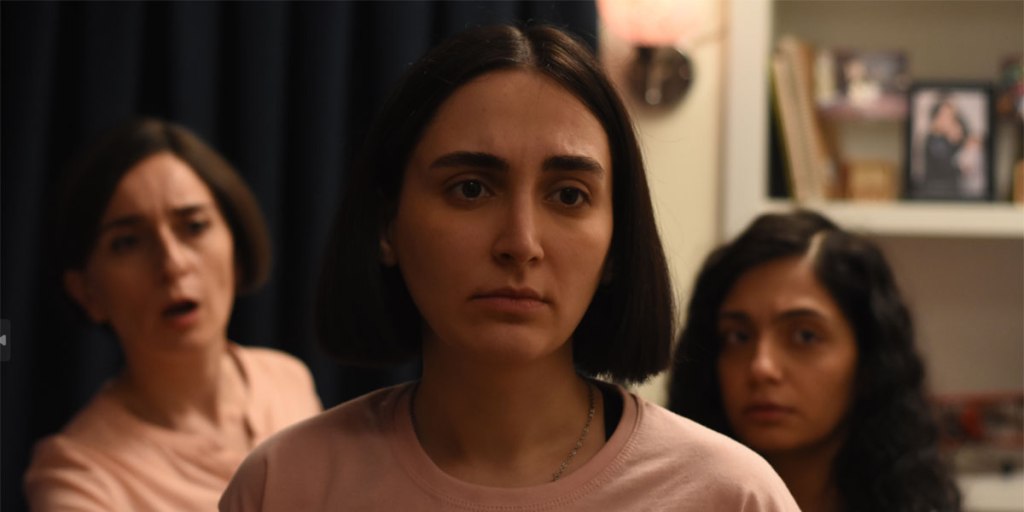
influence of an authoritarian government on all of their lives. It was shot entirely in Iran, on the sly, by noted director Mohammad Rasoulof who smuggled it out of the country. (It was edited in Germany.)
The Room Next Door
daughter). And though deathly afraid of death, Ingrid agrees. They move to a gorgeous isolated wood-and-glass
between. Instead it is subtle, soft, and gentle. And yet it still clearly is Almodovar’s work. The set design, colour palette, camerawork, the


leave a comment