Different. Films reviewed: Father Mother Sister Brother, Primate, The Choral
Hi, this is Daniel Garber at the Movies for culturalmining.com and CIUT 89.5 FM.
This week I’m looking at three very different movies from diverse genres: historical drama, suspense horror, and an arthouse tryptic. There’s a choir in England, a killer chimp in Hawaii, and three sets of adults visiting their parents in the US, France and Ireland.
Father Mother Sister Brother
Wri/Dir: Jim Jarmusch (Only Livers Left Alive, Paterson)
Jeff (Adam Driver: Ferrari, White Noise, House of Gucci, Marriage Story, The Report, Black KKKlansman, Paterson, Hungry Hearts, ) and Emily (Mayim Bialik) are on a long road trip to visit their dad (Tom Waites: The Ballad of Buster Scruggs, The Old Man & the Gun ). They’re worried about him: his health, well-being and financial status, ever since their mom — his wife — died. Maybe he needs some money? He lives in a remote wooden house beside a frozen pond, somewhere in New England. But their annual visits are always short, awkward and perfunctory. Meanwhile, in Dublin, Ireland, two sisters Lilith (Vicky Krieps: The There Musketeers, Old ) and Timothea (Cate Blanchett: Black Bag, Borderlands, Tar, Nightmare Alley, Don’t Look Up, Stateless, Truth, Blue Jasmine, Hanna,) are visiting their Mom (Charlotte Rampling: Benedetta, The Sense of an Ending, 45 Years, ) for high tea. She lives in an elegant home where they meet once a year. But the adult daughters are too busy playing pranks and hiding secrets to pay much attention to their Mom’s petits fours. And sister and brother Skye and Billy (Indya Moore, Luka Sabbat) are paying a final visit to their late parents’ long-time flat in Paris after visiting the family storage locker. Can parents ever understand their kids? Are adult children really grow up? And can family dynamics
ever evolve past childhood?
Father Mother Sister Brother is a triptych that looks at three sets of families in sequence: uptight, white-bread American sister-brothers with a cooler dad, eccentric sisters still terrified of their very chill mom, and hip Black-American sister-brothers from Paris whose much cooler parents recently died in an accident. The segments all share an unusual number of themes: Long drives, short visits, skateboarders on the street, discussions about water, whether a certain brand of wristwatch they’re wearing is real or counterfeit. So my immediate impression is it has great acting — Vicky Krieps, Tom Waits, Cate Blanchett, and Charlotte Rampling! I love Jarmusch’s distinctive style and wonderful cinematography, its visual and musical dynamics with a well-planned pace. But it’s way too repetitive to the point where it felt like an extended product-placement for Rolex. Once is cute, twice is funny, three times is just repetitive. But when I though about it some more, a week afterwards, I started to appreciate it as a baroque theme and variation, building on the original chapter but with slightly new twists each time. A slice-of-life from each family, put together to form a still life, a triptych.
Does it work? I’ll give it a qualified yes. It’s not my favourite Jim Jarmusch film, too long, too slow, too repetitive, but it does leave you with enough images to make it worth seeing.
The Choral
Dir: Nicholas Hytner
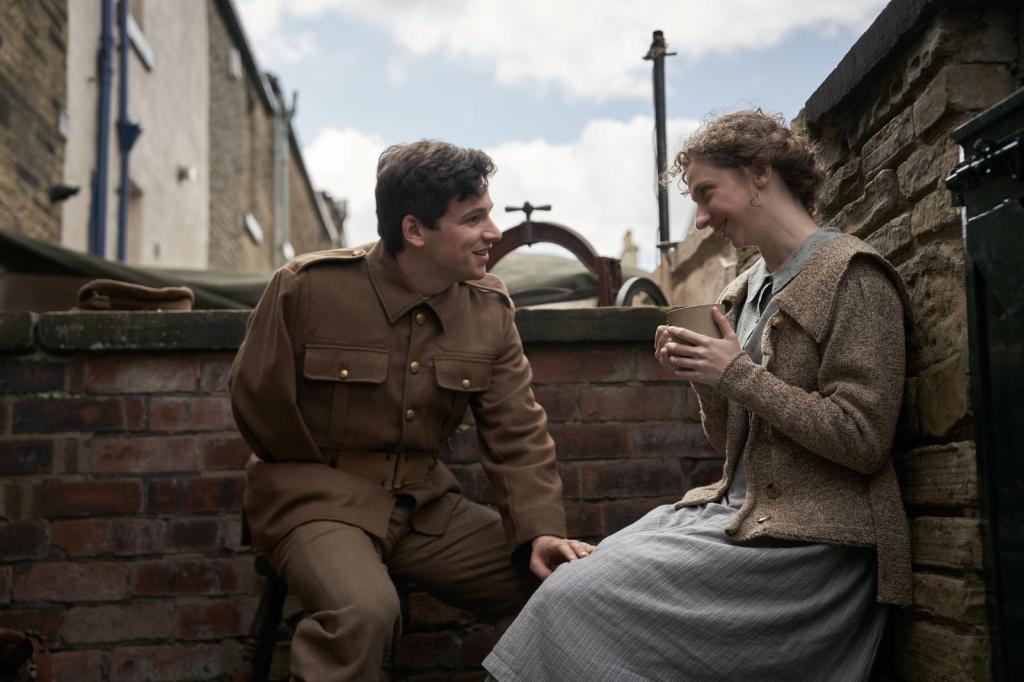
It’s a one-factory town in England during WWI. The local industrialist sponsors a chorus each year at Christmastime, there’s a noticeable dearth in participants with all the young men rushing off to join the army. Gone too is their chorus master. So they are forced to compromise and rehire someone controversial from their past, a certain Mr Guthrie (Ralph Fiennes: The Return, Conclave, A Bigger Splash). Though well- known in the music world, he carries a stain: he only recently returned from the Kaiser’s Germany, the enemy his country is fighting. The fact he had a male lover in Germany is also suspect but never spoken of. Another problem is what can they sing? All the local favourites are written by Bach, Brahms, Beethoven or Handel, Germans all. They decide to perform The Dream of Gerontius — an Oratorio by Elgar who A) is still alive, and B) still English.
Next they hold auditions and manage to find one returned soldier missing an arm, but with a angelic voice (Jacob Dudman), a young woman in the Salvation Army named Mary (Amara Okereke) whose notes are pure as the driven snow, and their benefactor — the industrialist — who sings an
adequate baritone. But can the chorus be ready in time? And what will they do when Elgar himself shows up?
The Choral is a wonderful period drama about trying to put on a show despite all the hurdles in their way. With a large ensemble cast, it follows diverse storielines and covers wide ground: local prejudices, patriotism and hatred, first sexual experiences, love, valour, passion, rejection… and the dark cloud of war hanging over it all. I love the music, the acting,
cinematography, but the movie itself is even bigger than the sum of its parts. I think we owe that to the writer, Alan Bennett, and the director Nicholas Hytner. You may be familiar with their past collaborations on stage and screen: The History Boys, The Madness of King George, and The Old Lady in the Van, to name a few. Like them the Choral is once again both grand and intimate, dealing with heavy issues but always light and clever.
I quite enjoyed this one.
Primate
Co-Wri/Dir: Johannes Roberts (Resident Evil: Welcome to Raccoon City, The Strangers: Prey at Night)
It’s another perfect day in Hawaii, and Lucy (Johnny Sequoyah) is really happy to be flying home again. Yes, she likes going to college but she also misses her family and home in Hawaii. Her late mom was a linguist who worked with apes in the style of Jane Goodall. And their dad (Troy Kotsur), is a bestselling author who was born deaf. So she and her shy little sister grew up speaking American Sign Language with their dad and another sign-and-spoken language with the chimpanzee Ben, who, though he sleeps in his own caged enclosure, is almost considered a part of their family. Coming home with her are her BFF Kate (Victoria Wyant), Kate’s brother Nick (Benjamin Cheng) who Lucy has a secret crush on, her frenemy Hannah (Jess Alexander), and a pair of himbos Hannah was hitting on aboard the plane.
And, as luck would have it, their dad is going away for a day to do some book signings, so they have the home — a multilevel glass- walled, playground with a stucco, lunar-landscape tunnel that leads to the backyard, and an Infiniti pool by the edge of a cliff — all to themselves. Which means it’s time to par-tay! They light up their pre-rolls and pop open their beers and start having fun.
But that’s when things go bad. Ben, the chimpanzee has rabies and is going ape-crazy, attacking and maybe even killing some of these college kids. Dad is far away, and all seven of them have misplaced their cel phones! Oh no! What can they do? Who will survive this murderous ape?
Primate is a suspense thriller/horror about college kids vs a
killer chimp. It’s stupid-funny and basically plotless — just how to survive this rabid monkey till someone calls 9-1-1 — but it is fun. Lots of surprises, with the ominous chimp (still dressed in brightly-coloured kids clothes) swinging from the rafters, breaking through windows and, you know, killing people.
Personally, I found the goriness unnecessary — I don’t like watching people’s faces getting torn off — but I guess gorno is part of its horror appeal. And lest you think I’m spoiling it, the movie tells you about rabies before the first line is spoken, and Ben peels the skin off someone’s face in the first five minutes, so I’m not telling you anything they didn’t already want you to know.
Yes, it’s super-simplistic, and breaks down logically very quickly, but as a movie, it pushes all the right buttons.
Primate, The Choral and Father Mother Sister Brother all open in Toronto this weekend; check your local listings.
This is Daniel Garber at the Movies, each Saturday morning, on CIUT 89.5 FM and on my website culturalmining.com.
Commitment. Movies reviewed: Jimmy’s Hall, The Tribe, PLUS It Comes in Waves
Hi, this is Daniel Garber at the Movies for culturalmining.com and CIUT 89.5 FM.
Most forms of entertainment ask for little commitment from their viewers: just sit there and take it all in. But sometimes they demand a little bit more.
I just saw a production — a combination of theatrical drama,
music, modern dance and exercise — called It Comes in Waves (Jordan Tannahill, bluemouth inc., and Necessary Angel). The audience actually rows canoes to a remote part of Toronto Island, in a Heart of Darkness journey past wild egrets and tame swans. Once there, expect to catch a trumpet
and snare drum drifting past in a rowboat, Naked Guy running across a field, voices singing in the woods, campfires, Celtic dances and a Waiting for Godot-style surprise party (where the audience — us — are the guests). You walk down the beach carrying lanterns as an ethereal angel dances half a mile away. It’s a play that completely eliminates the proscenium arch, and it’s like nothing you’ve ever seen before.
But what about movies? This week I’m looking at two films that require if not participation, at least commitment. There’s a historical political drama from Ireland that stimulates intellectual rigour, and a crime drama from the Ukraine that activates creative vigour.
Jimmy’s Hall
Dir: Ken Loach
James Gralton (Barry Ward) witnessed the roaring twenties in NY. 10 years later, it’s the Great Depression and he’s back home in County Leitrim, Ireland. He’s there to take care of his aging mother (Aileen Henry). He’s keeping a low profile, having been kicked out after the Irish Civil War. He’s back to work digging up peat. But no sooner does he get there than he sees kids from the town dancing the jig on a country road. Is this a local custom? No. They just have nowhere else to go. A decade earlier he had built and opened a community centre on his land, where people would sing songs, write poetry, draw, study literature, dance to jazz music, practice boxing… but the hall was closed and he was kicked out.
Now that he’s back, he’s surrounded by locals imploring him to
reopen Jimmy’s Hall, a place where they can enjoy life. Is there anyone, anywhere who could oppose such a thing? You bet there is. Father Sheridan (Jim Norton) the top local priest. If it isn’t run by the church, it is, by definition, no good. “He’s a communist and plays jungle music!” says the good Father.
And a high-ranked official also loathes Jimmy for his left-wing politics. His daughter, though, can’t wait to join the club. And
Jimmy’s lost love Oonagh (Simone Kirby) is glad to see him back
But local incidents can lead to national repercussions. With Catholic and Protestant labourers striking together in Belfast the Powers That Be feared what James Gralton might inspire. As tensions escalate, who will triumph? Father Sheridan and his supporters? Or Jimmy?
Based on a true story, Jimmy’s Hall is a typical Ken Loach movie. Its politics are decidedly left-wing, but the characters and the ideologies they espouse are never cut-and-dry. For every right-wing Father Sheridan, there’s a younger priest urging compromise. And like Loach’s other historical dramas (The Wind that Shakes the Barley, Land and Freedom), it has scenes with long — though never boring — political discussions. Not for everyone, but I liked this film a lot. Well-acted and nicely shot, it filled in a period of Irish history — leftist politics in the 1930s — that I knew nothing about.
The Tribe (Plemya)
Dir: Miroslav Slaboshpitsky
It’s present-day Ukraine. A nondescript kid named Sergey (Grigory Fesenko) arrives at his new home, a boarding school for deaf kids. It’s a typical school, the classrooms and dorms flavoured by drab Soviet austerity.
Sergey is honest, polite and naïve. And he suffers like any newbie: he’s at the bottom of every possible totem pole at the school. Even a boy with Down Syndrome nonchalantly steals his lunch. Almost immediately, he’s guided by a weasely fast-talker to meet his new boss, a no-nonsense older student. Higher-ranked bullies confiscate his money, and he’s put right
to work.
He’s thrown out of bed on his first night and sent out to a truck stop along with two young women from the school. Anna (Yana Novikova) is a flirty, pale blond, her dark haired coworker is bigger and bossier. They ply their trade by knocking on parked truck windows, and Sergey pimps them out and collects the money. This is just part of a complex criminal gang operating out of the school.
They sneak out at night to mug pensioners and steal their groceries. They also send young kids to ply ugly little plush toys on commuter trains, a front for unlawful behavior. They’re looking for charity donations but are just as willing to beat up reluctant donors.
His status begins to rise when he fends off four guys in a no-rules fight. He becomes a tough enforcer: he shakes down little kids for their pocket change. Literally! He holds them upside-down by their feet until their money falls out of their pockets.
Eventually he hooks up with Anna in a paid encounter, and they become a couple. But her main goal is to get the hell out of there with an exit visa to Western Europe. And as he becomes more experienced his personality is transformed.Will the moral Sergey ever come back to the surface?
The Tribe is a fantastic movie. And – get this — all dialogue is
in sign language – with not a word spoken in the entire movie… and no subtitles either. But it’s completely clear what they are saying. The actors are all hearing-impaired and express themselves beautifully. Each scene is shot in a single take, with one camera constantly moving down halls, around corners, and into rooms. Explicit sex scenes, violent fights… everything happens right in your face.
The Tribe and Jimmy’s Hall open today in Toronto; check your local listings. It Comes in Waves is now playing as part of Panamania, the cultural side of the Pan Am games. For more information go to toronto2015.org/panamania.
This is Daniel Garber at the Movies, each Friday morning, on CIUT 89.5 FM and on my website, culturalmining.com.
leave a comment