Dangerous, exotic. Films reviewed: Sinners, Yadang: the Snitch, The Legend of the Ochi

Posted in 1930s, Action, Adventure, Black, Crime, Fantasy, History, Korea, Mississippi, Romania, Thriller, Vampires by CulturalMining.com on April 26, 2025

Hi, this is Daniel Garber at the Movies for culturalmining.com and CIUT 89.5 FM.

Hotdocs International Documentary Film festival is on now in Toronto, with free daytime admission for students and seniors. So get out there and watch some docs!

But this week I’m looking at three new movies about unexpected dangers in exotic locales. There are vampires in the Mississippi Delta, snitches in the drug wars of South Korea, and elusive, sharp-toothed creatures on an island in Carpathia.

Sinners

Wri/Dir: Ryan Coogler

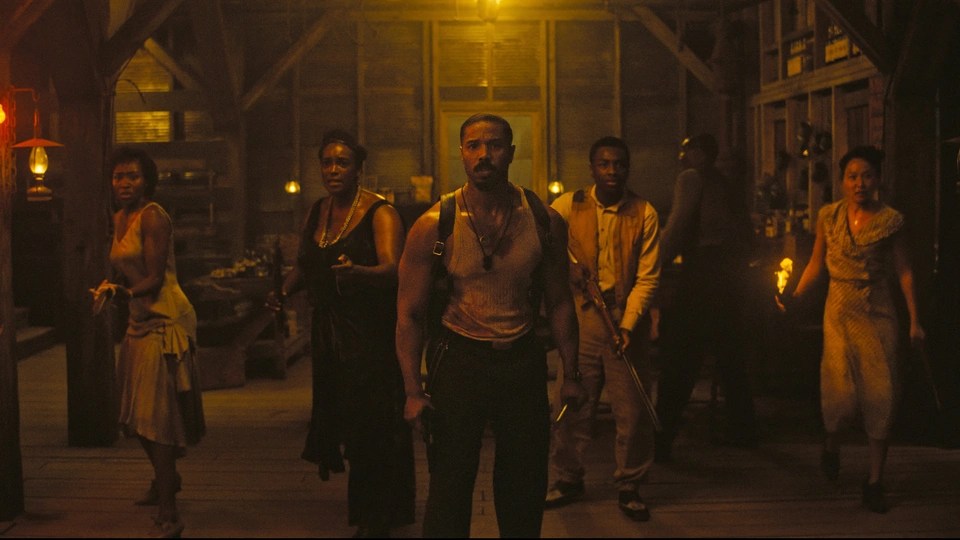
It’s 1932 in a small town in the Mississippi Delta. The Smokestack brothers aka Smoke and Stack (Michael B Jordan: The Fantastic Four, Chronicle) are identical twin who spent years making money working for the mob in Chicago. Now they’re back in town with a truck full of bootleg alcohol, a wad of cash and big ideas on how to make it rich. Namely, they’re opening a juke joint in an abandoned woodmill they bought from a local good ol’ boy. They’re rounding up the necessary musicians, like their cousin Sammie (Miles Caton), the preacher’s son, on blues guitar and Delta Slim (Delroy Lindo) on the piano and mouth organ.  Bo and Grace Chow furnish the provisions and Cornbread minds the door. Even Smoke’s and Stack’s ex-partners show up: Mary (Hailee Steinfeld) a glamorous married woman who can pass for white, and Annie (Wunmi Mosaku) an experienced practitioner of Hoodoo. By sunset the place is hopping, the customers are drinking and gambling,  everything is going great, until… a mysterious, smiling stranger who loves Irish music (Jack O’Connell; Seberg, Unbroken, ’71, Starred Up ) appears at the door asking to be let in.  They don’t know who he is but he just looks shifty.  Turns out he’s a vampire who wants all their blood — not to wipe them out, just to turn everyone over to the dark side. But can the people on the inside keep the demons on the outside until the sun comes up in the morning?

The Sinners is a black history drama about life in the Jim Crow south in the 1930s combined with the action and horror of a conventional genre movie, that succeeds on both fronts. It’s rich in meticulous historical detail in the background: sharecroppers picking cotton in the same fields as their grandparents had as slaves, paid in company scrip not dollars; chain gangs on the highway; and the omnipresent KKK.

All this is counterposed with raunchy dialogue and the sexualized dancing and singing of the juke joint. Every character has a backstory, devoid of cookie-cutter cliches. The costumes, scenery and especially the music — from delta blues to Irish folk songs — evoke that period in a way only a movie can. The acting is superb, though I do wish Michael B Jordan made Smoke and Stack a little less identical. The vampires are more conventional. They still hate garlic, sunlight and stakes through the heart but interestingly these demons lose also racial prejudice once they become vampires. Put this all together and you end up with this amazing movie that’s multifaceted, educational and really fun to watch.

Yadang: The Snitch 

Dir: Hwang Byeong-gug

It’s present-day Korea. Lee Kang-su (Kang Ha-neul) is a self-confident young man with a perpetual grin. Why does he swagger and show off his gold lighter? It’s because he’s always two steps ahead of anyone else. He’s a yadang, an informant, and plays a crucial role in the government’s war on drugs. But things weren’t always this way. He was incarcerated after being falsely accused of drug dealing, where he was beaten up and bullied on a daily basis. Until Ku Gwan-hee (Yoo Hai-jin) an ambitious prosecutor pulled him out of that world to be his personal  Yadang. Now the two of them are pledged as eternal brothers, functioning like a well-oiled machine, pulling off repeated sting operations and arrests of drug kingpins and thugs across the country. Much to the chagrin of a police detective trying to arrest those same criminals. So Det. Oh Sang-jae (Park Hae-joon) a.k.a. the Jade Emperor of Narcotics Division, finds a Yadang of his own, a rising young actress (Chae Won-been) who is caught using illegal amphetamines as diet pills. Now the lines are drawn and the two sides — the prosecutors and the police — are in direct competition. But the Prosecutor, in his rapid rise to the top, has to make some uncomfortable political alliances, including a rich junkie named Cho Hoon, whose dad just happens to be running for President. Will Cho-hoon’s influence on the Prosecutors rise in power threaten the Yadang’s status and the delicate balance of that world?  

Yadang: the Snitch is a Korean action-thriller about crime, corruption, and the complex relationships among politicians, police and informants in the world of organized drug-crime. Fast moving and compelling, it maintains a frenetic pace throughout the film, with some flashbacks that last only a few seconds. It’s dizzying. It’s also quite violent, sometimes disturbingly so. Luckily, it has interesting characters and a clever plot with enough double- and triple-crosses to keep you guessing until the very end.

Yadang: The Snitch is an entertaining action flic. 

The Legend of Ochi

Wri/Dir: Isaiah Saxon

Yuri (Helena Zengel) is a teenaged girl who lives with her dad and adopted brother, Petro. She likes reading library books and listening to loud music. Her farm is on a mountainous island in the Black Sea, off the coast of Romania, and though it’s decades since the fall of Ceausescu, people there still drive Ladas and keep to the old ways. Above all, they fear the Ochi, mythical beasts unique to their island who live in trees, attack sheep and kidnap children. Her Dad (Willem Dafoe) lives in constant fear of the Ochi. He leads a ragtag army of children to capture and kill the monsters… though they have never been successful. Her step-brother Petro (Finn Wolfhard) is a member too, though her rarely speaks. Yuri, on the other hand, is angry at her father and wonders why her mother  (Emily Watson) abandoned her. (It’s the Ochi! says her dad.)

One day, when her father sends her out to do her rounds, she finds a small ochi with its paw caught in an animal trap. She frees him and takes him home in her knapsack. He looks like a blue-faced koala until he bares his teeth revealing long pointed fangs.  But Yuri is not afraid, she nurses him back to health and eventually the two form an unexpected bond. But can she get him back to his homeland without her father finding out?

The Legend of Ochi is a highly-original adventure story about a young girl and the creature she befriends. It’s warm and delightful. While on the surface it’s a kids’ movie, the sumptuous, painted scenery and retro feel makes it an instant cult classic. (Think ET, and Charlie and the Chocolate Factory.) It’s full of panpipes and medieval crusaders overladen with Soviet kitsch. Even the odd faces of the kids in the army are straight out of Dr Seuss. I’ve never heard of director Isaiah Saxon before, but I get the impression he’s been doodling pictures of Ochis since he was a little kid. And they are amazing: not cheap-ass CGI, but a  combination of puppetry and animatronics that make them seem totally real in their own fantastical way.

I love this movie.

The Legend of the Ochi, Yadang: The Snitch and The Sinners all open this weekend in Toronto; check your local listings. This is Daniel Garber at the Movies, each Saturday morning, on CIUT 89.5 FM and on my website culturalmining.com.

Some gems at #TIFF23. Films reviewed: The Movie Teller, Do Not Expect Too Much From the End of the World, The Promised Land

Posted in 1700s, 1960s, Chile, Class, Denmark, Family, History, Romania, Rural, Satire, Social Networks by CulturalMining.com on September 16, 2023

Hi, this is Daniel Garber at the Movies for culturalmining.com and CIUT 89.5 FM.

TIFF is coming to an end this weekend, but plenty of movies still playing, with free screenings of Peoples Choice winners, including the Midnight Madness and Platform series. But this week I’m talking about three gems that played the festival, from Chile, Romania and Denmark. There’s a performer in the Pampas, a driver in Romania and a would-be farmer in Jutland.

The Movie Teller

Dir: Lone Scherfig (An Education, The Riot Club, One Day, The Kindness of Strangers)

Based on the Chilean novel by Hernán Rivera Letelier

Maria Margarita and her three brothers Minto, Mauricio and Marcelino, live in a remote company- town in the Pampas where they mine saltpeter. Her mother is a beauty, obsessed with radio soap operas, her father a gruff man with a big moustache. Their biggest source of pleasure is their weekly trip to the local cinema. But when their dad is badly injured  — but not killed — in a work accident, they are suddenly without income. And their father, now in a wheelchair, can’t go to the movies anymore.

So the four kids decide to take the movies to him, by describing what they saw. The three brothers were not very interesting but Maria Margarita blew them all the way with her renditions — the love scenes, the fights, the commentaries all perfectly reproduced.  Soon word spreads and everyone in town wants to watch her perform. But will it solve their deeper problems?  And can it bring their mother home again (she abandoned her family once her husband was injured)?

The Movie Teller is a magnificent, romantic coming-of-age story (each of the four kids are played by three different actors as they grow up). The main events of their lives — like Maria Margarita’s fight with with a dust devil, or her first date with the son of the union organizer — are played out against historical events in Chile, culminating in the US-backed coup that killed Allende and brought dictator Pinochet to power. (You can guess what year it is by the movies they’re seeing). Though a bittersweet story, it feels like a classic drama. Despite the fact they’re in the middle of a desert the film is rich, lush and colourful. And it’s filled with quirky, endearing — or hateable — characters. Danish director Lone Scherfig makes a movie about movies in a cinematic style. 

Wonderful.

Do Not Expect Too Much From the End of the World

Dir: Radu Jude (Bad Luck Banging or Loony Porn)

Angela (Ilinca Manolache) is an overworked PA working for a low-rent film studio in Bucharest. She has bleached-blonde hair and wears a dress covered in metallic sequins. She spends long hours driving across the city on minor assignments. Her latest? To interview people who were badly injured while working at a foreign-owned furniture factor. She sees people missing fingers, paralyzed, or in wheelchairs. But this is not an expose; the company wants this for a promotional campaign telling people to wear their helmets… though most of them weren’t injured on their heads.

Everywhere she goes, she pulls out her smart phone and records a short video she posts on Instagram or TikTok swapping her face with a cartoonish version of Andrew Tate’s. She calls her persona Bobito, who spouts a series of bawdy,  obscene, misogynistic, and  reactionary punchlines, told in the most offensive way possible. Later she picks up marketing exec Doris Goethe (Nina Hoss) from the Austrian furniture company they’re making the film for. Will Angela survive another gruelling day? Or will tiredness turn to a fatal traffic accident?

Do Not Expect Too Much From the End of the World is a biting satirical film about contemporary Romania. It mocks pop culture, government censorship, corporate greed, in a way sure to offend almost everybody. Thereme, Deloitte, KFC, Ukraine, Orban, Putin, Germans, American gun culture,  nothing is off limits. This is an avant-garde film, not a conventional one, with very long takes — as long as half an hour — with no cuts. The scenes in her car are grainy black and white, while other scenes are brightly coloured. There are also clips from a 1981 Romanian movie about a female cab driver in Bucharest and the macho Transylvanian man she meets (the same actors appear in this film 40 years later.) And what Radu Jude film would be complete without a a seemingly endless montage of photos, almost like a slide show?

I think this film is brilliant, just like his previous one, but much easier on the eyes. If you’re OK with political satire and unconventional cinema, you should check this one out. 

The Promised Land (Bastarden)

Co-Wri/Dir: Nikolaj Arcel

It’s Jutland in Denmark in the 18th century. Captain Ludvig Kahlen (Mads Mikkelsen) is trying to start a farm in an expanse of inhospitable heath land. He wants to make his fortune, live in a mansion, and be knighted by the king. He’s the illegitimate son of a nobleman and his maid, who served 25 years in the German army, but left with only a meagre pension. He has Royal permission to start a farm there  — many have tried, none have succeeded — but faces unexpected obstacles. First, there are few people who want to work there. He ends up hiring a husband and his wife, Ann Barbara  (Amanda Collin), fleeing servitude in a manor house at the hands of a noble. He was cruelly tortured, she was sexually assaulted.

Then there’s the noble, Frederik de Schinkel (Simon Bennebjerg) a snotty young man, who craves absolute power over all of Jutland. Just by existing on the land, Kahlen challenges his authority, and de Schinkel goes out of his way to stop him. It also doesn’t help that his beautiful cousin Edel doesn’t want to marry him — she only has eyes for Kahlen. Then there are the vagabonds who live in the woods attacking any passing visitors. That’s where he meets a foul-mouthed little girl named Anmai Mus (Hagberg Melina), who the thieves use as a lure. After much squabbling, and dramatic happenings, he, Ann Barbara and Anmai Mus form a makeshift family to face the elements as they attempt to produce  the first crop ever grown on that land. Will he succeed or fail?

The Promised Land is an epic and novelistic historical drama, about a stubborn and driven man looking to fulfill his big dreams. It’s full of sneak attacks, and revenge plots. Mads Mikkelsen is marvellous as Kahlen, a man who risks his life for the sake of a title or rank, at the expense of the people he really cares about. The large cast is terrific (I mentioned only a few of the Dickensian characters) and the cinematography is panoramic.

This is a fantastic movie.

The Movie Teller, Do Not Expect Too Much From the End of the World, and The Promised Land all played at #TIFF23, which runs through tomorrow. Go to tiff.net for details.

This is Daniel Garber at the Movies, each Saturday morning, on CIUT 89.5 FM and on my website, culturalmining.com.

Scary? Films reviewed: The Beasts, The Last Voyage of the Demeter

Posted in Clash of Cultures, Class, Farming, France, Horror, Romania, Rural, Spain, Supernatural, Thriller, Vampires by CulturalMining.com on August 12, 2023

Hi, this is Daniel Garber at the Movies for culturalmining.com and CIUT 89.5 FM.

August is Emancipation Month in Toronto, commemorating the end of slavery in the British commonwealth, including Canada. So in honour of that there’s a free screening of RasTa: A Soul’s Journey, at Daniels Spectrum in Regent Park on August 13th.

But this week I’m looking at two new, scary movies. There are sailors who want to abandon ship, and farmers who don’t want to leave their land.

The Beasts

Co-Wri/Dir: Rodrigo Sorogoyen

Antoine (Denis Ménochet) and Olga (Marina Foïs) are a middle aged professional couple living in Galicia in northwestern Spain.  He’s a burly, reserved man, while she is direct and no-nonsense. They gave up their lives and careers to settle among the rocky hills, growing organic tomatoes and vegetables. They love the simple life, working hard, breathing the fresh air and taking long walking through the nearby forests and hills They get along well with some of their neighbours, but not all of them. And especially not Xan and Lorenzo, a pair of wiry, adult brothers who keep nomadic horses. Lorenzo (Diego Anido) may be simple-minded but is prone to cruel, practical jokes, with Antoine as the victim. Xan (Luis Zahera) is much worse. Xan insults him, calls him a derogatory name for French people, mutters veiled threats and even spits at him. 

At the centre of their dispute is a contract which Antoine and Olga refuse to sign. A multinational energy corporation wants to turn the village into a wind farm.  But after all the money, time and work they have put into it, they don’t want to throw it all away for a small buyout. It’s their home. This is what makes their neighbours so angry. They want to leave their ancestral homes forever. And as their fight grows, it gradually turns to violence. What will become of them?

The Beasts is an intense, dark drama played out in a clash of cultures and class. The film starts with a group of men physically wrestling with horses in slow motion. This motif comes up later in the movie in an unexpected way. It’s billed as a thriller, but it’s not — I’d call it more of a slow-burn drama, spread out over more than two hours. The dialogue is in French, Spanish and (I’m guessing) Galician, since it doesn’t sound  like any Spanish I’ve ever heard before. 

Is it a good movie? I like the characters, and the acting and the drama, and its beautiful cinematography, locations and music. But the film has a weird structure, with a very long ending after an intense chapter in the middle. It’s less thrilling or scary than it is creepy and disturbing, though it does have a satisfying finish. I just don’t quite get the point of this movie. If you like feeling uncomfortable for a couple hours but not really challenged, then you’ll probably like The Beasts.

The Last Voyage of the Demeter

Dir: André Øvredal

It’s the 1890s and the three-masted Demeter is loading at a Romanian dock, preparing for its voyage to Dover, England. Captain Eliot (Liam Cunningham) has mustered all his sailors on the ship, as well as Wojchek, his first mate (David Dastmalchian), Joseph, his bible-thumping cook (Jon Jon Briones) and his eight-year-old grandson Toby (Woody Norman). It’s the captain’s last voyage so he wants to pass on some of his lore. The only unfamiliar face is Clemens (Corey Hawkins), the ship’s doctor. Not a sailor, but he does hold a medical degree from Cambridge (very uncommon for a black man in Victorian England). But with such a small crew, even the doctor has to take his turn steering the ship and on night watch. But the most unusual thing is this ship’s cargo: a series of large wooden crates filled with dirt and branded with a sinister-looking mark. The locals refuse even to board the ship, but the crew is happy that there’s a big cash bonus if they deliver the cargo in time.

Unfortunately, things start to go wrong pretty quickly. First, a female stowaway is found on board — and sailors considered women on ships bad luck. Anna (Aisling Franciosi) is half dead, speechless and frightened. Clemens keeps her alive with frequent blood transfusions. Then all the ship’s animals — from livestock, to a dog, to even the rats hidden in the hold — are found dead. And then the crew starts disappearing, one by one. Is this a disease? A stowaway killer? Or something even worse? And will the Demeter and its crew ever reach its destination?

The Last Voyage of the Demeter is a well-crafted thriller/horror about a vampire on board a ship, based on Bram Stoker’s Dracula. And — no spoilers here — if this vampire looks familiar, it’s because he’s Nosferatu, the cadaverous, long fingered, pointy-eared  creature made famous by the silent German expressionist masterpiece by FW Murnau, released a full century ago (1922). This Nosferatu can fly, swim, hypnotize its victims and seemingly pass through walls. He’s almost indestructible. The film is beautifully shot in a German studio, with the camera flying down long passageways, into the galley, under tables and up to the sailmasts. The soundtrack is punctuated with tapping sounds that reverberate the length of the ship. The acting is quite good all around. And this vampire is a scary one.

The one thing that’s missing is pathos — with a few exceptions, you don’t feel close or attached to most of the characters. But that’s a minor problem in a good horror movie. And this one gives new life to a very old vampire.

The Last Voyage of the Demeter and the Beasts are both opening this weekend in Toronto, with The Beasts playing at the TIFF Bell Lightbox.

This is Daniel Garber at the Movies, each Saturday morning, on CIUT 89.5 FM and on my website, culturalmining.com.


60s, 70s, 80s. Films reviewed: Cocaine Bear, Jesus Revolution, Metronom

Posted in 1960s, 1970s, 1980s, Animals, Christianity, comedy, Coming of Age, Communism, drugs, Georgia, High School, Hippies, Religion, Romance, Romania by CulturalMining.com on February 25, 2023

Hi, this is Daniel Garber at the Movies for culturalmining.com and CIUT 89.5 FM.

This week, I’m looking at three new movies. There are spiritual revolutionaries in California in the 1960s, teenaged dissidents in Bucharest in the 1970s, and a crazed animal in Georgia in the 1980s.

Cocaine Bear

Dir: Elizabeth Banks

It looks like a typical day in 1985 in the Chattahoochee National Forest in Georgia. Two little kids are playing hooky, three skateboard-riding teenage delinquents are looking for some petty crime to commit, a pair of Scandinavian backpackers are on a hike, and a middle-aged forest ranger is dressed to impress a guy she wants to date. But everything changes when a prop-plane pilot drops a dozen duffel bags of uncut cocaine into the woods… and then promptly dies. Suddenly the supply chain is broken, and out-of-state traffickers looking to retrieve their supply — and the cops who want to nab them — all descend on the park at once. And here’s where the actual movie starts: a huge black bear sticks its nose into the duffel bag and emerges as a frantic, delirious, coke head, forever on the lookout for more snow to blow. Who will find the drugs — the cops, the gangsters, the delinquents, or the children? And who will not be eaten by the bear?

Cocaine Bear is a low-brow, high-concept comedy that’s basically 90 minutes of extreme-gore violence. I was a bit dubious at the beginning, but about half an hour in it started to get really funny. I know it’s stupid-funny, but it still made me laugh. The all-CGI bear is one of the main characters, but there’s a great assortment of humans, too, played by an all-star cast: Margo Martindale as the forest ranger, the late Ray Liotta was the gangster, Alden Ehrenreich as his diffident son, O’Shea Jackson Jr as his henchman, and Keri Russell as a mom searching for the two missing children. It’s hilariously directed by TV actor Elizabeth Banks. Cocaine Bear easily beats Snakes on a Plane and Sharknado as best movie based solely on its title. Supposedly inspired by true events (yeah, right) it has lots of room for ridiculous 80s haircuts, music and other gags to good effect. Stoner movies are a dime a dozen and half of the movies coming out of Hollywood are clearly made by cokeheads, but this may be the first comedy about cocaine I’ve ever seen.  If you’re comfortable laughing at blood, gore and gratuitous violence, along with lots of base humour, I think you’ll love this one. 

Jesus Revolution

Dir: Jon Erwin, Brent McCorkle

It’’s the late 1960s in California, where young people everywhere are tuning in, turning on, and dropping out. One of these kids is Greg Laurie (Joel Courtney), who attends a military academy but would rather be drawing cartoons. He lives in a trailer with his Mom, a  glamorous but alcoholic barfly. He meets a pretty girl named Kathe hanging with the hippies outside a public high school, and decides that’s where he’d rather be. But Kathe is from an upper-class family whose parents frown on Greg. Meanwhile, Chuck Smith (Kelsey Grammer), a local pastor, wonders why no one is coming to his Calvary Chapel anymore. It’s because your a square, his daughter tells him. So she introduces him to a unique man she met at a psychedelic Happening. Lonnie Frisbee (Jonathan Roumie) is a charismatic, touchy-feely type who talks like a hippie and looks like Jesus. He emerged from the sex-and-drug world of Haight Ashbury with a mission from God, and now wants to spread the gospel. Chuck Smith is less than impressed, but decides to give him a try.

Soon there are block-long lineups to hear what Lonnie — and Chuck — have to say. This includes Kathe and Greg, who barely survived a bad acid trip. Lonnie gives Greg a place to live and invites him to join the church. Calvary Chapel is attracting people from everywhere, culminating in mass baptisms in the Pacific ocean. But as their fame grows, so does the friction. The more moderate Chuck frowns on Lonnie’s in-your-face style —  from faith-healing to his talk of being closer to God. Can Greg find a place in this world? Will Kathe’s family ever accept him? And is this a movement or just a flash in the pan?

Jesus Revolution is a retelling of the unexpected upsurge in grassroots Christianity among baby boomers in the 70s. The film is clearly aimed at evangelical church-goers, a subject in which I have absolutely no interest. Zero. Which is why I’m surprised how watchable this film is to a general audience. It’s not preachy — it shows, not tells. It’s well-acted with compelling characters and a surprisingly good story. No angels or miracles here, just regular — flawed but sympathetic — people.  I think it’s because the Erwin Brothers (American Underdog, I Still Believe)have figured out how to make mainstream, faith-based movies that are actually good. The film is based on real people, so I was a bit surprised they never mention that Lonnie Frisbee was actually a gay man who later died of HIV AIDS. I guess it doesn’t fit the story they want to tell That said, if you’re involved in a church or a fan of spiritual films, this might be just what you’re looking for.

Metronom

Wri/Dir: Alexandru Belc 

It’s 1972 in Bucharest, Romania.  Ana and Sarin (Mara Bugarin, Serban Lazarovici) are a beautiful couple still in high school, and madly in love. They both come from “intellectual” families, who are given special privileges in Ceausescu’s communist regime. They go to an elite school together, and hope to pass their Baccalaureates to get into an equally good university. They meet in front of a WWII heroes monument dressed in stylish trench coats and school uniforms. So why is Ana crying? Sarin and his family are emigrating to Germany. That means they’re breaking up for good and will probably never see each other again. Ana is crushed — her world is broken. Which is why she has no interest in going to an afternoon party at a friend’s house, but changes her mind at the least minute. Her father, a law professor, is easy going, but her mother absolutely forbids it. So Ana sneaks out of the apartment and heads to the get-together. This is her last chance before he leaves to make out with Sarin and express her eternal love. 

The party is centred around listening to music — Led Zepplin, Hendrix, The Doors — as played on a radio show called Metronom on Radio Free Europe. Western music is underground, subversive and illicit. They decide to write a letter to the show and pass it on to a French journalist. But two bad things happened. When they make love behind a closed door, Sarin won’t say he loves her. And the party gets raided by the secret police and all the kids are arrested and forced to write confessions. But Ana is so caught up in her relationship she barely notices the interrogation she has landed up in. Who ratted them out to the authorities? And what will happen to Ana?

Metronom is a passionate story of young love in the 1970s under the omnipresent gaze of an authoritarian government. It’s a coming of age story, about heartbreak and the loss of innocence as the real world reveals its ugly face.  

If you’ve never seen a Romanian film before (such as Întregalde, Bad Luck Banging or Loony Porn, Poppy Field, The Whistlers, The Fixer, One Floor Below), this is a good place to start. They all have this feeling of tension, corruption, mistrust and unease, whether they’re set during Ceaucescu’s reign or long after his fall. This one also has hot sex, good music, stark cinematography, and terrific acting, especially Mara Bugarin as Ana. It manages to be a thriller, a romance and a coming-of-age story, all at once.

This is a good one.

Metronom is now playing a the TIFF Bell Lightbox; Cocaine Bear and Jesus Revolution open nationwide this weekend; check your local listings.

This is Daniel Garber at the Movies, each Saturday morning, on CIUT 89.5 FM and on my website, culturalmining.com.

Balkan stories. Films reviewed: You Won’t Be Alone, Întregalde, The White Fortress

Posted in Bosnia, Class, Fairytales, Folktale, Roma, Romance, Romania, Witches by CulturalMining.com on March 26, 2022

Hi, this is Daniel Garber at the Movies for culturalmining.com and CIUT 89.5 FM.

Movie theatres are finally open again, for real. I mean munching-popcorn-and-seeing-silly-movies-on -the-big-screen real. I went to a preview of The Lost City, sort of a remake of the 80s hit Romancing the Stone, starring Sandra Bullock and Channing Tatum. It’s totally goofy, but I really liked seeing a movie I could watch  and enjoy without my critical eye. It’s what I call a popcorn movie.

This week we’re escaping to the Balkans, for three stories set in Romania, Macedonia and Bosnia–Herzegovina. There are three do-gooders stuck in the mud, two teenagers falling in love, and one girl promised to an evil witch on her 16th birthday.

You Won’t Be Alone

Wri/Dir: Goran Stolevski

It’s 19th century Macedonia, a time when people still believed in witches and  folklore. In particular there’s a wolf-like witch who terrorizes a village by devouring their babies. One woman dares to talk back. She appeals to Old Maid Maria (Anamaria Marinca) a hideously ugly woman covered in scars, not to killer her infant. In exchange she can have her when she’s a young woman, someone to take care of her in her old age. The witch agrees, but first marks her and takes away her tongue. But the next 16 years are neither  childhood nor girlhood. Mother keeps her isolated in a deep dark cave, hoping the witch will never find her. But of course she does and takes her away. Says the witch — this world is a terrible place, peopled by liars and killers. So you must learn to kill. But the girl is overwhelmed by the beauty of blue skies and green fields. She loves living, from rabbits to fish, and cherishes them all. IN frustration the witch sets her free, vowing she will soon learn how awful people are. Turns out the watch is partly right — people can be cruel. And learn she does. Her long claws frighten them until she realizes she can change her appearance… but first she must find someone who just died, be they male or female, young or old, and put their beating heart into her chest. Thus begins her search for love in this hideous and wondrous world. 

You Won’t Be Alone is a highly impressionistic retelling of a classic folktale, filled with sex, nudity, violence. The characters rarely speak, rather a constant voiceover tells the girl’s thoughts using childlike stilted words. The camera drifts in and out, changing point of view from  human to witch to wolf. The film was shot in Serbia with an international cast, including the Swedish Noomi Rapace  (The Girl with the Dragon Tattoo series, and Lamb), The French Carloto Cotta (Diamantino)  and many others. But don’t expect a traditional supernatural fairytale, cause it’s not. It’s more of a poetic, feminist art-piece about witchery, ignorance and nature. If you look at it that way, you’ll probably love it.

Întregalde

Co-Wri/Dir: Radu Muntean

(I previously interviewed Radu about One Floor Below).

It’s a food bank in big-city Romania where volunteers are happily putting together care packages for the needy. Three of them — Maria, Dan and Iliac (Maria Popistasu, Alex Bogdan, Ilona Brezoianu) are ready for an adventurous and rewarding day. But they’re not visiting poor families in the city; rather, they’re heading for a remote town deep in the woods, where relief is needed most. But where the paved roads end, trouble begins. They meet an old man named Kente (Luca Sabin) on the road and offer him a ride. He tells strange and disgusting stories about the local area (is he a visionary or merely demented?) But when their car gets stuck in the mud, frustration turns to anger and none of them car get the car back to the main road. When they get hungry they are forced to dig into the supplies meant for the poor. They finally decide to split up and look for help at a local wood mill. But it’s getting darker and colder as night-time approaches. Will they ever find their way out of this strange forest?

Întregalde — I’m guessing the title is a pun on Transylvania — is a social satire about how good intentions don’t always lead to good results. It’s told like a fairytale, set in a complex, polyglot world, but there are no vampires here. The only monsters are issues like elder abuse, homophobia, marital problems and anti-Roma prejudice. But don’t worry, it’s not a heavy-issues movie — although there are some shockingly realistic scenes — rather it’s a humorous look at our own preconceptions. 

The White Fortress 

Wri/Dir: Igor Drljaca

(I previously interviewed Igor about KrivinaIn Her Place,  and reviewed his film The Stone Speakers.)

Faruk (Pavle Cemerikic) is a teenaged boy with pale blue eyes in Sarajevo, Bosnia-Herzogovina. He has no memory of his dad, and his mom — a concert pianist — died when he was young. He lives with his grandmother in a housing block. He earns pocket money working with his uncle selling scrap metal for a few bucks. But he wants more. So he takes on small jobs for a local crime boss. He wants Faruk to find a girl and trick her into working as a prostitute. He builds up his courage and approaches a stranger in shopping mall and gives her his telephone number. And to both their surprise, she actually calls him back.

Mona (Sumeja Dardagan) is a young woman from a privileged family, the only daughter of a corrupt politician. She studies English but can’t stand what her parents represent. They are still strangers, but they soon fall in love, together exploring the hidden spaces of Sarajevo. But how long can it last? Mona’s parents plan to send her off to Toronto. The crime boss has cruel intentions, while her family is even more dangerous. Is their love destined for failure? Or like a fairytale will they both live happily ever after?

The White Fortress is a coming of age drama about young lovers from different planets and the obstacles they face. Its beautiful cinematography caresses Sarajevo’s cityscapes and lingers on Faruk and Mona’s eyes, faces and bodies. Pavle Cemerikic is outstanding as Faruk; we really see inside his soul. The White Fortress is a lovely but melancholy romance.

The White Fortress is now available at the digital TIFF Bell Lightbox; Întregalde opens in Toronto at the beautiful Paradise Cinema on March 29th; and You Won’t Be Alone starts theatrically on April 1st; check your local listings.

This is Daniel Garber at the Movies, each Saturday morning, on CIUT 89.5 FM and on my website, culturalmining.com

Female saviours. Films reviewed: The 355, The King’s Daughter, Bad Luck Banging or Loony Porn

Posted in 1600s, Action, Espionage, Fairytales, France, High School, Mermaids, Porn, Roma, Romania, violence, Women by CulturalMining.com on January 29, 2022

Hi, this is Daniel Garber at the Movies for culturalmining.com and CIUT 89.5 FM.

Movie theatres are re-opening on Monday, at 50% capacity. That means the movies they’ve been banking are all coming out in the next little while — brace yourselves. So this week, I’m looking at three new movies about women: an action-thriller, a historical romance, and a social satire. There’s a teacher who wants to save her job, a princess who wants to save a mermaid, and a group of spies who want to save the planet.

The 355

Co-Wri/Dir: Simon Kinberg

In a Colombian jungle a drug lord is handing off a major sale to an international criminals, when something goes wrong. In the scuffle a computer drive disappears. It’s the hard drive, not the drugs that’s so valuable. It holds the ultimate hack: a device that can penetrate and control any computer or system in the world. So Mace (Jessica Chastain) a CIA agent flies to Paris with. Her partner, in and out of bed, to purchase the program. She enlists a former colleague named Khadija (Lupita Nyong’o), a British Mi6 agent to help her out.  Khadija doesn’t want to spy anymore. She’s an academic now, with a lover. But she grudgingly agrees. Meanwhile a Colombian desk agent named Graciela (Penelope Cruz) with no fieldwork experience, is flown in to make sure the hand-off goes as planned. But it doesn’t, partly because of a clash with an unknown  woman, named Marie (Diane Kruger). Turns out she’s not a criminal, she an allied spy who works for the German government. And Mace’s erstwhile lover – and partner – is killed.

So now we have four agents, none of whom trust one another, but are forced to work together when they are all declared rogue by their respective agencies. Meanwhile, jet planes are crashing, systems are imploding — just a taste of what the master criminals can do with this hard drive. It’s cyber warfare and the bad guys hold all the cards. So it’s up to them to find the device, save the world, restore their tarnished reputations and be taken off the most wanted list. 

The 355 is a typical, run-of-the-mill action movie. Lots of fights, chases, narrow escapes and shootouts, against exotic locations in Europe, Morocco and Shanghai. I was worried at first that Jessica Chastain would pull another disgusting Zero Dark Thirty glorifying CIA torture in the so-called War on Terror.  But that’s not what this movie is about at all.  It’s a classic James Bond-style movie, but with four agents not one. What’s good about it is the incredible cast — these aren’t female Sylvester Stallone or Vin Diesels. They’re top tier actors — Lupita Nyong’o in 12 Years a Slave, Us, and Queen of Katwe; Diane Kruger is a major European actor (In the Fade, The Host, Unknown) best known in North America for Inglourious Basterds, Oscar-winner Penelope Cruz (Pain and Glory, Zoolander 2, To Rome with Love) and everyone knows Jessica Chastain (The Eyes of Tammy Fae,  The Zookeeper’s Wife, Crimson Peak, The Martian,  Mama, Lawless, Take Shelter,, etc). Plus top Chinese star Fan Bingbing (Buddha Mountain, Wheat,) appears in the movie, too (no spoilers). Take it for what it is, great female actors playing kick-ass roles in an enjoyable (through totally forgettable) action flick.

The King’s Daughter

Dir: Sean McNamara

It’s the 17th century in Versailles. Louis XIV, the Sun King (Pierce Brosnan) lives a life of luxury confessing his excesses to priest and confident Père Lachaise (William Hurt). But he realizes his mortality when he is wounded by a bullet.  And France itself is deeply in debt following a long expensive war. So on the advice of an evil doctor (Pablo Schreiber), he orders the dashing Captain Yves (Benjamin Walker) to search for the lost continent of Atlantis and to capture a mermaid there. If he kills the mermaid during a total eclipse he will become the king of France forever — immortal. Meanwhile, Marie Josephe (Kaya Scodelario) has lived since birth in a remote convent, cloistered by nuns. She still manages to learn music, sneaking outside to hone her horseriding and ocean swimming skills. She is suddenly called back to Versailles. Why? Of course, she is the King’s daughter, but only the king knows this. She soon makes friends with the mermaid (Fan Bingbing), communicating telepathically and using music to bring them together. She also falls for to the handsome sailor Yves. But the king has other ideas — to marry her off to a rich duke. Can Marie Josephe marry the man she loves? Will the King ever listen to his daughter? And will he kill the innocent mermaid for his own glory?

The King’s Daughter is a second-rate Disney- princess-type movie, set in a gilded royal palace. It borrows liberally from Guillermo del Toro’s The Shape of Water and virtually any of princess-centric fairytales (its narrated by Julie Andrews.) Lots of CGI — generally mediocre, though I like the underwater scenes —  and way too much gilded ornate settings. This is Louis Quatorze, but you wouldn’t know it from the sets. The makeup and costumes don’t even attempt to look like Versailles. We’re talking the era of the Three Musketeers but you wouldn’t know it; it’s so sterilized and dumbed down that it ends up as a  gold-leaf bowl of pablum. Which isn’t surprising from a director of such masterpieces as 3 Ninjas: High Noon at Mega Mountain and Cats & Dogs 3: Paws Unite. I liked Kaya Scodelario she’s very good, but the script and direction are uninspired. If you are a little girl or boy into supernatural princess romances, you just might love this movie, otherwise, for the rest of you, the movie’s not terrible, it’s bearable, it’s just not very good.

Bad Luck Banging or Loony Porn

Dir: Radu Jude

Emi (Katia Pascariu) is a teacher  at a prestigious school in Bucharest, Romania. She’s well respected in her profession, and dresses in a conservative grey skirt and jacket. But when her husband takes their laptop into the shop for repairs, some of their private footage is leaked online. And that’s when everything falls apart. They made a sex video for private viewing only, but now it’s everywhere, on tabloid news sites, Facebook and her students’ smartphones. Even after it’s been taken down by Pornhub, copies still circulate. And the parents are angry. She asks the schoolmistress (Claudia Ieremia) to take her side but to no avail. She’s forced to attend a humiliating parent/teacher meeting, held out of doors, to defend her reputation, and explain that a sex tape made by consenting adults in the privacy of their own home is not a crime. But the mob at the meeting disagrees. They insist on showing the tape again right in front of her at the meeting, complete with lewd commentary from some,  and pillorying by the rest. Will she lose her job, or can she emerge from this ordeal unscathed?

Bad Luck Banging or Loony Porn is a scathing indictment of contemporary Romania, in the form of an absurdist comical farce. The movie is divided into three sections. The first part follows Emi on a walk around Bucharest , as she tries to fathom what happened. On the sway she observes random street conversations ranging from obscene to mundane. The camera lingers on signs, billboards and shopwindow, emphasizing the omnipresence of sex there. The second part is a long montage of a series of images — ranging from century old porn, to wartime photos, fascist memorabilia, Patriotic songs, kitschy poetry, nationalistic quotes, Holocaust denial, the persecution of the Roma, and much more. Each image is accompanied by unspoken comments in the form of subtitles. The third part is the outdoor tribunal as Emi is put on the stand before angry parents who want her fired.

The whole film is set within the current pandemic, with everyone in masks for the entire film, whether indoors or out. (This includes the absolutely explicit sex tape, where Emi’s face is sometimes covered but never her or her husband’s rampant genitalia. If you are bothered by explicit sex, do not watch this movie.) That said, it’s hard to watch a movie where people’s faces are covered. That’s a drawback, no matter how you look at it. On the other hand its funny, shocking and eye-opening. And it’s presented as a darkly satirical comedy. I would have liked to have seen more faces; I expect to see lips move when I watch a movie. But at least the middle montage section helps break up the Covid protocols into more digestible parts.

The 355 and the King’s Daughter open in theatres in Toronto on Monday; check your local listings. Bad Luck Banging or Loony Porn is now playing at the Digital Bell Lightbox.

This is Daniel Garber at the Movies, each Saturday morning, on CIUT 89.5 FM and on my website, culturalmining.com

Potatoes, Radios and Poppies. Films reviewed: Potato Dreams of America, How to Fix Radios, Poppy Field #InsideOut!

Posted in Bullying, Canada, Christianity, Coming of Age, Conservatism, Corruption, LGBT, Police, Queer, Romania, Slackers, USSR, Vladivostok by CulturalMining.com on May 28, 2021

Hi, this is Daniel Garber at the Movies for culturalmining.com and CIUT 89.5 FM.

Inside Out, Toronto’s LGBT film festival, kicked off last night, and is open for digital viewing across Ontario. It has movies, docs and shorts from around the world, many showing here for the first time.

This week I’m looking at three of these new movies two of which are directors’ first features. There’s a “little potato” in Russia, a broken radio in Canada, and a field of poppies in Romania.

Potato Dreams of America

Wri/Dir: Wes Hurley

Little Potato (Hersh Powers) is a school kid in 1980s Vladivostok, in the USSR a land of Perestroila and Glasnost. But he can’t stand communism, he puts all his faith in Jesus and wants to go to America, where it’s just like the movies and everyone has coloured TV. So he is overjoyed when his devoted and progressive mom, a prison doctor becomes a mail-order bride and takes him with her to Seattle. He likes his new school and stepdad, and is thrilled to see the relative openness toward gay people. But the teenaged potato (Tyler Bocock) wants to assimilate and doesn’t American attitudes. And when his step father’s Christianity turns out to be  steeped in homophobia he’s afraid they’ll both be on the next plane back to Russia. Will Potato’s dreams be ruined?

Potato Dreams of America is a highly stylized, theatrical and campy version of the real  memoirs of Russian American director Wes Hurley. And it’s full of surprises. I’m only allowed a capsule review here, but let me just say, if you like to watch a view of gay life in Russia and America, with lots of homoerotic details, occasional two-dimensional sets, and characters who burst into song, you’ll love this one.

How to Fix Radios

Dir: Casper Leonard, Emily Russell

It’s summer in a rural town town in Ontario. Evan (James Rudden) has found a summer job — cleaning up the land around a ramshackle hut before acomes in and clears it all away. He’s a quiet loner, a high school student who lives with his dad in an isolated home ad dresses in basic clothes: Shorts, T-shirt and ball cap. So he’s taken aback when he meets his supervisor. Ross (Dimitri Watson) is his opposite: a combative angry attitude, dressed in overalls, with bright pink hair, black fingernail polish and a pierced septum. He’s here, he’s queer and he doesn’t care who knows it. Evan has never seen anyone like him, but they gradually become friends. They meet up with Ross’s sister to go on picnics, and retreats to an abandoned house by a lake that everyone uses. And there they share intimate secrets by the campfire. 

But things are complicated. 

Small towns have gay people but they also have bullies. Ross is constantly tormented by a thug named Jake who rides around on his three wheeled RV, smoking pot and drinking beer with his chowderhead friends.  Problem is, he’s also the son of their employer who owns the land they’re cleaning up and pays their salaries. Why don’t you move to the city, Evan wonders. Because, Ross says, he likes the quiet and trees there, and the nature all around him. And he doesn’t want a moron like Jake determining what he does with his life. But how much longer can Ross endure the punches and taunts from Jake?

How to Fix Radios (the title refers to one of Evan’s skills) is a warm look at friendship and the life of a queer kid in small-town Ontario. It’s an ultra-low-budget, indie film shot last summer during COVID, with all the spacing and location rules that entailed, which may explain why the sound quality is dodgy (some lines are lost or else overpowered by background noise.)  But  the great music, beautiful images and engaging characters make it a treat to watch. 

Poppy Field

Dir: Eugen Jebeleanu

It’s present-day Romania. Cristi (Conrad Mericoffer) is a member of the Gendarmerie, an elite  national police force run military style, using tightly-knit squads. They’re called in to handle dangerous riots and criminal acts. But tonight they’re at a movie theatre. How come? A lesbian drama, sponsored by an LGBT group, is scheduled to play that night. But the theatre has been occupied by a group of right-wing Christian activists. Draped in Romanian flags and carrying icons of the Virgin Mary, they say they’re trying to stop the pornographic “Homosexual Mafia”. The people in the audience say they just want to watch a movie. The tension is rising, but for some reason, Christi, unlike the other gendarmes, is standing far back, doing nothing. What is bothering him? But when he is confronted by a gay man, he loses it and beats the man up. This outs his whole squad in potential trouble. Why did he do it? Christi is gay too, but doesn’t want the other cops to know. He even has a Parisian lover waiting to meet him tonight in his apartment. Has Christi’s secret been revealed? Will he lose his job? And can he face his inner demons?

Poppy Field (and I have to admit, I have no idea what the title means) is a realistic and tense drama about a gay Romanian cop being pushed to the brink by his two separate lives: a passionate personal life and a rigid and violent workplace.  The film is divided in the same way: part one is a night with him and his lover Hadi, and part two is a day at work. This is an excellent movie — a first feature but done in the style of current Romanian cinema: hyper realistic, done in real time, dealing with social issues. If you’ve ever seen contemporary Romanian movies like Police: Adjective, you’ll immediately recognize the style. Director Jebeleanu uses the fantastic veteran cinematographer Marius Panduru gives it his distinctive, minimalist look. Mericoffer, as Christi, rarely speaks, but you can see the angst brewing beneath his stone-cold features.

Short, sharp and fast-moving, Poppy Field is a great art house pic.

Potato Dreams of America, How to Fix Radios, and Poppy Field are all playing  now at Inside Out, Toronto’s LGBT Film Festival.

This is Daniel Garber at the Movies, each Friday morning, on CIUT 89.5 FM and on my website, culturalmining.com

Daniel Garber talks with filmmaker Corneliu Porumboiu about The Whistlers

Posted in Corruption, Crime, Romania, Thriller by CulturalMining.com on March 13, 2020

Photos by Jeff Harris

Cristo is a corrupt police detective who lives with his mother in Bucharest. But everything starts to change when a beautiful woman asks for his help freeing her friend from jail. At stake? 30 million euros in cash…  hidden in a mattress. At risk? Arrest, torture or gruesome, painful death. And in order to succeed, first he must learn a secret whistling language used only in the Canary Islands. But which of the whistlers will come out alive?

The Whistlers is a new dark and twisted crime thriller that uncovers multiple layers of crime and corruption in Romania and across Europe. It’s directed by Romanian New Wave filmmaker Corneliu Porumboiu, known for award-winning films like Police: Adjective.

I spoke with Corneliu at TIFF19.

The film had its debut at TIFF, opened theatrically in March, and will be available VOD or for purchase in June.

Dark TIFF. Films reviewed: We Are Never Alone, Manchester by the Sea, The Fixer PLUS Pop VR at #TIFF16 and FIVARS

Posted in Czech Republic, Drama, Family, Journalism, Movies, Romania, Sex Trade, US by CulturalMining.com on September 9, 2016

kathebattle_still_02Hi, this is Daniel Garber at the Movies for culturalmining.com and CIUT 89.5 FM.

Take a trip down to King street between Spadina and University and you’ll see TIFF, the Toronto International Film Festival, in full swing, with celebrities everywhere and free concerts and events. Featured this year for the first time are movies not invasion_03-1from Hollywood, nor India’s Bollywood, but from Nollywood, Nigeria’s thriving movie industry. Another new attraction at TIFF is POP VR, short films and documentaries shot in 3-d, and 360: movies you watch all around you. Using special headgear, kathebattle_still_05earphones and a smartphone attached to the front, you can see things like a cartoon about aliens, a doc about a feminist movement in India to enter sacred temples, and a Cirque de Soleil performance that puts you right in the middle of a Chinese sword fight! VR is still developing, but it’s a force to be reckoned with. This week I’m talking about three great dark movies playing now at TIFF. There’s a Czech village purple with paranoia, a man in New England with a dark history, and some yellow journalism in Romania.

miroslav-hanus-left-and-daniel-doubrava-right-in-we-are-never-alone-courtesy-of-wideWe Are Never Alone
Dir: Petr Vacla

Two families live in a remote small town in the Czech Republic built around a fortress-like prison. One is headed by a burly single dad (Miroslav Hanus), a prison guard, with a small son. He believes minorities and ex-cons are out to get him, and is writing a rightwing nationalist manifesto to rid the country of subversives and Roma. He longs to see those strong Czech bridges and dams being built again and the factories producing more widgets. In another family, a hypochondriac dad (Karl Roden) spends his time trying to photograph his back with a cellphone. He desperately seeks evidence of cancer. His wife (Lenka Vlasakova) stares lenka-vlasakova-left-and-zdenek-godla-right-in-we-are-never-alone-courtesy-of-widelongingly out the window all day of a roadside convenience store where she works.

Meanwhile a swarthy part-time pimp and his stand-offish junkie girlfriend drive around in a broken down red cart purchasing garish gifts. But things go really wrong when the two paranoid men meet, and begin to blend their strange theories and conspiracies. And daniel-doubrava-in-we-are-never-alone-courtesy-of-wideunbeknownst to them both, their young sons are gaslighting their dads, trying to drive them crazy, by secretly leaving increasingly large dead animals on their own doorsteps. Things start to spiral into increasingly awfulness as the three groups interact.

We are Never Alone is a dark story of nationalism, paranoia and apathy win modern-day Czech Republic. It has great acting, an unpredictable plot, and, thankfully, an underlying streak of absurdist comedy that lets usavoid the dread of the characters’ lives.

76e05278-81a6-4fc7-97b4-861c73eee46eManchester by the Sea
Dir: Kenneth Lonergan

Lee Chandler (Casey Affleck) is a handyman who lives alone in Quincy, just outside Boston. But he’s called back to his hometown in Manchester, when his divorced brother John dies. It’s up to him to inform his nephew Patrick that his dad is dead. Patrick (Lucas Hedges) is 16 years old, on the school hockey team and in a band. Lee and Casey were always been close, until something terrible happened, and Lee left town. Now, suddenly and against his wishes, he finds himself Patrick’s de facto dad. It’s written in his brother’s will. He doesn’t know how to

MBTS_3869.CR2raise a teen. He did have kids once, but that was a long time ago.

At first he acts like Chris’s buddy – lets him drink, take girls home, say or do whatever he likes. But gradually reality sets in and Lee realizes he has to do the right thing: either raise him properly or find someone else who can. Trouble is Lee’s reputation is dirt in this town, and no one will hire him. Ghosts of his past keep popping up, like Randi, his ex-alcoholic, ex-wife (Michelle Williams).

Although this may sounds like a typical movie, it’s not. The form, emotions and acting set it apart. It’s edited in a chop-up style, with flashbacks coming unannounced right after a scene set in the present. So you have to pay attention. Emotionally, it’s a devastating tearjerker, as the hidden past is gradually revealed. The whole film is exquisitely structured, with certain scenes repeated but with new, subtle variations and revelations. And the acting – especially Casey Affleck and Lucas Hedges – is just so good. Oscar good. Great movie.

fixer_01The Fixer (Fixeur)
Dir: Adrian Sitaru

Radu (Tudor Istodar) is a journalist living in Bucharest with his wife and small son, He comes across an exclusive news story – a real scoop. A young woman named Anca (Diana Spatarescu)
has escaped from her Parisian pimp and made her way back to a small town in northern Romania. If they can track her down, a first hand interview could expose the huge network of underage 14138013_1063443357080084_3733967339935546785_otrafficking across Europe. Agence France Press sends their trip TV reporters to capture her on film, telling her story. But that’s easier said than done. Radu has to call in favours, smoothe out troubles, and serve as 10256865_778397828917973_7636613034058641716_otranslator, guide and journalist for Axel (Mehdi Nebbou) the French reporter. He is stymied by local thugs, a recalcitrant mother superior sheltering the girl in a nunnery, and even Anca herself, who doesn’t trust the French reporters. And as the story develops he starts to wonder: do journalists want to expose stories for the public good… or merely to boost their ratings?

The Fixer is another shocking movie. Like many Romanian movies it is hyper-realistic and slow to develop, but when it does — wow! It slams you and makes you question what you thought was happening. Distinctive cinematography, and again, great acting, The Fixer is a potent indictment of com-samsung-vrvideo-20160726-232455-1024x920investigative journalism.

We are Never Alone, The Fixer, and Manchester by the Sea are all playing at TIFF. Go to tiff.net for more information. And for another view of augmented and virtual reality, check out fivars, another Toronto VR festival that takes beyond where Pokemon-go can go. Go to fivars.net for details.

This is Daniel Garber at the Movies, each Friday morning, on CIUT 89.5 FM and on my website, culturalmining.com

Daniel Garber talks with director Radu Muntean about his new film One Floor Below at #TIFF15

Posted in Corruption, Cultural Mining, Death, Movies, Mystery, Romania by CulturalMining.com on January 22, 2016

Radu Muntean-5- Jeff Harris culturalminingPatrascu is a middle-aged, middle-class man, working as a middleman in contemporary Romania. He lives in a nice apartment with his wife Olga, his teenaged son Matei, and his dog Jerry. But one day he hears screaming from a woman’s apartment, and out walks Vali, a married man from upstairs. The next day the woman is found dead with her skull smashed in. But when the police come by to investigate, Patrascu clams up.

Can he live with a suspected murderer One Floor Below?Radu Muntean-4- Jeff Harris culturalmining

One Floor Below (Un etaj mai jos) is also the name of a dark drama that premiered at TIFF. It blurs the lines among feelings of guilt, responsibility, mistrust and fear in a country still emerging from generations under an authoritarian government. The film is made by award-winning Romanian director Radu Muntean.

I spoke with Radu about his intriguing, fifth feature in September, 2015, at the Toronto International Film Festival. One Floor Below opens today.