Numerical titles. Films reviewed: Five Nights at Freddy’s 2, One More Shot
Hi, this is Daniel Garber at the Movies for culturalmining.com and CIUT 89.5 FM.
When you watch hundreds of movies a year, you start to notice certain trends, like avoid movies with numbers in their titles, especially sequels. But it doesn’t always work. Some people say The Godfather 2, Toy Story 3 or Rocky IV, are the best of their series.
So this week I’m looking at a couple more movies with numerical titles. There’s an Aussie who can travel in time using a swig of magic tequila, and an American who can bring automatons to life in a defunct pizzeria.
Five Nights at Freddy’s 2
Dir: Emma Tammi
(Based on the game by Scott Cawthon)
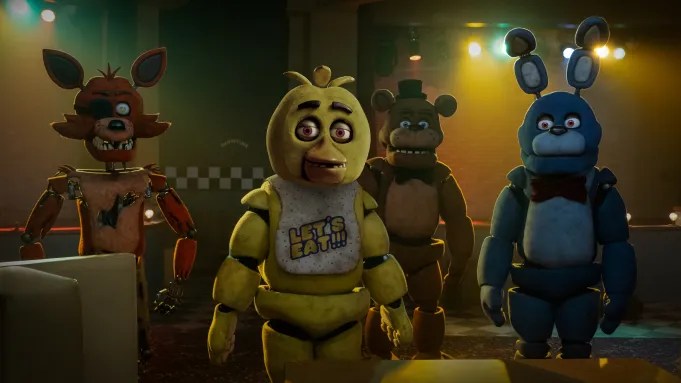
It’s some time in the not-so-distant past, somewhere in Middle America. Mike (Josh Hutcherson) is a guy in his twenties who takes care of his 11-year-old sister Abby (Piper Rubio). Abby is lonely because no one at school believes the stories she tells. Mike is a lonely former security guard. He used to work in the ruins of former family restaurant Frank Fazbear’s Pizza. In its heyday, the place was wildly popular with children because of its giant, grinning animal-puppets who performed mechanically on a small stage. But the chain was shuttered for good 20 years ago when the animatronics went rogue and killed some kids. Then, one year ago, Mike and Abby barely escaped with their lives when the animals came back to life. Now, if Mike never sees another animatronic monster in his life, it will be too soon. But Abby holds a special affection for them; she considers them her only real friends. They talk to her, understand her problems and look out for her. And it’s hard to get away from them in this town, since everybody knows about them: there’s a festival devoted to Freddy Fazbear and a robotics contest both just around the corner. Meanwhile, Mike is flirting with Vanessa (Elizabeth Lail), a former cop who helped save Mike and Abby in last year’s bloodbath. She also happens to be the daughter of a deranged megalomaniacal
serial killer who built the original automatons, and who was personally responsible for the hideous crimes they committed. And it goes without saying that Vanessa hates her psychotic father.
But despite all their precautions, Abby is hellbent on returning to the the crumbling restaurant, and in the mayhem that follows , the creatures are set loose to seek vengeance on their perceived enemies in the town. Can Mike, Abby and Vanessa fight them off and save the city? Or will the robots win out in the end?
Five Nights at Freddy’s 2 is the sequel to last years hit movie based on a video game by the same name, about an evil Chucky Cheese-style restaurant. It has some cool special effects, a few scary moments, especially involving a spooky villain known as the marionette. And I love the old 90s computers and the restaurant-gone-to-ruins motif. The main actors reprising their roles are all good. The problem with this movie is its meandering pointlessness, just a series of random episodes that have virtually no affect on what follows or precedes it. So an important character might be brutally murdered by animatronic creatures in one scene, and then
they drop out of the movie and are never referred to again.
This happens over and over, which makes you wonder is their any coherence or point to this movie, other than chase scenes, brutal killings and jump scares? I went to a screening packed with fans dressed in cos-play cheering and shouting whenever a familiar character from the game appeared on the screen. They seemed to like it. But for the average viewer, like you or me, who’s never played the game, Five Nights at Freddy’s 2 is just another schlocky knock-off.
One More Shot
Dir: Nicholas Clifford
It’s New Year’s Eve, 1999, in Melbourne, Australia. Minnie (Emily Browning) is invited to a costume party to usher in the new millennium. She’s a doctor in her thirties, single and attractive. Many of her friends — and ex-lovers — will be at that party. She even has the words “party time” tattooed on her skin. But for some reason, she’s not in a partying mood. Her past relationships all went sour, and she’s been alone, and celibate, for far too long. At least her go-to sex buddy Joe (Sean Keenan) is back in town, so at the very least she’ll get some (Joe sports a matching tattoo which bonds them as sex partners forever.)
But when she arrives at the party, everything seems to go wrong. Joe has a new lover — an American bartender or “mixologist” as she calls herself (Aisha Dee) — and it looks serious. The hosts, Rodney and Pia (Ashley Zukerman, Pallavi Sharda) have a beautiful house and young kid, but they seem somehow at odds all the time; Flick and Max (Anna McGahan, Contessa Treffone), whose apartment she’s sharing want to
kick her out; and the only stranger at the party is a douchey OB-GYN (Hamish Michael) who is also a coke-head. And at midnight, everyone anticipates a computer crash due to the Y2K. Can things possibly get worse?
Oh yes they can. Minnie keeps messing everything up, and alienating all her friends just for a chance to get laid. But then she discovers she has the solution: the ancient bottle of Tequila she’s brought to the gathering. For some reason, each gulp brings her back again to the first time she tried it, right at the door to the party. Can she right all her wrongs and erase all her mistakes before the bottle is empty? Or will she just end up as a drooling hot mess on someone else’s couch?
One More Shot is a very light social comedy about Australian millennials at play. It’s a cute, somewhat funny riff on the Groundhog Day theme. Which makes it more than a little
repetitive. The cast is attractive and mildly clever, though I couldn’t really sympathize with any of them. But I do like time- travel comedies however they happen, and this version is pretty original. Kept me interested till the end.
While clearly no masterpiece, I enjoyed watching this one.
5 Nights at Freddy’s 2 opens this weekend in Toronto; check your local listings. One More Shot is now available on VOD.
This is Daniel Garber at the Movies, each Saturday morning, on CIUT 89.5 FM and on my website culturalmining.com.
Daniel Garber talks with Eric San (Kid Koala) about Space Cadet at ReelAsian
Hi, this is Daniel Garber at the Movies for culturalmining.com and CIUT 89.5 FM.
It’s the near future in a major North American city. Celeste is a graduate of the space academy, studying rockets since she was a little girl. Her mother was a famous astronaut who disappeared on a space mission. So she is raised by a robot, who serves as her best friend and her parental unit. Now it’s her turn: she’s heading out on a six month trip into the far reaches of the galaxy… and beyond. Can Celeste travel to new planets, collecting samples for
scientific research and return safely to her home? And will her beloved robot still be waiting for this space cadet?
Space Cadet is a new animated film entirely without spoken dialogue. It’s a funny, poignant and bittersweet look at our futures. It’s the work of Montreal-based composer, musician, graphic novelist, scratch DJ, and director/producer Kid Koala, aka Eric San. His music has appeared on everything from NFB films to Sesame Street, movies like Scott Pilgrim and Baby Driver, and even Nintendo games. Space Cadet played at TIFF and Berlin to great acclaim.
I last spoke with Kid Koala on this show in 2014.
Family-friendly pics at #TIFF24. Films reviewed: The Wild Robot, Sketch
Hi, this is Daniel Garber at the Movies for culturalmining.com and CIUT 89.5 FM.
There’s lots happening in Toronto this weekend. At the Toronto Palestine Film Festival you can watch films and docs, go to concerts, art exhibitions, a brunch, workshops and discussions all weekend long, both online and at the Lightbox. And the Toronto Garlic Festival is on this Sunday on Spadina Road, with food, drinks, a garlic market and culture, too… including me! I’ll be giving a talk on garlic and the movies at 12:00 noon, with free admission.
But today I’m talking about two new, family-friendly movies that were featured at TIFF this year. There are monster drawings that come to life, and a robot stranded on an island that can talk to the animals.
Wild Robot
Co-Wri/Dir: Chris Sanders (Review: How to Train your Dragon)
It’s a small island in North America, sometime in the future. ROZZUM unit 7134 (Lupita Nyong’o) is a robot. She was built for family consumers, the product of a multinational corporation. Powered by AI, she speaks and understands multiple languages and is made to serve. Somehow her box has washed ashore on this island, but the expected suburban home is nowhere to be found. This place is uninhabited… by humans that is, but it’s teeming with wildlife. Deer and moose, bears and foxes, raccoons, porcupines, skunks, beavers, possums and all types of birds, insects and aquatic life. She sees animals ruthlessly killing and eating each other as part of their daily lives. She gazes at them all in wonder, but they regard her cautiously. She has no smell, can’t be eaten, but isn’t a predator either — what good is she?
But for the robot, it’s imperative she complete her assignment, any assignment. So she studies all the animals and learns to speak their languages. And when she rescues a newly-hatched gosling (Kit Connor) from a sly fox (Pedro Pascal), she has finally found her purpose in life: to take care of this newborn bird. You can call me
Roz, she says, but the bird — who bonds with her the second he opens his eyes — would rather call her Mama. So Roz, the little bird, and the somewhat untrustworthy fox form a makeshift family, teaching the bird the facts of life as he grows up. But can they teach him to swim and fly before the great migration south for the winter?
The Wild Robot is an amazingly-moving animated film about nature and technology forming deep bonds of their own with humans nowhere to be seen. But the villains are all man-made. This is a thoroughly well-put-together movie, from the quirky characters, to the funny surprises, to the heart-stopping scenes of suspense. It’s a genuine tear-jerker, but with characters that are just loveable enough to care for, without making you cringe. Roz is a white enamel ball whose accordion arms can spring out and come back, and whose head has neat slots for add-on devices. Her whole body glows in different colours along the seams. I love the art direction, down to the 1950s woodsy, summer- camp font they use for the title. Based on a novel of the same time, it also borrows from classic kids’ literature like the Ugly Duckling, the Jungle Book and Doctor Doolittle, but it still feels completely original. It also features additional voices of Ving Rhames, Mark Hamill, and Catherine O’Hara to name just a few.
I recommend this movie for people of all ages and most robots and animals, too.
Sketch
Wri/Dir: Seth Worley
It’s a small town somewhere in the US. Taylor Wyatt (Tony Hale) lives with his two pre-teen kids Amber (Bianca Belle) and Jack (Kue Lawrence) in a lovely home backing onto a small forest. They’ve all been down in the dumps since their mom died, so Taylor has gone out of his way to hide any pictures of her, to help the family get through this difficult period. And now he’s trying to sell the house — with the help of his sister Liz (D’Arcy Carden), a real estate agent. Maybe that will wipe the emotional slate clean. But it’s not working, as becomes clear when Taylor is called into the kids’ school to talk to the principal. Little Amber is accused of plotting to murder a classmate! And they have a drawing she made to prove it.
Luckily, the sensible guidance counsellor manages to defuse the situation right away. Amber is angry, right? So she gives her a sketch book where she can draw away all her frustrations, however she likes — the book is hers to keep and she doesn’t have to show it to anyone. Better to draw it than to do it, right?
Meanwhile, her brother Jack spends lots of time in the woods where he discovers a small pond that seems to have curative powers. It heals a cut on his hand, and fixes a family heirloom he broke. Maybe if he dumps a box of his mom’s ashes into the water, it will bring her back to life? But Amber finds out and this leads to a big fight, followed by Amber’s sketchbook falling into the pond. And that’s when all the scary monsters she drew with crayons and glitter, start coming to life.
Sketch is a delightful adventure about two kids trying to stop gigantic imaginary creatures — who have come to life — from destroying their town and killing all the people. It’s cute, it’s fun and it’s a bit scary. It’s also a touch psychological and moralistic but not enough to drag it down. Movies like this used to be fairly common, but nowadays it’s almost rare to find a movie that isn’t tied to a game, a toy, a Disney princess or a Marvel superhero. And the special-effect monsters are really cool. What other movie can you get a 30-foot- tall creature wreaking havoc in a cornfield that is clearly made of crayon scribbles? In his first feature, director Seth Worley has created a good, fun, stand-alone movie that kids will love, and parents can enjoy.
Sketch, and The Wild Robot both premiered at TIFF with Wild Robot opening this weekend in Toronto; check your local listings.
This is Daniel Garber at the Movies, each Saturday morning, on CIUT 89.5 FM and on my website culturalmining.com.
Separated. Films reviewed: I Used to be Funny, Longing, Robot Dreams
Hi, this is Daniel Garber at the Movies for culturalmining.com and CIUT 89.5 FM.
Not all love is sexual, and not all relationships lead to marriage. This week, I’m looking at three bittersweet dramas about people separated, against their will, from those they love. There’s a teenaged girl separated from her nanny (who is also a standup comic); a man separated from his biological son (who is also dead); and a dog separated from his best friend (who is also a robot).
I Used To Be Funny
Wri/Dir: Ally Pankiw
Sam (Rachel Sennott: Shiva Baby) is a standup comic in downtown Toronto. She shares an apartment with friends and fellow comics Paige and Philip (Sabrina Jalee, Caleb Hearon). But Sam can’t do her act anymore. She rarely showers, changes her clothes, or eats. She dumped her longtime boyfriend Noah (Ennis Esmer), and she quit the day job that used to pay her rent. Now she just sits around all day, staring at the wall. Why? Well, obviously she’s severely depressed. She’s also recovering from a traumatic violent event.
Things used to be better. She had a job in the suburbs as a nanny for a troubled 12-year-old named Brooke (Olga Petsa). Brooke’s mother was dying in hospital, her aunt had little free time and her dad was always busy — he’s a cop. But now Brooke has disappeared and her aunt doesn’t even know where to look for her. And when Brooke throws a rock through her window, Sam decides maybe she should join the effort to find the runaway and bring her home. But where is she hiding, why is she angry at Sam, and what will happen if she finds her?
I Used to Be Funny is a bittersweet comedy about a wise-
But it’s also Sam dealing with a not-at-all funny event — no spoilers here. It costars many Canadian comic actors, including Hoodo Hersi, Dan Beirne (The Twentieth Century, Great, Great, Great) and Jason Jones in a rare serious role. Rachel Sennott is excellent as Sam.
I Used to be Funny is a humorous look at depression and assault.
Longing
Wri/Dir: Savi Gabizon
Daniel Bloch (Richard Gere) is a successful businessman, and committed bachelor. He enjoys sex, not commitment or kids. He owns a factory and lives in a luxurious penthouse suite looking down on Manhattan. But when a when a surprise visitor arrives at his door, he is floored by her message. Rachel (Suzanne Clément) is a Canadian woman he had a fling with 20 years earlier. She reveals she was pregnant when she returned to Canada, later married and raised Allen — his biological son — with another man she married. But Allen died in an accident two weeks earlier. Daniel is floored. She hasn’t come for money or legal action, just to tell him the news. So he travels north to Hamilton, to attend a memorial and find out more about the son he never knew. And what he found was both frightening and endearing.
He talks to the people who played a key role in his son’s life, and discovers some surprising facts. He was a piano virtuoso. His best friend (Wayne Burns) says Allen was involved in a drug deal. A much younger girl (Jessica Clement) was in love with him, but says the feelings were not reciprocal. And his school teacher Alice (Diane Kruger) says he was obsessed with her and painted romantic poems about her on the school walls. What was Daniel’s son really like? And what can he do to remember someone he never knew?
Longing is a quirky, disjointed drama about kinship and death as a father desperately tries to become a belated part of his late son’s life. Richard Gere underplays his role, almost to the point of absurdity, but it somehow makes sense within the nature of his character. It’s also about the boy’s parents, not just Daniel and Rachel, but his other de facto parents And it all takes place in a very posh and elegant version of Hamilton, unlike any Hamilton I’ve ever seen. This is a strange movie that sets up lots of tension-filled revelations, but then attempts to resolve them all using an absurd ceremony.
Longing never blew me away, but it stayed interesting enough to watch.
Robot Dreams
Co-Wri/Dir: Pablo Berger
It’s the early 1980s in the East Village of NY City. There are tons of people, but they’re not people, they’re animals. Literally. Bulls and ducks, racoons and gorillas. Dog — a dog with floppy ears and a pot belly — lives there, alone in an apartment, gazing longingly out the window at happy couples cavorting in the summer sun. Dog plays pong by himself, or eats TV dinners while watching TV. He’s bored and lonely, with no one to play Pong with or just hang out. Until he orders a robot — as advertised on TV, some assembly required — and waits eagerly for it to arrive. He’s a delight with tubular arms, a mailbox shaped trunk, an elongated German helmet as a head, with round eyes and a happy smile. They are instant friends, maybe soulmates. They go rollerskating in central park, take pictures in a photo booth. Feelings grow. Another day they head out for the beach. They sunbathe and swim together — a perfect day. Until the robot finds himself rusted solid just as the beach is closing for the night. And despite Dog’s efforts, he is too heavy to drag home, so he comes back one next day to get him. But the beach is closed for the season, locked up behind a metal fence. And despite repeated tries, Dog can’t
seem to rescue Robot from his sandy prison. Can Robot survive for a year, unmoving, in the great outdoors? And will that spark between Robot and Dog still remain in the spring?
Robot Dreams is an amazing animated film about friendship and loss. It’s called Robot Dreams because much of the film takes place inside the robot’s imagination as he lay on the beach, It’s set in the grittiness of 1980s New York, with graffiti-filled subways, punks in East Village, break dancing teens and Jean-Michel Basquiat. Remember Zootopia, that animated movie where everyone is an animal? Robot Dreams is the flip side of
that, darker, cooler, adult, more Fritz the Cat than Disney or Pixar. There’s also no dialogue, but it’s anything but silent, with constant music and grunts and quick-changing gags and cultural references. But it’s also very moving — you can feel the pathos between Dog and Robot. I saw this movie cold (without reading any descriptions) and it wasn’t till afterwards that I realized it’s by Pablo Berger, the Spanish director who, more than a decade ago, made the equally amazing Blancanieves, a silent, B&W version of Snow White as a toreador. The man’s a genius.
I totally love Robot Dreams.
I Used To Be Funny, Longing and Robot Dreams all open theatrically this weekend in Toronto; check your local listings.
This is Daniel Garber at the Movies each Saturday morning on CIUT 89.5 FM and on my website culturalmining.com.
Current cinema. Films reviewed: Destroy All Neighbours, Freud’s Last Session, T.I.M.
Hi, this is Daniel Garber at the Movies for culturalmining.com and CIUT 89.5 FM.
It’s “award season” when prizes are handed out to the best — or most widely publicized — movies. But not every film is prestigious or a blockbuster. So this week, I’m looking at three new movies — one each from the US, Ireland and England — that might otherwise fall through the cracks. There’s a robot with human traits, a music producer turned serial killer, and a psychoanalyst talking about God.
Destroy All Neighbours
Wri/Dir: Jonah Ray Rodrigues
William (Jonah Ray Rodrigues) lives in a rundown apartment with his girlfriend Emily (Kiran Deol) a lawyer. He’s tall, skinny, and wears unfashionable clothes and nerd glasses. He works in a studio at the soundboard, helping bands record their music. But sometimes he feels like he’s just a knob- turner, going through the motions. His real passion is recording the ultimate prog-rock album, and is constantly coming up with new ideas, but never finishing it. Emily encourages him to give up and move on, but he feels he has to do it. But he’s getting more and more tired and frustrated by the people around him. At work, his boss is constantly ragging him for being late. And the latest client, Caleb Bang Jansen is insufferable. Even the panhandler where he parks his car is getting on his nerves. At home, Eleanor, the elderly pothead superintendent (Randee Heller) is constantly calling him for help with the fuses. Another neighbour, Phillip, lets his pet pig roam the halls. But worst of all is the new tenant next door. Vlad (Alex Winter) is hideously ugly, aggressive and incredibly loud, playing non-stop euro disco all night long. Vlad lifts weights using buckets of cement attached to his barbell. He’s a scary guy, William is passive aggressive and terrified of face to face confrontations.
When he finally visits Vlad to ask him to turn down the music, they get in a fight and somehow Vlad ends up impaled on a stake, and — accidentally — decapitated!
William doesn’t know what to do, but finally realizes he has to dispose of the body. But things have changed since Vlad — new bodies keep piling up — always killed unintentionally by him, by strange coincidences. He becomes a serial killer by default, or a serial manslaughterer, as he likes to say.
But when the all the people he killed come back to life, he realizes something really strange is going on. Can William keep his boss and girlfriend happy, record his prog rock album, stop killing people, and living a normal life? Is he destined for a very dark future? Or is he just losing his marbles?
Destroy all Neighbours (the title says it all) is a comedy/horror movie, with an emphasis on in-your-face, gross-out humour. So there’s lots of disgusting blood and
gore, but it’s always so exaggerated it’s funny, not scary, in the manner of Monte Python or Army of Darkness. Jonah Ray Rodrigues is the writer/ director/star and the current host of Mystery Science Theatre 3000. I admit it’s an acquired taste, and some of the gags and schtick fall flat, but I was laughing more than not. I happen to like that kind of humour (in moderation) but, admittedly, it’s not for everyone. So if you’re into bloody horror-comedy set in L.A.s skid row, or even if you’ve ever had annoying neighbours, I think you’ll love Destroy all Neighbours.
Freud’s Last Session
Co-Wri/Dir: Matt Brown
It’s September, 1939. Germany has invaded Poland and Great Britain is about to go to war. Sigmund Freud (Anthony Hopkins) and his daughter Anna (Liv Lisa Fries) left their homes and vocations in Vienna after the Anschluss — the unification of Austria and the Third Reich, and moved to London. His office is decorated with the art and bric-a-brac of home: Persian rugs, African fertility statues and Catholic saints. Anna continues to research and give lectures on psychoanalysis and child psychology, but Sigmund, due to his age (he’s 83) and poor health (he’s dying of cancer) rarely leaves his home now. But on this day he has an unusual visitor: CS Lewis (Matthew Goode). Lewis is a don at Oxford where he teaches English and has written a book about Pilgrims Progress. (He later goes on to write The Chronicles of Narnia.) And he’s still suffering from shell shock from WWI. But why are they meeting? Lewis wants to talk with Freud about God and religion. He once was an atheist but now has adopted theism and Christianity as his guiding light. Freud, on the other hand, is a committed atheist and finds all religions equally fascinating and equally false. Still, they have a spirited discussion on a wide range of issues. But certain topics are taboo. For example, Freud refuses to talk about the fact that Anna has a female lover. And Lewis considers his own sexual relationship with his late best friend’s mother as something too private to share. Meanwhile, air raid sirens are going off, Freud is struggling with the oral prosthetic he calls his “Monster” and nobody knows what the future will bring. Will this be Freud’s very last session?
Freud’s Last Session is a fictional historical drama adapted from the successful stage play. There’s no evidence that an elderly Freud and a younger Lewis ever actually met; the story functions more as an intellectual exercise than a theatrical drama. So it’s not captivating, but it did keep my attention. They try to perk it up a bit with flashbacks — Lewis in the trenches in WWI; Freud as a small child — but I found them lacklustre at
best. There are some clever touches, where Freud ends up reclining on the settee while Lewis takes on the analysts role. Of course it has nice period costumes and sets, but the main reasons to see this film is first the topics and second the acting. The topics range from sex to psychoanalysis to theology. Devotees of Freud and/or Lewis may get a kick out of it, but no major revelations here. The acting, though is delightful. Hopkins walks through his usual role — along with a few artfully-placed wunderbars and ja ja ja and das ist gut! so we don’t forget he’s Austrian. Goode is more passionate, fearful and sad. Best of all is German actress Liv Lisa Fries (from Babylon Berlin) as Anna Freud, who gets to rush around London looking for meds for her Dad.
Freud’s Last Session is not bad, but not noteworthy, either.
T.I.M.
Co-Wri/Dir: Spencer Brown
Abi and Paul Granger (Georgina Campbell, Mark Rowley) are married, professionals, double-income, no kids, moving into a beautiful, modern home in rural England. It’s at the end of a long country road, with open staircases, glass walls and a huge garden, all paid for and arranged by Abi’s employer. She’s an engineer who specializes in AI robotic prostheses. She designs the human-looking hands of robots. Paul is currently unemployed, but is in line for a corporate position in London. They’re both looking forward to their first child, and are working hard at it each night.
Now this house is completely on the grid. Everything’s smart — smart windows, locks, heating, computers, lighting — all controlled through a central console, and co-ordinated with their smart watches and phones. The central console, though, is something her company invented. It’s a Technologically Integrated Manservant, T.I.M. for short, or just Tim. Tim (Eamon Farren) is a humanoid robot with perfect male features, blond hair, and artificial intelligence; he’s constantly learning. He’s a prototype: he can cook gourmet foods, do heavy lifting, play the piano, send and answer emails. Abi’s boss is adamant that all his employees have a T.I.M., so they can get rid of the bugs in the system before the upcoming release. Abi, loves her new toy, but Paul is less enthusiastic. Why did T.I.M. barge into their bedroom while they were making love? T.I.M. says Abi’s blood pressure and temperature had risen, he just wanted to make sure she was OK. But Paul suspects T.I.M. of spying on him. He thinks TIM sends messages to Abi whenever Paul visits Rose their only neighbour (Amara Karan), feeding Abi’s suspicious jealousies. And when he catches T.I.M. perving through Abi’s clothes, he knows something is very wrong. Is T.I.M. morphing into something bad? Can a robot even have feelings? And if things go wrong, who will Abi trust: Paul, the fallible human, or T.I.M., the perfect machine?
T.I.M. is a sci-fi thriller about the potential dire consequences of AI given a human form. This isn’t the first humanoid movie — there have been at least a dozen in the past few years — and some of the plot is predictable. And it does have that “pandemic movie feel” to it, with a tiny cast (just four main characters) located in an isolated country setting, but, in this case, it really works. It’s scary, it’s creepy, it’s interesting. It feeds on your worst fears about electronic devices communicating without your knowledge, and the possibility of the singularity, when humans will no longer be essential. I’m not familiar with any of the actors but the cast is good. The storyline is compelling, and most of all, the movie feels believable. So if you ever feel like your smart phone is a bit too smart, you’ll like this scary, sci-fi thriller. It’s a good one.
Freud’s Last Session opens this weekend in Toronto; check your local listings. Destroy All Neighbours is streaming exclusively on shudder.com, starting today; and T.I.M. is now available digitally and on V.O.D.
This is Daniel Garber at the Movies, each Saturday morning, on CIUT 89.5 FM and on my website culturalmining.com.
S Movies. Films reviewed: Soft, Simulant, The Super Mario Bros Movie
Hi, this is Daniel Garber at the Movies for culturalmining.com and CIUT 89.5 FM.
This week, I’m looking at three new movies: one realistic, one sci fi and one fantasy. We’ve got three kids exploring Toronto’s underworld; a futuristic world where androids compete with humans for dominance; and a cartoon universe where plumbers on mushrooms battle fire-breathing turtles.
Soft
Wri/Dir: Joseph Amenta
It’s summertime in Toronto and three kids are making the most of their time away from Junior High. Julian (Matteus Lunot) has pink hair and likes brightly coloured clothes. He lives with Dawn (Miyoko Anderson), a sex worker. She helps him dye his hair to match hers, and gives him clothing and makeup tips, acting as a surrogate mother ever since his mom kicked him out for being gay. Otis (Harlow Joy) has to sneak away to have fun — he plays it straight when he’s with his bible-thumping dad. Tony (Zion Matheson) has a loving mom who accepts the three kids’ shifting genders and sexualities. The three of them splash around public swimming pools and explore the Scarborough Bluffs.
Their big goal? To sneak into a gay dance club to listen to the music, explore the lights and shadows, and maybe make friends. Of the three, Julian is the most street-smart. Closed windows and high walls are no barrier to getting where he wants to go, and his nimble fingers help him “find” wallets and credit cards — his only source of income. But after a
night on the town, they discover Dawn went out the night before and never came home. Is she in trouble? Or in danger? So they set out to find her or what happened to her. But as things get more serious, cracks start to appear in their friendship. What happened to Dawn? Where will Julian go without her? And can the three friends stay friends?
Soft is a free-form look at three kids feeling their way through a judgemental (and sometimes dangerous) city as they navigate their own identities, sexualities and genders. Soft is tender and exuberant. It shows a realistic Toronto — a mix of races, classes and languages — while exposing the soft underbelly of its counterculture. Though a coming-of-age story, it’s not about intimate sexual experiences, it’s about self identity and friendship.
Soft is both rough and sweet.
Simulant
Dir: April Mullen (Badsville)
It’s the near future in an industrialized city, and robots and androids are everywhere. A young couple, Evan (Robbie Amell: Resident Evil, Code 8) and Faye (Jordana Brewster: Random Acts of Violence) have slept in separate bedrooms since recovering from a terrible car accident. Evan often wakes up to nightmares about the crash, but his memories are still foggy. Faye is depressed and keeps him at arms distance. Luckily, they still have a plastic robot who cooks them perfect pancakes each morning. But Faye thinks there’s a problem with the android, so she calls an expert AI programmer named Casey (Simu Liu) for help. But there’s nothing wrong with their pancakes. It’s Evan
with the problem: he’s actually a 7th generation humanoid, (known as a Simulant) who looks, talks and acts exactly like her husband who died in the car crash!
His brain contains all of his memories and thought patterns; more like a clone than a robot. And he had no idea till now that he’s not the real Evan. So Casey volunteers to take care of him at his apartment building, while Faye adjusts to the concept.
Evan is agreeable to the fact, as he wants to win back Faye’s affections. Even though he knows he’s an android now, he still feels like he’s the real thing — that he possesses Evan’s soul — and still loves Faye. Simulants have thoughts and feelings identical to humans, yet they are bought and sold like slaves, and their masters can shut them down whenever they please, just by saying “shut down”… is that fair? Casey thinks it’s not; it’s his goal to secretly reprogram people with seventh
generation artificial intelligence to set them free. But Kessler (Sam Worthington: Kidnapping Mr Heineken, Clash of Titans) a Blade-Runner-like enforcement officer, is out there trying to stop any simulant gone rogue. Which side will win? And what will happen to Evan and Faye’s relationship if he gains free will?
Simulant is a Canadian science fiction movie that plays with an interesting topic, especially now, with AI at the front of everyone’s mind. It’s the latest in a slew of films about almost-human humanoids — I’m Your Man, After Yang, Ex Machina, to name just a few — and I gobble this stuff up. So I like the concept. The problem with Simulant is it feels disjointed, and, for a thriller, it tends to drag. The aerial drone shots of industrial Hamilton are cool, and I like the rich art direction, but as a whole it doesn’t quite work. Like many science fiction movies, it’s hard to connect with the characters; we can watch them but don’t feel a part of them. Simulant isn’t bad, but, aside from a couple of genuine surprises, it just didn’t grab me.
The Super Mario Bros Movie
Dir: Aaron Horvath, Michael Jelenic
It’s 1985 in Brooklyn, New York.
Mario and Luigi are plumbers and business partners. They just opened their new company called Super Mario Bros, and they say they can fix any leaky pipe, anywhere. But business is bad. So to show their mettle they decide to tackle a huge explosion beneath the street that no one can fix. But deep in the sewer they both get sucked down a pipe, separated and ejected into two separate worlds. Luigi is locked up in a bird cage suspended over molten lava with only a nihilistic blue star to keep him company. They’re captive of cruel king Bowser, a giant, dragon-like monster in the land of turtles. Mario ends up in a much nice place filled with talking mushrooms. It’s ruled by Princess Peach, a human, just like Mario and
Luigi. She decides to work with Mario and Donkey Kong (a gorilla in a nearby kingdom) to rescue Luigi and fight off Bowser’s invading army. But can anyone beat that scary turtle? And will Mario or Luigi ever make it back to Brooklyn?
Super Mario Bros: The Movie is exactly what the title promises: an animated reenactment of various classic Nintendo games, held together by a threadbare plot, wicked graphics and frequent jokes. I really love psychedelic images in this movie and its fidelity to the original games, both for its nostalgia value and its all-around coolness. I’m less crazy about the fact that much of the movie feels like a well-
produced infomercial, plugging an assortment of Nintendo products, from the original to Mario Kart. A significant portion of screen time is devoted to these characters actually playing their games! Is that why we go to movies now — to watch characters play video games? Don’t get me wrong, the images, music, sound effects and jokes were enough to keep me interested and happy; there’s just not much there, there.
Soft, Super Mario Bros, and Simulant all open this weekend in Toronto; check your local listings.
This is Daniel Garber at the Movies, each Saturday morning, on CIUT 89.5 FM and on my website, culturalmining.com.
Almost human. Films reviewed: Shin Ultraman, M3GAN plus the best movies of 2022!
Hi, this is Daniel Garber at the Movies for culturalmining.com and CIUT 89.5 FM.
Happy New Year, everybody!
As we move closer to an uncertain future, we’re finding it harder to tell the difference between a human and a robot, or human thoughts vs artificial intelligence. This week, I’m looking at two new movies about almost humans. There’s a semi-human superhero who comes from outer space, and a cute little robot doll with a very dark side.
But before that, I’m going to run through what I think were some of the best movies of 2022.
Best movies of 2022
Every year, I see hundreds of movies so it’s hard to narrow it down to just a few, for that reason only I don’t include documentaries, like Laura Poitras’s fantastic All the Beauty and the Bloodshed; nor cartoons, like Guillermo Del Toro’s Pinnochio, only movies that I saw on a movie screen and reviewed last year. There are many other good, or even great movies I saw, but here are what I think are the best movies of 2022, in alphabetical order:
All Quiet on the Western Front, Dir: Edward Berger
Armageddon Time, Dir: James Gray
Broker, Dir: Kore-eda Hirokazu
The Innocents, Dir: Eskil Vogt
Memoria, Dir: Apichatpong Weerasathakul
Nope Dir: Jordan Peele
The Northman, Dir: Robert Eggers
Tár, Dir: Todd Field
Triangle of Sadness, Dir: Ruben
Östlund
The Whale, Dir: Darren Aronofsky
Dir: Shinji Higuchi
It’s present-day Tokyo, and things are not going well. Previously unknown monsters — or “S-Class Species” — keep appearing from nowhere and wreaking havoc across Japan. They’re drilling holes, smashing dams and sucking up electrical power like slurpees. Luckily, there’s a government body that handles cases like this. They’re the S-Class Species Suppression Protocol, or SSSP. The head guy, Tamura, gives the orders, while the scientists investigate. Strategist Kaminaga (Saitoh Takumi) is a nerdy, introvert who speaks with no inflections or emotions. He works with newcomer analyst Asami (Nagasawa Masami) his exact opposite, an assertive woman who wants Kaminaga to be her buddy. And two more members round up their team.
Fortunately, whenever the Kaiju monsters appear, a strange giant
man, dressed in a silver and red suit, arrives to save the day. He is dubbed Ultraman, protecting Japan from these strange invaders. But why does Kaminaga always disappear when Ultraman arrives? And is he human, alien, or somewhere in between?
The Japanese government — and the rest of the world — takes notice. They want to find out where Ultraman comes from and what his secret powers are. Things get more complicated when a benevolent-seeming alien arrives on earth, saying he will handle international relations from now on. But
no one realizes his real aim — to take over and kill all the homo sapiens on the planet… unless Ultraman and the SSSP stop him first.
Shin Ultraman is a purist reboot of the classic Japanese 1960s TV show. I remember seeing reruns as a kid, and really liking it. This new version is a re-creation set in present-day Japan, but with nothing particularly contemporary or different from the original. It does include some political content — government politicians and bureaucrats who repeatedly make the wrong decisions — and the other characters are modernized. Watching this movie — which I enjoyed! — it seemed identical to what I remembered, until I re-watched bits of the original, and was shocked at how bad and campy the special effects had been. Here the CGI and costumes are much, much better. But it preserves the sombre and earnest tone that geeky, sci-fi devotees demand. If you’re a fan of Ultraman, or of Japanese kaiju movies in general, you won’t be disappointed — this is the real thing.
Dir: Gerard Johnstone
Gemma (Allison Williams) is an inventor who, as part of a team, develops toys at a conglomerate called “Funki”. Their last big success was a Furby knock-off, but it’s losing market share, so they need a new hit. All their hopes lie on a project she’s been secretly working on for a long time, but it’s not quite ready yet. It’s code-named M3gan — Model 3 Generative Android — and is a robot in the form of a smart and pretty little girl. With a titanium core and sophisticated AI memory, she can talk, walk and act like a real human.
More than that, Megan’s artificial intelligence lets her learn and change as she grows up. By bonding with her primary owner, she’s not just a toy, she’s a friend for any little girl. But she wouldn’t come cheap — she’s priced more like a car than a toy. Gemma’s boss is pushing her to finish Megan’s prototype, ASAP, to attract new investors, when, suddenly, disaster strikes. In a freak accident, her sister and brother-in-law are killed by a snowplow on a ski trip, leaving their 10-year-old daughter — Gemma’s niece — an orphan. Cady (Violet McGraw) needs someone to turn to in her hour of grief, and Gemma, as her closest living relative, is appointed her guardian. But she knows nothing about parenting; she lives alone and devotes all her time to her career.
So, to kill two birds with one stone, she brings M3gan home to take care of Cady, even while she works on the toy’s programming in time for the big launch. She observes them
interacting through a one-way mirror in a glassed-in playroom at the company. Megan has only one overriding rule: to protect Cady from any danger, both physical and emotional. Cady loves M3gan, who is very protective of her best friend. But when she allows them outside of the lab, things turn dark. And when the dead bodies start piling up, Gemma realizes something is terribly wrong with her design. Can she fix Gemma before she goes rogue? Or is it too late?
M3gan is a thriller-horror take on the classic story — dating back to Frankenstein — about the bad things that can come out of a benevolent scientist’s experiment. It’s also about bad grown-ups and evil kids — in addition to M3gan — facing their comeuppance. For a movie that doesn’t ever take itself top
seriously, it succeeds in being both kinda scary and funny. It has lots of kitschy, fake toy ads, and your usual stock characters, like grumpy boss, noisy neighbour, spoiled kids. Beware: there is a fair amount of violence, including a disturbing scene where a boy assaults M3gan thinking she’s a doll, so definitely not suitable for everyone, but I liked it. Allison Williams is excellent as Gemma, and Megan (composed of actor Amie Donald, the voice of Jenna Davis and lots of CGI) is a doll villain that’s weird enough that I think we’ll be seeing lots more of her.
M3gan opens this weekend; check your local listings. And you can see Shin Ultraman on January 11th and 12th at the TIFF Bell Lightbox.
This is Daniel Garber at the Movies, each Saturday morning, on CIUT 89.5 FM and on my website, culturalmining.com.
Humans and machines. Films reviewed: L’homme Parfait, Pinocchio
Hi, this is Daniel Garber at the Movies for culturalmining.com and CIUT 89.5 FM.
In these troubled times, many feel daunted by quickly-changing technology, and wait with trepidation the eventual coming of the Singularity: the day robots and artificial intelligence become smarter than humans. What will happen to us after the Singularity?
This week I’m looking at two new movies about the increasingly thin line separating people from machines. There’s a woodcutter in Italy who creates a puppet that acts like a boy; and a woman in France who buys a robot that acts like a man.
Co-wri/Dir: Xavier Durringer
It’s the near future, somewhere in France.
Franck and Florence (Didier Bourdon, Valérie Karsenti) are a happily unmarried middle-aged couple with two kids, Max and Victoire. Florence has an office job, while Franck works from home. He’s an actor who is writing that blockbuster screenplay which will turn his career around. But it’s been three years now with no sign of progress, and his agent isn’t exactly banging on his door with acting jobs. And even though Franck is at home all day, it’s Florence who ends up cooking, cleaning and taking care of the kids. But enough is enough. She puts in an order and two days later a large box arrives at their door. Meet Bobby (Pierre-François Martin-Laval): a realistic-looking male robot: strong, smart and friendly. He has artificially blue eyes and speaks in a monotone. With a variety of built-in options, from Salsa dancing to Krav Maga, soon Bobby is whipping up boeuf bourgognon, ironing their sheets and telling bedtime stories to the kids. And his artificial intelligence means, like Siri, he listens to — and remembers — everything he hears.
But there are side effects. Florence may love all the free time she has now, but Franck
feels stripped of all his fatherly duties. Bobby is better at bowling. Bobby can fix a broken car engine in a flash. Bobby can select the best wine, say the right thing, buy the right gift. Franck feels increasingly left out. And when he accidentally sees Bobby’s “standard equipment” he feels second-rate and useless. Meanwhile, Florence feels sexually neglected and doesn’t understand why. Is Bobby ruining their marriage? Will Florence ever activate Bobby’s forbidden love-love button? Or can Franck reactivate their relationship?
L’homme parfait is a French comedy about robots, technology and middle-age crises. It’s also a clear knock-off of last year’s German hit I’m Your Man (they actually give it a nod by saying Bobby is manufactured in Germany). It’s conventional, predictable, and anything but subversive, in the style of those cheap-ass Hollywood comedies in the ‘80s and ‘90s. That said, it did make me laugh more than once. What can I say — no one will call L’homme parfait a great movie, but it is a funny, low-brow sex-comedy in an emerging sub-genre: humanoid robots.
Dir: Guillermo del Toro and Mark Gustafson
Geppetto is a wood carver who lives with his beloved son Carlo in a small village in Tuscany. He carves everything in town from wooden clogs for Carlo, to Christ on the Cross in their local church. But when a WWI bomb drops on the village killing his son, Geppetto becomes a reclusive alcoholic, spending all his time crying by Carlo’s grave. Two decades later, in drunken rage, he chops down a knotty pine tree that grew from a pinecone Carlo found on his last day alive, and roughly carves a new boy — with wobbly knees and elbows, rough-hewn hair and a long piece of wood for a nose — all modelled on his son. He calls him little pine, or Pinocchio. What he doesn’t realize is a blue cricket (the story’s narrator) lives inside a hole in the wood the boy is made of.
After Geppetto passes out, a magical wood sprite, out of sympathy for the old man, brings Pinocchio to life. She gives the cricket responsibility of taking care of the kid and teaching him right from wrong. The new-born boy is clumsy and dangerous, a tabula rasa taking in all around him. He exalts in learning and gleefully smashes everything he sees. Soon the discovers Pinocchio with different reactions. Some call him an abomination, the work of the Devil. Podesta, a member of Mussolini’s Fascist Party, thinks Pinocchio can be the ultimate weapon, a soldier who cannot die. And a sleazy carnival barker named Count Volpe, and his sinister sidekick, a monkey named
Spazzatura, see him as a money-maker, a living puppet he can exploit at his circus. Being pulled in all directions, can Pinocchio ever find his way back to his father and creator Gepetto?
Pinocchio is a dark retelling of the 19th century Italian classic. It’s masterfully-made using stop-motion animation of dolls and puppets, in the style of Rudolph the Red-Nosed Reindeer or A Nightmare Before Christmas. Gone are the cutesy Disney costumes and hats; this Pinocchio is bare-bones wood all the way, with clothing hacked onto his body. The naughty boy is made of knotty pine. It’s partly a musical, with characters spontaneously breaking into song (some good, some not), especially at the circus. But it’s also, like all of del Toro’s movies, dark, sad and scary. It deals with theft, alcoholism and death. And by transplanting the story into fascist wartime Italy (similar to Spain in Pan’s Labyrinth), he makes it even darker.
In addition to Gregory Mann, David Bradley and Ewen McGregor — as, Pinocchio, Geppetto and the cricket — other voices include Tilda Swinton, Kate Blanchett, Rob Perlman, and Finn Wolfhard as Candlewick, Pinocchio’s frenemy. But it’s the characters themselves, animated on the screen, that really make this movie. If I saw this as a little kid, I guarantee, Pinocchio would have given me nightmares. But as a grown-up, I found it a sad and very moving story, beautifully made.
Pinocchio is now playing at the TIFF Bell Lightbox, and L’homme parfait is one of many films screening at Cinefranco till Tuesday and then digitally till the end of the month.
This is Daniel Garber at the Movies, each Saturday morning, on CIUT 89.5 FM and on my website, culturalmining.com.


leave a comment