Parts of history. Films reviewed: Fanon, Train Dreams, Christy

Posted in 1920s, 1950s, 1990s, Algeria, Biopic, Boxing, Class, Colonialism, Lesbian, LGBT, Politics, Psychiatry, Resistance, Trains, violence by CulturalMining.com on November 9, 2025

Hi, this is Daniel Garber at the Movies for culturalmining.com and CIUT 89.5 FM.

Toronto’s Fall Film Festival season continue with two series on right now. Reelasian features films from Asia and its diaspora, including two great ones from Canada: Min Sook Lee’s heart-wrenching doc There are No Words, and Koala Kid’s whimsical, animated Space Cadet. Cinefranco has movies in French from Europe, Africa, and Quebec, including many Toronto premieres: look out for la Venue de l’Avenir by Cedric Klapisch (Ma Part du Gateau), and le Dernier Souffle by the legendary Costa-Gavras. 

But this week, I’m looking at three new films set in historical eras. There’s a lumberjack at the turn of the previous century, a psychiatrist in Algeria in the 1950s, and a female boxer from West Virginia in the 1990s. 

Fanon

Co-Wri/Dir: Jean-Claude Flamand-Barny

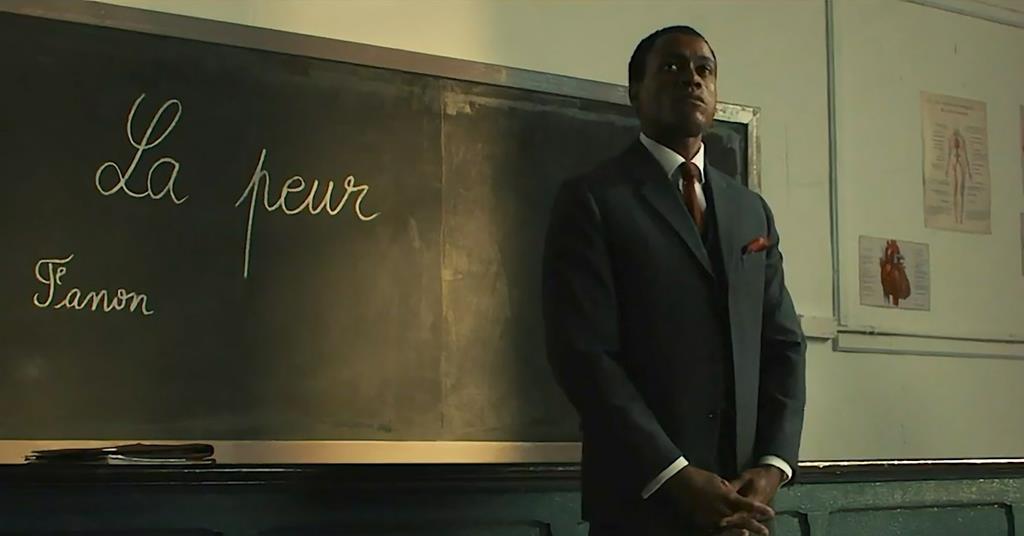
It’s the early 1950s in Algeria. Frantz Fanon (Alexandre Bouyer) is a renowned psychiatrist from the French Island of Martinique. He is starting his new job at a mental hospital. But he’s shocked at how Algerian patients are treated there. In contrast to Europeans, the “savage” north Africans are kept shackled in filthy cells, because of their “barbarous and dangerous” nature. Fanon (who is black) insists his North African patients be treated like any others. He lets them walk in the garden, plant vegetables, play soccer and make friends. Their mental health quickly improves. He’s assisted by diverse Algerian interns and staff: Hocine (Mehdi Senoussi) Jacques (Arthur Dupont) and Alice (Salomé Partouche), all followers of his techniques. But he’s strongly opposed by traditionalists and the French military, who are increasingly violent in their tactics. (Algeria was annexed by France but most of the locals are not considered full citizens.) He and his wife Josie (Déborah François) are upper-middle-class French citizens playing their role supporting the sprawling Empire. Fanon fought the Nazis in WWII. He likes Sartre, elegant suits and and fine wine. But his views are changing. He now writes books (dictated to his wife) about the effect of colonization on the mental health of the colonized in Algeria. Their own self-image is denigrated by their oppressors, he writes, when they internally accept their status as “the other”. Word gets out and he’s invited to join the FLN, (considered terrorists by the French). But the threat of violence reaches his hospital, as personified by Sergeant Rolland (Stanislas Merhar), a particularly violent soldier who checks in as a patient. How can Frantz Fanon simultaneously balance his various roles — as a husband and father, as a Black man serving the French empire, as an innovative psychiatrist, and as an intellectual joining the Algerian struggle for independence?

Fanon is a vibrant biopic about a decade in the life of the renowned author. I find it gripping and fascinating. Alexandre Bouyer is strong and statesman-like in the title role. I’ve known of Fanon for many years — as the author of books like The Wretched of the Earth and Black Skin, White Masks — but never knew about his background in psychiatry. Though occasionally heavy-handed and hagiographic, this movie opened my eyes to the exciting and intellectually stimulating story of his life in Algeria and the history that surrounded it. 

I like this one a lot.

Train Dreams

Co-Wri/Dir: Clint Bentley (Jockey) 

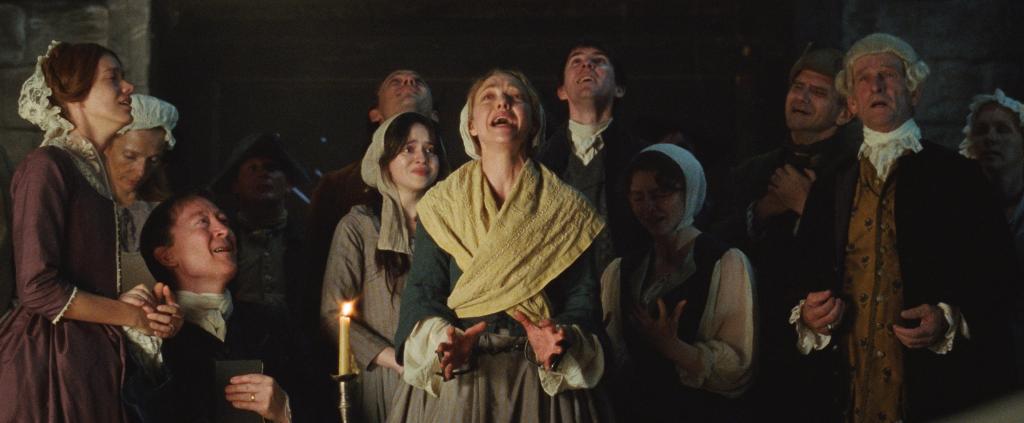
It’s the early twentieth century in the US Northwest. Robert Grainier (Joel Edgerton) is a bearded lumberjack who rarely speaks. He earns his living chopping down trees at migrant lumber camps and building the railroad.  He meets a woman named Gladys (Felicity Jones), they fall in love and build a homestead in a grassy patchl near a flowing river. He cuts all of the wood by hand. Gladys is good with a rifle and shoots foul and deer to eat. The rest they buy in town at a general store owned by Ignatius Jack (Nathaniel Arcand).

He spends lonely months away earning money, but always returns home in the end. He makes friends with a Chinese labourer named Fu Sheng — they don’t talk but that’s fine with Rainier who never has much to stay. But he is shocked when a crowd decides to murder Fu Sheng just because he’s a celestial. He later makes friends with an old-timer named Peebles (William H. Macy) who handles the dynamite explosions. He loves their new baby girl  but his home and family are threatened when a wildfire sweeps through the forest while he’s away. What will Grainier do?

Train Dreams is a series of events in one unremarkable man’s life set along the early 20th century northwestern frontier. A folksy omniscient voice narrates the story, hoping to add profundity; it doesn’t work. The film is meandering,  pointless and stupid. It gives token nods toward environmentalism and against racism but they’re not really part of the plot. I hated this movie from the first few seconds, with its over-produced images and inappropriate soundtrack. We see a guy sawing wood until the camera pulls back revealing…? Nothing, just more trees, as if we’re supposed to applaud the scenery! At times it’s twee, like a Wes Anderson film, but without the humour or intellect. The men all look like they’re posing for a Carhartt fashion shoot. I try to feel sympathy toward Rainier  but he’s deliberately opaque. Worst of all are the Train Dreams of the title — we keep seeing the same montages of flashbacks from previous scenes… but the original ones are as short-lived as his memories of them. 

You might enjoy the pretty pictures in Train Dreams, but I can’t see any other reason to watch this annoying blunderbuss of a film.

Christy

Co-Wri/Dir: David Michôd (The Rover)

It’s 1989 in West Virginia. Christy Salters (Sydney Sweeney) is a high school kid, and a star player on the girls’ basketball team. She’s also in love with her girlfriend Rosie (Jess Gabor), a relationship her mom (Merritt Wever) doesn’t approve. She ends up trying out as a novelty act at a boxing match, and, though she has zero training, she scores a KO on her first try. She’s a natural. She catches the eye of a middle-aged boxing entrepreneur named Jim Martin (Ben Foster). He reluctantly takes her on and lets her train at his gym, but he will not allow her to see — or even talk to — Rosie. He sets her up in a trailer park where he can keep an eye on her. Though a great fighter, she’s isolated and unprotected outside of the ring. 

Christy is a powerhouse. Her career takes off, including a new hairstyle and a trademark pink silk hooded robe to make her look more “feminine”. She knocks out all contenders and after much pressure, the 22-year-old Christy sleeps with the middle- aged Jim… and they eventually marry. 

Her career soars, she meets Don King (hilariously played by Chad Coleman) and is signed to Mike Tyson’s slate. She gains fans worldwide, but her life is micromanaged by her Svengali husband. She may be a professional fighter but he’s twice her size, unstable, and increasingly violent. And he tries matching her up with boxers way above her weight class; that’s just dangerous. Is there any way to escape this oppressive relationship?

Christy is a biopic about the first prizewinning female boxer, who paved the way for a new professional women’s sport. I was hesitant about this one — ugh, yet another boxing movie — but Christy is as good as Rocky. It’s exciting, thrilling and moving, and despite her flaws, Christy Martin’s life is super-sympathetic. Sydney Sweeney is amazing. Yes, it’s Oscar-bait (you can tell by the prosthetic teeth and mullet haircuts, playing down her image as a sex-object) but she totally gets into this role. And Ben Foster is superbly hate-able as Jim — I seriously didn’t realize it was him till the credits rolled; he’s that skillful.

Christy is a good, old-fashioned biopic and a hell of a great boxing movie. 

Train Dreams and Christy both played at TIFF and are opening in Toronto this weekend; check your local listings. And Fanon is premiering today at Cinefranco, 4 pm at the Carlton Cinema.

This is Daniel Garber at the Movies, each Saturday morning, on CIUT 89.5 FM and on my website culturalmining.com.

Americans abroad. Films reviewed: Queer, September 5, Oh Canada

Posted in 1950s, 1960s, 1970s, Addiction, Canada, Dreams, drugs, Germany, Journalism, LGBT, Mexico, Resistance, Sex, Sports, TV, US, War by CulturalMining.com on December 14, 2024

Hi, this is Daniel Garber at the Movies for culturalmining.com and CIUT 89.5 FM.

This week I’m looking at three new movies set in the 1950s, 60s and 70s, about Americans abroad. There’s a novelist in Mexico City, a TV sportswriter in Munich, and a documentary filmmaker in Montreal.

Queer 

Dir: Luca Guadagnino (I am Love, A Bigger Splash, Call me by your Name, Suspiria)

It’s the 1950s in Mexico City. William Lee (Daniel Craig) is a middle-aged American writer addicted to heroine who hangs around local bar called Ship Ahoy. If he doesn’t get completely drunk he might spend the night with a man he meets. He’s friends with other flamboyant ex-pats, especially Joe (Jason Schwartzman) a portly, bearded man who shares Lee’s lascivious predilections. Lately, he has had his eyes on Eugene Alerton (Drew Starkey), an ex-GI who spends most of his days playing chess with an older red-haired woman. Eugene is no “queer”, but is up to talking with Lee.

After repeated drinks, and some opiates he eventually shares Lee’s bed in his seedy rental. Lee is smitten, Eugene content. Later the two head south in their quest for ever more potent drugs culminating in a journey toward the ultimate psychedelic experience. They end up in the Ecuadorean Amazon, in a remote shack guarded by a vicious but slow-moving three toed sloth. Inside, a mysterious doctor (Lesley Manville) holds the answers to all their questions. Is Eugene the man of his dreams? Will they ever reach hallucinatory nirvana? Or is life just an illusion?

Queer is a bizarre, sex-and-drug-filled psychedelic fantasy. It’s divided into three chapters: their meeting in Mexico City; their journey south; and their adventures in Ecuador.  It’s adapted from William S Burroughs’ semi-autobiographical novel written in the 1950s but not published for another 34 years. It swerves wildly between actual memoirs and pure imagination. Burroughs was a writer in the beat movement, and was married and had a son with another writer Joan Vollmer (perhaps she’s the red-haired woman Mary in the film).

The thing is, Queer is not a grave, serious movie, it’s a high-camp comic fantasy. Psychedelia has always been difficult to film, and there’s a fine line between the profound and the ridiculous. Some scenes, like the unfortunate semi-nude, interpretive dance sequence, falls on the (unintentionally) funny side. Others scenes were kinda cool. It’s a beautiful film to watch, for its music, set, costumes and art direction. Shot entirely in Rome’s Cinecitta, it’s never meant to look realistic. Daniel Craig plays Burroughs not as the usual chill junkie observer, but as a panting and sweating horndog, with bulging eyes, nearly choking on his own lust. 

If your looking for a sentimental romance a la Call Me by You Name, or a deeply profound meditation on psychedelic trips, this ain’t it. But if you just want a weird and funny drug-infused dream-filled movie with lots of soft-core gay sex, you’ll probably have a great time.

September 5

Co-Wri/Dir: Tim Fehlbaum

It’s September 5, 1972 at the Munich Summer Olympics and the crowds are roaring. Americans are glued to their sets watching the US cleaning up, with swimmer Mark Spitz winning an unheard of seven gold medals.  ABC is the perennial loser of the top three networks. So their sportscasters are thrilled to have won exclusive coverage rights. The team behind the cameras are hard at work. Geoffrey Mason (John Magaro) is the newbie, trying to prove his chops. His boss Marvin (Ben Chaplin) wants things to run smoothly, and his boss’s boss (Peter Sarsgaard) is thinking of the bigger picture. Jacques (Zinedine Soualem) is their French cameraman with Marianne (Leonie Benesch) the only woman on the team, is a German journalist, and their de facto translator. Everything is great until they hear gunshots… not at the games, but at the nearby Olympic village. A group of masked militants, known as the Black September Organization is holding Israel’s Olympic team hostage. 

Suddenly, the ABC sportscasters realize they are the only American TV journalists in Munich. They have the cameras, the boom mics and the broadcast and satellite rights ready to send stories home. They shift their telephoto lenses from pointing toward the swimming pools to the athletes’ dormitories, trying to catch a glimpse of the hostages. What will happen next? Will German authorities step in? And can a sports crew handle crisis news?

September 5 is a journalistic thriller about 24 hours at the Munich Olympics. Despite its title, this isn’t about the Israel/Palestine conflict — they barely delve into it. That’s just the backdrop. What it really looks at is how a team of US journalists — at the right place at the wrong time —  figure out how to get the news out even as the crisis grows. I love the period details: giant-sized spools of reel-to-reel videotapes, and how little white tiles on a black background were superimposed onto a sports channel screen. So cool. I’ve never heard of Swiss director Tim Fehlbaum before, but he keeps the action moving in the midst of constantly shifting mayhem. The acting is ok, but best by far is Leonie Benesch who starred in last year’s The Teacher’s Lounge. I went into this movie full of dread. It’s clearly Oscar-bait; Hollywood churns out journalistic dramas every year. But this one is surprisingly good, and had my heart pumping all the way through. If you’re looking for some journalistic excitement, check out September 5. 

Oh Canada

Co-Wri/Dir: Paul Schrader (First Reformed)

Based on the story by Russell Banks   

Leo Fife (Richard Gere) is a renowned documentary filmmaker in Montreal. He is getting ready for an interview in his own living room in the grand old home he shares with his wife Emma (Uma Thurman).  The director, Malcolm (Michael Imperioli) and his crew are longtime admirers of Leo’s legendary work. After crossing the northern border in the 1960s to protest the war in Vietnam, he ended filming docs that changed the course of history. He uncovered the use of Agent Orange at the military base in Gagetown, New Brunswick, and became a university prof teaching young journalists how to make movies. Now, decades later, Leo is on his deathbed, dying of cancer, so Malcolm wants to record his final thoughts.

Leo treats this film as a confession — he wants to clear the record. He starts by talking about his first wife and son, a family he left behind in Virginia. But she’s not the only skeleton in his closet. His past life is full of lies, deceptions and possibly terrible acts. Emma doesn’t like him talking like this and wants him to stop. Leo’s nurse thinks can’t take all this stress. But the filmmakers persist and Leo perseveres.  Are any of his stories true? Was he a good man or a bad man? And what do we really know about Leo Fife?

Oh Canada is a fictional story about a day in the life of an American filmmaker and activist recalling his past. It’s a simple concept with a slight plot. It’s structurally divided between the documentary being made about him, and his hidden past, shown in a series of flashbacks (He is played by Jacob Elordi as his younger self.) The film is  almost too simple. But with Paul Schrader at the helm, you know there’s going to be more to it. He wrote Taxi Driver and Raging Bull for Scorsese, and directed movies like The Yakuza (1974) First Reformed (2017) and American Gigolo (1980) that also starred Richard Gere.

Unfortunately, Gere is the weakest part of this film; he rants and complains, but there’s no heart in his performance. The film’s called Oh Canada, but it’s really Oh America. It was entirely shot there, with so-called Canadian characters using americanisms like “restroom”. What’s interesting is Schrader’s use of false visual narratives. There are  flashback scenes where Elordi as a young Leo is suddenly replaced by a contemporary Gere while all the other characters remain unchanged. Likewise, the names of past lovers seem to melt away. Perhaps Leo has dementia, or maybe this contrasts Leo’s current story with his past truths. Also interesting is the way we see Leo’s face throughout the eye of Malcolm’s camera, giving it a meta aspect that messes with your brain.

Oh Canada is not one of Schrader’s better films, but there’s enough stuff going on to keep it intriguing. 

Oh Canada, Queer and September 5 all open this weekend in Toronto; check your local listings.

This is Daniel Garber at the Movies, each Saturday morning, on CIUT 89.5 FM and on my website culturalmining.com.

Places. Films reviewed: The Burning Season, We Grown Now, Evil Does Not Exist

Posted in 1990s, African-Americans, Canada, Chicago, Clash of Cultures, Coming of Age, Japan, Kids, Poverty, Resistance, Romance, Secrets by CulturalMining.com on May 11, 2024

Hi, this is Daniel Garber at the Movies for culturalmining.com and CIUT 89.5 FM.

If you’re looking for a fun night out, check out a beautifully renovated movie palace known as  The Paradise Theatre in Toronto. It’s now running Flurry of Filth, the aptly titled John Waters retrospective, including camp classics like Female Trouble, Hairspray, Polyester and Cry Baby, featuring Divine, Mink Stole, Tab Hunter and many more, on now through May 18th.

But this week, I’m looking at three new indie movies, from Canada, the US and Japan. There’s a jack-of-all-trades in a mountain village near Tokyo, a hotelier on a lake in Northern Ontario, and two kids in a housing project in Chicago.

The Burning Season

Dir: Sean Garrity (Interviews: 2013, 2016, 2022)

It’s summer at a resort on Luna Lake in northern Ontario. JB (Jonas Chernick) is preparing to marry his longtime girlfriend Poppy (Tanisha Thammavongsa). Guests at the lavish outdoor wedding include Alena (Sara Canning) and her husband Tom (Joe Pingue), a couple who make it a point to visit the resort each summer. This is where JB grew up — his family owned the place — and he knows every inch of the woods. But it turns into a wedding from hell when the groom-zilla starts snorting coke, improvising his vows, breaking dishes, and getting in a fistfight with Tom. What’s the cause of all this anger, confusion and mayhem? It seems JB and Alena have been having a secret affair at the park since they both were teenagers. This summertime relationship continued even after they both met their life partners. And it all stems back to a fire at the cottages the first time they met. What’s the attraction? What rules do they play by? And will they ever own up to their secret past?

The Burning Season is a bittersweet chronicle of a longtime furtive romance set in Algonquin Park. The very first scene shows the teenaged couple taking vows of secrecy in front of a big fire, but from there it jumps forward to the faulty marriage many years later. The rest of the movie fills in the blanks, summer by summer, going back in time in reverse chronological order. Winnipeg director Sean Garrity has a history of making identifiably Canadian movies — including location, story, actors and music — but often with a dark, twisted theme. This one is co-written by Garrity’s long-time collaborator Jonas Chernick (The Last Mark,  James vs his Future Self, A Swingers Weekend) and carries on this tradition. What does that mean? It means you get a twisted plot, good acting, beautiful scenery, and a fair amount of sex. 

What more do you need?

We Grown Now

Wri/Dir: Minhal Baig

It’s 1992 in Cabrini-Green, a vast, mainly black public housing project in Chicago’s north side. Malik (Blake Cameron James) and Eric (Gian Knight Ramirez) are best friends in elementary school. They study and hang together, often staying at Malik’s home with his mother Dolores (Jurnee Smollett) and his Grandma. Eric’s Dad works at a pizza place and his much older sister helps out at home. They don’t have much money but life is still good. Until everything changes when a classmate is killed by a stray bullet. 

Mayor Daley declares war, and suddenly the kids all have to carry IDs, and their homes are broken into, without warrants, by swarms of police. Cabrini-Green is suddenly made a symbol of crime, and its days are numbered. Should Delores look for somewhere else to live? Even outside of Chicago? And what will happen to friends like Eric and Malik?

We Grown Now is a coming-of-age drama about two kids living in a long gone housing project (it was torn down a few years after the film takes place.) It’s well-acted and brings back to life an important place and its historical significance. The problem is it didn’t grab me. It’s missing something: the joys of childhood and friendship don’t seem real. The whole movie is drab and dreary, not fun. Where are the games they play, the comic books they read, the TV shows, the video games, the music they listen to? What are their favourite sports teams? Not in this movie. When they play hooky it’s to go to an art museum but back home do they start drawing and painting their own art? No.  Aside from jumping on mattresses on the street these kids don’t ever seem to have fun, or do anything exceptional except being poor. The filmmaker says she talked to people who used to live there, but it translates into an earnest but lifeless movie set in aspic.

Evil Does Not Exist

Co-Wri/Dir: Hamaguchi Ryusuke 

Takumi (Omika Hitoshi) is a jack-of-all-trades living in a tiny mountain village outside Tokyo. He chops wood, forages for wild vegetables, and carries water from a stream. (The villagers prize the delicious, clean taste of their well water.) And he devotes himself to his young daughter Hana (Nishikawa Ryo). Hana loves exploring the woods nearby, picking up things she finds along the way, like feathers. Everyone knows everyone in this village — the school kids, the retired folks, the local noodle shop owner — and Takumi is the de facto spokesman. So he takes the lead when rumours of a huge change strikes the town.

A Tokyo-based company apparently plans to open a “glamping” resort just outside the village. “Glamping” means glamorous camping, a luxury, outdoor encampment for city folk. And they set up an information meeting in the town hall. But there’s no one from the company — just a pair of friendly actors from a talent agency (Kosaka Ryuji, Shibutani Ayaka).  After their glitzy presentation comes the Q&A, and the locals are not pleased. This glamping venture would ruin their idyllic, back-to-nature lifestyle and contaminate their water with a leaking septic tank upstream. Can the two sides find common ground? 

Evil Does Not Exist is a stunning clash of cultures and the unexpected spinoff a seemingly-inoffensive idea can generate. It’s also a great character study, both of the stubborn NIMBY townsfolk and the affable talents who realize they’re actually the pawns of corporate treachery. It’s beautifully shot at a leisurely pace with amazing cinematography, and a jarring soundtrack that features lush romantic music that will stops suddenly, without warning. The film is written and directed by Hamaguchi Ryusuke, who brought us Drive My Car a couple years ago, which garnered four Oscar nominations. Evil Does Not Exist has a totally different theme but shares the same dark undercurrent. 

This is a very good movie.

We Grown Now and Evil Does Not Exist open this weekend at the TIFF Lightbox; The Burning Season also opens in Toronto; check your local listings.

This is Daniel Garber at the Movies, each Saturday morning, on CIUT 89.5 FM and on my website culturalmining.com.

MassachuTIFF! Films reviewed: Dumb Money, The Holdovers, American Fiction

Posted in 1960s, 1970s, comedy, Coming of Age, High School, Movies, Resistance, Satire, Wall Street, Writers by CulturalMining.com on September 23, 2023

Hi, this is Daniel Garber at the Movies for culturalmining.com and CIUT 89.5 FM.

TIFF23 is over but it has ushered in Toronto’s Fall Film Festival Season. Toronto Palestine Film Fest offers film screenings, live concert performances and museum installations, starting on Sept 27th. And you can catch eight short dance films, called “8-Count” at the Hot Docs cinema on the 27th and at York U on the 28th. But this week, I’m talking about three more great movies that played at TIFF, all from the USA, all set in Massachusetts. There’s a prep school student named Tully, a novelist with the nom de plume Studd, and an online investor known as Roaring Kitty.

Dumb Money

Dir: Craig Gillespie

Keith Gill (Paul Dano) is a investment analyst in Brockton, Massachusetts who posts his financial details daily online on a  sub/Reddit. He works out of his basement. One day he notices a stock he likes is undervalued, so he buys 50,000 shares and posts the recerd  on YouTube. It’s GameStop, a shopping mall chain that buys and sells video games and equipment. And when it goes viral, and everyone starts buying them, the prices climb. The chain doesn’t go bankrupt and ordinary people — the dumb money of the movie title — start making good money on sites like Robinhood. That’s good for everyone, right? No — not for short sellers. Those are the wall street tycoons who make their fortunes by betting on the future price of a stock being lower than the current price. But this one is soaring exponentially, resulting in a short squeeze where the short sellers have to buy back shares at a much higher rate than they bet on. Can Keith — and all his followers — keep GameStop shares afloat? Or will Wall Street triumph once again? 

Dumb Money is a simple but very fun movie — based on a true story that happened just two years ago — about ordinary investors trying to beat Wall Street at their own game. It follows Gill, his wife Caroline (Shailene Woodley) his bro Kevin (Pete Davidson), and the many small investors across the country: a nurse, some college students, even a mall employee of GameStop (played by actors including America Ferrera, Anthony Ramos). They’re pitted against the Wall Street short sellers (Vincent d’Onofrio, Seth Rogan). Most of the characters never actually meet one another, but somehow it all holds together. It’s a lot like The Big Short, but the heroes and heroines are regular people not just a bunch of rich guys playing the system. There’s a warm and rustic feel to this  movie — a nostalgia for last year! —  with nice characters you want to get to know. Nothing spectacular but Dumb Money is highly entertaining and a hell of a lot of fun.

For some reason, I really like this one. 

American Fiction

Co-Wri/Dir: Cord Jefferson

Thelonious Ellison (Jeffrey Wright) known as “Monk” to his family and friends is an upper-middle writer and academic. He’s spending time with his family in Massachusetts after being unceremoniously put on leave from his college for displaying the “N word” in class — white students said it made them feel “uncomfortable”. Coming from a family of doctors (he’s a PhD), Monk has very high standards when it comes to literature. He sneers at pulp fiction. Unfortunately his novels aren’t selling.  What is selling is We’s Lives in Da Ghetto, written by an equally upper-middle-class, college-educated writer, Sintara Golden (Issa Rae).  Monk holds fast to his ideals: he’s a writer who is black, not a black writer. But his agent (Jon Ortiz) wonders why Monk can’t write more “black”. In a fit of pique, Monk churns out the trashiest novel he can imagine, full of dreadful stereotypes and contrived black slang, gangstas, single parent families and crack dealers. But to his surprise and disgust, there’s an instant bidding war for the book, finally offering him 3/4 of million dollars. (He wrote it under the pen name Stagg R. Lee, posing as a fugitive from the law.) He wants to come clean  and call off the deal, but he does need the money to pay for a nursing home for her mom (Leslie Uggams). But as his mythical fame starts to grow, and Hollywood comes knocking at his door, he winders how long the truth comes out?

American Fiction is a scathing comedy about academia, literature, movies and white American attitudes toward Blacks. It’s also an interesting family drama — with his clever divorced sister Lisa, his incorrigible divorced brother Cliff (Sterling K Brown) and the family maid Lorraine (Myra Lucretia Taylor). It’s also a potential romance, when he meets Coraline (Erika Alexander) a neighbour to the family’s beach house. This is director Cord Jefferson’s first feature, but he makes a mature, clever movie. He takes what could have been a simple farce, and turns it into something bigger than that. Jeffrey Wright is perfect as Monk, never hamming or mugging, just honing his character to a sharp and pithy — but flawed — person. 

Great movie.

The Holdovers

Dir: Alexander Payne

It’s December, 1969 at Barton Academy, an elite prep school in New England. Mr Hunham (Paul Giamatti) the hard-ass classics teacher, is put in charge of the kids who have nowhere to go over the winter holidays. Although its Christmas, he assigns the kids homework. These boys are troglodytes and its up to Hunham to whip them into shape, or at least try to. He’s the kind of guy who drops quotes in Latin and ancient greek to no one else’s amusement. He has a glass eye and smells like old fish. Cooking and cleaning is done by Mary Lamb (Da’Vine Joy Randolph). She works at Barton so her son can study there and go to University. But, unlike the rich kids he couldn’t afford to pay for college. So he got drafted and died in Vietnam. Mary is still at the school, because where else is she going to go? Then there’s the students — Jason, an heir to a aviation fortune but his hair is too long for his dad’s wishes; the class pot dealer, Kountse, and Alex and Ye-Joon two little kids, too far from home — their parents are in Salt Lake City and Seoul. But after an unexpected event, only one student is left with Mary and Mr Hunham.

Angus Tully (Dominic Sessa) is the smartest kid in class, gangly and arrogant, but also a trouble maker. His divorced parents are rich but neglectful, so he’s been kicked out of a long list of prestigious boarding schools. If it happens again he’ll be sent to military school, a fate worse than death. Can the three of them, Angus, Mr Hunham and Mary, form a truce and act like a makeshift family? Or will they drive each other crazy first?

The Holdovers is a remarkably good coming-of-age comedy/drama with a compelling story and fantastic acting. It tugs at your heart without ever resorting to sentimentality. Paul Giamatti is always good, in this case as an unusual anti-hero, while the other two, Dominic Sessa and Da’Vine Joy Randolph, are totally new faces (never seen them in a movie before) but they’re both so good. They are three-dimensional and real, arrogant and vulnerable, and totally believable.  I went into this movie with zero expectations, and was shocked by how good it is. I’m purposely not giving away the plot — no spoilers —  but I can’t see anyone not liking this movie.

All three of these movies played at #TIFF23. with American Fiction winning the People’s Choice Award, and The Holdovers the runner up. Dumb Money opens this weekend across Canada; check your local listings.

This is Daniel Garber at the Movies, each Saturday morning, on CIUT 89.5 FM and on my website, culturalmining.com.

Fighting the big fight. Films reviewed: How to Blow up a Pipeline, Renfield PLUS #HotDocs30

Posted in Climate Change, comedy, Horror, New Orleans, Protest, Resistance, Revenge, Super Villains, Suspense, Terrorism, Texas, Thriller, Vampires by CulturalMining.com on April 15, 2023

Hi, this is Daniel Garber at the Movies for culturalmining.com and CIUT 89.5 FM.

This coming Wednesday is Canadian Film Day, where you can see great Canadian movies for free all across the country. And Hot Docs — is right around the corner offering documentaries from Canada and around the world. It’s their 30th anniversary, and once again daytime screenings are free for seniors and students, so don’t miss it.

This week, I’ll be talking about films to look out for at Hot Docs as well as two new features — a horror comedy and a suspense thriller. There are radical activists in Texas fighting Big Oil, and a servant in New Orleans fighting Big Vampire. 

Films coming to Hot Docs

Photo by Angela Gzowski Photography

The festival opens with the first pan-polar indigenous documentary about the Inuit in Greenland and Nunavut. It’s called Twice Colonized.

In You Were My First Boyfriend the filmmaker looks back at her traumatic high school days.

Someone Lives Here is about the young guy in Toronto who built those tiny wooden houses, providing shelter for the homeless during the pandemic.

Praying for Armageddon is about the political power wielded by evangelical groups in the US.


Love to Love You, Donna Summer is a tribute to the queen of disco.

Lac Megantic is the first documentary on that railway disaster in Quebec.

And Satan Wants You retraces the satanic panic that sprung up in the US in the 1980s.

These are just a few of the many films coming to Hotdocs, that caught my eye.

How to blow up a Pipeline 

Co-Wri/Dir: Daniel Goldhaber

If you heard that bombs exploding near Odessa are affecting world oil prices, you’d probably say Of course! There’s a war on in Ukraine. But what if the explosion is near Odessa, Texas? And the bombing is planned by young radical climate activists making a statement about Big Oil? This is a film about a group with loose ties across the country who get together in Texas to blow up an oil pipeline in two places, to make a big statement felt worldwide, because West Texas Crude determines the world’s price of oil 

Who is this diverse group sharing a single goal? 

Xochitl (Ariela Barer) and Theo (Sasha Lane) have been best friends since childhood. They grew up beside an oil refinery, and now Xochitl has terminal cancer, a type of leukemia specific to people who live near oil refineries. Xochitl’s lover, Alisha (Jayme Lawson) is also there. Michael (Forrest Goodluck) is from North Dakota where his indigenous community couldn’t prevent a pipeline from running through their town. Rowan and Logan (Kristine Froseth, Lukas Gage) are anti-fa-type activists who up to now have done low-key actions. And Dwayne (Jake Weary) is a Texan, married with a kid, whose ancestral homestead was demolished by another oil company using eminent domain. Shawn (Marcus Scribner) met Dwayne while working as the sound guy on a documentary.

How to Bomb a Pipeline is not a documentary, it’s a suspense                                                                                                                                                                                                                                                                                                                                                                                                                                                                                                                                                                                                                                                                                                                                                                                                                                                                                                                                                                                                                                                                                                                                                                                                                                                                                                                                                                                                                                                                                                                                                                                                                                                                                                                                                                                                                                                                                                                                                                                                                                                                                                                                                                                                                                                                                                                                                                                                                                                                                                                                                                                                                                                                                                                                                                                                                                                                                                                                                                                                                                    /thriller about this diverse crew trying to build bombs and set them off without getting caught. They use public access information that’s online and work out careful plans… but things don’t go exactly how they plan it. And at least one member of the group is a rat, reporting progress to the police. I liked this movie; it was pretty good alternating between the group at work and flashbacks showing the backstories of each member. If you’re into watching (un-)civil disobedience by radical activists, told in a gripping style, you might like How to Bomb a Pipeline. 

Renfield

Dir: Chris McKay

It’s present-day New Orleans. Renfield (Nicholas Hoult) is an Englishman, new to the city but with the same old job, one he really hates. So he joins a 12 step group for people in co-dependency relationships. But it will take more than 12 steps to get quit his job. You see he’s Dracula’s servant, the one who brings the vampire (Nicolas Cage) bodies to feast on. TO be a better person, he kills the rotten spouses or lovers spouses of other people in his group. But Dracula wants more: Bring me a busload of nuns, cheerleaders and innocent tourists!  Dracula commands. But though he has ever disobeyed his master, he does have some superpowers: insects are to Renfield as spinach is to Popeye. Chew up a cricket and he can fight off an armed gang. And he does exactly that when heir to a criminal family, the notorious Lobos clan  comes after him. Tedward Lobo (Ben Schwartz) wants to prove his skills to his mother the mob boss, but Renfield is a thorn in his side. The fight is witnessed by Officer Quincy (Awkwafina) a traffic officer who is the only cop in New Orleans not on the take. She tells the Renfield he’s a hero, something he’s never been called before. Together they vow to bring an end to crime. But what will Dracula do if he ever finds out?

Renfield is a very funny horror/action/comedy. I went this one expecting total crap, so I was pleasantly surprised at how good it is. Nicolas Cage is always hit and miss — he’s prone to hamming it up, and is in a lot of dreadful clunkers. But he’s terrific as Dracula, the perfect blend of disgusting, sleazy, scary and funny. He’s on a roll. And he never breaks character. Nicholas Hoult is just as good as a meek serial killer/hero, and Awkwafina serves as the perfect foil. In fact everyone plays their roles really well. If you can’t stand blood, stay away. This movie is Fangoria material. Lots of violence spilled guts and cut off limbs, in a semi-comical way. But if that’s no problem I think you’ll enjoy this one.

Hotdocs begins on April 27th. Renfield and How to Blow Up a Pipeline both open across Canada this weekend; check your local listings. 

This is Daniel Garber at the Movies, each Saturday morning, on CIUT 89.5 FM and on my website, culturalmining.com.

Daniel Garber talks with Desirée Mckenzie about the Jayu Human Rights Film Festival

Posted in documentary, Human Rights, Indigenous, Movies, Poetry, Poverty, Racism, Resistance, Toronto by CulturalMining.com on December 4, 2021

Hi, this is Daniel Garber at the Movies for culturalmining.com and CIUT 89.5 FM.

Movies are made to entertain — they should be interesting, novel, funny, exciting, or surprising. But movies can also inform, opening our eyes to important issues. Well, there’s a film festival in Toronto that does all that… and more. The JAYU Human Rights Film festival offers movies, poetry, art talks and films for audiences to watch and to discuss afterwards.

Desirée Mckenzie is the iAM Program Coordinator at JAYU — she’s also an award-winning poet, arts educator, and national poetry slam champion.

I spoke with Desirée in Toronto, via ZOOM.

The JAYU Human Rights Film Festival is entering its 10th year; it runs through  Dec 10th. 

Guys doing stuff. Films reviewed: Nobody, Six Minutes to Midnight, Judas and the Black Messiah

Posted in 1930s, 1960s, Espionage, FBI, Nazi, Resistance, Suburbs, Thriller, UK, Uncategorized, WWII by CulturalMining.com on March 26, 2021

Hi, this is Daniel Garber at the Movies for culturalmining.com and CIUT 89.5 FM.

A few weeks ago. I did International Women’s Day, so this week I’m looking at three new movies about guys doing stuff. There’s a WWII drama about a spy in a school for Nazi girls, a ‘60s drama about an FBI rat in the Black Panther Party, and an action-thriller about an ordinary, middle-aged man who decides to fight against the Mafia.

Nobody

Dir: Ilya Naishuller

Hutch (Bob Odenkirk) is a ordinary guy who lives in the suburbs with his wife and two kids. He works at a dull desk job in a nondescript factory, a life that, while not perfect, is what he wants. But when his house in broken into by a pair of amateur burglars., everything falls apart. His his son no longer respects him and his wife seems bored by his very existence.  She married a wimp. Something has got to change. So Hutch sets out to channel his anger and aggression. 

He gets his chance when a pack of hoods boards a city bus and begin harassing and threatening a teenaged girl. So he decides to pick a fight. They’re younger, stronger and meaner than he is, and there’s six of them. Is there something about Hutch we don’t know? The good news is he beats all six to a pulp, sending them to hospital. The bad news is one of them dies. Worse news is he’s the younger brothers of a notoriously powerful Russian mob boss named Yulian (Aleksey Serebryakov). Yulian is cruel, sadistic and vengeful, with a veritable army of supporters. Can Hutch face down an entire Russian mob? Or is he, and his family, doomed to die?

Nobody is a great action thriller, extremely violent but quite entertaining. There are car chases and excellent fight scenes — many without guns — and a pace that is constantly moving.  You might know Odinkirk from the Breaking Bad spin-off Better Call Saul, not your average action hero, but he pulls it off perfectly. And Serebryakov as the villain is also fascinating — he’s actually a famous Russian actor, in movies like Leviathan.  Also Christopher Lloyd as an elderly action hero, and RZA, of Wu Tang fame, rounding out the slate. This is actually a Russian movie (though it’s mainly in English and shot in Winnipeg) and the director, Ilya Naishuller, does really cool stuff with his camera, eliding entire days into just a few seconds on the screen. I like the look and feel and mood and music he uses. There’s nothing deep or socially relevant or meaningful about this film, it’s just a fun and exciting action movie about fights, explosions, guns and cars, skillfully done.

Six Minutes to Midnight

Dir: Andy Goddard

It’s the summer of 1939 in Bexhill-on-Sea, a small coastal town in southeastern England. The girls at Augusta-Victoria College, a prestigious boarding school, are out for their morning swim. They’re excited because a new English teacher is coming that day. The school is run by a stern headmistress (Judi Dench) who is adamant about teaching girls poise, grace and maybe a bit of knowledge. And while she’s suspicious of the new “gentleman teacher” Thomas Miller (Eddie Izzard), she likes the fact he plays the piano. And the girls — including Ilsa (Carla Juri), their leader, Astrid the rebel, and Gretel the bullied girl with glasses — all enjoy singing in class. But what’s so special about this school?  All the young women there are Germans. And not just ordinary Germans, but the daughters and granddaughters of the Nazi elite.

Mr Miller knows all about this before he arrives. He’s a British spy on a secret mission: to find out what’s going on behind closed doors. But when his handler, a Colonel, is assassinated before his very eyes, things get dangerous. He’s blamed for the killing, labeled a German spy, and has no way to contact headquarters to clear his name. Meanwhile,  German sympathizers are everywhere — who can he trust? Europe is on the brink of war, and something major is about to happen to the girls in the academy. Can Miller free himself, save the girls, and stop the German war effort? Or is he doomed to failure?

Six Minutes to Midnight is an enjoyable WWII thriller. It’s filled with classic skullduggery, like hidden cameras, double crossers and political intrigue. Eddie Izzard and Judi Dench are good, along with James D’Arcy as a police captain, Jim Broadbent as a bus driver, plus a bevy of talented German and Swiss actresses.

I guess I’m a sucker for British historical dramas, but… they do them so well!

Judas and the Black Messiah

Dir: Shaka King

It’s the summer of ’68 in Chicago. Fred Hampton (Daniel Kaluuya) is the young local head of the Black Panther Party. They supply meals for poor kids and plan to open a medical centre. He takes up with Deborah (Dominique Fishback) a young idealistic poet. Fred is also known for his rabble-rousing speeches, done without a mic, calling for revolution, instead of just posturing: Political power doesn’t flow from the sleeve of a dashiki, he says. You have to do something, don’t just talk about it. Because 1968 is a time of change, with  the war in Vietnam, the Democratic convention, and massive marches and demos going on in downtown Chicago. 

Naturally, J Edgar Hoover and the FBI don’t like it at all. They label the Panthers “dangerous extremists” and decide to go all out to stop them, with their notorious and illegal operation known as COINTELPRO. They plan to infiltrate, jail or kill the Panthers, whom they call a subversive criminal group. 

Meanwhile, there’s Wild Bill O’Neal (LaKeith Stanfield) a petty grifter  and car thief who poses as an FBI agent to rob other blacks. He’s caught, threatened with prison or worse, and forced to work as a rat for the FBI. It’s a carrot and stick operation. His handler, Roy Mitchell (Jesse Plemons), possibly the whitest guy in the world, shares the wealth — cigars, expensive alcohol, and envelopes of cash. He just has to betray the panthers, incite violence, and draw maps of their headquarters for illegal break-ins and assassinations. 

Judas and the Black Messiah is a fantastic historical dramatic thriller about major social movements and the the US government’s attempt to stop it. The title suggests it’s about two clashing forces, Hampton and O’Neal, the revolutionary and the traitor, facing off. But actually they seldom interact. It’s actually a story divided into two points of view, the FBI, and the Black Panther Party. It’s full of stuff I hadn’t heard about — things like Hampton organizing working-class whites, Puerto Ricans and Blacks in order to form a united front based on class, not race. Kaluuya and Stanfield were in the movie Get Out together and they’re both unrecognizable; they totally get into their roles here. It’s an important issue told in a cinematic way… and it’s nominated for for academy awards this year.

Great movie.

Nobody and Six  Minutes to Midnight are available starting today, and Judas and the Black Messiah is coming soon.  

This is Daniel Garber at the Movies, each Friday morning, on CIUT 89.5 FM and on my website, culturalmining.com


Daniel Garber talks with writer and lawyer Jay Paul Deratany about Foster Boy at the Toronto Black Film Festival

Posted in African-Americans, Chicago, Corruption, Courtroom Drama, Family, Movies, Orphans, Resistance, Secrets, Thriller, violence by CulturalMining.com on February 19, 2021

Hi, this is Daniel Garber at the Movies for culturalmining.com and CIUT 89.5 FM.

Jamal is an angry 19-year-old who finds himself back in a Chicago courtroom once again. He’s a product of the deeply- flawed foster care industry, a privatized system which left him physically and mentally scarred, and in and out of prison. But this time he’s before a judge voluntarily; he’s suing the corporation that put him through hell. His lawyer? An unsympathetic corporate shill assigned to his case, pro bono, by a sympathetic judge. Jamal sees a “three-piece” supporter of the system he’s fighting, and the lawyer sees Jamal as a “thug” he’s ordered to represent. Can the two of them fight the power of an abusive system that made him a foster boy?

Foster Boy is the name a new courtroom drama and legal thriller inspired by true events, that was the opening night feature at the Toronto Black Film Festival. It’s produced by Shaquille O’Neal directed by Youssef Delara and stars Shane Paul McGhie, Matthew Modine, and Louis Gosset, Jr.

The script is by Jay Paul Deratany, a screenwriter who is also an accomplished Chicago lawyer and a foster youth advocate.

I spoke with Jay Paul Deratany in Chicago, via ZOOM, on February 17, 2021.

Foster Boy is available across North America at the Toronto Black Film Festival through Sunday, and online VOD.

Dissidents. Films reviewed: The Dissident, The Chicago 10

Posted in Animation, Chicago, documentary, Hippies, History, Politics, Protest, Resistance, Saudi Arabia, War by CulturalMining.com on January 8, 2021

Hi, this is Daniel Garber at the Movies for cultural mining.com and CIUT 89.5 FM.

I’m recording this on Wednesday (January 6th), when the Q Anon army, red-pilled and red-capped, at the behest of a certain, soon-to-be-former President, has just stormed the (widely anticipated but strangely unguarded) Capitol building and many state government buildings, too. Sort of a reverse-coup, an attempt to block regime change? The mob has dispersed and Trump has temporarily been stripped of his Twitter account, a fate worse than impeachment. But if you’re listening to this on Friday morning, things may have changed so much that these comments are already old hat.

Either way, I think it’s as good a time as any to talk about political unrest and dissent. So this week I have two new movies, both documentaries. There are antiwar radicals who disrupt the Democrats in Chicago; and a Saudi journalist who disappears in Istanbul.

The Dissident
Dir: Bryan Fogel

Jamal Khashoggi is a successful journalist born into an illustrious family in Medina, Saudi Arabia. For thirty years he works tirelessly for the government, and is part of the country’s elite. But in a sudden about face, he divorces his wife, and leaving his family behind, relocates in Washington DC. He is hired by The Washington Post to write columns, some of which criticize the Saudi government and its royal family. But in the authoritarian monarchy this is a no-no. He becomes a dissident.

Later, he falls in love with a young Turkish woman — a scholar who speaks Arabic — he met at a conference. He travels to Turkey to meet his fiancee’s family. In order to marry, they need a document from the Saudi consulate in Istanbul, proving he has divorced his first wife. But this is where things get weird; after entering the consulate a year ago, he is never seen again.

After widespread outrage, Turkish detectives are allowed into the building. Based on the evidence they find — in addition to wiretaps, recordings and external video footage — they came to a shocking conclusion: Khashoggi was murdered in cold blood by a hit team of Saudi team of special ops flown in especially for that purpose. He was suffocated in front of a diplomat=, his body dismembered by a pathologist and burned to ashes in a barbecue pit

The Dissident is a detailed documentary — in Arabic, Turkish and English — that traces Khashoggi’s life and death from inisder to dissident to victim. Using new interviews with most of the key players — though no one inside the Kingdom — it solves many of the mysteries dogging his case. It rarely veers from its central topic, Khashoggi and freedom of speech, and stays away from important issues like women’s rights, the war in Yemen, never mind cultural expression and sexual liberation. But the one area the doc does explore is an insider’s look at dissidents across the Arab world. The film is narrated by Omar Abdulaziz, a young Saudi who sought asylum in Canada. He helped guide Khashoggi when he becomes a dissident. And this is where the movie gets really interesting. It explores a government-sponsored troll army that silences dissent on social networks like Twitter — a site used by 80% of Saudis; and the work Omar has done to counter it. While some of the doc is a bit dry, it shines when it digs deep into cyber warfare, political activism and and newly revealed secrets of the Kingdom.

The Chicago 10 (2007)
Wri/Dir: Brett Morgen

It’s the summer of ’68, and the youth of America, the product of the baby boom, is revolting. LBJ has plunged the country into war in Vietnam; civil rights leaders, Malcolm X, Martin Luther King and Robert F Kennedy have been assassinated. People are sitting in, dropping out, fighting back. It’s also an election year, and the DNC (Democratic National Committee) is holding its convention in Chicago. To confront this and to have their voices heard, radical political action youth groups converge on Chicago from across the country. The Yippies, from the east coast, headed by Abbie Hoffman, Jerry Rubin and poet Allen Ginsberg, are humorous, media savvy, sex-positive masters of performance art.

Rennie Davis and Tom Hayden fight against war, poverty and racism. David Dellinger is a long-time anti-war activists. They plan a massive be-in, a festival of life, based in Lincoln Park, full of speeches and music culminating in a march to the Hilton Hotel to confront the Democratic convention. But they are met by riot police, ordered by Mayor Daley, and the national guard who violently attack the largely unarmed peace activists. Loads of people were arrested and injured, and a key few — including Davis, Hoffman, Rubin, Heyden, and Dellinger — are put on trial in 1969 by the feds and charged with conspiracy. For some reason they throw Bobby Seale of the Black Panther Party into the group, when he was only in Chicago for a few hours that summer. And thus begins the lengthy show trial.

The Chicago 10 is an excellently researched documentary on that famous trial and the demonstrations that led to it. The film jumps back and forth, chronologically, between the trial and the summer demos. No cameras were allowed into the courtroom, so the trial scenes are 3-D animated using the actual transcripts, and the voices of actors like Nick Nolte, Leiv Schrieber, Hank Azaria, Roy scheider, Mark Ruffalo,Jeffrey Wright and many others. The voices are occasionally cartoonish, because, well, its a cartoon, but generakky feel like the r eal thing. The demonstations are taken from beautifully restored contemporary footage and news clips, as well as radio recordings, and onstage performamces all done while the trial was actually taking place. (none of the accused were locked away during the trial so they were constantly on the media.

It’s full of revelations. Allen Ginsberg is called in as a witness, and the prosecutor makes him recite his most salacious erotic poems, presumably to shock the jury. There are great news stories, like little kids in Chicago seen playing cops and protesters, instead of cops and robbers, where in this game activists get clubbed by police.

You may have seen the much lauded the Trial of the Chicago 7, Aaron Sorkin’s star-studded take on the story. While the production values and acting are great in that one, Chicago 10 is much more historically accurate than Sorkin’s revisionist drama.

If the topic interests you, Chicago 10 is definitely worth a watch.

The Chicago 10 is now available online, and The Dissident opens today across North America, check your local listings.

This is Daniel Garber at the Movies each Friday morning on CIUT 89.5 fm and on my website culturalmining.com.

Against the Grain. Films reviewed: Judy vs Capitalism, Monkey Beach, The Trial of the Chicago 7

Posted in 1960s, Canada, Depression, documentary, drugs, Ghosts, Indigenous, Magic, Police, Politics, Poverty, Protest, Resistance, Trial, War by CulturalMining.com on October 23, 2020

Hi, this is Daniel Garber at the Movies for culturalmining.com and CIUT 89.5 FM.

Toronto’s Fall Film Festival Season continues with ImagineNative Film + Media Arts Festival, the world’s largets indigenous film festival, and Rendezvous with Madness, the first and largest arts and mental health festival in the world, both running through Sunday, the 25th.

This week I’m talking about three new movies – a doc, a drama and a courtroom pic – about people who go against the grain. There’s a young woman resisting ghosts, another woman fighting anti-abortion activists; and boomers protesting the war in Vietnam.

Judy vs Capitalism

Dir: Mike Holboom

Judy Rebick is a well-known activist and writer in Toronto. As a former Trotskyite revolutionary turned writer and TV commentator, she’s a pro-choice feminist and socialist known for slogans like “Radical is Practical”. She can be seen everywhere, from CBC panels to tent-city protests. A new documentary looking at her life divides it into six stages: Family – her dad was a baseball player quick to pick fights; Weight – she says she has a pair of hips “like two battleships”; Feminism – women’s bodies and the violence they face; Abortion – her hands-on role in legalizing reproductive rights in Canada; Others – her struggles with depression and mental health; and End Notes – her views on various political topics, like the rise of neo-liberalism, the war in Gaza, and as head of NAC, the National Action Committee on the Status of Women.

Did you know she single-handedly fought off a man trying to stab Dr Henry Morgantaler with a pair of garden shears? This film includes footage of that in slow motion. Each section begins with a speech – some mundane talks in lecture halls, others shouted through a bullhorn at a rally. Judy vs Capitalism is directed by artist/filmmaker Mike Holboom in his patented style: clear sound and straightforward narration, combined with avant-garde images: slow motion, high speed, underwater photography, blurred and melting visuals, random faces… basically Holboom’s interpretations of Rebick’s moods, memories, thoughts and ideas rather than the typical clips you might expect in a conventional biography.  Judy vs Capitalism is an experimental look at a Canadian icon.

Monkey Beach

Dir: Loretta Todd (Based on the novel by Eden Robinson)

Lisa (Grace Dove) is a young woman who lives in East Vancouver. She’s been there for the past two years with nothing to show for it but a bad hangover. Till her friend Tab tells her it’s time to go home, back to her family in the Haisla community in Kitimat. So she does. Her family is shocked but delighted to to see her – they weren’t even sure she was still alive. There’s her mom and dad, her little brother Jimmy (Joel Oulette) a swimming champ, and her Uncle Mick (Adam Beach) who told her at an early age to say “f*ck the oppressors!” Then there’s her grandma Ma-Ma-Oo (Tina Lameman) who taught Lisa everything she knows… including things she doesn’t want to know. Like why a little man with red hair keeps appearing. A crow talks to her, and ghosts (people who should be dead) appear to her in real, human form. (Tab, for example, was murdered but she’s still around.) Worst of all are the dreams and premonitions she keeps having – that her brother Jimmy, the swimmer – is going to drown. Are her powers a gift or a curse? Can she ever live normally? And can she keep Jimmy out of the water?

Monkey Beach is a good YA drama filmed in the gorgeous forests and waters of Kitimat in the pacific northwest, with a uniformly good indigenous cast. It incorporates traditional Haisla culture and practices with contemporary, realistic social problems, sprinkled with the supernatural. And it flashes back and forth between the present day and Lisa’s childhood. I like this movie but I can’t help but compare it to the CBC TV series Trickster, which is edgier, faster-moving and more complex. They’re both based on Eden Robinson’s novels – Monkey Beach was her first, showing many of the themes later explored in Son of a Trickster. That said, if you’re a fan of Trickster, you’ll want to see Monkey Beach, too.

The Trial of the Chicago 7

Wri/Dir: Aaron Sorkin

It’s the summer of ‘68 in the USA, and the youth are restless. Robert Kennedy and Martin Luther King had just been killed, with demonstrations springing up across the country. The US is embroiled in an increasingly senseless war in Vietnam and it’s an election year. So droves of young people converge on the Democratic National Convention in Chicago, to have their voices heard. The protests are brutally crushed by police and state troopers. Nixon is elected in November, and the protest leaders, known as the Chicago 7, are arrested and put on trial. The defendants are from the SDS – Students for a Democratic Society, a radical group that sprung out of the labour movement – led by Tom Hayden (Eddie Redmayne) and Rennie Davis (Alex Sharp); the Yippies, founded by Abbie Hoffman (Sacha Baron Cohen) and Jerry Rubin who use performance and pranks to forward their agenda; anti-war activist David Dellinger (John Carroll Lynch);  and Bobby Seale (Yahya Abdul-Mateen II) co-founder of the Black Panther Party, known both for its militant image and progressive social programs. The charge? Conspiracy, even though these group leaders had never met one other.

The Trial of the Chicago 7 is two-hour film that manages to condense hundreds of days of testimony into a few key scenes. This includes a shocking re-enactment of the binding and gagging of Bobby Seale in the courtroom. The script’s pace is fast, the production values excellent, and the acting is superb, especially Baron-Cohen in an unusual funny-serious role, Mark Rylance as their lawyer, William Kunstler, Frank Langella as the unjust judge Julius Hoffman, and Lynch as the veteran pacifist. Women are invisible in this film, except as receptionists, wives-of and one undercover FBI agent. I was glued to the screen the entire time. Still, it leaves me with an uneasy feeling Aaron Sorkin has done some subtle, historic slight of hand. He portrays the anti-war movement as mainly about honouring and saving the lives of American soldiers, not Vietnamese civilians. It buries the aims of the defendants beneath petty squabbles. And somehow he takes a protest aimed squarely at Democratic politicians — the hawks and conservative Democrats in a city and state run by that party — into a Democrats vs Republican division…!

Hmm…

Judy vs Capitalism is at Rendezvous with Madness; Monkey Beach is at ImagineNative, both through Sunday; and The Trial of the Chicago 7 is now streaming on Netflix.

This is Daniel Garber at the Movies each Friday morning on CIUT 89.5 FM and on my website culturalmining.com.