By Women. Films reviewed: Angela’s Shadow, Samia, Oh, Hi!
Hi, this is Daniel Garber at the Movies for culturalmining.com and CIUT 89.5 FM.
If you’re feeling overwhelmed by big, blockbuster movies, try something smaller. Cinecycle is having a free, open screening of super-8 films this Sunday. Bring your own or watch other people’s — just no videos, please. Also on now at the TIFF Lightbox is Marlee Matlin: Not Alone Anymore, a surprisingly intimate documentary about the Oscar winning deaf actress — a really great doc.
Speaking of films directed by women, this week I’m looking at three more movies wth female directors. There’s a girl in Somalia running in circles, a woman north of Ottawa pulled in two directions, and a couple in New York… whose relationship is tied up in knots.
Angela’s Shadow
Co-Wri/Dir: Jules Koostachin
It’s the 1930s in Ottawa. Angela (Sera-Lys McArthur) is a happy middle-class housewife who lives with her husband Henry (Matthew Kevin Anderson) an aspiring journalist. She’s pregnant with their first child. But everything changes when an urgent letter arrives from her childhood nanny Mary (Renae Morriseau). She writes that she must see Angela on her reserve (Mary is Cree) before the baby is born. While Angela is hesitant, Henry is gung-ho. He loves a good adventure, and hopes to get some good shots and news scoops in Canada’s North. But once they get there, Angela is separated from Henry — she to meet the elders and he to try his hand at “native style” hunting.
Angela is taken to a sacred area where she discovers the
secrets of her past: she was born to a Cree mother and an Irish father, and when both parents died, she was sent to live with her father’s sister in Ottawa. Turns out, Mary is actually her aunt, too, on her mother’s side. This was kept a secret to keep Angela safe from the Residential Schools. And they tell her the meaning of a little girl she keeps imagining.
Henry, meanwhile, is taken on a hunting trip by two young men: Isaiah and Malachi, Angela’s cousins (Asivak and Mahiigan Koostachin). Henry is eager to learn about there way of life, but understands everything from his Christian upbringing. So when he starts to see visions after a sweat lodge, something snaps. And while Angela welcomes her visions and feels an attachment to the land, Henry feels a deep
fear and repulsion, and an urgent need to take his wife out of there. Can they reconcile their differences? Or will their visions prove hazardous to their health?
Angela’s Shadow is an historical drama about a clash of cultures between Anglo and Cree, Christianity and spirituality, and education in residential schools vs the passing on of outlawed culture, language and rituals. Visually, it’s quite lavish, with period costumes, sets, and lush camerawork, a la Murdoch Mysteries. It’s also meticulous in its portrayals of indigenous culture. I found the acting a bit over the top in the beginning, but it redeems itself once it turns into a psychological thriller.
Yes, Angela’s Shadow is a bit melodramatic, but, hey, I like melodramas. This is an engrossing indigenous story about Canada’s chequered history.
Samia
Co-Dir: Yasemin Samdereli, Deka Mohamed
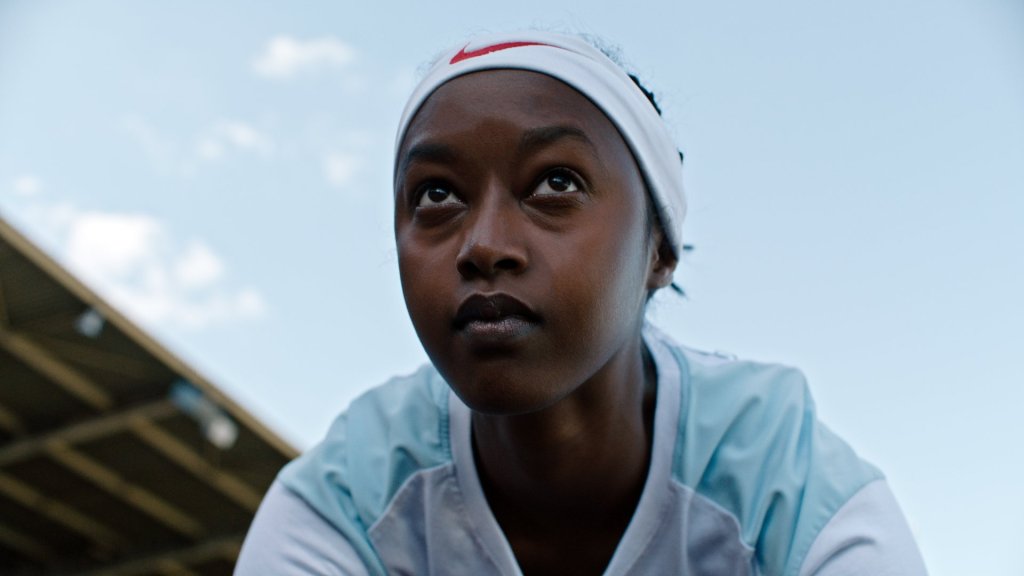
Samia (Riyan Roble) loves to run. Though only a little girl, she places among the top 10 runners in her town’s annual race. She lives in a walled compound with her strict mother, her fun-loving dad, her conservative brother Said, and her singing sister Hodan. She’s also good friends with Ali (Zakaria Mohammed) who is almost like a brother to her; his family shares their compound. But he’s a terrible runner so he appoints himself Samia’s coach.Like Rocky, they train outdoors, racing around corners and down back allies. Their goal? To make her the fastest girl in town! And as they grow older, the teenaged Samia and Ali (llham Mohamed Osman, Elmi Rashid Elmi) discover there’s a world beyond their city, beckoning Samia toward international competition.
But Somalia is unstable, with armed military tanks roaming the streets. Fundamentalists demand all girls wear a head scarf — but what about my running? asks Samia. Regional differences are on the rise and so are religious fights. Local armies and child soldiers are popping up everywhere, making it a dangerous place to live. Can Samia fulfill her dreams in an unstable country? Will she ever make it to the Olympics? And will her family support her if she does?
Samia is a bittersweet, naturalistic biopic inspired by true
events. It’s told in a series of extended flashbacks from her past remembered by an adult Samia, now fleeing Somalia for Italy, via Libya. This is an Italian film, co-directed by a Kurdish German, and an all-Somali cast. It reminds me a lot of Io Capitano (review here) from a few years ago, though this one, while touching and sympathetic, is less triumphant. It’s also rare — the first movie I’ve seen set in Somalia with Somali actors.
I liked this movie.
Oh, Hi!
Co-Wri/Dir: Sophie Brooks
Iris and Isaac (Molly Gordon, Logan Lerman: Indignation, The Lightning Thief) are a young couple in their twenties staying at a BnB in upstate New York. She is pretty, sexy and fond of practical jokes. He is good looking, chill, and open-minded. They’ve been dating for three months, but this one looks like a turning point. Isaac has perfectly arranged everything for the weekend: a beautiful house to stay in with a lake in the back, and delicious meals he cooks for her. And the sex! They are adventurous and passionate together. So when they uncover some bondage material in closet, they decide to try it out. Isaac agrees to be chained to the bed and it works out better than either of them hoped. But somehow the post-coital cuddling leads to some discussions, which reveal she thinks they have a monogamous long term relationship, while he thinks she’s fun and friendly but just another sex partner with no commitment. And all of
this happens while he is still tied to the bed.
Iris does not take this lightly; she feels betrayed. Isaac, on the other hand is genuinely frightened with her jokes about wanting to stab a previous boyfriend to death. And as time passes with little progress, both sides begin to panic. If she lets him go, will he call the cops and have her arrested for kidnapping? Is his life in danger? And when Iris’s best friend Max (Geraldine Viswanathan) and her boyfriend arrive to find Isaac still tied to the bed, it gets even more complicated. How will they ever get themselves out of this colossal mess?
Oh, Hi! is a hilarious sex comedy about trust, relationships and a date gone wrong. While I found some of the relationship psychologizing wasn’t fun, it only made up a small part of the movie. I’ve never seen Molly Gordon before — she co-wrote the script — but she has this uncanny ability to suddenly switch from gorgeous sex-goddess to google-eyed maniac. Logan Lerman is more of the straight man, but carries off his laid-back role quite nicely, considering he’s tied to the bedpost for much of the film. The story itself — along with the unexpected twists it takes — keeps you squirm-laughing almost all the way through. Though the audience at the screening I saw was maybe 80% women (who really seemed to like it), I think there’s lots there for men to think about, too.
This is a very funny movie.
Angela’s Shadow, Samia and Oh, Hi! all open this weekend in Toronto; check your local listings.
This is Daniel Garber at the Movies, each Saturday morning, on CIUT 89.5 FM and on my website culturalmining.com.
Magical kids. Films reviewed: The New Boy, Butterfly Tale, Once Within a Time
Hi, this is Daniel Garber at the Movies for culturalmining.com and CIUT 89.5 FM.
You’ve heard of Peter Pan, right? He’s most famous for not growing up and for believing in fairies. And it’s true, kids are more likely to believe in magic than grown ups. This week, I’m looking at three new movies about the innocence and magic of childhood. There’s a disabled, teenaged butterfly that wants to migrate with his flock; an indigenous boy with magical powers sent to a church-run school; and a group of kids forced to face a fairytale apocalypse.
The New Boy
Wri/Dir: Warwick Thornton (Sweet Country)
It’s the 1940s at a remote Australian Benedictine monastery. Sister Eileen (Kate Blanchett) is excited because there’s a new student arriving soon. She runs the place, ever since the head Benedictine monk died — she keeps this detail a secret from the outside world. The new boy (Aswan Reid) is indigenous, can’t speak English, and has had virtually no contact with white Australia. He has blond hair and brown skin. He sleeps on the floor, not on a bed, and finds forks and spoons a mystery. At the same time, he can conjure up glowing particles to light his way, using just his hands. And he has magical powers: he can speak to trees, and cures people bitten by poisonous snakes.
The sisters teach him out to use an outhouse (which he finds both funny and revolting), and about western ways and foods. Above all, Sister Eileen wants to convert him to Christianity — she lives him deeply, and wants to save his soul. She uses a life-sized wooden statue of Jesus writhing on the cross as the catalyst. She hopes to change him completely, and ultimately to baptize him and give him a Christian name. Will he convert? And what will happen if he does?
The New Boy is a gentle, bittersweet look at religion,
colonization, forced assimilation and residential schools (known as boarding schools in Australia), as seen through one boy’s eyes. I found it both inspiring and tragic. Kate Blanchett is wonderful as the scheming but good-hearted nun, while young actor Aswan Reid is remarkable as the unnamed new boy. (The movie opens with a violent fight between him and a soldier in the bush, just one of many surprising scenes he manages to convey without uttering a single word.) Director Warwick Thornton based it partly on his own experiences as a boy in Alice Springs, and those personal details and feelings come through.
I liked The New Boy a lot.
Butterfly Tale
Dir: Sophie Roy
Patrick (Mena Massoud) is a young monarch butterfly who recently made the transition from caterpillar. He and his best friend Marty are looking forward to joining his village on their annual migration to Mexico. He is especially excited about spending quality time with the girl he’s crushing on, Jennifer (Tatiana Maslany). But there’s a problem. Patrick emerged from his cocoon with mismatched wings, so he’s disabled and can’t fly. And Marty is still a caterpillar. They are teased and bullied by the bigger butterflies as “butter fails”.
Worse still, Patrick’s mom, a leading flier in the “flutter” (what they call their butterfly community) wants him to stay home in the winter. But Patrick and Marty are determined to get there by hook or by crook. Jennifer, a strong flier, is pulling a leaf filled with milkweed so they can all eat on the way. Patric and Marty stowaway aboard that leaf! Little did they know they’ll face tornadoes, big box stores and angry birds posing life threatening dangers on the way. Will Patrick ever learn to fly? Will Marty ever make the transition from caterpillar to butterfly? And will Jennifer get over her hangups?
Butterfly Tale is an animated, coming-of-age road movie
about anthropomorphic butterflies. They’re basically people, with human hair, faces, and bodies but with big butterfly wings coming out of their backs. They wear T-shirts and hoodies, and worry about adolescent insecurities. (They even have to stop the flight along the way to take a leak.) Little kids might really identify with the characters and like this movie; it has good role models for children with disabilities, and deals with environmental issues. The thing is, it’s not original or funny or risky or challenging anywhere, just a typical adolescent drama, where the people happen to be butterflies. I’m not saying it was uninteresting — it kept my attention the whole time — there just wasn’t much to it.
Once Within a Time
Wri/Dir: Godfrey Reggio
Once upon a time, a bunch of happy kids follow the beckoning voice of a goddess onto a stage. After riding a merry-go-round they start to notice strange happenings. An Adam-and-Eve-like young couple in wire masks take a piece of fruit from a sinister looking apple-man, unleashing terrible events. Smart phones generate robots, a chimp in a monkey suit and another in a VR helmet, huge industrial power-towers, a baobab tree exploding into a mushroom cloud. Ecological and geopolitical devastation is at hand! Can we survive the end of this world… or maybe start a new one?
Once Within a Time is a phantasmagorical, magic-lantern fable performed on a two dimensional stage beneath a prominent proscenium arch. It’s equal parts live-action, documentary
footage, still images, and 3-D stop-motion animation.
I first saw Godfrey Reggio’s Koyaanasqatsi as a teenager and the barrage of apocalyptic images of corporate uniformity combined with Philip Glass’s pounding music left deep marks in my psyche. This one is kinder and gentler but still effective. It’s co-directed and edited by Jon Kane with amazing vintage special affects from irises to rear projections to dual spectroscope photos. There are tinted black & white shots, shadow puppets, grotesque masks, and dancing robots
that evoke everything from Georges Méliès to Guy Maddin to the late Peewee Herman’s Playhouse. Who knew the apocalypse could be so beautiful? It’s less than an hour in length, but provides about three times that in intensity. If you can, see it on a big screen and just let the images and music overwhelm you.
Great movie.
Butterfly Tale is now playing in Toronto; check your local listings. The New Boy is a feature at the ImagineNative film festival starting next week. And Once Within a Time is playing tomorrow (Sunday, October 15th, at 5 pm) at the TIFF Bell Lightbox.
This is Daniel Garber at the Movies, each Saturday morning, on CIUT 89.5 FM and on my website, culturalmining.com.
Serious. Films reviewed: Beirut, Abu, Indian Horse
Hi, this is Daniel Garber at the Movies for culturalmining.com and CIUT 89.5 FM.
Spring film festival season is on now. Look out for Cinefranco featuring films from Québec; Human Rights Watch Film Fest with films from around the world, and here’s a new one: The Toronto International Porn Film Festival! This week, though, I’m looking at some serious movies. There’s a spy thriller set in Lebanon, a family memoir in Pakistan and Canada, and a drama about Canada’s residential schools.
Dir: Brad Anderson
It’s 1972 at the US Embassy in Beirut. Mason (Jon Hamm) and his wife are hosting a party for bigwigs from Washington. Helping out is Karim, an earnest 12-year-old Palestinian kid who they treat like a son. But all is not well. His best friend, Cal, a CIA agent
tells him something’s up with that cute little boy so they’re just going to take him away to a dark cell somewhere for awhile.
What–? Mason objects, but just then, gunmen enter the embassy, kill his wife, and drive off with the boy. Mason’s life is ruined. Ten years later he’s back in the States, staying just
sober enough to keep his job as a labour negotiator… when out of the blue comes an urgent call: top government officials wants him back in Beirut, but they won’t say why.
He is met by Sandy (Rosamund Pike) in the now wartorn city, who fills him in. Militants have kidnapped an American and have asked Mason to negotiate. Turns out the kidnappee is his old friend Cal, and the kidnapper? Little Karim, now all grown up. Can Mason defuse the tensions, negotatiate a trade between the
CIA, the Mossad, the PLO, the Lebanese government, splinter groups and corrupt officials? Or will the intrigue and subterfuge prove too much for him to handle?
Beirut is a neat and taut action thriller with lots of suspense
amidst the twists and turns. (The script is by Tony Gilroy who did the Bourne trilogy.) Poltically, though, it’s a total mess. The film is loaded with visual “shorthand”, so 1982 Lebanon is represented by a woman in a niqab beside a camel on the beach! Really?? This isn’t Saudi Arabia in 2018, it’s Lebanon in 1982. The movie also implies that every Arab child is a potential terrorist in the making.
Still the acting is good, the pace brisk and the game-theory-fuelled plot is fascinating to watch.
Wri/Dir: Arshad Khan
Arshad is a little kid growing up in Pakistan to an Army engineer dad and an upper-class mom. He likes dancing to disco music and being flamboyant. And by his teenaged years he’s secretly dating another boy. The parents find out and he is deeply humiliated.
Later, the family moves to Canada, where he stands out for a different reason. Suddenly, he’s Pakistani, he’s an immigrant, he’s a person of colour – with all the racism that comes with his new identity. Arshad
gradually feels his way through an unfamiliar, racialized setting, as a South Asian, as a Canadian, as a gay man, and as a political activist. His parents veer in the opposite direction. They gradually turn to fundamentalist Islam, which they learn about in their new home. Can this family stay together?
Abu is deeply personal film, that serves as both a tribute to Arshad’s parents (Abu means father) and a look at his own life. It’s filled with family photos, videos, and interviews – his parents were movie enthusiasts who recorded everything. These random vignettes are strung together with an unusual plot device – an animated version of a dream he has that proves prophetic. Though the story is routine, much like what countless other new immigrants to Canada experience, I love the way the film puts everything – history, pop culture, music – into a larger context.
Dir: Stephen S. Campanelli
Based on the novel by Richard Wagamese
It’s the 1950s in Northern Ontario. Saul Indian Horse (Sladen Peltier as young Saul; Forrest Goodluck as teen Saul; Ajuawak Kapashesit as
adult Saul) is a young boy raised by his grandmother (Edna Manitowabi) who teaches him the Ojibway ways. Until the day government officials arrive in a fancy car who literally pull him out of his grandmother’s arms. They leave him at St Jerome’s a Catholic residential school where they can “kill the Indian in
him”. Right away they cut off his hair, forbid him from speaking his language. The school is run by cruel priests and nuns, who abuse the kids physically and psychologically. Some are tortured, even locked up in a cage in the basement. Saul is a survivor and stays out of trouble, unlike his best friend who can’t hack it… and suffers terribly.
Saul comes up with a way to get out of the place: hockey. He’s
seen it on B&W TV at school and it speaks to him. He’s sure if he learns to skate and practices on his own every morning, hockey will save him. He’s helped by way of a deal he makes with Father Gaston (Michiel Huisman), a friendly priest who takes a liking to him. It turns out Saul’s right – he is a fantastic player. He joins a native hockey team up north and slowly climbs his way up the ladder. He faces racism and discrimination at every step but he keeps his identity and sense of self. Eventually he gets drafted to the NHL and sent to Toronto – their first
indigenous player. But deep inside, something from his past is eating away at him. What will become of Saul? Will he succeed in his dreams? Or will his experiences at the residential school drag him down?
Indian Horse is a deeply moving story, starring indigenous actors playing Saul at each stage of his life. It exposes a recent, shameful part of Canadian history, and one that’s still being felt today. The movie is not perfect or without flaws — it was made with a limited budget, and isn’t a Hollywood-style pic with a feel-good ending. But I think it’s a really good drama about an important topic, and one that should be required viewing across this country.
Beirut, Abu and Indian Horse all open today in Toronto; check your local listings. Also opening is the fantastic, realistic drama Lean on Pete which I reviewed here last September and is also on my New Year’s list of best movies of the year.
This is Daniel Garber at the Movies, each Friday morning, on CIUT 89.5 FM and on my website, culturalmining.com.


leave a comment