It’s dangerous! Films reviewed: Daniela Forever, Apocalypse in the Tropics, We Were Dangerous

Posted in 1950s, Brazil, Coming of Age, Fantasy, High School, Horror, Indigenous, Maori, New Zealand, Politics, Religion, Romance, Spain by CulturalMining.com on July 12, 2025

Hi, this is Daniel Garber at the Movies for culturalmining.com and CIUT 89.5 FM.

Guillermo del Toro, the celebrated director who splits his time between Mexico and Canada, has curated a series of classic Canadian horror movies called From Rabid to Skinamarink: Canadian Movie Madness, playing at the TIFF Lightbox this weekend.  I happen to have seen everyone of them myself, and I totally agree with del Toro’s selection.  You can catch Canadian gems like the feminist werewolf drama Ginger Snaps, Vincenzo Natali’s cult-hit Cube, Kyle Edward Ball’s experimental Skinamarink, and many more. 

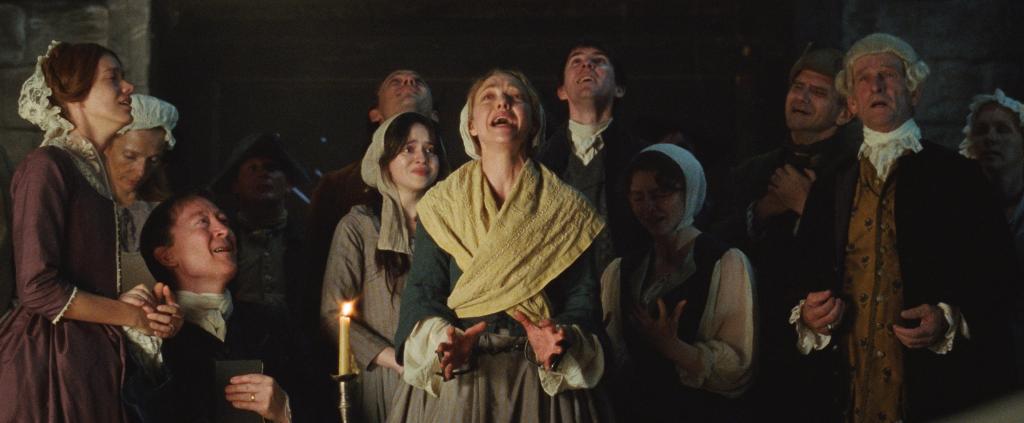
But this week, I’m looking at three new movies from abroad: a surreal fantasy from Spain, a politically documentary from Brazil, and a period drama from New Zealand.

Daniela Forever

Wri/Dir: Nacho Vigalondo

It’s present-day Madrid. Nicolas (Henry Golding: Crazy Rich Asians) is a popular DJ at the city’s hottest nightclubs. But he is thrown into a deep depression when his girlfriend, an artist named Daniela (Beatrice Grannò: The White Lotus) is killed by a negligent driver just outside his home. But things take a turn for the better when a good friend of his, Victoria (Nathalie Poza), tells him of a new, experimental drug that might be just what he needs. But it’s top secret, filled with non-disclosure clauses, and requires regular visits to the pharmaceutical labs. The scientists there tell him each pill, if taken just before bed, will produce lucid dreams, real visions where he can control the content and won’t forget about them when he wakes up. This means he can bring Daniela back to life, at least while he sleeps. But he soon discovers its limitations: he can’t dream about something he’s never seen. If he turns down an ally he’s never visited, it will be covered in unformed, writhing grey matter. Kinda creepy.

Daniela seems artificial at first, but as time progresses, she starts turning real. She even produces creative ideas and thoughts that he doesn’t remember ever experiencing in the awake world. And far from seeming etherial, his lucid dreams are now wide- screen images in living colour, while awake time is small and drab. He can take Daniela to new places just by thinking about them and opening a door, and change the city of Madrid into something out of one of her paintings. But he soon realizes, not everything is going the way he planned. And when things from his dream world start appearing in awake time, he has to wonder what is real? Can he be in love with someone who doesn’t exist? And can she ever really love him if she’s just a figure of his imagination?

Forever Daniela is a highly- creative science fiction romance about love, death and reality. While it sounds like a Black Mirror jump-scare thriller, it actually avoids most  “bad” things except for the sadness of mourning. It also has a very surprising twist at the end (no spoilers). The film is Spanish, but most of the dialogue is in English. Henry Golding (Crazy Rich Asians) is appealing as the leading man, but runs into a bit of acting trouble when he tries to do a full-fledged meltdown. The special effects are excellent, fooling around with unusual concepts like daytime light and shadows in a nighttime environment. I quite like the writer/director Nacho Vigalondo

for the way he incorporates horror movie elements within an otherwise realistic context (like his film Colossal a few years ago.) So if you’re looking for something that’s surreal and supernatural but told in a positive, though bittersweet, way, I think you’ll like Daniela Forever.

Apocalypse in the Tropics

Wri/Dir: Petra Costa

Brasilia — a capital city  designed, planned and built from the ground up — was meant to be modern, secular and democratic. But after a coup-d’etat in 1964, Brazil became something other than democratic: a military dictatorship which ruled for the next two decades. So when a new, populist right-wing leader with military ties emerged in the 2010s, many Brazilians were wary of democracy falling again. But Jair Bolsonaro was different, a politician who changed his power base when he forged ties with evangelical Christians. 

Apocalypse in the Tropics traces Brazilian politics over the past decade and the rise in religion within government policies. It also gives background, from the building of the capital, through the military coup, American evangelist Billy Graham, the return to democracy, and more recent developments. It uses beautiful period footage, lush music and symbolic paintings — like Hieronymus Bosch’s Garden of Earthly Delights —  as a metaphoric portrayal of millenarian changes in Brazilian politics. It is narrated by the filmmaker and includes her one-on-one interviews with Bolsonaro, current President Luiz Inácio Lula da Silva, and the wildly popular televangelist, Silas Malafaia, who served as Bolsonaro’s right-hand man. We witness Malafaia’s sermons before huge crowds — shouting his opposition to same-sex marriage, abortion rights, and feminism — as well as intimate conversations aboard his private plane. The doc also shows new footage of the beloved capital Brazilia occupied and trashed by massive demonstrators, who called for a coup after Bolsonaro’s defeat. 

Apocalypse in the Tropics is a follow-up to Petra Costa’s 2019 film The Edge of Democracy with similar footage, style, and topic but concentrating this time on religion’s role in government policies. I’m not sure if this is a sequel, a reshoot or a continuation, but either way, it’s as aesthetically beautiful as it is disturbing. 

We Were Dangerous

Wri/Dir  Josephine Stewart-Te Whiu

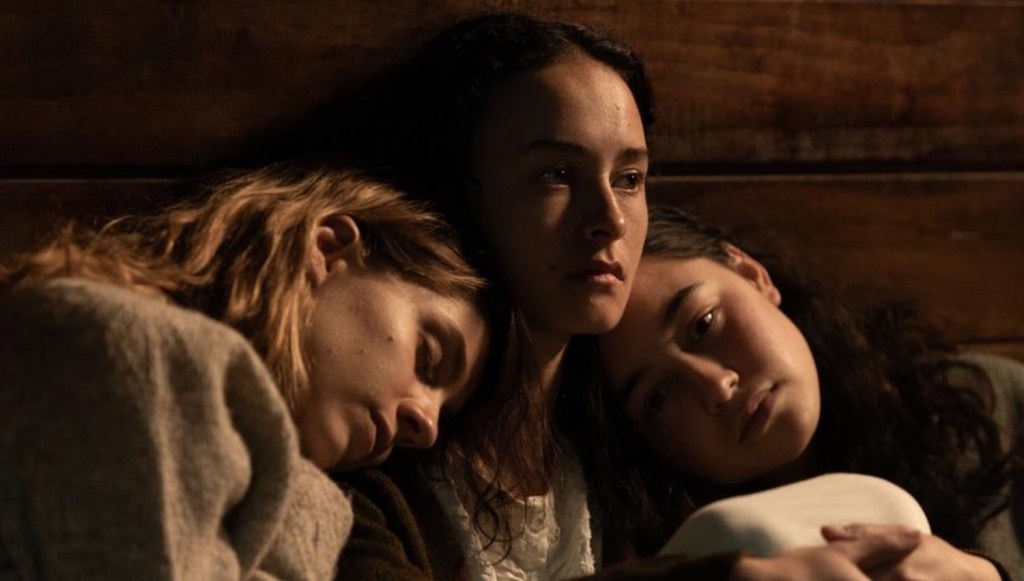
It’s the 1950s on a small island somewhere off the coast of New Zealand, where three girls share a cabin: Daisy, Nelly and Lou (Manaia Hall, Erana James, and Nathalie Morris). They were sent there by the authorities or their parents. Te Motu is a school for “incorrigible” girls or, as the administrators call them, “whores, queers, delinquents and sexual deviants.” Many are orphans or runaways caught stealing food, like Daisy or Nelly. Lou is the exception. She comes from a rich family but was caught making out with her (female) tutor. The school operates under the strict rule of Matron (Rima Te Wiata), who has a cruel streak a mile long. Raised by nuns, she feels the only way to cure these girls’ bad attitudes is through the bible and the lash. Naturally the girls all want to get the hell out of there, but it’s hard to escape from an isolated island in the south pacific. The purpose of the school is to turn bad girls into happy homemakers. They are given lessons in diction and manners but not reading or math. Matron is frustrated by their outcome: She says they are “too stupid for school, to uncivilized to be maids and too barbaric to work”. Every so often, Matron is visited by men in suits from the mainland, one of whom suggests a horrifying treatment. But when Nelly find out, the three girls decide they have to do something to stop it.

We Were Dangerous is a moving, coming-of-age story about girls surviving in 1950s New Zealand. It’s bright and exuberant, full of playfulness and dancing, Haka and history, and though fictional, it tackles the very real issue of the mistreatment of indigenous girls. The acting is excellent all around, full of subtle clues and delightful details. For a first film, Stewart-Te Whiu avoids many potential stumbles and instead gives us a solid film that’s fun to watch. It played at ImagineNative this year, and is definitely worth seeing.


Apocalypse in the Tropics is playing this weekend at HotDocs and will be streaming on Netflix this coming week; Daniela Forever opens this weekend in Toronto; check your local listings; and We Were Dangerous is available now on VOD.

This is Daniel Garber at the Movies, each Saturday morning, on CIUT 89.5 FM and on my website culturalmining.com.

Intrigue. Films reviewed: The Phoenician Scheme, The Ritual, Ballerina

Posted in 1920s, 1950s, Action, comedy, Crime, Horror, Nun, Religion, Satanism, Thriller, violence by CulturalMining.com on June 7, 2025

Hi, this is Daniel Garber at the Movies for culturalmining.com and CIUT 89.5 FM.

imagineNative — Toronto’s own indigenous film and media arts festival — is on now through Sunday with docs, films, exhibitions and performances from around the world with both free and paid events.  Check it out!

But this week I’m looking at three new movies: an art house comedy, a religious horror movie and an action thriller. There’s a devious mogul preparing his daughter to take over his busines, a priest attempting an exorcism, and a professional assassin fighting to avenge her dad.

The Phoenician Scheme 

Co-Wri/Dir: Wes Anderson (Reviews: Fantastic Mr Fox, Isle of Dogs, The French Dispatch, Asteroid City)

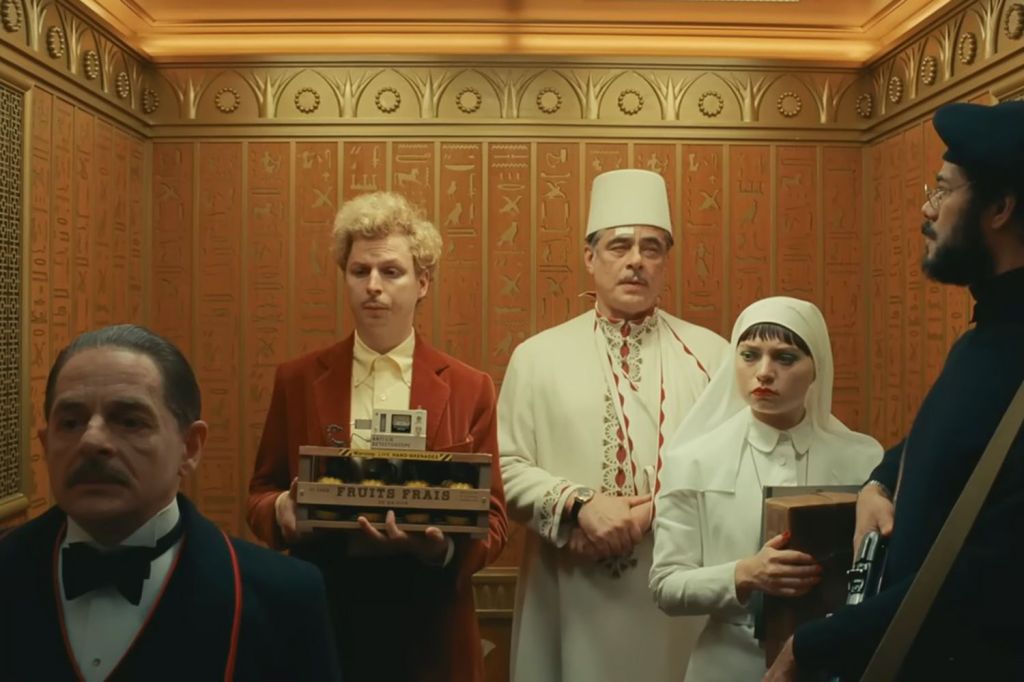
Zsa-Zsa Korda (Benicia Del Toro) is the richest industrialist in the world. He amasses millions by embarking on huge projects in developing countries using virtual slave labour. He’s ruthless and cruel. He has sired a dozen kids whose names he can’t remember and whom he keeps locked up in a threadbare orphanage. Except, one. Liesl (Mia Threapleton) is a novice, brought up in a convent and dresses like a nun but who who has yet to take her vows. Korda is grooming her to take over his huge business interests after he dies. And attempts on his life — like poisons, bombs and sabotaged airplanes — are a routine part of his life. But he always seems to survive. And so he embarks on a grand scheme to involving interconnected tunnels, waterways and cornering global markets. But first he must raise the money from investors. He takes Liesly along with him as he carries out his complex plans. And accompanying them is Bjorn (Michael Cera) a Scandinavian tutor, ostensibly hired to educate his kids, but instead tags along on these journeys. But they face hostile business partners, revolutionaries, spies and assassins, quicksand, plane crashes and other symbols of disaster. Will his scheme be successful? Will Liesl learn to love him? And will he survive the final attempt on his life?

The Phoenician Scheme is an art-house comedy film, the latest in Wes Anderson’s collection. It’s stylized and formalistic, shot in almost two-dimensional geometric settings with precisely directed sequences. Combining social satire with silliness, it’s wacky and always surprising. It consists of a series of segments as he checks off the list of the projects he planned as he swindles repeated capitalists out of their investments. The story line is punctuated by repeated dreams fantasies of Korda — in his near-death experiences — as he faces judgement in Heaven, but always ending up back again on earth. Threapleton is fun to watch as she gradually transforms from an avowed zealot to a lover of luxury, as Korda replaces her rosary with semiprecious stones, and her simple corncob pipe with an inlayed treasure from Cartier. Cera is hilarious as the insect-loving tutor Bjorn, and Del Toro is sufficiently both grand and seedy to convey his anti-hero’s character. Like all of Wes Anderson’s films, many members of his stable of actors reappear in short, cute roles: Tom Hanks, Willem Defoe, Bryan Cranston, Charlotte Gainsbourg, Richard Ayoade, Scarlett Johansson, Ris Ahmet, Bill Murray, and Benedict Cumberbatch, to name just a few. Some people are put off by Anderson’s emphasis on style and form — which, admittedly, doesn’t always work — but in this case, I think he’s made a fine movie that’s a pleasure to watch. 

The Ritual

Co-Wri/Dir: David Midell

It’s the late 1920s in a small town in Iowa and Father Joseph Steiger (Dan Stevens) is mourning the death of his only brother. But his grief is interrupted by a young woman in his parish. Emma Schmidt (Abigail Cowen) says she is possessed by a demon. For many years she has seen doctors and psychiatrists but no one can explain her strange condition. So she has turned to the Church to cure her, and says only an exorcism can free of from her very real torment. This is unheard of, but the ritual has been approved by the local Bishop, with an expert in demonic possession heading their way. Father Theophilus Riesinger (Al Pacino) is a shaggy-haired little monk who wears a cowl and talks like Tevye from Fiddler on the Roof. But he knows the practice of exorcisms inside and out. Along with a bevy of assorted nuns to help out, the ceremony begins. Emma is tied to the bed as her body writhes. She  pukes pea soup and breaks out in weird rashes. The furniture flies around the room as she curses in five languages. But can they exorcise this demon before it consumes her?

The Ritual is a horror movie that (supposedly)  reenacts an actual historical event: the performance of an exorcism in the US. The script is based on documents from that era. Thing is it is also the inspiration for William Friedkin’s iconic film The Exorcist, and the novel, by William Peter Blatty, it was based on. This version has atrocious writing, painful acting, and cheap-ass special effects. Fear and grief is conveyed by actors covering their faces with their hands, over and over. The whole movie is shot with in extreme close-ups using a hand-held camera that jiggle enough to make any viewer feel nauseous. Although the chapters of each ritual is documented, there’s minimal difference from one to the next. It isn’t even vaguely scary, more boring than anything else. It feels more like a Sunday school sermon than a horror movie. Al Pacino? Dan Stevens? These are famous actors! What are they doing in this dreadful movie? They must really be desperate. 

The obvious question is, what possessed the filmmakers to attempt to retell a story that’s already been told so well?

What a clunker. 

Ballerina

Dir: Len Wiseman

Eve (Ana de Armas) is a little girl raised by her father in a hidden palace somewhere in Eastern Europe. She is kept hidden from the rest of the world for her own safety. Until a man named The Chancellor  (Garbiel Byrne) tracks her down, kills her father and takes her away. All she has left to remember her dad by is a music box snow globe with a dancing ballerina inside. She is immediately enrolled in a school run by The Director (Anjelica Huston), a cruel teacher in the tradition of the Ruska Roma who trains her girls to endure the pain of classical ballet dancing. They also learn how to kill their adversaries using fists, kicks, knives or any other dangerous object. Upon graduation, only those with true bloodlust are farmed out across the globe as killers to hire. And Eve is at the top of her class. She is highly successful as an assassin, but has another hidden motive: vengeance for the death of her father and sister.

Her relentless search leads her to a picturesque alpine village filled with jolly bakers and wood carvers. The women have blond braids and rosy cheeks while the men happily quaff steins of pilsener. Unfortunately, everyone in the village, I mean everyone, is a trained killer. And they happen to belong to a criminal outfit in an uneasy truce with the clan works for. Can she find her father’s killer and escape the village alive?

Ballerina is an action/thriller about a young, female assassin out for revenge. Its a spin-off of the John Wick franchise with many of the same recurring characters, including cameos by Keanu Reeves as John Wick himself. The plot is simple, and the script has relatively few lines. What it does have is fighting and lots of it, which it does really well, whether hand to hand or using enormous lethal weapons. The fight choreography is skillful and creative — it’s ballet. And I liked Ana de Armas as the protagonist… enough that if there were another Ballerina movie, I’d watch that one too. This is good action feature.

Ballerina and The Ritual both open this weekend in Toronto and The Phoenecian Scheme expands across Canada; ; check your local listings;

This is Daniel Garber at the Movies, each Saturday morning, on CIUT 89.5 FM and on my website culturalmining.com.

A coup, a cult and a cry. Films reviewed: The Penguin Lessons, AUM: the cult at the end of the world, Bob Trevino Likes It

Posted in 1970s, 1990s, Argentina, comedy, documentary, Family, High School, Japan, Protest, Religion, Social Networks, US by CulturalMining.com on March 29, 2025

Hi, this is Daniel Garber at the Movies for culturalmining.com and CIUT 89.5 FM.

In these times of extreme uncertainty, many people feel there’s something missing in their lives but they’re not sure what. Some turn to new religions for spiritual fulfillment, others to pets they can love, or to chosen families to replace their inadequate biological ones.

So this week, I’m looking at three new movies, two dramas and a documentary about people trying to replace something missing. There’s an English teacher in Argentina who talks to a penguin, a  caregiver in Kentucky looking for a replacement dad, and a religious cult in Japan trying to bring about the end of the world.

The Penguin Lessons 

Dir: Peter Cattaneo

(Based on a true story)

It’s March, 1976 in Buenos Aires, Argentina. Tom Michell (Steve Coogan) is a newly-hired English teacher at a boys’ prep school for rich kids. It’s run by the strictly by-the-book Headmaster Buckle (Jonathan Pryce). No pets and no politics. Divorced, middle-aged and jaded, Michell cares little about morals. He describes himself as like Hemingway but without money and who never wrote anything. The boys in his class are spoiled and unruly; they don’t listen to a word he says. But bombs and rifles can be heard even within the walls of this elite academy. There’s a US-backed coup d’etat going on out there to install a military dictatorship! When the school closes for a week, Michell and fellow-teacher Tapio, a hapless Finn (Björn Gustafsson) head out to the Punta del Este in Uruguay to sit out the coup. But a romantic seaside stroll with a woman Michell meets turns —  much to his chagrin — into a mission to save a flock of birds caught in an oil spill. They clean a penguin’s feathers, but by morning, the woman’s gone, and the penguin won’t leave him alone. He reluctantly takes him back to the school, in the hopes of donating him to a zoo. But the school kids adore him, and actually start to pay attention as long as the bird is around. But all is not well. Plainclothes police are disappearing anyone who disagrees with the government, including the beautiful but opinionated Sofia (Vivian El Jaber), the school’s cleaning woman.

Can a little penguin bring peace to the school and pull them all together? What will happen if Headmaster catches him with the bird? And will Michell ever stick his neck out to challenge the status quo?

The Penguin Lessons is a touching, cute, nostalgic and easily digestible story set during a dark and sinister era. Director Cattaneo brought us similar English crowd-pleasers like The Full Monty. And I’ll see anything with Steve Coogan in it. This movie is full all the cliched crowd pleasers: kids, animals, history, and a wise-cracking cynic who might have a soul. But I don’t care. That penguin is just soooo cute. 

OK, I admit it, I’ve been played, I’m a sucker of a critic who fell for a bird… but so will you. 

I liked this movie.

AUM: The Cult at the End of the World

Wri/Dir: Ben Braun, Chiaki Yanagimoto

It’s March, 1995 in Tokyo when something unexpected and terrifying happens. Someone lets loose poison gas at Kasumigaseki station, where three train lines converge. 5,800 people are injured and 13 of them killed. And this is a planned attack, not an accident. Who is responsible and why did they do it?

Decades early, a child named Chizuo is born into a post-WWII family with visual disabilities. Years later he opens a yoga school to attract paying customers. Somewhere along the way, it changes first into a religious sect, and later into a bonafide cult with tens of thousands of members. The group is called Aum Shinrikyo, and they set up headquarters on the banks of the sacred Mt Fuji.  Their guru, now known as Shoko Asahara, with long hair and beard and flowing pink robes, convinces his worshippers that he is a god with supernatural powers. Popular music and anime videos extolling Asahara attract lots of favourable media attention, and detached young Japanese join in droves to experience miracles like levitation. These followers drink his bathwater or take tiny transfusions of his blood, even as he drains their bank accounts dry. Others have wires attached to their brains. Only bland food is permitted, no sex, no free-thinking. The cult expands internationally, migrating to Moscow once the Soviet Union falls, converting countless Russians to their cause. And while they’re there, they get ahold of military-grade artillery, chemical and biological weapons which they ship back to Japan. And eventually this leads to the horrific Sarin gas killings, in Tokyo and Matsumoto.

AUM: The Cult at the End of the World is an extensive, shocking and at terrifying documentary about this bizarre and dangerous cult. It covers the story throughout Asahara’s life and beyond, using period footage and new talking-head interviews. It goes right to the source — its victims, innocent people wrongly blamed for Aum’s crimes, journalists who follow the story, and advocates who — long before the sarin attacks — were trying to free friends and relatives from their clutches. Perhaps most chilling of all are the interviews with Joyu the high-ranked Aum Shinrikyo member who was allegedly behind some of its most heinous chemicals weapons.

I found this documentary extremely engrossing and well researched, narrated  in the form of an oral history by those most affected by these atrocities. I couldn’t stop watching this one. I wonder why there have been loads of movies about the Manson Family, but relatively few on Aum Shinrikyo. This one helps fill that gap.

Bob Trevino Likes It

Wri/Dir: Tracie Laymon 

(Based on a true story) 

It’s present-day northern Kentucky. Lily Trevino (Barbie Ferreira) is young woman who works as a caregiver for Dapne (Laureen “Lolo” Spencer) a woman with a degenerative condition. Lily has no friends, and 

her boyfriend dumped her using texts. Robert Trevino, her dad (French Stewart) is a flippantly cruel and self-centred man-boy responsible for most of Lily’s neuroses. He blames her for ruining his life (her mom died as an addict when she was a child). But things hit rock-bottom when her dad cuts off all communication with her. In a desperate search on Facebook to see what he’s up to, she ends up “liking” a different Bob Trevino. This Bob (John Leguizamo) is everything her own father is not. He’s kind, honest and giving, someone who pays attention to her texts. Bob works as a contractor out of his trailer. He has few hobbies — he likes gazing at the shooting stars, while his wife Jeanie (Rachel Bay Jones) is into making scrap books. When childless Bob and parentless Lily finally meet face to face, they feel a familial warmth they can’t quite explain. Jeanie thinks Lily’s a grifter or an aspiring catfish, trying to get his money. While insecure Lily is afraid of messing things up. Can two people, who live in different states ever have a real friendship? And is this new friendship superficial or deep?

Bob Trevino Likes It is a very cute, very sweet tear-jerker of a movie about friendship, kinship and chosen families. Much of the story is told through text messages and Facebook posts. Barbie Ferreira plays Lily as a non-stop faucet. She weeps in the opening, she cries in the middle and bawls at the end. And as the viewer, I cried along with her. John Leguizamo — once known for his over-the-top comedy — is at his most restrained in this one. But despite all the tears, it’s told in a light, humorous way.

This is a really nice indie movie.

Bob Trevino Likes It is now playing across Canada, with The Penguin Lessons opening this weekend in Toronto; check your local listings. And Aum is now available on VOD.

This is Daniel Garber at the Movies, each Saturday morning, on CIUT 89.5 FM and on my website culturalmining.com.

Dangerous jobs? Movies reviewed: Love Hurts, Dark Nuns, Bring Them Down

Posted in Action, Farming, Ireland, Korea, Nun, Organized Crime, Religion, Romantic Comedy, Vengeance by CulturalMining.com on February 8, 2025

Hi, this is Daniel Garber at the Movies for culturalmining.com and CIUT 89.5 FM.

Look at Me, a movie from Nova Scotia about an insecure, bisexual actor with an eating disorder, is finally opening in Toronto! In a review about year ago, I called it a “scathing — and humorous — self-examination that exposes Taylor Olsen’s innermost thoughts and fears.” Check it out.

But this week, I’m looking at three new movies (two by first-time directors) from around the world. They’re all about people who work at peaceful and innocuous jobs who encounter danger and even death. There’s a Catholic nun in South Korea, a real estate agent in Milwaukee, Wisconsin, and a sheep farmer in rural Ireland.

Dark Nuns

Dir: Hyeok-jae Kwon

Somewhere in Korea, a teenaged boy named Hae-Jun (Moon Woo-jin) is suffering from a serious illness. The doctors are baffled by his condition; nothing they try is working. But Sister Giunia (Song Hye-kyo) a Catholic nun, identifies the problem immediately: the boy is possessed. You see, Sister Giunia is a Dark Nun, a woman born with indigenous shamanistic powers. She can hear what demons say. And this boy needs a full-blown exorcism. But she can’t do it alone.

She turns to Sister Michela (Jeon Yeo-been), a much younger nun, for help. A Dark Nun like herself, Michela is adept at reading tarot cards, and can use her powers to see vision,  and manifestations of evil. But she is a nun now, and a nurse. She said goodbye to all that mumbo-jumbo years ago, and, besides it’s expressly forbidden by the Church — especially Father Paolo (Lee Jin-wook). He may be a scholar of exorcism, but he doesn’t believe in it. But Giunia is convinced the boy will die unless they intervene. Can she get sister Michela to come aboard? Will the church ever let them do it? And can two nuns and a  stammering shaman defeat Satan himself?

Dark Nuns is a pretty typical exorcism/horror movie but with a twist: It incorporates Buddhism and Shamanism within a Catholic ritual. There are a lot of quirks in this movie. Like why do all the Korean priests and nuns have Italian names, like Paolo, and Michela? Are they Ninja Turtles? And the exorcism seemed way off: heavy on the holy water — she pours gallon after gallon of it on the kid! — but awfully light on bibles, crosses or rosary beads. Then there’s the biggest problem of all: it’s a horror movie, but it just isn’t scary. What’s good about this movie? I like the way it compares Korean patriarchal neo-Confucianism with a Catholic Church keeping women out of positions of power. I’m intrigued by the culture-clash of Christianity meets Shamanism. But if you’re looking for a Korean horror movie about shamans and possession, you should watch last year’s Exhuma, instead.

Love Hurts

Dir: Jonathan Eusebio

It’s Valentine’s Day in the suburbs of Milwaukee, and  Marvin Gable (Ke Huy Quan) is busy baking heart-shaped cookies. No, he’s not in love or in a relationship; all his efforts are focussed on his career as a real estate agent. And he considers all his clients as his friends. But everything changes when a valentine’s day letter appears on his desk. Rose (Ariana DeBose) is back in town. You see, before he went straight, he used to be a killer employed by his older brother Knuckles (Daniel Wu) who is a powerful local gangster. And killing Rose was his last job. The thing is, he didn’t kill her and now everyone wants to have a word to Marvin Gable. There’s the poet-assassin Raven (Mustafa Shakir) along with a slew of other killers, with weird names like King, Otis Merlo and Kippy. Can he dodge the bullets and kill the killers, without harming all the clients trying to buy his houses? Or will he be dragged back into a dark world he thought he had left far behind?

Love Hurts is an action movie about people trying to kill each other. Despite the extreme violence it’s told a light and somewhat humorous manner. Unfortunately, it’s also tedious and predictable. The dialogue is dumb, the plot is basically non-existent. (There is also a rom-com sub-plot, with various characters falling in love with their respective crushes, but that seems like an afterthought more than part of the story.) So what’s good about it? Two things. Jonathan Eusebio is obviously a first-time director, but what he is not  new at is fight scenes. He’s a highly experienced fight choreographer, and luckily most of the movie consists of creative takes on people throwing knives and kicks as they destroy the interiors of houses and video stores. This I like. First time I’ve ever witnessed a killing using a bubble tea straw. And the cast is appealing too. It’s nice to see Ke Huy Quan back again after his big comeback in Everything, Everywhere, All at Once. He’s funny! So are Ariana DeBose, Lio Tipton, Sean Astin and Drew Scott… the whole crew.

Is this a good movie? Not really, but it’s very light, easy to watch, and the fight scenes are well-done. 

Bring Them Down

Wri/Dir: Chris Andrews

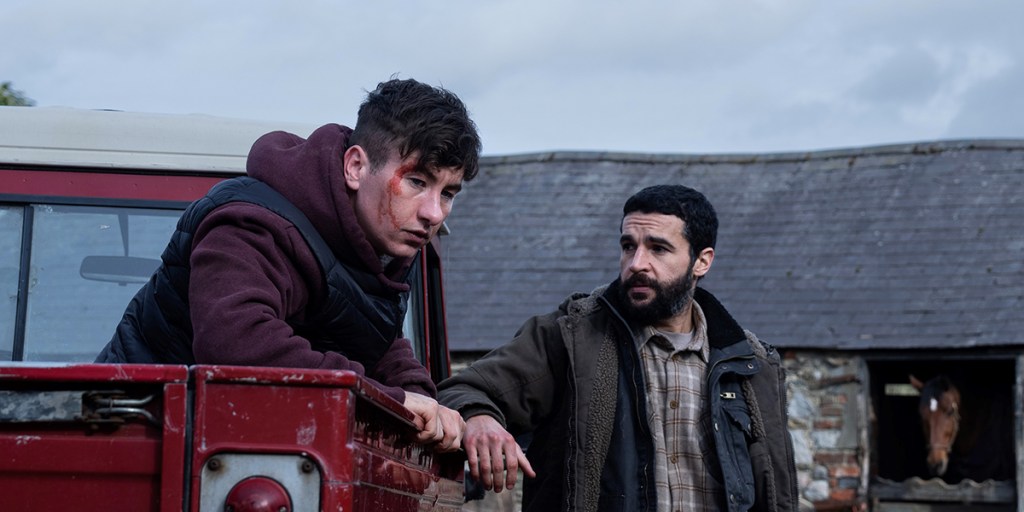
It’s rural Ireland in the present day. Michael (Christopher Abbott) runs a one-man sheep farm, where prize-winning rams graze on rocky hillsides. His abusive dad Ray (Colm Meaney) sits in the kitchen all day shouting angry epithets in Irish at Michael about all the things he’s doing wrong. In the next sheep farm over, young Jack Keeley (Barry Keoghan) does much the same as Michael but not very well. His dad Gary (Paul Ready)  — who is Michael’s age — tries to keep things going but the farm is bleeding money. Gary is married to Caroline (Nora-Jane Noone), Michael’s ex, and Jack can see his parents are not getting along. Michael hasn’t seen her for 20 years, ever since a car accident killed his mother and sent Caroline to hospital with serious injuries (The accident was Michael’s fault).

But their relatively bucolic lives are interrupted when two rams disappear from Michael’s flock. And there’s only one place they can go — to the Keeley farm just over the hill. But Jack claims they both suddenly died and he threw their bodies into a pit…a very unlikely story. This signals the start of a feud between the two families, involving simmering grudges, sheep poachers, and organized crime. Can their conflicts ever be resolved? Or are both farms headed for ruin, violence and possibly even death?

Bring Them Down is a violent, suspenseful drama about escalating grudges between two houses. It’s done in that chop-up style popular among some European arthouse directors where the narrative is not told chronologically. Your perception of “who is to blame for what” gradually shifts as new scenes fill in the blanks. I liked the acting and the dialogue — half of which is in Irish — and it has a compelling plot. The settings are just beautiful, with wide panoramic views of hillsides at dusk and dawn, and images like Michael carrying a lame sheep draped over his shoulders. There are also some strikingly original tableaux like the sheep at an auction house. This is a good first film — it reminds me of Frozen River and Winter’s Bone, all serious looks at crime in rural settings. But why are all these movies about brooding Irish men so depressing? What miserable lives these people seem to lead! If there were a bit of humour or love, Bring them Down would have been a lot easier to take.

But it’s still a good movie, anyway.

Dark Nuns, Love Hurts, and Bring them Down are all opening this weekend in Toronto; check your local listings. This is Daniel Garber at the Movies, each Saturday morning, on CIUT 89.5 FM and on my website culturalmining.com.

Films reviewed: Your Monster, Drive Back Home, Conclave

Posted in 1970s, Canada, Catholicism, LGBT, Monsters, Politics, Religion, Romantic Comedy, Theatre, Thriller by CulturalMining.com on October 26, 2024

Hi, this is Daniel Garber at the Movies for culturalmining.com and CIUT 89.5 FM.

More Film Festivals are coming up soon, with ReelAsian, Cinefranco and BITS, Blood in the Snow, just around the corner.

But this week, I’m looking at three great new movies. There’s a consortium of cardinals locked in their chambers; a monster discovered in a closet by a NY actress, and a Toronto man forced out of his closet by the police. 

Your Monster

Wri/Dir: Caroline Lindy

It’s present day Manhattan. Laura (Melissa Barrera) is a triple threat — she can sing, dance and act. She’s helping her boyfriend Jacob (Edmund Donovan) write his breakout musical, soon to open on Broadway with her in the lead role. But when she gets sick — the big C! — and needs surgery, he dumps her — out of the blue — while still in hospital. And casts another actress (Meghann Fahy), in her part. The surgery is a success but Laura is a total wreck. She’s doubly devastated, both from the sudden end of her five year relationship and for being cheated out of her big break. Her anger, frustration and self pity are all ready to explode. That’s when she makes an unexpected discovery. There’s a monster in her closet!

The creature (Tommy Dewey) is an actual monster, bearded with long hair, sharp teeth and leonine features, who talks like a dude. Apparently he has lived there all her life (she grew up in this house) she just never saw him before. It’s hate and fear at first sight. He threatens to tear out her throat and eat her alive — and tells her to leave the place and never come back. Meanwhile, Laura shows up for the audition uninvited and becomes the understudy for her own role. But things gradually warm up at home, as Laura and her monster get to know each other. But can she take him to the Halloween Ball? Will she ever get to perform her role on stage? And will her boyfriend ever take her back?

Your Monster is a very cute, rom-com/horror with a fair bit of singing, too. It’s a riff on Disney’s Beauty and the Beast but with a funnier monster and brooding beauty with a lot of anger inside. Melissa Barrera and Tommy Dewey have lots of chemistry while Edmund Donovan is suitably villainous as the bad boyfriend. He looks strangely like Jared Kushner. The movie as a whole is enjoyable and adorable.  It takes a funny concept to its extreme. I like the costumes, I like tight script — the whole movie is much better than I expected. There’s a play within the play (half the scenes are rehearsals or performances) but even the “real” home scenes are theatrical. Your Monster will make a great date movie, but just keep in mind there’s a bit of horror within this rom-com.

Drive Back Home

Wri/Dir: Michael Clowater

It’s 1970 in the village of Stanley, New Brunswick. 

Weldon (Charlie Creed-Miles) is a mechanic who lives with his mom, his wife and his son in the house he was born and grew up in.  One night he gets a long distance phone call from Toronto. His estranged younger brother Perly (Alan Cumming) — an advertising exec who he hasn’t heard from in many years — has been arrested for gross indecency (meaning consensual sex with another man). The cop lays it out. If you can pick him up and take him home, all charges will be dropped. If not, he’s going to prison for five years. So Weldon loads up his pickup truck with enough sandwiches and gasoline for a long trip and leaves his village for the first time in his life. He’s terrified of having to speak French so he takes a circuitous route avoiding Montreal altogether.

He picks up Perly from the cop shop but there is no love lost between them. Perly is a city boy who wears a jaunty cravat while his big brother is a hick, who’s never seen a high-rise apartment or an answering machine. He just wants to drive back home. Perly isn’t a happy camper either: His marriage is a shambles, his career has tanked and his dog is dead, since the cops arrested him. But what’s left for him in Toronto? And so they begin their long journey home. But what secrets will be revealed along the way?

Drive Back Home is a bittersweet drama about family and trauma. It’s done in the style of classic  Canadian Road movies,  like Don Shebib’s Goin’ Down the Road, but this one is about leaving the big city. Their trip through rural Ontario and Quebec alternates between scenic beauty, rustic kindness, and vicious, small-town bigotry. Canada was still rife with homophobic hatred at the time —  it was only decriminalized a year earlier, and there are disturbing gay-bashing scenes in this film along with a lot of homophobic F bombs.

The two main actors are English and Scottish but both quite good, and maintain decent Canadian accents, gruff for Creed Miles and arch for Cumming. The rest of the cast features prominent Canadian actors, with Clare Coulter as Adelaide, the hard-ass mom, Guy Sprung, as a Francophone farmer, Dan Beirne as a priest and Alexandre Bourgeois as a young guy they meet in a roadhouse bar. Drive Back Home is a moving look at Canada’s bad ol’ days.

Conclave

Dir: Edward Berger

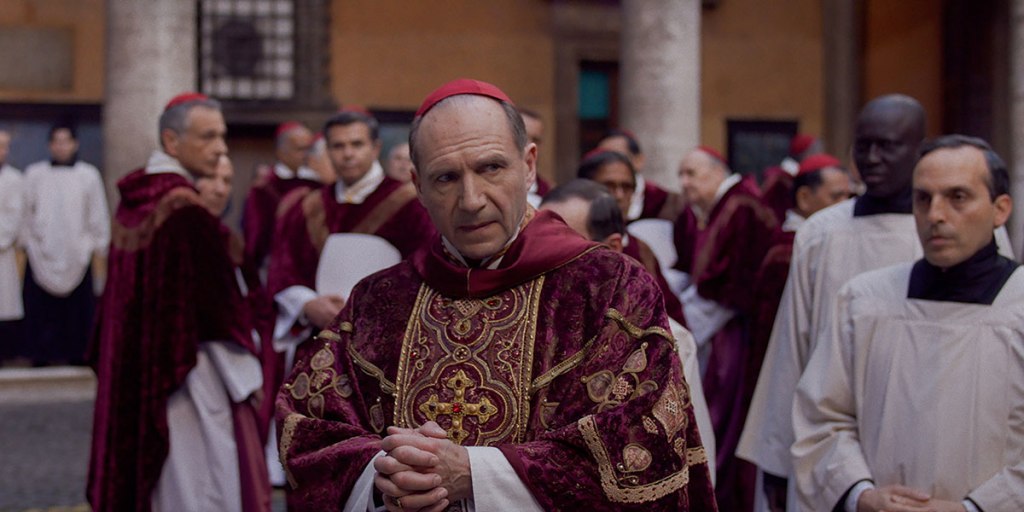
A hush hangs over the Vatican; his holiness the Pope is dead. And the world’s Cardinals, in red robes with white mitres, are congregating to choose the next pontiff from within their group. Ballots are secret, but until one receives 2/3 of the votes, they are literally locked-in, no contact with the outside world. What are their criteria for the next pope? He must be virtuous and humble, but also healthy and strong. And he must be honest as the Pope is infallible. Bishop Lawrence (Ralph Fiennes) is the Dean in charge of the highly secretive process. The most popular candidates: Bellini (Stanley Tucci), a modest liberal reformer, Tedesco (Sergio Castellitto), a bombastic traditionalist, and the highly respected Adeyami (Lucian Msamati). But Lawrence is privy to new information just before the lockdown. A drunken monsignor alleges the Pope fired Tremblay (John Lithgow) just before he died. And mystery man, Benitez (Carlos Diehz), appears out of nowhere claiming to be the Cardinal of Kabul, Afghanistan. And then there are the nuns, including Sister Agnes (Isabella Rossellini) who remain silent but see and hear everything. Which bishop will they choose to turn the conclave’s smoke from black to white?

Conclave is a stunningly- good thriller about secrets and subterfuge within the Vatican. The constant changes of political alliances as well as shocking revelations will keep your rapt attention until the very end. It presents a Vatican that’s both exquisite and decadent, with black mould spreading on it’s columns. It’s all the work of German director Edward Berger who made All Quiet on the Western Front, with Volker Bertelmann’s powerful music, and fascinating camerawork. It was filmed at Rome’s famous Cinecitta studio who are always deft at recreating the Vatican. I love this constant attention to detail — red sealing wax, Latin prayers, and tortellini soup.The acting is superb, especially Ralph Fiennes. I’ve never been a fan, but he is just sooo good in this role, maybe his best I’ve ever seen. Altogether, this makes Conclave a great night out.

Your Monster and Conclave both open this weekend in Toronto; check your local listings. And Drive Back Home is having its Toronto premiere tonight at CAMH on Queen West as part of the Rendezvous with Madness film fest.

This is Daniel Garber at the Movies, each Saturday morning, on CIUT 89.5 FM and on my website culturalmining.com.

Unobtainable, unsustainable, inevitable. Films reviewed: Bookworm, Monkey on a Stick, Smile 2

Posted in 1970s, 1980s, Addiction, Canada, Crime, Family, Hippies, Horror, India, Kids, Magic, New York City, New Zealand, Religion by CulturalMining.com on October 19, 2024

Hi, this is Daniel Garber at the Movies for culturalmining.com and CIUT 89.5 FM.

Toronto Fall Film Festival season continues with Rendezvous with Madness presenting docs and dramas, features and shorts, about addiction and mental health followed by in-person discussions, starting on October 25th. 

But this week, I’m looking at three new films, a kids’ movie, a doc and a horror film. There’s a precocious girl looking for the unobtainable; a group of deranged gurus trying to hold onto the unsustainable; and a pop starch wants to escape the inevitable. 

Bookworm

Co-Wri/Dir: Ant Timpson

Mildred (Nell Fisher) is a young girl who lives with her mom in New Zealand. She loves reading but hates school. Her desk is surrounded by leather-bound books alongside a microscope, a telescope, a typewriter and a record player. She talks like a grownup, and is obsessed by wild animals. Her dream? To catch on film a black panther said to be roaming in the woods (along with a big fat cash prize for anyone who can take a picture of it.) But her plans all change when her mother is sent to hospital in critical condition following an exploding toaster. That’s when her biological father comes into the picture. He flies in from America to save the day.

Strawn (Elijah Wood) is a professional magician — he prefers “illusionist” — who loves magic: like making small things disappear or pulling coins from behind someone’s ears. Most people are wowed by Strawn’s prestidigitations and puppy dog eyes, but not Mildred. She scoffs at magic and is quick to reveal all his tricks. They two are opposites at heart.  If you say “David Copperfield” she thinks of Dickens while he thinks of the magician. Nonetheless, they are stuck together for now, so he agrees to take her camping. But little do they know of the exciting adventures and frightening dangers — like criminals, wild animals and crazy escapes — that lie ahead.

Bookworm is a very cute coming-of-age adventure about two strangers put together to form a makeshift family. It feels like a cross between a Roald Dahl Matilda and Taika Waititi’s Hunt for the Wilderpeople. It’s shot in the New Zealand wilderness amidst stunning mountains, cliffs and lakes. Nell Fisher is adorable as the obnoxiously mature Mildred, while Elijah Wood is equally adorable as the man-child who won’t grow up. I wanted to see this one because I loved director Ant Timpson’s bizarre debut, the violent comedy Come to Daddy. Bookworm is as different as any film could be but just as enjoyable.

I liked this one a lot.

Monkey on a Stick

Dir: Jason Lapeyre

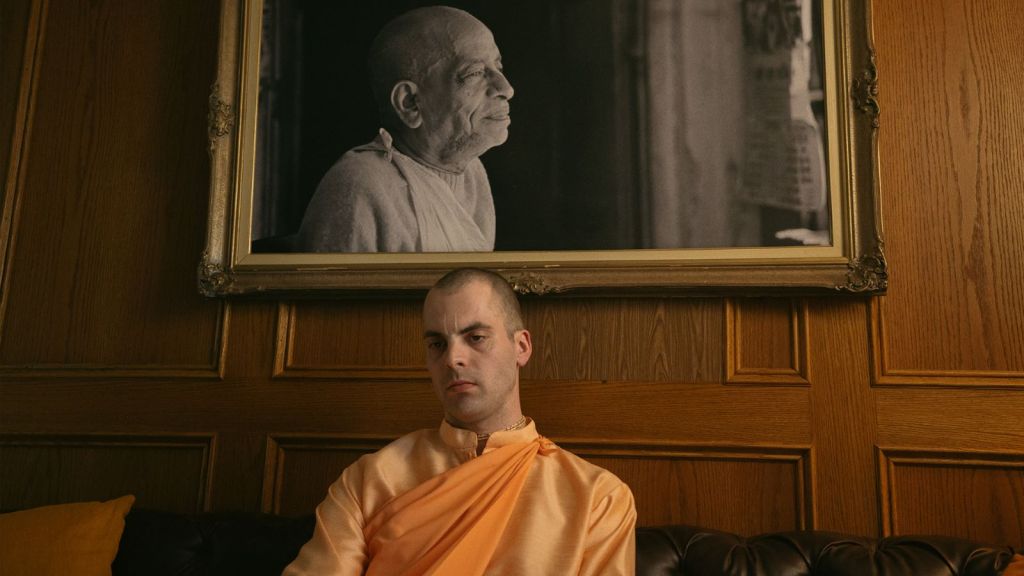
It’s 1965 and America is in high hippie mode.  A. C. Bhaktivedanta Swami Prabhupada arrives in New York City from Calcutta. He’s there to sell books, including his own translation of the Baghdad Gita. But he ends up heading the Hare Krishna movement, a vast multinational phenomenon, a religion that espouses dancing, singing and chanting mantras in order to achieve a better afterlife. After picking up many devotees in New York, the movement exploded in popularity once he reaches California. Allen Ginzburg endorses it and George Harrison writes a song about it. Countless people join  the religion, throwing away material possessions to dance, chant and collect alms in airports. But when the Swami dies, he leaves behind eleven gurus. That’s when things start to fall apart. This documentary — based on a bestselling book — exposes the crimes and excesses of the Hare Krishna movement in the 1970s and 80s.

One guru — in order to generate more money —  sets up a drug ring of devotees instructed to smuggle hash from Pakistan to Canada. They have ties to the mob, leading to a series of violent crimes until it is finally exposed. Another guru collects automatic weapons, and goes on a shooting spree in California.  A third guru — a self-declared Swami —  the scariest of them all, builds himself an ornate golden castle in West Virginia, while his disciples — who have given away all their worldly possessions — live in a shanty town beside the castle without toilet paper or plumbing. He later plans murders and is suspected of molesting children. 

In fact, the movement as a whole is riddled with problems. Women are treated as inferior beings who distract male practitioners from their religious obligations. Homosexuality is strictly forbidden as is all sex outside marriage. And heavy censorship prevails — no TV, magazines, newspapers, movies, or books are allowed, except for one official newspaper. And by the second generation — the 1970s and 80s, when most of the documentary takes place — kids are sent to schools with teachers who have no training. They lock kids in dark closets or dump them in trashcans as punishment, among even worse crimes. 

Monkey on a Stick is a documentary that looks at crimes of the Hare Krishna movement. It’s told using talking heads — including former devotees — period footage, and many reenactments, with actors visually demonstrating what the narrators are talking about. There’s also a series of random people sharing their views on religion, God and the afterlife. Though quite disturbing in parts, on the whole, it’s a fascinating story that exposes events I had never heard about before.

Smile 2

Wri/Dir: Parker Finn

Skye Riley (Naomi Scott) is a pop superstar, about to launch a worldwide tour. She lives in a luxury apartment on Park Avenue, and can buy anything she wants. She’s busy 24/7 at dance rehearsals, talk show appearances and autograph signings, under the constant supervision of her stage mom (Rosemarie DeWitt) and her PA (Miles Gutierrez-Riley). It’s her big comeback, after a year of rehab. This follows a bout of addiction culminating in a terrible car crash that killed her boyfriend and put her in intensive care. A year later, she still suffers from intense pain, pain so bad she is forced to buy opioids on the sly. But everything changes when she witnesses her high school friend (and drug supplier), Lewis (Lucas Gage) kill himself in front of her eyes in the most gruesome manner imaginable. And he dies with a rictus grin plastered on his face.

That’s when things start to go bad. Everywhere she looks she sees that awful smile. It’s like she caught a disease by witnessing her friend’s death. She starts seeing people who aren’t really there, and experiencing events that never happened — even though they feel so real. She begins to doubt her sanity. It’s like some alien presence has lodged itself into her brain. Her friends, family and colleagues look at her in a strange way, even as she fears she’ll end up dead in a matter of days, with that same awful smile. Can she break this smile cycle? Or is she headed for insanity and death?

Smile 2 is a genuinely-scary psychological thriller/ horror about fame, celebrity, and a deadly condition passed on from person to person. It’s also one of those Hollywood rarities: a sequel that’s demonstrably better than the original. Naomi Scott is terrific as Skye, a punky, self-centred celebrity; Skye’s not just a horror movie screamer, she’s a real character, complete with a psyche and a believable back story. The movie itself is really well made, with beautiful art direction, cool choreography, and ingenious camerawork and editing, where a scene can flip, elliptically, from an elevator ride to an overhead view of the street. Warning: it’s quite violent, so if you don’t like seeing blood and guts, stay away. But otherwise, Smile 2 is a really good, heart-pounding genre movie.

Bookworm, Monkey on a Stick and Smile 2 all open this weekend in Toronto; check your local listings.

This is Daniel Garber at the Movies, each Saturday morning, on CIUT 89.5 FM and on my website culturalmining.com.

Parents and their children. Films reviewed: Tuesday, Kidnapped

Posted in 1800s, Courtroom Drama, Death, Denial, Drama, Fairytales, Family, Italy, Politics, Religion, Supernatural, UK by CulturalMining.com on June 15, 2024

Hi, this is Daniel Garber at the Movies for culturalmining.com and CIUT 89.5 FM.

Sunday is Fathers Day, so this week I’m looking at two movies about parents and children. There’s a mother whose daughter is threatened by a big ugly bird, and parents whose son is kidnapped by the Pope.

Tuesday

Wri/Dir: Daina Oniunas-Pusic

Tuesday (Lola Petticrew) is a teenaged girl in London who is dying of an incurable disease. She likes comics and drawing. She spends most of her time in her bedroom with her Nurse Billie (Leah Harvey) or else in the walled garden outside her home, because she is too weak to get around anymore. She only sees her mother at night when she comes home from work. Until a stranger shows up in her life. It’s a huge bird, like a giant parrot, covered in filthy, black feathers. He is death incarnate, and he’s come to take her away by placing his wing over her body. But instead, she asks to talk to him. She helps him clean up, revealing colourful plumage, and she tells him a joke — the first time he’s laughed in centuries. So he lets her live, for now, but she can’t tell anyone about him. Meanwhile Tuesday’s mom Zora (Julia Louis-Dreyfus), has a secret of her own. She quit work a long time ago, to take care of her dying daughter. But she can’t face it; instead she spends all day sitting alone in a nearby park, doing nothing. And she’s been selling off all their possessions to help pay for the nurse. But everything changes when Tuesday tells her about her imaginary friend… and Zora is shocked to find she’s telling the truth. But she refuses to accept her daughter’s death, and takes an extraordinarily drastic step to stop the inevitable from happening. But what will these new changes bring to the family and the world and can Zora ever accept the inevitable loss waiting to happen.

Tuesday is an unusual but strangely moving fantasy about a mother and daughter confronting death. It starts out a bit odd, and gradually turns into a very strange movie indeed. But while it deals with some horrific ideas, it’s not a horror movie. It has supernatural elements, but it’s not meant to be scary. And despite its religious concepts of life and death, it’s not a faith-based movie. What it is is a very moving, mother/daughter drama about death. Julie Louis Dreyfuss, best known for her deadpan comedy in Seinfeld and Veep, plays it straight in this one, and really bares her soul in a deeply moving performance. And Lola Petticrew is equally sympathetic as Tuesday. This is nothing like most movies you see, but very effective nonetheless; come prepared both to laugh and cry.

I really liked this movie.

Kidnapped

Co-Wri/Dir:  Marco Bellocchio

It’s the 1850s in a middle-class neighbourhood in Bologna.  Salomone Mortara (Fausto Russo Alesi) lives with his wife Marianna Padovani Mortara (Barbara Ronchi) and their children. One night there is a banging on their front door: it’s the police demanding an inspection. They want to see Edgardo Mortara, an angelic little boy, number six of eight kids. Local officials are apologetic, but they must hand him over, under the orders of Father Feletti (Fabrizio Gifuni), the local inquisitor. But surely there’s some mistake, they say, what could this little boy have done? He was secretly baptized as a baby by his maid, they say, and no Christian child can be brought up in a Jewish family. Bologna — and much of Italy — was then part of the Papal States, where the government, the police, and the judiciary were all under the direct rule of the Vatican’s representatives and ultimately Pope Pius IX. And despite their vehement  objections and petitions, they whisk the crying child off to Rome. 

He is brought to the House of Catachumens, a special school for converts to be taught the Latin Mass. Little Edgardo (Enea Sala) misses his family terribly but a friend he meets says if you want to go home soon, just cooperate and learn the prayers, you don’t have to believe them. His flabbergasted father and devastated mother are desperately trying to get him out of there, but to no avail. But the story has caught the eye of the international press, making banner headlines in Paris, London and New York. And this makes Pope Pius IX even more steadfast in his beliefs. Will the family all convert to Catholicism to get back their son? Will Pope Pius relent and let him go home again? And who will the little boy choose as his guardians: his Mama and Papa or Il Papa, the Pope himself?

Kidnapped: The Abduction of Edgardo Mortara is an overwhelming drama based on true historic events. Though little-known today, it had a huge affect on world politics, history and, ultimately, the unification of Italy. It takes place in their homes of Bologna, The Roman Ghetto, in courtrooms, on canals, and within the Vatican itself. Its powerful music, lush photography and opulent sets and costumes support the passionate almost melodramatic acting. Barbara Ronchi is fantastic as Mrs Mortara, while Paolo Pierobon as Pope Pius comes across as a creepily salacious Mafia don, cuddling up to his favourite little boy and letting him hide beneath his robes (as he had huddled in his mother’s skirts when first abducted.) It also veers into fantasy within the dreams of various characters, from little Edgardo who dreams of de-crucifying Jesus so he can go home, and the Pope who has nightmares of being forcibly circumcised by a gang of rabbis. Kidnapped is an amazingly powerful  historical drama set within the changing tides of 19th century Europe.

On a personal note, my childhood next door neighbour, Mrs Sharon Stahl, ended up writing her doctoral theological dissertation on this case, so I had head about it many years ago and it’s amazing to finally see it dramatized on the big screen.

Fantastic movie.

Tuesday is now playing at the TIFF Lightbox, and Kidnapped also opened this weekend; check your local listings. 

This is Daniel Garber at the Movies, each Saturday morning, on CIUT 89.5 FM and on my website culturalmining.com.

Magical kids. Films reviewed: The New Boy, Butterfly Tale, Once Within a Time

Hi, this is Daniel Garber at the Movies for culturalmining.com and CIUT 89.5 FM.

You’ve heard of Peter Pan, right? He’s most famous for not growing up and for believing in fairies. And it’s true, kids are more likely to believe in magic than grown ups. This week, I’m looking at three new movies about the innocence and magic of childhood. There’s a disabled, teenaged butterfly that wants to migrate with his flock; an indigenous boy with magical powers sent to a church-run school; and a group of kids forced to face a fairytale apocalypse.

The New Boy

Wri/Dir: Warwick Thornton (Sweet Country)

It’s the 1940s at a remote Australian Benedictine monastery. Sister Eileen (Kate Blanchett) is excited because there’s a new student arriving soon. She runs the place, ever since the head Benedictine monk died — she keeps this detail a secret from the outside world. The new boy (Aswan Reid) is indigenous, can’t speak English, and has had virtually no contact with white Australia. He has blond hair and brown skin. He sleeps on the floor, not on a bed, and finds forks and spoons a mystery. At the same time, he can conjure up glowing particles to light his way, using just his hands. And he has magical powers: he can speak to trees, and cures people bitten by poisonous snakes.

The sisters teach him out to use an outhouse (which he finds both funny and revolting), and about western ways and foods. Above all, Sister Eileen wants to convert him to Christianity — she lives him deeply, and wants to save his soul. She uses a life-sized wooden statue of Jesus writhing on the cross as the catalyst. She hopes to change him completely, and ultimately to baptize him and give him a Christian name. Will he convert? And what will happen if he does?

The New Boy is a gentle, bittersweet look at religion, colonization, forced assimilation and residential schools (known as boarding schools in Australia), as seen through one boy’s eyes. I found it both inspiring and tragic. Kate Blanchett is wonderful as the scheming but good-hearted nun, while young actor Aswan Reid is remarkable as the unnamed new boy. (The movie opens with a violent fight between him and a soldier in the bush, just one of many surprising scenes he manages to convey without uttering a single word.) Director Warwick Thornton based it partly on his own experiences as a boy in Alice Springs, and those personal details and feelings come through. 

I liked The New Boy a lot.

Butterfly Tale

Dir: Sophie Roy

Patrick (Mena Massoud) is a young monarch butterfly who recently made the transition from caterpillar. He and his best friend Marty are looking forward to joining his village on their annual migration to Mexico. He is especially excited about spending quality time with the girl he’s crushing on, Jennifer (Tatiana Maslany). But there’s a problem. Patrick emerged from his cocoon with mismatched wings, so he’s disabled and can’t fly. And Marty is still a caterpillar. They are teased and bullied by the bigger butterflies as “butter fails”.

Worse still, Patrick’s mom, a leading flier in the “flutter” (what they call their butterfly community) wants him to stay home in the winter. But Patrick and Marty are determined to get there by hook or by crook. Jennifer, a strong flier, is pulling a leaf filled with milkweed so they can all eat on the way. Patric and Marty stowaway aboard that leaf! Little did they know they’ll face tornadoes, big box stores and angry birds posing life threatening dangers on the way. Will Patrick ever learn to fly? Will Marty ever make the transition from caterpillar to butterfly? And will Jennifer get over her hangups? 

Butterfly Tale is an animated, coming-of-age road movie about anthropomorphic  butterflies. They’re basically people, with human hair, faces, and bodies but with big butterfly wings coming out of their backs. They wear T-shirts and hoodies, and worry about adolescent insecurities. (They even have to stop the flight along the way to take a leak.) Little kids might really identify with the characters and like this movie; it has good role models for children with disabilities, and deals with environmental issues. The thing is, it’s not original or funny or risky or challenging anywhere, just a typical adolescent drama, where the people happen to be butterflies. I’m not saying it was uninteresting — it kept my attention the whole time — there just wasn’t much to it.

Once Within a Time

Wri/Dir: Godfrey Reggio

Once upon a time, a bunch of happy kids follow the beckoning voice of a goddess onto a stage. After riding a merry-go-round they start to notice strange happenings. An Adam-and-Eve-like young couple in wire masks take a piece of fruit from a sinister looking apple-man, unleashing terrible events. Smart phones generate robots, a chimp in a monkey suit and another in a VR helmet, huge industrial power-towers, a baobab tree exploding into a mushroom cloud.  Ecological and geopolitical devastation is at hand! Can we survive the end of this world… or maybe start a new one?

Once Within a Time is a phantasmagorical, magic-lantern fable performed on a two dimensional stage beneath a prominent proscenium arch. It’s equal parts live-action, documentary footage, still images, and 3-D stop-motion animation. 

I first saw Godfrey Reggio’s Koyaanasqatsi as a teenager and the barrage of apocalyptic images of corporate uniformity combined with Philip Glass’s pounding music left deep marks in my psyche. This one is kinder and gentler but still effective. It’s co-directed and edited by Jon Kane with amazing vintage special affects from irises to rear projections to dual spectroscope photos. There are tinted black & white shots, shadow puppets, grotesque masks, and dancing robots that evoke everything from Georges Méliès to Guy Maddin to the late Peewee Herman’s Playhouse.  Who knew the apocalypse could be so beautiful? It’s less than an hour in length, but provides about three times that in intensity. If you can, see it on a big screen and just let the images and music overwhelm you.

Great movie. 

Butterfly Tale is now playing in Toronto; check your local listings. The New Boy is a feature at the ImagineNative film festival starting next week. And Once Within a Time is playing tomorrow (Sunday, October 15th, at 5 pm) at the TIFF Bell Lightbox.

This is Daniel Garber at the Movies, each Saturday morning, on CIUT 89.5 FM and on my website, culturalmining.com.

60s, 70s, 80s. Films reviewed: Cocaine Bear, Jesus Revolution, Metronom

Posted in 1960s, 1970s, 1980s, Animals, Christianity, comedy, Coming of Age, Communism, drugs, Georgia, High School, Hippies, Religion, Romance, Romania by CulturalMining.com on February 25, 2023

Hi, this is Daniel Garber at the Movies for culturalmining.com and CIUT 89.5 FM.

This week, I’m looking at three new movies. There are spiritual revolutionaries in California in the 1960s, teenaged dissidents in Bucharest in the 1970s, and a crazed animal in Georgia in the 1980s.

Cocaine Bear

Dir: Elizabeth Banks

It looks like a typical day in 1985 in the Chattahoochee National Forest in Georgia. Two little kids are playing hooky, three skateboard-riding teenage delinquents are looking for some petty crime to commit, a pair of Scandinavian backpackers are on a hike, and a middle-aged forest ranger is dressed to impress a guy she wants to date. But everything changes when a prop-plane pilot drops a dozen duffel bags of uncut cocaine into the woods… and then promptly dies. Suddenly the supply chain is broken, and out-of-state traffickers looking to retrieve their supply — and the cops who want to nab them — all descend on the park at once. And here’s where the actual movie starts: a huge black bear sticks its nose into the duffel bag and emerges as a frantic, delirious, coke head, forever on the lookout for more snow to blow. Who will find the drugs — the cops, the gangsters, the delinquents, or the children? And who will not be eaten by the bear?

Cocaine Bear is a low-brow, high-concept comedy that’s basically 90 minutes of extreme-gore violence. I was a bit dubious at the beginning, but about half an hour in it started to get really funny. I know it’s stupid-funny, but it still made me laugh. The all-CGI bear is one of the main characters, but there’s a great assortment of humans, too, played by an all-star cast: Margo Martindale as the forest ranger, the late Ray Liotta was the gangster, Alden Ehrenreich as his diffident son, O’Shea Jackson Jr as his henchman, and Keri Russell as a mom searching for the two missing children. It’s hilariously directed by TV actor Elizabeth Banks. Cocaine Bear easily beats Snakes on a Plane and Sharknado as best movie based solely on its title. Supposedly inspired by true events (yeah, right) it has lots of room for ridiculous 80s haircuts, music and other gags to good effect. Stoner movies are a dime a dozen and half of the movies coming out of Hollywood are clearly made by cokeheads, but this may be the first comedy about cocaine I’ve ever seen.  If you’re comfortable laughing at blood, gore and gratuitous violence, along with lots of base humour, I think you’ll love this one. 

Jesus Revolution

Dir: Jon Erwin, Brent McCorkle

It’’s the late 1960s in California, where young people everywhere are tuning in, turning on, and dropping out. One of these kids is Greg Laurie (Joel Courtney), who attends a military academy but would rather be drawing cartoons. He lives in a trailer with his Mom, a  glamorous but alcoholic barfly. He meets a pretty girl named Kathe hanging with the hippies outside a public high school, and decides that’s where he’d rather be. But Kathe is from an upper-class family whose parents frown on Greg. Meanwhile, Chuck Smith (Kelsey Grammer), a local pastor, wonders why no one is coming to his Calvary Chapel anymore. It’s because your a square, his daughter tells him. So she introduces him to a unique man she met at a psychedelic Happening. Lonnie Frisbee (Jonathan Roumie) is a charismatic, touchy-feely type who talks like a hippie and looks like Jesus. He emerged from the sex-and-drug world of Haight Ashbury with a mission from God, and now wants to spread the gospel. Chuck Smith is less than impressed, but decides to give him a try.

Soon there are block-long lineups to hear what Lonnie — and Chuck — have to say. This includes Kathe and Greg, who barely survived a bad acid trip. Lonnie gives Greg a place to live and invites him to join the church. Calvary Chapel is attracting people from everywhere, culminating in mass baptisms in the Pacific ocean. But as their fame grows, so does the friction. The more moderate Chuck frowns on Lonnie’s in-your-face style —  from faith-healing to his talk of being closer to God. Can Greg find a place in this world? Will Kathe’s family ever accept him? And is this a movement or just a flash in the pan?

Jesus Revolution is a retelling of the unexpected upsurge in grassroots Christianity among baby boomers in the 70s. The film is clearly aimed at evangelical church-goers, a subject in which I have absolutely no interest. Zero. Which is why I’m surprised how watchable this film is to a general audience. It’s not preachy — it shows, not tells. It’s well-acted with compelling characters and a surprisingly good story. No angels or miracles here, just regular — flawed but sympathetic — people.  I think it’s because the Erwin Brothers (American Underdog, I Still Believe)have figured out how to make mainstream, faith-based movies that are actually good. The film is based on real people, so I was a bit surprised they never mention that Lonnie Frisbee was actually a gay man who later died of HIV AIDS. I guess it doesn’t fit the story they want to tell That said, if you’re involved in a church or a fan of spiritual films, this might be just what you’re looking for.

Metronom

Wri/Dir: Alexandru Belc 

It’s 1972 in Bucharest, Romania.  Ana and Sarin (Mara Bugarin, Serban Lazarovici) are a beautiful couple still in high school, and madly in love. They both come from “intellectual” families, who are given special privileges in Ceausescu’s communist regime. They go to an elite school together, and hope to pass their Baccalaureates to get into an equally good university. They meet in front of a WWII heroes monument dressed in stylish trench coats and school uniforms. So why is Ana crying? Sarin and his family are emigrating to Germany. That means they’re breaking up for good and will probably never see each other again. Ana is crushed — her world is broken. Which is why she has no interest in going to an afternoon party at a friend’s house, but changes her mind at the least minute. Her father, a law professor, is easy going, but her mother absolutely forbids it. So Ana sneaks out of the apartment and heads to the get-together. This is her last chance before he leaves to make out with Sarin and express her eternal love. 

The party is centred around listening to music — Led Zepplin, Hendrix, The Doors — as played on a radio show called Metronom on Radio Free Europe. Western music is underground, subversive and illicit. They decide to write a letter to the show and pass it on to a French journalist. But two bad things happened. When they make love behind a closed door, Sarin won’t say he loves her. And the party gets raided by the secret police and all the kids are arrested and forced to write confessions. But Ana is so caught up in her relationship she barely notices the interrogation she has landed up in. Who ratted them out to the authorities? And what will happen to Ana?

Metronom is a passionate story of young love in the 1970s under the omnipresent gaze of an authoritarian government. It’s a coming of age story, about heartbreak and the loss of innocence as the real world reveals its ugly face.  

If you’ve never seen a Romanian film before (such as Întregalde, Bad Luck Banging or Loony Porn, Poppy Field, The Whistlers, The Fixer, One Floor Below), this is a good place to start. They all have this feeling of tension, corruption, mistrust and unease, whether they’re set during Ceaucescu’s reign or long after his fall. This one also has hot sex, good music, stark cinematography, and terrific acting, especially Mara Bugarin as Ana. It manages to be a thriller, a romance and a coming-of-age story, all at once.

This is a good one.

Metronom is now playing a the TIFF Bell Lightbox; Cocaine Bear and Jesus Revolution open nationwide this weekend; check your local listings.

This is Daniel Garber at the Movies, each Saturday morning, on CIUT 89.5 FM and on my website, culturalmining.com.

From India to Iceland. Films reviewed: To Kill a Tiger, Godland

Posted in 1800s, Canada, Courtroom Drama, Denmark, documentary, Family, Feminism, Iceland, photography, Religion, Sexual Assault by CulturalMining.com on February 11, 2023

Hi, this is Daniel Garber at the Movies for culturalmining.com and CIUT 89.5 FM.

This week, I’m looking at two new movies now playing in Toronto: a documentary and an historical drama.   There’s an underdog in India standing up to her oppressors; and a Dane in Iceland cowering in fright. 

To Kill a Tiger

Wri/Dir: Nisha Pahuja

(I interviewed Nisha here, in 2012)

Ranjit is a poor farmer in a rural village in the Bero district of Jharkhand, in Eastern India. Together with his wife, they are raising his beloved children, whom they hope will advance to a better life through education. But everything changed late one night, after a wedding party. Their oldest, a 13-year-old girl. is attacked and brutally gang raped by men from the village. When their parents found out what happened, they rushed her to the police and eventually the men are arrested. But the authorities decided the proper response to this is for a 13-year-old girl — their beloved daughter! — to marry one of her rapists. It’s a hellish proposition, and the entire family rejected it. And with the help of an NGO, they decide to press charges and put the men on trial. She has the full support of her father, and agrees to testify in court. This is almost unheard of in India, and the trial became a cause celebre, with people across the country awaiting its verdict. 

But the process is far from favourable. The family receives death threats, while local officials blame the victim for her attackers’ crimes. They are shunned in their home village, and strongly pressured to drop it. Can they go through with the trial? Will the girl testify? And do they have any chance of winning?

To Kill A Tiger is an NFB documentary about a young girl and her supportive family who question authority from within a strictly hierarchical society. Although the film estimates a woman is raped in India every 20 minutes, few cases are reported and fewer still are vindicated in trial. The documentary covers the family in their home, along with their many supporters — lawyers, NGOs, civil rights activists — and their detractors, including her unrepentant alleged attackers. The entire film was shot in India in the days leading up to around the trial, in the places where it was happening. 

This strong documentary stands behind underdogs in their fight against the system, and provides a sliver of hope amidst very grave circumstances. 

Godland

Wri/Dir: Hlynur Pálmason

It’s the late 19th Century in Denmark. Lucas (Elliott Crosset Hove) is an earnest young priest with a seemingly simple mission: to travel to a Danish colony in southeastern Iceland, build a church there before winter comes, and then start preaching. But beware, warns his supercilious superior, Iceland is not what you expect it to be. They may look sort of like us, but they speak a different language, they believe in different things, and they are primitive in their ways, not civilized like us Europeans. And the landscape though beautiful is dangerous and treacherous, full of erupting volcanoes, flooding rivers and steep rocks. Not to be trifled with. 

Ignoring him, Lucas sets out on his carefree journey, carrying his camera equipment, books and a giant cross. There’s also a large entourage of Icelandic workers. He takes an instant dislike toward Ragnar (Ingvar Sigurðsson) an older man who speaks no Danish. But he soon makes friends and bonds with his translator (Hilmar Guðjónsson), the only person he can talk with. But when things start to go wrong and the translator is killed, Lucas sinks into a deep melancholy. His depression grows deeper even as his anger, directed mainly at Ragnar, starts to swell. Can he survive until they reach the town and build the church? And will he be a suitable leader of the congregation?

Godland is an impressionistic historical drama about a clash of cultures. It follows a Danish priest’s journey into his own private heart of darkness. The film is full of love, romance, rivalry and revenge, as experienced by a group of strange and quirky characters. There is so much to love about this movie: they ride small horses with beautiful manes straight out of My Little Pony. Poetry, sagas, story-telling and Iceland’s oral history are still living things, part of everyday use, not something hidden away in dusty books. And around any twist in the trail. they might run into a breathtaking waterfall, a crackling glacier or an erupting volcano. Lucas photographs the people he’s travelling with, posing them before ethereal land- and seascapes. 

The pace is slow, but still dramatic: it takes the time to show the priest applying egg whites and silver to a pane of glass to take one of his wet plate photos. In real life a lost cache of these pictures was found there a century later — and that’s what inspired this film. The entire movie is shot to look like those photos, in an almost square shape with softly rounded corners.

And like any good Nordic film, Godland combines a dark storyline with a stunning aesthetic. 

I recommend this movie.

To Kill a Tiger is now playing in Toronto at the Ted Rogers Hot Docs Cinema, and Godland at the TIFF Bell Lightbox; check your local listings.

This is Daniel Garber at the Movies, each Saturday morning, on CIUT 89.5 FM and on my website, culturalmining.com.