Not tourists. Films reviewed: Souleymane’s Story, The Legacy of Cloudy Falls
Hi, this is Daniel Garber at the Movies for culturalmining.com and CIUT 89.5 FM.
August is when people scour the earth for vacation spots, where they can soak up the glamour and romance of famous locales without ever actually living there. This week I’m looking at two new movies about the people who live in popular tourist destinations. There are asylum-seekers in Paris, and psychic-debunkers in Niagara Falls.
Souleymane’s Story
Co-Wri/Dir: Boris Lojkine
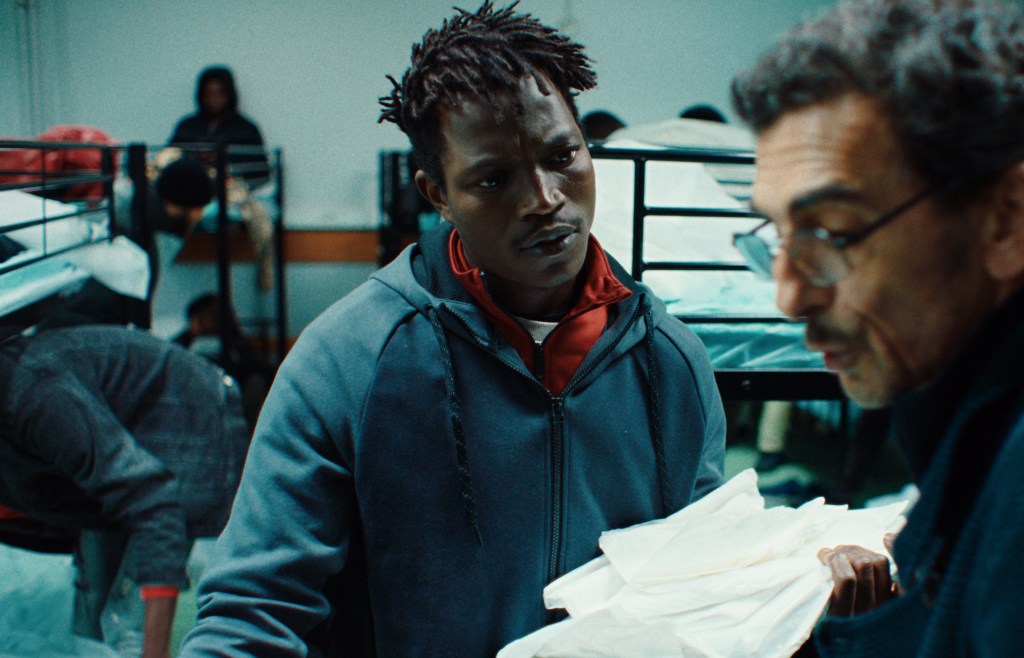
Souleymane Sangaré (Abou Sangaré) is a young man on a bike. His friends call him Souleye de Paris. He earns his keep delivering meals to paid customers across the city using his smartphone to record the deliveries and pass on his next assignment. Other young men from West Africa look up to him as a role model, and beg him to help them become couriers too. But Souleymane’s life is more complicated than it seems.
Originally from Guinee, he arrived in France as a refugee seeking asylum. His beloved girlfriend back home (they speak by phone) is talking about marrying someone else, and his mother seems particularly out of touch when he speaks with her. He is homeless, and sleeps in a dormitory far from the Gare du Nord. But he never gets a full night’s sleep because he is forced to wake up in the middle of the night to electronically reserve his next night’s bed. He catches a bus ride to and from the shelter, and if he’s late he’s forced to sleep in the rough.
Even his delivery job is done on the sly, using someone else’s name who takes a large cut of each transaction (he’s undocumented and can’t work legally.) And everything he does is done for one goal: his asylum interview scheduled in just a few days. He’s studying hard to pass that ordeal. And to do that correctly, he needs to hire a coach to fill in the forms and train him on exactly what to say.
So when an accident messed up a single delivery, his carefully constructed life suddenly becomes precarious. Can Souleymane keep his job, pay his asylum coach, and pass the government interview? Or will he be sent back to the country he fled?
Souleymane’s Story is a powerful, fast-moving, slice-of-life drama about a refugee in Paris. Souleymane is in constant motion, on a bike, climbing staircases, on trying to catch the
metro or a bus. Most of the movie is in the form of a flashback as he waits for his immigration interview. And as it slowly builds to that event, everything leading p to it is exposed, climaxing in a heart wrenching, tear jerking finish. The dialogue shifts between French and a number of other West African languages, showing the polyglot nature of life in the big city.
I don’t recognize the director or any of the actors, but it has a realistic feel.
Good movie.
The Legacy of Cloudy Falls
Wri/Dir: Nick Butler
It’s summertime in the city of Niagara Falls. A group of long-term tenants at a seedy apartment building live in close proximity. Terry (Andrew Moodie) is a single, middle-aged gay, Black man who runs an unsuccessful souvenir shop. He spends his lonely days surrounded by fridge magnets and snow globes that nobody seems to want. But he has one goal: to locate the son of a man he once knew. Terry fantasizes about his next door neighbour, Edwin, a compulsive, body-conscious young man who lifts weights and decorates himself with home-made tattoos. Edwin (Josh Dohy) just appeared there one day,
claiming he is the nephew of the hotel’s owner but Terry has never seen them together.
Brigit (Grace Glowicki) sees herself as a debunker of the lies and scams perpetrated by fortune tellers and mind-readers. (She’s also having an affair with a croupier at the casino, but that’s another story.) She has a website devoted to her whistle-blowing, which no one seems to read. Still, she’s ready to catch her Moby Dick, a man named Walter Pryce, due to arrive in town soon. Pryce is a tele-psychic whose YouTube videos are watched by millions, and who Brigit vows to take down.
Finally there’s Riley (Amanda Martínez) a cynical, compulsive liar, who pretends she’s the director of a talent agency. She keeps her boss semi-conscious through the use of sleeping powders generously sprinkled into her drinks. But she feels strangely drawn to Calvin (Richard Zeppieri) a shy man who appears at the office one day, with dreams of becoming a professional actor. These are just a few of the plot streams happening simultaneously in and around the apartments as recounted in a nasal voice by Rita (Susan Berger) a senior with bottle-red hair who sees everything going on at the Cloudy Falls.
The Legacy of Cloudy Falls is a comedy/drama about a group of quirky and tragically lonely characters as they interact with one another. (I kept hearing the lyrics to Eleanor Rigby in the back of my mind.) Vendettas, scams and conspiracy theories ebb and flow like the misty waterfall nearby. Amid walls
painted with UFOs, no one seems to do what they’re supposed to be doing but somehow, still continue to get along. This film is retro kitsch mixed with Wes Anderson-style odd-balls. There’s something about Niagara Falls that brings all these strange people to one place — especially in movies. (I’m thinking Albert Shin’s Disappearance at Clifton Hill from 2019, for example).
This is director Nick Butler’s first feature after a series of shorts and many years oworking in casting for various TV series — which may explain the episodic nature of this film — stories that are linked and coexist but have their own separate narratives.
So if you’re in the mood for something whack but oddly compelling, check out this one.
The Legacy of Cloudy Falls opens on August 25 in Toronto, with Souleymane’s Story playing this weekend at the TIFF Lightbox; check your local listings.
This is Daniel Garber at the Movies each Saturday Morning on CIUT 89.5 FM and on my website www.culturalmining.com.
Class. Films reviewed: The Old Oak, Monkey Man, Wicked Little Letters
Hi, this is Daniel Garber at the Movies for culturalmining.com and CIUT 89.5 FM.
Ordinary people fighting back is an old story, but not a tired one. This week I’m looking at three new movies — one from northern England, one from southern England, and one from India — about people confronting injustice. There are women fighting the courts, a poor man fighting the oligarchs, and a lonely man trying to stop his town’s gradual collapse.
The Old Oak
Dir: Ken Loach (my interview: 2020)
It’s 2016 in a seaside village in northern England. TJ Ballantyne (Dave Turner) is the publican of The Old Oak, one of the few gathering places left standing. But like the town — once a thriving coal pit, but now impoverished and depressed — the pub is not what it used to be. It has few customers aside from a few regulars. The sign is sagging, and half of the building is no longer used. TJ lives above the pub; he’s lonely and pessimistic. His son won’t speak to him, and he has only a little dog to keep him company. But when a group of Syrian refugees arrives in town, TJ decides to help. Alongside Laura (Claire Rodgerson) he distributes furniture and food — donated through local churches and unions — to the newcomers. They are grateful, but some people resent it. Why are they helping refugees when local kids are going without food and heating? Syrian kids are bullied in schools, and a young photographer Yara (Ebla Mari)’s camera is broken.
What can they do to bring the community together? Together with Yara,
Laura, and dozens of volunteers, they reopen a long boarded up section of the Old Oak to provide a place where people can come to eat and spend time together. The photographs on the walls recall the coal miners strike of Thatcher’s England: If you eat together, you stick together, says one sign. But can they overcome old prejudices to form new friendships? Or will it all fall apart?
The Old Oak is a wonderfully poignant and deeply-moving drama that deals with big issues but on a personal scale. It looks at racism, poverty, unions and scabs, and how geopolitics affect us all. Like all of Ken Loach’s movies, it looks at imperfect people from multiple viewpoints. Some you like and end up hating, others seem like villains but you find out later they’re good people. Lots of grey, no black and white (aside from the photographs Yara takes.)
Once again, the script is by Loach’s longtime collaborator Paul Laverty, and the ensemble cast includes both professionals and first-time actors, many hired at the location.
It shows the real Britain, warts and all, not the shiny tourist-attraction you see in Hollywood movies. It’s a tear jerker, with more than one heartbreaking scenes. But it still leaves room for hope. The Old Oak may be Ken Loach’s final film, so you should get out and see it. I really like this film.
Monkey Man
Co-Wri/Dir: Dev Patel
Kid (Dev Patel) is a man with a vengeance — to punish those whose crimes he witnessed as a small child. Raised by his mother in a forest in rural India, he now lives in an unnamed megalopolis in the mythical state of Yatana (= torment, anguish). It is ruled by a god-king followed by throngs of devoted cult-like followers. They kick farmers off their land for corporate profit and persecute minorities with impunity. Kid earns his money as a boxer, beaten up regularly by bigger, stronger men. In the ring, he conceals his face behind a monkey mask, in honour of the god Hanuman whose story his mother had told him as a child. Following a complex scheme, he somehow manages to get work inside an exclusive nightclub ruled by a woman named Queenie (Ashwini Kalsekar). She warns him to never disobey her or step out of his class. He gradually works his way up the latter until he makes it into the kitchen. His goal? To shoot a corrupt police chief named Rana Singh (Sikandar Kher). But his plans all fail, and he ends up a nearly-dead fugitive, his body floating in a canal. He is rescued and brought back to health by a temple dedicated to Shiva, and run by androgynous priests.
They admire that he, an outcaste, dares to fight authority. But he needs the strength and skill if he wants to succeed. So, to the sounds of a tabla drum, he trains in the temple, gradually building up his stamina and muscles until he its
ready to face his enemies to the death once again. But does he even have a chance against the powers that be?
Monkey Man is a class-struggle action-thriller about one man’s quest for personal vengeance and his plan to overthrow by force corrupt and autocratic leaders. It’s told using intricate plotting, involving dozens of people cooperating for a single goal. And it interweaves visions and sounds, like a child’s picture book, an elaborate mural, and the thumping of a tabla music. There’s a lot of content to digest. The problem is, a large part of the movie consists of chases and violent fights, and they’re not very good. Blurred shots using a jiggly, hand-held camera may be artistic, but they’re unpleasant and hard to look at. Seasickness is not a valid substitute for good fight choreography.
I admire Dev Patel’s first attempt as a director and his transformation into an action hero, but Monkey Man doesn’t cut it.
Wicked Little Letters
Dir: Thea Sharrock
It’s the 1920s in Littlehampton, Sussex, a small town in southern England. Edith Swan (Olivia Colman) is a middle aged educated woman who still lives with her strict parents in a tiny row house. She reads the bible and quotes its teachings; basically, she’s an uptight prig. She shares a wall with Rose (Jessie Buckley) a migrant from the Emerald Isle. She is fond of drinking and carousing, can swear a blue streak, and is often seen wandering in just a slip outside her home. Rose likes her live-in boyfriend Bill (her husband died in WWI) but most of all, adores her daughter Nancy (Elisha Weir). But her neighbour, Edith’s father Edward Swan (Timothy Spall) despises Rose and her libertine ways, and blames her for everything going wrong in Littlehampton. They live in a tenuous detente, until everything changes when Edith receives a piece of hate mail. The unsigned letter is filled with cruel insults and vulgar words.
And when the letters pile up, the police come to investigate. They arrest Rose for the nasty letters and throw her in jail, despite her protests of innocence. The press picks up the story and it becomes a national scandal. But not everyone believes Rose is guilty. A small group of women, led by Police Officer Gladys Moss (Anjana Vasan), think Rose is innocent and set out to prove it. But can they find the true culprit before the trial? And what will happen to Nancy if her
mother ends up behind bars?
Wicked Little Letters is a delightful dark comedy, based on a true story; apparently this was a hot topic 100 years ago. Little is the key word: little letters, Littlehampton, and the kind of petty quarrels that can blow up into serious events. This is a movie that knows it’s own boundaries and sticks to them perfectly, without veering off into remote tangents, flashbacks or lengthy soliloquies. It’s tight, set in tiny homes around town, and in the courthouse and jail. The acting is wonderful — everyone’s a character. Olivia Colman and Jesse Buckley previously co-starred in The Lost Daughter, but I like this one much better. And though it’s a period drama set in 1920s England, it uses colourblind casting, with many roles played by black and brown actors, without racial or ethnic issues ever entering the story (except, of course, Rose being Irish in England).
If you’re looking for a fun night out, I think you’ll like this one.
Wicked Little Letters, Monkey Man and The Old Oak all open this weekend in Toronto: check your local listings.
This is Daniel Garber at the Movies, each Saturday morning, on CIUT 89.5 FM and on my website culturalmining.com.
Daniel Garber talks with Ema Kawawada about My Small Land
Edited version
Long version, 日本語 付き
Hi, this is Daniel Garber at the Movies for culturalmining.com and CIUT 89.5 FM.
Sarya is a typical Japanese high school girl in her graduating year. She is studying hard to pass her university entrance exams, and hopes to become a school teacher. She likes playing badminton, and hanging with her best friends. And she’s starting to flirt with a guy, Sota, who works with her, part-time, at a convenience store. But her whole life falls apart overnight when her father is turned down for asylum, and all their ID cards are taken away. Sarya and her family are Kurdish refugees, and have been waiting for proper visas since she was just a little girl. But suddenly she’s
undocumented, can’t travel, can’t go to university, can’t take paid work or even cross the invisible border into Tokyo. What has happened to her small land?
My Small Land is a thoughtful, touching and deeply moving coming-of-age story about a girl’s life in Japan whose identity is called into question. It deals with family, culture, refugees, assimilation, and how a young woman handles a double life as a Kurd in Japan. The film is produced by Hirokazu Kore-eda and written and directed by Ema Kawawada, her first feature. The film premiered at the Berlin Film Festival to great acclaim and opens soon in Canada.
I spoke with Ema Kawawada in Tokyo from Toronto via Zoom.
Interpretor: Aki Takabatake
My Small Land is playing in Toronto at the TIFF Bell Lightbox on Nov 9th and 16th.
Daniel Garber talks with Doron and Yoav Paz about PLAN A at #TJFF
Hi, this is Daniel Garber at the Movies for culturalmining.com and CIUT 89.5 FM.
It’s 1945, just after WWII in Germany. Max, a man in his 30s, is wandering through the woods back home hoping to be reunited with his wife and young son. But, to his horror, his house has been taken over by a neighbour, and his wife and child were murdered in mass graves. After surviving a concentration camp, everything Max knew and valued is gone. But he discovers and infiltrates a secret military unit called Nakam, made up of holocaust survivors who were looking for revenge in the killing of millions of Germans. Can Max stop
this mass murder before it happens? Or does he want to join in on “Plan A”?
PLAN A is the name of a new movie about a plot to poison millions of people in and around the city of Nuremberg, Germany. This dramatic thriller is based on actual — though little-known — historic events. It’s written and directed The Paz brothers, Doron and Yoav Paz. Critically acclaimed and wildly popular among horror aficionados, their previous films, including Jeruzalem and The Golem, have hit top-ten lists on sites like Netflix.
I spoke with Doron Paz and Yoav Paz via ZOOM.
PLAN A is having its Ontario premiere on Thursday, June 9th at TJFF.
Men on the Run. Films reviewed: Flee, Red Rocket, Nightmare Alley
Hi, this is Daniel Garber at the Movies for culturalmining.com and CIUT 89.5 FM.
With Award Season quickly approaching — from the Golden Globes to the Golden Turkeys — the studios are releasing a lot of its big ticket movies in hopes of being considered for some of the major prizes up for grabs. This week I’m looking at three potential Oscar nominations, all stories about men trying to flee from their dark pasts for a potentially better future. There’s a man who leaves a burning house to join the circus, a middle-aged porn star who leaves LA to find a job in small-town Texas, and a young man who runs for his life from Afghanistan in hopes of finding a better one in Europe.
Co-Wri/Dir: Sean Baker
Mikey Sabre (Simon Rex) is down on his luck. He was an LA porn star in his heyday, along with his wife,
Lexi (Bree Elrod). But the good times are long gone. Now he’s back home in Texas City, Texas, with no money, no possessions, no reputation, the prodigal husband knocking at his ex-wife’s door. Naturally she and her mother, Lil (Brenda Deiss) want nothing to do with him, but he manages to sweet talk his way into letting him sleep on their couch. And after an exhausting search for employment — no one will hire a former sex worker — he falls back on his teenage job as a pot dealer. And soon enough, with the help of his blue happy pills, he’s sleeping wth Lexi again each night. But everything changes when he meets a beautiful naive young woman with red hair, who works at the local donut shop. Her name is Strawberry (Suzanna Son), who loves pink hearts and everything sweet. Mikey becomes infatuated by her, both as a focus of his lust and his imagined ticket to wealth. He tells her
he’ll take her away from this dead-end town and introduce her to the top names in Hollywood porn, after, of course, she turns 18. Wait… what?
Red Rocket is an outrageous comedy about the misadventures of a former male porn star, including an extended across town by a panicking naked Mikey brandishing his Sabre. This is Sean Baker’s third such film — Tangerine about two black transwomen
in LA, and The Florida Project, told through the eyes of kids in Orlando — shot, guerilla-style, on location on a budget using mainly first-time actors (who, I have to say, are all great!) And he helps normalize marginal sex workers by defying the usual stereotypes. At the same time, a movie about a predatory 40-year-old guy seducing a Lolita-like teenaged girl is not the same as rambunctious kids in Florida or wisecracking transwomen in LA. Don’t worry, everyone gets their comeuppance in the end, but Red Rocket will make you squirm and cringe uncomfortably along the way.
Co-Wri/Dir: Jonas Poher Rasmussen
Amin is born in Kabul where he grows up under communist rule, watching Bruce Lee movies and dancing to pop music on his walkman. Now he lives in Copenhagen with Kasper, his lover — they’re thinking of buying a house in the countryside. After that is, he finishes his post-doctoral work at Princeton. But how did he get from Afghanistan to Denmark? When the US-backed Mujahideen invaded Kabul his family is forced to flee. Russia is the only place offering a tourist visa — but Moscow is a mess; the the Soviet Union has just collapsed and is now run by oligarchs and corrupt police. Now they’re stuck in limbo, supported by his older brother a janitor in Sweden. Can the
family stay together? Can they ever make it to somewhere safe? Or will unscrupulous human traffickers lead them to disaster?
Flee is a deeply moving drama about one man’s journey as a refugee from danger to sanctuary, and all the moral
compromises he is forced to make along the way. It’s sort of a documentary, in that it’s a true story told by the man it happened to, even though it’s voiced by actors using animated characters. And by animation, I don’t mean cute animals with big eyes, I mean lovely, hand-made drawings that portray what actually happened. Far from being the heavy, ponderous lesson I was dreading, Flee has a wonderfully surprising story, elegantly told.
Co-Wri/Dir: Guillermo del Toro
It’s the dustbowl during the Great Depression. Stan Carlisle (Bradley Cooper) is a bright and fit young man with great ambitions and a shady past. Leaving a dead man in a burnt house behind him, he sets out to find his fortune He comes upon a circus, and makes his way through the tents to Nightmare Alley, the area where the carnies do their work out of sight. He gets hired as a roustabout, hammering nails, pitching tents, but soon rises quickly within the circus ranks. Zeena the Seer (Toni Collette) seduces him, and in return she provides access to her partner Ezra (Richard Jenkins) an aging alcoholic. Ezra holds a little black book outlining exactly
how to con strangers out of their money by convincing them you can read their minds and talk to the dead. But he warns Stan, don’t fall into the trap of believing you it’s real — that can kill you. Meanwhile, Stan only has eyes for the beautiful and innocent Molly Cahill (Rooney Mara), the electric woman. She’s fiercely defended by the other carnies, but they let her go when she says they’re in love.
They move to the big city where they find great success in their
psychic act. Stan loves their new rich lifestyle, while Molly pines for her previously life at the circus. But trouble brews in the form of a femme fatale, a beautiful blonde woman with an ivory-handled gun who attends one of their acts. Dr Lilith Ritter (Cate Blanchett) is a successful psychoanalyst who listens to — and records — the confessions of the richest and most powerful men in the city… and she is intrigued by Stan’s psychic abilities. (She completely ignores Molly). Perhaps they can combine their resources for even greater success?
Nightmare Alley is a dark movie about an ambitious but ruthless man in his quest for success. Bradley Cooper is credible in the lead, but even better are all the supporting actors, from Willem Dafoe to Cate Blanchett. It has a novelistic storyline with a plethora of characters, almost like a classic Hollywood film,
which makes sense. Based on a novel, it’s a remake of the 1949 film noir of the same name, starring Tyrone Power and Joan Blondell. And it fits perfectly in del Toro’s body of work, with his love of freaks, legerdemain, underdogs, young women with pageboy haircuts, and of course many actors who
appeared in his previous films. Guillermo del Toro (who shoots his movies in studios and locations around Toronto) has a troupe of actors he uses over and over, like Ron Perlman, dating back to his earliest movies. NIghtmare Alley is quite long — two and a half hours — but kept my attention all the way to a perfectly twisted finish. It’s a good, classic drama.
I quite like this one.
Red Rocket, Flee and Nightmare Alley all theatrically in Toronto this weekend; check your local listings.
This is Daniel Garber at the Movies, each Saturday morning, on CIUT 89.5 FM and on my website, culturalmining.com
Berlin, Los Alamos, London. Films reviewed: Berlin Alexanderplatz, Adventures of a Mathematician, No Time to Die
Hi, this is Daniel Garber at the Movies for culturalmining.com and CIUT 89.5 FM.
This week, I’m looking at three new movies, all from Europe. There’s a Polish mathematician in WWII New Mexico, a refugee turned gangster in present-day Berlin, and a retired secret agent returning to his office in London.
Co-Wri/ Dir: Burhan Qurbani
Francis (Welket Bungué) is a young refugee from Guinea-Bissau who washes ashore on a beach near Berlin (leaving his lover drowned at the bottom of the sea). He’s young, intelligent, strong and ambitious, a handsome man with striking features. He wants to get ahead and live a good life as a good man. Easier said than done. He lives in a temporary housing bloc for refugees and carries no papers. He doesn’t exist in Germany., and is horribly exploited and demeaned at his job. So he leaves honest Labour and is seduced into a life of crime through a twisted friendship with Reinhold (Albrecht Schuch) a psychotic gangster who traffics in women and drugs. Francis — renamed Franz by Reinhold — learns German, and works his way up the ladder under kingpin gangster Pums. But he is betrayed by his so-called friend Reinhold who attempts to kill him. He is nursed
back to help by Mieze (Jella Haase) a beautiful, no-nonsense sex worker, leaving his life of organized crime behind. Eventually they fall in love, and plan to have a family… but can they stay together? Can he resist the allure of treacherous Renihold’s world? And torn apart in two directions — between love and morality on one side and success, wealth and power on the other — which path will he choose?
Berlin Alexanderplatz is a fantastic contemporary reboot of the classic 1929 German book by Alfred Döblin, sometimes described as one of the first modernist novels. And like any great novel it has a huge cast with tons of side characters and a nicely twisting plot. But also loads of ambiguity — Francis who is persecuted and abused always rises again from the ashes, declaring himself Deutschland – he is Germany. The story is told in five chapters, a cautionary tale narrated by Mieze, even
though she doesn’t appear until halfway through. It’s a long movie — almost three hours — but it holds you captive till the end. It’s amazingly photographed by Yoshi Heimrath with images that will remain long after seeing them.
If you want a taste of contemporary German cinema, you should not miss this one.
Wri/Dir: Thor Klein
It’s the late 1930s in America. Stan Ulam (Philippe Tlokinski) is a mathematician who lives with his younger brother Adam at an ivy league university. Their family is well off, and still living in Lvov Poland, despite the troubling rise of totalitarian regimes all around them. He likes gambling, debating and telling jokes with his best friend, the physicist Johnnie Von Neumann (Fabien Kociecku). It’s all about the odds, Stan says, and house always wins. His life is comfortable but precarious. Then he meets an outspoken young writer named Francoise (Esther Garrel), another refugee from Europe, and sparks fly. But before he has taken their relationship any further, Johnnie invites him to join a highly secretive government enterprise in the rocky plateaus of Los Alamos New Mexico. Siblings are not allowed, just spouses and kids. Giving a tearful goodby to his needy brother, proposed marriage to Francoise, so they could stay together. It’s the Manhattan Project, and he’s there to on a
team including Edward Teller (Joel Basman) to build the hydrogen bomb. But shocking news leads to a cerebral swelling treated with a drill into his skull. Will he ever recover?
Adventures of a Mathematician, based on Ulam’s biography of the same name, is not an action thriller or a passionate romance. It’s a straightforward telling of the highs and lows of a lesser-known genius’s life. He was instrumental in the creation of the hydrogen bomb, something he did not want to make. But he was also responsible for crucial mathematic advances, including his “Monte Carlo Method” (named after the
famed casino) still essential in computer and statistical projects. He also came up with amazing theories of space exploration not yet tested. Though mainly in English, this is a Polish movie, which perhaps explains the odd accents of some of the characters (For example Edward Teller, the Hungarian physicist speaks with a heavy French accent). And story is told at a very slow pace. Still, I found Ulam’s story (someone I’d never heard of before) and the ideas behind his tale, intriguing.
Co-Wri/Dir:Cary Joji Fukunaga
His name is Bond…James Bond (Daniel Craig) and he’s retired as a British spy. Now he enjoys sitting around fishing in a lakeside cabin. Five years earlier he said farewell to his one true love, Madeleine Swann (Léa Seydoux), after — he believes — she betrayed him. What he doesn’t know is she’s the daughter of an infamous hitman who once killed a supervillain’s family. But his peace and quiet is interrupted by an urgent call from the CIA. Sceptre, the evil international criminal organization is having a meeting, and if he’s not there, maybe the world will end. Something known as The Heracles Project — the creation of a DNA-linked poison — is in danger of being released. But it’s not as simple as that. It seems both the CIA and MI6 including M (Ralph Fiennes) himself, might be involved in a conspiracy. Should he return to his old job? Who can he trust? And will he
ever see Madeleine again?
I’ve been watching James Bond movies since I was a kid, and to tell the truth, they bore me silly with their formulaic storylines, tedious characters and repetitious conventions. So I was very surprised to find how good No Time to Die really is. This is the best 007 I’ve seen in decades. It feels like a real movie, not just a franchise. No spoilers but I can say this one has a black, female 007 (Lashana
Lynch) a Q (Ben Whishaw) coming out as gay (more or less) and a marvelous trio of supervillains, played by Rami Malek, Christoph Waltz, and Dali Benssalah. Also great are the hero (Daniel Craig), and his erstwhile lover, the mysterious Madeleine (Léa Seydoux). It has the usual cars, gadgets, fights, beautiful women and exotic scenery, but it also has characters you actually care about. If you’re willing to go back to a movie theatre, and you want something fun, I think you should see No Time to Die.
Adventures of a Mathematician is available on VOD and digital platforms this weekend, No Time to Die opens in theatres next week — check your local listings. And Berlin Alexanderplatz is playing at the TIFF Bell Lightbox for the Canadian Premier, one screening only, on October 7th, 6.30PM as part of the Goethe Films series History Now: Past as Prologue.
This is Daniel Garber at the Movies, each Saturday morning, on CIUT 89.5 FM and on my website, culturalmining.com
The Twentieth Century. Films reviewed: Escape from Mogadishu, When Hitler Stole Pink Rabbit, 12 Mighty Orphans
Hi, this is Daniel Garber at the Movies for culturalmining.com and CIUT 89.5 FM.
Some movies have titles that tell you a lot about what you’re going to see. This week I’m looking at three such movies, all set during the 20th century. We’ve got Koreans in Mogadishu in the 1990s; child refugees from Nazi Germany in the early 30s; and Texan orphans playing football in the Great Depression.
Dir: Seung-wan Ryoo
It’s 1990 in Mogadishu Somalia, and the country is on the verge of collapse. Its authoritarian President Barre is still in power but rebel forces are gaining strength. It’s also the year when both North and South Korea are joining the United Nations, and are in heavy cold-war competition to build up more allies than their rival in vote-rich Africa. And the two ambassadors, Ambassador Han from the south (Kim Yoon-seok) and Ambassador Rim (Heo Joon-ho) from the north are in constant competition to curry favour with Barre’s government. And they each have heavy-hitters to help them. Kang (In-Sung Jo) is a recent arrival from the notorious Korean CIA. He’s arrogant and rude, but effective. Likewise, his counterpart from the north. They each run underhanded schemes against the other side, from planting fake news reports, to hiring thugs to steal embassy materials. But the Somali government is losing its grip, and there’s mayhem on the streets. And when all communications cease, both sides realize they
have to get the hell out of Mogadishu. And due to strange circumstances, the North and the South are forced to cooperate, and try to escape together.
But will it work?
Escape from Mogadishu is a Korean action/thriller set in a Somalia teetering on the brink of civil war. There are child soldiers shooting rifles at random, corrupt police, and mobs of looters running rampant. Both North and South Koreans loathe their rivals — the countries are technically still at war, with a 40-year-old ceasefire at their shared border. When they encounter each other face-to-face, the ROKs thinks the DPRKs are trained as killers since they
were kids; while they’re sure the South Koreans are either trying to poison them or force them to defect. And neither country can let it be known they’re doing anything that might help the other side.
This is a fun movie about rivals caught in an apocalypse. It includes an amazing, 30-minute chase scene as they try to escape. It’s set in Somalia (and shot in Morocco) but it’s really about Koreans — rivalry, suspicion, with the underlying hope of brotherhood and peace. The Somalis are there as decoration, mainly portrayed as corrupt, violent, crazy, untrustworthy, or else as silent, nameless victims — typical of most war movies. The Korean characters are more rounded but not always favourable either. Escape from Mogadishu has a hardboiled, cynical tone, but with a great streak of ironic humour and an underlying message of good will. This movie was just released in South Korea and it’s the years first blockbuster. So if you like action thrillers, you should check this one out.
Co-WriDir: Caroline Link
It’s 1933 in Berlin. The Kempers are an upper middle class family living in a nice neighbourhood. Dad (Oliver Masucci) is a leading theatre critic, also known for his radio broadcasts. Mom (Carla Juri) is a pianist. Their son, Max (Marinus Hohmann) is into Zorro, while little Anna (Riva Krymalowski) likes drawing pictures of animals at the zoo. And they all adore their housekeeper Heimpi. But with elections a week away, and Hitler’s Nazis likely to prevail, Dad is worried. As a committed socialist and an unsparing critic, he’s prominent on Hitler’s enemy list. If the Nazis win he will likely be jailed or killed. So the family packs up a few suitcases for a quick trip to Switzerland. They plan to come back after the election. No such luck. Hitler triumphs, and they’re stranded in
Zurich. The government seizes all his possessions and furniture, brown shirts burn his books, and newspapers stop publishing his work. Suddenly they are refugees, and Jewish intellectuals, no less, an exceedingly unpopular category.
So they settle into country life in a tiny alpen village near lake Zurich. Anna is baffled by the strange accent, their melted cheese and odd customs. Girls are separated from boys and kept at the back of the classroom, and boys throw rocks at girls they like. She soon adjusts and makes local friends. But their parents must keep a low profile. Dad is a wanted man, with a price on his head, and Nazi sympathizers are everywhere. Eventually they movie to Paris, where antisemitism is rife. As they sink deeper into poverty, they are forced to
choose between necessities (like food, pencils and lightbulbs) and luxuries (like books and meat). Will the tide ever turn in their favour?
When Hitler Stole Pink Rabbit is a realistic and poignant story about a young girl’s life as a refugee in the 1930s. It’s about the whole family but seen through Anna’s eyes. It’s also about her internal trauma — her drawings turn from cute animals to people drowning in the ocean or crushed in an avalanche. It’s based on the semi-autobiographical novel by the late British author and illustrator Judith Kerr. So, as a film, it’s not the kind that builds to big climax and denouement; rather it’s episodic storytelling, a collection of vivid memories taken from the author’s childhood. The movie is filled with the wonder and disillusionment of a girl growing up in an unkind world, but it never loses its optimism.
This is a very nice and engrossing film.
Dir: Ty Roberts
It’s the 1938 in the Texas panhandle dustbowl, where starving farmers are abandoning their land and their children. Rusty Russel (Luke Wilson) is a renowned high school football coach starting a new job. He has taken many teams statewide championships. But his newest school is an exception. The kids here are barefoot, undernourished and illiterate. And they’re all orphans. But the coach is determined to change all that. So he tries to put together a football team, the school’s first, from among the orphans. They’re regularly flogged by Frank Wynne (Wayne Knight) who runs a for-profit printing press on school grounds and who treats the kids as virtual slaves. Rusty offers an
enticement — when you’re training on the football field, you won’t be working on the fields.
Rusty pulls together a ramshackle bunch of scrawny, gap-toothed kids with low-esteem. And a newcomer, Hardy Brown (Jake Austin Walker) a 17-year-old seething with anger. With the help of the school’s medic, the kindly alcoholic Doc Hall (Martin Sheen), they manage to get the boys to resemble something like a team. Through pep-talks, motivation and intensive training, they’re ready to play ball — but against whom? The other schools want nothing to do with them. And they’re so much smaller than the average football player they don’t stand a chance even if they do play. But the Mighty
Mites persevere, and make it into the league. But can they ever win? And will they learn to call themselves orphans with pride not shame?
12 Mighty Orphans is a wonderful, heartwarming sports movie about a team of underdogs trying to make it. I have no interest whatsoever in high school football, and yet I found this movie captivating. It’s a traditional-style movie — it could have been made in the 1940s — but still feels fresh. Each kid has his own personality, with names like Snoggs (Jacob Lofland), Fairbanks, Wheatie, and Pickett — all based on actual players. With clear-cut villains, and bittersweet heroes, it’s simple and easy to follow but moving, nonetheless.
This is a good one.
When Hitler Stole Pink Rabbit is now available on VOD and other digital formats. 12 Mighty Orphans and Escape from Mogadishu both open theatrically in Toronto this weekend — check your local listings.
This is Daniel Garber at the Movies, each Saturday morning, on CIUT 89.5 FM and on my website, culturalmining.com
The Aussie connection. Reviewed: Stateless, Helmut Newton: The Bad and the Beautiful
Hi, this is Daniel Garber at the Movies for culturalmining.com and CIUT 89.5 FM.
Toronto used to be movie city, a place with countless films in production at any one time, competing for access to location shots and studio space. Dozens of screens showing the latest releases and over a hundred film festivals showcasing upcoming hits… but that was pre-Pandemic. Now the city is so dead you can almost hear a pin drop.
But don’t panic, movies are still being shown. The Lavazza Drive-in Film Fest continues at Ontario Place, showing everything from Bollywood comedies to Italian dramas to crowd pleasers from Brazil, the US and China. Go to ICFF.ca for tickets. And if you want to stay home this weekend, don’t miss the Toronto Arab Film Festival, premiering features and short films online from Canada and around the world, today through Sunday. Films are all free or PWYC. For more information, go to arabfilm.ca.
This week I’m looking at two new productions, a glamorous documentary and a human TV drama, both with an Australian connection. There’s an Australian who wants to be deported to Germany, and a German fashion photographer who finds refuge in Australia.
Helmut Newton: The Bad and the Beautiful
Dir: Gero von Boehm
Are the high-fashion photographs you see in Vogue magazine revolutionary and sexually subversive looks at our culture? Or are they violent, misogynistic views of women? A new documentary asks these questions about the pictures of renowned photographer Helmut Newton and the story of his life. He isborn in 1920 in Weimar Berlin. His father owns a factory that makes buttons and buckles. By the time he’s a teenager the Nazis are in power. He’s both repelled by and attracted to the fascist imagery of photographers like Leni Riefenstahl – he’s German-
Jewish, immersed in the culture all around him but also highly restricted and persecuted by government laws.
He works as an apprentice for a woman named Yva, one of the first to use photographs within the fashion industry. In 1938 he boards a ship with a ticket to Shanghai, but disembarks in Singapore, and from there to Australia, where he spends two years in an internment camp, joins the army, and eventually
becomes a fashion photographer. And he marries his life and work partner, June, AKA Alice Springs.
His photos become a smash hit in Europe, where they change the whole look of fashion photgraphy. By the 1960s he’s the first to use nude models in fashion spreads. His images are filled with fear, embarssment and the threat of violence. They often include statuesque women with domineering expressions, chiseled features, athletic bodies and large breasts. Many verge on soft core porn, with images of women dominating men. There are also photos of women as victims of violence, swallowed whole by aligators, missing limbs or brandishing knives.
And, surprisingly, a series of photos showing the erotic violence of roast chickens.
Newton settled into the Chateau Marmont in Hollywood where he died in a car accident, aged 83.
This film takes an unusual tactic. Rather than the narrator intruding into the film, we hear instead from all the women, the actors and models, he worked with: Grace Jones, Isabella Rosselini, Catherine Deneuve, Hannah Schygulla, Claudia Schiffer, Marianne Faithfull, Anna Wintour and many more. They talk about whether they felt liberated or exploited by posing in the nude; what it was like to work with him, and how the final images are often very different from
the shooting itself. Many mention how he treated models like puppets, dolls or manequins that convey Newton’s ideas not the models – that’s undeniable. But most say they loved working with him and also liked the shocking and subversive images they played a part in. This film mirrors Newton’s gaze of women and turns it around by reversing the POV to that of those women examining Newton and his work. Very clever.
If you like the aesthetic of glamorous images, high fashion, and stark, nude women’s bodies — that also gives a subjective voice to the women Newton used as objects — you will love this doc.
Created by Tony Ayres, Cate Blanchett, Elise McCredie
It’s the 2000s in a remote detention centre somewhere in Australia. High fences stop inmates from escaping, while visitors must line up to pass through security inspections. It’s just another day in the life prisoners in the carceral system. The problem is this isn’t a prison at all and the inmates have committed no crimes. They’re actually asylum seekers, refugees from around the world, who arrive there by boat.
One such inmate is Ameer (Fayssal Bazzi) who is
separated from his wife and kids. The family fled the Taiban in Afghanistan only to find themselves at the mercy of unscrupulous refugee brokers who steal their savings and set them adrift in leaky boats. Ameer manages to reach Australia on his own, but now he’s locked up in the detention centre and can’t find his beloved family.
Another inmate is Eva (Yvonne Strahovski). Unlike most of the detainees, she’s not a refugee from the developing world; she’s European and just wants to leave Australia for Germany. But she has no papers to prove who she is. That’s because she’s actually an Australian flight attendant on the run from a creepy personality cult.
The inmates are guarded by people like Cam (Jai Courtney) a likeable newlywed from a nearby town. With the decent salary he can afford a new house with a swimming pool. But after a few months of working in the toxic prison-like atmosphere he finds himself
morphing from ordinary guy to sadistic torturer.
Then there’s Claire (Asher Keddie) an ambitious federal civil servant. She’s sent there to clean the place up, keep journalists at bay and restore the centre’s reputation. But she arrives to find news helicopters filming despondent Sri Lankan Tamil refugees camped out on rooftop, with others driven to suicide by the horrible and hopeless conditions there. What will happen to the refugees? Will Ameer ever find his family? Why is a mentally ill Australian woman locked up in a concentration camp? And for that matter why are asylum seekers there at all?
Stateless is a six-part drama, based on a true story about actually refugees imprisoned in Australian detention camps, as well as the case of an Australian woman who ended up in one of the camps. It’s a heart-wrenching TV series with powerful acting and compelling characters played out against an extremely bleak setting. I found it really interesting – I wanted to find it what happens and binged-watched it in two sittings. It’s a bit strange though that – except for Ameer – the asylum seekers are all peripheral characters while the three Australian characters all have backstories, histories, neuroses and sex lives. I guess that’s the point – it’s not about asylum seekers, per se, it’s about how poorly the Australian government treats them, and how passionately other Australians fight for their rights.
Stateless is streaming on Netflix, Helmut Newton: The Bad and the Beautiful is playing now on VOD.
This is Daniel Garber at the Movies each Friday morning on CIUT 89.5 FM and on my website culturalmining.com.
Daniel Garber talks with immigration attorney Judy Wood about the new biopic Saint Judy
Hi, this is Daniel Garber at the Movies for culturalmining.com and CIUT 89.5 FM.
It’s the early 2000s in L.A. Judy Wood (Michelle Monaghan), an immigration lawyer and single mom, discovers a shocking case. A young woman – a school teacher who defied Taliban oppression in Afghanistan – is incarcerated in California awaiting deportation. But sending her back to her home village would be like a death sentence. Why isn’t she considered a refugee? Trouble is women are not a minority group, and her religion, language and nationality – Muslim and Pashtun – are the same as her oppressors. Which means she’s not a “persecuted minority” and doesn’t
qualify for asylum. What can she do?
Saint Judy is a new biopic based on real events that tells the story of this important trial. It centres on Judy Wood, an immigration lawyer – still practising in LA – who changed the Law of Asylum.
I spoke to Judy in Los Angeles via telephone from CIUT 89.5 FM in Toronto.
Saint Judy has its Canadian Premier on Thursday, June 20 in Oakville, and its Toronto VOD launch on Friday, June 21 at the Revue Cinema in a benefit for Sistering. Judy Wood will appear in panel discussionsat both screenings.
Light on their feet. Dykes in the Street, We are the Radical Monarchs, Gordon Lightfoot: If You Could Read My Mind, Diamantino
Hi, this is Daniel Garber at the Movies for culturalmining.com and CIUT 89.5 FM.
Spring festival season continues in Toronto with Inside Out LGBT Film Festival. It premiers queer movies and docs from around the world. This week I’m talking about films at InsideOut and some general releases.There’s a musician who’s a light foot, a soccer player who is light on his feet, and some women marching in solidarity, boots on the ground.
Inside Out LGBT Film Festival
Inside Out opened last night and runs for the next 10 days. It features some major releases, like the Elton John Biopic Rocketman, Mindy Kaling’s Late Night, and the latest chapters in Armistead Maupin’s amazing serial Tales of the City.
I’m not allowed to talk about any of those films yet, but let me tell you about a couple of great new docs on radical lesbians.
Dir: Almerinda Travassos
…looks at the evolution of the dyke march in Toronto over the past 35 years. It started in 1981 with 300 women matching down Yonge and Bay streets organized by Lesbians Aganst the Right. This informative documentary combines talking heads with historical footage from the period. It talks to women who were there then and at subsequent marches ten, fifteen and thirty-five years later, as it becomes more inclusive and diverse.
Another radical lesbian documentary is shot in Oakland California:
Dir: Linda Goldstein Knowlton
…tells about a new alternative to scouts and girl guides. Founded by Anayvette Martinez and Marilyn Hollinquest the Radical Monarchs go camping, learn fun songs and chants and earn badges. But they also wear berets reminiscent of the Black Panther Party, and learn about social justice activism and black and brown history in Oakland. There’s even a Black Lives Matter badge! Adorable kids working for a good cause.
These are just a few of the dozens of great movies playing at InsideOut.
Wri/Dir: Gabriel Abrantes, Daniel Schmidt
Diamantino (Carloto Cotta) is a Portuguese soccer player at the top of his game. Like no other player, he can weave his way through a crowded field as if he’s all alone. His secret power? he sees other players as enormous fluffy pink dogs frolicking in the grass. That’s the source of his success. Diamantino is fit, popular and incredibly rich. He owns a mansion and a yacht. He’s also naïve, gullible and very stupid. Which makes him vulnerable to adversaries and villains alike.
When he first encouters refugees he is so upset he decides to adopt a teenaged boy from Africa who loves soccer. What he doesn’t realize is the “teenaged refugee” is actually the much older Aisha (Cleo Tavares) a gorgeous, lesbian secret agent. She is working undercover to find evidence of fraud and corruption in Diamantino’s many businesses.
Diamantino also has twin sisters, Sonia and Natasha (Anabela and Margarida Moreira), the real villains. They depend on their brother to finance their lavish lifestyle and don’t want to lose it… so they start spying on the spy. Something seems suspicious about that boy. Throw in some right-wing nationalists who want Diamantino to endorse their
cause, and an evil scientist named Dr Lamborghini (Carla Maciel) – who drives a Lamborghini! – and you can see all the obstacles our hero has to face. Can Diamantino survive a cruel world and remain a soccer great?
Diamantino is a bizarre and fantastical comedy, an explosion of pastel eye-candy across the screen. It’s told in an exaggerated storybook style, but deals with important issues. I can’t keep calling every movie “like nothing you’ve ever seen” but it’s safe to say this one really is.
I liked this one a lot.
Gordon Lightfoot: If You Could Read My Mind
Wri/Dir: Martha Kehoe, Joan Tosoni
Like many Canadians I’ve heard of Gordon Lightfoot and vaguely familiar with some of his songs. But before watching this documentary I knew little about his life. Originally from Orillia Ontario, he worked his way through the folk scene in Toronto’s Yorkville and NY City’s Greenwich Village. He studied music in LA and
learned to compose and arrange at an early stage, and began writing his poetic lyrics even earlier. His widely covered songs range from traditional folk melodies, to country and western, pop, rock and even the long neglected ballad genre. (The Wreck of the Edmund Fitzgerald – a six-and-a-half minute retelling of a shipwreck the year before, became an unexpected smash hit in the 1970s.)
This movie fills in a lot of gaps about his music, his career, personal problems (like alcoholism) and the meaning behind many of his lyrics. It shows him composing, recording and performing his hits, giving an inside perspective rarely seen. My only criticism is it didn’t need the overwrought ass-kissery, celebrity musicians gushing about how great Lightfoot is. (He knows it, and we know it – it feels like a eulogy, and he’s very much alive.) Luckily, that only takes up about 10-15 minutes. The rest of the documentary is
outstanding, with unequalled visual and sound research. They found a recording of him singing in the church choir as a teenager, and footage of him chatting with Alex Trebec in the 1960s. There are countless family photos and films and period shots of Toronto streets meticulously covering sixty years. Just amazing. And all his best songs and performances spread out from beginning to end, getting better and better as it goes.
I went in expecting nothing, and was blown away by this great music doc.
Gordon Lightfoot and Diamantino both open today in Toronto at Hot Docs cinema and theTiff Bell Lightbox, respectively. Check your local listings. Dykes in the Street and We are the Radical Monarchs are two of many fine movies at Inside Out over the next 10 days.
This is Daniel Garber at the Movies, each Friday morning, on CIUT 89.5 FM and on my website, culturalmining.com.


leave a comment