Dysfunctional Dystopia? Films reviewed: Sentimental Value, The Running Man, Left-Handed Girl
Hi, this is Daniel Garber at the Movies for culturalmining.com and CIUT 89.5 FM.
Still more Fall film festivals coming at you in Toronto, with the EU film fest — free films from each country of the European Union, plus Ukraine — and Ekran, the Polish Film Festival. So much to see, but look out for Agnieszaka Holland’s biopic of Franz Kafka (called Franz) at Ekran.
But this week, I’m looking at three great new movies, one action and two dramas. There’s an estranged family in Oslo; a fugitive on the run in a dystopian America, and a dysfunctional family in Taipei, Taiwan.
Sentimental Value
Co-Wri/Dir: Joachim Trier
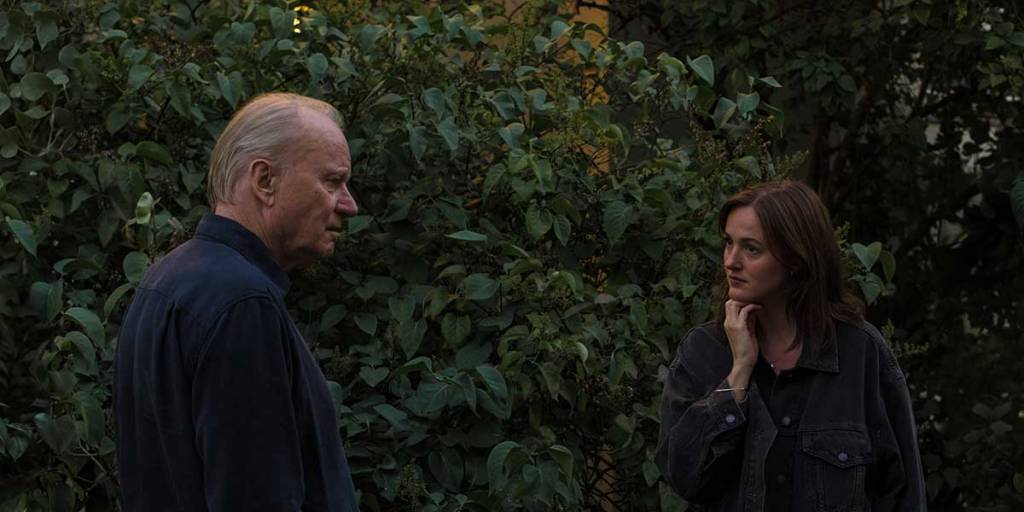
Nora Borg (Renate Reinsve) is a successful stage actress who lives in a grand old house in Oslo. It’s been in her family for generations: it’s where her grandmother killed herself, and where she grew up with her sister Agnes (Inga Ibsdotter Lilleaas) and their mom. Their dad, Gustav, (Stellan Skarsgård) disappeared after their divorce when she was still young, and they haven’t heard much from him in decades. Until now. Their mom just died and she and her sister have to deal with the house and go through all their family’s possessions (that’s the “sentimental value” of the title). And dad owns part of the house, too. But he has a second reason for showing up.
He wants to make a movie there, to use the house as his set. He’s a famous film director, but not in his prime anymore; he hasn’t shot a movie in decades. And he wants Nora in the main role of what is likely his swan song. You’re the only one who can do it, he says, just read the script! Nora refuses; bad blood runs deep. So, partly to get the funding he needs to make the picture, Gustav casts a Hollywood actress to play the role that Nora turned down. Rachel Kemp (Elle Fanning) is a big name, and she’s also a fan of Gustav’s work. What will happen to the house? Will Gustav make his film? And will they ever be on speaking terms again?
Sentimental Value is dramatic comedy about a Norwegian family. It’s full of clever asides and wide-ranging topics, but with a solid core at its centre. What makes Trier such a good director (The Worst Person in the World, Thelma, Oslo August 31st) is he creates believable characters in tough situations but without losing his sense of humour. He constantly plays around with his audience as to what is real and what is
artifice: we see Nora having a deep, emotional breakdown and then discover she’s acting a role on a stage set. He also uses biting satire to get his points across, skewering the superficiality of both Hollywood and bourgeois Norwegian society. He also repeatedly casts from a company of actors in his films. Elle Fanning and Swedish actor Stellan Skarsgård are new, but Renate Reinsve and Anders Danielsen Lie are familiar faces if you’ve ever seen Trier’s movies (and if you haven’t, you should).
Sentimental Value is moving, funny and full of good stuff to think about. I really liked this one.
The Running Man
Co-Wri/Dir: Edgar Wright
Based on a story by Steven King
It’s some point in the not-so-distant future in a dystopian America. A few rich people live luxurious lives, but the majority eke out a precarious existence within the endless sprawl of urban slums. They’re constantly surveilled by cameras, drones and DNA detectors while a brutal paramilitary police force patrols the streets. What keeps the people satisfied? Watching the reality shows and game shows broadcast from a single, big-brother-like monopoly network which controls the government, big business and media.
Ben Richards (Glen Powell) is a skilled labourer and union rep. He also has a volatile temper. He points out dangerous problems on the shop floor, which in this world gets you fired. So he’s out of work, his wife depends on tips in a hostess bar, and their 5 year old daughter is dying of an ordinary flu because they can’t afford basic medicine. What to do? There’s only one choice left: compete on THE RUNNING MAN, a reality show where all contestants try to survive for 30 days being hunted by a gang of professional killers. The winner gets a huge cash prize. And the losers pay with their lives. Luckily, the show’s producer, Dan Killian (Josh Brolin) takes a liking to Ben Richards — he’s smart, strong and most of all, angry! And the audience starts to like him… and his messages of rebellion. Can Ben outsmart the powers that be and survive? Or will the Network crush him, like they did with every Runner before him?
The Running Man is a non-stop action movie, with good
acting and an interesting plot. It’s set in the future, but done in a 1980s style, with zines, nerds and gadgets over spacemen and phasers. There are chase scenes using planes, trains and automobiles, and fiery explosions that level a city block. Glen Powell is wonderful in the lead role, appealing and heroic, painted like a Luigi Mangione fighting the corporate super-villain played by a slimy Josh Brolin. Director Edgar Wright — who brought us Toronto’s greatest Scott Pilgrim vs the Universe — keeps it funny and nerdy; he even casts Michael Cera as a nerdy revolutionary.
The Running Man is a lot of fun to watch.
Left-Handed Girl
Co-Wri/Dir: Shih-Ching Tsou
It’s Taipei’s night market, and a small family is moving into a tiny apartment nearby: I-Jing (Nina Ye) a little girl with a wild imagination, I-Ann (Shih-Yuan Ma) a diffident teenager with a chip on her shoulder, and their hardworking mom (Janel Tsai). She’s opening up a noodle stall to pay their basic rent cheque. Dad is nowhere to be seen; he ran off years ago, leaving the family high and dry. I-Jing quickly adjusts to her new kindergarten class and life in the constantly-moving marketplace. She even helps Johnny (Brando Huang) — a huckster with a heart of gold who sells carnival junk to unsuspecting shoppers — by making announcements on his loudspeaker. Mom is constantly busy, cooking and cleaning her stall, but can’t seem to earn a living. She also takes time to visit her ex-husband, now dying of cancer in hospital. Sadly he leaves his
abandoned family nothing but funeral debts and a pet meerkat. And I-Ann — who was once top of her class until she suddenly dropped out — works as a scantily-clad “betel nut beauty” selling smokes and the addictive chewing treat from her boyfriend’s shop.
But things get tense when the kids’ Mom is forced to visit their grandparents to ask for some money to tide them over. Mom’s brother is the golden boy who can do no wrong, and her two sisters both live in nice houses and are unsympathetic about her economic condition. And worst of all is grandpa, who scolds i-Jing for being left handed. He tells her left hand belongs to the devil (which she interprets as having an evil hand over which she has no control.) Now grandma is smuggling migrants through airports, mom faves eviction from the market, I-Ann missed her last period, and tiny I-Jing is turning into an avid shoplifter, using her “devil’s hand” to do the dirty work. Can this dysfunctional family ever pull itself back together?
Left-Handed Girl is a social drama about a family of women living on the brink. It’s tender, shocking and hilarious. It’s full of fast, clang-y music, flashy lights and hyper-saturated colour. It’s specifically Taiwanese in details (from bubble tea to class snobbery) but universal in its emotional appeal. And it’s co-written and edited by Sean Baker (Tangerine, The Florida Project, Red Rocket, Anora), who swept the Oscars last year with Anora. The characters speak Chinese but it’s clearly a Sean Baker movie, full of imperfect women in precarious times. And its Taiwanese-American director Shih-Ching Tsou worked on all of Baker’s films, so this is part of a long term partnership, with her taking the helm. And it’s Taiwan’s selection for best international Oscar.
I loved Left-Handed Girl, too.
Sentimental Value — opening this weekend — and Left-Handed Girl — next weekend — both played at TIFF. And The Running Man is now playing across Canada; check your local listings.
This is Daniel Garber at the Movies, each Saturday morning, on CIUT 89.5 FM and on my website culturalmining.com.
Daniel Garber talks with Ingrid Veninger about Crocodile Eyes
Hi, this is Daniel Garber at the Movies for culturalmining.com and CIUT 89.5 FM.
It’s present day Toronto. Independent filmmaker Ruby White (Ingrid Veninger) is working on a documentary about her family. She has stuck a hundred, hot-pink post-it notes on a wall, and is gradually filling in the blanks, using vintage footage she has dug up, and brand new snippets as they happen. Her daughter Sara, an artist, is very pregnant with a four- year-old daughter already there. Little Freya is exploring the world, one blade of grass at a time. Her son Jake is a manager at a movie theatre and a member of a
band. Ruby’s Slovakian parents, Dedo and Baba, still play an active role in their family; her Mom still vivacious, her Dad on his last legs. But with life, death and birth happening all around her, Ruby must decide what to include in her film and what to leave out. What is real and what is fictitious? And what will her family think of the final film?
Crocodile Eyes is a semi-fictional, semi-documentary slice-of-life drama, told through a raw and visceral lens. It’s both heartwarming and shocking. It’s the work of prize-winning, independent filmmaker Ingrid Veninger, whose films have
been shown at TIFF and festivals worldwide. She has also taught and mentored countless other filmmakers, many of whom who have risen to their own fame. I’ve been following her work for the past decade and a half, reviewing movies like the wonderful Modra and the hilarious I Am a Good Person/I Am a Bad Person, and have interviewed her twice on this show about Porcupine Lake (2017), and The Animal Project (2014).
I spoke wth Ingrid Veninger in person, at CIUT 89,5 FM.
Crocodile Eyes is having its world premiere on March 28th at the Canadian Film Fest.
Is reality just an illusion? Films reviewed: Petite Maman, Doctor Strange in the Multiverse of Madness, Stanleyville
Hi, this is Daniel Garber at the Movies for culturalmining.com and CIUT 89.5 FM.
Spring festival season is on now, with Hot Docs, entering its final weekend with tons of great documentaries still playing. Check it out while you still can.
But this week, I’m looking at three new movies, where reality, time and space are just illusions. There’s a magical doctor trapped in a parallel universe; a disillusioned office worker caught up in a deadly reality show; and a little girl who encounters another little girl in the woods… who is actually her own mother.
Dir: Céline Sciamma
Nelly (Joséphine Sanz) is a little French girl who is visiting her grandmother’s house with her parents. It’s where her mother grew up. But grand-mere isn’t there anymore. She died recently in a nursing home. Rather, they’re there to go over old possessions and letters and to spend a night there before they close it up for good. But the family is in a crisis with her parents not getting along. And Nelly’s mom (Nina Meurisse) flees the house without even saying goodbye to her. Meanwhile, Nelly explores the house and the woods behind it where she encounters another little girl named Marion (played by her twin sister, Gabrielle Sanz). They play in a fort she built in an old tree. She follows her home to a house that looks exactly like grand-mère’s… except it’s prettier, with a warm glow all about it. And there she meets grande-mère, alive again, when she was still her mother’s age. That would make Marion her mother when she is just a girl, going through
another crisis of her own. Can this new understanding of her mother’s past help hold her family together?
Petite Maman is a very simple, very short story, which is at the same time, quite moving and sentimental. It’s all about memory, loss and mother-daughter relationships. Although there’s a magical, time-travel element to it, this is no Harry Potter — it doesn’t dwell on the supernatural, that’s just a matter-of-fact element of a child’s life. Petite Maman is a wonderfully understated drama — cute but not cutesy, sentimental but never treacly — that leaves you feeling warm inside. I saw this last year at TIFF, and I put it on my best 10 movies of the year list in January, so I’m really glad it’s finally being released.
This is a tiny, perfect movie.
Doctor Strange in the Multiverse of Madness
Dir: Sam Raimi
Doctor Stephen Strange (Benedict Cumberbatch) is a former medical doctor who has changed his practice from surgeon to sorcerer. He lives in an enormous mansion in New York City. He is friends with Wong (Benedict Wong) and another doctor Christine (Rachel McAdams) who is the love of his life, but also a love lost. She couldn’t stand his hubris and self-centred nature. And he is forced to confront his rival Baron Mordo (Chiwetel Ejiofor). But when he dabbles with the dark arts, the universe is turned into chaos and he finds himself in another universe.
There he encounters the Scarlett Witch (Elizabeth Olsen) who dreams each night of a suburban housewife named Wanda. She wants to rule the world so she can return to this lost life. But the one person with the power to transcend parallel universes is a naive young girl in sneakers and a bluejean jacket named America (Xochitl Gomez). She wants to return to her own universe so she can see her two moms again. Doctor Strange rescues her just in time and they end up hurling through dimensions and realities, before landing on a topsy-turvy
New York where green means stop and red means go. Can Doctor Strange fight the witch, break the spells, and make the multiple universes all safe again?
Doctor Strange in the Multiverse of Madness is the latest instalment in a seemingly endless number of movies and TV shows. While I recognized the parade of various minor superheroes and villains as they appeared in different guises, I have to say I don’t quite get it. What is the point of this movie and why should I care? It’s directed by horror great Sam Raimi, so I was expecting some chiller-thriller elements, but I wasn’t ever scared, not even a tiny bit. It’s much too tame for that. It is fun to watch: there’s a cool psychedelic sequence in the middle along with a brilliant house of mirrors and some old -school Hong Kong kung-fu mid-air battles that I liked, but in general, I found the movie not great… just good enough.
Dir: Maxwell McCabe-Lokos
Maria (Susanne Wuest) is a woman who works at a pointless office job in a high-rise tower. One day she is disturbed by an omen — a noble bird flying in the sky that crashes into her office window. Though married with a teenaged daughter and a full-time career, she gives it all top in an instant. She empties her pocketbook, including money, phone and credit cards and wanders aimlessly into a shopping mall. There she encounters a geeky man with glasses, named Homunculus (Julian Richings) who tells her matter of factly, that she’s been chosen from 100s of millions of people to participate in a contest with four others. The winner gets an orange-coloured SUV (in which she has no interest), but more than that she can find her true self. In an abandoned warehouse called The Pavilion the five contestants are given tasks to complete, with one winner declared at the end of each round, recorded on a large blackboard.
Her ridiculously-named fellow contestants are Manny Jumpcannon (Adam Brown), a fearful
snivelling man in a leopard-print shirt; Felicie Arkady (Cara Ricketts) a conniving woman who will stop at nothing for a free SUV; Bofill Pacreas (George Tchortov) a muscle-headed obsessive body-building; and Andrew Frisbee, Jr (Christian Serritiello) an insufferable corporate executive with daddy issues. Their tasks start as simple as blowing up a balloon, but gradually become more and more difficult, some of which threaten their lives. And deprived of cel phones, their only contact with the outside world is an electrified conch shell that Maria somehow rigged up. As the alpha-types fight each other, possibly to death, only Maria seeks to get in touch with her inner self. Will they ever leave the pavilion? Will somebody win? Or is it all just an illusion?
Stanleyville is a mystical, comedy/horror movie, with echoes of Lord of the Flies, Squid Game, and other life-or-death dystopian survival stories. But this one is intentionally absurd, quirky and ridiculous. The characters all play to stereotypes but in a humorous way. So if you’re looking for something completely different, you might enjoy Stanleyville.
I did.
Petite Maman, Doctor Strange and the Multiverse of Madness, and Stanleyville all open this weekend in Toronto; check your local listings.
This is Daniel Garber at the Movies, each Saturday morning, on CIUT 89.5 FM and on my website, culturalmining.com
Daniel Garber talks with Kliph Nesteroff about Funny How? at Just For Laughs Film Fest and Viceland

Hi, this is Daniel Garber at the Movies for culturalmining.com and CIUT 89.5 FM.
Comedians and their audience share an unspoken contract. Standup comics provide the funny things, the audience supplies the laughs. But the unknown variable, the big question hovering at the back of the comic’s mind is always: Funny how?
Funny How? is the name of a new documentary series that takes you behind the scenes of stand-up comedy. It’s showing at the Just For Laughs Film Festival in Montreal, and is broadcast on TV on Viceland. Funny How is hosted by Kliph Nesteroff, the celebrated author, producer and comedy historian.
I reached Kliph in Montreal by telephone from CIUT 89.5 FM in Toronto.
Kliph Nesteroff’s new series Funny How? premiers at the Just for Laughs Film Festival and will be broadcast on Viceland TV.
For information about Just For Laughs go to hahaha.com.
Reality in Italy. Movies reviewed: Reality, Diaz: Don’t Clean Up this Blood
Hi, this is Daniel Garber at the Movies for culturalmining.com and CIUT 89.5 FM, looking at high-brow and low-brow movies, indie, cult, foreign, festival, documentary, genre and mainstream films, helping you see movies with good taste, movies that taste good, and how to tell the difference.
Summer is here — makes you want to get out of the sun and sit in a nice, air-conditioned movie theatre, maybe curl up with some popcorn and a warm body or two. Or maybe just stay outside all night long. Well, for the outside crowd,
movies are popping up everywhere. Every Tuesday they’re showing free outdoor movies once the sun sets at the Yonge-Dundas Square. Crowd pleasers like Edward Scissorshands, Napoleon Dynamite, and this coming week Sam Raimi’s classic Army of Darkness starring Bruce Campbell and a chainsaw. Or check out the Toronto Palestine Film Fest’s outdoor screening of
the popular Checkpoint Rock at the Christie Pits on July 15th – also completely free!
It’s also Canada Day weekend – but what if it rains? Check out the Umbrellas of Cherbourg on Saturday night at the TIFF Bell Lightbox, as part of a bitter-sweet Jacques Demy retrospective. And it’s also Pride Day weekend; if you want to shake your booty, don’t miss the throbbing beat in Jamie Kastner’s new tongue-in-cheek documentary The Secret Disco Revolution.
And finally, Toronto’s Italian Contemporary Film Festival is open now (downtown and up in Vaughan), So this week I’m looking at two very different dramas about life in recent Italy under right-wing media mogul Berlusconi. One’s a dark comedy about a man in Naples who will do anything to be on a reality TV show; the other a historical drama about a group of protesters in Genoa who want to escape their own grim reality.
Dir: Matteo Garrone
What is reality? A new film by the Neapolitan director of the great gangster movie Gomorra asks that question. The movie starts with a golden, horse-drawn carriage arriving at a lavish rococo palace. A well-dressed couple runs through the gilt-lined hallways to prepare for a big event. Who are these rich powerful people? Royalty? CEOs? Celebrities? Nope…it’s all artifice. They’re just guests at a wedding.
Luciano (Aniello Arena) is a well-liked fishmonger in modern-day Naples. He’s a fast talker with a sense of humour – a born entertainer. Muscular and tattooed, he has a fish stall in the marketplace and knows everybody. His time is filled with his job, his family, and his wife Maria (Loredana Simioli). They’re also involved in a complicated scam involving white- elephant robots that make pasta. Surrounded by his odd-looking extended family in the ruins of Naples, he manages to eke out a living.
But, after a brief encounter with Enzo, a minor TV celebrity at the wedding, he decides to go to a local audition for Big Brother. Big Brother is a grotesque reality show, popular in Europe, where contestants give up all privacy to live together in a glass house filled with cameras and microphones. Their day-to-day lives are edited and broadcast to the adoring but cruel public.
The audition goes well and he gets sent to Rome for the second round. But when
Luciano gets a first-hand glimpse of fame and adulation, it turns on a switch in his head that he can’t turn off.
As time passes, and he still hasn’t received the call, he decides to follow Enzo’s vapid catch phrase: Never give up! He becomes convinced that he’s being spied on – just like on the show – by TV executives from Rome who are judging his character. He abandons his parsimonious ways, and becomes lavishly generous to everyone he knows… even to strangers.
Luciano’s character becomes more and more erratic and nonsensical as his obsession with TV takes over his life. Is it all an illusion? Or will Luciano actually become a part of the surreal world of reality TV?
I enjoyed Reality – it’s a good absurdist take on the effects of mass media. As in Gomorra, Garonne casts strange, interesting locals for many of the supporting roles and shoots it in locations all around Naples. But this dark, absurdist comedy — with none of shocking violence and tension of Gamorra — leaves you feeling the emptiness of mass media, as detached as the character Luciano.
Diaz: Don’t Clean Up This Blood
Dir: Daniele Vicari
In 2001, the G8 summit in Genoa, hosted by then Prime Minister Berlusconi, attracted protesters from across Europe. What happened there is the subject of this truly shocking historical drama.
Street protesters became angry after a local student, 23-year-old Carlo Giuliani, was shot dead by the Carabiniere (military police). Protesters threw beer bottles while police used tear gas. Then came the incident which the movie concentrates on. Many activists, students and protesters – as well as all of the reporters covering them – are camped out in the empty Armando Diaz schoolhouse.
A huge number of police, many brought in from outside areas, descend on the school in the middle of the night. They attack students and journalists alike, men and women lying in their sleeping bags. They go wild, breaking bones, cracking skulls, kicking, and clubbing everyone they see. Dragged down stairways, herded
into vans they are brought, en masse, to police stations. The least lucky are sent to the now infamous town of Bolzaneto, where they are subject to humiliation and torture. Women are stripped naked, men chained up and treated like dogs.
This is an extremely shocking drama, based entirely on existing footage and first person testimony given afterwards. Although different in style, it evokes scenes from Pier Paolo Pasolini’sSalo: 100 days of Sodom, Denis Villeneuve’sPolytechnique or even the infamous photos from Abu Ghraib.
The movie is presented as a drama. You get to meet some of the individuals: a young female protester from Germany, a French journalist, a sympathetic local policeman who hears screams through the bathroom pipes, a local conservative reporter caught up in the attack. This makes it easier to identify with what happens to them, and all the more moving. But most of the film is a record of the harrowing incidents themselves and their effect on the participants. (And it makes you wonder: far from being held up as an unmitigated disaster, police seem to be intentionally repeating the techniques of Genoa like clockwork at each successive G8 summit, ensuring mass arrests and horrible violence.) Diaz is not a fun movie to watch, but it is an important one and a real eye-opener. (I reviewed an Italian documentary on the same topic last year: Black Block).
Reality and Diaz are both playing at Toronto’s Italian Contemporary Film Festival (go to icff.ca for details). And the Bitter/Sweet Jacques Demy retrospective and The Secret Disco Revolution are both on now.
This is Daniel Garber at the Movies, each Friday morning on CIUT 89.5 FM and on my website,culturalmining.com.
Daniel Garber talks with Alan Zweig about his new documentary 15 Reasons to Live
Hi, this is Daniel Garber at the Movies for culturalmining.com and CIUT 89.5 FM
What makes you get out of bed in the morning? What little things get you through the day? What makes you commit? What do you do when you suffer an enormous loss?
A new documentary follows 15 diverse people who tell their brief, honest stories to the filmmaker, in sequence — some life-affirming, some inconsequential. Whale watchers, a man who walks around the world, a massage artist, a lighthouse keeper. This is an intensely
personal movie, though not necessarily intimate. It’s called Fifteen Reasons to Live, it’s directed by Alan Zweig and it’s having its world premier at Toronto’s Hotdocs documentary festival. Alan talks about why he made the film, how he chose the subjects, whether this represents a shift in his filmmaking style… and more.
Daniel Garber talks to director Kazik Radwanski and producer Dan Montgomery about their new film TOWER
Hi, this is Daniel Garber at the Movies forculturalmining.com and CIUT 89.5 FM.
A few years ago a new voice appeared on the indie movie scene. A series of short, sharp realistic films showing ordinary, if socially awkward, people. People who run up against harsh authority figures, the holders of power, whom they try, unsuccessfully, to avoid: a little kid facing a domineering teacher, an older woman who may be losing her memory sent to a condescending psychiatrist, a teenager accused of assaulting a cop, an unsuccessful real estate agent with a pushy wife…
The films created quite the buzz on the festival scene, bouncing from Edinburgh to Berlin,
Melbourne to Toronto, picking up lots of prizes on the way. And now the first feature, TOWER, which played at TIFF last fall and is opening in Toronto on February 22, 2013. It tells the story of a rudderless, socially inept man named Derek (Derek Bogart), a guy without ambition or aims, who’s just coasting along through life. This fascinatingly dark comedy is designed to make audiences squirm along with the characters on the screen.
Writer/Director Kazik Radwanski, and his long time collaborator producer Daniel Montgomery talk to me about the film’s characters and where they came from, its themes, its look, whether it’s a comedy, a drama, or a documentary; some of their earlier films, where their production company got its name, and more…


leave a comment