Outstanding, great… or just ugly? Films reviewed: Eleanor the Great, Out Standing, The Ugly
Hi, this is Daniel Garber at the Movies for culturalmining.com and CIUT 89.5 FM.
Toronto Palestine Film Festival is on right now, with movies, shorts and docs by and about Palestinians, as well music, cuisine and art to share with other Canadians. This is it’s 17th year and it’s never been more relevant, so check it out.
But this week, I’m looking at three new movies that premiered at TIFF and are all opening theatrically this weekend. There’s an elderly woman who tells a lie, a woman with an “ugly” face who disappears without a trace, and a female officer in the Canadian Army who wishes a certain photo would just go away.
Eleanor the Great
Dir: Scarlett Johansson
Eleanor Morganstein (June Squibb) is a grandmother in her 90s. Since her husband died ten years back, she has shared her Florida condo with her best friend Bessie whom she’s known for 70 years. They do everything together, and work well as a team. Where Bessie is timid, Eleanor is brash and outspoken. If there’s something Bessie wants, Eleanor knows how to get it, even if it involves telling a few fibs. She has chutzpah to spare. But when Bessie suddenly dies, she realizes there’s no reason to stick around, so she packs up her stuff and flies back to New York for the first time in decades. She’s staying with her daughter Lisa (Jessica Hecht) and her grandson Max (Will Price). She’s hoping for some quality time but Lisa’s a worrywart and Max is always busy at school. So she takes up her daughter’s offer to attend some classes at the JCC she signed her up for; maybe she’ll make some friends. The first class is a washout — broadway musicals — so she wanders into another group almost by accident. It’s a support group for Holocaust survivors, and the members urge Eleanor — as a newcomer — to tell her story. She’s not a holocaust survivor, but her best friend Bessie was… and she knows all her memories, especially the death of her brother. So, in deference to Bessie, she tells them to the group as if they’re her own. Why not, right? It goes over well… a bit too well, actually. A teenaged college student Nina (Erin Kellyman) is auditing the group and soon bonds with Eleanor (her mom recently died and her dad is distant and
withdrawn.) The two women bond and start sharing intimate stories.
Nina is in a journalism class, and wants to make a video of her telling her holocaust memories as part of an assignment. Then things get really out of hand: Nina’s dad (Chiwetel Ejiofor) happens to be a popular TV news journalist… and he wants to make Eleanor his next feature. But what will happen to her friendship with Nina — never mind her own family — once the truth inevitably comes out?
Eleanor the Great is a nice, light movie-of-the-week-type drama about death, mourning, and inter-generational relations. It’s a very simple and easy movie, part comedy, part weeper. What’s good about it is the acting. June Squibb — who really is in her 90s — is great as the energetic, down-home Eleanor. (She played another rebellious granny in last year’s hit Thelma.) This is Scarlett Johansson’s first time as a director, and luckily she doesn’t bite off more than she can chew. She concentrates on characters — Squibb and Kellyman are both great in their roles — more than the basic story. And you know what? That’s good enough.
I wouldn’t call Eleanor the Great great, but it’s worth the watch.
Out Standing
Co-Wri/Dir: Mélanie Charbonneau
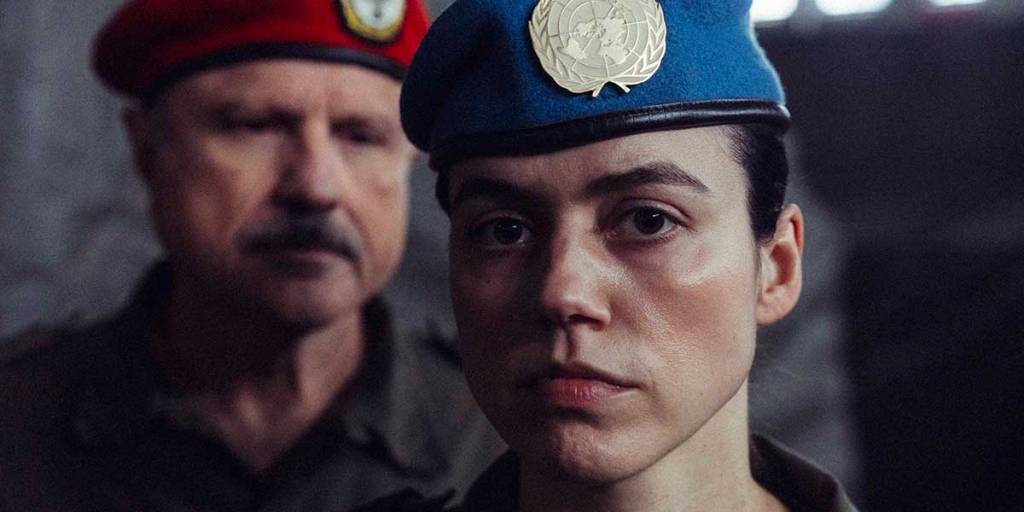
It’s the 1990s, and Captain Perron is leading a troop of UN peacekeeping forces in the former Yugoslavia. Why is this unusual? Sandra Perron (Nina Kiri) is a Canadian woman, the first to lead a squad of infantry soldiers in combat, and the first female to serve in the prestigious 22nd division, known as the Van Doos. Raised as an army brat in bases across Canada, she comes from a long line of soldiers, so it makes sense that she is following in her father’s vocation. She trained as a cadet and received commendations while still a teenager. And she’s the first woman to survive the brutal training that squadron demands. But there’s a photo circulating from her past that’s threatening to derail her military career. It’s a picture of her tied to a tree, barefoot, in the snow and semiconscious.
It was part of her training in a Prisoner of War exercise that went far beyond the normal treatment soldiers are forced to endure. A Canadian woman facing treatment tantamount to torture at CFB Gagetown in New Brunswick. But Captain Perron isn’t the one who released the photo, one fact she didn’t want the photo circulated. She had endured years of hazing bullying, harassment, obscene phone calls, sabotage to her kit, and a hidden campaign by certain officers to get rid of her. They detest the idea of serving alongside or under the command of a woman. And unlike the other women who
attempted to to join the Van Doos, she alone managed to survive and not quit.
Out Standing is a biopic about a trailblazing woman in the Canadian Armed Forces. It’s both moving and disturbing. The title, based on her memoirs, refers both to her achievements and to the notorious photo of her standing tied to a tree. (That pic was eventually published by the press, triggering a wave of shock and disgust across the country, and, one hopes, an improvement in how women are treated in the military.) Nina Kiri gives an excellent performance, totally believable as Perron.
While Hollywood churns out dozens of war movies each year, showcasing the latest weapons and fighter planes, you rarely see a Canadian one. This one is full of details carefully chosen to distinguish how soldiers behave here. The military culture is quite different. Unlike in the US there’s no Sir-yes-sir! And instead of saluting a Canadian soldier stand sharply at attention. I never knew this because you never see it in movies. For this alone it’s a eye-opener. The film is not perfect — there’s a particularly clumsy scene near the end — but altogether it’s a compelling and disturbing look at a Canadian woman’s life in the military.
The Ugly
Wri/Dir: Yeon Sang-ho (Peninsula, Train to Busan)
Lim Yeon-gyu (Kwon Hae-hyo) is a well-known carver of dojang, the name stamps used in Korea like a signature on official documents. He built up his business from scratch while raising his son as a single parent. (His wife ran away soon after the baby was born.) He trained his son Lim Dong-hwan (Park Jeong-min) in every aspect of the craft. Now an adult he is taking over the family business. At this moment, a documentary filmmaker (HAN Ji-hyeon) is celebrating this dad’s life as a national treasure. Why did she choose this man for her documentary? He’s been blind since birth, which makes his many accomplishments even more impressive. But filming is put on hold when a surprise announcement arrives. They’ve found Dong-hwan’s mother decades after she disappeared. Turns out she’s been dead all that time and only her bones remain. This comes as a total shock to Dong-hwan, and it just gets worse.
First his mother’s long lost relatives arrive for the funeral but they’re despicable people who just want to make sure he doesn’t claim any family inheritance.They bullied and beat his mother, a veritable Cinderella raised by this cruel family. It’s also the first time he hears his mother described as ugly. Ugly how? He longs to see a photo of her, something to display at the funeral, but there are no photos anywhere. Of course his blind father doesn’t have one. While Dong-hwan is trying to process all this new information, the filmmaker leaps on it as a great story and insists on continuing the documentary but with a new twist: who killed his mom and why? Together, over a series of interviews with hidden cameras, they uncover
events and people from her past as the tragic puzzle gradually falls into place.
The Ugly is a mystery about a kind-hearted woman — the main character’s mother — and how she is horribly treated because of her looks. It’s a heart wrenching story, a dark, bleak view of humanity with only Dong-hwan (and his mother) as redeeming characters. The story is told as a series of interviews with the various characters and extended flashbacks to what actually happened (The actor who plays Dong-hwa also plays his blind father as a young man in the flashbacks, while Jung Young-hee plays his mother, but always from behind or from the side, without ever revealing her face). In Yeon Sang-ho’s previous movies (Peninsula, Train to Busan) the action hero is surrounded by mutants or zombies or killers. The Ugly is about normal people but they’re just as hideous.
The Ugly is a powerful and dark look at human cruelty and physical beauty.
Eleanor the Great, Out Standing and the Ugly all open this weekend in Toronto; check your local listings. This is Daniel Garber at the Movies, each Saturday morning, on CIUT 89.5 FM and on my website culturalmining.com.
Daniel Garber talks with Steve J. Adams and Sean Horlor about Satan Wants You!
Hi, this is Daniel Garber at the Movies for culturalmining.com and CIUT 89.5 FM.
In the 1980s, tabloids like the National Enquirer and daytime talk shows from Oprah to Jerry Springer were talking about everyone’s biggest fear: that animals and small children were being kidnapped by witches and sacrificed to the devil. A new psychological method known as Recovered Memory Syndrome was in vogue, and countless adults who suffered trauma as a child, were somehow recalling bizarre satanic rituals doing back to their earliest memories. And in courtrooms across America, daycare workers, teachers and social workers were accused of heinous crimes, leading to arrests, trials and prison sentences, based on dubious testimony. Who would have
thought this all harkened back to a young woman named Michelle Smith and her psychiatrist Lawrence Pazder in peaceful Victoria, BC?
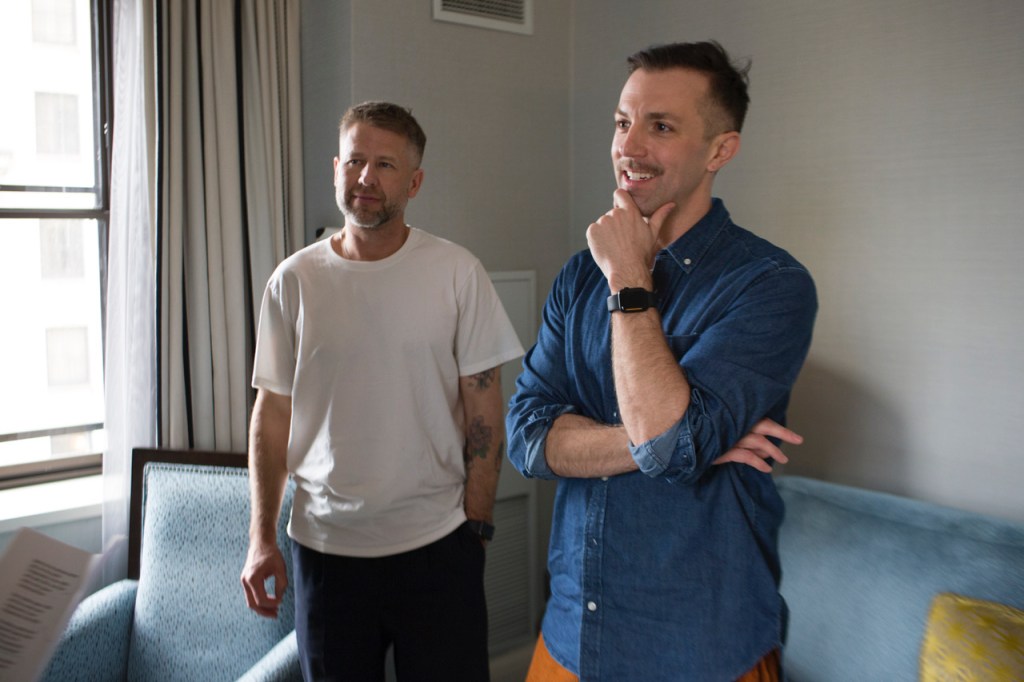
Satan Wants You! is a new documentary that delves into the case of Michelle Smith, her psychiatrist Lawrence Pazder, the bestselling book Michelle Remembers that followed and the ramifications it led to. This compelling film tears the veil from this story, using period TV footage, and new interviews with family members and everyone involved. Satan
Wants You is written and directed by Vancouver-based documentarians Steve J. Adams and Sean Horlor. Steve and Sean are a prize-winning team known for their films on pop culture and queer topics and whose doc Someone Like Me won the Audience Choice award at Hot Docs in 2021.
I spoke with Steve and Sean, in person, at TIFF 2023.
Satan Wants You! had its world premiere at this years Hotdocs Film Festival, and is now playing at the Rogers HotDocs Cinema in Toronto.
Daniel Garber talks with Cam Christiansen about Echo of Everything
Hi, this is Daniel Garber at the Movies for culturalmining.com and CIUT 89.5 FM.
What do punk, gospel, jazz and Andalusian duende music have in common? They all bring an ecstatic reaction from musicians making the music and listeners dancing to it. It’s a primal response dating back thousands of years, with music bringing joy, anger, sadness, and inspiring sex and even violence from its listeners. Are these ecstatic reactions still around today? And are the notes and rhythms
we hear an echo of ancient rituals or even primordial sound waves?
Echo of Everything is an amazing new documentary about music and how it affects us emotionally, spiritually and scientifically. A highly personal film it incorporates expressionistic scenes in black and white, philosophic interviews and intense musical performances recorded in supersaturated colour. And running throughout is a constant stream of sound and rhythm, recorded around the world.
Echo of Everything is written and directed by Calgary-based filmmaker and animator Cam Christiansen, known for his award-winning features Wall and I Have Seen the Future.
I spoke with Cam in person, on-site during Hot Docs at the Luma Café at the TIFF Bell Lightbox.
Echo of Everything had its world premiere at Hot Docs and is opening theatrically later this year.
Smiles and frowns. Films reviewed: Smile, Triangle of Sadness
Hi, this is Daniel Garber at the Movies for culturalmining.com and CIUT 89.5 FM.
Weather changes with the seasons and so do our moods: one minute it may be sunny, the next dark and overcast. So this week I’m looking at two new movies about changing emotions. There’s a comedy about a frown and a horror movie about a smile.
Wri/Dir: Parker Finn
Dr Rose Cotter (Sosie Bacon) is a therapist who works in the emergency psych ward at a large New Jersey hospital. She’s always prim and proper, wearing buttoned shirts, with her hair neatly pulled back from her face. She spends most of her time at work, up to 80 hours a week, but on her free time she likes nothing better than sipping white wine in her bungalow, cuddling her fluffy cat Moustache or just chatting with Trevor, her nondescript fiancé. She is devoted to helping her patients, having survived her own mother’s mental illness and suicide when she was a little girl.
It’s just a normal day when she examines a new patient in intake. Laura is a grad student showing signs of paranoid delusions. She is terrified that someone is out to get her. “I’m not crazy, I’m a PhD candidate!” says Laura (as if the two were mutually exclusive). She’s not sure whether it’s an evil spirit, a ghost or a satanic possession, but whatever it is, it’s been haunting her since she witnessed her prof commit suicide just a few days earlier. It takes the form of people closest to her,
that only she can see. And worst of all, it has a horrible smile. And before Rose can do anything, Laura violently kills herself right in front of her… with that awful smile plastered on her face. And from that moment on things feel different for Rose.
Her nightmares turn into daydreams. She begins to hallucinate — with figures from her past, including a dead patient, reappear before her, smiling. She has very few people to talk to outside of the hospital: Trevor, and her older sister Holly, who only talks about family and real estate. She visits her own former therapist, who refuses to prescribe anti-psychotics, saying it’s just stress and overwork. But Rose knows it’s something more. Everything that happened to Laura — and her professor before her — seems to be inflicted on Rose now. She finally turns to her ex-boyfriend
Joel (Kyle Gallner) for help. He’s a police detective now, investigating Laura’s death; perhaps he can find out what’s causing these suicides. Because Rose is sure she’s either going insane, or is controlled by an evil entity… or both! And if she doesn’t do something fast, she’ll be dead in three days. Can Rose figure out what’s happening to her, and stop her impending, smiling suicide? Or is she out of time?
Smile is a good psychological thriller/horror. While it’s occasionally predictable — with some dubiously freudian plot
turns — it’s mainly a gripping, scary flick. Great spooky music and some cool visuals, like disorienting, upside down drone shots of a cityscape, and a delightful scene change using the camera’s iris. And lots of cute, smiley-face images popping up everywhere in the background. I’ve never seen Sosie Bacon before, (she’s second generation Hollywood, the daughter of Kevin Bacon and Kyra Sedgwick) but she’s quite good as Rose, gradually transforming from uptight doctor to terrified heroine.
If you’re in the mood for a good screamer, check out Smile.
Wri/Dir: Ruben Östlund
Yaya and Carl (Charlbi Dean, Harris Dickinson) are a millennial power couple. Carl is a fashion model who is featured shirtless in perfume and underwear ads. He is known for his looks. But he still has to show up for cattle-calls. Yaya, though, is an influencer — her posts and selfies are followed by millions, and sponsors are constantly sending her money and goods to promote. But their unequal status spurs an argument. Why does he have to pick up the cheque when they go out to dinner? He’s the man in the relationship but Yaya is much more famous and earns way more money than Carl. It’s just not fair. So she invites him to join her on an elite cruise ship, all expenses paid.
The boat is an exclusive luxury liner, and the passengers are some of the richest people in the world. One couple made billions selling bombs and landmines. Another oligarch, named
Dimitri (Zlatko Buric) proudly says he earned his fortune selling shit — literally. He cornered the market in fertilizer. And the staff are trained by Paula, the head of the crew (Vicki Berlin), to fulfill any whims or demands of the passengers no matter how outlandish or nonsensical. And Carl and Yaya soon find out that any casual complaint or criticism of a staff member they might make may lead to their instant dismissal. But the ship hits trouble on the high seas, and the captain (Woody Harrelson), an alcoholic communist, can’t stay sober long enough to prevent a disaster.
Later, the passengers and staff regroup on a tropical isle, situated somewhere between Gilligan’s Island and Lord of the Flies. But with a new power structure in place, who will make it out of there alive?
Triangle of Sadness — the title refers to that part of the face from the brow to the bridge of the nose that supposedly conveys happy or sad emotions — is a scathing satire about the state of the world. Told in three chapters — in the city, on a ship, and on a remote island — it follows a young couple as they navigate life among the powerful and super-rich. It also shows what could happen if existing power structures (and the money that reinforces them) ceased to exist. Did I mention this is a comedy? I found it bitingly and bitterly hilarious, though at times disgusting. For humour’s sake, it reverses many presumptions: by presenting men — not women — as sexual objects subject to exploitation; and by pulling away the curtains hiding the transgressions of the rich and powerful.
The acting in this dark comedy — especially by the late Charlbi
Dean and Harris Dickinson, as well as Zlatko Buric and Dolly De Leon as Abigail a former toilet cleaner who suddenly finds herself as the big fish in a small pond — is excellent all around. The story is told as a comic fable, intentionally never realistic, with settings, costumes, and music, all reinforcing its farcical nature. This is not Swedish director Ruben Östlund first dark comedy — he previously directed such great movies as The Square and Force Majeure — but Triangle of Sadness is the most extreme of all his films, one that takes his themes beyond the expected limits. Though not universally loved, in my opinion this is one great movie.
Smile is now playing and Triangle of Sadness, which played at #TIFF22 earlier this year, opens at the TIFF Bell Lightbox this weekend.
This is Daniel Garber at the Movies, each Saturday morning, on CIUT 89.5 FM and on my website, culturalmining.com
Mind Games. Films reviewed: Spiderhead, Chess Story, In the Wake
Hi, this is Daniel Garber at the Movies for culturalmining.com and CIUT 89.5 FM.
Spring film festival continues through June with Toronto’s Japanese Film Festival and the Toronto Jewish Film Festival showing films for another week. Also on now is the Future of Film Showcase, Canada’s premiere festival for short films. It also has panels, coffee sessions and workshops, covering everything from casting to funding, from locations to issues like equity.
This week, I’m looking at three new movies about people forced to play games. There’s a prisoner playing chess in WWII Vienna, another prisoner forced to play mind games in a secretive American facility; and a detective playing cat-and-mouse with a murderer… ten years after an earthquake in Japan.
Dir: Joseph Kosinski (Top Gun: Maverick)
Jeff (Miles Teller) is an inmate in a remote, high-security prison. Located inside a brutalist cement building on a placid lake, it can only be reached by boat or pontoon prop plane. But inside it’s a virtual paradise. Doors are kept unlocked, prisoners chat on colourful sofas while eating canapés, and are free to pursue their favourite pastimes. They can even become friends with other prisoners — like Lizzy (Jurnee Smollett). No violence or distrust here; the benevolent warden Steve (Chris Hemsworth) makes sure of that.
So what’s the catch?
All prisoners are kept placid by a little gadget attached to their bodies, which — through remote control — releases chemical serums directly into their bloodstreams which controls their moods. They are also forced to attend sessions — controlled by Steve and his assistant behind a glass wall — where they test the potency of their pharmaceuticals. Sometimes it’s as simple as making them laugh at deliberately unfunny jokes. Other times they’re placed in the room with a stranger — a female prisoner in Jeff’s case — to see if drugs can make them so thirsty and the other seem so attractive (like “beer goggles” times 1000) that they can’t help having sex on the spot. But things take a sinister turn when Jeff is taken behind the glass wall and ordered to remotely inject painful drugs into other prisoners’ bodies. Can Jeff resist the psychological and chemical pressures put on him? What is Chris’s motive behind these experiments? And is there anything Jeff
can do to stop him?
Spiderhead — the title is the name of the prison — is a sci-fi psychological thriller, about the dangers of pharmaceuticals and whether we can resist authority if it goes against our beliefs. The film is partly based on the Milgram experiment of the 1960s, where volunteers behind a glass wall were ordered to send increasingly painful electric shocks to actors pretending to be patients. In Spiderhead it’s taken to even greater extremes.
Is this movie good? It’s not too bad — I actually enjoyed it, loved the location and sets (it’s shot in Australia), the cheesy 1980s soundtrack, and the fun concepts, along with some huge movie stars… but the ending is as predictable as it is implausible. The concept is much better than the story. But if you just want be entertained for a couple hours, you could do worse.
Dir: Philipp Stölzl
It’s 1939 in Vienna, and Josef Bartok (Oliver Masucci) is living the high life. He always dressed in formal black and white, and only the finest scotch and the best cigarettes ever pass through his lips. He loves telling jokes with his friends, and waltzing with his beloved wife Anna. As long as the Viennese keep dancing what could go wrong? But that night German soldiers march into Austria declaring Anschluss; it’s all one Reich now. Jacob springs into action, scanning through his ledgers and memorizing the codes before throwing them into a blazing fire. You see, his job is to keep the riches of the Austrian royalty safe from the Nazis in numbered Swiss bank accounts. Hours later he is arrested, but not killed, by the Gestapo and locked in a hotel room. If he tells them the numbers they say they’ll let him go — they just want the money. But solitary confinement can play tricks on your brain. He stays alive by studying a chess book he smuggled into the room.
Later, he is on a ship with Anna heading to America and freedom. But he can’t resist playing
chess against Mirko, an unusual world chess champion, who is illiterate and can barely form a sentence. But as reality begins to warp, he can’t help wonder if he’s on a ship or still a captive of the nazis. And where is this chess game really taking place?
Chess Story is an historical drama based on a story by Stefan Zweig, the last thing he wrote. He died during the war, in Brazil not Austria, but clearly he was damaged before he left. Everything you see in this film is filtered through Josef’s mind, so you’re never quite sure what is real and what is imaginary. Oliver Masucci who plays him is excellent, portraying a man’s descent from carefree joker to broken soul. It feels almost like an episode of The Twilight Zone episode, but with the emphasis on the characters, not on the twist.
In the Wake (Mamorarenakatta mono tachi e)
Dir: Zeze Takahisa
Det. Tomashino (Abe Hiroshi) is a policeman in northeastern Japan. He is investigating the mysterious death of two middle-aged men, both found starved death in different locations. Is there a serial killer out there, and if so, what are his motives? Turns out they both worked out of the local welfare office. He turns to a young welfare case worker Mikiko (Kiyohara Kaya) to help him put the pieces together. This is also the site of a mammoth earthquake and tsunami, ten years earlier. The detective remember it well, as he lost both his wife and his young son. Now he’s a loner who has yet to deal with his losses.
Meanwhile, Tone (Satoh Takeru) a troubled young man, just out of prison for arson, gets a job in a welding factory. And he wants to get in touch with his makeshift family former after the earthquake: a little kid, and an elderly woman named Kei (Baishô Mitsuko) who cared for the two lost orphans. But things have clearly changed. Could they have driven him… to murder?
In The Wake is a Japanese drama set immediately after an earthquake and a decade later. While it’s ostensibly a police procedural, about a detective trying to catch a killer, it’s also a
surprisingly powerful and moving drama, that takes it much deeper than your usual mystery. It shifts back and forth between the two periods, as all the major characters were also survivors of the quake. And it delves into the terrible inadequacies of Japan’s austerity cutbacks to to their already inadequate welfare state. The movie features Abe Hiroshi, a huge star from Kore-eda’s films; Baishô Mitsuko , who was in movies by the most famous Japanese Kurosawa and Imamura; and Satoh Takeru best known for the Rurouni Kenshin series. I was expecting something simple, and lucked into a really good movie instead.
Spiderhead is now streaming on Netflix; Chess Story is now playing digitally at TJFF, The Toronto Jewish Film Festival; and In the Wake is playing at the other TJFF, the Toronto Japanese Film Festival, on one day only, June 25th, at the Japanese Canadian Cultural Centre.
This is Daniel Garber at the Movies, each Saturday morning, on CIUT 89.5 FM and on my website, culturalmining.com.
Daniel Garber talks with Kelly McCormack about her new film Sugar Daddy
Hi, this is Daniel Garber at the Movies for culturalmining.com and CIUT 89.5 FM.
Darren is a small town girl with big city ambitions. She left her divorced mom and adoring sister behind for a music career in Toronto. She found a gaggle of artists to hang with and an apartment-mate who has a crush on her. She earns her rent at a catering job. But when, in a Dickensian plot turn, she’s caught taking home leftover sandwiches — she finds herself fired, broke, starving, and nearly homeless. What to do? She signs onto a service where she’s paid to go on public dates with much older, much richer men. This solves her money deficit… but what about her career and sense of self worth? Will Darren’s new arrangements lead to success? Or is she doomed to failure as an artist on the payroll of a “sugar daddy”?
Sugar Daddy is a coming-of-age feature about a young woman
discovering her self worth, and what her youth, body, and talent will fetch on the open market. The film is written, produced by and starring Toronto-based writer, musician, actor, and artist Kelly McCormack. Kelly has made her mark on stage and screen — you’ve probably seen her as Betty Anne on LetterKenny as well as parts on Ginny and Georgia on Netflix and the upcoming A League of their Own on Amazon.
I spoke with Kelly via Zoom in Toronto. I previously interviewed her along with Alec Toller in 2014 about her off-beat film Play: the Movie.
Sugar Daddy premiered at the Canadian Film Festival on April 1st, and opens on VOD, beginning April 6th, 2021.
Separated. Films reviewed: Dear Comrades!, A Glitch in the Matrix, Two of Us
Hi, this is Daniel Garber at the Movies for culturalmining.com and CIUT 89.5 FM.
Festival and award season has begun, so this week I’m looking at three new movies – from the US, Russia and France – now playing at Sundance or already nominated for upcoming awards. There are people who believe perception is separate from reality; a Communist official separated from her daughter; and an elderly woman separated from the love of her life.
Co-Wri/Dir: Andrey Konchalovskiy
It’s summer in a small Russian city on the Don River, and the people are angry. Food prices are soaring while wages are going down. Thousands of factory workers take to the streets carrying red flags and pictures of Lenin. Is this the Russian revolution of 1905? Or is it 1917?
Neither… it’s the Soviet Union in 1962!
Lyuda (Yuliya Vysotskaya) is a single mom who lives with her and her daughter Svetka (Yuliya Burova) who works in a train factory, She’s an ardent Stalinist. And because she’s an apparatchik — a high-placed local official and member of the Communist Party — she lives a good life. This means access to hair salons,
nylon stockings, negligees, and Hungarian salami. She’s having an affair with a married official.
The food shortages and wage cuts don’t really affect her.
But her life is shaken up by the walkout at a locomotive factory (where Svetka works) and spreading across the city of Novocherkassk. And their meetings — they’re trying to figure out how to handle this — end up with bricks through the window and Lyuda and the rest forced to
sneak out through a sewer tunnel. In comes the KGB who want to bring guns ammunition into the equation: the instigators must be stopped. Mayhem and killings ensue. Lyuda is a hardliner, but when her daughter disappears she has to decide whether her loyalty is to the state or to her kin.
Dear Comrades is a moving drama about a real event and the massive cover-up that followed it. It’s shot in glorious, high-contrast black and white, similar to
Polish director Pawilowski’s Ida and Cold War, but with magnificent, classic cinematic scenes involving hundreds of rioters and soldiers in the public square. Yuliya Vysotskaya’s performance as Lyuda runs the gamut from cold official to angry mother to disillusioned and drunken party member as her entire existence and beliefs are called into question.
This is Russia’s nominee for best foreign film Oscar and definitely deserves to be seen.
Dir: Rodney Ascher
Have you ever had the sensation that everything around you — other people, your job, what you see and hear — is an illusion, that you’re living in a programmed reality? If so, you’re not alone. A new documentary talks to people who are convinced they are trapped in a world like the Wachowskis’ 1999 movie The Matrix, where everything they perceive is just a computer simulation. And anyone else — other than one’s self — is either a part of this conspiracy, or a victim of it, or they don’t even exist outside of your head. And it is only detectable by paying attention to weird glitches in the system, like odd
examples of deja vu, or coincidences that are too absurd or fantastical to be merely random events.
The doc interviews people rendered into 3-D animated avatars who tell about their own experiences. It also gives a full history of these beliefs, dating back to Plato’s concept of shadows on the wall of a cave, through Descarte’s epistemological example of an “Evil Demon” deceiving us, all the way to the present. This includes a rare recording of a
speech given by author Phillip K Dick in the 1970s, who says the ideas in his books are not science fiction but science fact. His stories inspired movies like Blade Runner, Total Recall.
A Glitch in the Matrix is a fascinating, informative and bizarre documentary that premiered at the Sundance Film Festival a couple days ago. Aside from the animated interviews and narration, it presents a veritable tsunami of visual references to movies and TV shows video games that deal with these topics. I’m talking hundreds of clips, from the game
Minecraft, to The Truman Show, to the kids’ book Horton Hears a Who, all of which propose that there are worlds or universes who don’t know they are just tiny self-contained units within much larger realities.
Do I believe I’m living in a glass dome or floating in a sensory deprivation tank? No. But that didn’t stop me from enjoying this mind-warp of a documentary.
Co-Wri/Dir: Filippo Meneghetti
Nina and Madeleine (Barbara Sukowa, Martine Chevallier) are two elderly women who live in Paris (Nina’s originally from Berlin). They first met as children in a public park in Rome, and kept in touch ever since. And for the past 20 years they’ve been passionate lovers who share one floor of an apartment building, floating back and forth between the two homes separated by a hallway. And they’re planning on selling them leaving Paris and retiring somewhere in Rome. The only thing holding them back are Madeleine (or Made as Nina calls her)’s two adult children and her Anne and
Frédéric and her grandson Théo.
She was married to an abusive husband for Amy years until he died, though her actual relationship was with her lover Nina. But she’s never told her family the truth — she’s too worried about what they’ll think. But when Mado has a sudden stroke rendering her speechless, Nina is suddenly separated from her de facto wife. Mado’s family just think of her as the kindly neighbour Mme Dorn who lives down the hall. They bring in a paid caregiver who blocks her entry into the other apartment. When Nina demands to spend time with her lover, Anne and Frederic begin to regard Nina as a crazy woman who won’t leave their mother alone and cut off all contact. Will Nina and Mado ever see each other again? And can their relationship be saved?
Two of Us is a wonderful and passionate drama about two elderly lovers. It’s the young, Paris-based Italian director’s first feature, but it feels mature and masterfully done. And it co-stars the great Barbara Sukowa (If you’re into German cinema, you may remember her from movies in the 70s and 80s by Fassbinder and more recently by von Trotta), Sukowa is just as good now as she’s ever been. And Chevalier conveys volumes even when she can’t speak. The movie is full of pathos and tears and frustration and joy, you feel so much for both of them.
Two of Us is France’s nominee for best Foreign Oscar, and it’s definitely worth seeing.
A Glitch in the Matrix starts today, and Dear Comrade and Two of Us are both opening at the digital TIFF Bell Lightbox.
This is Daniel Garber at the Movies, each Friday morning, on CIUT 89.5 FM and on my website, culturalmining.com
Two Ladies and a Gentleman. Films Reviewed: Love Sarah, Promising Young Woman, Lupin
Hi, this is Daniel Garber at the Movies for culturalmining.com and CIUT 89.5 FM.
Doug Ford’s latest rules to fight the pandemic say don’t leave home… except when you do But don’t worry, there’s lots to see without going outside. This week I’m looking at two new movies and a TV series. There’s three woman in London opening a bakery, a Parisian thief who’s a master of fakery, and a vengeful woman exposing predators by pretending to be drunk when she’s actually wide-awakery.
Dir: Eliza Schroeder
It’s present-day London, in Notting Hill (before the pandemic). Sarah is a chef who comes from a family of very talented women. Her daughter Clarissa (Shannon Tarbet) is a professional dancer, and her mum, Mimi (Celia Imrie), is a retired trapeze artist. She plans to open a gourmet bakery/cafe with her best friend Isabella (Shelley Conn). They studied cooking together in Paris. But right after they secure the property, Sarah is killed in a bicycle accident, and her whole family is in disarray. Depressed Clarissa can’t dance anymore, and her dancer-boyfriend kicks her out. Mimi was already estranged from Sarah before she died. And Isabella without a real chef, is forced to go back to her office job. The three manage to overcome their differences and open the cafe in Sarah’s name. But where will they find a baker? In walks Matthew (Rupert Penry-
Jones). He’s a two star Michelin chef who studied with Sarah and Isabella in Paris and slept with each of them (he’s a notorious womanizer.) Perhaps he’s also Clarissa’s birth father… And does he still carry a torch for Isabella?
Love Sarah is a charming, low-key drama about the joys and trepidations of running a business in honour of someone who died. It’s full of vignettes about cooking and baking in a quaint and colourful neighbourhood. There are also chances of romance for each of the three women. The plot is threadbare but the characters — and the actors who portray them — are quite endearing, in that understated English way. Love Sarah is a cute, but inoffensive, picture.
Wri/Dir: Emerald Fennell
Cassandra (Carey Mulligan) is a promising young woman at med school with her best friend Mimi. They’ve planned to become doctors since they were kids. But then something terrible happens. Mimi gets drunk at a party and is raped by another student and the university sides with the man. Mimi commits suicide and a despondent Cassandra quits school, moves in with her parents and drops out of life. She works by day at a dead end job, while her nights are spent in a drunken stupor at tawdry pick-up bars, going home with whatever guy asks her. But things aren’t what they seem. Whenever her “date” inevitably throws

Carey Mulligan stars as “Cassandra” in director Emerald Fennell’s PROMISING YOUNG WOMAN, a Focus Features release.
Credit: Courtesy of Focus Features
himself on this seemingly drunken woman, she jumps into action to teach the predator a lesson. This secret heroin will never be a victim. But can she single-handedly avenge all the people to blame for Nina’s suicide? And will she ever start living a normal life again?
Promising Young Woman is a vengeance thriller that’s full of shocks surprises. Carey Mulligan is fantastic as Clarissa, a multi-leveled character who is both depressing, and funny with a dark, deranged streak running through her. Bo Burnham plays a self-effacing nerd — and potential boyfriend — who challenges her theory that all men are douches; and comic relief is provided by Jennifer Coolidge as her mom, and Laverne Cox as her boss. Promising Young Woman is shocking and deeply disturbing while also reassuringly moralistic. This movie keeps you guessing — and your heart pumping — till the very end.
Assan Diop (Omar Sy) is a young boy who lives with his Senegalese father in a palatial estate in Paris. His dad’s a chauffeur for the Pellegrinis, a very rich but ruthless family. He gives Assan a book — classic stories of Arsene Lupin, the eponymous gentleman thief and master of disguises — and tells him to read it carefully and learn from it. Lupin is ingenious and conniving but always a gentleman (they use the English word in this French drama) But when his father is arrested for stealing priceless jewels, Assan is left alone, penniless and orphaned. Luckily an anonymous donor pays for his education at an elite academy. Years later he emerges as a modern day Lupin, reenacting his most audacious thefts and reaping its rewards. He’s married now and has a teenaged son. But when the jewels his father was accused of stealing reappear at an auction, he is determined to get the necklace, prove his father’s innocence and get revenge on Pellegrini, whom he believes set his dad up. But to do
this he must outsmart the police, evade Pellegrini’s hired killers, even while he continues to carry out his intricately planned heists.
Lupin is a delightful new TV series full of capers and adventures, a new take on a classic character. It follows multiple sub-plots: his relationship with his wife and son; his various capers; his war against Pellegrini, and the cat & mouse game he plays with the police. Omar Sy is wonderful in the main role, so much so that there’s little screen time given to the supporting actors — the buffoonish cops and naive millionaires are mainly there as foils for his exploits. Yes, it’s an unbelievable fantasy, and yes, it’s purely light entertainment, but I like it a lot. And after one week with only 5 episodes, it is already trending at #1.
Lupin is now streaming on Netflix. And Love Sarah and Promising Young Woman both open today digitally and on VOD.
This is Daniel Garber at the Movies, each Friday morning, on CIUT 89.5 FM and on my website, culturalmining.com
Daniel Garber talks with Michael Allcock about his new doc Fear of Dancing
Hi, this is Daniel Garber at the Movies for culturalmining.com and CIUT 89.5 FM.
As long as people have made music, we’ve also danced to it. Dancing is artistic expression, it’s sexual attraction, it’s our innermost emotions laid bare. But alongside these cfowded dancefloors are always the unnoticed few, the wallflowers huddled in the shadows, never leaving their seats. Are they stubborn? Are they snobs? Are they just waiting for the right partner? Or is it… something else? Psychologists have a word for this: chorophobia, the irrational fear of dancing.
Fear of Dancing is also the name of a quirky, new, personal documentary. It follows
subjects around the world – from Canada to Switzerland to Kenya – who suffer from this unusual condition, and the things we’re trying to do to overcome it. The film was made by Canadian documentarian Michael Allcock, known for his writing, story editing and directing on a wide range of topics, from punk rock to poker, from the Unabomber to the Spanish Inquisition. This time, though, he’s one of the subjects of his own film.
You can view Fear of Dancing on CBC Gem in Canada, beginning on Friday, Nov 27, 2020.
I spoke to Michael via zoom from my home.


leave a comment