Parts of history. Films reviewed: Fanon, Train Dreams, Christy

Posted in 1920s, 1950s, 1990s, Algeria, Biopic, Boxing, Class, Colonialism, Lesbian, LGBT, Politics, Psychiatry, Resistance, Trains, violence by CulturalMining.com on November 9, 2025

Hi, this is Daniel Garber at the Movies for culturalmining.com and CIUT 89.5 FM.

Toronto’s Fall Film Festival season continue with two series on right now. Reelasian features films from Asia and its diaspora, including two great ones from Canada: Min Sook Lee’s heart-wrenching doc There are No Words, and Koala Kid’s whimsical, animated Space Cadet. Cinefranco has movies in French from Europe, Africa, and Quebec, including many Toronto premieres: look out for la Venue de l’Avenir by Cedric Klapisch (Ma Part du Gateau), and le Dernier Souffle by the legendary Costa-Gavras. 

But this week, I’m looking at three new films set in historical eras. There’s a lumberjack at the turn of the previous century, a psychiatrist in Algeria in the 1950s, and a female boxer from West Virginia in the 1990s. 

Fanon

Co-Wri/Dir: Jean-Claude Flamand-Barny

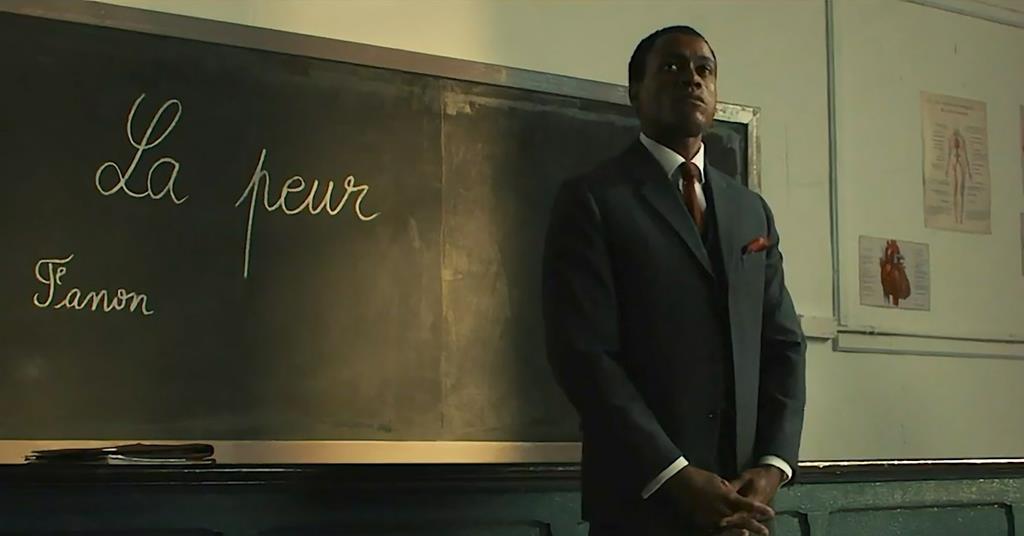
It’s the early 1950s in Algeria. Frantz Fanon (Alexandre Bouyer) is a renowned psychiatrist from the French Island of Martinique. He is starting his new job at a mental hospital. But he’s shocked at how Algerian patients are treated there. In contrast to Europeans, the “savage” north Africans are kept shackled in filthy cells, because of their “barbarous and dangerous” nature. Fanon (who is black) insists his North African patients be treated like any others. He lets them walk in the garden, plant vegetables, play soccer and make friends. Their mental health quickly improves. He’s assisted by diverse Algerian interns and staff: Hocine (Mehdi Senoussi) Jacques (Arthur Dupont) and Alice (Salomé Partouche), all followers of his techniques. But he’s strongly opposed by traditionalists and the French military, who are increasingly violent in their tactics. (Algeria was annexed by France but most of the locals are not considered full citizens.) He and his wife Josie (Déborah François) are upper-middle-class French citizens playing their role supporting the sprawling Empire. Fanon fought the Nazis in WWII. He likes Sartre, elegant suits and and fine wine. But his views are changing. He now writes books (dictated to his wife) about the effect of colonization on the mental health of the colonized in Algeria. Their own self-image is denigrated by their oppressors, he writes, when they internally accept their status as “the other”. Word gets out and he’s invited to join the FLN, (considered terrorists by the French). But the threat of violence reaches his hospital, as personified by Sergeant Rolland (Stanislas Merhar), a particularly violent soldier who checks in as a patient. How can Frantz Fanon simultaneously balance his various roles — as a husband and father, as a Black man serving the French empire, as an innovative psychiatrist, and as an intellectual joining the Algerian struggle for independence?

Fanon is a vibrant biopic about a decade in the life of the renowned author. I find it gripping and fascinating. Alexandre Bouyer is strong and statesman-like in the title role. I’ve known of Fanon for many years — as the author of books like The Wretched of the Earth and Black Skin, White Masks — but never knew about his background in psychiatry. Though occasionally heavy-handed and hagiographic, this movie opened my eyes to the exciting and intellectually stimulating story of his life in Algeria and the history that surrounded it. 

I like this one a lot.

Train Dreams

Co-Wri/Dir: Clint Bentley (Jockey) 

It’s the early twentieth century in the US Northwest. Robert Grainier (Joel Edgerton) is a bearded lumberjack who rarely speaks. He earns his living chopping down trees at migrant lumber camps and building the railroad.  He meets a woman named Gladys (Felicity Jones), they fall in love and build a homestead in a grassy patchl near a flowing river. He cuts all of the wood by hand. Gladys is good with a rifle and shoots foul and deer to eat. The rest they buy in town at a general store owned by Ignatius Jack (Nathaniel Arcand).

He spends lonely months away earning money, but always returns home in the end. He makes friends with a Chinese labourer named Fu Sheng — they don’t talk but that’s fine with Rainier who never has much to stay. But he is shocked when a crowd decides to murder Fu Sheng just because he’s a celestial. He later makes friends with an old-timer named Peebles (William H. Macy) who handles the dynamite explosions. He loves their new baby girl  but his home and family are threatened when a wildfire sweeps through the forest while he’s away. What will Grainier do?

Train Dreams is a series of events in one unremarkable man’s life set along the early 20th century northwestern frontier. A folksy omniscient voice narrates the story, hoping to add profundity; it doesn’t work. The film is meandering,  pointless and stupid. It gives token nods toward environmentalism and against racism but they’re not really part of the plot. I hated this movie from the first few seconds, with its over-produced images and inappropriate soundtrack. We see a guy sawing wood until the camera pulls back revealing…? Nothing, just more trees, as if we’re supposed to applaud the scenery! At times it’s twee, like a Wes Anderson film, but without the humour or intellect. The men all look like they’re posing for a Carhartt fashion shoot. I try to feel sympathy toward Rainier  but he’s deliberately opaque. Worst of all are the Train Dreams of the title — we keep seeing the same montages of flashbacks from previous scenes… but the original ones are as short-lived as his memories of them. 

You might enjoy the pretty pictures in Train Dreams, but I can’t see any other reason to watch this annoying blunderbuss of a film.

Christy

Co-Wri/Dir: David Michôd (The Rover)

It’s 1989 in West Virginia. Christy Salters (Sydney Sweeney) is a high school kid, and a star player on the girls’ basketball team. She’s also in love with her girlfriend Rosie (Jess Gabor), a relationship her mom (Merritt Wever) doesn’t approve. She ends up trying out as a novelty act at a boxing match, and, though she has zero training, she scores a KO on her first try. She’s a natural. She catches the eye of a middle-aged boxing entrepreneur named Jim Martin (Ben Foster). He reluctantly takes her on and lets her train at his gym, but he will not allow her to see — or even talk to — Rosie. He sets her up in a trailer park where he can keep an eye on her. Though a great fighter, she’s isolated and unprotected outside of the ring. 

Christy is a powerhouse. Her career takes off, including a new hairstyle and a trademark pink silk hooded robe to make her look more “feminine”. She knocks out all contenders and after much pressure, the 22-year-old Christy sleeps with the middle- aged Jim… and they eventually marry. 

Her career soars, she meets Don King (hilariously played by Chad Coleman) and is signed to Mike Tyson’s slate. She gains fans worldwide, but her life is micromanaged by her Svengali husband. She may be a professional fighter but he’s twice her size, unstable, and increasingly violent. And he tries matching her up with boxers way above her weight class; that’s just dangerous. Is there any way to escape this oppressive relationship?

Christy is a biopic about the first prizewinning female boxer, who paved the way for a new professional women’s sport. I was hesitant about this one — ugh, yet another boxing movie — but Christy is as good as Rocky. It’s exciting, thrilling and moving, and despite her flaws, Christy Martin’s life is super-sympathetic. Sydney Sweeney is amazing. Yes, it’s Oscar-bait (you can tell by the prosthetic teeth and mullet haircuts, playing down her image as a sex-object) but she totally gets into this role. And Ben Foster is superbly hate-able as Jim — I seriously didn’t realize it was him till the credits rolled; he’s that skillful.

Christy is a good, old-fashioned biopic and a hell of a great boxing movie. 

Train Dreams and Christy both played at TIFF and are opening in Toronto this weekend; check your local listings. And Fanon is premiering today at Cinefranco, 4 pm at the Carlton Cinema.

This is Daniel Garber at the Movies, each Saturday morning, on CIUT 89.5 FM and on my website culturalmining.com.

It’s dangerous! Films reviewed: Daniela Forever, Apocalypse in the Tropics, We Were Dangerous

Posted in 1950s, Brazil, Coming of Age, Fantasy, High School, Horror, Indigenous, Maori, New Zealand, Politics, Religion, Romance, Spain by CulturalMining.com on July 12, 2025

Hi, this is Daniel Garber at the Movies for culturalmining.com and CIUT 89.5 FM.

Guillermo del Toro, the celebrated director who splits his time between Mexico and Canada, has curated a series of classic Canadian horror movies called From Rabid to Skinamarink: Canadian Movie Madness, playing at the TIFF Lightbox this weekend.  I happen to have seen everyone of them myself, and I totally agree with del Toro’s selection.  You can catch Canadian gems like the feminist werewolf drama Ginger Snaps, Vincenzo Natali’s cult-hit Cube, Kyle Edward Ball’s experimental Skinamarink, and many more. 

But this week, I’m looking at three new movies from abroad: a surreal fantasy from Spain, a politically documentary from Brazil, and a period drama from New Zealand.

Daniela Forever

Wri/Dir: Nacho Vigalondo

It’s present-day Madrid. Nicolas (Henry Golding: Crazy Rich Asians) is a popular DJ at the city’s hottest nightclubs. But he is thrown into a deep depression when his girlfriend, an artist named Daniela (Beatrice Grannò: The White Lotus) is killed by a negligent driver just outside his home. But things take a turn for the better when a good friend of his, Victoria (Nathalie Poza), tells him of a new, experimental drug that might be just what he needs. But it’s top secret, filled with non-disclosure clauses, and requires regular visits to the pharmaceutical labs. The scientists there tell him each pill, if taken just before bed, will produce lucid dreams, real visions where he can control the content and won’t forget about them when he wakes up. This means he can bring Daniela back to life, at least while he sleeps. But he soon discovers its limitations: he can’t dream about something he’s never seen. If he turns down an ally he’s never visited, it will be covered in unformed, writhing grey matter. Kinda creepy.

Daniela seems artificial at first, but as time progresses, she starts turning real. She even produces creative ideas and thoughts that he doesn’t remember ever experiencing in the awake world. And far from seeming etherial, his lucid dreams are now wide- screen images in living colour, while awake time is small and drab. He can take Daniela to new places just by thinking about them and opening a door, and change the city of Madrid into something out of one of her paintings. But he soon realizes, not everything is going the way he planned. And when things from his dream world start appearing in awake time, he has to wonder what is real? Can he be in love with someone who doesn’t exist? And can she ever really love him if she’s just a figure of his imagination?

Forever Daniela is a highly- creative science fiction romance about love, death and reality. While it sounds like a Black Mirror jump-scare thriller, it actually avoids most  “bad” things except for the sadness of mourning. It also has a very surprising twist at the end (no spoilers). The film is Spanish, but most of the dialogue is in English. Henry Golding (Crazy Rich Asians) is appealing as the leading man, but runs into a bit of acting trouble when he tries to do a full-fledged meltdown. The special effects are excellent, fooling around with unusual concepts like daytime light and shadows in a nighttime environment. I quite like the writer/director Nacho Vigalondo

for the way he incorporates horror movie elements within an otherwise realistic context (like his film Colossal a few years ago.) So if you’re looking for something that’s surreal and supernatural but told in a positive, though bittersweet, way, I think you’ll like Daniela Forever.

Apocalypse in the Tropics

Wri/Dir: Petra Costa

Brasilia — a capital city  designed, planned and built from the ground up — was meant to be modern, secular and democratic. But after a coup-d’etat in 1964, Brazil became something other than democratic: a military dictatorship which ruled for the next two decades. So when a new, populist right-wing leader with military ties emerged in the 2010s, many Brazilians were wary of democracy falling again. But Jair Bolsonaro was different, a politician who changed his power base when he forged ties with evangelical Christians. 

Apocalypse in the Tropics traces Brazilian politics over the past decade and the rise in religion within government policies. It also gives background, from the building of the capital, through the military coup, American evangelist Billy Graham, the return to democracy, and more recent developments. It uses beautiful period footage, lush music and symbolic paintings — like Hieronymus Bosch’s Garden of Earthly Delights —  as a metaphoric portrayal of millenarian changes in Brazilian politics. It is narrated by the filmmaker and includes her one-on-one interviews with Bolsonaro, current President Luiz Inácio Lula da Silva, and the wildly popular televangelist, Silas Malafaia, who served as Bolsonaro’s right-hand man. We witness Malafaia’s sermons before huge crowds — shouting his opposition to same-sex marriage, abortion rights, and feminism — as well as intimate conversations aboard his private plane. The doc also shows new footage of the beloved capital Brazilia occupied and trashed by massive demonstrators, who called for a coup after Bolsonaro’s defeat. 

Apocalypse in the Tropics is a follow-up to Petra Costa’s 2019 film The Edge of Democracy with similar footage, style, and topic but concentrating this time on religion’s role in government policies. I’m not sure if this is a sequel, a reshoot or a continuation, but either way, it’s as aesthetically beautiful as it is disturbing. 

We Were Dangerous

Wri/Dir  Josephine Stewart-Te Whiu

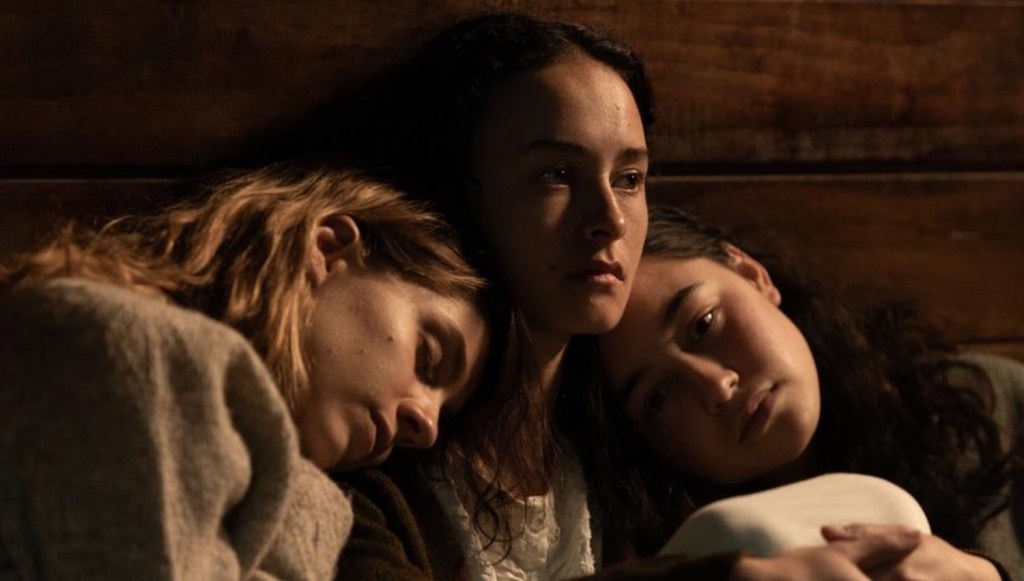
It’s the 1950s on a small island somewhere off the coast of New Zealand, where three girls share a cabin: Daisy, Nelly and Lou (Manaia Hall, Erana James, and Nathalie Morris). They were sent there by the authorities or their parents. Te Motu is a school for “incorrigible” girls or, as the administrators call them, “whores, queers, delinquents and sexual deviants.” Many are orphans or runaways caught stealing food, like Daisy or Nelly. Lou is the exception. She comes from a rich family but was caught making out with her (female) tutor. The school operates under the strict rule of Matron (Rima Te Wiata), who has a cruel streak a mile long. Raised by nuns, she feels the only way to cure these girls’ bad attitudes is through the bible and the lash. Naturally the girls all want to get the hell out of there, but it’s hard to escape from an isolated island in the south pacific. The purpose of the school is to turn bad girls into happy homemakers. They are given lessons in diction and manners but not reading or math. Matron is frustrated by their outcome: She says they are “too stupid for school, to uncivilized to be maids and too barbaric to work”. Every so often, Matron is visited by men in suits from the mainland, one of whom suggests a horrifying treatment. But when Nelly find out, the three girls decide they have to do something to stop it.

We Were Dangerous is a moving, coming-of-age story about girls surviving in 1950s New Zealand. It’s bright and exuberant, full of playfulness and dancing, Haka and history, and though fictional, it tackles the very real issue of the mistreatment of indigenous girls. The acting is excellent all around, full of subtle clues and delightful details. For a first film, Stewart-Te Whiu avoids many potential stumbles and instead gives us a solid film that’s fun to watch. It played at ImagineNative this year, and is definitely worth seeing.


Apocalypse in the Tropics is playing this weekend at HotDocs and will be streaming on Netflix this coming week; Daniela Forever opens this weekend in Toronto; check your local listings; and We Were Dangerous is available now on VOD.

This is Daniel Garber at the Movies, each Saturday morning, on CIUT 89.5 FM and on my website culturalmining.com.

Films reviewed: Your Monster, Drive Back Home, Conclave

Posted in 1970s, Canada, Catholicism, LGBT, Monsters, Politics, Religion, Romantic Comedy, Theatre, Thriller by CulturalMining.com on October 26, 2024

Hi, this is Daniel Garber at the Movies for culturalmining.com and CIUT 89.5 FM.

More Film Festivals are coming up soon, with ReelAsian, Cinefranco and BITS, Blood in the Snow, just around the corner.

But this week, I’m looking at three great new movies. There’s a consortium of cardinals locked in their chambers; a monster discovered in a closet by a NY actress, and a Toronto man forced out of his closet by the police. 

Your Monster

Wri/Dir: Caroline Lindy

It’s present day Manhattan. Laura (Melissa Barrera) is a triple threat — she can sing, dance and act. She’s helping her boyfriend Jacob (Edmund Donovan) write his breakout musical, soon to open on Broadway with her in the lead role. But when she gets sick — the big C! — and needs surgery, he dumps her — out of the blue — while still in hospital. And casts another actress (Meghann Fahy), in her part. The surgery is a success but Laura is a total wreck. She’s doubly devastated, both from the sudden end of her five year relationship and for being cheated out of her big break. Her anger, frustration and self pity are all ready to explode. That’s when she makes an unexpected discovery. There’s a monster in her closet!

The creature (Tommy Dewey) is an actual monster, bearded with long hair, sharp teeth and leonine features, who talks like a dude. Apparently he has lived there all her life (she grew up in this house) she just never saw him before. It’s hate and fear at first sight. He threatens to tear out her throat and eat her alive — and tells her to leave the place and never come back. Meanwhile, Laura shows up for the audition uninvited and becomes the understudy for her own role. But things gradually warm up at home, as Laura and her monster get to know each other. But can she take him to the Halloween Ball? Will she ever get to perform her role on stage? And will her boyfriend ever take her back?

Your Monster is a very cute, rom-com/horror with a fair bit of singing, too. It’s a riff on Disney’s Beauty and the Beast but with a funnier monster and brooding beauty with a lot of anger inside. Melissa Barrera and Tommy Dewey have lots of chemistry while Edmund Donovan is suitably villainous as the bad boyfriend. He looks strangely like Jared Kushner. The movie as a whole is enjoyable and adorable.  It takes a funny concept to its extreme. I like the costumes, I like tight script — the whole movie is much better than I expected. There’s a play within the play (half the scenes are rehearsals or performances) but even the “real” home scenes are theatrical. Your Monster will make a great date movie, but just keep in mind there’s a bit of horror within this rom-com.

Drive Back Home

Wri/Dir: Michael Clowater

It’s 1970 in the village of Stanley, New Brunswick. 

Weldon (Charlie Creed-Miles) is a mechanic who lives with his mom, his wife and his son in the house he was born and grew up in.  One night he gets a long distance phone call from Toronto. His estranged younger brother Perly (Alan Cumming) — an advertising exec who he hasn’t heard from in many years — has been arrested for gross indecency (meaning consensual sex with another man). The cop lays it out. If you can pick him up and take him home, all charges will be dropped. If not, he’s going to prison for five years. So Weldon loads up his pickup truck with enough sandwiches and gasoline for a long trip and leaves his village for the first time in his life. He’s terrified of having to speak French so he takes a circuitous route avoiding Montreal altogether.

He picks up Perly from the cop shop but there is no love lost between them. Perly is a city boy who wears a jaunty cravat while his big brother is a hick, who’s never seen a high-rise apartment or an answering machine. He just wants to drive back home. Perly isn’t a happy camper either: His marriage is a shambles, his career has tanked and his dog is dead, since the cops arrested him. But what’s left for him in Toronto? And so they begin their long journey home. But what secrets will be revealed along the way?

Drive Back Home is a bittersweet drama about family and trauma. It’s done in the style of classic  Canadian Road movies,  like Don Shebib’s Goin’ Down the Road, but this one is about leaving the big city. Their trip through rural Ontario and Quebec alternates between scenic beauty, rustic kindness, and vicious, small-town bigotry. Canada was still rife with homophobic hatred at the time —  it was only decriminalized a year earlier, and there are disturbing gay-bashing scenes in this film along with a lot of homophobic F bombs.

The two main actors are English and Scottish but both quite good, and maintain decent Canadian accents, gruff for Creed Miles and arch for Cumming. The rest of the cast features prominent Canadian actors, with Clare Coulter as Adelaide, the hard-ass mom, Guy Sprung, as a Francophone farmer, Dan Beirne as a priest and Alexandre Bourgeois as a young guy they meet in a roadhouse bar. Drive Back Home is a moving look at Canada’s bad ol’ days.

Conclave

Dir: Edward Berger

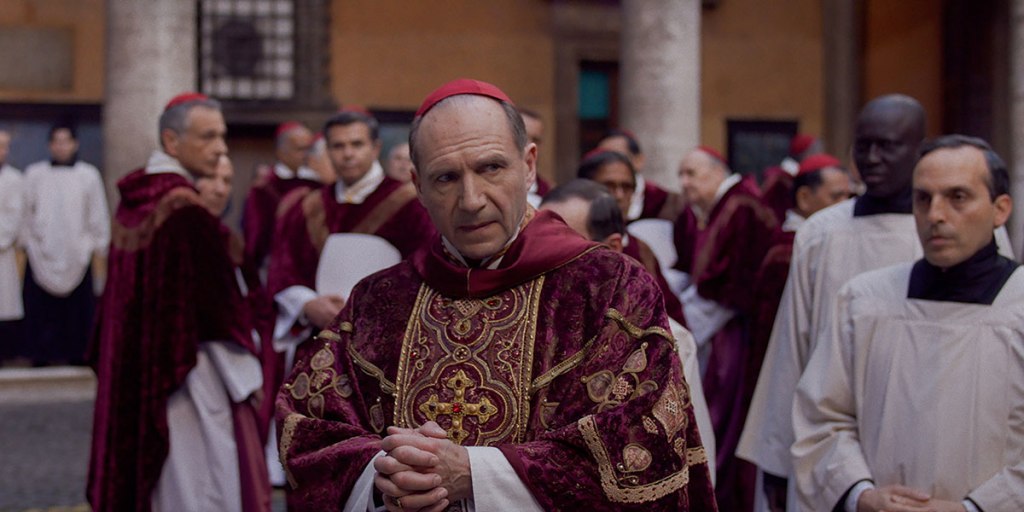
A hush hangs over the Vatican; his holiness the Pope is dead. And the world’s Cardinals, in red robes with white mitres, are congregating to choose the next pontiff from within their group. Ballots are secret, but until one receives 2/3 of the votes, they are literally locked-in, no contact with the outside world. What are their criteria for the next pope? He must be virtuous and humble, but also healthy and strong. And he must be honest as the Pope is infallible. Bishop Lawrence (Ralph Fiennes) is the Dean in charge of the highly secretive process. The most popular candidates: Bellini (Stanley Tucci), a modest liberal reformer, Tedesco (Sergio Castellitto), a bombastic traditionalist, and the highly respected Adeyami (Lucian Msamati). But Lawrence is privy to new information just before the lockdown. A drunken monsignor alleges the Pope fired Tremblay (John Lithgow) just before he died. And mystery man, Benitez (Carlos Diehz), appears out of nowhere claiming to be the Cardinal of Kabul, Afghanistan. And then there are the nuns, including Sister Agnes (Isabella Rossellini) who remain silent but see and hear everything. Which bishop will they choose to turn the conclave’s smoke from black to white?

Conclave is a stunningly- good thriller about secrets and subterfuge within the Vatican. The constant changes of political alliances as well as shocking revelations will keep your rapt attention until the very end. It presents a Vatican that’s both exquisite and decadent, with black mould spreading on it’s columns. It’s all the work of German director Edward Berger who made All Quiet on the Western Front, with Volker Bertelmann’s powerful music, and fascinating camerawork. It was filmed at Rome’s famous Cinecitta studio who are always deft at recreating the Vatican. I love this constant attention to detail — red sealing wax, Latin prayers, and tortellini soup.The acting is superb, especially Ralph Fiennes. I’ve never been a fan, but he is just sooo good in this role, maybe his best I’ve ever seen. Altogether, this makes Conclave a great night out.

Your Monster and Conclave both open this weekend in Toronto; check your local listings. And Drive Back Home is having its Toronto premiere tonight at CAMH on Queen West as part of the Rendezvous with Madness film fest.

This is Daniel Garber at the Movies, each Saturday morning, on CIUT 89.5 FM and on my website culturalmining.com.

Americana, Canadiana. Films reviewed: Reagan, You Gotta Believe PLUS Canadian films at #TIFF24

Posted in 1980s, Canada, Hollywood, Politics, Sports, Texas by CulturalMining.com on August 31, 2024

Hi, this is Daniel Garber at the Movies for culturalmining.com and CIUT 89.5 FM.

The Toronto International Film Festival is less than a week away, bringing you the best of next year’s movies today. So this week I’m going to share a bit of Canadiana, an overview of movies playing at TIFF. But first, some Americana, two nostalgic biopics opening this weekend. There’s a president straight out of Hollywood, and a baseball team deep in the heart of Texas.

Reagan

Wri/Dir: Sean McNamara (The King’s Daughter, The Miracle Season)

Ronald Reagan is born in the town of Tampico, Ill, in 1911, to a bible-thumping mom, and an alcoholic dad. After summer jobs as a lifeguard he plays on a college football team for three years. His life in show business starts as a radio announcer, but he is eventually is drawn to Hollywood, where he has minor success in B-Movies. He marries Jane Wyman (Mena Suvari) a much bigger star than he is. They get divorced and he eventually marries Nancy Reagan (Penelope Ann Miller), who stays with him throughout his career, He rises in the union ranks till he’s head of the Screen Actors Guild. As his acting career tanks he turns to politics, and is elected Republican governor of California, from 1967 through 1985. And eventually becomes the 40th president of the United States. 

He runs on an upbeat conservative platform, and wins he a landslide. He cuts taxes to the very rich, brings a huge increase in military spending and a decimation of public welfare, while also running up the national debt. He pointedly ignores the AIDS epidemic, killing 100,000 mainly young people in the 1980s. And he brings the world to the brink of a nuclear holocaust, before switching to a more cooperative stance with the USSR’s new leader Gorbachev. He survives an assassination attempt, the Iran Contra scandal, and much, much more, all carefully noted in the film.

Reagan (the movie) is a comprehensive dramatic biopic about the life and career of this man. It’s hagiographic in its outlook and revisionist in its politics. It clocks in at 2:15 minutes but seems even longer, with its plodding retelling of every one of Reagan’s more famous moments or speeches. The costumes all look like recreations of Ralph Lauren fashion spreads in Vanity Fair. The acting varies widely. Dennis Quaid is adequate but not  believable as the much older Reagan. Lesley-Anne Down is absurd as a genteel and elegant Margaret Thatcher. But Penelope Ann Miller is uncanny as Nancy Reagan, perfectly capturing her look, voice, and expressions. It’s chronologically precise but full of blatant opinions and half-truths. Were the Contras really freedom fighters? Was it Reagan’s speeches and policies that brought down the Berlin Wall and the fall of the Iron Curtain? If you think so, this movie is for you. The twist is it’s all narrated by Jon Voigt (with a heavy Russian accent) as a KGB agent who supposedly followed Reagan’s career. Which fits, given the Cold War propaganda vibe of the whole movie.

This one’s a clunker.

You Gotta Believe

Dir: Ty Roberts (12 Mighty Orphans)

It’s the early 2000s in Fort Worth, Texas. Bobby and Jon (Luke Wilson, Greg Kinnear) are best friends. They go fishing together and are the coach and manager of the local Little League baseball team. Both their sons are players. Unfortunately, the team is terrible, ranked last in their division. They can’t even make it to first base. They’re a gang of 

oddballs and misfits. One with glasses, one with braces, a redhead, sleepy, happy, sneezy, doc… you get the picture.  Due to some odd circumstances they’re asked to go to the playoffs. But both Jon and the team members are less than enthusiastic. Why subject ourselves to even more of this constant failure?  Until they come up with a real reason to play, to try hard… and maybe even to win. Bobby has cancer. And he would love to see them in the championships. So they get together, enter heavy training, exercise and practice, practice, practice. And guess what? They make it all the way to the Little League World Cup in Massachusetts! But now they’re in the big (little) leagues… can they pull off a win? And can their enthusiasm help Bobby in his fight against cancer?

You Gotta Believe is a cute and funny family picture about kids and baseball. It’s based on a true story, and shows where the characters are now, 20 years later. The teams are all male, and so are most of the characters, except Sarah Gadon and Molly Parker as Jon and Bobby’s wives.  I am the opposite of a baseball fan, but even I know the difference between a strike out and a home run. (Lots of both in this film, though strangely very few singles doubles or triples.) There’s nothing terribly new or original in the story, but it’s still watchable by kids and some grownups. If you like baseball, and stories of comradery and teamwork, you’ll like this one.

Canada at TIFF24

TIFF brings us great movies from around the world; here are a few Canadian movies that I want to see. From the classics there’s Young Werther a contemporary retelling of Goethe’s famous novel, minus the sturm und drang; as well as a new version of  Bonjour Tristesse, based on the 1950s book written by a teenager. Guy Maddin’s Rumours is about the G7 leaders lost in the woods, while David Cronenberg’s The Shrouds has an inventor connecting with the dead. Matthew Rankin’s Universal Language envisions a bilingual Canada where everyone speaks French or Farsi; and Sofia Bohdanowicz’s Measures for a Funeral, about a renowned violinist. Sophie Deraspe’s Shepherds (Bergers) tells of a Montreal copywriter who flees to the alps; and Kazik Radwanski’s Matt and Mara about college friends reconnecting.

There are also some first features: Omar Wala’s Shook about a writer who falls for a barista, and Marie-Hélène Viens and Philippe Lupien’s Vous n’êtes pas seuls, about a pizza deliverer who falls for a musician but gets kidnapped by aliens. And Seeds, by Kaniehtiio Horn, about an influencer who signs a juicy contract promoting a multinational corporation only to discover they’re bad, bad, bad. And I’ve already told you about Sook-Yin Lee’s Paying for It. That’s just some of the Canadian films at TIFF this year. 

Reagan and You Gotta Believe both open this weekend in Toronto; check your local listings. TIFF starts next Thursday — go to tiff.net for tickets.

This is Daniel Garber at the Movies, each Saturday morning, on CIUT 89.5 FM and on my website culturalmining.com.

Daniel Garber speaks with Jamie Kastner about Nobody Wants to Talk About Jacob Applebaum

Posted in Berlin, Canada, documentary, Espionage, Interview, Politics, Tech by CulturalMining.com on June 15, 2024

Hi, this is Daniel Garber at the Movies for culturalmining.com and CIUT 89.5 FM.

Photo of Jamie Kastner by Jeff Harris.

Jacob Appelbaum is a computer programmer, hacker, and journalist. He was a core member of TOR, and a major player in the world of information privacy. Through his access to NSA files released by whistleblower Edward Snowden he helped break stories like the US government spying on Angela Merkel. He was good looking, charismatic  a crucial spokesman for Wikileaks, a highly sought-after writer and pubic speaker and has worked with major cultural stars like Ai Weiwei and Laura Poitras. But in 2016, in the wake of sexual abuse accusations, everything came to a halt. Since then, a cloak of silence has descended on everything about him. Is the US government surveilling him? Is he a victim of Cointelpro? Will he end up like Julian Assange, locked away for years without a  trial? And how come nobody wants to talk about Jacob Appelbaum anymore?

Nobody Wants to Talk About Jacob Appelbaum is a new documentary that looks at this man’s life before and after 2016. It’s clever, surprising and revealing. The film follows him from East Berlin to Tel Aviv to Portugal to interview him and those who know him. It’s the latest work by award-winning Toronto documentarian Jamie Kastner. I’ve previously talked with Jamie about The Secret Disco Revolution (2012), The Skyjacker’s Tale  (2016), There are no Fakes (2019) and Charlotte’s Castle (2023).

I spoke with Jamie Kastner in Toronto via ZOOM.

Nobody Wants to Talk About Jacob Applebaum is screening at the TIFF Lightbox on June 23, and premieres on CBC Gem on June 26th.

Parents and their children. Films reviewed: Tuesday, Kidnapped

Posted in 1800s, Courtroom Drama, Death, Denial, Drama, Fairytales, Family, Italy, Politics, Religion, Supernatural, UK by CulturalMining.com on June 15, 2024

Hi, this is Daniel Garber at the Movies for culturalmining.com and CIUT 89.5 FM.

Sunday is Fathers Day, so this week I’m looking at two movies about parents and children. There’s a mother whose daughter is threatened by a big ugly bird, and parents whose son is kidnapped by the Pope.

Tuesday

Wri/Dir: Daina Oniunas-Pusic

Tuesday (Lola Petticrew) is a teenaged girl in London who is dying of an incurable disease. She likes comics and drawing. She spends most of her time in her bedroom with her Nurse Billie (Leah Harvey) or else in the walled garden outside her home, because she is too weak to get around anymore. She only sees her mother at night when she comes home from work. Until a stranger shows up in her life. It’s a huge bird, like a giant parrot, covered in filthy, black feathers. He is death incarnate, and he’s come to take her away by placing his wing over her body. But instead, she asks to talk to him. She helps him clean up, revealing colourful plumage, and she tells him a joke — the first time he’s laughed in centuries. So he lets her live, for now, but she can’t tell anyone about him. Meanwhile Tuesday’s mom Zora (Julia Louis-Dreyfus), has a secret of her own. She quit work a long time ago, to take care of her dying daughter. But she can’t face it; instead she spends all day sitting alone in a nearby park, doing nothing. And she’s been selling off all their possessions to help pay for the nurse. But everything changes when Tuesday tells her about her imaginary friend… and Zora is shocked to find she’s telling the truth. But she refuses to accept her daughter’s death, and takes an extraordinarily drastic step to stop the inevitable from happening. But what will these new changes bring to the family and the world and can Zora ever accept the inevitable loss waiting to happen.

Tuesday is an unusual but strangely moving fantasy about a mother and daughter confronting death. It starts out a bit odd, and gradually turns into a very strange movie indeed. But while it deals with some horrific ideas, it’s not a horror movie. It has supernatural elements, but it’s not meant to be scary. And despite its religious concepts of life and death, it’s not a faith-based movie. What it is is a very moving, mother/daughter drama about death. Julie Louis Dreyfuss, best known for her deadpan comedy in Seinfeld and Veep, plays it straight in this one, and really bares her soul in a deeply moving performance. And Lola Petticrew is equally sympathetic as Tuesday. This is nothing like most movies you see, but very effective nonetheless; come prepared both to laugh and cry.

I really liked this movie.

Kidnapped

Co-Wri/Dir:  Marco Bellocchio

It’s the 1850s in a middle-class neighbourhood in Bologna.  Salomone Mortara (Fausto Russo Alesi) lives with his wife Marianna Padovani Mortara (Barbara Ronchi) and their children. One night there is a banging on their front door: it’s the police demanding an inspection. They want to see Edgardo Mortara, an angelic little boy, number six of eight kids. Local officials are apologetic, but they must hand him over, under the orders of Father Feletti (Fabrizio Gifuni), the local inquisitor. But surely there’s some mistake, they say, what could this little boy have done? He was secretly baptized as a baby by his maid, they say, and no Christian child can be brought up in a Jewish family. Bologna — and much of Italy — was then part of the Papal States, where the government, the police, and the judiciary were all under the direct rule of the Vatican’s representatives and ultimately Pope Pius IX. And despite their vehement  objections and petitions, they whisk the crying child off to Rome. 

He is brought to the House of Catachumens, a special school for converts to be taught the Latin Mass. Little Edgardo (Enea Sala) misses his family terribly but a friend he meets says if you want to go home soon, just cooperate and learn the prayers, you don’t have to believe them. His flabbergasted father and devastated mother are desperately trying to get him out of there, but to no avail. But the story has caught the eye of the international press, making banner headlines in Paris, London and New York. And this makes Pope Pius IX even more steadfast in his beliefs. Will the family all convert to Catholicism to get back their son? Will Pope Pius relent and let him go home again? And who will the little boy choose as his guardians: his Mama and Papa or Il Papa, the Pope himself?

Kidnapped: The Abduction of Edgardo Mortara is an overwhelming drama based on true historic events. Though little-known today, it had a huge affect on world politics, history and, ultimately, the unification of Italy. It takes place in their homes of Bologna, The Roman Ghetto, in courtrooms, on canals, and within the Vatican itself. Its powerful music, lush photography and opulent sets and costumes support the passionate almost melodramatic acting. Barbara Ronchi is fantastic as Mrs Mortara, while Paolo Pierobon as Pope Pius comes across as a creepily salacious Mafia don, cuddling up to his favourite little boy and letting him hide beneath his robes (as he had huddled in his mother’s skirts when first abducted.) It also veers into fantasy within the dreams of various characters, from little Edgardo who dreams of de-crucifying Jesus so he can go home, and the Pope who has nightmares of being forcibly circumcised by a gang of rabbis. Kidnapped is an amazingly powerful  historical drama set within the changing tides of 19th century Europe.

On a personal note, my childhood next door neighbour, Mrs Sharon Stahl, ended up writing her doctoral theological dissertation on this case, so I had head about it many years ago and it’s amazing to finally see it dramatized on the big screen.

Fantastic movie.

Tuesday is now playing at the TIFF Lightbox, and Kidnapped also opened this weekend; check your local listings. 

This is Daniel Garber at the Movies, each Saturday morning, on CIUT 89.5 FM and on my website culturalmining.com.

Class. Films reviewed: The Old Oak, Monkey Man, Wicked Little Letters

Posted in 1920s, Action, Clash of Cultures, Class, comedy, Drama, Feminism, India, Politics, Refugees, Thriller, UK, Women by CulturalMining.com on April 6, 2024

Hi, this is Daniel Garber at the Movies for culturalmining.com and CIUT 89.5 FM.

Ordinary people fighting back is an old story, but not a tired one. This week I’m looking at three new movies — one from northern England, one from southern England, and one from India — about people confronting injustice. There are women fighting the courts, a poor man fighting the oligarchs, and a lonely man trying to stop his town’s gradual collapse.

The Old Oak

Dir: Ken Loach (my interview: 2020)

It’s 2016 in a seaside village in northern England. TJ Ballantyne (Dave Turner) is the publican of The Old Oak, one of the few gathering places left standing. But like the town — once a thriving coal pit, but now impoverished and depressed — the pub is not what it used to be. It has few customers aside from a few regulars. The sign is sagging, and half of the building is no longer used.  TJ lives above the pub; he’s lonely and pessimistic. His son won’t speak to him, and he has only a little dog to keep him company. But when a group of Syrian refugees arrives in town, TJ decides to help. Alongside Laura (Claire Rodgerson) he distributes furniture and food — donated through local churches and unions — to the newcomers. They are grateful, but some people resent it. Why are they helping refugees when local kids are going without food and heating? Syrian kids are bullied in schools, and a young photographer Yara (Ebla Mari)’s camera is broken.

What can they do to bring the community together? Together with Yara, Laura, and dozens of volunteers, they reopen a long boarded up section of the Old Oak to provide a place where people can come to eat and spend time together. The photographs on the walls recall the coal miners strike of Thatcher’s England: If you eat together, you stick together, says one sign.  But can they overcome old prejudices to form new friendships? Or will it all fall apart?

The Old Oak is a wonderfully poignant and deeply-moving drama that deals with big issues but on a personal scale. It looks at racism, poverty, unions and scabs, and how geopolitics affect us all.  Like all of Ken Loach’s movies, it  looks at imperfect people from multiple viewpoints. Some you like and end up hating, others seem like villains but you find out later they’re good people. Lots of grey, no black and white (aside from the photographs Yara takes.)

Once again, the script is by Loach’s longtime collaborator Paul Laverty, and the ensemble cast includes both professionals and first-time actors, many hired at the location.

It shows the real Britain, warts and all, not the shiny tourist-attraction you see in Hollywood movies. It’s a tear jerker, with more than one heartbreaking scenes. But it still leaves room for hope. The Old Oak may be Ken Loach’s final film, so you should get out and see it. I really like this film.

Monkey Man

Co-Wri/Dir: Dev Patel

Kid (Dev Patel) is a man with a vengeance — to punish those whose crimes he witnessed as a small child. Raised by his mother in a forest in rural India, he now lives in an unnamed megalopolis in the mythical state of Yatana (= torment, anguish). It is ruled by a god-king followed by throngs of devoted cult-like followers. They kick farmers off their land for corporate profit and persecute minorities with impunity. Kid earns his money as a boxer, beaten up regularly by bigger, stronger men. In the ring, he conceals his face behind a monkey mask, in honour of the god Hanuman whose story his mother had told him as a child. Following a complex scheme, he somehow manages to get work inside an exclusive nightclub ruled by a woman named Queenie (Ashwini Kalsekar). She warns him to never disobey her or step out of his class. He gradually works his way up the latter until he makes it into the kitchen. His goal? To shoot  a corrupt police chief named Rana Singh (Sikandar Kher). But his plans all fail, and he ends up a nearly-dead fugitive, his body floating in a canal. He is rescued and brought back to health by a temple dedicated to Shiva, and run by androgynous priests.

They admire that he, an outcaste, dares to fight authority.  But he needs the strength and skill if he wants to succeed. So, to the sounds of a tabla drum, he trains in the temple, gradually building up his stamina and muscles until he its ready to face his enemies to the death once again. But does he even have a chance against the powers that be?

Monkey Man is a class-struggle action-thriller about one man’s quest for personal vengeance and his plan to overthrow by force corrupt and autocratic leaders. It’s told using intricate plotting, involving dozens of people cooperating for a single goal. And it interweaves visions and sounds, like a  child’s picture book, an elaborate mural, and the thumping of a tabla music. There’s a lot of content to digest. The problem is, a large part of the movie consists of chases and violent fights, and they’re not very good. Blurred shots using a jiggly, hand-held camera may be artistic, but they’re unpleasant and hard to look at. Seasickness is not a valid substitute for good fight choreography.

I admire Dev Patel’s first attempt as a director and his transformation into an action hero, but Monkey Man doesn’t cut it.

Wicked Little Letters

Dir: Thea Sharrock

It’s the 1920s in Littlehampton, Sussex, a small town in southern England. Edith Swan (Olivia Colman) is a middle aged educated woman who still lives with her strict parents in a tiny row house. She reads the bible and quotes its teachings; basically, she’s an uptight prig. She shares a wall with Rose (Jessie Buckley) a migrant from the Emerald Isle. She is fond of drinking and carousing, can swear a blue streak, and is often seen wandering in just a slip outside her home. Rose likes her live-in boyfriend Bill (her husband died in WWI) but most of all, adores her daughter Nancy (Elisha Weir). But her neighbour, Edith’s father Edward Swan (Timothy Spall) despises Rose and her libertine ways, and blames her for everything going wrong in Littlehampton. They live in a tenuous detente, until everything changes when Edith receives a piece of hate mail. The unsigned letter is filled with cruel insults and vulgar words.

And when the letters pile up, the police come to investigate. They arrest Rose for the nasty letters and throw her in jail, despite her protests of innocence. The press picks up the story and it becomes a national scandal. But not everyone believes Rose is guilty. A small group of women, led by Police Officer Gladys Moss (Anjana Vasan), think Rose is innocent and set out to prove it. But can they find the true culprit before the trial? And what will happen to Nancy if her mother ends up behind bars?

Wicked Little Letters is a delightful dark comedy, based on a true story; apparently this was a hot topic 100 years ago. Little is the key word: little letters, Littlehampton, and the kind of petty quarrels that can blow up into serious events. This is a movie that knows it’s own boundaries and sticks to them perfectly, without veering off into remote tangents, flashbacks or lengthy soliloquies. It’s tight, set in tiny homes around town, and in the courthouse and jail. The acting is wonderful — everyone’s a character. Olivia Colman and Jesse Buckley previously co-starred in The Lost Daughter, but I like this one much better. And though it’s a period drama set in 1920s England, it uses colourblind casting, with many roles played by black and brown actors, without racial or ethnic issues ever entering the story (except, of course, Rose being Irish in England).

If you’re looking for a fun night out, I think you’ll like this one.

Wicked Little Letters, Monkey Man and The Old Oak all open this weekend in Toronto: check your local listings.

This is Daniel Garber at the Movies, each Saturday morning, on CIUT 89.5 FM and on my website culturalmining.com.

Road movies. Io Capitano, Ordinary Angels, Drive Away Dolls

Posted in 1990s, Adventure, Africa, comedy, Coming of Age, Crime, Disease, Italy, Kids, Lesbian, LGBT, Migrants, Politics, Road Movie, Senegal by CulturalMining.com on February 24, 2024

Hi, this is Daniel Garber at the Movies for culturalmining.com and CIUT 89.5 FM.

The road from the festival circuit to your local cinema is a slow and tortuous one. I reviewed Meredith Hana-Brown’s Seagrass — a moving drama about a young couple and their daughters at an island retreat in BC — five months ago, but it’s finally hitting theatres this weekend — check it out! (Review here).

So, in recognition of that long and twisted path, this week I’m looking at three new road movies. There’s two lesbians in their twenties driving south from Philly, two teenaged boys travelling across the Sahara desert from Dakar, and a middle-aged hairdresser trying to get a little girl to a far-off hospital in time for a transplant.

Io Capitano

Co-Wri/Dir: Matteo Garrone

It’s present-day in Dakar, Senegal. Seydou (Seydou Sarr) is a 16-year-old student who works part time as a builder. With his best friend Moussa (Moustapha Fall) they’re saving money for a major purchase. Their goal? To travel to Europe to make it big as singer-songwriters. But though Seydou’s mother and others object —  People die at sea! Europe is not like what they show on TV — the two boys sneak out one night, and head off on their journey. They buy their tickets for a long trip across the Sahara, via Mali and Niger to Tripoli, Libya, and from their on to Europe. They are promised modern new trucks to whiz them there.  But they soon discover, the world is full of thieves, swindlers, and worse. They are forced to pay bribes to cross borders. Anyone who falls out of the rusty flatbed trucks is left behind to die.  They are set upon by cruel bandits, separating the boys, with Seydou sent to a prison run by the Libyan Mafia. Inmates are subject to extortion and torture. And those who survive are sold into de facto slavery. But, somehow, Seydou makes it to Tripoli. Now he has to find Moussa, and get a boat to take them to Italy. But what will the future bring?

Io Capitano is a powerful, heartfelt drama about two young migrants trying to reach Europe. Seydou is a heroic figure who gradually matures from boy to man to leader. (The title means I am the Captain.) Garrone, as in most of his films (Reviews: Dogman, Reality, Gomorrah), again casts first-time actors in the main roles, giving the movie a hyper-realistic feel. Seydou, for one, is amazing, totally believable. And lest you think this is a gruelling journey, it is also filled with music, dance and magical fantasies that appear in Seydou’s mind. 

Io Capitano is an uplifting and heroic story.

Ordinary Angels

Co-Wri/Dir: Jon Gunn (Writer/Producer: I Still Believe, American Underdog, Jesus Revolution)

It’s the 1990s in Louisville, Kentucky. Sharon (Hilary Swank) is a hair stylist who owns a beauty parlour. She’s known for her sparkling skirts, fringed leather jackets, and her long, curly hair with frosted tips. She likes getting drunk at roadhouses and dancing on the bar. But her best friend and coworker Rose (Tamala Jones), sees trouble ahead if she doesn’t stop drinking. Clearly, Sharon needs something — a lover, a religion, or a cause — to devote herself to. But her first marriage was a bomb (her adult son won’t even talk with her), and going to church isn’t her thing. But when she spots a local newspaper headline — Man’s wife dies, his 5-year-old daughter is suffering from a rare illness — she decides to do something about it. She starts raising funds at the hair salon, and spreading awareness of this family’s plight. Ed Schmitt (Alan Ritchson) is a simple roofer in debt half a million bucks, and his daughter Michelle (Emily Mitchell) needs expensive treatment. Sharon starts giving him envelopes of cash she raises, but he doesn’t feel comfortable. Why is this strange alcoholic woman giving him money?

But the kids and Ed’s mom take to Sharon like bees to honey. She helps him balance his books, and raises money from the bigwigs in Louisville. Soon everyone knows about Michelle’s plight. But when the big day comes for a liver transplant, the city is closed down by a freak snowstorm. And the hospital is halfway across the country. Are Sharon — and the community’s — wits and determination be enough to save a dying girl?

Ordinary Angels is an uplifting, non-preachy faith-based drama about an ordinary woman trying to change the world. It feels a bit manipulative at times, with gushing music, and twinkling stars overhead . Ed barely talks —  he’s the strong, silent type, just yes ma’am, no ma’am — and little dying Michelle is way too cute. Luckily, Hilary Swank is just great as the indefatigable Sharon, a woman who won’t take “no” for an answer. Yeah, the movie is a little bit forced and a little too long, but it also tugs your heart-strings in just the right places. And it’s great seeing a large group of people working together in an attempt to save a life. (It’s based on a true story.)

So if you like tear-jerkers, this one is a two-hankie classic, one that’ll leave you crying, for sure. 

Drive Away Dolls

Co-Wri/Dir: Ethan Coen

It’s 1999 in Philadelphia.

Jamie and Marion are best friends, but couldn’t be more different. Jamie (Margaret Qualley) has a southern drawl and a wild-at-heart attitude. She’s always up for a roll in the hay with any chick she meets in a lesbian bar. Marian (Geraldine Vishvanathan) is reserved and uptight, stuck in a futureless, cubicle office job. But when Jamie’s long-time girlfriend Sukie (Beanie Feldstein) catches her cheating in their own apartment, she goes ballistic. Sukie is a hot-headed cop and Jamie knows when it’s time to skedaddle. So she decides to go for a drive home to Tallahassee with Marian as her co-pilot. Luckily, Jamie knows about a great deal at Drive Away autos — they deliver the car to Tallahassee and they get the ride for free. What they don’t know, is they’re driving the wrong car, carrying unexpected cargo in the trunk: a metal suitcase… and a human head!

You see, that metal suitcase contains something of crucial importance to someone with a lot of power, and a gang of ruthless men want it back. And they’re racing down the highway trying to catch up with Jamie and Marion and take back the suitcase. But the clueless pair are taking their own sweet time, with Jamie smoking pot and meeting up with nubile soccer players in honky-tonk bars and sleazy motel rooms on the way,  while Marion has to deal with over-zealous redneck sheriffs. But the criminals are steadily getting closer, and who knows what will happen if they meet. What’s in the metal suitcase? Can Jamie and Marion stay friends? And is there something deeper going on between them?

Drive Away Dolls is an unapologetic B-movie, a non-stop comedy-thriller about lesbians on the road. It’s full of wanton sex and gratuitous violence, though nothing overly explicit. It also features cameos by A-listers like Matt Damon, Pedro Pascal and Colman Domingo. And it’s all strangely interspersed with vintage, psychedelic soft-core hippy-porn, (its meaning only revealed at the end). This is like a Coen Brothers movie, but no Joel. Instead Ethan is paired with longtime film-editor (and wife) Tricia Cooke who also co-directed and cowrote it, apparently based on her own salad days. It’s great raunchy fun. The only thing that puzzles me is, in a movie that’s all about lesbians, why does the trailers completely hide that fact? (Not to mention changing the title from Drive Away Dykes to Drive Away Dolls.) But I guess you have to sell a movie to a broader audience or you won’t get the crowds. 

Either way, I really enjoyed this one.

Io Capitano is now playing at the TIFF Lightbox; with Drive Away Dolls and Ordinary Angels both opening theatrically this weekend in Toronto; check your local listings. 

This is Daniel Garber at the Movies, each Saturday morning, on CIUT 89.5 FM and on my website culturalmining.com.

Films reviewed: Orlando: My Political Biography, Fallen Leaves

Posted in 1600s, 1700s, 1800s, 1900s, Finland, France, LGBT, Noir, Politics, Romantic Comedy, Trans by CulturalMining.com on November 25, 2023

Hi, this is Daniel Garber at the Movies for culturalmining.com and CIUT 89.5 FM.

Toronto’s Fall film festival season continues in December with the Jayu Human Rights film festival showing insightful documentaries on pertinent issues, along with a slam poetry competition at the Ace Hotel.

But this week, I’m looking at two new European movies that played at TIFF this year and are now in cinemas. There are trans shape-shifters in France and lonely job-seekers in Finland.

Orlando: My Political Biography

Wri/Dir: Paul B. Preciado

It’s 17th century, Elizabethan England. Orlando is a teenaged boy, a handsome courtier in the Queen’s castle. He’s also an aspiring writer, waxing lyrical on oak trees and winter frosts. He falls in love with Sasha, a blonde, Russian aristocrat. But at the age of 30, he wakes from a deep sleep transformed into a woman. Orlando’s life takes her (and him) through various guises over hundreds of years, to capitals as far away as Constantinople, until finally returning by ship to 20th century London, where they finally complete and publish their book. Such is the “biography” of Orlando in Virginia Woolf’s famous novel. So what’s different about this film?

For one thing, the entire cast is trans or non-binary, as is Preciado, the director. And the cast is huge. Each version of Orlando is played by another actor, their sex, gender and sexuality presented in a myriad of ways.  Orlando is plural in this incarnation.  Not just that, Orlando’s race, colour and language also shifts, with the actors ages ranging from small children to the elderly. Some characters wear chainmail like Joan of Arc, while others recline, luxuriantly,  in an Ottoman seraglio. The one common factor is their Elizabethan white neck ruffs, the fashion of the day.

Orlando, My Political Biography is not the first film version of the novel — far from it.  It seems to attract the most experimental and avant garde filmmakers out there.  German director Ulrike Ottinger made Freak Orlando in 1981 which entirely rejects the conventions of both narrative and art movies. English director Sally Potter (see: The Roads Not Taken, The Party,  Ginger and Rosa)’s Orlando of 1992 starred Tilda Swinton as the various Orlandos and featured Jimmy Sommerville singing up in a tree.

But this French political biography adopts Bertolt Brecht’s (and Jean-Luc Godard’s) method of deliberately alienating the audience to promote a political stand. Each Orlando introduces their scene by announcing directly to the camera their real /adopted name and personal history, followed by their Orlando passage, often reading directly from a copy of Woolf’s book. But it remains engaging because of the beauty of the photography and costumes and the sincerity of the players in the film. Settings vary from deliberately artificial backdrops to an exquisite forest and a grotesque Parisian catacomb.

The political stance is complex, and involves a rejection of the accepted binary. Some take issue with psychiatrists, surgeons and pharmacists having control of their identities and bodies. Says one young Orlando: you must hate your genitals if you want the doctor to give you hormones… but I don’t hate my genitals. Says another: I adopted a ridiculous caricature of masculinity for a year after transitioning before realizing I shouldn’t erase my personal history just because I’m trans.

Orlando, My Political Biography is equal parts intellectual lecture, political diatribe, performance art, and cinematic experiment, and, most surprisingly… it works.

Fallen Leaves

Wri/Dir: Aki Kaurismaki

It’s typical day in Helsinki, Finland. 

Ansa (Alma Pöysti), a single woman in her thirties, works at a low-paying job in a supermarket. She lives in a small apartment and subsists on frozen microwave dinners. She likes listening to relaxing music, but her bakelite radio only plays bad news from the Ukrainian war these days. She does go out occasionally to a local karaoke bar, with her best friend Liisa (Nuppu Koivu). There she encounters — but doesn’t actually meet — Holappa (Jussi Vatanen). Holappa is a depressed guy who works as a welder at a small factory. He lives in the company dorm, along with acquaintances and his best friend and confident Huotari (Janne Hyytiäinen). He handles his depression with constant drinking, which only gets him more depressed. After a few near misses they finally meet face to face. Their first date? A zombie movie at a local rep cinema. Sparks fly and they vow to meet again soon. But various unfortunate coincidences seem destined to keep these soulmates far apart. Can they ever find happiness together? Or is this a relationship that can never happen?

Fallen Leaves is a tragicomic proletarian love story par excellence. Its also a deadpan comedy, which despite it’s nearly tragic atmosphere, will have you laughing and crying all the way through. If you’ve ever seen an Aki Kaurismaki  movie before you’ll instantly recognize his style: seedy bars, bearded bikers, dark rock n roll, and a noir-ish, retro feel. Similar to Jim Jarmusch, but much funnier. It also deals with real-life issues like alcoholism and poverty. Ansa loses her job for taking home an expired cookie instead of throwing it away, while Holappa is driven close to self- destruction by his constant boozing. If you haven’t seen his movies before, Fallen Leaves is a great one to start.

Everything in this film is retro. Finland is the high-tech home of Nokia and Supercell, but in Kaurismaki’s world the characters use avocado coloured landlines,  with cel phones or video games nowhere to be seen. Computers seem relegated to internet cafes. Phone numbers are written on slips of paper, blown away with the wind. Movie theatres only play classics, and every bar is on skid row. 

At the same time, there’s always a niceness and sweetness burbling just below the surface of the humdrum futility of everyday life. Fallen Leaves is a wonderfully depressing movie with a feel-good atmosphere. I love this movie.

Fallen Leaves and Orlando My Political Biography are  both playing now at the TIFF Bell Lightbox, and at other theatres across Canada — check your local listings.

This is Daniel Garber at the Movies, each Saturday morning, on CIUT 89.5 FM and on my website culturalmining.com.

Fighting. Films reviewed: Seagrass, The Hunger Games: The Ballad of Songbirds and Snakes, Testament

Posted in Canada, Family, Politics, Protest, Quebec, Satire, Science Fiction, violence, Y.A. by CulturalMining.com on November 12, 2023

Hi, this is Daniel Garber at the Movies for culturalmining.com and CIUT 89.5 FM.

Fall Film Festival Season keeps on rolling. I had the pleasure of attending the opening-night screening of the ReelAsian film festival. It’s the delightful comedy/drama The Queen Of My Dreams, directed by Fawzia Mirza. It follows a queer Toronto woman in Karachi for a funeral as she recalls her own and her estranged mother’s) history in Pakistan in the 60s and Halifax in the 80s — all while listening and dancing to Bollywood songs. ReelAsian is in its 27th year showing films from across that continent and in the asian diaspora, now through November 19th. And the Shorts not Pants festival opens on November 17th. In case you’re wondering it’s not about cut-offs or basketball shorts — it’s a curated short film festival, which I’ve heard is quite good.

This week, I’m looking at three new movies — one of which is playing at ReelAsian. There’s a fight over a painting in Montreal, a fighting couple on an island near Nanaimo, and a fight to the death in the city of Panem.

Seagrass

Wri/Dir: Meredith Hama-Brown

It’s the summer of 2011. Judith and Steve (Ally Maki, Luke Roberts) are riding a ferry with their kids to a rocky island near Nanaimo, BC. They’re renting a cabin complete with a kitchen, and there’s even a swimming pool with lots of games and hikes planned for all the kids there. It’s a shady forest that leads to a mysterious dark cave on the shore. The couple in the next cabin, Pat and Carol (Chris Pang and Sarah Gadon) —  a white and asian pair like Judith and Steve — swear the last time they spent on the island was a life-changer. The thing is, they’re not there for a vacation. It’s a place where couples can look at their relationship and try to work out their differences through daily group therapy sessions. The kids, Steph and Emmy (Nyha Huang Breitkreuz,  Remy Marthaller) have problems of their own to work out. 10-year-old Steph doesn’t want to babysit her 6-year-old sister — she’d rather mess around with friends at get-togethers. 

The problem is Judith is depressed — she’s been that way since her mom died many months earlier. And now she’s regretting she never talked with her about the internment camps Japanese Canadians were put in during WWII. Or what happened to her dad’s fishing boat. It’s like there’s a ghost or spirit lurking above the family — is it the kids’ late grandmother or just the general bad feelings?  It’s not just that, Judith isn’t sleeping with Steve anymore. And Steve is increasingly jealous and angry that Pat — the husband next-door — seems to be spending too much time with Judith. As the pressure builds it begins to affect the kids too, leading to a potentially frightening conclusion.

Seagrass is a stunning look at secrets revealed at a getaway in British Columbia. It’s also about identity, history and family, especially of Japanese-Canadians. I found it very moving, a bit of a tear-jerker actually. At the same time, it makes you uneasy to watch the story unfold, and the unexpected revelations it leads to. It’s not your typical marriage counselling movie; it’s equally about the kids, and the subtle racism they face. The cast is uniformly great, but especially Ally Maki as a woman on the verge of a nervous breakdown. This movie also does amazing things  both visually and audibly, from pop songs to eerie sound effects.

Great movie.

The Hunger Games: The Ballad of Songbirds and Snakes

Dir: Francis Lawrence

Coriolanus Snow (Tom Blyth) is a young man with a keen intellect. He’s handsome, popular and ambitious. He lives in Panem, the capital city of a post-apocalyptic world. A top student at the Academy, the training grounds for the nation’s top leaders, he’s in line for the Plinth prize. He needs to win it because, although he’s from an aristocratic family, he’s poor. So poor, his cousin Tigris makes his shirt buttons out of bathroom tiles, and school lunches keep him alive. 

But the scholarship is at risk when Dean Highbottom (Peter Dinklage) declares all students must participate in the Hunger Games as a mentor to a tribute, the kids sent to the capital from each outlying district. Lucy Gray (Rachel Zegler) from District 12 is his Tribute — if she wins the Hunger Games, Coriolanus gets the prize money. So he will do anything to keep her alive. She’s a pretty songbird — from a long line of travelling musicians — who dresses in colourful outfits. The two hit it off, and prove a formidable team of underdogs. Will they beat the odds, and survive? And is there relationship more than just a game?

The Hunger Games: The Ballad of Songbirds and Snakes is a gripping action-adventure movie based on the dystopian YA novels. I read avidly the trilogy when it first came out, but was less attached to the related movies — I only watched the first one, maybe because I knew what was going to happen. But this one took me by surprise; it’s a prequel, set half a century before the other books. So I found it exciting, dark and gripping. It is violent — after all, this game is about 24 kids murdering one another in a stadium. But this is set in the early years of the Hunger Games: the capital is battle-scarred and decrepit. Drones sent to the tributes are primitive and dangerous, as likely to kill a player as to send them food or water. These hunger games are darker and grittier. I like the novelistic turns of plot, and the truly evil characters, especially Dr. Volumnia Gaul wonderfully played by Viola Davis as a mad scientist who creates terrifying animals — the snakes and birds of the title — to stymie the districts and their tributes. Zegler is good as Lucy, singing as much as she talks, and Blyth is great as the conflicted Corio. The explosions and pyrotechnics look fantastic on a big screen, so if you’re into this kind of  movie, see it now, not on some future TV streamer.  

Testament

Wri/Dir: Denys Arcand

Jean-Michel Bouchard (Rémy Girard) is a retired writer and archivist in Montreal. He still has an office but lives in a venerable, public retirement home. Never married, no kids, but he still has many friends to spend time with.  Suzanne Francoeur (Sophie Lorain) is the directrice of the building, and keeps her eagle eye on anything that could disrupt her tightly-run edifice. But when a group of college protesters set up camp across the street chanting Free First Nations! she isn’t sure how to handle it. The anglophone demonstrators say the building is full of racist art.

The issue at hand? A 19th century fresco on a wall in the music room depicting Champlain’s first meeting with the Iroquois. The protesters say the French are settler-colonists in fancy dress while indigenous men are depicted as primitive barbarians, while the women are topless. Meanwhile, Jean- Michel’s close friend Roger, a fitness and health food nut, suddenly drops dead right in front of him. Jean- Michel receives a literary prize, but is mistaken for someone else with a similar name. And Suzanne seems to be standing just outside his door whenever a young woman visits him in his bedroom — why is she there? As the tension from the protesters grows, media, Quebec nationalists, bureaucrats and politicians all descend on the home. Can Jean-Michel stop the madness? Or is this the beginning of the end? And what will happen to the mural?

Testament is a political and social satire about Quebec’s aging boomers, as their rule ends. Denys Arcand has been covering this cohort for four decades, in films like The Decline of the American Empire, The Barbarian Invasions, and The Fall of the American Empire. This one shares similar themes and some of the same actors as well. The characters are stereotypical and amusing — anglo protesters are buffoons, seniors are clueless busybodies, feminists snarl, while politicians tell baldfaced lies — but he pokes at the politics from all sides. It has a huge cast, including Robert Lepage (who had his own controversy involving indigenous issues) as an effete arts/politics leader in an hilarious parody of himself. There’s also a romantic subplot — no spoilers — and, surprisingly, some very moving moments.

If you want to understand Quebec cultural politics — with a lot of laughs — you must watch Denys Arcand’s Testament. 

Seagrass is playing at the TIFF Bell Lightbox, one of many great films at the ReelAsian Film Festival. Testament and Hunger Games both open this weekend in Toronto; check your local listings. 

This is Daniel Garber at the Movies, each Saturday morning, on CIUT 89.5 FM and on my website, culturalmining.com.