Blacks, Jews and Irishmen. Films reviewed: The Piano Lesson, A Real Pain, Small Things Like These

Posted in 1930s, 1980s, African-Americans, Family, Ghosts, Ireland, Nun, Pittsburg, Poland, Theatre by CulturalMining.com on November 8, 2024

Hi, this is Daniel Garber at the Movies for culturalmining.com and CIUT 89.5 FM.

Fall Film Festival Season continues with the EU Film Fest, showing free films from across Europe at Spadina Theatre starting on the 14th.

This week, I’m looking at three family dramas. There’s Black siblings in Pittsburgh, Jewish cousins in Warsaw, and an Irish dad with his five daughters, in… well, Ireland.

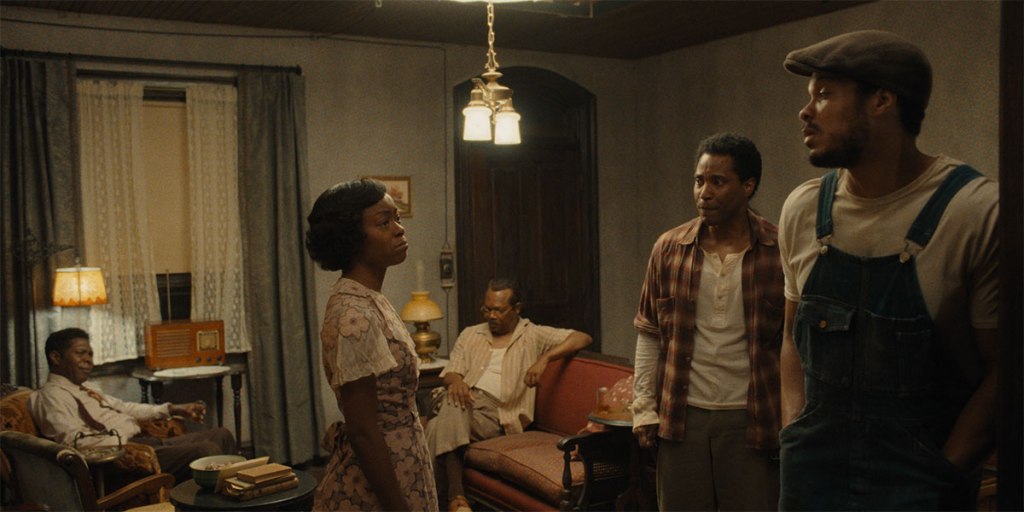
The Piano Lesson

Dir: Malcolm Washington

It’s 1936. Boy Willie Charles (John David Washington) and his friend Lymon are driving north from Mississippi with a truckload of watermelons, to visit his sister Berniece (Danielle Deadwyler) in Pittsburgh, Pennsylvania. She’s living with their uncle Doaker (Samuel L. Jackson). Once they sell the melons, Boy Willie plans to take his share of the profit (along with his savings) to purchase Sutter’s land. That’s the same place where his great grandparents were slaves, and where he still toils the land as a share-cropper. This is his one chance to own it.  But he’ll only have enough money if he sells the family piano. That’s why he’s visiting Pittsburgh. But Berniece refuses to sell it. Why? She grew up playing that piano, and more to the point it has family faces elegantly carved into the wood itself, dating back to pre-Civil War days. Besides, she says, that piano is haunted… and the ghost is getting meaner.  Meanwhile various family and friends, like a trickster and a preacher, are congregating at this house with different motives for being there. Can Boy Willie and Berniece come to terms about the piano? Or will bad spirits — both supernatural and human — ruin everything first?

The Piano Lesson is an excellent filmed version of playwright August Wilson’s drama. Fine acting all around, with Danielle Deadwyler outstanding as Berniece. Now, plays and movies are two different things. Actors emote louder and move bigger on stage (so everyone can see and hear them). And even the blocking and dialogue is different. Movies are no more real, but different. This Piano Lesson is very much a play. So I was a bit put off by it’s style… until the my brain started watching it as a play, at which point I really liked it.

If you notice a lot of Washingtons here, it’s no coincidence. Denzel Washington is the producer, and actor John David and director Malcolm are both sons of his. Denzel is committed to putting all ten of August Wilson’s Pittsburg Cycle on the big screen to preserve crucial Black American culture. Witness Fences in 2016 and Ma Rainey’s Black Bottom in 2020. The Piano Lesson is a fine addition to this series and should be watched.

A Real Pain

Wri/Dir: Jesse Eisenberg 

Benji and David Kaplan are cousins in their 30s, as close as brothers, but totally different. Benji (Kieran Culkin) is loud, gregarious, obnoxious and larger than life. He likes to raise a ruckus and mess things up. He lives alone in Binghamton, NY. David is shy, insecure and withdrawn. He’s married with a small kid and lives in Manhattan. He’s in a constant state of dithering and worrying. They’re travelling together to Poland to explore their family’s heritage. Their grandmother was Polish and a Holocaust survivor.

Benji was very close to her and devastated by her recent death, much more so than David. They’re part of a small tour group, all Jewish. Their guide (Will Sharpe) is a nerdy  English guy, very accommodating. Also on the tour are Marcia (Jennifer Grey) who suffers from intergenerational trauma;  Eloge (Kurt Egyiawan) from Winnipeg but originally from Rwanda where he survived Tutsi genocide; and a middle-class couple whose family immigrated from Poland generations ago but want to see where they came from. (“We’re Mayflower Jews”, he says).

Their journey takes in cultural and historical sites across Poland, but the closer they get to the concentration camp where their grandmother was imprisoned, the more agitated Benji gets.  He slips into shouted diatribes and lectures, causing scenes within their group and in public places — to David’s acute embarrassment. Can they both make it through the whole tour? Or will one of them drop out?

A Real Pain is a low-key, social comedy — yes, a comedy — about the uncomfortable dynamics within a family. it’s actually pretty funny, No slapstick or pratfalls, rather unexpected squirmy riffs on the two main characters’ personalities. (Like Benji telling David his bare feet are gorgeous, making him stare at them for the rest of the trip.)  It’s told in a series of clever vignettes over the course of the trip,  all hovering over unvoiced feelings of personal and collective mourning.   I’m always suspicious when actors play at directing, but this is no vanity pic. Eisenberg stays suitably subdued, letting Culkin go wild.

I like this movie.

Small Things Like These

Dir: Tim Mielants

It’s winter in a small town in Ireland in the 1980s. Bill Furlong (Cillian Murphy) is a working man who scrubs coal dust off his hands and face each day. But he doesn’t work in a coal mine; he has his own business, built from scratch, selling coal. His wife Eileen (Eileen Walsh) and his eldest daughter handle the finances. One day, he’s making a delivery when he’s alarmed to see a teenaged girl being dragged, kicking and screaming, into the local convent. That’s not right. She may be unmarried and pregnant, but why are they kidnapping that poor girl? 

So he steps inside to take a look. It’s the Magdalene Laundries, a Church organization that operates across Ireland, to care for unwed mothers. They put the babies up for adoption, and the girls and young women are trained to work as industrial laundresses. But to Bill it seems almost like a prison, where the girls are treated horribly. When one girl runs over, begging him to help her escape, he doesn’t know to do. The nuns quickly disabuse him of any notions he might have, and rush him out the front door. 

But Bill has history. He was brought up in this same town by his own single mum, who chose to stay away from that convent. He was bullied as a child because of this, but he still remembers how his mother — and her employer, an independently wealthy woman — defied the church. He feels he has to do something for that girl. But the nuns have their fingers in every pie; the school, government, they’re even a client of his own business. Should he confront the cold-eyed Sister Mary (Emily Watson) who runs everything? Or should he just worry about  his own family, and pretend nothing is wrong?

Small Things Like These is a deeply-moving drama about families, moral dilemmas and the checkered history of the Catholic Church in Ireland. This is the third such movie, after The Magdalene Sisters and Philomena, but its repercussions are still very much alive. Cillian Murphy —  who you probably recognize from Oppenheimer or Peaky Blinders — once again pulls you into the character he plays. He rarely speaks but the emotion in his features really affect you. So if you’re looking for a real tear-jerker, this is the one to watch.

A Real Pain, Small Things Like These, and The Piano Lesson all open in Toronto this weekend; check your local listings.

This is Daniel Garber at the Movies, each Saturday morning, on CIUT 89.5 FM and on my website culturalmining.com.

Sorry, Charley. Movies reviewed: She’s Out of my League, The Ghost Writer, The Messenger

Today I ponder whether, in the words of Charley the Tuna, people should look for movies with good taste or movies that taste good.

How do you choose what movie to see, anyway? If you’re like a lot of people, you go because of the actor, the director, the title, or the genre, not because of the movie itself. So it’s:

“Oh – Maggie Gyllenhall is in it. She’s so funny!”

“Hey Scorsese directed this one… Scor-SE-se…!”

“Well, like, I really liked Nightmare on Elm Street, so if Nightmare was good, Nightmare XII must be twelve times better…”

This isn’t irrational behaviour, it actually makes sense to keep choosing something you liked last time, rather than gamble on something new that may not be good.

That’s why we keep getting endless sequels, franchises, movie brands. Those are the McDonald’s movies that taste good… or if not actually good, at least you know what it’s going to be, no surprises. But who wants to spend all their life sucking super-sized pablum through a plastic straw – and miss out on all the hidden old diners, the suburban strip mall roti shops, the Greek bakeries… mmmm… Ok I’ve mangled the food metaphor enough. I‘m hungry. But do you get my point? I’m encouraging movie goers to be a bit more adventurous in their movie choices.

A warning: watch out for the good-taste ones, the “Oscar-bound” unwatchable, PBS-style dreck, where they think the mere hint of an English accent, period costumes, or a tedious biopic plot “based on a true story” is enough to rescue a dull movie. If I have to waste an hour and a half at a crappy movie, I’d rather it’s one that tastes good, not one with good taste.

Out of My League

Dir: Jim Field Smith

First, some junk food: “Out of my League”. I wanted to see this movie because it seemed funny and I like Canadian actor Jay Baruchel. It is directed by a young British comedy guy named Jim Field Smith, and written by the team who will bring us the upcoming dubious comedy “Hot Tub Time Machine”.

Kirk is a meek and nerdy, but nice, guy who works at the airport in Pittsburg with his three high school buddies. He still lives with his parents and pines for his ex-girl friend who dumped him years ago. His friends –Jack a handsome mechanic, Nate, who is married but loves Disney romances, and Stainer (a little like Stiffler from American Pie, but unsuccessful with women) who plays in a Hall and Oates tribute band – his friends like hockey – the Penguins – bowling, and kibitzing, trading barbs with one other. They tell Kirk he’s a moodle – a man-poodle without any self-esteem.

When he meets Molly, a beautiful, rich and successful lawyer-turned-event planner, Kirk can’t believe it when a “ten” like her falls for a five like him. Neither can his family or friends, and they make sure to tell them so. Can this relationship work?

The story’s a bit weak; it’s more of an excuse to say clever things and show funny embarrassing situations. This is a pretty funny movie with lots of good lines and gags. For example, Kirk’s ex-girlfriend doesn’t use air quotation marks, she uses what looks like an air semi-colon. Jay Baruchel is good as Kirk, and TJ Miller as Stainer and Krysten Ritter as Patty, Molly’s cruel side-kick, are both really good. This is a rare comedy in that there are funny female characters, not just guys. The movie’s uneven though — sometimes it’s hilarious, sometimes it’s deadly for long stretches – but it works as a light romantic comedy, with more emphasis on the comedy than the romance.

The Ghost Writer

Dir: Roman Polanski

I chose to see Roman Polanski’s new movie, the Ghost Writer, in the hope that it would be one of his good movies not one of his bad ones.

Tom, played by Ewen McGregor, is a scruffy London writer, who’s single, with no living relative, and no interest in politics. He’s hired to rewrite the memoirs of a past British Prime Minister, a telegenic Tony Blair-type, because the previous ghost writer washed up dead on the beach, and they need someone to fix up the book.

They offer him a very high wage, but it requires him to move to the US, where the ex-PM is living in self-imposed exile on a windy, deserted Atlantic island. Tom enters this fenced-in, high security world as a gormless, naïve hack, but, gradually becomes enmeshed in the strange political morass and shifting alliances of the Prime Minister’s entourage. A possible war scandal surfaces about the Prime Minister’s role in torture and espionage, and with the scandal comes protestors and aggressive reporters. The plot thickens. Tom uncovers some evidence from his employer’s past – but evidence of what? – and transforms himself from a writer into a sort of a detective who’s trying to figure out who’s who and whodunit.

The movie is stark, barren, overcast and spooky, the characters are suspicious liars, afraid of exposure. There are lots of people whispering behind doors, seen through windows, and breaking into rooms to riffle through papers. Security forces and mass-media compete for dominance. In one scene the characters are all glued to a TV screen in the beach house to find out about themselves, when they suddenly see themselves on the screen watching TV, they look up and there’s a news helicopter hovering right outside the picture window! Classic Polanski.

I liked the movie, it isn’t great or perfect – things like the inappropriate plinky glockenspiely music threw me off – but it’s generally beautifully, spookily shot, and well acted, by McGregor, Pierce Brosnan, Kim Cattrall, and Olivia Williams. Even the small roles in the movie are well played, with people like Eli Wallach, Timothy Hutton, and Tom Wilkinson popping up at appropriate moments.

The Messenger

Dir: Oren Moverman

I saw this partly because Woody Harrelson was in it and he usually chooses good movies. This one turned out to be a great movie, but not because of it’s simple story. A plot isn’t enough to carry a movie.

Compare it to “Up in the Air”. That one’s about a man whose job is to tell strangers something they don’t want to hear – in this case, that they’re fired or laid-off. He grudgingly takes a newbie, a much younger woman, under his wing to show her the rules and sensitivities of this odd, alienating and difficult profession, and is forced to deal with the outcomes of what he does, and how it affects his own life.

“The Messenger” is very similar. It’s about a military captain, Woody Harrelson, who’s job is tell strangers something they don’t want to hear – in this case, that their next of kin, a soldier, had just died. He grudgingly takes a newbie, a decorated, injured young officer, played by Ben Foster, under his wing to show him the rules and sensitivities of this odd, alienating and difficult profession, they are forced to deal with the outcomes of what they do, and how it affects their own lives.

So why did “The Messenger” turn out to be such a terrific movie, why did it affect me so strongly, while “Up in the Air”, essentially the same picture, sucked and left me cold?

I think it because “The Messenger” really cared for the story and the characters – they weren’t jokey bit parts shown in quick succession like in “Up in the Air”. They were real people; it took these scenes at a slower pace, and really explored their lives and emotions as encapsulated in moment they realize they’re hearing about death.

There were two or three devastating instances of next-of-kin reactions to the two soldiers’ revelations. The pathos of this movie really hits you hard.

It also follows the relationship of the young soldier and a new widow, Olivia, played by Samantha Morton. She’s the real surprise: Morton’s a British actress, but she is perfect as the young, plain American army wife. With the exception of a bad wedding scene, “The Messenger” is told subtly, without gushing violins, people running to catch a train, or walking hand in hand on a beach sunset.

Good taste, and tastes good.