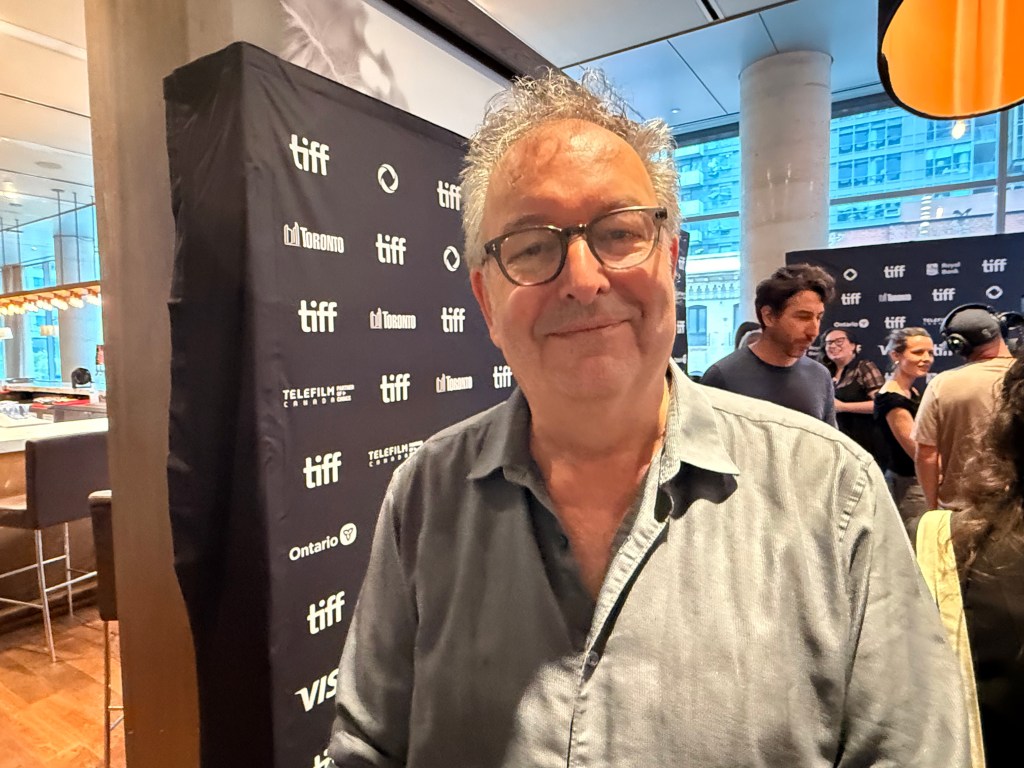
Daniel Garber talks with Peter Mettler about While the Green Grass Grows: A Cinematic Diary in Seven Parts

Posted in Canada, Covid-19, documentary, Experimental Film, Family, Philosophy, Switzerland by CulturalMining.com on August 23, 2025

Part 1

Part 2

Hi, this is Daniel Garber at the Movies for culturalmining.com and CIUT 89.5 FM.

Media pundits say outlets like Tiktok and Instagram have distilled ideas into their purest and shortest form: a thirty second clip best viewed on a smartphone. This, they say, is our future. But not everything is shrinking. Some films are growing, lengthening and expanding. Would you believe I just saw a seven-and-a-half hour movie… and loved it?

It’s a film diary whose seven chapters are shown in two parts. This philosophical travelogue and life-record follows its filmmaker over half a decade in Canada, New Mexico, Cuba and Switzerland. It deals with images of animals and caves, rivers and waterfalls, alongside a personal examination of life and death, and the past and the future.

The film’s called While the Green Grass Grows and is  written, directed and photographed by award-winning Swiss-Canadian filmmaker Peter Mettler. Peter’s retrospectives — featuring Gambling Gods and LSD, and Picture of Light — have been shown at the Lincoln Center, the Jeu de Paume, and Cinémathèque Suisse, while his cinematography can be seen in movies like Robert Lepage’s Tectonic Plates and Jennifer Baichwal’s Manufactured Landscapes. With a distinct cinematic style that lies somewhere between experimental film and documentary, Peter explores both the physical world and the ideas we carry within our minds. 

While the Green Grass Grows: A Diary in Seven Parts will have its world premiere at #TIFF50.

I spoke with Peter Mettler in Toronto, via ZOOM.

Daniel Garber talks with Sook-Yin Lee and Dan Beirne about Paying for It

Posted in 1990s, Books, Canada, Comics, Philosophy, Sex, Sex Trade, Toronto, Women by CulturalMining.com on August 24, 2024

Photographs by Jeff Harris

Hi, this is Daniel Garber at the Movies for culturalmining.com and CIUT 89.5 FM.

It’s the late 1990s in Toronto.

Sunny and Chester — a VJ and a cartoonist — live together in a house in Kensington Market. Up to now, they’ve been in a loving, monogamous relationship but their sex-life is kaput. So Sunny suggests they broaden their sexual outlook, and seek new partners.

This leaves a void in Chester’s life: sex. Finding a new girlfriend is out of the question. Dating is costly, time-consuming and rarely leads to sex. So he decides to try a different path. What will happen to Chester’s and Sunny’s lives when he starts “paying for it”?  

Paying for It is a new film about sex work and relationships, told from the point of view of the John. It’s brilliant, shocking, hilarious and touching. Based on Chester Brown’s graphic novel by the same name, it’s directed and co-written by Sook-Yin Lee. The film stars Dan Beirne as Chester and Emily Lê as Sunny. Dan is a prolific Canadian TV and film actor who is also one of the funniest and most underrated actors working today. Dan has starred in countless TV shows and movies including Great Great Great and The Twentieth Century. The multi-talented Sook-Yin is a producer, director, actor, and musician who began as a VJ on MuchMusic, and went on to direct films like Octavio is Dead, and starring in pictures like Shortbus.

Paying for It is having its world premiere at TIFF on Friday, September 6th at 930 PM.

I spoke with Sook-Yin Lee and Dan Beirne in-person and in-studio at CIUT 89.5 FM.

Bikes and books. Films reviewed: The Last Rider, Umberto Eco: A Library of the World

Posted in Books, documentary, France, History, Italy, Language, Philosophy, Semiotics, Sports, US by CulturalMining.com on July 8, 2023

Hi, this is Daniel Garber at the Movies for culturalmining.com and CIUT 89.5 FM.

It’s Summertime and Toronto is melting. Luckily there are lots of new movies playing at festivals, both indoors and out. The ICFF is showing great movies from Morocco to China at the distillery district throughout July. Art of Documentary Film Festival is on next Saturday, July 15th, at Innis Town Hall Theatre featuring a talk by Shasha Nakhai and Rich Williamson, the great Toronto directors who brought us Scarborough.  And later this month keep an eye out for the Female Eye Film Fest featuring memorable movies and shorts directed by women.

But this week I’m looking at two new documentaries that stimulate the body and the mind. There’s an Italian film about books and American one about Bikes.

The Last Rider

Wri/Dir: Alex Holmes (Maiden)

It’s 1989. Greg LeMond is a champion professional cyclist who was the first American ever to win the Tour de France. He has trained since a teenager in Lake Tahoe, growing up with a gut-knowledge of their mountains and steep roads. He meets Cathy, his future wife, like in a movie, at a Holiday Inn. He is soon recruited as a member of the Renault team, moves to France for training, and becomes world famous. Cathy comes with him, dropping out of College.

But after winning the Tour, he falls into a deep depression, followed by a terrible accident: he is accidentally shot and almost killed on a turkey hunt with his family. This happens while Cathy is in labour, so Greg barely gets a chance to see their newborn for weeks.  But after a few years of recovery, they decide he should try once again.. Not to win the Tour de France, but just to see if he can finish it (remember: competitive cycling, especially climbing up gruelling Alpen roads like in the Tour, requires absolute perfection  in strength, skill and stamina— and Greg still has metal pellets riddling his body!)

But to everyone’s surprise, it becomes a three way race for Greg, Pedro Delgado and Laurent Fignon. Who will wear the yellow jersey?

The Last Rider is a biographical sports doc about that historical and exciting race in 1989. It’s 75% period video footage — the Tour de France is heavily photographed, start to finish — and 25% new taking-head interviews with LeMond, his family and many participants in that race. 1989 was before the dirty side of professional cycling — all the scandals, illegal drugs and supplements that became endemic in the sport — so there is a sense of innocence and pathos permeating this story. I am not a big fan of the sport — I barely follow it — but it was still an exciting watch.

Umberto Eco: A Library of the World

Dir: Davide Ferrario 

Umberto Eco is a writer, novelist and semiotician from Piedmont, Italy. He writes books — including international bestselling novels like The Name the Rose and Foucault’s Pendulum — and academic essays and treatises. He also accumulates and reads an astonishingly diverse number of books. And though he is an academic, he avoids ranking books by their moral or political value, ignoring the usual canons of good vs bad literature.

His shelves are filled with Charlie Brown bobble heads beside Voltaire, devoting equal space to fumetti — low-brow italian comics — and pulp fiction, as he does to obscure codices scribed by medieval monks. The more obscure the better. There are illuminated manuscripts of animals with human heads. And — unlike the current vogue of labelling works as misinformation, disinformation or “fake news” — Eco loves writers who churn out huge quantities of books of dubious credibility and provenance. Like the 17th-century German Jesuit Athanasius Kircher, who studied and wrote about practically everything, including travelogues of China (despite never having been there), and treatises on mathematics, music, medicine, the tower of Babel and Egyptian hieroglyphics. There’s always room for mysticism, conspiracy theories and apostate Cathars.  Eco died in 2016 but left behind a stupendous collection of books, including his own voluminous output.

Umberto Eco: A Library of the World is a fascinating, esoteric and aesthetically pleasing documentary about Eco and his writing, the books he read, and about libraries worldwide. Members of his family tell their stories and they and actors recite aloud some of Eco’s works, both profound and mundane.  There are also countless TV talks in Italian, French and English of eco himself spannng his career. And the cameras take us through lush stacks of burnished wood in libraries throughout the world, caressing atlases and thesauruses. To the whimsical music of Carl Orff and striking architectural locations, this doc, like Eco himself,  is a nearly limitless compendium of everything wondrous, grotesque and interesting.

If you like Umberto Eco’s work, this is a must-see; and if you’ve never heard of him watch this movie — you’ll learn learn a thing or two. 

Umbertio Eco: A Library of the World starts next Friday at Hot Docs cinema, and The Last Rider which recently opened in Toronto is playing later this month at the Lavazza INCLUCITY FESTIVAL in the distillery district; check your local listings.

This is Daniel Garber at the Movies, each Saturday morning, on CIUT 89.5 FM and on my website, culturalmining.com.

Self Help. Films reviewed: Becoming Nobody, Brittany Runs a Marathon

Posted in 1960s, 1970s, comedy, Death, Depression, documentary, drugs, Philosophy, psychedelia, Psychology, Women by CulturalMining.com on August 30, 2019

Hi, this is Daniel Garber at the Movies for culturalmining.com and CIUT 89.5 FM.

It’s Labour Day weekend, a good time to catch up on all those things you’ve been meaning to do. That’s why this week I’m looking at two movies – a dramedy and a documentary – about Self Help. There’s a woman who wants to lose some of herself, and a man who wants to lose all of himself.

Becoming Nobody

Dir: Jamie Catto

A hippie walks into a pizza parlour. The guy behind the counter asks: What would you like?  The hippie says: Make me One… with Everything!

Old joke, but I’m trying to explain who Ram Dass is.

He’s born Richard Alpert in Newton, Mass., to an upper middle class family, and becomes a clinical psychology prof at Harvard University. In the early 1960s Timothy Leary introduces him to hallucinogenic drugs as a part of therapy. Alpert takes psilocybin mushrooms for the first time and it blows his mind (in the positive sense.) But he wants to know how he can harnass its effects when he’s not high. He drops out, grows long hair and a beard. Somehow he ends up in India, in the Himilayas, right on the border of Tibet. There he studies under Maharaj-ji, his spiritual guru – who dubs him Ram Dass, Servant of Rama, Servent of God – and then brings his findings back to America. Back home, youth culture is rejecting the status quo, protesting the war in Vietnam, and opting out of the rat race. They’re looking for new answers. Spiritual answers. His book, Be Here Now (1971) provides just that to a large part of his generation.

I am not a devotee of Ram Dass, I don’t go to yoga classes and I don’t practice meditation in a search for spiritual enlightenment. I do remember being fascinated as a little kid by the cube-shaped book Be Here Now with the hypnotic mandala drawn on its cover.

So I won’t attempt to explain his entire spiritual philosophy in a few sentences. But the film Becoming Nobody, attempts to do some of that in 90 minutes. It’s basically a selection of his talks and conversations spanning his life from the 1960s to the present – discovery, spiritualism, losing oneself, and accepting death. You see him change from uptight academic, to long-haired hippy, to lecturer with a Dr. Phil moustache, to wise and funny old man. The film is illustrated with cute period footage and framed by a dialogue with the director, British musician Jamie Catto.

For a non-initiate like me, some of what Ram Dass says sounds like a collection of simple aphorisms, a mishmash of Hindu and Buddhist thought. But when you think about it, a lot of what he says really make sense; it’s not just hollow rhetoric. So whether you’re looking for a simple introduction to his philosophy, or just interested in him, Becoming Nobody gives you lots to chew on.

Brittany Runs a Marathon

Wri/Dir: Paul Downs Colaizzo

Brittany (Jillian Bell) lives in a cluttered New York apartment. By day she works as a low-paid usher at a theatre. At night she goes to bars with her roommate Gretchen (Alice Lee). A good time means getting high on adderal and having drunken sex with a stranger in a bathroom stall. She thought her college education would land her a creative job on Madison Avenue. Instead she’s underemployed with a huge student debt. Which depresses her. And to rub salt in the wound, her doctor tells her she’s 60 pounds overweight and if she doesn’t do something about it, she might die.

Could her life get any worse? Actually, it begins to get better when her neighbor, Catherine (Michaela Watkins) – who she’s never met and who she refers to as “Moneybags Martha” when she sees her through the window – offers to help Brittany train with her running club. There she meets Seth (Micah Stock) a slightly effeminate, married gay guy, who wants his kids to respect him and call him dad. Catherine is dealing with a painful divorce and custody battle. So the three form a sort of a support group to help Brittany run in the New York City Marathon.

She also lands a long-term house-sitting job, which helps her keep her above water economically and away from roommate Gretchen’s bad influence. She begins to lose weight, her self confidence grown, and she becomes closer to her fellow house-sitter Jern (Utkarsh Ambudkar) a poster boy for slackers. Are they a couple? Can she lose 60 pounds, get a job in her profession, find a home, meet a guy, and run the marathon? Or are these just a series of unattainable hopes?

Brittany Runs a Marathon is exactly what the title suggests – a woman trying to run a marathon to achieve a personal goal. But it’s also a really funny comedy. Jillian Bell is hilarious and disarming as the sneaky, funny, self-deprecating Brittany. You also feel for her character as she goes through crushing disappointments. And it deals with serious issues like the ups and downs of weight loss, body image, and depression, without turning into a condescending sermon. It’s a fun, funny, heartwarming and inspiring movie. I like this one.

Brittany Runs a Marathon opens today in Toronto, check your local listings; and Becoming Nobody opens next Friday, September 6th at Hot Docs.

This is Daniel Garber at the Movies, each Friday morning, on CIUT 89.5 FM and on my website, culturalmining.com.

“What is Democracy?” Daniel Garber talks with Astra Taylor about her new documentary

Posted in documentary, Economics, Greece, Interview, Italy, Morality, Movies, Philosophy, Politics, Poverty, Protest, US by CulturalMining.com on November 9, 2018

Hi, this is Daniel Garber at the Movies for culturalmining.com and CIUT 89.5 FM.

Photos by Jeff Harris

Is democracy justice or is it freedom? And if it’s freedom, is it freedom to think and say what you want, or is it freedom from hunger, poverty, and homelessness? Or is it just choosing which political party to vote for once every four years?

Should democracy just exist inside a nation, or should it extend across borders? Is majority rule fair and equal?

What is democracy, anyway?

A new documentary poses just that question to intellectuals and the hoi polloi in America and across the Atlantic. It talks to barbers and doctors, students and politicians, in legislatures and at Trump rallies, to try to determine what democracy actually is.

It’s called What Is Democracy and is written and directed by noted documentary filmmaker Astra Taylor, whose works include Examined Life and Zizek!

What is Democracy had its world premier at #TIFF18.

I spoke with Astra Taylor at NFB’s Toronto headquarters during TIFF. Her film is opening soon.