All Canadian. Films reviewed: Seven Veils, Night of the Zoopocalypse, Shepherds

Posted in Aliens, Animals, Animation, Canada, Farming, France, Opera, Quebec, Zombie by CulturalMining.com on March 8, 2025

Hi, this is Daniel Garber at the Movies for culturalmining.com and CIUT 89.5 FM.

Most of the movies we see come out of Hollywood, but now that the US government has declared (economic) war, I figure why not look at more Canadian movies, instead.

So for this week, I’m talking about three new Canadian movies all opening this weekend. There’s a Montreal PR exec who wants to become a shepherd, a wolf in a theme park who doesn’t want to become a zombie, and an opera director in Toronto who says the show must go on. 

Seven Veils

Wri/Dir: Atom Egoyan

It’s winter in Toronto. Jeanine (Amanda Seyfried) has flown in for a new project: she has been selected (by the late director) to remount his production of the opera Salome. She knows this version inside and out, as she was his assistant on it while still a student. But by taking on this role, she has opened a pandora’s box of hidden secrets: The male lead, Johann (Michael Kupfer-Radecky), is notorious for his roving hands. Ambur (Ambur Braid) sings the part of Salome but her past misgivings with Johann threaten to erupt. Then there are the understudies. Johann’s second knew Jeanine from their student days, and follows her with puppy dog eyes and long-held hurt. Rachel, Ambur’s understudy, is dating the same woman Ambur used to be with, before she was a superstar.  

Jeanine is requested to add personal changes to the remount, but whenever she tries something outrageous, the management swoops in to stop her. And then there’s her home life: She left their young daughter with her husband,  but her mother whispers her pretty and young caregiver is sleeping with Jeanine’s husband.All of these pressure-points seem ready to burst at any time. Can Jeanine survive this trouble-filled production? Or is it headed for disaster?

Seven Veils is a dramatic, behind-the scenes look of the remounting of an opera. It has some good acting and lovely cinematography, but it’s laden down by a messy, overly-complicated plot. It feels like a full season of a reality show condensed into 1 hour and 50 minutes. Atom Egoyan filmed this movie even as he was directing a live performance off the same opera with the same singers on the same set. Is this creative brilliance, or just double-dipping? Egoyan has long been known as a pioneer in incorporating video footage within his films and stage productions. But he went whole hog with this one, including more mixed media than you can shake a stick at: Zoom calls, a snarky podcast recording, a making-of doc filmed on the prop director’s cel phone, and even creepy childhood home videos by Jeanine’s dad. Some of these fall flat — Jeanine’s voiceover narration is embarrassingly clunky.  Others examples are brilliant: like a giant projection of Johann’s mouth on a scrim on stage objecting haughtily with any directions Jeanine tries to give him. The film also covers myriad diverse topics, including intersectionality,  sexual harassment, women fighting the patriarchy, a severed head, backstabbing, entrapment and revenge.

Way too much stuff to fit in one film, but with enough good parts to keep it going. 

Night of the Zoopocalypse

Co-Dir: Ricardo Curtis, Rodrigo Perez-Castro

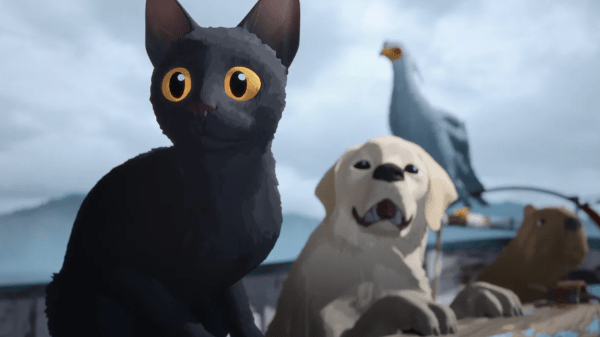
Gracie is a young wolf who likes hunting on his own. He ignores his Alpha grandma’s warnings to always stay with the pack. After all, what does it matter; they live in a theme park (the Colepepper Zoo) with no predators! But Gracie has spoken too soon. That night, a radioactive meteor crashes through the sky and lands smack-dab into their collective home. Anyone who touches the glowing rock is instantly transformed into a hideous version of their former self with glowing eyes and zombie-like behaviour. The infection spreads across the zoo, with ever more animals being zombified. Luckily Gracie finds safety in the zoo hospital, along with Ash the ostrich, Xavier the lemur, Felix, a self-centred proboscis monkey, Frida a capybara, and a dangerous-looking mountain lion called Dan. If they work together maybe they can fend off this otherworldly ailment; or they could split up and see who can make it out of the park. Can these creatures find a common aim? Or will they all be zombified before dawn? And what will happen to the outside world once the park’s gates reopen?

Night of the Zoopocalypse is a cute, animated kids movie about animals infected by an alien disease, featuring  the voices of David Harbour, Scott Thompson, and Paul Sun-Hyung Lee. The unoriginal dialogue seems aimed at very young children, not adults, but perhaps zombies are too scary for the youngest ones. But I do like a lot of things in Zoopocalypse, from the obnoxious theme songs, to the eerie Kenny Scharf-like cut-out designs of grotesquely smiling figures. And who couldn’t like Poot, the baby pygmy hippo!  If your kids don’t scare easily, I think they’ll like Night of the Zoopocalypse. 

Shepherds (Bergers)

Co-Wri/Dir: Sophie Deraspe (Interview: Antigone)

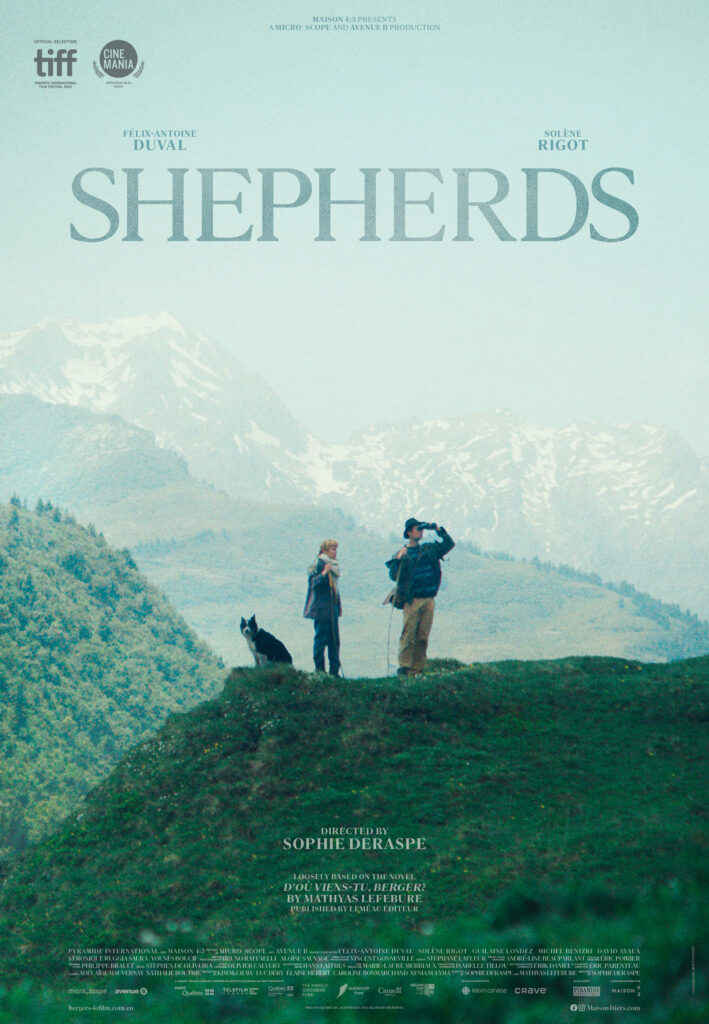
Mathyas (Félix-Antoine Duval) is a young man who works as a copywriter at a Montreal PR firm. He’s creative, sensitive and ambitious. So what is he doing sipping yellow Pastis in a small town cafe in Provence? To change his life from pointless and unfulfilling to a simpler one, entirely off the grid. He’s in Provence because he wants to become a shepherd. You heard me: someone who herds sheep. And he wants to write a book about his experiences afterwards. He has already bought a requisite black hat and leather satchel, and he’s been boning up on all the books on how to herd sheep. But he’s having trouble finding a sheep breeder willing to take him on. His try is a total wash-out: he’s never stood in a flock of sheep in his life.  

So he pays a visit to the local government office, in hopes of getting a work visa. No such luck, but he does meet the cute bureaucrat behind the counter. Elise (Solène Rigot) is smart, pretty and bored with her job, too. She’s impressed by Mathyas’ convictions, but is sorry to tell him you can’t apply from within the country. But he keeps up his correspondence with her via handwritten snail mail, and her simple responses keep him sane.

He eventually finds under-the-counter work as an apprentice shepherd for a retired, childless couple looking for someone to take over. But he finds the environment hostile and violent, full of cruelty and insanity… nothing like what he was looking for. So when Elise shows up suddenly, he decides to quit. Surprisingly, the two of them are hired almost immediately as a team, to work through the summer tending sheep in a stone cottage way up in the Alps. Can two non-shepherds learn the lay of the land and how to take care of hundreds of pregnant sheep? And will their friendship develop into something more?

Shepherds is a wonderful movie about going back to the land. The story is based on the novel D’où viens tu, berger? by the real Mathyas Lefebure who actually did leave Quebec to seek his fortune as a shepherd in Provence. I’ve always liked Sophie Deraspe’s brilliant films. And while Shepherds is very different from her past work, it’s just as good.  Félix-Antoine Duval is amazing as Mathyas with just the right blend of vulnerability and sincerity, like a gawky teenager trapped in an adult’s body. French actress Solène Rigot conveys such warmth she’s totally loveable.

Shepherds is a gorgeous movie with unforgettable images, like rivers of sheep pouring across a valley and through alpine city streets. Absolutely breathtaking.  One warning: After watching Bergers, you might consider becoming a shepherd, too.

Night of the Zoopocalypse,  Shepherds, and Seven Veils all open this weekend in Toronto; check your local listings. This is Daniel Garber at the Movies, each Saturday morning, on CIUT 89.5 FM and on my website culturalmining.com.

Tough Cookies. Films reviewed: Maria, Flow, The G

Posted in 1950s, 1960s, 1970s, Animals, Animation, Corruption, Crime, France, Latvia, Opera, Vengeance, Women by CulturalMining.com on November 30, 2024

Hi, this is Daniel Garber at the Movies for culturalmining.com and CIUT 89.5 FM.

With a rapidly aging population, the traditional image of frightened, little-old cat ladies is gradually shifting to one of strength and cunning. Witness new TV shows like Matlock. So this week I’m looking at two new movies about tough older women and one about a cat. There’s an opera diva in Paris preparing her swan song; a rustbelt widow who wants to go out with a bang; and a cat on a sailboat in a world covered in water.

Maria

Dir: Pablo Larraín (Reviews: Spencer, The Club)

It’s 1977 in Paris, and Maria Callas (Angelina Jolie: Salt, The Tourist, Unbroken) — one of the greatest divas in opera history, is not doing well. She rarely eats, often never leaving the bedroom of her palatial apartments for days at a time. She rarely speaks with anyone anymore, aside from her servants. She runs her butler ragged (Pierfrancesco Favino: The Hummingbird, in a red monkey suit) and she relies on her cook (Alba Rohrwacher: Sworn Virgin, Hungry Hearts, The Ties/Lucci ) for judgement on the quality of her vocal chords. 

But she’s not completely alone. She is seeing a pianist for his unvarnished opinion on whether her legendary “voice” has returned. And has agreed to an unheard-of interview with a young journalist named Mandrax (Kodi Smit-McPhee: The Road, The Congress, The Power of the Dog, Memoir of a Snail). But Maria faces a number of problems. She refuses to see a doctor, despite her rapidly declining health, and she won’t stop popping Quaaludes, leading to frequent hallucinations and delusions. Can her devoted servants save her life? Or is this the end?

Maria is a biopic about the death of a legendary Greek-American diva. The movie begins with her demise at age 53, then goes back in time to show what led up to it. This includes flashbacks to her chubby adolescence in German-occupied Athens in WWII, her failed marriage, and at the peak of career, including trysts with Aristotle  Onassis and JFK. 

But is this biopic any good? I have very mixed feelings about that. I love the beautifully shot interiors, the ostentatious costumes and the amazing arias provided by recordings of Callas herself. Italian actors Rohrwacher and Favino provide wonderfully painful performances. And, as the latest in a series of films about famous woman by Chilean director Pablo Larraín it has good pedigree, especially Spencer (with Kristen Stewart as Princess Diana). But this movie depends on Angeline Jolie, and she doesn’t carry it off. She always seems to be acting. I don’t see Maria Callas here, I see Jolie posing for the camera, with  a haughty face here and a dramatic gestures there; so you rapidly lose sympathy with the main character. Perhaps Maria Callas really did act like that, even behind closed doors, but Jolie plays her somewhere between high camp and kitsch. 

Maria is never boring… just a bit embarrassing. 

Flow

Co-Wri/Dir: Gints Zilbalodis

It’s some time in the future, somewhere in the world. A small grey cat with golden eyes and pointy ears is enjoying a walk in the woods. The cat lives by an abandoned old house surrounded by enormous cat statues. The cat is very shy, and fears, most of all, a pack of feral dogs. Suddenly, there’s a stampede of animals running in one direction, full speed. They‘re trying to avoid a massive flood, sweeping away everything in its path. But cat and a friendly, white dog are among its victims. Survival instinct kicks in and eventually cat manages to climb on board a tattered sailboat. There Cat discovers a gentle, sloth-like capybara already on board. Other animals make their way onto the sailboat, including an ingenious lemur, that big, white dog and a majestic-looking phoenix. Together they form an uneasy friendship as they brave a dangerous water-covered world. But can they learn to get along? And is this world worth living in?

Flow is a brilliantly animated film about a picaresque journey by a mismatched troupe of animals. It’s tender, heart moving and lovely to watch. It’s all about friendship and cooperation learned by animals living in a gently hostile world. And though they behave a tiny bit like humans, there are no people in the story, and no dialogue either; just grunts meows and barks. Dogs still want to fetch. Cats want to catch fish.  

And though it’s post-apocalyptic, there is nothing futuristic in this film; human technology is limited to abandoned ancient cities, glass bottles and sailboats; no cars or smartphones to be seen. The science fiction comes in with its universality, where animals from different continents, along with mythical beasts like sea monsters, can randomly encounter and learn from one another. I just watched Flow, and I already want to see it again.

Flow is Latvia’s Oscar submission for Best International Feature.

The G

Wri/Dir: Karl R. Hearne

It’s a rust-belt city somewhere in North America. Ann Hunter (Dale Dickey) is a tough cookie in her 70s, who is feeling depressed. You can see it  in every wrinkle on her face. She lives with her ailing husband in their fully-owned condo. He was once a tough guy, but is rapidly sliding into immobility and dementia. She grudgingly takes care of him, and drowns her sorrows in rot-gut alcohol straight from the bottle. Aside from him, she only spends time with Emma, step-granddaughter (Romane Denis). Emma models her life on The G (as she calls her grandmother) someone who doesn’t take crap from anyone. The G also helps her out financially, and doles out hardboiled words of wisdom.

But everything changes when a man in a suit  named Rivera (Bruce Ramsay), out of the blue, breaks down The G’s front door, accompanied by two toughs:  Matt (Joey Scarpellino), a handsome but simple-minded gardener; and Ralph, a psychopath with bleach blond hair (Jonathan Koensgen). Together they violently shove Ann and her husband into a van, who wind up locked in a threadbare room without a phone, in a nursing home that feels more like a prison. This is your new home, Rivera says, and there’s nothing you can do to stop me. He’s now their legal guardian and has the documents to prove it; their doctor (a silent partner in the scam) has declared them both incompetent. No one’s allowed to go in or out for the first month. He roughs up her husband to try to find the proverbial pot of gold he thinks they’re hiding. But they underestimate the G, her stubbornness, and her shady connections back in Texas.

Meanwhile, Emma is shocked when she discovers her grandparents have suddenly disappeared, leaving behind just a torn-up home. She scours the city to find them, and makes friends with a caretaker who works at the home (who also happens to be Matt, the friendly thug). It’s too late to save her grandpa but she vows to get the G out of there. And even while Emma is trying to free her, the G has vowed vengeance on all her enemies — and she’s not messing around. Who can they trust? Can two women best a criminal organization? Or will they end up buried alive? 

The G is a great revenge thriller about the very real phenomenon of organized criminals attacking and abusing the elderly. It’s dark and disturbing. Dale Dickey blows this movie out of the water, supported by a good Quebecois cast. (It’s shot in Montreal). If you’re looking for a gratifyingly violent revenge flic, this is the one to see.

Maria and Flow are now playing at the TIFF Lightbox, with Maria streaming on MUBI on December 11th; and The G is opening across Canada; check your local listings.

This is Daniel Garber at the Movies, each Saturday morning, on CIUT 89.5 FM and on my website culturalmining.com.