Intrigue. Films reviewed: The Phoenician Scheme, The Ritual, Ballerina

Posted in 1920s, 1950s, Action, comedy, Crime, Horror, Nun, Religion, Satanism, Thriller, violence by CulturalMining.com on June 7, 2025

Hi, this is Daniel Garber at the Movies for culturalmining.com and CIUT 89.5 FM.

imagineNative — Toronto’s own indigenous film and media arts festival — is on now through Sunday with docs, films, exhibitions and performances from around the world with both free and paid events.  Check it out!

But this week I’m looking at three new movies: an art house comedy, a religious horror movie and an action thriller. There’s a devious mogul preparing his daughter to take over his busines, a priest attempting an exorcism, and a professional assassin fighting to avenge her dad.

The Phoenician Scheme 

Co-Wri/Dir: Wes Anderson (Reviews: Fantastic Mr Fox, Isle of Dogs, The French Dispatch, Asteroid City)

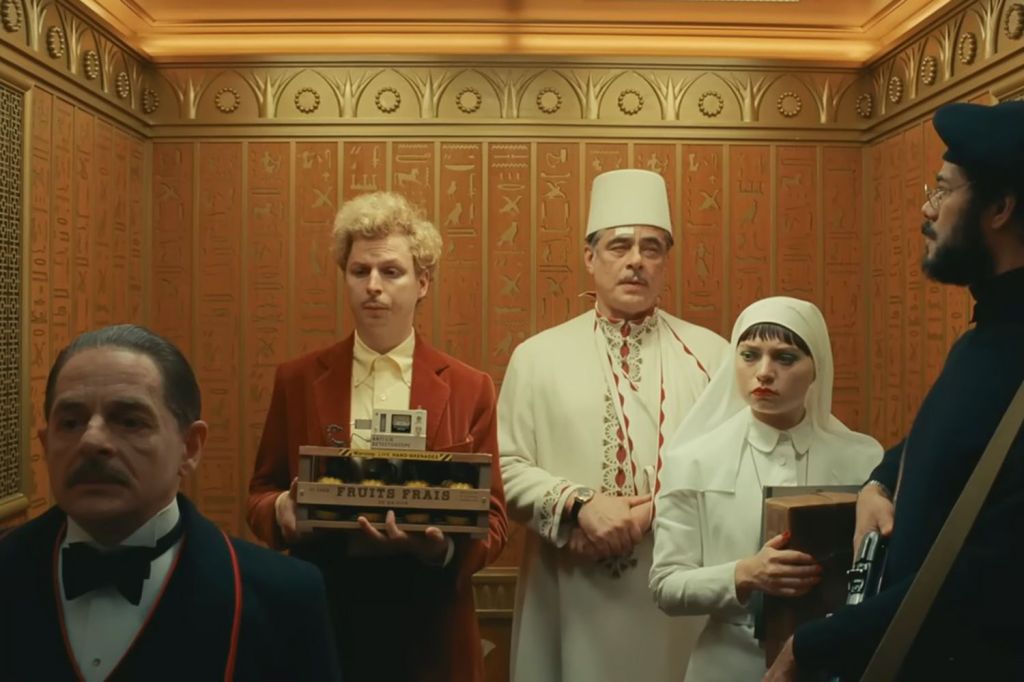
Zsa-Zsa Korda (Benicia Del Toro) is the richest industrialist in the world. He amasses millions by embarking on huge projects in developing countries using virtual slave labour. He’s ruthless and cruel. He has sired a dozen kids whose names he can’t remember and whom he keeps locked up in a threadbare orphanage. Except, one. Liesl (Mia Threapleton) is a novice, brought up in a convent and dresses like a nun but who who has yet to take her vows. Korda is grooming her to take over his huge business interests after he dies. And attempts on his life — like poisons, bombs and sabotaged airplanes — are a routine part of his life. But he always seems to survive. And so he embarks on a grand scheme to involving interconnected tunnels, waterways and cornering global markets. But first he must raise the money from investors. He takes Liesly along with him as he carries out his complex plans. And accompanying them is Bjorn (Michael Cera) a Scandinavian tutor, ostensibly hired to educate his kids, but instead tags along on these journeys. But they face hostile business partners, revolutionaries, spies and assassins, quicksand, plane crashes and other symbols of disaster. Will his scheme be successful? Will Liesl learn to love him? And will he survive the final attempt on his life?

The Phoenician Scheme is an art-house comedy film, the latest in Wes Anderson’s collection. It’s stylized and formalistic, shot in almost two-dimensional geometric settings with precisely directed sequences. Combining social satire with silliness, it’s wacky and always surprising. It consists of a series of segments as he checks off the list of the projects he planned as he swindles repeated capitalists out of their investments. The story line is punctuated by repeated dreams fantasies of Korda — in his near-death experiences — as he faces judgement in Heaven, but always ending up back again on earth. Threapleton is fun to watch as she gradually transforms from an avowed zealot to a lover of luxury, as Korda replaces her rosary with semiprecious stones, and her simple corncob pipe with an inlayed treasure from Cartier. Cera is hilarious as the insect-loving tutor Bjorn, and Del Toro is sufficiently both grand and seedy to convey his anti-hero’s character. Like all of Wes Anderson’s films, many members of his stable of actors reappear in short, cute roles: Tom Hanks, Willem Defoe, Bryan Cranston, Charlotte Gainsbourg, Richard Ayoade, Scarlett Johansson, Ris Ahmet, Bill Murray, and Benedict Cumberbatch, to name just a few. Some people are put off by Anderson’s emphasis on style and form — which, admittedly, doesn’t always work — but in this case, I think he’s made a fine movie that’s a pleasure to watch. 

The Ritual

Co-Wri/Dir: David Midell

It’s the late 1920s in a small town in Iowa and Father Joseph Steiger (Dan Stevens) is mourning the death of his only brother. But his grief is interrupted by a young woman in his parish. Emma Schmidt (Abigail Cowen) says she is possessed by a demon. For many years she has seen doctors and psychiatrists but no one can explain her strange condition. So she has turned to the Church to cure her, and says only an exorcism can free of from her very real torment. This is unheard of, but the ritual has been approved by the local Bishop, with an expert in demonic possession heading their way. Father Theophilus Riesinger (Al Pacino) is a shaggy-haired little monk who wears a cowl and talks like Tevye from Fiddler on the Roof. But he knows the practice of exorcisms inside and out. Along with a bevy of assorted nuns to help out, the ceremony begins. Emma is tied to the bed as her body writhes. She  pukes pea soup and breaks out in weird rashes. The furniture flies around the room as she curses in five languages. But can they exorcise this demon before it consumes her?

The Ritual is a horror movie that (supposedly)  reenacts an actual historical event: the performance of an exorcism in the US. The script is based on documents from that era. Thing is it is also the inspiration for William Friedkin’s iconic film The Exorcist, and the novel, by William Peter Blatty, it was based on. This version has atrocious writing, painful acting, and cheap-ass special effects. Fear and grief is conveyed by actors covering their faces with their hands, over and over. The whole movie is shot with in extreme close-ups using a hand-held camera that jiggle enough to make any viewer feel nauseous. Although the chapters of each ritual is documented, there’s minimal difference from one to the next. It isn’t even vaguely scary, more boring than anything else. It feels more like a Sunday school sermon than a horror movie. Al Pacino? Dan Stevens? These are famous actors! What are they doing in this dreadful movie? They must really be desperate. 

The obvious question is, what possessed the filmmakers to attempt to retell a story that’s already been told so well?

What a clunker. 

Ballerina

Dir: Len Wiseman

Eve (Ana de Armas) is a little girl raised by her father in a hidden palace somewhere in Eastern Europe. She is kept hidden from the rest of the world for her own safety. Until a man named The Chancellor  (Garbiel Byrne) tracks her down, kills her father and takes her away. All she has left to remember her dad by is a music box snow globe with a dancing ballerina inside. She is immediately enrolled in a school run by The Director (Anjelica Huston), a cruel teacher in the tradition of the Ruska Roma who trains her girls to endure the pain of classical ballet dancing. They also learn how to kill their adversaries using fists, kicks, knives or any other dangerous object. Upon graduation, only those with true bloodlust are farmed out across the globe as killers to hire. And Eve is at the top of her class. She is highly successful as an assassin, but has another hidden motive: vengeance for the death of her father and sister.

Her relentless search leads her to a picturesque alpine village filled with jolly bakers and wood carvers. The women have blond braids and rosy cheeks while the men happily quaff steins of pilsener. Unfortunately, everyone in the village, I mean everyone, is a trained killer. And they happen to belong to a criminal outfit in an uneasy truce with the clan works for. Can she find her father’s killer and escape the village alive?

Ballerina is an action/thriller about a young, female assassin out for revenge. Its a spin-off of the John Wick franchise with many of the same recurring characters, including cameos by Keanu Reeves as John Wick himself. The plot is simple, and the script has relatively few lines. What it does have is fighting and lots of it, which it does really well, whether hand to hand or using enormous lethal weapons. The fight choreography is skillful and creative — it’s ballet. And I liked Ana de Armas as the protagonist… enough that if there were another Ballerina movie, I’d watch that one too. This is good action feature.

Ballerina and The Ritual both open this weekend in Toronto and The Phoenecian Scheme expands across Canada; ; check your local listings;

This is Daniel Garber at the Movies, each Saturday morning, on CIUT 89.5 FM and on my website culturalmining.com.

Dangerous jobs? Movies reviewed: Love Hurts, Dark Nuns, Bring Them Down

Posted in Action, Farming, Ireland, Korea, Nun, Organized Crime, Religion, Romantic Comedy, Vengeance by CulturalMining.com on February 8, 2025

Hi, this is Daniel Garber at the Movies for culturalmining.com and CIUT 89.5 FM.

Look at Me, a movie from Nova Scotia about an insecure, bisexual actor with an eating disorder, is finally opening in Toronto! In a review about year ago, I called it a “scathing — and humorous — self-examination that exposes Taylor Olsen’s innermost thoughts and fears.” Check it out.

But this week, I’m looking at three new movies (two by first-time directors) from around the world. They’re all about people who work at peaceful and innocuous jobs who encounter danger and even death. There’s a Catholic nun in South Korea, a real estate agent in Milwaukee, Wisconsin, and a sheep farmer in rural Ireland.

Dark Nuns

Dir: Hyeok-jae Kwon

Somewhere in Korea, a teenaged boy named Hae-Jun (Moon Woo-jin) is suffering from a serious illness. The doctors are baffled by his condition; nothing they try is working. But Sister Giunia (Song Hye-kyo) a Catholic nun, identifies the problem immediately: the boy is possessed. You see, Sister Giunia is a Dark Nun, a woman born with indigenous shamanistic powers. She can hear what demons say. And this boy needs a full-blown exorcism. But she can’t do it alone.

She turns to Sister Michela (Jeon Yeo-been), a much younger nun, for help. A Dark Nun like herself, Michela is adept at reading tarot cards, and can use her powers to see vision,  and manifestations of evil. But she is a nun now, and a nurse. She said goodbye to all that mumbo-jumbo years ago, and, besides it’s expressly forbidden by the Church — especially Father Paolo (Lee Jin-wook). He may be a scholar of exorcism, but he doesn’t believe in it. But Giunia is convinced the boy will die unless they intervene. Can she get sister Michela to come aboard? Will the church ever let them do it? And can two nuns and a  stammering shaman defeat Satan himself?

Dark Nuns is a pretty typical exorcism/horror movie but with a twist: It incorporates Buddhism and Shamanism within a Catholic ritual. There are a lot of quirks in this movie. Like why do all the Korean priests and nuns have Italian names, like Paolo, and Michela? Are they Ninja Turtles? And the exorcism seemed way off: heavy on the holy water — she pours gallon after gallon of it on the kid! — but awfully light on bibles, crosses or rosary beads. Then there’s the biggest problem of all: it’s a horror movie, but it just isn’t scary. What’s good about this movie? I like the way it compares Korean patriarchal neo-Confucianism with a Catholic Church keeping women out of positions of power. I’m intrigued by the culture-clash of Christianity meets Shamanism. But if you’re looking for a Korean horror movie about shamans and possession, you should watch last year’s Exhuma, instead.

Love Hurts

Dir: Jonathan Eusebio

It’s Valentine’s Day in the suburbs of Milwaukee, and  Marvin Gable (Ke Huy Quan) is busy baking heart-shaped cookies. No, he’s not in love or in a relationship; all his efforts are focussed on his career as a real estate agent. And he considers all his clients as his friends. But everything changes when a valentine’s day letter appears on his desk. Rose (Ariana DeBose) is back in town. You see, before he went straight, he used to be a killer employed by his older brother Knuckles (Daniel Wu) who is a powerful local gangster. And killing Rose was his last job. The thing is, he didn’t kill her and now everyone wants to have a word to Marvin Gable. There’s the poet-assassin Raven (Mustafa Shakir) along with a slew of other killers, with weird names like King, Otis Merlo and Kippy. Can he dodge the bullets and kill the killers, without harming all the clients trying to buy his houses? Or will he be dragged back into a dark world he thought he had left far behind?

Love Hurts is an action movie about people trying to kill each other. Despite the extreme violence it’s told a light and somewhat humorous manner. Unfortunately, it’s also tedious and predictable. The dialogue is dumb, the plot is basically non-existent. (There is also a rom-com sub-plot, with various characters falling in love with their respective crushes, but that seems like an afterthought more than part of the story.) So what’s good about it? Two things. Jonathan Eusebio is obviously a first-time director, but what he is not  new at is fight scenes. He’s a highly experienced fight choreographer, and luckily most of the movie consists of creative takes on people throwing knives and kicks as they destroy the interiors of houses and video stores. This I like. First time I’ve ever witnessed a killing using a bubble tea straw. And the cast is appealing too. It’s nice to see Ke Huy Quan back again after his big comeback in Everything, Everywhere, All at Once. He’s funny! So are Ariana DeBose, Lio Tipton, Sean Astin and Drew Scott… the whole crew.

Is this a good movie? Not really, but it’s very light, easy to watch, and the fight scenes are well-done. 

Bring Them Down

Wri/Dir: Chris Andrews

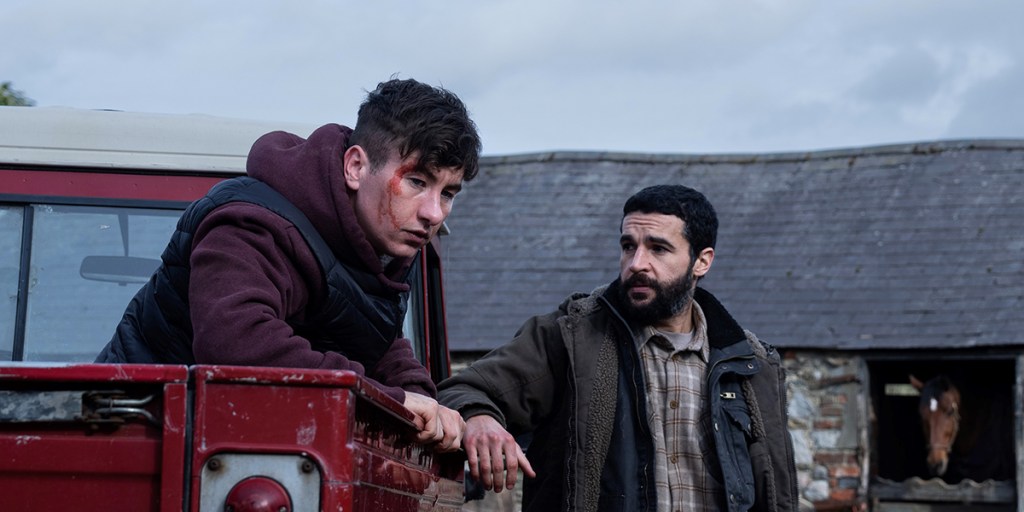
It’s rural Ireland in the present day. Michael (Christopher Abbott) runs a one-man sheep farm, where prize-winning rams graze on rocky hillsides. His abusive dad Ray (Colm Meaney) sits in the kitchen all day shouting angry epithets in Irish at Michael about all the things he’s doing wrong. In the next sheep farm over, young Jack Keeley (Barry Keoghan) does much the same as Michael but not very well. His dad Gary (Paul Ready)  — who is Michael’s age — tries to keep things going but the farm is bleeding money. Gary is married to Caroline (Nora-Jane Noone), Michael’s ex, and Jack can see his parents are not getting along. Michael hasn’t seen her for 20 years, ever since a car accident killed his mother and sent Caroline to hospital with serious injuries (The accident was Michael’s fault).

But their relatively bucolic lives are interrupted when two rams disappear from Michael’s flock. And there’s only one place they can go — to the Keeley farm just over the hill. But Jack claims they both suddenly died and he threw their bodies into a pit…a very unlikely story. This signals the start of a feud between the two families, involving simmering grudges, sheep poachers, and organized crime. Can their conflicts ever be resolved? Or are both farms headed for ruin, violence and possibly even death?

Bring Them Down is a violent, suspenseful drama about escalating grudges between two houses. It’s done in that chop-up style popular among some European arthouse directors where the narrative is not told chronologically. Your perception of “who is to blame for what” gradually shifts as new scenes fill in the blanks. I liked the acting and the dialogue — half of which is in Irish — and it has a compelling plot. The settings are just beautiful, with wide panoramic views of hillsides at dusk and dawn, and images like Michael carrying a lame sheep draped over his shoulders. There are also some strikingly original tableaux like the sheep at an auction house. This is a good first film — it reminds me of Frozen River and Winter’s Bone, all serious looks at crime in rural settings. But why are all these movies about brooding Irish men so depressing? What miserable lives these people seem to lead! If there were a bit of humour or love, Bring them Down would have been a lot easier to take.

But it’s still a good movie, anyway.

Dark Nuns, Love Hurts, and Bring them Down are all opening this weekend in Toronto; check your local listings. This is Daniel Garber at the Movies, each Saturday morning, on CIUT 89.5 FM and on my website culturalmining.com.

Blacks, Jews and Irishmen. Films reviewed: The Piano Lesson, A Real Pain, Small Things Like These

Posted in 1930s, 1980s, African-Americans, Family, Ghosts, Ireland, Nun, Pittsburg, Poland, Theatre by CulturalMining.com on November 8, 2024

Hi, this is Daniel Garber at the Movies for culturalmining.com and CIUT 89.5 FM.

Fall Film Festival Season continues with the EU Film Fest, showing free films from across Europe at Spadina Theatre starting on the 14th.

This week, I’m looking at three family dramas. There’s Black siblings in Pittsburgh, Jewish cousins in Warsaw, and an Irish dad with his five daughters, in… well, Ireland.

The Piano Lesson

Dir: Malcolm Washington

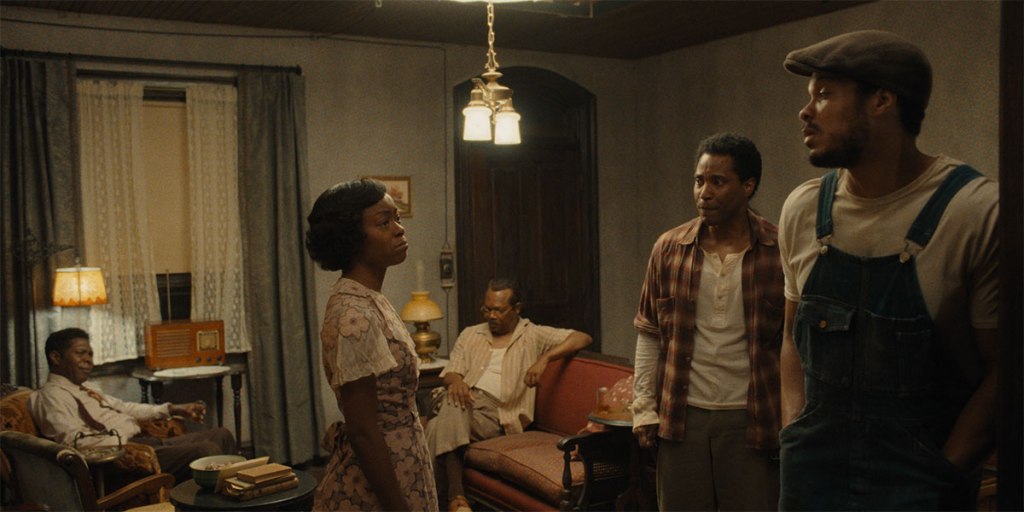
It’s 1936. Boy Willie Charles (John David Washington) and his friend Lymon are driving north from Mississippi with a truckload of watermelons, to visit his sister Berniece (Danielle Deadwyler) in Pittsburgh, Pennsylvania. She’s living with their uncle Doaker (Samuel L. Jackson). Once they sell the melons, Boy Willie plans to take his share of the profit (along with his savings) to purchase Sutter’s land. That’s the same place where his great grandparents were slaves, and where he still toils the land as a share-cropper. This is his one chance to own it.  But he’ll only have enough money if he sells the family piano. That’s why he’s visiting Pittsburgh. But Berniece refuses to sell it. Why? She grew up playing that piano, and more to the point it has family faces elegantly carved into the wood itself, dating back to pre-Civil War days. Besides, she says, that piano is haunted… and the ghost is getting meaner.  Meanwhile various family and friends, like a trickster and a preacher, are congregating at this house with different motives for being there. Can Boy Willie and Berniece come to terms about the piano? Or will bad spirits — both supernatural and human — ruin everything first?

The Piano Lesson is an excellent filmed version of playwright August Wilson’s drama. Fine acting all around, with Danielle Deadwyler outstanding as Berniece. Now, plays and movies are two different things. Actors emote louder and move bigger on stage (so everyone can see and hear them). And even the blocking and dialogue is different. Movies are no more real, but different. This Piano Lesson is very much a play. So I was a bit put off by it’s style… until the my brain started watching it as a play, at which point I really liked it.

If you notice a lot of Washingtons here, it’s no coincidence. Denzel Washington is the producer, and actor John David and director Malcolm are both sons of his. Denzel is committed to putting all ten of August Wilson’s Pittsburg Cycle on the big screen to preserve crucial Black American culture. Witness Fences in 2016 and Ma Rainey’s Black Bottom in 2020. The Piano Lesson is a fine addition to this series and should be watched.

A Real Pain

Wri/Dir: Jesse Eisenberg 

Benji and David Kaplan are cousins in their 30s, as close as brothers, but totally different. Benji (Kieran Culkin) is loud, gregarious, obnoxious and larger than life. He likes to raise a ruckus and mess things up. He lives alone in Binghamton, NY. David is shy, insecure and withdrawn. He’s married with a small kid and lives in Manhattan. He’s in a constant state of dithering and worrying. They’re travelling together to Poland to explore their family’s heritage. Their grandmother was Polish and a Holocaust survivor.

Benji was very close to her and devastated by her recent death, much more so than David. They’re part of a small tour group, all Jewish. Their guide (Will Sharpe) is a nerdy  English guy, very accommodating. Also on the tour are Marcia (Jennifer Grey) who suffers from intergenerational trauma;  Eloge (Kurt Egyiawan) from Winnipeg but originally from Rwanda where he survived Tutsi genocide; and a middle-class couple whose family immigrated from Poland generations ago but want to see where they came from. (“We’re Mayflower Jews”, he says).

Their journey takes in cultural and historical sites across Poland, but the closer they get to the concentration camp where their grandmother was imprisoned, the more agitated Benji gets.  He slips into shouted diatribes and lectures, causing scenes within their group and in public places — to David’s acute embarrassment. Can they both make it through the whole tour? Or will one of them drop out?

A Real Pain is a low-key, social comedy — yes, a comedy — about the uncomfortable dynamics within a family. it’s actually pretty funny, No slapstick or pratfalls, rather unexpected squirmy riffs on the two main characters’ personalities. (Like Benji telling David his bare feet are gorgeous, making him stare at them for the rest of the trip.)  It’s told in a series of clever vignettes over the course of the trip,  all hovering over unvoiced feelings of personal and collective mourning.   I’m always suspicious when actors play at directing, but this is no vanity pic. Eisenberg stays suitably subdued, letting Culkin go wild.

I like this movie.

Small Things Like These

Dir: Tim Mielants

It’s winter in a small town in Ireland in the 1980s. Bill Furlong (Cillian Murphy) is a working man who scrubs coal dust off his hands and face each day. But he doesn’t work in a coal mine; he has his own business, built from scratch, selling coal. His wife Eileen (Eileen Walsh) and his eldest daughter handle the finances. One day, he’s making a delivery when he’s alarmed to see a teenaged girl being dragged, kicking and screaming, into the local convent. That’s not right. She may be unmarried and pregnant, but why are they kidnapping that poor girl? 

So he steps inside to take a look. It’s the Magdalene Laundries, a Church organization that operates across Ireland, to care for unwed mothers. They put the babies up for adoption, and the girls and young women are trained to work as industrial laundresses. But to Bill it seems almost like a prison, where the girls are treated horribly. When one girl runs over, begging him to help her escape, he doesn’t know to do. The nuns quickly disabuse him of any notions he might have, and rush him out the front door. 

But Bill has history. He was brought up in this same town by his own single mum, who chose to stay away from that convent. He was bullied as a child because of this, but he still remembers how his mother — and her employer, an independently wealthy woman — defied the church. He feels he has to do something for that girl. But the nuns have their fingers in every pie; the school, government, they’re even a client of his own business. Should he confront the cold-eyed Sister Mary (Emily Watson) who runs everything? Or should he just worry about  his own family, and pretend nothing is wrong?

Small Things Like These is a deeply-moving drama about families, moral dilemmas and the checkered history of the Catholic Church in Ireland. This is the third such movie, after The Magdalene Sisters and Philomena, but its repercussions are still very much alive. Cillian Murphy —  who you probably recognize from Oppenheimer or Peaky Blinders — once again pulls you into the character he plays. He rarely speaks but the emotion in his features really affect you. So if you’re looking for a real tear-jerker, this is the one to watch.

A Real Pain, Small Things Like These, and The Piano Lesson all open in Toronto this weekend; check your local listings.

This is Daniel Garber at the Movies, each Saturday morning, on CIUT 89.5 FM and on my website culturalmining.com.

Daniel Garber talks with Daniel Stamm and Jacqueline Byers about Prey for the Devil

Posted in Bulgaria, Catholicism, Christianity, Horror, Nun, Supernatural, Women by CulturalMining.com on October 22, 2022

Hi, this is Daniel Garber at the Movies for culturalmining.com and CIUT 89.5 FM.

Sister Ann is a nun who works as a nurse in a Catholic hospital. It’s a training hospital, with classes held with in its walls. There are doctors and psychiatrists there to observe and treat the patients. But there is something unique about this medical centre: the patients are possessed and treatment involves an exorcism. Ann believes she has special experience dealing with possession dating back to her childhood. And she wants to train alongside the priests — but that is not allowed. And when she attempts to help a little girl named Natalie, she is chastised by the church for putting herself and the patient in danger. Can she help cure little Natalie? Or will she end up as Prey for the Devil.

Prey for the Devil is a new horror film about possession, exorcism, the supernatural and the Catholic Church. It harkens back to classic films like the Exorcist, but this time from a woman’s point of view. The film is directed by Daniel Stamm, an award-winning German-born filmmaker and documentarian. The film stars Jacqueline Byers an accomplished actress who you may have seen at the Toronto Fringe festival, in movies and in the hit sci-fi series Salvation.

I spoke to Daniel Stamm and Jacqueline Byers in person, on site, in Toronto.

Prey for the Devil had its world premiere at Toronto After Dark on March 19th, and opens in theatres on March 28th. 

Organized religion. Films reviewed: Hand of God, Agnes, Benedetta

Posted in 1600s, 1980s, Breasts, Catholicism, Coming of Age, Horror, Italy, Lesbian, LGBT, Nun, Religion, Sex, Supernatural, Women by CulturalMining.com on December 4, 2021

Hi, this is Daniel Garber at the Movies for culturalmining.com and CIUT 89.5 FM.

It’s December and we’re entering holiday season, so I thought it’s time to talk about movies involving religion. So this week I’m looking at three new movies with (small c) catholic themes. There’s an adolescent boy in 1980s Naples who witnesses the “Hand of God”, a lesbian nun in renaissance Tuscany who is in love with God, and another nun in the US who may be possessed by the Devil.

Benedetta

Co-Wri/Dir: Paul Verhoeven

It’s the 1600s in Tuscany Italy. Benedetta (Virginie Efira) is a beautiful young  nun with blond hair and a quick wit. She was placed in small town convent as a young girl, paid for by a rich dowry her parents gave the Abbess (Charlotte Rampling). Now Benedetta is married to God, both metaphorically, and literally, in her mind. She goes through vivid spells, where she has sex with a violent Jesus after he slays all her attackers with a sword. She also has a streak of cruelty since she was told that suffering, by oneself and others,  brings one closer to God. The cynical Abbess thinks Benedetta’s trances are just an elaborate hoax. But everything changes when Bartolomea (Daphné Patakia) a gorgeous young novice, appears at their doorstep. 

She is illiterate, and the victim of horrific abuses from her father and brothers. Benedetta takes her under her wing, nurtures her and schools her in divinity, reading and math. In exchange, Bartolomea sleeps with her, awakening hidden desires. Could this be love? Benadetta says she’s having chaste, spiritual sex with Jesus himself, not carnal passion with the young novice. And her spontaneous stigmata — bleeding that appears in her hands and feet like Jesus on the cross — attracts pilgrims and followers from far and wide seeking advice and cures. But when she’s caught using a wooden statue of the Virgin Mary as a sex toy, things take a turn for the worse. A cruel Nuncio (Lambert Wilson) arrives from plague-ridden Florence for an inquisition. Will he manage to wring a confession from the two women? Or will Benedetta’s spiritual powers protect her from being burned at the stake?

Benedetta (based on  actual historical records)  is a bittersweet and passionate look at the life and love of a lesbian nun in Northern Italy. It’s sexually explicit with lots of matter-of-fact nudity throughout the film as well as some horrific violence  (remember, this is a movie by the great Paul Verhoeven who knows well how to keep bums in seats). This is a visually stunning film, with sumptuous views of sunlit cathedrals, long-flowing costumes, diaphanous bed curtains and beautiful faces and bodies. Never has a convent looked so erotic. But it’s also a fascinating look at faith in the face of cynical religious practices. Benedetta is a beautiful and shocking film.

Agnes

Wri/Dir: Mickey Reece

Sister Agnes (Hayley McFarland) is a young nun in a convent whose birthday celebration turns into a disaster. Now he’s tied to her bed, foaming at the mouth and speaking in strange otherworldly voices. What is going on?Enter Father Donoghue (Ben Hall). He’s a grizzled priest with a shady past, but also many successful exorcisms under his belt.  And he takes a newby with him, the devout Benjamin (Jake Horowitz) a divinity student who has yet to take his vows. Father Donoghue doesn’t believe that they’re actually possessed, just that they think they are. And only the elaborate song and dance of an exorcism will allow them to give it up. At the convent, Mother Superior (Mary Buss) a stickler for rules, is much less enthusiastic. She’s not comfortable with men under her roof, especially a young one without a priest’s collar. But she allows it to proceed. And the routine exorcism takes an unexpected turn.

The story picks up with Sister Agnes’s friend Sister Mary (Molly C. Quinn). She left the convent after the incident. Now she works at two jobs — a convenience store and a laundromat, —and is trying to live a normal life. But she doesn’t know what to do or how to act. Can she keep the faith? Matters aren’t helped when she meets a cynical stand up comic at a local dive bar (Sean Gunn). Can he teach her what she needs to know?

Agnes is a look at faith, and self-doubt within the church. It starts as a genre pic, a conventional, low-budget horror, but it ends up as a deeper and darker melodrama propelled by scary undertones. It’s called Agnes, but it’s actually in two acts, the second part mainly about Sister Mary. It’s unpredictable and uncomfortable, and sometimes a bit bloody. This may be the first Mickey Reece film I’ve ever watched but I can see why this indie filmmaker has such an avid following. The film has an interesting mix of experimental film and conventional, even kitschy, horror, comparable to avant-garde filmmakers like Ben Wheatley and Peter Strickland. Not for everyone, but I enjoyed it — and I think want to see more Mickey Reece.

Hand of God 

Dir: Paolo Sorrentino

It’s 1984. Fabietto (Filippo Scotti) is a young man at Don Bosco high school in Naples, Italy. He is precocious and well-read, — constantly quoting classic verse — but has neither friends nor sexual experience. He gets most of his advice from his big brother (who shares a room with him) and his parents. Dad (Toni Servillo) is a self-declared communist while his mom (Teresa Saponangelo) is a inveterate practical joker. Then there are all the odd-ball neighbours in their apartment building (including a former countess) and his even stranger family members. But foremost in Fabio’s eyes is his aunt Patrizia (Luisa Ranieri). She suffers from delusions which cause her to innocently expose her flawless naked body at unusual times — which provide fodder for the sexually-starved Fabio’s fantasies. 

It’s also the year when rumour has it that international soccer star Maradona may start playing for the local team — an obsession of most of his family. Third on Fabietto’s list — after sex and football — are the movies. Fellini is casting extras in Napoli — he goes to the audition —  while another up-and-coming director is shooting his latest film downtown. That director is also dating the very actress Fabio is dying to meet. Will he ever fulfill any of his wishes? And how will this pivotal year affect the rest of his life?

Hand of God (the title refers to a legendary goal scored by Maradona) is a coming-of-age story based on the filmmaker’s own recollections. It seems like the straight version of the popular Call Me By Your Name, another Italian feature. Set in the 80s, it’s also about a precocious adolescent’s first sexual experiences, situated within a quirky but loving family. There’s lots of 80s music, fashion and hairstyles to look at. Filippo Scotti also happens to looks a hell of a lot like Timothée Chalamet. That said, it is its own film, and fits very firmly within Sorentino’s work, including his fascination with celebrities as characters,

perennial actors like the great Toni Servillo  hapless men, as well as the requisite “naked woman with perfect breasts” who manages to turn up, in one form or another, in all his movies. Although Hand of God isn’t that original, and a bit contrived, it does have some very funny and a few honestly shocking scenes that should not be missed. I liked this one.

Hand of God and Benedetta both open theatrically in Toronto this weekend at the TIFF Bell Lightbox; check your local listings; and Agnes starts next Friday at the Carlton Cinema in Toronto.

This is Daniel Garber at the Movies, each Saturday morning, on CIUT 89.5 FM and on my website, culturalmining.com

Eastern Europe at TIFF13. Films reviewed: The Burning Bush, Ida, Le Grand Cahier

Posted in Communism, Cultural Mining, Czech Republic, Drama, Hungary, Movies, Nazi, Nun, Poland, Prague Spring, TIFF, Uncategorized by CulturalMining.com on September 20, 2013

Hi, this is Daniel Garber at the Movies for culturalmining.com and CIUT 89.5 FM, looking at high-brow and low-brow movies, indie, cult, foreign, festival, documentary, genre and mainstream films, helping you see movies with good taste, movies that taste good, and how to tell the difference.

Eastern Europe used to have a specific meaning — not so much geographical as political. It meant the countries cossacksbehind the iron curtain. Western Europe was allied with the US, Eastern Europe with the Soviet Union. And it meant the barrier to those scary “Asiatic” hordes waiting to swarm, en masse, across Western Europe to enslave us all.

Now, though, there is no eastern Europe anymore. Just Europe. Maybe mittel-Europe if you want to be fancy about it. But the old Eastern Europe lives on in the minds and films of the countries that suffered the brunt of two World Wars, and both Nazi and Stalinist occupations.

So, this week I’m looking at some really good movies, all from Eastern Europe, all from TIFF. They come from the Czech Republic, Poland and Hungary: all historical dramas, two set in the 1960s and one in 1944.

TIFF Burning Bush1The Burning Bush

Dir: Agnieszka Holland

In January, 1969, Jan Palach – a history student at Prague’s Charles University – walks into Wenceslaus square with a bucket. He pours the liquid all over himself then sets himself on fire. He’s rushed to a hospital to treat his burns, but is barely alive. He immediately becomes a symbol of Czech opposition to the invasion of the country by Russian tanks to crush the short-lived Prague Spring.

The Party overlords want his story silenced, or the narrative stripped of any political significance. The Czech investigator looking into the case doesn’t want the Russians to impose martial law. His political allies at the university – students and some professors – want his story told. And his family – his older brother and his mother, the ticket seller at a remote train station – are devastated when they discover what happens.

burningbush_04

But when a privileged party hack makes the papers when he states Jan Palach not only was working for the west, but never intended to burn himself alive. Jan’s steadfast mother decides to sue the man who made the speech, with the help of a sympathetic lawyer, a woman, and a young idealistic university student. But the wrath of the party is let loose all around the main characters, with midnight phone calls, men in black cars parked outside their homes, and mysterious disappearances.

The Burning Bush is an epic, four-hour-long story, (originally made as a Czech mini-series, in four, one-hour parts.) It has many diverse plot lines and dozens of characters. It alternates between the hope Jan Palach’s action inspired, and the dread of authoritarian rule that fought against him and his allies.

But it stands up beautifully all-together. The director, the renowned Agnieszka Holland (Europa Europa, Olivier Olivier, In Darkness) follows this gripping story all the way through. It had me glued to the screen.

Ida_01_mediumIda

Dir: Pawel Pawlikowski

Anna (Agata Trzebuchowska) was an orphaned baby in WWII Poland, left at a nunnery near Lodz. She wears a plain grey dress and covers her hair. She’s quiet and obedient. Now 16, she’s ready to take her vows, become a nun, but Mother Superior insists first she speak to her only known relative, her aunt Wanda Gruz (Agata Kulesza). But why?

Wanda is a woman of the world. She wears lipstick, smokes cigarettes and listens to jazz.

And she sleeps with younger men she picks up in bars. She’s cold, cynical and bitter. She used to be a high-ranked communist party prosecutor, though she seems to have lost her status. And she’s Jewish.

Anna discovers she is too, and her real name is Ida. Wanda advises herida_04

Ida wants to see her parents’ grave. Wanda laughs: Jews who died in the war have no graves! But the two of them head out to the small town. The family that took over their home stonewalls them and says Jews never lived there. But does he know what happened to her parents? Never heard of them.

Wanda delves deeper. Ida starts to discover her own hidden history. Wanda warms toward her – Ida is just like her sister, with her red hair, and three dimples when she smiles. Ida dips her toe into the real world (jazz, alcohol, cigarettes, men). She has to decide between cosmopolitan urban Poland and a cloistered life behind the walls.

Ida is beautifully shot in black and white on a 4×3 frame (not widescreen) like old TV shows.  Each scene stylized. It’s only 80 minutes long, but has everything it needs. It’s subtle, compact, minimalist. The two actresses – the two Agatas – as the naïve teen and her world-weary aunt are both fantastic, with fine rapport as their relationship gradually changes. This is a great movie – beautiful to look at, moving to watch.

Le Grand Cahier PosterLe Grand Cahier (A Nagy Füzet)

Dir: János Szász (based on the novel by Agota Kristov)

A soldier and his wife live in a big city (Budapest?) with their twin boys (András and László Gyémánt). Life is beautiful. Then suddenly, boom! it’s 1944, and the Germans are moving in, taking over Hungary. So they send the twins off to stay with the wife’s estranged mother in a remote farm, to keep them safe. It’s wartime, their dad says, everything’s different. He gives the a big black ledger – the Grand Cahier of the title – and they promise to record everything that happens.

Grandmother – fat, gruff, unmannered – is known as the witch by the locals. She has no friends, and takes care of the farm all by herself. “I’ll put them to work – they don’t eat for free.” The twins – dressed in navy peacoats and clean white shirts — are terrified by the evil witch. They have one book to read – the bible – but they use it for memorization and grammar skills not for prayers.

The boys decide in order to survive the war they have to be impervious to pain, hunger, and remorse. They refuse food from Grandmother, and take turns punching and hitting each other to see who can endure the most.

They start to meet people. There’s a girl they call harelip (Orsolya Tóth) — who teaches them how to steal. A kindly Jewish shoemaker gives them boots. Then there’s the corrupt deacon at the church and his lascivious secretary – she introduces them to the adult world but they recoil from her black heart. And a gay Nazi officer, fascinated when he sees the twins punching each other. The twins record it all, good and bad.

They witness the wartime atrocities and start to kill: first insects, le grand cahier_01_mediumworking their way up the food chain. Will they become killers themselves, just like the people around them? Or will they retain a sense of morality?

Le Grand Cahier is an amazing, rich, and disturbing coming-of-age story, told through the twins’ eyes.  The two boys — undifferentiated, nameless —  give a mythical, novelistic view of wartime life under the Nazi occupation. The movie follows them until the end of the war, in a gripping unexpected adventure. You should see this one when it comes out.

The Burning Bush, Ida, and Le Grand Cahier, all played at TIFF13 – keep an eye open for these three films. Also worth mentioning are two movies whose titles are self-explanatory. A documentary about a dissident theatrical troop that uses its performances to challenge the authoritarian Belarus government: Dangerous Acts Starring the Unstable Elements of Belarus (Madeleine Sackler); and a drama about an Australian woman who discovers the hotel in Serbian Bosnia she slept in was the site of unspeakable war crimes: For Those Who Can Tell no Tales,  (Jasmila Zbanic, who previously directed the excellent Grbavica (2006).)

This is Daniel Garber at the Movies, each Friday morning on CIUT 89.5 FM and on my website,culturalmining.com

May 25, 2011. Inside Out Festival. Renee, Lost in the Crowd, Gun Hill Road, Black Field, Harvest, We Were Here

Hi, this is Daniel Garber at the Movies, for culturalmining.com and CIUT 89.5 FM.

Toronto Inside-Out festival is one of the world’s biggest LGBT film festivals, that shows movies and documentaries from around the world by and about lesbians, gays, bisexuals, and transsexuals. Or queers for short. The festival is continuing through this weekend, mainly at Toronto’s Light Box, and I hear there are still some tickets available, so now’s your chance to catch some of these very varied and interesting movies.

So this week I’m going to look at a cross-section of movies and docs at this festival with a special emphasis on some good movies about the too often neglected “T” in LGBT. Next week: more on the “L” word.

Renee

Dir: Eric Drath

“I’m getting the message across that you can be a transsexual… and yet be a nice, normal, socially acceptable and productive member of society.” – Renee Richards.

Renee Richards was born as Richard Raskin, who grew up as an aggressive alpha male, served in the navy, became a tennis champ, a young man with dating prowess, a surgeon, a husband and a father.

But in the early seventies, after years of agonizing, and (after first chickening out on her first attempt, when she went to Morocco for sex-reassignment surgery) she took the plunge and became a woman. She named herself Renee (French for reborn) and started a new life. She became a sensation on the women’s tennis circuit until the past came out. She was ostracized, alienated by many tennis players, and splashed across the mass media.

They attempted to force Renee Richards to take a DNA test to prove her sex – this despite surgery, hormones, her day-to-day identity, clothes, body, voice and name. So she took them to court.

This is a very good, sympathetic documentary, that uses TV sports footage, home movies, newspaper articles and present- day interviews with family members, and famous tennis players (like Billie Jean King and Martina Navritolova). The most emotionally trying part of the documentary is about her difficult relationship with her son Rick.

Lost in The Crowd

Dir: Susi Graf

…is another documentary, also touching on problems faced by transsexuals and others. But if Renee is about rich and famous celebrities, Lost in the Crowd is about the other side of things. It’s about Queer youth who migrate to new York City to escape homophobia and other dangers in their hometowns, only to find themselves penniless, homeless and alone on the streets of Manhattan. It shows a few of these kids and young adults, many latina, and gay or trans, who seek shelter but end up in prison, on the streets, or dead.

While a very important issue, I was a bit disappointed by the movie, since it mainly just showed the victimization of the runaways by drugs, prostitution, and crime. It didn’t really offer any new viewpoint on the standard risks that face all runaways. One exception were the scenes shot in a prison, where one person (who had been arrested for low-level drug dealing) said he felt more free in the jail than he had in his midwestern small town.

Much more moving was a fictionalized drama about many of the same issues, a movie called

Gun Hill Road

Dir: Rasheed Ernesto Green

This tells about Enrique, and ex-con out on parole going back home. He’s an ultra-macho Puerto Rican-American who was known for attacking any “maricon” in prison who might have looked at him the wrong way. What’s a few months of solitary if he’s defending his own masculinity? He arrives back with his street corner pals to see his much missed son Michael (Harmony Santana). But something about Michael has changed.

He’s living his life as a girl in school, but like a boy at home. He hangs out with his friends at school but faces widespread bullying in the hallways. As pretty and strong Vanessa, she meets a boyfriend at a poetry slam, but he’s less friendly once he discovers Vanessa is a pre-op transsexual. He doesn’t want to see her as a boy – she has to cover up anything that might turn him off. But Michaels’s father doesn’t want to see his son as in any way feminine. He attacks him with a scissors and hacks off his long hair.

Gun Hill Road is a good, moving drama of the trials and tribulations of being trans in a public school, and how both a father and a son have to learn how to understand each other. The actor playing Vanessa/Michael is excellent, and you feel for all the characters. And it has a great latino hiphop soundtrack.

Black Field

Dir: Vardis Marinakis

In the middle ages, at its height,  the Ottoman empire used a special unit in their military known as the Janissaries. This was a division consisting entirely of paid, trained soldiers who were also slaves. They had no outside friends or families because they were kidnapped as small boys from outlying villages in the Balkans. Eventually, they converted to Islam and enlisted in this all-male, elite part of the army — the Janissaries.  In this movie, a wounded janissary (Hristos Passalis) is found outside a Christian convent in a remote, mountainous region of Greece. The black-hooded nuns take him in, chain him up, while they tend to his wounds. A young nun, Anthi  is sent to heal him, but there she makes a surprising discovery  — his genitals are like hers. She is actually a boy, who had been taken in as an infant and raised there, so that the Mother Superior could save him from being kidnapped and made into… a janissary!

The movie follows – literally follows, the camera holds back behind the two as they walk through the lush forest, a green-covered swamp, and a dark rocky area –  the tough, mean, AWOL soldier and the timid, whispering nun, as he forces the newly discovered boy to reclaim his male identity, and eventually become his partner. To make matters even more ambiguous, the boy who was raised as a girl is played by a very good actress (Sofia Georgovassili). It’s a slow-paced, challenging, sometimes violent, and at other times sensuous and exquisitely beautiful,  first film. Very interesting to watch and should be seen on the big screen.

Harvest

Dir: Benjamin Cantu

Marco is a young man who lives and works at an internship program on what used to be an East German communal farm. He wears overalls and a T-Shirt as he sorts carrots, bales hay, and clips the ears off cattle, along with the other interns. But he’s resisting committing himself to a lifetime of farm work. He doesn’t want to write the exam he has to take, mainly because he can’t write well. And he’s a bit of a loner – he won’t go out drinking with the other trainees, and they tease him for it.

But he enters into a silent friendship with a newby, Jacob. Things start to heat up in an abandoned old car (a Trabant?) and they realize they have something in common when Jacob finds the keys and drives them both into Berlin for an evening.

Harvest is another one of these hyper-realistic films –  made on real locations, usually with non-actors, without a complicated plots, and often without a written script. There aren’t that many lines in this movie, and the budding relationship between Marco and Jacob is never really talked about – it just happens. But you totally understand and identify with all the characters, and the farm footage is fantastic – I’d never actually seen an enormous carrot-sorting mill. Harvetst is a very good, understated, realistic drama.

We Were Here

Dir: David Weissman

This is a documentary about San Francisco from the late 70’s until the early nineties. That was the period when the city was transformed from a gay mecca into the epicentre of a worldwide epidemic. I’m speaking about AIDS and HIV, then called the gay plague for the sudden, massive death toll of that community.

This movie is heart-wrenchingly moving because of the way it was made. They found a handful of people who lived there at that time and were somehow involved in that disaster, to tell the story of themselves and their friends directly to the camera.

The movie shows the face of one speaker’s friend and then close-ups, ten days later. So happily galavanting at a Castro street party one day, and then, suddenly, the same man infected with Karposi Sarcoma (cancerous, but painless black spots on the skin) and then, a few days after that, just dropping dead.

No one knew what was going on or what to do about it. Panic set in. The movie shows the quick progression of events — the protests, the medical advances, the set-backs — all told through the eyes of real, sympathetic men and women.

This is a very important, living oral history, illustrated by ample newspaper clips, snapshots and still photos.

These movies and more are part of Inside-Out, continuing on this weekend: you can check times atinsideout.ca . Also opening is the terrific documentary Bobby Fischer against the World, and the Canadian low-budget spooky, post-apocalyptic horror thriller The Collapsed, both of which I reviewed last week, and Little White Lies, a very funny, if long, French social comedy about the secrets and conflicts of a group of friends who vacation together; I reviewed that last year.

This is Daniel Garber at the Movies for CIUT 89.5 FM, and on my web site, Cultural Mining dot com.